   B.C. – Before Christ
    A.D. – Anno Domini (The Year of Our Lord)


           There is no year “0” the year
           1 A.D. follows the year 1 B.C.


    The first art objects were not created out of
       decoration but as spiritual symbols.
The Stone Age

        The Stone Age is divided into three periods

            Paleolithic • Mesolithic • Neolithic

           Paleo: Ancient • Meso: Middle • Neo: New

The Paleolithic accounts for 98% of the Stone Age (also called
                      “prehistoric art”)

Materials included: stone, bone, antlers, mammoth ivory and
  pigments & charcoal possibly from face/body painting
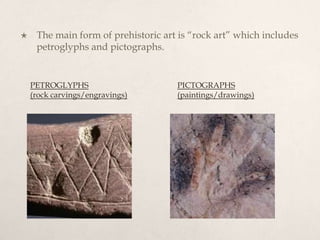
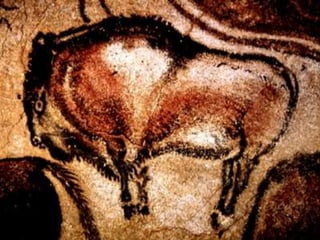
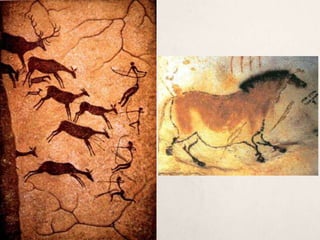
    The main form of prehistoric art is “rock art” which includes
     petroglyphs and pictographs.


    PETROGLYPHS                      PICTOGRAPHS
    (rock carvings/engravings)       (paintings/drawings)
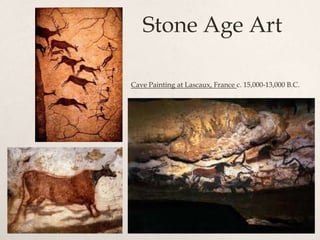
Stone Age Art

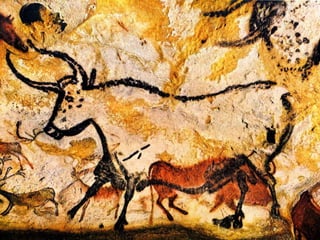
Cave Painting at Lascaux, France c. 15,000-13,000 B.C.
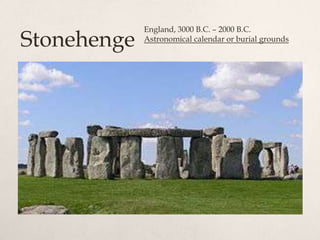
England, 3000 B.C. – 2000 B.C.
Stonehenge   Astronomical calendar or burial grounds
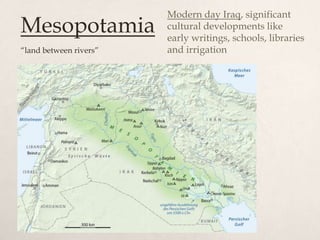
Modern day Iraq, significant
Mesopotamia             cultural developments like
                        early writings, schools, libraries
“land between rivers”   and irrigation
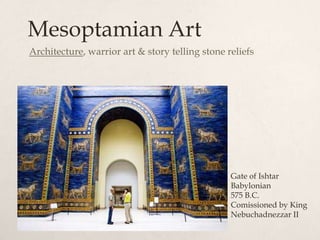
Mesoptamian Art
Architecture, warrior art & story telling stone reliefs


                                                 Gate of Ishtar
                                                 Babylonian
                                                 575 B.C.
                                                 Comissioned by King
                                                 Nebuchadnezzar II
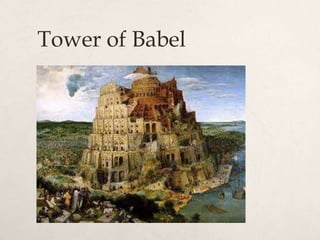
Tower of Babel
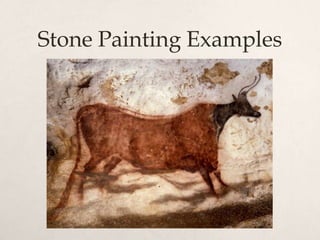
Stone Painting Examples
Stoneage & Mesoptamian Art

Stoneage & Mesoptamian Art

  • 2.
    B.C. – Before Christ  A.D. – Anno Domini (The Year of Our Lord) There is no year “0” the year 1 A.D. follows the year 1 B.C. The first art objects were not created out of decoration but as spiritual symbols.
  • 3.
    The Stone Age The Stone Age is divided into three periods Paleolithic • Mesolithic • Neolithic Paleo: Ancient • Meso: Middle • Neo: New The Paleolithic accounts for 98% of the Stone Age (also called “prehistoric art”) Materials included: stone, bone, antlers, mammoth ivory and pigments & charcoal possibly from face/body painting
  • 4.
    The main form of prehistoric art is “rock art” which includes petroglyphs and pictographs. PETROGLYPHS PICTOGRAPHS (rock carvings/engravings) (paintings/drawings)
  • 5.
    Stone Age Art CavePainting at Lascaux, France c. 15,000-13,000 B.C.
  • 6.
    England, 3000 B.C.– 2000 B.C. Stonehenge Astronomical calendar or burial grounds
  • 7.
    Modern day Iraq,significant Mesopotamia cultural developments like early writings, schools, libraries “land between rivers” and irrigation
  • 8.
    Mesoptamian Art Architecture, warriorart & story telling stone reliefs Gate of Ishtar Babylonian 575 B.C. Comissioned by King Nebuchadnezzar II
  • 9.
  • 10.

Editor's Notes

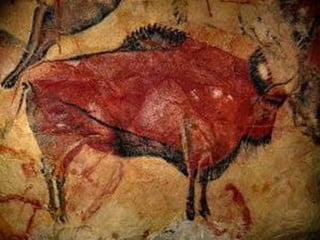
  • #5 Blombos Cave Rock Art, coast of South Africa, limestone, one of the oldest known pieces of artworkCosquer Cave Paintings, coast of France, underwater tunnel 40 metres below sea level, ice age glaciation store water and level was over 100 metres lower, discovered 1985
  • #6 Discovered in 1940 by three teenagers and their dog. Open to public until carbon dioxide damage, black mold outbreak due to a.c. system. Cattle, bison & horses depicted as well as geometric people and signs & star map.
  • #8 Tigris & EuphratesBelieved to be the location of the Garden of Eden
  • #9 no names the work was about the subject matter and not the artist. Gate into the city of Babylon, considered one of the seven wonders of the world until replaced by the lighthouse of Alexandria, urban planners, early pyramids
  • #10 270 foot tall, eight stepped towers, golden brass gates, 120 lions, bright glazed tile, spiral stairway…chamber of their God.
  • #12 Two toned
  • #13 Stylized line, thickness differation, subtle color additions
  • #14 Stylized line, size shows perspective, transparency
  • #15 Addition of white