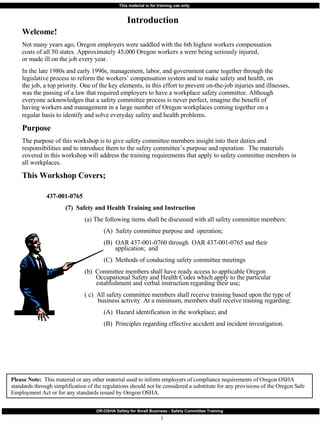
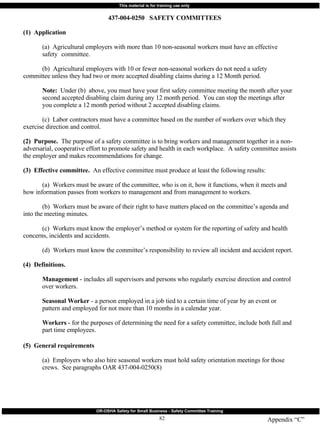
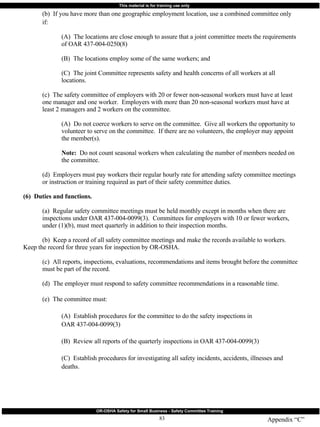
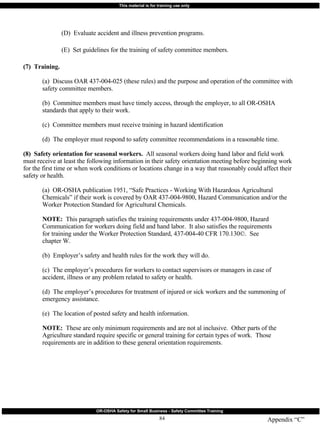
Welcome! Not many years ago, Oregon employers were saddled with the 6th highest workers compensation costs of all 50 states. Approximately 45,000 Oregon workers a were being seriously injured, or made ill on the job every year. In the late 1980s and early 1990s, management, labor, and government came together through the legislative process to reform the workers’ compensation system and to make safety and health, on the job, a top priority. One of the key elements, in this effort to prevent on-the-job injuries and illnesses, was the passing of a law that required employers to have a workplace safety committee. Although everyone acknowledges that a safety committee process is never perfect, imagine the benefit of having workers and management in a large number of Oregon workplaces coming together on a regular basis to identify and solve everyday safety and health problems.   Purpose The purpose of this workshop is to give safety committee members insight into their duties and responsibilities and to introduce them to the safety committee’s purpose and operation.  The materials covered in this workshop will address the training requirements that apply to safety committee members in all workplaces. This Workshop Covers; Please Note:  This material or any other material used to inform employers of compliance requirements of Oregon OSHA standards through simplification of the regulations should not be considered a substitute for any provisions of the Oregon Safe Employment Act or for any standards issued by Oregon OSHA.  Introduction  437-001-0765 (7)  Safety and Health Training and Instruction (a)   The following items shall be discussed with all safety committee members: (A)  Safety committee purpose and  operation; (B)  OAR 437-001-0760 through  OAR 437-001-0765 and their    application;  and (C)  Methods of conducting safety committee meetings (b)  Committee members shall have ready access to applicable Oregon    Occupational Safety and Health Codes which apply to the particular    establishment and verbal instruction regarding their use; ( c)  All safety committee members shall receive training based upon the type of      business activity  At a minimum, members shall receive training regarding; (A)  Hazard identification in the workplace; and (B)  Principles regarding effective accident and incident investigation.
 
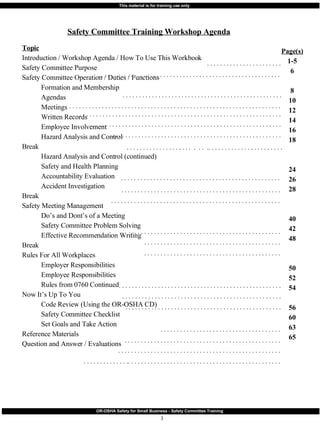
Safety Committee Training Workshop Agenda Topic Introduction / Workshop Agenda / How To Use This Workbook Safety Committee Purpose Safety Committee Operation / Duties / Functions Formation and Membership Agendas Meetings Written Records Employee Involvement Hazard Analysis and Control Break  Hazard Analysis and Control (continued) Safety and Health Planning Accountability Evaluation Accident Investigation Break Safety Meeting Management Do’s and Dont’s of a Meeting Safety Committee Problem Solving Effective Recommendation Writing Break Rules For All Workplaces Employer Responsibilities Employee Responsibilities Rules from 0760 Continued Now It’s Up To You Code Review (Using the OR-OSHA CD) Safety Committee Checklist Set Goals and Take Action Reference Materials Question and Answer / Evaluations Page(s) 1-5 6 8 10 12 14 16 18 24 26 28 40 42 48 50 52 54 56 60 63 65 . . . . . . . . . . . . . . . . . . . . . . . . . . . . . . . . . . . . . . . . . . . . . . . . . . . . . . . . . . . . . . . . . . . . . . . . . . . . . . . . . . . . . . . . . . . . . . . . . . . . . . . . . . . . . . . . . . . . . . . . . . . . . . . . . . . . . . . . . . . . . . . . . . . . . . . . . . . . . . . . . . . . . . . . . . . . . . . . . . . . . . . . . . . . . . . . . . . . . . . . . . . . . . . . . . . . . . . . . . . . . . . . . . . . . . . . . . . . . . . . . . . . . . . . . . . . . . . . . . . . . . . . . . . . . . . . . . . . . . . . . . . . . . . . . . . . . . . . . . . . . . . . . . . . . . . . . . . . . . . . . . . . . . . . . . . . . . . . . . . . . . . . . . . . . . . . . . . . . . . . . . . . . . . . . . . . . . . . . . . . . . . . . . . . .  .  . .  .. . . . . . . . . . . . . . . . . . . . . . . . . . . . . . . . . . . . . . . . . . . . . . . . . . . . . . . . . . . . . . . . . . . . . . . . . . . . . . . . . . . . . . . . . . . . . . . . . . . . . . . . . . . . . . . . . . . . . . . . . . . . . . . . . . . . . . . . . . . . . . . . . . . . . . . . . . . . . . . . . . . . . . . . . . . . . . . . . . . . . . . . . . . . . . . . . . . . . . . . . . . . . . . . . . . . . . . . . . . . . . . . . . . . . . . . . . . . . . . . . . . . . . . . . . . . . . . . . . . . . . . . . . . . . . . . . . . . . . . . . . . . . . . . . . . . . . . . . . . . . . . . . . . . . . . . . . . . . . . . . . . . . . . . . . . . . . . . . . . . . . . . . . . . . . . . . . . . . . . . . . . . . . . . . . . . . . . . . . . . . . . . . . . . . . . . . . . . . . . . . . . . . . . . . . . . . . . . . . . . . . . . . . . . . . . . . . . . . . . . . . . . . . . . . . . . . . . . . . . . . . . . . . . . . . . . . . . . . . . . . . . . . . . . . . . . . . . . . . . . . . . . . . . . . . . . . . . . . . . . . . . . . . . . . . . . . . . . . . . . . . . . . . .. . . . . . . . . . . . . . . . . . . . . . . . . . . . . . . . . . . . . . . . . . . . . . . . . . . . . . . . . . . . . . . . . . . . . . . . . . . . . . . . . . . . . . . . . . . . . . . . . . .
 
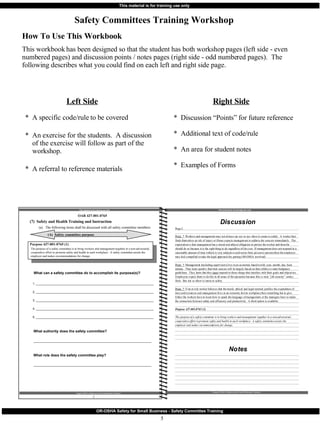
How To Use This Workbook This workbook has been designed so that the student has both workshop pages (left side - even numbered pages) and discussion points / notes pages (right side - odd numbered pages).  The following describes what you could find on each left and right side page. Safety Committees Training Workshop This material is for training use only Oregon OSHA’s Safety and the Small Business Employer OAR 437-001-0765 (7)  Safety and Health Training and Instruction (a) The following items shall be discussed with all safety committee members: (A)  Safety committee purpose What can a safety committee do to accomplish its purpose(s)? 1. ________________________________________________________________________ 2. ________________________________________________________________________ 3. ________________________________________________________________________ 4. ________________________________________________________________________ 5. ________________________________________________________________________ What authority does the safety committee? ________________________________________________________________________ What role does the safety committee play? ________________________________________________________________________ 2 Left Side *  A specific code/rule to be covered  *  An exercise for the students.  A discussion of the exercise will follow as part of the workshop. *  A referral to reference materials Right Side *  Discussion “Points” for future reference *  Additional text of code/rule *  An area for student notes *  Examples of Forms Purpose 437-001-0765 (1) The purpose of a safety committee is to bring workers and management together in a non-adversarial, cooperative effort to promote safety and health in each workplace.  A safety committee assists the employer and makes recommendations for change.
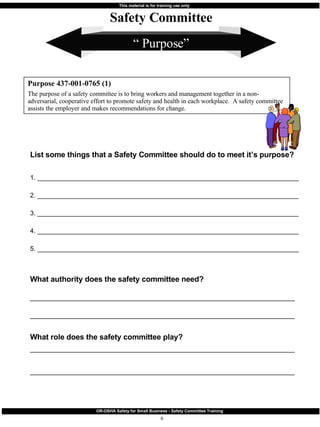
“  Purpose” List some things that a Safety Committee should do to meet it’s purpose?  1. ________________________________________________________________________ 2. ________________________________________________________________________ 3. ________________________________________________________________________ 4. ________________________________________________________________________ 5. ________________________________________________________________________ What authority does the safety committee need? _________________________________________________________________________ _________________________________________________________________________ What role does the safety committee play? _________________________________________________________________________ _________________________________________________________________________ Purpose 437-001-0765 (1) The purpose of a safety committee is to bring workers and management together in a non-adversarial, cooperative effort to promote safety and health in each workplace.  A safety committee assists the employer and makes recommendations for change. Safety Committee
Discussion Notes Point  *   Workers and management may not always see eye to eye when it comes to safety.  A worker that finds themselves at risk of injury or illness expects management to address the concern immediately.  The expectation is that management has a moral and ethical obligation to protect the worker and therefore should do so because it is the right thing to do regardless of the cost.  If management does not respond in a reasonable amount of time (which is very subjective and varies from person to person) then the employee may feel compelled to take the legal approach (by getting OR-OSHA involved) Point  *   Management (including supervisors) live in an economic based world; year, month, day, hour, minute.  They learn that their success can be largely based on their ability to meet budgetary guidelines.  They learn that they  must  respond to those things that interfere with their goals and objectives.  Employees expect them to do this in all areas of the operation because their “job security” depends on it.  But not so when it comes to safety. Point  *   If an at risk worker believes that the moral, ethical and legal rational justifies the expenditure of time and resources and management lives in an economy driven workplace then something has to give.  Either the workers have to learn how to speak the language of management or the managers have to make the connection between safety and efficiency and productivity.  A third option is available: 437-001-0765 (1) Purpose The purpose of a safety committee is to bring workers and management together in a non-adversarial, cooperative effort to promote safety and health in each workplace.  A safety committee assists the employer and makes recommendations for change.
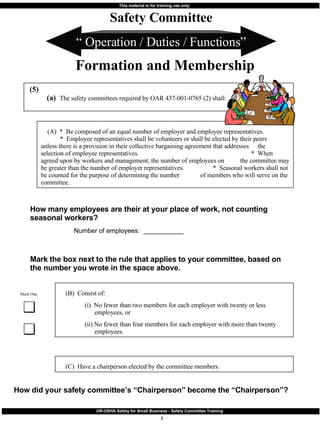
“  Operation / Duties / Functions” How many employees are their at your place of work, not counting seasonal workers?    Number of employees:  ___________ (5) (a)  The safety committees required by OAR 437-001-0765 (2) shall: Safety Committee Formation and Membership Mark the box next to the rule that applies to your committee, based on the number you wrote in the space above. (B)  Consist of:   (i)  No fewer than two members for each employer with twenty or less    employees, or   (ii) No fewer than four members for each employer with more than twenty    employees. Mark One (C)  Have a chairperson elected by the committee members. (A)  *  Be composed of an equal number of employer and employee representatives.  *  Employee representatives shall be volunteers or shall be elected by their peers    unless there is a provision in their collective bargaining agreement that addresses    the selection of employee representatives.  *  When agreed upon by workers and management, the number of employees on    the committee may be greater than the number of employer representatives.  *  Seasonal workers shall not be counted for the purpose of determining the number    of members who will serve on the committee. How did your safety committee’s “Chairperson” become the “Chairperson”?
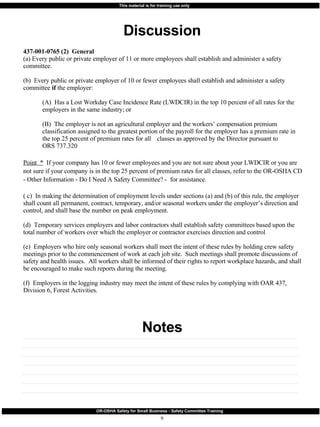
Discussion Notes 437-001-0765 (2)  General (a) Every public or private employer of 11 or more employees shall establish and administer a safety committee. (b)  Every public or private employer of 10 or fewer employees shall establish and administer a safety committee  if  the employer: (A)  Has a Lost Workday Case Incidence Rate (LWDCIR) in the top 10 percent of all rates for the  employers in the same industry; or (B)  The employer is not an agricultural employer and the workers’ compensation premium  classification assigned to the greatest portion of the payroll for the employer has a premium rate in  the top 25 percent of premium rates for all  classes as approved by the Director pursuant to  ORS 737.320 Point  *   If your company has 10 or fewer employees and you are not sure about your LWDCIR or you are not sure if your company is in the top 25 percent of premium rates for all classes, refer to the OR-OSHA CD - Other Information - Do I Need A Safety Committee? -  for assistance.  ( c)  In making the determination of employment levels under sections (a) and (b) of this rule, the employer shall count all permanent, contract, temporary, and/or seasonal workers under the employer’s direction and control, and shall base the number on peak employment. (d)  Temporary services employers and labor contractors shall establish safety committees based upon the total number of workers over which the employer or contractor exercises direction and control (e)  Employers who hire only seasonal workers shall meet the intent of these rules by holding crew safety meetings prior to the commencement of work at each job site.  Such meetings shall promote discussions of safety and health issues.  All workers shall be informed of their rights to report workplace hazards, and shall be encouraged to make such reports during the meeting. (f)  Employers in the logging industry may meet the intent of these rules by complying with OAR 437, Division 6, Forest Activities.
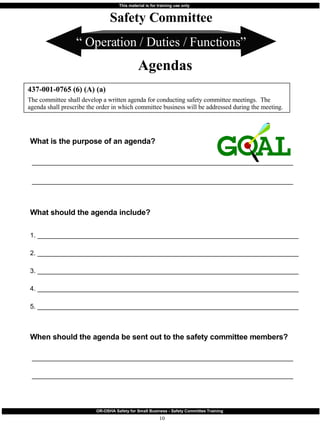
“  Operation / Duties / Functions” What is the purpose of an agenda? ________________________________________________________________________ ________________________________________________________________________   What should the agenda include?  1. ________________________________________________________________________ 2. ________________________________________________________________________ 3. ________________________________________________________________________ 4. ________________________________________________________________________ 5. ________________________________________________________________________ When should the agenda be sent out to the safety committee members? ________________________________________________________________________ ________________________________________________________________________ 437-001-0765 (6) (A) (a) The committee shall develop a written agenda for conducting safety committee meetings.  The agenda shall prescribe the order in which committee business will be addressed during the meeting. Safety Committee Agendas
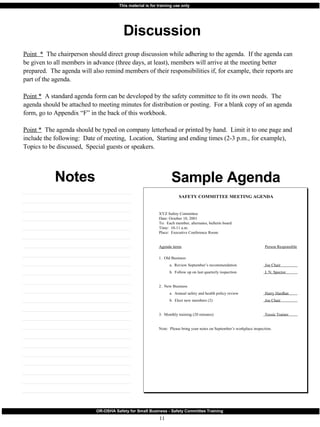
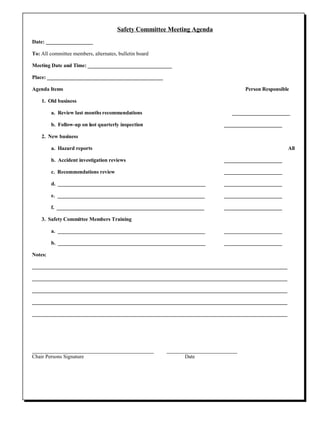
Discussion Sample Agenda Notes Point  *   The chairperson should direct group discussion while adhering to the agenda.  If the agenda can be given to all members in advance (three days, at least), members will arrive at the meeting better prepared.  The agenda will also remind members of their responsibilities if, for example, their reports are part of the agenda. Point *   A standard agenda form can be developed by the safety committee to fit its own needs.  The agenda should be attached to meeting minutes for distribution or posting.  For a blank copy of an agenda form, go to Appendix “F” in the back of this workbook. Point *   The agenda should be typed on company letterhead or printed by hand.  Limit it to one page and include the following:  Date of meeting,  Location,  Starting and ending times (2-3 p.m., for example),  Topics to be discussed,  Special guests or speakers.
“  Operation / Duties / Functions” What happens when meetings that are scheduled get canceled or members are not allowed to attend?  1. ________________________________________________________________________ 2. ________________________________________________________________________ 3. ________________________________________________________________________ 4. ________________________________________________________________________ 5. ________________________________________________________________________ How can these problems be addressed? ________________________________________________________________________ ________________________________________________________________________ Can a written “Safety Committee Policy” help and if so how? ________________________________________________________________________ ________________________________________________________________________ 437-001-0765 (6) (a) (B) The safety committee shall hold regular meetings at least once a month except months when quarterly workplace safety inspections are made.  This does not exclude other months from safety committee meetings if more frequent safety inspections are conducted. Safety Committee Meetings
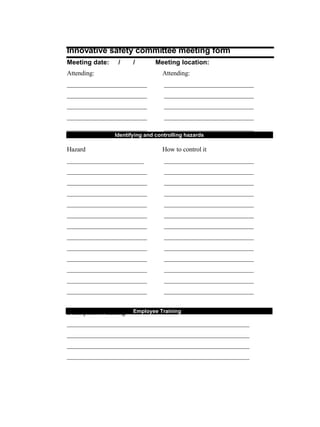
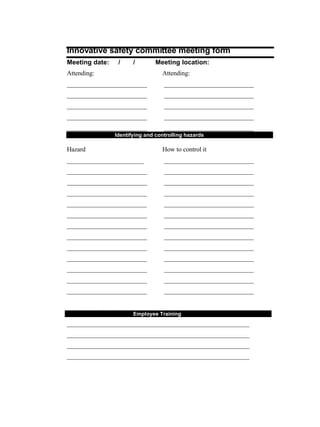
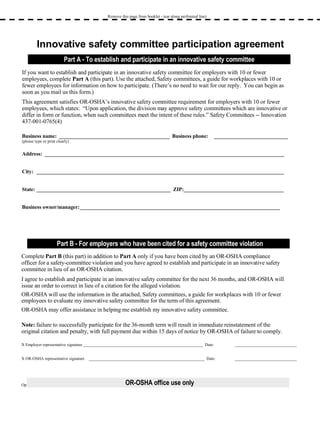
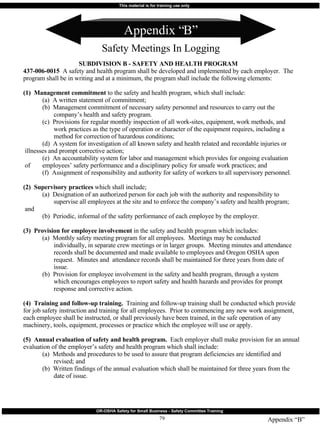
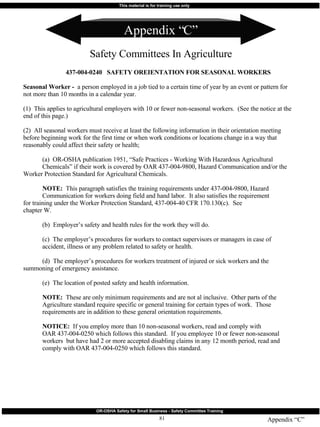
Discussion Notes 437-001-0765 (6) (a) (C) Quarterly safety committee meetings may be substituted for monthly meetings where the committee’s sole area of responsibility involves low hazard work environments such as offices. 437-001-0765 (6) (a) (D) Small farms of five or fewer full time employees may substitute quarterly meetings for monthly meetings during the farms’ off season.  The off season shall mean that period of time when only routine farm upkeep is being done. 437-001-0765 (4) Innovation.  Upon application, the division may approve safety committees which are innovative or differ in form or function, when such committees meet the intent of these rules. Point  *   To find out about the “Innovative safety committee program” for small businesses, go to Appendix “A”, page 67. Point  *   Does your company do logging?  Find out about safety meetings in logging by going to  Appendix “B”, page 79. Point *   If your company is involved in agriculture, you may want to go to the back of the book to Appendix “C”, page 81.
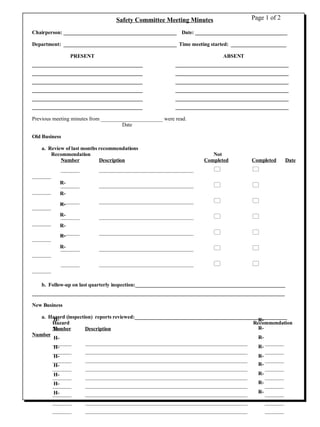
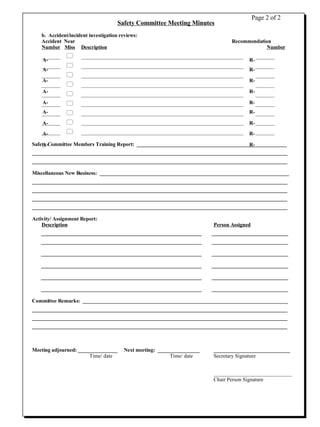
“  Operation / Duties / Functions” How would you define “reasonable time limit? ________________________________________________________________________ ________________________________________________________________________ ________________________________________________________________________ 437-001-0765 (6) (b) (A) Minutes shall be made of each meeting which the employer shall review and maintain for three years for inspection by the Division.  Copies of minutes shall be posted or made available for all employees and shall be sent to each committee member. Safety Committee Written Records 437-001-0765 (6) (b) (B) All reports, evaluations, and recommendations of the safety committee shall be made a part of the minutes of the safety committee meeting. 437-001-0765 (6) (b) (C) A reasonable time limit shall be established for the employer to respond in writing to all safety committee recommendations. What kinds of recommendations might a safety committee make? ________________________________________________________________________ ________________________________________________________________________ ________________________________________________________________________
Discussion Notes Point  *   Reasonable time limits are to be set by the safety committee.  There may be different time limits depending on the hazard or issue Example:  A hazard that could cause a permanent  disability may require a time limit of very short duration while on the other hand a hazard that needs some study or research to identify and approve the needed correction may take longer.
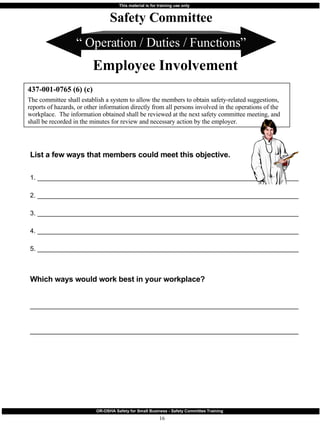
“  Operation / Duties / Functions” List a few ways that members could meet this objective.  1. ________________________________________________________________________ 2. ________________________________________________________________________ 3. ________________________________________________________________________ 4. ________________________________________________________________________ 5. ________________________________________________________________________ Which ways would work best in your workplace? __________________________________________________________________________ __________________________________________________________________________ 437-001-0765 (6) (c) The committee shall establish a system to allow the members to obtain safety-related suggestions, reports of hazards, or other information directly from all persons involved in the operations of the workplace.  The information obtained shall be reviewed at the next safety committee meeting, and shall be recorded in the minutes for review and necessary action by the employer. Safety Committee Employee Involvement
Discussion Notes Point  *   Each employee, regardless of his or her position within the company, is expected to cooperate in all aspects of the company’s safety and health program, including the following: 1.  Accidents must be reported immediately to the supervisor 2.  Required personal protective equipment must be worn by all employees 3.  Hazardous conditions or other safety and health concerns must be reported to your supervisor    immediately 4.  Employees participate in safety committee activities and support safety committee membership Point  *   If employees are reluctant to tell the safety committee about their concerns, the committee will need to discuss the possible reasons for this lack of participation.  Many times the reason will stem from past negative experiences.  If an employee has informed the committee members or management about a hazard and a recommendation or suggestion for a possible improvement, and there was no response, then the employee may have become discouraged.  The more times this happens, and the more people involved in this experience, the bigger the problem. Point  *   In the example given above, the root of the problem lies with the lack of “trust”.  The perception of employees may be that management doesn’t care about their employees, or that they are only concerned with profits.  If this is the case, the solution will be complex and reversal of these perceptions may take a long time. Point  *   A place to start is with the committee itself.  Have a discussion about the safety committees purpose.  Understand it and have a plan in mind that will address this problem.  Talk to employees about your observations.  Ask for their input.  When they do give suggestions, recognize them for their help and keep them in the information loop.
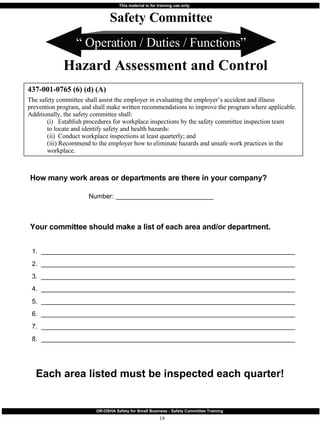
“  Operation / Duties / Functions” How many work areas or departments are there in your company?   Number: ___________________________ Your committee should make a list of each area and/or department. 1.  ______________________________________________________________________ 2.  ______________________________________________________________________ 3.  ______________________________________________________________________ 4.  ______________________________________________________________________ 5.  ______________________________________________________________________ 6.  ______________________________________________________________________ 7.  ______________________________________________________________________ 8.  ______________________________________________________________________ 437-001-0765 (6) (d) (A) The safety committee shall assist the employer in evaluating the employer’s accident and illness prevention program, and shall make written recommendations to improve the program where applicable.  Additionally, the safety committee shall: (i)  Establish procedures for workplace inspections by the safety committee inspection team    to locate and identify safety and health hazards: (ii)  Conduct workplace inspections at least quarterly; and (iii) Recommend to the employer how to eliminate hazards and unsafe work practices in the    workplace.  Safety Committee Hazard Assessment and Control Each area listed must be inspected each quarter!
Discussion Notes Point  *   The entire work-site must be inspected each quarter.  The inspection may be a quarterly walk-through by the entire safety committee, divided up and covered by different members of the team, or delegated to others within the organization and accomplished throughout the quarter. 437-001-0765 (6) (d) (B) The inspection team shall include employer and employee representatives and shall document in writing the location and identity of the hazards and make recommendations to the employer regarding correction of the hazard. 437-001-0765 (6) (d) (C) Quarterly inspections of satellite locations shall be conducted by the committee team or by a person designated at the location. 437-001-0765 (6) (d) (D) Mobile work sites or locations and activities which do not lend themselves to a quarterly schedule shall be inspected by a designated person as often as Oregon occupational safety and health rules require and/or the committee determines is necessary. 437-001-0765 (6) (d) (E) The person designated to carry out inspection activities at the locations identified in sections (C) and (D) of this rule shall be selected by the employer and shall receive training in hazard identification in the workplace.
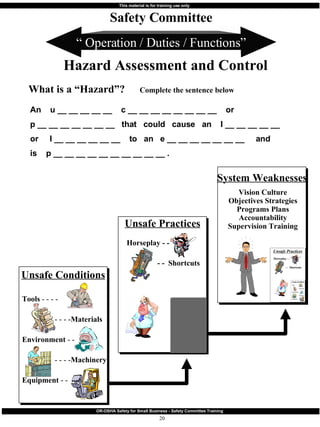
“  Operation / Duties / Functions” An  u __ __ __ __ __  c __ __ __ __ __ __ __ __  or p __ __ __ __ __ __ __  that  could  cause  an  I __ __ __ __ __ or  I __ __ __ __ __ __  to  an  e __ __ __ __ __ __ __  and is  p __ __ __ __ __ __ __ __ __ __ . Safety Committee Hazard Assessment and Control What is a “Hazard”?   Complete the sentence below System Weaknesses Vision Culture Objectives Strategies Programs Plans Accountability Supervision Training Unsafe Conditions Tools  - - - - - - - - Materials Environment  - - - - - - Machinery Equipment  - -  Unsafe Practices Horseplay - - - -  Shortcuts
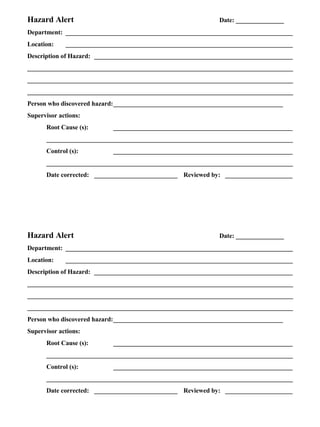
Discussion Point  *   Hazards are all around us.  It would be impossible to eliminate all hazards.  Hazards do not become a concern unless employee enters the danger zone.  The danger zone is an area around a hazard in which an employee becomes exposed to the hazard and is at risk of an injury. Example:  There is a three foot wide hole in the floor and there is a 10 foot drop to the next level.  The guardrails are being installed.  If there are no employees near the hole then there is no risk of falling through it and therefore there are no employees in the danger zone.  When the employees approach the hole to install the guardrails there is a point at which they become at risk.  When they cross this point they have entered the danger zone.  The closer to the hole, the higher the risk. Point  *   Incidents are close calls or near misses.  The only thing that stands between a near miss and an accident is luck.  And luck can’t be counted on.  Incidents should be investigated right along with accidents.  This will also help the committee identify trends. Point  *   A hazard  is an unsafe condition or practice that could cause an injury or illness to an employee and is preventable.  Point  *   Conditions are those things in the physical environment that could cause injury or illness.  They include faulty equipment, dangerous materials, improperly maintained tools, poorly designed machinery, and environments that could cause physical harm to name a few. Point  *   Practices are work habits, activities, and/or processes or procedures that in and of themselves put an employee at risk of injury or illness.  Left unchecked, these practices can turn an otherwise safe workplace into one in which accidents occur. Point  *   System weaknesses are also called root causes.  Employers and/or employees that do not take safety seriously contribute to these weaknesses.  Unsafe conditions or practices, controlled by the workers and usually labeled surface causes, only account for a small percentage of the overall safety concern.  Unsafe conditions or practices that are the result of weaknesses in the system are often times wide spread and carry with them a negative impact on the workplace. Point  *   Conditions account for 3% of all workplace accidents.  Behaviors account for 95% and uncontrollable acts account for 2% of all workplace accidents.  What do these statistics tell us?  Most accidents are caused by unsafe behaviors.  Management has control to some degree over 98% of the accidents that occur in the workplace.  It is a myth to say that lack of “common sense” is a cause of accidents.  There are too many variables for this to be true.  Culture, age, experience, geographic region, education, and motivation are just a few of these variables.  There is no “common sense” when it comes to safety.  Just clearly stated expectations and follow up with appropriate consequences.  This will lead to safe behavior.
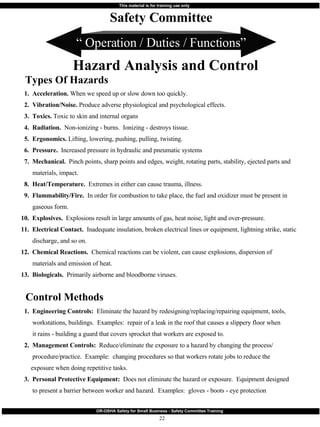
“  Operation / Duties / Functions” 1.  Acceleration.  When we speed up or slow down too quickly. 2.  Vibration/Noise.  Produce adverse physiological and psychological effects. 3.  Toxics.  Toxic to skin and internal organs 4.  Radiation.  Non-ionizing - burns.  Ionizing - destroys tissue. 5.  Ergonomics.  Lifting, lowering, pushing, pulling, twisting. 6.  Pressure.   Increased pressure in hydraulic and pneumatic systems 7.  Mechanical.   Pinch points, sharp points and edges, weight, rotating parts, stability, ejected parts and  materials, impact. 8.  Heat/Temperature.  Extremes in either can cause trauma, illness. 9.  Flammability/Fire.   In order for combustion to take place, the fuel and oxidizer must be present in gaseous form. 10.  Explosives.   Explosions result in large amounts of gas, heat noise, light and over-pressure. 11.  Electrical Contact.   Inadequate insulation, broken electrical lines or equipment, lightning strike, static discharge, and so on. 12.  Chemical Reactions.   Chemical reactions can be violent, can cause explosions, dispersion of materials and emission of heat. 13.  Biologicals.  Primarily airborne and bloodborne viruses. Safety Committee Hazard Analysis and Control Types Of Hazards  1.  Engineering Controls:  Eliminate the hazard by redesigning/replacing/repairing equipment, tools, workstations, buildings.  Examples:  repair of a leak in the roof that causes a slippery floor when it rains - building a guard that covers sprocket that workers are exposed to. 2.  Management Controls:   Reduce/eliminate the exposure to a hazard by changing the process/ procedure/practice.  Example:  changing procedures so that workers rotate jobs to reduce the exposure when doing repetitive tasks. 3.  Personal Protective Equipment:   Does not eliminate the hazard or exposure.  Equipment designed  to present a barrier between worker and hazard.  Examples:  gloves - boots - eye protection Control Methods
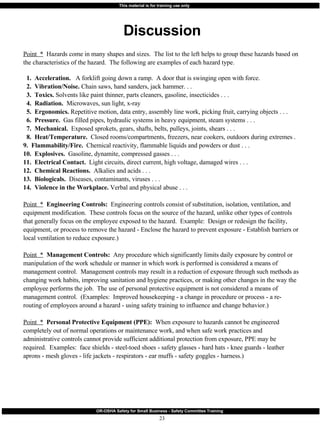
Discussion Point  *   Hazards come in many shapes and sizes.  The list to the left helps to group these hazards based on the characteristics of the hazard.  The following are examples of each hazard type. 1.  Acceleration.  A forklift going down a ramp.  A door that is swinging open with force. 2.  Vibration/Noise.  Chain saws, hand sanders, jack hammer. . . 3.  Toxics.  Solvents like paint thinner, parts cleaners, gasoline, insecticides . . . 4.  Radiation.  Microwaves, sun light, x-ray 5.  Ergonomics.  Repetitive motion, data entry, assembly line work, picking fruit, carrying objects . . . 6.  Pressure.   Gas filled pipes, hydraulic systems in heavy equipment, steam systems . . . 7.  Mechanical.   Exposed sprokets, gears, shafts, belts, pulleys, joints, shears . . . 8.  Heat/Temperature.  Closed rooms/compartments, freezers, near cookers, outdoors during extremes .  9.  Flammability/Fire.   Chemical reactivity, flammable liquids and powders or dust . . . 10.  Explosives.   Gasoline, dynamite, compressed gasses . . . 11.  Electrical Contact.   Light circuits, direct current, high voltage, damaged wires . . . 12.  Chemical Reactions.   Alkalies and acids . . .  13.  Biologicals.  Diseases, contaminants, viruses . . . 14.  Violence in the Workplace.  Verbal and physical abuse . . .  Point  *   Engineering Controls:   Engineering controls consist of substitution, isolation, ventilation, and equipment modification.  These controls focus on the source of the hazard, unlike other types of controls that generally focus on the employee exposed to the hazard.  Example:  Design or redesign the facility, equipment, or process to remove the hazard - Enclose the hazard to prevent exposure - Establish barriers or local ventilation to reduce exposure.) Point  *   Management Controls:   Any procedure which significantly limits daily exposure by control or manipulation of the work schedule or manner in which work is performed is considered a means of management control.  Management controls may result in a reduction of exposure through such methods as changing work habits, improving sanitation and hygiene practices, or making other changes in the way the employee performs the job.  The use of personal protective equipment is not considered a means of management control.  (Examples:  Improved housekeeping - a change in procedure or process - a re-routing of employees around a hazard - using safety training to influence and change behavior.) Point  *   Personal Protective Equipment (PPE):   When exposure to hazards cannot be engineered completely out of normal operations or maintenance work, and when safe work practices and administrative controls cannot provide sufficient additional protection from exposure, PPE may be required.  Examples:  face shields - steel-toed shoes - safety glasses - hard hats - knee guards - leather aprons - mesh gloves - life jackets - respirators - ear muffs - safety goggles - harness.)
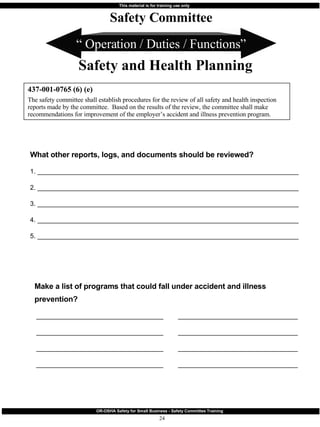
“  Operation / Duties / Functions” What other reports, logs, and documents should be reviewed?  1. ________________________________________________________________________ 2. ________________________________________________________________________ 3. ________________________________________________________________________ 4. ________________________________________________________________________ 5. ________________________________________________________________________ 437-001-0765 (6) (e) The safety committee shall establish procedures for the review of all safety and health inspection reports made by the committee.  Based on the results of the review, the committee shall make recommendations for improvement of the employer’s accident and illness prevention program. Safety Committee Safety and Health Planning Make a list of programs that could fall under accident and illness prevention? ___________________________________  _________________________________ ___________________________________  _________________________________ ___________________________________  _________________________________ ___________________________________  _________________________________
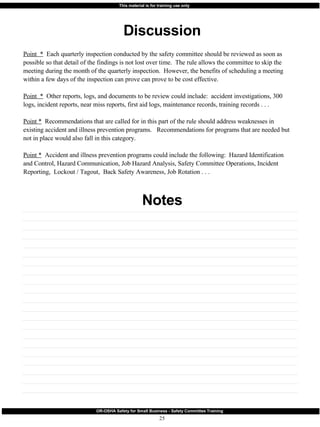
Discussion Notes Point  *   Each quarterly inspection conducted by the safety committee should be reviewed as soon as possible so that detail of the findings is not lost over time.  The rule allows the committee to skip the meeting during the month of the quarterly inspection.  However, the benefits of scheduling a meeting within a few days of the inspection can prove can prove to be cost effective. Point  *   Other reports, logs, and documents to be review could include:  accident investigations, 300 logs, incident reports, near miss reports, first aid logs, maintenance records, training records . . . Point *   Recommendations that are called for in this part of the rule should address weaknesses in existing accident and illness prevention programs.  Recommendations for programs that are needed but not in place would also fall in this category. Point *   Accident and illness prevention programs could include the following:  Hazard Identification and Control, Hazard Communication, Job Hazard Analysis, Safety Committee Operations, Incident Reporting,  Lockout / Tagout,  Back Safety Awareness, Job Rotation . . .
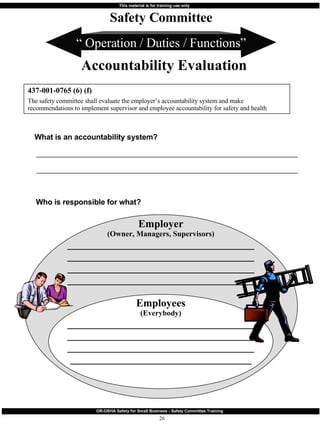
“  Operation / Duties / Functions” Safety Committee Accountability Evaluation 437-001-0765 (6) (f) The safety committee shall evaluate the employer’s accountability system and make recommendations to implement supervisor and employee accountability for safety and health What is an accountability system? ________________________________________________________________________ ________________________________________________________________________ Who is responsible for what? Employer (Owner, Managers, Supervisors) ___________________________________ ___________________________________ ___________________________________ ___________________________________ Employees (Everybody) ___________________________________ ___________________________________ ___________________________________ __________________________________
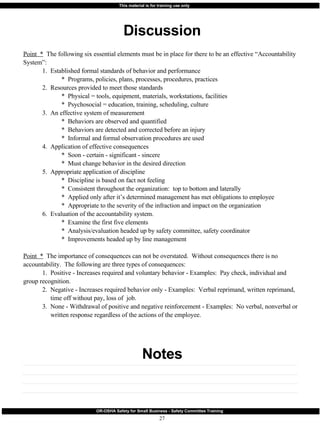
Discussion Notes Point  *   The following six essential elements must be in place for there to be an effective “Accountability System”: 1.  Established formal standards of behavior and performance *  Programs, policies, plans, processes, procedures, practices 2.  Resources provided to meet those standards *  Physical = tools, equipment, materials, workstations, facilities *  Psychosocial = education, training, scheduling, culture 3.  An effective system of measurement *  Behaviors are observed and quantified *  Behaviors are detected and corrected before an injury *  Informal and formal observation procedures are used 4.  Application of effective consequences *  Soon - certain - significant - sincere *  Must change behavior in the desired direction 5.  Appropriate application of discipline *  Discipline is based on fact not feeling *  Consistent throughout the organization:  top to bottom and laterally *  Applied only after it’s determined management has met obligations to employee *  Appropriate to the severity of the infraction and impact on the organization 6.  Evaluation of the accountability system. *  Examine the first five elements *  Analysis/evaluation headed up by safety committee, safety coordinator *  Improvements headed up by line management Point  *   The importance of consequences can not be overstated.  Without consequences there is no accountability.  The following are three types of consequences: 1.  Positive - Increases required and voluntary behavior - Examples:  Pay check, individual and    group recognition. 2.  Negative - Increases required behavior only - Examples:  Verbal reprimand, written reprimand,    time off without pay, loss of  job. 3.  None - Withdrawal of positive and negative reinforcement - Examples:  No verbal, nonverbal or    written response regardless of the actions of the employee.
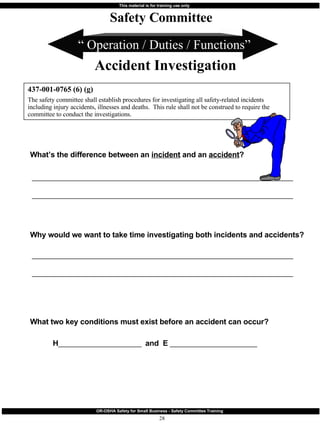
“  Operation / Duties / Functions” What’s the difference between an  incident  and an  accident ?  ________________________________________________________________________ ________________________________________________________________________ Why would we want to take time investigating both incidents and accidents? ________________________________________________________________________ ________________________________________________________________________ What two key conditions must exist before an accident can occur? H _______________________  and  E  ________________________ 437-001-0765 (6) (g) The safety committee shall establish procedures for investigating all safety-related incidents including injury accidents, illnesses and deaths.  This rule shall not be construed to require the committee to conduct the investigations. Safety Committee Accident Investigation
Discussion Notes Point  *   The main purpose for an accident investigation is to prevent a repeat.  It is not to place blame. Point  *   If someone deliberately sets out to produce loss or injury, that is called a crime, not an accident.  Yet many accident investigations get confused with criminal investigations.  Whenever the investigative procedures are used to place blame, an adversarial relationship is inevitable.  The investigator wants to find out what actually happened while those involved are trying to be sure they are not going to be punished for their actions.  The result is an inadequate investigation.  (Kingsley Hendrick, Ludwig Benner, Investigating Accidents with STEP, p 42. Marcel Dekker, Inc. 1987.) Point  *   Tracking and investigating incidents  gives the employer another opportunity to intervene and take corrective action before and accident occurs.

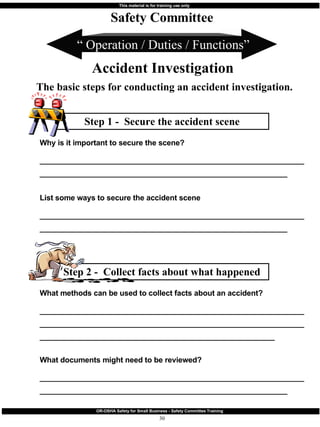
Step 2 -  Collect facts about what happened Step 1 -  Secure the accident scene “  Operation / Duties / Functions” Safety Committee Accident Investigation The basic steps for conducting an accident investigation. List some ways to secure the accident scene __________________________________________________________________________________________________________________________ Why is it important to secure the scene? __________________________________________________________________________________________________________________________ What documents might need to be reviewed? __________________________________________________________________________________________________________________________ What methods can be used to collect facts about an accident? ______________________________________________________________________________________________________________________________________________________________________________________
Discussion Notes Point  *   The primary goal in step one is to insure that the accident scene remains the same as it was at the time of the accident.  Making sure that the investigators have an opportunity to document the scene, before it changes, is critical to the quality of the investigation. Point  *   The methods used to secure the scene vary from case to case.  In some cases the scene will have to be secured to prevent others from entering for their own protection.  In other cases the scene may have to be entered by medical personnel to aid an injured person.  Once the injured person is taken care of, someone should note any changes in the scene that took place, and this information should be given to the investigator. Point  *   Step two is to collect facts about what happened.  The investigator should use various tools and techniques to collect pertinent  information   about the accident  to determine the: *  Direct cause of the injury; *  Hazardous conditions and unsafe employee/management behaviors (surfaces causes) that   produced the accident; *  System weaknesses (root causes) that produced the surface causes for the accident.
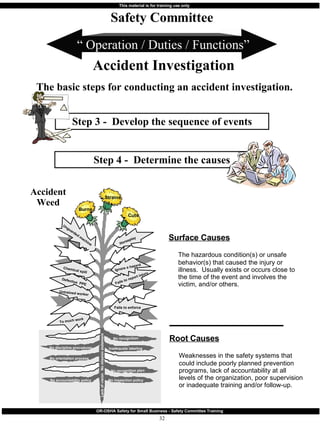
Step 4 -  Determine the causes Step 3 -  Develop the sequence of events “  Operation / Duties / Functions” Safety Committee Accident Investigation The basic steps for conducting an accident investigation. Accident Weed Surface Causes The hazardous condition(s) or unsafe  behavior(s) that caused the injury or  illness.  Usually exists or occurs close to  the time of the event and involves the  victim, and/or others.  Root Causes Weaknesses in the safety systems that  could include poorly planned prevention  programs, lack of accountability at all  levels of the organization, poor supervision or inadequate training and/or follow-up.  No recognition plan No accountability policy No inspection policy No discipline procedures No orientation process Unguarded machine Horseplay To much work Defective  PPE Fails to report injury Fails to enforce Untrained worker Ignore a hazard Inadequate labeling No recognition Cuts Burns Lack of vision Strains No mission statement Chemical spill
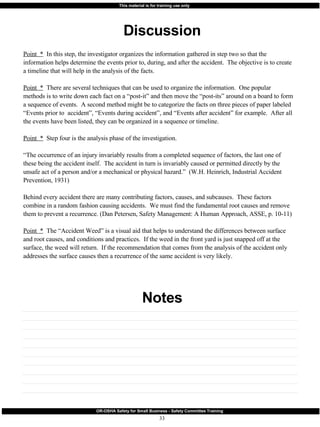
Discussion Notes Point  *   In this step, the investigator organizes the information gathered in step two so that the information helps determine the events prior to, during, and after the accident.  The objective is to create a timeline that will help in the analysis of the facts. Point  *   There are several techniques that can be used to organize the information.  One popular methods is to write down each fact on a “post-it” and then move the “post-its” around on a board to form a sequence of events.  A second method might be to categorize the facts on three pieces of paper labeled “Events prior to  accident”, “Events during accident”, and “Events after accident” for example.  After all the events have been listed, they can be organized in a sequence or timeline. Point  *   Step four is the analysis phase of the investigation.  “ The occurrence of an injury invariably results from a completed sequence of factors, the last one of these being the accident itself.  The accident in turn is invariably caused or permitted directly by the unsafe act of a person and/or a mechanical or physical hazard.”  (W.H. Heinrich, Industrial Accident Prevention, 1931) Behind every accident there are many contributing factors, causes, and subcauses.  These factors combine in a random fashion causing accidents.  We must find the fundamental root causes and remove them to prevent a recurrence. (Dan Petersen, Safety Management: A Human Approach, ASSE, p. 10-11) Point  *   The “Accident Weed” is a visual aid that helps to understand the differences between surface and root causes, and conditions and practices.  If the weed in the front yard is just snapped off at the surface, the weed will return.  If the recommendation that comes from the analysis of the accident only addresses the surface causes then a recurrence of the same accident is very likely.
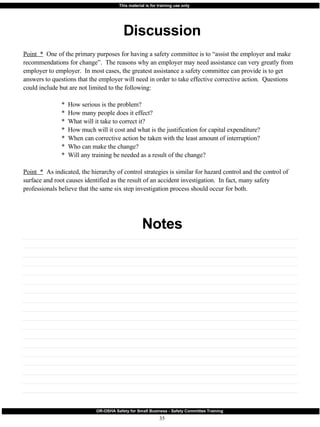
Step 5 -  Recommend corrective action “  Operation / Duties / Functions” Safety Committee Accident Investigation The basic steps for conducting an accident investigation. Recommendations that are made because of an accident will resemble those that are made in hazard control. Use one or more of the following for each “Surface Cause”  identified in the investigation. ____  1.  Engineering Controls: ____  2.  Management Controls:   ____  3.  Personal Protective Equipment: A Little Review -  Match the control with the definition Does not eliminate the hazard or exposure.  Equipment designed to present a barrier between worker and hazard.  Example:  gloves - boots - eye protection Eliminate the hazard by redesigning/replacing/repairing equipment, tools,  workstations, buildings . Example:  repair leak in roof - build guard to cover sprocket  Reduce/eliminate the exposure to a hazard by changing the process/procedure/practice.  Example:  route workers around hazard - job rotation A.  B.  C.
Discussion Notes Point  *   One of the primary purposes for having a safety committee is to “assist the employer and make recommendations for change”.  The reasons why an employer may need assistance can very greatly from employer to employer.  In most cases, the greatest assistance a safety committee can provide is to get answers to questions that the employer will need in order to take effective corrective action.  Questions could include but are not limited to the following: *  How serious is the problem? *  How many people does it effect? *  What will it take to correct it? *  How much will it cost and what is the justification for capital expenditure? *  When can corrective action be taken with the least amount of interruption? *  Who can make the change? *  Will any training be needed as a result of the change? Point  *   As indicated, the hierarchy of control strategies is similar for hazard control and the control of surface and root causes identified as the result of an accident investigation.  In fact, many safety professionals believe that the same six step investigation process should occur for both.
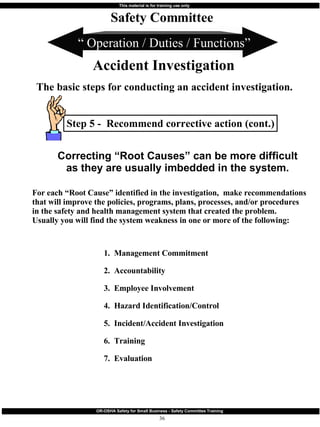
Step 5 -  Recommend corrective action (cont.) “  Operation / Duties / Functions” Safety Committee Accident Investigation The basic steps for conducting an accident investigation. 1.  Management Commitment 2.  Accountability 3.  Employee Involvement 4.  Hazard Identification/Control 5.  Incident/Accident Investigation 6.  Training 7.  Evaluation For each “Root Cause” identified in the investigation,  make recommendations that will improve the policies, programs, plans, processes, and/or procedures in the safety and health management system that created the problem.  Usually you will find the system weakness in one or more of the following: Correcting “Root Causes” can be more difficult as they are usually imbedded in the system.
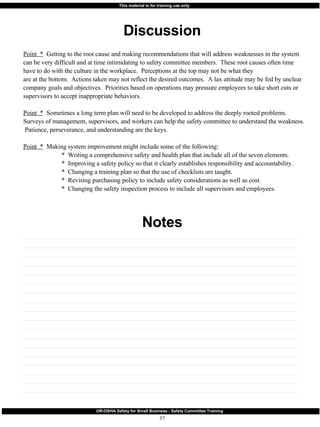
Discussion Notes Point  *   Getting to the root cause and making recommendations that will address weaknesses in the system can be very difficult and at time intimidating to safety committee members.  These root causes often time have to do with the culture in the workplace.  Perceptions at the top may not be what they  are at the bottom.  Actions taken may not reflect the desired outcomes.  A lax attitude may be fed by unclear company goals and objectives.  Priorities based on operations may pressure employees to take short cuts or supervisors to accept inappropriate behaviors. Point  *   Sometimes a long term plan will need to be developed to address the deeply rooted problems.  Surveys of management, supervisors, and workers can help the safety committee to understand the weakness.  Patience, perseverance, and understanding are the keys.  Point  *   Making system improvement might include some of the following: *  Writing a comprehensive safety and health plan that include all of the seven elements. *  Improving a safety policy so that it clearly establishes responsibility and accountability. *  Changing a training plan so that the use of checklists are taught. *  Revising purchasing policy to include safety considerations as well as cost. *  Changing the safety inspection process to include all supervisors and employees.
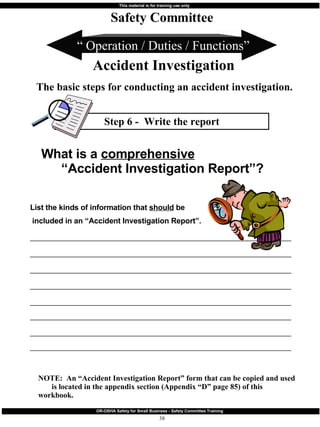
Step 6 -  Write the report “  Operation / Duties / Functions” Safety Committee Accident Investigation The basic steps for conducting an accident investigation. What is a  comprehensive   “Accident Investigation Report”? List the kinds of information that  should  be included in an “Accident Investigation Report”.  ________________________________________________________________________ ________________________________________________________________________ ________________________________________________________________________ ________________________________________________________________________ ________________________________________________________________________ ________________________________________________________________________ ________________________________________________________________________  ________________________________________________________________________ NOTE:  An “Accident Investigation Report” form that can be copied and used  is located in the appendix section (Appendix “D” page 85) of this workbook.
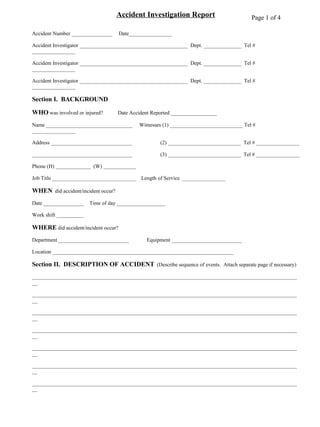
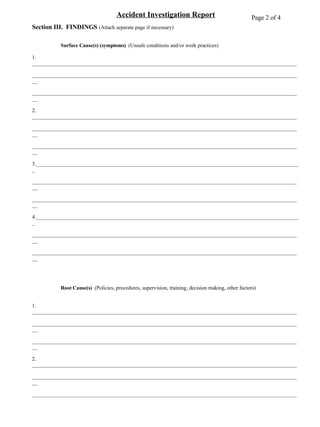
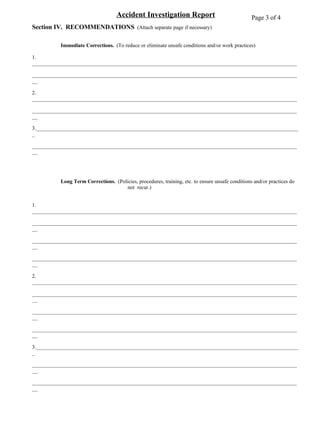
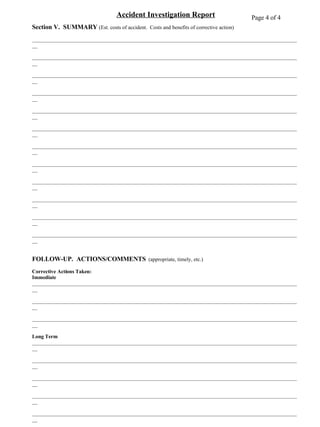
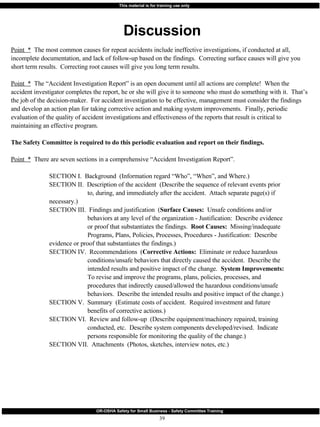
Point  *   The most common causes for repeat accidents include ineffective investigations, if conducted at all, incomplete documentation, and lack of follow-up based on the findings.  Correcting surface causes will give you short term results.  Correcting root causes will give you long term results. Point  *   The “Accident Investigation Report” is an open document until all actions are complete!  When the accident investigator completes the report, he or she will give it to someone who must do something with it.  That’s the job of the decision-maker.  For accident investigation to be effective, management must consider the findings and develop an action plan for taking corrective action and making system improvements.  Finally, periodic evaluation of the quality of accident investigations and effectiveness of the reports that result is critical to maintaining an effective program.  The Safety Committee is required to do this periodic evaluation and report on their findings. Point  *   There are seven sections in a comprehensive “Accident Investigation Report”.  SECTION I.  Background  (Information regard “Who”, “When”, and Where.) SECTION II.  Description of the accident  (Describe the sequence of relevant events prior  to, during, and immediately after the accident.  Attach separate page(s) if  necessary.) SECTION III.  Findings and justification  ( Surface Causes:   Unsafe conditions and/or  behaviors at any level of the organization - Justification:  Describe evidence  or proof that substantiates the findings.  Root Causes:   Missing/inadequate  Programs, Plans, Policies, Processes, Procedures - Justification:  Describe  evidence or proof that substantiates the findings.) SECTION IV.  Recommendations  ( Corrective Actions:   Eliminate or reduce hazardous  conditions/unsafe behaviors that directly caused the accident.  Describe the  intended results and positive impact of the change.  System Improvements:  To revise and improve the programs, plans, policies, processes, and  procedures that indirectly caused/allowed the hazardous conditions/unsafe  behaviors.  Describe the intended results and positive impact of the change.) SECTION V.  Summary  (Estimate costs of accident.  Required investment and future  benefits of corrective actions.) SECTION VI.  Review and follow-up  (Describe equipment/machinery repaired, training  conducted, etc.  Describe system components developed/revised.  Indicate  persons responsible for monitoring the quality of the change.) SECTION VII.  Attachments  (Photos, sketches, interview notes, etc.) Discussion
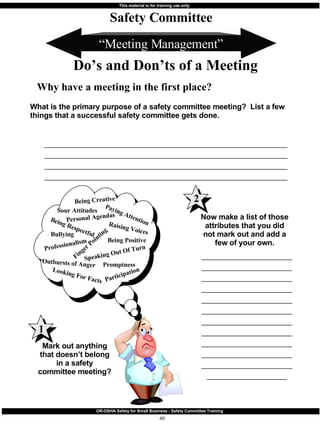
“ Meeting Management” What is the primary purpose of a safety committee meeting?  List a few things that a successful safety committee gets done. ____________________________________________________________________________________________________________________________________________________________________________________________________________________________________________________________________________ Safety Committee Do’s and Don’ts of a Meeting Why have a meeting in the first place? Mark out anything that doesn’t belong in a safety committee meeting? Now make a list of those attributes that you did not mark out and add a few of your own. _________________________________________________________________________________________________________________________________________________________________________________________________________________________________________________________________________________________________________ 1 Sour Attitudes Personal Agendas Finger Pointing Bullying Raising Voices Being Positive Being Respectful Professionalism Participation Outbursts of Anger Promptness Paying Attention Being Creative Looking For Facts Speaking Out Of Turn 2
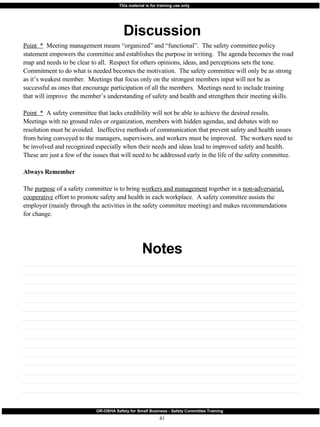
Discussion Notes Point  *   Meeting management means “organized” and “functional”.  The safety committee policy statement empowers the committee and establishes the purpose in writing.  The agenda becomes the road map and needs to be clear to all.  Respect for others opinions, ideas, and perceptions sets the tone.  Commitment to do what is needed becomes the motivation.  The safety committee will only be as strong as it’s weakest member.  Meetings that focus only on the strongest members input will not be as successful as ones that encourage participation of all the members.  Meetings need to include training that will improve  the member’s understanding of safety and health and strengthen their meeting skills. Point  *   A safety committee that lacks credibility will not be able to achieve the desired results.  Meetings with no ground rules or organization, members with hidden agendas, and debates with no resolution must be avoided.  Ineffective methods of communication that prevent safety and health issues from being conveyed to the managers, supervisors, and workers must be improved.  The workers need to be involved and recognized especially when their needs and ideas lead to improved safety and health.  These are just a few of the issues that will need to be addressed early in the life of the safety committee. Always Remember The  purpose  of a safety committee is to bring  workers and management  together in a  non-adversarial, cooperative  effort to promote safety and health in each workplace.  A safety committee assists the employer (mainly through the activities in the safety committee meeting) and makes recommendations for change.
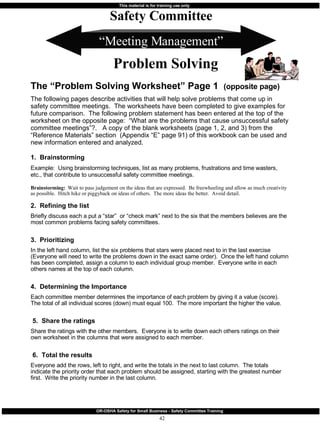
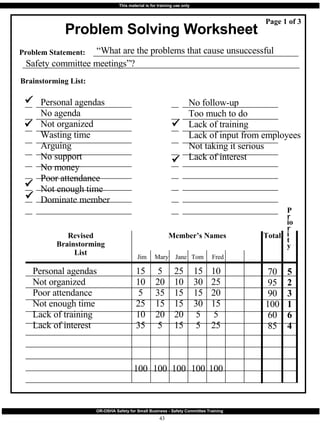
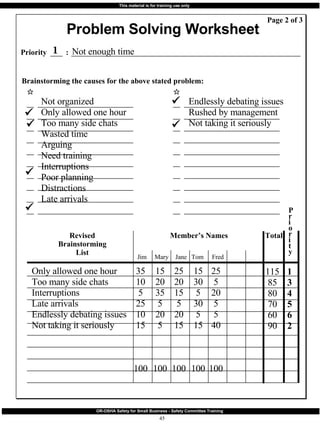
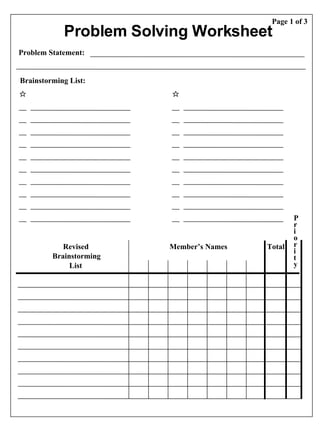
“ Meeting Management” The “Problem Solving Worksheet” Page 1  (opposite page) The following pages describe activities that will help solve problems that come up in safety committee meetings.  The worksheets have been completed to give examples for future comparison.  The following problem statement has been entered at the top of the worksheet on the opposite page:  “What are the problems that cause unsuccessful safety committee meetings”?.  A copy of the blank worksheets (page 1, 2, and 3) from the “Reference Materials” section  (Appendix “E” page 91) of this workbook can be used and new information entered and analyzed. 1.  Brainstorming Example:  Using brainstorming techniques, list as many problems, frustrations and time wasters, etc., that contribute to unsuccessful safety committee meetings.   Brainstorming:  Wait to pass judgement on the ideas that are expressed.  Be freewheeling and allow as much creativity as possible.  Hitch hike or piggyback on ideas of others.  The more ideas the better.  Avoid detail. 2.  Refining the list Briefly discuss each a put a “star”  or “check mark” next to the six that the members believes are the most common problems facing safety committees. 3.  Prioritizing  In the left hand column, list the six problems that stars were placed next to in the last exercise (Everyone will need to write the problems down in the exact same order).  Once the left hand column has been completed, assign a column to each individual group member.  Everyone write in each others names at the top of each column. 4.  Determining the Importance Each committee member determines the importance of each problem by giving it a value (score).  The total of all individual scores (down) must equal 100.  The more important the higher the value. 5.  Share the ratings Share the ratings with the other members.  Everyone is to write down each others ratings on their own worksheet in the columns that were assigned to each member. 6.  Total the results Everyone add the rows, left to right, and write the totals in the next to last column.  The totals indicate the priority order that each problem should be assigned, starting with the greatest number first.  Write the priority number in the last column. Safety Committee Problem Solving
Problem Solving Worksheet  Problem Statement: Brainstorming List: Page 1 of 3 “ What are the problems that cause unsuccessful Safety committee meetings”? Personal agendas No agenda Not organized Wasting time Arguing No support No money Poor attendance Not enough time Dominate member No follow-up Too much to do Lack of training Lack of input from employees Not taking it serious Lack of interest       Personal agendas Not organized Poor attendance Not enough time Lack of training Lack of interest Jim Mary Jane Tom Fred 15 10 5 25 10 35 100 5 20 35 15 20 5 100 25 10 15 15 20 15 100 15 30 15 30 5 5 100 10 25 20 15 5 25 100 70 95 90 100 60 85 5 2 3 1 6 4 Revised Brainstorming List Member’s Names Total Pr ior i ty
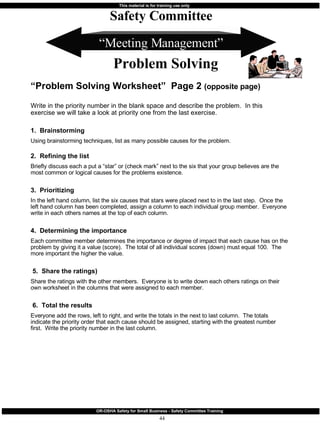
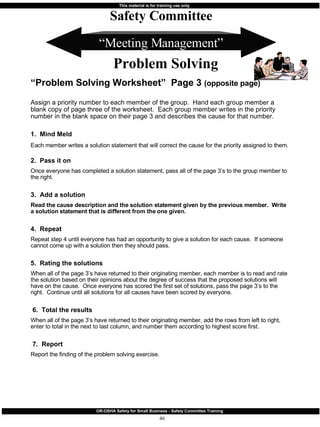
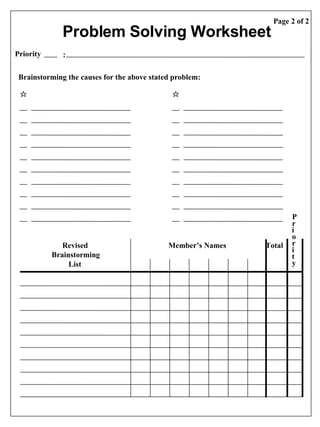
“ Meeting Management” “ Problem Solving Worksheet”  Page 2  (opposite page) Write in the priority number in the blank space and describe the problem.  In this exercise we will take a look at priority one from the last exercise. 1.  Brainstorming Using brainstorming techniques, list as many possible causes for the problem. 2.  Refining the list Briefly discuss each a put a “star” or (check mark” next to the six that your group believes are the most common or logical causes for the problems existence. 3.  Prioritizing  In the left hand column, list the six causes that stars were placed next to in the last step.  Once the left hand column has been completed, assign a column to each individual group member.  Everyone write in each others names at the top of each column. 4.  Determining the importance Each committee member determines the importance or degree of impact that each cause has on the problem by giving it a value (score).  The total of all individual scores (down) must equal 100.  The more important the higher the value. 5.  Share the ratings) Share the ratings with the other members.  Everyone is to write down each others ratings on their own worksheet in the columns that were assigned to each member. 6.  Total the results Everyone add the rows, left to right, and write the totals in the next to last column.  The totals indicate the priority order that each cause should be assigned, starting with the greatest number first.  Write the priority number in the last column. Safety Committee Problem Solving
1 Not enough time Endlessly debating issues Rushed by management Not taking it seriously      Only allowed one hour Too many side chats Interruptions Late arrivals Endlessly debating issues Not taking it seriously Jim Mary Jane Tom Fred 35 10 5 25 10 15 100 15 20 35 5 20 5 100 25 20 15 5 20 15 100 15 30 5 30 5 15 100 25 5 20 5 5 40 100 115 85 80 70 60 90 1 3 4 5 6 2  Problem Solving Worksheet  Priority  : Brainstorming the causes for the above stated problem: Revised Brainstorming List Member’s Names Total Pr i or i ty Page 2 of 3 Not organized Only allowed one hour Too many side chats Wasted time Arguing Need training Interruptions Poor planning Distractions Late arrivals
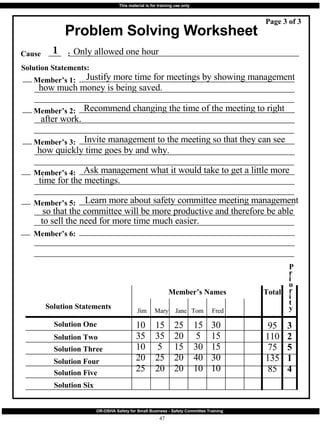
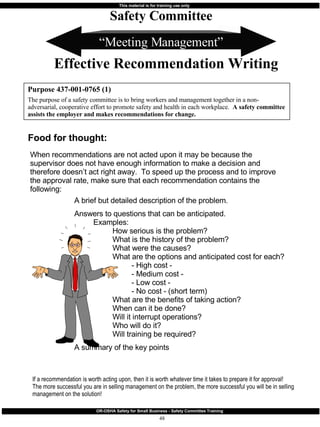
“ Meeting Management” “ Problem Solving Worksheet”  Page 3  (opposite page) Assign a priority number to each member of the group.  Hand each group member a blank copy of page three of the worksheet.  Each group member writes in the priority number in the blank space on their page 3 and describes the cause for that number.   1.  Mind Meld  Each member writes a solution statement that will correct the cause for the priority assigned to them.   2.  Pass it on Once everyone has completed a solution statement, pass all of the page 3’s to the group member to the right. 3.  Add a solution Read the cause description and the solution statement given by the previous member.  Write a solution statement that is different from the one given. 4.  Repeat Repeat step 4 until everyone has had an opportunity to give a solution for each cause.  If someone cannot come up with a solution then they should pass. 5.  Rating the solutions When all of the page 3’s have returned to their originating member, each member is to read and rate the solution based on their opinions about the degree of success that the proposed solutions will have on the cause.  Once everyone has scored the first set of solutions, pass the page 3’s to the right.  Continue until all solutions for all causes have been scored by everyone. 6.  Total the results When all of the page 3’s have returned to their originating member, add the rows from left to right, enter to total in the next to last column, and number them according to highest score first. 7.  Report Report the finding of the problem solving exercise. Safety Committee Problem Solving
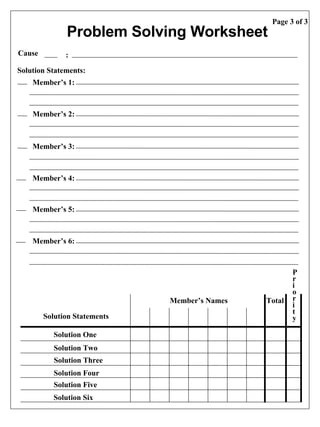
Problem Solving Worksheet  Cause  : Solution Statements: Solution Statements Page 3 of 3 Member’s 1: Member’s 2: Member’s 3: Member’s 4: Member’s 5: Member’s 6: Solution One Solution Two Solution Three Solution Four Solution Five Solution Six 1 Only allowed one hour Justify more time for meetings by showing management Recommend changing the time of the meeting to right Invite management to the meeting so that they can see Ask management what it would take to get a little more Learn more about safety committee meeting management how much money is being saved. after work. how quickly time goes by and why. time for the meetings. so that the committee will be more productive and therefore be able to sell the need for more time much easier. Jim Mary Jane Tom Fred 10 35 10 20 25 15 35 5 25 20 25 20 15 20 20 15 5 30 40 10 30 15 15 30 10 95 110 75 135 85 3 2 5 1 4 Member’s Names Total P r i o r i t y
“ Meeting Management” When recommendations are not acted upon it may be because the supervisor does not have enough information to make a decision and therefore doesn’t act right away.  To speed up the process and to improve the approval rate, make sure that each recommendation contains the following: Purpose 437-001-0765 (1) The purpose of a safety committee is to bring workers and management together in a non-adversarial, cooperative effort to promote safety and health in each workplace.  A safety committee assists the employer and makes recommendations for change. Safety Committee Effective Recommendation Writing Food for thought: A brief but detailed description of the problem. Answers to questions that can be anticipated. Examples: How serious is the problem? What is the history of the problem? What were the causes? What are the options and anticipated cost for each? - High cost - - Medium cost -  - Low cost -  - No cost - (short term) What are the benefits of taking action? When can it be done? Will it interrupt operations? Who will do it? Will training be required? A summary of the key points   If a recommendation is worth acting upon, then it is worth whatever time it takes to prepare it for approval!  The more successful you are in selling management on the problem, the more successful you will be in selling management on the solution!
Discussion Notes Point  *   There are a variety of theories regard what make one recommendation better than another.  In general there are a few common denominators that all recommendations contain.  The following list a few of the major considerations. 1.  What exactly is the problem (surface and root causes)? *  Hazardous condition, unsafe practice. *  Inadequate policies, procedures, rules. 2.  What is the history of the problem?  Any similar accidents in the past? *  What were the direct costs? *  What were the costs that were not in the budget, and what caused them? 3.  What are the options that would correct the problem?  Include at least three.  These options must address the hazards and the exposures. *  Low/high cost solutions that eliminate the problems now/soon. *  Low/high cost solutions that reduce the problem now/soon. *  What are the advantages and disadvantages of each solution? 4.  Who is the decision maker?  Who can approve, authorize, and act on the corrective measure and  when can it be carried out once approved? *  What are possible objections the decision maker might raise? *  What arguments are most likely to be successful against those objections? 5.  What will be gained (the benefits) by approving the recommendation and what is the predictable result (costs) if not approved? *  Estimate costs of corrective action. *  Review employer obligations under administrative law.  (Oregon OSHA) *  Address probability and severity. *  Probability  is defined as: the chance that a given event will occur and is based on the    number of employees exposed, the frequency and duration of exposure, and the    proximity of employees to the danger zone.  In OR-OSHA terminology, the probability    is defined as “Low” (unlikely), “Medium” (likely), or “High” (very likely). *  Severity  is defined as:  the degree of injury or illness which is reasonably predictable.    In OR-OSHA terminology, the severity is expressed as “Other Than Serious”,    “Serious Physical Harm”, or “Death”. *  Estimate insured and uninsured costs if corrective action not taken. *  Discuss the “message” sent to the workforce as a result of action or inaction.
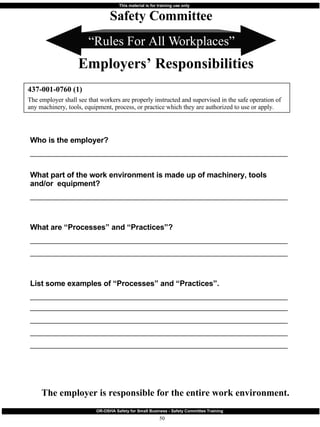
“ Rules For All Workplaces” Who is the employer?  _______________________________________________________________________ What part of the work environment is made up of machinery, tools and/or  equipment?  _______________________________________________________________________ What are “Processes” and “Practices”? _______________________________________________________________________ _______________________________________________________________________ List some examples of “Processes” and “Practices”. ______________________________________________________________________________________________________________________________________________ _______________________________________________________________________   _______________________________________________________________________ _______________________________________________________________________ 437-001-0760 (1) The employer shall see that workers are properly instructed and supervised in the safe operation of any machinery, tools, equipment, process, or practice which they are authorized to use or apply. Safety Committee Employers’ Responsibilities The employer is responsible for the entire work environment.
Discussion Notes 437-001-0760 (3)  (c )  Any supervisors or persons in charge of work are held to be the agents of the employer in the discharge of their authorized duties, and are at all times responsible for: (A)  The execution in a safe manner of the work under their supervision; and (B)  The safe conduct of their crew while under their supervision; and (C)  The safety of all workers under their supervision. 437-001-0760  (1) (a)  The employer shall see that workers are properly instructed and supervised in the safe operation of any machinery, tools, equipment, process, or practice which they are authorized to use or apply.  This rule shall not be construed to require a supervisor on every part of an operation nor to prohibit workers from working alone. (b)  The employer shall take all reasonable means to require employees: (A)  To work and act in a safe and healthful manner; (B)  To conduct their work in compliance with all applicable safety and health rules; (C)  To use all means and methods, including but not limited to, ladders, scaffolds, guardrails,   machine guards, safety belts and lifelines, that are necessary to safely accomplish all work   where employees are exposed to a hazard; and (D)  Not to remove, displace, damage, destroy or carry off any safety device, guard, notice or   warning provided for use in any employment or place of employment while such use is   required by applicable safety and health rules. (c )  Every employer shall be responsible for providing the health hazard control measures necessary to protect the employees’ health from harmful or hazardous conditions and for maintaining such control measures in good working order and in use. (d)  Every employer shall inform the employees regarding the known health hazards to which they are exposed, the measures which have been taken for the prevention and control of such hazards, and the proper methods for utilizing such control measures.
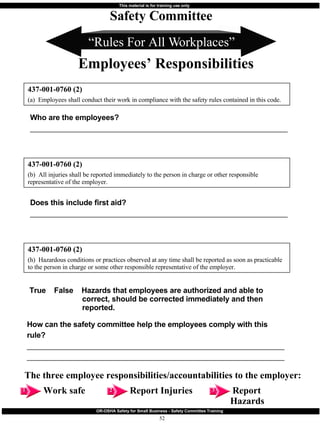
“ Rules For All Workplaces” Who are the employees?  _______________________________________________________________________ 437-001-0760 (2) (a)  Employees shall conduct their work in compliance with the safety rules contained in this code. Safety Committee Employees’ Responsibilities The three employee responsibilities/accountabilities to the employer: Does this include first aid?  _______________________________________________________________________ 437-001-0760 (2) (b)  All injuries shall be reported immediately to the person in charge or other responsible representative of the employer. How can the safety committee help the employees comply with this rule? _______________________________________________________________________ _______________________________________________________________________ 437-001-0760 (2) (h)  Hazardous conditions or practices observed at any time shall be reported as soon as practicable to the person in charge or some other responsible representative of the employer. Work safe  Report Injuries  Report    Hazards True  False  Hazards that employees are authorized and able to    correct, should be corrected immediately and then    reported.   1 1 2 2 3 3
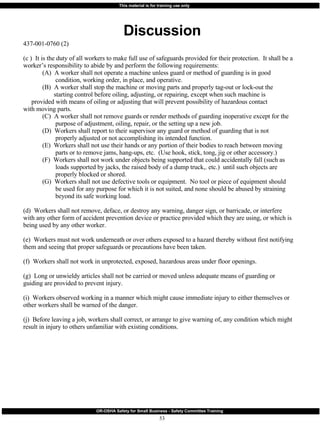
Discussion 437-001-0760 (2) (c )  It is the duty of all workers to make full use of safeguards provided for their protection.  It shall be a worker’s responsibility to abide by and perform the following requirements: (A)  A worker shall not operate a machine unless guard or method of guarding is in good    condition, working order, in place, and operative. (B)  A worker shall stop the machine or moving parts and properly tag-out or lock-out the   starting control before oiling, adjusting, or repairing, except when such machine is    provided with means of oiling or adjusting that will prevent possibility of hazardous contact    with moving parts. (C)  A worker shall not remove guards or render methods of guarding inoperative except for the   purpose of adjustment, oiling, repair, or the setting up a new job. (D)  Workers shall report to their supervisor any guard or method of guarding that is not   properly adjusted or not accomplishing its intended function. (E)  Workers shall not use their hands or any portion of their bodies to reach between moving   parts or to remove jams, hang-ups, etc.  (Use hook, stick, tong, jig or other accessory.) (F)  Workers shall not work under objects being supported that could accidentally fall (such as   loads supported by jacks, the raised body of a dump truck,. etc.)  until such objects are    properly blocked or shored. (G)  Workers shall not use defective tools or equipment.  No tool or piece of equipment should   be used for any purpose for which it is not suited, and none should be abused by straining    beyond its safe working load. (d)  Workers shall not remove, deface, or destroy any warning, danger sign, or barricade, or interfere with any other form of accident prevention device or practice provided which they are using, or which is being used by any other worker. (e)  Workers must not work underneath or over others exposed to a hazard thereby without first notifying them and seeing that proper safeguards or precautions have been taken. (f)  Workers shall not work in unprotected, exposed, hazardous areas under floor openings. (g)  Long or unwieldy articles shall not be carried or moved unless adequate means of guarding or guiding are provided to prevent injury. (i)  Workers observed working in a manner which might cause immediate injury to either themselves or other workers shall be warned of the danger. (j)  Before leaving a job, workers shall correct, or arrange to give warning of, any condition which might result in injury to others unfamiliar with existing conditions.
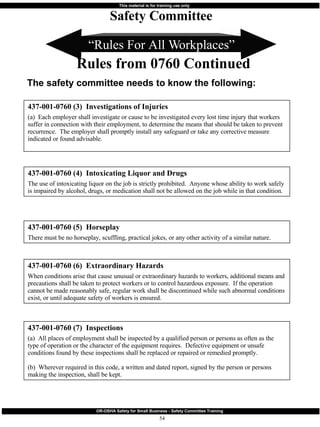
“ Rules For All Workplaces” 437-001-0760 (3)  Investigations of Injuries (a)  Each employer shall investigate or cause to be investigated every lost time injury that workers suffer in connection with their employment, to determine the means that should be taken to prevent recurrence.  The employer shall promptly install any safeguard or take any corrective measure indicated or found advisable. Safety Committee Rules from 0760 Continued 437-001-0760 (4)  Intoxicating Liquor and Drugs The use of intoxicating liquor on the job is strictly prohibited.  Anyone whose ability to work safely is impaired by alcohol, drugs, or medication shall not be allowed on the job while in that condition. 437-001-0760 (5)  Horseplay There must be no horseplay, scuffling, practical jokes, or any other activity of a similar nature. The safety committee needs to know the following: 437-001-0760 (7)  Inspections (a)  All places of employment shall be inspected by a qualified person or persons as often as the type of operation or the character of the equipment requires.  Defective equipment or unsafe conditions found by these inspections shall be replaced or repaired or remedied promptly. (b)  Wherever required in this code, a written and dated report, signed by the person or persons making the inspection, shall be kept. 437-001-0760 (6)  Extraordinary Hazards When conditions arise that cause unusual or extraordinary hazards to workers, additional means and precautions shall be taken to protect workers or to control hazardous exposure.  If the operation cannot be made reasonably safe, regular work shall be discontinued while such abnormal conditions exist, or until adequate safety of workers is ensured.
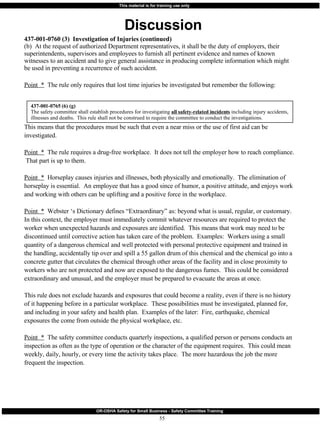
Discussion 437-001-0760 (3)  Investigation of Injuries (continued) (b)  At the request of authorized Department representatives, it shall be the duty of employers, their superintendents, supervisors and employees to furnish all pertinent evidence and names of known witnesses to an accident and to give general assistance in producing complete information which might be used in preventing a recurrence of such accident. Point  *   The rule only requires that lost time injuries be investigated but remember the following: This means that the procedures must be such that even a near miss or the use of first aid can be investigated. Point  *   The rule requires a drug-free workplace.  It does not tell the employer how to reach compliance.  That part is up to them. Point  *   Horseplay causes injuries and illnesses, both physically and emotionally.  The elimination of horseplay is essential.  An employee that has a good since of humor, a positive attitude, and enjoys work and working with others can be uplifting and a positive force in the workplace.  Point  *   Webster ‘s Dictionary defines “Extraordinary” as: beyond what is usual, regular, or customary.  In this context, the employer must immediately commit whatever resources are required to protect the worker when unexpected hazards and exposures are identified.  This means that work may need to be discontinued until corrective action has taken care of the problem.  Examples:  Workers using a small quantity of a dangerous chemical and well protected with personal protective equipment and trained in the handling, accidentally tip over and spill a 55 gallon drum of this chemical and the chemical go into a concrete gutter that circulates the chemical through other areas of the facility and in close proximity to workers who are not protected and now are exposed to the dangerous fumes.  This could be considered extraordinary and unusual, and the employer must be prepared to evacuate the areas at once.  This rule does not exclude hazards and exposures that could become a reality, even if there is no history of it happening before in a particular workplace.  These possibilities must be investigated, planned for, and including in your safety and health plan.  Examples of the later:  Fire, earthquake, chemical exposures the come from outside the physical workplace, etc.  Point  *   The safety committee conducts quarterly inspections, a qualified person or persons conducts an inspection as often as the type of operation or the character of the equipment requires.  This could mean weekly, daily, hourly, or every time the activity takes place.  The more hazardous the job the more frequent the inspection.  437-001-0765 (6) (g) The safety committee shall establish procedures for investigating  all safety-related incidents  including injury accidents, illnesses and deaths.  This rule shall not be construed to require the committee to conduct the investigations.
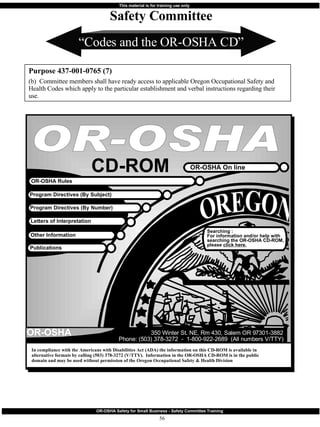
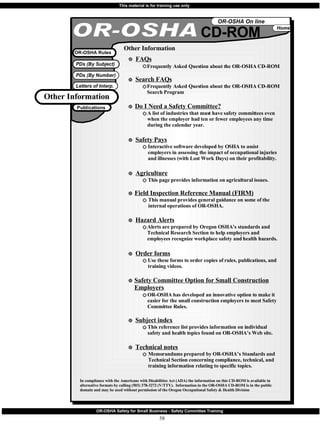
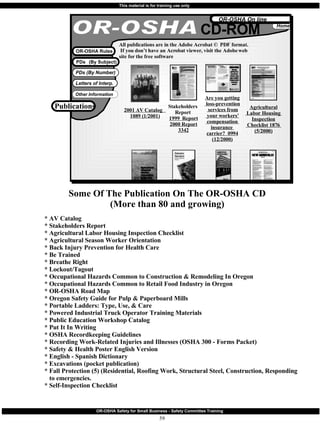
“ Codes and the OR-OSHA CD” Purpose 437-001-0765 (7) (b)  Committee members shall have ready access to applicable Oregon Occupational Safety and Health Codes which apply to the particular establishment and verbal instructions regarding their use. Safety Committee OR-OSHA OR-OSHA On line CD-ROM Program Directives (By Subject) Program Directives (By Number) Letters of Interpretation Other Information Publications Searching : For information and/or help with searching the OR-OSHA CD-ROM, please  click here. 350 Winter St. NE, Rm 430, Salem OR 97301-3882 Phone: (503) 378-3272  -  1-800-922-2689  (All numbers V/TTY) OR-OSHA In compliance with the Americans with Disabilities Act (ADA) the information on this CD-ROM is available in alternative formats by calling (503) 378-3272 (V/TTY).  Information in the OR-OSHA CD-ROM is in the public domain and may be used without permission of the Oregon Occupational Safety & Health Division OR-OSHA Rules
OR-OSHA CD-ROM All standards are in the Adobe Acrobat ©  PDF format. If you don’t have an Acrobat viewer, visit the Adobe Web site for the free software  OAS 654 - The Oregon Safe Employment Act - (1999) Division 1 - General Administrative Rules Division 2 - General Occupational Safety and Health Rules  Division 3 - Construction Division 4 - Agriculture Division 5 - Maritime Activities Division 6 - Forest Activities If you have questions regarding OR-OSHA rules, please contact Oregon OSHA Standards & Technical Section, (503) 378-3272 toll free in Oregon, (800) 922-2689 Or send e-mail to  [email_address] OR-OSHA Rules In compliance with the Americans with Disabilities Act (ADA) the information on this CD-ROM is available in alternative formats by calling (503) 378-3272 (V/TTY).  Information in the OR-OSHA CD-ROM is in the public domain and may be used without permission of the Oregon Occupational Safety & Health Division Publications
OR-OSHA CD-ROM In compliance with the Americans with Disabilities Act (ADA) the information on this CD-ROM is available in alternative formats by calling (503) 378-3272 (V/TTY).  Information in the OR-OSHA CD-ROM is in the public domain and may be used without permission of the Oregon Occupational Safety & Health Division OR-OSHA Rules Other Information Frequently Asked Question about the OR-OSHA CD-ROM FAQs Other Information Publications Frequently Asked Question about the OR-OSHA CD-ROM Search Program Search FAQs A list of industries that must have safety committees even when the employer had ten or fewer employees any time during the calendar year. Do I Need a Safety Committee? Interactive software developed by OSHA to assist employers in assessing the impact of occupational injuries and illnesses (with Lost Work Days) on their profitability. Safety Pays This page provides information on agricultural issues. Agriculture This manual provides general guidance on some of the internal operations of OR-OSHA. Field Inspection Reference Manual (FIRM) Alerts are prepared by Oregon OSHA’s standards and Technical Research Section to help employers and employees recognize workplace safety and health hazards. Hazard Alerts Use these forms to order copies of rules, publications, and training videos. Order forms OR-OSHA has developed an innovative option to make it easier for the small construction employers to meet Safety Committee Rules. Safety Committee Option for Small Construction Employers This reference list provides information on individual  safety and health topics found on OR-OSHA’s Web site. Subject index Memorandums prepared by OR-OSHA’s Standards and Technical Section concerning compliance, technical, and training information relating to specific topics. Technical notes
OR-OSHA CD-ROM 2001 AV Catalog  1089 (1/2001) Publications All publications are in the Adobe Acrobat ©  PDF format.  If you don’t have an Acrobat viewer, visit the Adobe web site for the free software  PDs (By Subject) OR-OSHA Rules Stakeholders  Report  1999  Report 2000 Report 3342 Are you getting loss-prevention services from your workers’ compensation  insurance  carrier?  0994 (12/2000) Agricultural Labor Housing  Inspection Checklist 1876  (5/2000) Some Of The Publication On The OR-OSHA CD (More than 80 and growing) * AV Catalog * Stakeholders Report * Agricultural Labor Housing Inspection Checklist * Agricultural Season Worker Orientation * Back Injury Prevention for Health Care * Be Trained * Breathe Right * Lockout/Tagout * Occupational Hazards Common to Construction & Remodeling In Oregon * Occupational Hazards Common to Retail Food Industry in Oregon * OR-OSHA Road Map * Oregon Safety Guide for Pulp & Paperboard Mills * Portable Ladders: Type, Use, & Care * Powered Industrial Truck Operator Training Materials * Public Education Workshop Catalog * Put It In Writing * OSHA Recordkeeping Guidelines * Recording Work-Related Injuries and Illnesses (OSHA 300 - Forms Packet) * Safety & Health Poster English Version * English - Spanish Dictionary * Excavations (pocket publication) * Fall Protection (5) (Residential, Roofing Work, Structural Steel, Construction, Responding to emergencies. * Self-Inspection Checklist
“ Evaluation Checklist” Safety Committee Use the following “Evaluation Checklist” to find out how your safety committee is doing regarding the duties and responsibilities outlines in 437-001-0765.  Item 1. 2. 3. 4. 5. 6. 7. 8. 9. 10. 11. 12. 13. 14. 15. 16. Question Is the safety committee composed of an equal number of employer and employee representative? Are the employee representatives either volunteers or elected by their peers? For employers of twenty or more employees, are there at least four members on the safety committee? Is the safety committee chairperson elected by the committee? Are safety committee members compensated at their normal hourly wage during safety committee training and meetings? Do employee representatives serve terms that last at least one year? Are terms of service alternated or staggered so that at least one experienced member is serving on the committee? Are reasonable efforts made to ensure that committee members represent the major work activities of the firm? Does the safety committee hold regular meetings at least once a month except in months in which workplace inspections are performed? Does the safety committee work from a written agenda? Are minutes kept at each meeting? Are the minutes made available to all employees? Are the minutes maintained for at least three years? Are all reports, evaluations, and recommendations of the safety committee made part of the safety committee minutes? Has a reasonable limit been set within which the employer must respond in writing to safety committee suggestions? Has the safety committee set up a system for collecting safety-related suggestions, reports of hazards, or other information directly from those involved in workplace operations? Yes  No
Item 17. 18. 19. 20. 21. 22. 23. 24. 25. 26. 27. 28. 29. 30. 31. 32. 33. 34. Question Is such information reviewed during the next safety committee meeting and recorded in the minutes? Does the safety committee assist the employer in evaluating the employer’s accident and illness prevention program? Does the safety committee make written recommendations to improve the safety and health program? Has the safety committee established procedures by which the safety committee inspection team can find and identify safety and health hazards? Does the safety committee conduct workplace inspections at least quarterly? Does the safety committee recommend ways for the employer to eliminate or correct hazards and unsafe work practices in the workplace? Does the safety committee inspection team include employer and employee representatives? Does the safety committee inspection team document I writing the location and identity of hazards? Are quarterly inspections of satellite locations done by the safety committee inspection team or by a person designated at the location? Has the safety committee established procedures to review all safety and health inspection reports made by the committee? Based on the results of the above review, does the safety committee make recommendations for the improvement of the employer’s safety and health program? Has the safety committee evaluated the employer’s accountability system? Has the safety committee made recommendations o implement supervisor and employee accountability for safety and health? Has the safety committee established procedures for investigating all safety-related incidents, including injury accidents, illnesses, and deaths? Has safety committee purpose and operation been discussed with all safety committee members? Have the safety committee rules and their application been discussed with all committee members? Do safety committee members have ready access to applicable Oregon Occupational Safety and Health Codes? Have safety committee members received safety training based on your company’s activity, hazard identification training, and effective accident investigation training? Yes  No
 
“ Set Goals & Take Action” Safety Committee Now that you know the basics, it’s time to take action.  Having an effective safety and health program, one that truly helps to reduce workplace injuries through prevention, is hard work.  It takes commitment.  List a few of your personal safety and health goals and a next to them some action steps that will help you reach these goals. Goal   Action _________________________________  __________________________________   __________________________________   __________________________________ Goal   Action _________________________________  __________________________________   __________________________________   __________________________________ Goal   Action _________________________________  __________________________________   __________________________________   __________________________________
 
Appendix “A” = Innovative Safety Committees for    Small Business   (Fewer than 11 employees) Appendix “B” = Safety Meetings In Logging Appendix “C” =  Safety Committees In Agriculture Appendix “D” = Accident Investigation Report Form Appendix “E” = Problem Solving Worksheet Appendix “F” = Safety Committee Report Forms *  Meeting Agenda *  Meeting Minutes *  Hazard Alert “ Reference Materials”
 
Appendix “A” Appendix “A”
About this guide If you’re a small-business owner or manager, and you have 10 or fewer employees, your workplace must have a safety committee if it meets one of the following conditions: • Has a lost-workday cases incidence rate in the top 10 percent of those rates for employers in your industry. (This rate is the number of lost-workday injuries and illnesses per 100 full-time workers per year. The rate for your organization is based on the number of lost- workday injuries and illnesses you record on your OR-OSHA Injury and Illness Log and Summary forms.) • Has an NCCI classification and premium rate in the top 25 percent of rates for all NCCI classifications. (NCCI stands for National Council on Compensation Insurance. The NCCI groups employers into approximately 600 industrial classifications and calculates a premium rate for each classification that reflects the risk of injury to workers. The NCCI ranks the classifications by the premium rates.) The purpose of a safety committee is to involve employees in achieving and maintaining a safe, healthful workplace. However, many small business owners have told us that their safety committees should be less formal and require less paperwork than the safety committees we require for larger workplaces. We agree. Now you can have a safety committee that meets the needs of your small business and meets the intent of our safety-committee rules – we call it an innovative safety committee. This guide tells you how to develop an effective innovative safety committee and gives you all the record-keeping forms you need to keep your paperwork to a minimum. How to become an innovative safety committee employer If you’d like to participate, just fill out  Part A  of the attached  Innovative safety committee participation agreement  and drop it in the mail. You’re eligible to participate as long as you have 10 or fewer employees. You can terminate your participation at any time, unless you are participating in lieu of an OR-OSHA citation, as stated under  Part B  of the agreement. Questions? Call the OR-OSHA  Standards and Technical Resources Section  at (503) 378-3272. 2
Contents How to develop an effective innovative safety committee .......................................... 4 Hold weekly safety meetings ............................................ 4 Be accountable ............................................................... 4 Be involved ..................................................................... 5 Identify, report, and control hazards ................................ 5 Educate and train ............................................................... 5 Hazard assessment checklist   ......................................... 6 What you and your employees can do to achieve and maintain a safe, healthful workplace. Innovative safety committee meeting forms  ......... 8 One-page forms to document what you’ve done at your safety committee meetings. (“Master For Copy” follows page 8) Innovative safety committee participation agreement  ...............  T ear-out insert, fill out form, add  postage, and  mail in. (follows safety committee meeting forms “Master for Copy”) 3
4 4 How to develop an effective innovative safety committee Effective safety committees find solutions to problems that cause accidents, injuries, and illnesses. Fewer accidents, injuries, and illnesses lower your workers’ compensation costs and insurance premium rates and can increase your bottom-line profit. Here’s what you can do to do to make your safety committee an effective one. Hold weekly safety meetings Make all your employees safety committee representatives. Because your business has 10 or fewer employees, your safety commit-tee includes all of them. Once a week, bring them together to discuss what everyone can do to achieve – or maintain – a safer, more healthful workplace. To keep each meeting short but effective, focus the discussion on just one important topic; for example, controlling an existing hazard or identifying an unsafe work practice and determining how to make it safer. If you have a construction business You must hold a pre-job planning meeting with the general contractor to discuss worksite hazards. You must also have a pre-job meeting with your work crew to evaluate the hazards, inspect tools and equipment, and review safe work practices. Take minutes at each meeting. Minutes are the written record of your committee’s activities and accom-plishments.  It’s an easy – but important – task. At each meeting, just complete one of the weekly safety meeting forms included in this guide. Record the meeting date, location, who attended, and a brief summary of the discussion topics. Keep the forms on file for three years. Compensate employees while they attend meetings. Employees must receive their regular wages while they attend a safety committee meeting. Be accountable Accountability means that your employees know the safe work practices that apply to their jobs and they follow them; they know how to identify hazards and they’re willing to discuss how to control them during weekly safety committee meetings. Accountability also means that you make your commitment to workplace safety and health a company policy and that you require your employees to follow safe work practices as a condition of employment. You ensure
that your employees have the appropriate tools, equipment, and the materials they need to do their jobs safely. Be involved Require your employees to attend the weekly safety meetings. Encourage them to report hazards and unsafe work practices. Act on their suggestions and recognize their contributions. Identify, report, and control hazards Prevent workplace hazards and unsafe practices by doing the following: •  Ensure that employees know how to recognize hazards and that they understand the basic principles for controlling them. •  Focus on identifying hazards and unsafe practices that are likely to cause serious injuries. • Conduct thorough walk-around inspections at least quarterly. • Document hazards during the inspections and discuss how to control them at weekly meetings. Did you know? If your business has an informal conference with OR-OSHA to discuss a citation, employees can also attend. Informal conferences are an excel-lent opportunity to educate employees about hazard identification and about OR-OSHA’s safety and health requirements. Educate and train Employees need to understand how they can contribute to achieving and maintaining a safe, healthful workplace. The best time to teach them is during a weekly safety committee meeting. Your employees should know that you have a safety and health policy and that you expect them to follow it. In addition, they should understand the safe work practices that apply to their jobs, how to identify and report hazardous conditions and unsafe work practices, and how to make suggestions for controlling hazards. Who can do the training? You can do the training if you’re confident you can accomplish the objectives or you can choose someone who has relevant training experience and understands the objectives. Did you know? OR-OSHA’s Education Section offers no-cost workshops on hazard identification and accident investigation. You can also have an OR-OSHA consultant or technical specialist attend one of your safety com-mittee meetings to answer questions or to conduct a walk-around safety inspection. Register for a workshop or schedule a consultation at www.orosha.or g. 5
6 Hazard assessment checklist Use these lists to help you avoid common workplace hazards. Construction workplaces  Employees are protected by personal fall-arrest systems, guardrails, or safety nets when they work on unguarded surfaces more than six  feet above a lower level.  Employees who work on low-slope roofs that have unprotected sides six feet or more above a lower level are protected by personal  fall-arrest systems, guardrails, or safety nets.  All floor holes six feet or more above a lower level are blocked by guard rails or covered by material that can hold at least twice the weight of any object placed on it.  Employees are protected from electrical hazards by ground fault circuit interrupters or an assured-equipment-grounding program.  Employees inspect cords and plugs daily and remove from service those that are defective.  Electrical power cords are connected to equipment and outlets so  that they won’t stress joints or terminal screws.  Employees who may be exposed to hazardous chemicals have been  trained and informed about the chemicals’ hazards and understand the information on container warning labels and material safety data  sheets.  Stairways that have four or more risers have hand rails on unpro- tected sides.  Employees receive and wear hardhats when they’re exposed to falling object or other hazards that could cause a head injury.  Employees use appropriate metal or plastic containers to handle flammable liquids in quantities greater than one gallon.  Employees place straight portable ladders so that they extend at  least 36 inches above the upper level.  Defective ladders are removed from service and marked so that employees know they are defective.  Employees keep the worksite clean and free of scrap lumber and other debris.  Employees who work in excavations deeper than five feet are protected from cave-ins.  Scaffolds have securely tied off access ladders.  Scaffolds higher than 10 feet have guardrails and end rails.
7 General industry workplaces  Each reported workplace accident and near-miss incident is docu- mented and investigated.  Fire extinguishers are located where employees can reach them easily in an emergency  Employees receive and wear appropriate personal protective  equipment when their work requires it.  Walkways are dry or slip resistant.  Walkways keep employees a safe distance from hazardous  operations and equipment.  Walkways that are more than four feet above a lower level have standard guardrails.  Stairways that have four or more risers have handrails on unpro- tected sides.  Ladders are in good condition; the joints between steps and side  rails are tight and the fittings are securely attached.  Grinders and saws have safety guards.  Employees lock out equipment that could start or move  unexpectedly  before they do service or maintenance work.  Compressed gas cylinders are secure when they’re stored or trans- ported so that they won’t tip over.  Employees who may be exposed to hazardous chemicals have  been trained and informed about the chemicals’ hazards and  understand the information on container warning labels and  material safety data sheets. Agriculture workplaces  Appropriate containers and tanks are used to handle flammable and combustible liquids.  Farm labor housing is registered with OR-OSHA yearly.  Employees are prohibited from entering areas such as vats or pits that may have atmospheres immediately dangerous to life or health (IDLH).  Pesticide storage areas have posted signs that read, “Pesticides Poison, Keep Out.”  Employees receive appropriate respirators and are required to wear them when they are exposed to respiratory hazards.  Drive shafts, belts, pulleys, and gear mesh points are properly guarded.
8  Employees who may be exposed to hazardous chemicals have been trained and informed about the chemicals’ hazards and understand the information on container warning labels and material safety  data sheets.  Employees who apply pesticides have received Worker Protection Standard training.  Working surfaces and open-sided floors higher than four feet  above a lower level have standard guardrails.  Stairways that have four or more risers have handrails on unpro- tected sides.  Ladders are in good condition; the joints between steps and side  rails are tight and the fittings are securely attached.  Exits are clearly marked and unobstructed.  Fuel cylinders are at least 20 feet from oxygen cylinders and are secured so that they won’t tip over.  Employees receive and wear appropriate personal protective equip- ment when their work requires it.  Toilet facilities with potable water are available for employees at fixed work sites and at hand labor sites.  Appropriate first-aid supplies are available and employees know where to find them.  Employees who use forklifts have been trained to operate them and receive refresher training annually.  Employees are required to wear seat belts when they ride in equip- ment that has rollover protection. Innovative safety committee meeting forms Use these forms to record the minutes for each weekly safety committee meeting. Complete one form at each meeting. Record the meeting date, location, and who attended, and include a brief summary of the discussion topics. (We suggest that you leave the completed forms in this guide. When you complete all the forms, call the OR-OSHA Resource Center and we’ll send you another booklet or you can download one from our Web site:  www.orosha.or g.) Don’t throw the completed forms away! You must keep them on file for three years.
Innovative safety committee meeting form Meeting date:  /  /  Meeting location: Attending:  Attending: _________________________  ____________________________ _________________________  ____________________________ _________________________  ____________________________ _________________________  ____________________________ _________________________  ____________________________ dentifying and controlling hazar Hazard  How to control it ________________________  ____________________________ _________________________  ____________________________ _________________________  ____________________________ _________________________  ____________________________ _________________________  ____________________________ _________________________  ____________________________ _________________________  ____________________________ _________________________  ____________________________ _________________________  ____________________________ _________________________  ____________________________ _________________________  ____________________________ _________________________  ____________________________ _________________________  ____________________________ Employee trainin Description of training _________________________________________________________ _________________________________________________________ _________________________________________________________ _________________________________________________________ Identifying and controlling hazards Employee Training
Innovative safety committee meeting form Meeting date:  /  /  Meeting location: Attending:  Attending: _________________________  ____________________________ _________________________  ____________________________ _________________________  ____________________________ _________________________  ____________________________ _________________________  ____________________________ dentifying and controlling hazar Hazard  How to control it ________________________  ____________________________ _________________________  ____________________________ _________________________  ____________________________ _________________________  ____________________________ _________________________  ____________________________ _________________________  ____________________________ _________________________  ____________________________ _________________________  ____________________________ _________________________  ____________________________ _________________________  ____________________________ _________________________  ____________________________ _________________________  ____________________________ _________________________  ____________________________ Description of training _________________________________________________________ _________________________________________________________ _________________________________________________________ _________________________________________________________ Identifying and controlling hazards Employee Training
Remove this page from booklet - tear along perforated line) Innovative safety committee participation agreement If you want to establish and participate in an innovative safety committee for employers with 10 or fewer employees, complete  Part A  (this part). Use the attached, Safety committees, a guide for workplaces with 10 or fewer employees for information on how to participate. (There’s no need to wait for our reply.  You can begin as soon as you mail us this form.) This agreement satisfies OR-OSHA’s innovative safety committee requirement for employers with 10 or fewer employees, which states:  “Upon application, the division may approve safety committees which are innovative or differ in form or function, when such committees meet the intent of these rules.” Safety Committees -- Innovation 437-001-0765(4) Business name:  __________________________________________  Business phone:  ____________________________ (please type or print clearly) Address:  ___________________________________________________________________________________________ City:  ______________________________________________________________________________________________ State: ___________________________________________________  ZIP:______________________________________ Business owner/manager: ____________________________________________________________________________ Complete  Part B  (this part) in addition to  Part A  only if you have been cited by an OR-OSHA compliance officer for a safety-committee violation and you have agreed to establish and participate in an innovative safety committee in lieu of an OR-OSHA citation.  I agree to establish and participate in an innovative safety committee for the next 36 months, and OR-OSHA will issue an order to correct in lieu of a citation for the alleged violation.  OR-OSHA will use the information in the attached, Safety committees, a guide for workplaces with 10 or fewer employees to evaluate my innovative safety committee for the term of this agreement. OR-OSHA may offer assistance in helping me establish my innovative safety committee. Note:  failure to successfully participate for the 36-month term will result in immediate reinstatement of the original citation and penalty, with full payment due within 15 days of notice by OR-OSHA of failure to comply. X Employer representative signature __________________________________________________________  Date:  ______________________________ X OR-OSHA representative signature ________________________________________________________  Date: ______________________________ Optional report number:  ______________________________________  Compliance officer number:  _________________________________________ Part A - To establish and participate in an innovative safety committee Part B - For employers who have been cited for a safety committee violation OR-OSHA office use only
Remove this page from booklet - tear along perforated line) (fold on line and mail) Oregon Occupational Safety & Health Division Oregon OSHA ATTN: Technical Section 350 Winter St. NE. Room 430 Salem, Oregon 97301-3882
Appendix “B” Safety Meetings In Logging Appendix “B” SUBDIVISION B - SAFETY AND HEALTH PROGRAM 437-006-0015   A safety and health program shall be developed and implemented by each employer.  The program shall be in writing and at a minimum, the program shall include the following elements: (1)  Management commitment  to the safety and health program, which shall include: (a)  A written statement of commitment; (b)  Management commitment of necessary safety personnel and resources to carry out the    company’s health and safety program. (c)  Provisions for regular monthly inspection of all work-sites, equipment, work methods, and    work practices as the type of operation or character of the equipment requires, including a    method for correction of hazardous conditions; (d)  A system for investigation of all known safety and health related and recordable injuries or    illnesses and prompt corrective action; (e)  An accountability system for labor and management which provides for ongoing evaluation    of  employees’ safety performance and a disciplinary policy for unsafe work practices; and (f)  Assignment of responsibility and authority for safety of workers to all supervisory personnel. (2)  Supervisory practices  which shall include; (a)  Designation of an authorized person for each job with the authority and responsibility to    supervise all employees at the site and to enforce the company’s safety and health program;    and (b)  Periodic, informal of the safety performance of each employee by the employer. (3)  Provision for employee involvement  in the safety and health program which includes: (a)  Monthly safety meeting program for all employees.  Meetings may be conducted    individually, in separate crew meetings or in larger groups.  Meeting minutes and attendance    records shall be documented and made available to employees and Oregon OSHA upon    request.  Minutes and  attendance records shall be maintained for three years from date of    issue. (b)  Provision for employee involvement in the safety and health program, through a system    which encourages employees to report safety and health hazards and provides for prompt    response and corrective action. (4)  Training and follow-up training.   Training and follow-up training shall be conducted which provide for job safety instruction and training for all employees.  Prior to commencing any new work assignment, each employee shall be instructed, or shall previously have been trained, in the safe operation of any machinery, tools, equipment, processes or practice which the employee will use or apply. (5)  Annual evaluation of safety and health program.   Each employer shall make provision for an annual evaluation of the employer’s safety and health program which shall include: (a)  Methods and procedures to be used to assure that program deficiencies are identified and    revised; and (b)  Written findings of the annual evaluation which shall be maintained for three years from the    date of issue.
 
Appendix “C” Safety Committees In Agriculture Appendix “C” 437-004-0240  SAFETY OREIENTATION FOR SEASONAL WORKERS Seasonal Worker -   a person employed in a job tied to a certain time of year by an event or pattern for not more than 10 months in a calendar year. (1)  This applies to agricultural employers with 10 or fewer non-seasonal workers.  (See the notice at the end of this page.) (2)  All seasonal workers must receive at least the following information in their orientation meeting before beginning work for the first time or when work conditions or locations change in a way that reasonably could affect their safety or health; (a)  OR-OSHA publication 1951, “Safe Practices - Working With Hazardous Agricultural  Chemicals” if their work is covered by OAR 437-004-9800, Hazard Communication and/or the  Worker Protection Standard for Agricultural Chemicals. NOTE:   This paragraph satisfies the training requirements under 437-004-9800, Hazard  Communication for workers doing field and hand labor.  It also satisfies the requirement  for training under the Worker Protection Standard, 437-004-40 CFR 170.130(c).  See  chapter W. (b)  Employer’s safety and health rules for the work they will do. (c)  The employer’s procedures for workers to contact supervisors or managers in case of  accident, illness or any problem related to safety or health. (d)  The employer’s procedures for workers treatment of injured or sick workers and the  summoning of emergency assistance. (e)  The location of posted safety and health information. NOTE:   These are only minimum requirements and are not al inclusive.  Other parts of the  Agriculture standard require specific or general training for certain types of work.  Those  requirements are in addition to these general orientation requirements. NOTICE:   If you employ more than 10 non-seasonal workers, read and comply with  OAR 437-004-0250 which follows this standard.  If you employee 10 or fewer non-seasonal  workers  but have had 2 or more accepted disabling claims in any 12 month period, read and  comply with OAR 437-004-0250 which follows this standard.
Appendix “C” 437-004-0250  SAFETY COMMITTEES (1)  Application (a)  Agricultural employers with more than 10 non-seasonal workers must have an effective  safety  committee. (b)  Agricultural employers with 10 or fewer non-seasonal workers do not need a safety  committee unless they had two or more accepted disabling claims during a 12 Month period. Note:   Under (b)  above, you must have your first safety committee meeting the month after your  second accepted disabling claim during any 12 month period.  You can stop the meetings after  you complete a 12 month period without 2 accepted disabling claims. (c)  Labor contractors must have a committee based on the number of workers over which they  exercise direction and control. (2)  Purpose.   The purpose of a safety committee is to bring workers and management together in a non-adversarial, cooperative effort to promote safety and health in each workplace.  A safety committee assists the employer and makes recommendations for change. (3)  Effective committee.   An effective committee must produce at least the following results: (a)  Workers must be aware of the committee, who is on it, how it functions, when it meets and  how information passes from workers to management and from management to workers. (b)  Workers must be aware of their right to have matters placed on the committee’s agenda and  into the meeting minutes. (c)  Workers must know the employer’s method or system for the reporting of safety and health  concerns, incidents and accidents. (d)  Workers must know the committee’s responsibility to review all incident and accident report. (4)  Definitions. Management  - includes all supervisors and persons who regularly exercise direction and control  over workers. Seasonal Worker  - a person employed in a job tied to a certain time of year by an event or  pattern and employed for not more than 10 months in a calendar year. Workers  - for the purposes of determining the need for a safety committee, include both full and  part time employees. (5)  General requirements (a)  Employers who also hire seasonal workers must hold safety orientation meetings for those  crews.  See paragraphs OAR 437-004-0250(8)
Appendix “C” (b)  If you have more than one geographic employment location, use a combined committee only  if: (A)  The locations are close enough to assure that a joint committee meets the requirements  of OAR 437-004-0250(8) (B)  The locations employ some of the same workers; and (C)  The joint Committee represents safety and health concerns of all workers at all  locations. (c)  The safety committee of employers with 20 or fewer non-seasonal workers must have at least  one manager and one worker.  Employers with more than 20 non-seasonal workers must have at  least 2 managers and 2 workers on the committee. (A)  Do not coerce workers to serve on the committee.  Give all workers the opportunity to  volunteer to serve on the committee.  If there are no volunteers, the employer may appoint  the member(s). Note:   Do not count seasonal workers when calculating the number of members needed on  the committee. (d)  Employers must pay workers their regular hourly rate for attending safety committee meetings  or instruction or training required as part of their safety committee duties. (6)  Duties and functions.   (a)  Regular safety committee meetings must be held monthly except in months when there are  inspections under OAR 437-004-0099(3).  Committees for employers with 10 or fewer workers,  under (1)(b), must meet quarterly in addition to their inspection months. (b)  Keep a record of all safety committee meetings and make the records available to workers.  Keep the record for three years for inspection by OR-OSHA. (c)  All reports, inspections, evaluations, recommendations and items brought before the committee  must be part of the record. (d)  The employer must respond to safety committee recommendations in a reasonable time. (e)  The committee must: (A)  Establish procedures for the committee to do the safety inspections in  OAR 437-004-0099(3) (B)  Review all reports of the quarterly inspections in OAR 437-004-0099(3) (C)  Establish procedures for investigating all safety incidents, accidents, illnesses and  deaths.
Appendix “C” (D)  Evaluate accident and illness prevention programs. (E)  Set guidelines for the training of safety committee members. (7)  Training.   (a)  Discuss OAR 437-004-025 (these rules) and the purpose and operation of the committee with  safety committee members. (b)  Committee members must have timely access, through the employer, to all OR-OSHA  standards that apply to their work. (c)  Committee members must receive training in hazard identification (d)  The employer must respond to safety committee recommendations in a reasonable time. (8)  Safety orientation for seasonal workers.   All seasonal workers doing hand labor and field work must receive at least the following information in their safety orientation meeting before beginning work for the first time or when work conditions or locations change in a way that reasonably could affect their safety or health. (a)  OR-OSHA publication 1951, “Safe Practices - Working With Hazardous Agricultural  Chemicals” if their work is covered by OAR 437-004-9800, Hazard Communication and/or the  Worker Protection Standard for Agricultural Chemicals. NOTE:   This paragraph satisfies the training requirements under 437-004-9800, Hazard  Communication for workers doing field and hand labor.  It also satisfies the requirements  for training under the Worker Protection Standard, 437-004-40 CFR 170.130©.  See  chapter W. (b)  Employer’s safety and health rules for the work they will do. (c)  The employer’s procedures for workers to contact supervisors or managers in case of  accident, illness or any problem related to safety or health. (d)  The employer’s procedures for treatment of injured or sick workers and the summoning of  emergency assistance. (e)  The location of posted safety and health information. NOTE:   These are only minimum requirements and are not al inclusive.  Other parts of the  Agriculture standard require specific or general training for certain types of work.  Those  requirements are in addition to these general orientation requirements.
Appendix “D” The following is an “Accident Investigation Report” form that can be copied and used for documentation of the incident. If more room is needed for documentation of the information, more pages should be added. Appendix “D”
 
Accident Investigation Report Accident Number _______________  Date________________ Accident Investigator ________________________________________  Dept. ______________  Tel # ________________ Accident Investigator ________________________________________  Dept. ______________  Tel # ________________ Accident Investigator ________________________________________  Dept. ______________  Tel # ________________ Section I.  BACKGROUND WHO  was involved or injured?  Date Accident Reported _________________ Name ________________________________  Witnesses (1) ___________________________ Tel # ________________ Address ______________________________   (2) ___________________________  Tel # ________________ _____________________________________   (3) ___________________________  Tel # ________________ Phone (H) _____________  (W) ____________ Job Title _______________________________   Length of Service  ________________ WHEN   did accident/incident occur? Date _______________ Time of day __________________ Work shift __________ WHERE  did accident/incident occur? Department __________________________ Equipment __________________________ Location ___________________________________________________________________ Section II.  DESCRIPTION OF ACCIDENT   (Describe sequence of events.  Attach separate page if necessary) ____________________________________________________________________________________________________ ____________________________________________________________________________________________________ ____________________________________________________________________________________________________ ____________________________________________________________________________________________________ ____________________________________________________________________________________________________ ____________________________________________________________________________________________________ ____________________________________________________________________________________________________ ____________________________________________________________________________________________________ ____________________________________________________________________________________________________ ____________________________________________________________________________________________________ ____________________________________________________________________________________________________ Page 1 of 4
Accident Investigation Report Section III.  FINDINGS  (Attach separate page if necessary) Surface Cause(s) (symptoms)  (Unsafe conditions and/or work practices) 1. __________________________________________________________________________________________________ ____________________________________________________________________________________________________ ____________________________________________________________________________________________________ 2. __________________________________________________________________________________________________ ____________________________________________________________________________________________________ ____________________________________________________________________________________________________ 3.__________________________________________________________________________________________________ ____________________________________________________________________________________________________ ____________________________________________________________________________________________________ 4.__________________________________________________________________________________________________ ____________________________________________________________________________________________________ ____________________________________________________________________________________________________ Root Cause(s)   (Policies, procedures, supervision, training, decision making, other factors) 1. __________________________________________________________________________________________________ ____________________________________________________________________________________________________ ____________________________________________________________________________________________________ 2. __________________________________________________________________________________________________ ____________________________________________________________________________________________________ ____________________________________________________________________________________________________ 3.__________________________________________________________________________________________________ ____________________________________________________________________________________________________ ____________________________________________________________________________________________________ 4.__________________________________________________________________________________________________ ____________________________________________________________________________________________________ ____________________________________________________________________________________________________ Page 2 of 4
Accident Investigation Report Section IV.  RECOMMENDATIONS  (Attach separate page if necessary) Immediate Corrections.  (To reduce or eliminate unsafe conditions and/or work practices) 1. __________________________________________________________________________________________________ ____________________________________________________________________________________________________ 2. __________________________________________________________________________________________________ ____________________________________________________________________________________________________ 3.__________________________________________________________________________________________________ ____________________________________________________________________________________________________ Long Term Corrections.   (Policies, procedures, training, etc. to ensure unsafe conditions and/or practices do  not  recur.) 1. __________________________________________________________________________________________________ ____________________________________________________________________________________________________ ____________________________________________________________________________________________________ ____________________________________________________________________________________________________ 2. __________________________________________________________________________________________________ ____________________________________________________________________________________________________ ____________________________________________________________________________________________________ ____________________________________________________________________________________________________ 3.__________________________________________________________________________________________________ ____________________________________________________________________________________________________ ____________________________________________________________________________________________________ ____________________________________________________________________________________________________ 4.__________________________________________________________________________________________________ ____________________________________________________________________________________________________ ____________________________________________________________________________________________________ ____________________________________________________________________________________________________ Page 3 of 4
Page 4 of 4 Accident Investigation Report Section V.  SUMMARY  (Est. costs of accident.  Costs and benefits of corrective action) ____________________________________________________________________________________________________ ____________________________________________________________________________________________________ ____________________________________________________________________________________________________ ____________________________________________________________________________________________________ ____________________________________________________________________________________________________ ____________________________________________________________________________________________________ ____________________________________________________________________________________________________ ____________________________________________________________________________________________________ ____________________________________________________________________________________________________ ____________________________________________________________________________________________________ ____________________________________________________________________________________________________ ____________________________________________________________________________________________________ FOLLOW-UP.  ACTIONS/COMMENTS   (appropriate, timely, etc.) Corrective Actions Taken: Immediate ____________________________________________________________________________________________________ ____________________________________________________________________________________________________ ____________________________________________________________________________________________________ Long Term ____________________________________________________________________________________________________ ____________________________________________________________________________________________________ ____________________________________________________________________________________________________ ____________________________________________________________________________________________________ ____________________________________________________________________________________________________ Prepared by _____________________________________ Reviewed by ______________________________________ Title ___________________________ Date ___________  Title ___________________________ Date ___________ Department _____________________________________  Reviewed by ______________________________________ Title ___________________________ Date ___________ ATTACHMENTS:   (Photos, sketches, interview notes, etc. )
Appendix “E” The following is a “Problem Solving Worksheet” (page 1, 2, and 3) that can be copied and used for analysis and documentation. Appendix “E”
 
Problem Solving Worksheet Problem Statement: Brainstorming List: Revised Brainstorming List Member’s Names Total P r i o r i t y Page 1 of 3
Problem Solving Worksheet  Priority  : Brainstorming the causes for the above stated problem: Revised Brainstorming List Member’s Names Total P r i o r i t y Page 2 of 2
Problem Solving Worksheet  Cause  : Solution Statements: Solution Statements Member’s Names Total P r i o r i t y Page 3 of 3 Solution One Solution Two Solution Three Solution Four Solution Five Solution Six Member’s 1: Member’s 2: Member’s 3: Member’s 4: Member’s 5: Member’s 6:
 
Appendix “F” Safety Committee Report Forms *  Meeting Agenda *  Meeting Minutes *  Hazard Alert *  Hazard Tracking Log Appendix “F”
 
Safety Committee Meeting Agenda Date: __________________ To:  All committee members, alternates, bulletin board Meeting Date and Time: ________________________________ Place: ____________________________________________ Agenda Items Person Responsible 1.  Old business a.  Review last months recommendations   ______________________ b.  Follow-up on last quarterly inspection ______________________ 2.  New business a.  Hazard reports All b.  Accident investigation reviews ______________________ c.  Recommendations review ______________________ d.  ________________________________________________________ ______________________ e.  ________________________________________________________ ______________________ f.  ________________________________________________________ ______________________ 3.  Safety Committee Members Training a.  ________________________________________________________ ______________________ b.  ________________________________________________________ ______________________ Notes: _________________________________________________________________________________________________ _________________________________________________________________________________________________ _________________________________________________________________________________________________ _________________________________________________________________________________________________ _________________________________________________________________________________________________ ______________________________________  ______________________ Chair Persons Signature   Date
 
Safety Committee Meeting Minutes Chairperson: ___________________________________________  Date: ___________________________________ Department:  ___________________________________________  Time meeting started:  _____________________ PRESENT ABSENT __________________________________________ ___________________________________________ __________________________________________ ___________________________________________ __________________________________________ ___________________________________________ __________________________________________ ___________________________________________ __________________________________________ ___________________________________________ __________________________________________ ___________________________________________ Previous meeting minutes from _______________________ were read.   Date Old Business a.  Review of last months recommendations Recommendation Not Number Description Completed   Completed   Date _______ ___________________________________         _______ _______ ___________________________________         _______ _______ ___________________________________         _______ _______ ___________________________________         _______ _______ ___________________________________         _______ _______ ___________________________________         _______ _______ ___________________________________         _______ b.  Follow-up on last quarterly inspection:_________________________________________________________ ________________________________________________________________________________________________  New Business a.  Hazard (inspection)  reports reviewed:__________________________________________________________   Hazard   Recommendation   Number   Description Number   _______   ____________________________________________________________  _______   _______   ____________________________________________________________  _______   _______   ____________________________________________________________  _______   _______   ____________________________________________________________  _______     _______   ____________________________________________________________  _______     _______   ____________________________________________________________  _______     _______   ____________________________________________________________  _______     _______   ____________________________________________________________  _______     _______   ____________________________________________________________  _______   R- R- R- R- R- R- R- Page 1 of 2 H- H- H- H- H- H- H- H- H- R- R- R- R- R- R- R- R- R-
Safety Committee Meeting Minutes b.  Accident/incident investigation reviews: Accident  Near   Recommendation Number   Miss     Description Number _______       ____________________________________________________________  _______ _______       ____________________________________________________________  _______ _______       ____________________________________________________________  _______ _______       ____________________________________________________________  _______ _______       ____________________________________________________________  _______ _______       ____________________________________________________________  _______ _______       ____________________________________________________________  _______ _______       ____________________________________________________________  _______ _______       ____________________________________________________________  _______ Safety Committee Members Training Report:  _________________________________________________________ _________________________________________________________________________________________________  _________________________________________________________________________________________________ Miscellaneous New Business:  ________________________________________________________________________ _________________________________________________________________________________________________  _________________________________________________________________________________________________  _________________________________________________________________________________________________  _________________________________________________________________________________________________ Activity/ Assignment Report: Description Person Assigned _____________________________________________________________  _____________________________ _____________________________________________________________  _____________________________  _____________________________________________________________  _____________________________  _____________________________________________________________  _____________________________  _____________________________________________________________  _____________________________  _____________________________________________________________  _____________________________  Committee Remarks:  ______________________________________________________________________________ _________________________________________________________________________________________________  _________________________________________________________________________________________________  _________________________________________________________________________________________________  Meeting adjourned: _______________  Next meeting:  ________________ _____________________________ Time/ date   Time/ date Secretary Signature _____________________________ Chair Person Signature Page 2 of 2 A- A- A- A- A- A- A- A- A- R- R- R- R- R- R- R- R- R-
Hazard Alert Date: _______________ Department: _______________________________________________________________________ Location: _______________________________________________________________________ Description of Hazard: ______________________________________________________________ ___________________________________________________________________________________ ___________________________________________________________________________________ ___________________________________________________________________________________ Person who discovered hazard: _____________________________________________________ Supervisor actions: Root Cause (s): ________________________________________________________ _____________________________________________________________________________ Control (s): ________________________________________________________ _____________________________________________________________________________ Date corrected: __________________________   Reviewed by:  _____________________ Hazard Alert Date: _______________ Department: _______________________________________________________________________ Location: _______________________________________________________________________ Description of Hazard: ______________________________________________________________ ___________________________________________________________________________________ ___________________________________________________________________________________ ___________________________________________________________________________________ Person who discovered hazard: _____________________________________________________ Supervisor actions: Root Cause (s): ________________________________________________________ _____________________________________________________________________________ Control (s): ________________________________________________________ _____________________________________________________________________________ Date corrected: __________________________   Reviewed by:  _____________________
 
Hazard Tracking Log Hazard   Reported  Date  Corrected  Responsible   Date Number Description   by  Reported   by  Supervisor  Corrected
Department of Consumer and Business Services Oregon Occupational Safety and Health Division (OR-OSHA) Public Education Workshop Evaluation Workshop Title: _________________________________  Date:  ______________  Instructor: ______________________ 4. Please rate the overall effectiveness of the instructor in providing quality training   … Not Effective...     … Effective... 1 2 3 4 5 6 7 WE VALUE YOUR COMMENTS Agree  Disagree 1. I found the course materials easy to understand and useable 2. The information I learned today can help me reduce hazards and  prevent  work-related injuries and illnesses at my workplace 3. Please rate the overall usefulness of this workshop in helping you to understand your safety and health issues and possible solutions:  … Not Effective...     … Effective... 1 2 3 4 5 6 7 We value your comments. Please tell us how we can improve.  Thanks !! Course Content: Materials: Instructor: Facility: Other Subjects I’d like to see offered: How did you learn about this workshop?  (Please check only ONE) Brochure/Flyer  ________ Web site  ________ Consultant  ________ TV/Radio  ________ Newspaper  ________ Association  ________ Other  _________________________________________
Safety Committee Training 0502-03 Presented by The Public Education Section Oregon Occupational Safety and Health Division (OR-OSHA) An Introduction To  Safety Committee Training Requirements OR-OSHA 800 Safety For Small Business  -  Oregon OSHA  -  Public Education  -
OR-OSHA Services Oregon OSHA offers a variety of safety and health services to employers and employees: Consultative Services  (all field offices) Offers no-cost, confidential on-site safety, health, and ergonomic assistance to Oregon employers for help in recognizing and correcting safety and health problems in their workplaces. Our consultants can also introduce you to the Safety & Health Achievement Recognition Program (SHARP) and Oregon’s Voluntary Protection Program (VPP). Standards and Technical Resources  (Salem Central) Adopts, amends, and formally interprets occupational safety and health standards and provides technical assistance such as reviewing variances.  Operates a resource center containing books, topical files, technical periodicals, pamphlets and brochures, more than 200 technical data bases, and an audiovisual lending library.  Enforcement  (all field offices) Inspects places of employment for occupational safety and health rule violations and investigates workplace safety and health accidents, complaints, and referrals.  Provides compliance assistance, specific abatement assistance to employers who have received citation, and offers pre-job conferences for construction employers.  Public Education & Conferences  (Portland, Salem Central, Eugene) Conducts no-cost statewide educational workshops in a wide variety of safety and health subjects.  Co-sponsors statewide conferences including the biennial Governor’s Occupational Safety and Health Conference in Portland. Portland Field Office  (503) 229-5910 Salem Field Office  (503) 378-3274 Eugene Field Office  (541) 686-7562 Medford Field Office  (541) 776-6030 Bend Field Office  (541) 388-6066 Pendleton Field Office  (541) 276-9175 Salem Central Office:   (800) 922-2689 or (503) 378-3272 Web Site:   www.orosha.org OR-OSHA Mission Statement To advance and improve workplace safety and health for all workers in Oregon. Check out our series of five specific safety and health training program certificates! Additional Public Education Services Safety for Small Business workshops Interactive Internet courses Training Series Certificates On-site training requests Access workshop materials  Spanish training aids Training and Education Grants Continuing Education Units/Credit Hours For more information on Public Education services, please call (888) 292-5247 Option 2 Date August 19, 2003 Michelle Cattanach Manager For the completion of  32  hours of training in occupational safety and health Your Name The Oregon Occupational Safety and Health Division of the Department of Consumer and Business Services presents this certificate to commend Safety Committee Member Training Series Award of Completion
In Compliance with the Americans with Disabilities Act (ADA),  this publication is available in alternative formats by calling the  OR-OSHA Public Relations Manager at (503) 378-3272 (V/TTY).

Safety Committe Training

  • 1.
    Welcome! Not manyyears ago, Oregon employers were saddled with the 6th highest workers compensation costs of all 50 states. Approximately 45,000 Oregon workers a were being seriously injured, or made ill on the job every year. In the late 1980s and early 1990s, management, labor, and government came together through the legislative process to reform the workers’ compensation system and to make safety and health, on the job, a top priority. One of the key elements, in this effort to prevent on-the-job injuries and illnesses, was the passing of a law that required employers to have a workplace safety committee. Although everyone acknowledges that a safety committee process is never perfect, imagine the benefit of having workers and management in a large number of Oregon workplaces coming together on a regular basis to identify and solve everyday safety and health problems. Purpose The purpose of this workshop is to give safety committee members insight into their duties and responsibilities and to introduce them to the safety committee’s purpose and operation. The materials covered in this workshop will address the training requirements that apply to safety committee members in all workplaces. This Workshop Covers; Please Note: This material or any other material used to inform employers of compliance requirements of Oregon OSHA standards through simplification of the regulations should not be considered a substitute for any provisions of the Oregon Safe Employment Act or for any standards issued by Oregon OSHA. Introduction 437-001-0765 (7) Safety and Health Training and Instruction (a) The following items shall be discussed with all safety committee members: (A) Safety committee purpose and operation; (B) OAR 437-001-0760 through OAR 437-001-0765 and their application; and (C) Methods of conducting safety committee meetings (b) Committee members shall have ready access to applicable Oregon Occupational Safety and Health Codes which apply to the particular establishment and verbal instruction regarding their use; ( c) All safety committee members shall receive training based upon the type of business activity At a minimum, members shall receive training regarding; (A) Hazard identification in the workplace; and (B) Principles regarding effective accident and incident investigation.
  • 2.
  • 3.
    Safety Committee TrainingWorkshop Agenda Topic Introduction / Workshop Agenda / How To Use This Workbook Safety Committee Purpose Safety Committee Operation / Duties / Functions Formation and Membership Agendas Meetings Written Records Employee Involvement Hazard Analysis and Control Break Hazard Analysis and Control (continued) Safety and Health Planning Accountability Evaluation Accident Investigation Break Safety Meeting Management Do’s and Dont’s of a Meeting Safety Committee Problem Solving Effective Recommendation Writing Break Rules For All Workplaces Employer Responsibilities Employee Responsibilities Rules from 0760 Continued Now It’s Up To You Code Review (Using the OR-OSHA CD) Safety Committee Checklist Set Goals and Take Action Reference Materials Question and Answer / Evaluations Page(s) 1-5 6 8 10 12 14 16 18 24 26 28 40 42 48 50 52 54 56 60 63 65 . . . . . . . . . . . . . . . . . . . . . . . . . . . . . . . . . . . . . . . . . . . . . . . . . . . . . . . . . . . . . . . . . . . . . . . . . . . . . . . . . . . . . . . . . . . . . . . . . . . . . . . . . . . . . . . . . . . . . . . . . . . . . . . . . . . . . . . . . . . . . . . . . . . . . . . . . . . . . . . . . . . . . . . . . . . . . . . . . . . . . . . . . . . . . . . . . . . . . . . . . . . . . . . . . . . . . . . . . . . . . . . . . . . . . . . . . . . . . . . . . . . . . . . . . . . . . . . . . . . . . . . . . . . . . . . . . . . . . . . . . . . . . . . . . . . . . . . . . . . . . . . . . . . . . . . . . . . . . . . . . . . . . . . . . . . . . . . . . . . . . . . . . . . . . . . . . . . . . . . . . . . . . . . . . . . . . . . . . . . . . . . . . . . . . . . . .. . . . . . . . . . . . . . . . . . . . . . . . . . . . . . . . . . . . . . . . . . . . . . . . . . . . . . . . . . . . . . . . . . . . . . . . . . . . . . . . . . . . . . . . . . . . . . . . . . . . . . . . . . . . . . . . . . . . . . . . . . . . . . . . . . . . . . . . . . . . . . . . . . . . . . . . . . . . . . . . . . . . . . . . . . . . . . . . . . . . . . . . . . . . . . . . . . . . . . . . . . . . . . . . . . . . . . . . . . . . . . . . . . . . . . . . . . . . . . . . . . . . . . . . . . . . . . . . . . . . . . . . . . . . . . . . . . . . . . . . . . . . . . . . . . . . . . . . . . . . . . . . . . . . . . . . . . . . . . . . . . . . . . . . . . . . . . . . . . . . . . . . . . . . . . . . . . . . . . . . . . . . . . . . . . . . . . . . . . . . . . . . . . . . . . . . . . . . . . . . . . . . . . . . . . . . . . . . . . . . . . . . . . . . . . . . . . . . . . . . . . . . . . . . . . . . . . . . . . . . . . . . . . . . . . . . . . . . . . . . . . . . . . . . . . . . . . . . . . . . . . . . . . . . . . . . . . . . . . . . . . . . . . . . . . . . . . . . . . . . . . . . . . .. . . . . . . . . . . . . . . . . . . . . . . . . . . . . . . . . . . . . . . . . . . . . . . . . . . . . . . . . . . . . . . . . . . . . . . . . . . . . . . . . . . . . . . . . . . . . . . . . . .
  • 4.
  • 5.
    How To UseThis Workbook This workbook has been designed so that the student has both workshop pages (left side - even numbered pages) and discussion points / notes pages (right side - odd numbered pages). The following describes what you could find on each left and right side page. Safety Committees Training Workshop This material is for training use only Oregon OSHA’s Safety and the Small Business Employer OAR 437-001-0765 (7) Safety and Health Training and Instruction (a) The following items shall be discussed with all safety committee members: (A) Safety committee purpose What can a safety committee do to accomplish its purpose(s)? 1. ________________________________________________________________________ 2. ________________________________________________________________________ 3. ________________________________________________________________________ 4. ________________________________________________________________________ 5. ________________________________________________________________________ What authority does the safety committee? ________________________________________________________________________ What role does the safety committee play? ________________________________________________________________________ 2 Left Side * A specific code/rule to be covered * An exercise for the students. A discussion of the exercise will follow as part of the workshop. * A referral to reference materials Right Side * Discussion “Points” for future reference * Additional text of code/rule * An area for student notes * Examples of Forms Purpose 437-001-0765 (1) The purpose of a safety committee is to bring workers and management together in a non-adversarial, cooperative effort to promote safety and health in each workplace. A safety committee assists the employer and makes recommendations for change.
  • 6.
    “ Purpose”List some things that a Safety Committee should do to meet it’s purpose? 1. ________________________________________________________________________ 2. ________________________________________________________________________ 3. ________________________________________________________________________ 4. ________________________________________________________________________ 5. ________________________________________________________________________ What authority does the safety committee need? _________________________________________________________________________ _________________________________________________________________________ What role does the safety committee play? _________________________________________________________________________ _________________________________________________________________________ Purpose 437-001-0765 (1) The purpose of a safety committee is to bring workers and management together in a non-adversarial, cooperative effort to promote safety and health in each workplace. A safety committee assists the employer and makes recommendations for change. Safety Committee
  • 7.
    Discussion Notes Point * Workers and management may not always see eye to eye when it comes to safety. A worker that finds themselves at risk of injury or illness expects management to address the concern immediately. The expectation is that management has a moral and ethical obligation to protect the worker and therefore should do so because it is the right thing to do regardless of the cost. If management does not respond in a reasonable amount of time (which is very subjective and varies from person to person) then the employee may feel compelled to take the legal approach (by getting OR-OSHA involved) Point * Management (including supervisors) live in an economic based world; year, month, day, hour, minute. They learn that their success can be largely based on their ability to meet budgetary guidelines. They learn that they must respond to those things that interfere with their goals and objectives. Employees expect them to do this in all areas of the operation because their “job security” depends on it. But not so when it comes to safety. Point * If an at risk worker believes that the moral, ethical and legal rational justifies the expenditure of time and resources and management lives in an economy driven workplace then something has to give. Either the workers have to learn how to speak the language of management or the managers have to make the connection between safety and efficiency and productivity. A third option is available: 437-001-0765 (1) Purpose The purpose of a safety committee is to bring workers and management together in a non-adversarial, cooperative effort to promote safety and health in each workplace. A safety committee assists the employer and makes recommendations for change.
  • 8.
    “ Operation/ Duties / Functions” How many employees are their at your place of work, not counting seasonal workers? Number of employees: ___________ (5) (a) The safety committees required by OAR 437-001-0765 (2) shall: Safety Committee Formation and Membership Mark the box next to the rule that applies to your committee, based on the number you wrote in the space above. (B) Consist of: (i) No fewer than two members for each employer with twenty or less employees, or (ii) No fewer than four members for each employer with more than twenty employees. Mark One (C) Have a chairperson elected by the committee members. (A) * Be composed of an equal number of employer and employee representatives. * Employee representatives shall be volunteers or shall be elected by their peers unless there is a provision in their collective bargaining agreement that addresses the selection of employee representatives. * When agreed upon by workers and management, the number of employees on the committee may be greater than the number of employer representatives. * Seasonal workers shall not be counted for the purpose of determining the number of members who will serve on the committee. How did your safety committee’s “Chairperson” become the “Chairperson”?
  • 9.
    Discussion Notes 437-001-0765(2) General (a) Every public or private employer of 11 or more employees shall establish and administer a safety committee. (b) Every public or private employer of 10 or fewer employees shall establish and administer a safety committee if the employer: (A) Has a Lost Workday Case Incidence Rate (LWDCIR) in the top 10 percent of all rates for the employers in the same industry; or (B) The employer is not an agricultural employer and the workers’ compensation premium classification assigned to the greatest portion of the payroll for the employer has a premium rate in the top 25 percent of premium rates for all classes as approved by the Director pursuant to ORS 737.320 Point * If your company has 10 or fewer employees and you are not sure about your LWDCIR or you are not sure if your company is in the top 25 percent of premium rates for all classes, refer to the OR-OSHA CD - Other Information - Do I Need A Safety Committee? - for assistance. ( c) In making the determination of employment levels under sections (a) and (b) of this rule, the employer shall count all permanent, contract, temporary, and/or seasonal workers under the employer’s direction and control, and shall base the number on peak employment. (d) Temporary services employers and labor contractors shall establish safety committees based upon the total number of workers over which the employer or contractor exercises direction and control (e) Employers who hire only seasonal workers shall meet the intent of these rules by holding crew safety meetings prior to the commencement of work at each job site. Such meetings shall promote discussions of safety and health issues. All workers shall be informed of their rights to report workplace hazards, and shall be encouraged to make such reports during the meeting. (f) Employers in the logging industry may meet the intent of these rules by complying with OAR 437, Division 6, Forest Activities.
  • 10.
    “ Operation/ Duties / Functions” What is the purpose of an agenda? ________________________________________________________________________ ________________________________________________________________________ What should the agenda include? 1. ________________________________________________________________________ 2. ________________________________________________________________________ 3. ________________________________________________________________________ 4. ________________________________________________________________________ 5. ________________________________________________________________________ When should the agenda be sent out to the safety committee members? ________________________________________________________________________ ________________________________________________________________________ 437-001-0765 (6) (A) (a) The committee shall develop a written agenda for conducting safety committee meetings. The agenda shall prescribe the order in which committee business will be addressed during the meeting. Safety Committee Agendas
  • 11.
    Discussion Sample AgendaNotes Point * The chairperson should direct group discussion while adhering to the agenda. If the agenda can be given to all members in advance (three days, at least), members will arrive at the meeting better prepared. The agenda will also remind members of their responsibilities if, for example, their reports are part of the agenda. Point * A standard agenda form can be developed by the safety committee to fit its own needs. The agenda should be attached to meeting minutes for distribution or posting. For a blank copy of an agenda form, go to Appendix “F” in the back of this workbook. Point * The agenda should be typed on company letterhead or printed by hand. Limit it to one page and include the following: Date of meeting, Location, Starting and ending times (2-3 p.m., for example), Topics to be discussed, Special guests or speakers.
  • 12.
    “ Operation/ Duties / Functions” What happens when meetings that are scheduled get canceled or members are not allowed to attend? 1. ________________________________________________________________________ 2. ________________________________________________________________________ 3. ________________________________________________________________________ 4. ________________________________________________________________________ 5. ________________________________________________________________________ How can these problems be addressed? ________________________________________________________________________ ________________________________________________________________________ Can a written “Safety Committee Policy” help and if so how? ________________________________________________________________________ ________________________________________________________________________ 437-001-0765 (6) (a) (B) The safety committee shall hold regular meetings at least once a month except months when quarterly workplace safety inspections are made. This does not exclude other months from safety committee meetings if more frequent safety inspections are conducted. Safety Committee Meetings
  • 13.
    Discussion Notes 437-001-0765(6) (a) (C) Quarterly safety committee meetings may be substituted for monthly meetings where the committee’s sole area of responsibility involves low hazard work environments such as offices. 437-001-0765 (6) (a) (D) Small farms of five or fewer full time employees may substitute quarterly meetings for monthly meetings during the farms’ off season. The off season shall mean that period of time when only routine farm upkeep is being done. 437-001-0765 (4) Innovation. Upon application, the division may approve safety committees which are innovative or differ in form or function, when such committees meet the intent of these rules. Point * To find out about the “Innovative safety committee program” for small businesses, go to Appendix “A”, page 67. Point * Does your company do logging? Find out about safety meetings in logging by going to Appendix “B”, page 79. Point * If your company is involved in agriculture, you may want to go to the back of the book to Appendix “C”, page 81.
  • 14.
    “ Operation/ Duties / Functions” How would you define “reasonable time limit? ________________________________________________________________________ ________________________________________________________________________ ________________________________________________________________________ 437-001-0765 (6) (b) (A) Minutes shall be made of each meeting which the employer shall review and maintain for three years for inspection by the Division. Copies of minutes shall be posted or made available for all employees and shall be sent to each committee member. Safety Committee Written Records 437-001-0765 (6) (b) (B) All reports, evaluations, and recommendations of the safety committee shall be made a part of the minutes of the safety committee meeting. 437-001-0765 (6) (b) (C) A reasonable time limit shall be established for the employer to respond in writing to all safety committee recommendations. What kinds of recommendations might a safety committee make? ________________________________________________________________________ ________________________________________________________________________ ________________________________________________________________________
  • 15.
    Discussion Notes Point * Reasonable time limits are to be set by the safety committee. There may be different time limits depending on the hazard or issue Example: A hazard that could cause a permanent disability may require a time limit of very short duration while on the other hand a hazard that needs some study or research to identify and approve the needed correction may take longer.
  • 16.
    “ Operation/ Duties / Functions” List a few ways that members could meet this objective. 1. ________________________________________________________________________ 2. ________________________________________________________________________ 3. ________________________________________________________________________ 4. ________________________________________________________________________ 5. ________________________________________________________________________ Which ways would work best in your workplace? __________________________________________________________________________ __________________________________________________________________________ 437-001-0765 (6) (c) The committee shall establish a system to allow the members to obtain safety-related suggestions, reports of hazards, or other information directly from all persons involved in the operations of the workplace. The information obtained shall be reviewed at the next safety committee meeting, and shall be recorded in the minutes for review and necessary action by the employer. Safety Committee Employee Involvement
  • 17.
    Discussion Notes Point * Each employee, regardless of his or her position within the company, is expected to cooperate in all aspects of the company’s safety and health program, including the following: 1. Accidents must be reported immediately to the supervisor 2. Required personal protective equipment must be worn by all employees 3. Hazardous conditions or other safety and health concerns must be reported to your supervisor immediately 4. Employees participate in safety committee activities and support safety committee membership Point * If employees are reluctant to tell the safety committee about their concerns, the committee will need to discuss the possible reasons for this lack of participation. Many times the reason will stem from past negative experiences. If an employee has informed the committee members or management about a hazard and a recommendation or suggestion for a possible improvement, and there was no response, then the employee may have become discouraged. The more times this happens, and the more people involved in this experience, the bigger the problem. Point * In the example given above, the root of the problem lies with the lack of “trust”. The perception of employees may be that management doesn’t care about their employees, or that they are only concerned with profits. If this is the case, the solution will be complex and reversal of these perceptions may take a long time. Point * A place to start is with the committee itself. Have a discussion about the safety committees purpose. Understand it and have a plan in mind that will address this problem. Talk to employees about your observations. Ask for their input. When they do give suggestions, recognize them for their help and keep them in the information loop.
  • 18.
    “ Operation/ Duties / Functions” How many work areas or departments are there in your company? Number: ___________________________ Your committee should make a list of each area and/or department. 1. ______________________________________________________________________ 2. ______________________________________________________________________ 3. ______________________________________________________________________ 4. ______________________________________________________________________ 5. ______________________________________________________________________ 6. ______________________________________________________________________ 7. ______________________________________________________________________ 8. ______________________________________________________________________ 437-001-0765 (6) (d) (A) The safety committee shall assist the employer in evaluating the employer’s accident and illness prevention program, and shall make written recommendations to improve the program where applicable. Additionally, the safety committee shall: (i) Establish procedures for workplace inspections by the safety committee inspection team to locate and identify safety and health hazards: (ii) Conduct workplace inspections at least quarterly; and (iii) Recommend to the employer how to eliminate hazards and unsafe work practices in the workplace. Safety Committee Hazard Assessment and Control Each area listed must be inspected each quarter!
  • 19.
    Discussion Notes Point * The entire work-site must be inspected each quarter. The inspection may be a quarterly walk-through by the entire safety committee, divided up and covered by different members of the team, or delegated to others within the organization and accomplished throughout the quarter. 437-001-0765 (6) (d) (B) The inspection team shall include employer and employee representatives and shall document in writing the location and identity of the hazards and make recommendations to the employer regarding correction of the hazard. 437-001-0765 (6) (d) (C) Quarterly inspections of satellite locations shall be conducted by the committee team or by a person designated at the location. 437-001-0765 (6) (d) (D) Mobile work sites or locations and activities which do not lend themselves to a quarterly schedule shall be inspected by a designated person as often as Oregon occupational safety and health rules require and/or the committee determines is necessary. 437-001-0765 (6) (d) (E) The person designated to carry out inspection activities at the locations identified in sections (C) and (D) of this rule shall be selected by the employer and shall receive training in hazard identification in the workplace.
  • 20.
    “ Operation/ Duties / Functions” An u __ __ __ __ __ c __ __ __ __ __ __ __ __ or p __ __ __ __ __ __ __ that could cause an I __ __ __ __ __ or I __ __ __ __ __ __ to an e __ __ __ __ __ __ __ and is p __ __ __ __ __ __ __ __ __ __ . Safety Committee Hazard Assessment and Control What is a “Hazard”? Complete the sentence below System Weaknesses Vision Culture Objectives Strategies Programs Plans Accountability Supervision Training Unsafe Conditions Tools - - - - - - - - Materials Environment - - - - - - Machinery Equipment - - Unsafe Practices Horseplay - - - - Shortcuts
  • 21.
    Discussion Point * Hazards are all around us. It would be impossible to eliminate all hazards. Hazards do not become a concern unless employee enters the danger zone. The danger zone is an area around a hazard in which an employee becomes exposed to the hazard and is at risk of an injury. Example: There is a three foot wide hole in the floor and there is a 10 foot drop to the next level. The guardrails are being installed. If there are no employees near the hole then there is no risk of falling through it and therefore there are no employees in the danger zone. When the employees approach the hole to install the guardrails there is a point at which they become at risk. When they cross this point they have entered the danger zone. The closer to the hole, the higher the risk. Point * Incidents are close calls or near misses. The only thing that stands between a near miss and an accident is luck. And luck can’t be counted on. Incidents should be investigated right along with accidents. This will also help the committee identify trends. Point * A hazard is an unsafe condition or practice that could cause an injury or illness to an employee and is preventable. Point * Conditions are those things in the physical environment that could cause injury or illness. They include faulty equipment, dangerous materials, improperly maintained tools, poorly designed machinery, and environments that could cause physical harm to name a few. Point * Practices are work habits, activities, and/or processes or procedures that in and of themselves put an employee at risk of injury or illness. Left unchecked, these practices can turn an otherwise safe workplace into one in which accidents occur. Point * System weaknesses are also called root causes. Employers and/or employees that do not take safety seriously contribute to these weaknesses. Unsafe conditions or practices, controlled by the workers and usually labeled surface causes, only account for a small percentage of the overall safety concern. Unsafe conditions or practices that are the result of weaknesses in the system are often times wide spread and carry with them a negative impact on the workplace. Point * Conditions account for 3% of all workplace accidents. Behaviors account for 95% and uncontrollable acts account for 2% of all workplace accidents. What do these statistics tell us? Most accidents are caused by unsafe behaviors. Management has control to some degree over 98% of the accidents that occur in the workplace. It is a myth to say that lack of “common sense” is a cause of accidents. There are too many variables for this to be true. Culture, age, experience, geographic region, education, and motivation are just a few of these variables. There is no “common sense” when it comes to safety. Just clearly stated expectations and follow up with appropriate consequences. This will lead to safe behavior.
  • 22.
    “ Operation/ Duties / Functions” 1. Acceleration. When we speed up or slow down too quickly. 2. Vibration/Noise. Produce adverse physiological and psychological effects. 3. Toxics. Toxic to skin and internal organs 4. Radiation. Non-ionizing - burns. Ionizing - destroys tissue. 5. Ergonomics. Lifting, lowering, pushing, pulling, twisting. 6. Pressure. Increased pressure in hydraulic and pneumatic systems 7. Mechanical. Pinch points, sharp points and edges, weight, rotating parts, stability, ejected parts and materials, impact. 8. Heat/Temperature. Extremes in either can cause trauma, illness. 9. Flammability/Fire. In order for combustion to take place, the fuel and oxidizer must be present in gaseous form. 10. Explosives. Explosions result in large amounts of gas, heat noise, light and over-pressure. 11. Electrical Contact. Inadequate insulation, broken electrical lines or equipment, lightning strike, static discharge, and so on. 12. Chemical Reactions. Chemical reactions can be violent, can cause explosions, dispersion of materials and emission of heat. 13. Biologicals. Primarily airborne and bloodborne viruses. Safety Committee Hazard Analysis and Control Types Of Hazards 1. Engineering Controls: Eliminate the hazard by redesigning/replacing/repairing equipment, tools, workstations, buildings. Examples: repair of a leak in the roof that causes a slippery floor when it rains - building a guard that covers sprocket that workers are exposed to. 2. Management Controls: Reduce/eliminate the exposure to a hazard by changing the process/ procedure/practice. Example: changing procedures so that workers rotate jobs to reduce the exposure when doing repetitive tasks. 3. Personal Protective Equipment: Does not eliminate the hazard or exposure. Equipment designed to present a barrier between worker and hazard. Examples: gloves - boots - eye protection Control Methods
  • 23.
    Discussion Point * Hazards come in many shapes and sizes. The list to the left helps to group these hazards based on the characteristics of the hazard. The following are examples of each hazard type. 1. Acceleration. A forklift going down a ramp. A door that is swinging open with force. 2. Vibration/Noise. Chain saws, hand sanders, jack hammer. . . 3. Toxics. Solvents like paint thinner, parts cleaners, gasoline, insecticides . . . 4. Radiation. Microwaves, sun light, x-ray 5. Ergonomics. Repetitive motion, data entry, assembly line work, picking fruit, carrying objects . . . 6. Pressure. Gas filled pipes, hydraulic systems in heavy equipment, steam systems . . . 7. Mechanical. Exposed sprokets, gears, shafts, belts, pulleys, joints, shears . . . 8. Heat/Temperature. Closed rooms/compartments, freezers, near cookers, outdoors during extremes . 9. Flammability/Fire. Chemical reactivity, flammable liquids and powders or dust . . . 10. Explosives. Gasoline, dynamite, compressed gasses . . . 11. Electrical Contact. Light circuits, direct current, high voltage, damaged wires . . . 12. Chemical Reactions. Alkalies and acids . . . 13. Biologicals. Diseases, contaminants, viruses . . . 14. Violence in the Workplace. Verbal and physical abuse . . . Point * Engineering Controls: Engineering controls consist of substitution, isolation, ventilation, and equipment modification. These controls focus on the source of the hazard, unlike other types of controls that generally focus on the employee exposed to the hazard. Example: Design or redesign the facility, equipment, or process to remove the hazard - Enclose the hazard to prevent exposure - Establish barriers or local ventilation to reduce exposure.) Point * Management Controls: Any procedure which significantly limits daily exposure by control or manipulation of the work schedule or manner in which work is performed is considered a means of management control. Management controls may result in a reduction of exposure through such methods as changing work habits, improving sanitation and hygiene practices, or making other changes in the way the employee performs the job. The use of personal protective equipment is not considered a means of management control. (Examples: Improved housekeeping - a change in procedure or process - a re-routing of employees around a hazard - using safety training to influence and change behavior.) Point * Personal Protective Equipment (PPE): When exposure to hazards cannot be engineered completely out of normal operations or maintenance work, and when safe work practices and administrative controls cannot provide sufficient additional protection from exposure, PPE may be required. Examples: face shields - steel-toed shoes - safety glasses - hard hats - knee guards - leather aprons - mesh gloves - life jackets - respirators - ear muffs - safety goggles - harness.)
  • 24.
    “ Operation/ Duties / Functions” What other reports, logs, and documents should be reviewed? 1. ________________________________________________________________________ 2. ________________________________________________________________________ 3. ________________________________________________________________________ 4. ________________________________________________________________________ 5. ________________________________________________________________________ 437-001-0765 (6) (e) The safety committee shall establish procedures for the review of all safety and health inspection reports made by the committee. Based on the results of the review, the committee shall make recommendations for improvement of the employer’s accident and illness prevention program. Safety Committee Safety and Health Planning Make a list of programs that could fall under accident and illness prevention? ___________________________________ _________________________________ ___________________________________ _________________________________ ___________________________________ _________________________________ ___________________________________ _________________________________
  • 25.
    Discussion Notes Point * Each quarterly inspection conducted by the safety committee should be reviewed as soon as possible so that detail of the findings is not lost over time. The rule allows the committee to skip the meeting during the month of the quarterly inspection. However, the benefits of scheduling a meeting within a few days of the inspection can prove can prove to be cost effective. Point * Other reports, logs, and documents to be review could include: accident investigations, 300 logs, incident reports, near miss reports, first aid logs, maintenance records, training records . . . Point * Recommendations that are called for in this part of the rule should address weaknesses in existing accident and illness prevention programs. Recommendations for programs that are needed but not in place would also fall in this category. Point * Accident and illness prevention programs could include the following: Hazard Identification and Control, Hazard Communication, Job Hazard Analysis, Safety Committee Operations, Incident Reporting, Lockout / Tagout, Back Safety Awareness, Job Rotation . . .
  • 26.
    “ Operation/ Duties / Functions” Safety Committee Accountability Evaluation 437-001-0765 (6) (f) The safety committee shall evaluate the employer’s accountability system and make recommendations to implement supervisor and employee accountability for safety and health What is an accountability system? ________________________________________________________________________ ________________________________________________________________________ Who is responsible for what? Employer (Owner, Managers, Supervisors) ___________________________________ ___________________________________ ___________________________________ ___________________________________ Employees (Everybody) ___________________________________ ___________________________________ ___________________________________ __________________________________
  • 27.
    Discussion Notes Point * The following six essential elements must be in place for there to be an effective “Accountability System”: 1. Established formal standards of behavior and performance * Programs, policies, plans, processes, procedures, practices 2. Resources provided to meet those standards * Physical = tools, equipment, materials, workstations, facilities * Psychosocial = education, training, scheduling, culture 3. An effective system of measurement * Behaviors are observed and quantified * Behaviors are detected and corrected before an injury * Informal and formal observation procedures are used 4. Application of effective consequences * Soon - certain - significant - sincere * Must change behavior in the desired direction 5. Appropriate application of discipline * Discipline is based on fact not feeling * Consistent throughout the organization: top to bottom and laterally * Applied only after it’s determined management has met obligations to employee * Appropriate to the severity of the infraction and impact on the organization 6. Evaluation of the accountability system. * Examine the first five elements * Analysis/evaluation headed up by safety committee, safety coordinator * Improvements headed up by line management Point * The importance of consequences can not be overstated. Without consequences there is no accountability. The following are three types of consequences: 1. Positive - Increases required and voluntary behavior - Examples: Pay check, individual and group recognition. 2. Negative - Increases required behavior only - Examples: Verbal reprimand, written reprimand, time off without pay, loss of job. 3. None - Withdrawal of positive and negative reinforcement - Examples: No verbal, nonverbal or written response regardless of the actions of the employee.
  • 28.
    “ Operation/ Duties / Functions” What’s the difference between an incident and an accident ? ________________________________________________________________________ ________________________________________________________________________ Why would we want to take time investigating both incidents and accidents? ________________________________________________________________________ ________________________________________________________________________ What two key conditions must exist before an accident can occur? H _______________________ and E ________________________ 437-001-0765 (6) (g) The safety committee shall establish procedures for investigating all safety-related incidents including injury accidents, illnesses and deaths. This rule shall not be construed to require the committee to conduct the investigations. Safety Committee Accident Investigation
  • 29.
    Discussion Notes Point * The main purpose for an accident investigation is to prevent a repeat. It is not to place blame. Point * If someone deliberately sets out to produce loss or injury, that is called a crime, not an accident. Yet many accident investigations get confused with criminal investigations. Whenever the investigative procedures are used to place blame, an adversarial relationship is inevitable. The investigator wants to find out what actually happened while those involved are trying to be sure they are not going to be punished for their actions. The result is an inadequate investigation. (Kingsley Hendrick, Ludwig Benner, Investigating Accidents with STEP, p 42. Marcel Dekker, Inc. 1987.) Point * Tracking and investigating incidents gives the employer another opportunity to intervene and take corrective action before and accident occurs.
  • 30.
    Step 2 - Collect facts about what happened Step 1 - Secure the accident scene “ Operation / Duties / Functions” Safety Committee Accident Investigation The basic steps for conducting an accident investigation. List some ways to secure the accident scene __________________________________________________________________________________________________________________________ Why is it important to secure the scene? __________________________________________________________________________________________________________________________ What documents might need to be reviewed? __________________________________________________________________________________________________________________________ What methods can be used to collect facts about an accident? ______________________________________________________________________________________________________________________________________________________________________________________
  • 31.
    Discussion Notes Point * The primary goal in step one is to insure that the accident scene remains the same as it was at the time of the accident. Making sure that the investigators have an opportunity to document the scene, before it changes, is critical to the quality of the investigation. Point * The methods used to secure the scene vary from case to case. In some cases the scene will have to be secured to prevent others from entering for their own protection. In other cases the scene may have to be entered by medical personnel to aid an injured person. Once the injured person is taken care of, someone should note any changes in the scene that took place, and this information should be given to the investigator. Point * Step two is to collect facts about what happened. The investigator should use various tools and techniques to collect pertinent information about the accident to determine the: * Direct cause of the injury; * Hazardous conditions and unsafe employee/management behaviors (surfaces causes) that produced the accident; * System weaknesses (root causes) that produced the surface causes for the accident.
  • 32.
    Step 4 - Determine the causes Step 3 - Develop the sequence of events “ Operation / Duties / Functions” Safety Committee Accident Investigation The basic steps for conducting an accident investigation. Accident Weed Surface Causes The hazardous condition(s) or unsafe behavior(s) that caused the injury or illness. Usually exists or occurs close to the time of the event and involves the victim, and/or others. Root Causes Weaknesses in the safety systems that could include poorly planned prevention programs, lack of accountability at all levels of the organization, poor supervision or inadequate training and/or follow-up. No recognition plan No accountability policy No inspection policy No discipline procedures No orientation process Unguarded machine Horseplay To much work Defective PPE Fails to report injury Fails to enforce Untrained worker Ignore a hazard Inadequate labeling No recognition Cuts Burns Lack of vision Strains No mission statement Chemical spill
  • 33.
    Discussion Notes Point * In this step, the investigator organizes the information gathered in step two so that the information helps determine the events prior to, during, and after the accident. The objective is to create a timeline that will help in the analysis of the facts. Point * There are several techniques that can be used to organize the information. One popular methods is to write down each fact on a “post-it” and then move the “post-its” around on a board to form a sequence of events. A second method might be to categorize the facts on three pieces of paper labeled “Events prior to accident”, “Events during accident”, and “Events after accident” for example. After all the events have been listed, they can be organized in a sequence or timeline. Point * Step four is the analysis phase of the investigation. “ The occurrence of an injury invariably results from a completed sequence of factors, the last one of these being the accident itself. The accident in turn is invariably caused or permitted directly by the unsafe act of a person and/or a mechanical or physical hazard.” (W.H. Heinrich, Industrial Accident Prevention, 1931) Behind every accident there are many contributing factors, causes, and subcauses. These factors combine in a random fashion causing accidents. We must find the fundamental root causes and remove them to prevent a recurrence. (Dan Petersen, Safety Management: A Human Approach, ASSE, p. 10-11) Point * The “Accident Weed” is a visual aid that helps to understand the differences between surface and root causes, and conditions and practices. If the weed in the front yard is just snapped off at the surface, the weed will return. If the recommendation that comes from the analysis of the accident only addresses the surface causes then a recurrence of the same accident is very likely.
  • 34.
    Step 5 - Recommend corrective action “ Operation / Duties / Functions” Safety Committee Accident Investigation The basic steps for conducting an accident investigation. Recommendations that are made because of an accident will resemble those that are made in hazard control. Use one or more of the following for each “Surface Cause” identified in the investigation. ____ 1. Engineering Controls: ____ 2. Management Controls: ____ 3. Personal Protective Equipment: A Little Review - Match the control with the definition Does not eliminate the hazard or exposure. Equipment designed to present a barrier between worker and hazard. Example: gloves - boots - eye protection Eliminate the hazard by redesigning/replacing/repairing equipment, tools, workstations, buildings . Example: repair leak in roof - build guard to cover sprocket Reduce/eliminate the exposure to a hazard by changing the process/procedure/practice. Example: route workers around hazard - job rotation A. B. C.
  • 35.
    Discussion Notes Point * One of the primary purposes for having a safety committee is to “assist the employer and make recommendations for change”. The reasons why an employer may need assistance can very greatly from employer to employer. In most cases, the greatest assistance a safety committee can provide is to get answers to questions that the employer will need in order to take effective corrective action. Questions could include but are not limited to the following: * How serious is the problem? * How many people does it effect? * What will it take to correct it? * How much will it cost and what is the justification for capital expenditure? * When can corrective action be taken with the least amount of interruption? * Who can make the change? * Will any training be needed as a result of the change? Point * As indicated, the hierarchy of control strategies is similar for hazard control and the control of surface and root causes identified as the result of an accident investigation. In fact, many safety professionals believe that the same six step investigation process should occur for both.
  • 36.
    Step 5 - Recommend corrective action (cont.) “ Operation / Duties / Functions” Safety Committee Accident Investigation The basic steps for conducting an accident investigation. 1. Management Commitment 2. Accountability 3. Employee Involvement 4. Hazard Identification/Control 5. Incident/Accident Investigation 6. Training 7. Evaluation For each “Root Cause” identified in the investigation, make recommendations that will improve the policies, programs, plans, processes, and/or procedures in the safety and health management system that created the problem. Usually you will find the system weakness in one or more of the following: Correcting “Root Causes” can be more difficult as they are usually imbedded in the system.
  • 37.
    Discussion Notes Point * Getting to the root cause and making recommendations that will address weaknesses in the system can be very difficult and at time intimidating to safety committee members. These root causes often time have to do with the culture in the workplace. Perceptions at the top may not be what they are at the bottom. Actions taken may not reflect the desired outcomes. A lax attitude may be fed by unclear company goals and objectives. Priorities based on operations may pressure employees to take short cuts or supervisors to accept inappropriate behaviors. Point * Sometimes a long term plan will need to be developed to address the deeply rooted problems. Surveys of management, supervisors, and workers can help the safety committee to understand the weakness. Patience, perseverance, and understanding are the keys. Point * Making system improvement might include some of the following: * Writing a comprehensive safety and health plan that include all of the seven elements. * Improving a safety policy so that it clearly establishes responsibility and accountability. * Changing a training plan so that the use of checklists are taught. * Revising purchasing policy to include safety considerations as well as cost. * Changing the safety inspection process to include all supervisors and employees.
  • 38.
    Step 6 - Write the report “ Operation / Duties / Functions” Safety Committee Accident Investigation The basic steps for conducting an accident investigation. What is a comprehensive “Accident Investigation Report”? List the kinds of information that should be included in an “Accident Investigation Report”. ________________________________________________________________________ ________________________________________________________________________ ________________________________________________________________________ ________________________________________________________________________ ________________________________________________________________________ ________________________________________________________________________ ________________________________________________________________________ ________________________________________________________________________ NOTE: An “Accident Investigation Report” form that can be copied and used is located in the appendix section (Appendix “D” page 85) of this workbook.
  • 39.
    Point * The most common causes for repeat accidents include ineffective investigations, if conducted at all, incomplete documentation, and lack of follow-up based on the findings. Correcting surface causes will give you short term results. Correcting root causes will give you long term results. Point * The “Accident Investigation Report” is an open document until all actions are complete! When the accident investigator completes the report, he or she will give it to someone who must do something with it. That’s the job of the decision-maker. For accident investigation to be effective, management must consider the findings and develop an action plan for taking corrective action and making system improvements. Finally, periodic evaluation of the quality of accident investigations and effectiveness of the reports that result is critical to maintaining an effective program. The Safety Committee is required to do this periodic evaluation and report on their findings. Point * There are seven sections in a comprehensive “Accident Investigation Report”. SECTION I. Background (Information regard “Who”, “When”, and Where.) SECTION II. Description of the accident (Describe the sequence of relevant events prior to, during, and immediately after the accident. Attach separate page(s) if necessary.) SECTION III. Findings and justification ( Surface Causes: Unsafe conditions and/or behaviors at any level of the organization - Justification: Describe evidence or proof that substantiates the findings. Root Causes: Missing/inadequate Programs, Plans, Policies, Processes, Procedures - Justification: Describe evidence or proof that substantiates the findings.) SECTION IV. Recommendations ( Corrective Actions: Eliminate or reduce hazardous conditions/unsafe behaviors that directly caused the accident. Describe the intended results and positive impact of the change. System Improvements: To revise and improve the programs, plans, policies, processes, and procedures that indirectly caused/allowed the hazardous conditions/unsafe behaviors. Describe the intended results and positive impact of the change.) SECTION V. Summary (Estimate costs of accident. Required investment and future benefits of corrective actions.) SECTION VI. Review and follow-up (Describe equipment/machinery repaired, training conducted, etc. Describe system components developed/revised. Indicate persons responsible for monitoring the quality of the change.) SECTION VII. Attachments (Photos, sketches, interview notes, etc.) Discussion
  • 40.
    “ Meeting Management”What is the primary purpose of a safety committee meeting? List a few things that a successful safety committee gets done. ____________________________________________________________________________________________________________________________________________________________________________________________________________________________________________________________________________ Safety Committee Do’s and Don’ts of a Meeting Why have a meeting in the first place? Mark out anything that doesn’t belong in a safety committee meeting? Now make a list of those attributes that you did not mark out and add a few of your own. _________________________________________________________________________________________________________________________________________________________________________________________________________________________________________________________________________________________________________ 1 Sour Attitudes Personal Agendas Finger Pointing Bullying Raising Voices Being Positive Being Respectful Professionalism Participation Outbursts of Anger Promptness Paying Attention Being Creative Looking For Facts Speaking Out Of Turn 2
  • 41.
    Discussion Notes Point * Meeting management means “organized” and “functional”. The safety committee policy statement empowers the committee and establishes the purpose in writing. The agenda becomes the road map and needs to be clear to all. Respect for others opinions, ideas, and perceptions sets the tone. Commitment to do what is needed becomes the motivation. The safety committee will only be as strong as it’s weakest member. Meetings that focus only on the strongest members input will not be as successful as ones that encourage participation of all the members. Meetings need to include training that will improve the member’s understanding of safety and health and strengthen their meeting skills. Point * A safety committee that lacks credibility will not be able to achieve the desired results. Meetings with no ground rules or organization, members with hidden agendas, and debates with no resolution must be avoided. Ineffective methods of communication that prevent safety and health issues from being conveyed to the managers, supervisors, and workers must be improved. The workers need to be involved and recognized especially when their needs and ideas lead to improved safety and health. These are just a few of the issues that will need to be addressed early in the life of the safety committee. Always Remember The purpose of a safety committee is to bring workers and management together in a non-adversarial, cooperative effort to promote safety and health in each workplace. A safety committee assists the employer (mainly through the activities in the safety committee meeting) and makes recommendations for change.
  • 42.
    “ Meeting Management”The “Problem Solving Worksheet” Page 1 (opposite page) The following pages describe activities that will help solve problems that come up in safety committee meetings. The worksheets have been completed to give examples for future comparison. The following problem statement has been entered at the top of the worksheet on the opposite page: “What are the problems that cause unsuccessful safety committee meetings”?. A copy of the blank worksheets (page 1, 2, and 3) from the “Reference Materials” section (Appendix “E” page 91) of this workbook can be used and new information entered and analyzed. 1. Brainstorming Example: Using brainstorming techniques, list as many problems, frustrations and time wasters, etc., that contribute to unsuccessful safety committee meetings. Brainstorming: Wait to pass judgement on the ideas that are expressed. Be freewheeling and allow as much creativity as possible. Hitch hike or piggyback on ideas of others. The more ideas the better. Avoid detail. 2. Refining the list Briefly discuss each a put a “star” or “check mark” next to the six that the members believes are the most common problems facing safety committees. 3. Prioritizing In the left hand column, list the six problems that stars were placed next to in the last exercise (Everyone will need to write the problems down in the exact same order). Once the left hand column has been completed, assign a column to each individual group member. Everyone write in each others names at the top of each column. 4. Determining the Importance Each committee member determines the importance of each problem by giving it a value (score). The total of all individual scores (down) must equal 100. The more important the higher the value. 5. Share the ratings Share the ratings with the other members. Everyone is to write down each others ratings on their own worksheet in the columns that were assigned to each member. 6. Total the results Everyone add the rows, left to right, and write the totals in the next to last column. The totals indicate the priority order that each problem should be assigned, starting with the greatest number first. Write the priority number in the last column. Safety Committee Problem Solving
  • 43.
    Problem Solving Worksheet Problem Statement: Brainstorming List: Page 1 of 3 “ What are the problems that cause unsuccessful Safety committee meetings”? Personal agendas No agenda Not organized Wasting time Arguing No support No money Poor attendance Not enough time Dominate member No follow-up Too much to do Lack of training Lack of input from employees Not taking it serious Lack of interest       Personal agendas Not organized Poor attendance Not enough time Lack of training Lack of interest Jim Mary Jane Tom Fred 15 10 5 25 10 35 100 5 20 35 15 20 5 100 25 10 15 15 20 15 100 15 30 15 30 5 5 100 10 25 20 15 5 25 100 70 95 90 100 60 85 5 2 3 1 6 4 Revised Brainstorming List Member’s Names Total Pr ior i ty
  • 44.
    “ Meeting Management”“ Problem Solving Worksheet” Page 2 (opposite page) Write in the priority number in the blank space and describe the problem. In this exercise we will take a look at priority one from the last exercise. 1. Brainstorming Using brainstorming techniques, list as many possible causes for the problem. 2. Refining the list Briefly discuss each a put a “star” or (check mark” next to the six that your group believes are the most common or logical causes for the problems existence. 3. Prioritizing In the left hand column, list the six causes that stars were placed next to in the last step. Once the left hand column has been completed, assign a column to each individual group member. Everyone write in each others names at the top of each column. 4. Determining the importance Each committee member determines the importance or degree of impact that each cause has on the problem by giving it a value (score). The total of all individual scores (down) must equal 100. The more important the higher the value. 5. Share the ratings) Share the ratings with the other members. Everyone is to write down each others ratings on their own worksheet in the columns that were assigned to each member. 6. Total the results Everyone add the rows, left to right, and write the totals in the next to last column. The totals indicate the priority order that each cause should be assigned, starting with the greatest number first. Write the priority number in the last column. Safety Committee Problem Solving
  • 45.
    1 Not enoughtime Endlessly debating issues Rushed by management Not taking it seriously      Only allowed one hour Too many side chats Interruptions Late arrivals Endlessly debating issues Not taking it seriously Jim Mary Jane Tom Fred 35 10 5 25 10 15 100 15 20 35 5 20 5 100 25 20 15 5 20 15 100 15 30 5 30 5 15 100 25 5 20 5 5 40 100 115 85 80 70 60 90 1 3 4 5 6 2  Problem Solving Worksheet Priority : Brainstorming the causes for the above stated problem: Revised Brainstorming List Member’s Names Total Pr i or i ty Page 2 of 3 Not organized Only allowed one hour Too many side chats Wasted time Arguing Need training Interruptions Poor planning Distractions Late arrivals
  • 46.
    “ Meeting Management”“ Problem Solving Worksheet” Page 3 (opposite page) Assign a priority number to each member of the group. Hand each group member a blank copy of page three of the worksheet. Each group member writes in the priority number in the blank space on their page 3 and describes the cause for that number. 1. Mind Meld Each member writes a solution statement that will correct the cause for the priority assigned to them. 2. Pass it on Once everyone has completed a solution statement, pass all of the page 3’s to the group member to the right. 3. Add a solution Read the cause description and the solution statement given by the previous member. Write a solution statement that is different from the one given. 4. Repeat Repeat step 4 until everyone has had an opportunity to give a solution for each cause. If someone cannot come up with a solution then they should pass. 5. Rating the solutions When all of the page 3’s have returned to their originating member, each member is to read and rate the solution based on their opinions about the degree of success that the proposed solutions will have on the cause. Once everyone has scored the first set of solutions, pass the page 3’s to the right. Continue until all solutions for all causes have been scored by everyone. 6. Total the results When all of the page 3’s have returned to their originating member, add the rows from left to right, enter to total in the next to last column, and number them according to highest score first. 7. Report Report the finding of the problem solving exercise. Safety Committee Problem Solving
  • 47.
    Problem Solving Worksheet Cause : Solution Statements: Solution Statements Page 3 of 3 Member’s 1: Member’s 2: Member’s 3: Member’s 4: Member’s 5: Member’s 6: Solution One Solution Two Solution Three Solution Four Solution Five Solution Six 1 Only allowed one hour Justify more time for meetings by showing management Recommend changing the time of the meeting to right Invite management to the meeting so that they can see Ask management what it would take to get a little more Learn more about safety committee meeting management how much money is being saved. after work. how quickly time goes by and why. time for the meetings. so that the committee will be more productive and therefore be able to sell the need for more time much easier. Jim Mary Jane Tom Fred 10 35 10 20 25 15 35 5 25 20 25 20 15 20 20 15 5 30 40 10 30 15 15 30 10 95 110 75 135 85 3 2 5 1 4 Member’s Names Total P r i o r i t y
  • 48.
    “ Meeting Management”When recommendations are not acted upon it may be because the supervisor does not have enough information to make a decision and therefore doesn’t act right away. To speed up the process and to improve the approval rate, make sure that each recommendation contains the following: Purpose 437-001-0765 (1) The purpose of a safety committee is to bring workers and management together in a non-adversarial, cooperative effort to promote safety and health in each workplace. A safety committee assists the employer and makes recommendations for change. Safety Committee Effective Recommendation Writing Food for thought: A brief but detailed description of the problem. Answers to questions that can be anticipated. Examples: How serious is the problem? What is the history of the problem? What were the causes? What are the options and anticipated cost for each? - High cost - - Medium cost - - Low cost - - No cost - (short term) What are the benefits of taking action? When can it be done? Will it interrupt operations? Who will do it? Will training be required? A summary of the key points If a recommendation is worth acting upon, then it is worth whatever time it takes to prepare it for approval! The more successful you are in selling management on the problem, the more successful you will be in selling management on the solution!
  • 49.
    Discussion Notes Point * There are a variety of theories regard what make one recommendation better than another. In general there are a few common denominators that all recommendations contain. The following list a few of the major considerations. 1. What exactly is the problem (surface and root causes)? * Hazardous condition, unsafe practice. * Inadequate policies, procedures, rules. 2. What is the history of the problem? Any similar accidents in the past? * What were the direct costs? * What were the costs that were not in the budget, and what caused them? 3. What are the options that would correct the problem? Include at least three. These options must address the hazards and the exposures. * Low/high cost solutions that eliminate the problems now/soon. * Low/high cost solutions that reduce the problem now/soon. * What are the advantages and disadvantages of each solution? 4. Who is the decision maker? Who can approve, authorize, and act on the corrective measure and when can it be carried out once approved? * What are possible objections the decision maker might raise? * What arguments are most likely to be successful against those objections? 5. What will be gained (the benefits) by approving the recommendation and what is the predictable result (costs) if not approved? * Estimate costs of corrective action. * Review employer obligations under administrative law. (Oregon OSHA) * Address probability and severity. * Probability is defined as: the chance that a given event will occur and is based on the number of employees exposed, the frequency and duration of exposure, and the proximity of employees to the danger zone. In OR-OSHA terminology, the probability is defined as “Low” (unlikely), “Medium” (likely), or “High” (very likely). * Severity is defined as: the degree of injury or illness which is reasonably predictable. In OR-OSHA terminology, the severity is expressed as “Other Than Serious”, “Serious Physical Harm”, or “Death”. * Estimate insured and uninsured costs if corrective action not taken. * Discuss the “message” sent to the workforce as a result of action or inaction.
  • 50.
    “ Rules ForAll Workplaces” Who is the employer? _______________________________________________________________________ What part of the work environment is made up of machinery, tools and/or equipment? _______________________________________________________________________ What are “Processes” and “Practices”? _______________________________________________________________________ _______________________________________________________________________ List some examples of “Processes” and “Practices”. ______________________________________________________________________________________________________________________________________________ _______________________________________________________________________ _______________________________________________________________________ _______________________________________________________________________ 437-001-0760 (1) The employer shall see that workers are properly instructed and supervised in the safe operation of any machinery, tools, equipment, process, or practice which they are authorized to use or apply. Safety Committee Employers’ Responsibilities The employer is responsible for the entire work environment.
  • 51.
    Discussion Notes 437-001-0760(3) (c ) Any supervisors or persons in charge of work are held to be the agents of the employer in the discharge of their authorized duties, and are at all times responsible for: (A) The execution in a safe manner of the work under their supervision; and (B) The safe conduct of their crew while under their supervision; and (C) The safety of all workers under their supervision. 437-001-0760 (1) (a) The employer shall see that workers are properly instructed and supervised in the safe operation of any machinery, tools, equipment, process, or practice which they are authorized to use or apply. This rule shall not be construed to require a supervisor on every part of an operation nor to prohibit workers from working alone. (b) The employer shall take all reasonable means to require employees: (A) To work and act in a safe and healthful manner; (B) To conduct their work in compliance with all applicable safety and health rules; (C) To use all means and methods, including but not limited to, ladders, scaffolds, guardrails, machine guards, safety belts and lifelines, that are necessary to safely accomplish all work where employees are exposed to a hazard; and (D) Not to remove, displace, damage, destroy or carry off any safety device, guard, notice or warning provided for use in any employment or place of employment while such use is required by applicable safety and health rules. (c ) Every employer shall be responsible for providing the health hazard control measures necessary to protect the employees’ health from harmful or hazardous conditions and for maintaining such control measures in good working order and in use. (d) Every employer shall inform the employees regarding the known health hazards to which they are exposed, the measures which have been taken for the prevention and control of such hazards, and the proper methods for utilizing such control measures.
  • 52.
    “ Rules ForAll Workplaces” Who are the employees? _______________________________________________________________________ 437-001-0760 (2) (a) Employees shall conduct their work in compliance with the safety rules contained in this code. Safety Committee Employees’ Responsibilities The three employee responsibilities/accountabilities to the employer: Does this include first aid? _______________________________________________________________________ 437-001-0760 (2) (b) All injuries shall be reported immediately to the person in charge or other responsible representative of the employer. How can the safety committee help the employees comply with this rule? _______________________________________________________________________ _______________________________________________________________________ 437-001-0760 (2) (h) Hazardous conditions or practices observed at any time shall be reported as soon as practicable to the person in charge or some other responsible representative of the employer. Work safe Report Injuries Report Hazards True False Hazards that employees are authorized and able to correct, should be corrected immediately and then reported. 1 1 2 2 3 3
  • 53.
    Discussion 437-001-0760 (2)(c ) It is the duty of all workers to make full use of safeguards provided for their protection. It shall be a worker’s responsibility to abide by and perform the following requirements: (A) A worker shall not operate a machine unless guard or method of guarding is in good condition, working order, in place, and operative. (B) A worker shall stop the machine or moving parts and properly tag-out or lock-out the starting control before oiling, adjusting, or repairing, except when such machine is provided with means of oiling or adjusting that will prevent possibility of hazardous contact with moving parts. (C) A worker shall not remove guards or render methods of guarding inoperative except for the purpose of adjustment, oiling, repair, or the setting up a new job. (D) Workers shall report to their supervisor any guard or method of guarding that is not properly adjusted or not accomplishing its intended function. (E) Workers shall not use their hands or any portion of their bodies to reach between moving parts or to remove jams, hang-ups, etc. (Use hook, stick, tong, jig or other accessory.) (F) Workers shall not work under objects being supported that could accidentally fall (such as loads supported by jacks, the raised body of a dump truck,. etc.) until such objects are properly blocked or shored. (G) Workers shall not use defective tools or equipment. No tool or piece of equipment should be used for any purpose for which it is not suited, and none should be abused by straining beyond its safe working load. (d) Workers shall not remove, deface, or destroy any warning, danger sign, or barricade, or interfere with any other form of accident prevention device or practice provided which they are using, or which is being used by any other worker. (e) Workers must not work underneath or over others exposed to a hazard thereby without first notifying them and seeing that proper safeguards or precautions have been taken. (f) Workers shall not work in unprotected, exposed, hazardous areas under floor openings. (g) Long or unwieldy articles shall not be carried or moved unless adequate means of guarding or guiding are provided to prevent injury. (i) Workers observed working in a manner which might cause immediate injury to either themselves or other workers shall be warned of the danger. (j) Before leaving a job, workers shall correct, or arrange to give warning of, any condition which might result in injury to others unfamiliar with existing conditions.
  • 54.
    “ Rules ForAll Workplaces” 437-001-0760 (3) Investigations of Injuries (a) Each employer shall investigate or cause to be investigated every lost time injury that workers suffer in connection with their employment, to determine the means that should be taken to prevent recurrence. The employer shall promptly install any safeguard or take any corrective measure indicated or found advisable. Safety Committee Rules from 0760 Continued 437-001-0760 (4) Intoxicating Liquor and Drugs The use of intoxicating liquor on the job is strictly prohibited. Anyone whose ability to work safely is impaired by alcohol, drugs, or medication shall not be allowed on the job while in that condition. 437-001-0760 (5) Horseplay There must be no horseplay, scuffling, practical jokes, or any other activity of a similar nature. The safety committee needs to know the following: 437-001-0760 (7) Inspections (a) All places of employment shall be inspected by a qualified person or persons as often as the type of operation or the character of the equipment requires. Defective equipment or unsafe conditions found by these inspections shall be replaced or repaired or remedied promptly. (b) Wherever required in this code, a written and dated report, signed by the person or persons making the inspection, shall be kept. 437-001-0760 (6) Extraordinary Hazards When conditions arise that cause unusual or extraordinary hazards to workers, additional means and precautions shall be taken to protect workers or to control hazardous exposure. If the operation cannot be made reasonably safe, regular work shall be discontinued while such abnormal conditions exist, or until adequate safety of workers is ensured.
  • 55.
    Discussion 437-001-0760 (3) Investigation of Injuries (continued) (b) At the request of authorized Department representatives, it shall be the duty of employers, their superintendents, supervisors and employees to furnish all pertinent evidence and names of known witnesses to an accident and to give general assistance in producing complete information which might be used in preventing a recurrence of such accident. Point * The rule only requires that lost time injuries be investigated but remember the following: This means that the procedures must be such that even a near miss or the use of first aid can be investigated. Point * The rule requires a drug-free workplace. It does not tell the employer how to reach compliance. That part is up to them. Point * Horseplay causes injuries and illnesses, both physically and emotionally. The elimination of horseplay is essential. An employee that has a good since of humor, a positive attitude, and enjoys work and working with others can be uplifting and a positive force in the workplace. Point * Webster ‘s Dictionary defines “Extraordinary” as: beyond what is usual, regular, or customary. In this context, the employer must immediately commit whatever resources are required to protect the worker when unexpected hazards and exposures are identified. This means that work may need to be discontinued until corrective action has taken care of the problem. Examples: Workers using a small quantity of a dangerous chemical and well protected with personal protective equipment and trained in the handling, accidentally tip over and spill a 55 gallon drum of this chemical and the chemical go into a concrete gutter that circulates the chemical through other areas of the facility and in close proximity to workers who are not protected and now are exposed to the dangerous fumes. This could be considered extraordinary and unusual, and the employer must be prepared to evacuate the areas at once. This rule does not exclude hazards and exposures that could become a reality, even if there is no history of it happening before in a particular workplace. These possibilities must be investigated, planned for, and including in your safety and health plan. Examples of the later: Fire, earthquake, chemical exposures the come from outside the physical workplace, etc. Point * The safety committee conducts quarterly inspections, a qualified person or persons conducts an inspection as often as the type of operation or the character of the equipment requires. This could mean weekly, daily, hourly, or every time the activity takes place. The more hazardous the job the more frequent the inspection. 437-001-0765 (6) (g) The safety committee shall establish procedures for investigating all safety-related incidents including injury accidents, illnesses and deaths. This rule shall not be construed to require the committee to conduct the investigations.
  • 56.
    “ Codes andthe OR-OSHA CD” Purpose 437-001-0765 (7) (b) Committee members shall have ready access to applicable Oregon Occupational Safety and Health Codes which apply to the particular establishment and verbal instructions regarding their use. Safety Committee OR-OSHA OR-OSHA On line CD-ROM Program Directives (By Subject) Program Directives (By Number) Letters of Interpretation Other Information Publications Searching : For information and/or help with searching the OR-OSHA CD-ROM, please click here. 350 Winter St. NE, Rm 430, Salem OR 97301-3882 Phone: (503) 378-3272 - 1-800-922-2689 (All numbers V/TTY) OR-OSHA In compliance with the Americans with Disabilities Act (ADA) the information on this CD-ROM is available in alternative formats by calling (503) 378-3272 (V/TTY). Information in the OR-OSHA CD-ROM is in the public domain and may be used without permission of the Oregon Occupational Safety & Health Division OR-OSHA Rules
  • 57.
    OR-OSHA CD-ROM Allstandards are in the Adobe Acrobat © PDF format. If you don’t have an Acrobat viewer, visit the Adobe Web site for the free software OAS 654 - The Oregon Safe Employment Act - (1999) Division 1 - General Administrative Rules Division 2 - General Occupational Safety and Health Rules Division 3 - Construction Division 4 - Agriculture Division 5 - Maritime Activities Division 6 - Forest Activities If you have questions regarding OR-OSHA rules, please contact Oregon OSHA Standards & Technical Section, (503) 378-3272 toll free in Oregon, (800) 922-2689 Or send e-mail to [email_address] OR-OSHA Rules In compliance with the Americans with Disabilities Act (ADA) the information on this CD-ROM is available in alternative formats by calling (503) 378-3272 (V/TTY). Information in the OR-OSHA CD-ROM is in the public domain and may be used without permission of the Oregon Occupational Safety & Health Division Publications
  • 58.
    OR-OSHA CD-ROM Incompliance with the Americans with Disabilities Act (ADA) the information on this CD-ROM is available in alternative formats by calling (503) 378-3272 (V/TTY). Information in the OR-OSHA CD-ROM is in the public domain and may be used without permission of the Oregon Occupational Safety & Health Division OR-OSHA Rules Other Information Frequently Asked Question about the OR-OSHA CD-ROM FAQs Other Information Publications Frequently Asked Question about the OR-OSHA CD-ROM Search Program Search FAQs A list of industries that must have safety committees even when the employer had ten or fewer employees any time during the calendar year. Do I Need a Safety Committee? Interactive software developed by OSHA to assist employers in assessing the impact of occupational injuries and illnesses (with Lost Work Days) on their profitability. Safety Pays This page provides information on agricultural issues. Agriculture This manual provides general guidance on some of the internal operations of OR-OSHA. Field Inspection Reference Manual (FIRM) Alerts are prepared by Oregon OSHA’s standards and Technical Research Section to help employers and employees recognize workplace safety and health hazards. Hazard Alerts Use these forms to order copies of rules, publications, and training videos. Order forms OR-OSHA has developed an innovative option to make it easier for the small construction employers to meet Safety Committee Rules. Safety Committee Option for Small Construction Employers This reference list provides information on individual safety and health topics found on OR-OSHA’s Web site. Subject index Memorandums prepared by OR-OSHA’s Standards and Technical Section concerning compliance, technical, and training information relating to specific topics. Technical notes
  • 59.
    OR-OSHA CD-ROM 2001AV Catalog 1089 (1/2001) Publications All publications are in the Adobe Acrobat © PDF format. If you don’t have an Acrobat viewer, visit the Adobe web site for the free software PDs (By Subject) OR-OSHA Rules Stakeholders Report 1999 Report 2000 Report 3342 Are you getting loss-prevention services from your workers’ compensation insurance carrier? 0994 (12/2000) Agricultural Labor Housing Inspection Checklist 1876 (5/2000) Some Of The Publication On The OR-OSHA CD (More than 80 and growing) * AV Catalog * Stakeholders Report * Agricultural Labor Housing Inspection Checklist * Agricultural Season Worker Orientation * Back Injury Prevention for Health Care * Be Trained * Breathe Right * Lockout/Tagout * Occupational Hazards Common to Construction & Remodeling In Oregon * Occupational Hazards Common to Retail Food Industry in Oregon * OR-OSHA Road Map * Oregon Safety Guide for Pulp & Paperboard Mills * Portable Ladders: Type, Use, & Care * Powered Industrial Truck Operator Training Materials * Public Education Workshop Catalog * Put It In Writing * OSHA Recordkeeping Guidelines * Recording Work-Related Injuries and Illnesses (OSHA 300 - Forms Packet) * Safety & Health Poster English Version * English - Spanish Dictionary * Excavations (pocket publication) * Fall Protection (5) (Residential, Roofing Work, Structural Steel, Construction, Responding to emergencies. * Self-Inspection Checklist
  • 60.
    “ Evaluation Checklist”Safety Committee Use the following “Evaluation Checklist” to find out how your safety committee is doing regarding the duties and responsibilities outlines in 437-001-0765. Item 1. 2. 3. 4. 5. 6. 7. 8. 9. 10. 11. 12. 13. 14. 15. 16. Question Is the safety committee composed of an equal number of employer and employee representative? Are the employee representatives either volunteers or elected by their peers? For employers of twenty or more employees, are there at least four members on the safety committee? Is the safety committee chairperson elected by the committee? Are safety committee members compensated at their normal hourly wage during safety committee training and meetings? Do employee representatives serve terms that last at least one year? Are terms of service alternated or staggered so that at least one experienced member is serving on the committee? Are reasonable efforts made to ensure that committee members represent the major work activities of the firm? Does the safety committee hold regular meetings at least once a month except in months in which workplace inspections are performed? Does the safety committee work from a written agenda? Are minutes kept at each meeting? Are the minutes made available to all employees? Are the minutes maintained for at least three years? Are all reports, evaluations, and recommendations of the safety committee made part of the safety committee minutes? Has a reasonable limit been set within which the employer must respond in writing to safety committee suggestions? Has the safety committee set up a system for collecting safety-related suggestions, reports of hazards, or other information directly from those involved in workplace operations? Yes No
  • 61.
    Item 17. 18.19. 20. 21. 22. 23. 24. 25. 26. 27. 28. 29. 30. 31. 32. 33. 34. Question Is such information reviewed during the next safety committee meeting and recorded in the minutes? Does the safety committee assist the employer in evaluating the employer’s accident and illness prevention program? Does the safety committee make written recommendations to improve the safety and health program? Has the safety committee established procedures by which the safety committee inspection team can find and identify safety and health hazards? Does the safety committee conduct workplace inspections at least quarterly? Does the safety committee recommend ways for the employer to eliminate or correct hazards and unsafe work practices in the workplace? Does the safety committee inspection team include employer and employee representatives? Does the safety committee inspection team document I writing the location and identity of hazards? Are quarterly inspections of satellite locations done by the safety committee inspection team or by a person designated at the location? Has the safety committee established procedures to review all safety and health inspection reports made by the committee? Based on the results of the above review, does the safety committee make recommendations for the improvement of the employer’s safety and health program? Has the safety committee evaluated the employer’s accountability system? Has the safety committee made recommendations o implement supervisor and employee accountability for safety and health? Has the safety committee established procedures for investigating all safety-related incidents, including injury accidents, illnesses, and deaths? Has safety committee purpose and operation been discussed with all safety committee members? Have the safety committee rules and their application been discussed with all committee members? Do safety committee members have ready access to applicable Oregon Occupational Safety and Health Codes? Have safety committee members received safety training based on your company’s activity, hazard identification training, and effective accident investigation training? Yes No
  • 62.
  • 63.
    “ Set Goals& Take Action” Safety Committee Now that you know the basics, it’s time to take action. Having an effective safety and health program, one that truly helps to reduce workplace injuries through prevention, is hard work. It takes commitment. List a few of your personal safety and health goals and a next to them some action steps that will help you reach these goals. Goal Action _________________________________ __________________________________ __________________________________ __________________________________ Goal Action _________________________________ __________________________________ __________________________________ __________________________________ Goal Action _________________________________ __________________________________ __________________________________ __________________________________
  • 64.
  • 65.
    Appendix “A” =Innovative Safety Committees for Small Business (Fewer than 11 employees) Appendix “B” = Safety Meetings In Logging Appendix “C” = Safety Committees In Agriculture Appendix “D” = Accident Investigation Report Form Appendix “E” = Problem Solving Worksheet Appendix “F” = Safety Committee Report Forms * Meeting Agenda * Meeting Minutes * Hazard Alert “ Reference Materials”
  • 66.
  • 67.
  • 68.
    About this guideIf you’re a small-business owner or manager, and you have 10 or fewer employees, your workplace must have a safety committee if it meets one of the following conditions: • Has a lost-workday cases incidence rate in the top 10 percent of those rates for employers in your industry. (This rate is the number of lost-workday injuries and illnesses per 100 full-time workers per year. The rate for your organization is based on the number of lost- workday injuries and illnesses you record on your OR-OSHA Injury and Illness Log and Summary forms.) • Has an NCCI classification and premium rate in the top 25 percent of rates for all NCCI classifications. (NCCI stands for National Council on Compensation Insurance. The NCCI groups employers into approximately 600 industrial classifications and calculates a premium rate for each classification that reflects the risk of injury to workers. The NCCI ranks the classifications by the premium rates.) The purpose of a safety committee is to involve employees in achieving and maintaining a safe, healthful workplace. However, many small business owners have told us that their safety committees should be less formal and require less paperwork than the safety committees we require for larger workplaces. We agree. Now you can have a safety committee that meets the needs of your small business and meets the intent of our safety-committee rules – we call it an innovative safety committee. This guide tells you how to develop an effective innovative safety committee and gives you all the record-keeping forms you need to keep your paperwork to a minimum. How to become an innovative safety committee employer If you’d like to participate, just fill out Part A of the attached Innovative safety committee participation agreement and drop it in the mail. You’re eligible to participate as long as you have 10 or fewer employees. You can terminate your participation at any time, unless you are participating in lieu of an OR-OSHA citation, as stated under Part B of the agreement. Questions? Call the OR-OSHA Standards and Technical Resources Section at (503) 378-3272. 2
  • 69.
    Contents How todevelop an effective innovative safety committee .......................................... 4 Hold weekly safety meetings ............................................ 4 Be accountable ............................................................... 4 Be involved ..................................................................... 5 Identify, report, and control hazards ................................ 5 Educate and train ............................................................... 5 Hazard assessment checklist ......................................... 6 What you and your employees can do to achieve and maintain a safe, healthful workplace. Innovative safety committee meeting forms ......... 8 One-page forms to document what you’ve done at your safety committee meetings. (“Master For Copy” follows page 8) Innovative safety committee participation agreement ............... T ear-out insert, fill out form, add postage, and mail in. (follows safety committee meeting forms “Master for Copy”) 3
  • 70.
    4 4 Howto develop an effective innovative safety committee Effective safety committees find solutions to problems that cause accidents, injuries, and illnesses. Fewer accidents, injuries, and illnesses lower your workers’ compensation costs and insurance premium rates and can increase your bottom-line profit. Here’s what you can do to do to make your safety committee an effective one. Hold weekly safety meetings Make all your employees safety committee representatives. Because your business has 10 or fewer employees, your safety commit-tee includes all of them. Once a week, bring them together to discuss what everyone can do to achieve – or maintain – a safer, more healthful workplace. To keep each meeting short but effective, focus the discussion on just one important topic; for example, controlling an existing hazard or identifying an unsafe work practice and determining how to make it safer. If you have a construction business You must hold a pre-job planning meeting with the general contractor to discuss worksite hazards. You must also have a pre-job meeting with your work crew to evaluate the hazards, inspect tools and equipment, and review safe work practices. Take minutes at each meeting. Minutes are the written record of your committee’s activities and accom-plishments. It’s an easy – but important – task. At each meeting, just complete one of the weekly safety meeting forms included in this guide. Record the meeting date, location, who attended, and a brief summary of the discussion topics. Keep the forms on file for three years. Compensate employees while they attend meetings. Employees must receive their regular wages while they attend a safety committee meeting. Be accountable Accountability means that your employees know the safe work practices that apply to their jobs and they follow them; they know how to identify hazards and they’re willing to discuss how to control them during weekly safety committee meetings. Accountability also means that you make your commitment to workplace safety and health a company policy and that you require your employees to follow safe work practices as a condition of employment. You ensure
  • 71.
    that your employeeshave the appropriate tools, equipment, and the materials they need to do their jobs safely. Be involved Require your employees to attend the weekly safety meetings. Encourage them to report hazards and unsafe work practices. Act on their suggestions and recognize their contributions. Identify, report, and control hazards Prevent workplace hazards and unsafe practices by doing the following: • Ensure that employees know how to recognize hazards and that they understand the basic principles for controlling them. • Focus on identifying hazards and unsafe practices that are likely to cause serious injuries. • Conduct thorough walk-around inspections at least quarterly. • Document hazards during the inspections and discuss how to control them at weekly meetings. Did you know? If your business has an informal conference with OR-OSHA to discuss a citation, employees can also attend. Informal conferences are an excel-lent opportunity to educate employees about hazard identification and about OR-OSHA’s safety and health requirements. Educate and train Employees need to understand how they can contribute to achieving and maintaining a safe, healthful workplace. The best time to teach them is during a weekly safety committee meeting. Your employees should know that you have a safety and health policy and that you expect them to follow it. In addition, they should understand the safe work practices that apply to their jobs, how to identify and report hazardous conditions and unsafe work practices, and how to make suggestions for controlling hazards. Who can do the training? You can do the training if you’re confident you can accomplish the objectives or you can choose someone who has relevant training experience and understands the objectives. Did you know? OR-OSHA’s Education Section offers no-cost workshops on hazard identification and accident investigation. You can also have an OR-OSHA consultant or technical specialist attend one of your safety com-mittee meetings to answer questions or to conduct a walk-around safety inspection. Register for a workshop or schedule a consultation at www.orosha.or g. 5
  • 72.
    6 Hazard assessmentchecklist Use these lists to help you avoid common workplace hazards. Construction workplaces  Employees are protected by personal fall-arrest systems, guardrails, or safety nets when they work on unguarded surfaces more than six feet above a lower level.  Employees who work on low-slope roofs that have unprotected sides six feet or more above a lower level are protected by personal fall-arrest systems, guardrails, or safety nets.  All floor holes six feet or more above a lower level are blocked by guard rails or covered by material that can hold at least twice the weight of any object placed on it.  Employees are protected from electrical hazards by ground fault circuit interrupters or an assured-equipment-grounding program.  Employees inspect cords and plugs daily and remove from service those that are defective.  Electrical power cords are connected to equipment and outlets so that they won’t stress joints or terminal screws.  Employees who may be exposed to hazardous chemicals have been trained and informed about the chemicals’ hazards and understand the information on container warning labels and material safety data sheets.  Stairways that have four or more risers have hand rails on unpro- tected sides.  Employees receive and wear hardhats when they’re exposed to falling object or other hazards that could cause a head injury.  Employees use appropriate metal or plastic containers to handle flammable liquids in quantities greater than one gallon.  Employees place straight portable ladders so that they extend at least 36 inches above the upper level.  Defective ladders are removed from service and marked so that employees know they are defective.  Employees keep the worksite clean and free of scrap lumber and other debris.  Employees who work in excavations deeper than five feet are protected from cave-ins.  Scaffolds have securely tied off access ladders.  Scaffolds higher than 10 feet have guardrails and end rails.
  • 73.
    7 General industryworkplaces  Each reported workplace accident and near-miss incident is docu- mented and investigated.  Fire extinguishers are located where employees can reach them easily in an emergency  Employees receive and wear appropriate personal protective equipment when their work requires it.  Walkways are dry or slip resistant.  Walkways keep employees a safe distance from hazardous operations and equipment.  Walkways that are more than four feet above a lower level have standard guardrails.  Stairways that have four or more risers have handrails on unpro- tected sides.  Ladders are in good condition; the joints between steps and side rails are tight and the fittings are securely attached.  Grinders and saws have safety guards.  Employees lock out equipment that could start or move unexpectedly before they do service or maintenance work.  Compressed gas cylinders are secure when they’re stored or trans- ported so that they won’t tip over.  Employees who may be exposed to hazardous chemicals have been trained and informed about the chemicals’ hazards and understand the information on container warning labels and material safety data sheets. Agriculture workplaces  Appropriate containers and tanks are used to handle flammable and combustible liquids.  Farm labor housing is registered with OR-OSHA yearly.  Employees are prohibited from entering areas such as vats or pits that may have atmospheres immediately dangerous to life or health (IDLH).  Pesticide storage areas have posted signs that read, “Pesticides Poison, Keep Out.”  Employees receive appropriate respirators and are required to wear them when they are exposed to respiratory hazards.  Drive shafts, belts, pulleys, and gear mesh points are properly guarded.
  • 74.
    8  Employeeswho may be exposed to hazardous chemicals have been trained and informed about the chemicals’ hazards and understand the information on container warning labels and material safety data sheets.  Employees who apply pesticides have received Worker Protection Standard training.  Working surfaces and open-sided floors higher than four feet above a lower level have standard guardrails.  Stairways that have four or more risers have handrails on unpro- tected sides.  Ladders are in good condition; the joints between steps and side rails are tight and the fittings are securely attached.  Exits are clearly marked and unobstructed.  Fuel cylinders are at least 20 feet from oxygen cylinders and are secured so that they won’t tip over.  Employees receive and wear appropriate personal protective equip- ment when their work requires it.  Toilet facilities with potable water are available for employees at fixed work sites and at hand labor sites.  Appropriate first-aid supplies are available and employees know where to find them.  Employees who use forklifts have been trained to operate them and receive refresher training annually.  Employees are required to wear seat belts when they ride in equip- ment that has rollover protection. Innovative safety committee meeting forms Use these forms to record the minutes for each weekly safety committee meeting. Complete one form at each meeting. Record the meeting date, location, and who attended, and include a brief summary of the discussion topics. (We suggest that you leave the completed forms in this guide. When you complete all the forms, call the OR-OSHA Resource Center and we’ll send you another booklet or you can download one from our Web site: www.orosha.or g.) Don’t throw the completed forms away! You must keep them on file for three years.
  • 75.
    Innovative safety committeemeeting form Meeting date: / / Meeting location: Attending: Attending: _________________________ ____________________________ _________________________ ____________________________ _________________________ ____________________________ _________________________ ____________________________ _________________________ ____________________________ dentifying and controlling hazar Hazard How to control it ________________________ ____________________________ _________________________ ____________________________ _________________________ ____________________________ _________________________ ____________________________ _________________________ ____________________________ _________________________ ____________________________ _________________________ ____________________________ _________________________ ____________________________ _________________________ ____________________________ _________________________ ____________________________ _________________________ ____________________________ _________________________ ____________________________ _________________________ ____________________________ Employee trainin Description of training _________________________________________________________ _________________________________________________________ _________________________________________________________ _________________________________________________________ Identifying and controlling hazards Employee Training
  • 76.
    Innovative safety committeemeeting form Meeting date: / / Meeting location: Attending: Attending: _________________________ ____________________________ _________________________ ____________________________ _________________________ ____________________________ _________________________ ____________________________ _________________________ ____________________________ dentifying and controlling hazar Hazard How to control it ________________________ ____________________________ _________________________ ____________________________ _________________________ ____________________________ _________________________ ____________________________ _________________________ ____________________________ _________________________ ____________________________ _________________________ ____________________________ _________________________ ____________________________ _________________________ ____________________________ _________________________ ____________________________ _________________________ ____________________________ _________________________ ____________________________ _________________________ ____________________________ Description of training _________________________________________________________ _________________________________________________________ _________________________________________________________ _________________________________________________________ Identifying and controlling hazards Employee Training
  • 77.
    Remove this pagefrom booklet - tear along perforated line) Innovative safety committee participation agreement If you want to establish and participate in an innovative safety committee for employers with 10 or fewer employees, complete Part A (this part). Use the attached, Safety committees, a guide for workplaces with 10 or fewer employees for information on how to participate. (There’s no need to wait for our reply. You can begin as soon as you mail us this form.) This agreement satisfies OR-OSHA’s innovative safety committee requirement for employers with 10 or fewer employees, which states: “Upon application, the division may approve safety committees which are innovative or differ in form or function, when such committees meet the intent of these rules.” Safety Committees -- Innovation 437-001-0765(4) Business name: __________________________________________ Business phone: ____________________________ (please type or print clearly) Address: ___________________________________________________________________________________________ City: ______________________________________________________________________________________________ State: ___________________________________________________ ZIP:______________________________________ Business owner/manager: ____________________________________________________________________________ Complete Part B (this part) in addition to Part A only if you have been cited by an OR-OSHA compliance officer for a safety-committee violation and you have agreed to establish and participate in an innovative safety committee in lieu of an OR-OSHA citation. I agree to establish and participate in an innovative safety committee for the next 36 months, and OR-OSHA will issue an order to correct in lieu of a citation for the alleged violation. OR-OSHA will use the information in the attached, Safety committees, a guide for workplaces with 10 or fewer employees to evaluate my innovative safety committee for the term of this agreement. OR-OSHA may offer assistance in helping me establish my innovative safety committee. Note: failure to successfully participate for the 36-month term will result in immediate reinstatement of the original citation and penalty, with full payment due within 15 days of notice by OR-OSHA of failure to comply. X Employer representative signature __________________________________________________________ Date: ______________________________ X OR-OSHA representative signature ________________________________________________________ Date: ______________________________ Optional report number: ______________________________________ Compliance officer number: _________________________________________ Part A - To establish and participate in an innovative safety committee Part B - For employers who have been cited for a safety committee violation OR-OSHA office use only
  • 78.
    Remove this pagefrom booklet - tear along perforated line) (fold on line and mail) Oregon Occupational Safety & Health Division Oregon OSHA ATTN: Technical Section 350 Winter St. NE. Room 430 Salem, Oregon 97301-3882
  • 79.
    Appendix “B” SafetyMeetings In Logging Appendix “B” SUBDIVISION B - SAFETY AND HEALTH PROGRAM 437-006-0015 A safety and health program shall be developed and implemented by each employer. The program shall be in writing and at a minimum, the program shall include the following elements: (1) Management commitment to the safety and health program, which shall include: (a) A written statement of commitment; (b) Management commitment of necessary safety personnel and resources to carry out the company’s health and safety program. (c) Provisions for regular monthly inspection of all work-sites, equipment, work methods, and work practices as the type of operation or character of the equipment requires, including a method for correction of hazardous conditions; (d) A system for investigation of all known safety and health related and recordable injuries or illnesses and prompt corrective action; (e) An accountability system for labor and management which provides for ongoing evaluation of employees’ safety performance and a disciplinary policy for unsafe work practices; and (f) Assignment of responsibility and authority for safety of workers to all supervisory personnel. (2) Supervisory practices which shall include; (a) Designation of an authorized person for each job with the authority and responsibility to supervise all employees at the site and to enforce the company’s safety and health program; and (b) Periodic, informal of the safety performance of each employee by the employer. (3) Provision for employee involvement in the safety and health program which includes: (a) Monthly safety meeting program for all employees. Meetings may be conducted individually, in separate crew meetings or in larger groups. Meeting minutes and attendance records shall be documented and made available to employees and Oregon OSHA upon request. Minutes and attendance records shall be maintained for three years from date of issue. (b) Provision for employee involvement in the safety and health program, through a system which encourages employees to report safety and health hazards and provides for prompt response and corrective action. (4) Training and follow-up training. Training and follow-up training shall be conducted which provide for job safety instruction and training for all employees. Prior to commencing any new work assignment, each employee shall be instructed, or shall previously have been trained, in the safe operation of any machinery, tools, equipment, processes or practice which the employee will use or apply. (5) Annual evaluation of safety and health program. Each employer shall make provision for an annual evaluation of the employer’s safety and health program which shall include: (a) Methods and procedures to be used to assure that program deficiencies are identified and revised; and (b) Written findings of the annual evaluation which shall be maintained for three years from the date of issue.
  • 80.
  • 81.
    Appendix “C” SafetyCommittees In Agriculture Appendix “C” 437-004-0240 SAFETY OREIENTATION FOR SEASONAL WORKERS Seasonal Worker - a person employed in a job tied to a certain time of year by an event or pattern for not more than 10 months in a calendar year. (1) This applies to agricultural employers with 10 or fewer non-seasonal workers. (See the notice at the end of this page.) (2) All seasonal workers must receive at least the following information in their orientation meeting before beginning work for the first time or when work conditions or locations change in a way that reasonably could affect their safety or health; (a) OR-OSHA publication 1951, “Safe Practices - Working With Hazardous Agricultural Chemicals” if their work is covered by OAR 437-004-9800, Hazard Communication and/or the Worker Protection Standard for Agricultural Chemicals. NOTE: This paragraph satisfies the training requirements under 437-004-9800, Hazard Communication for workers doing field and hand labor. It also satisfies the requirement for training under the Worker Protection Standard, 437-004-40 CFR 170.130(c). See chapter W. (b) Employer’s safety and health rules for the work they will do. (c) The employer’s procedures for workers to contact supervisors or managers in case of accident, illness or any problem related to safety or health. (d) The employer’s procedures for workers treatment of injured or sick workers and the summoning of emergency assistance. (e) The location of posted safety and health information. NOTE: These are only minimum requirements and are not al inclusive. Other parts of the Agriculture standard require specific or general training for certain types of work. Those requirements are in addition to these general orientation requirements. NOTICE: If you employ more than 10 non-seasonal workers, read and comply with OAR 437-004-0250 which follows this standard. If you employee 10 or fewer non-seasonal workers but have had 2 or more accepted disabling claims in any 12 month period, read and comply with OAR 437-004-0250 which follows this standard.
  • 82.
    Appendix “C” 437-004-0250 SAFETY COMMITTEES (1) Application (a) Agricultural employers with more than 10 non-seasonal workers must have an effective safety committee. (b) Agricultural employers with 10 or fewer non-seasonal workers do not need a safety committee unless they had two or more accepted disabling claims during a 12 Month period. Note: Under (b) above, you must have your first safety committee meeting the month after your second accepted disabling claim during any 12 month period. You can stop the meetings after you complete a 12 month period without 2 accepted disabling claims. (c) Labor contractors must have a committee based on the number of workers over which they exercise direction and control. (2) Purpose. The purpose of a safety committee is to bring workers and management together in a non-adversarial, cooperative effort to promote safety and health in each workplace. A safety committee assists the employer and makes recommendations for change. (3) Effective committee. An effective committee must produce at least the following results: (a) Workers must be aware of the committee, who is on it, how it functions, when it meets and how information passes from workers to management and from management to workers. (b) Workers must be aware of their right to have matters placed on the committee’s agenda and into the meeting minutes. (c) Workers must know the employer’s method or system for the reporting of safety and health concerns, incidents and accidents. (d) Workers must know the committee’s responsibility to review all incident and accident report. (4) Definitions. Management - includes all supervisors and persons who regularly exercise direction and control over workers. Seasonal Worker - a person employed in a job tied to a certain time of year by an event or pattern and employed for not more than 10 months in a calendar year. Workers - for the purposes of determining the need for a safety committee, include both full and part time employees. (5) General requirements (a) Employers who also hire seasonal workers must hold safety orientation meetings for those crews. See paragraphs OAR 437-004-0250(8)
  • 83.
    Appendix “C” (b) If you have more than one geographic employment location, use a combined committee only if: (A) The locations are close enough to assure that a joint committee meets the requirements of OAR 437-004-0250(8) (B) The locations employ some of the same workers; and (C) The joint Committee represents safety and health concerns of all workers at all locations. (c) The safety committee of employers with 20 or fewer non-seasonal workers must have at least one manager and one worker. Employers with more than 20 non-seasonal workers must have at least 2 managers and 2 workers on the committee. (A) Do not coerce workers to serve on the committee. Give all workers the opportunity to volunteer to serve on the committee. If there are no volunteers, the employer may appoint the member(s). Note: Do not count seasonal workers when calculating the number of members needed on the committee. (d) Employers must pay workers their regular hourly rate for attending safety committee meetings or instruction or training required as part of their safety committee duties. (6) Duties and functions. (a) Regular safety committee meetings must be held monthly except in months when there are inspections under OAR 437-004-0099(3). Committees for employers with 10 or fewer workers, under (1)(b), must meet quarterly in addition to their inspection months. (b) Keep a record of all safety committee meetings and make the records available to workers. Keep the record for three years for inspection by OR-OSHA. (c) All reports, inspections, evaluations, recommendations and items brought before the committee must be part of the record. (d) The employer must respond to safety committee recommendations in a reasonable time. (e) The committee must: (A) Establish procedures for the committee to do the safety inspections in OAR 437-004-0099(3) (B) Review all reports of the quarterly inspections in OAR 437-004-0099(3) (C) Establish procedures for investigating all safety incidents, accidents, illnesses and deaths.
  • 84.
    Appendix “C” (D) Evaluate accident and illness prevention programs. (E) Set guidelines for the training of safety committee members. (7) Training. (a) Discuss OAR 437-004-025 (these rules) and the purpose and operation of the committee with safety committee members. (b) Committee members must have timely access, through the employer, to all OR-OSHA standards that apply to their work. (c) Committee members must receive training in hazard identification (d) The employer must respond to safety committee recommendations in a reasonable time. (8) Safety orientation for seasonal workers. All seasonal workers doing hand labor and field work must receive at least the following information in their safety orientation meeting before beginning work for the first time or when work conditions or locations change in a way that reasonably could affect their safety or health. (a) OR-OSHA publication 1951, “Safe Practices - Working With Hazardous Agricultural Chemicals” if their work is covered by OAR 437-004-9800, Hazard Communication and/or the Worker Protection Standard for Agricultural Chemicals. NOTE: This paragraph satisfies the training requirements under 437-004-9800, Hazard Communication for workers doing field and hand labor. It also satisfies the requirements for training under the Worker Protection Standard, 437-004-40 CFR 170.130©. See chapter W. (b) Employer’s safety and health rules for the work they will do. (c) The employer’s procedures for workers to contact supervisors or managers in case of accident, illness or any problem related to safety or health. (d) The employer’s procedures for treatment of injured or sick workers and the summoning of emergency assistance. (e) The location of posted safety and health information. NOTE: These are only minimum requirements and are not al inclusive. Other parts of the Agriculture standard require specific or general training for certain types of work. Those requirements are in addition to these general orientation requirements.
  • 85.
    Appendix “D” Thefollowing is an “Accident Investigation Report” form that can be copied and used for documentation of the incident. If more room is needed for documentation of the information, more pages should be added. Appendix “D”
  • 86.
  • 87.
    Accident Investigation ReportAccident Number _______________ Date________________ Accident Investigator ________________________________________ Dept. ______________ Tel # ________________ Accident Investigator ________________________________________ Dept. ______________ Tel # ________________ Accident Investigator ________________________________________ Dept. ______________ Tel # ________________ Section I. BACKGROUND WHO was involved or injured? Date Accident Reported _________________ Name ________________________________ Witnesses (1) ___________________________ Tel # ________________ Address ______________________________ (2) ___________________________ Tel # ________________ _____________________________________ (3) ___________________________ Tel # ________________ Phone (H) _____________ (W) ____________ Job Title _______________________________ Length of Service ________________ WHEN did accident/incident occur? Date _______________ Time of day __________________ Work shift __________ WHERE did accident/incident occur? Department __________________________ Equipment __________________________ Location ___________________________________________________________________ Section II. DESCRIPTION OF ACCIDENT (Describe sequence of events. Attach separate page if necessary) ____________________________________________________________________________________________________ ____________________________________________________________________________________________________ ____________________________________________________________________________________________________ ____________________________________________________________________________________________________ ____________________________________________________________________________________________________ ____________________________________________________________________________________________________ ____________________________________________________________________________________________________ ____________________________________________________________________________________________________ ____________________________________________________________________________________________________ ____________________________________________________________________________________________________ ____________________________________________________________________________________________________ Page 1 of 4
  • 88.
    Accident Investigation ReportSection III. FINDINGS (Attach separate page if necessary) Surface Cause(s) (symptoms) (Unsafe conditions and/or work practices) 1. __________________________________________________________________________________________________ ____________________________________________________________________________________________________ ____________________________________________________________________________________________________ 2. __________________________________________________________________________________________________ ____________________________________________________________________________________________________ ____________________________________________________________________________________________________ 3.__________________________________________________________________________________________________ ____________________________________________________________________________________________________ ____________________________________________________________________________________________________ 4.__________________________________________________________________________________________________ ____________________________________________________________________________________________________ ____________________________________________________________________________________________________ Root Cause(s) (Policies, procedures, supervision, training, decision making, other factors) 1. __________________________________________________________________________________________________ ____________________________________________________________________________________________________ ____________________________________________________________________________________________________ 2. __________________________________________________________________________________________________ ____________________________________________________________________________________________________ ____________________________________________________________________________________________________ 3.__________________________________________________________________________________________________ ____________________________________________________________________________________________________ ____________________________________________________________________________________________________ 4.__________________________________________________________________________________________________ ____________________________________________________________________________________________________ ____________________________________________________________________________________________________ Page 2 of 4
  • 89.
    Accident Investigation ReportSection IV. RECOMMENDATIONS (Attach separate page if necessary) Immediate Corrections. (To reduce or eliminate unsafe conditions and/or work practices) 1. __________________________________________________________________________________________________ ____________________________________________________________________________________________________ 2. __________________________________________________________________________________________________ ____________________________________________________________________________________________________ 3.__________________________________________________________________________________________________ ____________________________________________________________________________________________________ Long Term Corrections. (Policies, procedures, training, etc. to ensure unsafe conditions and/or practices do not recur.) 1. __________________________________________________________________________________________________ ____________________________________________________________________________________________________ ____________________________________________________________________________________________________ ____________________________________________________________________________________________________ 2. __________________________________________________________________________________________________ ____________________________________________________________________________________________________ ____________________________________________________________________________________________________ ____________________________________________________________________________________________________ 3.__________________________________________________________________________________________________ ____________________________________________________________________________________________________ ____________________________________________________________________________________________________ ____________________________________________________________________________________________________ 4.__________________________________________________________________________________________________ ____________________________________________________________________________________________________ ____________________________________________________________________________________________________ ____________________________________________________________________________________________________ Page 3 of 4
  • 90.
    Page 4 of4 Accident Investigation Report Section V. SUMMARY (Est. costs of accident. Costs and benefits of corrective action) ____________________________________________________________________________________________________ ____________________________________________________________________________________________________ ____________________________________________________________________________________________________ ____________________________________________________________________________________________________ ____________________________________________________________________________________________________ ____________________________________________________________________________________________________ ____________________________________________________________________________________________________ ____________________________________________________________________________________________________ ____________________________________________________________________________________________________ ____________________________________________________________________________________________________ ____________________________________________________________________________________________________ ____________________________________________________________________________________________________ FOLLOW-UP. ACTIONS/COMMENTS (appropriate, timely, etc.) Corrective Actions Taken: Immediate ____________________________________________________________________________________________________ ____________________________________________________________________________________________________ ____________________________________________________________________________________________________ Long Term ____________________________________________________________________________________________________ ____________________________________________________________________________________________________ ____________________________________________________________________________________________________ ____________________________________________________________________________________________________ ____________________________________________________________________________________________________ Prepared by _____________________________________ Reviewed by ______________________________________ Title ___________________________ Date ___________ Title ___________________________ Date ___________ Department _____________________________________ Reviewed by ______________________________________ Title ___________________________ Date ___________ ATTACHMENTS: (Photos, sketches, interview notes, etc. )
  • 91.
    Appendix “E” Thefollowing is a “Problem Solving Worksheet” (page 1, 2, and 3) that can be copied and used for analysis and documentation. Appendix “E”
  • 92.
  • 93.
    Problem Solving WorksheetProblem Statement: Brainstorming List: Revised Brainstorming List Member’s Names Total P r i o r i t y Page 1 of 3
  • 94.
    Problem Solving Worksheet Priority : Brainstorming the causes for the above stated problem: Revised Brainstorming List Member’s Names Total P r i o r i t y Page 2 of 2
  • 95.
    Problem Solving Worksheet Cause : Solution Statements: Solution Statements Member’s Names Total P r i o r i t y Page 3 of 3 Solution One Solution Two Solution Three Solution Four Solution Five Solution Six Member’s 1: Member’s 2: Member’s 3: Member’s 4: Member’s 5: Member’s 6:
  • 96.
  • 97.
    Appendix “F” SafetyCommittee Report Forms * Meeting Agenda * Meeting Minutes * Hazard Alert * Hazard Tracking Log Appendix “F”
  • 98.
  • 99.
    Safety Committee MeetingAgenda Date: __________________ To: All committee members, alternates, bulletin board Meeting Date and Time: ________________________________ Place: ____________________________________________ Agenda Items Person Responsible 1. Old business a. Review last months recommendations ______________________ b. Follow-up on last quarterly inspection ______________________ 2. New business a. Hazard reports All b. Accident investigation reviews ______________________ c. Recommendations review ______________________ d. ________________________________________________________ ______________________ e. ________________________________________________________ ______________________ f. ________________________________________________________ ______________________ 3. Safety Committee Members Training a. ________________________________________________________ ______________________ b. ________________________________________________________ ______________________ Notes: _________________________________________________________________________________________________ _________________________________________________________________________________________________ _________________________________________________________________________________________________ _________________________________________________________________________________________________ _________________________________________________________________________________________________ ______________________________________ ______________________ Chair Persons Signature Date
  • 100.
  • 101.
    Safety Committee MeetingMinutes Chairperson: ___________________________________________ Date: ___________________________________ Department: ___________________________________________ Time meeting started: _____________________ PRESENT ABSENT __________________________________________ ___________________________________________ __________________________________________ ___________________________________________ __________________________________________ ___________________________________________ __________________________________________ ___________________________________________ __________________________________________ ___________________________________________ __________________________________________ ___________________________________________ Previous meeting minutes from _______________________ were read. Date Old Business a. Review of last months recommendations Recommendation Not Number Description Completed Completed Date _______ ___________________________________   _______ _______ ___________________________________   _______ _______ ___________________________________   _______ _______ ___________________________________   _______ _______ ___________________________________   _______ _______ ___________________________________   _______ _______ ___________________________________   _______ b. Follow-up on last quarterly inspection:_________________________________________________________ ________________________________________________________________________________________________ New Business a. Hazard (inspection) reports reviewed:__________________________________________________________ Hazard Recommendation Number Description Number _______ ____________________________________________________________ _______ _______ ____________________________________________________________ _______ _______ ____________________________________________________________ _______ _______ ____________________________________________________________ _______ _______ ____________________________________________________________ _______ _______ ____________________________________________________________ _______ _______ ____________________________________________________________ _______ _______ ____________________________________________________________ _______ _______ ____________________________________________________________ _______ R- R- R- R- R- R- R- Page 1 of 2 H- H- H- H- H- H- H- H- H- R- R- R- R- R- R- R- R- R-
  • 102.
    Safety Committee MeetingMinutes b. Accident/incident investigation reviews: Accident Near Recommendation Number Miss Description Number _______  ____________________________________________________________ _______ _______  ____________________________________________________________ _______ _______  ____________________________________________________________ _______ _______  ____________________________________________________________ _______ _______  ____________________________________________________________ _______ _______  ____________________________________________________________ _______ _______  ____________________________________________________________ _______ _______  ____________________________________________________________ _______ _______  ____________________________________________________________ _______ Safety Committee Members Training Report: _________________________________________________________ _________________________________________________________________________________________________ _________________________________________________________________________________________________ Miscellaneous New Business: ________________________________________________________________________ _________________________________________________________________________________________________ _________________________________________________________________________________________________ _________________________________________________________________________________________________ _________________________________________________________________________________________________ Activity/ Assignment Report: Description Person Assigned _____________________________________________________________ _____________________________ _____________________________________________________________ _____________________________ _____________________________________________________________ _____________________________ _____________________________________________________________ _____________________________ _____________________________________________________________ _____________________________ _____________________________________________________________ _____________________________ Committee Remarks: ______________________________________________________________________________ _________________________________________________________________________________________________ _________________________________________________________________________________________________ _________________________________________________________________________________________________ Meeting adjourned: _______________ Next meeting: ________________ _____________________________ Time/ date Time/ date Secretary Signature _____________________________ Chair Person Signature Page 2 of 2 A- A- A- A- A- A- A- A- A- R- R- R- R- R- R- R- R- R-
  • 103.
    Hazard Alert Date:_______________ Department: _______________________________________________________________________ Location: _______________________________________________________________________ Description of Hazard: ______________________________________________________________ ___________________________________________________________________________________ ___________________________________________________________________________________ ___________________________________________________________________________________ Person who discovered hazard: _____________________________________________________ Supervisor actions: Root Cause (s): ________________________________________________________ _____________________________________________________________________________ Control (s): ________________________________________________________ _____________________________________________________________________________ Date corrected: __________________________ Reviewed by: _____________________ Hazard Alert Date: _______________ Department: _______________________________________________________________________ Location: _______________________________________________________________________ Description of Hazard: ______________________________________________________________ ___________________________________________________________________________________ ___________________________________________________________________________________ ___________________________________________________________________________________ Person who discovered hazard: _____________________________________________________ Supervisor actions: Root Cause (s): ________________________________________________________ _____________________________________________________________________________ Control (s): ________________________________________________________ _____________________________________________________________________________ Date corrected: __________________________ Reviewed by: _____________________
  • 104.
  • 105.
    Hazard Tracking LogHazard Reported Date Corrected Responsible Date Number Description by Reported by Supervisor Corrected
  • 106.
    Hazard Tracking LogHazard Reported Date Corrected Responsible Date Number Description by Reported by Supervisor Corrected
  • 107.
    Department of Consumerand Business Services Oregon Occupational Safety and Health Division (OR-OSHA) Public Education Workshop Evaluation Workshop Title: _________________________________ Date: ______________ Instructor: ______________________ 4. Please rate the overall effectiveness of the instructor in providing quality training … Not Effective... … Effective... 1 2 3 4 5 6 7 WE VALUE YOUR COMMENTS Agree Disagree 1. I found the course materials easy to understand and useable 2. The information I learned today can help me reduce hazards and prevent work-related injuries and illnesses at my workplace 3. Please rate the overall usefulness of this workshop in helping you to understand your safety and health issues and possible solutions: … Not Effective... … Effective... 1 2 3 4 5 6 7 We value your comments. Please tell us how we can improve. Thanks !! Course Content: Materials: Instructor: Facility: Other Subjects I’d like to see offered: How did you learn about this workshop? (Please check only ONE) Brochure/Flyer ________ Web site ________ Consultant ________ TV/Radio ________ Newspaper ________ Association ________ Other _________________________________________
  • 108.
    Safety Committee Training0502-03 Presented by The Public Education Section Oregon Occupational Safety and Health Division (OR-OSHA) An Introduction To Safety Committee Training Requirements OR-OSHA 800 Safety For Small Business - Oregon OSHA - Public Education -
  • 109.
    OR-OSHA Services OregonOSHA offers a variety of safety and health services to employers and employees: Consultative Services (all field offices) Offers no-cost, confidential on-site safety, health, and ergonomic assistance to Oregon employers for help in recognizing and correcting safety and health problems in their workplaces. Our consultants can also introduce you to the Safety & Health Achievement Recognition Program (SHARP) and Oregon’s Voluntary Protection Program (VPP). Standards and Technical Resources (Salem Central) Adopts, amends, and formally interprets occupational safety and health standards and provides technical assistance such as reviewing variances. Operates a resource center containing books, topical files, technical periodicals, pamphlets and brochures, more than 200 technical data bases, and an audiovisual lending library. Enforcement (all field offices) Inspects places of employment for occupational safety and health rule violations and investigates workplace safety and health accidents, complaints, and referrals. Provides compliance assistance, specific abatement assistance to employers who have received citation, and offers pre-job conferences for construction employers. Public Education & Conferences (Portland, Salem Central, Eugene) Conducts no-cost statewide educational workshops in a wide variety of safety and health subjects. Co-sponsors statewide conferences including the biennial Governor’s Occupational Safety and Health Conference in Portland. Portland Field Office (503) 229-5910 Salem Field Office (503) 378-3274 Eugene Field Office (541) 686-7562 Medford Field Office (541) 776-6030 Bend Field Office (541) 388-6066 Pendleton Field Office (541) 276-9175 Salem Central Office: (800) 922-2689 or (503) 378-3272 Web Site: www.orosha.org OR-OSHA Mission Statement To advance and improve workplace safety and health for all workers in Oregon. Check out our series of five specific safety and health training program certificates! Additional Public Education Services Safety for Small Business workshops Interactive Internet courses Training Series Certificates On-site training requests Access workshop materials Spanish training aids Training and Education Grants Continuing Education Units/Credit Hours For more information on Public Education services, please call (888) 292-5247 Option 2 Date August 19, 2003 Michelle Cattanach Manager For the completion of 32 hours of training in occupational safety and health Your Name The Oregon Occupational Safety and Health Division of the Department of Consumer and Business Services presents this certificate to commend Safety Committee Member Training Series Award of Completion
  • 110.
    In Compliance withthe Americans with Disabilities Act (ADA), this publication is available in alternative formats by calling the OR-OSHA Public Relations Manager at (503) 378-3272 (V/TTY).