Stocks and Bonds
By: Love Leoann Duran 
Stocks are shares of ownership in
a corporation. When you become
a stockholder or shareholder of a
company, you become part-owner
of that company.
Securities, on the other hand, are
proof of one's ownership or
indebtedness in a company.
Example of Securities
•Treasury bills
•Commercial papers (short-term
and traded in market)
•Stocks and bonds (long-term and
traded in capital market)
Securities are easily bought and
sold in the stock market.
WHAT ARE THE TYPES OF SECURITIES
THAT I CAN BUY IN THE STOCK
MARKET?
1. Common Stocks - These
are usually purchased for
participation in the profits and
control of ownership and
management of the company.
Holders of common stocks have
voting rights.
They are also entitled to an equal
pro rata division of profits
without preference or advantage
over another stockholder.
However, they have the last claim
on dividends and are the last to
collect in case of corporate
liquidation.
2. Preferred Stocks - Its
name is derived from preference
given to the holders of these
stocks over holders of common
stocks.
Holders of preferred stocks are
entitled to receive dividends, to
the extent agreed upon, before
any dividends are paid to the
holders of common stocks.
However, preferred stocks usually
have a specified limited rate of
return or dividend and a specified
limited redemption and
liquidation price.
3. Warrants - A corporation
can also raise additional capital
by issuing warrants.
A warrant, normally issued on a
detachable basis, allows its
holders the right, but not the
obligation, to subscribe to new
shares at a set price during a
specified period of time.
It is usually provided free of
charge and traded separately in
the securities market.
4. Philippine Deposit
Receipts (PDRs) - A PDR is a
security which grants the holder
the right to the delivery or sale of
the underlying share, and to
certain other rights
PDRs are evidences or statements
nor certificates of ownership of a
foreign/foreign-based
corporation.
5. Small-Demominated
Treasury Bonds (SDT-
Bonds) - The SDT Bonds are
long-term and relatively risk-free
debt securities issued by the
Bureau of Treasury (BTr) of the
Republic of the Philippines.
The bond is a certificate of
indebtedness of the Republic of
the Philippines to the owner of
the SDT-Bonds.
WHERE CAN I BUY OR SELL SHARES
OF STOCKS AND/OR BONDS?
In the Philippines, the only
operating stock exchange is the
Philippine Stock Exchange (PSE).
Its main function is to facilitate
the buying and selling of stocks
and other securities through its
accredited trading participants.
Individual clients buy or hold
government bonds through
common trust funds/unit
investment trust funds, mutual
funds, or pension plans.
HOW ARE SHARES AND SDT-BONDS
BOUGHT OR SOLD?
If you wish to buy shares of stocks
or SDT-Bonds, you must have a
stockbroker who will do this for
you.
A stockbroker is a person or a
corporation authorized and
licensed by the Securities and
Exchange Commission (SEC) and
PSE to trade securities.
WHAT IS THE MINIMUM AMOUNT
NEEDED TO INVEST IN THE STOCK
MARKET?
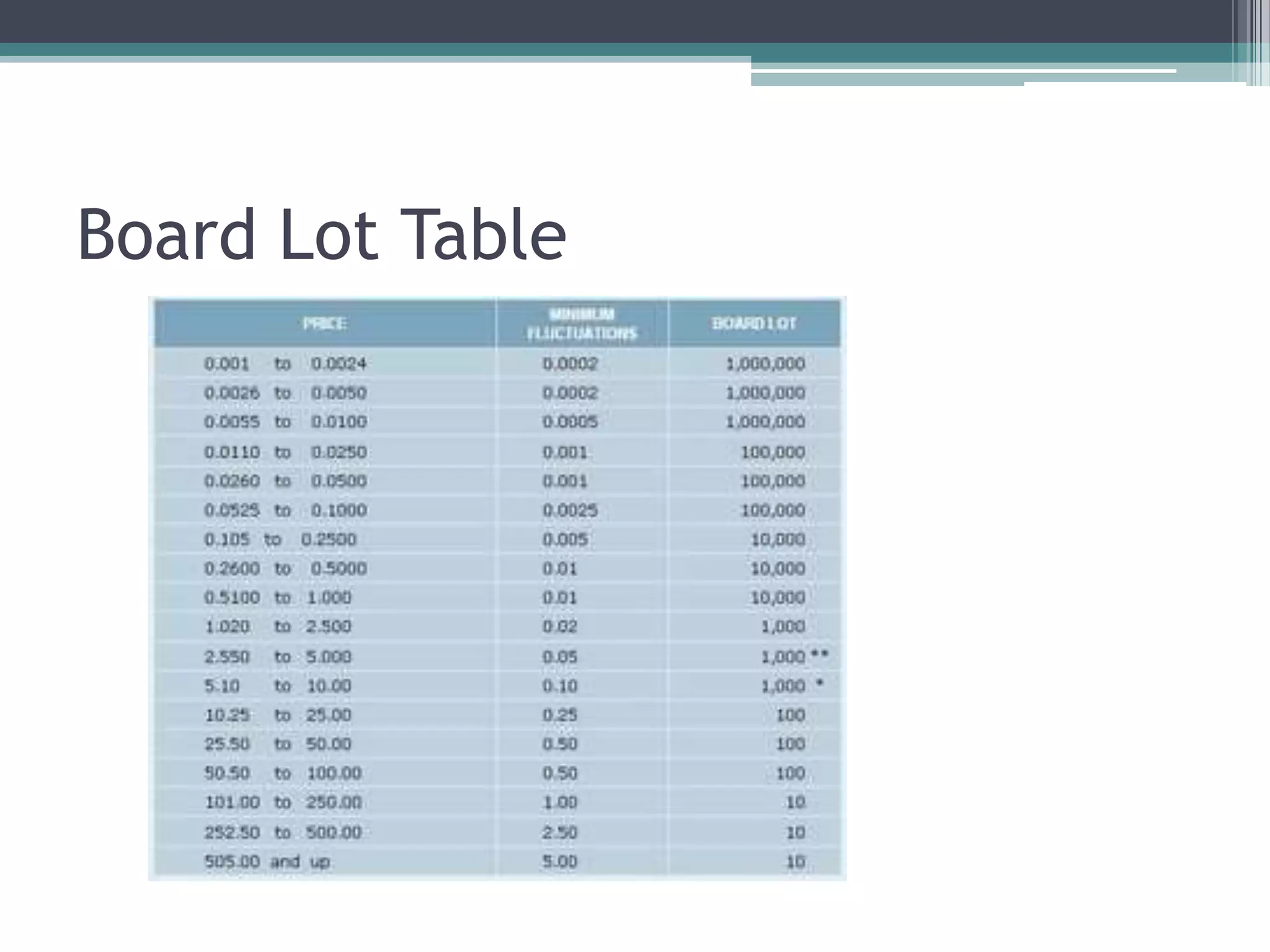
Equity trading is done by board
lot or round lot system. The
Board Lot Table determines the
minimum number of shares one
can purchase or sell at a specific
price range.
Therefore, the minimum amount
needed to invest in the stock
market varies and will depend on
the market price of the security as
well as its corresponding board
lot.
Prices of stocks move through a
scale of minimum price
fluctuations.
On the other hand, the minimum
amount of SDT-Bonds that an
investor can buy if PhP 5,000.00.
Board Lot Table
The following securities fees and
taxes (subject to change) are
levied on the investors:
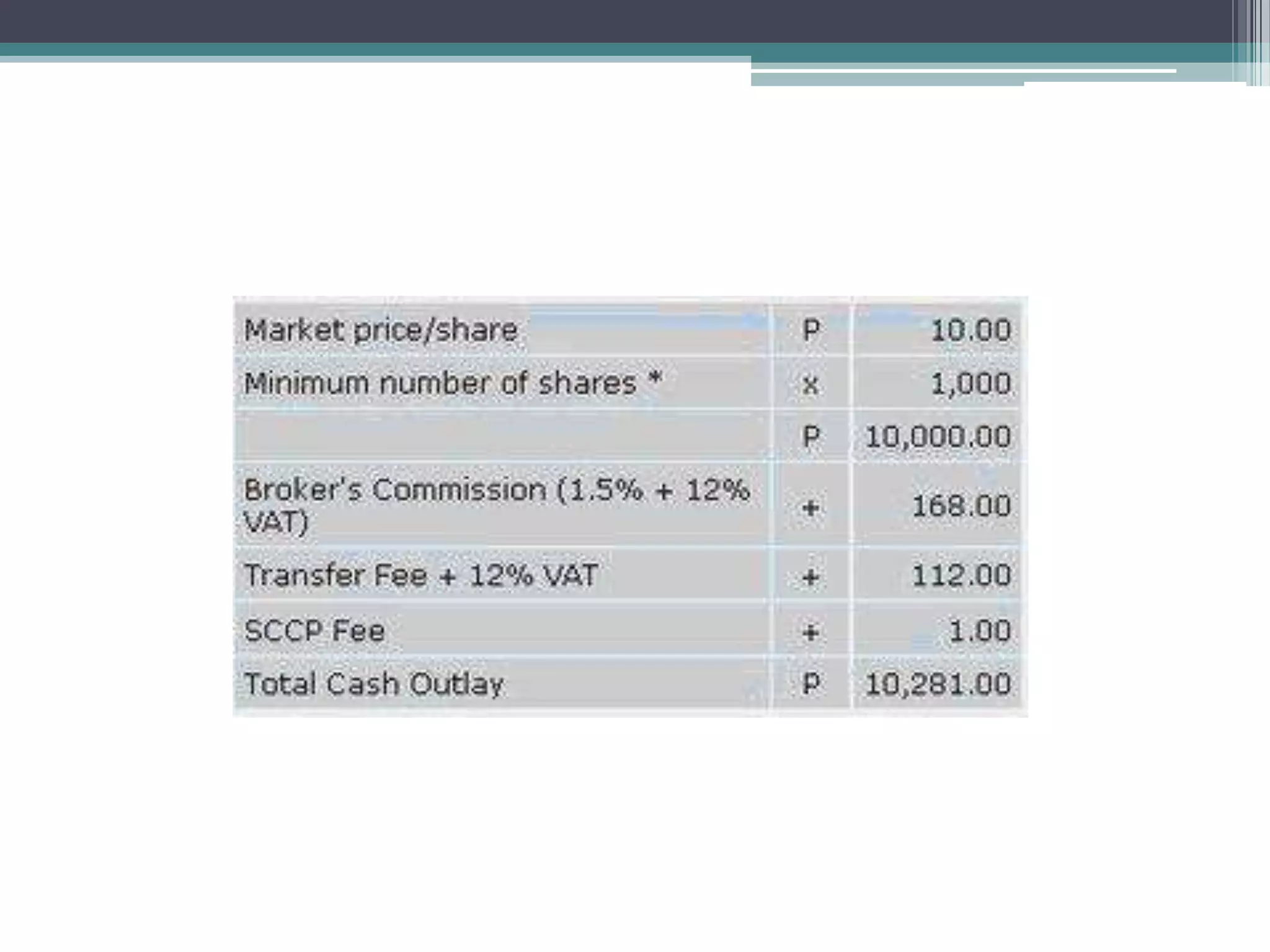
Buying Transaction:
Mr. X wishes to buy a stock whose
market price is P10.00 and with a
par value of P1.00. Based on the
Board Lot Table, the minimum
number of shares he can buy at a
regular transaction is 1,000
shares (a).
In this case, the amount that
he needs is about P10,000.00
plus charges. His required
cash outflow will be as follows:
Selling Transaction:
Mr. Y wishes to sell a stock whose
market price is P5.00 and with a
par value of P1.00. Based on the
Board Lot Table, the minimum
number of shares he can sell at a
regular transaction is 1,000 (b).
In this case, the proceeds of the
sale is about P5,000.00 less
charges. His cash inflow will be as
follows:
HOW CAN I PROFIT IN THE STOCK
MARKET?
•Capital Gains - These are
profits made due to an increase in
the market price of a stock from
the buying price.
•Cash Dividend - A dividend
given to shareholders in the form
of cash. It is computed by
multiplying the number of shares
held by the cash dividend rate
declared.
•Stock Dividend - A dividend
given to shareholders in the form
of additional stocks. It is
computed by multiplying the
number of shares held by the
percentage of the stock dividend
declared.
•Stock Rights - Stock rights
offering is the option given to the
present shareholders to buy
additional shares of stock at a
price lower than its market price.
SOURCE
http://investmentvehiclesforfilipinos.blogspot.co
m/2010/03/stocks-investment-philippine-
stock.html

Stocks and bonds

  • 1.
    Stocks and Bonds By:Love Leoann Duran 
  • 2.
    Stocks are sharesof ownership in a corporation. When you become a stockholder or shareholder of a company, you become part-owner of that company.
  • 3.
    Securities, on theother hand, are proof of one's ownership or indebtedness in a company.
  • 4.
    Example of Securities •Treasurybills •Commercial papers (short-term and traded in market) •Stocks and bonds (long-term and traded in capital market)
  • 5.
    Securities are easilybought and sold in the stock market.
  • 6.
    WHAT ARE THETYPES OF SECURITIES THAT I CAN BUY IN THE STOCK MARKET? 1. Common Stocks - These are usually purchased for participation in the profits and control of ownership and management of the company.
  • 7.
    Holders of commonstocks have voting rights.
  • 8.
    They are alsoentitled to an equal pro rata division of profits without preference or advantage over another stockholder. However, they have the last claim on dividends and are the last to collect in case of corporate liquidation.
  • 9.
    2. Preferred Stocks- Its name is derived from preference given to the holders of these stocks over holders of common stocks.
  • 10.
    Holders of preferredstocks are entitled to receive dividends, to the extent agreed upon, before any dividends are paid to the holders of common stocks.
  • 11.
    However, preferred stocksusually have a specified limited rate of return or dividend and a specified limited redemption and liquidation price.
  • 12.
    3. Warrants -A corporation can also raise additional capital by issuing warrants.
  • 13.
    A warrant, normallyissued on a detachable basis, allows its holders the right, but not the obligation, to subscribe to new shares at a set price during a specified period of time.
  • 14.
    It is usuallyprovided free of charge and traded separately in the securities market.
  • 15.
    4. Philippine Deposit Receipts(PDRs) - A PDR is a security which grants the holder the right to the delivery or sale of the underlying share, and to certain other rights
  • 16.
    PDRs are evidencesor statements nor certificates of ownership of a foreign/foreign-based corporation.
  • 17.
    5. Small-Demominated Treasury Bonds(SDT- Bonds) - The SDT Bonds are long-term and relatively risk-free debt securities issued by the Bureau of Treasury (BTr) of the Republic of the Philippines.
  • 18.
    The bond isa certificate of indebtedness of the Republic of the Philippines to the owner of the SDT-Bonds.
  • 19.
    WHERE CAN IBUY OR SELL SHARES OF STOCKS AND/OR BONDS? In the Philippines, the only operating stock exchange is the Philippine Stock Exchange (PSE). Its main function is to facilitate the buying and selling of stocks and other securities through its accredited trading participants.
  • 20.
    Individual clients buyor hold government bonds through common trust funds/unit investment trust funds, mutual funds, or pension plans.
  • 21.
    HOW ARE SHARESAND SDT-BONDS BOUGHT OR SOLD? If you wish to buy shares of stocks or SDT-Bonds, you must have a stockbroker who will do this for you.
  • 22.
    A stockbroker isa person or a corporation authorized and licensed by the Securities and Exchange Commission (SEC) and PSE to trade securities.
  • 23.
    WHAT IS THEMINIMUM AMOUNT NEEDED TO INVEST IN THE STOCK MARKET? Equity trading is done by board lot or round lot system. The Board Lot Table determines the minimum number of shares one can purchase or sell at a specific price range.
  • 24.
    Therefore, the minimumamount needed to invest in the stock market varies and will depend on the market price of the security as well as its corresponding board lot.
  • 25.
    Prices of stocksmove through a scale of minimum price fluctuations.
  • 26.
    On the otherhand, the minimum amount of SDT-Bonds that an investor can buy if PhP 5,000.00.
  • 27.
  • 28.
    The following securitiesfees and taxes (subject to change) are levied on the investors:
  • 29.
    Buying Transaction: Mr. Xwishes to buy a stock whose market price is P10.00 and with a par value of P1.00. Based on the Board Lot Table, the minimum number of shares he can buy at a regular transaction is 1,000 shares (a).
  • 30.
    In this case,the amount that he needs is about P10,000.00 plus charges. His required cash outflow will be as follows:
  • 32.
    Selling Transaction: Mr. Ywishes to sell a stock whose market price is P5.00 and with a par value of P1.00. Based on the Board Lot Table, the minimum number of shares he can sell at a regular transaction is 1,000 (b).
  • 33.
    In this case,the proceeds of the sale is about P5,000.00 less charges. His cash inflow will be as follows:
  • 35.
    HOW CAN IPROFIT IN THE STOCK MARKET? •Capital Gains - These are profits made due to an increase in the market price of a stock from the buying price.
  • 36.
    •Cash Dividend -A dividend given to shareholders in the form of cash. It is computed by multiplying the number of shares held by the cash dividend rate declared.
  • 37.
    •Stock Dividend -A dividend given to shareholders in the form of additional stocks. It is computed by multiplying the number of shares held by the percentage of the stock dividend declared.
  • 38.
    •Stock Rights -Stock rights offering is the option given to the present shareholders to buy additional shares of stock at a price lower than its market price.
  • 39.