

STAMFORD POWER
    MATRIX


    Prepared by,
    Nimmi Jayadevan
    MACFAST
• Research method designed to monitor and
  evaluate the progress and positions of
  companies in a specific, technology-based
  market.
• Also known as “The Gartner Magic Quadrant”.
• Developed by Gartner Inc., headquartered in
  Stamford, Connecticut US.
• Uses a visual, box display to show the
  strengths and differences between
  companies.

• The display divides competing businesses into
  four distinct sections, based on two business
  values, ie completeness of vision and ability
  to execute it.
• Ability to execute
 - reflects discipline and resources.
 - It measures the core competencies, financial
   strength and right strategic alliances.
• Completeness of vision
 - focus on creativity and inventiveness.
 - It measures a firm’s ability to lead and
   influence the direction of technology
   development.
POWER OF 2 X 2 MATRIX
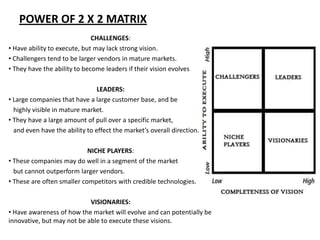
                              CHALLENGES:
• Have ability to execute, but may lack strong vision.
• Challengers tend to be larger vendors in mature markets.
• They have the ability to become leaders if their vision evolves

                                LEADERS:
• Large companies that have a large customer base, and be
  highly visible in mature market.
• They have a large amount of pull over a specific market,
  and even have the ability to effect the market’s overall direction.

                            NICHE PLAYERS:
• These companies may do well in a segment of the market
  but cannot outperform larger vendors.
• These are often smaller competitors with credible technologies.

                            VISIONARIES:
• Have awareness of how the market will evolve and can potentially be
innovative, but may not be able to execute these visions.
Steps…
• Define the problem
  -articulate the business issue intended to confront

• Create the matrix
  -focus on the dimensions

• Assess
  -Place all relevant industry players on the matrix.

• Follow up
  -Update the matrix following major announcements by
  players and new entrants.
Stmfrd pwr mtrx

Stmfrd pwr mtrx

  • 1.
    STAMFORD POWER MATRIX Prepared by, Nimmi Jayadevan MACFAST
  • 2.
    • Research methoddesigned to monitor and evaluate the progress and positions of companies in a specific, technology-based market. • Also known as “The Gartner Magic Quadrant”. • Developed by Gartner Inc., headquartered in Stamford, Connecticut US.
  • 3.
    • Uses avisual, box display to show the strengths and differences between companies. • The display divides competing businesses into four distinct sections, based on two business values, ie completeness of vision and ability to execute it.
  • 4.
    • Ability toexecute - reflects discipline and resources. - It measures the core competencies, financial strength and right strategic alliances. • Completeness of vision - focus on creativity and inventiveness. - It measures a firm’s ability to lead and influence the direction of technology development.
  • 5.
    POWER OF 2X 2 MATRIX CHALLENGES: • Have ability to execute, but may lack strong vision. • Challengers tend to be larger vendors in mature markets. • They have the ability to become leaders if their vision evolves LEADERS: • Large companies that have a large customer base, and be highly visible in mature market. • They have a large amount of pull over a specific market, and even have the ability to effect the market’s overall direction. NICHE PLAYERS: • These companies may do well in a segment of the market but cannot outperform larger vendors. • These are often smaller competitors with credible technologies. VISIONARIES: • Have awareness of how the market will evolve and can potentially be innovative, but may not be able to execute these visions.
  • 7.
    Steps… • Define theproblem -articulate the business issue intended to confront • Create the matrix -focus on the dimensions • Assess -Place all relevant industry players on the matrix. • Follow up -Update the matrix following major announcements by players and new entrants.