University	
   Teaching	
  Fellow,	
   Kwantlen	
   Polytechnic	
   University
Senior	
  Open	
  Education	
  Advocacy	
   &	
  Research	
  Fellow,	
   BCcampus
Rajiv	
  Jhangiani,	
  Ph.D.
@thatpsychprof
Psychology	
   Instructor,	
  Justice	
  Institute	
  of	
  British	
  Columbia
Sessional	
   Lecturer,	
  University	
   of	
  British	
  Columbia
Surita	
  Jhangiani,	
  Ph.D.
@SuritaJhangiani
Factors that influence
the selection of open
(and commercial)
educational resources
Jazmin	
  Quaynor/Unsplash
!
!
BCcampus)Research)Report)
!!
Prepared'by:'
Rajiv!S.!Jhangiani,!Ph.D.,!Kwantlen!Polytechnic!University!
Rebecca!Pitt,!Ph.D.,!OER!Hub!
Christina!Hendricks,!Ph.D.,!University!of!British!Columbia!
Jessie!Key,!Ph.D.,!Vancouver!Island!University!
Clint!Lalonde,!M.A.,!BCcampus!
EXPLORING)FACULTY)USE)OF)
OPEN)EDUCATIONAL)RESOURCES)
AT)BRITISH)COLUMBIA)POSTA
SECONDARY)INSTITUTIONS))
January!18,!2016!!
bit.ly/BC-OER-report
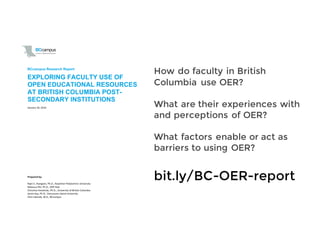
How do faculty in British
Columbia use OER?
What are their experiences with
and perceptions of OER?
What factors enable or act as
barriers to using OER?
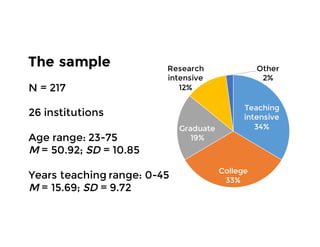
Teaching
intensive
34%
College
33%
Graduate
19%
Research
intensive
12%
Other
2%
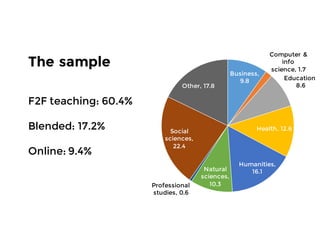
The sample
N = 217
26 institutions
Age range: 23-75
M = 50.92; SD = 10.85
Years teaching range: 0-45
M = 15.69; SD = 9.72
The sample
Business,
9.8
Computer &
info
science, 1.7
Education,
8.6
Health, 12.6
Humanities,
16.1Natural
sciences,
10.3Professional
studies, 0.6
Social
sciences,
22.4
Other, 17.8
F2F teaching: 60.4%
Blended: 17.2%
Online: 9.4%
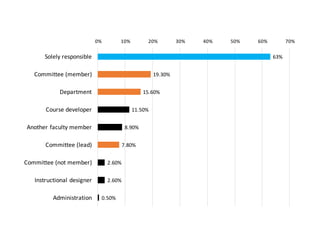
1. Who selects required
course materials?
63%
19.30%
15.60%
11.50%
8.90%
7.80%
2.60%
2.60%
0.50%
0% 10% 20% 30% 40% 50% 60% 70%
Solely	
  responsible
Committee	
  (member)
Department
Course	
  developer
Another	
  faculty	
  member
Committee	
  (lead)
Committee	
  (not	
  member)
Instructional	
  designer
Administration
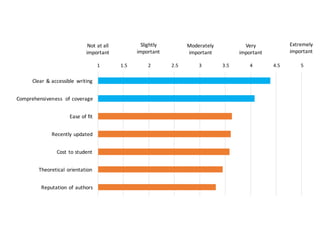
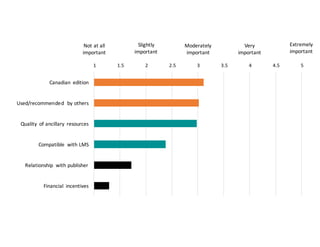
2. What factors influence
your selection of course
materials?
1 1.5 2 2.5 3 3.5 4 4.5 5
Clear	
  &	
  accessible	
   writing
Comprehensiveness	
   of	
  coverage
Ease	
  of	
  fit
Recently	
  updated
Cost	
  to	
  student
Theoretical	
  orientation
Reputation	
  of	
  authors
Not	
  at	
  all
important
Slightly
important
Moderately
important
Very
important
Extremely
important
1 1.5 2 2.5 3 3.5 4 4.5 5
Canadian	
   edition
Used/recommended	
   by	
  others
Quality	
   of	
  ancillary	
   resources
Compatible	
   with	
  LMS
Relationship	
   with	
  publisher
Financial	
   incentives
Not	
  at	
  all
important
Slightly
important
Moderately
important
Very
important
Extremely
important
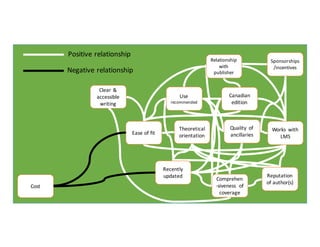
Cost
Recently	
  
updated Reputation	
  
of	
  author(s)
Comprehen
-­‐siveness of	
  
coverage
Theoretical	
  
orientationEase	
  of	
  fit
Quality	
   of	
  
ancillaries
Use	
  
recommended
Clear	
  &	
  
accessible	
  
writing
Canadian	
  
edition
Works	
   with	
  
LMS
Relationship	
  
with	
  
publisher
Sponsorships
/incentives
Positive	
  relationship
Negative	
  relationship
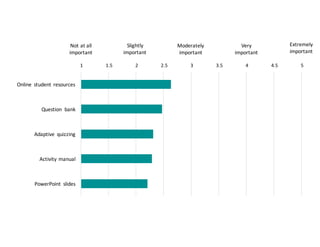
3. How important are
ancillary materials?
1 1.5 2 2.5 3 3.5 4 4.5 5
Online	
   student	
  resources
Question	
   bank
Adaptive	
   quizzing
Activity	
  manual
PowerPoint	
   slides
Not	
  at	
  all
important
Slightly
important
Moderately
important
Very
important
Extremely
important
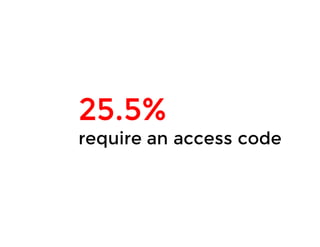
25.5%
require an access code
4. How often do you hear
from students about
textbook unaffordability?
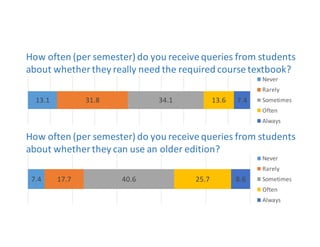
How	
  often	
  (per	
  semester)	
  do	
  you	
  receive	
  queries	
  from	
  students	
  
about	
  whether	
  they	
  really	
  need	
  the	
  required	
  course	
  textbook?
How	
  often	
  (per	
  semester)	
  do	
  you	
  receive	
  queries	
  from	
  students	
  
about	
  whether	
  they	
  can	
  use	
  an	
  older	
  edition?
13.1 31.8 34.1 13.6 7.4
Never
Rarely
Sometimes
Often
Always
7.4 17.7 40.6 25.7 8.6
Never
Rarely
Sometimes
Often
Always
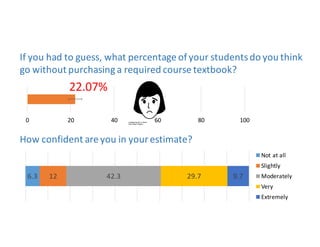
If	
  you	
  had	
  to	
  guess,	
  what	
  percentage	
  of	
  your	
  students	
  do	
  you	
  think	
  
go	
  without	
  purchasing	
  a	
  required	
  course	
  textbook?
How	
  confident	
  are	
  you	
  in	
  your	
  estimate?
0 20 40 60 80 100
22.07%
6.3 12 42.3 29.7 9.7
Not	
  at	
  all
Slightly
Moderately
Very
Extremely
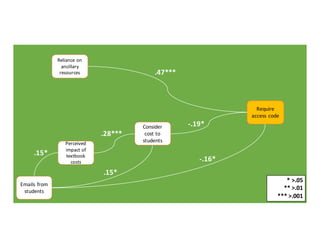
Require
access	
  code
Reliance	
  on	
  
ancillary	
  
resources
Consider	
  
cost	
  to	
  
studentsPerceived	
  
impact	
  of	
  
textbook	
  
costs
Emails	
  from	
  
students
.15*
.28***
-­‐.19*
.47***
*	
  >.05
**	
  >.01
***	
  >.001
.15*
-­‐.16*
5. How aware are you
of OER?
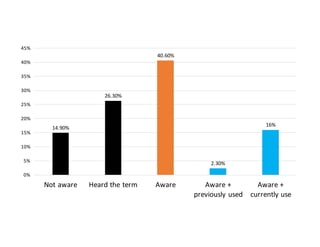
14.90%
26.30%
40.60%
2.30%
16%
0%
5%
10%
15%
20%
25%
30%
35%
40%
45%
Not	
  aware Heard	
  the	
  term Aware Aware	
  +	
  
previously	
  used
Aware	
  +	
  
currently	
  use
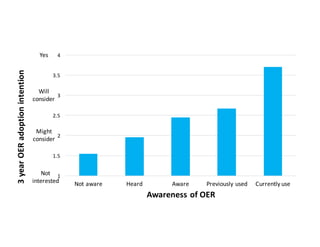
6. Do you think you will
adopt OER over the
next 3 years?
1
1.5
2
2.5
3
3.5
4
Not	
  aware Heard Aware Previously	
  used Currently	
  use
3	
  year	
  OER	
  adoption	
  intention
Awareness	
  of	
  OER
Yes
Will
consider
Might
consider
Not
interested
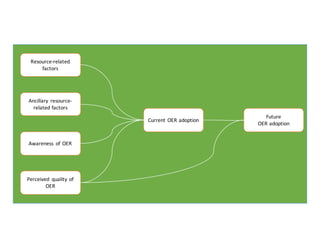
Predicting OER adoption:
A model
Resource-­‐related	
  
factors
Ancillary	
   resource-­‐
related	
  factors
Awareness	
   of	
  OER
Perceived	
   quality	
  of	
  
OER
Current	
  OER	
  adoption
Future
OER	
  adoption
@thatpsychprof
rajiv@kpu.ca
slideshare.net/thatpsychprofWWW
@SuritaJhangiani
sjhangiani@jibc.ca
Jonatan	
  Pie/Unsplash

STLHE 2017 presentation