www.crodalubricants.com
New Organic
Friction Modifiers for
Industrial Gear Oils
Paul Bonner
www.crodalubricants.com
Outline
• Industrial gear oil (IGO) applications and technologies
• Benefits of friction reduction in IGOs
• Tribological testing of new IGO friction modifier
• Demulsibility and elastomer testing
• Further testing planned
www.crodalubricants.com
Where are Industrial Gear Oils Used?
Wind turbines
Mining Mills (paper, textile, sugar)
Steel production
www.crodalubricants.com
Wind Turbines
• Wind turbine gearboxes experience very high
contact pressures (Average 2.5 GPa)
• This generates high temperatures which places a lot
of thermal stress on the lubricant
• Wind turbine failures can be
catastrophic and are usually
caused by failure of the lubricant
www.crodalubricants.com
Industrial Gearboxes
• The factories and mills where IGOs found are often hot and
humid where contamination is also a big issue
• Large gearboxes such as
those found in mills also
generate high torque values
• General trend is to smaller
gearboxes, higher loads and
more demand on the lubricant
and additives as the IGO runs
hotter
www.crodalubricants.com
Types of Gears
• Different gears experience different lubrication regimes
• Most gears are a mixed sliding/rolling contact
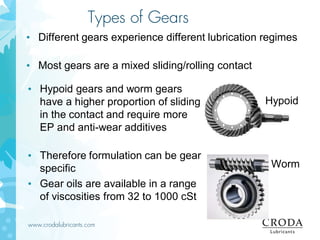
• Hypoid gears and worm gears
have a higher proportion of sliding
in the contact and require more
EP and anti-wear additives
• Therefore formulation can be gear
specific
• Gear oils are available in a range
of viscosities from 32 to 1000 cSt
Hypoid
Worm
www.crodalubricants.com
IGO Requirements
• Rejection of water – Water can
damage internal components
• Lower friction - Improved efficiency of
the gearbox
• Foam control – Foam inhibits film
formation
• Paint/Seal compatibility – Lubricant
must not degrade protective seals or
coatings
www.crodalubricants.com
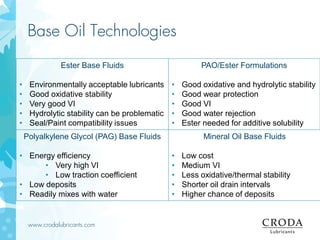
Base Oil Technologies
Ester Base Fluids
• Environmentally acceptable lubricants
• Good oxidative stability
• Very good VI
• Hydrolytic stability can be problematic
• Seal/Paint compatibility issues
PAO/Ester Formulations
• Good oxidative and hydrolytic stability
• Good wear protection
• Good VI
• Good water rejection
• Ester needed for additive solubility
Polyalkylene Glycol (PAG) Base Fluids
• Energy efficiency
• Very high VI
• Low traction coefficient
• Low deposits
• Readily mixes with water
Mineral Oil Base Fluids
• Low cost
• Medium VI
• Less oxidative/thermal stability
• Shorter oil drain intervals
• Higher chance of deposits
www.crodalubricants.com
Friction Modifiers
• A reduction in friction is desirable as it reduces oil
sump temperatures (Even more important in smaller
gearboxes with less oil)
• This leads to less thinning of the lubricant and a thicker
oil film which helps to prevent wear
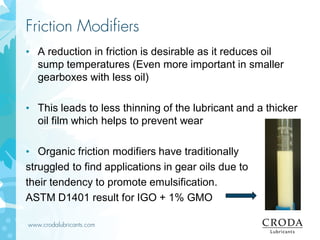
• Organic friction modifiers have traditionally
struggled to find applications in gear oils due to
their tendency to promote emulsification.
ASTM D1401 result for IGO + 1% GMO
www.crodalubricants.com
“IGO – FM”
• IGO-FM is a new friction modifier for IGOs that has the
following advantages over conventional chemistries:
• Fully saturated - thermally and oxidatively stable
• Low impact on emulsification properties
• Sulphur, ash and phosphorus-free
• Strong reductions in friction at high temperatures and high loads
• IGO-FM is compliant with all major global inventories
www.crodalubricants.com
Typical Physical Properties
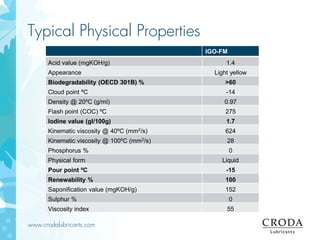
IGO-FM
Acid value (mgKOH/g) 1.4
Appearance Light yellow
Biodegradability (OECD 301B) % >60
Cloud point ºC -14
Density @ 20ºC (g/ml) 0.97
Flash point (COC) ºC 275
Iodine value (gl/100g) 1.7
Kinematic viscosity @ 40ºC (mm2/s) 624
Kinematic viscosity @ 100ºC (mm2/s) 28
Phosphorus % 0
Physical form Liquid
Pour point ºC -15
Renewability % 100
Saponification value (mgKOH/g) 152
Sulphur % 0
Viscosity index 55
www.crodalubricants.com
Performance Testing
• Tribological Testing
• MTM
• Stribeck curves (Friction vs speed)
• Variable load test (Friction vs contact pressure)
• HFRR
• Demulsification
• ASTM D1401
www.crodalubricants.com
Testing formulations
• All testing done with commercially available additive
packages
• All initial screening tests: PAO + 10% ester + 1.65% commercially
available additive package to the viscosity quoted
www.crodalubricants.com
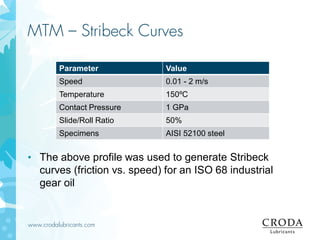
MTM – Stribeck Curves
• The above profile was used to generate Stribeck
curves (friction vs. speed) for an ISO 68 industrial
gear oil
Parameter Value
Speed 0.01 - 2 m/s
Temperature 150ºC
Contact Pressure 1 GPa
Slide/Roll Ratio 50%
Specimens AISI 52100 steel
www.crodalubricants.com
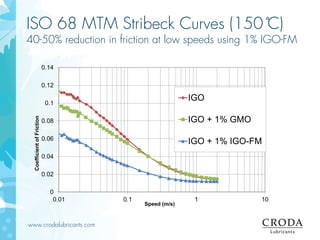
ISO 68 MTM Stribeck Curves (150 ̊C)
40-50% reduction in friction at low speeds using 1% IGO-FM
0
0.02
0.04
0.06
0.08
0.1
0.12
0.14
0.01 0.1 1 10
CoefficientofFriction
Speed (m/s)
IGO
IGO + 1% GMO
IGO + 1% IGO-FM
www.crodalubricants.com
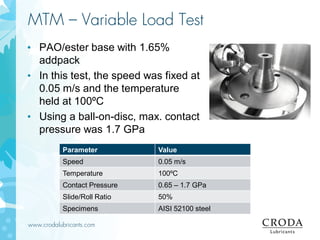
MTM – Variable Load Test
• PAO/ester base with 1.65%
addpack
• In this test, the speed was fixed at
0.05 m/s and the temperature
held at 100ºC
• Using a ball-on-disc, max. contact
pressure was 1.7 GPa
Parameter Value
Speed 0.05 m/s
Temperature 100ºC
Contact Pressure 0.65 – 1.7 GPa
Slide/Roll Ratio 50%
Specimens AISI 52100 steel
www.crodalubricants.com
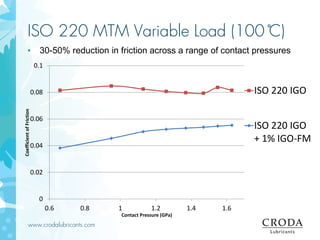
ISO 220 MTM Variable Load (100 ̊C)
• 30-50% reduction in friction across a range of contact pressures
0
0.02
0.04
0.06
0.08
0.1
0.6 0.8 1 1.2 1.4 1.6
CoefficientofFriction
Contact Pressure (GPa)
ISO 220 IGO
ISO 220 IGO
+ 1% IGO-FM
www.crodalubricants.com
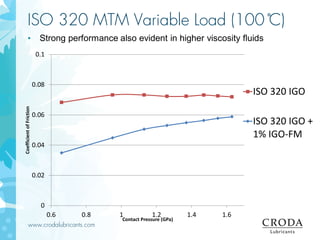
ISO 320 MTM Variable Load (100 ̊C)
• Strong performance also evident in higher viscosity fluids
0
0.02
0.04
0.06
0.08
0.1
0.6 0.8 1 1.2 1.4 1.6
CoefficientofFriction
Contact Pressure (GPa)
ISO 320 IGO
ISO 320 IGO +
1% IGO-FM
www.crodalubricants.com
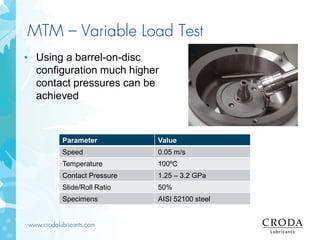
MTM – Variable Load Test
• Using a barrel-on-disc
configuration much higher
contact pressures can be
achieved
Parameter Value
Speed 0.05 m/s
Temperature 100ºC
Contact Pressure 1.25 – 3.2 GPa
Slide/Roll Ratio 50%
Specimens AISI 52100 steel
www.crodalubricants.com
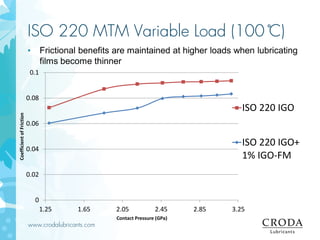
ISO 220 MTM Variable Load (100 ̊C)
• Frictional benefits are maintained at higher loads when lubricating
films become thinner
0
0.02
0.04
0.06
0.08
0.1
1.25 1.65 2.05 2.45 2.85 3.25
CoefficientofFriction
Contact Pressure (GPa)
ISO 220 IGO
ISO 220 IGO+
1% IGO-FM
www.crodalubricants.com
ISO 320 MTM Variable Load (100 ̊C)
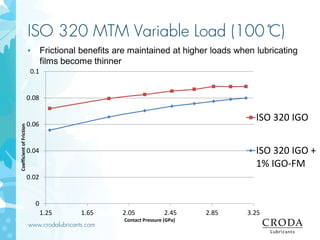
• Frictional benefits are maintained at higher loads when lubricating
films become thinner
0
0.02
0.04
0.06
0.08
0.1
1.25 1.65 2.05 2.45 2.85 3.25
CoefficientofFriction
Contact Pressure (GPa)
ISO 320 IGO
ISO 320 IGO +
1% IGO-FM
www.crodalubricants.com
MTM Variable Load Test Summary
• Performance demonstrated in both ISO 220 and ISO
320 fluids
• Excellent performance at low loads / contact pressures
• Performance maintained at high loads
• Significant for heavily loaded gear systems such as wind
turbines, which can experience contact pressures around
2.5 GPa
www.crodalubricants.com
HFRR Testing Profile
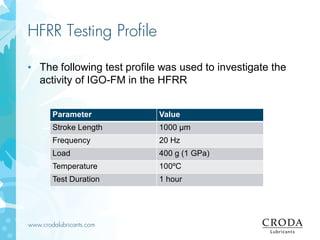
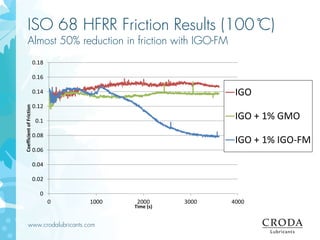
• The following test profile was used to investigate the
activity of IGO-FM in the HFRR
Parameter Value
Stroke Length 1000 µm
Frequency 20 Hz
Load 400 g (1 GPa)
Temperature 100ºC
Test Duration 1 hour
www.crodalubricants.com
ISO 68 HFRR Friction Results (100 ̊C)
Almost 50% reduction in friction with IGO-FM
0
0.02
0.04
0.06
0.08
0.1
0.12
0.14
0.16
0.18
0 1000 2000 3000 4000
CoefficientofFriction
Time (s)
IGO
IGO + 1% GMO
IGO + 1% IGO-FM
www.crodalubricants.com
HFRR Wear Scar Results
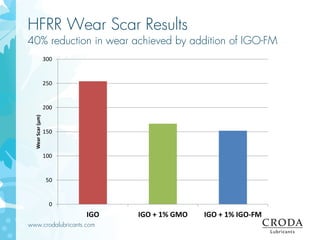
40% reduction in wear achieved by addition of IGO-FM
0
50
100
150
200
250
300
IGO IGO + 1% GMO IGO + 1% IGO-FM
WearScar(µm)
www.crodalubricants.com
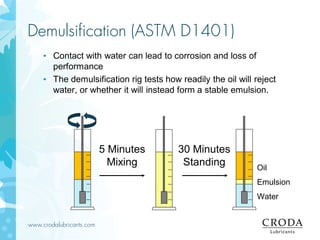
Demulsification (ASTM D1401)
• Contact with water can lead to corrosion and loss of
performance
• The demulsification rig tests how readily the oil will reject
water, or whether it will instead form a stable emulsion.
5 Minutes
Mixing
30 Minutes
Standing Oil
Emulsion
Water
www.crodalubricants.com
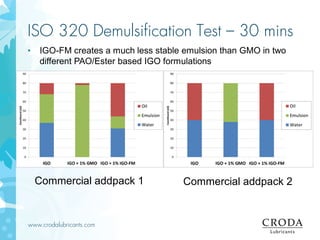
ISO 320 Demulsification Test – 30 mins
• IGO-FM creates a much less stable emulsion than GMO in two
different PAO/Ester based IGO formulations
Commercial addpack 1 Commercial addpack 2
www.crodalubricants.com
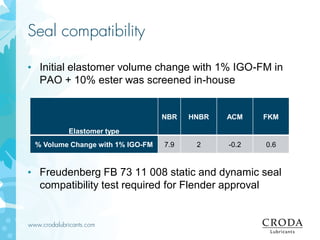
Seal compatibility
• Initial elastomer volume change with 1% IGO-FM in
PAO + 10% ester was screened in-house
• Freudenberg FB 73 11 008 static and dynamic seal
compatibility test required for Flender approval
Elastomer type
NBR HNBR ACM FKM
% Volume Change with 1% IGO-FM 7.9 2 -0.2 0.6
www.crodalubricants.com
Ester base
www.crodalubricants.com
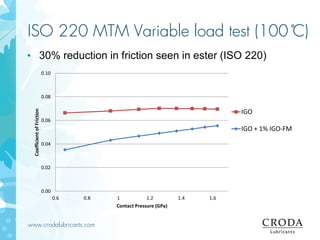
ISO 220 MTM Variable load test (100 ̊C)
• 30% reduction in friction seen in ester (ISO 220)
0.00
0.02
0.04
0.06
0.08
0.10
0.6 0.8 1 1.2 1.4 1.6
CoefficientofFriction
Contact Pressure (GPa)
IGO
IGO + 1% IGO-FM
www.crodalubricants.com
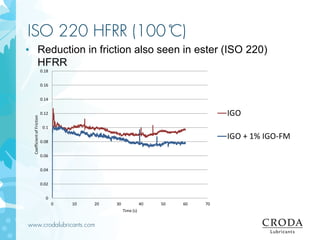
ISO 220 HFRR (100 ̊C)
• Reduction in friction also seen in ester (ISO 220)
HFRR
0
0.02
0.04
0.06
0.08
0.1
0.12
0.14
0.16
0.18
0 10 20 30 40 50 60 70
CoefficientofFriction
Time (s)
IGO
IGO + 1% IGO-FM
www.crodalubricants.com
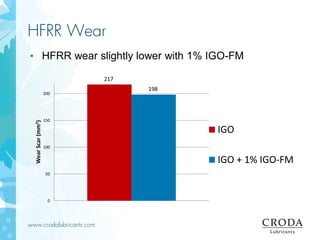
HFRR Wear
217
198
0
50
100
150
200
WearScar(mm2)
IGO
IGO + 1% IGO-FM
• HFRR wear slightly lower with 1% IGO-FM
www.crodalubricants.com
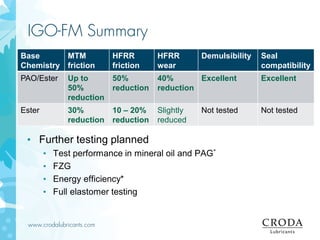
IGO-FM Summary
Base
Chemistry
MTM
friction
HFRR
friction
HFRR
wear
Demulsibility Seal
compatibility
PAO/Ester Up to
50%
reduction
50%
reduction
40%
reduction
Excellent Excellent
Ester 30%
reduction
10 – 20%
reduction
Slightly
reduced
Not tested Not tested
• Further testing planned
• Test performance in mineral oil and PAG*
• FZG
• Energy efficiency*
• Full elastomer testing

STLE 2014 Paul Bonner Croda - Perfad 3100 initial results

  • 1.
    www.crodalubricants.com New Organic Friction Modifiersfor Industrial Gear Oils Paul Bonner
  • 2.
    www.crodalubricants.com Outline • Industrial gearoil (IGO) applications and technologies • Benefits of friction reduction in IGOs • Tribological testing of new IGO friction modifier • Demulsibility and elastomer testing • Further testing planned
  • 3.
    www.crodalubricants.com Where are IndustrialGear Oils Used? Wind turbines Mining Mills (paper, textile, sugar) Steel production
  • 4.
    www.crodalubricants.com Wind Turbines • Windturbine gearboxes experience very high contact pressures (Average 2.5 GPa) • This generates high temperatures which places a lot of thermal stress on the lubricant • Wind turbine failures can be catastrophic and are usually caused by failure of the lubricant
  • 5.
    www.crodalubricants.com Industrial Gearboxes • Thefactories and mills where IGOs found are often hot and humid where contamination is also a big issue • Large gearboxes such as those found in mills also generate high torque values • General trend is to smaller gearboxes, higher loads and more demand on the lubricant and additives as the IGO runs hotter
  • 6.
    www.crodalubricants.com Types of Gears •Different gears experience different lubrication regimes • Most gears are a mixed sliding/rolling contact • Hypoid gears and worm gears have a higher proportion of sliding in the contact and require more EP and anti-wear additives • Therefore formulation can be gear specific • Gear oils are available in a range of viscosities from 32 to 1000 cSt Hypoid Worm
  • 7.
    www.crodalubricants.com IGO Requirements • Rejectionof water – Water can damage internal components • Lower friction - Improved efficiency of the gearbox • Foam control – Foam inhibits film formation • Paint/Seal compatibility – Lubricant must not degrade protective seals or coatings
  • 8.
    www.crodalubricants.com Base Oil Technologies EsterBase Fluids • Environmentally acceptable lubricants • Good oxidative stability • Very good VI • Hydrolytic stability can be problematic • Seal/Paint compatibility issues PAO/Ester Formulations • Good oxidative and hydrolytic stability • Good wear protection • Good VI • Good water rejection • Ester needed for additive solubility Polyalkylene Glycol (PAG) Base Fluids • Energy efficiency • Very high VI • Low traction coefficient • Low deposits • Readily mixes with water Mineral Oil Base Fluids • Low cost • Medium VI • Less oxidative/thermal stability • Shorter oil drain intervals • Higher chance of deposits
  • 9.
    www.crodalubricants.com Friction Modifiers • Areduction in friction is desirable as it reduces oil sump temperatures (Even more important in smaller gearboxes with less oil) • This leads to less thinning of the lubricant and a thicker oil film which helps to prevent wear • Organic friction modifiers have traditionally struggled to find applications in gear oils due to their tendency to promote emulsification. ASTM D1401 result for IGO + 1% GMO
  • 10.
    www.crodalubricants.com “IGO – FM” •IGO-FM is a new friction modifier for IGOs that has the following advantages over conventional chemistries: • Fully saturated - thermally and oxidatively stable • Low impact on emulsification properties • Sulphur, ash and phosphorus-free • Strong reductions in friction at high temperatures and high loads • IGO-FM is compliant with all major global inventories
  • 11.
    www.crodalubricants.com Typical Physical Properties IGO-FM Acidvalue (mgKOH/g) 1.4 Appearance Light yellow Biodegradability (OECD 301B) % >60 Cloud point ºC -14 Density @ 20ºC (g/ml) 0.97 Flash point (COC) ºC 275 Iodine value (gl/100g) 1.7 Kinematic viscosity @ 40ºC (mm2/s) 624 Kinematic viscosity @ 100ºC (mm2/s) 28 Phosphorus % 0 Physical form Liquid Pour point ºC -15 Renewability % 100 Saponification value (mgKOH/g) 152 Sulphur % 0 Viscosity index 55
  • 12.
    www.crodalubricants.com Performance Testing • TribologicalTesting • MTM • Stribeck curves (Friction vs speed) • Variable load test (Friction vs contact pressure) • HFRR • Demulsification • ASTM D1401
  • 13.
    www.crodalubricants.com Testing formulations • Alltesting done with commercially available additive packages • All initial screening tests: PAO + 10% ester + 1.65% commercially available additive package to the viscosity quoted
  • 14.
    www.crodalubricants.com MTM – StribeckCurves • The above profile was used to generate Stribeck curves (friction vs. speed) for an ISO 68 industrial gear oil Parameter Value Speed 0.01 - 2 m/s Temperature 150ºC Contact Pressure 1 GPa Slide/Roll Ratio 50% Specimens AISI 52100 steel
  • 15.
    www.crodalubricants.com ISO 68 MTMStribeck Curves (150 ̊C) 40-50% reduction in friction at low speeds using 1% IGO-FM 0 0.02 0.04 0.06 0.08 0.1 0.12 0.14 0.01 0.1 1 10 CoefficientofFriction Speed (m/s) IGO IGO + 1% GMO IGO + 1% IGO-FM
  • 16.
    www.crodalubricants.com MTM – VariableLoad Test • PAO/ester base with 1.65% addpack • In this test, the speed was fixed at 0.05 m/s and the temperature held at 100ºC • Using a ball-on-disc, max. contact pressure was 1.7 GPa Parameter Value Speed 0.05 m/s Temperature 100ºC Contact Pressure 0.65 – 1.7 GPa Slide/Roll Ratio 50% Specimens AISI 52100 steel
  • 17.
    www.crodalubricants.com ISO 220 MTMVariable Load (100 ̊C) • 30-50% reduction in friction across a range of contact pressures 0 0.02 0.04 0.06 0.08 0.1 0.6 0.8 1 1.2 1.4 1.6 CoefficientofFriction Contact Pressure (GPa) ISO 220 IGO ISO 220 IGO + 1% IGO-FM
  • 18.
    www.crodalubricants.com ISO 320 MTMVariable Load (100 ̊C) • Strong performance also evident in higher viscosity fluids 0 0.02 0.04 0.06 0.08 0.1 0.6 0.8 1 1.2 1.4 1.6 CoefficientofFriction Contact Pressure (GPa) ISO 320 IGO ISO 320 IGO + 1% IGO-FM
  • 19.
    www.crodalubricants.com MTM – VariableLoad Test • Using a barrel-on-disc configuration much higher contact pressures can be achieved Parameter Value Speed 0.05 m/s Temperature 100ºC Contact Pressure 1.25 – 3.2 GPa Slide/Roll Ratio 50% Specimens AISI 52100 steel
  • 20.
    www.crodalubricants.com ISO 220 MTMVariable Load (100 ̊C) • Frictional benefits are maintained at higher loads when lubricating films become thinner 0 0.02 0.04 0.06 0.08 0.1 1.25 1.65 2.05 2.45 2.85 3.25 CoefficientofFriction Contact Pressure (GPa) ISO 220 IGO ISO 220 IGO+ 1% IGO-FM
  • 21.
    www.crodalubricants.com ISO 320 MTMVariable Load (100 ̊C) • Frictional benefits are maintained at higher loads when lubricating films become thinner 0 0.02 0.04 0.06 0.08 0.1 1.25 1.65 2.05 2.45 2.85 3.25 CoefficientofFriction Contact Pressure (GPa) ISO 320 IGO ISO 320 IGO + 1% IGO-FM
  • 22.
    www.crodalubricants.com MTM Variable LoadTest Summary • Performance demonstrated in both ISO 220 and ISO 320 fluids • Excellent performance at low loads / contact pressures • Performance maintained at high loads • Significant for heavily loaded gear systems such as wind turbines, which can experience contact pressures around 2.5 GPa
  • 23.
    www.crodalubricants.com HFRR Testing Profile •The following test profile was used to investigate the activity of IGO-FM in the HFRR Parameter Value Stroke Length 1000 µm Frequency 20 Hz Load 400 g (1 GPa) Temperature 100ºC Test Duration 1 hour
  • 24.
    www.crodalubricants.com ISO 68 HFRRFriction Results (100 ̊C) Almost 50% reduction in friction with IGO-FM 0 0.02 0.04 0.06 0.08 0.1 0.12 0.14 0.16 0.18 0 1000 2000 3000 4000 CoefficientofFriction Time (s) IGO IGO + 1% GMO IGO + 1% IGO-FM
  • 25.
    www.crodalubricants.com HFRR Wear ScarResults 40% reduction in wear achieved by addition of IGO-FM 0 50 100 150 200 250 300 IGO IGO + 1% GMO IGO + 1% IGO-FM WearScar(µm)
  • 26.
    www.crodalubricants.com Demulsification (ASTM D1401) •Contact with water can lead to corrosion and loss of performance • The demulsification rig tests how readily the oil will reject water, or whether it will instead form a stable emulsion. 5 Minutes Mixing 30 Minutes Standing Oil Emulsion Water
  • 27.
    www.crodalubricants.com ISO 320 DemulsificationTest – 30 mins • IGO-FM creates a much less stable emulsion than GMO in two different PAO/Ester based IGO formulations Commercial addpack 1 Commercial addpack 2
  • 28.
    www.crodalubricants.com Seal compatibility • Initialelastomer volume change with 1% IGO-FM in PAO + 10% ester was screened in-house • Freudenberg FB 73 11 008 static and dynamic seal compatibility test required for Flender approval Elastomer type NBR HNBR ACM FKM % Volume Change with 1% IGO-FM 7.9 2 -0.2 0.6
  • 29.
  • 30.
    www.crodalubricants.com ISO 220 MTMVariable load test (100 ̊C) • 30% reduction in friction seen in ester (ISO 220) 0.00 0.02 0.04 0.06 0.08 0.10 0.6 0.8 1 1.2 1.4 1.6 CoefficientofFriction Contact Pressure (GPa) IGO IGO + 1% IGO-FM
  • 31.
    www.crodalubricants.com ISO 220 HFRR(100 ̊C) • Reduction in friction also seen in ester (ISO 220) HFRR 0 0.02 0.04 0.06 0.08 0.1 0.12 0.14 0.16 0.18 0 10 20 30 40 50 60 70 CoefficientofFriction Time (s) IGO IGO + 1% IGO-FM
  • 32.
  • 33.
    www.crodalubricants.com IGO-FM Summary Base Chemistry MTM friction HFRR friction HFRR wear Demulsibility Seal compatibility PAO/EsterUp to 50% reduction 50% reduction 40% reduction Excellent Excellent Ester 30% reduction 10 – 20% reduction Slightly reduced Not tested Not tested • Further testing planned • Test performance in mineral oil and PAG* • FZG • Energy efficiency* • Full elastomer testing