ISO Stitch Terminology AMERICAN & EFIRD, INC Page 1 of 4
Stitch Drawing
Top View As Sewn Bottom View As Sewn
ISO 4915
Number
Common
Application Requirements Stitch Description
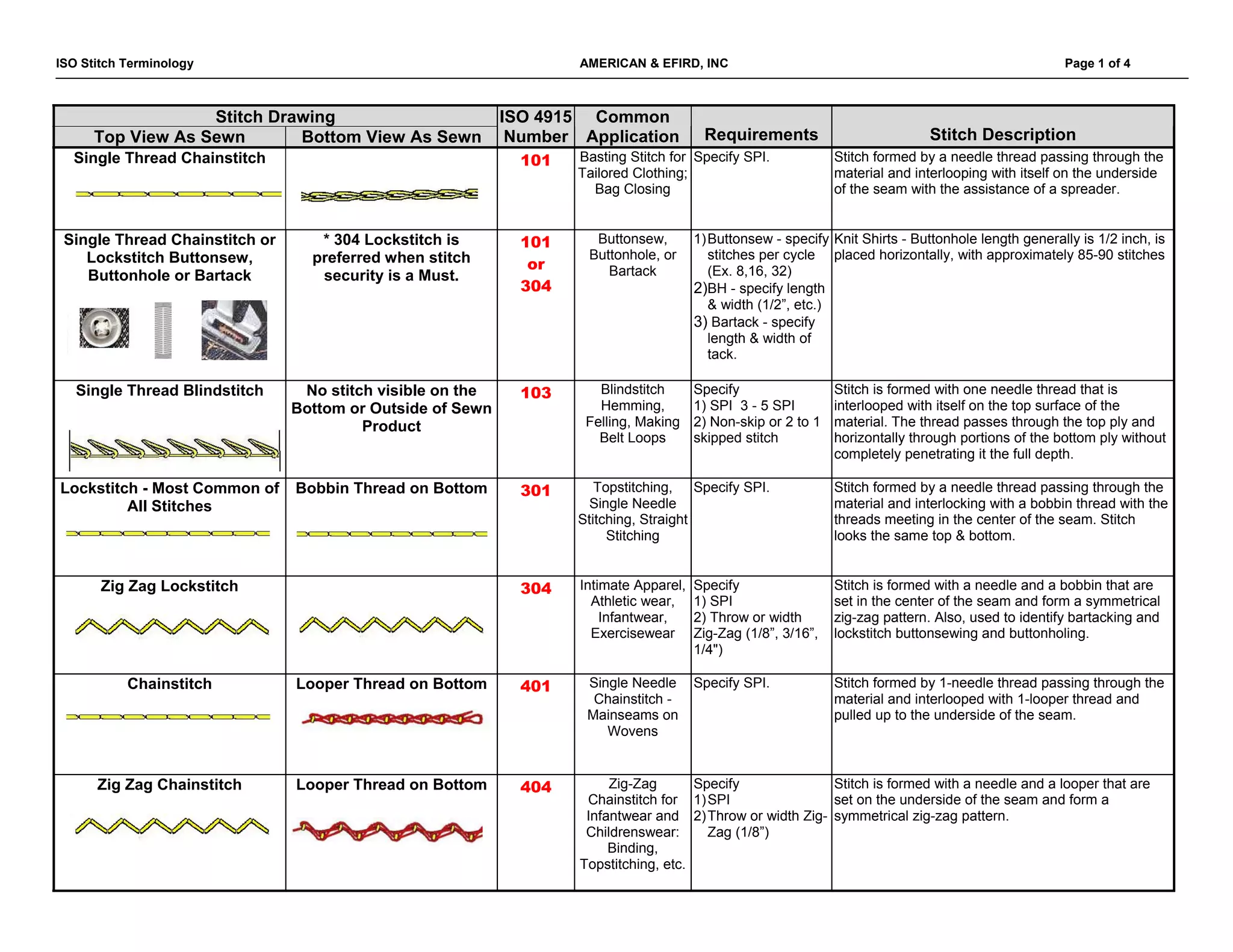
Single Thread Chainstitch 101 Basting Stitch for
Tailored Clothing;
Bag Closing
Specify SPI. Stitch formed by a needle thread passing through the
material and interlooping with itself on the underside
of the seam with the assistance of a spreader.
Single Thread Chainstitch or
Lockstitch Buttonsew,
Buttonhole or Bartack
* 304 Lockstitch is
preferred when stitch
security is a Must.
101
or
304
Buttonsew,
Buttonhole, or
Bartack
1)Buttonsew - specify
stitches per cycle
(Ex. 8,16, 32)
2)BH - specify length
& width (1/2”, etc.)
3) Bartack - specify
length & width of
tack.
Knit Shirts - Buttonhole length generally is 1/2 inch, is
placed horizontally, with approximately 85-90 stitches
Single Thread Blindstitch No stitch visible on the
Bottom or Outside of Sewn
Product
103 Blindstitch
Hemming,
Felling, Making
Belt Loops
Specify
1) SPI 3 - 5 SPI
2) Non-skip or 2 to 1
skipped stitch
Stitch is formed with one needle thread that is
interlooped with itself on the top surface of the
material. The thread passes through the top ply and
horizontally through portions of the bottom ply without
completely penetrating it the full depth.
Lockstitch - Most Common of
All Stitches
Bobbin Thread on Bottom 301 Topstitching,
Single Needle
Stitching, Straight
Stitching
Specify SPI. Stitch formed by a needle thread passing through the
material and interlocking with a bobbin thread with the
threads meeting in the center of the seam. Stitch
looks the same top & bottom.
Zig Zag Lockstitch 304 Intimate Apparel,
Athletic wear,
Infantwear,
Exercisewear
Specify
1) SPI
2) Throw or width
Zig-Zag (1/8”, 3/16”,
1/4")
Stitch is formed with a needle and a bobbin that are
set in the center of the seam and form a symmetrical
zig-zag pattern. Also, used to identify bartacking and
lockstitch buttonsewing and buttonholing.
Chainstitch Looper Thread on Bottom 401 Single Needle
Chainstitch -
Mainseams on
Wovens
Specify SPI. Stitch formed by 1-needle thread passing through the
material and interlooped with 1-looper thread and
pulled up to the underside of the seam.
Zig Zag Chainstitch Looper Thread on Bottom 404 Zig-Zag
Chainstitch for
Infantwear and
Childrenswear:
Binding,
Topstitching, etc.
Specify
1)SPI
2)Throw or width Zig-
Zag (1/8”)
Stitch is formed with a needle and a looper that are
set on the underside of the seam and form a
symmetrical zig-zag pattern.
American & Efird, Inc. 2006. All International Rights Reserved.
ISO Stitch Terminology AMERICAN & EFIRD, INC Page 2 of 4
Stitch Drawing
Top View As Sewn Bottom View As Sewn
ISO 4915
Number
Common
Application Requirements Stitch Description
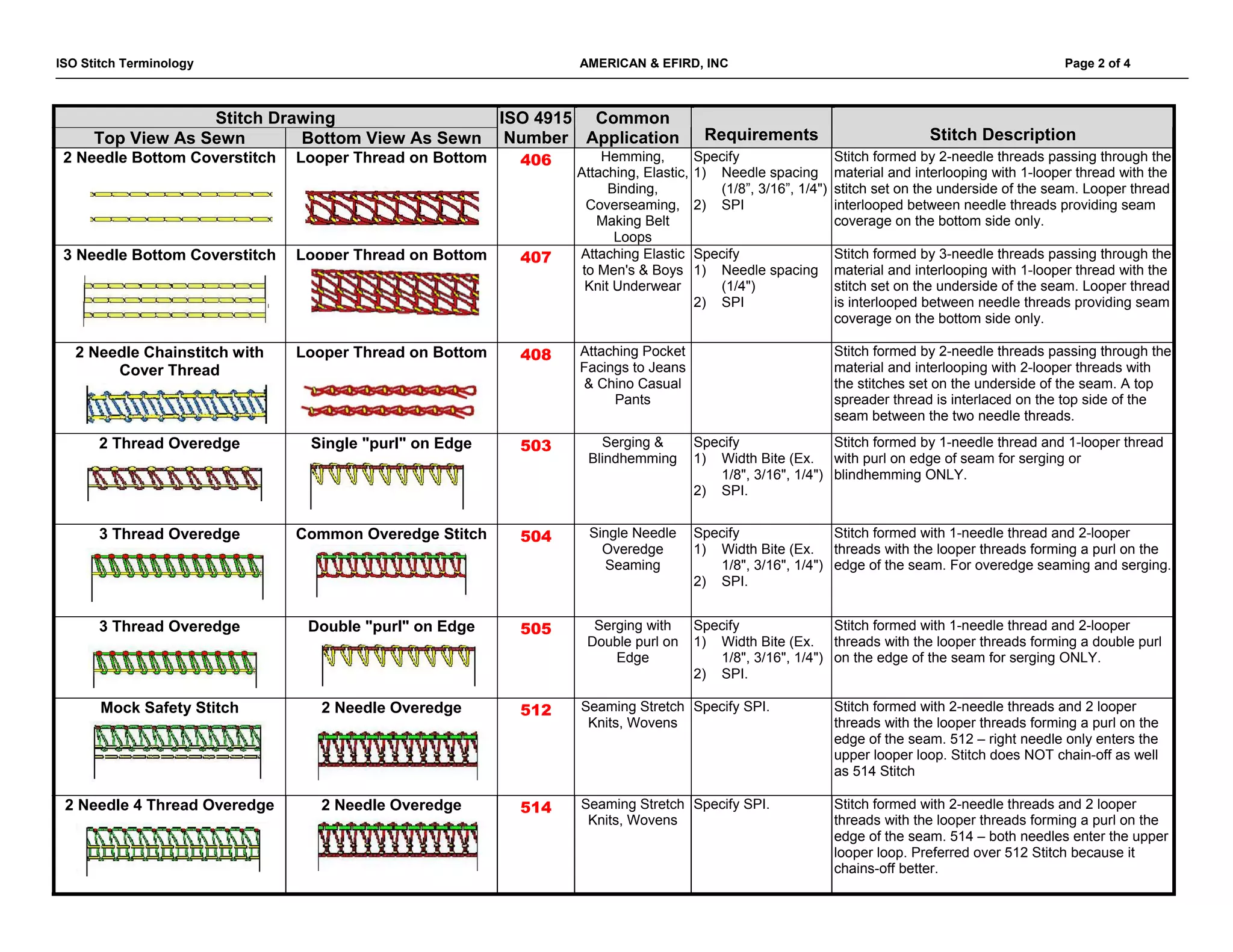
2 Needle Bottom Coverstitch Looper Thread on Bottom 406 Hemming,
Attaching, Elastic,
Binding,
Coverseaming,
Making Belt
Loops
Specify
1) Needle spacing
(1/8”, 3/16”, 1/4")
2) SPI
Stitch formed by 2-needle threads passing through the
material and interlooping with 1-looper thread with the
stitch set on the underside of the seam. Looper thread
interlooped between needle threads providing seam
coverage on the bottom side only.
3 Needle Bottom Coverstitch Looper Thread on Bottom 407 Attaching Elastic
to Men's & Boys
Knit Underwear
Specify
1) Needle spacing
(1/4")
2) SPI
Stitch formed by 3-needle threads passing through the
material and interlooping with 1-looper thread with the
stitch set on the underside of the seam. Looper thread
is interlooped between needle threads providing seam
coverage on the bottom side only.
2 Needle Chainstitch with
Cover Thread
Looper Thread on Bottom 408 Attaching Pocket
Facings to Jeans
& Chino Casual
Pants
Stitch formed by 2-needle threads passing through the
material and interlooping with 2-looper threads with
the stitches set on the underside of the seam. A top
spreader thread is interlaced on the top side of the
seam between the two needle threads.
2 Thread Overedge Single "purl" on Edge 503 Serging &
Blindhemming
Specify
1) Width Bite (Ex.
1/8", 3/16", 1/4")
2) SPI.
Stitch formed by 1-needle thread and 1-looper thread
with purl on edge of seam for serging or
blindhemming ONLY.
3 Thread Overedge Common Overedge Stitch 504 Single Needle
Overedge
Seaming
Specify
1) Width Bite (Ex.
1/8", 3/16", 1/4")
2) SPI.
Stitch formed with 1-needle thread and 2-looper
threads with the looper threads forming a purl on the
edge of the seam. For overedge seaming and serging.
3 Thread Overedge Double "purl" on Edge 505 Serging with
Double purl on
Edge
Specify
1) Width Bite (Ex.
1/8", 3/16", 1/4")
2) SPI.
Stitch formed with 1-needle thread and 2-looper
threads with the looper threads forming a double purl
on the edge of the seam for serging ONLY.
Mock Safety Stitch 2 Needle Overedge 512 Seaming Stretch
Knits, Wovens
Specify SPI. Stitch formed with 2-needle threads and 2 looper
threads with the looper threads forming a purl on the
edge of the seam. 512 – right needle only enters the
upper looper loop. Stitch does NOT chain-off as well
as 514 Stitch
2 Needle 4 Thread Overedge 2 Needle Overedge 514 Seaming Stretch
Knits, Wovens
Specify SPI. Stitch formed with 2-needle threads and 2 looper
threads with the looper threads forming a purl on the
edge of the seam. 514 – both needles enter the upper
looper loop. Preferred over 512 Stitch because it
chains-off better.
American & Efird, Inc. 2006. All International Rights Reserved.
ISO Stitch Terminology AMERICAN & EFIRD, INC Page 3 of 4
Stitch Drawing
Top View As Sewn Bottom View As Sewn
ISO 4915
Number
Common
Application Requirements Stitch Description
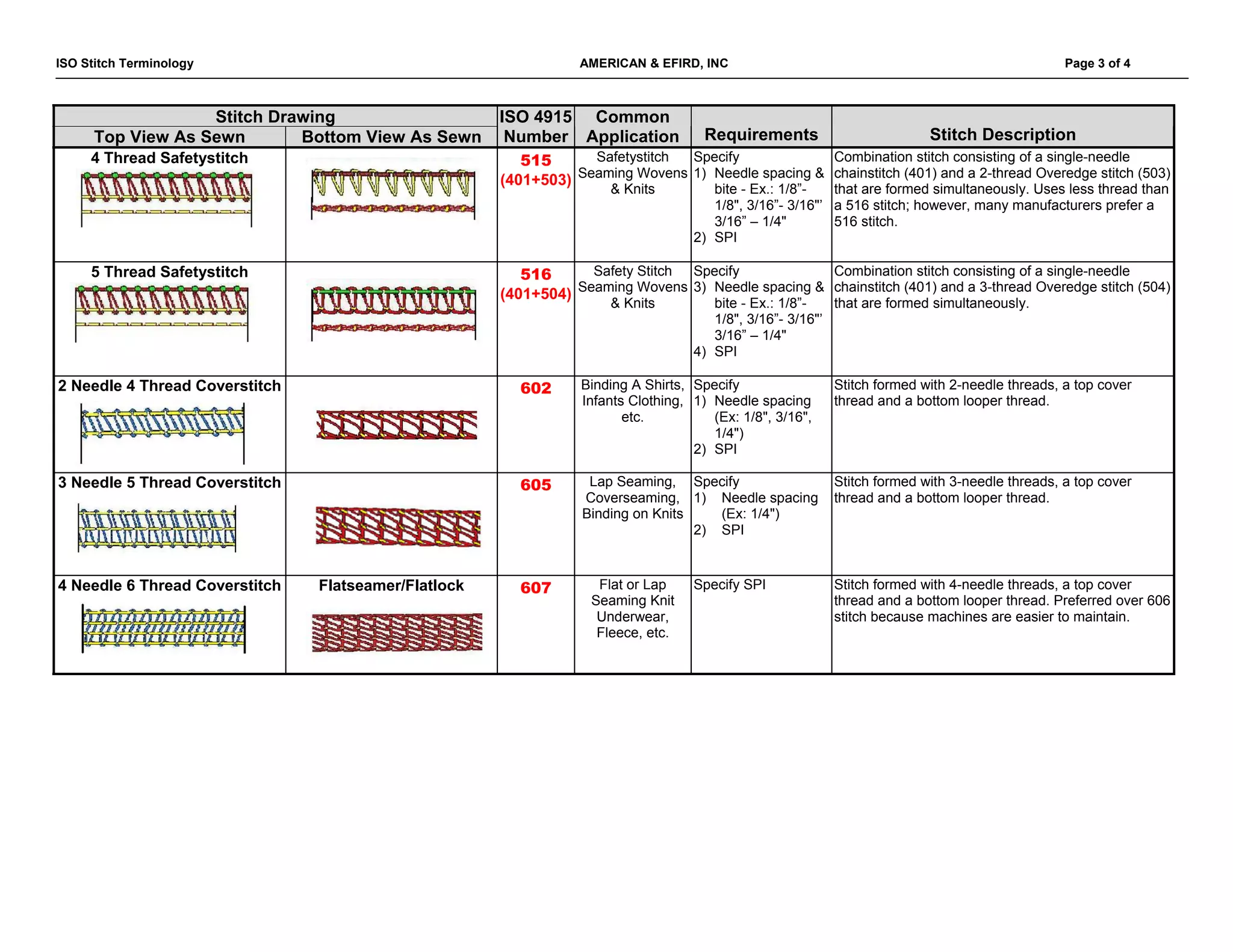
4 Thread Safetystitch 515
(401+503)
Safetystitch
Seaming Wovens
& Knits
Specify
1) Needle spacing &
bite - Ex.: 1/8”-
1/8", 3/16”- 3/16"’
3/16” – 1/4"
2) SPI
Combination stitch consisting of a single-needle
chainstitch (401) and a 2-thread Overedge stitch (503)
that are formed simultaneously. Uses less thread than
a 516 stitch; however, many manufacturers prefer a
516 stitch.
5 Thread Safetystitch 516
(401+504)
Safety Stitch
Seaming Wovens
& Knits
Specify
3) Needle spacing &
bite - Ex.: 1/8”-
1/8", 3/16”- 3/16"’
3/16” – 1/4"
4) SPI
Combination stitch consisting of a single-needle
chainstitch (401) and a 3-thread Overedge stitch (504)
that are formed simultaneously.
2 Needle 4 Thread Coverstitch 602 Binding A Shirts,
Infants Clothing,
etc.
Specify
1) Needle spacing
(Ex: 1/8", 3/16",
1/4")
2) SPI
Stitch formed with 2-needle threads, a top cover
thread and a bottom looper thread.
3 Needle 5 Thread Coverstitch 605 Lap Seaming,
Coverseaming,
Binding on Knits
Specify
1) Needle spacing
(Ex: 1/4")
2) SPI
Stitch formed with 3-needle threads, a top cover
thread and a bottom looper thread.
4 Needle 6 Thread Coverstitch Flatseamer/Flatlock 607 Flat or Lap
Seaming Knit
Underwear,
Fleece, etc.
Specify SPI Stitch formed with 4-needle threads, a top cover
thread and a bottom looper thread. Preferred over 606
stitch because machines are easier to maintain.
American & Efird, Inc. 2006. All International Rights Reserved.
ISO Stitch Terminology AMERICAN & EFIRD, INC Page 4 of 4
American & Efird, Inc. 2006. All International Rights Reserved.

Stitch terminology.pdf

  • 1.
    ISO Stitch TerminologyAMERICAN & EFIRD, INC Page 1 of 4 Stitch Drawing Top View As Sewn Bottom View As Sewn ISO 4915 Number Common Application Requirements Stitch Description Single Thread Chainstitch 101 Basting Stitch for Tailored Clothing; Bag Closing Specify SPI. Stitch formed by a needle thread passing through the material and interlooping with itself on the underside of the seam with the assistance of a spreader. Single Thread Chainstitch or Lockstitch Buttonsew, Buttonhole or Bartack * 304 Lockstitch is preferred when stitch security is a Must. 101 or 304 Buttonsew, Buttonhole, or Bartack 1)Buttonsew - specify stitches per cycle (Ex. 8,16, 32) 2)BH - specify length & width (1/2”, etc.) 3) Bartack - specify length & width of tack. Knit Shirts - Buttonhole length generally is 1/2 inch, is placed horizontally, with approximately 85-90 stitches Single Thread Blindstitch No stitch visible on the Bottom or Outside of Sewn Product 103 Blindstitch Hemming, Felling, Making Belt Loops Specify 1) SPI 3 - 5 SPI 2) Non-skip or 2 to 1 skipped stitch Stitch is formed with one needle thread that is interlooped with itself on the top surface of the material. The thread passes through the top ply and horizontally through portions of the bottom ply without completely penetrating it the full depth. Lockstitch - Most Common of All Stitches Bobbin Thread on Bottom 301 Topstitching, Single Needle Stitching, Straight Stitching Specify SPI. Stitch formed by a needle thread passing through the material and interlocking with a bobbin thread with the threads meeting in the center of the seam. Stitch looks the same top & bottom. Zig Zag Lockstitch 304 Intimate Apparel, Athletic wear, Infantwear, Exercisewear Specify 1) SPI 2) Throw or width Zig-Zag (1/8”, 3/16”, 1/4") Stitch is formed with a needle and a bobbin that are set in the center of the seam and form a symmetrical zig-zag pattern. Also, used to identify bartacking and lockstitch buttonsewing and buttonholing. Chainstitch Looper Thread on Bottom 401 Single Needle Chainstitch - Mainseams on Wovens Specify SPI. Stitch formed by 1-needle thread passing through the material and interlooped with 1-looper thread and pulled up to the underside of the seam. Zig Zag Chainstitch Looper Thread on Bottom 404 Zig-Zag Chainstitch for Infantwear and Childrenswear: Binding, Topstitching, etc. Specify 1)SPI 2)Throw or width Zig- Zag (1/8”) Stitch is formed with a needle and a looper that are set on the underside of the seam and form a symmetrical zig-zag pattern. American & Efird, Inc. 2006. All International Rights Reserved.
  • 2.
    ISO Stitch TerminologyAMERICAN & EFIRD, INC Page 2 of 4 Stitch Drawing Top View As Sewn Bottom View As Sewn ISO 4915 Number Common Application Requirements Stitch Description 2 Needle Bottom Coverstitch Looper Thread on Bottom 406 Hemming, Attaching, Elastic, Binding, Coverseaming, Making Belt Loops Specify 1) Needle spacing (1/8”, 3/16”, 1/4") 2) SPI Stitch formed by 2-needle threads passing through the material and interlooping with 1-looper thread with the stitch set on the underside of the seam. Looper thread interlooped between needle threads providing seam coverage on the bottom side only. 3 Needle Bottom Coverstitch Looper Thread on Bottom 407 Attaching Elastic to Men's & Boys Knit Underwear Specify 1) Needle spacing (1/4") 2) SPI Stitch formed by 3-needle threads passing through the material and interlooping with 1-looper thread with the stitch set on the underside of the seam. Looper thread is interlooped between needle threads providing seam coverage on the bottom side only. 2 Needle Chainstitch with Cover Thread Looper Thread on Bottom 408 Attaching Pocket Facings to Jeans & Chino Casual Pants Stitch formed by 2-needle threads passing through the material and interlooping with 2-looper threads with the stitches set on the underside of the seam. A top spreader thread is interlaced on the top side of the seam between the two needle threads. 2 Thread Overedge Single "purl" on Edge 503 Serging & Blindhemming Specify 1) Width Bite (Ex. 1/8", 3/16", 1/4") 2) SPI. Stitch formed by 1-needle thread and 1-looper thread with purl on edge of seam for serging or blindhemming ONLY. 3 Thread Overedge Common Overedge Stitch 504 Single Needle Overedge Seaming Specify 1) Width Bite (Ex. 1/8", 3/16", 1/4") 2) SPI. Stitch formed with 1-needle thread and 2-looper threads with the looper threads forming a purl on the edge of the seam. For overedge seaming and serging. 3 Thread Overedge Double "purl" on Edge 505 Serging with Double purl on Edge Specify 1) Width Bite (Ex. 1/8", 3/16", 1/4") 2) SPI. Stitch formed with 1-needle thread and 2-looper threads with the looper threads forming a double purl on the edge of the seam for serging ONLY. Mock Safety Stitch 2 Needle Overedge 512 Seaming Stretch Knits, Wovens Specify SPI. Stitch formed with 2-needle threads and 2 looper threads with the looper threads forming a purl on the edge of the seam. 512 – right needle only enters the upper looper loop. Stitch does NOT chain-off as well as 514 Stitch 2 Needle 4 Thread Overedge 2 Needle Overedge 514 Seaming Stretch Knits, Wovens Specify SPI. Stitch formed with 2-needle threads and 2 looper threads with the looper threads forming a purl on the edge of the seam. 514 – both needles enter the upper looper loop. Preferred over 512 Stitch because it chains-off better. American & Efird, Inc. 2006. All International Rights Reserved.
  • 3.
    ISO Stitch TerminologyAMERICAN & EFIRD, INC Page 3 of 4 Stitch Drawing Top View As Sewn Bottom View As Sewn ISO 4915 Number Common Application Requirements Stitch Description 4 Thread Safetystitch 515 (401+503) Safetystitch Seaming Wovens & Knits Specify 1) Needle spacing & bite - Ex.: 1/8”- 1/8", 3/16”- 3/16"’ 3/16” – 1/4" 2) SPI Combination stitch consisting of a single-needle chainstitch (401) and a 2-thread Overedge stitch (503) that are formed simultaneously. Uses less thread than a 516 stitch; however, many manufacturers prefer a 516 stitch. 5 Thread Safetystitch 516 (401+504) Safety Stitch Seaming Wovens & Knits Specify 3) Needle spacing & bite - Ex.: 1/8”- 1/8", 3/16”- 3/16"’ 3/16” – 1/4" 4) SPI Combination stitch consisting of a single-needle chainstitch (401) and a 3-thread Overedge stitch (504) that are formed simultaneously. 2 Needle 4 Thread Coverstitch 602 Binding A Shirts, Infants Clothing, etc. Specify 1) Needle spacing (Ex: 1/8", 3/16", 1/4") 2) SPI Stitch formed with 2-needle threads, a top cover thread and a bottom looper thread. 3 Needle 5 Thread Coverstitch 605 Lap Seaming, Coverseaming, Binding on Knits Specify 1) Needle spacing (Ex: 1/4") 2) SPI Stitch formed with 3-needle threads, a top cover thread and a bottom looper thread. 4 Needle 6 Thread Coverstitch Flatseamer/Flatlock 607 Flat or Lap Seaming Knit Underwear, Fleece, etc. Specify SPI Stitch formed with 4-needle threads, a top cover thread and a bottom looper thread. Preferred over 606 stitch because machines are easier to maintain. American & Efird, Inc. 2006. All International Rights Reserved.
  • 4.
    ISO Stitch TerminologyAMERICAN & EFIRD, INC Page 4 of 4 American & Efird, Inc. 2006. All International Rights Reserved.