Stitch Guide
Most Common Stitch Types in ASTM D-6193 and
ISO 4915:1991 Standards
This quick reference guide is to help communication be-
tween designers, production managers and sewing con-
tractors. The guide is freely distributed.
Images courtecy of www.garmento.org, www.wikipedia.org, www.
merrow.com
First Edition October 17, 2007
Second Editon June 3, 2008
Sewingcontract.com
Dewellton LLC, Helsinki, TexUp OÜ, Estonia, Wapductions Inc. New York
Sewingcontract.com
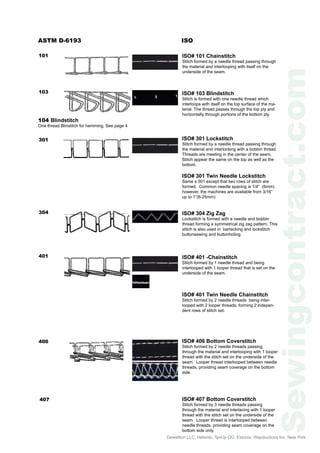
101 ISO# 101 Chainstitch
Stitch formed by a needle thread passing through
the material and interlooping with itself on the
underside of the seam.
ISO# 103 Blindstitch
Stitch is formed with one needle thread which
interloops with itself on the top surface of the ma-
terial. The thread passes through the top ply and
horizontally through portions of the bottom ply.
ISO# 301 Lockstitch
Stitch formed by a needle thread passing through
the material and interlocking with a bobbin thread.
Threads are meeting in the center of the seam.
Stitch appear the same on the top as well as the
bottom.
ISO# 301 Twin Needle Lockstitch
Same s 301 except that two rows of stitch are
formed. Common needle spacing is 1/4” (6mm)
however, the machines are available from 3/16”
up to 1”(6-25mm)
ISO# 304 Zig Zag
Lockstitch is formed with a needle and bobbin
thread forming a symmetrical zig zag pattern. This
stitch is also used in bartacking and lockstitch
buttonsewing and buttonholing.
ISO# 401 -Chainstitch
Stitch formed by 1 needle thread and being
interlooped with 1 looper thread that is set on the
underside of the seam.
ISO# 401 Twin Needle Chainstitch
Stitch formed by 2 needle threads being inter-
looped with 2 looper threads, forming 2 indepen-
dent rows of stitch set.
ISO# 406 Bottom Coverstitch
Stitch formed by 2 needle threads passing
through the material and interlooping with 1 looper
thread with the stitch set on the underside of the
seam. Looper thread interlooped between needle
threads, providing seam coverage on the bottom
side.
ISO# 407 Bottom Coverstitch
Stitch formed by 3 needle threads passing
through the material and interlacing with 1 looper
thread with the stitch set on the underside of the
seam. Looper thread is interlooped between
needle threads, providing seam coverage on the
bottom side only.
304
301
401
406
103
407
ASTM D-6193 ISO
104 Blindstitch
One thread Blinstitch for hemming, See page 4
Dewellton LLC, Helsinki, TexUp OÜ, Estonia, Wapductions Inc. New York
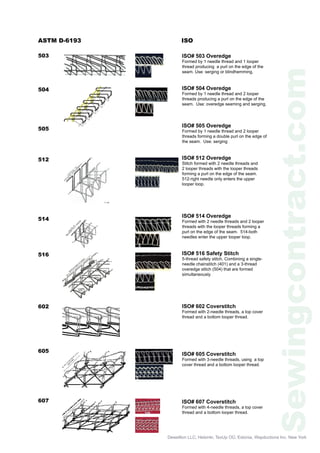
ISO# 503 Overedge
Formed by 1 needle thread and 1 looper
thread producing a purl on the edge of the
seam. Use: serging or blindhemming.
ISO# 504 Overedge
Formed by 1 needle thread and 2 looper
threads producing a purl on the edge of the
seam. Use: overedge seaming and serging.
ISO# 505 Overedge
Formed by 1 needle thread and 2 looper
threads forming a double purl on the edge of
the seam. Use: serging
ISO# 512 Overedge
Stitch formed with 2 needle threads and
2 looper threads with the looper threads
forming a purl on the edge of the seam.
512-right needle only enters the upper
looper loop.
ISO# 514 Overedge
Formed with 2 needle threads and 2 looper
threads with the looper threads forming a
purl on the edge of the seam. 514-both
needles enter the upper looper loop.
ISO# 516 Safety Stitch
5-thread safety stitch. Combining a single-
needle chainstitch (401) and a 3-thread
overedge stitch (504) that are formed
simultaneously.
ISO# 602 Coverstitch
Formed with 2-needle threads, a top cover
thread and a bottom looper thread.
ISO# 605 Coverstitch
Formed with 3-needle threads, using a top
cover thread and a bottom looper thread.
ISO# 607 Coverstitch
Formed with 4-needle threads, a top cover
thread and a bottom looper thread.
503
504
512
605
607
602
516
514
Sewingcontract.com
ASTM D-6193 ISO
505
Dewellton LLC, Helsinki, TexUp OÜ, Estonia, Wapductions Inc. New York
Sewingcontract.com
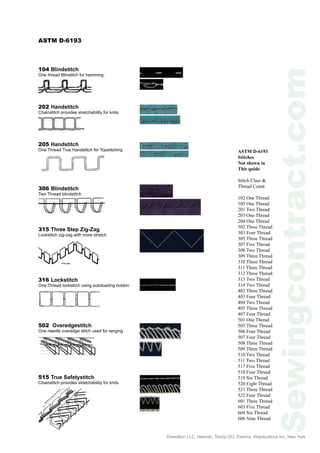
104 Blindstitch
One thread Blinstitch for hemming,
ASTM D-6193
502 Overedgestitch
One needle overedge stitch used for serging
316 Lockstitch
One Thread lockstitch using autoloading bobbin
315 Three Step Zig-Zag
Lockstitch zig-zag with more stretch
306 Blindstitch
Two Thread blindstitch
515 True Safetystitch
Chainstitch provides stretchability for knits
205 Handstitch
One Thread True Handstitch for Topstitching
202 Handstitch
Chainstitch provides stretchability for knits
ASTM D-6193
Stitches
Not shown in
This quide
Stitch Class &
Thread Count
102 One Thread
105 One Thread
201 Two Thread
203 One Thread
204 One Thread
302 Three Thread
303 Four Thread
305 Three Thread
307 Five Thread
308 Two Thread
309 Three Thread
310 Three Thread
311 Three Thread
312 Three Thread
313 Two Thread
314 Two Thread
402 Three Thread
403 Four Thread
404 Two Thread
405 Three Thread
407 Four Thread
501 One Thread
505 Three Thread
506 Four Thread
507 Four Thread
508 Three Thread
509 Three Thread
510 Two Thread
511 Two Thread
517 Five Thread
518 Four Thread
519 Six Thread
520 Eight Thread
521 Three Thread
522 Four Thread
601 Three Thread
603 Five Thread
604 Six Thread
606 Nine Thread
Dewellton LLC, Helsinki, TexUp OÜ, Estonia, Wapductions Inc. New York
Sewingcontract.com
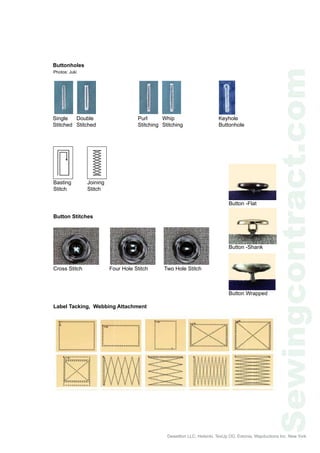
Keyhole
Buttonhole
Double
Stitched
Single
Stitched
Purl
Stitching
Whip
Stitching
Buttonholes
Photos: Juki
Basting
Stitch
Joining
Stitch
Label Tacking, Webbing Attachment
Button Stitches
Cross Stitch Four Hole Stitch Two Hole Stitch
Dewellton LLC, Helsinki, TexUp OÜ, Estonia, Wapductions Inc. New York
Button -Flat
Button -Shank
Button Wrapped
Purl Stich, Photo: Merrow Sewing Machine
Company
4-thread, 5/32” wide, 17
stitches per inch
Photo: Merrow Sewing
Machine Company
Types of Overlock Stitches
Overlock stitches are classified in a number of ways. The most basic classification is by the number
of threads used in the stitch. Industrial overlock machines are generally made in 1, 2, 3, 4, or 5 thread
formations. Each of these formations has unique uses and benefits: 1-thread formations are used for
end-to-end seaming, or ‘butt-seaming’. Two- and three-thread formations, also known as ‘merrowing’,
are the most common, used for edging and seaming, especially on knits and wovens. Four-thread
formations are called mock safety stitches and create extra strength while retaining flexibility. 5-thread
formations, which utilize 2 needles, are called safety stitches, creating a very strong seam used for
apparel manufacturing.
Overlocking is also referred to as “overedging”, “merrowing” or “serging”. Though “serging” technically
refers to overlocking with cutters, in practice the four terms are used
2-thread, 1/8” wide, 20 stitches per inch, with differential
feed: Photo: Merrow
4-thread, 5/32” wide, 17 stitch-
es per inch, Photo: Merrow
3-thread, ¼” wide, 7 stitches per inch
Merrow rolled blanket stich
Narrow blanket Stitch
Traditional Blanket Stitch
Merrow blanket Stitch
Sewingcontract.com
Dewellton LLC, Helsinki, TexUp OÜ, Estonia, Wapductions Inc. New York
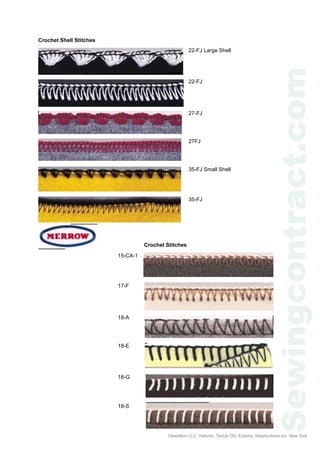
22-FJ Large Shell
22-FJ
27-FJ
27FJ
35-FJ Small Shell
35-FJ
Crochet Shell Stitches
Sewingcontract.com
Dewellton LLC, Helsinki, TexUp OÜ, Estonia, Wapductions Inc. New York
15-CA-1
17-F
18-A
18-E
18-G
18-S
Crochet Stitches
Sewingcontract.com
Dewellton LLC, Helsinki, TexUp OÜ, Estonia, Wapductions Inc. New York

Stitch Classification

  • 1.
    Stitch Guide Most CommonStitch Types in ASTM D-6193 and ISO 4915:1991 Standards This quick reference guide is to help communication be- tween designers, production managers and sewing con- tractors. The guide is freely distributed. Images courtecy of www.garmento.org, www.wikipedia.org, www. merrow.com First Edition October 17, 2007 Second Editon June 3, 2008 Sewingcontract.com Dewellton LLC, Helsinki, TexUp OÜ, Estonia, Wapductions Inc. New York
  • 2.
    Sewingcontract.com 101 ISO# 101Chainstitch Stitch formed by a needle thread passing through the material and interlooping with itself on the underside of the seam. ISO# 103 Blindstitch Stitch is formed with one needle thread which interloops with itself on the top surface of the ma- terial. The thread passes through the top ply and horizontally through portions of the bottom ply. ISO# 301 Lockstitch Stitch formed by a needle thread passing through the material and interlocking with a bobbin thread. Threads are meeting in the center of the seam. Stitch appear the same on the top as well as the bottom. ISO# 301 Twin Needle Lockstitch Same s 301 except that two rows of stitch are formed. Common needle spacing is 1/4” (6mm) however, the machines are available from 3/16” up to 1”(6-25mm) ISO# 304 Zig Zag Lockstitch is formed with a needle and bobbin thread forming a symmetrical zig zag pattern. This stitch is also used in bartacking and lockstitch buttonsewing and buttonholing. ISO# 401 -Chainstitch Stitch formed by 1 needle thread and being interlooped with 1 looper thread that is set on the underside of the seam. ISO# 401 Twin Needle Chainstitch Stitch formed by 2 needle threads being inter- looped with 2 looper threads, forming 2 indepen- dent rows of stitch set. ISO# 406 Bottom Coverstitch Stitch formed by 2 needle threads passing through the material and interlooping with 1 looper thread with the stitch set on the underside of the seam. Looper thread interlooped between needle threads, providing seam coverage on the bottom side. ISO# 407 Bottom Coverstitch Stitch formed by 3 needle threads passing through the material and interlacing with 1 looper thread with the stitch set on the underside of the seam. Looper thread is interlooped between needle threads, providing seam coverage on the bottom side only. 304 301 401 406 103 407 ASTM D-6193 ISO 104 Blindstitch One thread Blinstitch for hemming, See page 4 Dewellton LLC, Helsinki, TexUp OÜ, Estonia, Wapductions Inc. New York
  • 3.
    ISO# 503 Overedge Formedby 1 needle thread and 1 looper thread producing a purl on the edge of the seam. Use: serging or blindhemming. ISO# 504 Overedge Formed by 1 needle thread and 2 looper threads producing a purl on the edge of the seam. Use: overedge seaming and serging. ISO# 505 Overedge Formed by 1 needle thread and 2 looper threads forming a double purl on the edge of the seam. Use: serging ISO# 512 Overedge Stitch formed with 2 needle threads and 2 looper threads with the looper threads forming a purl on the edge of the seam. 512-right needle only enters the upper looper loop. ISO# 514 Overedge Formed with 2 needle threads and 2 looper threads with the looper threads forming a purl on the edge of the seam. 514-both needles enter the upper looper loop. ISO# 516 Safety Stitch 5-thread safety stitch. Combining a single- needle chainstitch (401) and a 3-thread overedge stitch (504) that are formed simultaneously. ISO# 602 Coverstitch Formed with 2-needle threads, a top cover thread and a bottom looper thread. ISO# 605 Coverstitch Formed with 3-needle threads, using a top cover thread and a bottom looper thread. ISO# 607 Coverstitch Formed with 4-needle threads, a top cover thread and a bottom looper thread. 503 504 512 605 607 602 516 514 Sewingcontract.com ASTM D-6193 ISO 505 Dewellton LLC, Helsinki, TexUp OÜ, Estonia, Wapductions Inc. New York
  • 4.
    Sewingcontract.com 104 Blindstitch One threadBlinstitch for hemming, ASTM D-6193 502 Overedgestitch One needle overedge stitch used for serging 316 Lockstitch One Thread lockstitch using autoloading bobbin 315 Three Step Zig-Zag Lockstitch zig-zag with more stretch 306 Blindstitch Two Thread blindstitch 515 True Safetystitch Chainstitch provides stretchability for knits 205 Handstitch One Thread True Handstitch for Topstitching 202 Handstitch Chainstitch provides stretchability for knits ASTM D-6193 Stitches Not shown in This quide Stitch Class & Thread Count 102 One Thread 105 One Thread 201 Two Thread 203 One Thread 204 One Thread 302 Three Thread 303 Four Thread 305 Three Thread 307 Five Thread 308 Two Thread 309 Three Thread 310 Three Thread 311 Three Thread 312 Three Thread 313 Two Thread 314 Two Thread 402 Three Thread 403 Four Thread 404 Two Thread 405 Three Thread 407 Four Thread 501 One Thread 505 Three Thread 506 Four Thread 507 Four Thread 508 Three Thread 509 Three Thread 510 Two Thread 511 Two Thread 517 Five Thread 518 Four Thread 519 Six Thread 520 Eight Thread 521 Three Thread 522 Four Thread 601 Three Thread 603 Five Thread 604 Six Thread 606 Nine Thread Dewellton LLC, Helsinki, TexUp OÜ, Estonia, Wapductions Inc. New York
  • 5.
    Sewingcontract.com Keyhole Buttonhole Double Stitched Single Stitched Purl Stitching Whip Stitching Buttonholes Photos: Juki Basting Stitch Joining Stitch Label Tacking,Webbing Attachment Button Stitches Cross Stitch Four Hole Stitch Two Hole Stitch Dewellton LLC, Helsinki, TexUp OÜ, Estonia, Wapductions Inc. New York Button -Flat Button -Shank Button Wrapped
  • 6.
    Purl Stich, Photo:Merrow Sewing Machine Company 4-thread, 5/32” wide, 17 stitches per inch Photo: Merrow Sewing Machine Company Types of Overlock Stitches Overlock stitches are classified in a number of ways. The most basic classification is by the number of threads used in the stitch. Industrial overlock machines are generally made in 1, 2, 3, 4, or 5 thread formations. Each of these formations has unique uses and benefits: 1-thread formations are used for end-to-end seaming, or ‘butt-seaming’. Two- and three-thread formations, also known as ‘merrowing’, are the most common, used for edging and seaming, especially on knits and wovens. Four-thread formations are called mock safety stitches and create extra strength while retaining flexibility. 5-thread formations, which utilize 2 needles, are called safety stitches, creating a very strong seam used for apparel manufacturing. Overlocking is also referred to as “overedging”, “merrowing” or “serging”. Though “serging” technically refers to overlocking with cutters, in practice the four terms are used 2-thread, 1/8” wide, 20 stitches per inch, with differential feed: Photo: Merrow 4-thread, 5/32” wide, 17 stitch- es per inch, Photo: Merrow 3-thread, ¼” wide, 7 stitches per inch Merrow rolled blanket stich Narrow blanket Stitch Traditional Blanket Stitch Merrow blanket Stitch Sewingcontract.com Dewellton LLC, Helsinki, TexUp OÜ, Estonia, Wapductions Inc. New York
  • 7.
    22-FJ Large Shell 22-FJ 27-FJ 27FJ 35-FJSmall Shell 35-FJ Crochet Shell Stitches Sewingcontract.com Dewellton LLC, Helsinki, TexUp OÜ, Estonia, Wapductions Inc. New York 15-CA-1 17-F 18-A 18-E 18-G 18-S Crochet Stitches
  • 8.
    Sewingcontract.com Dewellton LLC, Helsinki,TexUp OÜ, Estonia, Wapductions Inc. New York