DEPERTMENT OF
CONSEVATIVE DENTISTRY &
ENDODONTICS
PRESENTED BY:
SANDIPTA BANERJEE
(FINAL YEAR)
STERILIZATION & INFECTION
CONTROL
Contents
1. Definitions
2. Infection
3. Methods of disinfection
4. Methods of sterilization
5. Most common methods of
sterilization
6. Sterilization monitoring
7. Sterilization of Dental instruments
Sterilization
A physical or chemical process that completely destroys or removes all microbial
life, including spores.
Disinfection
It is killing or removing of harmful microorganisms
Disinfectant
Products used to kill microorganisms on inanimate objects or surfaces.
Disinfectants are not necessarily sporicidal, but may be sporostatic, inhibiting
germination or outgrowth
Antiseptic
A product that destroys or inhibits the growth of microorganisms in or on living
tissue.
Aseptic
Characterized by the absence of pathogenic microbes.
Infection Control
It is the discipline concerned with preventing nosocomial infection, a practical
sub-discipline of epidemiology.
1. DEFINITIONS
2.INFECTION
• Infection is the deposition of organisms in the tissues & their
growth resulting in a host reaction.
• The no. of organisms required to cause an infection is termed
“The infective dose”. It depends on-
1. Virulence of organism
2. susceptibility of the host
ROUTE OF TRANSMISSION-
1. Direct contact of tissues with infective biological
fluids. such as-blood
2. Indirect contact-with contaminated instruments
3. Inhalation of aerosolized infective droplets
4. Direct inoculation into cuts & abrasions of
unprotected skin &mucosa
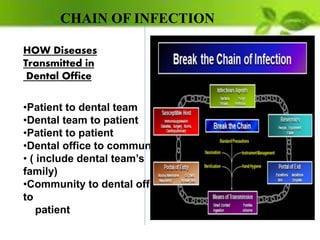
CHAIN OF INFECTION
•Patient to dental team
•Dental team to patient
•Patient to patient
•Dental office to community
• ( include dental team’s
family)
•Community to dental office
to
patient
HOW Diseases
Transmitted in
Dental Office
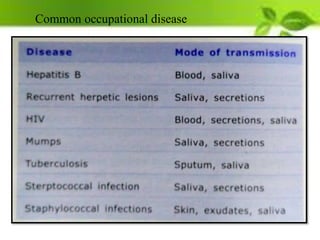
Common occupational disease
INFECTION CONTROL
• Infection control involves 2 basic factors:
a) Prevention of spread of microorganisms
from their hosts(patients & clinician)
b) Killing of removal of microorganisms from
objectives & surface
3.METHODS OF DISINFECTION
1. HEAT- boiling in water
flaming of alcohol
pasteurization
2.Physical- ultrasonic cleanser
3.chemical- high level
intermediate level
low level
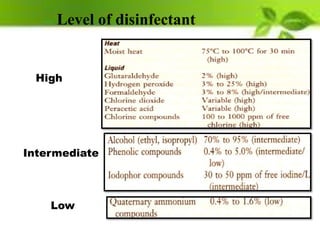
Level of disinfectant
High
Intermediate
Low
CHEMICAL DISINFECTANT
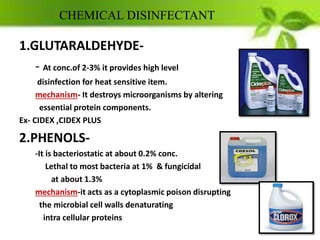
1.GLUTARALDEHYDE-
- At conc.of 2-3% it provides high level
disinfection for heat sensitive item.
mechanism- It destroys microorganisms by altering
essential protein components.
Ex- CIDEX ,CIDEX PLUS
2.PHENOLS-
-It is bacteriostatic at about 0.2% conc.
Lethal to most bacteria at 1% & fungicidal
at about 1.3%
mechanism-it acts as a cytoplasmic poison disrupting
the microbial cell walls denaturating
intra cellular proteins
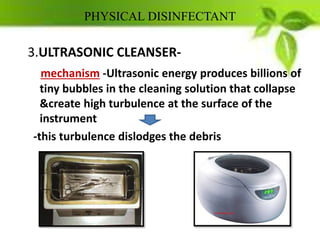
3.ULTRASONIC CLEANSER-
mechanism -Ultrasonic energy produces billions of
tiny bubbles in the cleaning solution that collapse
&create high turbulence at the surface of the
instrument
-this turbulence dislodges the debris
PHYSICAL DISINFECTANT
INFECTION CONTROL STEPS
1.Obtaining health history
2.Immunization recommended for oral health
care worker
3.Infection control in dental units
4.Disposal of contaminated waste or
house keeping
5.Personal protective equipment
6.Hand washing and care
7.Sterilization and infection control
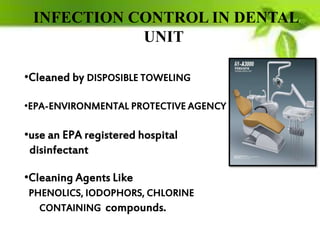
INFECTION CONTROL IN DENTAL
UNIT
•Cleaned by DISPOSIBLE TOWELING
•EPA-ENVIRONMENTAL PROTECTIVE AGENCY
•use an EPA registered hospital
disinfectant
•Cleaning Agents Like
PHENOLICS, IODOPHORS, CHLORINE
CONTAINING compounds.
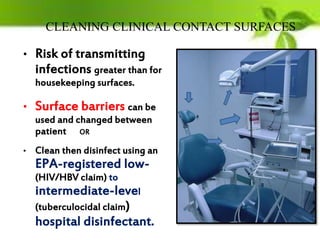
CLEANING CLINICAL CONTACT SURFACES
• Risk of transmitting
infections greater than for
housekeeping surfaces.
• Surface barriers can be
used and changed between
patient OR
• Clean then disinfect using an
EPA-registered low-
(HIV/HBV claim) to
intermediate-level
(tuberculocidal claim)
hospital disinfectant.
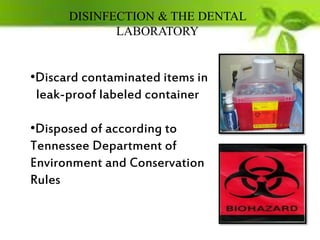
DISINFECTION & THE DENTAL
LABORATORY
•Discard contaminated items in
leak-proof labeled container
•Disposed of according to
Tennessee Department of
Environment and Conservation
Rules
ENVIRONMENTAL SURFACES
• CLINICAL CONTACT SURFACES
–High potential for DIRECT CONTAMINATION
from spray or spatter or by contact with
gloved hand.
• HOUSEKEEPING SURFACES
–Do not come into contact with patients or
devices
–LIMITED RISK of disease transmission
Cleaning Housekeeping
Surfaces
• Routinely clean with SOAP AND
WATER or an EPA-REGISTERED
DETERGENT/HOSPITAL
DISINFECTANTroutinely
• Clean MOPS AND CLOTHS and
allow to dry thoroughly before re-using.
• Prepare FRESH CLEANING AND
DISINFECTING SOLUTIONS
daily and per manufacturer
recommendations.
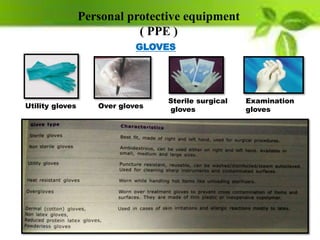
Personal protective equipment
( PPE )
Examination
glovesOver gloves
Sterile surgical
glovesUtility gloves
GLOVES
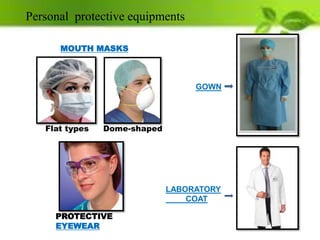
Dome-shapedFlat types
MOUTH MASKS
PROTECTIVE
EYEWEAR
GOWN
LABORATORY
COAT
Personal protective equipments
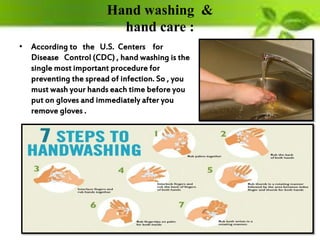
• According to the U.S. Centers for
Disease Control (CDC) , hand washing is the
single most important procedure for
preventing the spread of infection. So , you
must wash your hands each time before you
put on gloves and immediately after you
remove gloves .
Hand washing &
hand care :
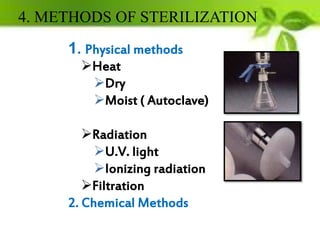
1. Physical methods
Heat
Dry
Moist ( Autoclave)
Radiation
U.V. light
Ionizing radiation
Filtration
2. Chemical Methods
4. METHODS OF STERILIZATION
5.MOST COMMON METHODS OF
STERILIZATION IN DENTAL OFFICE
• THE STEAM AUTOCLAVE
• CHEMICLAVE
• DRY HEAT OVENS
• OTHERS
-EXPOSURE TO ETHYLENE OXIDE GAS
-IONIZING RADIATION
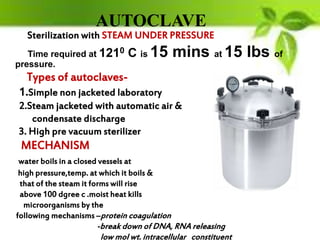
Sterilization with STEAM UNDER PRESSURE
Time required at 1210 C is 15 mins at 15 lbs of
pressure.
Types of autoclaves-
1.Simple non jacketed laboratory
2.Steam jacketed with automatic air &
condensate discharge
3. High pre vacuum sterilizer
MECHANISM
water boils in a closed vessels at
high pressure,temp. at which it boils &
that of the steam it forms will rise
above 100 dgree c .moist heat kills
microorganisms by the
following mechanisms –protein coagulation
-break down of DNA, RNA releasing
low mol wt. intracellular constituent
AUTOCLAVE
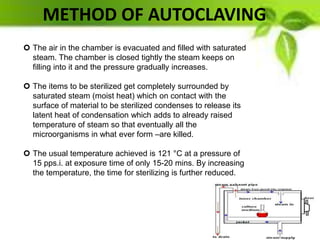
METHOD OF AUTOCLAVING
 The air in the chamber is evacuated and filled with saturated
steam. The chamber is closed tightly the steam keeps on
filling into it and the pressure gradually increases.
 The items to be sterilized get completely surrounded by
saturated steam (moist heat) which on contact with the
surface of material to be sterilized condenses to release its
latent heat of condensation which adds to already raised
temperature of steam so that eventually all the
microorganisms in what ever form –are killed.
 The usual temperature achieved is 121 °C at a pressure of
15 pps.i. at exposure time of only 15-20 mins. By increasing
the temperature, the time for sterilizing is further reduced.
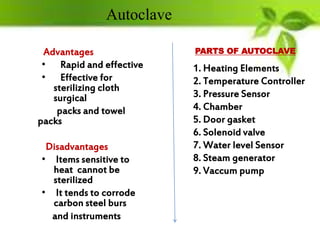
Advantages
• Rapid and effective
• Effective for
sterilizing cloth
surgical
packs and towel
packs
Disadvantages
• Items sensitive to
heat cannot be
sterilized
• It tends to corrode
carbon steel burs
and instruments
1. Heating Elements
2. Temperature Controller
3. Pressure Sensor
4. Chamber
5. Door gasket
6. Solenoid valve
7. Water level Sensor
8. Steam generator
9. Vaccum pump
PARTS OF AUTOCLAVE
Autoclave
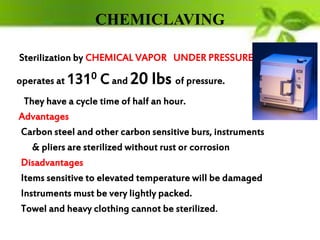
CHEMICLAVING
Sterilization by CHEMICAL VAPOR UNDER PRESSURE
operates at 1310 Cand 20 lbs of pressure.
They have a cycle time of half an hour.
Advantages
Carbon steel and other carbon sensitive burs, instruments
& pliers are sterilized without rust or corrosion
Disadvantages
Items sensitive to elevated temperature will be damaged
Instruments must be very lightly packed.
Towel and heavy clothing cannot be sterilized.
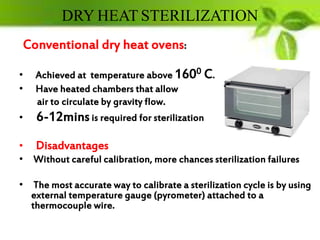
DRY HEAT STERILIZATION
Conventional dry heat ovens:
• Achieved at temperature above 1600 C.
• Have heated chambers that allow
air to circulate by gravity flow.
• 6-12minsis required for sterilization
• Disadvantages
• Without careful calibration, more chances sterilization failures
• The most accurate way to calibrate a sterilization cycle is by using
external temperature gauge (pyrometer) attached to a
thermocouple wire.
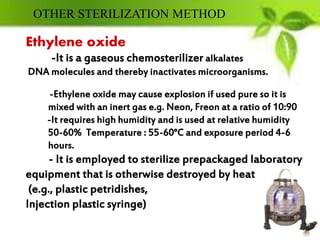
Ethylene oxide
-It is a gaseous chemosterilizer alkalates
DNA molecules and thereby inactivates microorganisms.
-Ethylene oxide may cause explosion if used pure so it is
mixed with an inert gas e.g. Neon, Freon at a ratio of 10:90
-It requires high humidity and is used at relative humidity
50-60% Temperature : 55-60°C and exposure period 4-6
hours.
- It is employed to sterilize prepackaged laboratory
equipment that is otherwise destroyed by heat
(e.g., plastic petridishes,
Injection plastic syringe)
OTHER STERILIZATION METHOD
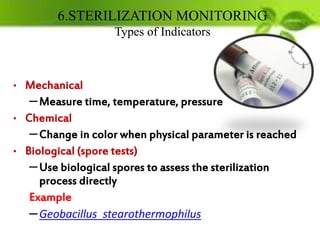
6.STERILIZATION MONITORING
Types of Indicators
• Mechanical
–Measure time, temperature, pressure
• Chemical
–Change in color when physical parameter is reached
• Biological (spore tests)
–Use biological spores to assess the sterilization
process directly
Example
–Geobacillus stearothermophilus
7. DENTAL INSTRUMENTS
CLASSIFICATION BASED ON
RISK OF TRANSMISSION &
NEED OF STERILIZATION
-CRITICAL
-SEMI-CRITICAL
-NON-CRITICAL
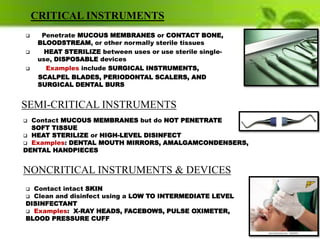
CRITICAL INSTRUMENTS
 Penetrate MUCOUS MEMBRANES or CONTACT BONE,
BLOODSTREAM, or other normally sterile tissues
 HEAT STERILIZE between uses or use sterile single-
use, DISPOSABLE devices
 Examples include SURGICAL INSTRUMENTS,
SCALPEL BLADES, PERIODONTAL SCALERS, AND
SURGICAL DENTAL BURS
 Contact MUCOUS MEMBRANES but do NOT PENETRATE
SOFT TISSUE
 HEAT STERILIZE or HIGH-LEVEL DISINFECT
 Examples: DENTAL MOUTH MIRRORS, AMALGAMCONDENSERS,
DENTAL HANDPIECES
SEMI-CRITICAL INSTRUMENTS
 Contact intact SKIN
 Clean and disinfect using a LOW TO INTERMEDIATE LEVEL
DISINFECTANT
 Examples: X-RAY HEADS, FACEBOWS, PULSE OXIMETER,
BLOOD PRESSURE CUFF
NONCRITICAL INSTRUMENTS & DEVICES
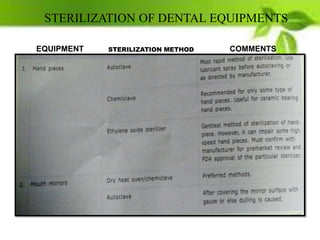
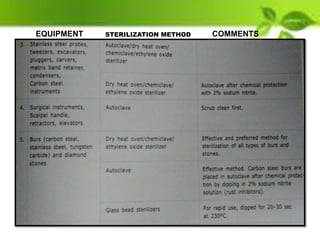
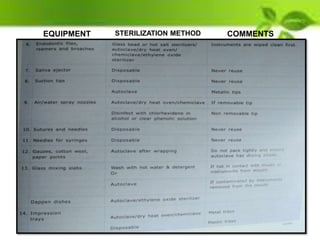
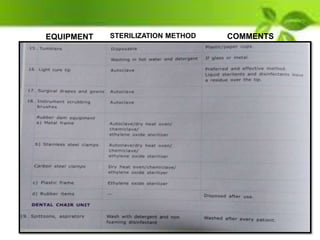
STERILIZATION OF DENTAL EQUIPMENTS
EQUIPMENT STERILIZATION METHOD COMMENTS
THANK YOU

Sterilization; infection control, sandipta banerjee

  • 1.
    DEPERTMENT OF CONSEVATIVE DENTISTRY& ENDODONTICS PRESENTED BY: SANDIPTA BANERJEE (FINAL YEAR) STERILIZATION & INFECTION CONTROL
  • 2.
    Contents 1. Definitions 2. Infection 3.Methods of disinfection 4. Methods of sterilization 5. Most common methods of sterilization 6. Sterilization monitoring 7. Sterilization of Dental instruments
  • 3.
    Sterilization A physical orchemical process that completely destroys or removes all microbial life, including spores. Disinfection It is killing or removing of harmful microorganisms Disinfectant Products used to kill microorganisms on inanimate objects or surfaces. Disinfectants are not necessarily sporicidal, but may be sporostatic, inhibiting germination or outgrowth Antiseptic A product that destroys or inhibits the growth of microorganisms in or on living tissue. Aseptic Characterized by the absence of pathogenic microbes. Infection Control It is the discipline concerned with preventing nosocomial infection, a practical sub-discipline of epidemiology. 1. DEFINITIONS
  • 4.
    2.INFECTION • Infection isthe deposition of organisms in the tissues & their growth resulting in a host reaction. • The no. of organisms required to cause an infection is termed “The infective dose”. It depends on- 1. Virulence of organism 2. susceptibility of the host ROUTE OF TRANSMISSION- 1. Direct contact of tissues with infective biological fluids. such as-blood 2. Indirect contact-with contaminated instruments 3. Inhalation of aerosolized infective droplets 4. Direct inoculation into cuts & abrasions of unprotected skin &mucosa
  • 5.
    CHAIN OF INFECTION •Patientto dental team •Dental team to patient •Patient to patient •Dental office to community • ( include dental team’s family) •Community to dental office to patient HOW Diseases Transmitted in Dental Office
  • 6.
  • 7.
    INFECTION CONTROL • Infectioncontrol involves 2 basic factors: a) Prevention of spread of microorganisms from their hosts(patients & clinician) b) Killing of removal of microorganisms from objectives & surface
  • 8.
    3.METHODS OF DISINFECTION 1.HEAT- boiling in water flaming of alcohol pasteurization 2.Physical- ultrasonic cleanser 3.chemical- high level intermediate level low level
  • 9.
  • 10.
    CHEMICAL DISINFECTANT 1.GLUTARALDEHYDE- - Atconc.of 2-3% it provides high level disinfection for heat sensitive item. mechanism- It destroys microorganisms by altering essential protein components. Ex- CIDEX ,CIDEX PLUS 2.PHENOLS- -It is bacteriostatic at about 0.2% conc. Lethal to most bacteria at 1% & fungicidal at about 1.3% mechanism-it acts as a cytoplasmic poison disrupting the microbial cell walls denaturating intra cellular proteins
  • 11.
    3.ULTRASONIC CLEANSER- mechanism -Ultrasonicenergy produces billions of tiny bubbles in the cleaning solution that collapse &create high turbulence at the surface of the instrument -this turbulence dislodges the debris PHYSICAL DISINFECTANT
  • 12.
    INFECTION CONTROL STEPS 1.Obtaininghealth history 2.Immunization recommended for oral health care worker 3.Infection control in dental units 4.Disposal of contaminated waste or house keeping 5.Personal protective equipment 6.Hand washing and care 7.Sterilization and infection control
  • 13.
    INFECTION CONTROL INDENTAL UNIT •Cleaned by DISPOSIBLE TOWELING •EPA-ENVIRONMENTAL PROTECTIVE AGENCY •use an EPA registered hospital disinfectant •Cleaning Agents Like PHENOLICS, IODOPHORS, CHLORINE CONTAINING compounds.
  • 14.
    CLEANING CLINICAL CONTACTSURFACES • Risk of transmitting infections greater than for housekeeping surfaces. • Surface barriers can be used and changed between patient OR • Clean then disinfect using an EPA-registered low- (HIV/HBV claim) to intermediate-level (tuberculocidal claim) hospital disinfectant.
  • 15.
    DISINFECTION & THEDENTAL LABORATORY •Discard contaminated items in leak-proof labeled container •Disposed of according to Tennessee Department of Environment and Conservation Rules
  • 16.
    ENVIRONMENTAL SURFACES • CLINICALCONTACT SURFACES –High potential for DIRECT CONTAMINATION from spray or spatter or by contact with gloved hand. • HOUSEKEEPING SURFACES –Do not come into contact with patients or devices –LIMITED RISK of disease transmission
  • 17.
    Cleaning Housekeeping Surfaces • Routinelyclean with SOAP AND WATER or an EPA-REGISTERED DETERGENT/HOSPITAL DISINFECTANTroutinely • Clean MOPS AND CLOTHS and allow to dry thoroughly before re-using. • Prepare FRESH CLEANING AND DISINFECTING SOLUTIONS daily and per manufacturer recommendations.
  • 18.
    Personal protective equipment (PPE ) Examination glovesOver gloves Sterile surgical glovesUtility gloves GLOVES
  • 19.
  • 20.
    • According tothe U.S. Centers for Disease Control (CDC) , hand washing is the single most important procedure for preventing the spread of infection. So , you must wash your hands each time before you put on gloves and immediately after you remove gloves . Hand washing & hand care :
  • 21.
    1. Physical methods Heat Dry Moist( Autoclave) Radiation U.V. light Ionizing radiation Filtration 2. Chemical Methods 4. METHODS OF STERILIZATION
  • 22.
    5.MOST COMMON METHODSOF STERILIZATION IN DENTAL OFFICE • THE STEAM AUTOCLAVE • CHEMICLAVE • DRY HEAT OVENS • OTHERS -EXPOSURE TO ETHYLENE OXIDE GAS -IONIZING RADIATION
  • 23.
    Sterilization with STEAMUNDER PRESSURE Time required at 1210 C is 15 mins at 15 lbs of pressure. Types of autoclaves- 1.Simple non jacketed laboratory 2.Steam jacketed with automatic air & condensate discharge 3. High pre vacuum sterilizer MECHANISM water boils in a closed vessels at high pressure,temp. at which it boils & that of the steam it forms will rise above 100 dgree c .moist heat kills microorganisms by the following mechanisms –protein coagulation -break down of DNA, RNA releasing low mol wt. intracellular constituent AUTOCLAVE
  • 24.
    METHOD OF AUTOCLAVING The air in the chamber is evacuated and filled with saturated steam. The chamber is closed tightly the steam keeps on filling into it and the pressure gradually increases.  The items to be sterilized get completely surrounded by saturated steam (moist heat) which on contact with the surface of material to be sterilized condenses to release its latent heat of condensation which adds to already raised temperature of steam so that eventually all the microorganisms in what ever form –are killed.  The usual temperature achieved is 121 °C at a pressure of 15 pps.i. at exposure time of only 15-20 mins. By increasing the temperature, the time for sterilizing is further reduced.
  • 25.
    Advantages • Rapid andeffective • Effective for sterilizing cloth surgical packs and towel packs Disadvantages • Items sensitive to heat cannot be sterilized • It tends to corrode carbon steel burs and instruments 1. Heating Elements 2. Temperature Controller 3. Pressure Sensor 4. Chamber 5. Door gasket 6. Solenoid valve 7. Water level Sensor 8. Steam generator 9. Vaccum pump PARTS OF AUTOCLAVE Autoclave
  • 26.
    CHEMICLAVING Sterilization by CHEMICALVAPOR UNDER PRESSURE operates at 1310 Cand 20 lbs of pressure. They have a cycle time of half an hour. Advantages Carbon steel and other carbon sensitive burs, instruments & pliers are sterilized without rust or corrosion Disadvantages Items sensitive to elevated temperature will be damaged Instruments must be very lightly packed. Towel and heavy clothing cannot be sterilized.
  • 27.
    DRY HEAT STERILIZATION Conventionaldry heat ovens: • Achieved at temperature above 1600 C. • Have heated chambers that allow air to circulate by gravity flow. • 6-12minsis required for sterilization • Disadvantages • Without careful calibration, more chances sterilization failures • The most accurate way to calibrate a sterilization cycle is by using external temperature gauge (pyrometer) attached to a thermocouple wire.
  • 28.
    Ethylene oxide -It isa gaseous chemosterilizer alkalates DNA molecules and thereby inactivates microorganisms. -Ethylene oxide may cause explosion if used pure so it is mixed with an inert gas e.g. Neon, Freon at a ratio of 10:90 -It requires high humidity and is used at relative humidity 50-60% Temperature : 55-60°C and exposure period 4-6 hours. - It is employed to sterilize prepackaged laboratory equipment that is otherwise destroyed by heat (e.g., plastic petridishes, Injection plastic syringe) OTHER STERILIZATION METHOD
  • 29.
    6.STERILIZATION MONITORING Types ofIndicators • Mechanical –Measure time, temperature, pressure • Chemical –Change in color when physical parameter is reached • Biological (spore tests) –Use biological spores to assess the sterilization process directly Example –Geobacillus stearothermophilus
  • 30.
    7. DENTAL INSTRUMENTS CLASSIFICATIONBASED ON RISK OF TRANSMISSION & NEED OF STERILIZATION -CRITICAL -SEMI-CRITICAL -NON-CRITICAL
  • 31.
    CRITICAL INSTRUMENTS  PenetrateMUCOUS MEMBRANES or CONTACT BONE, BLOODSTREAM, or other normally sterile tissues  HEAT STERILIZE between uses or use sterile single- use, DISPOSABLE devices  Examples include SURGICAL INSTRUMENTS, SCALPEL BLADES, PERIODONTAL SCALERS, AND SURGICAL DENTAL BURS  Contact MUCOUS MEMBRANES but do NOT PENETRATE SOFT TISSUE  HEAT STERILIZE or HIGH-LEVEL DISINFECT  Examples: DENTAL MOUTH MIRRORS, AMALGAMCONDENSERS, DENTAL HANDPIECES SEMI-CRITICAL INSTRUMENTS  Contact intact SKIN  Clean and disinfect using a LOW TO INTERMEDIATE LEVEL DISINFECTANT  Examples: X-RAY HEADS, FACEBOWS, PULSE OXIMETER, BLOOD PRESSURE CUFF NONCRITICAL INSTRUMENTS & DEVICES
  • 32.
    STERILIZATION OF DENTALEQUIPMENTS EQUIPMENT STERILIZATION METHOD COMMENTS
  • 33.
  • 34.
  • 35.
  • 36.