Download to read offline


![Specific Rotation
The extent of rotation depends on the number of optically active molecules
encountered by the light beam. This number, in turn, depends on sample
concentration and sample path length. If the concentration of sample is doubled,
the observed rotation doubles. If the concentration is kept constant but the length
of the sample tube is doubled, the observed rotation doubles. In addition, the
angle of rotation depends on the wavelength of the light used.
To express optical rotations in a meaningful way so that comparisons can be made,
we have to choose standard conditions. The specific rotation, [α]D, of a
compound is defined as “the observed rotation when light of 589.6 nanometer
(nm; 1 nm = 10-9 m) wavelength is used with a sample path length l of 1 decimeter
(dm; 1 dm = 10 cm) and a sample concentration c of 1 g/cm3”.
R.C.P.KASEGAON](https://image.slidesharecdn.com/sterioisomerism-221203052945-d1e1a451/85/Sterioisomerism-pptx-7-320.jpg)
![When optical rotation data are expressed in this standard way, the specific
rotation, [α]D, is a physical constant characteristic of a given optically active
compound. For example, (+)-lactic acid has [α]D = +3.82, and (─)-lactic acid has
[α]D = ─3.82. That is, the two enantiomers rotate plane-polarized light to the same
extent but in opposite directions.
R.C.P.KASEGAON](https://image.slidesharecdn.com/sterioisomerism-221203052945-d1e1a451/85/Sterioisomerism-pptx-8-320.jpg)


![4.Identity
[E]:-
This is an operation which brings molecule back to its original
orientation.
This operation does nothing. It is simplest of all the symmetry
elements.
It is the only element/operation possessed by all molecules.
It is denoted by E.
for example:- CHBrFCl
R.C.P.KASEGAON](https://image.slidesharecdn.com/sterioisomerism-221203052945-d1e1a451/85/Sterioisomerism-pptx-18-320.jpg)


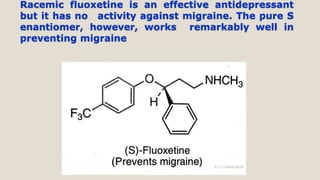


![4)Use of chiral
catalyst
R2
R3
R1
OH
O
R1
R1
R1
R3
R1
O
OH
R-isomer
R3
OH
+
Ti
O O C
O
CH O
H
CH3
CH3
C
H
H
C CH3
CH3
H3C
3
H C
CH3 CH3
S-Isomer
H
HO
COOC2H5
C OH
C H
COOC2H5
(R)-DET(Diethyl tartarate)
+
Chiral Catalyst
2
Chiral Catalyst
Ti
O O
O
CH O
C
H
CH3
CH3
C
H
H
C CH3
CH3
H3C
3
H C
COOC2H5
C H
HO
H C OH
COOC2H5
(S)-DET
+
CH3 CH3
(Titanium isopropoxide)
[O]
[O]
Titanium Isopropoxide
R.C.P.KASEGAON](https://image.slidesharecdn.com/sterioisomerism-221203052945-d1e1a451/85/Sterioisomerism-pptx-122-320.jpg)


1. Optical isomerism refers to compounds that exist in two forms that are non-superimposable mirror images and rotate plane-polarized light in opposite directions. 2. Compounds are optically active if they contain a chiral carbon - a carbon bonded to four different groups - and lack a plane of symmetry. 3. The two enantiomers of an optically active compound have equal but opposite rotations of plane-polarized light and are distinguished as (+) and (-) forms. Their mixture is optically inactive.


