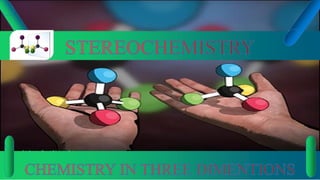
Stereochemistry
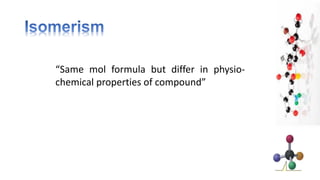
“Same mol formula but differ in physio-
chemical properties of compound”
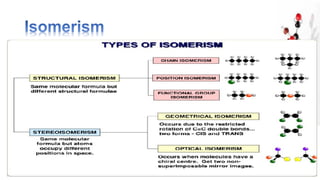
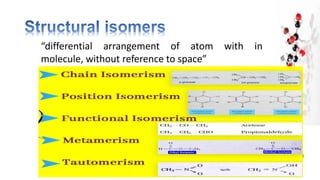
“differential arrangement of atom with in
molecule, without reference to space”
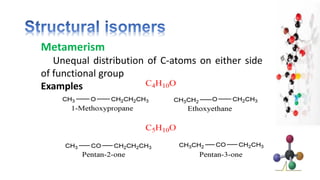
Metamerism
Unequal distribution of C-atoms on either side
of functional group
Examples
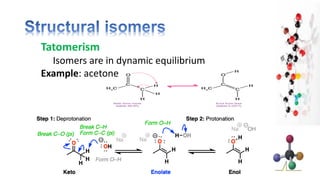
Tatomerism
Isomers are in dynamic equilibrium
Example: acetone
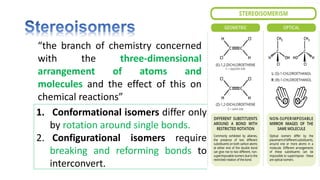
“the branch of chemistry concerned
with the three-dimensional
arrangement of atoms and
molecules and the effect of this on
chemical reactions”
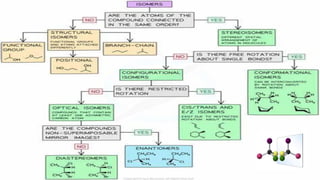
1. Conformational isomers differ only
by rotation around single bonds.
2. Configurational isomers require
breaking and reforming bonds to
interconvert.
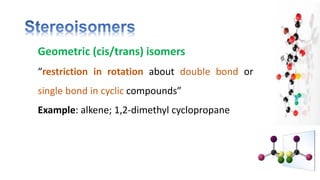
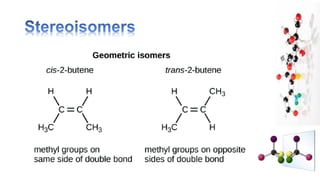
Geometric (cis/trans) isomers
“restriction in rotation about double bond or
single bond in cyclic compounds”
Example: alkene; 1,2-dimethyl cyclopropane
Example: cis-3-Hexene and trans-3-Hexene
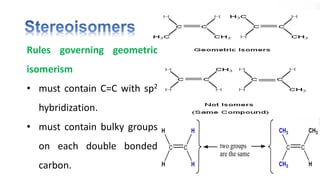
Rules governing geometric
isomerism
• must contain C=C with sp2
hybridization.
• must contain bulky groups
on each double bonded
carbon.
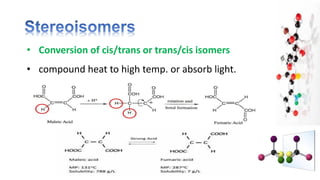
• Conversion of cis/trans or trans/cis isomers
• compound heat to high temp. or absorb light.
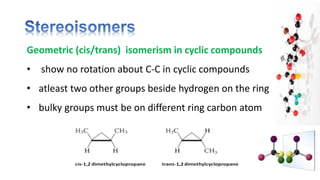
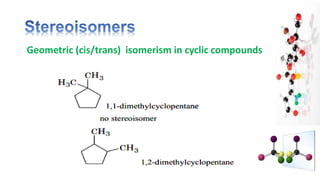
Geometric (cis/trans) isomerism in cyclic compounds
• show no rotation about C-C in cyclic compounds
• atleast two other groups beside hydrogen on the ring
• bulky groups must be on different ring carbon atom
Geometric (cis/trans) isomerism in cyclic compounds
Optical isomerism
“they have same molecular formula but differ in
the way of their arrangement in space ”
Optical activity
“the ability to rotate plain polarized light either
to left or right”
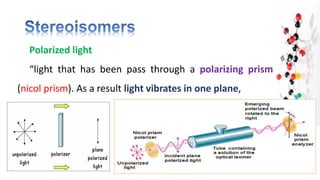
Polarized light
“light that has been pass through a polarizing prism
(nicol prism). As a result light vibrates in one plane,
Polarized light
• The polarimeter measures the rotation of plane
polarized-light, that has passed through a solution.
• Rotation, in degree is, [α]
• Right rotation = Clockwise [+] = dextrorotatory (d)
• Left rotation = Anticlockwise [-] = levorotatory (l)
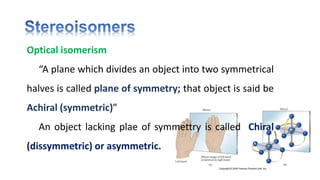
Optical isomerism
“A plane which divides an object into two symmetrical
halves is called plane of symmetry; that object is said be
Achiral (symmetric)”
An object lacking plae of symmettry is called Chiral
(dissymmetric) or asymmetric.
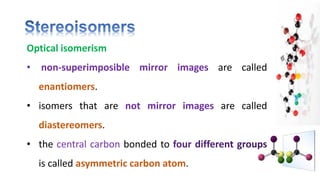
Optical isomerism
• non-superimposible mirror images are called
enantiomers.
• isomers that are not mirror images are called
diastereomers.
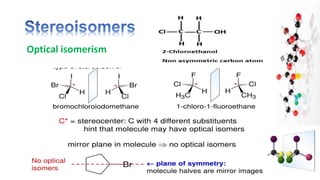
• the bonded to
is called asymmetric carbon atom.
Optical isomerism
Optical isomerism
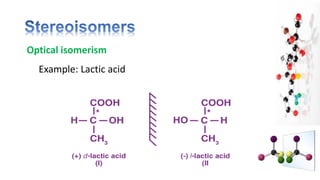
Example: Lactic acid
Optical isomerism
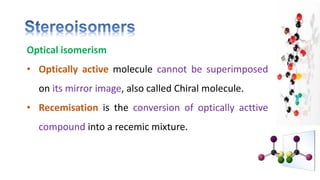
• Optically active molecule cannot be superimposed
on its mirror image, also called Chiral molecule.
• Recemisation is the conversion of optically acttive
compound into a recemic mixture.
Optical isomerism
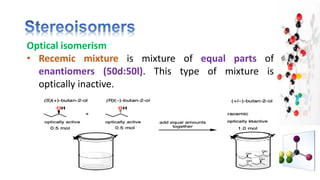
• Recemic mixture is mixture of equal parts of
enantiomers (50d:50l). This type of mixture is
optically inactive.
Optical isomerism
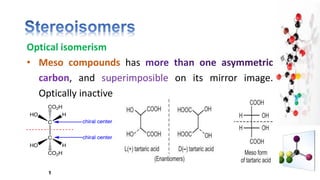
• Meso compounds has
, and superimposible on its mirror image.
Optically inactive
Optical isomerism
• Resolution of recemic mixture is the saperation of
enantiomers ( d and l isomers) into an optically active
components (+ and -).
• Recemic mixture can be resolved by two methods:
1. Chemical
2. Bio-chemical
Optical isomerism
• Resolution of recemic mixture
1. Chemical resolution
Recemic mixture is made to combine with another
optically active compound, differences are setup,
which exploit saperation.
A recemic mixture of optically active base can be
saperated by the use of an optically active acid.
Optical isomerism
• Resolution of recemic mixture
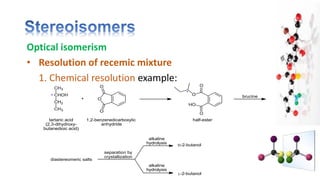
1. Chemical resolution example:
Optical isomerism
• Resolution of recemic mixture
2. Biochemical resolution
When certain bacteria or moulds are added to a
solution of a recemic mixture they bring about
decomposition of optically active form more rapidly
than others.
Optical isomerism
• Resolution of recemic mixture
2. Biochemical resolution example: racemic tartaric
acid can be resolved with the aid of certain penicillin
molds that consume the dextrorotatory enantiomer
faster than the levorotatory enantiomer; pure (-)-
tartaric acid can be recovered from the mixture:
• Text book of Organic Chemistry by BS Bhal
and Arun Bhal

Document from Vengeance.pdfbbbbbbjjjjjjj

  • 2.
  • 3.
    “Same mol formulabut differ in physio- chemical properties of compound”
  • 5.
    “differential arrangement ofatom with in molecule, without reference to space”
  • 6.
    Metamerism Unequal distribution ofC-atoms on either side of functional group Examples
  • 7.
    Tatomerism Isomers are indynamic equilibrium Example: acetone
  • 8.
    “the branch ofchemistry concerned with the three-dimensional arrangement of atoms and molecules and the effect of this on chemical reactions” 1. Conformational isomers differ only by rotation around single bonds. 2. Configurational isomers require breaking and reforming bonds to interconvert.
  • 9.
    Geometric (cis/trans) isomers “restrictionin rotation about double bond or single bond in cyclic compounds” Example: alkene; 1,2-dimethyl cyclopropane
  • 11.
  • 12.
    Rules governing geometric isomerism •must contain C=C with sp2 hybridization. • must contain bulky groups on each double bonded carbon.
  • 13.
    • Conversion ofcis/trans or trans/cis isomers • compound heat to high temp. or absorb light.
  • 14.
    Geometric (cis/trans) isomerismin cyclic compounds • show no rotation about C-C in cyclic compounds • atleast two other groups beside hydrogen on the ring • bulky groups must be on different ring carbon atom
  • 15.
  • 16.
    Optical isomerism “they havesame molecular formula but differ in the way of their arrangement in space ”
  • 17.
    Optical activity “the abilityto rotate plain polarized light either to left or right”
  • 18.
    Polarized light “light thathas been pass through a polarizing prism (nicol prism). As a result light vibrates in one plane,
  • 19.
    Polarized light • Thepolarimeter measures the rotation of plane polarized-light, that has passed through a solution. • Rotation, in degree is, [α] • Right rotation = Clockwise [+] = dextrorotatory (d) • Left rotation = Anticlockwise [-] = levorotatory (l)
  • 20.
    Optical isomerism “A planewhich divides an object into two symmetrical halves is called plane of symmetry; that object is said be Achiral (symmetric)” An object lacking plae of symmettry is called Chiral (dissymmetric) or asymmetric.
  • 21.
    Optical isomerism • non-superimposiblemirror images are called enantiomers. • isomers that are not mirror images are called diastereomers. • the bonded to is called asymmetric carbon atom.
  • 22.
  • 23.
  • 24.
    Optical isomerism • Opticallyactive molecule cannot be superimposed on its mirror image, also called Chiral molecule. • Recemisation is the conversion of optically acttive compound into a recemic mixture.
  • 25.
    Optical isomerism • Recemicmixture is mixture of equal parts of enantiomers (50d:50l). This type of mixture is optically inactive.
  • 26.
    Optical isomerism • Mesocompounds has , and superimposible on its mirror image. Optically inactive
  • 27.
    Optical isomerism • Resolutionof recemic mixture is the saperation of enantiomers ( d and l isomers) into an optically active components (+ and -). • Recemic mixture can be resolved by two methods: 1. Chemical 2. Bio-chemical
  • 28.
    Optical isomerism • Resolutionof recemic mixture 1. Chemical resolution Recemic mixture is made to combine with another optically active compound, differences are setup, which exploit saperation. A recemic mixture of optically active base can be saperated by the use of an optically active acid.
  • 29.
    Optical isomerism • Resolutionof recemic mixture 1. Chemical resolution example:
  • 30.
    Optical isomerism • Resolutionof recemic mixture 2. Biochemical resolution When certain bacteria or moulds are added to a solution of a recemic mixture they bring about decomposition of optically active form more rapidly than others.
  • 31.
    Optical isomerism • Resolutionof recemic mixture 2. Biochemical resolution example: racemic tartaric acid can be resolved with the aid of certain penicillin molds that consume the dextrorotatory enantiomer faster than the levorotatory enantiomer; pure (-)- tartaric acid can be recovered from the mixture:
  • 32.
    • Text bookof Organic Chemistry by BS Bhal and Arun Bhal