
Presented By
Sijo A
Ph.D. Research Scholar (Microbiology)
School of Biosciences, MACFAST College
Tiruvalla, Kerala, India
STERILIZATION TECHNIQUES
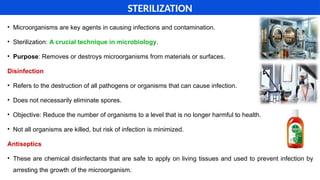
• Microorganisms are key agents in causing infections and contamination.
• Sterilization: A crucial technique in microbiology.
• Purpose: Removes or destroys microorganisms from materials or surfaces.
Disinfection
• Refers to the destruction of all pathogens or organisms that can cause infection.
• Does not necessarily eliminate spores.
• Objective: Reduce the number of organisms to a level that is no longer harmful to health.
• Not all organisms are killed, but risk of infection is minimized.
Antiseptics
• These are chemical disinfectants that are safe to apply on living tissues and used to prevent infection by
arresting the growth of the microorganism.
STERILIZATION
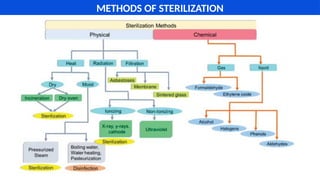
METHODS OF STERILIZATION
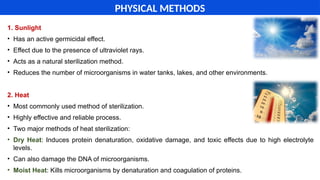
1. Sunlight
• Has an active germicidal effect.
• Effect due to the presence of ultraviolet rays.
• Acts as a natural sterilization method.
• Reduces the number of microorganisms in water tanks, lakes, and other environments.
2. Heat
• Most commonly used method of sterilization.
• Highly effective and reliable process.
• Two major methods of heat sterilization:
• Dry Heat: Induces protein denaturation, oxidative damage, and toxic effects due to high electrolyte
levels.
• Can also damage the DNA of microorganisms.
• Moist Heat: Kills microorganisms by denaturation and coagulation of proteins.
PHYSICAL METHODS
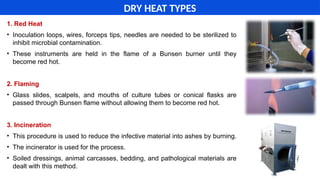
1. Red Heat
• Inoculation loops, wires, forceps tips, needles are needed to be sterilized to
inhibit microbial contamination.
• These instruments are held in the flame of a Bunsen burner until they
become red hot.
2. Flaming
• Glass slides, scalpels, and mouths of culture tubes or conical flasks are
passed through Bunsen flame without allowing them to become red hot.
3. Incineration
• This procedure is used to reduce the infective material into ashes by burning.
• The incinerator is used for the process.
• Soiled dressings, animal carcasses, bedding, and pathological materials are
dealt with this method.
DRY HEAT TYPES
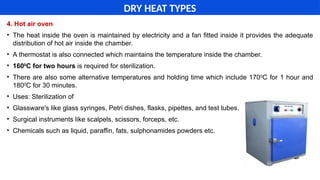
4. Hot air oven
• The heat inside the oven is maintained by electricity and a fan fitted inside it provides the adequate
distribution of hot air inside the chamber.
• A thermostat is also connected which maintains the temperature inside the chamber.
• 1600
C for two hours is required for sterilization.
• There are also some alternative temperatures and holding time which include 1700
C for 1 hour and
1800
C for 30 minutes.
• Uses: Sterilization of
• Glassware's like glass syringes, Petri dishes, flasks, pipettes, and test tubes.
• Surgical instruments like scalpels, scissors, forceps, etc.
• Chemicals such as liquid, paraffin, fats, sulphonamides powders etc.
DRY HEAT TYPES
Temperature below 100°C
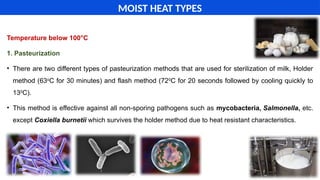
1. Pasteurization
• There are two different types of pasteurization methods that are used for sterilization of milk, Holder
method (63o
C for 30 minutes) and flash method (720
C for 20 seconds followed by cooling quickly to
130
C).
• This method is effective against all non-sporing pathogens such as mycobacteria, Salmonella, etc.
except Coxiella burnetii which survives the holder method due to heat resistant characteristics.
MOIST HEAT TYPES
Temperature below 100°C
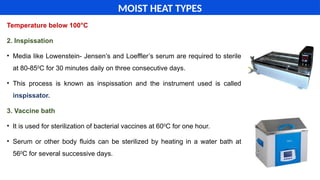
2. Inspissation
• Media like Lowenstein- Jensen’s and Loeffler’s serum are required to sterile
at 80-850
C for 30 minutes daily on three consecutive days.
• This process is known as inspissation and the instrument used is called
inspissator.
3. Vaccine bath
• It is used for sterilization of bacterial vaccines at 600
C for one hour.
• Serum or other body fluids can be sterilized by heating in a water bath at
560
C for several successive days.
MOIST HEAT TYPES
At a temperature of 100°C
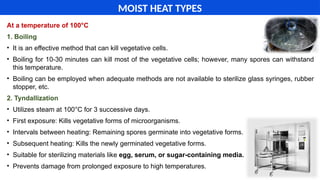
1. Boiling
• It is an effective method that can kill vegetative cells.
• Boiling for 10-30 minutes can kill most of the vegetative cells; however, many spores can withstand
this temperature.
• Boiling can be employed when adequate methods are not available to sterilize glass syringes, rubber
stopper, etc.
2. Tyndallization
• Utilizes steam at 100°C for 3 successive days.
• First exposure: Kills vegetative forms of microorganisms.
• Intervals between heating: Remaining spores germinate into vegetative forms.
• Subsequent heating: Kills the newly germinated vegetative forms.
• Suitable for sterilizing materials like egg, serum, or sugar-containing media.
• Prevents damage from prolonged exposure to high temperatures.
MOIST HEAT TYPES
Temperature above 100°C (under pressure)
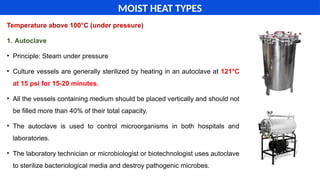
1. Autoclave
• Principle: Steam under pressure
• Culture vessels are generally sterilized by heating in an autoclave at 121°C
at 15 psi for 15-20 minutes.
• All the vessels containing medium should be placed vertically and should not
be filled more than 40% of their total capacity.
• The autoclave is used to control microorganisms in both hospitals and
laboratories.
• The laboratory technician or microbiologist or biotechnologist uses autoclave
to sterilize bacteriological media and destroy pathogenic microbes.
MOIST HEAT TYPES
• Filtration
1. HEPA Filters
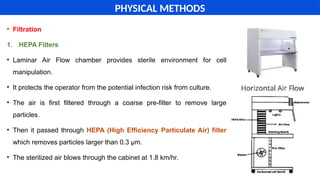
• Laminar Air Flow chamber provides sterile environment for cell
manipulation.
• It protects the operator from the potential infection risk from culture.
• The air is first filtered through a coarse pre-filter to remove large
particles.
• Then it passed through HEPA (High Efficiency Particulate Air) filter
which removes particles larger than 0.3 µm.
• The sterilized air blows through the cabinet at 1.8 km/hr.
PHYSICAL METHODS
• Radiation (Cold Sterilization)
1. UV Radiation
• The UV radiation of 260 nm does not penetrate the glass, water and other
substances.
• UV radiation burns skin and damages eyes.
• The UV lamps are used to sterilize the air in a biological safety cabinet.
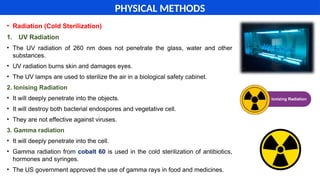
2. Ionising Radiation
• It will deeply penetrate into the objects.
• It will destroy both bacterial endospores and vegetative cell.
• They are not effective against viruses.
3. Gamma radiation
• It will deeply penetrate into the cell.
• Gamma radiation from cobalt 60 is used in the cold sterilization of antibiotics,
hormones and syringes.
• The US government approved the use of gamma rays in food and medicines.
PHYSICAL METHODS
CHARACTERISTICS OF DESIRABLE CHEMICAL OR DISINFECTANT
1. It must be effective against wide variety of infectious agents (bacteria, bacterial
endospores, fungi and virus) at high dilutions and in the presence of organic matter.
2. It must be toxic for infectious agents.
3. It should not be toxic to people.
4. It should not be corrosive for common materials
5. It should be soluble in water & lipids for the penetration into microorganisms.
6. It should have a low surface tension.
7. It should be relatively inexpensive.
CHEMICAL METHODS
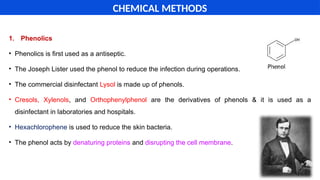
1. Phenolics
• Phenolics is first used as a antiseptic.
• The Joseph Lister used the phenol to reduce the infection during operations.
• The commercial disinfectant Lysol is made up of phenols.
• Cresols, Xylenols, and Orthophenylphenol are the derivatives of phenols & it is used as a
disinfectant in laboratories and hospitals.
• Hexachlorophene is used to reduce the skin bacteria.
• The phenol acts by denaturing proteins and disrupting the cell membrane.
CHEMICAL METHODS
2. Alcohols
• Alcohols are widely used as a antiseptic and disinfectants.
• The most popular alcohol are ethanol (70%) and isopropanol (80%).
• A 10 to 15 minute soaking is sufficient to disinfectant thermometers and
small instruments.
• The alcohol acts by denaturing proteins and dissolving membrane lipids.
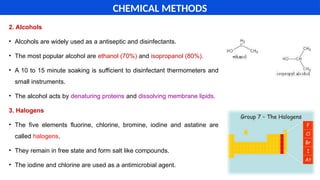
3. Halogens
• The five elements fluorine, chlorine, bromine, iodine and astatine are
called halogens.
• They remain in free state and form salt like compounds.
• The iodine and chlorine are used as a antimicrobial agent.
CHEMICAL METHODS
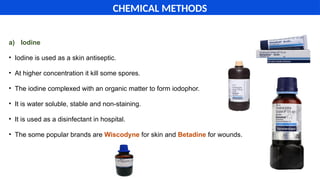
a) Iodine
• Iodine is used as a skin antiseptic.
• At higher concentration it kill some spores.
• The iodine complexed with an organic matter to form iodophor.
• It is water soluble, stable and non-staining.
• It is used as a disinfectant in hospital.
• The some popular brands are Wiscodyne for skin and Betadine for wounds.
CHEMICAL METHODS
b) Chlorine
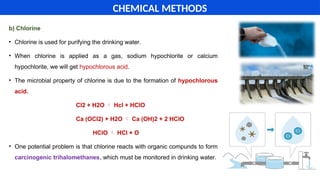
• Chlorine is used for purifying the drinking water.
• When chlorine is applied as a gas, sodium hypochlorite or calcium
hypochlorite, we will get hypochlorous acid.
• The microbial property of chlorine is due to the formation of hypochlorous
acid.
Cl2 + H2O  Hcl + HClO
Ca (OCl2) + H2O  Ca (OH)2 + 2 HClO
HClO  HCl + O
• One potential problem is that chlorine reacts with organic compunds to form
carcinogenic trihalomethanes, which must be monitored in drinking water.
CHEMICAL METHODS
4. Heavy metals
• Heavy metals like mercury, silver, zinc and copper are used as
germicide.
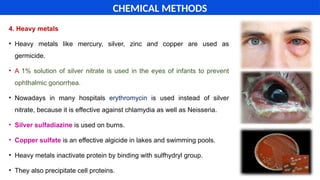
• A 1% solution of silver nitrate is used in the eyes of infants to prevent
ophthalmic gonorrhea.
• Nowadays in many hospitals erythromycin is used instead of silver
nitrate, because it is effective against chlamydia as well as Neisseria.
• Silver sulfadiazine is used on burns.
• Copper sulfate is an effective algicide in lakes and swimming pools.
• Heavy metals inactivate protein by binding with sulfhydryl group.
• They also precipitate cell proteins.
CHEMICAL METHODS
5. Quaternary Ammonium Compounds
• The detergents are organic molecules that serve as a wetting agent and
emulsifiers because they have both polar hydrophilic and non-polar
hydrophobic ends.
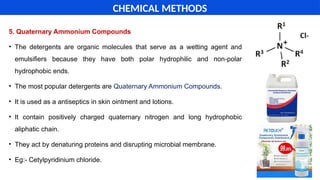
• The most popular detergents are Quaternary Ammonium Compounds.
• It is used as a antiseptics in skin ointment and lotions.
• It contain positively charged quaternary nitrogen and long hydrophobic
aliphatic chain.
• They act by denaturing proteins and disrupting microbial membrane.
• Eg:- Cetylpyridinium chloride.
CHEMICAL METHODS
6. Aldehydes
• The formaldehyde and gluteraldehyde are commonly used.
• The formaldehyde is dissolved in water before use.
• A 2 % buffered solution of gluteraldehyde is an effective disinfectant.
• They acts by inactivating proteins by cross linking and alkylating
molecule.
7. Sterilising gases
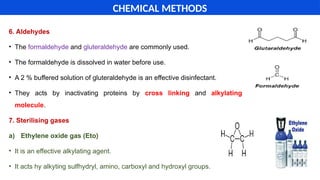
a) Ethylene oxide gas (Eto)
• It is an effective alkylating agent.
• It acts hy alkyting sulfhydryl, amino, carboxyl and hydroxyl groups.
CHEMICAL METHODS
7. Sterilising gases
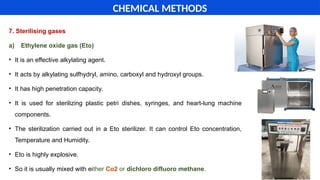
a) Ethylene oxide gas (Eto)
• It is an effective alkylating agent.
• It acts by alkylating sulfhydryl, amino, carboxyl and hydroxyl groups.
• It has high penetration capacity.
• It is used for sterilizing plastic petri dishes, syringes, and heart-lung machine
components.
• The sterilization carried out in a Eto sterilizer. It can control Eto concentration,
Temperature and Humidity.
• Eto is highly explosive.
• So it is usually mixed with either Co2 or dichloro difluoro methane.
CHEMICAL METHODS
7. Sterilising gases
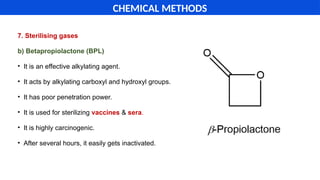
b) Betapropiolactone (BPL)
• It is an effective alkylating agent.
• It acts by alkylating carboxyl and hydroxyl groups.
• It has poor penetration power.
• It is used for sterilizing vaccines & sera.
• It is highly carcinogenic.
• After several hours, it easily gets inactivated.
CHEMICAL METHODS
THANK YOU

Sterilization Techniques - Medical Microbiology

  • 1.
    Presented By Sijo A Ph.D.Research Scholar (Microbiology) School of Biosciences, MACFAST College Tiruvalla, Kerala, India STERILIZATION TECHNIQUES
  • 2.
    • Microorganisms arekey agents in causing infections and contamination. • Sterilization: A crucial technique in microbiology. • Purpose: Removes or destroys microorganisms from materials or surfaces. Disinfection • Refers to the destruction of all pathogens or organisms that can cause infection. • Does not necessarily eliminate spores. • Objective: Reduce the number of organisms to a level that is no longer harmful to health. • Not all organisms are killed, but risk of infection is minimized. Antiseptics • These are chemical disinfectants that are safe to apply on living tissues and used to prevent infection by arresting the growth of the microorganism. STERILIZATION
  • 3.
  • 4.
    1. Sunlight • Hasan active germicidal effect. • Effect due to the presence of ultraviolet rays. • Acts as a natural sterilization method. • Reduces the number of microorganisms in water tanks, lakes, and other environments. 2. Heat • Most commonly used method of sterilization. • Highly effective and reliable process. • Two major methods of heat sterilization: • Dry Heat: Induces protein denaturation, oxidative damage, and toxic effects due to high electrolyte levels. • Can also damage the DNA of microorganisms. • Moist Heat: Kills microorganisms by denaturation and coagulation of proteins. PHYSICAL METHODS
  • 5.
    1. Red Heat •Inoculation loops, wires, forceps tips, needles are needed to be sterilized to inhibit microbial contamination. • These instruments are held in the flame of a Bunsen burner until they become red hot. 2. Flaming • Glass slides, scalpels, and mouths of culture tubes or conical flasks are passed through Bunsen flame without allowing them to become red hot. 3. Incineration • This procedure is used to reduce the infective material into ashes by burning. • The incinerator is used for the process. • Soiled dressings, animal carcasses, bedding, and pathological materials are dealt with this method. DRY HEAT TYPES
  • 6.
    4. Hot airoven • The heat inside the oven is maintained by electricity and a fan fitted inside it provides the adequate distribution of hot air inside the chamber. • A thermostat is also connected which maintains the temperature inside the chamber. • 1600 C for two hours is required for sterilization. • There are also some alternative temperatures and holding time which include 1700 C for 1 hour and 1800 C for 30 minutes. • Uses: Sterilization of • Glassware's like glass syringes, Petri dishes, flasks, pipettes, and test tubes. • Surgical instruments like scalpels, scissors, forceps, etc. • Chemicals such as liquid, paraffin, fats, sulphonamides powders etc. DRY HEAT TYPES
  • 7.
    Temperature below 100°C 1.Pasteurization • There are two different types of pasteurization methods that are used for sterilization of milk, Holder method (63o C for 30 minutes) and flash method (720 C for 20 seconds followed by cooling quickly to 130 C). • This method is effective against all non-sporing pathogens such as mycobacteria, Salmonella, etc. except Coxiella burnetii which survives the holder method due to heat resistant characteristics. MOIST HEAT TYPES
  • 8.
    Temperature below 100°C 2.Inspissation • Media like Lowenstein- Jensen’s and Loeffler’s serum are required to sterile at 80-850 C for 30 minutes daily on three consecutive days. • This process is known as inspissation and the instrument used is called inspissator. 3. Vaccine bath • It is used for sterilization of bacterial vaccines at 600 C for one hour. • Serum or other body fluids can be sterilized by heating in a water bath at 560 C for several successive days. MOIST HEAT TYPES
  • 9.
    At a temperatureof 100°C 1. Boiling • It is an effective method that can kill vegetative cells. • Boiling for 10-30 minutes can kill most of the vegetative cells; however, many spores can withstand this temperature. • Boiling can be employed when adequate methods are not available to sterilize glass syringes, rubber stopper, etc. 2. Tyndallization • Utilizes steam at 100°C for 3 successive days. • First exposure: Kills vegetative forms of microorganisms. • Intervals between heating: Remaining spores germinate into vegetative forms. • Subsequent heating: Kills the newly germinated vegetative forms. • Suitable for sterilizing materials like egg, serum, or sugar-containing media. • Prevents damage from prolonged exposure to high temperatures. MOIST HEAT TYPES
  • 10.
    Temperature above 100°C(under pressure) 1. Autoclave • Principle: Steam under pressure • Culture vessels are generally sterilized by heating in an autoclave at 121°C at 15 psi for 15-20 minutes. • All the vessels containing medium should be placed vertically and should not be filled more than 40% of their total capacity. • The autoclave is used to control microorganisms in both hospitals and laboratories. • The laboratory technician or microbiologist or biotechnologist uses autoclave to sterilize bacteriological media and destroy pathogenic microbes. MOIST HEAT TYPES
  • 11.
    • Filtration 1. HEPAFilters • Laminar Air Flow chamber provides sterile environment for cell manipulation. • It protects the operator from the potential infection risk from culture. • The air is first filtered through a coarse pre-filter to remove large particles. • Then it passed through HEPA (High Efficiency Particulate Air) filter which removes particles larger than 0.3 µm. • The sterilized air blows through the cabinet at 1.8 km/hr. PHYSICAL METHODS
  • 12.
    • Radiation (ColdSterilization) 1. UV Radiation • The UV radiation of 260 nm does not penetrate the glass, water and other substances. • UV radiation burns skin and damages eyes. • The UV lamps are used to sterilize the air in a biological safety cabinet. 2. Ionising Radiation • It will deeply penetrate into the objects. • It will destroy both bacterial endospores and vegetative cell. • They are not effective against viruses. 3. Gamma radiation • It will deeply penetrate into the cell. • Gamma radiation from cobalt 60 is used in the cold sterilization of antibiotics, hormones and syringes. • The US government approved the use of gamma rays in food and medicines. PHYSICAL METHODS
  • 13.
    CHARACTERISTICS OF DESIRABLECHEMICAL OR DISINFECTANT 1. It must be effective against wide variety of infectious agents (bacteria, bacterial endospores, fungi and virus) at high dilutions and in the presence of organic matter. 2. It must be toxic for infectious agents. 3. It should not be toxic to people. 4. It should not be corrosive for common materials 5. It should be soluble in water & lipids for the penetration into microorganisms. 6. It should have a low surface tension. 7. It should be relatively inexpensive. CHEMICAL METHODS
  • 14.
    1. Phenolics • Phenolicsis first used as a antiseptic. • The Joseph Lister used the phenol to reduce the infection during operations. • The commercial disinfectant Lysol is made up of phenols. • Cresols, Xylenols, and Orthophenylphenol are the derivatives of phenols & it is used as a disinfectant in laboratories and hospitals. • Hexachlorophene is used to reduce the skin bacteria. • The phenol acts by denaturing proteins and disrupting the cell membrane. CHEMICAL METHODS
  • 15.
    2. Alcohols • Alcoholsare widely used as a antiseptic and disinfectants. • The most popular alcohol are ethanol (70%) and isopropanol (80%). • A 10 to 15 minute soaking is sufficient to disinfectant thermometers and small instruments. • The alcohol acts by denaturing proteins and dissolving membrane lipids. 3. Halogens • The five elements fluorine, chlorine, bromine, iodine and astatine are called halogens. • They remain in free state and form salt like compounds. • The iodine and chlorine are used as a antimicrobial agent. CHEMICAL METHODS
  • 16.
    a) Iodine • Iodineis used as a skin antiseptic. • At higher concentration it kill some spores. • The iodine complexed with an organic matter to form iodophor. • It is water soluble, stable and non-staining. • It is used as a disinfectant in hospital. • The some popular brands are Wiscodyne for skin and Betadine for wounds. CHEMICAL METHODS
  • 17.
    b) Chlorine • Chlorineis used for purifying the drinking water. • When chlorine is applied as a gas, sodium hypochlorite or calcium hypochlorite, we will get hypochlorous acid. • The microbial property of chlorine is due to the formation of hypochlorous acid. Cl2 + H2O  Hcl + HClO Ca (OCl2) + H2O  Ca (OH)2 + 2 HClO HClO  HCl + O • One potential problem is that chlorine reacts with organic compunds to form carcinogenic trihalomethanes, which must be monitored in drinking water. CHEMICAL METHODS
  • 18.
    4. Heavy metals •Heavy metals like mercury, silver, zinc and copper are used as germicide. • A 1% solution of silver nitrate is used in the eyes of infants to prevent ophthalmic gonorrhea. • Nowadays in many hospitals erythromycin is used instead of silver nitrate, because it is effective against chlamydia as well as Neisseria. • Silver sulfadiazine is used on burns. • Copper sulfate is an effective algicide in lakes and swimming pools. • Heavy metals inactivate protein by binding with sulfhydryl group. • They also precipitate cell proteins. CHEMICAL METHODS
  • 19.
    5. Quaternary AmmoniumCompounds • The detergents are organic molecules that serve as a wetting agent and emulsifiers because they have both polar hydrophilic and non-polar hydrophobic ends. • The most popular detergents are Quaternary Ammonium Compounds. • It is used as a antiseptics in skin ointment and lotions. • It contain positively charged quaternary nitrogen and long hydrophobic aliphatic chain. • They act by denaturing proteins and disrupting microbial membrane. • Eg:- Cetylpyridinium chloride. CHEMICAL METHODS
  • 20.
    6. Aldehydes • Theformaldehyde and gluteraldehyde are commonly used. • The formaldehyde is dissolved in water before use. • A 2 % buffered solution of gluteraldehyde is an effective disinfectant. • They acts by inactivating proteins by cross linking and alkylating molecule. 7. Sterilising gases a) Ethylene oxide gas (Eto) • It is an effective alkylating agent. • It acts hy alkyting sulfhydryl, amino, carboxyl and hydroxyl groups. CHEMICAL METHODS
  • 21.
    7. Sterilising gases a)Ethylene oxide gas (Eto) • It is an effective alkylating agent. • It acts by alkylating sulfhydryl, amino, carboxyl and hydroxyl groups. • It has high penetration capacity. • It is used for sterilizing plastic petri dishes, syringes, and heart-lung machine components. • The sterilization carried out in a Eto sterilizer. It can control Eto concentration, Temperature and Humidity. • Eto is highly explosive. • So it is usually mixed with either Co2 or dichloro difluoro methane. CHEMICAL METHODS
  • 22.
    7. Sterilising gases b)Betapropiolactone (BPL) • It is an effective alkylating agent. • It acts by alkylating carboxyl and hydroxyl groups. • It has poor penetration power. • It is used for sterilizing vaccines & sera. • It is highly carcinogenic. • After several hours, it easily gets inactivated. CHEMICAL METHODS
  • 23.