UNIT III
3.3 Sterility testing of products
Presented by:
Mohammad Abuzar(M. Pharm)
Assistant Professor School of
Pharmacy AIKTC, New Panvel.
CONTENTS
2
Methods – direct inoculation and membrane filtration
Positive and negative controls
Summary
References
Introduction
Need for sterility testing
3
INTRODUCTION
Sterility testing
• Sterility testing examines samples of the final product for the presence of
microorganisms
• Should be applied to all products that are designated as sterile
• A satisfactory result only indicates that no contaminating
microorganism has been found in the sample examined in the
conditions of the test
4
Culture media
1. Fluid thioglycollate medium
– For the culture of aerobic and anaerobic bacteria
– pH after sterilization 6.9 to 7.3
– To be incubated at 30–35 °C
2. Soya-bean casein digest medium
– Suitable for the culture of both fungi and aerobic bacteria
– pH after sterilization 7.1 to 7.5
– To be incubated at 20–25 °C
Sterility check of media (Negative control)
• Incubate portions of the media for 14 days. No growth of should occur
5
Growth promotion test of aerobes, anaerobes and fungi (Positive control)
• Inoculate each media using test organism
• Incubate under the specified conditions
• The media are suitable if a clearly visible growth of the microorganisms
occurs
Aerobic bacteria
• Staphylococcus aureus ATCC 6538, CIP 4.83, NCTC 10788, NCIMB
9518, NBRC 13276
• Bacillus subtilis ATCC 6633, CIP 52.62, NCIMB 8054, NBRC 3134
• Pseudomonas aeruginosa ATCC 9027, NCIMB 8626, CIP 82.118, NBRC
13275
Anaerobic bacterium
• Clostridium sporogenes ATCC 19404, CIP 79.3, NCTC 532 or ATCC
11437, NBRC 14293
6
Fungi
• Candida albicans ATCC 10231, IP 48.72, NCPF 3179, NBRC 1594
• Aspergillus brasiliensis ATCC 16404, IP 1431.83, IMI 149007, NBRC
9455
• ATCC- American Type culture collection, USA
• CIP- Collection de l'Institut Pasteur, France
• NCTC- National collection of type cultures, England
• NCIMB- National Collection of Industrial and Marine Bacteria,
National Collections of Industrial, Food and Marine Bacteria,
UK ,Scotland
• NBRC – National Biological Resource Centre, Japan
• IMI- CABI GRC (Strain numbers: IMI): The Genetic Resource
Collection, CABI Bioscience UK Centre UK
7
Sterility testing methods
1. Direct inoculation methods
Involves introducing test samples directly into nutrient media
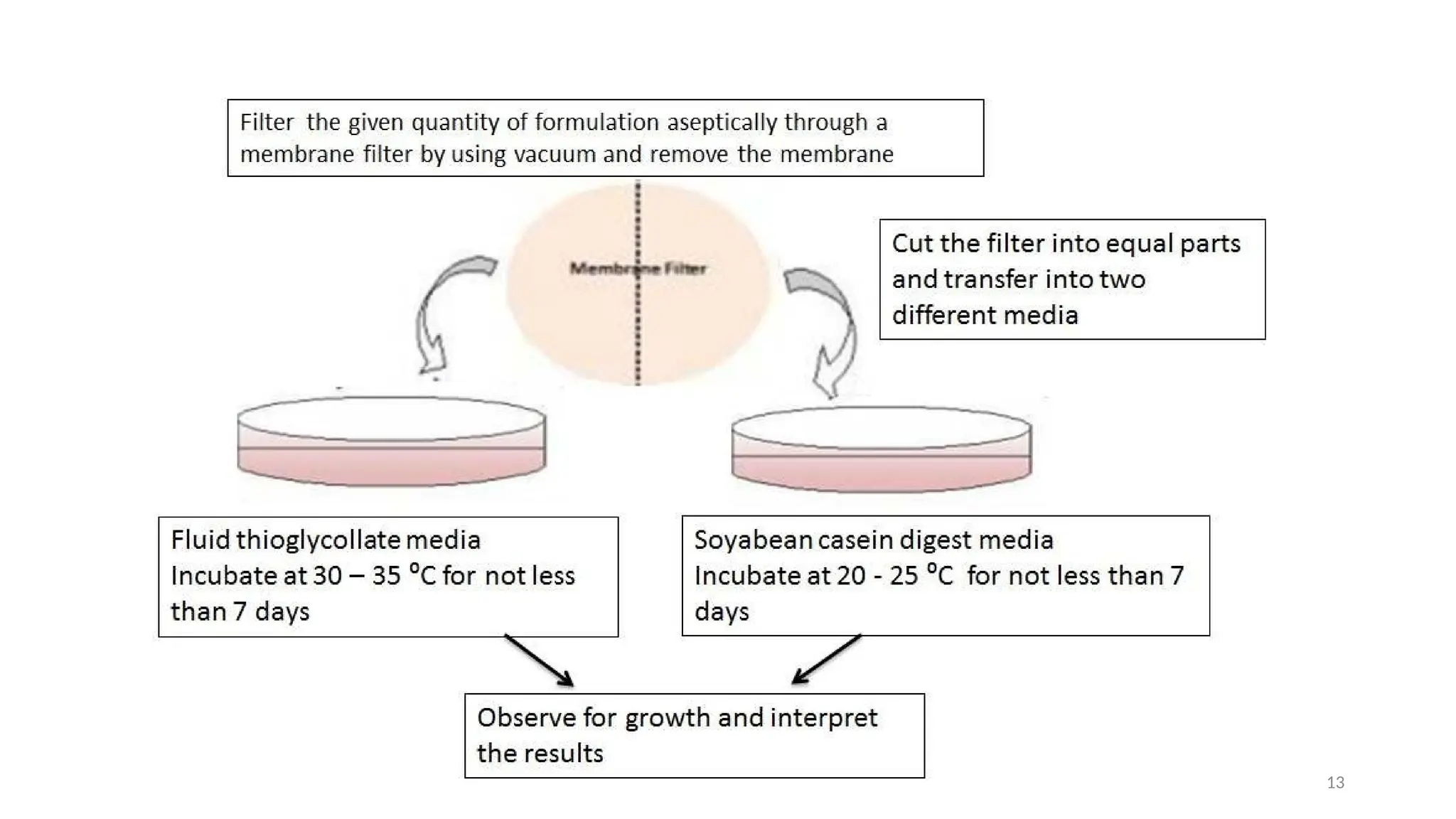
2. Membrane filtration method
• Involves filtration of fluids through a sterile membrane filter
• Microorganism present being retained on the surface of the filter
• Portions of the filter are transferred to suitable culture media
8
Sterility testing by direct inoculation method
Growth - contaminated
9
Sterility testing of pharmaceutical products Direct
inoculation method
If the product to be examined has antimicrobial
activity:
• Carry out the test after neutralizing this with a suitable neutralizing
substance or by dilution in a sufficient quantity of culture medium
Oily liquids
• Use media to which have been added a suitable emulsifying agent at a
concentration shown to be appropriate in the method suitability of the test,
for example, polysorbate 80 at a concentration of 10 g/L
10
Ointments and creams
• Prepare by diluting to about 1 in 10 by emulsifying with the chosen emulsifying agent
in a suitable sterile diluent such as peptone(1 g/L). Transfer the diluted product to a
medium not containing an emulsifying agent
• Incubate the inoculated media for not less than 14 days
• Observe the cultures several times during the incubation period
• Shake cultures containing oily products gently each day
• When fluid thioglycollate medium is used for the detection of anaerobic
microorganisms keep shaking or mixing to a minimum in order to maintain anaerobic
conditions
• Examination of the media for macroscopic evidence of microbial growth
11
If no evidence of microbial growth is found, the product to be examined
complies with the test for sterility
If evidence of microbial growth is found the product to be examined does not
comply with the test for sterility
The test may be considered invalid if
• A review of the testing procedure used during the test in question reveals a
fault
• The data of the microbiological monitoring of the sterility testing facility
show a fault
• Microbial growth is found in the negative controls
12
Sterility testing of pharmaceutical products Membrane filtration
method
Membrane filtration is used for
• Filterable aqueous preparations,
• Alcoholic or oily preparations
• Preparations miscible with or soluble in aqueous or oily solvents
(Provided these solvents do not have an antimicrobial effect in the
conditions of the test)
Growth - contaminated
13
14
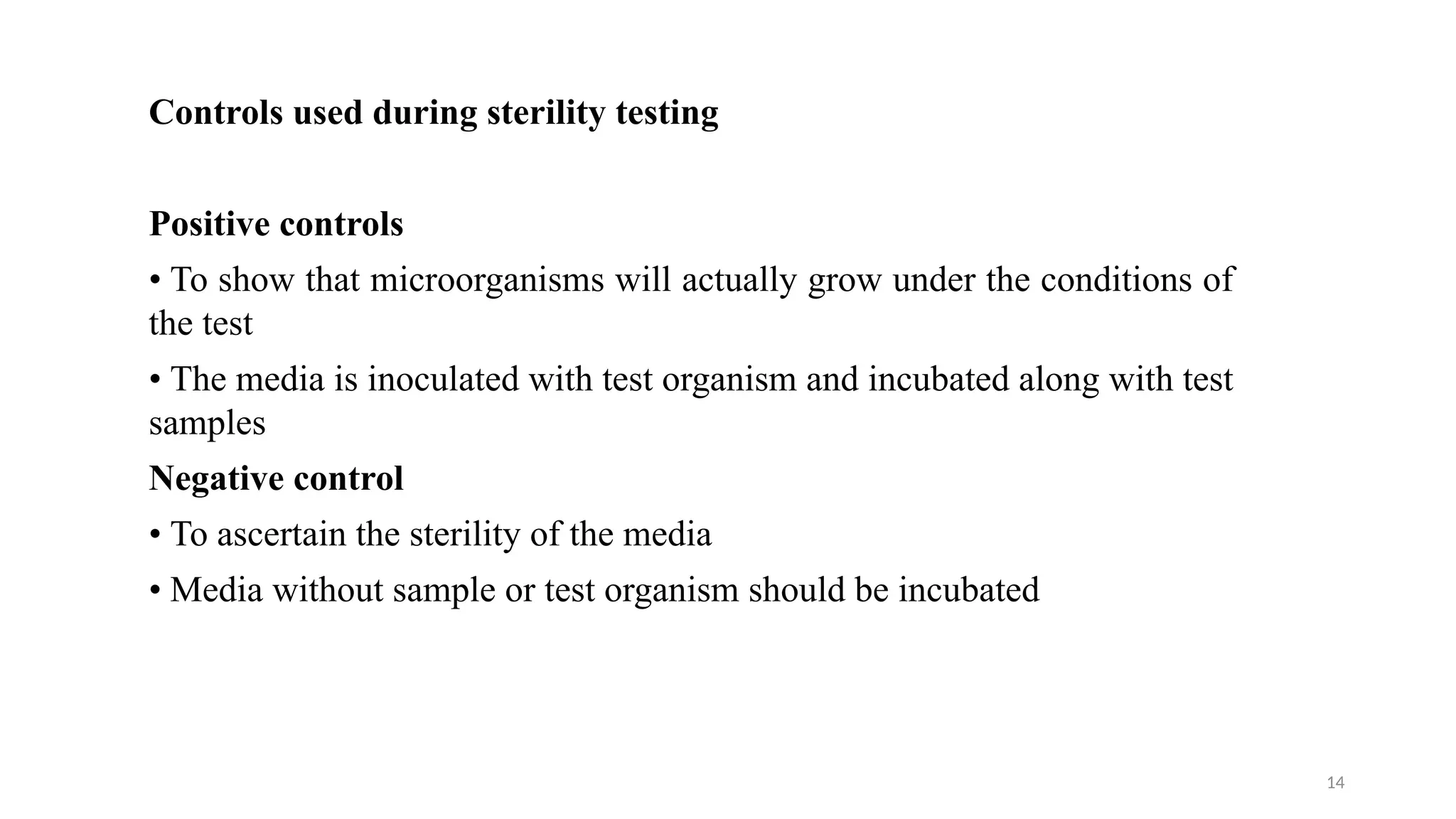
Controls used during sterility testing
Positive controls
• To show that microorganisms will actually grow under the conditions of
the test
• The media is inoculated with test organism and incubated along with test
samples
Negative control
• To ascertain the sterility of the media
• Media without sample or test organism should be incubated
15
Summary
• Sterility testing examines samples of the final product for the presence of
microorganisms and applied to all products that are designated as sterile
• Media used - Fluid thioglycollate medium (aerobic and anaerobic) Soya-bean
casein digest medium (for fungi)
• Methods – direct inoculation and membrane filtration
• Positive control – To show that microorganisms will actually grow under the
conditions of the test
• Negative control -To ascertain the sterility of the media
16
1. W.B. Hugo and A.D. Russel: Pharmaceutical Microbiology, Blackwell Scientific publications, Oxford London.
2. Prescott and Dunn., Industrial Microbiology, 4th edition, CBS Publishers & Distributors, Delhi.
3. Pelczar, Chan Kreig , Microbiology, Tata McGraw Hill edn.
4. Malcolm Harris, Balliere Tindall and Cox: Pharmaceutical Microbiology.
5. Rose: Industrial Microbiology.
6. Probisher , Hinsdill et al: Fundamentals of Microbiology, 9th ed. Japan
7. Cooper and Gunn’s: Tutorial Pharmacy, CBS Publisher and Distribution.
8. Peppler : Microbial Technology.
9. I.P., B.P., U.S.P.- latest editions.
10. Ananthnarayan : Text Book of Microbiology, Orient-Longman, Chennai
11. Edward: Fundamentals of Microbiology.
12. N.K.Jain: Pharmaceutical Microbiology, Vallabh Prakashan, Delhi
REFERENCES
17

Sterility testing of Pharmaceutical products

  • 1.
    UNIT III 3.3 Sterilitytesting of products Presented by: Mohammad Abuzar(M. Pharm) Assistant Professor School of Pharmacy AIKTC, New Panvel.
  • 2.
    CONTENTS 2 Methods – directinoculation and membrane filtration Positive and negative controls Summary References Introduction Need for sterility testing
  • 3.
    3 INTRODUCTION Sterility testing • Sterilitytesting examines samples of the final product for the presence of microorganisms • Should be applied to all products that are designated as sterile • A satisfactory result only indicates that no contaminating microorganism has been found in the sample examined in the conditions of the test
  • 4.
    4 Culture media 1. Fluidthioglycollate medium – For the culture of aerobic and anaerobic bacteria – pH after sterilization 6.9 to 7.3 – To be incubated at 30–35 °C 2. Soya-bean casein digest medium – Suitable for the culture of both fungi and aerobic bacteria – pH after sterilization 7.1 to 7.5 – To be incubated at 20–25 °C Sterility check of media (Negative control) • Incubate portions of the media for 14 days. No growth of should occur
  • 5.
    5 Growth promotion testof aerobes, anaerobes and fungi (Positive control) • Inoculate each media using test organism • Incubate under the specified conditions • The media are suitable if a clearly visible growth of the microorganisms occurs Aerobic bacteria • Staphylococcus aureus ATCC 6538, CIP 4.83, NCTC 10788, NCIMB 9518, NBRC 13276 • Bacillus subtilis ATCC 6633, CIP 52.62, NCIMB 8054, NBRC 3134 • Pseudomonas aeruginosa ATCC 9027, NCIMB 8626, CIP 82.118, NBRC 13275 Anaerobic bacterium • Clostridium sporogenes ATCC 19404, CIP 79.3, NCTC 532 or ATCC 11437, NBRC 14293
  • 6.
    6 Fungi • Candida albicansATCC 10231, IP 48.72, NCPF 3179, NBRC 1594 • Aspergillus brasiliensis ATCC 16404, IP 1431.83, IMI 149007, NBRC 9455 • ATCC- American Type culture collection, USA • CIP- Collection de l'Institut Pasteur, France • NCTC- National collection of type cultures, England • NCIMB- National Collection of Industrial and Marine Bacteria, National Collections of Industrial, Food and Marine Bacteria, UK ,Scotland • NBRC – National Biological Resource Centre, Japan • IMI- CABI GRC (Strain numbers: IMI): The Genetic Resource Collection, CABI Bioscience UK Centre UK
  • 7.
    7 Sterility testing methods 1.Direct inoculation methods Involves introducing test samples directly into nutrient media 2. Membrane filtration method • Involves filtration of fluids through a sterile membrane filter • Microorganism present being retained on the surface of the filter • Portions of the filter are transferred to suitable culture media
  • 8.
    8 Sterility testing bydirect inoculation method Growth - contaminated
  • 9.
    9 Sterility testing ofpharmaceutical products Direct inoculation method If the product to be examined has antimicrobial activity: • Carry out the test after neutralizing this with a suitable neutralizing substance or by dilution in a sufficient quantity of culture medium Oily liquids • Use media to which have been added a suitable emulsifying agent at a concentration shown to be appropriate in the method suitability of the test, for example, polysorbate 80 at a concentration of 10 g/L
  • 10.
    10 Ointments and creams •Prepare by diluting to about 1 in 10 by emulsifying with the chosen emulsifying agent in a suitable sterile diluent such as peptone(1 g/L). Transfer the diluted product to a medium not containing an emulsifying agent • Incubate the inoculated media for not less than 14 days • Observe the cultures several times during the incubation period • Shake cultures containing oily products gently each day • When fluid thioglycollate medium is used for the detection of anaerobic microorganisms keep shaking or mixing to a minimum in order to maintain anaerobic conditions • Examination of the media for macroscopic evidence of microbial growth
  • 11.
    11 If no evidenceof microbial growth is found, the product to be examined complies with the test for sterility If evidence of microbial growth is found the product to be examined does not comply with the test for sterility The test may be considered invalid if • A review of the testing procedure used during the test in question reveals a fault • The data of the microbiological monitoring of the sterility testing facility show a fault • Microbial growth is found in the negative controls
  • 12.
    12 Sterility testing ofpharmaceutical products Membrane filtration method Membrane filtration is used for • Filterable aqueous preparations, • Alcoholic or oily preparations • Preparations miscible with or soluble in aqueous or oily solvents (Provided these solvents do not have an antimicrobial effect in the conditions of the test) Growth - contaminated
  • 13.
  • 14.
    14 Controls used duringsterility testing Positive controls • To show that microorganisms will actually grow under the conditions of the test • The media is inoculated with test organism and incubated along with test samples Negative control • To ascertain the sterility of the media • Media without sample or test organism should be incubated
  • 15.
    15 Summary • Sterility testingexamines samples of the final product for the presence of microorganisms and applied to all products that are designated as sterile • Media used - Fluid thioglycollate medium (aerobic and anaerobic) Soya-bean casein digest medium (for fungi) • Methods – direct inoculation and membrane filtration • Positive control – To show that microorganisms will actually grow under the conditions of the test • Negative control -To ascertain the sterility of the media
  • 16.
    16 1. W.B. Hugoand A.D. Russel: Pharmaceutical Microbiology, Blackwell Scientific publications, Oxford London. 2. Prescott and Dunn., Industrial Microbiology, 4th edition, CBS Publishers & Distributors, Delhi. 3. Pelczar, Chan Kreig , Microbiology, Tata McGraw Hill edn. 4. Malcolm Harris, Balliere Tindall and Cox: Pharmaceutical Microbiology. 5. Rose: Industrial Microbiology. 6. Probisher , Hinsdill et al: Fundamentals of Microbiology, 9th ed. Japan 7. Cooper and Gunn’s: Tutorial Pharmacy, CBS Publisher and Distribution. 8. Peppler : Microbial Technology. 9. I.P., B.P., U.S.P.- latest editions. 10. Ananthnarayan : Text Book of Microbiology, Orient-Longman, Chennai 11. Edward: Fundamentals of Microbiology. 12. N.K.Jain: Pharmaceutical Microbiology, Vallabh Prakashan, Delhi REFERENCES
  • 17.