Course:-
SAI COLLEGE OF PHARMACY
Bachelor of Pharmacy
Subject:-
Pharmaceutical Microbiology
Evaluation of microbial stability of
formulations
Presented by Md Kashif
Topic:-
1
EVALUATION OF
MICROBIAL STABILITY OF
FORMULATION
OR
PRESERVATIVE EFFICACY
TEST
3
CONTENT
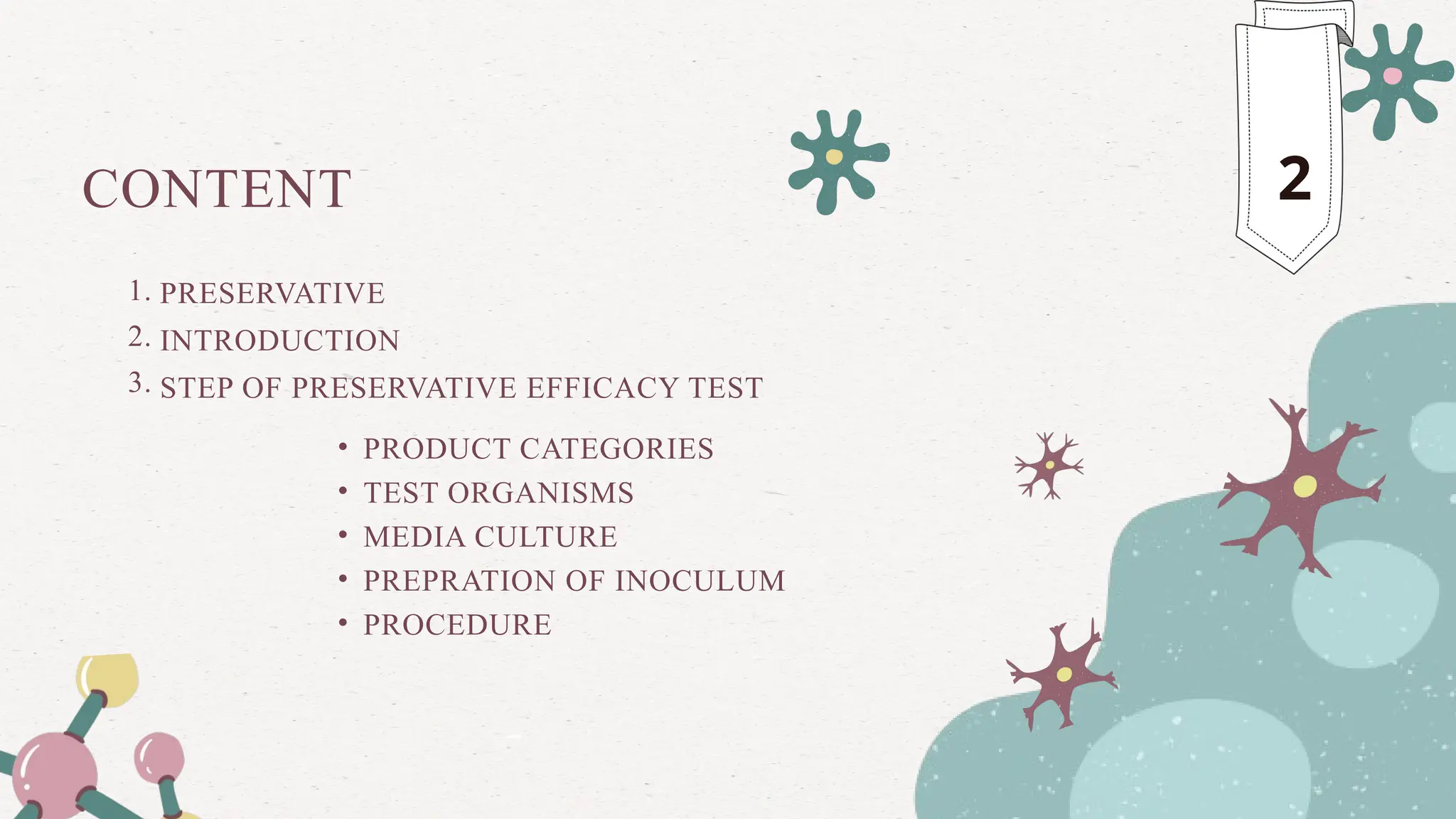
PRESERVATIVE
INTRODUCTION
STEP OF PRESERVATIVE EFFICACY TEST
• PRODUCT CATEGORIES
• TEST ORGANISMS
• MEDIA CULTURE
• PREPRATION OF INOCULUM
• PROCEDURE
1.
2.
3.
2
Preservative
Preservatives are the ingredients that are utilized in order
to improve the shelf life of products (Medicines, food).
These tend to slow down or stop the degradation or
decomposition processes, therefore, enhance the shelf life
of the products.
Preservative
4
Introduction
First preservative efficacy test appeared in USP in 18th revision 1
September 1970.
This test is applied to the formulated medicine in its final container
to determine whether it is adequately protected against microbial
spoilage.
The tests and standards apply only to the product in the original,
unopened container in which it is supplied by the manufacture.
It is used to check the stability of multiple dose such as parenteral,
oral, nasal, topical and opthalmic product made aqueous bases.
5
Product efficacy test is done by following step
• Product categories
• Test organisms
• Media culture preparation
• Preparation of inoculum
• Procedure
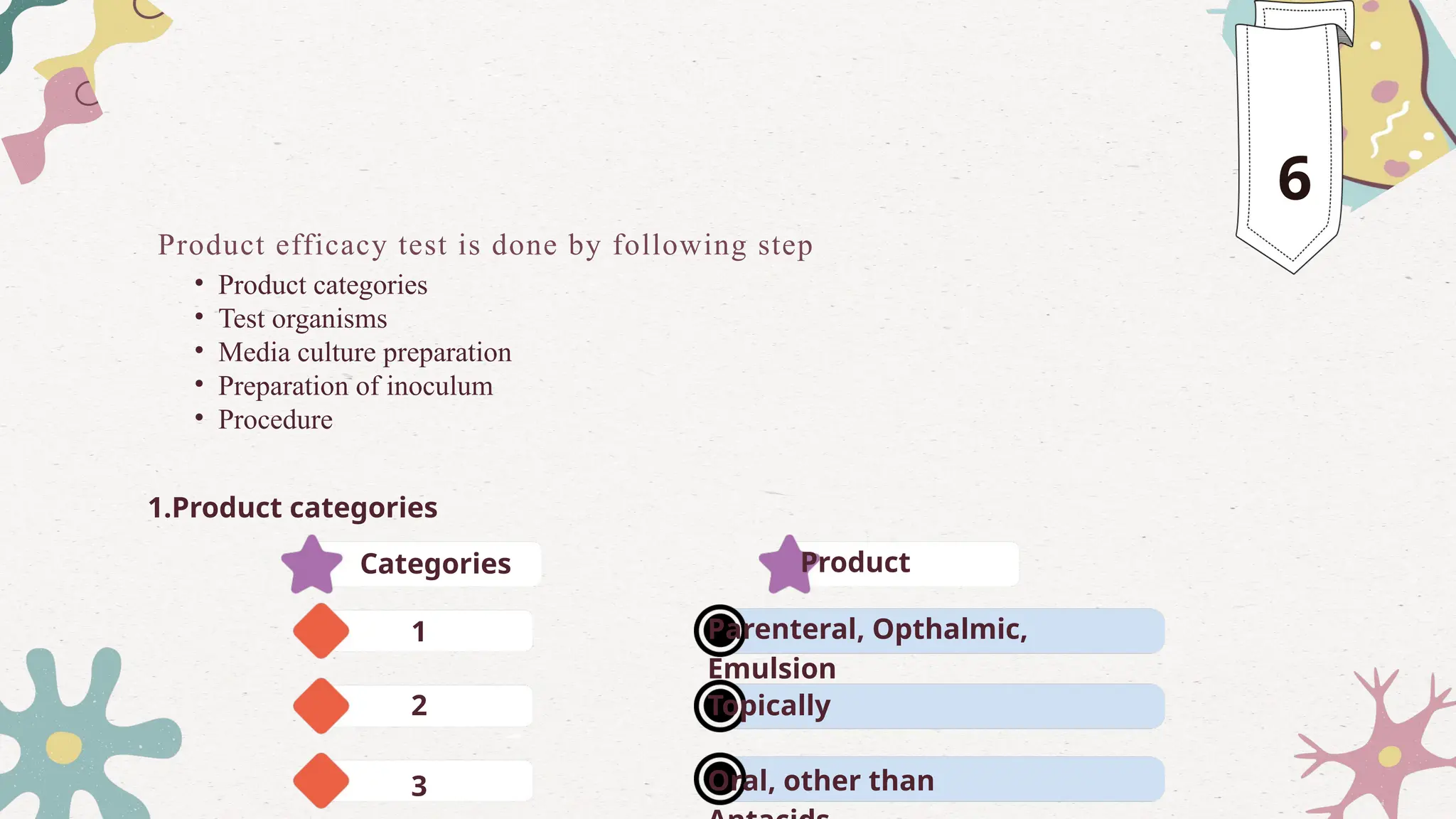
1.Product categories
Categories Product
1 Parenteral, Opthalmic,
Emulsion
Topically
2
Oral, other than
3
6
2.TEST ORGANISMS
Test organisms that are recommended by all of the pharmacopeia -
Staphylococcus aureus ATCC 6538 Pseudomonas aeruginosa ATCC 9027 E. coli ATCC 8734
Aspergillus brasiliensis ATCC 16404 Candida albicans ATCC 10231
7
3.Media culture preparation
Soyabean Casein Digest (SCD) Medium and Fluid Thioglycollate Medium (FTM)
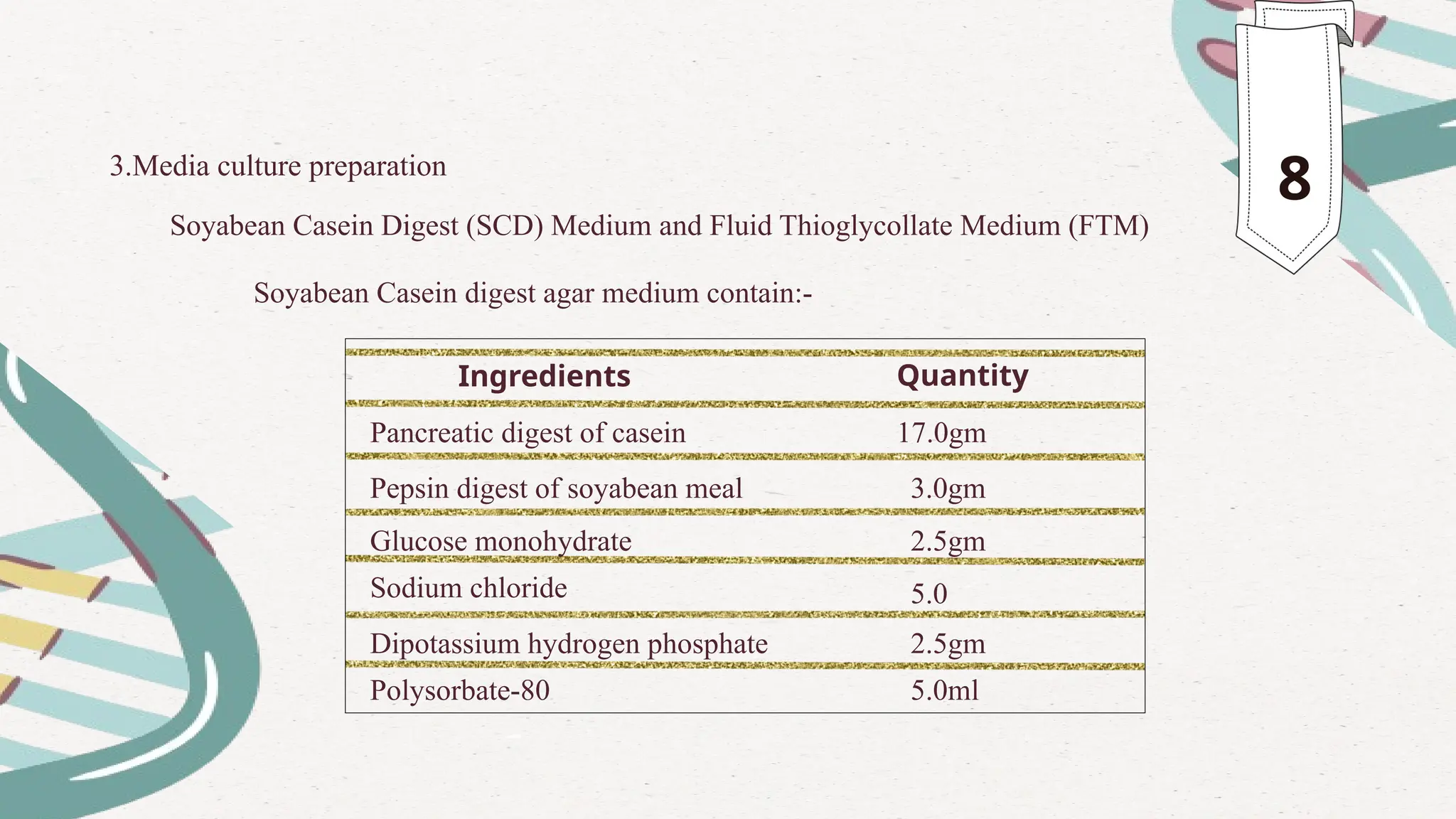
Soyabean Casein digest agar medium contain:-
Pancreatic digest of casein
Pepsin digest of soyabean meal
Glucose monohydrate
Sodium chloride
Dipotassium hydrogen phosphate
Ingredients Quantity
17.0gm
3.0gm
2.5gm
5.0
Polysorbate-80
2.5gm
5.0ml
8
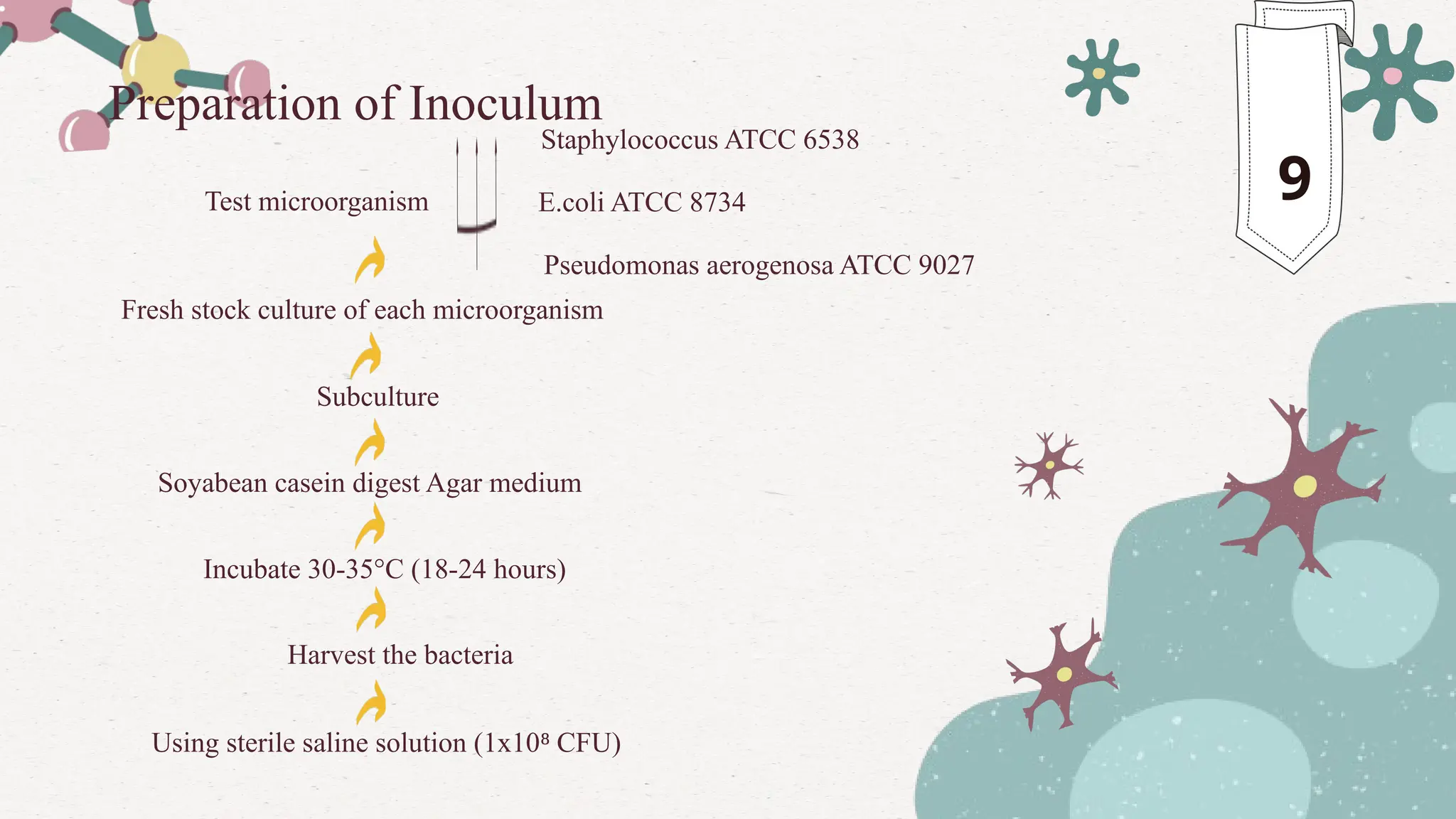
Soyabean casein digest Agar medium
Incubate 30-35°C (18-24 hours)
Preparation of Inoculum
Test microorganism
Staphylococcus ATCC 6538
Pseudomonas aerogenosa ATCC 9027
Fresh stock culture of each microorganism
Subculture
Using sterile saline solution (1x10 CFU)
⁸
Harvest the bacteria
E.coli ATCC 8734 9
Incubate container at room temperature
Determine the viable count at 7, 14, 28 days
Calculate % of reduction CFU/ml
Determine the number of viable microorganism
(Plate count method) calculate the of microorganism
Procedure:-
Each original product -20ml
Incubate with standardize microorganism 0.1ml
20 ml sample
0.1ml of different different
bacterial suspension
10
Stephen P Denyer, Norman A Hodges, Sean P
Gorman. Hugo and Russell's Pharmaceutical
Microbiology. 7th edition, Massachusetts: Blackwell
Science; 2004.
REFRENCE
11
ANY QUESTIONS
12
THANK YOU
VERY MUCH
13
Preservative efficacy test Microbiology .pptx

Preservative efficacy test Microbiology .pptx

  • 1.
    Course:- SAI COLLEGE OFPHARMACY Bachelor of Pharmacy Subject:- Pharmaceutical Microbiology Evaluation of microbial stability of formulations Presented by Md Kashif Topic:- 1
  • 2.
    EVALUATION OF MICROBIAL STABILITYOF FORMULATION OR PRESERVATIVE EFFICACY TEST 3
  • 3.
    CONTENT PRESERVATIVE INTRODUCTION STEP OF PRESERVATIVEEFFICACY TEST • PRODUCT CATEGORIES • TEST ORGANISMS • MEDIA CULTURE • PREPRATION OF INOCULUM • PROCEDURE 1. 2. 3. 2
  • 4.
    Preservative Preservatives are theingredients that are utilized in order to improve the shelf life of products (Medicines, food). These tend to slow down or stop the degradation or decomposition processes, therefore, enhance the shelf life of the products. Preservative 4
  • 5.
    Introduction First preservative efficacytest appeared in USP in 18th revision 1 September 1970. This test is applied to the formulated medicine in its final container to determine whether it is adequately protected against microbial spoilage. The tests and standards apply only to the product in the original, unopened container in which it is supplied by the manufacture. It is used to check the stability of multiple dose such as parenteral, oral, nasal, topical and opthalmic product made aqueous bases. 5
  • 6.
    Product efficacy testis done by following step • Product categories • Test organisms • Media culture preparation • Preparation of inoculum • Procedure 1.Product categories Categories Product 1 Parenteral, Opthalmic, Emulsion Topically 2 Oral, other than 3 6
  • 7.
    2.TEST ORGANISMS Test organismsthat are recommended by all of the pharmacopeia - Staphylococcus aureus ATCC 6538 Pseudomonas aeruginosa ATCC 9027 E. coli ATCC 8734 Aspergillus brasiliensis ATCC 16404 Candida albicans ATCC 10231 7
  • 8.
    3.Media culture preparation SoyabeanCasein Digest (SCD) Medium and Fluid Thioglycollate Medium (FTM) Soyabean Casein digest agar medium contain:- Pancreatic digest of casein Pepsin digest of soyabean meal Glucose monohydrate Sodium chloride Dipotassium hydrogen phosphate Ingredients Quantity 17.0gm 3.0gm 2.5gm 5.0 Polysorbate-80 2.5gm 5.0ml 8
  • 9.
    Soyabean casein digestAgar medium Incubate 30-35°C (18-24 hours) Preparation of Inoculum Test microorganism Staphylococcus ATCC 6538 Pseudomonas aerogenosa ATCC 9027 Fresh stock culture of each microorganism Subculture Using sterile saline solution (1x10 CFU) ⁸ Harvest the bacteria E.coli ATCC 8734 9
  • 10.
    Incubate container atroom temperature Determine the viable count at 7, 14, 28 days Calculate % of reduction CFU/ml Determine the number of viable microorganism (Plate count method) calculate the of microorganism Procedure:- Each original product -20ml Incubate with standardize microorganism 0.1ml 20 ml sample 0.1ml of different different bacterial suspension 10
  • 11.
    Stephen P Denyer,Norman A Hodges, Sean P Gorman. Hugo and Russell's Pharmaceutical Microbiology. 7th edition, Massachusetts: Blackwell Science; 2004. REFRENCE 11
  • 12.
  • 13.