UNIT III
3.1 Virus replication
Presented by:
Mohammad Abuzar(M. Pharm)
Assistant Professor School of
Pharmacy AIKTC, New Panvel.
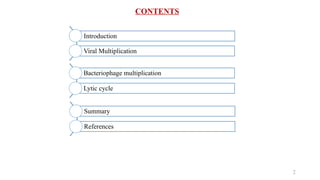
CONTENTS
2
Bacteriophage multiplication
Lytic cycle
Summary
References
Introduction
Viral Multiplication
3
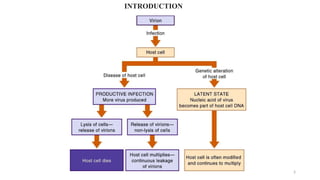
INTRODUCTION
4
Viral multiplication
• For a virus to multiply, it must invade a host cell and take
over the host's metabolic machinery.
• A single virion can give rise to several or even thousands
of similar viruses in a single host cell. This process can
drastically change the host cell and usually causes its
death.
• In a few viral infections, cells survive and continue to
produce viruses indefinitely.
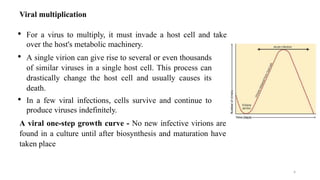
A viral one-step growth curve - No new infective virions are
found in a culture until after biosynthesis and maturation have
taken place
5
Multiplication of Bacteriophages
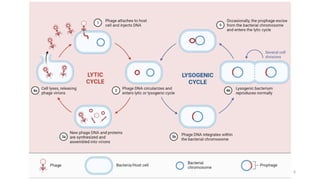
Bacteriophages can multiply by two alternative mechanisms:
• The lytic cycle - ends with the lysis and death of the host cell
• The lysogenic cycle - the host cell remains alive in the lysogenic cycle
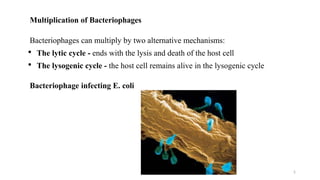
Bacteriophage infecting E. coli
6
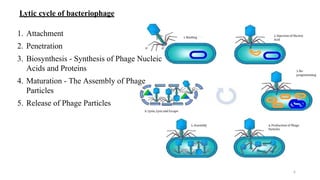
Lytic cycle of bacteriophage
1. Attachment
2. Penetration
3. Biosynthesis - Synthesis of Phage Nucleic
Acids and Proteins
4. Maturation - The Assembly of Phage
Particles
5. Release of Phage Particles
7
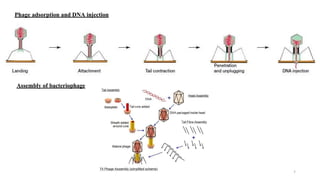
Phage adsorption and DNA injection
Assembly of bacteriophage
8
9
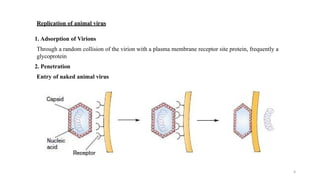
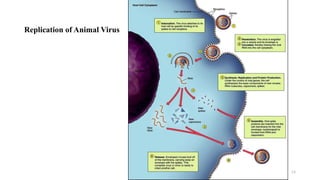
Replication of animal virus
1. Adsorption of Virions
Through a random collision of the virion with a plasma membrane receptor site protein, frequently a
glycoprotein
2. Penetration
Entry of naked animal virus
10
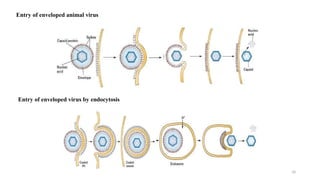
Entry of enveloped animal virus
Entry of enveloped virus by endocytosis
11
3. Uncoating
The removal of the capsid and release of viral nucleic acid
4. Replication and transcription of DNA
5. Synthesis and Assembly of Virus Capsids
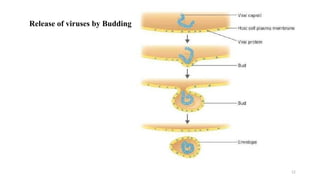
6. Virion Release
• Naked virions appear to be released most often by host
cell lysis.
• Enveloped virus - budding
12
Release of viruses by Budding
13
Replication of Animal Virus
14
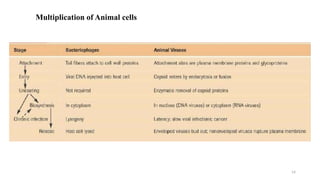
Multiplication of Animal cells
15
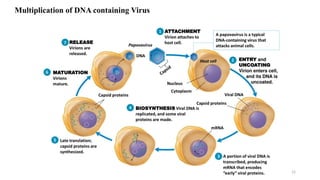
Multiplication of DNA containing Virus
16
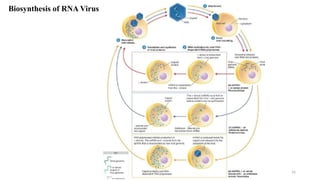
Biosynthesis of RNA Virus
17
Summary
• Virus can multiple by lytic or lysogenic cycle
• Steps in lytic cycle – attachment, penetration, biosynthesis, assembly and release
• Lysogeny involves the formation of a prophage
• DNA virus replicates in nucleus
• RNA virus replicates in cytoplasm
18
1. W.B. Hugo and A.D. Russel: Pharmaceutical Microbiology, Blackwell Scientific publications, Oxford London.
2. Prescott and Dunn., Industrial Microbiology, 4th edition, CBS Publishers & Distributors, Delhi.
3. Pelczar, Chan Kreig , Microbiology, Tata McGraw Hill edn.
4. Malcolm Harris, Balliere Tindall and Cox: Pharmaceutical Microbiology.
5. Rose: Industrial Microbiology.
6. Probisher , Hinsdill et al: Fundamentals of Microbiology, 9th ed. Japan
7. Cooper and Gunn’s: Tutorial Pharmacy, CBS Publisher and Distribution.
8. Peppler : Microbial Technology.
9. I.P., B.P., U.S.P.- latest editions.
10. Ananthnarayan : Text Book of Microbiology, Orient-Longman, Chennai
11. Edward: Fundamentals of Microbiology.
12. N.K.Jain: Pharmaceutical Microbiology, Vallabh Prakashan, Delhi
REFERENCES
19

A complete overview of Replication in viruses

  • 1.
    UNIT III 3.1 Virusreplication Presented by: Mohammad Abuzar(M. Pharm) Assistant Professor School of Pharmacy AIKTC, New Panvel.
  • 2.
  • 3.
  • 4.
    4 Viral multiplication • Fora virus to multiply, it must invade a host cell and take over the host's metabolic machinery. • A single virion can give rise to several or even thousands of similar viruses in a single host cell. This process can drastically change the host cell and usually causes its death. • In a few viral infections, cells survive and continue to produce viruses indefinitely. A viral one-step growth curve - No new infective virions are found in a culture until after biosynthesis and maturation have taken place
  • 5.
    5 Multiplication of Bacteriophages Bacteriophagescan multiply by two alternative mechanisms: • The lytic cycle - ends with the lysis and death of the host cell • The lysogenic cycle - the host cell remains alive in the lysogenic cycle Bacteriophage infecting E. coli
  • 6.
    6 Lytic cycle ofbacteriophage 1. Attachment 2. Penetration 3. Biosynthesis - Synthesis of Phage Nucleic Acids and Proteins 4. Maturation - The Assembly of Phage Particles 5. Release of Phage Particles
  • 7.
    7 Phage adsorption andDNA injection Assembly of bacteriophage
  • 8.
  • 9.
    9 Replication of animalvirus 1. Adsorption of Virions Through a random collision of the virion with a plasma membrane receptor site protein, frequently a glycoprotein 2. Penetration Entry of naked animal virus
  • 10.
    10 Entry of envelopedanimal virus Entry of enveloped virus by endocytosis
  • 11.
    11 3. Uncoating The removalof the capsid and release of viral nucleic acid 4. Replication and transcription of DNA 5. Synthesis and Assembly of Virus Capsids 6. Virion Release • Naked virions appear to be released most often by host cell lysis. • Enveloped virus - budding
  • 12.
  • 13.
  • 14.
  • 15.
    15 Multiplication of DNAcontaining Virus
  • 16.
  • 17.
    17 Summary • Virus canmultiple by lytic or lysogenic cycle • Steps in lytic cycle – attachment, penetration, biosynthesis, assembly and release • Lysogeny involves the formation of a prophage • DNA virus replicates in nucleus • RNA virus replicates in cytoplasm
  • 18.
    18 1. W.B. Hugoand A.D. Russel: Pharmaceutical Microbiology, Blackwell Scientific publications, Oxford London. 2. Prescott and Dunn., Industrial Microbiology, 4th edition, CBS Publishers & Distributors, Delhi. 3. Pelczar, Chan Kreig , Microbiology, Tata McGraw Hill edn. 4. Malcolm Harris, Balliere Tindall and Cox: Pharmaceutical Microbiology. 5. Rose: Industrial Microbiology. 6. Probisher , Hinsdill et al: Fundamentals of Microbiology, 9th ed. Japan 7. Cooper and Gunn’s: Tutorial Pharmacy, CBS Publisher and Distribution. 8. Peppler : Microbial Technology. 9. I.P., B.P., U.S.P.- latest editions. 10. Ananthnarayan : Text Book of Microbiology, Orient-Longman, Chennai 11. Edward: Fundamentals of Microbiology. 12. N.K.Jain: Pharmaceutical Microbiology, Vallabh Prakashan, Delhi REFERENCES
  • 19.