Company Analysis and Stock
             Valuation
   After analyzing the economy and stock
    markets for several countries, you have
    decided to invest some portion of your
    portfolio in common stocks
   After analyzing various industries, you have
    identified those industries that appear to
    offer       above-average       risk-adjusted
    performance over your investment horizon
   Which are the best companies?
   Are they overpriced?
                        Dr. Jitendra Mahakud        1
Company Analysis and Stock
           Valuation

   Good companies are not necessarily good
    investments
   Compare the intrinsic value of a stock to its
    market value
   Stock of a great company may be overpriced
   Stock of a growth company may not be
    growth stock
                      Dr. Jitendra Mahakud     2
Growth Companies
   Growth companies have historically
    been defined as companies that
    consistently experience above-average
    increases in sales and earnings
   Financial theorists define a growth
    company as one with management and
    opportunities that yield rates of return
    greater than the firm’s required rate of
    return         Dr. Jitendra Mahakud     3
Growth Stocks
   Growth stocks are not necessarily
    shares in growth companies
   A growth stock has a higher rate of
    return than other stocks with similar
    risk
   Superior risk-adjusted rate of return
    occurs      because                of market
    undervaluation compared to other
    stocks        Dr. Jitendra Mahakud         4
Defensive Companies and
              Stocks
   Defensive companies’ future earnings
    are more likely to withstand an
    economic downturn
   Low business risk
   Not excessive financial risk
   Stocks with low systematic risk


                 Dr. Jitendra Mahakud   5
Cyclical Companies and Stocks
   Cyclical companies are those whose
    sales and earnings will be heavily
    influenced by aggregate business
    activity
   Cyclical stocks are those that will
    experience changes in their rates of
    return greater than changes in overall
    market rates of return
                  Dr. Jitendra Mahakud       6
Speculative Companies and
Stocks
       Speculative companies are those whose
        assets involve great risk but those that
        also have a possibility of great gain
       Speculative stocks possess a high
        probability of low or negative rates of
        return and a low probability of normal
        or high rates of return

                      Dr. Jitendra Mahakud         7
Value versus Growth Investing
  Growth stocks will have positive
   earnings surprises and above-
   average risk adjusted rates of return
   because the stocks are undervalued
  Value stocks appear to be
   undervalued for reasons besides
   earnings growth potential
  Value stocks usually have low P/E

   ratio or low ratios of price to book
                    Dr. Jitendra Mahakud   8
Economic, Industry, and Structural
Links to Company Analysis
 Company analysis is the final step in the
  top-down approach to investing
 Macroeconomic analysis identifies

  industries expected to offer attractive
  returns in the expected future
  environment
 Analysis of firms in selected industries

  concentrates on a stock’s intrinsic value
                     Dr. Jitendra Mahakud     9
Economic and Industry
Influences
     If trends are favorable for an industry,
      the company analysis should focus on
      firms in that industry that are
      positioned to benefit from the economic
      trends
     Firms with sales or earnings particularly
      sensitive to macroeconomic variables
      should also be considered
     Research analysts need to be familiar
      with the cash flow and risk of the firms
                       Dr. Jitendra Mahakud       10
Structural Influences
 Social trends, technology, political, and
  regulatory influences can have
  significant influence on firms
 Early stages in an industry’s life cycle

  see changes in technology which
  followers may imitate and benefit from
 Politics and regulatory events can
  create opportunities even when
  economic influences are weak
                    Dr. Jitendra Mahakud      11
Company Analysis
 Industry competitive
  environment
 SWOT analysis

 Present value of cash flows

 Relative valuation ratio
  techniques
             Dr. Jitendra Mahakud   12
Firm Competitive Strategies
   Current rivalry
   Threat of new entrants

   Potential substitutes

   Bargaining power of suppliers

   Bargaining power of buyers


               Dr. Jitendra Mahakud   13
Firm Competitive Strategies
   Defensive strategy involves positioning firm
    so that its capabilities provide the best
    means to deflect the effect of competitive
    forces in the industry
   Offensive strategy involves using the
    company’s strength to affect the
    competitive industry forces, thus improving
    the firm’s relative industry position
   Porter suggests two major strategies: low-
    cost leadership and differentiation
                       Dr. Jitendra Mahakud        14
Porter's Competitive Strategies
   Low-Cost Strategy
       The firm seeks to be the low-cost
        producer, and hence the cost leader
        in its industry
   Differentiation Strategy
       firm positions itself as unique in the
        industry
                        Dr. Jitendra Mahakud     15
Focusing a Strategy
 Select segments in the industry
 Tailor strategy to serve those
  specific groups
 Determine which strategy a firm is

  pursuing and its success
 Evaluate the firm’s competitive
  strategy over time
                Dr. Jitendra Mahakud   16
SWOT Analysis
   Examination of a firm’s:
     Strengths
     Weaknesses

     Opportunities

     Threats


                      Dr. Jitendra Mahakud   17
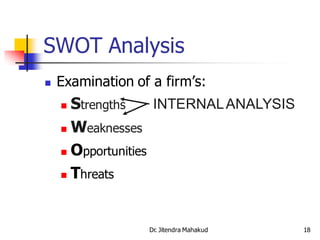
SWOT Analysis
   Examination of a firm’s:
     Strengths     INTERNAL ANALYSIS
     Weaknesses

     Opportunities

     Threats


                  Dr. Jitendra Mahakud   18
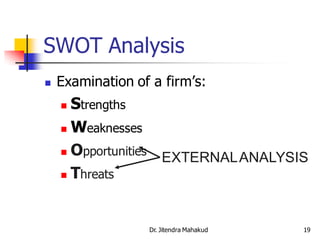
SWOT Analysis
   Examination of a firm’s:
     Strengths
     Weaknesses

     Opportunities
                    EXTERNAL ANALYSIS
     Threats


                  Dr. Jitendra Mahakud   19
Some Lessons from Peter
Lynch
Favorable Attributes of Firms
1. Firm’s product should not be faddish
2. Firm should have some long-run comparative
  advantage over its rivals
3. Firm’s industry or product has market
  stability
4. Firm can benefit from cost reductions
5. Firms that buy back shares show there are
  putting money into the firm
                 Dr. Jitendra Mahakud       20
Tenets of Warren Buffet
   Business Tenets
   Management Tenets
   Financial Tenets
   Market Tenets


                Dr. Jitendra Mahakud   21
Business Tenets
   Is the business simple and
    understandable?
   Does the business have a consistent
    operating history?
   Does the business have favorable long-
    term prospects?


                  Dr. Jitendra Mahakud   22
Management Tenets
   Is management rational?
   Is management candid with its
    shareholders?


                 Dr. Jitendra Mahakud   23
Financial Tenets
   Focus on return on equity, not earnings
    per share
   Calculate “owner earnings”
   Look for companies with high profit
    margins
   For every dollar retained, make sure the
    company has created at least one dollar
    of market value

                  Dr. Jitendra Mahakud     24
Market Tenets
   What is the value of the business?
   Can the business be purchased at a
    significant discount to its fundamental
    intrinsic value?


                   Dr. Jitendra Mahakud       25
Estimating Intrinsic Value
A. Present value of cash flows (PVCF)
     1. Present value of dividends (DDM)
     2. Present value of free cash flow to equity
      (FCFE)
     3. Present value of free cash flow (FCFF)
B. Relative valuation techniques
     1. Price   earnings ratio (P/E)
     2. Price   cash flow ratios (P/CF)
     3. Price   book value ratios (P/BV)
     4. Price   sales ratio (P/S) Mahakud
                              Dr. Jitendra           26
Analysis of Growth Companies
       Generating rates of return greater than
        the firm’s cost of capital is considered
        to be temporary
       Earnings higher than the required rate
        of return are pure profits
       How long can they earn these excess
        profits?
       Is the stock properly valued?
                       Dr. Jitendra Mahakud        27
Negative Growth Model
   Firm retains earnings, but reinvestment
    returns are below the firm’s cost of
    capital
   Since growth will be positive, but slower
    than it should be, the value will decline
    when the investors discount the
    reinvestment stream at the cost of
    capital
                   Dr. Jitendra Mahakud     28
Measures of Value-Added
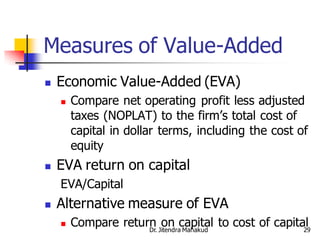
   Economic Value-Added (EVA)
       Compare net operating profit less adjusted
        taxes (NOPLAT) to the firm’s total cost of
        capital in dollar terms, including the cost of
        equity
   EVA return on capital
    EVA/Capital
   Alternative measure of EVA
       Compare return Jitendracapital to cost of capital
                     Dr.
                         on Mahakud                     29
Measures of Value-Added
   Market Value-Added (MVA)
       Measure of external performance
       How the market has evaluated the firm’s
        performance in terms of market value of
        debt and market value of equity compared
        to the capital invested in the firm
   Relationships between EVA and MVA
       mixed results

                        Dr. Jitendra Mahakud   30
Measures of Value-Added
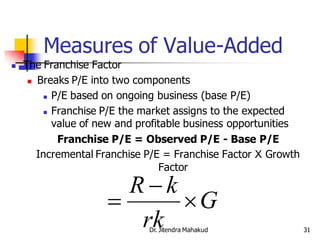
   The Franchise Factor
      Breaks P/E into two components

          P/E based on ongoing business (base P/E)

          Franchise P/E the market assigns to the expected

           value of new and profitable business opportunities
            Franchise P/E = Observed P/E - Base P/E
       Incremental Franchise P/E = Franchise Factor X Growth
                                 Factor

                       Rk
                          G
                        rk    Dr. Jitendra Mahakud              31
Intra-Industry Analysis

   Directly compare two firms in the same industry
   Factors to consider
      A major difference in the risk involved

      Inaccurate growth estimates

      Stock with a low P/E relative to its growth rate is

       undervalued
      Stock with high P/E and a low growth rate is overvalued


                             Dr. Jitendra Mahakud            32
Site Visits and the
Art of the Interview
   Focus on management’s plans, strategies, and
    concerns
   Restrictions on nonpublic information
   “What if” questions can help gauge sensitivity
    of revenues, costs, and earnings
   Management may indicate appropriateness of
    earnings estimates
   Discuss the industry’s major issues
   Review the planning process
   Talk to more than just the top managers

                        Dr. Jitendra Mahakud         33
When to Sell
   Holding a stock too long may lead to lower returns
    than expected
   If stocks decline right after purchase, is that a
    further buying opportunity or an indication of
    incorrect analysis?
   Continuously monitor key assumptions
   Evaluate closely when market value approaches
    estimated intrinsic value
   Know why you bought it and watch for that to
    change               Dr. Jitendra Mahakud            34
Efficient Markets
   Opportunities are mostly among less well-
    known companies
   To outperform the market you must find
    disparities between stock values and market
    prices - and you must be correct
   Concentrate on identifying what is wrong
    with the market consensus and what earning
    surprises may exist

                     Dr. Jitendra Mahakud    35
Global Company and Stock
Analysis
 Factors to Consider:
  Availability of Data
  Differential Accounting Conventions

  Currency Differences (Exchange Rate

   Risk)
  Political (Country) Risk

  Transaction Costs

  Valuation Differences

              Dr. Jitendra Mahakud   36

Company Analysis

  • 1.
    Company Analysis andStock Valuation  After analyzing the economy and stock markets for several countries, you have decided to invest some portion of your portfolio in common stocks  After analyzing various industries, you have identified those industries that appear to offer above-average risk-adjusted performance over your investment horizon  Which are the best companies?  Are they overpriced? Dr. Jitendra Mahakud 1
  • 2.
    Company Analysis andStock Valuation  Good companies are not necessarily good investments  Compare the intrinsic value of a stock to its market value  Stock of a great company may be overpriced  Stock of a growth company may not be growth stock Dr. Jitendra Mahakud 2
  • 3.
    Growth Companies  Growth companies have historically been defined as companies that consistently experience above-average increases in sales and earnings  Financial theorists define a growth company as one with management and opportunities that yield rates of return greater than the firm’s required rate of return Dr. Jitendra Mahakud 3
  • 4.
    Growth Stocks  Growth stocks are not necessarily shares in growth companies  A growth stock has a higher rate of return than other stocks with similar risk  Superior risk-adjusted rate of return occurs because of market undervaluation compared to other stocks Dr. Jitendra Mahakud 4
  • 5.
    Defensive Companies and Stocks  Defensive companies’ future earnings are more likely to withstand an economic downturn  Low business risk  Not excessive financial risk  Stocks with low systematic risk Dr. Jitendra Mahakud 5
  • 6.
    Cyclical Companies andStocks  Cyclical companies are those whose sales and earnings will be heavily influenced by aggregate business activity  Cyclical stocks are those that will experience changes in their rates of return greater than changes in overall market rates of return Dr. Jitendra Mahakud 6
  • 7.
    Speculative Companies and Stocks  Speculative companies are those whose assets involve great risk but those that also have a possibility of great gain  Speculative stocks possess a high probability of low or negative rates of return and a low probability of normal or high rates of return Dr. Jitendra Mahakud 7
  • 8.
    Value versus GrowthInvesting  Growth stocks will have positive earnings surprises and above- average risk adjusted rates of return because the stocks are undervalued  Value stocks appear to be undervalued for reasons besides earnings growth potential  Value stocks usually have low P/E ratio or low ratios of price to book Dr. Jitendra Mahakud 8
  • 9.
    Economic, Industry, andStructural Links to Company Analysis  Company analysis is the final step in the top-down approach to investing  Macroeconomic analysis identifies industries expected to offer attractive returns in the expected future environment  Analysis of firms in selected industries concentrates on a stock’s intrinsic value Dr. Jitendra Mahakud 9
  • 10.
    Economic and Industry Influences  If trends are favorable for an industry, the company analysis should focus on firms in that industry that are positioned to benefit from the economic trends  Firms with sales or earnings particularly sensitive to macroeconomic variables should also be considered  Research analysts need to be familiar with the cash flow and risk of the firms Dr. Jitendra Mahakud 10
  • 11.
    Structural Influences  Socialtrends, technology, political, and regulatory influences can have significant influence on firms  Early stages in an industry’s life cycle see changes in technology which followers may imitate and benefit from  Politics and regulatory events can create opportunities even when economic influences are weak Dr. Jitendra Mahakud 11
  • 12.
    Company Analysis  Industrycompetitive environment  SWOT analysis  Present value of cash flows  Relative valuation ratio techniques Dr. Jitendra Mahakud 12
  • 13.
    Firm Competitive Strategies  Current rivalry  Threat of new entrants  Potential substitutes  Bargaining power of suppliers  Bargaining power of buyers Dr. Jitendra Mahakud 13
  • 14.
    Firm Competitive Strategies  Defensive strategy involves positioning firm so that its capabilities provide the best means to deflect the effect of competitive forces in the industry  Offensive strategy involves using the company’s strength to affect the competitive industry forces, thus improving the firm’s relative industry position  Porter suggests two major strategies: low- cost leadership and differentiation Dr. Jitendra Mahakud 14
  • 15.
    Porter's Competitive Strategies  Low-Cost Strategy  The firm seeks to be the low-cost producer, and hence the cost leader in its industry  Differentiation Strategy  firm positions itself as unique in the industry Dr. Jitendra Mahakud 15
  • 16.
    Focusing a Strategy Select segments in the industry  Tailor strategy to serve those specific groups  Determine which strategy a firm is pursuing and its success  Evaluate the firm’s competitive strategy over time Dr. Jitendra Mahakud 16
  • 17.
    SWOT Analysis  Examination of a firm’s:  Strengths  Weaknesses  Opportunities  Threats Dr. Jitendra Mahakud 17
  • 18.
    SWOT Analysis  Examination of a firm’s:  Strengths INTERNAL ANALYSIS  Weaknesses  Opportunities  Threats Dr. Jitendra Mahakud 18
  • 19.
    SWOT Analysis  Examination of a firm’s:  Strengths  Weaknesses  Opportunities EXTERNAL ANALYSIS  Threats Dr. Jitendra Mahakud 19
  • 20.
    Some Lessons fromPeter Lynch Favorable Attributes of Firms 1. Firm’s product should not be faddish 2. Firm should have some long-run comparative advantage over its rivals 3. Firm’s industry or product has market stability 4. Firm can benefit from cost reductions 5. Firms that buy back shares show there are putting money into the firm Dr. Jitendra Mahakud 20
  • 21.
    Tenets of WarrenBuffet  Business Tenets  Management Tenets  Financial Tenets  Market Tenets Dr. Jitendra Mahakud 21
  • 22.
    Business Tenets  Is the business simple and understandable?  Does the business have a consistent operating history?  Does the business have favorable long- term prospects? Dr. Jitendra Mahakud 22
  • 23.
    Management Tenets  Is management rational?  Is management candid with its shareholders? Dr. Jitendra Mahakud 23
  • 24.
    Financial Tenets  Focus on return on equity, not earnings per share  Calculate “owner earnings”  Look for companies with high profit margins  For every dollar retained, make sure the company has created at least one dollar of market value Dr. Jitendra Mahakud 24
  • 25.
    Market Tenets  What is the value of the business?  Can the business be purchased at a significant discount to its fundamental intrinsic value? Dr. Jitendra Mahakud 25
  • 26.
    Estimating Intrinsic Value A.Present value of cash flows (PVCF)  1. Present value of dividends (DDM)  2. Present value of free cash flow to equity (FCFE)  3. Present value of free cash flow (FCFF) B. Relative valuation techniques  1. Price earnings ratio (P/E)  2. Price cash flow ratios (P/CF)  3. Price book value ratios (P/BV)  4. Price sales ratio (P/S) Mahakud Dr. Jitendra 26
  • 27.
    Analysis of GrowthCompanies  Generating rates of return greater than the firm’s cost of capital is considered to be temporary  Earnings higher than the required rate of return are pure profits  How long can they earn these excess profits?  Is the stock properly valued? Dr. Jitendra Mahakud 27
  • 28.
    Negative Growth Model  Firm retains earnings, but reinvestment returns are below the firm’s cost of capital  Since growth will be positive, but slower than it should be, the value will decline when the investors discount the reinvestment stream at the cost of capital Dr. Jitendra Mahakud 28
  • 29.
    Measures of Value-Added  Economic Value-Added (EVA)  Compare net operating profit less adjusted taxes (NOPLAT) to the firm’s total cost of capital in dollar terms, including the cost of equity  EVA return on capital EVA/Capital  Alternative measure of EVA  Compare return Jitendracapital to cost of capital Dr. on Mahakud 29
  • 30.
    Measures of Value-Added  Market Value-Added (MVA)  Measure of external performance  How the market has evaluated the firm’s performance in terms of market value of debt and market value of equity compared to the capital invested in the firm  Relationships between EVA and MVA  mixed results Dr. Jitendra Mahakud 30
  • 31.
    Measures of Value-Added  The Franchise Factor  Breaks P/E into two components  P/E based on ongoing business (base P/E)  Franchise P/E the market assigns to the expected value of new and profitable business opportunities Franchise P/E = Observed P/E - Base P/E Incremental Franchise P/E = Franchise Factor X Growth Factor Rk  G rk Dr. Jitendra Mahakud 31
  • 32.
    Intra-Industry Analysis  Directly compare two firms in the same industry  Factors to consider  A major difference in the risk involved  Inaccurate growth estimates  Stock with a low P/E relative to its growth rate is undervalued  Stock with high P/E and a low growth rate is overvalued Dr. Jitendra Mahakud 32
  • 33.
    Site Visits andthe Art of the Interview  Focus on management’s plans, strategies, and concerns  Restrictions on nonpublic information  “What if” questions can help gauge sensitivity of revenues, costs, and earnings  Management may indicate appropriateness of earnings estimates  Discuss the industry’s major issues  Review the planning process  Talk to more than just the top managers Dr. Jitendra Mahakud 33
  • 34.
    When to Sell  Holding a stock too long may lead to lower returns than expected  If stocks decline right after purchase, is that a further buying opportunity or an indication of incorrect analysis?  Continuously monitor key assumptions  Evaluate closely when market value approaches estimated intrinsic value  Know why you bought it and watch for that to change Dr. Jitendra Mahakud 34
  • 35.
    Efficient Markets  Opportunities are mostly among less well- known companies  To outperform the market you must find disparities between stock values and market prices - and you must be correct  Concentrate on identifying what is wrong with the market consensus and what earning surprises may exist Dr. Jitendra Mahakud 35
  • 36.
    Global Company andStock Analysis Factors to Consider:  Availability of Data  Differential Accounting Conventions  Currency Differences (Exchange Rate Risk)  Political (Country) Risk  Transaction Costs  Valuation Differences Dr. Jitendra Mahakud 36