STATUS EPILEPTICUS
PharmD St. Isa BADUR
Clinical Pharmacy, Istanbul Medipol
Universty
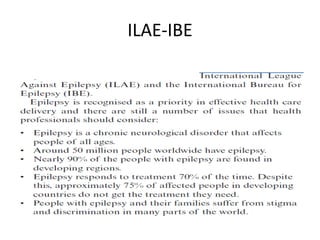
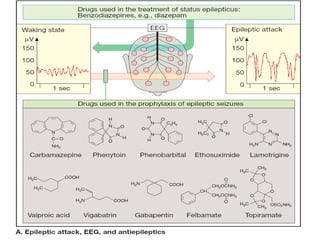
ILAE-IBE
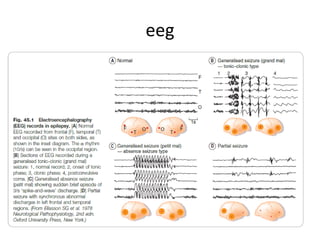
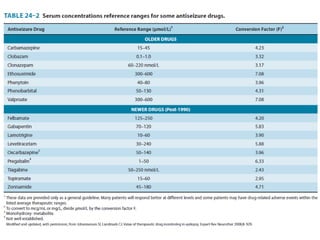
eeg
gilman
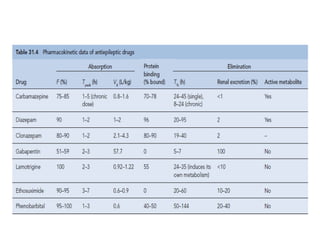
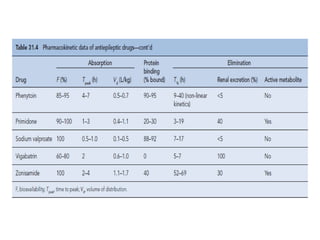
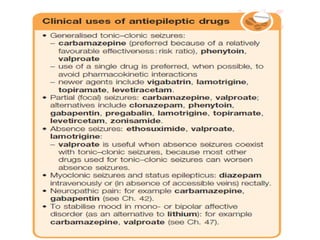
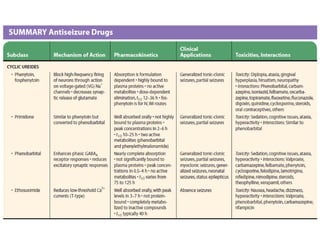
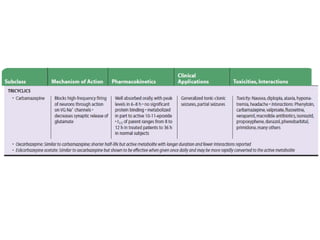
• Drugs should be administered intravenously.
• Four regimens have similar success rates of
44–65%: diazepam followed by phenytoin;
lorazepam; phenobarbital; and phenytoin
alone.
• Studies show no significant differences with
respect to recurrences or adverse reactions
gilman
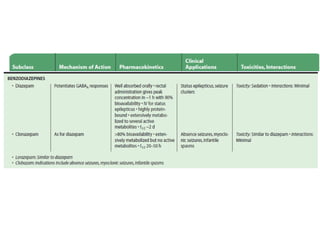
Intravenous diazepam or lorazepam is usually
effective in terminating attacks and providing
short-term control.
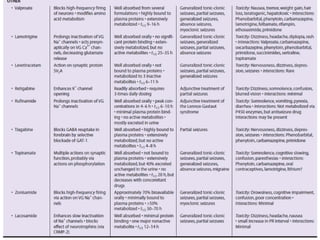
For prolonged therapy, intravenous phenytoin
has often been used because it is highly
effective and less sedating than
benzodiazepines or barbiturates.
gilman
However, phenytoin may cause cardiotoxicity (perhaps
because of its solvent propylene glycol), and
fosphenytoin (watersoluble) is a safer parenteral agent.
Phenobarbital has also been used in status epilepticus,
especially in children. In very severe status epilepticus
that does not respond to these measures, general
anesthesia may be used.
katzung
There are many forms of status epilepticus.
The most common,generalized tonic-clonic
status epilepticus, is a life-threatening
emergency, requiring immediate cardiovascular,
respiratory, and metabolic management as well
as pharmacologic therapy.
katzung
The latter virtually always requires intravenous administration of
antiseizure medications.
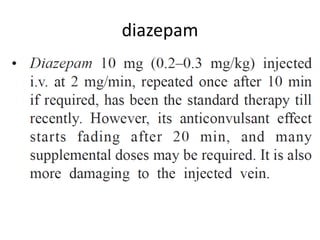
Diazepam is the most effective drug in most patients for stopping
the attacks and is given directly by intravenous push to a
maximum total dose of 20–30 mg in adults.
Intravenous diazepam may depress respiration (less frequently,
cardiovascular function), and facilities for resuscitation must be
immediately at hand during its administration.
katzung
The effect of diazepam is not lasting, but the 30- to 40-minute
seizure-free interval allows more definitive therapy to be
initiated.
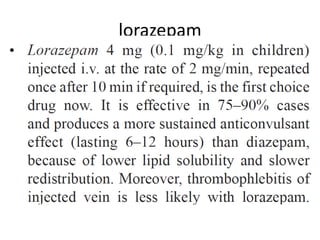
Some physicians prefer lorazepam, which is equivalent to
diazepam in effect and perhaps somewhat longer acting.
For patients who are not actually in the throes of a seizure,
diazepam therapy can be omitted and the patient treated at
once with a long-acting drug such as phenytoin.
katzung
Until the introduction of fosphenytoin, the
mainstay of continuing therapy for status
epilepticus was intravenous phenytoin, which is
effective and nonsedating.
It can be given as a loading dose of 13–18 mg/kg
in adults; the usual error is to give too little.
Administration should be at a maximum rate of
50 mg/min.
Katzung
It is safest to give the drug directly by intravenous
push, but it can also be diluted in saline; it
precipitates rapidly in the presence of glucose
Careful monitoring of cardiac rhythm and blood
pressure is necessary, especially in elderly people.
At least part of the cardiotoxicity
is from the propylene glycol in which the phenytoin
is dissolved.
katzung
Fosphenytoin, which is freely soluble in intravenous
solutions without the need for propylene glycol or other solubilizing
agents, is a safer parenteral agent. Because of its greater
molecular weight, this prodrug is two thirds to three quarters as
potent as phenytoin on a milligram basis.
In previously treated epileptic patients, the administration of a
large loading dose of phenytoin may cause some dose-related toxicity
such as ataxia. This is usually a relatively minor problem
during the acute status episode and is easily alleviated by later
adjustment of plasma levels.
katzung
For patients who do not respond to phenytoin, phenobarbital
can be given in large doses: 100–200 mg intravenously to a total of
400–800 mg. Respiratory depression is a common complication,
especially if benzodiazepines have already been given, and there
should be no hesitation in instituting intubation and ventilation.
Although other drugs such as lidocaine have been recommended
for the treatment of generalized tonic-clonic status epilepticus,
general anesthesia is usually necessary in highly resistant
cases.
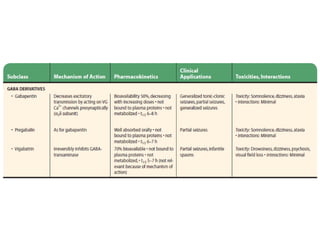
For patients in absence status, benzodiazepines are still drugs of
first choice. Rarely, intravenous valproate may be required
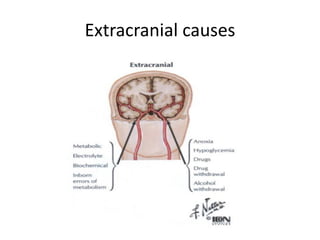
Extracranial causes
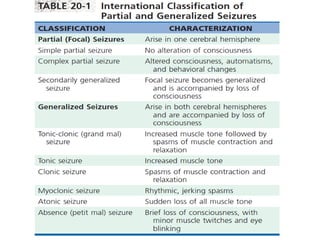
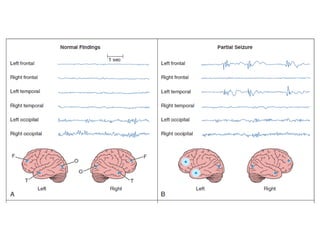
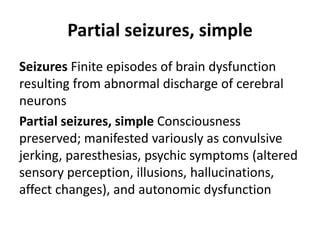
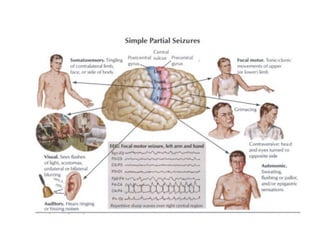
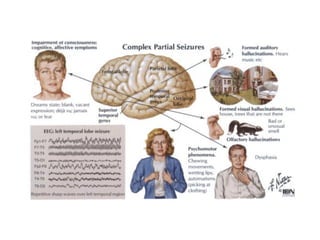
Partial seizures, simple
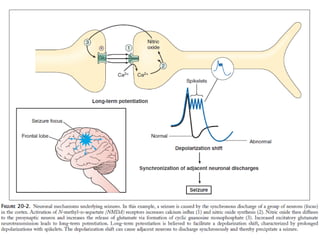
Seizures Finite episodes of brain dysfunction
resulting from abnormal discharge of cerebral
neurons
Partial seizures, simple Consciousness
preserved; manifested variously as convulsive
jerking, paresthesias, psychic symptoms (altered
sensory perception, illusions, hallucinations,
affect changes), and autonomic dysfunction
Partial seizures, Complex
Partial seizures, Complex Impaired
consciousness that is preceded, accompanied,
or followed by psychological symptoms
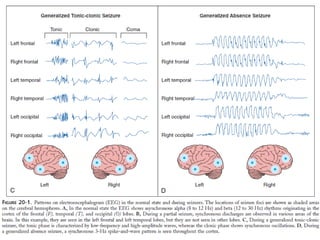
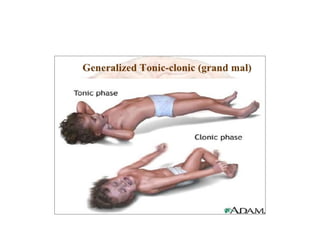
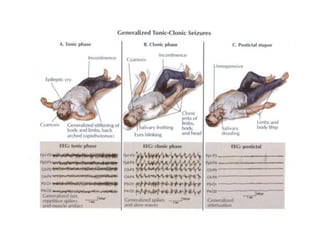
Tonic-clonic seizures, generalized
Tonic phase (less than 1 min) involves abrupt
loss of consciousness, muscle rigidity, and
respiration arrest; clonic phase (2–3 min)
involves jerking of body muscles, with lip or
tongue
biting, and fecal and urinary incontinence;
formerly called grand mal
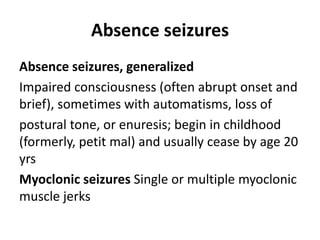
Absence seizures
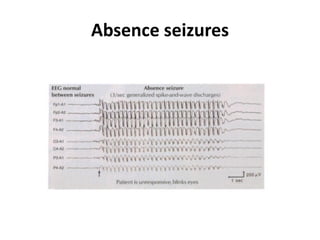
Absence seizures, generalized
Impaired consciousness (often abrupt onset and
brief), sometimes with automatisms, loss of
postural tone, or enuresis; begin in childhood
(formerly, petit mal) and usually cease by age 20
yrs
Myoclonic seizures Single or multiple myoclonic
muscle jerks
Absence seizures
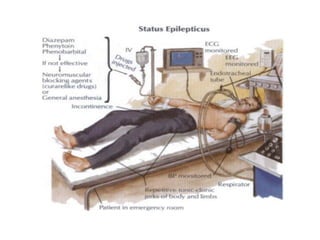
Status epilepticus
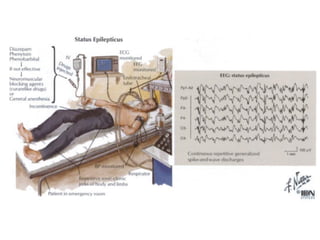
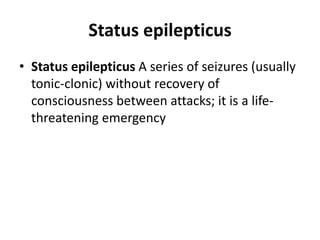
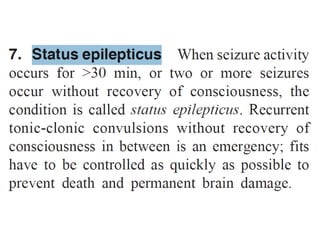
• Status epilepticus A series of seizures (usually
tonic-clonic) without recovery of
consciousness between attacks; it is a life-
threatening emergency
s. epilepticus
• 1. a continuous series of generalized tonic-clonic
seizures without return to consciousness, a life-
threatening emergency. Called also convulsive s.
epilepticus. convulsive s. epilepticus, tonic-clonic
s. epilepticus
• 2. any prolonged series of similar seizures
without return to full consciousness between
them; the two major types are convulsive s.
epilepticus, which is life-threatening, and
nonconvulsive s. epilepticus, which is serious but
not usually life-threatening.
Nanconvulsive status epilepticus
• s. epilepticus, nonconvulsive status epilepticus
that does not include generalized tonic-clonic
seizures; see complex partial s., petit mal s.,
and epilepsia partialis continua.
STATUS EPILEPTICUS
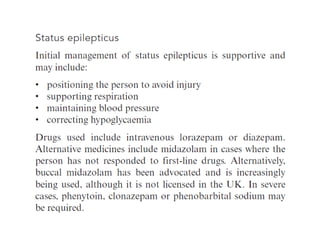
• Status epilepticus is a neurological emergency.
Mortality for adults is ~20%. The goal of
treatment is rapid termination of behavioral
and electrical seizure activity; the longer the
episode of status epilepticus is untreated, the
more difficult it is to control and the greater
the risk of permanent brain damage.
• .
STATUS EPILEPTICUS
• Critical to the management are a clear plan,
prompt treatment with effective drugs in
adequate doses, and attention to
hypoventilation and hypotension.
• Since the high doses of drugs used may cause
hypoventilation, it may be necessary to assist
respiration temporarily.
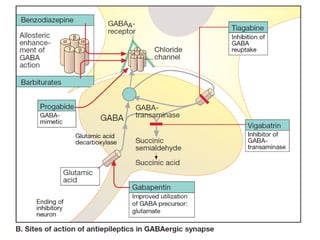
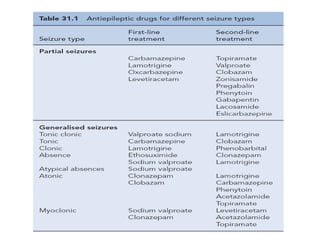
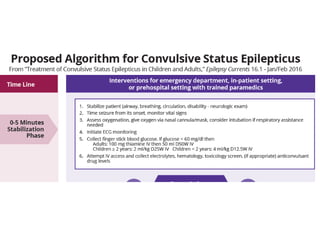
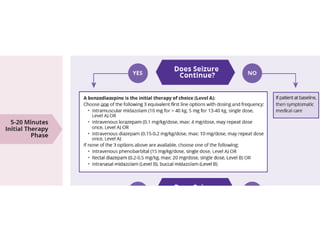
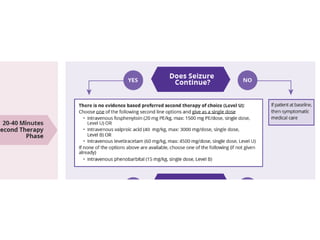
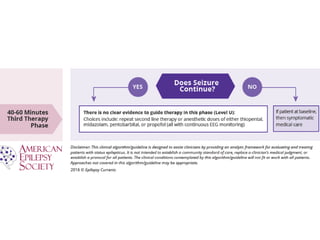
lorazepam
diazepam
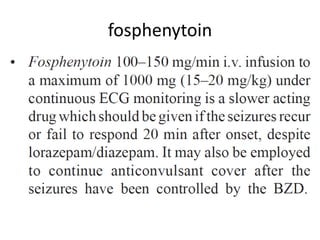
fosphenytoin
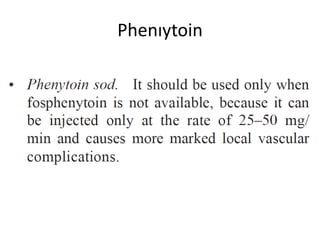
Phenıytoin
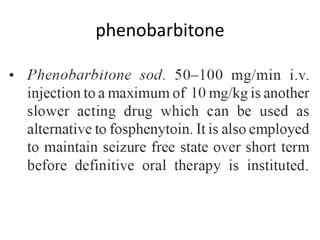
phenobarbitone
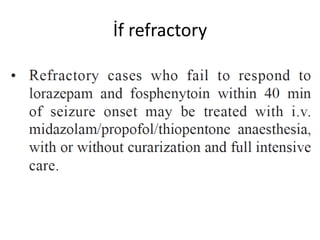
İf refractory
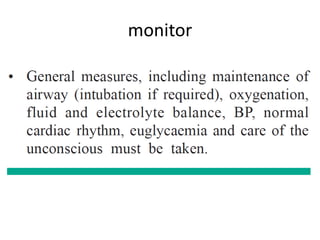
monitor
Status epilepticus and treatment

Status epilepticus and treatment

  • 1.
    STATUS EPILEPTICUS PharmD St.Isa BADUR Clinical Pharmacy, Istanbul Medipol Universty
  • 4.
  • 7.
  • 14.
    gilman • Drugs shouldbe administered intravenously. • Four regimens have similar success rates of 44–65%: diazepam followed by phenytoin; lorazepam; phenobarbital; and phenytoin alone. • Studies show no significant differences with respect to recurrences or adverse reactions
  • 15.
    gilman Intravenous diazepam orlorazepam is usually effective in terminating attacks and providing short-term control. For prolonged therapy, intravenous phenytoin has often been used because it is highly effective and less sedating than benzodiazepines or barbiturates.
  • 16.
    gilman However, phenytoin maycause cardiotoxicity (perhaps because of its solvent propylene glycol), and fosphenytoin (watersoluble) is a safer parenteral agent. Phenobarbital has also been used in status epilepticus, especially in children. In very severe status epilepticus that does not respond to these measures, general anesthesia may be used.
  • 17.
    katzung There are manyforms of status epilepticus. The most common,generalized tonic-clonic status epilepticus, is a life-threatening emergency, requiring immediate cardiovascular, respiratory, and metabolic management as well as pharmacologic therapy.
  • 18.
    katzung The latter virtuallyalways requires intravenous administration of antiseizure medications. Diazepam is the most effective drug in most patients for stopping the attacks and is given directly by intravenous push to a maximum total dose of 20–30 mg in adults. Intravenous diazepam may depress respiration (less frequently, cardiovascular function), and facilities for resuscitation must be immediately at hand during its administration.
  • 19.
    katzung The effect ofdiazepam is not lasting, but the 30- to 40-minute seizure-free interval allows more definitive therapy to be initiated. Some physicians prefer lorazepam, which is equivalent to diazepam in effect and perhaps somewhat longer acting. For patients who are not actually in the throes of a seizure, diazepam therapy can be omitted and the patient treated at once with a long-acting drug such as phenytoin.
  • 20.
    katzung Until the introductionof fosphenytoin, the mainstay of continuing therapy for status epilepticus was intravenous phenytoin, which is effective and nonsedating. It can be given as a loading dose of 13–18 mg/kg in adults; the usual error is to give too little. Administration should be at a maximum rate of 50 mg/min.
  • 21.
    Katzung It is safestto give the drug directly by intravenous push, but it can also be diluted in saline; it precipitates rapidly in the presence of glucose Careful monitoring of cardiac rhythm and blood pressure is necessary, especially in elderly people. At least part of the cardiotoxicity is from the propylene glycol in which the phenytoin is dissolved.
  • 22.
    katzung Fosphenytoin, which isfreely soluble in intravenous solutions without the need for propylene glycol or other solubilizing agents, is a safer parenteral agent. Because of its greater molecular weight, this prodrug is two thirds to three quarters as potent as phenytoin on a milligram basis. In previously treated epileptic patients, the administration of a large loading dose of phenytoin may cause some dose-related toxicity such as ataxia. This is usually a relatively minor problem during the acute status episode and is easily alleviated by later adjustment of plasma levels.
  • 23.
    katzung For patients whodo not respond to phenytoin, phenobarbital can be given in large doses: 100–200 mg intravenously to a total of 400–800 mg. Respiratory depression is a common complication, especially if benzodiazepines have already been given, and there should be no hesitation in instituting intubation and ventilation. Although other drugs such as lidocaine have been recommended for the treatment of generalized tonic-clonic status epilepticus, general anesthesia is usually necessary in highly resistant cases. For patients in absence status, benzodiazepines are still drugs of first choice. Rarely, intravenous valproate may be required
  • 24.
  • 25.
    Partial seizures, simple SeizuresFinite episodes of brain dysfunction resulting from abnormal discharge of cerebral neurons Partial seizures, simple Consciousness preserved; manifested variously as convulsive jerking, paresthesias, psychic symptoms (altered sensory perception, illusions, hallucinations, affect changes), and autonomic dysfunction
  • 27.
    Partial seizures, Complex Partialseizures, Complex Impaired consciousness that is preceded, accompanied, or followed by psychological symptoms
  • 29.
    Tonic-clonic seizures, generalized Tonicphase (less than 1 min) involves abrupt loss of consciousness, muscle rigidity, and respiration arrest; clonic phase (2–3 min) involves jerking of body muscles, with lip or tongue biting, and fecal and urinary incontinence; formerly called grand mal
  • 32.
    Absence seizures Absence seizures,generalized Impaired consciousness (often abrupt onset and brief), sometimes with automatisms, loss of postural tone, or enuresis; begin in childhood (formerly, petit mal) and usually cease by age 20 yrs Myoclonic seizures Single or multiple myoclonic muscle jerks
  • 35.
  • 36.
    Status epilepticus • Statusepilepticus A series of seizures (usually tonic-clonic) without recovery of consciousness between attacks; it is a life- threatening emergency
  • 37.
    s. epilepticus • 1.a continuous series of generalized tonic-clonic seizures without return to consciousness, a life- threatening emergency. Called also convulsive s. epilepticus. convulsive s. epilepticus, tonic-clonic s. epilepticus • 2. any prolonged series of similar seizures without return to full consciousness between them; the two major types are convulsive s. epilepticus, which is life-threatening, and nonconvulsive s. epilepticus, which is serious but not usually life-threatening.
  • 38.
    Nanconvulsive status epilepticus •s. epilepticus, nonconvulsive status epilepticus that does not include generalized tonic-clonic seizures; see complex partial s., petit mal s., and epilepsia partialis continua.
  • 39.
    STATUS EPILEPTICUS • Statusepilepticus is a neurological emergency. Mortality for adults is ~20%. The goal of treatment is rapid termination of behavioral and electrical seizure activity; the longer the episode of status epilepticus is untreated, the more difficult it is to control and the greater the risk of permanent brain damage. • .
  • 40.
    STATUS EPILEPTICUS • Criticalto the management are a clear plan, prompt treatment with effective drugs in adequate doses, and attention to hypoventilation and hypotension. • Since the high doses of drugs used may cause hypoventilation, it may be necessary to assist respiration temporarily.
  • 44.
  • 45.
  • 46.
  • 47.
  • 48.
  • 49.
  • 50.