Statistics
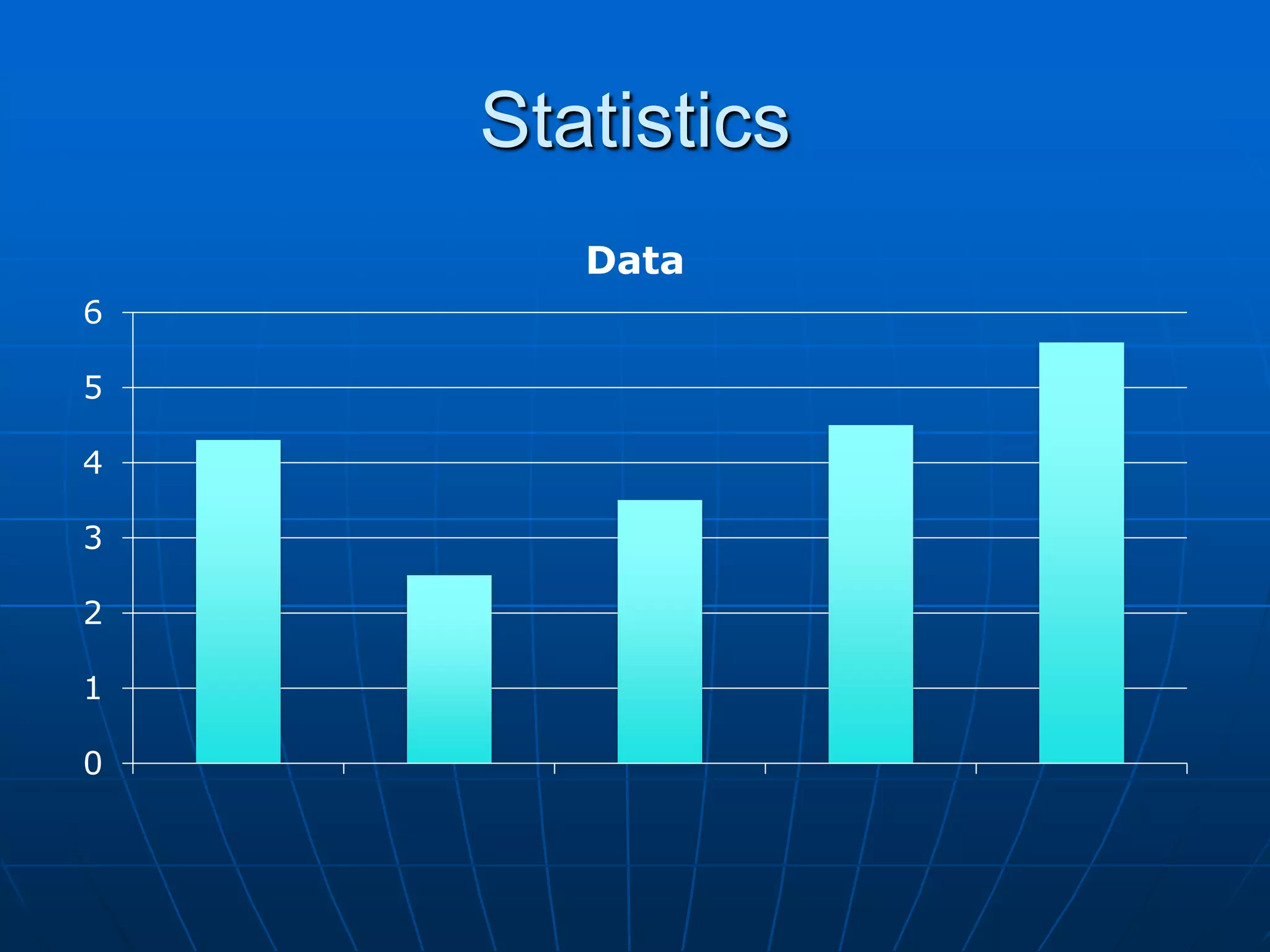
       Data
6

5

4

3

2

1

0
What is an average?
 An average is a measure of the "middle" value of a
                   set of data.


Mode, Mean, and Median, are all types of averages.


They can be used to help summarise a group of data.
WALT…


…understand  what the Mode is
and how to identify it in data.
Definition of Mode
• The “mode” for a set of data is the number (or item)
               that occurs most frequently.
• Sometimes data can have more than one mode. This
 happens when two or more numbers (or items)occur an
           equal number of times in the data.
    • A data set with two modes is called bimodal.
     • A data set with 3 modes is called Trimodal
• It is also possible to have a set of data with no mode.
How to find the Mode.
   Mode is the most common number
   Put the numbers in order
   Choose the number that appears the
    most frequently.
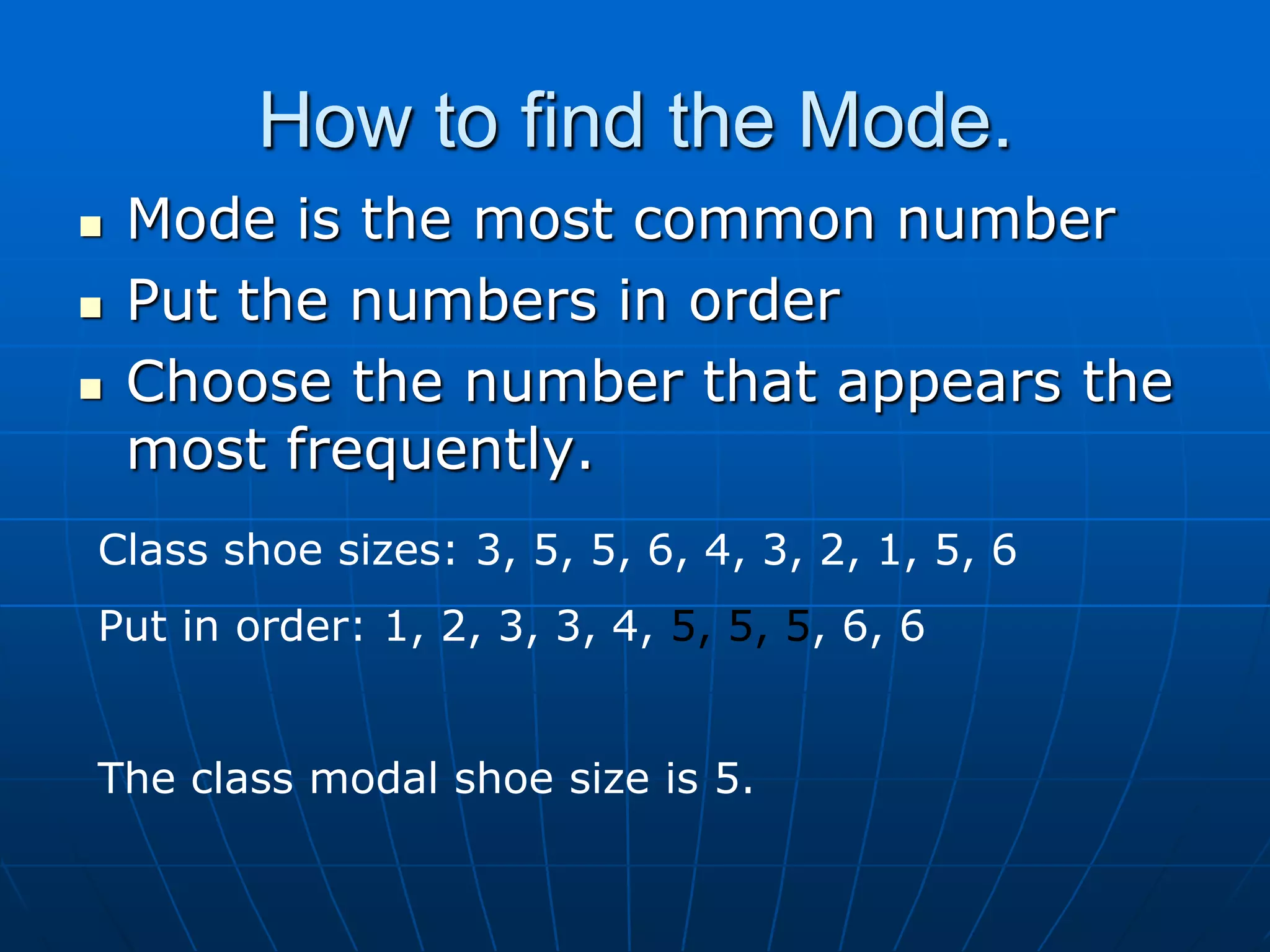
Class shoe sizes: 3, 5, 5, 6, 4, 3, 2, 1, 5, 6
Put in order: 1, 2, 3, 3, 4, 5, 5, 5, 6, 6


The class modal shoe size is 5.
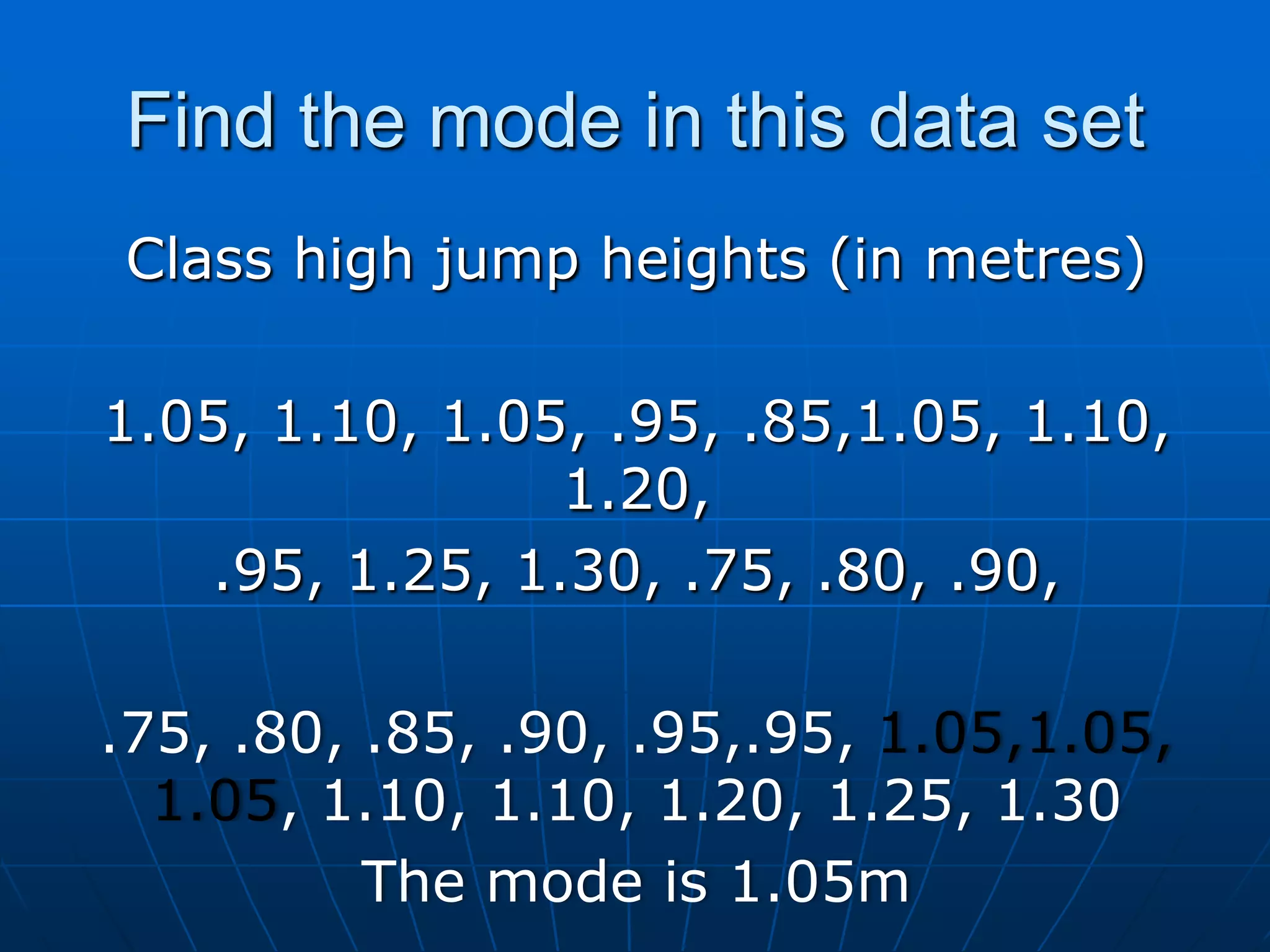
Find the mode in this data set
Class high jump heights (in metres)

1.05, 1.10, 1.05, .95, .85,1.05, 1.10,
                1.20,
   .95, 1.25, 1.30, .75, .80, .90,

.75, .80, .85, .90, .95,.95, 1.05,1.05,
  1.05, 1.10, 1.10, 1.20, 1.25, 1.30
          The mode is 1.05m
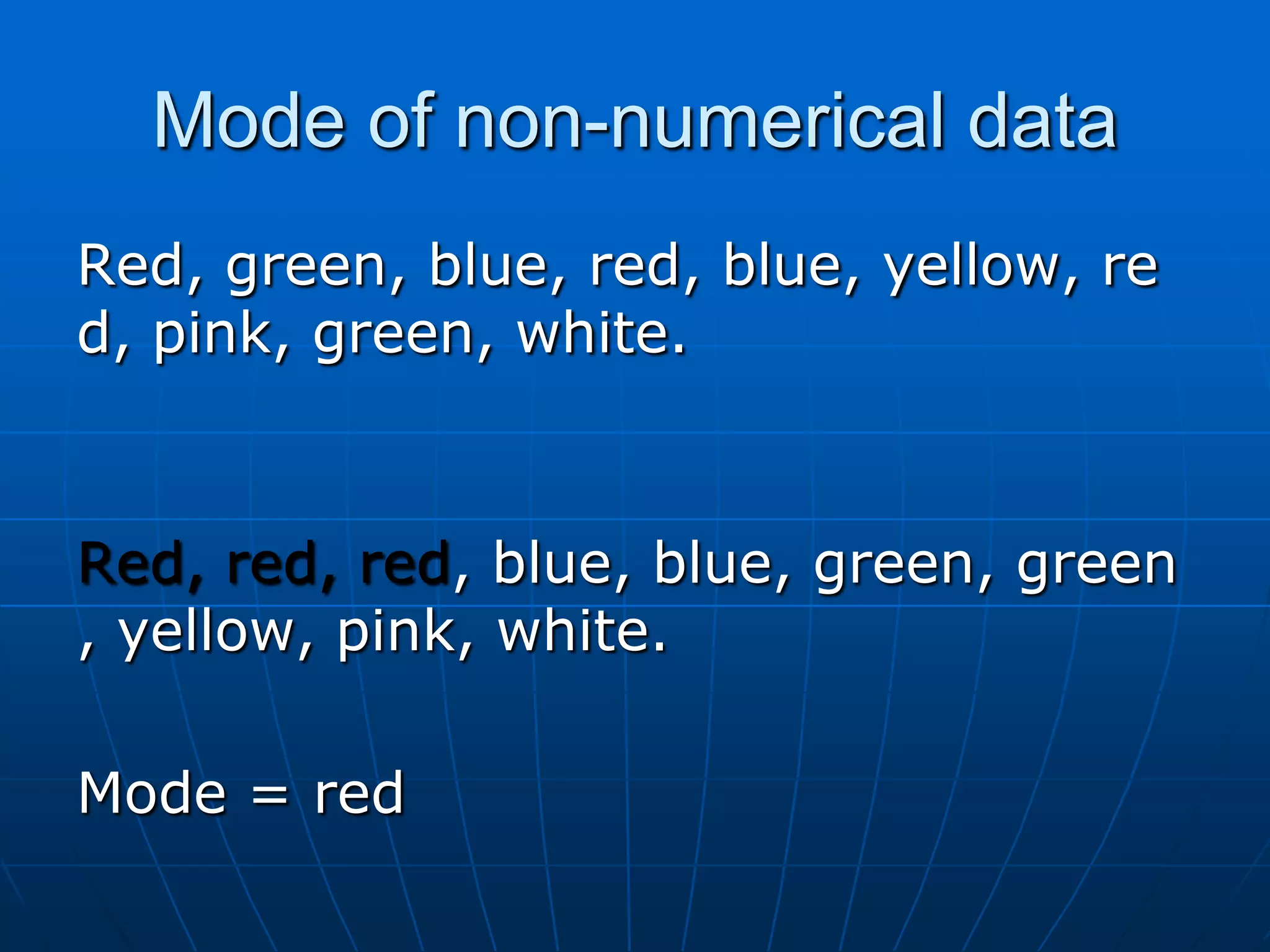
Mode of non-numerical data
Red, green, blue, red, blue, yellow, re
d, pink, green, white.


Red, red, red, blue, blue, green, green
, yellow, pink, white.

Mode = red
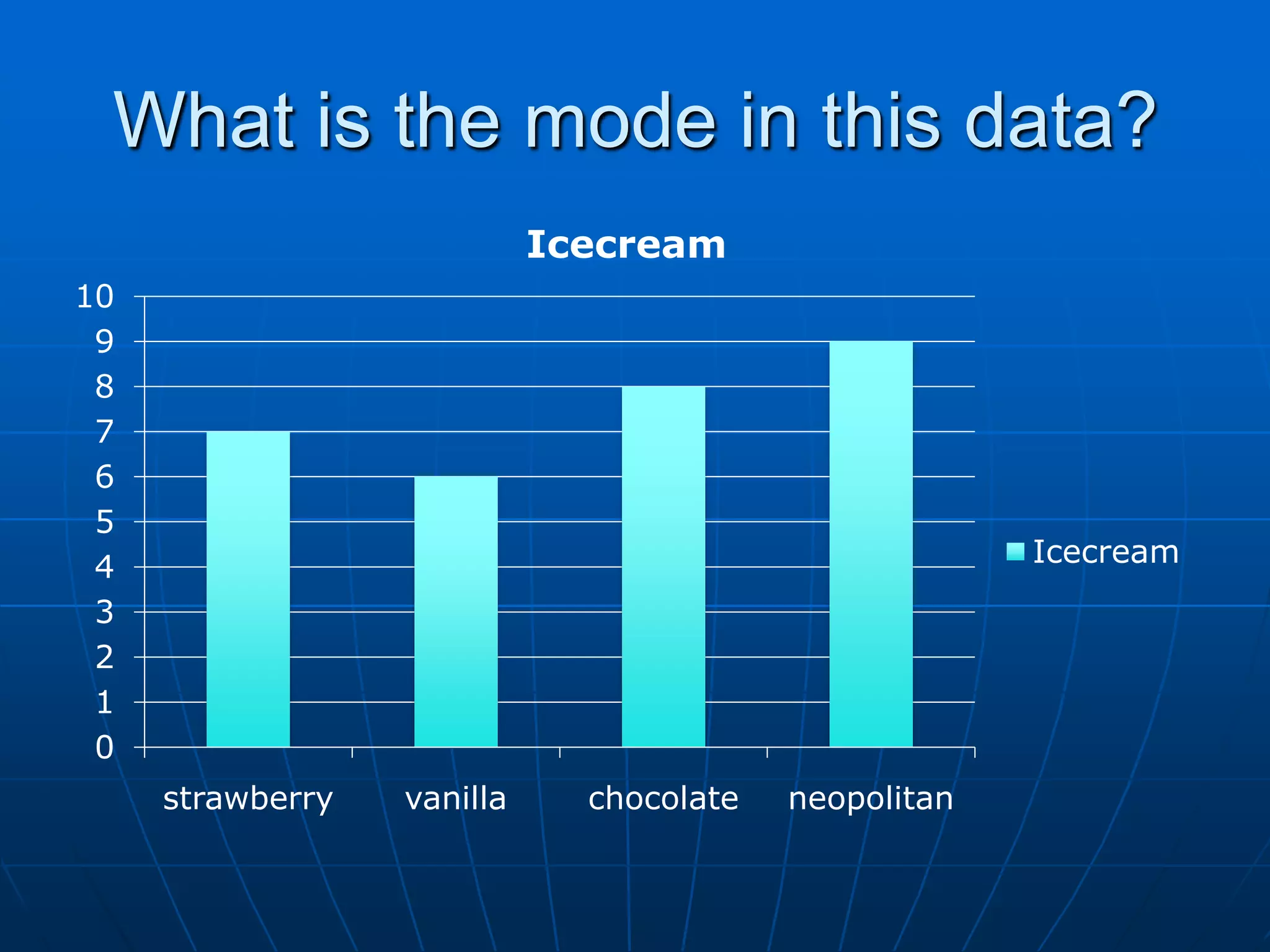
What is the mode in this data?
                            Icecream
10
 9
 8
 7
 6
 5
 4                                                     Icecream
 3
 2
 1
 0
     strawberry   vanilla     chocolate   neopolitan
Bar graph data


Mode = Neopolitan
Bimodal and trimodal
                 Bimodal
Data Set = 2, 5, 2, 3, 5, 4, 7
2, 2, 3, 4, 5, 5, 7
Modes = 2 and 5
                Trimodal
Data Set = 2, 5, 2, 7, 5, 4, 7
2, 2, 4, 5, 5, 7, 7
Modes = 2, 5, and 7
Example
Data Set= 3, 5, 6, 4, 7, 8, 9, 2, 1, 0

What is the mode?
0,1,2,3,4,5,6,7,8,9
Is the mode = 0?

Mode = no mode
When might the Mode be used?
    The mode can be useful for dealing with
    categorical data. For example, if a sandwich shop
    sells 10 different types of sandwiches, the mode
    would represent the most popular sandwich.
   The mode can be useful for summarising survey
    data.
    The mode can be useful for election votes.
Averages
   What other ways can we calculate
    the average of a set of data?

   We can use the Mean to give us an
    average of numerical data.
WALT…


understand what the Mean is and how
        to identify it in data.
Definition of the Mean
   The „Mean‟ is the „Average‟ value of numerical
    data.
   The Mean (or average) is found by adding all
    scores together and dividing by the number of
    scores.
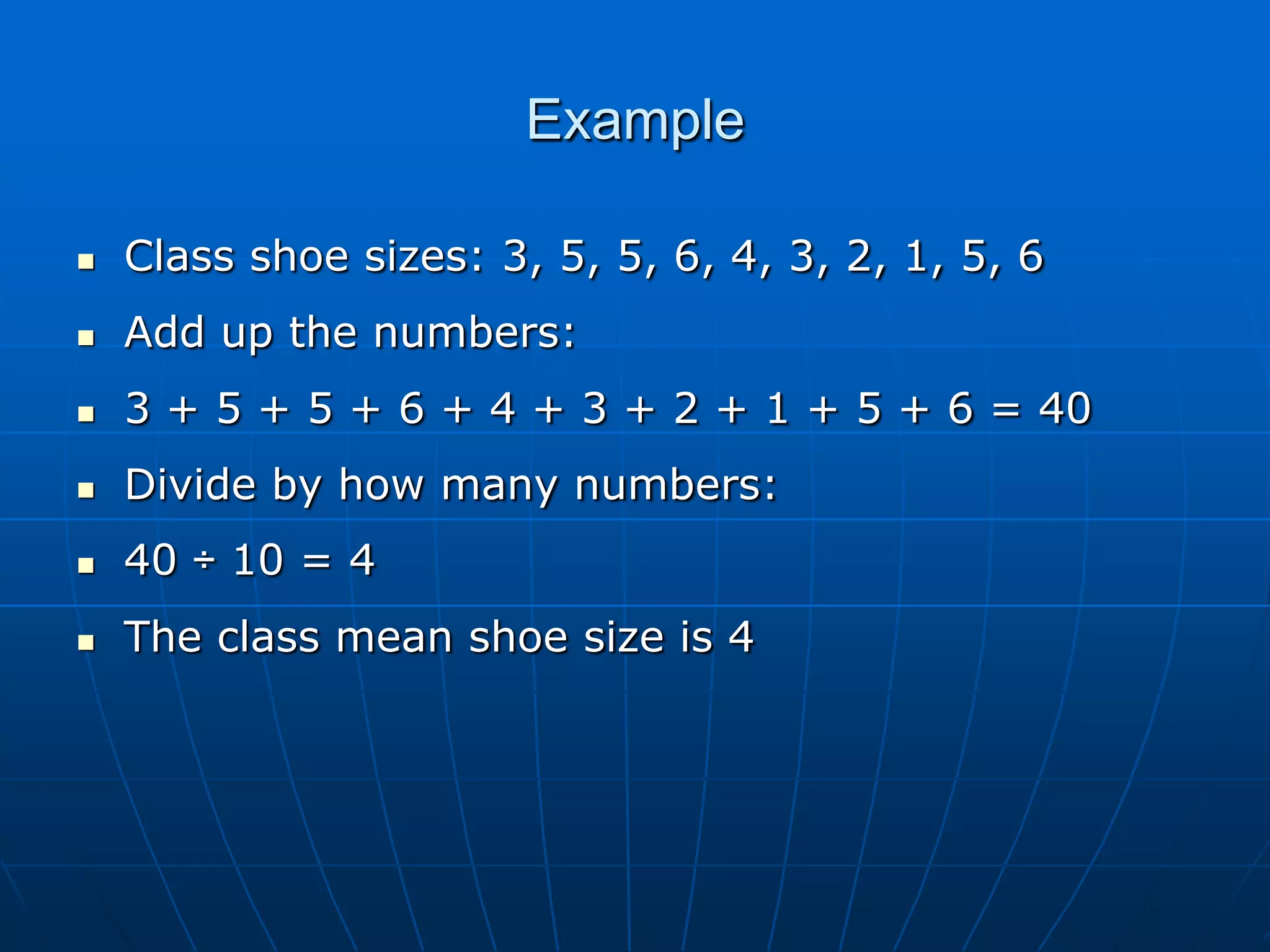
Example

   Class shoe sizes: 3, 5, 5, 6, 4, 3, 2, 1, 5, 6
   Add up the numbers:
   3 + 5 + 5 + 6 + 4 + 3 + 2 + 1 + 5 + 6 = 40
   Divide by how many numbers:
   40 ÷ 10 = 4
   The class mean shoe size is 4
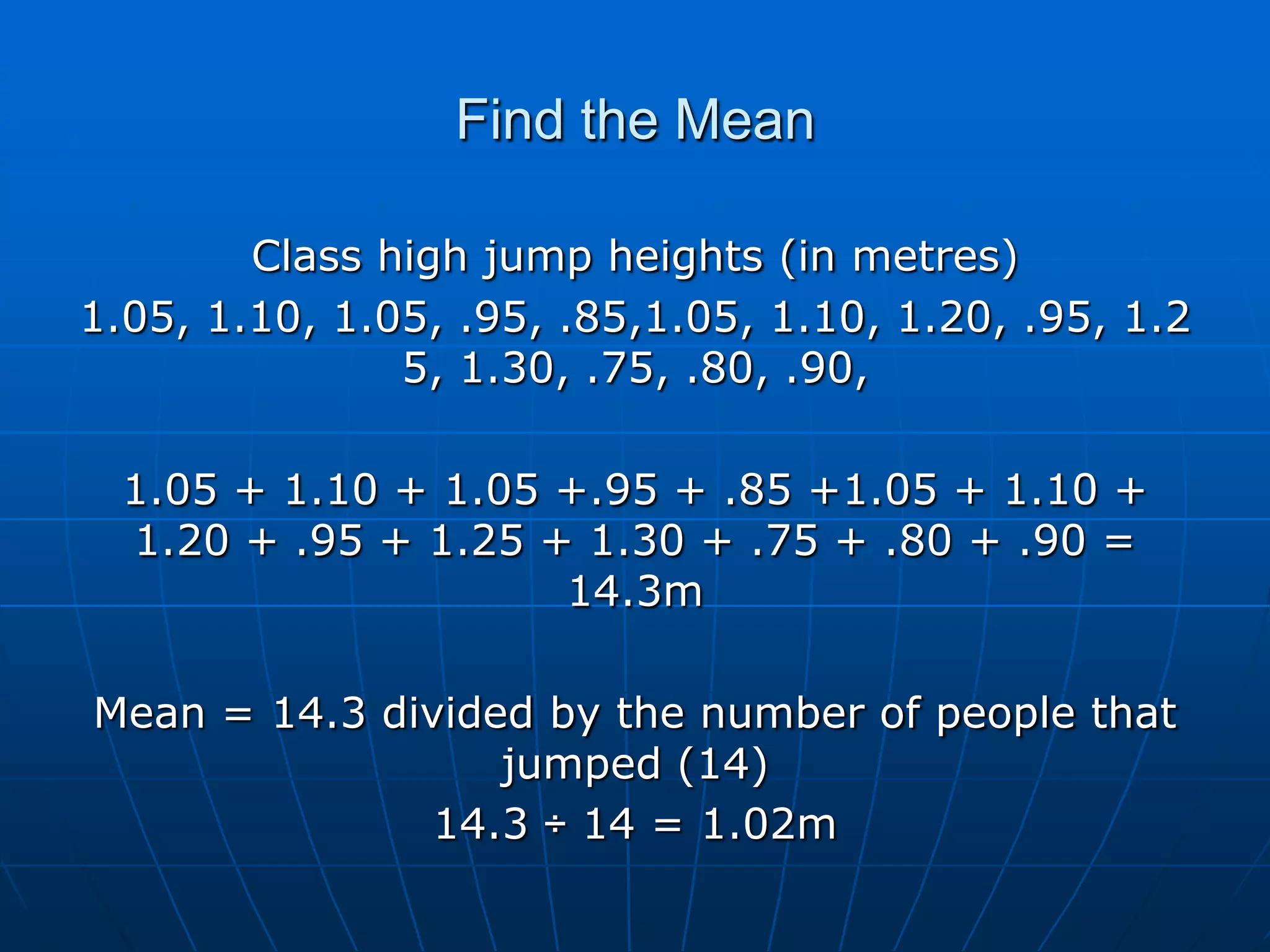
Find the Mean

        Class high jump heights (in metres)
1.05, 1.10, 1.05, .95, .85,1.05, 1.10, 1.20, .95, 1.2
               5, 1.30, .75, .80, .90,

  1.05 + 1.10 + 1.05 +.95 + .85 +1.05 + 1.10 +
  1.20 + .95 + 1.25 + 1.30 + .75 + .80 + .90 =
                     14.3m

Mean = 14.3 divided by the number of people that
                  jumped (14)
               14.3 ÷ 14 = 1.02m
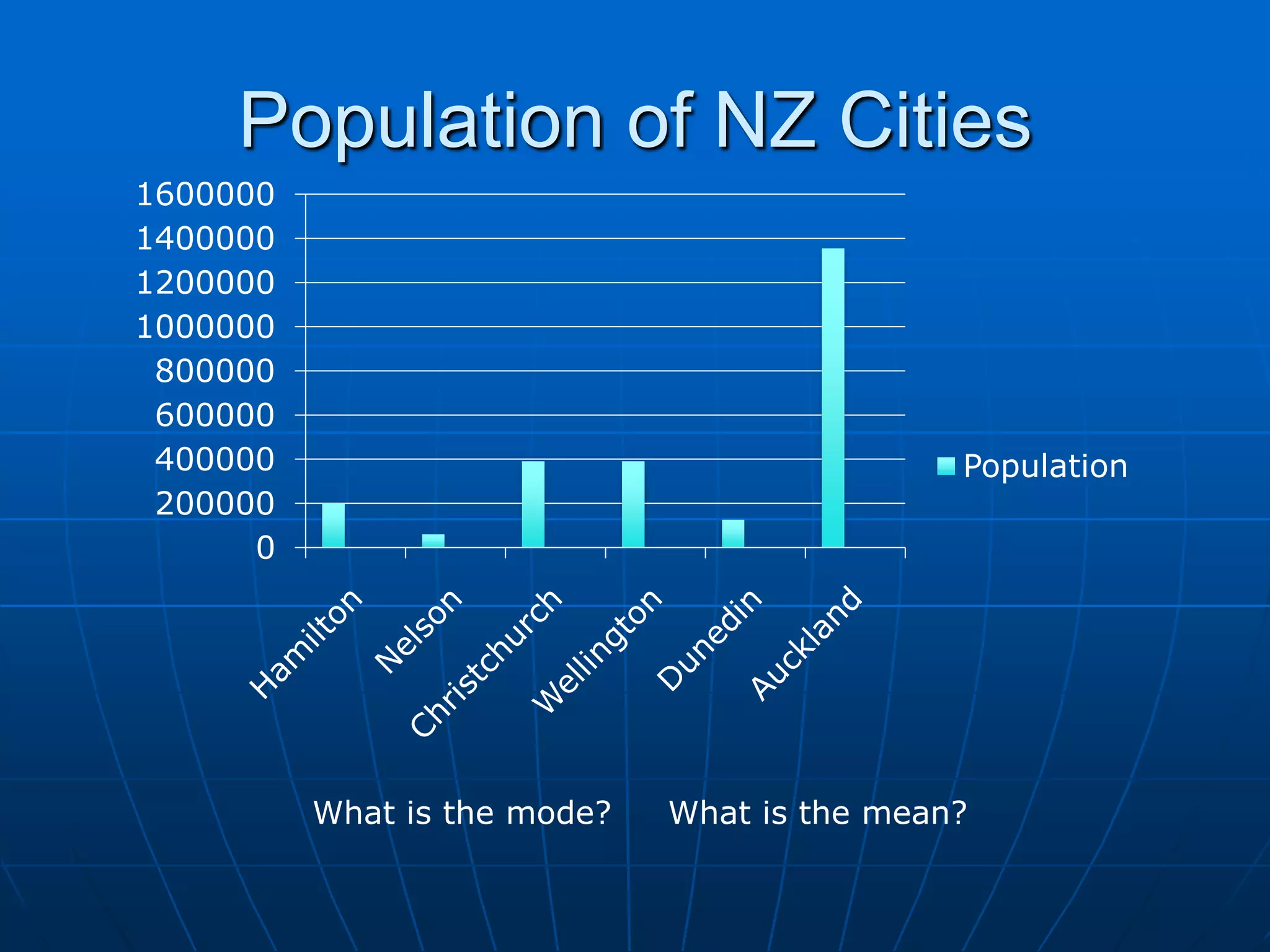
Population of NZ Cities
1600000
1400000
1200000
1000000
 800000
 600000
 400000                                       Population
 200000
      0


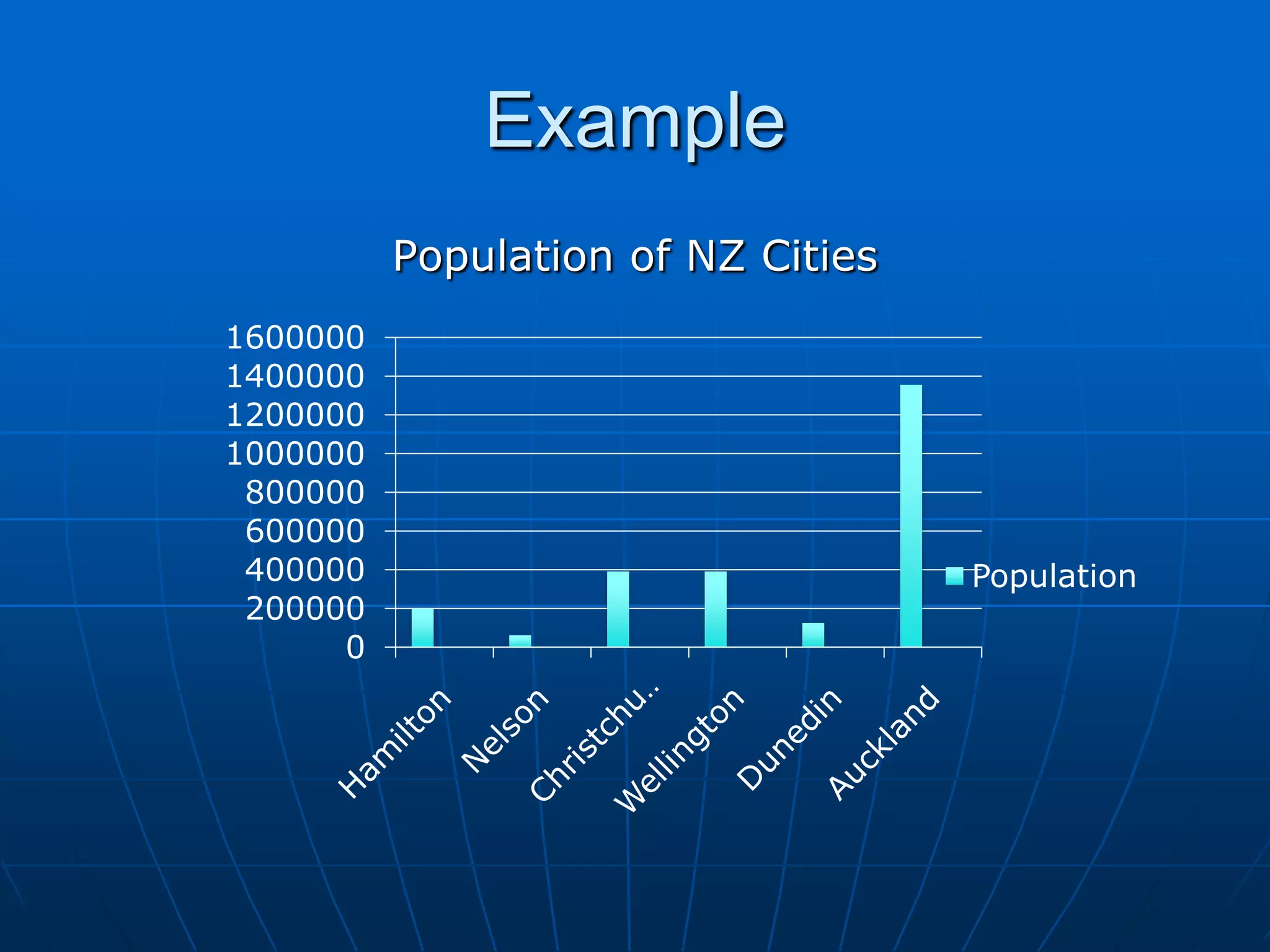
          What is the mode?   What is the mean?
Work it out
   Mode = most common – 390,000 is the mode of
    the population of the NZ Cities on the graph.
   Mean = the average population of the NZ cities
    on the graph –

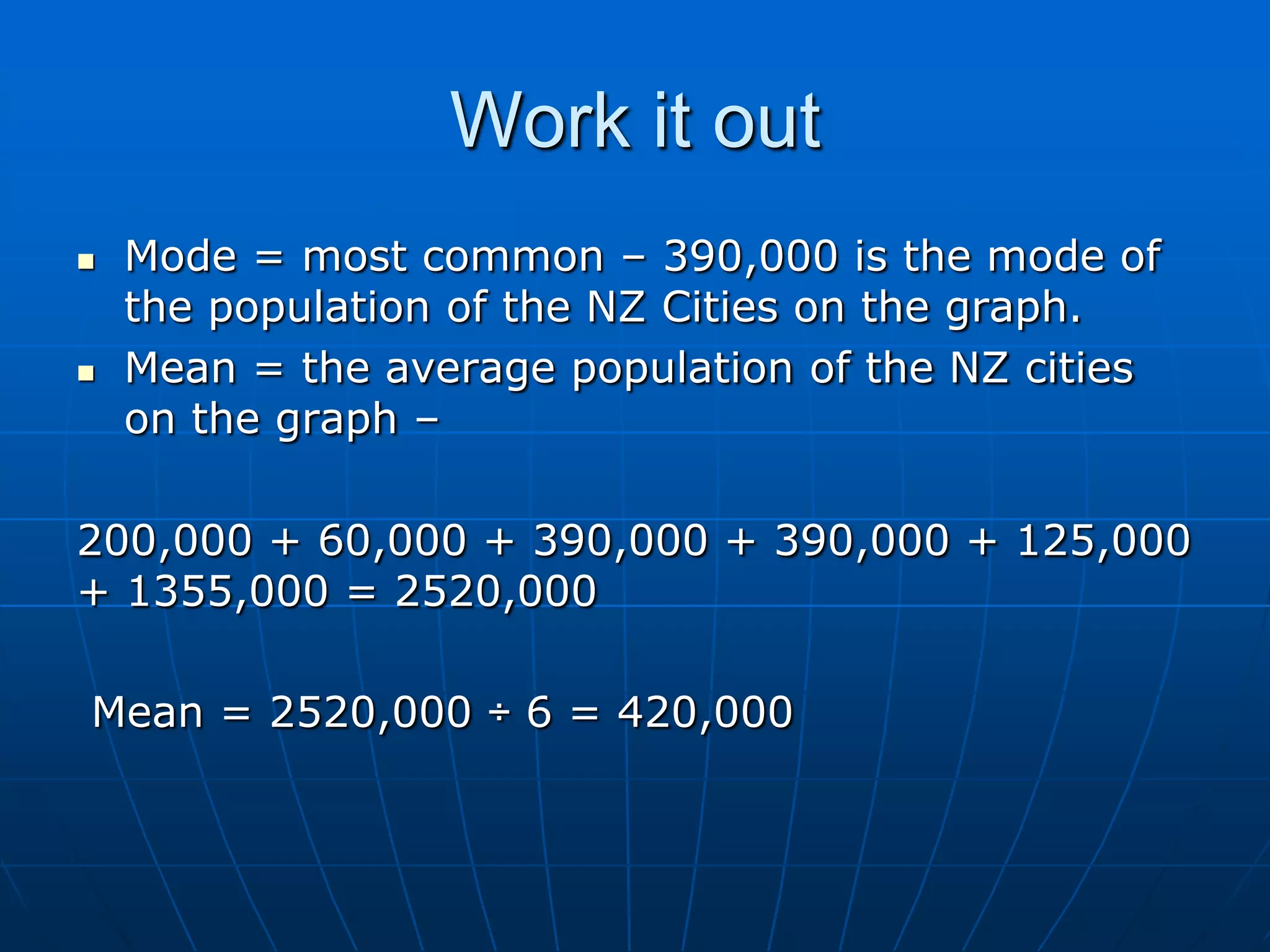
200,000 + 60,000 + 390,000 + 390,000 + 125,000
+ 1355,000 = 2520,000

Mean = 2520,000 ÷ 6 = 420,000
When to use the mean…
   The mean can give a good average value when
    the data is fairly evenly distributed as in the high
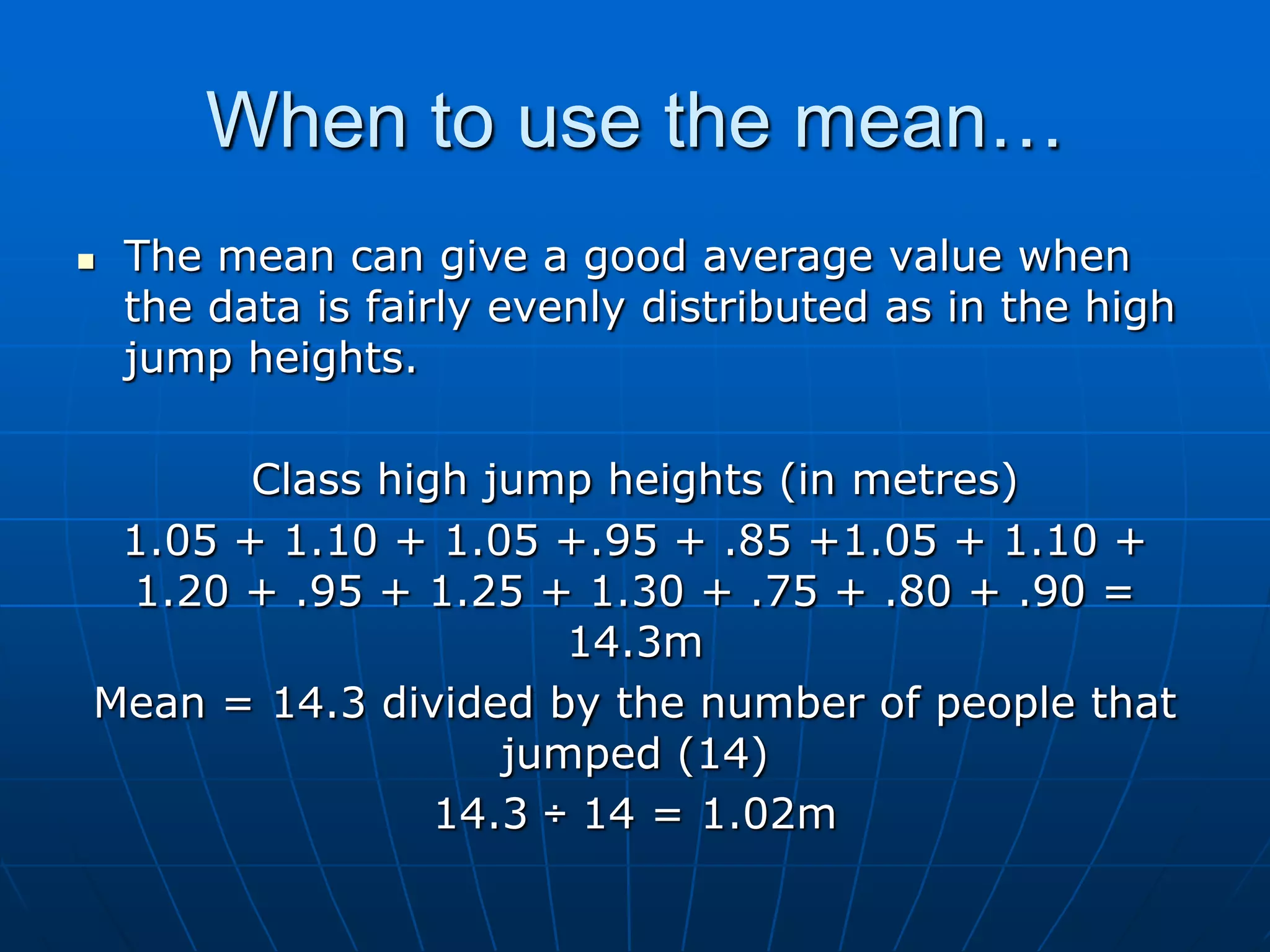
    jump heights.

       Class high jump heights (in metres)
 1.05 + 1.10 + 1.05 +.95 + .85 +1.05 + 1.10 +
 1.20 + .95 + 1.25 + 1.30 + .75 + .80 + .90 =
                      14.3m
Mean = 14.3 divided by the number of people that
                   jumped (14)
                14.3 ÷ 14 = 1.02m
However
   It is not always suitable to use the
    mean to get an average of data
    when there is a huge variation in
    data.
Example
          Population of NZ Cities
1600000
1400000
1200000
1000000
 800000
 600000
 400000                             Population
 200000
      0
What is an average?
                    ,
 .
 An average is a measure of the "middle" value of a
                   set of data.


Mode, Mean, and Median, are all types of averages.


They can be used to help summarise a group of data.
Recap
Definition of Mode –
The “Mode” for a set of data is the
number (or item) that occurs most
frequently.
Definition of Mean –
The “Mean” is the „Average‟ value of
numerical data.
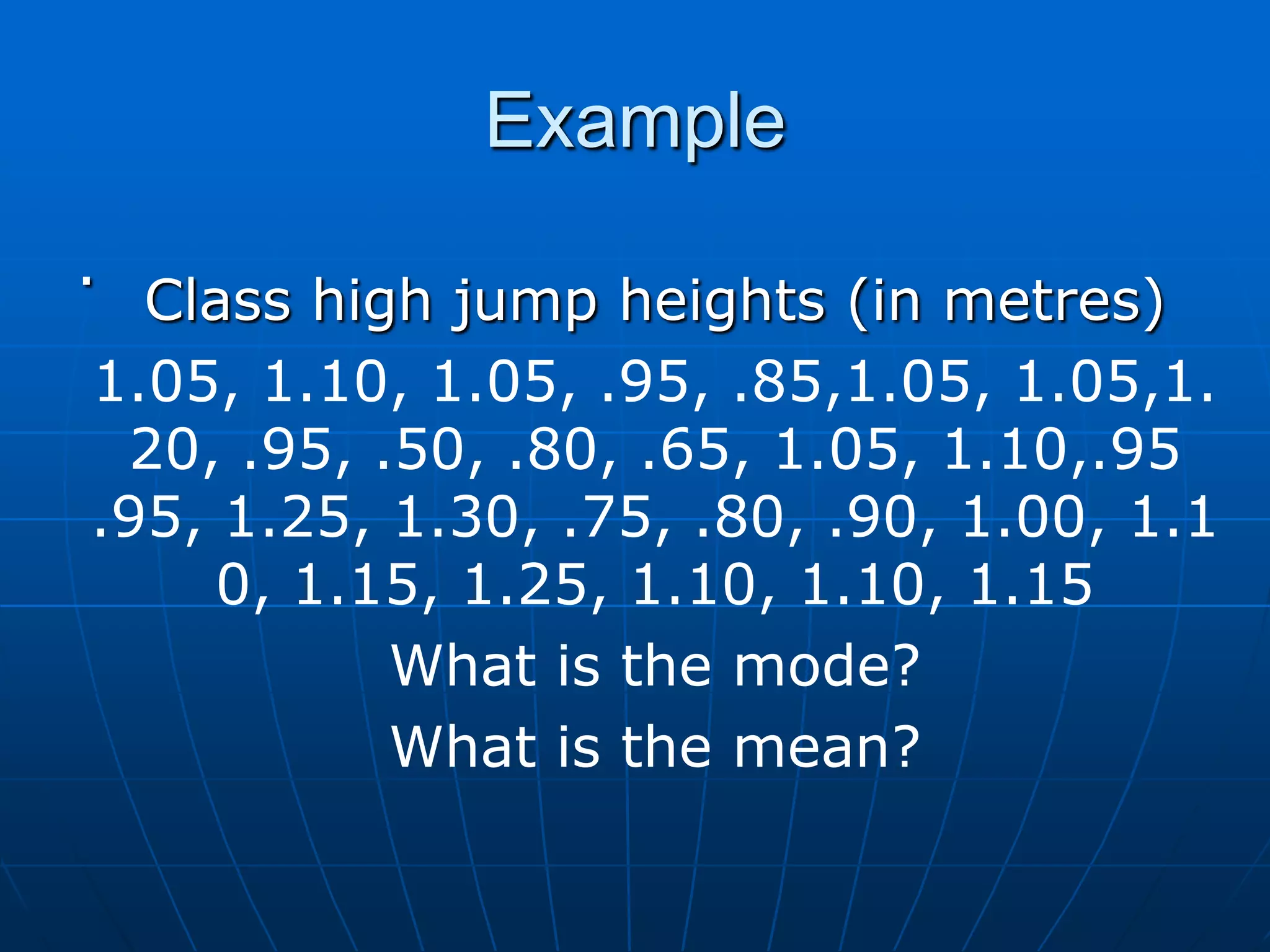
Example
.
  Class high jump heights (in metres)
1.05, 1.10, 1.05, .95, .85,1.05, 1.05,1.
 20, .95, .50, .80, .65, 1.05, 1.10,.95
.95, 1.25, 1.30, .75, .80, .90, 1.00, 1.1
     0, 1.15, 1.25, 1.10, 1.10, 1.15
           What is the mode?
           What is the mean?
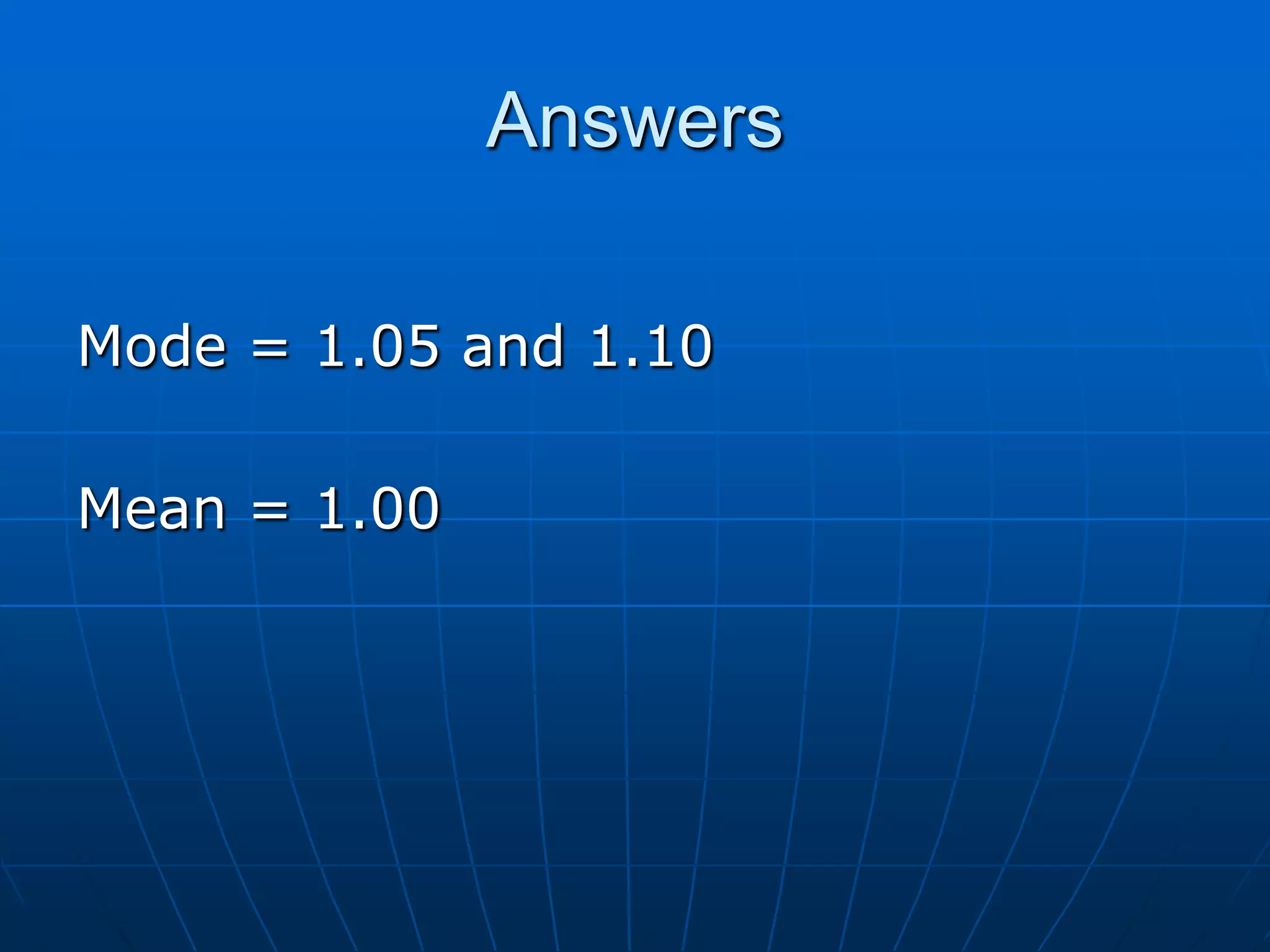
Answers

Mode = 1.05 and 1.10

Mean = 1.00
WALT…


..understand what the Median is and
     how to identify it in data.
Definition of Median
   The Median is the middle value when
    numbers are put in order.
   To find the Median, place the numbers in
    numerical order and find the middle
    number.
   If the total number of values in the
    sample is even, the median is calculated
    by finding the mean of the two values in
    the middle.
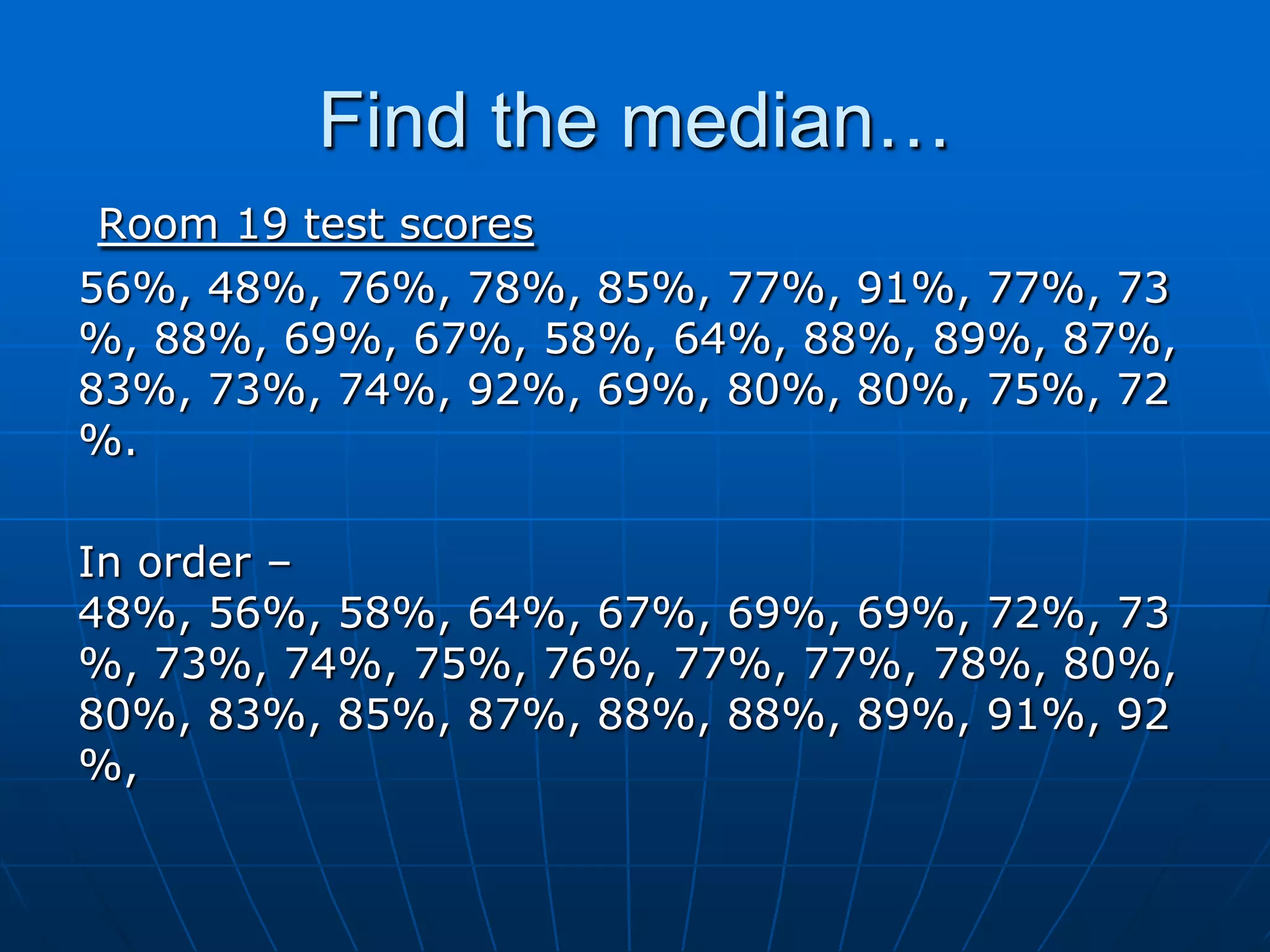
Find the median…
Room 19 test scores
56%, 48%, 76%, 78%, 85%, 77%, 91%, 77%, 73
%, 88%, 69%, 67%, 58%, 64%, 88%, 89%, 87%,
83%, 73%, 74%, 92%, 69%, 80%, 80%, 75%, 72
%.

In order –
48%, 56%, 58%, 64%, 67%, 69%, 69%, 72%, 73
%, 73%, 74%, 75%, 76%, 77%, 77%, 78%, 80%,
80%, 83%, 85%, 87%, 88%, 88%, 89%, 91%, 92
%,
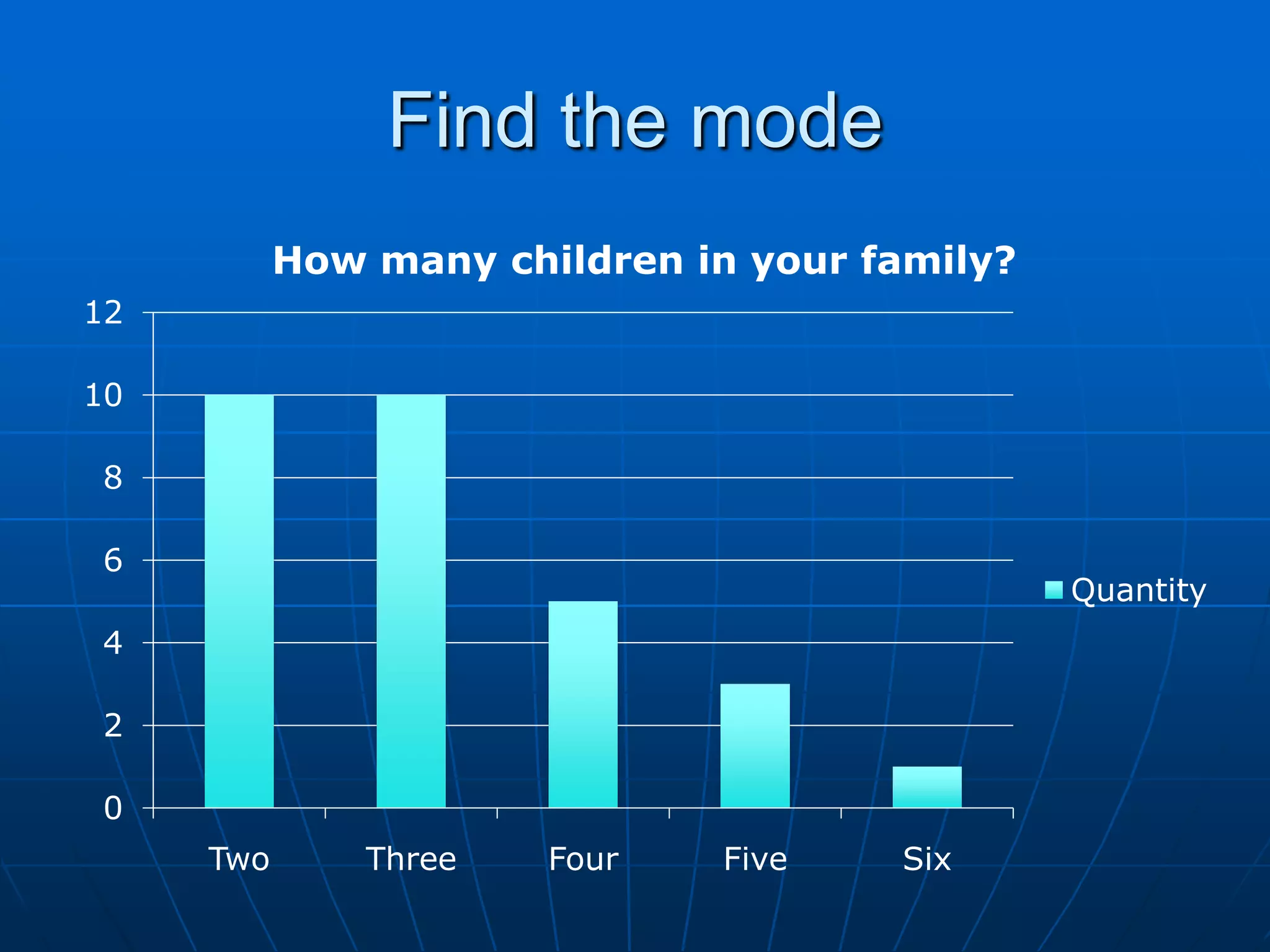
Find the mode
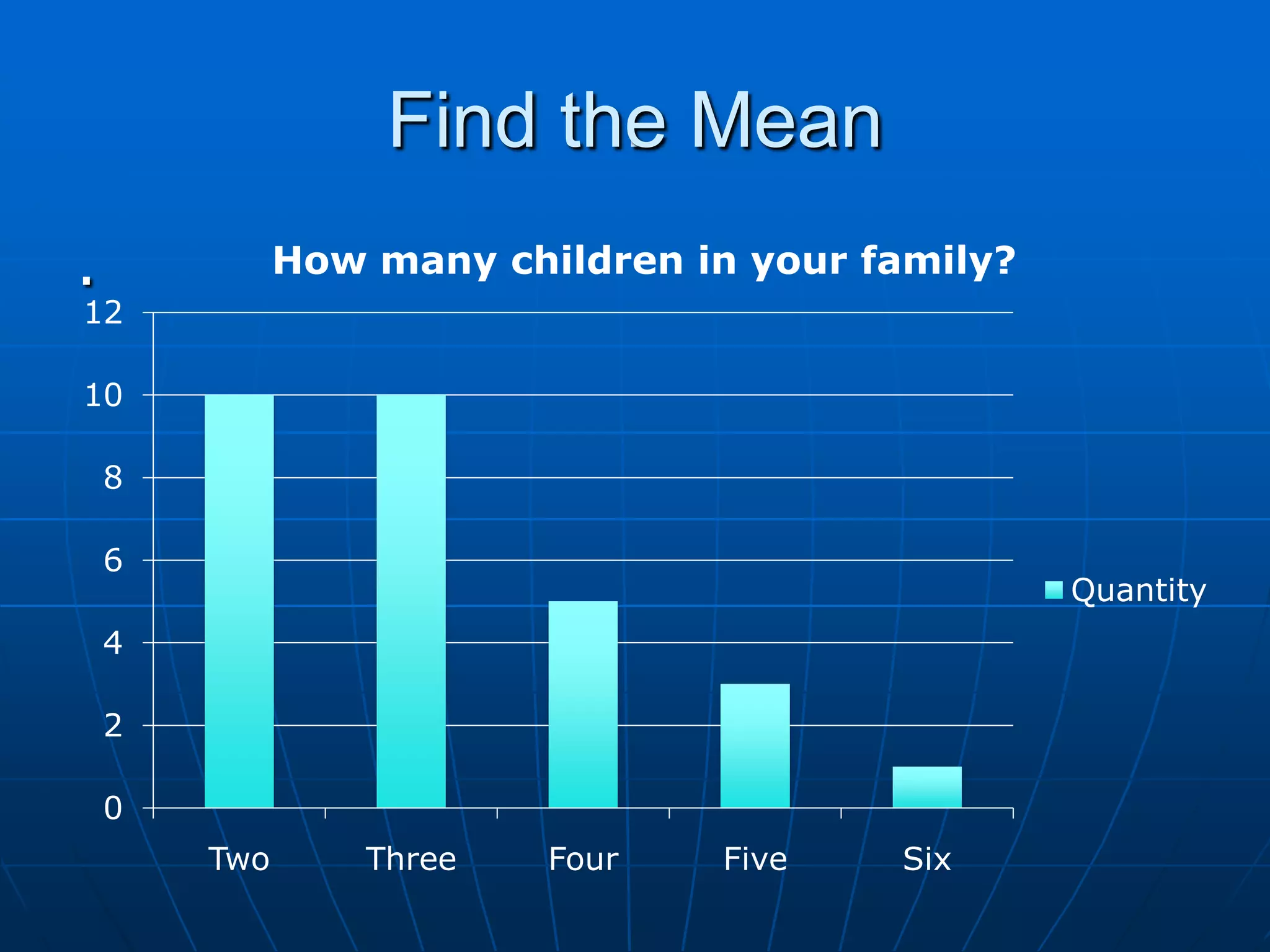
           How many children in your family?
12

10

8

6
                                               Quantity
4

2

0
     Two       Three   Four   Five    Six
Find the Mean
                          .
.             How many children in your family?
12

10

    8

    6
                                                  Quantity
    4

    2

    0
        Two       Three   Four   Five    Six
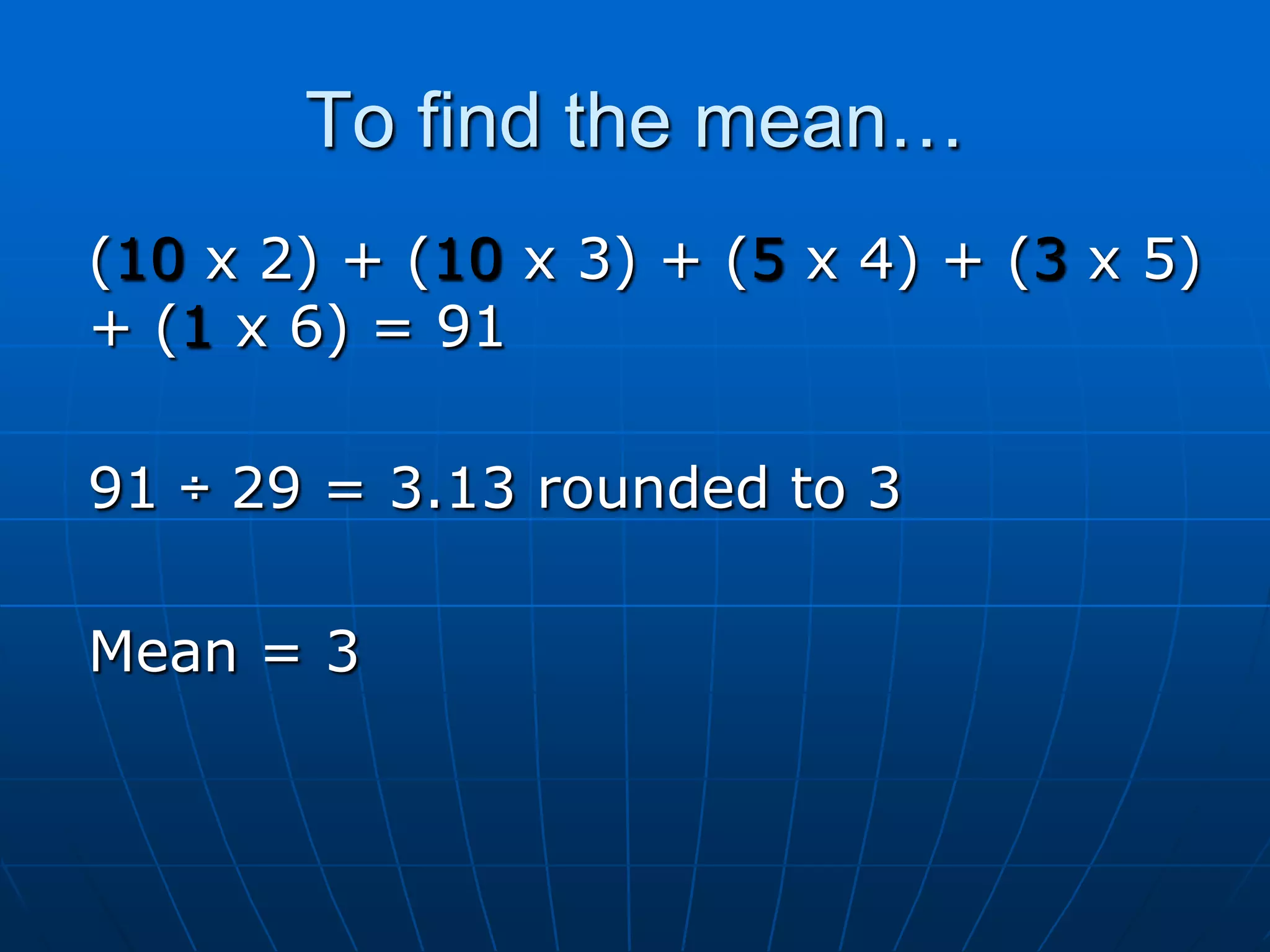
To find the mean…
(10 x 2) + (10 x 3) + (5 x 4) + (3 x 5)
+ (1 x 6) = 91

91 ÷ 29 = 3.13 rounded to 3

Mean = 3
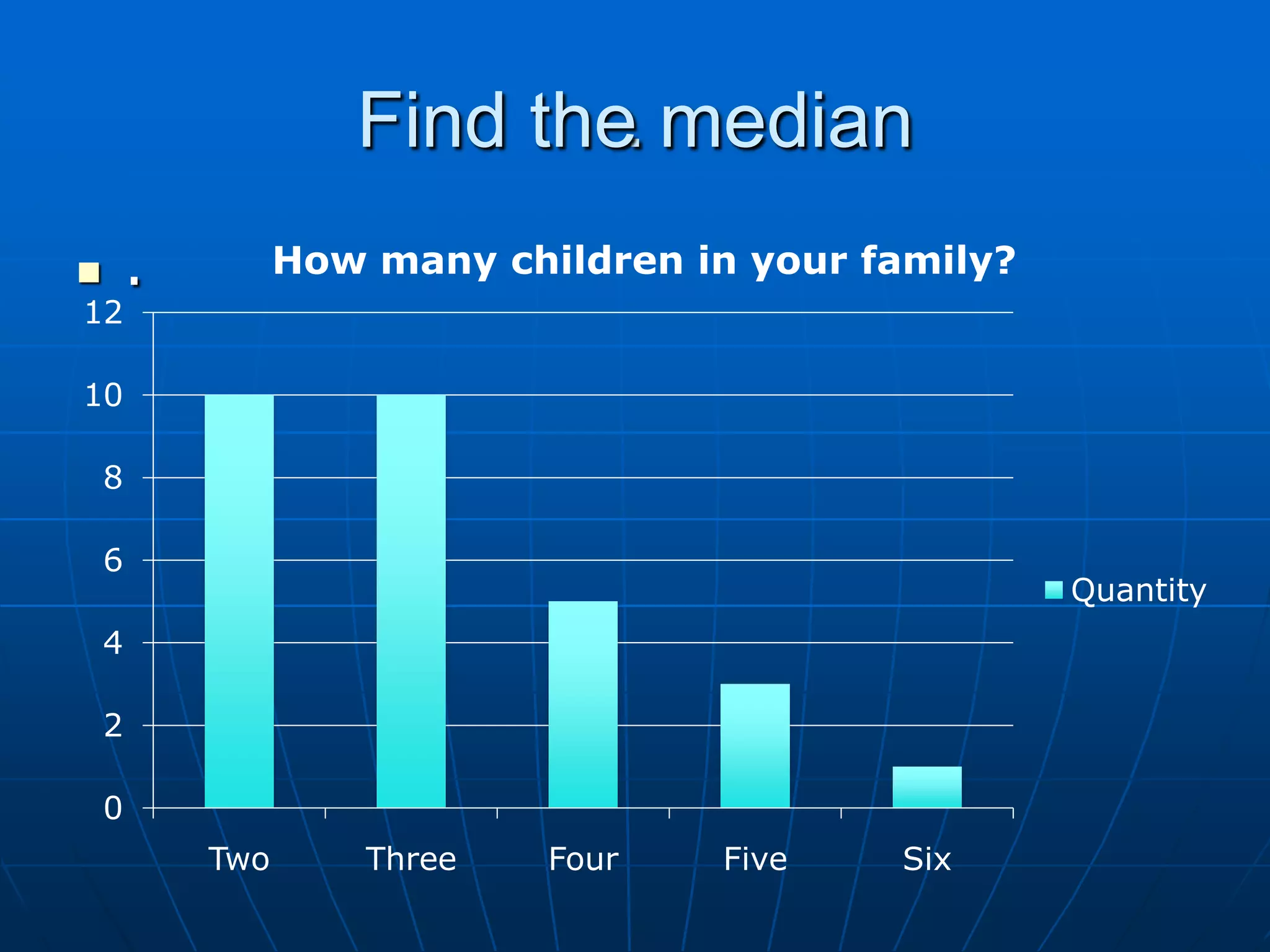
Find the. median
       .         How many children in your family?
12

10

    8

    6
                                                      Quantity
    4

    2

    0
            Two       Three   Four   Five    Six
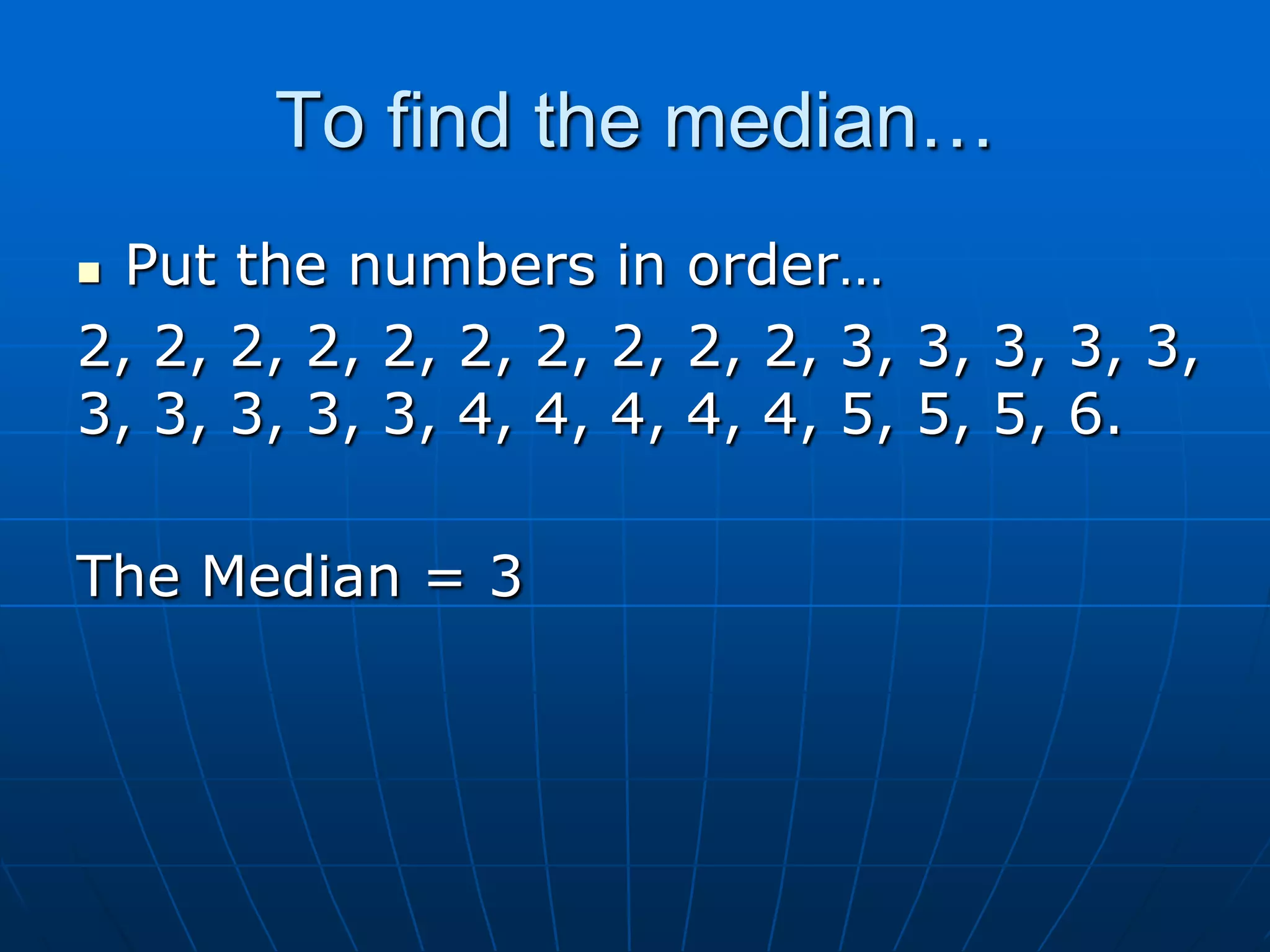
To find the median…
 Put the numbers in order…
2, 2, 2, 2, 2, 2, 2, 2, 2, 2, 3, 3, 3, 3, 3,
3, 3, 3, 3, 3, 4, 4, 4, 4, 4, 5, 5, 5, 6.

The Median = 3
Range
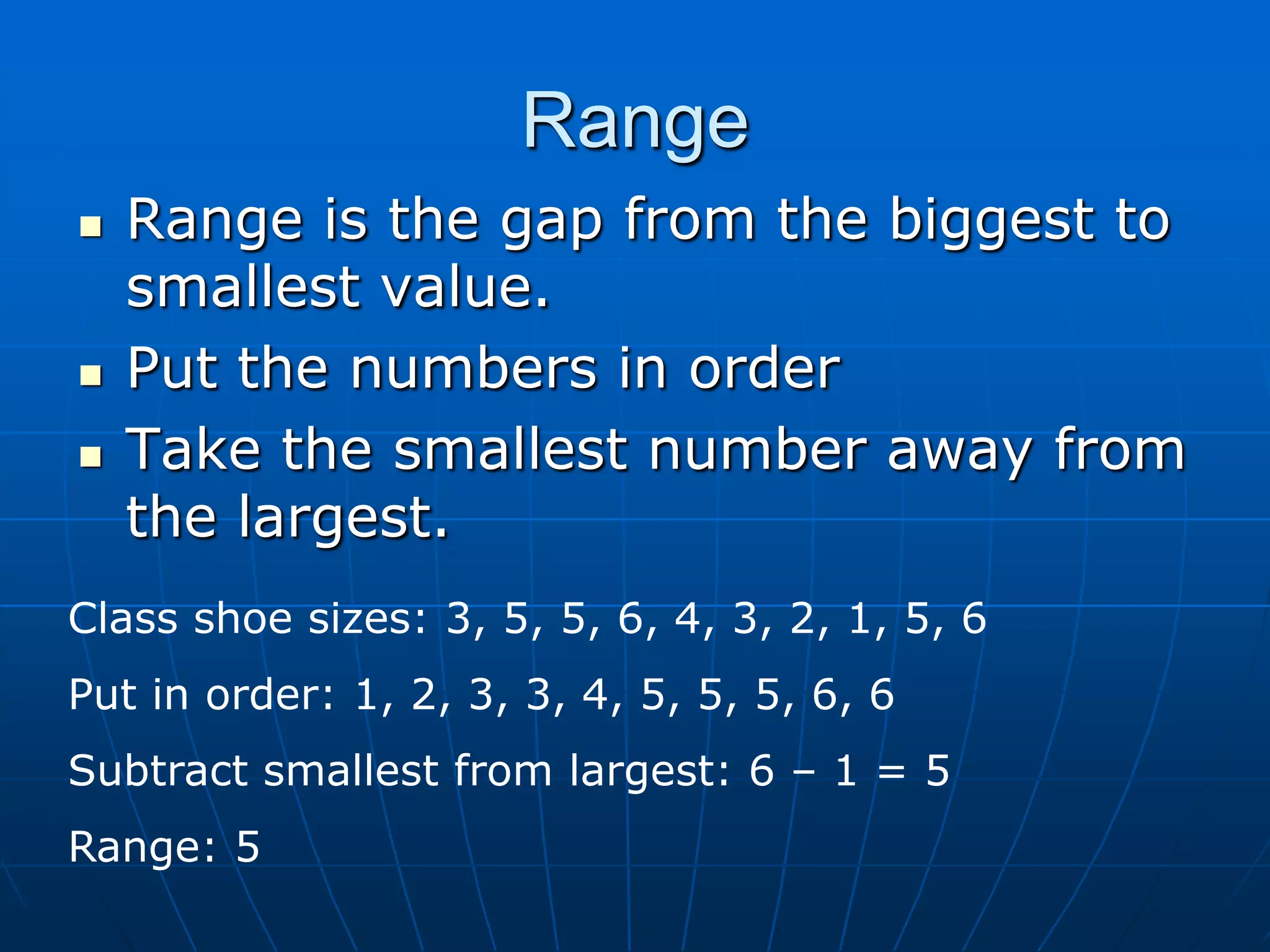
   Range is the gap from the biggest to
    smallest value.
   Put the numbers in order
   Take the smallest number away from
    the largest.
Class shoe sizes: 3, 5, 5, 6, 4, 3, 2, 1, 5, 6
Put in order: 1, 2, 3, 3, 4, 5, 5, 5, 6, 6
Subtract smallest from largest: 6 – 1 = 5
Range: 5
When should you use the
      Mean, Mode, or Median?

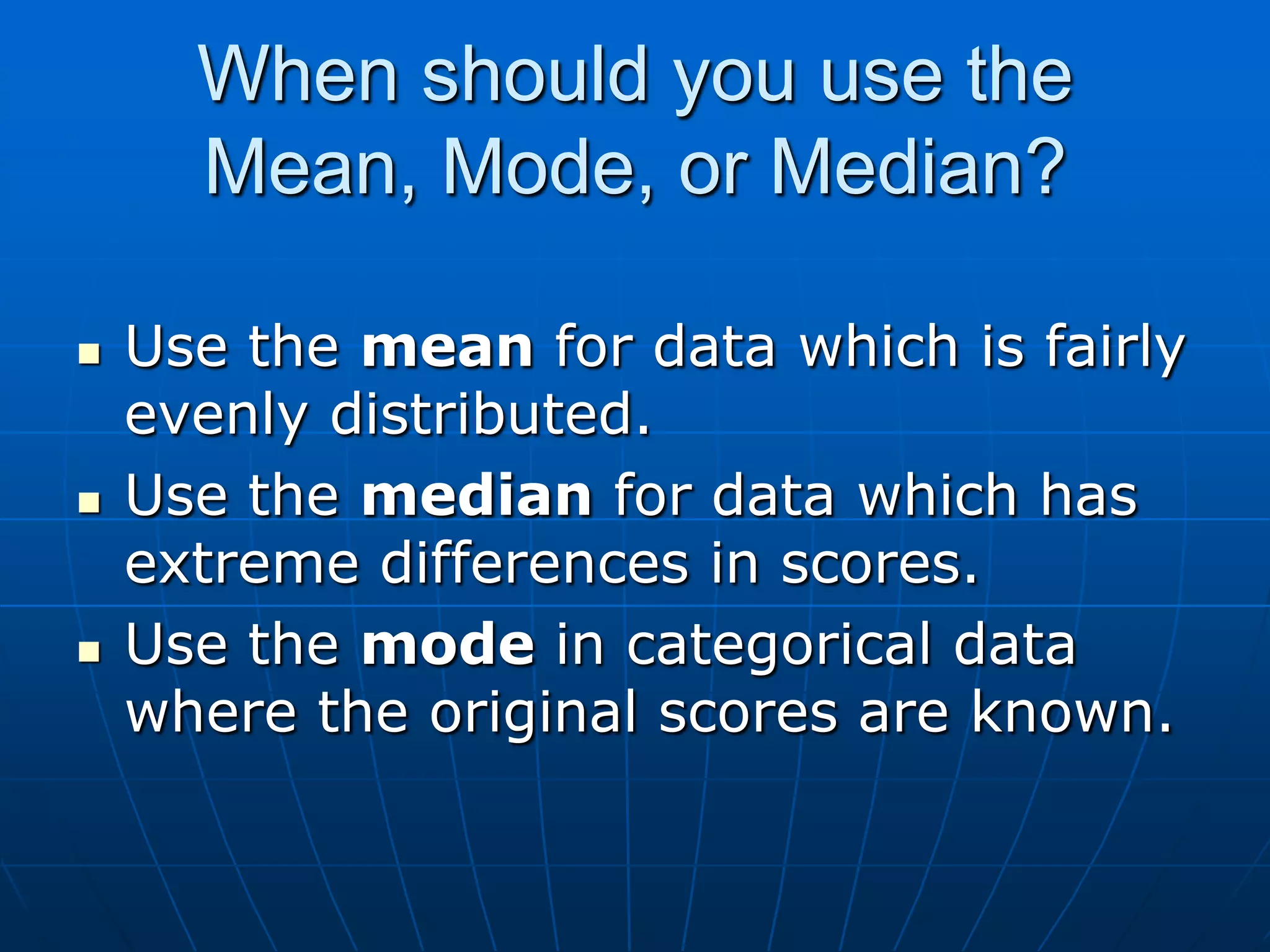
   Use the mean for data which is fairly
    evenly distributed.
   Use the median for data which has
    extreme differences in scores.
   Use the mode in categorical data
    where the original scores are known.

Statistics

  • 1.
    Statistics Data 6 5 4 3 2 1 0
  • 2.
    What is anaverage? An average is a measure of the "middle" value of a set of data. Mode, Mean, and Median, are all types of averages. They can be used to help summarise a group of data.
  • 3.
    WALT… …understand whatthe Mode is and how to identify it in data.
  • 4.
    Definition of Mode •The “mode” for a set of data is the number (or item) that occurs most frequently. • Sometimes data can have more than one mode. This happens when two or more numbers (or items)occur an equal number of times in the data. • A data set with two modes is called bimodal. • A data set with 3 modes is called Trimodal • It is also possible to have a set of data with no mode.
  • 5.
    How to findthe Mode.  Mode is the most common number  Put the numbers in order  Choose the number that appears the most frequently. Class shoe sizes: 3, 5, 5, 6, 4, 3, 2, 1, 5, 6 Put in order: 1, 2, 3, 3, 4, 5, 5, 5, 6, 6 The class modal shoe size is 5.
  • 6.
    Find the modein this data set Class high jump heights (in metres) 1.05, 1.10, 1.05, .95, .85,1.05, 1.10, 1.20, .95, 1.25, 1.30, .75, .80, .90, .75, .80, .85, .90, .95,.95, 1.05,1.05, 1.05, 1.10, 1.10, 1.20, 1.25, 1.30 The mode is 1.05m
  • 7.
    Mode of non-numericaldata Red, green, blue, red, blue, yellow, re d, pink, green, white. Red, red, red, blue, blue, green, green , yellow, pink, white. Mode = red
  • 8.
    What is themode in this data? Icecream 10 9 8 7 6 5 4 Icecream 3 2 1 0 strawberry vanilla chocolate neopolitan
  • 9.
    Bar graph data Mode= Neopolitan
  • 10.
    Bimodal and trimodal Bimodal Data Set = 2, 5, 2, 3, 5, 4, 7 2, 2, 3, 4, 5, 5, 7 Modes = 2 and 5 Trimodal Data Set = 2, 5, 2, 7, 5, 4, 7 2, 2, 4, 5, 5, 7, 7 Modes = 2, 5, and 7
  • 11.
    Example Data Set= 3,5, 6, 4, 7, 8, 9, 2, 1, 0 What is the mode? 0,1,2,3,4,5,6,7,8,9 Is the mode = 0? Mode = no mode
  • 12.
    When might theMode be used?  The mode can be useful for dealing with categorical data. For example, if a sandwich shop sells 10 different types of sandwiches, the mode would represent the most popular sandwich.  The mode can be useful for summarising survey data.  The mode can be useful for election votes.
  • 13.
    Averages  What other ways can we calculate the average of a set of data?  We can use the Mean to give us an average of numerical data.
  • 14.
    WALT… understand what theMean is and how to identify it in data.
  • 15.
    Definition of theMean  The „Mean‟ is the „Average‟ value of numerical data.  The Mean (or average) is found by adding all scores together and dividing by the number of scores.
  • 16.
    Example  Class shoe sizes: 3, 5, 5, 6, 4, 3, 2, 1, 5, 6  Add up the numbers:  3 + 5 + 5 + 6 + 4 + 3 + 2 + 1 + 5 + 6 = 40  Divide by how many numbers:  40 ÷ 10 = 4  The class mean shoe size is 4
  • 17.
    Find the Mean Class high jump heights (in metres) 1.05, 1.10, 1.05, .95, .85,1.05, 1.10, 1.20, .95, 1.2 5, 1.30, .75, .80, .90, 1.05 + 1.10 + 1.05 +.95 + .85 +1.05 + 1.10 + 1.20 + .95 + 1.25 + 1.30 + .75 + .80 + .90 = 14.3m Mean = 14.3 divided by the number of people that jumped (14) 14.3 ÷ 14 = 1.02m
  • 18.
    Population of NZCities 1600000 1400000 1200000 1000000 800000 600000 400000 Population 200000 0 What is the mode? What is the mean?
  • 19.
    Work it out  Mode = most common – 390,000 is the mode of the population of the NZ Cities on the graph.  Mean = the average population of the NZ cities on the graph – 200,000 + 60,000 + 390,000 + 390,000 + 125,000 + 1355,000 = 2520,000 Mean = 2520,000 ÷ 6 = 420,000
  • 20.
    When to usethe mean…  The mean can give a good average value when the data is fairly evenly distributed as in the high jump heights. Class high jump heights (in metres) 1.05 + 1.10 + 1.05 +.95 + .85 +1.05 + 1.10 + 1.20 + .95 + 1.25 + 1.30 + .75 + .80 + .90 = 14.3m Mean = 14.3 divided by the number of people that jumped (14) 14.3 ÷ 14 = 1.02m
  • 21.
    However  It is not always suitable to use the mean to get an average of data when there is a huge variation in data.
  • 22.
    Example Population of NZ Cities 1600000 1400000 1200000 1000000 800000 600000 400000 Population 200000 0
  • 23.
    What is anaverage? , . An average is a measure of the "middle" value of a set of data. Mode, Mean, and Median, are all types of averages. They can be used to help summarise a group of data.
  • 24.
    Recap Definition of Mode– The “Mode” for a set of data is the number (or item) that occurs most frequently. Definition of Mean – The “Mean” is the „Average‟ value of numerical data.
  • 25.
    Example . Classhigh jump heights (in metres) 1.05, 1.10, 1.05, .95, .85,1.05, 1.05,1. 20, .95, .50, .80, .65, 1.05, 1.10,.95 .95, 1.25, 1.30, .75, .80, .90, 1.00, 1.1 0, 1.15, 1.25, 1.10, 1.10, 1.15 What is the mode? What is the mean?
  • 26.
    Answers Mode = 1.05and 1.10 Mean = 1.00
  • 27.
    WALT… ..understand what theMedian is and how to identify it in data.
  • 28.
    Definition of Median  The Median is the middle value when numbers are put in order.  To find the Median, place the numbers in numerical order and find the middle number.  If the total number of values in the sample is even, the median is calculated by finding the mean of the two values in the middle.
  • 29.
    Find the median… Room19 test scores 56%, 48%, 76%, 78%, 85%, 77%, 91%, 77%, 73 %, 88%, 69%, 67%, 58%, 64%, 88%, 89%, 87%, 83%, 73%, 74%, 92%, 69%, 80%, 80%, 75%, 72 %. In order – 48%, 56%, 58%, 64%, 67%, 69%, 69%, 72%, 73 %, 73%, 74%, 75%, 76%, 77%, 77%, 78%, 80%, 80%, 83%, 85%, 87%, 88%, 88%, 89%, 91%, 92 %,
  • 30.
    Find the mode How many children in your family? 12 10 8 6 Quantity 4 2 0 Two Three Four Five Six
  • 31.
    Find the Mean . . How many children in your family? 12 10 8 6 Quantity 4 2 0 Two Three Four Five Six
  • 32.
    To find themean… (10 x 2) + (10 x 3) + (5 x 4) + (3 x 5) + (1 x 6) = 91 91 ÷ 29 = 3.13 rounded to 3 Mean = 3
  • 33.
    Find the. median  . How many children in your family? 12 10 8 6 Quantity 4 2 0 Two Three Four Five Six
  • 34.
    To find themedian…  Put the numbers in order… 2, 2, 2, 2, 2, 2, 2, 2, 2, 2, 3, 3, 3, 3, 3, 3, 3, 3, 3, 3, 4, 4, 4, 4, 4, 5, 5, 5, 6. The Median = 3
  • 35.
    Range  Range is the gap from the biggest to smallest value.  Put the numbers in order  Take the smallest number away from the largest. Class shoe sizes: 3, 5, 5, 6, 4, 3, 2, 1, 5, 6 Put in order: 1, 2, 3, 3, 4, 5, 5, 5, 6, 6 Subtract smallest from largest: 6 – 1 = 5 Range: 5
  • 36.
    When should youuse the Mean, Mode, or Median?  Use the mean for data which is fairly evenly distributed.  Use the median for data which has extreme differences in scores.  Use the mode in categorical data where the original scores are known.