CENTRAL TENDANCY
DR DIGVIJAY R PARMAR
BIOSTATISTICS
 Statistics is the science of the collection,
organization, and interpretation of data.
 Biostatistics (a contraction of biology and
statistics; sometimes referred to
as biometry or biometrics) is the application
of statistics to a wide range of topics in biology.
INTRODUCTION
 Classification of data are helpful in reducing
and understanding the bulk of the large mass
data.
 But they are descriptive.
 So need arises,to find a constant which will be
representative of a group.
 MEASURES OF CENTRAL TENDANCY
OR AVERAGE
 MEASURES OF VARIATION
 MEASUREA OF SKEWNESS AND
KURTOSIS
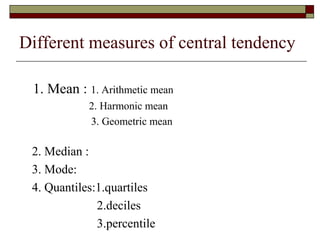
Different measures of central tendency
1. Mean : 1. Arithmetic mean
2. Harmonic mean
3. Geometric mean
2. Median :
3. Mode:
4. Quantiles:1.quartiles
2.deciles
3.percentile
AVERAGE
 By careful observation of data, it can be
noticed that observations tend to cluster
around central value.
 This is called central tendency of that group.
 This central value is known as a average.
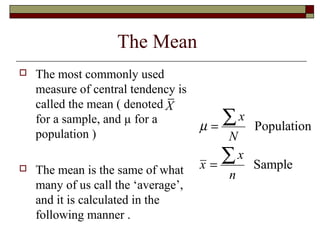
The Mean
 The most commonly used
measure of central tendency is
called the mean ( denoted
for a sample, and µ for a
population )
 The mean is the same of what
many of us call the ‘average’,
and it is calculated in the
following manner .
X
Population
Sample
x
N
x
x
n
µ =
=
∑
∑
Arithmetic mean
 It is commonly used measure of central
tendency.
 It is sum all observations divided by number
of observations
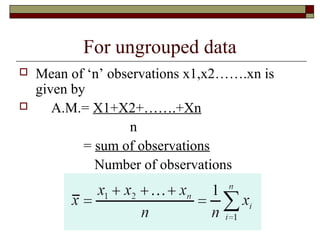
For ungrouped data
 Mean of ‘n’ observations x1,x2…….xn is
given by
 A.M.= X1+X2+…….+Xn
n
= sum of observations
Number of observations
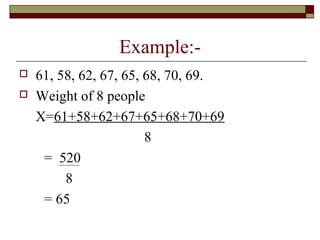
Example:-
 61, 58, 62, 67, 65, 68, 70, 69.
 Weight of 8 people
X=61+58+62+67+65+68+70+69
8
= 520
8
= 65
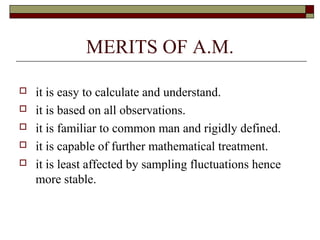
MERITS OF A.M.
 it is easy to calculate and understand.
 it is based on all observations.
 it is familiar to common man and rigidly defined.
 it is capable of further mathematical treatment.
 it is least affected by sampling fluctuations hence
more stable.
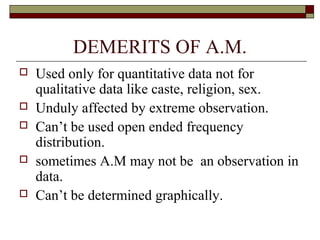
DEMERITS OF A.M.
 Used only for quantitative data not for
qualitative data like caste, religion, sex.
 Unduly affected by extreme observation.
 Can’t be used open ended frequency
distribution.
 sometimes A.M may not be an observation in
data.
 Can’t be determined graphically.
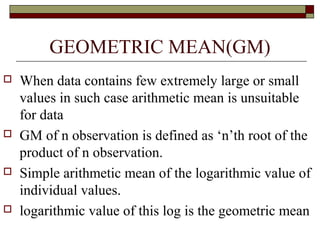
GEOMETRIC MEAN(GM)
 When data contains few extremely large or small
values in such case arithmetic mean is unsuitable
for data
 GM of n observation is defined as ‘n’th root of the
product of n observation.
 Simple arithmetic mean of the logarithmic value of
individual values.
 logarithmic value of this log is the geometric mean
HARMONIC MEAN:
 It is reciprocal of arithmetic mean of
reciprocal observations.
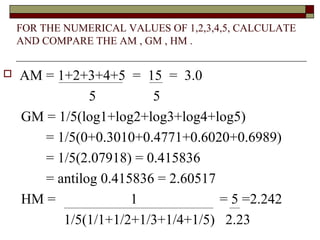
FOR THE NUMERICAL VALUES OF 1,2,3,4,5, CALCULATE
AND COMPARE THE AM , GM , HM .
 AM = 1+2+3+4+5 = 15 = 3.0
5 5
GM = 1/5(log1+log2+log3+log4+log5)
= 1/5(0+0.3010+0.4771+0.6020+0.6989)
= 1/5(2.07918) = 0.415836
= antilog 0.415836 = 2.60517
HM = 1 = 5 =2.242
1/5(1/1+1/2+1/3+1/4+1/5) 2.23
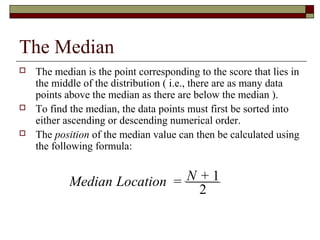
The Median
Median Location = N + 1
2
 The median is the point corresponding to the score that lies in
the middle of the distribution ( i.e., there are as many data
points above the median as there are below the median ).
 To find the median, the data points must first be sorted into
either ascending or descending numerical order.
 The position of the median value can then be calculated using
the following formula:
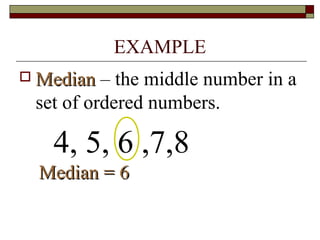
EXAMPLE
 MedianMedian – the middle number in a
set of ordered numbers.
4, 5, 6 ,7,8
Median = 6Median = 6
How to Find the Median in a Group of
Numbers
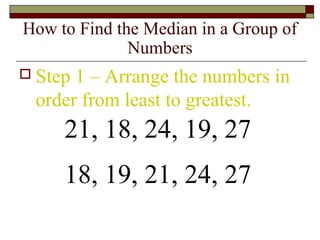
 Step 1 – Arrange the numbers in
order from least to greatest.
21, 18, 24, 19, 27
18, 19, 21, 24, 27
How to Find the Median in a Group of
Numbers
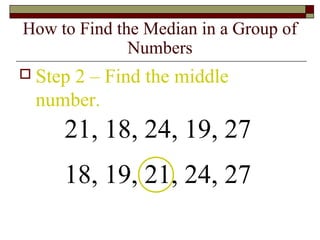
 Step 2 – Find the middle
number.
21, 18, 24, 19, 27
18, 19, 21, 24, 27
How to Find the Median in a Group of
Numbers
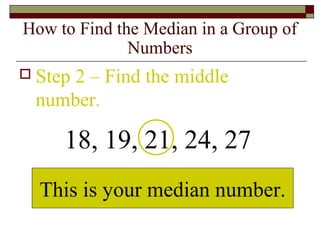
 Step 2 – Find the middle
number.
18, 19, 21, 24, 27
This is your median number.
How to Find the Median in a Group of
Numbers
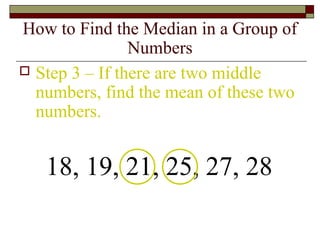
 Step 3 – If there are two middle
numbers, find the mean of these two
numbers.
18, 19, 21, 25, 27, 28
How to Find the Median in a Group of
Numbers
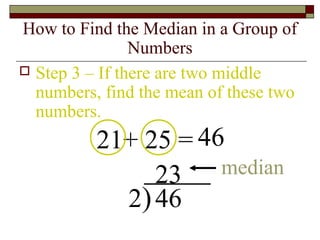
 Step 3 – If there are two middle
numbers, find the mean of these two
numbers.
21+ 25 = 46
2)46
23 median
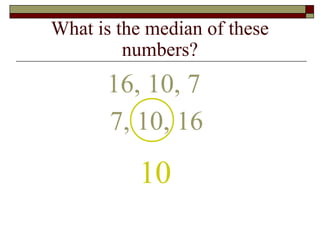
What is the median of these
numbers?
16, 10, 7
10
7, 10, 16
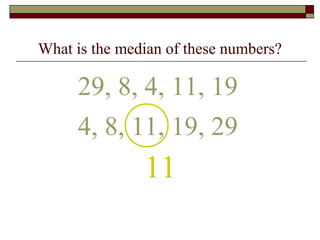
What is the median of these numbers?
29, 8, 4, 11, 19
11
4, 8, 11, 19, 29
What is the median of these numbers?
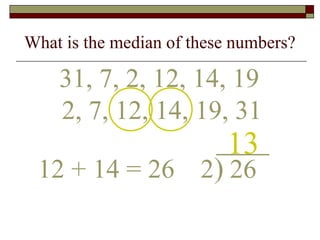
31, 7, 2, 12, 14, 19
13
2, 7, 12, 14, 19, 31
12 + 14 = 26 2) 26
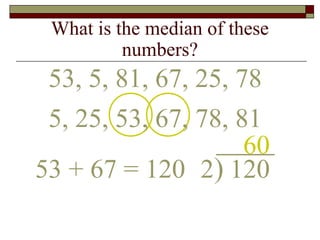
What is the median of these
numbers?
53, 5, 81, 67, 25, 78
60
53 + 67 = 120 2) 120
5, 25, 53, 67, 78, 81
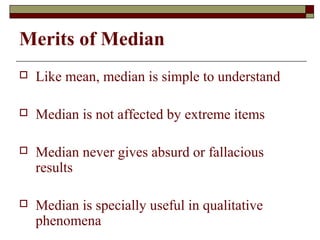
Merits of Median
 Like mean, median is simple to understand
 Median is not affected by extreme items
 Median never gives absurd or fallacious
results
 Median is specially useful in qualitative
phenomena
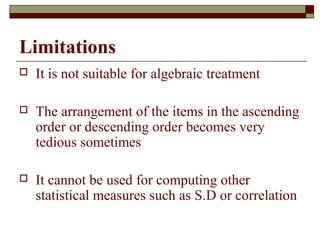
Limitations
 It is not suitable for algebraic treatment
 The arrangement of the items in the ascending
order or descending order becomes very
tedious sometimes
 It cannot be used for computing other
statistical measures such as S.D or correlation
The Mode
 The mode is simply the value of the relevant variable
that occurs most often (i.e., has the highest
frequency) in the sample
 Note that if you have done a frequency histogram,
you can often identify the mode simply by finding
the value with the highest bar.
 Modes in particular are probably best applied to
nominal data
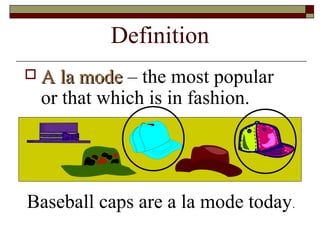
Definition
 A la modeA la mode – the most popular
or that which is in fashion.
Baseball caps are a la mode today.
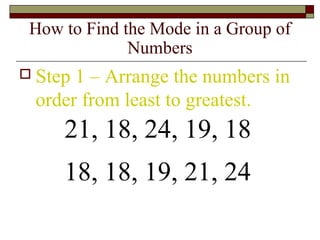
How to Find the Mode in a Group of
Numbers
 Step 1 – Arrange the numbers in
order from least to greatest.
21, 18, 24, 19, 18
18, 18, 19, 21, 24
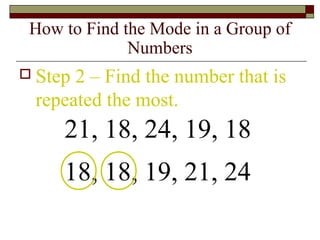
How to Find the Mode in a Group of
Numbers
 Step 2 – Find the number that is
repeated the most.
21, 18, 24, 19, 18
18, 18, 19, 21, 24
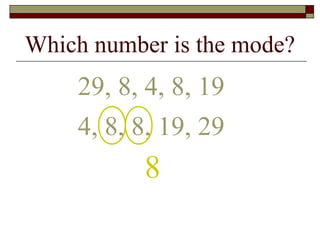
Which number is the mode?
29, 8, 4, 8, 19
8
4, 8, 8, 19, 29
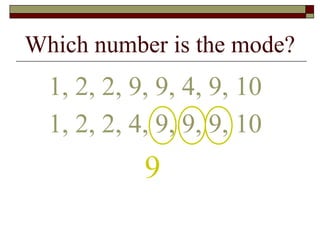
Which number is the mode?
1, 2, 2, 9, 9, 4, 9, 10
9
1, 2, 2, 4, 9, 9, 9, 10
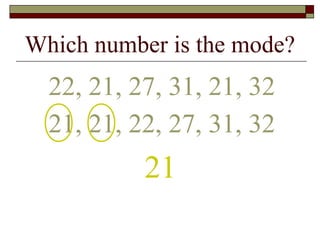
Which number is the mode?
22, 21, 27, 31, 21, 32
21
21, 21, 22, 27, 31, 32
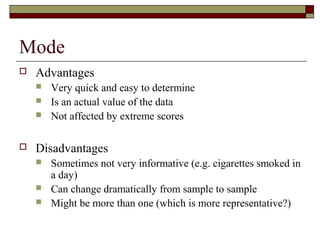
Mode
 Advantages
 Very quick and easy to determine
 Is an actual value of the data
 Not affected by extreme scores
 Disadvantages
 Sometimes not very informative (e.g. cigarettes smoked in
a day)
 Can change dramatically from sample to sample
 Might be more than one (which is more representative?)
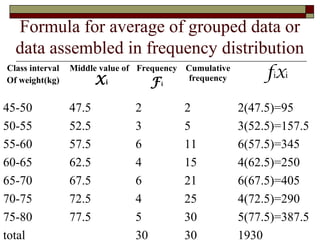
Formula for average of grouped data or
data assembled in frequency distribution
Class interval
Of weight(kg)
Middle value of
Xi
Frequency
Fi
Cumulative
frequency fiXi
45-50 47.5 2 2 2(47.5)=95
50-55 52.5 3 5 3(52.5)=157.5
55-60 57.5 6 11 6(57.5)=345
60-65 62.5 4 15 4(62.5)=250
65-70 67.5 6 21 6(67.5)=405
70-75 72.5 4 25 4(72.5)=290
75-80 77.5 5 30 5(77.5)=387.5
total 30 30 1930
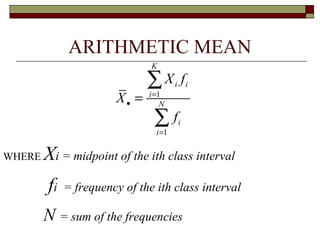
ARITHMETIC MEAN
1
1
K
i i
i
N
i
i
X f
X
f
=
•
=
=
∑
∑
WHERE Xi = midpoint of the ith class interval
fi = frequency of the ith class interval
N = sum of the frequencies
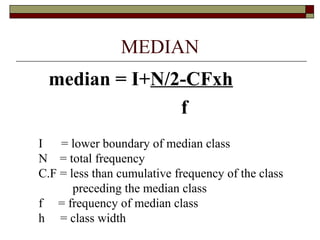
MEDIAN
median = I+N/2-CFxh
f
I = lower boundary of median class
N = total frequency
C.F = less than cumulative frequency of the class
preceding the median class
f = frequency of median class
h = class width
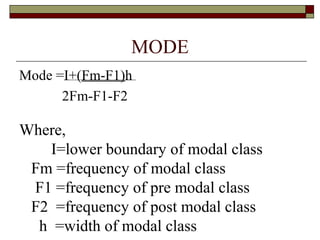
MODE
Mode =I+(Fm-F1)h
2Fm-F1-F2
Where,
I=lower boundary of modal class
Fm =frequency of modal class
F1 =frequency of pre modal class
F2 =frequency of post modal class
h =width of modal class
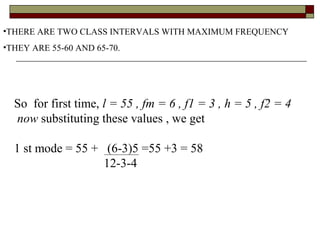
•THERE ARE TWO CLASS INTERVALS WITH MAXIMUM FREQUENCY
•THEY ARE 55-60 AND 65-70.
So for first time, l = 55 , fm = 6 , f1 = 3 , h = 5 , f2 = 4
now substituting these values , we get
1 st mode = 55 + (6-3)5 =55 +3 = 58
12-3-4
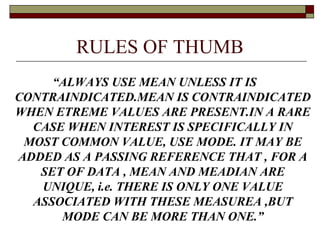
RULES OF THUMB
“ALWAYS USE MEAN UNLESS IT IS
CONTRAINDICATED.MEAN IS CONTRAINDICATED
WHEN ETREME VALUES ARE PRESENT.IN A RARE
CASE WHEN INTEREST IS SPECIFICALLY IN
MOST COMMON VALUE, USE MODE. IT MAY BE
ADDED AS A PASSING REFERENCE THAT , FOR A
SET OF DATA , MEAN AND MEADIAN ARE
UNIQUE, i.e. THERE IS ONLY ONE VALUE
ASSOCIATED WITH THESE MEASUREA ,BUT
MODE CAN BE MORE THAN ONE.”
 HAVE
A
NICE
DAY!

Dr digs central tendency

  • 1.
  • 2.
    BIOSTATISTICS  Statistics isthe science of the collection, organization, and interpretation of data.  Biostatistics (a contraction of biology and statistics; sometimes referred to as biometry or biometrics) is the application of statistics to a wide range of topics in biology.
  • 3.
    INTRODUCTION  Classification ofdata are helpful in reducing and understanding the bulk of the large mass data.  But they are descriptive.  So need arises,to find a constant which will be representative of a group.
  • 4.
     MEASURES OFCENTRAL TENDANCY OR AVERAGE  MEASURES OF VARIATION  MEASUREA OF SKEWNESS AND KURTOSIS
  • 5.
    Different measures ofcentral tendency 1. Mean : 1. Arithmetic mean 2. Harmonic mean 3. Geometric mean 2. Median : 3. Mode: 4. Quantiles:1.quartiles 2.deciles 3.percentile
  • 6.
    AVERAGE  By carefulobservation of data, it can be noticed that observations tend to cluster around central value.  This is called central tendency of that group.  This central value is known as a average.
  • 7.
    The Mean  Themost commonly used measure of central tendency is called the mean ( denoted for a sample, and µ for a population )  The mean is the same of what many of us call the ‘average’, and it is calculated in the following manner . X Population Sample x N x x n µ = = ∑ ∑
  • 8.
    Arithmetic mean  Itis commonly used measure of central tendency.  It is sum all observations divided by number of observations
  • 9.
    For ungrouped data Mean of ‘n’ observations x1,x2…….xn is given by  A.M.= X1+X2+…….+Xn n = sum of observations Number of observations
  • 10.
    Example:-  61, 58,62, 67, 65, 68, 70, 69.  Weight of 8 people X=61+58+62+67+65+68+70+69 8 = 520 8 = 65
  • 11.
    MERITS OF A.M. it is easy to calculate and understand.  it is based on all observations.  it is familiar to common man and rigidly defined.  it is capable of further mathematical treatment.  it is least affected by sampling fluctuations hence more stable.
  • 12.
    DEMERITS OF A.M. Used only for quantitative data not for qualitative data like caste, religion, sex.  Unduly affected by extreme observation.  Can’t be used open ended frequency distribution.  sometimes A.M may not be an observation in data.  Can’t be determined graphically.
  • 13.
    GEOMETRIC MEAN(GM)  Whendata contains few extremely large or small values in such case arithmetic mean is unsuitable for data  GM of n observation is defined as ‘n’th root of the product of n observation.  Simple arithmetic mean of the logarithmic value of individual values.  logarithmic value of this log is the geometric mean
  • 14.
    HARMONIC MEAN:  Itis reciprocal of arithmetic mean of reciprocal observations.
  • 15.
    FOR THE NUMERICALVALUES OF 1,2,3,4,5, CALCULATE AND COMPARE THE AM , GM , HM .  AM = 1+2+3+4+5 = 15 = 3.0 5 5 GM = 1/5(log1+log2+log3+log4+log5) = 1/5(0+0.3010+0.4771+0.6020+0.6989) = 1/5(2.07918) = 0.415836 = antilog 0.415836 = 2.60517 HM = 1 = 5 =2.242 1/5(1/1+1/2+1/3+1/4+1/5) 2.23
  • 16.
    The Median Median Location= N + 1 2  The median is the point corresponding to the score that lies in the middle of the distribution ( i.e., there are as many data points above the median as there are below the median ).  To find the median, the data points must first be sorted into either ascending or descending numerical order.  The position of the median value can then be calculated using the following formula:
  • 17.
    EXAMPLE  MedianMedian –the middle number in a set of ordered numbers. 4, 5, 6 ,7,8 Median = 6Median = 6
  • 18.
    How to Findthe Median in a Group of Numbers  Step 1 – Arrange the numbers in order from least to greatest. 21, 18, 24, 19, 27 18, 19, 21, 24, 27
  • 19.
    How to Findthe Median in a Group of Numbers  Step 2 – Find the middle number. 21, 18, 24, 19, 27 18, 19, 21, 24, 27
  • 20.
    How to Findthe Median in a Group of Numbers  Step 2 – Find the middle number. 18, 19, 21, 24, 27 This is your median number.
  • 21.
    How to Findthe Median in a Group of Numbers  Step 3 – If there are two middle numbers, find the mean of these two numbers. 18, 19, 21, 25, 27, 28
  • 22.
    How to Findthe Median in a Group of Numbers  Step 3 – If there are two middle numbers, find the mean of these two numbers. 21+ 25 = 46 2)46 23 median
  • 23.
    What is themedian of these numbers? 16, 10, 7 10 7, 10, 16
  • 24.
    What is themedian of these numbers? 29, 8, 4, 11, 19 11 4, 8, 11, 19, 29
  • 25.
    What is themedian of these numbers? 31, 7, 2, 12, 14, 19 13 2, 7, 12, 14, 19, 31 12 + 14 = 26 2) 26
  • 26.
    What is themedian of these numbers? 53, 5, 81, 67, 25, 78 60 53 + 67 = 120 2) 120 5, 25, 53, 67, 78, 81
  • 27.
    Merits of Median Like mean, median is simple to understand  Median is not affected by extreme items  Median never gives absurd or fallacious results  Median is specially useful in qualitative phenomena
  • 28.
    Limitations  It isnot suitable for algebraic treatment  The arrangement of the items in the ascending order or descending order becomes very tedious sometimes  It cannot be used for computing other statistical measures such as S.D or correlation
  • 29.
    The Mode  Themode is simply the value of the relevant variable that occurs most often (i.e., has the highest frequency) in the sample  Note that if you have done a frequency histogram, you can often identify the mode simply by finding the value with the highest bar.  Modes in particular are probably best applied to nominal data
  • 30.
    Definition  A lamodeA la mode – the most popular or that which is in fashion. Baseball caps are a la mode today.
  • 31.
    How to Findthe Mode in a Group of Numbers  Step 1 – Arrange the numbers in order from least to greatest. 21, 18, 24, 19, 18 18, 18, 19, 21, 24
  • 32.
    How to Findthe Mode in a Group of Numbers  Step 2 – Find the number that is repeated the most. 21, 18, 24, 19, 18 18, 18, 19, 21, 24
  • 33.
    Which number isthe mode? 29, 8, 4, 8, 19 8 4, 8, 8, 19, 29
  • 34.
    Which number isthe mode? 1, 2, 2, 9, 9, 4, 9, 10 9 1, 2, 2, 4, 9, 9, 9, 10
  • 35.
    Which number isthe mode? 22, 21, 27, 31, 21, 32 21 21, 21, 22, 27, 31, 32
  • 36.
    Mode  Advantages  Veryquick and easy to determine  Is an actual value of the data  Not affected by extreme scores  Disadvantages  Sometimes not very informative (e.g. cigarettes smoked in a day)  Can change dramatically from sample to sample  Might be more than one (which is more representative?)
  • 37.
    Formula for averageof grouped data or data assembled in frequency distribution Class interval Of weight(kg) Middle value of Xi Frequency Fi Cumulative frequency fiXi 45-50 47.5 2 2 2(47.5)=95 50-55 52.5 3 5 3(52.5)=157.5 55-60 57.5 6 11 6(57.5)=345 60-65 62.5 4 15 4(62.5)=250 65-70 67.5 6 21 6(67.5)=405 70-75 72.5 4 25 4(72.5)=290 75-80 77.5 5 30 5(77.5)=387.5 total 30 30 1930
  • 38.
    ARITHMETIC MEAN 1 1 K i i i N i i Xf X f = • = = ∑ ∑ WHERE Xi = midpoint of the ith class interval fi = frequency of the ith class interval N = sum of the frequencies
  • 39.
    MEDIAN median = I+N/2-CFxh f I= lower boundary of median class N = total frequency C.F = less than cumulative frequency of the class preceding the median class f = frequency of median class h = class width
  • 40.
    MODE Mode =I+(Fm-F1)h 2Fm-F1-F2 Where, I=lower boundaryof modal class Fm =frequency of modal class F1 =frequency of pre modal class F2 =frequency of post modal class h =width of modal class
  • 41.
    •THERE ARE TWOCLASS INTERVALS WITH MAXIMUM FREQUENCY •THEY ARE 55-60 AND 65-70. So for first time, l = 55 , fm = 6 , f1 = 3 , h = 5 , f2 = 4 now substituting these values , we get 1 st mode = 55 + (6-3)5 =55 +3 = 58 12-3-4
  • 42.
    RULES OF THUMB “ALWAYSUSE MEAN UNLESS IT IS CONTRAINDICATED.MEAN IS CONTRAINDICATED WHEN ETREME VALUES ARE PRESENT.IN A RARE CASE WHEN INTEREST IS SPECIFICALLY IN MOST COMMON VALUE, USE MODE. IT MAY BE ADDED AS A PASSING REFERENCE THAT , FOR A SET OF DATA , MEAN AND MEADIAN ARE UNIQUE, i.e. THERE IS ONLY ONE VALUE ASSOCIATED WITH THESE MEASUREA ,BUT MODE CAN BE MORE THAN ONE.”
  • 43.