Background on Statins
 Statins Overview:
 Drugs that lower cholesterol levels by inhibiting HMG-CoA
reductase.
 Widely used to prevent cardiovascular diseases.
 Types of Statins:
 Examples include simvastatin, pravastatin, rosuvastatin,
and atorvastatin.
Importance of Statin Use in CAD
 Coronary Artery Disease (CAD):
 Leading cause of morbidity and mortality worldwide.
 Statins reduce the risk of heart attacks and strokes in CAD
patients.
 Side effects can vary between different statins, but common side effects include:
 Headache, dizziness, feeling sick, feeling unusually tired or physically weak, digestive system
problems, such as constipation, diarrhoea, indigestion or farting, muscle pain, sleep
problems, low blood platelet count
 Uncommon side effects
 Uncommon side effects of statins include: being sick, memory problems, hair loss, pins and
needles, inflammation of the liver (hepatitis), which can cause flu-like symptoms,
inflammation of the pancreas (pancreatitis), which can cause stomach pain, skin problems,
such as acne or an itchy red rash, sexual problems, such as loss of libido (reduced sex drive)
or erectile dysfunction
 Rare side effects, Rare side effects of statins include: muscle weakness (myopathy), loss of
sensation or tingling in the nerve endings of the hands and feet (peripheral neuropathy)
 tendon problems (tendons are tough cords of tissue that connect muscles to bones)
 Muscle effects
 It's rare, but statins can sometimes cause muscle inflammation (swelling) and damage.
Comparison of Rosuvastatin and Atorvastatin
in Coronary Artery Disease:
A Three-Year Randomized Trial
• Secondary Analysis of the LODESTAR (Low-Density
Lipoprotein Cholesterol-Targeting Statin Therapy Versus
Intensity-Based Statin Therapy in Patients With Coronary Artery
Disease )Trial
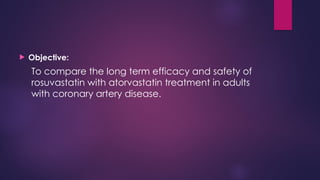
 Objective:
To compare the long term efficacy and safety of
rosuvastatin with atorvastatin treatment in adults
with coronary artery disease.
Study Design Overview
 Type:
 The LODESTAR trial, conducted at 12 centers in South
Korea is a Prospective, multicenter, randomized, open-
label trial using 2 x 2 factorial randomization.
 Population:
 4400 adults with confirmed coronary artery disease.
 Duration:
 Three years follow-up
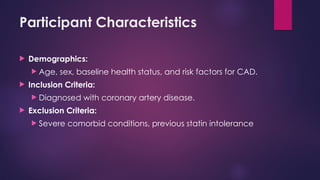
Participant Characteristics
 Demographics:
 Age, sex, baseline health status, and risk factors for CAD.
 Inclusion Criteria:
 Diagnosed with coronary artery disease.
 Exclusion Criteria:
 Severe comorbid conditions, previous statin intolerance
Randomization and Blinding
 Method:
 2x2 factorial randomization ensuring balanced groups.
 The factors were statin intensity strategy versus high intensity statin strategy)
and statin type (rosuvastatin versus atorvastatin)
Participants were randomly assigned to receive a statin using either a treat-to-
target strategy or a high intensity statin strategy; participants were also
randomly assigned to receive either rosuvastatin or atorvastatin
 Blinding:
 Open-label trial but outcomes adjudicated by a blinded committee
 The results of the analysis of the treat-to-target strategy using titrated intensity
statin treatment to reach a target LDL cholesterol level of 1.3-1.8 mmol/L versus
high intensity statin strategy without a target goal were recently reported
 The study focused on the adherence to assigned statin types (rosuvastatin or atorvastatin) and
the management of their intensity based on the 2013 ACC/AHA guidelines for dyslipidaemia.
Participants were either on a treat-to-target strategy or a high-intensity statin strategy, with
principles for titration or maintenance being identical for both groups.
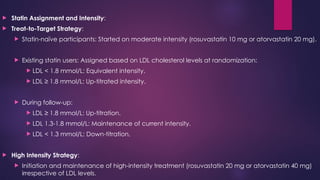
 Statin Assignment and Intensity:
 Treat-to-Target Strategy:
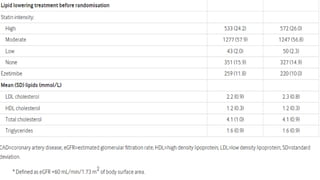
 Statin-naïve participants: Started on moderate intensity (rosuvastatin 10 mg or atorvastatin 20 mg).
 Existing statin users: Assigned based on LDL cholesterol levels at randomization:
 LDL < 1.8 mmol/L: Equivalent intensity.
 LDL ≥ 1.8 mmol/L: Up-titrated intensity.
 During follow-up:
 LDL ≥ 1.8 mmol/L: Up-titration.
 LDL 1.3-1.8 mmol/L: Maintenance of current intensity.
 LDL < 1.3 mmol/L: Down-titration.
 High Intensity Strategy:
 Initiation and maintenance of high-intensity treatment (rosuvastatin 20 mg or atorvastatin 40 mg)
irrespective of LDL levels.
•Medication Adherence:
•Non-statin agents like ezetimibe were discouraged to focus on statin treatment and
avoid confounding.
•Medication use tracked via doctors' prescription records and participants' self-reported
pill count.
•Other Medical Treatments:
•Guideline-directed treatments for risk factor modification (blood pressure, glucose
control, weight reduction, exercise, dietary changes, smoking cessation) were
encouraged
•Follow-up Visits:
•Scheduled at 6 weeks, and 3, 6, 12, 24, and 36 months to assess health status,
medication use, outcomes, and adverse events.
•Biochemical Monitoring:
•Lipid Profiles: Total cholesterol, LDL, HDL, and triglycerides at 6 weeks, 12, 24, and
36 months.
•Liver and Muscle Enzymes: Aspartate aminotransferase, alanine aminotransferase,
creatine kinase, and creatinine at the same intervals.
•Glucose Monitoring: Plasma glucose and HbA1c at 12, 24, and 36 months
Primary Outcomes
 Primary Outcome:
 Major Adverse Cardiac and Cerebrovascular Events (MACCE):
 Definition: Composite of all-cause death, myocardial infarction (MI), stroke, or any coronary
revascularization within three years.
 Cardiovascular Death: Includes death from MI, heart failure, stroke, cardiovascular
procedures or hemorrhage, sudden cardiac death, and cases where a cardiovascular
cause couldn't be excluded.
 Myocardial Infarction: Symptoms, ECG changes, imaging findings, along with elevated
creatine kinase myocardial band fraction or troponin levels.
 Stroke: Acute cerebrovascular event resulting in a neurological deficit >24 hours or
confirmed by imaging studies.
 Coronary Revascularization: Including percutaneous coronary intervention (PCI) and
coronary artery bypass graft surgery (CABG). Clinically indicated revascularization defined
by stenosis severity and symptoms/signs.
 Secondary Outcomes:
 New Onset Diabetes Mellitus:
 Definition: Fasting plasma glucose ≥7.0 mmol/L or new initiation of ant diabetics.
 Post hoc analysis included participants with HbA1c ≥6.5%.
 Hospital Admissions Due to Heart Failure
 Deep Vein Thrombosis or Pulmonary Thromboembolism
 Endovascular Revascularization for Peripheral Artery Disease
 Aortic Intervention or Surgery
 End Stage Kidney Disease
 Discontinuation of Study Drugs Due to Intolerance
 Cataract Surgery
 Composite of Laboratory Detected Abnormalities
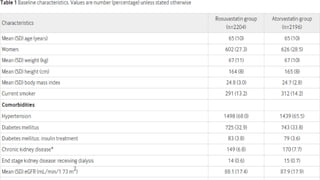
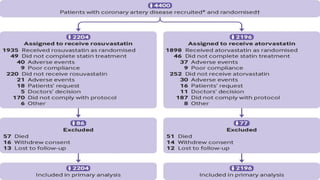
•Enrollment Period: September 2016 - November 2019
•Total Participants: 4400 adults with coronary artery disease
•Rosuvastatin Group: 2204 participants
•Atorvastatin Group: 2196 participants
•Baseline Characteristics:
•Mean age: 65 years (SD 10 years)
•Women: 27.9%
•Diabetes Mellitus: 33.4%
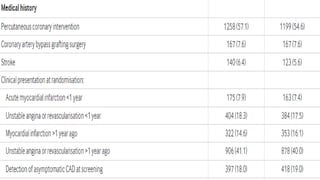
•Previous Percutaneous Coronary Intervention (PCI): 55.8%
•Initial diagnosis or coronary revascularization more than one year ago: 74.3%
 Adherence to Assigned Statin:
 Rosuvastatin Group:
 6 weeks: 93.9%
 3 months: 93.3%
 6 months: 93.4%
 1 year: 93.4%
 2 years: 92.0%
 3 years: 91.1%
 Atorvastatin Group:
 6 weeks: 93.8%
 3 months: 92.6%
 6 months: 92.5%
 1 year: 92.5%
 2 years: 91.3%
 3 years: 89.5%
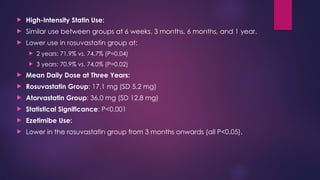
 High-Intensity Statin Use:
 Similar use between groups at 6 weeks, 3 months, 6 months, and 1 year.
 Lower use in rosuvastatin group at:
 2 years: 71.9% vs. 74.7% (P=0.04)
 3 years: 70.9% vs. 74.0% (P=0.02)
 Mean Daily Dose at Three Years:
 Rosuvastatin Group: 17.1 mg (SD 5.2 mg)
 Atorvastatin Group: 36.0 mg (SD 12.8 mg)
 Statistical Significance: P<0.001
 Ezetimibe Use:
 Lower in the rosuvastatin group from 3 months onwards (all P<0.05).
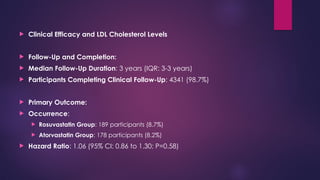
 Clinical Efficacy and LDL Cholesterol Levels
 Follow-Up and Completion:
 Median Follow-Up Duration: 3 years (IQR: 3-3 years)
 Participants Completing Clinical Follow-Up: 4341 (98.7%)
 Primary Outcome:
 Occurrence:
 Rosuvastatin Group: 189 participants (8.7%)
 Atorvastatin Group: 178 participants (8.2%)
 Hazard Ratio: 1.06 (95% CI: 0.86 to 1.30; P=0.58)
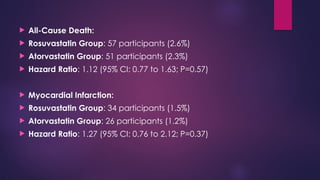
 All-Cause Death:
 Rosuvastatin Group: 57 participants (2.6%)
 Atorvastatin Group: 51 participants (2.3%)
 Hazard Ratio: 1.12 (95% CI: 0.77 to 1.63; P=0.57)
 Myocardial Infarction:
 Rosuvastatin Group: 34 participants (1.5%)
 Atorvastatin Group: 26 participants (1.2%)
 Hazard Ratio: 1.27 (95% CI: 0.76 to 2.12; P=0.37)
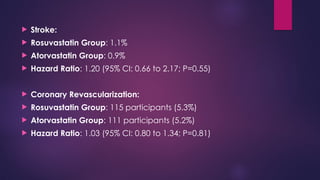
 Stroke:
 Rosuvastatin Group: 1.1%
 Atorvastatin Group: 0.9%
 Hazard Ratio: 1.20 (95% CI: 0.66 to 2.17; P=0.55)
 Coronary Revascularization:
 Rosuvastatin Group: 115 participants (5.3%)
 Atorvastatin Group: 111 participants (5.2%)
 Hazard Ratio: 1.03 (95% CI: 0.80 to 1.34; P=0.81)
 Summary
 Over a median follow-up of three years, there was no
significant difference in the primary outcome (major
adverse cardiac and cerebrovascular events) between the
rosuvastatin and atorvastatin groups. All-cause death,
myocardial infarction, stroke, and coronary
revascularization rates were similar between the two groups
New Onset Diabetes Mellitus
Incidence
 Findings:
 Rosuvastatin: 7.1%
 Atorvastatin: 5.5%
 Hazard Ratio:
 1.29 (95% CI 1.01 to 1.63, P=0.04)
 Implications:
 Potential increased risk of diabetes with rosuvastatin.
Diabetes Requiring Antidiabetics
 Incidence:
 Rosuvastatin: 7.2%
 Atorvastatin: 5.3%
 Hazard Ratio:
 1.39 (95% CI 1.03 to 1.87, P=0.03)
Cataract Surgery Incidence
• Findings:
• Rosuvastatin: 2.5%
• Atorvastatin: 1.5%
• Hazard Ratio:
• 1.66 (95% CI 1.07 to 2.58, P=0.02)
• Implications:
• Potential increased risk of cataract surgery with
rosuvastatin.
Secondary Outcomes Summary
• Other Outcomes:
• No significant differences observed in other
secondary outcomes between the two groups.
Subgroup Analysis
• Findings:
• Consistent primary outcome results across all
subgroups.
• Interaction:
• No significant interaction between statin type and
intensity strategy for the primary outcome.
New Onset Diabetes Mellitus as
Time-Dependent Variable
 Analysis:
 Not associated with increased risk of the primary
outcome.
 Hazard Ratio:
 1.16 (95% CI 0.51 to 2.64, P=0.73)
 Interaction:
 No significant interaction between statin type and new
onset diabetes mellitus for the primary outcome (P=0.08)
Safety Concerns - Diabetes
• Higher Incidence:
• Observed in the rosuvastatin group.
• Potential Mechanisms:
• Genetic factors and greater inhibition of HMG-CoA
reductase activity.
Safety Concerns - Cataract Surgery
 Higher Incidence:
 Observed in the rosuvastatin group.
 Potential Mechanisms:
 Effect on lens development due to more substantial LDL
cholesterol reduction.
Practical Applications
• Comparable Efficacy:
• Both statins effectively reduced LDL cholesterol.
• Similar primary outcomes between the groups.
Discussion :
•Risks:
•Rosuvastatin Risks:
•Higher incidence of new onset diabetes and cataract
surgery.
•Clinical Implications:
•Importance of monitoring and lifestyle interventions.
Implications for Clinical Practice
• Statin Choice:
• Importance of selecting appropriate statin type and
intensity based on patient profile.
• Monitoring:
• Regular monitoring for side effects such as new onset
diabetes and cataracts.
Previous Studies - SATURN Trial
 Overview:
 Compared rosuvastatin 40 mg and atorvastatin 80 mg in
CAD patients.
 Findings:
 No difference in atheroma volume change or composite
cardiovascular outcomes.
 Comparison with Current Study:
 Larger sample size and longer follow-up in the LODESTAR
trial.
Limitations of This Study
 Sample Size Estimation:
 Not based on statin type differences.
 Open-Label Design:
 Potential for bias despite blinded outcome
adjudication.
Additional Limitations
 Event Numbers:
 Small for individual components of the primary outcome.
 Initial Diabetes Definition:
 Did not include HbA1c levels, adjusted in post hoc
analysis.
 Ophthalmological Examinations:
 Not specified in protocol, potential underreporting of
cataracts.
Further Limitations
 Population:
 Study included only Asian participants, limiting
generalizability.
 Study Duration:
 Three years, potentially short for long-term effects
assessment.
Recommendations for Future
Research
 Further Studies:
Needed for long-term effects and underlying
mechanisms of statin treatment.
 Clinical Monitoring:
Emphasize the importance of regular monitoring
for adverse effects like diabetes and cataracts.
Conclusions
 Efficacy:
 Comparable for primary outcomes between rosuvastatin and atorvastatin.
 LDL Cholesterol:
 Lower levels achieved with rosuvastatin.
 Safety:
 Higher risk of new onset diabetes and cataract surgery with rosuvastatin.
Practical Applications
 Patient Care:
 Tailor statin choice to individual patient needs and risk
profiles.

 Future Research:
 Investigate underlying mechanisms and long-term safety
of different statins.
Thank you
Any Questions ?

Statins..................................

  • 1.
    Background on Statins Statins Overview:  Drugs that lower cholesterol levels by inhibiting HMG-CoA reductase.  Widely used to prevent cardiovascular diseases.  Types of Statins:  Examples include simvastatin, pravastatin, rosuvastatin, and atorvastatin.
  • 2.
    Importance of StatinUse in CAD  Coronary Artery Disease (CAD):  Leading cause of morbidity and mortality worldwide.  Statins reduce the risk of heart attacks and strokes in CAD patients.
  • 3.
     Side effectscan vary between different statins, but common side effects include:  Headache, dizziness, feeling sick, feeling unusually tired or physically weak, digestive system problems, such as constipation, diarrhoea, indigestion or farting, muscle pain, sleep problems, low blood platelet count  Uncommon side effects  Uncommon side effects of statins include: being sick, memory problems, hair loss, pins and needles, inflammation of the liver (hepatitis), which can cause flu-like symptoms, inflammation of the pancreas (pancreatitis), which can cause stomach pain, skin problems, such as acne or an itchy red rash, sexual problems, such as loss of libido (reduced sex drive) or erectile dysfunction  Rare side effects, Rare side effects of statins include: muscle weakness (myopathy), loss of sensation or tingling in the nerve endings of the hands and feet (peripheral neuropathy)  tendon problems (tendons are tough cords of tissue that connect muscles to bones)  Muscle effects  It's rare, but statins can sometimes cause muscle inflammation (swelling) and damage.
  • 4.
    Comparison of Rosuvastatinand Atorvastatin in Coronary Artery Disease: A Three-Year Randomized Trial • Secondary Analysis of the LODESTAR (Low-Density Lipoprotein Cholesterol-Targeting Statin Therapy Versus Intensity-Based Statin Therapy in Patients With Coronary Artery Disease )Trial
  • 5.
     Objective: To comparethe long term efficacy and safety of rosuvastatin with atorvastatin treatment in adults with coronary artery disease.
  • 6.
    Study Design Overview Type:  The LODESTAR trial, conducted at 12 centers in South Korea is a Prospective, multicenter, randomized, open- label trial using 2 x 2 factorial randomization.  Population:  4400 adults with confirmed coronary artery disease.  Duration:  Three years follow-up
  • 7.
    Participant Characteristics  Demographics: Age, sex, baseline health status, and risk factors for CAD.  Inclusion Criteria:  Diagnosed with coronary artery disease.  Exclusion Criteria:  Severe comorbid conditions, previous statin intolerance
  • 11.
    Randomization and Blinding Method:  2x2 factorial randomization ensuring balanced groups.  The factors were statin intensity strategy versus high intensity statin strategy) and statin type (rosuvastatin versus atorvastatin) Participants were randomly assigned to receive a statin using either a treat-to- target strategy or a high intensity statin strategy; participants were also randomly assigned to receive either rosuvastatin or atorvastatin  Blinding:  Open-label trial but outcomes adjudicated by a blinded committee
  • 12.
     The resultsof the analysis of the treat-to-target strategy using titrated intensity statin treatment to reach a target LDL cholesterol level of 1.3-1.8 mmol/L versus high intensity statin strategy without a target goal were recently reported
  • 13.
     The studyfocused on the adherence to assigned statin types (rosuvastatin or atorvastatin) and the management of their intensity based on the 2013 ACC/AHA guidelines for dyslipidaemia. Participants were either on a treat-to-target strategy or a high-intensity statin strategy, with principles for titration or maintenance being identical for both groups.
  • 14.
     Statin Assignmentand Intensity:  Treat-to-Target Strategy:  Statin-naïve participants: Started on moderate intensity (rosuvastatin 10 mg or atorvastatin 20 mg).  Existing statin users: Assigned based on LDL cholesterol levels at randomization:  LDL < 1.8 mmol/L: Equivalent intensity.  LDL ≥ 1.8 mmol/L: Up-titrated intensity.  During follow-up:  LDL ≥ 1.8 mmol/L: Up-titration.  LDL 1.3-1.8 mmol/L: Maintenance of current intensity.  LDL < 1.3 mmol/L: Down-titration.  High Intensity Strategy:  Initiation and maintenance of high-intensity treatment (rosuvastatin 20 mg or atorvastatin 40 mg) irrespective of LDL levels.
  • 15.
    •Medication Adherence: •Non-statin agentslike ezetimibe were discouraged to focus on statin treatment and avoid confounding. •Medication use tracked via doctors' prescription records and participants' self-reported pill count. •Other Medical Treatments: •Guideline-directed treatments for risk factor modification (blood pressure, glucose control, weight reduction, exercise, dietary changes, smoking cessation) were encouraged
  • 16.
    •Follow-up Visits: •Scheduled at6 weeks, and 3, 6, 12, 24, and 36 months to assess health status, medication use, outcomes, and adverse events. •Biochemical Monitoring: •Lipid Profiles: Total cholesterol, LDL, HDL, and triglycerides at 6 weeks, 12, 24, and 36 months. •Liver and Muscle Enzymes: Aspartate aminotransferase, alanine aminotransferase, creatine kinase, and creatinine at the same intervals. •Glucose Monitoring: Plasma glucose and HbA1c at 12, 24, and 36 months
  • 17.
    Primary Outcomes  PrimaryOutcome:  Major Adverse Cardiac and Cerebrovascular Events (MACCE):  Definition: Composite of all-cause death, myocardial infarction (MI), stroke, or any coronary revascularization within three years.  Cardiovascular Death: Includes death from MI, heart failure, stroke, cardiovascular procedures or hemorrhage, sudden cardiac death, and cases where a cardiovascular cause couldn't be excluded.  Myocardial Infarction: Symptoms, ECG changes, imaging findings, along with elevated creatine kinase myocardial band fraction or troponin levels.  Stroke: Acute cerebrovascular event resulting in a neurological deficit >24 hours or confirmed by imaging studies.  Coronary Revascularization: Including percutaneous coronary intervention (PCI) and coronary artery bypass graft surgery (CABG). Clinically indicated revascularization defined by stenosis severity and symptoms/signs.
  • 18.
     Secondary Outcomes: New Onset Diabetes Mellitus:  Definition: Fasting plasma glucose ≥7.0 mmol/L or new initiation of ant diabetics.  Post hoc analysis included participants with HbA1c ≥6.5%.  Hospital Admissions Due to Heart Failure  Deep Vein Thrombosis or Pulmonary Thromboembolism  Endovascular Revascularization for Peripheral Artery Disease  Aortic Intervention or Surgery  End Stage Kidney Disease  Discontinuation of Study Drugs Due to Intolerance  Cataract Surgery  Composite of Laboratory Detected Abnormalities
  • 20.
    •Enrollment Period: September2016 - November 2019 •Total Participants: 4400 adults with coronary artery disease •Rosuvastatin Group: 2204 participants •Atorvastatin Group: 2196 participants •Baseline Characteristics: •Mean age: 65 years (SD 10 years) •Women: 27.9% •Diabetes Mellitus: 33.4% •Previous Percutaneous Coronary Intervention (PCI): 55.8% •Initial diagnosis or coronary revascularization more than one year ago: 74.3%
  • 21.
     Adherence toAssigned Statin:  Rosuvastatin Group:  6 weeks: 93.9%  3 months: 93.3%  6 months: 93.4%  1 year: 93.4%  2 years: 92.0%  3 years: 91.1%  Atorvastatin Group:  6 weeks: 93.8%  3 months: 92.6%  6 months: 92.5%  1 year: 92.5%  2 years: 91.3%  3 years: 89.5%
  • 22.
     High-Intensity StatinUse:  Similar use between groups at 6 weeks, 3 months, 6 months, and 1 year.  Lower use in rosuvastatin group at:  2 years: 71.9% vs. 74.7% (P=0.04)  3 years: 70.9% vs. 74.0% (P=0.02)  Mean Daily Dose at Three Years:  Rosuvastatin Group: 17.1 mg (SD 5.2 mg)  Atorvastatin Group: 36.0 mg (SD 12.8 mg)  Statistical Significance: P<0.001  Ezetimibe Use:  Lower in the rosuvastatin group from 3 months onwards (all P<0.05).
  • 23.
     Clinical Efficacyand LDL Cholesterol Levels  Follow-Up and Completion:  Median Follow-Up Duration: 3 years (IQR: 3-3 years)  Participants Completing Clinical Follow-Up: 4341 (98.7%)  Primary Outcome:  Occurrence:  Rosuvastatin Group: 189 participants (8.7%)  Atorvastatin Group: 178 participants (8.2%)  Hazard Ratio: 1.06 (95% CI: 0.86 to 1.30; P=0.58)
  • 24.
     All-Cause Death: Rosuvastatin Group: 57 participants (2.6%)  Atorvastatin Group: 51 participants (2.3%)  Hazard Ratio: 1.12 (95% CI: 0.77 to 1.63; P=0.57)  Myocardial Infarction:  Rosuvastatin Group: 34 participants (1.5%)  Atorvastatin Group: 26 participants (1.2%)  Hazard Ratio: 1.27 (95% CI: 0.76 to 2.12; P=0.37)
  • 25.
     Stroke:  RosuvastatinGroup: 1.1%  Atorvastatin Group: 0.9%  Hazard Ratio: 1.20 (95% CI: 0.66 to 2.17; P=0.55)  Coronary Revascularization:  Rosuvastatin Group: 115 participants (5.3%)  Atorvastatin Group: 111 participants (5.2%)  Hazard Ratio: 1.03 (95% CI: 0.80 to 1.34; P=0.81)
  • 26.
     Summary  Overa median follow-up of three years, there was no significant difference in the primary outcome (major adverse cardiac and cerebrovascular events) between the rosuvastatin and atorvastatin groups. All-cause death, myocardial infarction, stroke, and coronary revascularization rates were similar between the two groups
  • 27.
    New Onset DiabetesMellitus Incidence  Findings:  Rosuvastatin: 7.1%  Atorvastatin: 5.5%  Hazard Ratio:  1.29 (95% CI 1.01 to 1.63, P=0.04)  Implications:  Potential increased risk of diabetes with rosuvastatin.
  • 28.
    Diabetes Requiring Antidiabetics Incidence:  Rosuvastatin: 7.2%  Atorvastatin: 5.3%  Hazard Ratio:  1.39 (95% CI 1.03 to 1.87, P=0.03)
  • 29.
    Cataract Surgery Incidence •Findings: • Rosuvastatin: 2.5% • Atorvastatin: 1.5% • Hazard Ratio: • 1.66 (95% CI 1.07 to 2.58, P=0.02) • Implications: • Potential increased risk of cataract surgery with rosuvastatin.
  • 30.
    Secondary Outcomes Summary •Other Outcomes: • No significant differences observed in other secondary outcomes between the two groups.
  • 31.
    Subgroup Analysis • Findings: •Consistent primary outcome results across all subgroups. • Interaction: • No significant interaction between statin type and intensity strategy for the primary outcome.
  • 32.
    New Onset DiabetesMellitus as Time-Dependent Variable  Analysis:  Not associated with increased risk of the primary outcome.  Hazard Ratio:  1.16 (95% CI 0.51 to 2.64, P=0.73)  Interaction:  No significant interaction between statin type and new onset diabetes mellitus for the primary outcome (P=0.08)
  • 33.
    Safety Concerns -Diabetes • Higher Incidence: • Observed in the rosuvastatin group. • Potential Mechanisms: • Genetic factors and greater inhibition of HMG-CoA reductase activity.
  • 34.
    Safety Concerns -Cataract Surgery  Higher Incidence:  Observed in the rosuvastatin group.  Potential Mechanisms:  Effect on lens development due to more substantial LDL cholesterol reduction.
  • 35.
    Practical Applications • ComparableEfficacy: • Both statins effectively reduced LDL cholesterol. • Similar primary outcomes between the groups.
  • 36.
    Discussion : •Risks: •Rosuvastatin Risks: •Higherincidence of new onset diabetes and cataract surgery. •Clinical Implications: •Importance of monitoring and lifestyle interventions.
  • 37.
    Implications for ClinicalPractice • Statin Choice: • Importance of selecting appropriate statin type and intensity based on patient profile. • Monitoring: • Regular monitoring for side effects such as new onset diabetes and cataracts.
  • 38.
    Previous Studies -SATURN Trial  Overview:  Compared rosuvastatin 40 mg and atorvastatin 80 mg in CAD patients.  Findings:  No difference in atheroma volume change or composite cardiovascular outcomes.  Comparison with Current Study:  Larger sample size and longer follow-up in the LODESTAR trial.
  • 39.
    Limitations of ThisStudy  Sample Size Estimation:  Not based on statin type differences.  Open-Label Design:  Potential for bias despite blinded outcome adjudication.
  • 40.
    Additional Limitations  EventNumbers:  Small for individual components of the primary outcome.  Initial Diabetes Definition:  Did not include HbA1c levels, adjusted in post hoc analysis.  Ophthalmological Examinations:  Not specified in protocol, potential underreporting of cataracts.
  • 41.
    Further Limitations  Population: Study included only Asian participants, limiting generalizability.  Study Duration:  Three years, potentially short for long-term effects assessment.
  • 42.
    Recommendations for Future Research Further Studies: Needed for long-term effects and underlying mechanisms of statin treatment.  Clinical Monitoring: Emphasize the importance of regular monitoring for adverse effects like diabetes and cataracts.
  • 43.
    Conclusions  Efficacy:  Comparablefor primary outcomes between rosuvastatin and atorvastatin.  LDL Cholesterol:  Lower levels achieved with rosuvastatin.  Safety:  Higher risk of new onset diabetes and cataract surgery with rosuvastatin.
  • 44.
    Practical Applications  PatientCare:  Tailor statin choice to individual patient needs and risk profiles.  Future Research:  Investigate underlying mechanisms and long-term safety of different statins.
  • 45.