

How Low To Go With
LDL?
Dr. Nagula Praveen MD,DM
Assistant Professor of Cardiology
Osmania General Hospital, Hyderabad.
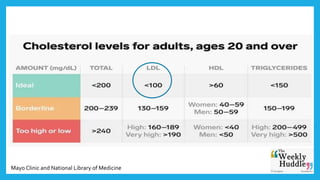
Mayo Clinic and National Library of Medicine
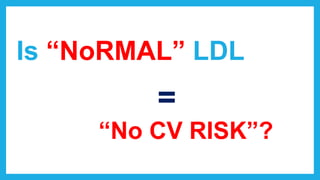
Is “NoRMAL” LDL
“No CV RISK”?
=
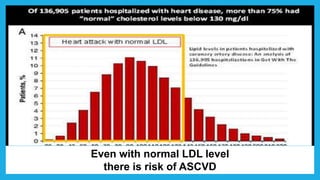
Even with normal LDL level
there is risk of ASCVD
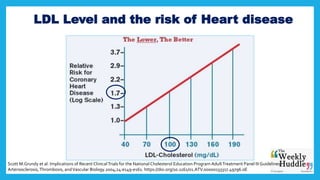
LDL Level and the risk of Heart disease
Scott M.Grundy et al. Implications of Recent ClinicalTrials for the National Cholesterol Education Program AdultTreatment Panel III Guidelines.
Arteriosclerosis, Thrombosis, andVascular Biology.2004;24:e149-e161. https://doi.org/10.1161/01.ATV.00000133317.49796.0E
What do the Guidelines
say?
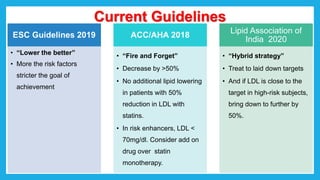
Current Guidelines
ESC Guidelines 2019
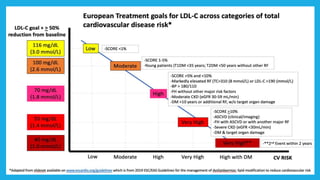
• “Lower the better”
• More the risk factors
stricter the goal of
achievement
ACC/AHA 2018
• “Fire and Forget”
• Decrease by >50%
• No additional lipid lowering
in patients with 50%
reduction in LDL with
statins.
• In risk enhancers, LDL <
70mg/dl. Consider add on
drug over statin
monotherapy.
Lipid Association of
India 2020
• “Hybrid strategy”
• Treat to laid down targets
• And if LDL is close to the
target in high-risk subjects,
bring down to further by
50%.
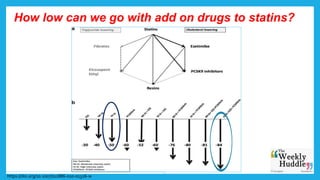
How low can we go with add on drugs to statins?
https://doi.org/10.1007/s11886-020-01326-w
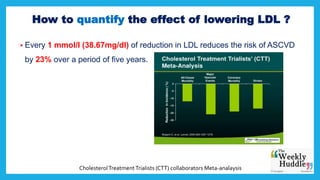
How to quantify the effect of lowering LDL ?
 Every 1 mmol/l (38.67mg/dl) of reduction in LDL reduces the risk of ASCVD
by 23% over a period of five years.
CholesterolTreatmentTrialists (CTT) collaborators Meta-analaysis
What to be considered for LDL
lowering therapy?
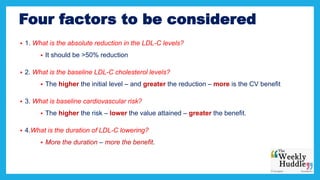
Four factors to be considered
 1. What is the absolute reduction in the LDL-C levels?
 It should be >50% reduction
 2. What is the baseline LDL-C cholesterol levels?
 The higher the initial level – and greater the reduction – more is the CV benefit
 3. What is baseline cardiovascular risk?
 The higher the risk – lower the value attained – greater the benefit.
 4.What is the duration of LDL-C lowering?
 More the duration – more the benefit.
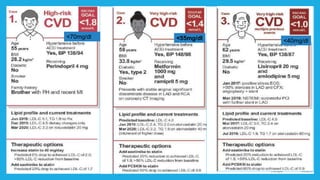
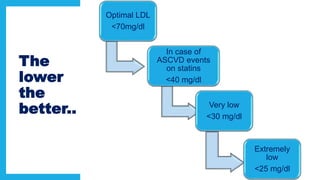
<70mg/dl <55mg/dl <40mg/dl
The
lower
the
better..
Optimal LDL
<70mg/dl
In case of
ASCVD events
on statins
<40 mg/dl
Very low
<30 mg/dl
Extremely
low
<25 mg/dl
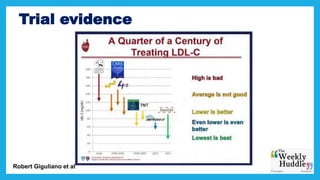
Trial evidence
Robert Giguliano et al
Possible Risks Of
Extremely Low LDL
Levels
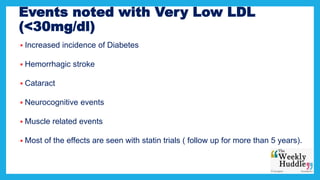
Events noted with Very Low LDL
(<30mg/dl)
 Increased incidence of Diabetes
 Hemorrhagic stroke
 Cataract
 Neurocognitive events
 Muscle related events
 Most of the effects are seen with statin trials ( follow up for more than 5 years).
Are they because of a very low LDL level
or
Because of Intensive dose of Statins?
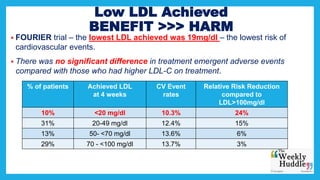
Low LDL Achieved
BENEFIT >>> HARM
 FOURIER trial – the lowest LDL achieved was 19mg/dl – the lowest risk of
cardiovascular events.
 There was no significant difference in treatment emergent adverse events
compared with those who had higher LDL-C on treatment.
% of patients Achieved LDL
at 4 weeks
CV Event
rates
Relative Risk Reduction
compared to
LDL>100mg/dl
10% <20 mg/dl 10.3% 24%
31% 20-49 mg/dl 12.4% 15%
13% 50- <70 mg/dl 13.6% 6%
29% 70 - <100 mg/dl 13.7% 3%
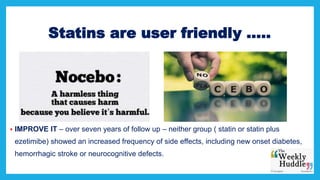
Statins are user friendly …..
 IMPROVE IT – over seven years of follow up – neither group ( statin or statin plus
ezetimibe) showed an increased frequency of side effects, including new onset diabetes,
hemorrhagic stroke or neurocognitive defects.
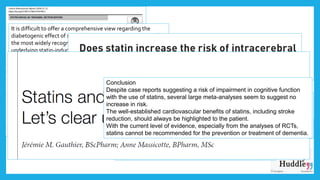
It is difficult to offer a comprehensive view regarding the
diabetogenic effect of statins because our understanding of
the most widely recognized potential mechanisms, i.e.
underlying statin-induced reduction of insulin sensitivity
and/or insulin secretion, is still far from complete.
Although statin therapy is associated with a modest increase
in the risk of NOD (about one per thousand patient-years),
patients should be reassured that the benefits of statins in
preventing cardiovascular disease (CVD) events far outweigh
the potential risk from elevation in plasma glucose.
Statin therapy in poststroke patients increased the risk of hemorrhagic stroke
but effectively reduced ischemic stroke risk.Weighing the benefits and potential
harms, statin has an overall beneficial effect in patients with previous stroke orTIA.
However, more studies are required to investigate the conclusiveness of the increased
hemorrhagic stroke risk revealed in our study.
Based on the present meta-analysis of these studies, we could
only conclude that there is no clear evidence showing that
statin use increases the risk of cataracts.The most likely case is
that there is no association between statin use and cataracts.
Because of the considerable benefits of statins in
cardiovascular patients, this issue should not deter their use.
Conclusion
Despite case reports suggesting a risk of impairment in cognitive function
with the use of statins, several large meta-analyses seem to suggest no
increase in risk.
The well-established cardiovascular benefits of statins, including stroke
reduction, should always be highlighted to the patient.
With the current level of evidence, especially from the analyses of RCTs,
statins cannot be recommended for the prevention or treatment of dementia.
Do we
have the
final
answer?
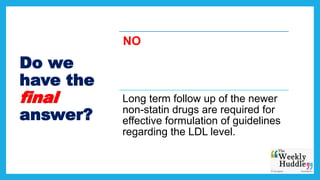
NO
Long term follow up of the newer
non-statin drugs are required for
effective formulation of guidelines
regarding the LDL level.
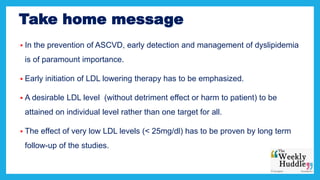
Take home message
 In the prevention of ASCVD, early detection and management of dyslipidemia
is of paramount importance.
 Early initiation of LDL lowering therapy has to be emphasized.
 A desirable LDL level (without detriment effect or harm to patient) to be
attained on individual level rather than one target for all.
 The effect of very low LDL levels (< 25mg/dl) has to be proven by long term
follow-up of the studies.
how low to go with LDL

how low to go with LDL

  • 1.
    How Low ToGo With LDL? Dr. Nagula Praveen MD,DM Assistant Professor of Cardiology Osmania General Hospital, Hyderabad.
  • 2.
    Mayo Clinic andNational Library of Medicine
  • 3.
  • 4.
    Even with normalLDL level there is risk of ASCVD
  • 5.
    LDL Level andthe risk of Heart disease Scott M.Grundy et al. Implications of Recent ClinicalTrials for the National Cholesterol Education Program AdultTreatment Panel III Guidelines. Arteriosclerosis, Thrombosis, andVascular Biology.2004;24:e149-e161. https://doi.org/10.1161/01.ATV.00000133317.49796.0E
  • 6.
    What do theGuidelines say?
  • 7.
    Current Guidelines ESC Guidelines2019 • “Lower the better” • More the risk factors stricter the goal of achievement ACC/AHA 2018 • “Fire and Forget” • Decrease by >50% • No additional lipid lowering in patients with 50% reduction in LDL with statins. • In risk enhancers, LDL < 70mg/dl. Consider add on drug over statin monotherapy. Lipid Association of India 2020 • “Hybrid strategy” • Treat to laid down targets • And if LDL is close to the target in high-risk subjects, bring down to further by 50%.
  • 8.
    How low canwe go with add on drugs to statins? https://doi.org/10.1007/s11886-020-01326-w
  • 9.
    How to quantifythe effect of lowering LDL ?  Every 1 mmol/l (38.67mg/dl) of reduction in LDL reduces the risk of ASCVD by 23% over a period of five years. CholesterolTreatmentTrialists (CTT) collaborators Meta-analaysis
  • 10.
    What to beconsidered for LDL lowering therapy?
  • 11.
    Four factors tobe considered  1. What is the absolute reduction in the LDL-C levels?  It should be >50% reduction  2. What is the baseline LDL-C cholesterol levels?  The higher the initial level – and greater the reduction – more is the CV benefit  3. What is baseline cardiovascular risk?  The higher the risk – lower the value attained – greater the benefit.  4.What is the duration of LDL-C lowering?  More the duration – more the benefit.
  • 13.
  • 14.
    The lower the better.. Optimal LDL <70mg/dl In caseof ASCVD events on statins <40 mg/dl Very low <30 mg/dl Extremely low <25 mg/dl
  • 15.
  • 16.
  • 17.
    Events noted withVery Low LDL (<30mg/dl)  Increased incidence of Diabetes  Hemorrhagic stroke  Cataract  Neurocognitive events  Muscle related events  Most of the effects are seen with statin trials ( follow up for more than 5 years).
  • 18.
    Are they becauseof a very low LDL level or Because of Intensive dose of Statins?
  • 19.
    Low LDL Achieved BENEFIT>>> HARM  FOURIER trial – the lowest LDL achieved was 19mg/dl – the lowest risk of cardiovascular events.  There was no significant difference in treatment emergent adverse events compared with those who had higher LDL-C on treatment. % of patients Achieved LDL at 4 weeks CV Event rates Relative Risk Reduction compared to LDL>100mg/dl 10% <20 mg/dl 10.3% 24% 31% 20-49 mg/dl 12.4% 15% 13% 50- <70 mg/dl 13.6% 6% 29% 70 - <100 mg/dl 13.7% 3%
  • 20.
    Statins are userfriendly …..  IMPROVE IT – over seven years of follow up – neither group ( statin or statin plus ezetimibe) showed an increased frequency of side effects, including new onset diabetes, hemorrhagic stroke or neurocognitive defects.
  • 21.
    It is difficultto offer a comprehensive view regarding the diabetogenic effect of statins because our understanding of the most widely recognized potential mechanisms, i.e. underlying statin-induced reduction of insulin sensitivity and/or insulin secretion, is still far from complete. Although statin therapy is associated with a modest increase in the risk of NOD (about one per thousand patient-years), patients should be reassured that the benefits of statins in preventing cardiovascular disease (CVD) events far outweigh the potential risk from elevation in plasma glucose. Statin therapy in poststroke patients increased the risk of hemorrhagic stroke but effectively reduced ischemic stroke risk.Weighing the benefits and potential harms, statin has an overall beneficial effect in patients with previous stroke orTIA. However, more studies are required to investigate the conclusiveness of the increased hemorrhagic stroke risk revealed in our study. Based on the present meta-analysis of these studies, we could only conclude that there is no clear evidence showing that statin use increases the risk of cataracts.The most likely case is that there is no association between statin use and cataracts. Because of the considerable benefits of statins in cardiovascular patients, this issue should not deter their use. Conclusion Despite case reports suggesting a risk of impairment in cognitive function with the use of statins, several large meta-analyses seem to suggest no increase in risk. The well-established cardiovascular benefits of statins, including stroke reduction, should always be highlighted to the patient. With the current level of evidence, especially from the analyses of RCTs, statins cannot be recommended for the prevention or treatment of dementia.
  • 22.
    Do we have the final answer? NO Longterm follow up of the newer non-statin drugs are required for effective formulation of guidelines regarding the LDL level.
  • 23.
    Take home message In the prevention of ASCVD, early detection and management of dyslipidemia is of paramount importance.  Early initiation of LDL lowering therapy has to be emphasized.  A desirable LDL level (without detriment effect or harm to patient) to be attained on individual level rather than one target for all.  The effect of very low LDL levels (< 25mg/dl) has to be proven by long term follow-up of the studies.