BALANCING
By: E/C Sapid, Mark Gil
topics
Dynamic
balance
  (two
masses in
a plane)
Static Balance
          The condition which exists in a body which has an
 absolutely even distribution of the weight mass around the
 axis of rotation

          This occurs when when there is no resultant
 centrifugal force and the center of gravity is on the axis of
 rotation.
Two masses
    Static
   balance
(two masses
 in a plane)   Static Balance
                   in a plane
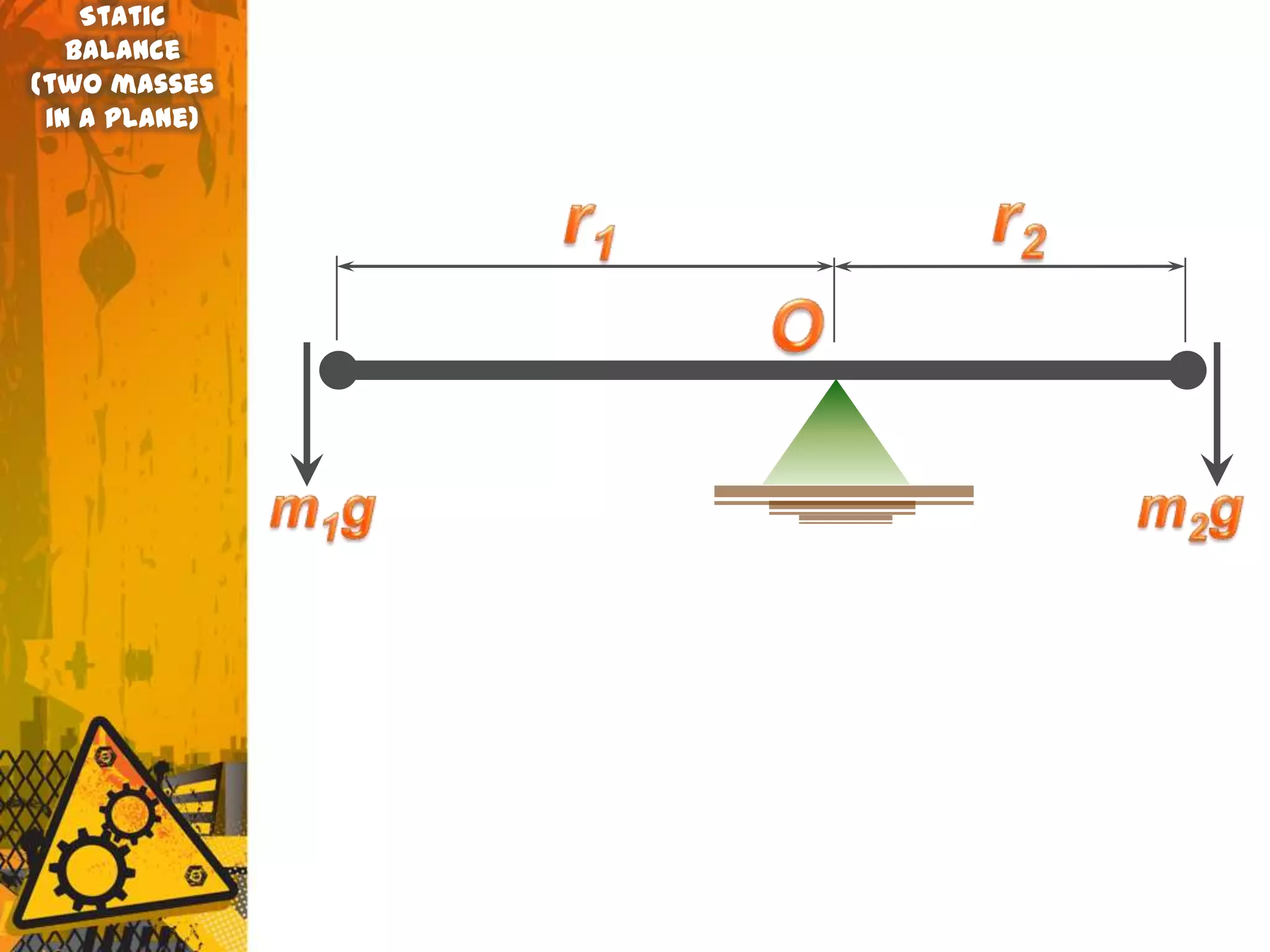
               Consider a light arm pivoted freely at the fulcrum O and
               carrying masses m1, m2 at distances r1, r2 from O
               respectively. In general the arm will rotate about O and the
               system is said to be out of balance. For equilibrium there
               must be balance of moments about O. i.e.

                                    m1g x r1 = m2g x r2
                                            or
                                       m1r1 = m2r2

               When in balance the arm may be set in any position and will
               remain at rest in that position. The weights are said to be in
               static balance and the center of gravity of the system is
               located at O.
Static
   balance
(two masses
 in a plane)
Dynamic Balance
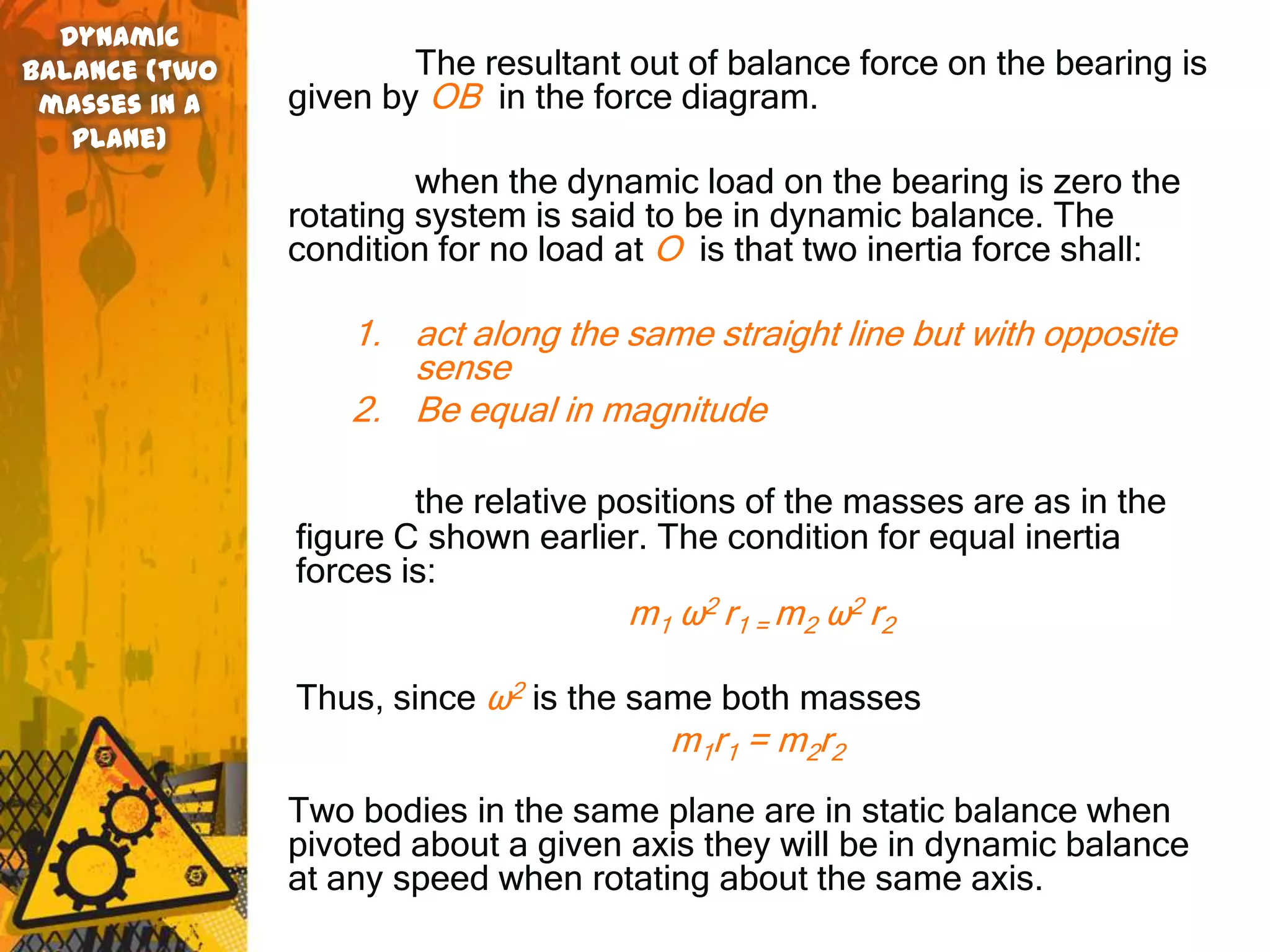
           The condition which exists in a rotating body when
 the axis about which it is forced to rotate, or to which
 reference is made, is parallel with a principal axis of inertia;
 no products of inertia about the center of gravity of the body
 exist in relation to the selected rotational axis.

         This occurs when there is no resulting moment
 along the axis.
Dynamic
balance (two
 masses in a
                    Two masses
               Dynamic Balance
                            in a plane
   plane)

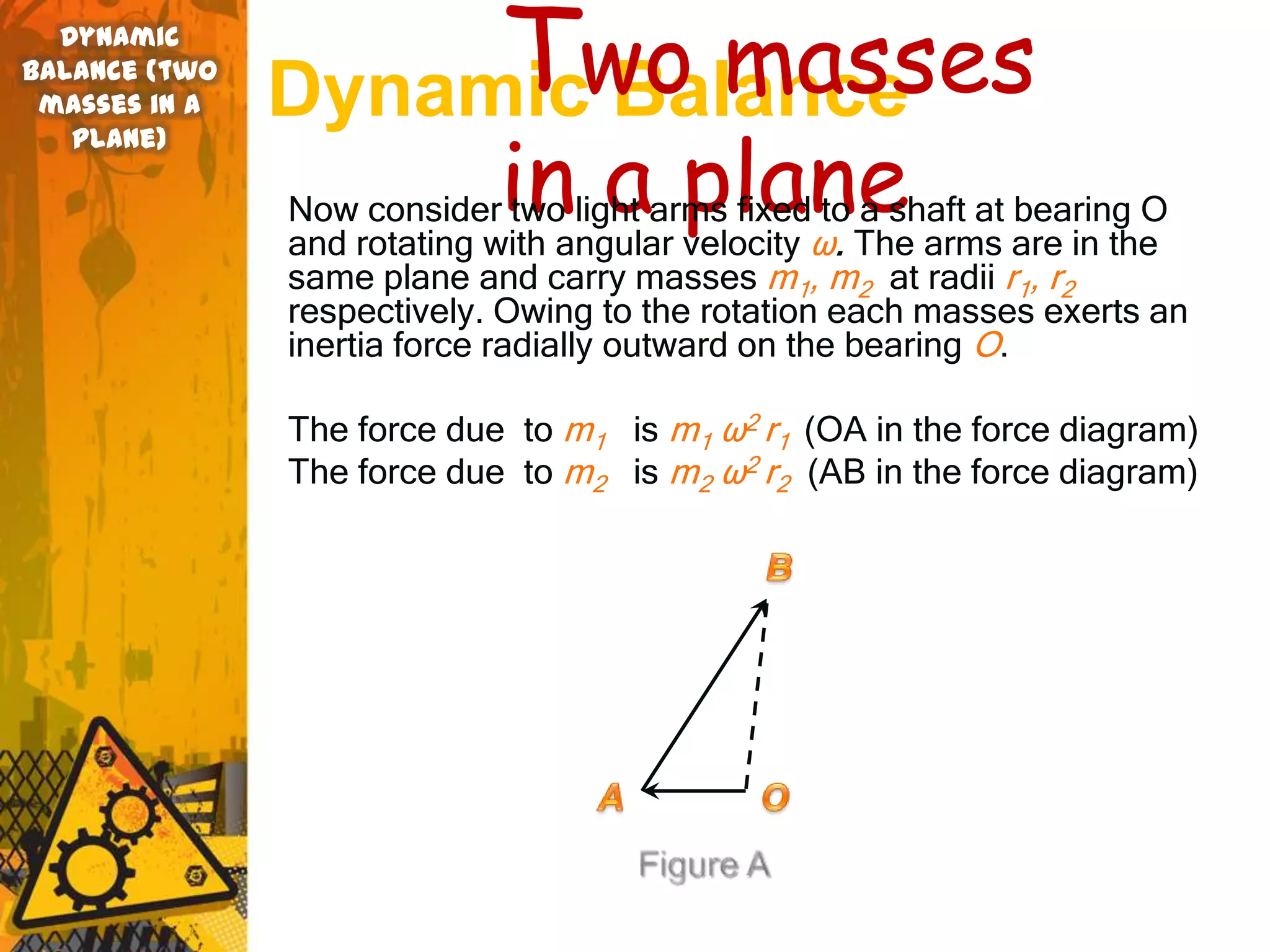
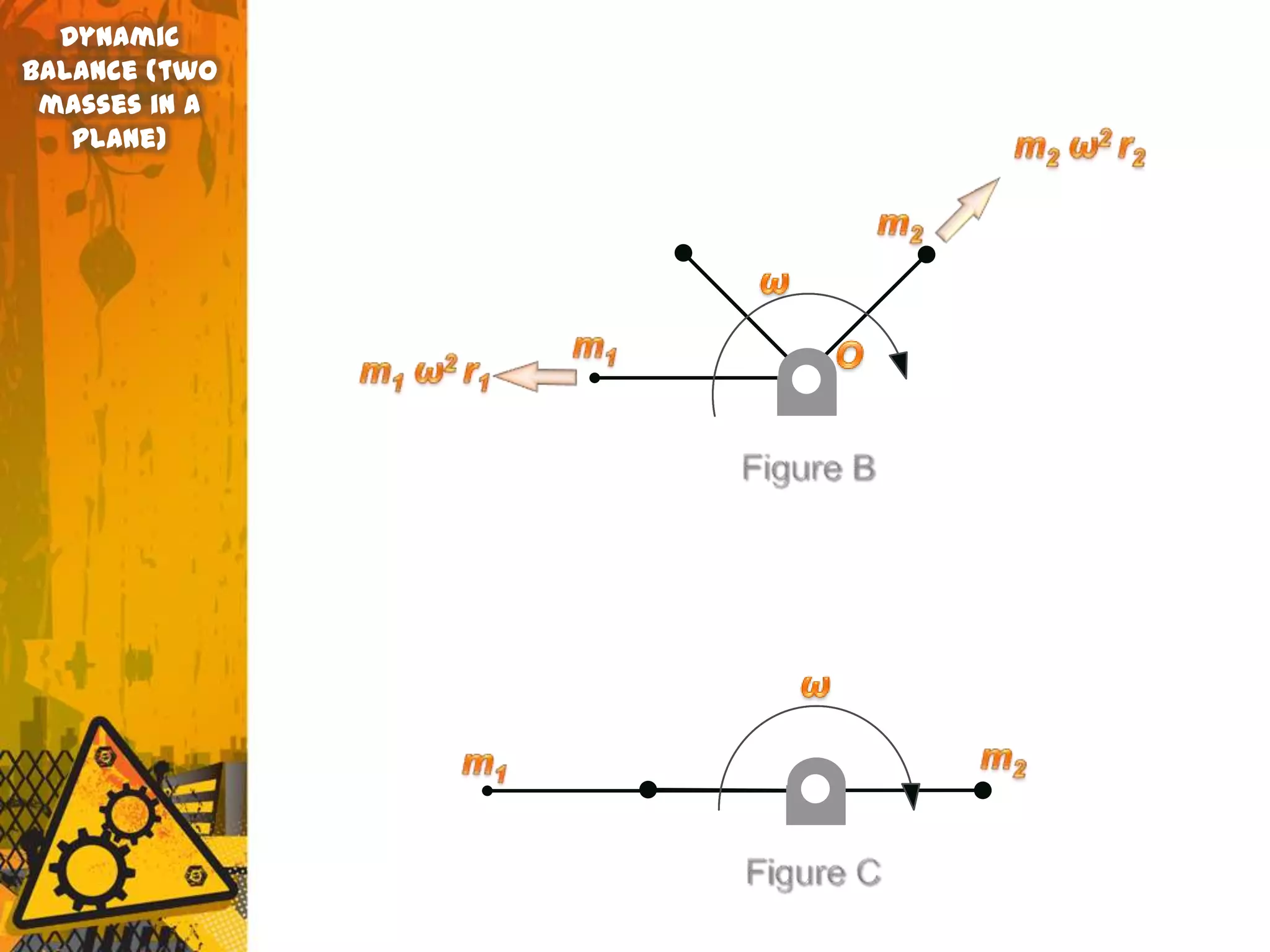
               Now consider two light arms fixed to a shaft at bearing O
               and rotating with angular velocity ω. The arms are in the
               same plane and carry masses m1, m2 at radii r1, r2
               respectively. Owing to the rotation each masses exerts an
               inertia force radially outward on the bearing O.

               The force due to m1 is m1 ω2 r1 (OA in the force diagram)
               The force due to m2 is m2 ω2 r2 (AB in the force diagram)
Dynamic
balance (two
 masses in a
   plane)
Dynamic
balance (two           The resultant out of balance force on the bearing is
 masses in a   given by OB in the force diagram.
   plane)
                        when the dynamic load on the bearing is zero the
               rotating system is said to be in dynamic balance. The
               condition for no load at O is that two inertia force shall:

                   1. act along the same straight line but with opposite
                      sense
                   2. Be equal in magnitude

                       the relative positions of the masses are as in the
               figure C shown earlier. The condition for equal inertia
               forces is:
                                     m1 ω2 r1 = m2 ω2 r2

               Thus, since ω2 is the same both masses
                                        m1r1 = m2r2
               Two bodies in the same plane are in static balance when
               pivoted about a given axis they will be in dynamic balance
               at any speed when rotating about the same axis.
Method of
balancing        Balancing
            Method of
                 Rotors
 Rotors


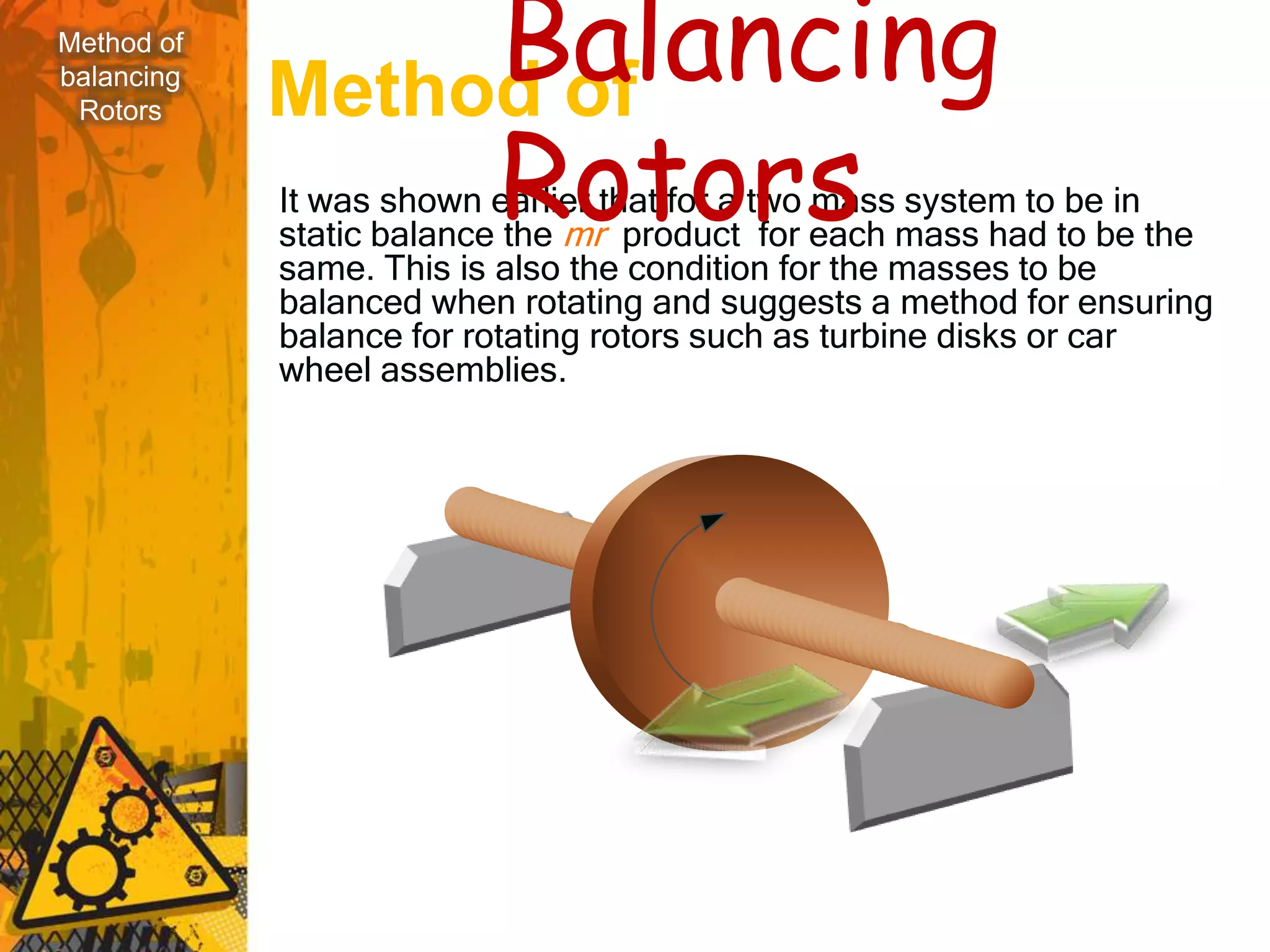
            It was shown earlier that for a two mass system to be in
            static balance the mr product for each mass had to be the
            same. This is also the condition for the masses to be
            balanced when rotating and suggests a method for ensuring
            balance for rotating rotors such as turbine disks or car
            wheel assemblies.
Method of
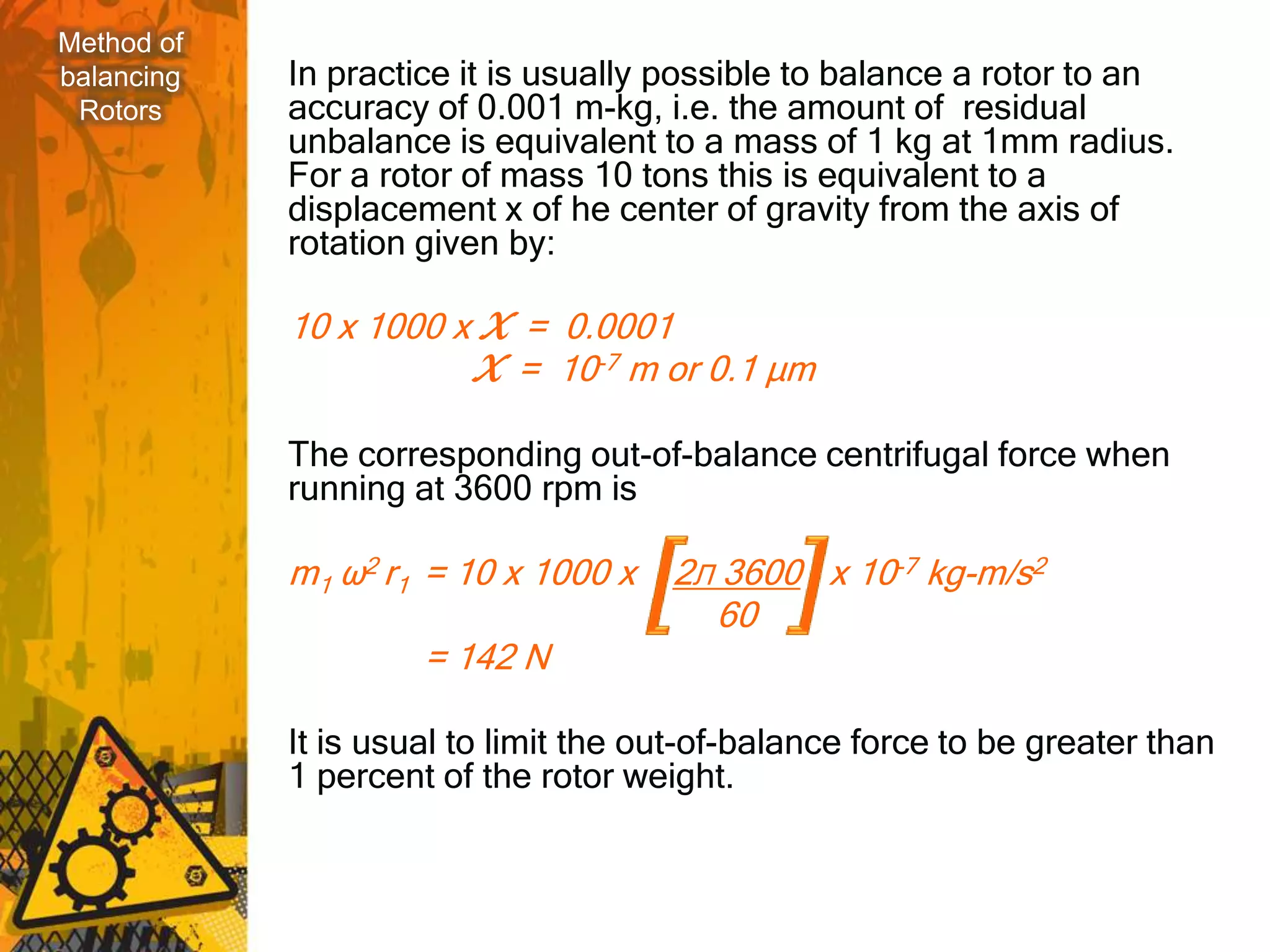
balancing   In practice it is usually possible to balance a rotor to an
 Rotors     accuracy of 0.001 m-kg, i.e. the amount of residual
            unbalance is equivalent to a mass of 1 kg at 1mm radius.
            For a rotor of mass 10 tons this is equivalent to a
            displacement x of he center of gravity from the axis of
            rotation given by:

            10 x 1000 x X = 0.0001
                       X = 10-7 m or 0.1 μm

            The corresponding out-of-balance centrifugal force when
            running at 3600 rpm is

            m1 ω2 r1 = 10 x 1000 x    2Л 3600 x 10-7 kg-m/s2
                                        60
                     = 142 N

            It is usual to limit the out-of-balance force to be greater than
            1 percent of the rotor weight.
Sample
Problem
Sample
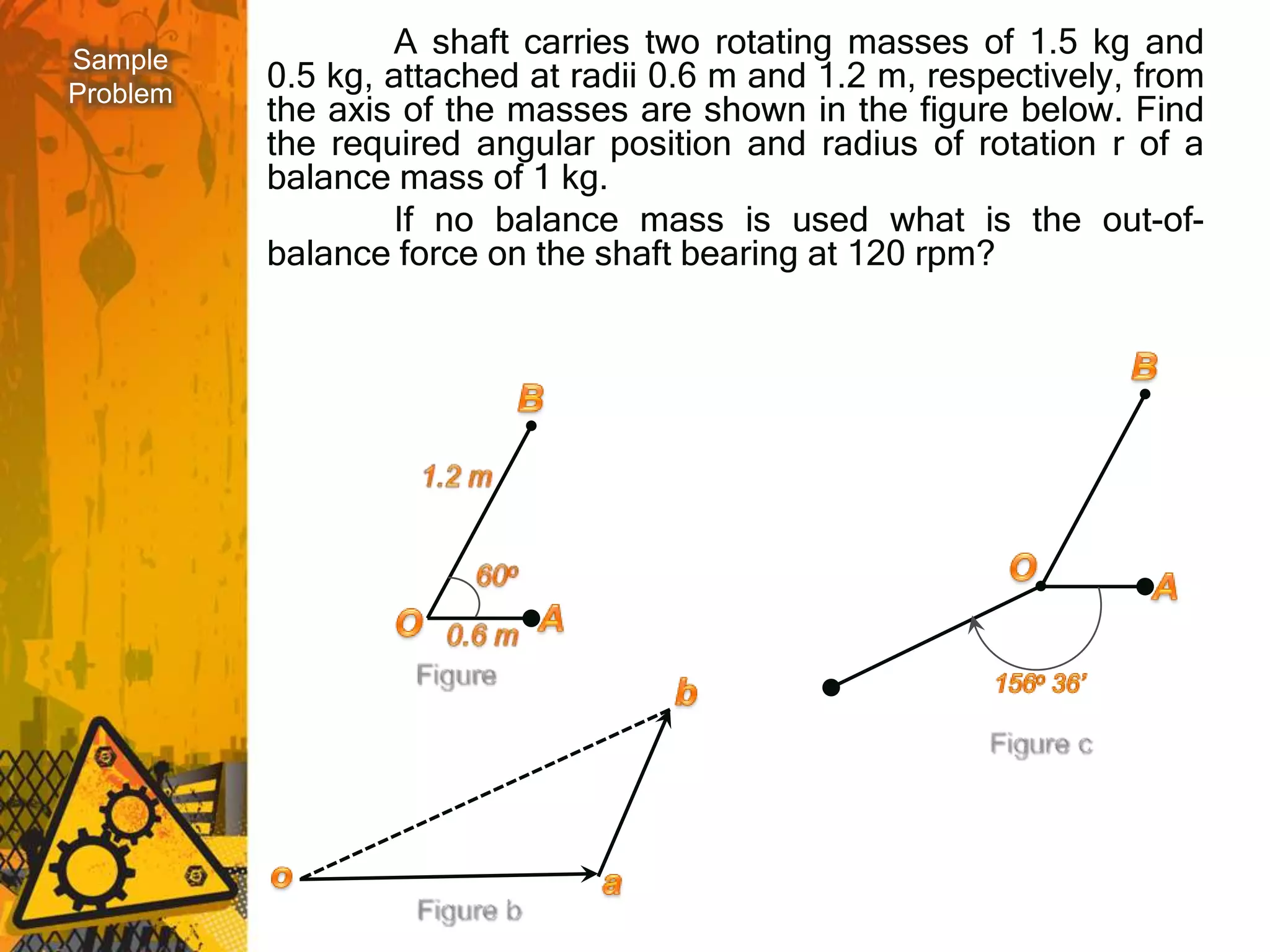
                  A shaft carries two rotating masses of 1.5 kg and
Problem
          0.5 kg, attached at radii 0.6 m and 1.2 m, respectively, from
          the axis of the masses are shown in the figure below. Find
          the required angular position and radius of rotation r of a
          balance mass of 1 kg.
                  If no balance mass is used what is the out-of-
          balance force on the shaft bearing at 120 rpm?
Sample
Problem   Solution:
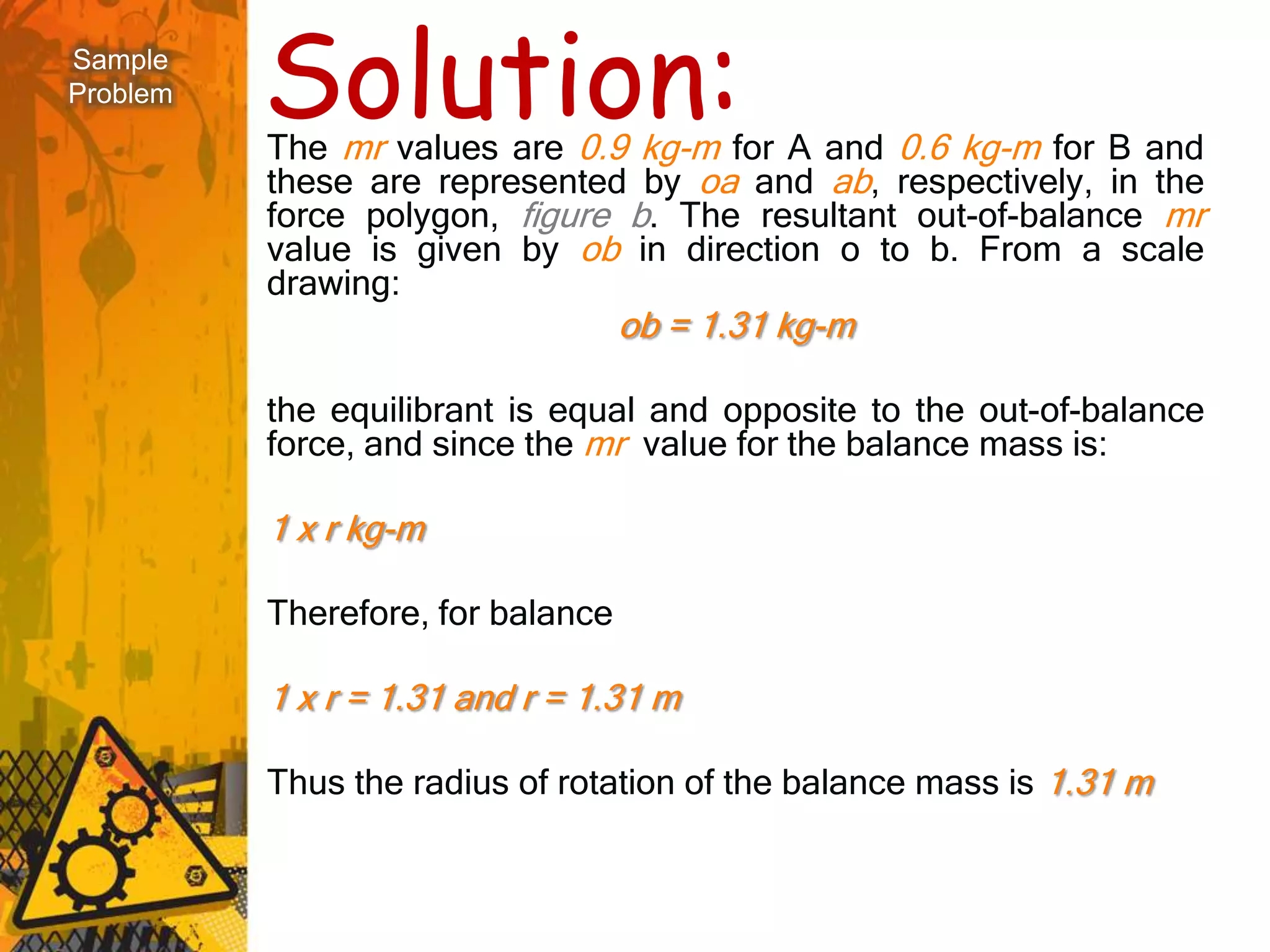
          The mr values are 0.9 kg-m for A and 0.6 kg-m for B and
          these are represented by oa and ab, respectively, in the
          force polygon, figure b. The resultant out-of-balance mr
          value is given by ob in direction o to b. From a scale
          drawing:
                                   ob = 1.31 kg-m

          the equilibrant is equal and opposite to the out-of-balance
          force, and since the mr value for the balance mass is:

          1 x r kg-m

          Therefore, for balance

          1 x r = 1.31 and r = 1.31 m

          Thus the radius of rotation of the balance mass is 1.31 m
Sample
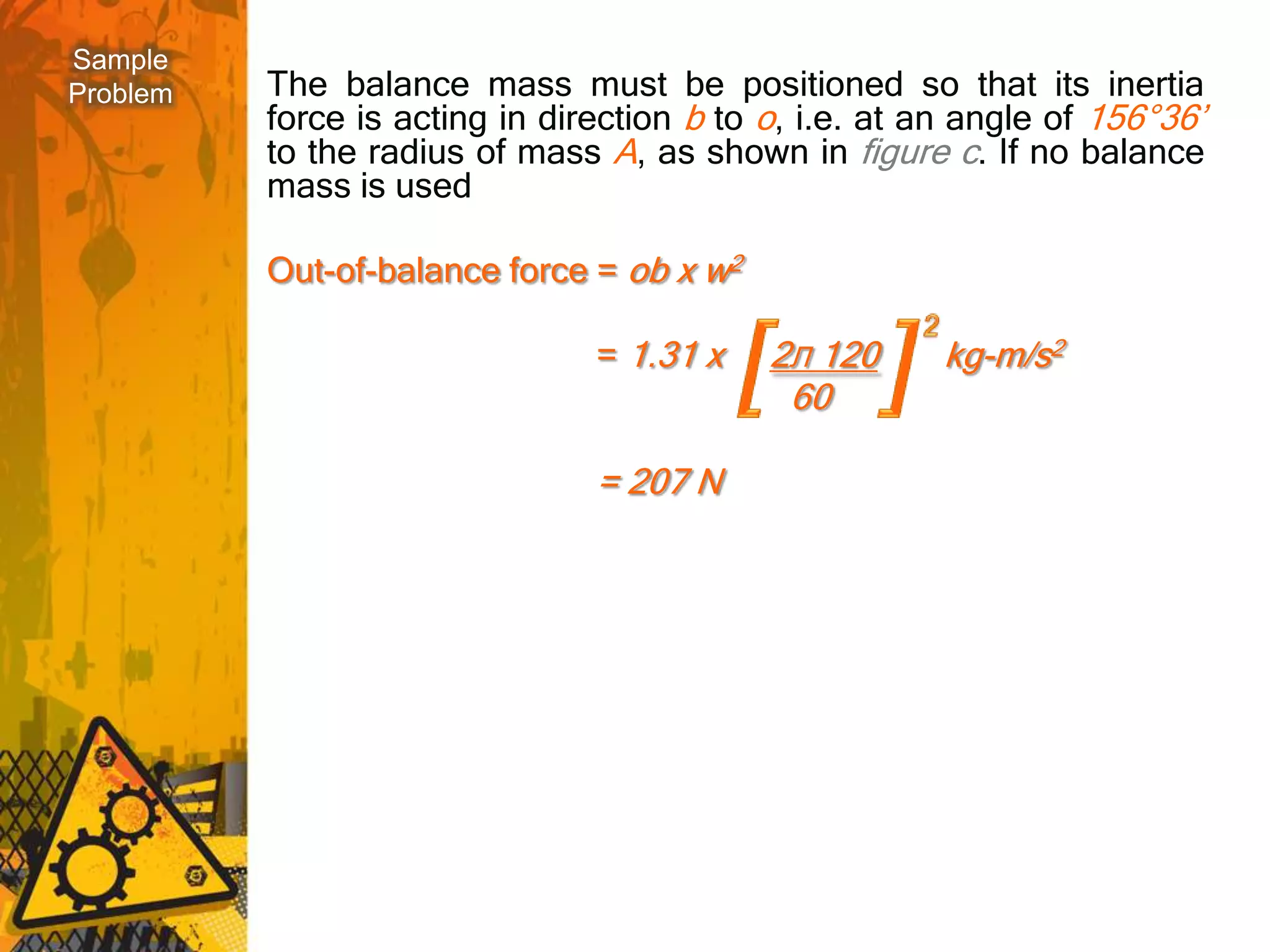
Problem   The balance mass must be positioned so that its inertia
          force is acting in direction b to o, i.e. at an angle of 156°36’
          to the radius of mass A, as shown in figure c. If no balance
          mass is used

          Out-of-balance force = ob x w2

                                = 1.31 x    2Л 120      kg-m/s2
                                             60

                                = 207 N
Thank you
Static balance is keeping balanced while still and dynamic balance is keeping balance while moving   .

static and dynamic balance

  • 1.
  • 2.
  • 3.
    Static Balance The condition which exists in a body which has an absolutely even distribution of the weight mass around the axis of rotation This occurs when when there is no resultant centrifugal force and the center of gravity is on the axis of rotation.
  • 4.
    Two masses Static balance (two masses in a plane) Static Balance in a plane Consider a light arm pivoted freely at the fulcrum O and carrying masses m1, m2 at distances r1, r2 from O respectively. In general the arm will rotate about O and the system is said to be out of balance. For equilibrium there must be balance of moments about O. i.e. m1g x r1 = m2g x r2 or m1r1 = m2r2 When in balance the arm may be set in any position and will remain at rest in that position. The weights are said to be in static balance and the center of gravity of the system is located at O.
  • 5.
    Static balance (two masses in a plane)
  • 6.
    Dynamic Balance The condition which exists in a rotating body when the axis about which it is forced to rotate, or to which reference is made, is parallel with a principal axis of inertia; no products of inertia about the center of gravity of the body exist in relation to the selected rotational axis. This occurs when there is no resulting moment along the axis.
  • 7.
    Dynamic balance (two massesin a Two masses Dynamic Balance in a plane plane) Now consider two light arms fixed to a shaft at bearing O and rotating with angular velocity ω. The arms are in the same plane and carry masses m1, m2 at radii r1, r2 respectively. Owing to the rotation each masses exerts an inertia force radially outward on the bearing O. The force due to m1 is m1 ω2 r1 (OA in the force diagram) The force due to m2 is m2 ω2 r2 (AB in the force diagram)
  • 8.
  • 9.
    Dynamic balance (two The resultant out of balance force on the bearing is masses in a given by OB in the force diagram. plane) when the dynamic load on the bearing is zero the rotating system is said to be in dynamic balance. The condition for no load at O is that two inertia force shall: 1. act along the same straight line but with opposite sense 2. Be equal in magnitude the relative positions of the masses are as in the figure C shown earlier. The condition for equal inertia forces is: m1 ω2 r1 = m2 ω2 r2 Thus, since ω2 is the same both masses m1r1 = m2r2 Two bodies in the same plane are in static balance when pivoted about a given axis they will be in dynamic balance at any speed when rotating about the same axis.
  • 10.
    Method of balancing Balancing Method of Rotors Rotors It was shown earlier that for a two mass system to be in static balance the mr product for each mass had to be the same. This is also the condition for the masses to be balanced when rotating and suggests a method for ensuring balance for rotating rotors such as turbine disks or car wheel assemblies.
  • 11.
    Method of balancing In practice it is usually possible to balance a rotor to an Rotors accuracy of 0.001 m-kg, i.e. the amount of residual unbalance is equivalent to a mass of 1 kg at 1mm radius. For a rotor of mass 10 tons this is equivalent to a displacement x of he center of gravity from the axis of rotation given by: 10 x 1000 x X = 0.0001 X = 10-7 m or 0.1 μm The corresponding out-of-balance centrifugal force when running at 3600 rpm is m1 ω2 r1 = 10 x 1000 x 2Л 3600 x 10-7 kg-m/s2 60 = 142 N It is usual to limit the out-of-balance force to be greater than 1 percent of the rotor weight.
  • 12.
  • 13.
    Sample A shaft carries two rotating masses of 1.5 kg and Problem 0.5 kg, attached at radii 0.6 m and 1.2 m, respectively, from the axis of the masses are shown in the figure below. Find the required angular position and radius of rotation r of a balance mass of 1 kg. If no balance mass is used what is the out-of- balance force on the shaft bearing at 120 rpm?
  • 14.
    Sample Problem Solution: The mr values are 0.9 kg-m for A and 0.6 kg-m for B and these are represented by oa and ab, respectively, in the force polygon, figure b. The resultant out-of-balance mr value is given by ob in direction o to b. From a scale drawing: ob = 1.31 kg-m the equilibrant is equal and opposite to the out-of-balance force, and since the mr value for the balance mass is: 1 x r kg-m Therefore, for balance 1 x r = 1.31 and r = 1.31 m Thus the radius of rotation of the balance mass is 1.31 m
  • 15.
    Sample Problem The balance mass must be positioned so that its inertia force is acting in direction b to o, i.e. at an angle of 156°36’ to the radius of mass A, as shown in figure c. If no balance mass is used Out-of-balance force = ob x w2 = 1.31 x 2Л 120 kg-m/s2 60 = 207 N
  • 16.
    Thank you Static balanceis keeping balanced while still and dynamic balance is keeping balance while moving .