THE STATE
GOVERNMENT
Civics chapter:3
Class :7th
By: vamil khurana
HOW STATE
GOVERNMENT
WORKS???
WHY DO WE HAVE STATE
GOVERNMENT?
• India is a huge country with 28
states and 8 union territories.
• Distribution of power between the
Centre and states has been
provided for in the Constitution
of India for the smooth
functioning of the country.
The state government is responsible for
good governance of the people of the
state. The state government manages
the affairs of the state at three levels –
Legislative, Executive and
Administrative.
Number of states :
28 Number of UT :
8
KICKSTARTER TUTORIALS
The State Legislature consists of
the Governor and one or two
houses.
In states where there are two
houses there is a Legislative
Council and a Legislative
Assembly .
States having
one house is
known as
unicameral
States having
two house is
known as
bicameral
•The Legislative Council (Vidhan
Parishad), is the Upper House.
•Legislative Assembly (Vidhan Sabha)
is the Lower House of the State
Legislature. KICKSTARTER TUTORIALS
LEGISLATIVE
COUNCILThe legislative council is mainly an advisory
body
• The members of the legislative council are not
directly elected by the people of the state but by
different bodies of the state.
• This is a permanent Body.
• The members are elected for a term of six
years.
• The meetings of the house are presided over by
The Chairman & in his absence Deputy
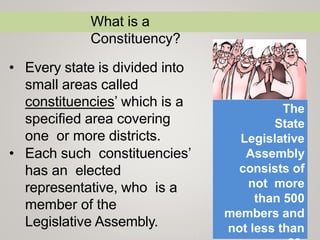
The
State
Legislative
Assembly
consists of
not more
than 500
members and
not less than
What is a
Constituency?
• Every state is divided into
small areas called
constituencies’ which is a
specified area covering
one or more districts.
• Each such constituencies’
has an elected
representative, who is a
member of the
Legislative Assembly.
KICKSTARTER TUTORIALS
MEMBER OF LEGISLATIVE
ASSEMBLYEvery 5 years election is announced for State’
Legislative Assembly. Political parties nominate
their people for each constituency. All members
of the Legislative Assembly are elected on the
basis of adult franchise, and one member
is elected from one constituency.
A Member of Legislative Assembly
(MLA) is a representative elected by
the voters of an electoral district
(constituency) to
the Legislature of a State in the
Indian system of government.
ML
A
To be member of the Legislative Assembly, a person must be a
citizen of India, must be at least 25 years of age, and must
have such other qualification as may be prescribed by the
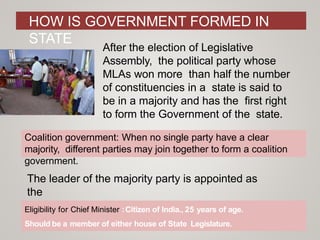
HOW IS GOVERNMENT FORMED IN
STATE
After the election of Legislative
Assembly, the political party whose
MLAs won more than half the number
of constituencies in a state is said to
be in a majority and has the first right
to form the Government of the state.
Coalition government: When no single party have a clear
majority, different parties may join together to form a coalition
government.
The leader of the majority party is appointed as
the
chief minister by the governor.Eligibility for Chief Minister :Citizen of India., 25 years of age.
Should be a member of either house of State Legislature.
Functionaries of the
state
Eligibilit
y:1. He/she has to
be a citizen of
India.
2. He/she should
not be a
member of
either house of
parliament or
state
legislature.
3. He/she cannot
hold
any office of
THE GOVERNOR
 The Governor is the constitutional head
of the state.
 He is appointed by the President of the
Country.
 He appoints the Chief Minister and
other members of the council of
ministers.
 He appoints the advocate general and
other officers of the state.
 Every bill has to be approved by the
Governor.
 He has the right to dissolve the
legislature.
POWER & FUNCTIONS OF CHIEF
MINISTER
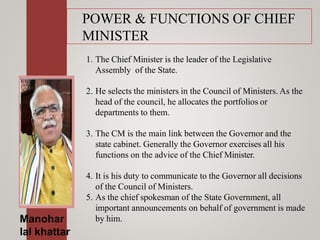
1. The Chief Minister is the leader of the Legislative
Assembly of the State.
2. He selects the ministers in the Council of Ministers. As the
head of the council, he allocates the portfolios or
departments to them.
3. The CM is the main link between the Governor and the
state cabinet. Generally the Governor exercises all his
functions on the advice of the Chief Minister.
4. It is his duty to communicate to the Governor all decisions
of the Council of Ministers.
5. As the chief spokesman of the State Government, all
important announcements on behalf of government is made
by him.Manohar
lal khattar
POWER & FUNCTIONS OF CHIEF
MINISTER
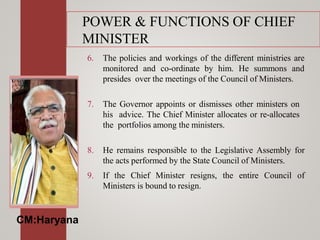
6. The policies and workings of the different ministries are
monitored and co-ordinate by him. He summons and
presides over the meetings of the Council of Ministers.
7. The Governor appoints or dismisses other ministers on
his advice. The Chief Minister allocates or re-allocates
the portfolios among the ministers.
8. He remains responsible to the Legislative Assembly for
the acts performed by the State Council of Ministers.
9. If the Chief Minister resigns, the entire Council of
Ministers is bound to resign.
CM:Haryana
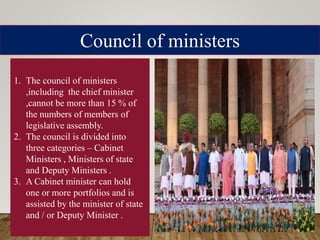
Council of ministers
1. The council of ministers
,including the chief minister
,cannot be more than 15 % of
the numbers of members of
legislative assembly.
2. The council is divided into
three categories – Cabinet
Ministers , Ministers of state
and Deputy Ministers .
3. A Cabinet minister can hold
one or more portfolios and is
assisted by the minister of state
and / or Deputy Minister .
1. The speaker coordinates
the discussions .
2. The speaker ensures that
everybody gets time to
present their opinion.
3. MLA’s listen to each other
peacefully.
4. speaker has to decide
which issue could be
discussed and in what
order .
FUNCTIONS OF THE GOVERNMENT
In the assembly the MLA’s make, amend and ratify
laws.
1. A proposal to pass a law or to amend an existing one is
called a bill. Bill is introduced in legislative assembly.
2. These proposals are debated or discussed among the
members of the assembly before voting.
3. Once the bill is approved with majority vote it is sent to the
other house where it goes through same procedure.
4. Thereafter the bill goes to the Governor for his approval.
Once approved the bill becomes a law.
The budget and all money bills can only be introduced in the
legislative assembly while other bills may be introduced in the
State government ch3 civics

State government ch3 civics

  • 1.
  • 2.
  • 3.
    WHY DO WEHAVE STATE GOVERNMENT? • India is a huge country with 28 states and 8 union territories. • Distribution of power between the Centre and states has been provided for in the Constitution of India for the smooth functioning of the country. The state government is responsible for good governance of the people of the state. The state government manages the affairs of the state at three levels – Legislative, Executive and Administrative. Number of states : 28 Number of UT : 8 KICKSTARTER TUTORIALS
  • 4.
    The State Legislatureconsists of the Governor and one or two houses. In states where there are two houses there is a Legislative Council and a Legislative Assembly . States having one house is known as unicameral States having two house is known as bicameral •The Legislative Council (Vidhan Parishad), is the Upper House. •Legislative Assembly (Vidhan Sabha) is the Lower House of the State Legislature. KICKSTARTER TUTORIALS
  • 5.
    LEGISLATIVE COUNCILThe legislative councilis mainly an advisory body • The members of the legislative council are not directly elected by the people of the state but by different bodies of the state. • This is a permanent Body. • The members are elected for a term of six years. • The meetings of the house are presided over by The Chairman & in his absence Deputy
  • 6.
    The State Legislative Assembly consists of not more than500 members and not less than What is a Constituency? • Every state is divided into small areas called constituencies’ which is a specified area covering one or more districts. • Each such constituencies’ has an elected representative, who is a member of the Legislative Assembly. KICKSTARTER TUTORIALS
  • 7.
    MEMBER OF LEGISLATIVE ASSEMBLYEvery5 years election is announced for State’ Legislative Assembly. Political parties nominate their people for each constituency. All members of the Legislative Assembly are elected on the basis of adult franchise, and one member is elected from one constituency. A Member of Legislative Assembly (MLA) is a representative elected by the voters of an electoral district (constituency) to the Legislature of a State in the Indian system of government. ML A To be member of the Legislative Assembly, a person must be a citizen of India, must be at least 25 years of age, and must have such other qualification as may be prescribed by the
  • 8.
    HOW IS GOVERNMENTFORMED IN STATE After the election of Legislative Assembly, the political party whose MLAs won more than half the number of constituencies in a state is said to be in a majority and has the first right to form the Government of the state. Coalition government: When no single party have a clear majority, different parties may join together to form a coalition government. The leader of the majority party is appointed as the chief minister by the governor.Eligibility for Chief Minister :Citizen of India., 25 years of age. Should be a member of either house of State Legislature.
  • 9.
  • 10.
    Eligibilit y:1. He/she hasto be a citizen of India. 2. He/she should not be a member of either house of parliament or state legislature. 3. He/she cannot hold any office of THE GOVERNOR  The Governor is the constitutional head of the state.  He is appointed by the President of the Country.  He appoints the Chief Minister and other members of the council of ministers.  He appoints the advocate general and other officers of the state.  Every bill has to be approved by the Governor.  He has the right to dissolve the legislature.
  • 11.
    POWER & FUNCTIONSOF CHIEF MINISTER 1. The Chief Minister is the leader of the Legislative Assembly of the State. 2. He selects the ministers in the Council of Ministers. As the head of the council, he allocates the portfolios or departments to them. 3. The CM is the main link between the Governor and the state cabinet. Generally the Governor exercises all his functions on the advice of the Chief Minister. 4. It is his duty to communicate to the Governor all decisions of the Council of Ministers. 5. As the chief spokesman of the State Government, all important announcements on behalf of government is made by him.Manohar lal khattar
  • 12.
    POWER & FUNCTIONSOF CHIEF MINISTER 6. The policies and workings of the different ministries are monitored and co-ordinate by him. He summons and presides over the meetings of the Council of Ministers. 7. The Governor appoints or dismisses other ministers on his advice. The Chief Minister allocates or re-allocates the portfolios among the ministers. 8. He remains responsible to the Legislative Assembly for the acts performed by the State Council of Ministers. 9. If the Chief Minister resigns, the entire Council of Ministers is bound to resign. CM:Haryana
  • 13.
    Council of ministers 1.The council of ministers ,including the chief minister ,cannot be more than 15 % of the numbers of members of legislative assembly. 2. The council is divided into three categories – Cabinet Ministers , Ministers of state and Deputy Ministers . 3. A Cabinet minister can hold one or more portfolios and is assisted by the minister of state and / or Deputy Minister .
  • 14.
    1. The speakercoordinates the discussions . 2. The speaker ensures that everybody gets time to present their opinion. 3. MLA’s listen to each other peacefully. 4. speaker has to decide which issue could be discussed and in what order .
  • 15.
    FUNCTIONS OF THEGOVERNMENT In the assembly the MLA’s make, amend and ratify laws. 1. A proposal to pass a law or to amend an existing one is called a bill. Bill is introduced in legislative assembly. 2. These proposals are debated or discussed among the members of the assembly before voting. 3. Once the bill is approved with majority vote it is sent to the other house where it goes through same procedure. 4. Thereafter the bill goes to the Governor for his approval. Once approved the bill becomes a law. The budget and all money bills can only be introduced in the legislative assembly while other bills may be introduced in the