THE CONSTITUTION OF INDIA
The State Executive
Governor, CM, Council of Ministers,
The State Executive
GOVERNOR
LEGISLATURE
Legislative
Assembly
Legislative
Council
EXECUTIVE
Council of Ministers
Governor
Governor: (Art.152 to Art.167)
Constitutional Head
Executive Head of State.
Acts per aid and advice of ministers.
Ministers are responsible to Legislative Assembly.
Legislative Assembly: Lower House: (Vidhan Sabha).
Legislative Council : Upper House: (Vidhan Parishad)
Art.152 : Offive of Governor in every State.
Constitution 7th (Amendment) Act 1956.—one Governor
for two or more States.
Chief Executive head—(Nominal Head) of State–
Representative of Central Government—Dual Role
Governor
The President of India appoints Governor by warrant
under his hand and seal. : (Art.155)
Normal Term of office
-
-
-
5Years from date of entry to office
during the pleasure of the President
can resign any time addressing a letter to the
President. (Art.156)
(Art.157): Qualifications:
-
-
-
Citizen of India:
35 years of age
Should not be a Member of either house of
Parliament or State Legislature.
Should not hold any other office of Profit.
-
Governor
OATH: [Art.159] In the presence of
CJ of concerned High Court or in his absence the
available Senior most Judge of that court.
Powers and Functions of Governor.:
• The Governor of a State possesses
executive. Legislative, financial. And judicial powers
analogous to the President of India.
No diplomatic, military or emergency powers like
President of India.
Executive Powers.
[Art.166(1)] All executive actions of government in the
name of Governor.
Governor
Governor.:
• The Governor of a State possesses
executive. Legislative, financial. And judicial powers
analogous to the President of India.
No diplomatic, military or emergency powers like President
of India.
Executive Powers.
• [Art.166(1)] All executive actions of government in the
name of Governor.
Governor can make rules specifying the manner in
which orders and other instruments made and
executed in his name shall be authenticate.
Governor can make rules for more convenient
transaction of business of the State Govt. and for
allocation among the ministers, of the said business.
•
•
Governor
• Governor appoints the Chief Minister and Council
of Ministers -- Art.[163]:
Governor appoints the Advocate-General of State
and determines his remunerations
Governor appoints the State Election
commissioner and determines his conditions of
service and tenure of office.
Governor appoints the Chairman and members
of State Public Service commission. But they can
be removed only by President of India and
not by the Governor.
Governor can seek information relating to the
administration of affairs of the State and proposal
for legislation from the Chief Minister.
•
•
•
•
Governor
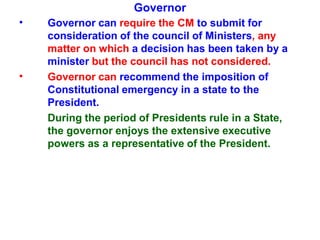
• Governor can require the CM to submit for
consideration of the council of Ministers, any
matter on which a decision has been taken by a
minister but the council has not considered.
Governor can recommend the imposition of
Constitutional emergency in a state to the
President.
During the period of Presidents rule in a State,
the governor enjoys the extensive executive
powers as a representative of the President.
•
Governor Legislative Powers
The Governor of a State is an essential part of its
Legislature.
• The Governor can from time to time summon or
prorogue either house of the State Legislature and
dissolve the State Assembly
Summon: It is a process to call upon the members
of the house to the session.
Prorogue: The act of bringing a session of
Parliament or other Legislative Assembly to an
end.
The Governor can address State Legislature at the
commencement of the first session after each
general election and the first session of each year.
•
Governor Legislative Powers
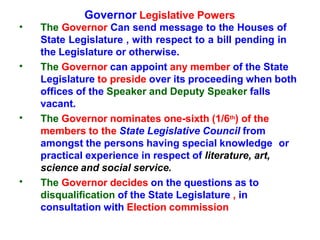
• The Governor Can send message to the Houses of
State Legislature , with respect to a bill pending in
the Legislature or otherwise.
The Governor can appoint any member of the State
Legislature to preside over its proceeding when both
offices of the Speaker and Deputy Speaker falls
vacant.
The Governor nominates one-sixth (1/6th) of the
members to the State Legislative Council from
amongst the persons having special knowledge or
practical experience in respect of literature, art,
science and social service.
The Governor decides on the questions as to
disqualification of the State Legislature , in
consultation with Election commission
•
•
•
Governor Legislative Powers (contd.)
• When a bill is sent to the Governor after it has been
passed by the State Legislatures,
he can
i) Give assent to the bill, or
ii) withhold his assent to the bill (veto power), or
iii)Return the bill (other than money bill) for
reconsideration of the State Legislature with or without
amendment, a Governor has to give his assent to the
bill.
• He can reserve for the consideration of President, any
bill passed by the State Legislature which endangers
the position of the State High Court.
• He lays the report of the State Finance Commission,
State Public Service Commission, Auditor-General
relating to the accounts of the State before the State
Legislature.
Governor Legislative Powers (contd.)
• He can promulgate ordinances when State
Legislature is not in session.
The State Legislature must approve these
ordinances within six week from its reassembly.
He can also withdraw an ordinance at any time.
[Art.213]
Financial Powers
• The Governor sees that the Annual Financial
Statement (State Budget) is laid before the before
the State Legislature.
• The Money Bill can be introduced in the State
Legislature only with Governor’s prior
recommendation [Art.199]
Governor Financial Powers
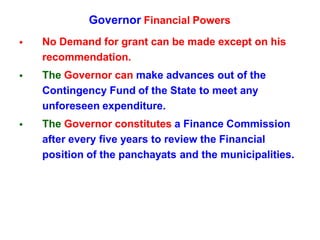
• No Demand for grant can be made except on his
recommendation.
The Governor can make advances out of the
Contingency Fund of the State to meet any
unforeseen expenditure.
The Governor constitutes a Finance Commission
after every five years to review the Financial
position of the panchayats and the municipalities.
•
•
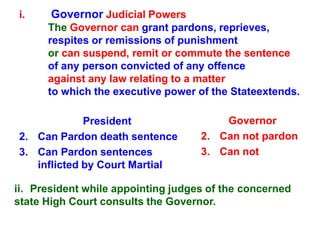
i. Governor Judicial Powers
The Governor can grant pardons, reprieves,
respites or remissions of punishment
or can suspend, remit or commute the sentence
of any person convicted of any offence
against any law relating to a matter
to which the executive power of the Stateextends.
Governor
2. Can not pardon
3. Can not
President
2. Can Pardon death sentence
3. Can Pardon sentences
inflicted by Court Martial
ii. President while appointing judges of the concerned
state High Court consults the Governor.
Governor Judicial Powers
• The Governor makes appointments, postings and
promotions of the district judges in consultation
with the State High Court.
• The Governor also appoints persons to
judicial service of the state
in consultation with the state High Court and
State Public Service Commission.
Governor Emergency Powers
• The Governor can make a report to the President
whenever he is satisfied that a situation has arisen
in which the Government of the state cannot be
carried on in accordance with the provisions of the
Constitution (Constitutional breakdown) and
hence can recommend ‘President’s Rule’.
THE CHIEF MINISTER
•
•
•
•
•
•
Pivot
Symbol of ruling power
Most powerful
Shapes the style of Govt.
Comparable to President in the Centre.
Appointed by Governor—responsible (along with his
ministry) to the popularly elected Legislative
Assembly.
Governor invites majority party- CM leader of…
Coalition govt.
•
•
THE CHIEF MINISTER
Qualifications:
-
-
-
Citizen of India:
25 years of age
Should be a Member of either house of State
Legislature.
Powers and Functions
Real Executive– vast powers
- Working head– advises Govt. –selection of
Ministers.
Presides over meeting of council of ministers–
ensures principle of collective responsibility.
Communicates all decisions of council of
ministers– administrative affairs & proposals of
legislation to the Governor when called for…
-
-
THE CHIEF MINISTER
Powers and Functions(…contd.)
Presides over meeting of council of ministers–
ensures principle of collective responsibility.
Communicates all decisions of council of
ministers– administrative affairs & proposals of
legislation to the Governor when called for…
Places matter for consideration of council of
ministers where Governors require him to have the
decision of the Govt.
Channel of communication between Governor &
his Ministers
Sole channel of communication betn his ministers
& Legislature. (bills, resolutions etc. moved in
Legislature must have his approval).
-
-
-
-
-
-
THE CHIEF MINISTER
Powers and Functions(…contd.)
2. As Leader of major party– duty to see discipline is
maintained
4. Tender his resignation anytime to Governor.
can advise Governor
to summon persons for installation of ministry
to dissolve the House (result – President’s Rule)
Practically, power of patronage vests in CM.
consulted for appointment of state HC judges
and SPSC members etc.
postings and transfer cannot take place without
his approval.
State Council of Ministers
Cabinet:
- is the Chief Executive body of Council of MINISTERs
- formulates / shapes policies
- initiates legislation
- coordinates work of various govt. agencies.
- guides, directs & controls the public admin
- implements Policies of the state.
(assisted by bureaucracy)
Quality of state administration is largely conditioned by
the leadership and direction provided by the Ministers
State Council of Ministers
Appointment of Ministers:
- by the Governor
- on the advise of the Chief Minister
Qualifications:
-
-
-
-
Citizen of India:
25 years of age
Should be a Member of either house of State Legislature
If non member, must become a member of legislature
within SIX months. Failing which he is liable to forfeit
his office.
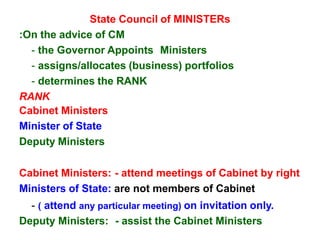
State Council of MINISTERs
:On the advice of CM
- the Governor Appoints Ministers
- assigns/allocates (business) portfolios
- determines the RANK
RANK
Cabinet Ministers
Minister of State
Deputy Ministers
Cabinet Ministers: - attend meetings of Cabinet by right
Ministers of State: are not members of Cabinet
- ( attend any particular meeting) on invitation only.
Deputy Ministers: - assist the Cabinet Ministers
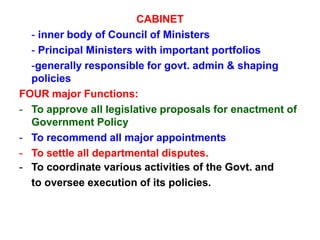
CABINET
- inner body of Council of Ministers
- Principal Ministers with important portfolios
-generally responsible for govt. admin & shaping
policies
FOUR major Functions:
- To approve all legislative proposals for enactment of
Government Policy
- To recommend all major appointments
- To settle all departmental disputes.
- To coordinate various activities of the Govt. and
to oversee execution of its policies.
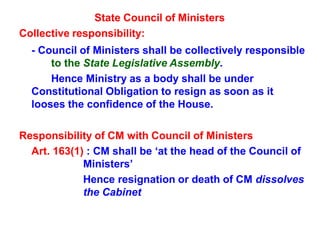
State Council of Ministers
Collective responsibility:
- Council of Ministers shall be collectively responsible
to the State Legislative Assembly.
Hence Ministry as a body shall be under
Constitutional Obligation to resign as soon as it
looses the confidence of the House.
Responsibility of CM with Council of Ministers
Art. 163(1) : CM shall be ‘at the head of the Council of
Ministers’
Hence resignation or death of CM dissolves
the Cabinet
Powers and Functions Of State Council of Ministers
Legislative Functions:
Controls the legislature of the State Government.
- Formulates Policy submits and explains it to
Legislature for approval.
- Ministers initiate the entire legislation of importance
passed by Legislature.
Financial Powers :
-
-
-
Controls the Financial Policy of the State.
Finance minister submits the State Budget.
Legislature approves the budget-expenditure &
revenue items in its original form with the support of
subservient majority.
Powers and Functions Of State Council of Ministers
Executive Powers :
-
-
-
-
State Council of Ministers is the executive of the State
Ministers preside over the various depts. of the Govt.
Give directions to the administration.
Cabinet coordinates the policy among the various
dept.s and settles their conflicts.

state-executive plan.pptx

  • 1.
    THE CONSTITUTION OFINDIA The State Executive Governor, CM, Council of Ministers,
  • 2.
  • 5.
    Governor Governor: (Art.152 toArt.167) Constitutional Head Executive Head of State. Acts per aid and advice of ministers. Ministers are responsible to Legislative Assembly. Legislative Assembly: Lower House: (Vidhan Sabha). Legislative Council : Upper House: (Vidhan Parishad) Art.152 : Offive of Governor in every State. Constitution 7th (Amendment) Act 1956.—one Governor for two or more States. Chief Executive head—(Nominal Head) of State– Representative of Central Government—Dual Role
  • 6.
    Governor The President ofIndia appoints Governor by warrant under his hand and seal. : (Art.155) Normal Term of office - - - 5Years from date of entry to office during the pleasure of the President can resign any time addressing a letter to the President. (Art.156) (Art.157): Qualifications: - - - Citizen of India: 35 years of age Should not be a Member of either house of Parliament or State Legislature. Should not hold any other office of Profit. -
  • 7.
    Governor OATH: [Art.159] Inthe presence of CJ of concerned High Court or in his absence the available Senior most Judge of that court. Powers and Functions of Governor.: • The Governor of a State possesses executive. Legislative, financial. And judicial powers analogous to the President of India. No diplomatic, military or emergency powers like President of India. Executive Powers. [Art.166(1)] All executive actions of government in the name of Governor.
  • 8.
    Governor Governor.: • The Governorof a State possesses executive. Legislative, financial. And judicial powers analogous to the President of India. No diplomatic, military or emergency powers like President of India. Executive Powers. • [Art.166(1)] All executive actions of government in the name of Governor. Governor can make rules specifying the manner in which orders and other instruments made and executed in his name shall be authenticate. Governor can make rules for more convenient transaction of business of the State Govt. and for allocation among the ministers, of the said business. • •
  • 9.
    Governor • Governor appointsthe Chief Minister and Council of Ministers -- Art.[163]: Governor appoints the Advocate-General of State and determines his remunerations Governor appoints the State Election commissioner and determines his conditions of service and tenure of office. Governor appoints the Chairman and members of State Public Service commission. But they can be removed only by President of India and not by the Governor. Governor can seek information relating to the administration of affairs of the State and proposal for legislation from the Chief Minister. • • • •
  • 10.
    Governor • Governor canrequire the CM to submit for consideration of the council of Ministers, any matter on which a decision has been taken by a minister but the council has not considered. Governor can recommend the imposition of Constitutional emergency in a state to the President. During the period of Presidents rule in a State, the governor enjoys the extensive executive powers as a representative of the President. •
  • 11.
    Governor Legislative Powers TheGovernor of a State is an essential part of its Legislature. • The Governor can from time to time summon or prorogue either house of the State Legislature and dissolve the State Assembly Summon: It is a process to call upon the members of the house to the session. Prorogue: The act of bringing a session of Parliament or other Legislative Assembly to an end. The Governor can address State Legislature at the commencement of the first session after each general election and the first session of each year. •
  • 12.
    Governor Legislative Powers •The Governor Can send message to the Houses of State Legislature , with respect to a bill pending in the Legislature or otherwise. The Governor can appoint any member of the State Legislature to preside over its proceeding when both offices of the Speaker and Deputy Speaker falls vacant. The Governor nominates one-sixth (1/6th) of the members to the State Legislative Council from amongst the persons having special knowledge or practical experience in respect of literature, art, science and social service. The Governor decides on the questions as to disqualification of the State Legislature , in consultation with Election commission • • •
  • 13.
    Governor Legislative Powers(contd.) • When a bill is sent to the Governor after it has been passed by the State Legislatures, he can i) Give assent to the bill, or ii) withhold his assent to the bill (veto power), or iii)Return the bill (other than money bill) for reconsideration of the State Legislature with or without amendment, a Governor has to give his assent to the bill. • He can reserve for the consideration of President, any bill passed by the State Legislature which endangers the position of the State High Court. • He lays the report of the State Finance Commission, State Public Service Commission, Auditor-General relating to the accounts of the State before the State Legislature.
  • 14.
    Governor Legislative Powers(contd.) • He can promulgate ordinances when State Legislature is not in session. The State Legislature must approve these ordinances within six week from its reassembly. He can also withdraw an ordinance at any time. [Art.213] Financial Powers • The Governor sees that the Annual Financial Statement (State Budget) is laid before the before the State Legislature. • The Money Bill can be introduced in the State Legislature only with Governor’s prior recommendation [Art.199]
  • 15.
    Governor Financial Powers •No Demand for grant can be made except on his recommendation. The Governor can make advances out of the Contingency Fund of the State to meet any unforeseen expenditure. The Governor constitutes a Finance Commission after every five years to review the Financial position of the panchayats and the municipalities. • •
  • 16.
    i. Governor JudicialPowers The Governor can grant pardons, reprieves, respites or remissions of punishment or can suspend, remit or commute the sentence of any person convicted of any offence against any law relating to a matter to which the executive power of the Stateextends. Governor 2. Can not pardon 3. Can not President 2. Can Pardon death sentence 3. Can Pardon sentences inflicted by Court Martial ii. President while appointing judges of the concerned state High Court consults the Governor.
  • 17.
    Governor Judicial Powers •The Governor makes appointments, postings and promotions of the district judges in consultation with the State High Court. • The Governor also appoints persons to judicial service of the state in consultation with the state High Court and State Public Service Commission.
  • 18.
    Governor Emergency Powers •The Governor can make a report to the President whenever he is satisfied that a situation has arisen in which the Government of the state cannot be carried on in accordance with the provisions of the Constitution (Constitutional breakdown) and hence can recommend ‘President’s Rule’.
  • 19.
    THE CHIEF MINISTER • • • • • • Pivot Symbolof ruling power Most powerful Shapes the style of Govt. Comparable to President in the Centre. Appointed by Governor—responsible (along with his ministry) to the popularly elected Legislative Assembly. Governor invites majority party- CM leader of… Coalition govt. • •
  • 20.
    THE CHIEF MINISTER Qualifications: - - - Citizenof India: 25 years of age Should be a Member of either house of State Legislature. Powers and Functions Real Executive– vast powers - Working head– advises Govt. –selection of Ministers. Presides over meeting of council of ministers– ensures principle of collective responsibility. Communicates all decisions of council of ministers– administrative affairs & proposals of legislation to the Governor when called for… - -
  • 21.
    THE CHIEF MINISTER Powersand Functions(…contd.) Presides over meeting of council of ministers– ensures principle of collective responsibility. Communicates all decisions of council of ministers– administrative affairs & proposals of legislation to the Governor when called for… Places matter for consideration of council of ministers where Governors require him to have the decision of the Govt. Channel of communication between Governor & his Ministers Sole channel of communication betn his ministers & Legislature. (bills, resolutions etc. moved in Legislature must have his approval). - - - - -
  • 22.
    - THE CHIEF MINISTER Powersand Functions(…contd.) 2. As Leader of major party– duty to see discipline is maintained 4. Tender his resignation anytime to Governor. can advise Governor to summon persons for installation of ministry to dissolve the House (result – President’s Rule) Practically, power of patronage vests in CM. consulted for appointment of state HC judges and SPSC members etc. postings and transfer cannot take place without his approval.
  • 23.
    State Council ofMinisters Cabinet: - is the Chief Executive body of Council of MINISTERs - formulates / shapes policies - initiates legislation - coordinates work of various govt. agencies. - guides, directs & controls the public admin - implements Policies of the state. (assisted by bureaucracy) Quality of state administration is largely conditioned by the leadership and direction provided by the Ministers
  • 24.
    State Council ofMinisters Appointment of Ministers: - by the Governor - on the advise of the Chief Minister Qualifications: - - - - Citizen of India: 25 years of age Should be a Member of either house of State Legislature If non member, must become a member of legislature within SIX months. Failing which he is liable to forfeit his office.
  • 25.
    State Council ofMINISTERs :On the advice of CM - the Governor Appoints Ministers - assigns/allocates (business) portfolios - determines the RANK RANK Cabinet Ministers Minister of State Deputy Ministers Cabinet Ministers: - attend meetings of Cabinet by right Ministers of State: are not members of Cabinet - ( attend any particular meeting) on invitation only. Deputy Ministers: - assist the Cabinet Ministers
  • 26.
    CABINET - inner bodyof Council of Ministers - Principal Ministers with important portfolios -generally responsible for govt. admin & shaping policies FOUR major Functions: - To approve all legislative proposals for enactment of Government Policy - To recommend all major appointments - To settle all departmental disputes. - To coordinate various activities of the Govt. and to oversee execution of its policies.
  • 27.
    State Council ofMinisters Collective responsibility: - Council of Ministers shall be collectively responsible to the State Legislative Assembly. Hence Ministry as a body shall be under Constitutional Obligation to resign as soon as it looses the confidence of the House. Responsibility of CM with Council of Ministers Art. 163(1) : CM shall be ‘at the head of the Council of Ministers’ Hence resignation or death of CM dissolves the Cabinet
  • 28.
    Powers and FunctionsOf State Council of Ministers Legislative Functions: Controls the legislature of the State Government. - Formulates Policy submits and explains it to Legislature for approval. - Ministers initiate the entire legislation of importance passed by Legislature. Financial Powers : - - - Controls the Financial Policy of the State. Finance minister submits the State Budget. Legislature approves the budget-expenditure & revenue items in its original form with the support of subservient majority.
  • 29.
    Powers and FunctionsOf State Council of Ministers Executive Powers : - - - - State Council of Ministers is the executive of the State Ministers preside over the various depts. of the Govt. Give directions to the administration. Cabinet coordinates the policy among the various dept.s and settles their conflicts.