Unit III
Governments of the States and
Local Government
The state executive: General structure – Governor – Council of ministers
– State legislature. Local government - Panchayat –Municipality– Power
authority and responsibilities municipalities.
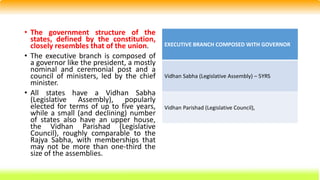
• The government structure of the
states, defined by the constitution,
closely resembles that of the union.
• The executive branch is composed of
a governor like the president, a mostly
nominal and ceremonial post and a
council of ministers, led by the chief
minister.
• All states have a Vidhan Sabha
(Legislative Assembly), popularly
elected for terms of up to five years,
while a small (and declining) number
of states also have an upper house,
the Vidhan Parishad (Legislative
Council), roughly comparable to the
Rajya Sabha, with memberships that
may not be more than one-third the
size of the assemblies.
EXECUTIVE BRANCH COMPOSED WITH GOVERNOR
Vidhan Sabha (Legislative Assembly) – 5YRS
Vidhan Parishad (Legislative Council),
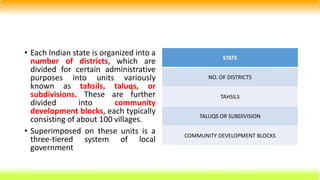
• Each Indian state is organized into a
number of districts, which are
divided for certain administrative
purposes into units variously
known as tahsils, taluqs, or
subdivisions. These are further
divided into community
development blocks, each typically
consisting of about 100 villages.
• Superimposed on these units is a
three-tiered system of local
government
STATE
NO. OF DISTRICTS
TAHSILS
TALUQS OR SUBDIVISION
COMMUNITY DEVELOPMENT BLOCKS
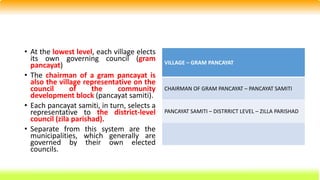
• At the lowest level, each village elects
its own governing council (gram
pancayat)
• The chairman of a gram pancayat is
also the village representative on the
council of the community
development block (pancayat samiti).
• Each pancayat samiti, in turn, selects a
representative to the district-level
council (zila parishad).
• Separate from this system are the
municipalities, which generally are
governed by their own elected
councils.
VILLAGE – GRAM PANCAYAT
CHAIRMAN OF GRAM PANCAYAT – PANCAYAT SAMITI
PANCAYAT SAMITI – DISTRRICT LEVEL – ZILLA PARISHAD
Unit III
Governments of the States and
Local Government
The state executive: General structure – Governor – Council of
ministers – State legislature. Local government - Panchayat –
Municipality– Power authority and responsibilities municipalities.
Structure of the state government
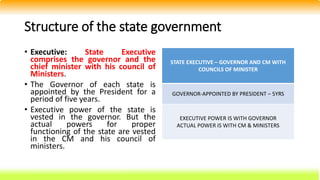
• Executive: State Executive
comprises the governor and the
chief minister with his council of
Ministers.
• The Governor of each state is
appointed by the President for a
period of five years.
• Executive power of the state is
vested in the governor. But the
actual powers for proper
functioning of the state are vested
in the CM and his council of
ministers.
STATE EXECUTIVE – GOVERNOR AND CM WITH
COUNCILS OF MINISTER
GOVERNOR-APPOINTED BY PRESIDENT – 5YRS
EXECUTIVE POWER IS WITH GOVERNOR
ACTUAL POWER IS WITH CM & MINISTERS
• Judiciary:
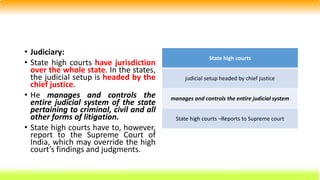
• State high courts have jurisdiction
over the whole state. In the states,
the judicial setup is headed by the
chief justice.
• He manages and controls the
entire judicial system of the state
pertaining to criminal, civil and all
other forms of litigation.
• State high courts have to, however,
report to the Supreme Court of
India, which may override the high
court’s findings and judgments.
State high courts
judicial setup headed by chief justice
manages and controls the entire judicial system
State high courts –Reports to Supreme court
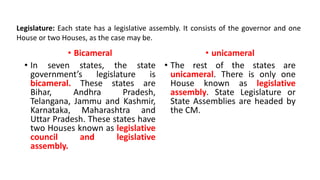
• Bicameral
• In seven states, the state
government’s legislature is
bicameral. These states are
Bihar, Andhra Pradesh,
Telangana, Jammu and Kashmir,
Karnataka, Maharashtra and
Uttar Pradesh. These states have
two Houses known as legislative
council and legislative
assembly.
• unicameral
• The rest of the states are
unicameral. There is only one
House known as legislative
assembly. State Legislature or
State Assemblies are headed by
the CM.
Legislature: Each state has a legislative assembly. It consists of the governor and one
House or two Houses, as the case may be.
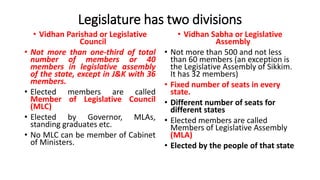
Legislature has two divisions
• Vidhan Parishad or Legislative
Council
• Not more than one-third of total
number of members or 40
members in legislative assembly
of the state, except in J&K with 36
members.
• Elected members are called
Member of Legislative Council
(MLC)
• Elected by Governor, MLAs,
standing graduates etc.
• No MLC can be member of Cabinet
of Ministers.
• Vidhan Sabha or Legislative
Assembly
• Not more than 500 and not less
than 60 members (an exception is
the Legislative Assembly of Sikkim.
It has 32 members)
• Fixed number of seats in every
state.
• Different number of seats for
different states
• Elected members are called
Members of Legislative Assembly
(MLA)
• Elected by the people of that state
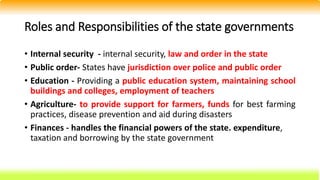
Roles and Responsibilities of the state governments
• Internal security - internal security, law and order in the state
• Public order- States have jurisdiction over police and public order
• Education - Providing a public education system, maintaining school
buildings and colleges, employment of teachers
• Agriculture- to provide support for farmers, funds for best farming
practices, disease prevention and aid during disasters
• Finances - handles the financial powers of the state. expenditure,
taxation and borrowing by the state government
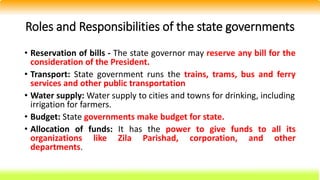
Roles and Responsibilities of the state governments
• Reservation of bills - The state governor may reserve any bill for the
consideration of the President.
• Transport: State government runs the trains, trams, bus and ferry
services and other public transportation
• Water supply: Water supply to cities and towns for drinking, including
irrigation for farmers.
• Budget: State governments make budget for state.
• Allocation of funds: It has the power to give funds to all its
organizations like Zila Parishad, corporation, and other
departments.
Structure
• There are generally three basic models for the organization of a
governor’s office
• Strict Hierarchy – All staff report to the governor through the chief of staff.
• Limited Hierarchy – The chief of staff serves as primary coordinator but one
or more other senior staff have direct access to the governor in specific
areas of responsibility.
• “Spokes of the Wheel” – Several senior staff members report directly to the
governor and the governor provides detailed direction and coordination as
needed.
Functions
• State-by-state differences notwithstanding, there is a common set of
functions that support each governor, including
• policy development,
• legal counsel,
• legislative relations,
• communications,
• appointments,
• Scheduling,
• intergovernmental relations,
• emergency management/homeland security,
• and administrative support
• for the governor and his or her spouse
In Relation to the Council of Ministers
• The Chief Minister is the head of state council of ministers. He
performs the following functions:
1. He recommends to the governor on who to appoint as ministers
2. He designates or reshuffles the portfolios of the ministers
3. He can ask a minister to resign
4. Meeting of the council of ministers is headed by him
5. All activities of the ministers are guided and controlled by the Chief
Minister
6. If he resigns, the entire council of ministers collapses.
In Relation to the Governor
• 1. All the activities, decisions that are taken up by the council of ministers
are communicated to the governor by the chief minister
• 2. To report to the governor, information about the administrative affairs
if and when asked by the governor
• 3. If any minister has decided on any issue, the same has to be reported to
the Governor by the Chief Minister when the same has not been
considered by the council.
• 4. He gives his advice to the governor for the appointment of the following
persons:
• Advocate-General
• Chairman of state public service commission
• The state election commission, etc.
In Relation to the State Legislature
• 1. Before a governor prorogues and summons the sessions of the
state legislature, the Chief Minister’s advice is a must
• 2. Legislative Assembly can be dissolved at any time on his
recommendation to the governor
• 3. All government policies are announced by him on the floor of the
house
Composition of Council of Ministers
• The size of the council is not mentioned in the Indian Constitution.
Chief Minister decides the size and the rank of the ministers as per
the requirement in the State Legislature.
• There are three categories of Council of Ministers:
1. Cabinet Ministers
2. Ministers of State
3. Deputy Ministers
Unit III
Governments of the States and
Local Government
The state executive: General structure – Governor – Council of ministers
– State legislature. Local government - Panchayat –Municipality– Power
authority and responsibilities municipalities.
• Local governments generally include two tiers: counties, also known
as boroughs in Alaska and parishes in Louisiana, and municipalities,
or cities/towns.
• In some States, counties are divided into townships.
• Municipalities can be structured in many ways, as defined by State
constitutions, and are called, variously, townships, villages, boroughs,
cities, or towns.
• Various kinds of districts also provide functions in local government
outside county or municipal boundaries, such as school districts or fire
protection districts.
• Municipal governments—those defined as cities, towns, boroughs
(except in Alaska), villages, and townships—are generally organized
around a population center and in most cases correspond to the
geographical designations used by the United States Census Bureau
for reporting of housing and population statistics.
• Municipalities generally
• take responsibility for parks and recreation services,
• Police and fire departments,
• Housing services,
• Emergency medical services,
• Municipal courts,
• Transportation services (including public transportation),
• and public works (streets, sewers, snow removal, signage, and so forth).
Types of Local Governments
• Counties. - Counties are usually the largest political subdivisions,
and their primary function is to administer state laws within their
borders.
• other duties, they keep the peace, maintain jails, collect taxes, build and
repair roads and bridges, and record deeds, marriages, and deaths.
• Elected officials called Supervisors or Commissioners
• Townships. - These units of government do not exist in about half
the states, and they have different responsibilities in those that have
them.
• A township may simply be another name for a town or city, or it may be a
subdivision of a county.
Special Districts
• These units of government have special functions. The best known
example is the local school district, but other types are growing in
numbers, especially in heavily populated areas where county and city
governments may be overloaded with work.
Municipalities
• City, town, or borough governments get their authority to rule only as
it is granted by the state.
• Today about 80% of the American population lives in municipalities,
and municipal governments affect the lives of many citizens.
• Municipalities may have elected mayors, or they may be managed by
appointed city managers.
THE PANCHAYATS
• a. “district” means a district in a State;
• b. “Gram Sabha” means a body consisting of persons registered in the
electoral rolls relating to a village comprised within the area of
Panchayat at the village level;
• c. “intermediate level” means a level between the village and district
levels specified by the Governor of a State by public notification to be
the intermediate level for the purposes of this Part;
• d. “Panchayat” means an institution of self-government constituted
under article 243B, for the rural areas;
• e. “Panchayat area” means the territorial area of a Panchayat;
• f. “Population” means the population as ascertained at the last
preceding census of which the relevant figures have been published;
• g. “village” means a village specified by the Governor by public
notification to be a village for the purposes of this Part and includes a
group of villages so specified.
Gram Sabha.
• A Gram Sabha may exercise such powers and perform such functions
at the village level as the Legislature of a State may, by law, provide.
Constitution of Panchayats.
• (1) There shall be constituted in every State, Panchayats at the village,
intermediate and district levels in accordance with the provisions of
this Part.
• (2) Notwithstanding anything in clause
• (3) Panchayats at the intermediate level may not be constituted in a
State having a population not exceeding twenty lakhs.
Composition of Panchayats
• a) Subject to the provisions of this Part, the Legislature of a State
may, by law, make provisions with respect to the composition of
Panchayats:
• Provided that the ratio between the population of the territorial area of a
Panchayat at any level and the number of seats in such Panchayat to be filled
by election shall, so far as practicable, be the same throughout the State.
• b) All the seats in a Panchayat shall be filled by persons chosen by
direct election from territorial constituencies in the Panchayat area
and, for this purpose, each Panchayat area shall be divided into
territorial constituencies in such manner that the ratio between the
population of each constituency and the number of seats allotted.
• (4) The Chairperson of a Panchayat and other members of a
Panchayat whether or not chosen by direct election from territorial
constituencies in the Panchayat area shall have the right to vote in
the meetings of the Panchayats.
• 5) The Chairperson of
• (a) a panchayat at the village level shall be elected in such manner as the
Legislature of a State may, by law, provide; and
• (b) a Panchayat at the intermediate level or district level shall be elected by,
and from amongst, the elected members thereof.
Disqualifications for membership
• (1) A person shall be disqualified for being chosen as, and for being, a
member of a Panchayat
• (a) if he is so disqualified by or under any law for the time being in force for
the purposes of elections to the Legislature of the State concerned: Provided
that no person shall be disqualified on the ground that he is less than twenty-
five years of age, if he has attained the age of twenty-one years;
• (b) if he is so disqualified by or under any law made by the Legislature of the
State.
• (2) If any question arises as to whether a member of a Panchayat has
become subject to any of the disqualifications mentioned in clause(1),
the question shall be referred for the decision of such authority and
in such manner as the Legislature of a State may, by law, provide.
Powers to impose taxes by, and Funds of, the
Panchayats.—The Legislature of a State may, by
law,—
• (a) Authorise a Panchayat to levy, collect and appropriate such taxes, duties,
tolls and fees in accordance with such procedure and subject to such limits;
• (b) Assign to a Panchayat such taxes, duties, tolls and fees levied and collected by
the State Government for such purposes and subject to such conditions and
limits;
• (c) Provide for making such grants-in-aid to the Panchayats from the Consolidated
Fund of the State; and
• (d) Provide for constitution of such Funds for crediting all moneys received,
respectively, by or on behalf of the Panchayats and also for the withdrawal of
such moneys therefrom, as may be specified in the law.
• 243J. Audit of accounts of Panchayats
• The Legislature of a State may, by law, make provisions with respect to the
maintenance of accounts by the Panchayats and the auditing of such
accounts.
• 243K. Elections to the Panchayats
Unit III
Governments of the States and
Local Government
The state executive: General structure – Governor – Council of ministers
– State legislature. Local government - Panchayat –Municipality– Power
authority and responsibilities municipalities.
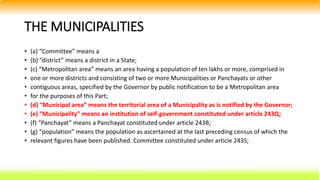
THE MUNICIPALITIES
• (a) “Committee” means a
• (b) “district” means a district in a State;
• (c) “Metropolitan area” means an area having a population of ten lakhs or more, comprised in
• one or more districts and consisting of two or more Municipalities or Panchayats or other
• contiguous areas, specified by the Governor by public notification to be a Metropolitan area
• for the purposes of this Part;
• (d) “Municipal area” means the territorial area of a Municipality as is notified by the Governor;
• (e) “Municipality” means an institution of self-government constituted under article 243Q;
• (f) “Panchayat” means a Panchayat constituted under article 243B;
• (g) “population” means the population as ascertained at the last preceding census of which the
• relevant figures have been published. Committee constituted under article 243S;
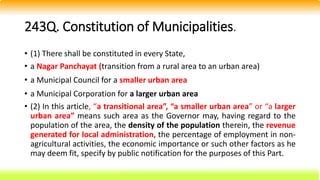
243Q. Constitution of Municipalities.
• (1) There shall be constituted in every State,
• a Nagar Panchayat (transition from a rural area to an urban area)
• a Municipal Council for a smaller urban area
• a Municipal Corporation for a larger urban area
• (2) In this article, “a transitional area”, “a smaller urban area” or “a larger
urban area” means such area as the Governor may, having regard to the
population of the area, the density of the population therein, the revenue
generated for local administration, the percentage of employment in non-
agricultural activities, the economic importance or such other factors as he
may deem fit, specify by public notification for the purposes of this Part.
243 R. Composition of Municipalities
• A)
• (a) The Legislature of a State may, by law, provide
• (b) for the representation - special knowledge or experience in Municipal
administration;
• (c) The members of the House of the People and the members of the
Legislative Assembly of the.
• B)
• b) State representing constituencies which comprise wholly or partly
the Municipal area;
• C)The members of the Council of States and the members of the
Legislative Council of the State registered as electors within the
Municipal area;
243S. Constitution and composition of Wards
Committees, etc.
• (1) There shall be constituted Wards Committees, consisting of one
or more wards, within the territorial area of a Municipality having a
population of three lakhs or more
• (2) The Legislature of a State may, by law, make provision with respect
to
• (a) the composition and the territorial area of a Wards Committee;
• (b) the manner in which the seats in a Wards Committee shall be filled.
• (3) A member of a Municipality representing a ward within the
territorial area of the Wards
• Committee shall be a member of that Committee
• (4) Where a Wards Committee consists of
• (a) one ward, the member representing that ward in the Municipality; or
• (b) two or more wards, one of the members representing such wards in the
Municipality elected by the members of the Wards Committee, shall be the
Chairperson of that Committee.
243T. Reservation of seats.
• (1) Seats shall be reserved for the Scheduled Castes and the
Scheduled Tribes in every Municipality and the number of seats so
reserved shall bear.
• (2) Not less than one-third of the total number of seats reserved
under clause (1) shall be reserved for women belonging to the
Scheduled Castes or, as the case may be, the Scheduled Tribes.
• (3) Not less than one-third (including the number of seats reserved
for women belonging to the Scheduled Castes and the Scheduled
Tribes) of the total number of seats to be filled by direct election
• (4) The offices of Chairpersons in the Municipalities shall be
reserved for the Scheduled Castes, the Scheduled Tribes and women
in such manner as the Legislature of a State may, by law, provide.
243U. Duration of Municipalities, etc.
• (1) Every Municipality, unless sooner dissolved under any law for the
time being in force, shall continue for five years from the date
appointed for its first meeting and no longer:
• (2) No amendment of any law for the time being in force shall have
the effect of causing dissolution of a Municipality at any level, which
is functioning immediately before such amendment, till the
expiration of its duration specified in clause (1).
• (3) An election to constitute a Municipality shall be completed,—
• (a) before the expiry of its duration specified in clause (1);
• (b) before the expiration of a period of six months from the date of its
dissolution:
243W. Powers, authority and responsibilities of Municipalities,
etc.—Subject to the provisions of this Constitution, the
Legislature of a State may, by law, endow—
• (a) the Municipalities with such powers and authority as may be
necessary to enable them to function as institutions of self-
government and such law may contain provisions for the devolution
of powers and responsibilities upon Municipalities, subject to such
conditions as may be specified therein, with respect to
• (i) the preparation of plans for economic development and social justice;
• (ii) the performance of functions and the implementation of schemes as may
be entrusted
243X. Power to impose taxes by, and Funds of, the
Municipalities.—The Legislature of a State may, by law,—
• (a) authorise a Municipality to levy, collect and appropriate such
taxes, duties, tolls and fees in accordance with such procedure and
subject to such limits;
• (b) assign to a Municipality such taxes, duties, tolls and fees levied
and collected by the State Government for such purposes and
subject to such conditions and limits;
243Y. Finance Commission.
• (1) The Finance Commission constituted under article 243-I shall also
review the financial position of the Municipalities and make
recommendations to the Governor
243Z. Audit of accounts of Municipalities.
• The Legislature of a State may, by law, make provisions with respect
to the maintenance of accounts by the Municipalities and the
auditing of such accounts
243ZA. Elections to the Municipalities.
• (1) The superintendence, direction and control of the preparation of
electoral rolls for, and the conduct of, all elections to the
Municipalities shall be vested in the State Election Commission
referred to in article 243K.
• (2) Subject to the provisions of this Constitution, the Legislature of a
State may, by law, make provision with respect to all matters relating
to, or in connection with, elections to the Municipalities.
END OF UNIT 3
THANK YOU

UNIT 3.pptx

  • 1.
    Unit III Governments ofthe States and Local Government The state executive: General structure – Governor – Council of ministers – State legislature. Local government - Panchayat –Municipality– Power authority and responsibilities municipalities.
  • 2.
    • The governmentstructure of the states, defined by the constitution, closely resembles that of the union. • The executive branch is composed of a governor like the president, a mostly nominal and ceremonial post and a council of ministers, led by the chief minister. • All states have a Vidhan Sabha (Legislative Assembly), popularly elected for terms of up to five years, while a small (and declining) number of states also have an upper house, the Vidhan Parishad (Legislative Council), roughly comparable to the Rajya Sabha, with memberships that may not be more than one-third the size of the assemblies. EXECUTIVE BRANCH COMPOSED WITH GOVERNOR Vidhan Sabha (Legislative Assembly) – 5YRS Vidhan Parishad (Legislative Council),
  • 3.
    • Each Indianstate is organized into a number of districts, which are divided for certain administrative purposes into units variously known as tahsils, taluqs, or subdivisions. These are further divided into community development blocks, each typically consisting of about 100 villages. • Superimposed on these units is a three-tiered system of local government STATE NO. OF DISTRICTS TAHSILS TALUQS OR SUBDIVISION COMMUNITY DEVELOPMENT BLOCKS
  • 4.
    • At thelowest level, each village elects its own governing council (gram pancayat) • The chairman of a gram pancayat is also the village representative on the council of the community development block (pancayat samiti). • Each pancayat samiti, in turn, selects a representative to the district-level council (zila parishad). • Separate from this system are the municipalities, which generally are governed by their own elected councils. VILLAGE – GRAM PANCAYAT CHAIRMAN OF GRAM PANCAYAT – PANCAYAT SAMITI PANCAYAT SAMITI – DISTRRICT LEVEL – ZILLA PARISHAD
  • 5.
    Unit III Governments ofthe States and Local Government The state executive: General structure – Governor – Council of ministers – State legislature. Local government - Panchayat – Municipality– Power authority and responsibilities municipalities.
  • 6.
    Structure of thestate government • Executive: State Executive comprises the governor and the chief minister with his council of Ministers. • The Governor of each state is appointed by the President for a period of five years. • Executive power of the state is vested in the governor. But the actual powers for proper functioning of the state are vested in the CM and his council of ministers. STATE EXECUTIVE – GOVERNOR AND CM WITH COUNCILS OF MINISTER GOVERNOR-APPOINTED BY PRESIDENT – 5YRS EXECUTIVE POWER IS WITH GOVERNOR ACTUAL POWER IS WITH CM & MINISTERS
  • 7.
    • Judiciary: • Statehigh courts have jurisdiction over the whole state. In the states, the judicial setup is headed by the chief justice. • He manages and controls the entire judicial system of the state pertaining to criminal, civil and all other forms of litigation. • State high courts have to, however, report to the Supreme Court of India, which may override the high court’s findings and judgments. State high courts judicial setup headed by chief justice manages and controls the entire judicial system State high courts –Reports to Supreme court
  • 8.
    • Bicameral • Inseven states, the state government’s legislature is bicameral. These states are Bihar, Andhra Pradesh, Telangana, Jammu and Kashmir, Karnataka, Maharashtra and Uttar Pradesh. These states have two Houses known as legislative council and legislative assembly. • unicameral • The rest of the states are unicameral. There is only one House known as legislative assembly. State Legislature or State Assemblies are headed by the CM. Legislature: Each state has a legislative assembly. It consists of the governor and one House or two Houses, as the case may be.
  • 9.
    Legislature has twodivisions • Vidhan Parishad or Legislative Council • Not more than one-third of total number of members or 40 members in legislative assembly of the state, except in J&K with 36 members. • Elected members are called Member of Legislative Council (MLC) • Elected by Governor, MLAs, standing graduates etc. • No MLC can be member of Cabinet of Ministers. • Vidhan Sabha or Legislative Assembly • Not more than 500 and not less than 60 members (an exception is the Legislative Assembly of Sikkim. It has 32 members) • Fixed number of seats in every state. • Different number of seats for different states • Elected members are called Members of Legislative Assembly (MLA) • Elected by the people of that state
  • 10.
    Roles and Responsibilitiesof the state governments • Internal security - internal security, law and order in the state • Public order- States have jurisdiction over police and public order • Education - Providing a public education system, maintaining school buildings and colleges, employment of teachers • Agriculture- to provide support for farmers, funds for best farming practices, disease prevention and aid during disasters • Finances - handles the financial powers of the state. expenditure, taxation and borrowing by the state government
  • 11.
    Roles and Responsibilitiesof the state governments • Reservation of bills - The state governor may reserve any bill for the consideration of the President. • Transport: State government runs the trains, trams, bus and ferry services and other public transportation • Water supply: Water supply to cities and towns for drinking, including irrigation for farmers. • Budget: State governments make budget for state. • Allocation of funds: It has the power to give funds to all its organizations like Zila Parishad, corporation, and other departments.
  • 12.
    Structure • There aregenerally three basic models for the organization of a governor’s office • Strict Hierarchy – All staff report to the governor through the chief of staff. • Limited Hierarchy – The chief of staff serves as primary coordinator but one or more other senior staff have direct access to the governor in specific areas of responsibility. • “Spokes of the Wheel” – Several senior staff members report directly to the governor and the governor provides detailed direction and coordination as needed.
  • 13.
    Functions • State-by-state differencesnotwithstanding, there is a common set of functions that support each governor, including • policy development, • legal counsel, • legislative relations, • communications, • appointments, • Scheduling, • intergovernmental relations, • emergency management/homeland security, • and administrative support • for the governor and his or her spouse
  • 14.
    In Relation tothe Council of Ministers • The Chief Minister is the head of state council of ministers. He performs the following functions: 1. He recommends to the governor on who to appoint as ministers 2. He designates or reshuffles the portfolios of the ministers 3. He can ask a minister to resign 4. Meeting of the council of ministers is headed by him 5. All activities of the ministers are guided and controlled by the Chief Minister 6. If he resigns, the entire council of ministers collapses.
  • 15.
    In Relation tothe Governor • 1. All the activities, decisions that are taken up by the council of ministers are communicated to the governor by the chief minister • 2. To report to the governor, information about the administrative affairs if and when asked by the governor • 3. If any minister has decided on any issue, the same has to be reported to the Governor by the Chief Minister when the same has not been considered by the council. • 4. He gives his advice to the governor for the appointment of the following persons: • Advocate-General • Chairman of state public service commission • The state election commission, etc.
  • 16.
    In Relation tothe State Legislature • 1. Before a governor prorogues and summons the sessions of the state legislature, the Chief Minister’s advice is a must • 2. Legislative Assembly can be dissolved at any time on his recommendation to the governor • 3. All government policies are announced by him on the floor of the house
  • 17.
    Composition of Councilof Ministers • The size of the council is not mentioned in the Indian Constitution. Chief Minister decides the size and the rank of the ministers as per the requirement in the State Legislature. • There are three categories of Council of Ministers: 1. Cabinet Ministers 2. Ministers of State 3. Deputy Ministers
  • 18.
    Unit III Governments ofthe States and Local Government The state executive: General structure – Governor – Council of ministers – State legislature. Local government - Panchayat –Municipality– Power authority and responsibilities municipalities.
  • 19.
    • Local governmentsgenerally include two tiers: counties, also known as boroughs in Alaska and parishes in Louisiana, and municipalities, or cities/towns. • In some States, counties are divided into townships. • Municipalities can be structured in many ways, as defined by State constitutions, and are called, variously, townships, villages, boroughs, cities, or towns. • Various kinds of districts also provide functions in local government outside county or municipal boundaries, such as school districts or fire protection districts.
  • 20.
    • Municipal governments—thosedefined as cities, towns, boroughs (except in Alaska), villages, and townships—are generally organized around a population center and in most cases correspond to the geographical designations used by the United States Census Bureau for reporting of housing and population statistics. • Municipalities generally • take responsibility for parks and recreation services, • Police and fire departments, • Housing services, • Emergency medical services, • Municipal courts, • Transportation services (including public transportation), • and public works (streets, sewers, snow removal, signage, and so forth).
  • 21.
    Types of LocalGovernments • Counties. - Counties are usually the largest political subdivisions, and their primary function is to administer state laws within their borders. • other duties, they keep the peace, maintain jails, collect taxes, build and repair roads and bridges, and record deeds, marriages, and deaths. • Elected officials called Supervisors or Commissioners • Townships. - These units of government do not exist in about half the states, and they have different responsibilities in those that have them. • A township may simply be another name for a town or city, or it may be a subdivision of a county.
  • 22.
    Special Districts • Theseunits of government have special functions. The best known example is the local school district, but other types are growing in numbers, especially in heavily populated areas where county and city governments may be overloaded with work.
  • 23.
    Municipalities • City, town,or borough governments get their authority to rule only as it is granted by the state. • Today about 80% of the American population lives in municipalities, and municipal governments affect the lives of many citizens. • Municipalities may have elected mayors, or they may be managed by appointed city managers.
  • 24.
    THE PANCHAYATS • a.“district” means a district in a State; • b. “Gram Sabha” means a body consisting of persons registered in the electoral rolls relating to a village comprised within the area of Panchayat at the village level; • c. “intermediate level” means a level between the village and district levels specified by the Governor of a State by public notification to be the intermediate level for the purposes of this Part; • d. “Panchayat” means an institution of self-government constituted under article 243B, for the rural areas;
  • 25.
    • e. “Panchayatarea” means the territorial area of a Panchayat; • f. “Population” means the population as ascertained at the last preceding census of which the relevant figures have been published; • g. “village” means a village specified by the Governor by public notification to be a village for the purposes of this Part and includes a group of villages so specified.
  • 26.
    Gram Sabha. • AGram Sabha may exercise such powers and perform such functions at the village level as the Legislature of a State may, by law, provide.
  • 27.
    Constitution of Panchayats. •(1) There shall be constituted in every State, Panchayats at the village, intermediate and district levels in accordance with the provisions of this Part. • (2) Notwithstanding anything in clause • (3) Panchayats at the intermediate level may not be constituted in a State having a population not exceeding twenty lakhs.
  • 28.
    Composition of Panchayats •a) Subject to the provisions of this Part, the Legislature of a State may, by law, make provisions with respect to the composition of Panchayats: • Provided that the ratio between the population of the territorial area of a Panchayat at any level and the number of seats in such Panchayat to be filled by election shall, so far as practicable, be the same throughout the State. • b) All the seats in a Panchayat shall be filled by persons chosen by direct election from territorial constituencies in the Panchayat area and, for this purpose, each Panchayat area shall be divided into territorial constituencies in such manner that the ratio between the population of each constituency and the number of seats allotted.
  • 29.
    • (4) TheChairperson of a Panchayat and other members of a Panchayat whether or not chosen by direct election from territorial constituencies in the Panchayat area shall have the right to vote in the meetings of the Panchayats. • 5) The Chairperson of • (a) a panchayat at the village level shall be elected in such manner as the Legislature of a State may, by law, provide; and • (b) a Panchayat at the intermediate level or district level shall be elected by, and from amongst, the elected members thereof.
  • 30.
    Disqualifications for membership •(1) A person shall be disqualified for being chosen as, and for being, a member of a Panchayat • (a) if he is so disqualified by or under any law for the time being in force for the purposes of elections to the Legislature of the State concerned: Provided that no person shall be disqualified on the ground that he is less than twenty- five years of age, if he has attained the age of twenty-one years; • (b) if he is so disqualified by or under any law made by the Legislature of the State. • (2) If any question arises as to whether a member of a Panchayat has become subject to any of the disqualifications mentioned in clause(1), the question shall be referred for the decision of such authority and in such manner as the Legislature of a State may, by law, provide.
  • 31.
    Powers to imposetaxes by, and Funds of, the Panchayats.—The Legislature of a State may, by law,— • (a) Authorise a Panchayat to levy, collect and appropriate such taxes, duties, tolls and fees in accordance with such procedure and subject to such limits; • (b) Assign to a Panchayat such taxes, duties, tolls and fees levied and collected by the State Government for such purposes and subject to such conditions and limits; • (c) Provide for making such grants-in-aid to the Panchayats from the Consolidated Fund of the State; and • (d) Provide for constitution of such Funds for crediting all moneys received, respectively, by or on behalf of the Panchayats and also for the withdrawal of such moneys therefrom, as may be specified in the law.
  • 32.
    • 243J. Auditof accounts of Panchayats • The Legislature of a State may, by law, make provisions with respect to the maintenance of accounts by the Panchayats and the auditing of such accounts. • 243K. Elections to the Panchayats
  • 33.
    Unit III Governments ofthe States and Local Government The state executive: General structure – Governor – Council of ministers – State legislature. Local government - Panchayat –Municipality– Power authority and responsibilities municipalities.
  • 34.
    THE MUNICIPALITIES • (a)“Committee” means a • (b) “district” means a district in a State; • (c) “Metropolitan area” means an area having a population of ten lakhs or more, comprised in • one or more districts and consisting of two or more Municipalities or Panchayats or other • contiguous areas, specified by the Governor by public notification to be a Metropolitan area • for the purposes of this Part; • (d) “Municipal area” means the territorial area of a Municipality as is notified by the Governor; • (e) “Municipality” means an institution of self-government constituted under article 243Q; • (f) “Panchayat” means a Panchayat constituted under article 243B; • (g) “population” means the population as ascertained at the last preceding census of which the • relevant figures have been published. Committee constituted under article 243S;
  • 35.
    243Q. Constitution ofMunicipalities. • (1) There shall be constituted in every State, • a Nagar Panchayat (transition from a rural area to an urban area) • a Municipal Council for a smaller urban area • a Municipal Corporation for a larger urban area • (2) In this article, “a transitional area”, “a smaller urban area” or “a larger urban area” means such area as the Governor may, having regard to the population of the area, the density of the population therein, the revenue generated for local administration, the percentage of employment in non- agricultural activities, the economic importance or such other factors as he may deem fit, specify by public notification for the purposes of this Part.
  • 36.
    243 R. Compositionof Municipalities • A) • (a) The Legislature of a State may, by law, provide • (b) for the representation - special knowledge or experience in Municipal administration; • (c) The members of the House of the People and the members of the Legislative Assembly of the.
  • 37.
    • B) • b)State representing constituencies which comprise wholly or partly the Municipal area; • C)The members of the Council of States and the members of the Legislative Council of the State registered as electors within the Municipal area;
  • 38.
    243S. Constitution andcomposition of Wards Committees, etc. • (1) There shall be constituted Wards Committees, consisting of one or more wards, within the territorial area of a Municipality having a population of three lakhs or more • (2) The Legislature of a State may, by law, make provision with respect to • (a) the composition and the territorial area of a Wards Committee; • (b) the manner in which the seats in a Wards Committee shall be filled. • (3) A member of a Municipality representing a ward within the territorial area of the Wards • Committee shall be a member of that Committee
  • 39.
    • (4) Wherea Wards Committee consists of • (a) one ward, the member representing that ward in the Municipality; or • (b) two or more wards, one of the members representing such wards in the Municipality elected by the members of the Wards Committee, shall be the Chairperson of that Committee.
  • 40.
    243T. Reservation ofseats. • (1) Seats shall be reserved for the Scheduled Castes and the Scheduled Tribes in every Municipality and the number of seats so reserved shall bear. • (2) Not less than one-third of the total number of seats reserved under clause (1) shall be reserved for women belonging to the Scheduled Castes or, as the case may be, the Scheduled Tribes. • (3) Not less than one-third (including the number of seats reserved for women belonging to the Scheduled Castes and the Scheduled Tribes) of the total number of seats to be filled by direct election
  • 41.
    • (4) Theoffices of Chairpersons in the Municipalities shall be reserved for the Scheduled Castes, the Scheduled Tribes and women in such manner as the Legislature of a State may, by law, provide.
  • 42.
    243U. Duration ofMunicipalities, etc. • (1) Every Municipality, unless sooner dissolved under any law for the time being in force, shall continue for five years from the date appointed for its first meeting and no longer: • (2) No amendment of any law for the time being in force shall have the effect of causing dissolution of a Municipality at any level, which is functioning immediately before such amendment, till the expiration of its duration specified in clause (1). • (3) An election to constitute a Municipality shall be completed,— • (a) before the expiry of its duration specified in clause (1); • (b) before the expiration of a period of six months from the date of its dissolution:
  • 43.
    243W. Powers, authorityand responsibilities of Municipalities, etc.—Subject to the provisions of this Constitution, the Legislature of a State may, by law, endow— • (a) the Municipalities with such powers and authority as may be necessary to enable them to function as institutions of self- government and such law may contain provisions for the devolution of powers and responsibilities upon Municipalities, subject to such conditions as may be specified therein, with respect to • (i) the preparation of plans for economic development and social justice; • (ii) the performance of functions and the implementation of schemes as may be entrusted
  • 44.
    243X. Power toimpose taxes by, and Funds of, the Municipalities.—The Legislature of a State may, by law,— • (a) authorise a Municipality to levy, collect and appropriate such taxes, duties, tolls and fees in accordance with such procedure and subject to such limits; • (b) assign to a Municipality such taxes, duties, tolls and fees levied and collected by the State Government for such purposes and subject to such conditions and limits;
  • 45.
    243Y. Finance Commission. •(1) The Finance Commission constituted under article 243-I shall also review the financial position of the Municipalities and make recommendations to the Governor
  • 46.
    243Z. Audit ofaccounts of Municipalities. • The Legislature of a State may, by law, make provisions with respect to the maintenance of accounts by the Municipalities and the auditing of such accounts
  • 47.
    243ZA. Elections tothe Municipalities. • (1) The superintendence, direction and control of the preparation of electoral rolls for, and the conduct of, all elections to the Municipalities shall be vested in the State Election Commission referred to in article 243K. • (2) Subject to the provisions of this Constitution, the Legislature of a State may, by law, make provision with respect to all matters relating to, or in connection with, elections to the Municipalities.
  • 49.
    END OF UNIT3 THANK YOU

Editor's Notes

  • #3 The executive branch is composed of a governor like the president, a mostly nominal and ceremonial post and a council of ministers, led by the chief minister.