1858 Act
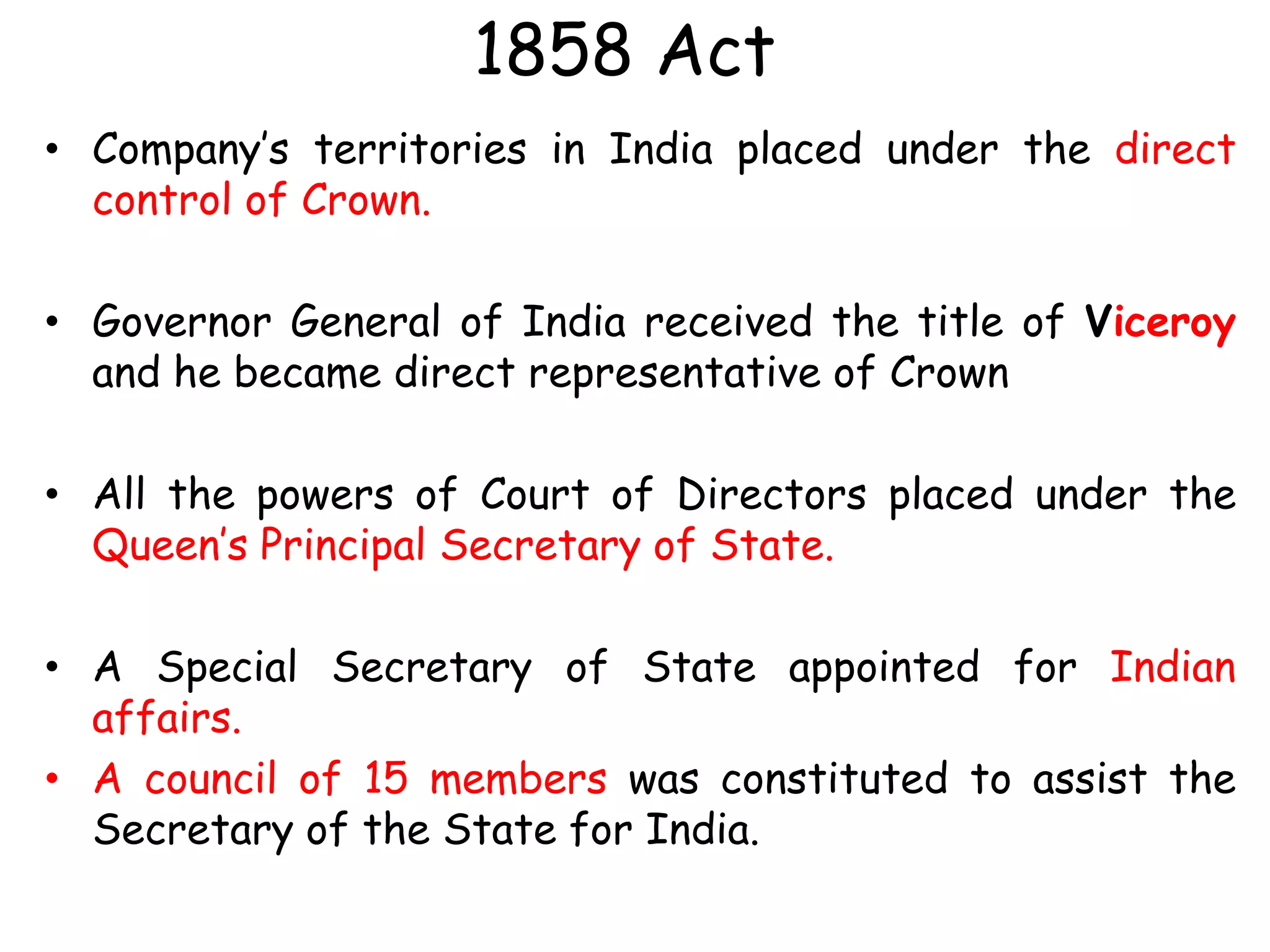
• Company’s territories in India placed under the direct
control of Crown.
• Governor General of India received the title of Viceroy
and he became direct representative of Crown
• All the powers of Court of Directors placed under the
Queen’s Principal Secretary of State.
• A Special Secretary of State appointed for Indian
affairs.
• A council of 15 members was constituted to assist the
Secretary of the State for India.
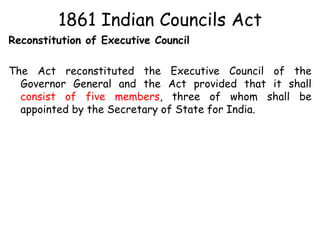
1861 Indian Councils Act
Reconstitution of Executive Council
The Act reconstituted the Executive Council of the
Governor General and the Act provided that it shall
consist of five members, three of whom shall be
appointed by the Secretary of State for India.
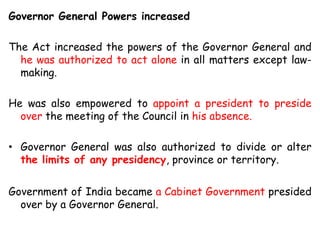
Governor General Powers increased
The Act increased the powers of the Governor General and
he was authorized to act alone in all matters except law-
making.
He was also empowered to appoint a president to preside
over the meeting of the Council in his absence.
• Governor General was also authorized to divide or alter
the limits of any presidency, province or territory.
Government of India became a Cabinet Government presided
over by a Governor General.
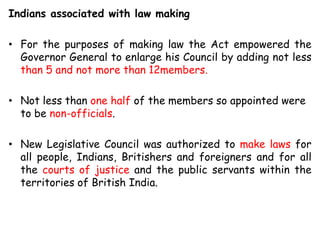
Indians associated with law making
• For the purposes of making law the Act empowered the
Governor General to enlarge his Council by adding not less
than 5 and not more than 12members.
• Not less than one half of the members so appointed were
to be non-officials.
• New Legislative Council was authorized to make laws for
all people, Indians, Britishers and foreigners and for all
the courts of justice and the public servants within the
territories of British India.
Governor General’s power to issue Ordinances
The Governor General was also empowered to issue
ordinances independently which were to remain in force
for six months unless disallowed by the crown.
Provincial Councils
The Act restored the Legislative powers of the Provincial
Legislature of Bombay and Madras.
For the purpose of making Laws the Executive Council
created with 4 to 8 members for a term of two years.
Indian High Courts Act, 1861
The Indian High Courts Act reorganized the judicial
organization in India by uniting the company’s Courts and
the King's Courts.
Three Presidency High Courts of Calcutta, Bombay, and
Madras were established in the place of old courts.

1861 act

  • 1.
    1858 Act • Company’sterritories in India placed under the direct control of Crown. • Governor General of India received the title of Viceroy and he became direct representative of Crown • All the powers of Court of Directors placed under the Queen’s Principal Secretary of State. • A Special Secretary of State appointed for Indian affairs. • A council of 15 members was constituted to assist the Secretary of the State for India.
  • 2.
    1861 Indian CouncilsAct Reconstitution of Executive Council The Act reconstituted the Executive Council of the Governor General and the Act provided that it shall consist of five members, three of whom shall be appointed by the Secretary of State for India.
  • 3.
    Governor General Powersincreased The Act increased the powers of the Governor General and he was authorized to act alone in all matters except law- making. He was also empowered to appoint a president to preside over the meeting of the Council in his absence. • Governor General was also authorized to divide or alter the limits of any presidency, province or territory. Government of India became a Cabinet Government presided over by a Governor General.
  • 4.
    Indians associated withlaw making • For the purposes of making law the Act empowered the Governor General to enlarge his Council by adding not less than 5 and not more than 12members. • Not less than one half of the members so appointed were to be non-officials. • New Legislative Council was authorized to make laws for all people, Indians, Britishers and foreigners and for all the courts of justice and the public servants within the territories of British India.
  • 5.
    Governor General’s powerto issue Ordinances The Governor General was also empowered to issue ordinances independently which were to remain in force for six months unless disallowed by the crown. Provincial Councils The Act restored the Legislative powers of the Provincial Legislature of Bombay and Madras. For the purpose of making Laws the Executive Council created with 4 to 8 members for a term of two years.
  • 6.
    Indian High CourtsAct, 1861 The Indian High Courts Act reorganized the judicial organization in India by uniting the company’s Courts and the King's Courts. Three Presidency High Courts of Calcutta, Bombay, and Madras were established in the place of old courts.