UNIT II - Random Variables Discrete Distributions Continuous Random Variables Continuous Distributions
STAT 253: Probability & Statistics
UNIT II - Random Variables
April 3, 2023
1 / 109
UNIT II - Random Variables Discrete Distributions Continuous Random Variables Continuous Distributions
Unit Objectives
This unit introduces students to concepts and computational
techniques associated with random variables. After studying this
unit students should be able to;
1 Define a random variable and distinguish between discrete and
continuous random variables
2 Define, describe and recognise probability mass functions
(pmf) and probability density functions (pdf)
3 Compute the probabilities of the various numerical values a
random variable assumes.
4 Compute numerical characteristics of a random variable
2 / 109
UNIT II - Random Variables Discrete Distributions Continuous Random Variables Continuous Distributions
Reference
Montgomery, D. and Runger, G. (2014). Applied Statistics and
Probability for Engineers, Sixth Edition. John Wiley and Sons, Inc.
3 / 109
UNIT II - Random Variables Discrete Distributions Continuous Random Variables Continuous Distributions
Random Variable
We shall not always be interested in a random experiment but
rather in some result of its outcome.
A random variable is a function that assigns a real number to
each outcome (event) in a sample space of a random experiment.
Mathematically;
X : Ω → R
Example: A fair coin is tossed twice
Ω = {HH, HT, TH, TT}
Let X be the number of heads, so that
X(HH) = 2, X(HT) = X(TH) = 1, X(TT) = 0
4 / 109
UNIT II - Random Variables Discrete Distributions Continuous Random Variables Continuous Distributions
II-1: Discrete Random Variable
A random variable is said to be discrete if takes on finite or
countably infinite set of values in R
Examples
1 The number of customers awaiting to be served at a bank
2 Number of scratches on a surface
3 Proportion of defective parts among 1000 tested
4 Number of transmitted bits received in error
5 / 109
UNIT II - Random Variables Discrete Distributions Continuous Random Variables Continuous Distributions
II-1-1: Probability Mass Function
The probability distribution of a random variable X is a description
of the probabilities associated with the possible values of X
For a discrete random variable X with possible values x1, x2, · · · , xk
a probability mass function (pmf) is a function such that
1 f (xi ) ≥ 0
2
Pk
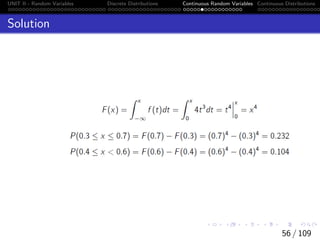
i=1 f (xi ) = 1
3 f (xi ) = P(X = xi ) ; f (x) is the probability that X = x
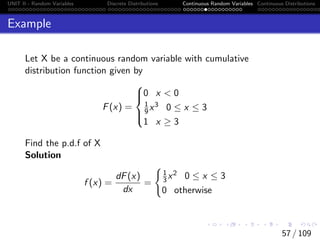
6 / 109
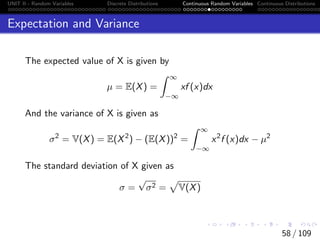
UNIT II - Random Variables Discrete Distributions Continuous Random Variables Continuous Distributions
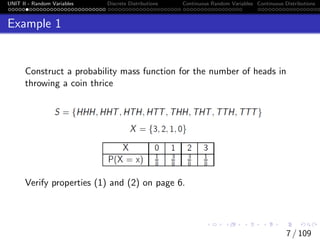
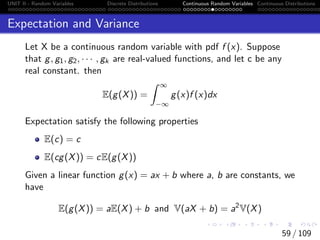
Example 1
Construct a probability mass function for the number of heads in
throwing a coin thrice
Verify properties (1) and (2) on page 6.
7 / 109
UNIT II - Random Variables Discrete Distributions Continuous Random Variables Continuous Distributions
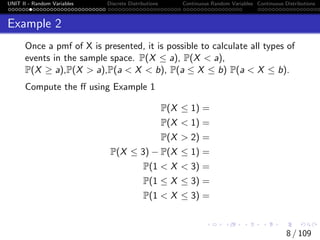
Example 2
Once a pmf of X is presented, it is possible to calculate all types of
events in the sample space. P(X ≤ a), P(X < a),
P(X ≥ a),P(X > a),P(a < X < b), P(a ≤ X ≤ b) P(a < X ≤ b).
Compute the ff using Example 1
P(X ≤ 1) =
P(X < 1) =
P(X > 2) =
P(X ≤ 3) − P(X ≤ 1) =
P(1 < X < 3) =
P(1 ≤ X ≤ 3) =
P(1 < X ≤ 3) =
8 / 109
UNIT II - Random Variables Discrete Distributions Continuous Random Variables Continuous Distributions
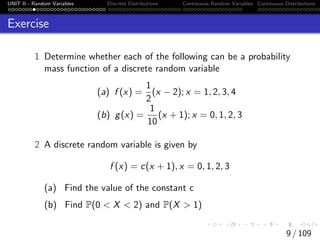
Exercise
1 Determine whether each of the following can be a probability
mass function of a discrete random variable
(a) f (x) =
1
2
(x − 2); x = 1, 2, 3, 4
(b) g(x) =
1
10
(x + 1); x = 0, 1, 2, 3
2 A discrete random variable is given by
f (x) = c(x + 1), x = 0, 1, 2, 3
(a) Find the value of the constant c
(b) Find P(0 < X < 2) and P(X > 1)
9 / 109
UNIT II - Random Variables Discrete Distributions Continuous Random Variables Continuous Distributions
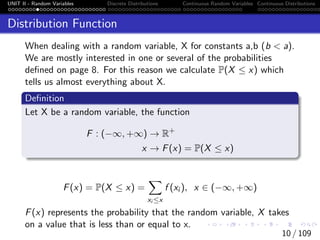
Distribution Function
When dealing with a random variable, X for constants a,b (b < a).
We are mostly interested in one or several of the probabilities
defined on page 8. For this reason we calculate P(X ≤ x) which
tells us almost everything about X.
Definition
Let X be a random variable, the function
F : (−∞, +∞) → R+
x → F(x) = P(X ≤ x)
F(x) = P(X ≤ x) =
X
xi ≤x
f (xi ), x ∈ (−∞, +∞)
F(x) represents the probability that the random variable, X takes
on a value that is less than or equal to x.
10 / 109
UNIT II - Random Variables Discrete Distributions Continuous Random Variables Continuous Distributions
Properties of the CDF
(a) F(x) is non decreasing function of x (i.e if x ≤ y, then
F(x) ≤ F(y))
(b) lim
x→∞
F(x) = F(∞) = 1
(c) lim
x→−∞
F(x) = F(−∞) = 0
(d) P(x1 < X ≤ x2) = F(x2) − F(x1)
(e) For all x ∈ R we have P[X > x] = 1 − F(x)
11 / 109
UNIT II - Random Variables Discrete Distributions Continuous Random Variables Continuous Distributions
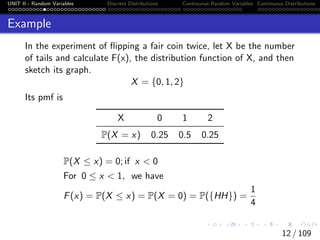
Example
In the experiment of flipping a fair coin twice, let X be the number
of tails and calculate F(x), the distribution function of X, and then
sketch its graph.
X = {0, 1, 2}
Its pmf is
X 0 1 2
P(X = x) 0.25 0.5 0.25
P(X ≤ x) = 0; if x < 0
For 0 ≤ x < 1, we have
F(x) = P(X ≤ x) = P(X = 0) = P({HH}) =
1
4
12 / 109
UNIT II - Random Variables Discrete Distributions Continuous Random Variables Continuous Distributions
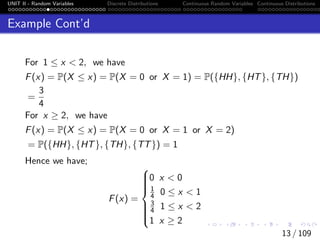
Example Cont’d
For 1 ≤ x < 2, we have
F(x) = P(X ≤ x) = P(X = 0 or X = 1) = P({HH}, {HT}, {TH})
=
3
4
For x ≥ 2, we have
F(x) = P(X ≤ x) = P(X = 0 or X = 1 or X = 2)
= P({HH}, {HT}, {TH}, {TT}) = 1
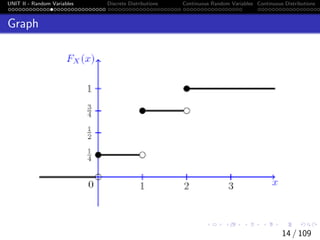
Hence we have;
F(x) =











0 x < 0
1
4 0 ≤ x < 1
3
4 1 ≤ x < 2
1 x ≥ 2
13 / 109
UNIT II - Random Variables Discrete Distributions Continuous Random Variables Continuous Distributions
Graph
14 / 109
UNIT II - Random Variables Discrete Distributions Continuous Random Variables Continuous Distributions
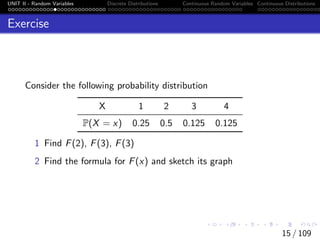
Exercise
Consider the following probability distribution
X 1 2 3 4
P(X = x) 0.25 0.5 0.125 0.125
1 Find F(2), F(3), F(3)
2 Find the formula for F(x) and sketch its graph
15 / 109
UNIT II - Random Variables Discrete Distributions Continuous Random Variables Continuous Distributions
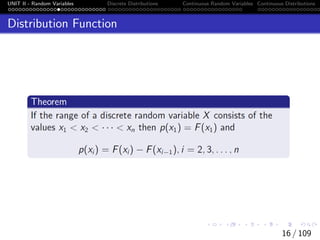
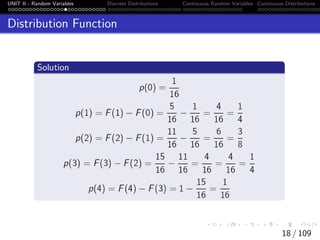
Distribution Function
16 / 109
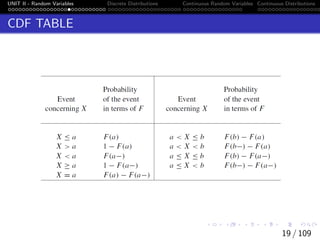
UNIT II - Random Variables Discrete Distributions Continuous Random Variables Continuous Distributions
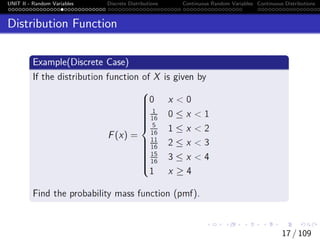
Distribution Function
17 / 109
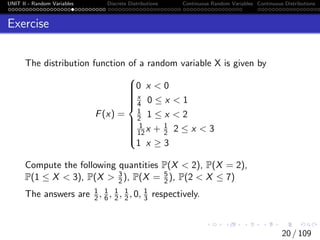
UNIT II - Random Variables Discrete Distributions Continuous Random Variables Continuous Distributions
Distribution Function
18 / 109
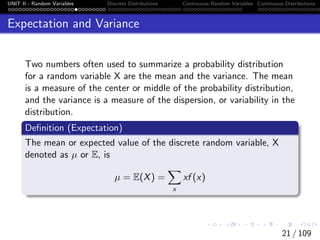
UNIT II - Random Variables Discrete Distributions Continuous Random Variables Continuous Distributions
CDF TABLE
19 / 109
UNIT II - Random Variables Discrete Distributions Continuous Random Variables Continuous Distributions
Exercise
The distribution function of a random variable X is given by
F(x) =















0 x < 0
x
4 0 ≤ x < 1
1
2 1 ≤ x < 2
1
12x + 1
2 2 ≤ x < 3
1 x ≥ 3
Compute the following quantities P(X < 2), P(X = 2),
P(1 ≤ X < 3), P(X > 3
2), P(X = 5
2), P(2 < X ≤ 7)
The answers are 1
2, 1
6, 1
2, 1
2, 0, 1
3 respectively.
20 / 109
UNIT II - Random Variables Discrete Distributions Continuous Random Variables Continuous Distributions
Expectation and Variance
Two numbers often used to summarize a probability distribution
for a random variable X are the mean and the variance. The mean
is a measure of the center or middle of the probability distribution,
and the variance is a measure of the dispersion, or variability in the
distribution.
Definition (Expectation)
The mean or expected value of the discrete random variable, X
denoted as µ or E, is
µ = E(X) =
X
x
xf (x)
21 / 109
UNIT II - Random Variables Discrete Distributions Continuous Random Variables Continuous Distributions
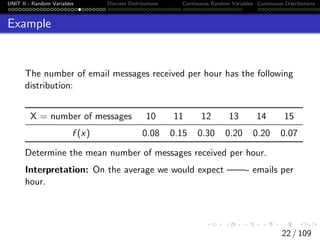
Example
The number of email messages received per hour has the following
distribution:
X = number of messages 10 11 12 13 14 15
f (x) 0.08 0.15 0.30 0.20 0.20 0.07
Determine the mean number of messages received per hour.
Interpretation: On the average we would expect ——- emails per
hour.
22 / 109
UNIT II - Random Variables Discrete Distributions Continuous Random Variables Continuous Distributions
Expectation
Let X be a discrete random variable, then for any function
g : R → R, g(X) is also a discrete random variable and has
expectation
E(g(X)) =
X
∀x
g(x)f (x) (1)
Let a be a constant, then the following properties hold;
1
E(c) = c
2
E[cg(X)] = cE[g(X)]
23 / 109
UNIT II - Random Variables Discrete Distributions Continuous Random Variables Continuous Distributions
Expectation
For linear function g(x) = ax +b where a, b are constants, we have
[3]E[g(X)] = aE(X) + b
We show proofs of [1], [2] and [3]. These rules are also applicable
if X is continuous.
24 / 109
UNIT II - Random Variables Discrete Distributions Continuous Random Variables Continuous Distributions
Example
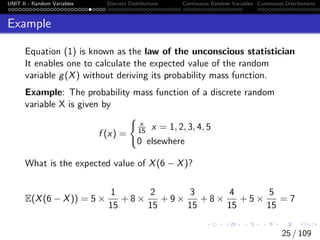
Equation (1) is known as the law of the unconscious statistician
It enables one to calculate the expected value of the random
variable g(X) without deriving its probability mass function.
Example: The probability mass function of a discrete random
variable X is given by
f (x) =
(
x
15 x = 1, 2, 3, 4, 5
0 elsewhere
What is the expected value of X(6 − X)?
E(X(6 − X)) = 5 ×
1
15
+ 8 ×
2
15
+ 9 ×
3
15
+ 8 ×
4
15
+ 5 ×
5
15
= 7
25 / 109
UNIT II - Random Variables Discrete Distributions Continuous Random Variables Continuous Distributions
Variance
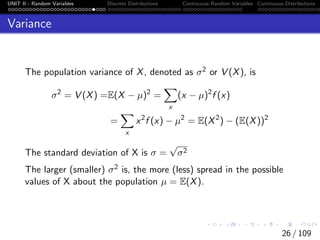
The population variance of X, denoted as σ2 or V (X), is
σ2
= V (X) =E(X − µ)2
=
X
x
(x − µ)2
f (x)
=
X
x
x2
f (x) − µ2
= E(X2
) − (E(X))2
The standard deviation of X is σ =
√
σ2
The larger (smaller) σ2 is, the more (less) spread in the possible
values of X about the population µ = E(X).
26 / 109
UNIT II - Random Variables Discrete Distributions Continuous Random Variables Continuous Distributions
Variance
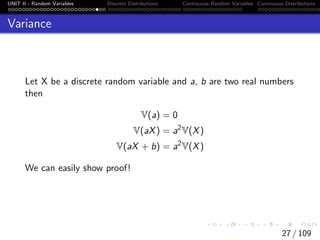
Let X be a discrete random variable and a, b are two real numbers
then
V(a) = 0
V(aX) = a2
V(X)
V(aX + b) = a2
V(X)
We can easily show proof!
27 / 109
UNIT II - Random Variables Discrete Distributions Continuous Random Variables Continuous Distributions
Example
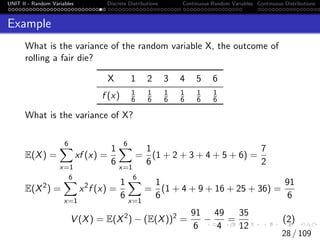
What is the variance of the random variable X, the outcome of
rolling a fair die?
X 1 2 3 4 5 6
f (x) 1
6
1
6
1
6
1
6
1
6
1
6
What is the variance of X?
E(X) =
6
X
x=1
xf (x) =
1
6
6
X
x=1
=
1
6
(1 + 2 + 3 + 4 + 5 + 6) =
7
2
E(X2
) =
6
X
x=1
x2
f (x) =
1
6
6
X
x=1
=
1
6
(1 + 4 + 9 + 16 + 25 + 36) =
91
6
V (X) = E(X2
) − (E(X))2
=
91
6
−
49
4
=
35
12
(2)
28 / 109
UNIT II - Random Variables Discrete Distributions Continuous Random Variables Continuous Distributions
Exercise
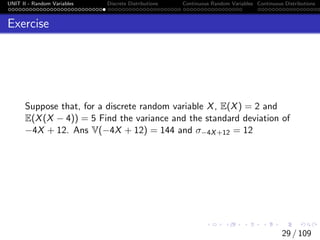
Suppose that, for a discrete random variable X, E(X) = 2 and
E(X(X − 4)) = 5 Find the variance and the standard deviation of
−4X + 12. Ans V(−4X + 12) = 144 and σ−4X+12 = 12
29 / 109
UNIT II - Random Variables Discrete Distributions Continuous Random Variables Continuous Distributions
Bernoulli Distribution
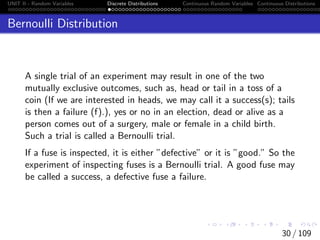
A single trial of an experiment may result in one of the two
mutually exclusive outcomes, such as, head or tail in a toss of a
coin (If we are interested in heads, we may call it a success(s); tails
is then a failure (f).), yes or no in an election, dead or alive as a
person comes out of a surgery, male or female in a child birth.
Such a trial is called a Bernoulli trial.
If a fuse is inspected, it is either ”defective” or it is ”good.” So the
experiment of inspecting fuses is a Bernoulli trial. A good fuse may
be called a success, a defective fuse a failure.
30 / 109
UNIT II - Random Variables Discrete Distributions Continuous Random Variables Continuous Distributions
Bernoulli Distribution
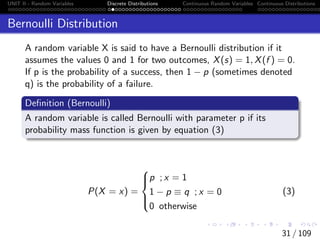
A random variable X is said to have a Bernoulli distribution if it
assumes the values 0 and 1 for two outcomes, X(s) = 1, X(f ) = 0.
If p is the probability of a success, then 1 − p (sometimes denoted
q) is the probability of a failure.
Definition (Bernoulli)
A random variable is called Bernoulli with parameter p if its
probability mass function is given by equation (3)
P(X = x) =





p ; x = 1
1 − p ≡ q ; x = 0
0 otherwise
(3)
31 / 109
UNIT II - Random Variables Discrete Distributions Continuous Random Variables Continuous Distributions
Expectation and Variance
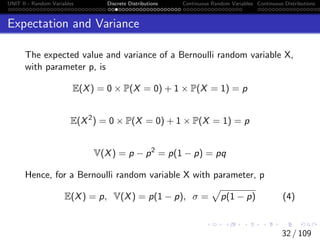
The expected value and variance of a Bernoulli random variable X,
with parameter p, is
E(X) = 0 × P(X = 0) + 1 × P(X = 1) = p
E(X2
) = 0 × P(X = 0) + 1 × P(X = 1) = p
V(X) = p − p2
= p(1 − p) = pq
Hence, for a Bernoulli random variable X with parameter, p
E(X) = p, V(X) = p(1 − p), σ =
p
p(1 − p) (4)
32 / 109
UNIT II - Random Variables Discrete Distributions Continuous Random Variables Continuous Distributions
Example
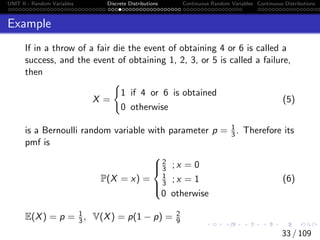
If in a throw of a fair die the event of obtaining 4 or 6 is called a
success, and the event of obtaining 1, 2, 3, or 5 is called a failure,
then
X =
(
1 if 4 or 6 is obtained
0 otherwise
(5)
is a Bernoulli random variable with parameter p = 1
3. Therefore its
pmf is
P(X = x) =





2
3 ; x = 0
1
3 ; x = 1
0 otherwise
(6)
E(X) = p = 1
3, V(X) = p(1 − p) = 2
9
33 / 109
UNIT II - Random Variables Discrete Distributions Continuous Random Variables Continuous Distributions
Binomial Distribution
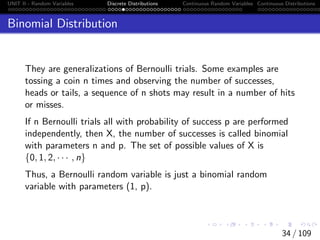
They are generalizations of Bernoulli trials. Some examples are
tossing a coin n times and observing the number of successes,
heads or tails, a sequence of n shots may result in a number of hits
or misses.
If n Bernoulli trials all with probability of success p are performed
independently, then X, the number of successes is called binomial
with parameters n and p. The set of possible values of X is
{0, 1, 2, · · · , n}
Thus, a Bernoulli random variable is just a binomial random
variable with parameters (1, p).
34 / 109
UNIT II - Random Variables Discrete Distributions Continuous Random Variables Continuous Distributions
Conditions of a Binomial Distribution
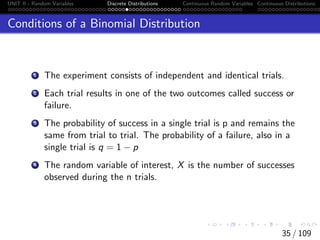
1 The experiment consists of independent and identical trials.
2 Each trial results in one of the two outcomes called success or
failure.
3 The probability of success in a single trial is p and remains the
same from trial to trial. The probability of a failure, also in a
single trial is q = 1 − p
4 The random variable of interest, X is the number of successes
observed during the n trials.
35 / 109
UNIT II - Random Variables Discrete Distributions Continuous Random Variables Continuous Distributions
Binomial Distribution
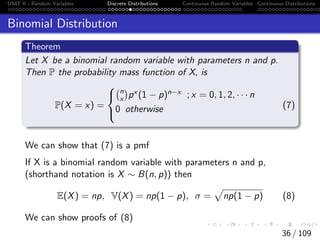
Theorem
Let X be a binomial random variable with parameters n and p.
Then P the probability mass function of X, is
P(X = x) =



n
x

px (1 − p)n−x ; x = 0, 1, 2, · · · n
0 otherwise (7)
We can show that (7) is a pmf
If X is a binomial random variable with parameters n and p,
(shorthand notation is X ∼ B(n, p)) then
E(X) = np, V(X) = np(1 − p), σ =
p
np(1 − p) (8)
We can show proofs of (8)
36 / 109
UNIT II - Random Variables Discrete Distributions Continuous Random Variables Continuous Distributions
Example
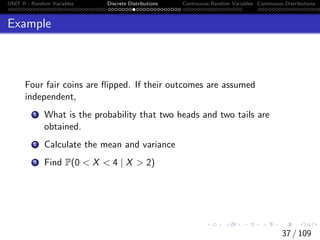
Four fair coins are flipped. If their outcomes are assumed
independent,
1 What is the probability that two heads and two tails are
obtained.
2 Calculate the mean and variance
3 Find P(0  X  4 | X  2)
37 / 109
UNIT II - Random Variables Discrete Distributions Continuous Random Variables Continuous Distributions
Solution
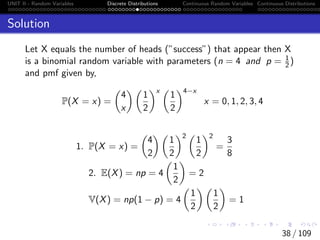
Let X equals the number of heads (”success”) that appear then X
is a binomial random variable with parameters (n = 4 and p = 1
2)
and pmf given by,
P(X = x) =

4
x
 
1
2
x 
1
2
4−x
x = 0, 1, 2, 3, 4
1. P(X = x) =

4
2
 
1
2
2 
1
2
2
=
3
8
2. E(X) = np = 4

1
2

= 2
V(X) = np(1 − p) = 4

1
2
 
1
2

= 1
38 / 109
UNIT II - Random Variables Discrete Distributions Continuous Random Variables Continuous Distributions
Solution Cont’d
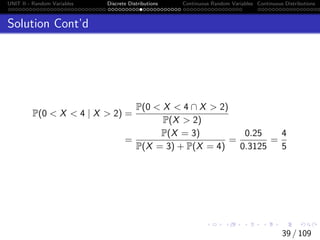
P(0  X  4 | X  2) =
P(0  X  4 ∩ X  2)
P(X  2)
=
P(X = 3)
P(X = 3) + P(X = 4)
=
0.25
0.3125
=
4
5
39 / 109
UNIT II - Random Variables Discrete Distributions Continuous Random Variables Continuous Distributions
Example
Question It is known that any item produced by a certain
machine will be defective with probability 0.1, independently of any
other item. What is the probability that in a sample of three items,
at most one will be defective?
Solution
If X is the number of defective items in the sample, then X is a
binomial random variable with parameters (3, 0.1). Hence, the
desired probability is given by
P{X = 0} + P{X = 1} =

3
0

(0.01)0
(0.9)3
+

3
1

(0.01)1
(0.9)2
= 0.972
Que What is the probability that at least one will be perfect?
40 / 109
UNIT II - Random Variables Discrete Distributions Continuous Random Variables Continuous Distributions
Exercises
Exercise A restaurant serves 8 entrées of fish, 12 of beef, and 10
of poultry. If customers select from these entrées randomly, what is
the probability that two of the next four customers order fish
entrees? Ans = 0.23
41 / 109
UNIT II - Random Variables Discrete Distributions Continuous Random Variables Continuous Distributions
Poisson Distribution
The Poisson distribution is used as a model for describing the
number of times some random event occurs in an interval of time
or an area, a volume or other unit.
Some examples are the number of claims processed by a certain
insurance company in a given month,
The number of road traffic accidents in an area during a given
time interval, the number of errors a typist makes in typing a page
of a text and the number of admissions of a clinic in a given time
interval.
42 / 109
UNIT II - Random Variables Discrete Distributions Continuous Random Variables Continuous Distributions
Poisson
1 the number of customers entering a post office in a given hour
2 the number of α-particles discharged from a radioactive
substance in one second
3 the number of machine breakdowns per month
4 the number of defects on a piece of raw material.
43 / 109
UNIT II - Random Variables Discrete Distributions Continuous Random Variables Continuous Distributions
Poission Distribution
Definition (Poisson Distribution)
A discrete random variable X with possible values 0, 1, 2, 3, · · · is
called Poisson with parameter λ, λ  0, if
P(X = k) =
e−λλk
k!
k = 0, 1, 2, 3 · · ·
In general, we define X = the number of ”occurrences” over a unit
interval of time (or space).
If X is a Poisson random variable with parameter λ written as X ∼
Poisson(λ), then
E(X) = λ, V(X) = λ, σ =
√
λ (9)
44 / 109
UNIT II - Random Variables Discrete Distributions Continuous Random Variables Continuous Distributions
Example
The number of power surges in an electric grid has a Poisson
distribution with a mean of one power surge every twelve hours.
a. What is the probability that there will be no more than one
power surge in a 24-hour period?
b. What is the probability that there will be more than three power
surge in a 24-hour period?
45 / 109
UNIT II - Random Variables Discrete Distributions Continuous Random Variables Continuous Distributions
Solution
46 / 109
UNIT II - Random Variables Discrete Distributions Continuous Random Variables Continuous Distributions
Solution Cont’d
The desired probability is 1 − 0.857 = 0.143
47 / 109
UNIT II - Random Variables Discrete Distributions Continuous Random Variables Continuous Distributions
Poisson Approximation to Binomial
When the number of trials, n in a Binomial process is large, the
computations of the binomial probabilities may be too tedious.
The Poisson distribution can be used as an alternative to
approximate the Binomial distribution.
48 / 109
UNIT II - Random Variables Discrete Distributions Continuous Random Variables Continuous Distributions
Exercises
1 Suppose that on average, 1 person in 1000 makes a numerical
error in preparing his or her income tax return. If 9000 forms
are selected at random and examined, find the probability that
less than 3 of the forms contain an error. Ans = 0.0062
2 Every week the average number of wrong-number phone calls
received by a certain mail-order house is seven. What is the
probability that they will receive (a) two wrong calls
tomorrow; (b) at least one wrong call tomorrow? Answers (a)
≈ 0.18 (b) ≈ 0.63
49 / 109
UNIT II - Random Variables Discrete Distributions Continuous Random Variables Continuous Distributions
Exercise
1 Orders arrive at a Web site according to a Poisson process
with a mean of 12 per hour. Determine the following:
(a) Probability of no orders in five minutes.
(b) Probability of 3 or more orders in five minutes.
(c) Length of a time interval such that the probability of no
orders in an interval of this length is 0.001.
50 / 109
UNIT II - Random Variables Discrete Distributions Continuous Random Variables Continuous Distributions
Continuous Random Variables
A continuous random variable is a random variable with an
interval (either finite or infinite) of real numbers for its range.
For example, if X = time (measured in seconds), then the set
of all possible values of X is
{x : x  0}
If X = temperature (measured in degree Celsius), the set of
all possible values of X (ignoring absolute zero and physical
upper bounds) might be described as
{x : −∞  x  +∞}
These set of values cannot be counted
51 / 109
UNIT II - Random Variables Discrete Distributions Continuous Random Variables Continuous Distributions
Probability Density Function
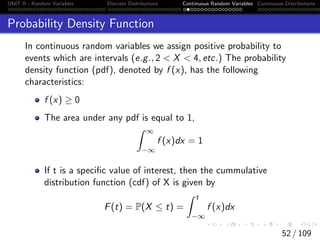
In continuous random variables we assign positive probability to
events which are intervals (e.g., 2  X  4, etc.) The probability
density function (pdf), denoted by f (x), has the following
characteristics:
f (x) ≥ 0
The area under any pdf is equal to 1,
Z ∞
−∞
f (x)dx = 1
If t is a specific value of interest, then the cummulative
distribution function (cdf) of X is given by
F(t) = P(X ≤ t) =
Z t
−∞
f (x)dx
52 / 109
UNIT II - Random Variables Discrete Distributions Continuous Random Variables Continuous Distributions
Probability Density Function
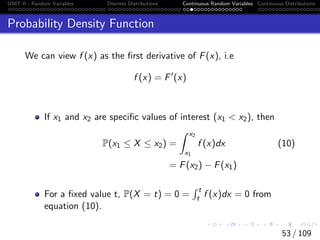
We can view f (x) as the first derivative of F(x), i.e
f (x) = F0
(x)
If x1 and x2 are specific values of interest (x1  x2), then
P(x1 ≤ X ≤ x2) =
Z x2
x1
f (x)dx (10)
= F(x2) − F(x1)
For a fixed value t, P(X = t) = 0 =
R t
t f (x)dx = 0 from
equation (10).
53 / 109
UNIT II - Random Variables Discrete Distributions Continuous Random Variables Continuous Distributions
Probability Density Function
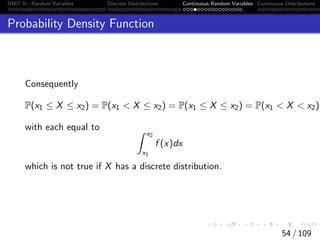
Consequently
P(x1 ≤ X ≤ x2) = P(x1  X ≤ x2) = P(x1 ≤ X ≤ x2) = P(x1  X  x2)
with each equal to Z x2
x1
f (x)dx
which is not true if X has a discrete distribution.
54 / 109
UNIT II - Random Variables Discrete Distributions Continuous Random Variables Continuous Distributions
Example
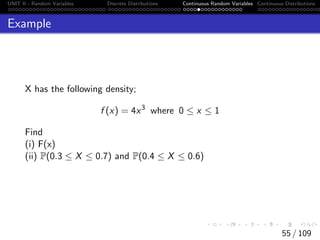
X has the following density;
f (x) = 4x3
where 0 ≤ x ≤ 1
Find
(i) F(x)
(ii) P(0.3 ≤ X ≤ 0.7) and P(0.4 ≤ X ≤ 0.6)
55 / 109
UNIT II - Random Variables Discrete Distributions Continuous Random Variables Continuous Distributions
Solution
56 / 109
UNIT II - Random Variables Discrete Distributions Continuous Random Variables Continuous Distributions
Example
Let X be a continuous random variable with cumulative
distribution function given by
F(x) =





0 x  0
1
9x3 0 ≤ x ≤ 3
1 x ≥ 3
Find the p.d.f of X
Solution
f (x) =
dF(x)
dx
=
(
1
3x2 0 ≤ x ≤ 3
0 otherwise
57 / 109
UNIT II - Random Variables Discrete Distributions Continuous Random Variables Continuous Distributions
Expectation and Variance
The expected value of X is given by
µ = E(X) =
Z ∞
−∞
xf (x)dx
And the variance of X is given as
σ2
= V(X) = E(X2
) − (E(X))2
=
Z ∞
−∞
x2
f (x)dx − µ2
The standard deviation of X given as
σ =
√
σ2 =
p
V(X)
58 / 109
UNIT II - Random Variables Discrete Distributions Continuous Random Variables Continuous Distributions
Expectation and Variance
Let X be a continuous random variable with pdf f (x). Suppose
that g, g1, g2, · · · , gk are real-valued functions, and let c be any
real constant. then
E(g(X)) =
Z ∞
−∞
g(x)f (x)dx
Expectation satisfy the following properties
E(c) = c
E(cg(X)) = cE(g(X))
Given a linear function g(x) = ax + b where a, b are constants, we
have
E(g(X)) = aE(X) + b and V(aX + b) = a2
V(X)
59 / 109
UNIT II - Random Variables Discrete Distributions Continuous Random Variables Continuous Distributions
Example
Suppose that X has the pdf
f (x) =
(
3x2 ; 0  x  1
0 otherwise
(11)
Find the
Find the cdf of X
Calculate P(X  0.3)
Calculate P(X  0.8)
Calc. P(0.3  X  0.8)
Find E(X)
Find the standard deviation of X
If we define Y = 3X, find the cdf and pdf of Y . Further
calculate the mean and variance of Y . 60 / 109
UNIT II - Random Variables Discrete Distributions Continuous Random Variables Continuous Distributions
Example
Suppose X has the following pdf, where A is a constant to be
determined.
f (x) =
(
A(1 − x2) ; −1 ≤ x ≤ 1
0 otherwise
Find A, P{0.5  X  1.5}, CDF (FX ), E(X), V(X), and σX
61 / 109
UNIT II - Random Variables Discrete Distributions Continuous Random Variables Continuous Distributions
Solution
To find A
Z ∞
−∞
f (u)du = 1
=
Z 1
−1
A(1 − u2
)du = A

u −
u3
3
 1
−1
= 1
Hence A = 3
4
P(0.5  X  1.5) =
Z 1.5
0.5
f (u)du =
Z 1
0.5
3(1 − u2)
4
du =
3
4

u −
u3
3
 1
0.5
=
3
4

2
3
−
11
24

=
5
32
62 / 109
UNIT II - Random Variables Discrete Distributions Continuous Random Variables Continuous Distributions
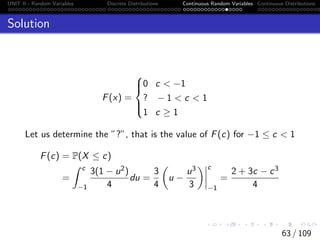
Solution
F(x) =





0 c  −1
? − 1  c  1
1 c ≥ 1
Let us determine the ”?”, that is the value of F(c) for −1 ≤ c  1
F(c) = P(X ≤ c)
=
Z c
−1
3(1 − u2)
4
du =
3
4

u −
u3
3
 c
−1
=
2 + 3c − c3
4
63 / 109
UNIT II - Random Variables Discrete Distributions Continuous Random Variables Continuous Distributions
Solution
F(x) =





0 c  1
2+3c−c2
4 − 1  c  1
1 c ≥ 1
Find E(X) =
R 1
−1
3
4u(1 − u2)du = 0,
V(X) = E(X2
) − (E(X))2
= E(X2
)
E(X2
) =
Z ∞
−∞
u2
f (u)du =
Z 1
−1
u2 3
4
(1 − u2
)du
=
3
4
Z 1
−1
(u2
− u4
)du = 0.2
Thus V(X) = 0.2 and σX =
√
0.2 = 0.45
64 / 109
UNIT II - Random Variables Discrete Distributions Continuous Random Variables Continuous Distributions
Exercise
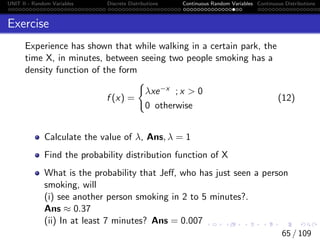
Experience has shown that while walking in a certain park, the
time X, in minutes, between seeing two people smoking has a
density function of the form
f (x) =
(
λxe−x ; x  0
0 otherwise
(12)
Calculate the value of λ, Ans, λ = 1
Find the probability distribution function of X
What is the probability that Jeff, who has just seen a person
smoking, will
(i) see another person smoking in 2 to 5 minutes?.
Ans ≈ 0.37
(ii) In at least 7 minutes? Ans = 0.007
65 / 109
UNIT II - Random Variables Discrete Distributions Continuous Random Variables Continuous Distributions
Exercise
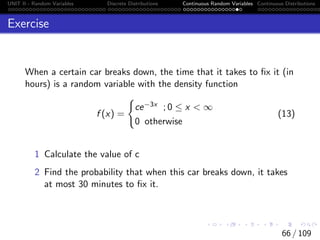
When a certain car breaks down, the time that it takes to fix it (in
hours) is a random variable with the density function
f (x) =
(
ce−3x ; 0 ≤ x  ∞
0 otherwise
(13)
1 Calculate the value of c
2 Find the probability that when this car breaks down, it takes
at most 30 minutes to fix it.
66 / 109
UNIT II - Random Variables Discrete Distributions Continuous Random Variables Continuous Distributions
Exercise
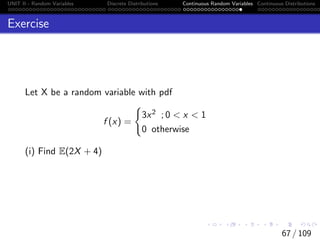
Let X be a random variable with pdf
f (x) =
(
3x2 ; 0  x  1
0 otherwise
(i) Find E(2X + 4)
67 / 109
UNIT II - Random Variables Discrete Distributions Continuous Random Variables Continuous Distributions
Exponential Distribution
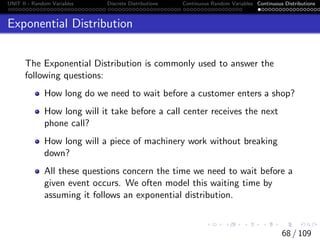
The Exponential Distribution is commonly used to answer the
following questions:
How long do we need to wait before a customer enters a shop?
How long will it take before a call center receives the next
phone call?
How long will a piece of machinery work without breaking
down?
All these questions concern the time we need to wait before a
given event occurs. We often model this waiting time by
assuming it follows an exponential distribution.
68 / 109
UNIT II - Random Variables Discrete Distributions Continuous Random Variables Continuous Distributions
Exponential Distribution
A random variable X is said to have an exponential distribution
with parameter λ  0 if its pdf is given by
f (x) =
(
λe−λx ; x  0
0 otherwise
The shorthand notation is X ∼ Exp(λ). The CDF of X is
69 / 109
UNIT II - Random Variables Discrete Distributions Continuous Random Variables Continuous Distributions
Exponential Distribution
For any specified time x, the probability of the event happens no
later than x is
F(x) =
Z x
−∞
f (t)dt =
Z x
0
λe−λt
dt =
(
1 − e−λx x  0
0 x  0
The expected value of X is
E(X) =
Z ∞
−∞
xf (x) = 0 +
Z ∞
0
xλe−λx
(14)
Integrating by parts, setting u = x and dv = λe−λx dx we obtain
E(X) =
1
λ
70 / 109
UNIT II - Random Variables Discrete Distributions Continuous Random Variables Continuous Distributions
Exponential Distribution
and the variance of X given
V(X) = E(X2
) − (E(X))2
=
2
λ2
−
1
λ2
=
1
λ2
For an exponential random variable with parameter λ,
E(X) =
1
λ
= σX , V(X) =
1
λ2
71 / 109
UNIT II - Random Variables Discrete Distributions Continuous Random Variables Continuous Distributions
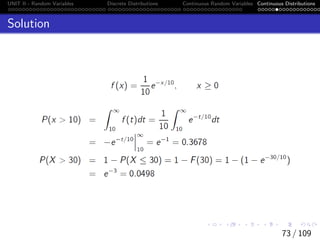
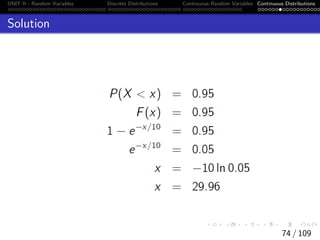
Example
Suppose X has the exponential distribution with mean 10.
Determine the following
(i) P(X  10)
(ii) P(X  30)
(iii) that value of x such that P(X  x) = 0.95
72 / 109
UNIT II - Random Variables Discrete Distributions Continuous Random Variables Continuous Distributions
Solution
73 / 109
UNIT II - Random Variables Discrete Distributions Continuous Random Variables Continuous Distributions
Solution
74 / 109
UNIT II - Random Variables Discrete Distributions Continuous Random Variables Continuous Distributions
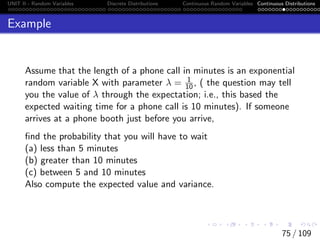
Example
Assume that the length of a phone call in minutes is an exponential
random variable X with parameter λ = 1
10, ( the question may tell
you the value of λ through the expectation; i.e., this based the
expected waiting time for a phone call is 10 minutes). If someone
arrives at a phone booth just before you arrive,
find the probability that you will have to wait
(a) less than 5 minutes
(b) greater than 10 minutes
(c) between 5 and 10 minutes
Also compute the expected value and variance.
75 / 109
UNIT II - Random Variables Discrete Distributions Continuous Random Variables Continuous Distributions
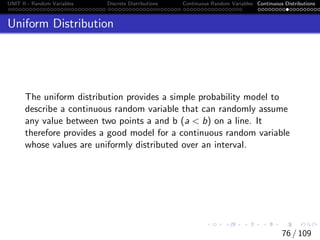
Uniform Distribution
The uniform distribution provides a simple probability model to
describe a continuous random variable that can randomly assume
any value between two points a and b (a  b) on a line. It
therefore provides a good model for a continuous random variable
whose values are uniformly distributed over an interval.
76 / 109
UNIT II - Random Variables Discrete Distributions Continuous Random Variables Continuous Distributions
Uniform Distribution
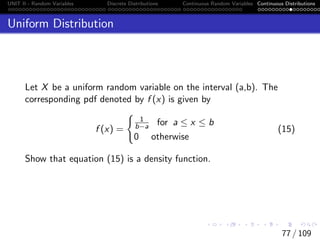
Let X be a uniform random variable on the interval (a,b). The
corresponding pdf denoted by f (x) is given by
f (x) =
(
1
b−a for a ≤ x ≤ b
0 otherwise
(15)
Show that equation (15) is a density function.
77 / 109
UNIT II - Random Variables Discrete Distributions Continuous Random Variables Continuous Distributions
Expectation and Variance
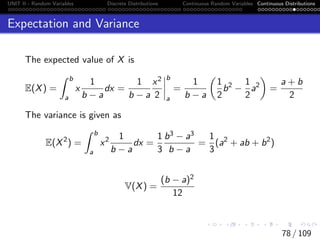
The expected value of X is
E(X) =
Z b
a
x
1
b − a
dx =
1
b − a
x2
2
b
a
=
1
b − a

1
2
b2
−
1
2
a2

=
a + b
2
The variance is given as
E(X2
) =
Z b
a
x2 1
b − a
dx =
1
3
b3 − a3
b − a
=
1
3
(a2
+ ab + b2
)
V(X) =
(b − a)2
12
78 / 109
UNIT II - Random Variables Discrete Distributions Continuous Random Variables Continuous Distributions
Uniform Distribution
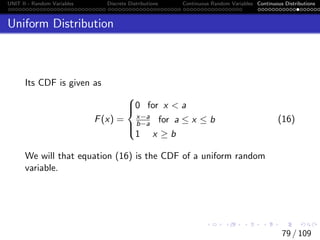
Its CDF is given as
F(x) =





0 for x  a
x−a
b−a for a ≤ x ≤ b
1 x ≥ b
(16)
We will that equation (16) is the CDF of a uniform random
variable.
79 / 109
UNIT II - Random Variables Discrete Distributions Continuous Random Variables Continuous Distributions
Example
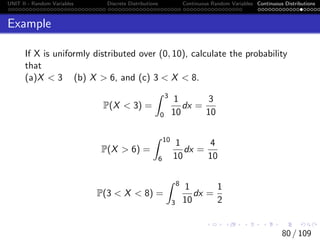
If X is uniformly distributed over (0, 10), calculate the probability
that
(a)X  3 (b) X  6, and (c) 3  X  8.
P(X  3) =
Z 3
0
1
10
dx =
3
10
P(X  6) =
Z 10
6
1
10
dx =
4
10
P(3  X  8) =
Z 8
3
1
10
dx =
1
2
80 / 109
UNIT II - Random Variables Discrete Distributions Continuous Random Variables Continuous Distributions
Example
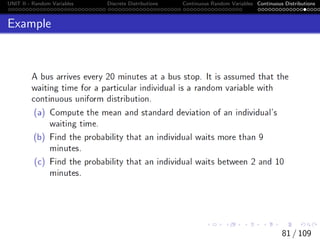
81 / 109
UNIT II - Random Variables Discrete Distributions Continuous Random Variables Continuous Distributions
Solution
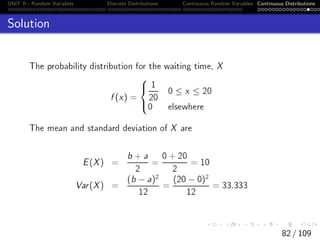
82 / 109
UNIT II - Random Variables Discrete Distributions Continuous Random Variables Continuous Distributions
Solution
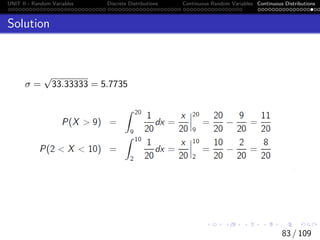
σ =
√
33.33333 = 5.7735
83 / 109
UNIT II - Random Variables Discrete Distributions Continuous Random Variables Continuous Distributions
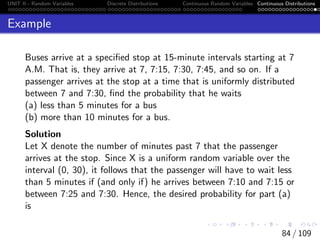
Example
Buses arrive at a specified stop at 15-minute intervals starting at 7
A.M. That is, they arrive at 7, 7:15, 7:30, 7:45, and so on. If a
passenger arrives at the stop at a time that is uniformly distributed
between 7 and 7:30, find the probability that he waits
(a) less than 5 minutes for a bus
(b) more than 10 minutes for a bus.
Solution
Let X denote the number of minutes past 7 that the passenger
arrives at the stop. Since X is a uniform random variable over the
interval (0, 30), it follows that the passenger will have to wait less
than 5 minutes if (and only if) he arrives between 7:10 and 7:15 or
between 7:25 and 7:30. Hence, the desired probability for part (a)
is
84 / 109
UNIT II - Random Variables Discrete Distributions Continuous Random Variables Continuous Distributions
Solution
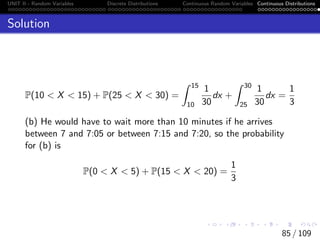
P(10  X  15) + P(25  X  30) =
Z 15
10
1
30
dx +
Z 30
25
1
30
dx =
1
3
(b) He would have to wait more than 10 minutes if he arrives
between 7 and 7:05 or between 7:15 and 7:20, so the probability
for (b) is
P(0  X  5) + P(15  X  20) =
1
3
85 / 109
UNIT II - Random Variables Discrete Distributions Continuous Random Variables Continuous Distributions
Normal Distribution
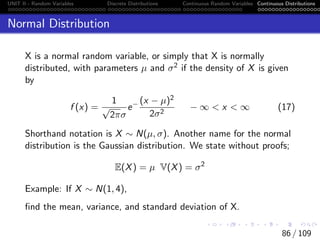
X is a normal random variable, or simply that X is normally
distributed, with parameters µ and σ2 if the density of X is given
by
f (x) =
1
√
2πσ
e− (x − µ)2
2σ2
− ∞  x  ∞ (17)
Shorthand notation is X ∼ N(µ, σ). Another name for the normal
distribution is the Gaussian distribution. We state without proofs;
E(X) = µ V(X) = σ2
Example: If X ∼ N(1, 4),
find the mean, variance, and standard deviation of X.
86 / 109
UNIT II - Random Variables Discrete Distributions Continuous Random Variables Continuous Distributions
Normal Distribution
87 / 109
UNIT II - Random Variables Discrete Distributions Continuous Random Variables Continuous Distributions
Normal Distribution
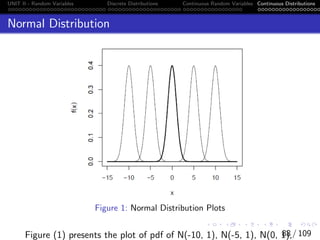
Figure 1: Normal Distribution Plots
Figure (1) presents the plot of pdf of N(-10, 1), N(-5, 1), N(0, 1),
88 / 109
UNIT II - Random Variables Discrete Distributions Continuous Random Variables Continuous Distributions
Normal Distribution
Figure 2: Normal Distribution Plots
Figure (2) presents the plot of pdf of N(0, 1), N(0, 4), N(0,9), 89 / 109
UNIT II - Random Variables Discrete Distributions Continuous Random Variables Continuous Distributions
Empirical Rule
90 / 109
UNIT II - Random Variables Discrete Distributions Continuous Random Variables Continuous Distributions
Example
The marks obtained by 600 engineering students in a test are
normally distributed with a mean of 75 and a standard deviation of
7.
(a) What is the proportion of the class that has a test score
between 68 and 82
(b) How many students have a test score between 61 and 89
(c) What is the probability that a student chosen at random has a
test between 54 and 75.
91 / 109
UNIT II - Random Variables Discrete Distributions Continuous Random Variables Continuous Distributions
Solution
Using the empirical rule
(a) P(68  X  82) = 0.68
(b) P(61  X  89) = 0.95
Hence the number of students is 600 × 0.95 = 570 students
(c) P(54  X  75) = 0.4985
92 / 109
UNIT II - Random Variables Discrete Distributions Continuous Random Variables Continuous Distributions
Solution
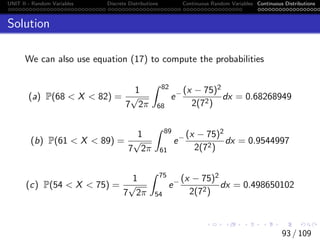
We can also use equation (17) to compute the probabilities
(a) P(68  X  82) =
1
7
√
2π
Z 82
68
e− (x − 75)2
2(72)
dx = 0.68268949
(b) P(61  X  89) =
1
7
√
2π
Z 89
61
e− (x − 75)2
2(72)
dx = 0.9544997
(c) P(54  X  75) =
1
7
√
2π
Z 75
54
e− (x − 75)2
2(72)
dx = 0.498650102
93 / 109
UNIT II - Random Variables Discrete Distributions Continuous Random Variables Continuous Distributions
Standard Normal Distribution
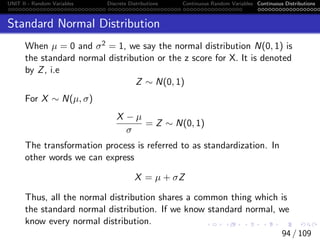
When µ = 0 and σ2 = 1, we say the normal distribution N(0, 1) is
the standard normal distribution or the z score for X. It is denoted
by Z, i.e
Z ∼ N(0, 1)
For X ∼ N(µ, σ)
X − µ
σ
= Z ∼ N(0, 1)
The transformation process is referred to as standardization. In
other words we can express
X = µ + σZ
Thus, all the normal distribution shares a common thing which is
the standard normal distribution. If we know standard normal, we
know every normal distribution.
94 / 109
UNIT II - Random Variables Discrete Distributions Continuous Random Variables Continuous Distributions
Standard Normal Distribution
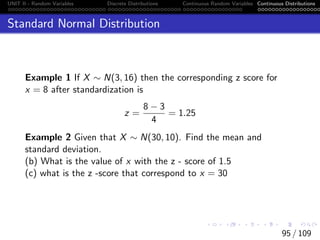
Example 1 If X ∼ N(3, 16) then the corresponding z score for
x = 8 after standardization is
z =
8 − 3
4
= 1.25
Example 2 Given that X ∼ N(30, 10). Find the mean and
standard deviation.
(b) What is the value of x with the z - score of 1.5
(c) what is the z -score that correspond to x = 30
95 / 109
UNIT II - Random Variables Discrete Distributions Continuous Random Variables Continuous Distributions
Standard Normal Distribution
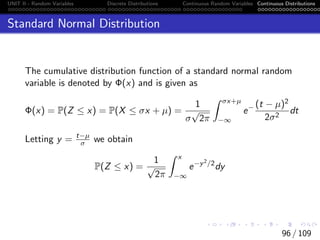
The cumulative distribution function of a standard normal random
variable is denoted by Φ(x) and is given as
Φ(x) = P(Z ≤ x) = P(X ≤ σx + µ) =
1
σ
√
2π
Z σx+µ
−∞
e− (t − µ)2
2σ2
dt
Letting y = t−µ
σ we obtain
P(Z ≤ x) =
1
√
2π
Z x
−∞
e−y2/2
dy
96 / 109
UNIT II - Random Variables Discrete Distributions Continuous Random Variables Continuous Distributions
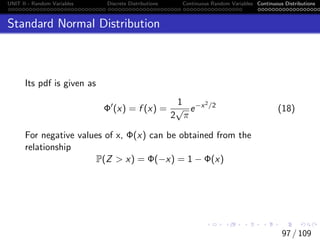
Standard Normal Distribution
Its pdf is given as
Φ0
(x) = f (x) =
1
2
√
π
e−x2/2
(18)
For negative values of x, Φ(x) can be obtained from the
relationship
P(Z  x) = Φ(−x) = 1 − Φ(x)
97 / 109
UNIT II - Random Variables Discrete Distributions Continuous Random Variables Continuous Distributions
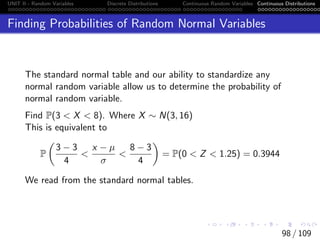
Finding Probabilities of Random Normal Variables
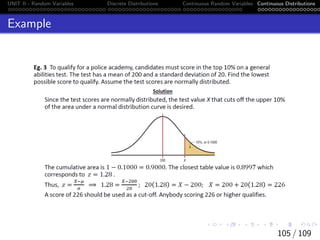
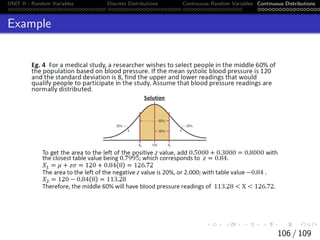
The standard normal table and our ability to standardize any
normal random variable allow us to determine the probability of
normal random variable.
Find P(3  X  8). Where X ∼ N(3, 16)
This is equivalent to
P

3 − 3
4

x − µ
σ

8 − 3
4

= P(0  Z  1.25) = 0.3944
We read from the standard normal tables.
98 / 109
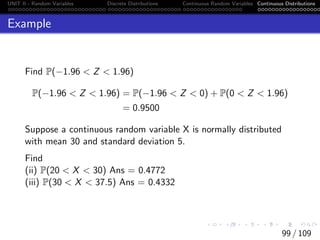
UNIT II - Random Variables Discrete Distributions Continuous Random Variables Continuous Distributions
Example
Find P(−1.96  Z  1.96)
P(−1.96  Z  1.96) = P(−1.96  Z  0) + P(0  Z  1.96)
= 0.9500
Suppose a continuous random variable X is normally distributed
with mean 30 and standard deviation 5.
Find
(ii) P(20  X  30) Ans = 0.4772
(iii) P(30  X  37.5) Ans = 0.4332
99 / 109
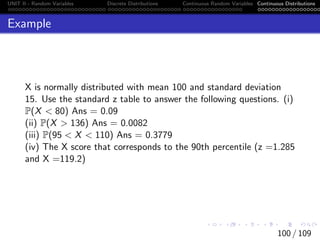
UNIT II - Random Variables Discrete Distributions Continuous Random Variables Continuous Distributions
Example
X is normally distributed with mean 100 and standard deviation
15. Use the standard z table to answer the following questions. (i)
P(X  80) Ans = 0.09
(ii) P(X  136) Ans = 0.0082
(iii) P(95  X  110) Ans = 0.3779
(iv) The X score that corresponds to the 90th percentile (z =1.285
and X =119.2)
100 / 109
UNIT II - Random Variables Discrete Distributions Continuous Random Variables Continuous Distributions
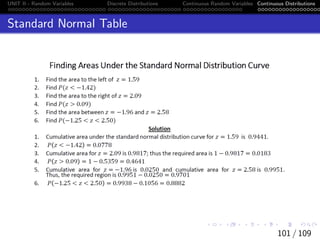
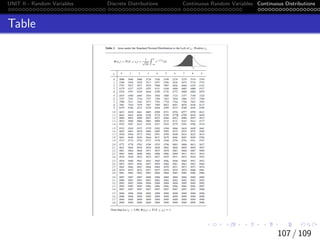
Standard Normal Table
101 / 109
UNIT II - Random Variables Discrete Distributions Continuous Random Variables Continuous Distributions
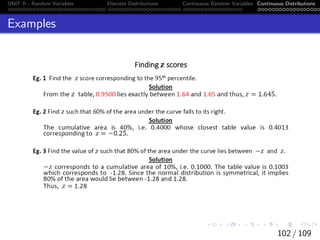
Examples
102 / 109
UNIT II - Random Variables Discrete Distributions Continuous Random Variables Continuous Distributions
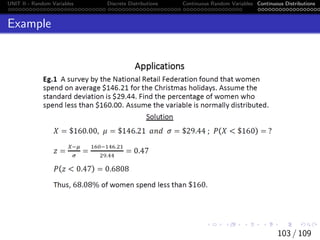
Example
103 / 109
UNIT II - Random Variables Discrete Distributions Continuous Random Variables Continuous Distributions
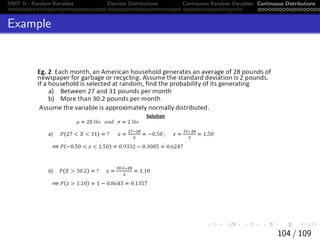
Example
104 / 109
UNIT II - Random Variables Discrete Distributions Continuous Random Variables Continuous Distributions
Example
105 / 109
UNIT II - Random Variables Discrete Distributions Continuous Random Variables Continuous Distributions
Example
106 / 109
UNIT II - Random Variables Discrete Distributions Continuous Random Variables Continuous Distributions
Table
107 / 109
UNIT II - Random Variables Discrete Distributions Continuous Random Variables Continuous Distributions
Extra Reading
Read on:
1 mean, median, mode (measures of central tendency)
2 variance, standard deviation, range (measures of variation)
108 / 109

STAT 253 Probability and Statistics UNIT II.pdf

  • 1.
    UNIT II -Random Variables Discrete Distributions Continuous Random Variables Continuous Distributions STAT 253: Probability & Statistics UNIT II - Random Variables April 3, 2023 1 / 109
  • 2.
    UNIT II -Random Variables Discrete Distributions Continuous Random Variables Continuous Distributions Unit Objectives This unit introduces students to concepts and computational techniques associated with random variables. After studying this unit students should be able to; 1 Define a random variable and distinguish between discrete and continuous random variables 2 Define, describe and recognise probability mass functions (pmf) and probability density functions (pdf) 3 Compute the probabilities of the various numerical values a random variable assumes. 4 Compute numerical characteristics of a random variable 2 / 109
  • 3.
    UNIT II -Random Variables Discrete Distributions Continuous Random Variables Continuous Distributions Reference Montgomery, D. and Runger, G. (2014). Applied Statistics and Probability for Engineers, Sixth Edition. John Wiley and Sons, Inc. 3 / 109
  • 4.
    UNIT II -Random Variables Discrete Distributions Continuous Random Variables Continuous Distributions Random Variable We shall not always be interested in a random experiment but rather in some result of its outcome. A random variable is a function that assigns a real number to each outcome (event) in a sample space of a random experiment. Mathematically; X : Ω → R Example: A fair coin is tossed twice Ω = {HH, HT, TH, TT} Let X be the number of heads, so that X(HH) = 2, X(HT) = X(TH) = 1, X(TT) = 0 4 / 109
  • 5.
    UNIT II -Random Variables Discrete Distributions Continuous Random Variables Continuous Distributions II-1: Discrete Random Variable A random variable is said to be discrete if takes on finite or countably infinite set of values in R Examples 1 The number of customers awaiting to be served at a bank 2 Number of scratches on a surface 3 Proportion of defective parts among 1000 tested 4 Number of transmitted bits received in error 5 / 109
  • 6.
    UNIT II -Random Variables Discrete Distributions Continuous Random Variables Continuous Distributions II-1-1: Probability Mass Function The probability distribution of a random variable X is a description of the probabilities associated with the possible values of X For a discrete random variable X with possible values x1, x2, · · · , xk a probability mass function (pmf) is a function such that 1 f (xi ) ≥ 0 2 Pk i=1 f (xi ) = 1 3 f (xi ) = P(X = xi ) ; f (x) is the probability that X = x 6 / 109
  • 7.
    UNIT II -Random Variables Discrete Distributions Continuous Random Variables Continuous Distributions Example 1 Construct a probability mass function for the number of heads in throwing a coin thrice Verify properties (1) and (2) on page 6. 7 / 109
  • 8.
    UNIT II -Random Variables Discrete Distributions Continuous Random Variables Continuous Distributions Example 2 Once a pmf of X is presented, it is possible to calculate all types of events in the sample space. P(X ≤ a), P(X < a), P(X ≥ a),P(X > a),P(a < X < b), P(a ≤ X ≤ b) P(a < X ≤ b). Compute the ff using Example 1 P(X ≤ 1) = P(X < 1) = P(X > 2) = P(X ≤ 3) − P(X ≤ 1) = P(1 < X < 3) = P(1 ≤ X ≤ 3) = P(1 < X ≤ 3) = 8 / 109
  • 9.
    UNIT II -Random Variables Discrete Distributions Continuous Random Variables Continuous Distributions Exercise 1 Determine whether each of the following can be a probability mass function of a discrete random variable (a) f (x) = 1 2 (x − 2); x = 1, 2, 3, 4 (b) g(x) = 1 10 (x + 1); x = 0, 1, 2, 3 2 A discrete random variable is given by f (x) = c(x + 1), x = 0, 1, 2, 3 (a) Find the value of the constant c (b) Find P(0 < X < 2) and P(X > 1) 9 / 109
  • 10.
    UNIT II -Random Variables Discrete Distributions Continuous Random Variables Continuous Distributions Distribution Function When dealing with a random variable, X for constants a,b (b < a). We are mostly interested in one or several of the probabilities defined on page 8. For this reason we calculate P(X ≤ x) which tells us almost everything about X. Definition Let X be a random variable, the function F : (−∞, +∞) → R+ x → F(x) = P(X ≤ x) F(x) = P(X ≤ x) = X xi ≤x f (xi ), x ∈ (−∞, +∞) F(x) represents the probability that the random variable, X takes on a value that is less than or equal to x. 10 / 109
  • 11.
    UNIT II -Random Variables Discrete Distributions Continuous Random Variables Continuous Distributions Properties of the CDF (a) F(x) is non decreasing function of x (i.e if x ≤ y, then F(x) ≤ F(y)) (b) lim x→∞ F(x) = F(∞) = 1 (c) lim x→−∞ F(x) = F(−∞) = 0 (d) P(x1 < X ≤ x2) = F(x2) − F(x1) (e) For all x ∈ R we have P[X > x] = 1 − F(x) 11 / 109
  • 12.
    UNIT II -Random Variables Discrete Distributions Continuous Random Variables Continuous Distributions Example In the experiment of flipping a fair coin twice, let X be the number of tails and calculate F(x), the distribution function of X, and then sketch its graph. X = {0, 1, 2} Its pmf is X 0 1 2 P(X = x) 0.25 0.5 0.25 P(X ≤ x) = 0; if x < 0 For 0 ≤ x < 1, we have F(x) = P(X ≤ x) = P(X = 0) = P({HH}) = 1 4 12 / 109
  • 13.
    UNIT II -Random Variables Discrete Distributions Continuous Random Variables Continuous Distributions Example Cont’d For 1 ≤ x < 2, we have F(x) = P(X ≤ x) = P(X = 0 or X = 1) = P({HH}, {HT}, {TH}) = 3 4 For x ≥ 2, we have F(x) = P(X ≤ x) = P(X = 0 or X = 1 or X = 2) = P({HH}, {HT}, {TH}, {TT}) = 1 Hence we have; F(x) =            0 x < 0 1 4 0 ≤ x < 1 3 4 1 ≤ x < 2 1 x ≥ 2 13 / 109
  • 14.
    UNIT II -Random Variables Discrete Distributions Continuous Random Variables Continuous Distributions Graph 14 / 109
  • 15.
    UNIT II -Random Variables Discrete Distributions Continuous Random Variables Continuous Distributions Exercise Consider the following probability distribution X 1 2 3 4 P(X = x) 0.25 0.5 0.125 0.125 1 Find F(2), F(3), F(3) 2 Find the formula for F(x) and sketch its graph 15 / 109
  • 16.
    UNIT II -Random Variables Discrete Distributions Continuous Random Variables Continuous Distributions Distribution Function 16 / 109
  • 17.
    UNIT II -Random Variables Discrete Distributions Continuous Random Variables Continuous Distributions Distribution Function 17 / 109
  • 18.
    UNIT II -Random Variables Discrete Distributions Continuous Random Variables Continuous Distributions Distribution Function 18 / 109
  • 19.
    UNIT II -Random Variables Discrete Distributions Continuous Random Variables Continuous Distributions CDF TABLE 19 / 109
  • 20.
    UNIT II -Random Variables Discrete Distributions Continuous Random Variables Continuous Distributions Exercise The distribution function of a random variable X is given by F(x) =                0 x < 0 x 4 0 ≤ x < 1 1 2 1 ≤ x < 2 1 12x + 1 2 2 ≤ x < 3 1 x ≥ 3 Compute the following quantities P(X < 2), P(X = 2), P(1 ≤ X < 3), P(X > 3 2), P(X = 5 2), P(2 < X ≤ 7) The answers are 1 2, 1 6, 1 2, 1 2, 0, 1 3 respectively. 20 / 109
  • 21.
    UNIT II -Random Variables Discrete Distributions Continuous Random Variables Continuous Distributions Expectation and Variance Two numbers often used to summarize a probability distribution for a random variable X are the mean and the variance. The mean is a measure of the center or middle of the probability distribution, and the variance is a measure of the dispersion, or variability in the distribution. Definition (Expectation) The mean or expected value of the discrete random variable, X denoted as µ or E, is µ = E(X) = X x xf (x) 21 / 109
  • 22.
    UNIT II -Random Variables Discrete Distributions Continuous Random Variables Continuous Distributions Example The number of email messages received per hour has the following distribution: X = number of messages 10 11 12 13 14 15 f (x) 0.08 0.15 0.30 0.20 0.20 0.07 Determine the mean number of messages received per hour. Interpretation: On the average we would expect ——- emails per hour. 22 / 109
  • 23.
    UNIT II -Random Variables Discrete Distributions Continuous Random Variables Continuous Distributions Expectation Let X be a discrete random variable, then for any function g : R → R, g(X) is also a discrete random variable and has expectation E(g(X)) = X ∀x g(x)f (x) (1) Let a be a constant, then the following properties hold; 1 E(c) = c 2 E[cg(X)] = cE[g(X)] 23 / 109
  • 24.
    UNIT II -Random Variables Discrete Distributions Continuous Random Variables Continuous Distributions Expectation For linear function g(x) = ax +b where a, b are constants, we have [3]E[g(X)] = aE(X) + b We show proofs of [1], [2] and [3]. These rules are also applicable if X is continuous. 24 / 109
  • 25.
    UNIT II -Random Variables Discrete Distributions Continuous Random Variables Continuous Distributions Example Equation (1) is known as the law of the unconscious statistician It enables one to calculate the expected value of the random variable g(X) without deriving its probability mass function. Example: The probability mass function of a discrete random variable X is given by f (x) = ( x 15 x = 1, 2, 3, 4, 5 0 elsewhere What is the expected value of X(6 − X)? E(X(6 − X)) = 5 × 1 15 + 8 × 2 15 + 9 × 3 15 + 8 × 4 15 + 5 × 5 15 = 7 25 / 109
  • 26.
    UNIT II -Random Variables Discrete Distributions Continuous Random Variables Continuous Distributions Variance The population variance of X, denoted as σ2 or V (X), is σ2 = V (X) =E(X − µ)2 = X x (x − µ)2 f (x) = X x x2 f (x) − µ2 = E(X2 ) − (E(X))2 The standard deviation of X is σ = √ σ2 The larger (smaller) σ2 is, the more (less) spread in the possible values of X about the population µ = E(X). 26 / 109
  • 27.
    UNIT II -Random Variables Discrete Distributions Continuous Random Variables Continuous Distributions Variance Let X be a discrete random variable and a, b are two real numbers then V(a) = 0 V(aX) = a2 V(X) V(aX + b) = a2 V(X) We can easily show proof! 27 / 109
  • 28.
    UNIT II -Random Variables Discrete Distributions Continuous Random Variables Continuous Distributions Example What is the variance of the random variable X, the outcome of rolling a fair die? X 1 2 3 4 5 6 f (x) 1 6 1 6 1 6 1 6 1 6 1 6 What is the variance of X? E(X) = 6 X x=1 xf (x) = 1 6 6 X x=1 = 1 6 (1 + 2 + 3 + 4 + 5 + 6) = 7 2 E(X2 ) = 6 X x=1 x2 f (x) = 1 6 6 X x=1 = 1 6 (1 + 4 + 9 + 16 + 25 + 36) = 91 6 V (X) = E(X2 ) − (E(X))2 = 91 6 − 49 4 = 35 12 (2) 28 / 109
  • 29.
    UNIT II -Random Variables Discrete Distributions Continuous Random Variables Continuous Distributions Exercise Suppose that, for a discrete random variable X, E(X) = 2 and E(X(X − 4)) = 5 Find the variance and the standard deviation of −4X + 12. Ans V(−4X + 12) = 144 and σ−4X+12 = 12 29 / 109
  • 30.
    UNIT II -Random Variables Discrete Distributions Continuous Random Variables Continuous Distributions Bernoulli Distribution A single trial of an experiment may result in one of the two mutually exclusive outcomes, such as, head or tail in a toss of a coin (If we are interested in heads, we may call it a success(s); tails is then a failure (f).), yes or no in an election, dead or alive as a person comes out of a surgery, male or female in a child birth. Such a trial is called a Bernoulli trial. If a fuse is inspected, it is either ”defective” or it is ”good.” So the experiment of inspecting fuses is a Bernoulli trial. A good fuse may be called a success, a defective fuse a failure. 30 / 109
  • 31.
    UNIT II -Random Variables Discrete Distributions Continuous Random Variables Continuous Distributions Bernoulli Distribution A random variable X is said to have a Bernoulli distribution if it assumes the values 0 and 1 for two outcomes, X(s) = 1, X(f ) = 0. If p is the probability of a success, then 1 − p (sometimes denoted q) is the probability of a failure. Definition (Bernoulli) A random variable is called Bernoulli with parameter p if its probability mass function is given by equation (3) P(X = x) =      p ; x = 1 1 − p ≡ q ; x = 0 0 otherwise (3) 31 / 109
  • 32.
    UNIT II -Random Variables Discrete Distributions Continuous Random Variables Continuous Distributions Expectation and Variance The expected value and variance of a Bernoulli random variable X, with parameter p, is E(X) = 0 × P(X = 0) + 1 × P(X = 1) = p E(X2 ) = 0 × P(X = 0) + 1 × P(X = 1) = p V(X) = p − p2 = p(1 − p) = pq Hence, for a Bernoulli random variable X with parameter, p E(X) = p, V(X) = p(1 − p), σ = p p(1 − p) (4) 32 / 109
  • 33.
    UNIT II -Random Variables Discrete Distributions Continuous Random Variables Continuous Distributions Example If in a throw of a fair die the event of obtaining 4 or 6 is called a success, and the event of obtaining 1, 2, 3, or 5 is called a failure, then X = ( 1 if 4 or 6 is obtained 0 otherwise (5) is a Bernoulli random variable with parameter p = 1 3. Therefore its pmf is P(X = x) =      2 3 ; x = 0 1 3 ; x = 1 0 otherwise (6) E(X) = p = 1 3, V(X) = p(1 − p) = 2 9 33 / 109
  • 34.
    UNIT II -Random Variables Discrete Distributions Continuous Random Variables Continuous Distributions Binomial Distribution They are generalizations of Bernoulli trials. Some examples are tossing a coin n times and observing the number of successes, heads or tails, a sequence of n shots may result in a number of hits or misses. If n Bernoulli trials all with probability of success p are performed independently, then X, the number of successes is called binomial with parameters n and p. The set of possible values of X is {0, 1, 2, · · · , n} Thus, a Bernoulli random variable is just a binomial random variable with parameters (1, p). 34 / 109
  • 35.
    UNIT II -Random Variables Discrete Distributions Continuous Random Variables Continuous Distributions Conditions of a Binomial Distribution 1 The experiment consists of independent and identical trials. 2 Each trial results in one of the two outcomes called success or failure. 3 The probability of success in a single trial is p and remains the same from trial to trial. The probability of a failure, also in a single trial is q = 1 − p 4 The random variable of interest, X is the number of successes observed during the n trials. 35 / 109
  • 36.
    UNIT II -Random Variables Discrete Distributions Continuous Random Variables Continuous Distributions Binomial Distribution Theorem Let X be a binomial random variable with parameters n and p. Then P the probability mass function of X, is P(X = x) =    n x px (1 − p)n−x ; x = 0, 1, 2, · · · n 0 otherwise (7) We can show that (7) is a pmf If X is a binomial random variable with parameters n and p, (shorthand notation is X ∼ B(n, p)) then E(X) = np, V(X) = np(1 − p), σ = p np(1 − p) (8) We can show proofs of (8) 36 / 109
  • 37.
    UNIT II -Random Variables Discrete Distributions Continuous Random Variables Continuous Distributions Example Four fair coins are flipped. If their outcomes are assumed independent, 1 What is the probability that two heads and two tails are obtained. 2 Calculate the mean and variance 3 Find P(0 X 4 | X 2) 37 / 109
  • 38.
    UNIT II -Random Variables Discrete Distributions Continuous Random Variables Continuous Distributions Solution Let X equals the number of heads (”success”) that appear then X is a binomial random variable with parameters (n = 4 and p = 1 2) and pmf given by, P(X = x) = 4 x 1 2 x 1 2 4−x x = 0, 1, 2, 3, 4 1. P(X = x) = 4 2 1 2 2 1 2 2 = 3 8 2. E(X) = np = 4 1 2 = 2 V(X) = np(1 − p) = 4 1 2 1 2 = 1 38 / 109
  • 39.
    UNIT II -Random Variables Discrete Distributions Continuous Random Variables Continuous Distributions Solution Cont’d P(0 X 4 | X 2) = P(0 X 4 ∩ X 2) P(X 2) = P(X = 3) P(X = 3) + P(X = 4) = 0.25 0.3125 = 4 5 39 / 109
  • 40.
    UNIT II -Random Variables Discrete Distributions Continuous Random Variables Continuous Distributions Example Question It is known that any item produced by a certain machine will be defective with probability 0.1, independently of any other item. What is the probability that in a sample of three items, at most one will be defective? Solution If X is the number of defective items in the sample, then X is a binomial random variable with parameters (3, 0.1). Hence, the desired probability is given by P{X = 0} + P{X = 1} = 3 0 (0.01)0 (0.9)3 + 3 1 (0.01)1 (0.9)2 = 0.972 Que What is the probability that at least one will be perfect? 40 / 109
  • 41.
    UNIT II -Random Variables Discrete Distributions Continuous Random Variables Continuous Distributions Exercises Exercise A restaurant serves 8 entrées of fish, 12 of beef, and 10 of poultry. If customers select from these entrées randomly, what is the probability that two of the next four customers order fish entrees? Ans = 0.23 41 / 109
  • 42.
    UNIT II -Random Variables Discrete Distributions Continuous Random Variables Continuous Distributions Poisson Distribution The Poisson distribution is used as a model for describing the number of times some random event occurs in an interval of time or an area, a volume or other unit. Some examples are the number of claims processed by a certain insurance company in a given month, The number of road traffic accidents in an area during a given time interval, the number of errors a typist makes in typing a page of a text and the number of admissions of a clinic in a given time interval. 42 / 109
  • 43.
    UNIT II -Random Variables Discrete Distributions Continuous Random Variables Continuous Distributions Poisson 1 the number of customers entering a post office in a given hour 2 the number of α-particles discharged from a radioactive substance in one second 3 the number of machine breakdowns per month 4 the number of defects on a piece of raw material. 43 / 109
  • 44.
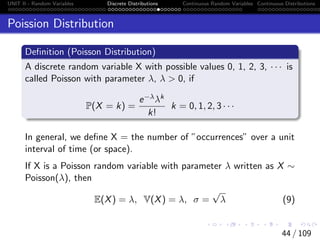
    UNIT II -Random Variables Discrete Distributions Continuous Random Variables Continuous Distributions Poission Distribution Definition (Poisson Distribution) A discrete random variable X with possible values 0, 1, 2, 3, · · · is called Poisson with parameter λ, λ 0, if P(X = k) = e−λλk k! k = 0, 1, 2, 3 · · · In general, we define X = the number of ”occurrences” over a unit interval of time (or space). If X is a Poisson random variable with parameter λ written as X ∼ Poisson(λ), then E(X) = λ, V(X) = λ, σ = √ λ (9) 44 / 109
  • 45.
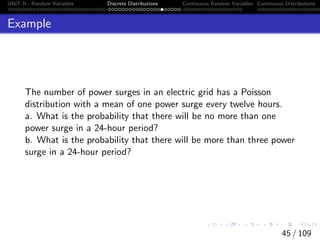
    UNIT II -Random Variables Discrete Distributions Continuous Random Variables Continuous Distributions Example The number of power surges in an electric grid has a Poisson distribution with a mean of one power surge every twelve hours. a. What is the probability that there will be no more than one power surge in a 24-hour period? b. What is the probability that there will be more than three power surge in a 24-hour period? 45 / 109
  • 46.
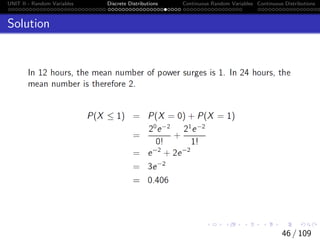
    UNIT II -Random Variables Discrete Distributions Continuous Random Variables Continuous Distributions Solution 46 / 109
  • 47.
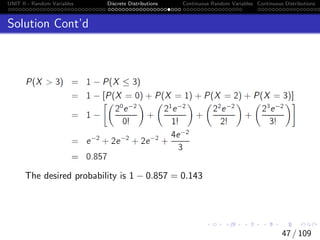
    UNIT II -Random Variables Discrete Distributions Continuous Random Variables Continuous Distributions Solution Cont’d The desired probability is 1 − 0.857 = 0.143 47 / 109
  • 48.
    UNIT II -Random Variables Discrete Distributions Continuous Random Variables Continuous Distributions Poisson Approximation to Binomial When the number of trials, n in a Binomial process is large, the computations of the binomial probabilities may be too tedious. The Poisson distribution can be used as an alternative to approximate the Binomial distribution. 48 / 109
  • 49.
    UNIT II -Random Variables Discrete Distributions Continuous Random Variables Continuous Distributions Exercises 1 Suppose that on average, 1 person in 1000 makes a numerical error in preparing his or her income tax return. If 9000 forms are selected at random and examined, find the probability that less than 3 of the forms contain an error. Ans = 0.0062 2 Every week the average number of wrong-number phone calls received by a certain mail-order house is seven. What is the probability that they will receive (a) two wrong calls tomorrow; (b) at least one wrong call tomorrow? Answers (a) ≈ 0.18 (b) ≈ 0.63 49 / 109
  • 50.
    UNIT II -Random Variables Discrete Distributions Continuous Random Variables Continuous Distributions Exercise 1 Orders arrive at a Web site according to a Poisson process with a mean of 12 per hour. Determine the following: (a) Probability of no orders in five minutes. (b) Probability of 3 or more orders in five minutes. (c) Length of a time interval such that the probability of no orders in an interval of this length is 0.001. 50 / 109
  • 51.
    UNIT II -Random Variables Discrete Distributions Continuous Random Variables Continuous Distributions Continuous Random Variables A continuous random variable is a random variable with an interval (either finite or infinite) of real numbers for its range. For example, if X = time (measured in seconds), then the set of all possible values of X is {x : x 0} If X = temperature (measured in degree Celsius), the set of all possible values of X (ignoring absolute zero and physical upper bounds) might be described as {x : −∞ x +∞} These set of values cannot be counted 51 / 109
  • 52.
    UNIT II -Random Variables Discrete Distributions Continuous Random Variables Continuous Distributions Probability Density Function In continuous random variables we assign positive probability to events which are intervals (e.g., 2 X 4, etc.) The probability density function (pdf), denoted by f (x), has the following characteristics: f (x) ≥ 0 The area under any pdf is equal to 1, Z ∞ −∞ f (x)dx = 1 If t is a specific value of interest, then the cummulative distribution function (cdf) of X is given by F(t) = P(X ≤ t) = Z t −∞ f (x)dx 52 / 109
  • 53.
    UNIT II -Random Variables Discrete Distributions Continuous Random Variables Continuous Distributions Probability Density Function We can view f (x) as the first derivative of F(x), i.e f (x) = F0 (x) If x1 and x2 are specific values of interest (x1 x2), then P(x1 ≤ X ≤ x2) = Z x2 x1 f (x)dx (10) = F(x2) − F(x1) For a fixed value t, P(X = t) = 0 = R t t f (x)dx = 0 from equation (10). 53 / 109
  • 54.
    UNIT II -Random Variables Discrete Distributions Continuous Random Variables Continuous Distributions Probability Density Function Consequently P(x1 ≤ X ≤ x2) = P(x1 X ≤ x2) = P(x1 ≤ X ≤ x2) = P(x1 X x2) with each equal to Z x2 x1 f (x)dx which is not true if X has a discrete distribution. 54 / 109
  • 55.
    UNIT II -Random Variables Discrete Distributions Continuous Random Variables Continuous Distributions Example X has the following density; f (x) = 4x3 where 0 ≤ x ≤ 1 Find (i) F(x) (ii) P(0.3 ≤ X ≤ 0.7) and P(0.4 ≤ X ≤ 0.6) 55 / 109
  • 56.
    UNIT II -Random Variables Discrete Distributions Continuous Random Variables Continuous Distributions Solution 56 / 109
  • 57.
    UNIT II -Random Variables Discrete Distributions Continuous Random Variables Continuous Distributions Example Let X be a continuous random variable with cumulative distribution function given by F(x) =      0 x 0 1 9x3 0 ≤ x ≤ 3 1 x ≥ 3 Find the p.d.f of X Solution f (x) = dF(x) dx = ( 1 3x2 0 ≤ x ≤ 3 0 otherwise 57 / 109
  • 58.
    UNIT II -Random Variables Discrete Distributions Continuous Random Variables Continuous Distributions Expectation and Variance The expected value of X is given by µ = E(X) = Z ∞ −∞ xf (x)dx And the variance of X is given as σ2 = V(X) = E(X2 ) − (E(X))2 = Z ∞ −∞ x2 f (x)dx − µ2 The standard deviation of X given as σ = √ σ2 = p V(X) 58 / 109
  • 59.
    UNIT II -Random Variables Discrete Distributions Continuous Random Variables Continuous Distributions Expectation and Variance Let X be a continuous random variable with pdf f (x). Suppose that g, g1, g2, · · · , gk are real-valued functions, and let c be any real constant. then E(g(X)) = Z ∞ −∞ g(x)f (x)dx Expectation satisfy the following properties E(c) = c E(cg(X)) = cE(g(X)) Given a linear function g(x) = ax + b where a, b are constants, we have E(g(X)) = aE(X) + b and V(aX + b) = a2 V(X) 59 / 109
  • 60.
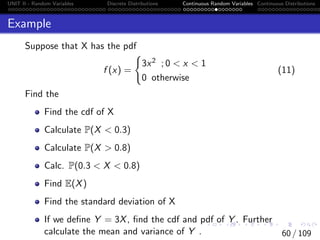
    UNIT II -Random Variables Discrete Distributions Continuous Random Variables Continuous Distributions Example Suppose that X has the pdf f (x) = ( 3x2 ; 0 x 1 0 otherwise (11) Find the Find the cdf of X Calculate P(X 0.3) Calculate P(X 0.8) Calc. P(0.3 X 0.8) Find E(X) Find the standard deviation of X If we define Y = 3X, find the cdf and pdf of Y . Further calculate the mean and variance of Y . 60 / 109
  • 61.
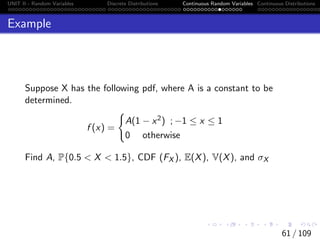
    UNIT II -Random Variables Discrete Distributions Continuous Random Variables Continuous Distributions Example Suppose X has the following pdf, where A is a constant to be determined. f (x) = ( A(1 − x2) ; −1 ≤ x ≤ 1 0 otherwise Find A, P{0.5 X 1.5}, CDF (FX ), E(X), V(X), and σX 61 / 109
  • 62.
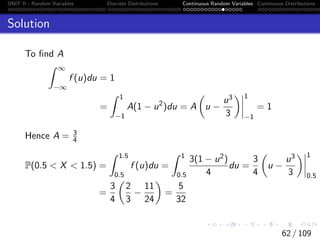
    UNIT II -Random Variables Discrete Distributions Continuous Random Variables Continuous Distributions Solution To find A Z ∞ −∞ f (u)du = 1 = Z 1 −1 A(1 − u2 )du = A u − u3 3 1 −1 = 1 Hence A = 3 4 P(0.5 X 1.5) = Z 1.5 0.5 f (u)du = Z 1 0.5 3(1 − u2) 4 du = 3 4 u − u3 3 1 0.5 = 3 4 2 3 − 11 24 = 5 32 62 / 109
  • 63.
    UNIT II -Random Variables Discrete Distributions Continuous Random Variables Continuous Distributions Solution F(x) =      0 c −1 ? − 1 c 1 1 c ≥ 1 Let us determine the ”?”, that is the value of F(c) for −1 ≤ c 1 F(c) = P(X ≤ c) = Z c −1 3(1 − u2) 4 du = 3 4 u − u3 3 c −1 = 2 + 3c − c3 4 63 / 109
  • 64.
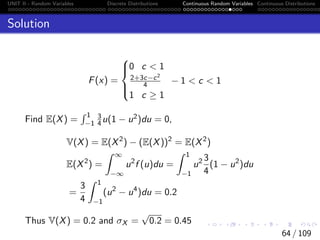
    UNIT II -Random Variables Discrete Distributions Continuous Random Variables Continuous Distributions Solution F(x) =      0 c 1 2+3c−c2 4 − 1 c 1 1 c ≥ 1 Find E(X) = R 1 −1 3 4u(1 − u2)du = 0, V(X) = E(X2 ) − (E(X))2 = E(X2 ) E(X2 ) = Z ∞ −∞ u2 f (u)du = Z 1 −1 u2 3 4 (1 − u2 )du = 3 4 Z 1 −1 (u2 − u4 )du = 0.2 Thus V(X) = 0.2 and σX = √ 0.2 = 0.45 64 / 109
  • 65.
    UNIT II -Random Variables Discrete Distributions Continuous Random Variables Continuous Distributions Exercise Experience has shown that while walking in a certain park, the time X, in minutes, between seeing two people smoking has a density function of the form f (x) = ( λxe−x ; x 0 0 otherwise (12) Calculate the value of λ, Ans, λ = 1 Find the probability distribution function of X What is the probability that Jeff, who has just seen a person smoking, will (i) see another person smoking in 2 to 5 minutes?. Ans ≈ 0.37 (ii) In at least 7 minutes? Ans = 0.007 65 / 109
  • 66.
    UNIT II -Random Variables Discrete Distributions Continuous Random Variables Continuous Distributions Exercise When a certain car breaks down, the time that it takes to fix it (in hours) is a random variable with the density function f (x) = ( ce−3x ; 0 ≤ x ∞ 0 otherwise (13) 1 Calculate the value of c 2 Find the probability that when this car breaks down, it takes at most 30 minutes to fix it. 66 / 109
  • 67.
    UNIT II -Random Variables Discrete Distributions Continuous Random Variables Continuous Distributions Exercise Let X be a random variable with pdf f (x) = ( 3x2 ; 0 x 1 0 otherwise (i) Find E(2X + 4) 67 / 109
  • 68.
    UNIT II -Random Variables Discrete Distributions Continuous Random Variables Continuous Distributions Exponential Distribution The Exponential Distribution is commonly used to answer the following questions: How long do we need to wait before a customer enters a shop? How long will it take before a call center receives the next phone call? How long will a piece of machinery work without breaking down? All these questions concern the time we need to wait before a given event occurs. We often model this waiting time by assuming it follows an exponential distribution. 68 / 109
  • 69.
    UNIT II -Random Variables Discrete Distributions Continuous Random Variables Continuous Distributions Exponential Distribution A random variable X is said to have an exponential distribution with parameter λ 0 if its pdf is given by f (x) = ( λe−λx ; x 0 0 otherwise The shorthand notation is X ∼ Exp(λ). The CDF of X is 69 / 109
  • 70.
    UNIT II -Random Variables Discrete Distributions Continuous Random Variables Continuous Distributions Exponential Distribution For any specified time x, the probability of the event happens no later than x is F(x) = Z x −∞ f (t)dt = Z x 0 λe−λt dt = ( 1 − e−λx x 0 0 x 0 The expected value of X is E(X) = Z ∞ −∞ xf (x) = 0 + Z ∞ 0 xλe−λx (14) Integrating by parts, setting u = x and dv = λe−λx dx we obtain E(X) = 1 λ 70 / 109
  • 71.
    UNIT II -Random Variables Discrete Distributions Continuous Random Variables Continuous Distributions Exponential Distribution and the variance of X given V(X) = E(X2 ) − (E(X))2 = 2 λ2 − 1 λ2 = 1 λ2 For an exponential random variable with parameter λ, E(X) = 1 λ = σX , V(X) = 1 λ2 71 / 109
  • 72.
    UNIT II -Random Variables Discrete Distributions Continuous Random Variables Continuous Distributions Example Suppose X has the exponential distribution with mean 10. Determine the following (i) P(X 10) (ii) P(X 30) (iii) that value of x such that P(X x) = 0.95 72 / 109
  • 73.
    UNIT II -Random Variables Discrete Distributions Continuous Random Variables Continuous Distributions Solution 73 / 109
  • 74.
    UNIT II -Random Variables Discrete Distributions Continuous Random Variables Continuous Distributions Solution 74 / 109
  • 75.
    UNIT II -Random Variables Discrete Distributions Continuous Random Variables Continuous Distributions Example Assume that the length of a phone call in minutes is an exponential random variable X with parameter λ = 1 10, ( the question may tell you the value of λ through the expectation; i.e., this based the expected waiting time for a phone call is 10 minutes). If someone arrives at a phone booth just before you arrive, find the probability that you will have to wait (a) less than 5 minutes (b) greater than 10 minutes (c) between 5 and 10 minutes Also compute the expected value and variance. 75 / 109
  • 76.
    UNIT II -Random Variables Discrete Distributions Continuous Random Variables Continuous Distributions Uniform Distribution The uniform distribution provides a simple probability model to describe a continuous random variable that can randomly assume any value between two points a and b (a b) on a line. It therefore provides a good model for a continuous random variable whose values are uniformly distributed over an interval. 76 / 109
  • 77.
    UNIT II -Random Variables Discrete Distributions Continuous Random Variables Continuous Distributions Uniform Distribution Let X be a uniform random variable on the interval (a,b). The corresponding pdf denoted by f (x) is given by f (x) = ( 1 b−a for a ≤ x ≤ b 0 otherwise (15) Show that equation (15) is a density function. 77 / 109
  • 78.
    UNIT II -Random Variables Discrete Distributions Continuous Random Variables Continuous Distributions Expectation and Variance The expected value of X is E(X) = Z b a x 1 b − a dx = 1 b − a x2 2 b a = 1 b − a 1 2 b2 − 1 2 a2 = a + b 2 The variance is given as E(X2 ) = Z b a x2 1 b − a dx = 1 3 b3 − a3 b − a = 1 3 (a2 + ab + b2 ) V(X) = (b − a)2 12 78 / 109
  • 79.
    UNIT II -Random Variables Discrete Distributions Continuous Random Variables Continuous Distributions Uniform Distribution Its CDF is given as F(x) =      0 for x a x−a b−a for a ≤ x ≤ b 1 x ≥ b (16) We will that equation (16) is the CDF of a uniform random variable. 79 / 109
  • 80.
    UNIT II -Random Variables Discrete Distributions Continuous Random Variables Continuous Distributions Example If X is uniformly distributed over (0, 10), calculate the probability that (a)X 3 (b) X 6, and (c) 3 X 8. P(X 3) = Z 3 0 1 10 dx = 3 10 P(X 6) = Z 10 6 1 10 dx = 4 10 P(3 X 8) = Z 8 3 1 10 dx = 1 2 80 / 109
  • 81.
    UNIT II -Random Variables Discrete Distributions Continuous Random Variables Continuous Distributions Example 81 / 109
  • 82.
    UNIT II -Random Variables Discrete Distributions Continuous Random Variables Continuous Distributions Solution 82 / 109
  • 83.
    UNIT II -Random Variables Discrete Distributions Continuous Random Variables Continuous Distributions Solution σ = √ 33.33333 = 5.7735 83 / 109
  • 84.
    UNIT II -Random Variables Discrete Distributions Continuous Random Variables Continuous Distributions Example Buses arrive at a specified stop at 15-minute intervals starting at 7 A.M. That is, they arrive at 7, 7:15, 7:30, 7:45, and so on. If a passenger arrives at the stop at a time that is uniformly distributed between 7 and 7:30, find the probability that he waits (a) less than 5 minutes for a bus (b) more than 10 minutes for a bus. Solution Let X denote the number of minutes past 7 that the passenger arrives at the stop. Since X is a uniform random variable over the interval (0, 30), it follows that the passenger will have to wait less than 5 minutes if (and only if) he arrives between 7:10 and 7:15 or between 7:25 and 7:30. Hence, the desired probability for part (a) is 84 / 109
  • 85.
    UNIT II -Random Variables Discrete Distributions Continuous Random Variables Continuous Distributions Solution P(10 X 15) + P(25 X 30) = Z 15 10 1 30 dx + Z 30 25 1 30 dx = 1 3 (b) He would have to wait more than 10 minutes if he arrives between 7 and 7:05 or between 7:15 and 7:20, so the probability for (b) is P(0 X 5) + P(15 X 20) = 1 3 85 / 109
  • 86.
    UNIT II -Random Variables Discrete Distributions Continuous Random Variables Continuous Distributions Normal Distribution X is a normal random variable, or simply that X is normally distributed, with parameters µ and σ2 if the density of X is given by f (x) = 1 √ 2πσ e− (x − µ)2 2σ2 − ∞ x ∞ (17) Shorthand notation is X ∼ N(µ, σ). Another name for the normal distribution is the Gaussian distribution. We state without proofs; E(X) = µ V(X) = σ2 Example: If X ∼ N(1, 4), find the mean, variance, and standard deviation of X. 86 / 109
  • 87.
    UNIT II -Random Variables Discrete Distributions Continuous Random Variables Continuous Distributions Normal Distribution 87 / 109
  • 88.
    UNIT II -Random Variables Discrete Distributions Continuous Random Variables Continuous Distributions Normal Distribution Figure 1: Normal Distribution Plots Figure (1) presents the plot of pdf of N(-10, 1), N(-5, 1), N(0, 1), 88 / 109
  • 89.
    UNIT II -Random Variables Discrete Distributions Continuous Random Variables Continuous Distributions Normal Distribution Figure 2: Normal Distribution Plots Figure (2) presents the plot of pdf of N(0, 1), N(0, 4), N(0,9), 89 / 109
  • 90.
    UNIT II -Random Variables Discrete Distributions Continuous Random Variables Continuous Distributions Empirical Rule 90 / 109
  • 91.
    UNIT II -Random Variables Discrete Distributions Continuous Random Variables Continuous Distributions Example The marks obtained by 600 engineering students in a test are normally distributed with a mean of 75 and a standard deviation of 7. (a) What is the proportion of the class that has a test score between 68 and 82 (b) How many students have a test score between 61 and 89 (c) What is the probability that a student chosen at random has a test between 54 and 75. 91 / 109
  • 92.
    UNIT II -Random Variables Discrete Distributions Continuous Random Variables Continuous Distributions Solution Using the empirical rule (a) P(68 X 82) = 0.68 (b) P(61 X 89) = 0.95 Hence the number of students is 600 × 0.95 = 570 students (c) P(54 X 75) = 0.4985 92 / 109
  • 93.
    UNIT II -Random Variables Discrete Distributions Continuous Random Variables Continuous Distributions Solution We can also use equation (17) to compute the probabilities (a) P(68 X 82) = 1 7 √ 2π Z 82 68 e− (x − 75)2 2(72) dx = 0.68268949 (b) P(61 X 89) = 1 7 √ 2π Z 89 61 e− (x − 75)2 2(72) dx = 0.9544997 (c) P(54 X 75) = 1 7 √ 2π Z 75 54 e− (x − 75)2 2(72) dx = 0.498650102 93 / 109
  • 94.
    UNIT II -Random Variables Discrete Distributions Continuous Random Variables Continuous Distributions Standard Normal Distribution When µ = 0 and σ2 = 1, we say the normal distribution N(0, 1) is the standard normal distribution or the z score for X. It is denoted by Z, i.e Z ∼ N(0, 1) For X ∼ N(µ, σ) X − µ σ = Z ∼ N(0, 1) The transformation process is referred to as standardization. In other words we can express X = µ + σZ Thus, all the normal distribution shares a common thing which is the standard normal distribution. If we know standard normal, we know every normal distribution. 94 / 109
  • 95.
    UNIT II -Random Variables Discrete Distributions Continuous Random Variables Continuous Distributions Standard Normal Distribution Example 1 If X ∼ N(3, 16) then the corresponding z score for x = 8 after standardization is z = 8 − 3 4 = 1.25 Example 2 Given that X ∼ N(30, 10). Find the mean and standard deviation. (b) What is the value of x with the z - score of 1.5 (c) what is the z -score that correspond to x = 30 95 / 109
  • 96.
    UNIT II -Random Variables Discrete Distributions Continuous Random Variables Continuous Distributions Standard Normal Distribution The cumulative distribution function of a standard normal random variable is denoted by Φ(x) and is given as Φ(x) = P(Z ≤ x) = P(X ≤ σx + µ) = 1 σ √ 2π Z σx+µ −∞ e− (t − µ)2 2σ2 dt Letting y = t−µ σ we obtain P(Z ≤ x) = 1 √ 2π Z x −∞ e−y2/2 dy 96 / 109
  • 97.
    UNIT II -Random Variables Discrete Distributions Continuous Random Variables Continuous Distributions Standard Normal Distribution Its pdf is given as Φ0 (x) = f (x) = 1 2 √ π e−x2/2 (18) For negative values of x, Φ(x) can be obtained from the relationship P(Z x) = Φ(−x) = 1 − Φ(x) 97 / 109
  • 98.
    UNIT II -Random Variables Discrete Distributions Continuous Random Variables Continuous Distributions Finding Probabilities of Random Normal Variables The standard normal table and our ability to standardize any normal random variable allow us to determine the probability of normal random variable. Find P(3 X 8). Where X ∼ N(3, 16) This is equivalent to P 3 − 3 4 x − µ σ 8 − 3 4 = P(0 Z 1.25) = 0.3944 We read from the standard normal tables. 98 / 109
  • 99.
    UNIT II -Random Variables Discrete Distributions Continuous Random Variables Continuous Distributions Example Find P(−1.96 Z 1.96) P(−1.96 Z 1.96) = P(−1.96 Z 0) + P(0 Z 1.96) = 0.9500 Suppose a continuous random variable X is normally distributed with mean 30 and standard deviation 5. Find (ii) P(20 X 30) Ans = 0.4772 (iii) P(30 X 37.5) Ans = 0.4332 99 / 109
  • 100.
    UNIT II -Random Variables Discrete Distributions Continuous Random Variables Continuous Distributions Example X is normally distributed with mean 100 and standard deviation 15. Use the standard z table to answer the following questions. (i) P(X 80) Ans = 0.09 (ii) P(X 136) Ans = 0.0082 (iii) P(95 X 110) Ans = 0.3779 (iv) The X score that corresponds to the 90th percentile (z =1.285 and X =119.2) 100 / 109
  • 101.
    UNIT II -Random Variables Discrete Distributions Continuous Random Variables Continuous Distributions Standard Normal Table 101 / 109
  • 102.
    UNIT II -Random Variables Discrete Distributions Continuous Random Variables Continuous Distributions Examples 102 / 109
  • 103.
    UNIT II -Random Variables Discrete Distributions Continuous Random Variables Continuous Distributions Example 103 / 109
  • 104.
    UNIT II -Random Variables Discrete Distributions Continuous Random Variables Continuous Distributions Example 104 / 109
  • 105.
    UNIT II -Random Variables Discrete Distributions Continuous Random Variables Continuous Distributions Example 105 / 109
  • 106.
    UNIT II -Random Variables Discrete Distributions Continuous Random Variables Continuous Distributions Example 106 / 109
  • 107.
    UNIT II -Random Variables Discrete Distributions Continuous Random Variables Continuous Distributions Table 107 / 109
  • 108.
    UNIT II -Random Variables Discrete Distributions Continuous Random Variables Continuous Distributions Extra Reading Read on: 1 mean, median, mode (measures of central tendency) 2 variance, standard deviation, range (measures of variation) 108 / 109