BUSINESS
STUDIES
UNIT 1
ENTERPRISE AND ENTREPRENEURS
Characteristics of successful entrepreneurs
-Passionate (about the product)
-Visionary (have faith)
-Energetic and driven(prepared to work hard)
-Calculated risk taker (take risk to maximise rewards)
-Multi-tasker (take on more than one role)
-Resilient (able to handle problems)
-Focused(set clear goals)
-Results orientated(take pleasure from achieving targets)
ENTERPRISE AND ENTREPRENEURS
Reasons for Starting a business
-More flexibility over working life
-Escape an uninteresting job
-Pursue an interest
-Want to be your own boss
-Feeling of satisfaction
-Wanting more of the rewards from your effort
-Fed up of working un a business hierarchy
-Financial necessity
ENTERPRISE AND ENTREPRENEURS
Risks of starting a business
-Potential loss of investments
-Loss of pay from previous job
-Potential unlimited liability
-Stress and pressure
-Earning little
-isolation
Rewards for the Entrepreneur
-Potential for income and profit
-Satisfaction
-Freedom
-Control
-Capital Gain
ENTERPRISE AND ENTREPRENEURS
Sources of Government Support
The government are encouraging start-ups for economic growth
-BIS (Dept for Business, Innovation and Skills)
-Business Link
-DirectGov (advice on tax, laws and regulations)
-UKTI (help with international sales)
-Tax incentives or breaks for investment
Other Support and Advice for Start-ups
-Many online sources
-Business Associations (the Princes Trust and Federation of small businesses)
-Local business networks
-Professional Firms (Accountants and Lawyers)
-Campaigning Organisations (start-up Britain)
OPPORTUNITY COST
Opportunity Cost- is the cost of missing out on the next best
alternative. The benefits that could have been gained by taking a
different decision.
How opportunity costs affect the startup:
- Resources are limited
- Decisions need to be made when resources are scarce
- Take calculated risks and weigh up potential implications before choosing what they
think is best for the business.
GENERATING AND PROTECTING IDEAS
Sources of ideas
- Brainstorming and creative thinking
- Business/ Personal Experience
- Frustrations with poor service
- Copying an existing idea (Franchising)
- Innovation or invention
What makes a good Idea?
- Solving a problem
- Cheaper or better product/service
- Easier to use
- Can be developed easily
- exploits gap in the market or an emerging growth trend
GENERATING AND PROTECTING IDEAS
Patents
- Difficult to obtain
- On a new invention or innovative product or production method
- The patent owner is given up to 20 years protection against competitors
- Ability to license right to use the invention in return for royalties
- Patents are expensive and time consuming to obtain
Trademarks
- Identifies a product
- Can be a name, logo or symbol etc.
- Trademark allows a business from using identical or confusingly similar marks
- Trademark protection lasts for 10 years
Copyright
- Important source of protection for any startup in creative or knowledge industries
- Protection is granted automatically
- Protects the way in which an idea is expressed as soon as it is published
- Lasts for 70 years after authors death
ADDING VALUE AND TARGETING A NICHE MARKET
Added value – is the difference between the price of the
finished product and the cost of the inputs used in making it.
How to add value:
- Delivering excellent and distinctive customer service
- Building a distinctive brand
- Product features and benefits
Why add value?
- Can charge higher price
- Differentiate from competition
- Build customer loyalty
- Focus on customer needs
ADDING VALUE AND TARGETING A NICHE MARKET
Niche Market- is a smaller, specialist part of a larger market
where customers have particular needs and wants.
Market Segments:
- Geographic (countries, regions and population)
- Demographic (customer age, gender, lifestyle etc)
Advantages of niche segments:
- Better able to add value
- Customer needs are more precisely defined
- Potential to charger higher prices
- Encounter less competition
- Target potential customers easier
Disadvantages of niche segments:
- Customers are more demanding
- Existing established competitors
- Less able to benefit economies of scale
- Competitors soon attracted when market becomes mainstream
FRANCHISING
Franchise- the business format which a franchisor allows a franchisee to
use, under license.
Franchisor- the ultimate owner of the franchise format
Franchisee- the business who is granted the right to operate a franchise on
behalf of the franchisor.
Costs of being a franchisee:
- Initial cost
- Service fee
- Advertising levy
- Mark ups
Franchisees can be seen as a lower risk:
- Easier to gain customers
- Tried and tested business model
- Easier to raise bank finance
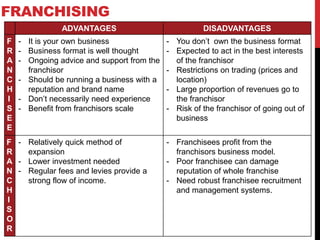
FRANCHISING
ADVANTAGES DISADVANTAGES
F
R
A
N
C
H
I
S
E
E
- It is your own business
- Business format is well thought
- Ongoing advice and support from the
franchisor
- Should be running a business with a
reputation and brand name
- Don’t necessarily need experience
- Benefit from franchisors scale
- You don’t own the business format
- Expected to act in the best interests
of the franchisor
- Restrictions on trading (prices and
location)
- Large proportion of revenues go to
the franchisor
- Risk of the franchisor of going out of
business
F
R
A
N
C
H
I
S
O
R
- Relatively quick method of
expansion
- Lower investment needed
- Regular fees and levies provide a
strong flow of income.
- Franchisees profit from the
franchisors business model.
- Poor franchisee can damage
reputation of whole franchise
- Need robust franchisee recruitment
and management systems.
ANALYSING AND UNDERSTANDING THE MARKET
A market is any location where buyers and sellers come together to transact
with each other.
Local Markets:
+ Customers are a short distance from suppliers
+ Close to the customers and respond to market change
- Market is small and often competitive
National Markets:
+ Much larger target market
- Customers are spread throughout the country
- Needs to be operated efficiently and hard to maintain
Physical markets:
+ Buyers and sellers meet in the same location(eg car boot sale)
+ Easier for buyers and sellers to exchange information
- Needs to be open for trade to take place
Electronic Market
+ Any connection between buyer and seller using electronic means
+ Ability to reach global market
- Price is highly competitive
- Product then has to be delivered
ANALYSING AND UNDERSTANDING THE MARKET
Demand is how much customers are prepared and willing
to buy a product at a given price.
Factors that affect demand:
- Price
- Incomes (how much money the customer has to spend)
- Taste and fashions
- Competitor actions
Market size – the value and volume
Market share – proportion of market owned
Market growth – the percentage growth over a period of time
CHOOSING A LEGAL STRUCTURE
Sole Trader
A business owned by a single individual
+ Quick and easy to set up
+ Simple to run
+ Minimal paperwork and simple accounting
- Full personal liability
- Harder to raise finance
- The business is the owner
CHOOSING A LEGAL STRUCTURE
Partnership
Where a business is owned by two or more people
+ The simplest way for two people to form a business together
+ Benefit from the expertise from all the owners
+ Greater potential to raise finance
- Full personal liability
- A poor decision by one partner damages the interests of others
- Harder to raise finance than a company
- Partners are bound to hour decisions of others
CHOOSING A LEGAL STRUCTURE
Limited company
A separate corporation owned by the shareholders
+ Limited liability
+ Easier to raise finance
+ Stable form of structure
- Greater admin costs
- Public disclosure of company information
- Directors legal duties
CHOOSING A LEGAL STRUCTURE
Social Enterprise
A business with a primarily social objective whose surplus is re-invested
for that purpose in the business or community.
- Still running a proper business
- Giving something back
- Activities that benefit society
- Availability of government grants and other finance support
- Stakeholders gain from profits reinvested
- Example is the big issue
SOURCES OF FINANCE
Internal sources:
- Personal sources
- Retained profits
- Share capital from entrepreneur
- Sales of assets
External sources:
- Share capital from outside investors
- Friends and family
- Bank overdraft
- Bank loan
- Grants and other government incentives
Factors affecting choice:
- Control
- Cost
- Amount
- Timing and flexibility
SOURCES OF FINANCE
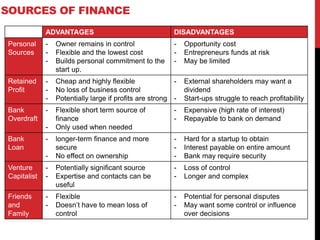
ADVANTAGES DISADVANTAGES
Personal
Sources
- Owner remains in control
- Flexible and the lowest cost
- Builds personal commitment to the
start up.
- Opportunity cost
- Entrepreneurs funds at risk
- May be limited
Retained
Profit
- Cheap and highly flexible
- No loss of business control
- Potentially large if profits are strong
- External shareholders may want a
dividend
- Start-ups struggle to reach profitability
Bank
Overdraft
- Flexible short term source of
finance
- Only used when needed
- Expensive (high rate of interest)
- Repayable to bank on demand
Bank
Loan
- longer-term finance and more
secure
- No effect on ownership
- Hard for a startup to obtain
- Interest payable on entire amount
- Bank may require security
Venture
Capitalist
- Potentially significant source
- Expertise and contacts can be
useful
- Loss of control
- Longer and complex
Friends
and
Family
- Flexible
- Doesn’t have to mean loss of
control
- Potential for personal disputes
- May want some control or influence
over decisions
BUSINESS LOCATION
Location is the physical place from which a business is operated and
controlled.
Quantitative factors- based on measureable information such as cost.
Qualitative factors- based on personal opinions and preferences such as
quality of life.
Home Based Startup-
+ Low cost
+ Little travelling
+ Can be combined with domestic tasks
+ Lowers business risk
+ Freedom over what to wear
- Requires greater self discipline
- Work often interrupted
- Work never goes away
- Potentially lonely
- Could give poor impression to customers
BUSINESS LOCATION
Factors that influence the choice of location:
- Cost
- fixed costs raises break even output
- it’s best to try to minimise costs to lower risk of failure
- Proximity to the market
- need to be close to potential customers
- Infrastructure
- transport, telecommunication
- Personal and other qualitative issues
- location may create a USP that could attract customers or staff
EMPLOYING PEOPLE
Full- Time- contracted employee working more than 30 hours a week
+ maximises output from each employee
+ available all the time
+ better returns from training
+ potentially better for customer service
- Higher costs
- is there enough work to justify a full timer
- Reduced flexibility
- Raises the breakeven output=higher risk
Part- Time- contracted employee working less than 30 hours a week
+ keeps costs down= lower breakeven output
+ may be easier to recruit
+ consistent with increasing demand for flexible working
- Not always able to handle the high workload
- Less opportunity for training
- Harder to communicate with them as they aren’t working long
Permanent- employed by the business for a non-specified amount of time.
Temporary- employment for a specific period after which employment is terminated or renewed.
+ Flexibility
+ ideal for certain tasks or projects
- Higher cost per hour
- Temps are less likely to know and understand
- Potentially negative customer service
Consultant- individuals and businesses external to the business that provide specific services and advice.
CALCULATING COSTS, REVENUES AND PROFITS
Costs- incurred in making and delivery of the products/services
Revenue- amounts earned by a business by selling products and
services (Revenue= price x quantity sold)
Profit- the difference between total revenues and total costs.
Variable costs – costs which change as a result of changes in output
Fixed costs- costs which do not change in relation to changes in output
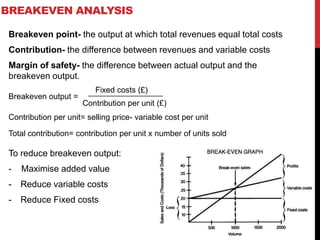
BREAKEVEN ANALYSIS
Breakeven point- the output at which total revenues equal total costs
Contribution- the difference between revenues and variable costs
Margin of safety- the difference between actual output and the
breakeven output.
To reduce breakeven output:
- Maximise added value
- Reduce variable costs
- Reduce Fixed costs
Breakeven output =
Fixed costs (£)
Contribution per unit (£)
Contribution per unit= selling price- variable cost per unit
Total contribution= contribution per unit x number of units sold
BREAKEVEN ANALYSIS
+ A crucial milestone
+ Focuses entrepreneur on a target
+ Encourages forecasting's of cash flow
+ Provides a measureable target
+ A key part of any credible business plan
+ Involves making estimates that could be wrong
- Ignores price and cost changes
- Assumes all output is sold
- New entrepreneurs may lack experience to make realistic estimates
- Breakeven output changes
CASH FLOW FORECASTING
A cash flow forecast is a prediction of cash inflow and outflow over a
period of time.
Why a business should produce a cash flow forecast:
- Identifies potential shortfalls
- Ensure the business can afford to pay suppliers
- Spot problems with customer payments
- Important discipline of financial planning
- External stakeholders and banks may require a forecast
However a forecast may not be reliable as:
- Difficult to forecast the timings
- Linked to the quality of market research
- Need to be cautious
- Good to have different scenarios
- Will have to make assumptions
BUSINESS PLANNING AND BUDGETING
- Income sales budget
- Expenditure costs budget
- Profit budget
A business plan:
Contents include, executive summary, market profile, competition, protection of the
business idea, management team, marketing, operations, financials, funding and exit
strategy.
+ Provides a focus on the business idea
+ Clarifies thoughts and identifies gaps in information and market research
+ Encourages the entrepreneur to focus and plan the future
+ Measure against performance
+ Essential to raise finance
- Assumptions about a business are uncertain
- Entrepreneurs may be optimistic
- Market research may be limited/unreliable
- Startups may incur unanticipated costs
- Budgeting is generally easier when there has been experience in trading
OBJECTIVES OF STARTUPS
- Survival
- Growth
- Profit
- Or Intangible such as freedom
What can go wrong:
- Poor management
- Sales lower than expected
- Startup costs too high
- Poor quality
- Overtrading
- Competitor actions
- Lack of finance

Business unit 1

  • 1.
  • 2.
    ENTERPRISE AND ENTREPRENEURS Characteristicsof successful entrepreneurs -Passionate (about the product) -Visionary (have faith) -Energetic and driven(prepared to work hard) -Calculated risk taker (take risk to maximise rewards) -Multi-tasker (take on more than one role) -Resilient (able to handle problems) -Focused(set clear goals) -Results orientated(take pleasure from achieving targets)
  • 3.
    ENTERPRISE AND ENTREPRENEURS Reasonsfor Starting a business -More flexibility over working life -Escape an uninteresting job -Pursue an interest -Want to be your own boss -Feeling of satisfaction -Wanting more of the rewards from your effort -Fed up of working un a business hierarchy -Financial necessity
  • 4.
    ENTERPRISE AND ENTREPRENEURS Risksof starting a business -Potential loss of investments -Loss of pay from previous job -Potential unlimited liability -Stress and pressure -Earning little -isolation Rewards for the Entrepreneur -Potential for income and profit -Satisfaction -Freedom -Control -Capital Gain
  • 5.
    ENTERPRISE AND ENTREPRENEURS Sourcesof Government Support The government are encouraging start-ups for economic growth -BIS (Dept for Business, Innovation and Skills) -Business Link -DirectGov (advice on tax, laws and regulations) -UKTI (help with international sales) -Tax incentives or breaks for investment Other Support and Advice for Start-ups -Many online sources -Business Associations (the Princes Trust and Federation of small businesses) -Local business networks -Professional Firms (Accountants and Lawyers) -Campaigning Organisations (start-up Britain)
  • 6.
    OPPORTUNITY COST Opportunity Cost-is the cost of missing out on the next best alternative. The benefits that could have been gained by taking a different decision. How opportunity costs affect the startup: - Resources are limited - Decisions need to be made when resources are scarce - Take calculated risks and weigh up potential implications before choosing what they think is best for the business.
  • 7.
    GENERATING AND PROTECTINGIDEAS Sources of ideas - Brainstorming and creative thinking - Business/ Personal Experience - Frustrations with poor service - Copying an existing idea (Franchising) - Innovation or invention What makes a good Idea? - Solving a problem - Cheaper or better product/service - Easier to use - Can be developed easily - exploits gap in the market or an emerging growth trend
  • 8.
    GENERATING AND PROTECTINGIDEAS Patents - Difficult to obtain - On a new invention or innovative product or production method - The patent owner is given up to 20 years protection against competitors - Ability to license right to use the invention in return for royalties - Patents are expensive and time consuming to obtain Trademarks - Identifies a product - Can be a name, logo or symbol etc. - Trademark allows a business from using identical or confusingly similar marks - Trademark protection lasts for 10 years Copyright - Important source of protection for any startup in creative or knowledge industries - Protection is granted automatically - Protects the way in which an idea is expressed as soon as it is published - Lasts for 70 years after authors death
  • 9.
    ADDING VALUE ANDTARGETING A NICHE MARKET Added value – is the difference between the price of the finished product and the cost of the inputs used in making it. How to add value: - Delivering excellent and distinctive customer service - Building a distinctive brand - Product features and benefits Why add value? - Can charge higher price - Differentiate from competition - Build customer loyalty - Focus on customer needs
  • 10.
    ADDING VALUE ANDTARGETING A NICHE MARKET Niche Market- is a smaller, specialist part of a larger market where customers have particular needs and wants. Market Segments: - Geographic (countries, regions and population) - Demographic (customer age, gender, lifestyle etc) Advantages of niche segments: - Better able to add value - Customer needs are more precisely defined - Potential to charger higher prices - Encounter less competition - Target potential customers easier Disadvantages of niche segments: - Customers are more demanding - Existing established competitors - Less able to benefit economies of scale - Competitors soon attracted when market becomes mainstream
  • 11.
    FRANCHISING Franchise- the businessformat which a franchisor allows a franchisee to use, under license. Franchisor- the ultimate owner of the franchise format Franchisee- the business who is granted the right to operate a franchise on behalf of the franchisor. Costs of being a franchisee: - Initial cost - Service fee - Advertising levy - Mark ups Franchisees can be seen as a lower risk: - Easier to gain customers - Tried and tested business model - Easier to raise bank finance
  • 12.
    FRANCHISING ADVANTAGES DISADVANTAGES F R A N C H I S E E - Itis your own business - Business format is well thought - Ongoing advice and support from the franchisor - Should be running a business with a reputation and brand name - Don’t necessarily need experience - Benefit from franchisors scale - You don’t own the business format - Expected to act in the best interests of the franchisor - Restrictions on trading (prices and location) - Large proportion of revenues go to the franchisor - Risk of the franchisor of going out of business F R A N C H I S O R - Relatively quick method of expansion - Lower investment needed - Regular fees and levies provide a strong flow of income. - Franchisees profit from the franchisors business model. - Poor franchisee can damage reputation of whole franchise - Need robust franchisee recruitment and management systems.
  • 13.
    ANALYSING AND UNDERSTANDINGTHE MARKET A market is any location where buyers and sellers come together to transact with each other. Local Markets: + Customers are a short distance from suppliers + Close to the customers and respond to market change - Market is small and often competitive National Markets: + Much larger target market - Customers are spread throughout the country - Needs to be operated efficiently and hard to maintain Physical markets: + Buyers and sellers meet in the same location(eg car boot sale) + Easier for buyers and sellers to exchange information - Needs to be open for trade to take place Electronic Market + Any connection between buyer and seller using electronic means + Ability to reach global market - Price is highly competitive - Product then has to be delivered
  • 14.
    ANALYSING AND UNDERSTANDINGTHE MARKET Demand is how much customers are prepared and willing to buy a product at a given price. Factors that affect demand: - Price - Incomes (how much money the customer has to spend) - Taste and fashions - Competitor actions Market size – the value and volume Market share – proportion of market owned Market growth – the percentage growth over a period of time
  • 15.
    CHOOSING A LEGALSTRUCTURE Sole Trader A business owned by a single individual + Quick and easy to set up + Simple to run + Minimal paperwork and simple accounting - Full personal liability - Harder to raise finance - The business is the owner
  • 16.
    CHOOSING A LEGALSTRUCTURE Partnership Where a business is owned by two or more people + The simplest way for two people to form a business together + Benefit from the expertise from all the owners + Greater potential to raise finance - Full personal liability - A poor decision by one partner damages the interests of others - Harder to raise finance than a company - Partners are bound to hour decisions of others
  • 17.
    CHOOSING A LEGALSTRUCTURE Limited company A separate corporation owned by the shareholders + Limited liability + Easier to raise finance + Stable form of structure - Greater admin costs - Public disclosure of company information - Directors legal duties
  • 18.
    CHOOSING A LEGALSTRUCTURE Social Enterprise A business with a primarily social objective whose surplus is re-invested for that purpose in the business or community. - Still running a proper business - Giving something back - Activities that benefit society - Availability of government grants and other finance support - Stakeholders gain from profits reinvested - Example is the big issue
  • 19.
    SOURCES OF FINANCE Internalsources: - Personal sources - Retained profits - Share capital from entrepreneur - Sales of assets External sources: - Share capital from outside investors - Friends and family - Bank overdraft - Bank loan - Grants and other government incentives Factors affecting choice: - Control - Cost - Amount - Timing and flexibility
  • 20.
    SOURCES OF FINANCE ADVANTAGESDISADVANTAGES Personal Sources - Owner remains in control - Flexible and the lowest cost - Builds personal commitment to the start up. - Opportunity cost - Entrepreneurs funds at risk - May be limited Retained Profit - Cheap and highly flexible - No loss of business control - Potentially large if profits are strong - External shareholders may want a dividend - Start-ups struggle to reach profitability Bank Overdraft - Flexible short term source of finance - Only used when needed - Expensive (high rate of interest) - Repayable to bank on demand Bank Loan - longer-term finance and more secure - No effect on ownership - Hard for a startup to obtain - Interest payable on entire amount - Bank may require security Venture Capitalist - Potentially significant source - Expertise and contacts can be useful - Loss of control - Longer and complex Friends and Family - Flexible - Doesn’t have to mean loss of control - Potential for personal disputes - May want some control or influence over decisions
  • 21.
    BUSINESS LOCATION Location isthe physical place from which a business is operated and controlled. Quantitative factors- based on measureable information such as cost. Qualitative factors- based on personal opinions and preferences such as quality of life. Home Based Startup- + Low cost + Little travelling + Can be combined with domestic tasks + Lowers business risk + Freedom over what to wear - Requires greater self discipline - Work often interrupted - Work never goes away - Potentially lonely - Could give poor impression to customers
  • 22.
    BUSINESS LOCATION Factors thatinfluence the choice of location: - Cost - fixed costs raises break even output - it’s best to try to minimise costs to lower risk of failure - Proximity to the market - need to be close to potential customers - Infrastructure - transport, telecommunication - Personal and other qualitative issues - location may create a USP that could attract customers or staff
  • 23.
    EMPLOYING PEOPLE Full- Time-contracted employee working more than 30 hours a week + maximises output from each employee + available all the time + better returns from training + potentially better for customer service - Higher costs - is there enough work to justify a full timer - Reduced flexibility - Raises the breakeven output=higher risk Part- Time- contracted employee working less than 30 hours a week + keeps costs down= lower breakeven output + may be easier to recruit + consistent with increasing demand for flexible working - Not always able to handle the high workload - Less opportunity for training - Harder to communicate with them as they aren’t working long Permanent- employed by the business for a non-specified amount of time. Temporary- employment for a specific period after which employment is terminated or renewed. + Flexibility + ideal for certain tasks or projects - Higher cost per hour - Temps are less likely to know and understand - Potentially negative customer service Consultant- individuals and businesses external to the business that provide specific services and advice.
  • 24.
    CALCULATING COSTS, REVENUESAND PROFITS Costs- incurred in making and delivery of the products/services Revenue- amounts earned by a business by selling products and services (Revenue= price x quantity sold) Profit- the difference between total revenues and total costs. Variable costs – costs which change as a result of changes in output Fixed costs- costs which do not change in relation to changes in output
  • 25.
    BREAKEVEN ANALYSIS Breakeven point-the output at which total revenues equal total costs Contribution- the difference between revenues and variable costs Margin of safety- the difference between actual output and the breakeven output. To reduce breakeven output: - Maximise added value - Reduce variable costs - Reduce Fixed costs Breakeven output = Fixed costs (£) Contribution per unit (£) Contribution per unit= selling price- variable cost per unit Total contribution= contribution per unit x number of units sold
  • 26.
    BREAKEVEN ANALYSIS + Acrucial milestone + Focuses entrepreneur on a target + Encourages forecasting's of cash flow + Provides a measureable target + A key part of any credible business plan + Involves making estimates that could be wrong - Ignores price and cost changes - Assumes all output is sold - New entrepreneurs may lack experience to make realistic estimates - Breakeven output changes
  • 27.
    CASH FLOW FORECASTING Acash flow forecast is a prediction of cash inflow and outflow over a period of time. Why a business should produce a cash flow forecast: - Identifies potential shortfalls - Ensure the business can afford to pay suppliers - Spot problems with customer payments - Important discipline of financial planning - External stakeholders and banks may require a forecast However a forecast may not be reliable as: - Difficult to forecast the timings - Linked to the quality of market research - Need to be cautious - Good to have different scenarios - Will have to make assumptions
  • 28.
    BUSINESS PLANNING ANDBUDGETING - Income sales budget - Expenditure costs budget - Profit budget A business plan: Contents include, executive summary, market profile, competition, protection of the business idea, management team, marketing, operations, financials, funding and exit strategy. + Provides a focus on the business idea + Clarifies thoughts and identifies gaps in information and market research + Encourages the entrepreneur to focus and plan the future + Measure against performance + Essential to raise finance - Assumptions about a business are uncertain - Entrepreneurs may be optimistic - Market research may be limited/unreliable - Startups may incur unanticipated costs - Budgeting is generally easier when there has been experience in trading
  • 29.
    OBJECTIVES OF STARTUPS -Survival - Growth - Profit - Or Intangible such as freedom What can go wrong: - Poor management - Sales lower than expected - Startup costs too high - Poor quality - Overtrading - Competitor actions - Lack of finance