CrackingThe Business Case For Learning Code
Understanding Return on Investment and Benefit cost
 Executives recognise learning as a key element in meeting the
challenges of a complex and global economy—not to mention
driving change and creating more excellent stakeholder value.
Therefore, learning is critical to an organisation's current and
future success.
 However, there are some concerns raised within the learning
and development community regarding the value of learning
and how and when it should be actually deployed. Also, the
leaders expect so much from learning programmes.
 But what does the Executive expect from the learning
programme?
1. Impact
2. Return on Investment (ROI)
For Physical
Submission
1.IMPACT OFTHE LEARNING PROGRAMME
According to one study, a learning organisation has a positive impact on knowledge performance,
which in turn has a positive impact on financial performance, and knowledge performance fully
mediates the connection between a learning organisation and financial performance.
In achieving these goals, training experts must provide value, explore new techniques to
measure programme success, and show increased expenditure accountability.
CASE STUDY
Let’s use the cost of implementing a conflict
resolution programme in your organisation as an example.
How do we get the value
of a conflict resolution programme?
To achieve that, we must look at this from two different value
areas.
In a conflict resolution programme, you’ve got people
involved; think about the time they spent, the convenience of
their involvement and the cost of having them involved.
In doing these, there are five outcomes you should consider;
 Is it something relevant to what they are doing
 Is it relevant in their department,
 Is it important to the function they perform
 Significantly, will it benefit them in person?
 Is it something they can recommend to others?
To measure the impact of your conflict resolution programme,
consider the tangible and intangible impacts.
The tangible impact is the impact you can calculate the
monetary value over time, while the intangible
impact cannot be measured in terms of monetary value.
2. RETURN ON INVESTMENT
 Training ROI measures how much an organization gains from
its investment in training. It is a financial metric that expands
on the benefits and business results relative to a training
program. It is not a training satisfaction measure which
indicates how happy the employees are with the training.
 With ROI, you're getting past lower-level evaluations of
training impact like learner satisfaction and cutting straight to
the bottom line: for what we spent, what did we get out of this
training?
 ROI is an economic indicator that shows the impact of your
programme in monetary terms. ROI for any training is a purely
economic measure that tells you the benefits of the
programme relative to its costs.
 The standard formula for calculating your ROI for training is
ROI% =
𝑇𝑟𝑎𝑖𝑛𝑖𝑛𝑔 𝑏𝑒𝑛𝑒𝑓𝑖𝑡𝑠−𝑡𝑟𝑎𝑖𝑛𝑖𝑛𝑔 𝑐𝑜𝑠𝑡𝑠
𝑇𝑟𝑎𝑖𝑛𝑖𝑛𝑔 𝑐𝑜𝑠𝑡𝑠
× 100
CALCULATINGTHE ROI OF
TRAINING PROGRAMME.
 When calculating the ROI for your training programme, you should
also consider the Benefit-cost ratio, which is the total benefits of the
programme divided by the costs, calculated as
BCR =
Benefits of training
Costs of training
 The BCR, along with other measures such as net present value,
return on investment, internal rate of return, and so on, is commonly
used in cost-benefit analyses.
Calculating the ROI of training
programme.
HOWTO MEASURE PROGRAMME
EVALUATION USING ROI METHODOLOGY
The ROI methodology has become one of the most popular evaluation methods in the
world.With the ROI Methodology, it has become possible to get credible data on the
effectiveness of any training programme on the participants and, more importantly,
the effect on the organisation's bottom line.
The ROI Methodology has sustained its position as the leading approach to program
evaluation because it:
1. Reports a balanced set of measures.
2. Follows a methodical, step-by-step process.
3. Adheres to standards and a philosophy of maintaining a conservative approach and
credible outcomes.
THE LEVELS OF ROI METHODOLOGY
The ROI methodology contains five levels of evaluation and six types of data.The five
levels are:
 Level 1—Reaction
 Level 2—Learning
 Level 3—Application
 Level 4—Impact
 Level 5—ROI
THE LEVELS OF ROI METHODOLOGY
1. Reaction: this measures the participant’s reaction to the programme and its
content.
2. Learning: this measures the knowledge and skills required to make the programme
successful.
3. Application: measures the application, relevance, and use of the content in the
workplace.
4. Impact: these are either tangible or intangible measures reflected in key
performance measures.
5. ROI: the return on investment is usually calculated as a benefit-cost ratio or ROI in
percentage (%).
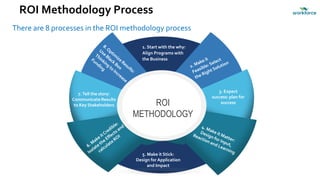
ROI Methodology Process
ROI
METHODOLOGY
3. Expect
success: plan for
success
1. Start with the why:
Align Programs with
the Business
7.Tell the story:
Communicate Results
to Key Stakeholders
5. Make it Stick:
Design for Application
and Impact
There are 8 processes in the ROI methodology process
1
STARTWITHTHE WHY - ALIGN
PROGRAMMEWITHTHE BUSINESS
The why of training is a business need expressed as a precise business measure.
 Pinpoint one or more business measures already in the system that should improve
as a result of the programme.
 Starting with “why” is the first step in the ROI Methodology.
There are six key steps to align training with business goals
1. Clearly define your strategic business objectives
2. Evaluate skill gaps
3. Set the related training goals
4. Develop the right training programs
5. Communicate training purpose to employees
6. Measure and repeat
2
MAKE IT FEASIBLE: SELECTTHE RIGHT
SOLUTION
This step identifies the causes of problems or explores the various approaches to
address an opportunity.
Finding the root cause of the programme’s need is exceptionally vital to the
success of the programme.
Three questions must be addressed when selecting the solution: :
 What needs to change to influence the impact measure?
 What can enable this change?
 What is the best solution?
3
EXPECT SUCCESS: PLAN FOR RESULTS
Several factors must be considered when expecting success, such as;defining what
success is for the programme, setting objectives at multiple levels, defining the
responsibilities of all stakeholders to achieve success, completing the data
collection plan, and completing the ROI analysis plan.
Success/objective must be time bound and specific.For example, using our conflict
resolution programme, we can measure success. Judging by the current level of
conflicts at this level, we’re going to reduce the conflict rate by 30% in the next six
months.
4
MAKE IT MATTER: DESIGN FOR INPUT,
REACTION AND LEARNING
Develop programmes with relevant, meaningful content that is important to the
individuals and the organisation and something they will use.
Provide participants with examples, activities, and exercises that reflect what the
participants are learning, what they will do with what they’ve learned, and the
impact it will have.
Two types of outcome data are collected at this stage:
1. Reaction
2. Learning.
5
MAKE IT STICK: DESIGN FOR APPLICATION
AND IMPACT
Make it stick focuses on two types of data collected after a program is
implemented: application and impact.
One of the most critical challenges is collecting data after the programme has
been implemented using various follow-up methods, such as surveys,
questionnaires, interviews, observation, etc.
Collect data to identify and enhance the enablers to the programme’s success and
eliminate the barriers to its success.
6
MAKE IT CREDIBLE: ISOLATETHE EFFECTS
AND CALCULATE ROI
One of the most critical steps in the process is to isolate the programme's effects
on impact data.
This identifies the amount of impact directly connected to the programme.
To calculate the ROI, improvement in business measures must be converted to
money, which involves developing a monetary benefit for one or more impact
measures linked to the programme.
7
TELLTHE STORY: COMMUNICATE
RESULTSTO KEY STAKEHOLDERS
Reporting the results of the learning programme is an essential step in the ROI
Methodology. Correctly identify the audience and provide appropriate
information.
There are four types of audiences to be reported to:
1.The participants directly involved in the programme who provide data to the
evaluators
2.The immediate managers of the participants who need evidence of the success
of the programme
3.The sponsors of the programme who need to understand the programme’s
value to the organisation
4.The staff team members who need to know how the ROI evaluation was
developed
8
MAKE IT FEASIBLE: SELECTTHE RIGHT
SOLUTION
Analyse the data with the goal of identifying factors that will enhance future
programme results and increase funding investments.
With the intense competition for resources, it is important to show key funders
and leaders the programme's value. Analyse whether the programme is delivering
the desired results or not.
However, the challenge is to make the learning programme even better and
increase the ROI.
As the demand for skill development grows and training budgets
expand, it is critical to understand whether your training
investment is yielding positive results. Some of the importance
are;
1. To enhance your training courses: Knowing the ROI of your
training programme will help you identify areas for
improvement, areas where you should be more insistent, and
departments where change will be easier to implement.
2. To assess their usefulness: Knowing the ROI of your
programme will assist you in determining which ones work and
which do not.With the results in hand, you'll be able to assess
the effectiveness of each course, see where it fails and
succeeds, and which ones should be expanded to other
departments.
WHY IS IT IMPORTANTTO
MEASURE ROI?
3.To report to your superiors: Businesses are increasingly basing
their decisions on an in-depth examination of business figures and
data (at the company, department, and employee levels).The ROI
is without a doubt one of the most in-demand metrics, and it is
becoming increasingly prevalent in human resources
departments.
4.To endorse your budget: There is absolutely no better way to
justify an investment than to discuss what it can bring in for the
organisation. If you're having trouble getting a bigger budget or
launching more ambitious initiatives, calculate the ROI and put the
numbers on the table.
WHY IS IT IMPORTANTTO
MEASURE ROI?
YOUR BUSINESS YOUR PEOPLE OUR FOCUS
=
Workforce Group
… We go beyond
What we do
We help organisations solve problems around:
Staff Payroll
Management
Performance management
support
Health insurance management
Executive, Experienced and
Graduate Recruitment
Staff onboarding and
training
Staff records
management
Leave and exit
management
Background
verification
Strategy Development and
Execution
Digital Learning Function Specific
Programmes
Leadership
Development
Digital Content Creation and
Conversion
Assessment and
Development centre
Occupational testing
and Success Profiling
Independent Contractor
Management
Assessor skills training
Professional Employer
Organisation
Employer of Record
Recruitment Process
Outsourcing
Workforce by Numbers
17
Year-old Startup
8
Businesses
120+
Consultants
20
African Countries
8000+
Outsourced
Employees
1200-
capacity
Learning Facility
115+
Computer-based
test facility
250+
Clients
10+
Industries Served
36
States in Nigeria
READY TO GET
STARTED?
Visit www.workforcegroup.com or
Send an email to -
hello@workforcegroup.com

Cracking The Business Case For Learning Code

  • 1.
    CrackingThe Business CaseFor Learning Code Understanding Return on Investment and Benefit cost
  • 2.
     Executives recogniselearning as a key element in meeting the challenges of a complex and global economy—not to mention driving change and creating more excellent stakeholder value. Therefore, learning is critical to an organisation's current and future success.  However, there are some concerns raised within the learning and development community regarding the value of learning and how and when it should be actually deployed. Also, the leaders expect so much from learning programmes.  But what does the Executive expect from the learning programme? 1. Impact 2. Return on Investment (ROI)
  • 3.
    For Physical Submission 1.IMPACT OFTHELEARNING PROGRAMME According to one study, a learning organisation has a positive impact on knowledge performance, which in turn has a positive impact on financial performance, and knowledge performance fully mediates the connection between a learning organisation and financial performance. In achieving these goals, training experts must provide value, explore new techniques to measure programme success, and show increased expenditure accountability.
  • 4.
    CASE STUDY Let’s usethe cost of implementing a conflict resolution programme in your organisation as an example. How do we get the value of a conflict resolution programme?
  • 5.
    To achieve that,we must look at this from two different value areas. In a conflict resolution programme, you’ve got people involved; think about the time they spent, the convenience of their involvement and the cost of having them involved. In doing these, there are five outcomes you should consider;  Is it something relevant to what they are doing  Is it relevant in their department,  Is it important to the function they perform  Significantly, will it benefit them in person?  Is it something they can recommend to others?
  • 6.
    To measure theimpact of your conflict resolution programme, consider the tangible and intangible impacts. The tangible impact is the impact you can calculate the monetary value over time, while the intangible impact cannot be measured in terms of monetary value.
  • 7.
    2. RETURN ONINVESTMENT  Training ROI measures how much an organization gains from its investment in training. It is a financial metric that expands on the benefits and business results relative to a training program. It is not a training satisfaction measure which indicates how happy the employees are with the training.  With ROI, you're getting past lower-level evaluations of training impact like learner satisfaction and cutting straight to the bottom line: for what we spent, what did we get out of this training?
  • 8.
     ROI isan economic indicator that shows the impact of your programme in monetary terms. ROI for any training is a purely economic measure that tells you the benefits of the programme relative to its costs.  The standard formula for calculating your ROI for training is ROI% = 𝑇𝑟𝑎𝑖𝑛𝑖𝑛𝑔 𝑏𝑒𝑛𝑒𝑓𝑖𝑡𝑠−𝑡𝑟𝑎𝑖𝑛𝑖𝑛𝑔 𝑐𝑜𝑠𝑡𝑠 𝑇𝑟𝑎𝑖𝑛𝑖𝑛𝑔 𝑐𝑜𝑠𝑡𝑠 × 100 CALCULATINGTHE ROI OF TRAINING PROGRAMME.
  • 9.
     When calculatingthe ROI for your training programme, you should also consider the Benefit-cost ratio, which is the total benefits of the programme divided by the costs, calculated as BCR = Benefits of training Costs of training  The BCR, along with other measures such as net present value, return on investment, internal rate of return, and so on, is commonly used in cost-benefit analyses. Calculating the ROI of training programme.
  • 10.
    HOWTO MEASURE PROGRAMME EVALUATIONUSING ROI METHODOLOGY The ROI methodology has become one of the most popular evaluation methods in the world.With the ROI Methodology, it has become possible to get credible data on the effectiveness of any training programme on the participants and, more importantly, the effect on the organisation's bottom line. The ROI Methodology has sustained its position as the leading approach to program evaluation because it: 1. Reports a balanced set of measures. 2. Follows a methodical, step-by-step process. 3. Adheres to standards and a philosophy of maintaining a conservative approach and credible outcomes.
  • 11.
    THE LEVELS OFROI METHODOLOGY The ROI methodology contains five levels of evaluation and six types of data.The five levels are:  Level 1—Reaction  Level 2—Learning  Level 3—Application  Level 4—Impact  Level 5—ROI
  • 12.
    THE LEVELS OFROI METHODOLOGY 1. Reaction: this measures the participant’s reaction to the programme and its content. 2. Learning: this measures the knowledge and skills required to make the programme successful. 3. Application: measures the application, relevance, and use of the content in the workplace. 4. Impact: these are either tangible or intangible measures reflected in key performance measures. 5. ROI: the return on investment is usually calculated as a benefit-cost ratio or ROI in percentage (%).
  • 13.
    ROI Methodology Process ROI METHODOLOGY 3.Expect success: plan for success 1. Start with the why: Align Programs with the Business 7.Tell the story: Communicate Results to Key Stakeholders 5. Make it Stick: Design for Application and Impact There are 8 processes in the ROI methodology process
  • 14.
    1 STARTWITHTHE WHY -ALIGN PROGRAMMEWITHTHE BUSINESS The why of training is a business need expressed as a precise business measure.  Pinpoint one or more business measures already in the system that should improve as a result of the programme.  Starting with “why” is the first step in the ROI Methodology. There are six key steps to align training with business goals 1. Clearly define your strategic business objectives 2. Evaluate skill gaps 3. Set the related training goals 4. Develop the right training programs 5. Communicate training purpose to employees 6. Measure and repeat
  • 15.
    2 MAKE IT FEASIBLE:SELECTTHE RIGHT SOLUTION This step identifies the causes of problems or explores the various approaches to address an opportunity. Finding the root cause of the programme’s need is exceptionally vital to the success of the programme. Three questions must be addressed when selecting the solution: :  What needs to change to influence the impact measure?  What can enable this change?  What is the best solution?
  • 16.
    3 EXPECT SUCCESS: PLANFOR RESULTS Several factors must be considered when expecting success, such as;defining what success is for the programme, setting objectives at multiple levels, defining the responsibilities of all stakeholders to achieve success, completing the data collection plan, and completing the ROI analysis plan. Success/objective must be time bound and specific.For example, using our conflict resolution programme, we can measure success. Judging by the current level of conflicts at this level, we’re going to reduce the conflict rate by 30% in the next six months.
  • 17.
    4 MAKE IT MATTER:DESIGN FOR INPUT, REACTION AND LEARNING Develop programmes with relevant, meaningful content that is important to the individuals and the organisation and something they will use. Provide participants with examples, activities, and exercises that reflect what the participants are learning, what they will do with what they’ve learned, and the impact it will have. Two types of outcome data are collected at this stage: 1. Reaction 2. Learning.
  • 18.
    5 MAKE IT STICK:DESIGN FOR APPLICATION AND IMPACT Make it stick focuses on two types of data collected after a program is implemented: application and impact. One of the most critical challenges is collecting data after the programme has been implemented using various follow-up methods, such as surveys, questionnaires, interviews, observation, etc. Collect data to identify and enhance the enablers to the programme’s success and eliminate the barriers to its success.
  • 19.
    6 MAKE IT CREDIBLE:ISOLATETHE EFFECTS AND CALCULATE ROI One of the most critical steps in the process is to isolate the programme's effects on impact data. This identifies the amount of impact directly connected to the programme. To calculate the ROI, improvement in business measures must be converted to money, which involves developing a monetary benefit for one or more impact measures linked to the programme.
  • 20.
    7 TELLTHE STORY: COMMUNICATE RESULTSTOKEY STAKEHOLDERS Reporting the results of the learning programme is an essential step in the ROI Methodology. Correctly identify the audience and provide appropriate information. There are four types of audiences to be reported to: 1.The participants directly involved in the programme who provide data to the evaluators 2.The immediate managers of the participants who need evidence of the success of the programme 3.The sponsors of the programme who need to understand the programme’s value to the organisation 4.The staff team members who need to know how the ROI evaluation was developed
  • 21.
    8 MAKE IT FEASIBLE:SELECTTHE RIGHT SOLUTION Analyse the data with the goal of identifying factors that will enhance future programme results and increase funding investments. With the intense competition for resources, it is important to show key funders and leaders the programme's value. Analyse whether the programme is delivering the desired results or not. However, the challenge is to make the learning programme even better and increase the ROI.
  • 22.
    As the demandfor skill development grows and training budgets expand, it is critical to understand whether your training investment is yielding positive results. Some of the importance are; 1. To enhance your training courses: Knowing the ROI of your training programme will help you identify areas for improvement, areas where you should be more insistent, and departments where change will be easier to implement. 2. To assess their usefulness: Knowing the ROI of your programme will assist you in determining which ones work and which do not.With the results in hand, you'll be able to assess the effectiveness of each course, see where it fails and succeeds, and which ones should be expanded to other departments. WHY IS IT IMPORTANTTO MEASURE ROI?
  • 23.
    3.To report toyour superiors: Businesses are increasingly basing their decisions on an in-depth examination of business figures and data (at the company, department, and employee levels).The ROI is without a doubt one of the most in-demand metrics, and it is becoming increasingly prevalent in human resources departments. 4.To endorse your budget: There is absolutely no better way to justify an investment than to discuss what it can bring in for the organisation. If you're having trouble getting a bigger budget or launching more ambitious initiatives, calculate the ROI and put the numbers on the table. WHY IS IT IMPORTANTTO MEASURE ROI?
  • 24.
    YOUR BUSINESS YOURPEOPLE OUR FOCUS = Workforce Group … We go beyond
  • 25.
    What we do Wehelp organisations solve problems around: Staff Payroll Management Performance management support Health insurance management Executive, Experienced and Graduate Recruitment Staff onboarding and training Staff records management Leave and exit management Background verification Strategy Development and Execution Digital Learning Function Specific Programmes Leadership Development Digital Content Creation and Conversion Assessment and Development centre Occupational testing and Success Profiling Independent Contractor Management Assessor skills training Professional Employer Organisation Employer of Record Recruitment Process Outsourcing
  • 26.
    Workforce by Numbers 17 Year-oldStartup 8 Businesses 120+ Consultants 20 African Countries 8000+ Outsourced Employees 1200- capacity Learning Facility 115+ Computer-based test facility 250+ Clients 10+ Industries Served 36 States in Nigeria
  • 27.
    READY TO GET STARTED? Visitwww.workforcegroup.com or Send an email to - hello@workforcegroup.com