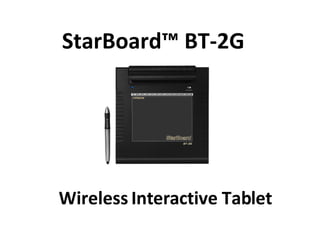
StarBoard™ BT-2G  Wireless Interactive Tablet
National Educational Technology Standards Teachers Facilitate and Inspire Student Learning and Creativity Design and Develop Digital-Age Learning Experiences and Assessments Model Digital-Age Work and Learning Promote and Model Digital Citizenship and Responsibility Engage in Professional Growth and Leadership Students Creativity and Innovation Communication and Collaboration Research and Information Fluency Critical Thinking, Problem Solving, and Decision Making Digital Citizenship Technology Operations and Concepts
Proposal Purchase six StarBoards to aid in  implementing the NETS for teachers  and students.
Rationale Aligning our classrooms with the NETS  We feel that the use of StarBoard technology in  conjunction with our existing technology infrastructure  will be the easiest and most efficient way to comply  with NETS Bring all classrooms up to equal footing Help facilitate better classroom management and  instruction
Projected Usage StarBoards will be used throughout every grade level  All teachers grades K-8 will use StarBoards to complete tasks  usually associated with conventional chalk/white boards Students in all grade levels will receive instruction by means of  StarBoards  Students in all grade levels will receive training in the use of  StarBoards Students in all grade levels will be able to use StarBoards in  the learning of their curriculum  Increase collaboration between subject areas and grade levels
Strengths Compatible with existing technology Infrastructure already in place Pockets of success in the school already Small, portable, light, and durable Reduces need for other classroom accoutrements Allows instruction to take place from all points of the classroom Reduces disciplinary problems Easy to learn software Teachers and students are already familiar with Smartboards Fraction of the cost of Smartboards $375 per tablet vs. $2000-2500 per Smartboard The six requested will only cost $2250  Brings technology to the students Allows for archiving of classroom sessions Allows for greater student-to-student, student-to-teacher, and teacher-to-teacher  collaboration Up to seven tablets to each room for student collaboration Up to 52 StarBoards can remote conference at a time Wireless range of 65 ft.
Weaknesses Takes time to get used to “writing” on tablet Text does not appear on tablet, only on screen
Resources www.hitachi-software.com www.camcor.com

Star Board™ Bt 2 G

  • 1.
    StarBoard™ BT-2G Wireless Interactive Tablet
  • 2.
    National Educational TechnologyStandards Teachers Facilitate and Inspire Student Learning and Creativity Design and Develop Digital-Age Learning Experiences and Assessments Model Digital-Age Work and Learning Promote and Model Digital Citizenship and Responsibility Engage in Professional Growth and Leadership Students Creativity and Innovation Communication and Collaboration Research and Information Fluency Critical Thinking, Problem Solving, and Decision Making Digital Citizenship Technology Operations and Concepts
  • 3.
    Proposal Purchase sixStarBoards to aid in implementing the NETS for teachers and students.
  • 4.
    Rationale Aligning ourclassrooms with the NETS We feel that the use of StarBoard technology in conjunction with our existing technology infrastructure will be the easiest and most efficient way to comply with NETS Bring all classrooms up to equal footing Help facilitate better classroom management and instruction
  • 5.
    Projected Usage StarBoardswill be used throughout every grade level All teachers grades K-8 will use StarBoards to complete tasks usually associated with conventional chalk/white boards Students in all grade levels will receive instruction by means of StarBoards Students in all grade levels will receive training in the use of StarBoards Students in all grade levels will be able to use StarBoards in the learning of their curriculum Increase collaboration between subject areas and grade levels
  • 6.
    Strengths Compatible withexisting technology Infrastructure already in place Pockets of success in the school already Small, portable, light, and durable Reduces need for other classroom accoutrements Allows instruction to take place from all points of the classroom Reduces disciplinary problems Easy to learn software Teachers and students are already familiar with Smartboards Fraction of the cost of Smartboards $375 per tablet vs. $2000-2500 per Smartboard The six requested will only cost $2250 Brings technology to the students Allows for archiving of classroom sessions Allows for greater student-to-student, student-to-teacher, and teacher-to-teacher collaboration Up to seven tablets to each room for student collaboration Up to 52 StarBoards can remote conference at a time Wireless range of 65 ft.
  • 7.
    Weaknesses Takes timeto get used to “writing” on tablet Text does not appear on tablet, only on screen
  • 8.