STANDARDS-BASED
ASSESSMENT AND GRADING IN
THE K-12 SYSTEM
WHAT DO YOU USUALLY DO
WHEN PLANNING FOR TEACHING?
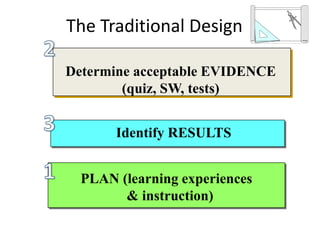
Identify RESULTS
Determine acceptable EVIDENCE
(quiz, SW, tests)
PLAN (learning experiences
& instruction)
The Traditional Design
WHAT IS UBD? WHY BACKWARD?
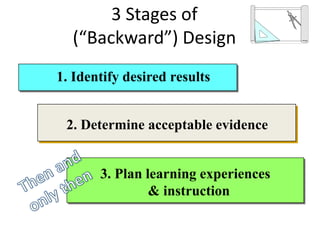
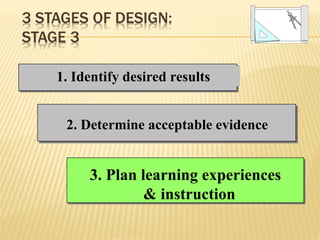
1. Identify desired results
2. Determine acceptable evidence
3. Plan learning experiences
& instruction
3 Stages of
(“Backward”) Design
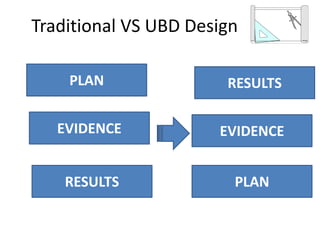
Traditional VS UBD Design
PLAN
EVIDENCE
RESULTS
RESULTS
EVIDENCE
PLAN
Wiggins and Mctighe
“BEGIN WITH THE END IN MIND!”
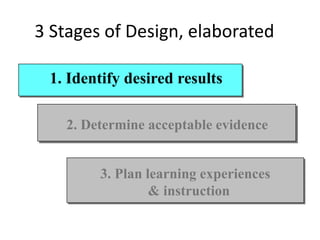
1. Identify desired results
2. Determine acceptable evidence
3. Plan learning experiences
& instruction
3 Stages of Design, elaborated
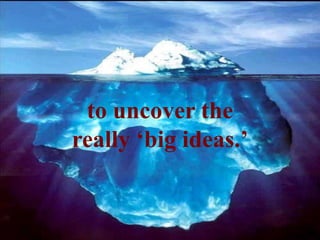
You’ve got to go
below the surface...
to uncover the
really ‘big ideas.’
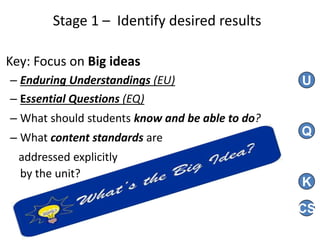
Stage 1 – Identify desired results
Key: Focus on Big ideas
– Enduring Understandings (EU)
– Essential Questions (EQ)
– What should students know and be able to do?
– What content standards are
addressed explicitly
by the unit?
U
K
Q
CS
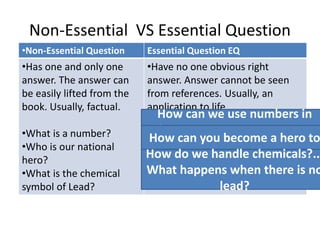
Non-Essential VS Essential Question
•Non-Essential Question Essential Question EQ
•Has one and only one
answer. The answer can
be easily lifted from the
book. Usually, factual.
•What is a number?
•Who is our national
hero?
•What is the chemical
symbol of Lead?
•Have no one obvious right
answer. Answer cannot be seen
from references. Usually, an
application to life.
How can we use numbers in
life? How can we use numbers
to ensure fairness?
How can you become a hero to
others?How do we handle chemicals?...
What happens when there is no
lead?
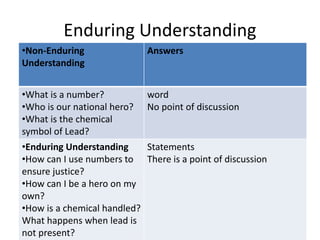
Enduring Understanding
•Non-Enduring
Understanding
Answers
•What is a number?
•Who is our national hero?
•What is the chemical
symbol of Lead?
word
No point of discussion
•Enduring Understanding
•How can I use numbers to
ensure justice?
•How can I be a hero on my
own?
•How is a chemical handled?
What happens when lead is
not present?
Statements
There is a point of discussion
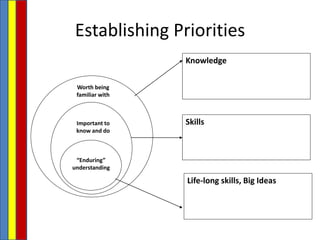
Establishing Priorities
Worth being
familiar with
Important to
know and do
“Enduring”
understanding
Knowledge
Skills
Life-long skills, Big Ideas
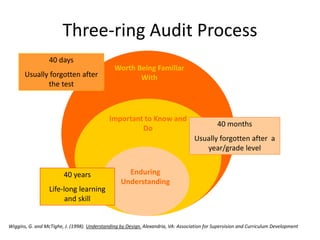
Three-ring Audit Process
Worth Being Familiar
With
Important to Know and
Do
Enduring
Understanding
40 days
Usually forgotten after
the test
40 months
Usually forgotten after a
year/grade level
40 years
Life-long learning
and skill
Wiggins, G. and McTighe, J. (1998). Understanding by Design. Alexandria, VA: Association for Supervision and Curriculum Development
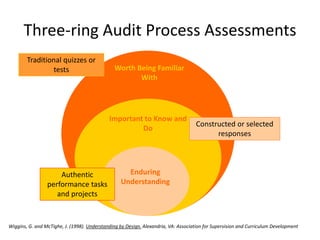
Three-ring Audit Process Assessments
Worth Being Familiar
With
Important to Know and
Do
Enduring
Understanding
Traditional quizzes or
tests
Constructed or selected
responses
Authentic
performance tasks
and projects
Wiggins, G. and McTighe, J. (1998). Understanding by Design. Alexandria, VA: Association for Supervision and Curriculum Development
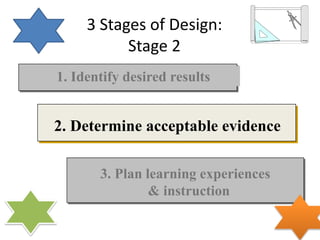
1. Identify desired results
2. Determine acceptable evidence
3. Plan learning experiences
& instruction
3 Stages of Design:
Stage 2
Adapted From the Work and Wisdom of Grant Wiggins & Jay McTighe, UBD 08/2002
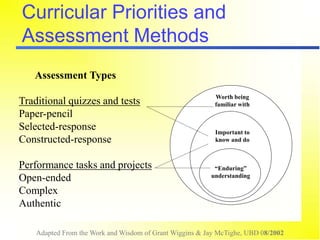
Curricular Priorities and
Assessment Methods
Worth being
familiar with
Important to
know and do
“Enduring”
understanding
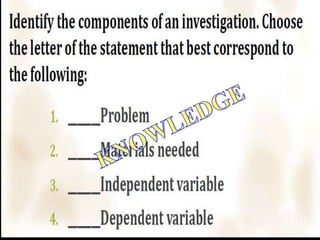
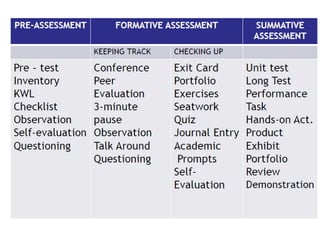
Assessment Types
Traditional quizzes and tests
Paper-pencil
Selected-response
Constructed-response
Performance tasks and projects
Open-ended
Complex
Authentic
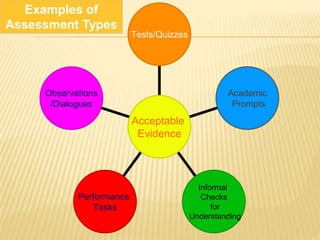
Observations
/Dialogues
Performance
Tasks
Informal
Checks
for
Understanding
Academic
Prompts
Tests/Quizzes
Acceptable
Evidence
Examples of
Assessment Types
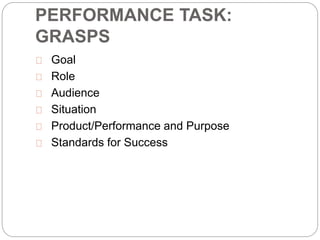
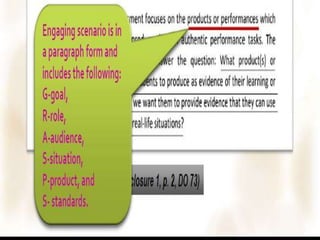
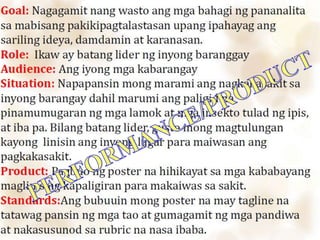
PERFORMANCE TASK:
GRASPS
Goal
Role
Audience
Situation
Product/Performance and Purpose
Standards for Success
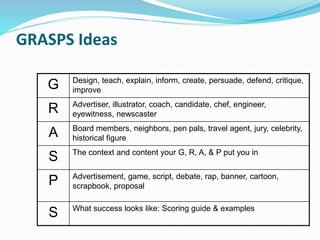
GRASPS Ideas
G Design, teach, explain, inform, create, persuade, defend, critique,
improve
R Advertiser, illustrator, coach, candidate, chef, engineer,
eyewitness, newscaster
A Board members, neighbors, pen pals, travel agent, jury, celebrity,
historical figure
S The context and content your G, R, A, & P put you in
P Advertisement, game, script, debate, rap, banner, cartoon,
scrapbook, proposal
S What success looks like: Scoring guide & examples
1. Identify desired results
2. Determine acceptable evidence
3. Plan learning experiences
& instruction
3 STAGES OF DESIGN:
STAGE 3
Adapted From the Work and Wisdom of Grant Wiggins & Jay McTighe, UBD 08/2002
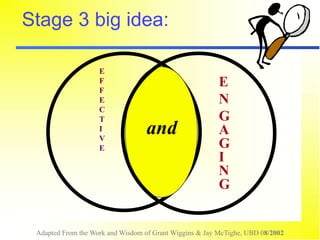
Stage 3 big idea:
E
F
F
E
C
T
I
V
E
and
E
N
G
A
G
I
N
G
Adapted From the Work and Wisdom of Grant Wiggins & Jay McTighe, UBD 08/2002
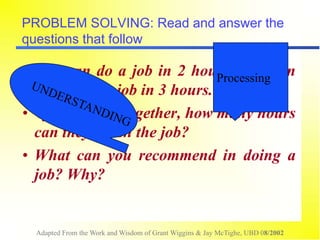
PROBLEM SOLVING: Read and answer the
questions that follow
• Lito can do a job in 2 hours. Lita can
do the same job in 3 hours.
• If they work together, how many hours
can they finish the job?
• What can you recommend in doing a
job? Why?
Processing
Adapted From the Work and Wisdom of Grant Wiggins & Jay McTighe, UBD 08/2002
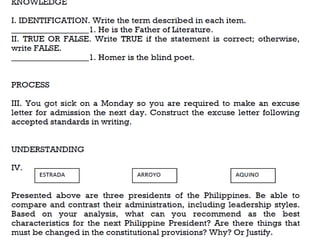
HOW DOES A TEST LOOK
LIKE?
Adapted From the Work and Wisdom of Grant Wiggins & Jay McTighe, UBD 08/2002
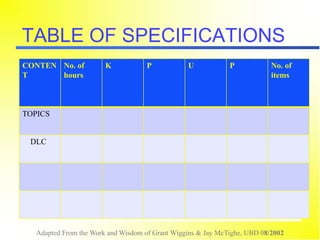
TABLE OF SPECIFICATIONS
CONTEN
T
No. of
hours
K P U P No. of
items
TOPICS
DLC
Adapted From the Work and Wisdom of Grant Wiggins & Jay McTighe, UBD 08/2002
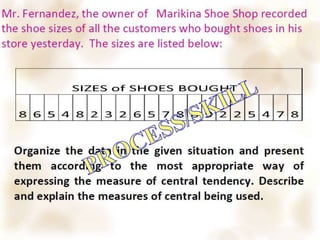
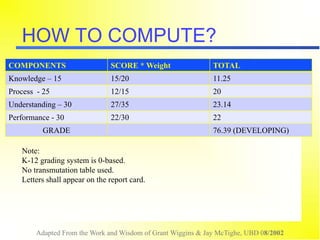
HOW TO COMPUTE?
COMPONENTS SCORE * Weight TOTAL
Knowledge – 15 15/20 11.25
Process - 25 12/15 20
Understanding – 30 27/35 23.14
Performance - 30 22/30 22
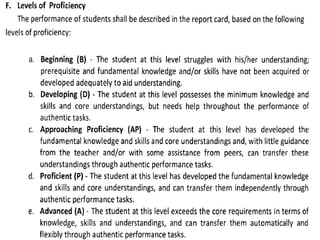
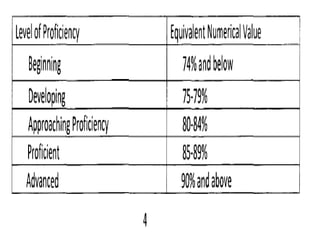
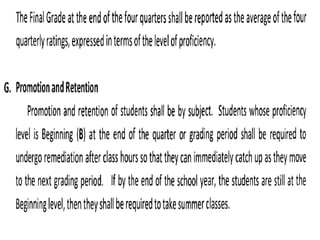
GRADE 76.39 (DEVELOPING)
Note:
K-12 grading system is 0-based.
No transmutation table used.
Letters shall appear on the report card.

Standards based assessment and grading in the k-12 system

  • 1.
  • 2.
    WHAT DO YOUUSUALLY DO WHEN PLANNING FOR TEACHING?
  • 3.
    Identify RESULTS Determine acceptableEVIDENCE (quiz, SW, tests) PLAN (learning experiences & instruction) The Traditional Design
  • 4.
    WHAT IS UBD?WHY BACKWARD?
  • 5.
    1. Identify desiredresults 2. Determine acceptable evidence 3. Plan learning experiences & instruction 3 Stages of (“Backward”) Design
  • 6.
    Traditional VS UBDDesign PLAN EVIDENCE RESULTS RESULTS EVIDENCE PLAN
  • 7.
    Wiggins and Mctighe “BEGINWITH THE END IN MIND!”
  • 8.
    1. Identify desiredresults 2. Determine acceptable evidence 3. Plan learning experiences & instruction 3 Stages of Design, elaborated
  • 9.
    You’ve got togo below the surface...
  • 10.
    to uncover the really‘big ideas.’
  • 11.
    Stage 1 –Identify desired results Key: Focus on Big ideas – Enduring Understandings (EU) – Essential Questions (EQ) – What should students know and be able to do? – What content standards are addressed explicitly by the unit? U K Q CS
  • 12.
    Non-Essential VS EssentialQuestion •Non-Essential Question Essential Question EQ •Has one and only one answer. The answer can be easily lifted from the book. Usually, factual. •What is a number? •Who is our national hero? •What is the chemical symbol of Lead? •Have no one obvious right answer. Answer cannot be seen from references. Usually, an application to life. How can we use numbers in life? How can we use numbers to ensure fairness? How can you become a hero to others?How do we handle chemicals?... What happens when there is no lead?
  • 13.
    Enduring Understanding •Non-Enduring Understanding Answers •What isa number? •Who is our national hero? •What is the chemical symbol of Lead? word No point of discussion •Enduring Understanding •How can I use numbers to ensure justice? •How can I be a hero on my own? •How is a chemical handled? What happens when lead is not present? Statements There is a point of discussion
  • 14.
    Establishing Priorities Worth being familiarwith Important to know and do “Enduring” understanding Knowledge Skills Life-long skills, Big Ideas
  • 15.
    Three-ring Audit Process WorthBeing Familiar With Important to Know and Do Enduring Understanding 40 days Usually forgotten after the test 40 months Usually forgotten after a year/grade level 40 years Life-long learning and skill Wiggins, G. and McTighe, J. (1998). Understanding by Design. Alexandria, VA: Association for Supervision and Curriculum Development
  • 16.
    Three-ring Audit ProcessAssessments Worth Being Familiar With Important to Know and Do Enduring Understanding Traditional quizzes or tests Constructed or selected responses Authentic performance tasks and projects Wiggins, G. and McTighe, J. (1998). Understanding by Design. Alexandria, VA: Association for Supervision and Curriculum Development
  • 17.
    1. Identify desiredresults 2. Determine acceptable evidence 3. Plan learning experiences & instruction 3 Stages of Design: Stage 2
  • 18.
    Adapted From theWork and Wisdom of Grant Wiggins & Jay McTighe, UBD 08/2002 Curricular Priorities and Assessment Methods Worth being familiar with Important to know and do “Enduring” understanding Assessment Types Traditional quizzes and tests Paper-pencil Selected-response Constructed-response Performance tasks and projects Open-ended Complex Authentic
  • 19.
  • 20.
  • 21.
    GRASPS Ideas G Design,teach, explain, inform, create, persuade, defend, critique, improve R Advertiser, illustrator, coach, candidate, chef, engineer, eyewitness, newscaster A Board members, neighbors, pen pals, travel agent, jury, celebrity, historical figure S The context and content your G, R, A, & P put you in P Advertisement, game, script, debate, rap, banner, cartoon, scrapbook, proposal S What success looks like: Scoring guide & examples
  • 22.
    1. Identify desiredresults 2. Determine acceptable evidence 3. Plan learning experiences & instruction 3 STAGES OF DESIGN: STAGE 3
  • 23.
    Adapted From theWork and Wisdom of Grant Wiggins & Jay McTighe, UBD 08/2002 Stage 3 big idea: E F F E C T I V E and E N G A G I N G
  • 24.
    Adapted From theWork and Wisdom of Grant Wiggins & Jay McTighe, UBD 08/2002
  • 25.
    Adapted From theWork and Wisdom of Grant Wiggins & Jay McTighe, UBD 08/2002
  • 26.
    Adapted From theWork and Wisdom of Grant Wiggins & Jay McTighe, UBD 08/2002
  • 27.
    Adapted From theWork and Wisdom of Grant Wiggins & Jay McTighe, UBD 08/2002
  • 28.
    Adapted From theWork and Wisdom of Grant Wiggins & Jay McTighe, UBD 08/2002
  • 29.
    Adapted From theWork and Wisdom of Grant Wiggins & Jay McTighe, UBD 08/2002
  • 30.
    Adapted From theWork and Wisdom of Grant Wiggins & Jay McTighe, UBD 08/2002
  • 31.
    Adapted From theWork and Wisdom of Grant Wiggins & Jay McTighe, UBD 08/2002
  • 32.
    Adapted From theWork and Wisdom of Grant Wiggins & Jay McTighe, UBD 08/2002
  • 33.
    Adapted From theWork and Wisdom of Grant Wiggins & Jay McTighe, UBD 08/2002
  • 34.
    Adapted From theWork and Wisdom of Grant Wiggins & Jay McTighe, UBD 08/2002
  • 35.
    Adapted From theWork and Wisdom of Grant Wiggins & Jay McTighe, UBD 08/2002
  • 36.
    Adapted From theWork and Wisdom of Grant Wiggins & Jay McTighe, UBD 08/2002
  • 37.
    Adapted From theWork and Wisdom of Grant Wiggins & Jay McTighe, UBD 08/2002
  • 38.
    Adapted From theWork and Wisdom of Grant Wiggins & Jay McTighe, UBD 08/2002
  • 39.
    Adapted From theWork and Wisdom of Grant Wiggins & Jay McTighe, UBD 08/2002
  • 40.
    Adapted From theWork and Wisdom of Grant Wiggins & Jay McTighe, UBD 08/2002
  • 41.
    Adapted From theWork and Wisdom of Grant Wiggins & Jay McTighe, UBD 08/2002
  • 42.
    Adapted From theWork and Wisdom of Grant Wiggins & Jay McTighe, UBD 08/2002
  • 43.
    Adapted From theWork and Wisdom of Grant Wiggins & Jay McTighe, UBD 08/2002
  • 44.
    Adapted From theWork and Wisdom of Grant Wiggins & Jay McTighe, UBD 08/2002
  • 45.
    Adapted From theWork and Wisdom of Grant Wiggins & Jay McTighe, UBD 08/2002
  • 46.
    Adapted From theWork and Wisdom of Grant Wiggins & Jay McTighe, UBD 08/2002
  • 47.
    Adapted From theWork and Wisdom of Grant Wiggins & Jay McTighe, UBD 08/2002 PROBLEM SOLVING: Read and answer the questions that follow • Lito can do a job in 2 hours. Lita can do the same job in 3 hours. • If they work together, how many hours can they finish the job? • What can you recommend in doing a job? Why? Processing
  • 48.
    Adapted From theWork and Wisdom of Grant Wiggins & Jay McTighe, UBD 08/2002
  • 49.
    Adapted From theWork and Wisdom of Grant Wiggins & Jay McTighe, UBD 08/2002
  • 50.
    Adapted From theWork and Wisdom of Grant Wiggins & Jay McTighe, UBD 08/2002
  • 51.
    Adapted From theWork and Wisdom of Grant Wiggins & Jay McTighe, UBD 08/2002 HOW DOES A TEST LOOK LIKE?
  • 52.
    Adapted From theWork and Wisdom of Grant Wiggins & Jay McTighe, UBD 08/2002 TABLE OF SPECIFICATIONS CONTEN T No. of hours K P U P No. of items TOPICS DLC
  • 53.
    Adapted From theWork and Wisdom of Grant Wiggins & Jay McTighe, UBD 08/2002 HOW TO COMPUTE? COMPONENTS SCORE * Weight TOTAL Knowledge – 15 15/20 11.25 Process - 25 12/15 20 Understanding – 30 27/35 23.14 Performance - 30 22/30 22 GRADE 76.39 (DEVELOPING) Note: K-12 grading system is 0-based. No transmutation table used. Letters shall appear on the report card.