© 2002 Grant Wiggins & Jay McTighe UBD 08/2002
1
Understanding by Design
the ‘big ideas’
of UbD
© 2002 Grant Wiggins & Jay McTighe UBD 08/2002
2
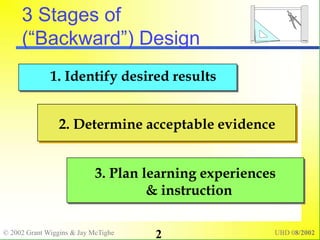
1. Identify desired results
2. Determine acceptable evidence
3. Plan learning experiences
& instruction
3 Stages of
(“Backward”) Design
© 2002 Grant Wiggins & Jay McTighe UBD 08/2002
3
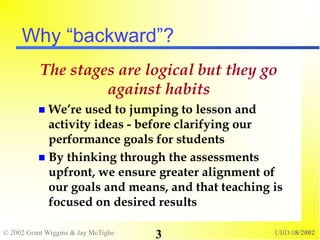
Why “backward”?
The stages are logical but they go
against habits
 We’re used to jumping to lesson and
activity ideas - before clarifying our
performance goals for students
 By thinking through the assessments
upfront, we ensure greater alignment of
our goals and means, and that teaching is
focused on desired results
© 2002 Grant Wiggins & Jay McTighe UBD 08/2002
4
Understanding by Design
Template: the basis of Exchange
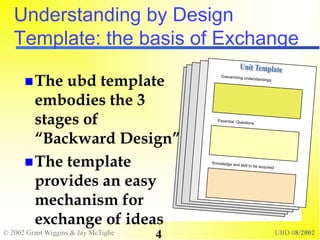
The ubd template
embodies the 3
stages of
“Backward Design”
The template
provides an easy
mechanism for
exchange of ideas
© 2002 Grant Wiggins & Jay McTighe UBD 08/2002
5
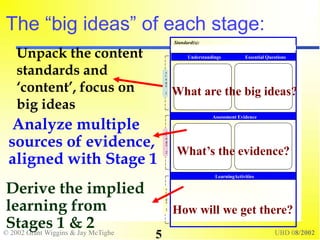
The “big ideas” of each stage:
Assessment Evidence
LearningActivities
Understandings Essential Questions
s
t
a
g
e
2
s
t
a
g
e
3
Standard(s):
s
t
a
g
e
1
Performance Task(s): Other Evidence:
Unpack the content
standards and
‘content’, focus on
big ideas
Analyze multiple
sources of evidence,
aligned with Stage 1
Derive the implied
learning from
Stages 1 & 2
What are the big ideas?
What’s the evidence?
How will we get there?
© 2002 Grant Wiggins & Jay McTighe UBD 08/2002
6
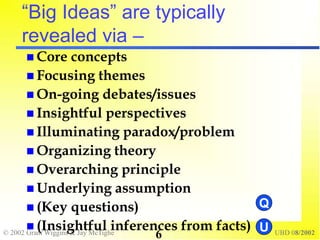
“Big Ideas” are typically
revealed via –
 Core concepts
 Focusing themes
 On-going debates/issues
 Insightful perspectives
 Illuminating paradox/problem
 Organizing theory
 Overarching principle
 Underlying assumption
 (Key questions)
 (Insightful inferences from facts) U
Q
You’ve got to go
below the surface...
© 2002 Grant Wiggins & Jay McTighe UBD 08/2002
8
to uncover the
really ‘big ideas.’
© 2002 Grant Wiggins & Jay McTighe UBD 08/2002
9
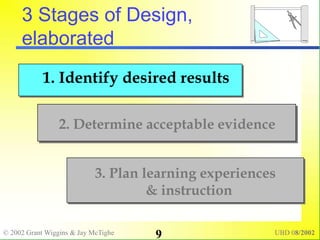
1. Identify desired results
2. Determine acceptable evidence
3. Plan learning experiences
& instruction
3 Stages of Design,
elaborated
© 2002 Grant Wiggins & Jay McTighe UBD 08/2002
10
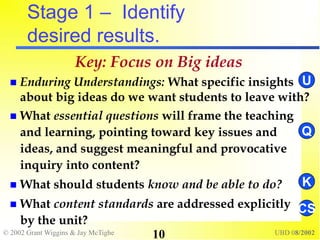
Stage 1 – Identify
desired results.
Key: Focus on Big ideas
 Enduring Understandings: What specific insights
about big ideas do we want students to leave with?
 What essential questions will frame the teaching
and learning, pointing toward key issues and
ideas, and suggest meaningful and provocative
inquiry into content?
 What should students know and be able to do?
 What content standards are addressed explicitly
by the unit?
U
K
Q
CS
© 2002 Grant Wiggins & Jay McTighe UBD 08/2002
11
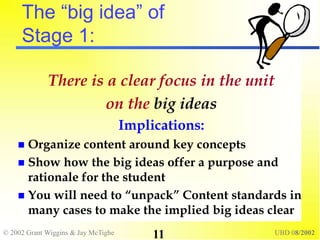
The “big idea” of
Stage 1:
There is a clear focus in the unit
on the big ideas
Implications:
 Organize content around key concepts
 Show how the big ideas offer a purpose and
rationale for the student
 You will need to “unpack” Content standards in
many cases to make the implied big ideas clear
© 2002 Grant Wiggins & Jay McTighe UBD 08/2002
12
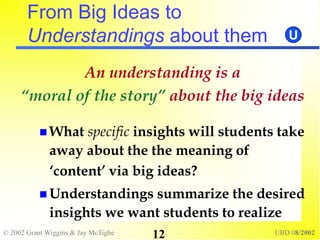
An understanding is a
“moral of the story” about the big ideas
 What specific insights will students take
away about the the meaning of
‘content’ via big ideas?
 Understandings summarize the desired
insights we want students to realize
From Big Ideas to
Understandings about them U
© 2002 Grant Wiggins & Jay McTighe UBD 08/2002
13
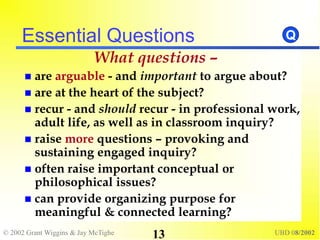
Essential Questions
What questions –
 are arguable - and important to argue about?
 are at the heart of the subject?
 recur - and should recur - in professional work,
adult life, as well as in classroom inquiry?
 raise more questions – provoking and
sustaining engaged inquiry?
 often raise important conceptual or
philosophical issues?
 can provide organizing purpose for
meaningful & connected learning?
Q
© 2002 Grant Wiggins & Jay McTighe UBD 08/2002
14
Essential vs. “leading” Q’s
used in teaching (Stage 3)
Essential - STAGE 1
 Asked to be argued
 Designed to
“uncover” new
ideas, views, lines
of argument
 Set up inquiry,
heading to new
understandings
Leading - STAGE 3
 Asked as a reminder,
to prompt recall
 Designed to “cover”
knowledge
 Point to a single,
straightforward fact -
a rhetorical question
© 2002 Grant Wiggins & Jay McTighe UBD 08/2002
15
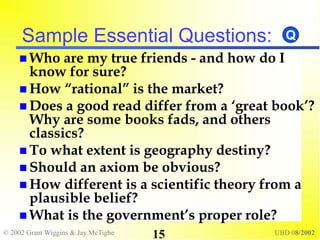
Sample Essential Questions:
 Who are my true friends - and how do I
know for sure?
 How “rational” is the market?
 Does a good read differ from a ‘great book’?
Why are some books fads, and others
classics?
 To what extent is geography destiny?
 Should an axiom be obvious?
 How different is a scientific theory from a
plausible belief?
 What is the government’s proper role?
Q
© 2002 Grant Wiggins & Jay McTighe UBD 08/2002
16
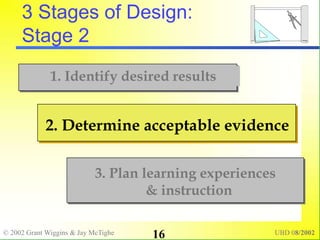
1. Identify desired results
2. Determine acceptable evidence
3. Plan learning experiences
& instruction
3 Stages of Design:
Stage 2
© 2002 Grant Wiggins & Jay McTighe UBD 08/2002
17
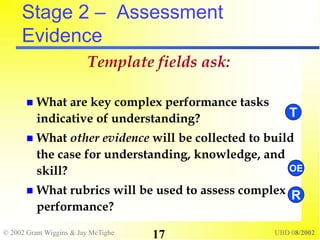
Stage 2 – Assessment
Evidence
Template fields ask:
 What are key complex performance tasks
indicative of understanding?
 What other evidence will be collected to build
the case for understanding, knowledge, and
skill?
 What rubrics will be used to assess complex
performance?
T
OE
R
© 2002 Grant Wiggins & Jay McTighe UBD 08/2002
18
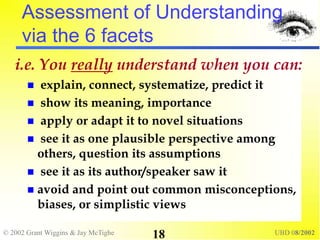
Assessment of Understanding
via the 6 facets
i.e. You really understand when you can:
 explain, connect, systematize, predict it
 show its meaning, importance
 apply or adapt it to novel situations
 see it as one plausible perspective among
others, question its assumptions
 see it as its author/speaker saw it
 avoid and point out common misconceptions,
biases, or simplistic views
© 2002 Grant Wiggins & Jay McTighe UBD 08/2002
19
Scenarios for Authentic Tasks
Build assessments anchored in
authentic tasks using GRASPS:
 What is the Goal in the scenario?
 What is the Role?
 Who is the Audience?
 What is your Situation (context)?
 What is the Performance challenge?
 By what Standards will work be judged
in the scenario?
S
P
S
G
R
A
T
© 2002 Grant Wiggins & Jay McTighe UBD 08/2002
20
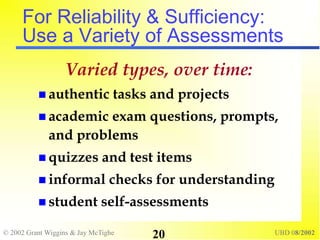
For Reliability & Sufficiency:
Use a Variety of Assessments
Varied types, over time:
 authentic tasks and projects
 academic exam questions, prompts,
and problems
 quizzes and test items
 informal checks for understanding
 student self-assessments
© 2002 Grant Wiggins & Jay McTighe UBD 08/2002
21
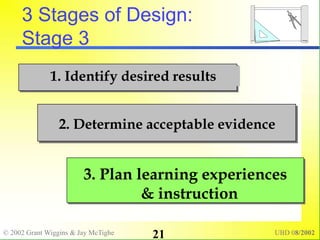
1. Identify desired results
2. Determine acceptable evidence
3. Plan learning experiences
& instruction
3 Stages of Design:
Stage 3
© 2002 Grant Wiggins & Jay McTighe UBD 08/2002
22
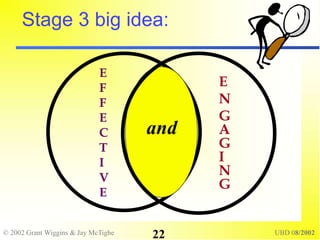
Stage 3 big idea:
E
F
F
E
C
T
I
V
E
and
E
N
G
A
G
I
N
G
© 2002 Grant Wiggins & Jay McTighe UBD 08/2002
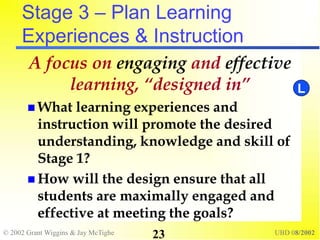
23
Stage 3 – Plan Learning
Experiences & Instruction
A focus on engaging and effective
learning, “designed in”
 What learning experiences and
instruction will promote the desired
understanding, knowledge and skill of
Stage 1?
 How will the design ensure that all
students are maximally engaged and
effective at meeting the goals?
L

Understanding by Design (UBD) - Presentation

  • 1.
    © 2002 GrantWiggins & Jay McTighe UBD 08/2002 1 Understanding by Design the ‘big ideas’ of UbD
  • 2.
    © 2002 GrantWiggins & Jay McTighe UBD 08/2002 2 1. Identify desired results 2. Determine acceptable evidence 3. Plan learning experiences & instruction 3 Stages of (“Backward”) Design
  • 3.
    © 2002 GrantWiggins & Jay McTighe UBD 08/2002 3 Why “backward”? The stages are logical but they go against habits  We’re used to jumping to lesson and activity ideas - before clarifying our performance goals for students  By thinking through the assessments upfront, we ensure greater alignment of our goals and means, and that teaching is focused on desired results
  • 4.
    © 2002 GrantWiggins & Jay McTighe UBD 08/2002 4 Understanding by Design Template: the basis of Exchange The ubd template embodies the 3 stages of “Backward Design” The template provides an easy mechanism for exchange of ideas
  • 5.
    © 2002 GrantWiggins & Jay McTighe UBD 08/2002 5 The “big ideas” of each stage: Assessment Evidence LearningActivities Understandings Essential Questions s t a g e 2 s t a g e 3 Standard(s): s t a g e 1 Performance Task(s): Other Evidence: Unpack the content standards and ‘content’, focus on big ideas Analyze multiple sources of evidence, aligned with Stage 1 Derive the implied learning from Stages 1 & 2 What are the big ideas? What’s the evidence? How will we get there?
  • 6.
    © 2002 GrantWiggins & Jay McTighe UBD 08/2002 6 “Big Ideas” are typically revealed via –  Core concepts  Focusing themes  On-going debates/issues  Insightful perspectives  Illuminating paradox/problem  Organizing theory  Overarching principle  Underlying assumption  (Key questions)  (Insightful inferences from facts) U Q
  • 7.
    You’ve got togo below the surface...
  • 8.
    © 2002 GrantWiggins & Jay McTighe UBD 08/2002 8 to uncover the really ‘big ideas.’
  • 9.
    © 2002 GrantWiggins & Jay McTighe UBD 08/2002 9 1. Identify desired results 2. Determine acceptable evidence 3. Plan learning experiences & instruction 3 Stages of Design, elaborated
  • 10.
    © 2002 GrantWiggins & Jay McTighe UBD 08/2002 10 Stage 1 – Identify desired results. Key: Focus on Big ideas  Enduring Understandings: What specific insights about big ideas do we want students to leave with?  What essential questions will frame the teaching and learning, pointing toward key issues and ideas, and suggest meaningful and provocative inquiry into content?  What should students know and be able to do?  What content standards are addressed explicitly by the unit? U K Q CS
  • 11.
    © 2002 GrantWiggins & Jay McTighe UBD 08/2002 11 The “big idea” of Stage 1: There is a clear focus in the unit on the big ideas Implications:  Organize content around key concepts  Show how the big ideas offer a purpose and rationale for the student  You will need to “unpack” Content standards in many cases to make the implied big ideas clear
  • 12.
    © 2002 GrantWiggins & Jay McTighe UBD 08/2002 12 An understanding is a “moral of the story” about the big ideas  What specific insights will students take away about the the meaning of ‘content’ via big ideas?  Understandings summarize the desired insights we want students to realize From Big Ideas to Understandings about them U
  • 13.
    © 2002 GrantWiggins & Jay McTighe UBD 08/2002 13 Essential Questions What questions –  are arguable - and important to argue about?  are at the heart of the subject?  recur - and should recur - in professional work, adult life, as well as in classroom inquiry?  raise more questions – provoking and sustaining engaged inquiry?  often raise important conceptual or philosophical issues?  can provide organizing purpose for meaningful & connected learning? Q
  • 14.
    © 2002 GrantWiggins & Jay McTighe UBD 08/2002 14 Essential vs. “leading” Q’s used in teaching (Stage 3) Essential - STAGE 1  Asked to be argued  Designed to “uncover” new ideas, views, lines of argument  Set up inquiry, heading to new understandings Leading - STAGE 3  Asked as a reminder, to prompt recall  Designed to “cover” knowledge  Point to a single, straightforward fact - a rhetorical question
  • 15.
    © 2002 GrantWiggins & Jay McTighe UBD 08/2002 15 Sample Essential Questions:  Who are my true friends - and how do I know for sure?  How “rational” is the market?  Does a good read differ from a ‘great book’? Why are some books fads, and others classics?  To what extent is geography destiny?  Should an axiom be obvious?  How different is a scientific theory from a plausible belief?  What is the government’s proper role? Q
  • 16.
    © 2002 GrantWiggins & Jay McTighe UBD 08/2002 16 1. Identify desired results 2. Determine acceptable evidence 3. Plan learning experiences & instruction 3 Stages of Design: Stage 2
  • 17.
    © 2002 GrantWiggins & Jay McTighe UBD 08/2002 17 Stage 2 – Assessment Evidence Template fields ask:  What are key complex performance tasks indicative of understanding?  What other evidence will be collected to build the case for understanding, knowledge, and skill?  What rubrics will be used to assess complex performance? T OE R
  • 18.
    © 2002 GrantWiggins & Jay McTighe UBD 08/2002 18 Assessment of Understanding via the 6 facets i.e. You really understand when you can:  explain, connect, systematize, predict it  show its meaning, importance  apply or adapt it to novel situations  see it as one plausible perspective among others, question its assumptions  see it as its author/speaker saw it  avoid and point out common misconceptions, biases, or simplistic views
  • 19.
    © 2002 GrantWiggins & Jay McTighe UBD 08/2002 19 Scenarios for Authentic Tasks Build assessments anchored in authentic tasks using GRASPS:  What is the Goal in the scenario?  What is the Role?  Who is the Audience?  What is your Situation (context)?  What is the Performance challenge?  By what Standards will work be judged in the scenario? S P S G R A T
  • 20.
    © 2002 GrantWiggins & Jay McTighe UBD 08/2002 20 For Reliability & Sufficiency: Use a Variety of Assessments Varied types, over time:  authentic tasks and projects  academic exam questions, prompts, and problems  quizzes and test items  informal checks for understanding  student self-assessments
  • 21.
    © 2002 GrantWiggins & Jay McTighe UBD 08/2002 21 1. Identify desired results 2. Determine acceptable evidence 3. Plan learning experiences & instruction 3 Stages of Design: Stage 3
  • 22.
    © 2002 GrantWiggins & Jay McTighe UBD 08/2002 22 Stage 3 big idea: E F F E C T I V E and E N G A G I N G
  • 23.
    © 2002 GrantWiggins & Jay McTighe UBD 08/2002 23 Stage 3 – Plan Learning Experiences & Instruction A focus on engaging and effective learning, “designed in”  What learning experiences and instruction will promote the desired understanding, knowledge and skill of Stage 1?  How will the design ensure that all students are maximally engaged and effective at meeting the goals? L