Inquiry-based, Data-driven Decision Making Ric Seager - Bronson Community Schools
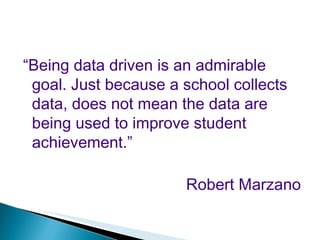
“ Being data driven is an admirable goal. Just because a school collects data, does not mean the data are being used to improve student achievement.” Robert Marzano
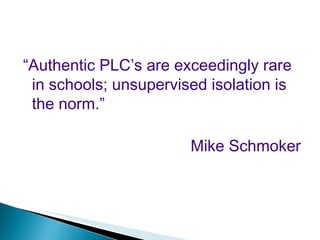
“ Authentic PLC’s are exceedingly rare in schools; unsupervised isolation is the norm.” Mike Schmoker
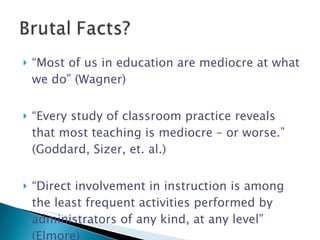
“ Most of us in education are mediocre at what we do” (Wagner) “ Every study of classroom practice reveals that most teaching is mediocre – or worse.” (Goddard, Sizer, et. al.) “ Direct involvement in instruction is among the least frequent activities performed by administrators of any kind, at any level” (Elmore)
“ Excellent teachers modify their curriculum based on data collected from student learning.” “ Excellent teachers take responsibility for failed student performance.” Platt, Trip, Ogden, Fraser
“ The best explanation for why our schools aren’t far more successful, intellectually engaging places is fairly simple: the most important people within and outside schools know very little about what actually goes on inside them.” Mike Schmoker Do you agree or disagree with this premise? Take a stand….
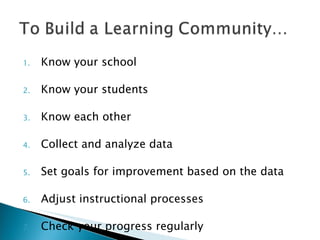
Know your school Know your students Know each other Collect and analyze data Set goals for improvement based on the data Adjust instructional processes Check your progress regularly
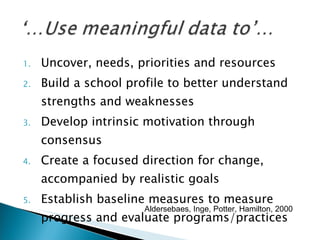
Uncover, needs, priorities and resources Build a school profile to better understand strengths and weaknesses Develop intrinsic motivation through consensus Create a focused direction for change, accompanied by realistic goals Establish baseline measures to measure progress and evaluate programs/practices Aldersebaes, Inge, Potter, Hamilton, 2000
 
The purpose of a TBD is not to debate but to gain new ideas and deepen understanding Refer to text whenever possible, citing page and location Speak to each other, not the facilitator Monitor your own ‘air time’
 
The most promising context for continuous professional learning
A  Professional Learning Community , or  PLC  is an extended learning opportunity to foster  collaborative learning  among colleagues within a particular work environment or field. http://en.wikipedia.org/wiki/Professional_Learning_Community
Professional Learning Communities seek to promote life long learning for its members through a safe and supportive working and learning environment which encourages collaboration, innovation, sharing and the development of partnerships. http://www.learningplace.com.au/deliver/content.asp?pid=13525
What do students need to know and be able to do? How will we know when they have learned it? What will we do for those who haven’t learned it? What will we do for those who already know it?
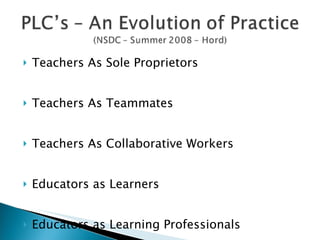
Teachers As Sole Proprietors Teachers As Teammates Teachers As Collaborative Workers Educators as Learners Educators as Learning Professionals
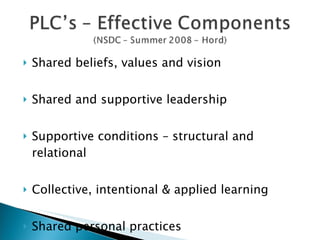
Shared beliefs, values and vision Shared and supportive leadership Supportive conditions – structural and relational Collective, intentional & applied learning Shared personal practices
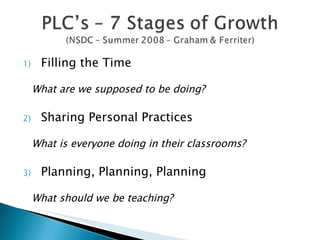
Filling the Time What are we supposed to be doing? Sharing Personal Practices What is everyone doing in their classrooms? Planning, Planning, Planning What should we be teaching?
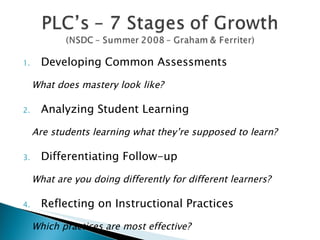
Developing Common Assessments What does mastery look like? Analyzing Student Learning Are students learning what they’re supposed to learn? Differentiating Follow-up What are you doing differently for different learners? Reflecting on Instructional Practices Which practices are most effective?
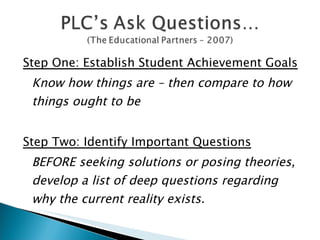
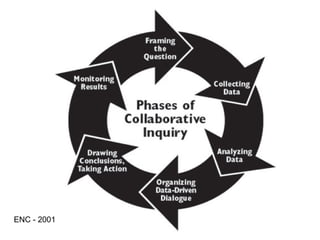
Step One: Establish Student Achievement Goals Know how things are – then compare to how things ought to be Step Two: Identify Important Questions BEFORE seeking solutions or posing theories, develop a list of deep questions regarding why the current reality exists.
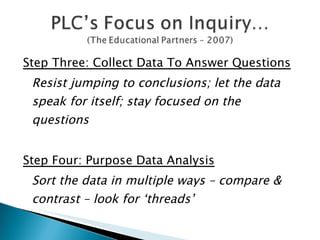
Step Three: Collect Data To Answer Questions Resist jumping to conclusions; let the data speak for itself; stay focused on the questions Step Four: Purpose Data Analysis Sort the data in multiple ways – compare & contrast – look for ‘threads’
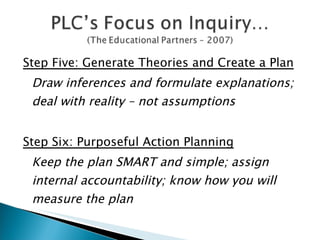
Step Five: Generate Theories and Create a Plan Draw inferences and formulate explanations; deal with reality – not assumptions Step Six: Purposeful Action Planning Keep the plan SMART and simple; assign internal accountability; know how you will measure the plan
Step Seven: Collect data on the plan Not and end unto itself, but rather, an ongoing process
ENC - 2001
Easily disaggregated Skill-based; objective-based Routine, embedded, accessible assessments
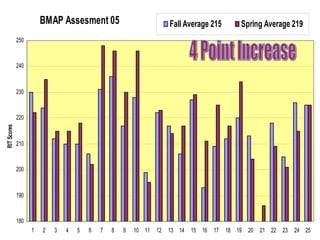
4 Point Increase
 
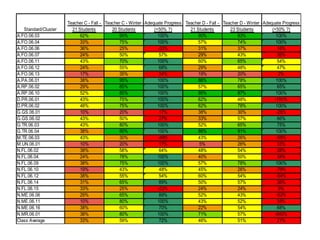
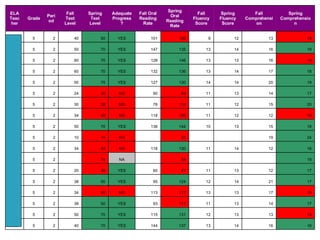
ELA Teacher Grade Period Fall Text Level Spring Text Level Adequate Progress? Fall Oral Reading Rate Spring Oral Reading Rate Fall Fluency Score Spring Fluency Score Fall Comprehension Spring Comprehension Keller 5 2 40 50 YES 101 109 9 12 13 15 Keller 5 2 50 70 YES 147 135 13 14 16 19 Keller 5 2 60 70 YES 128 146 13 13 16 16 Keller 5 2 60 70 YES 132 136 13 14 17 18 Keller 5 2 50 70 YES 127 130 14 14 20 19 Keller 5 2 24 30 NO 90 84 11 13 14 17 Keller 5 2 30 38 NO 78 114 11 12 15 20 Keller 5 2 34 40 NO 118 105 11 12 12 16 Keller 5 2 50 70 YES 138 144 10 13 15 18 Keller 5 2 10 14 NO   55     19 24 Keller 5 2 34 40 NO 118 130 11 14 12 18 Keller 5 2   14 NA   54       19 Keller 5 2 20 30 YES 60 81 11 13 12 17 Keller 5 2 38 50 YES 95 124 12 14 21 17 Keller 5 2 34 40 NO 113 117 13 13 17 15 Keller 5 2 38 50 YES 93 117 11 13 14 17 Keller 5 2 50 70 YES 115 131 12 13 13 15 Keller 5 2 40 70 YES 144 137 13 14 16 18
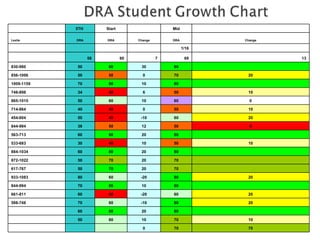
  5TH  Start   Mid   Lexile DRA DRA Change DRA Change         1/16     58 60 7 68 13 830-980 50 80 30 80   856-1006 50 50 0 70 20 1009-1159 70 80 10 80   748-898 34 40 6 50 10 865-1015 50 60 10 60 0 714-864 40 40 0 50 10 454-604 50 40 -10 60 20 844-994 38 50 12 50 0 563-713 60 80 20 80   533-683 30 40 10 50 10 884-1034 60 80 20 80   872-1022 50 70 20 70   617-767 50 70 20 70   933-1083 80 60 -20 80 20 844-994 70 80 10 80   661-811 60 40 -20 60 20 598-748 70 60 -10 80 20   60 80 20 80     50 60 10 70 10       0 70 70
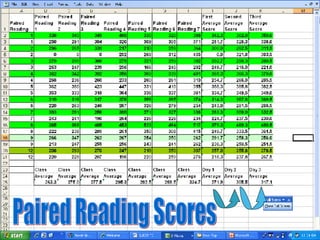
Paired Reading Scores
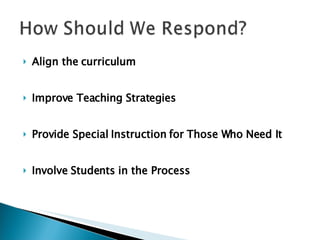
Align the curriculum Improve Teaching Strategies Provide Special Instruction for Those Who Need It Involve Students in the Process
Teachers must know the learning targets their students are supposed to master  (Stiggins, 2001) Teachers must be ‘assessment literate’  (Stiggins, 2001) Teachers need embedded time to conduct PLC work
What do you want to know?
What don’t I know that I should be looking for? How do my teachers know about the kids they have now, the kids they had, and the kids they’re going to have? How much am I missing?
Ric Seager -  [email_address]

New Leading With Plc’s

  • 1.
    Inquiry-based, Data-driven DecisionMaking Ric Seager - Bronson Community Schools
  • 2.
    “ Being datadriven is an admirable goal. Just because a school collects data, does not mean the data are being used to improve student achievement.” Robert Marzano
  • 3.
    “ Authentic PLC’sare exceedingly rare in schools; unsupervised isolation is the norm.” Mike Schmoker
  • 4.
    “ Most ofus in education are mediocre at what we do” (Wagner) “ Every study of classroom practice reveals that most teaching is mediocre – or worse.” (Goddard, Sizer, et. al.) “ Direct involvement in instruction is among the least frequent activities performed by administrators of any kind, at any level” (Elmore)
  • 5.
    “ Excellent teachersmodify their curriculum based on data collected from student learning.” “ Excellent teachers take responsibility for failed student performance.” Platt, Trip, Ogden, Fraser
  • 6.
    “ The bestexplanation for why our schools aren’t far more successful, intellectually engaging places is fairly simple: the most important people within and outside schools know very little about what actually goes on inside them.” Mike Schmoker Do you agree or disagree with this premise? Take a stand….
  • 7.
    Know your schoolKnow your students Know each other Collect and analyze data Set goals for improvement based on the data Adjust instructional processes Check your progress regularly
  • 8.
    Uncover, needs, prioritiesand resources Build a school profile to better understand strengths and weaknesses Develop intrinsic motivation through consensus Create a focused direction for change, accompanied by realistic goals Establish baseline measures to measure progress and evaluate programs/practices Aldersebaes, Inge, Potter, Hamilton, 2000
  • 9.
  • 10.
    The purpose ofa TBD is not to debate but to gain new ideas and deepen understanding Refer to text whenever possible, citing page and location Speak to each other, not the facilitator Monitor your own ‘air time’
  • 11.
  • 12.
    The most promisingcontext for continuous professional learning
  • 13.
    A ProfessionalLearning Community , or PLC is an extended learning opportunity to foster collaborative learning among colleagues within a particular work environment or field. http://en.wikipedia.org/wiki/Professional_Learning_Community
  • 14.
    Professional Learning Communitiesseek to promote life long learning for its members through a safe and supportive working and learning environment which encourages collaboration, innovation, sharing and the development of partnerships. http://www.learningplace.com.au/deliver/content.asp?pid=13525
  • 15.
    What do studentsneed to know and be able to do? How will we know when they have learned it? What will we do for those who haven’t learned it? What will we do for those who already know it?
  • 16.
    Teachers As SoleProprietors Teachers As Teammates Teachers As Collaborative Workers Educators as Learners Educators as Learning Professionals
  • 17.
    Shared beliefs, valuesand vision Shared and supportive leadership Supportive conditions – structural and relational Collective, intentional & applied learning Shared personal practices
  • 18.
    Filling the TimeWhat are we supposed to be doing? Sharing Personal Practices What is everyone doing in their classrooms? Planning, Planning, Planning What should we be teaching?
  • 19.
    Developing Common AssessmentsWhat does mastery look like? Analyzing Student Learning Are students learning what they’re supposed to learn? Differentiating Follow-up What are you doing differently for different learners? Reflecting on Instructional Practices Which practices are most effective?
  • 20.
    Step One: EstablishStudent Achievement Goals Know how things are – then compare to how things ought to be Step Two: Identify Important Questions BEFORE seeking solutions or posing theories, develop a list of deep questions regarding why the current reality exists.
  • 21.
    Step Three: CollectData To Answer Questions Resist jumping to conclusions; let the data speak for itself; stay focused on the questions Step Four: Purpose Data Analysis Sort the data in multiple ways – compare & contrast – look for ‘threads’
  • 22.
    Step Five: GenerateTheories and Create a Plan Draw inferences and formulate explanations; deal with reality – not assumptions Step Six: Purposeful Action Planning Keep the plan SMART and simple; assign internal accountability; know how you will measure the plan
  • 23.
    Step Seven: Collectdata on the plan Not and end unto itself, but rather, an ongoing process
  • 24.
  • 25.
    Easily disaggregated Skill-based;objective-based Routine, embedded, accessible assessments
  • 26.
  • 27.
  • 28.
    ELA Teacher GradePeriod Fall Text Level Spring Text Level Adequate Progress? Fall Oral Reading Rate Spring Oral Reading Rate Fall Fluency Score Spring Fluency Score Fall Comprehension Spring Comprehension Keller 5 2 40 50 YES 101 109 9 12 13 15 Keller 5 2 50 70 YES 147 135 13 14 16 19 Keller 5 2 60 70 YES 128 146 13 13 16 16 Keller 5 2 60 70 YES 132 136 13 14 17 18 Keller 5 2 50 70 YES 127 130 14 14 20 19 Keller 5 2 24 30 NO 90 84 11 13 14 17 Keller 5 2 30 38 NO 78 114 11 12 15 20 Keller 5 2 34 40 NO 118 105 11 12 12 16 Keller 5 2 50 70 YES 138 144 10 13 15 18 Keller 5 2 10 14 NO   55     19 24 Keller 5 2 34 40 NO 118 130 11 14 12 18 Keller 5 2   14 NA   54       19 Keller 5 2 20 30 YES 60 81 11 13 12 17 Keller 5 2 38 50 YES 95 124 12 14 21 17 Keller 5 2 34 40 NO 113 117 13 13 17 15 Keller 5 2 38 50 YES 93 117 11 13 14 17 Keller 5 2 50 70 YES 115 131 12 13 13 15 Keller 5 2 40 70 YES 144 137 13 14 16 18
  • 29.
      5TH Start   Mid   Lexile DRA DRA Change DRA Change         1/16     58 60 7 68 13 830-980 50 80 30 80   856-1006 50 50 0 70 20 1009-1159 70 80 10 80   748-898 34 40 6 50 10 865-1015 50 60 10 60 0 714-864 40 40 0 50 10 454-604 50 40 -10 60 20 844-994 38 50 12 50 0 563-713 60 80 20 80   533-683 30 40 10 50 10 884-1034 60 80 20 80   872-1022 50 70 20 70   617-767 50 70 20 70   933-1083 80 60 -20 80 20 844-994 70 80 10 80   661-811 60 40 -20 60 20 598-748 70 60 -10 80 20   60 80 20 80     50 60 10 70 10       0 70 70
  • 30.
  • 31.
    Align the curriculumImprove Teaching Strategies Provide Special Instruction for Those Who Need It Involve Students in the Process
  • 32.
    Teachers must knowthe learning targets their students are supposed to master (Stiggins, 2001) Teachers must be ‘assessment literate’ (Stiggins, 2001) Teachers need embedded time to conduct PLC work
  • 33.
    What do youwant to know?
  • 34.
    What don’t Iknow that I should be looking for? How do my teachers know about the kids they have now, the kids they had, and the kids they’re going to have? How much am I missing?
  • 35.
    Ric Seager - [email_address]