COMP23420 week 4:
    GRASP design principles (1)

   John Sargeant (johns@cs.man.ac.uk)

Please remember to switch off all electronic
         devices when in lectures.
Aspects of SE

3. Building the right software
4. Building the software right


Most of the course so far has been about 1. Now we will
  focus on 2.
Refactoring
• Most non-trivial SW systems end up as Big Balls of
  Mud – see http://www.laputan.org/mud/
• OO techniques help, up to a point, but don’t solve the
  problem
• Subsystems interact in unpredictable ways
• A design which looks good initially may be unsuitable
  later.
• Refactoring – changing the code purely to improve
  the design – is vital.
• Never refactor and add/change functionality at the
  same time.
GRASP
• How do we know what’s a good design?
• Only by experience, but much of that experience has
  recently been codified as Patterns.
• GRASP = General Responsibility Assignment
  Software Patterns
• A set of principles for assigning responsibilities to
  classes – the key skill in OO software design
  (observation: even strong programmers are often
  weak designers)
• GRASP provides the “building blocks” for Design
  Patterns (COMP33411)
Case study

You have been hired to develop an integrated
  information system for the Irwell online store. They
  originated as a book store but now sell other forms of
  media such as CDs and DVDs. They also intend to
  branch out into selling electronic devices such as
  laptops and PDAs although they don’t intend to
  become a general store.

Initially you will develop an inventory system: an
   inventory lists the products a company has in stock,
   along with information such as prices.
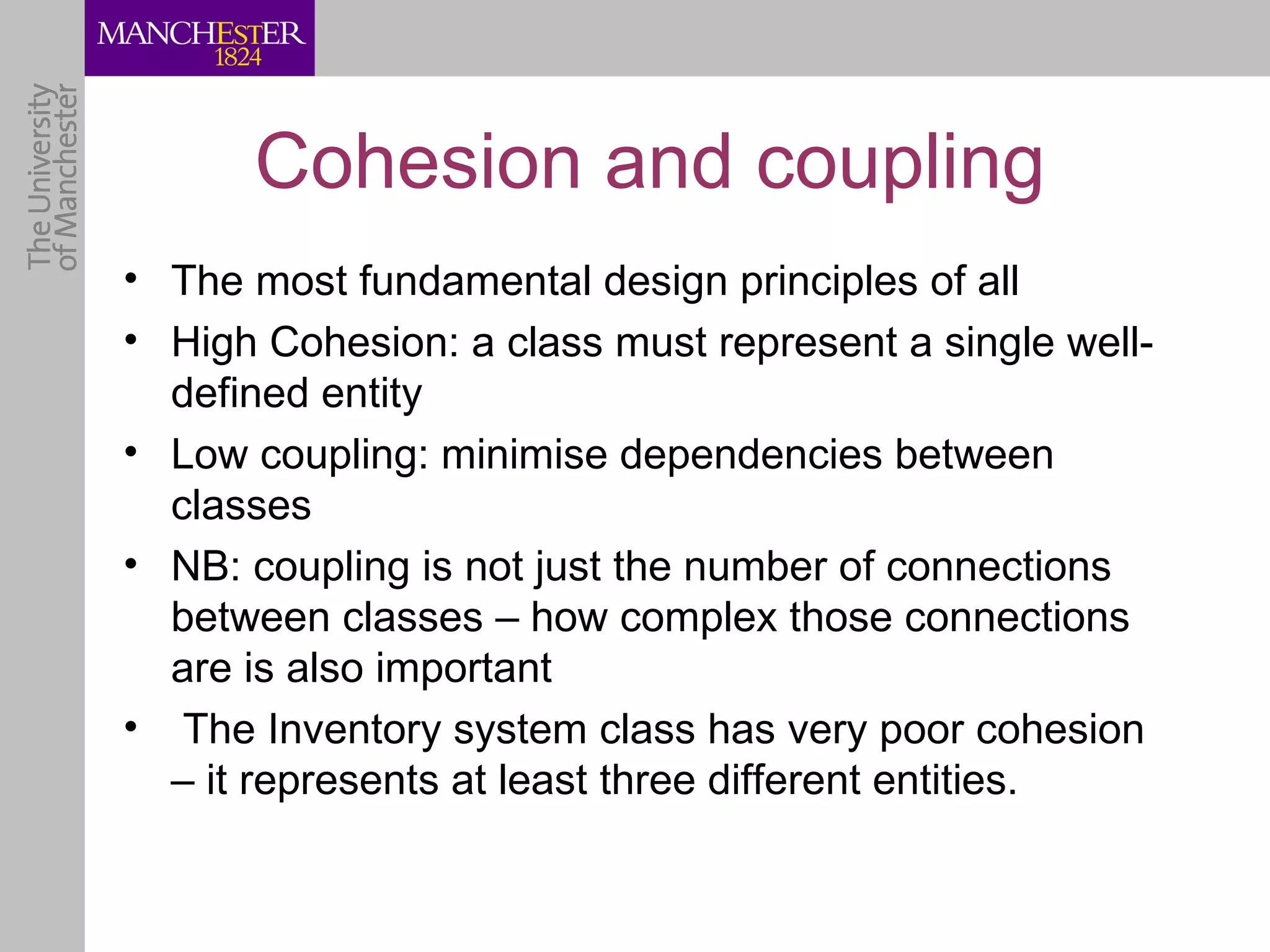
A possible design
Cohesion and coupling
• The most fundamental design principles of all
• High Cohesion: a class must represent a single well-
  defined entity
• Low coupling: minimise dependencies between
  classes
• NB: coupling is not just the number of connections
  between classes – how complex those connections
  are is also important
• The Inventory system class has very poor cohesion
  – it represents at least three different entities.
Types of coupling

• Internal coupling – between classes within a
  subsystem
• External coupling – between the subsystem and the
  rest of the system

The naïve design has high (i.e. bad) external coupling, a
  “bloated interface”.
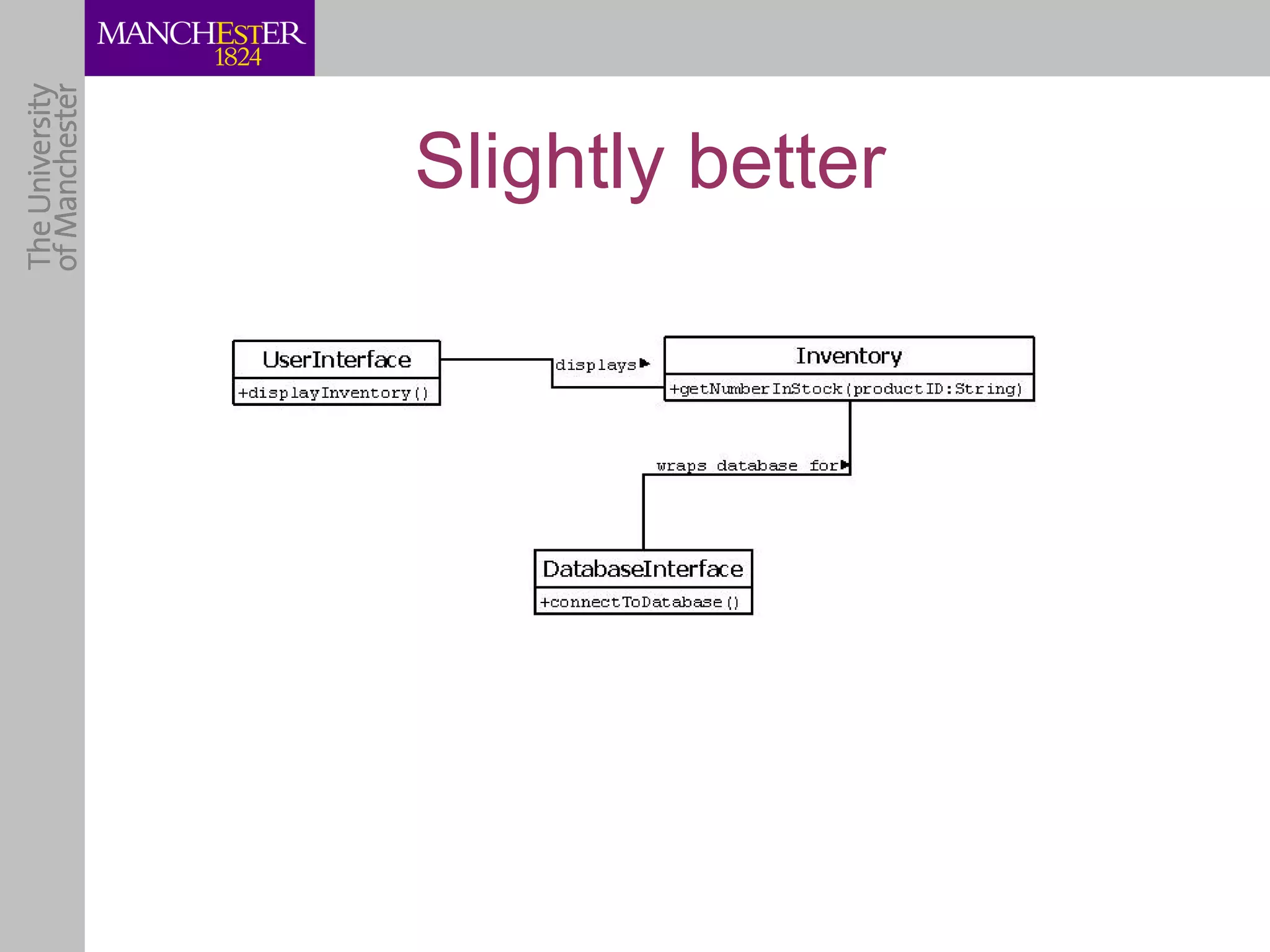
Slightly better
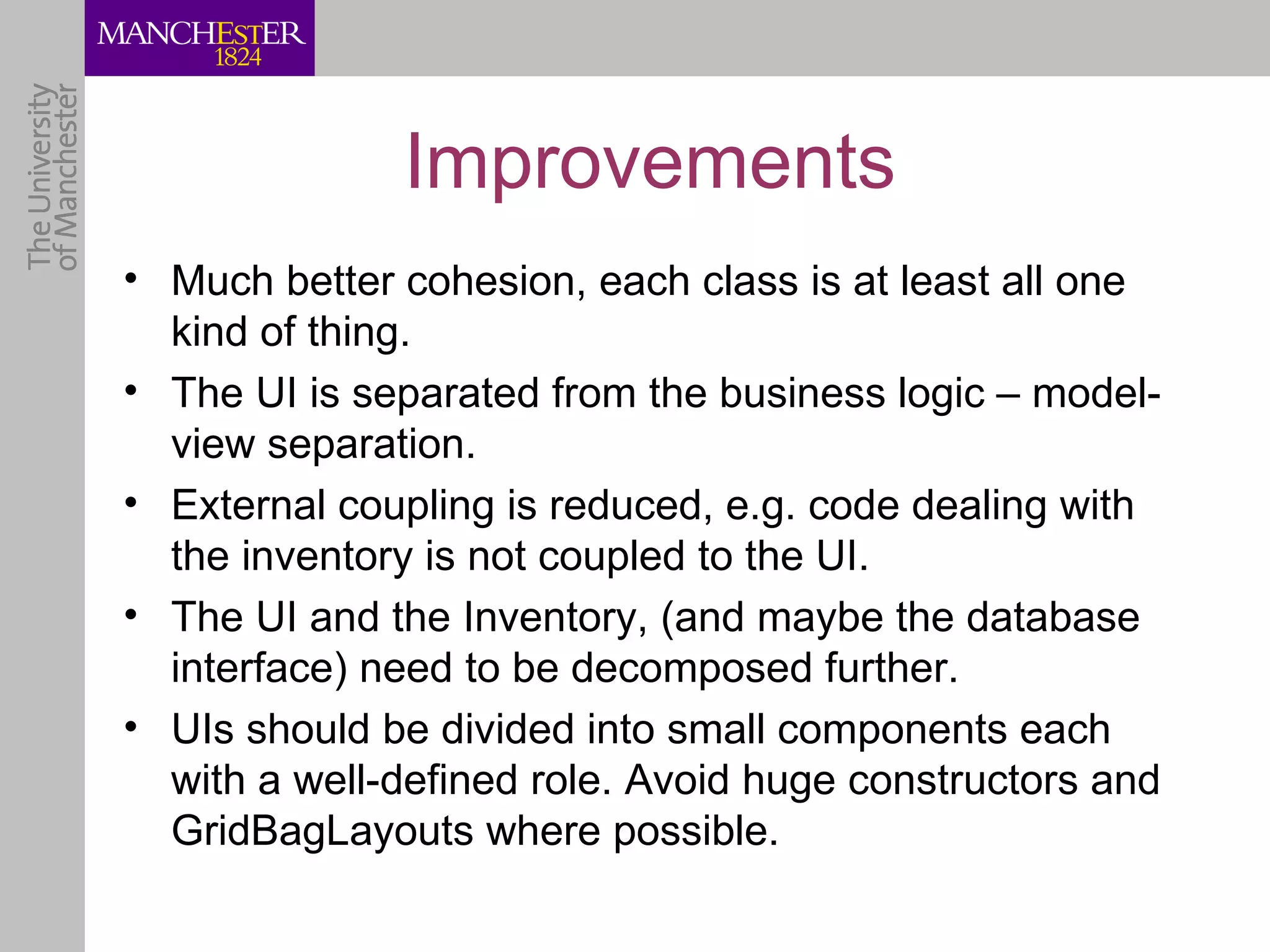
Improvements
• Much better cohesion, each class is at least all one
  kind of thing.
• The UI is separated from the business logic – model-
  view separation.
• External coupling is reduced, e.g. code dealing with
  the inventory is not coupled to the UI.
• The UI and the Inventory, (and maybe the database
  interface) need to be decomposed further.
• UIs should be divided into small components each
  with a well-defined role. Avoid huge constructors and
  GridBagLayouts where possible.
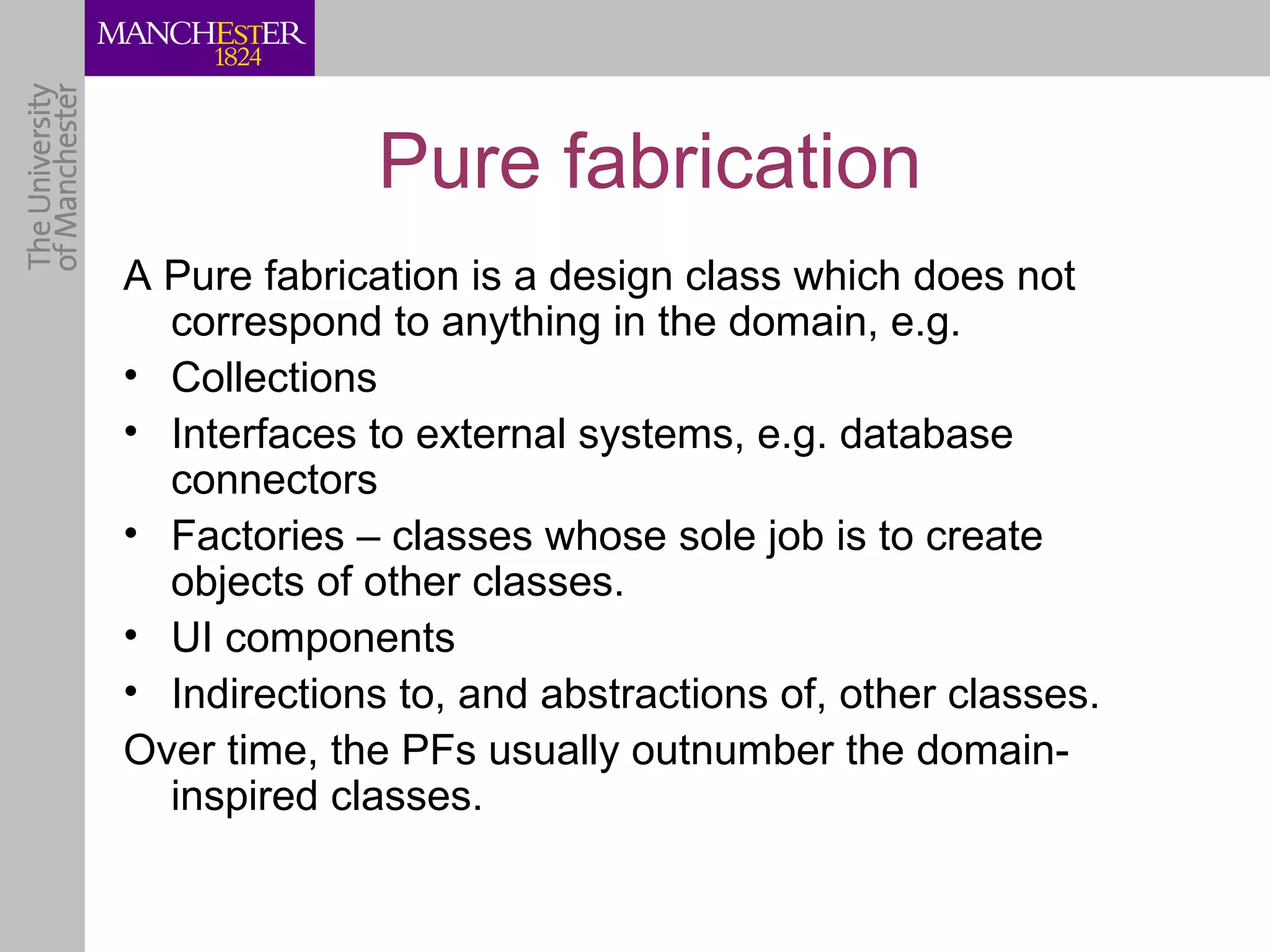
Pure fabrication
A Pure fabrication is a design class which does not
  correspond to anything in the domain, e.g.
• Collections
• Interfaces to external systems, e.g. database
  connectors
• Factories – classes whose sole job is to create
  objects of other classes.
• UI components
• Indirections to, and abstractions of, other classes.
Over time, the PFs usually outnumber the domain-
  inspired classes.
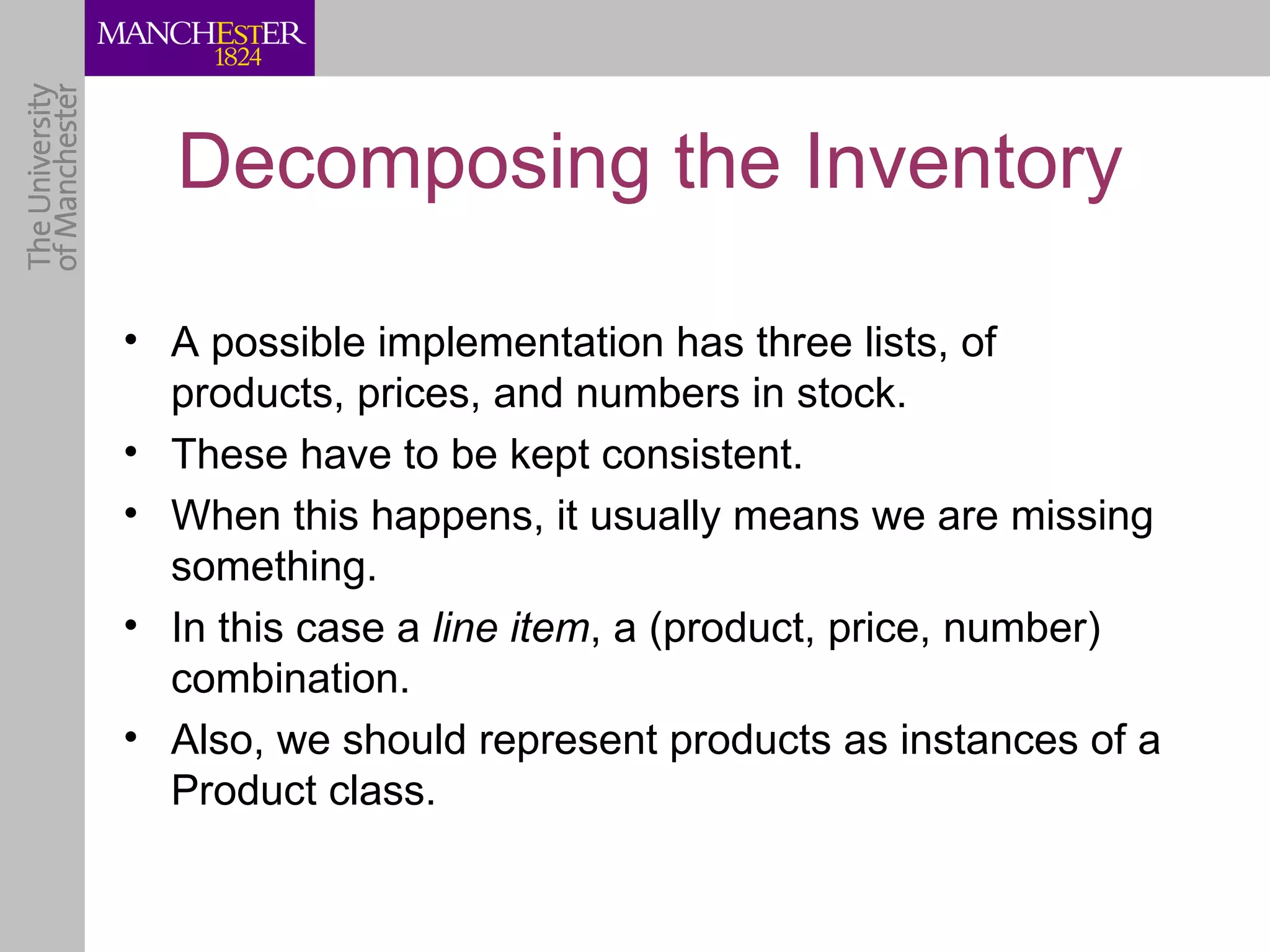
Decomposing the Inventory

• A possible implementation has three lists, of
  products, prices, and numbers in stock.
• These have to be kept consistent.
• When this happens, it usually means we are missing
  something.
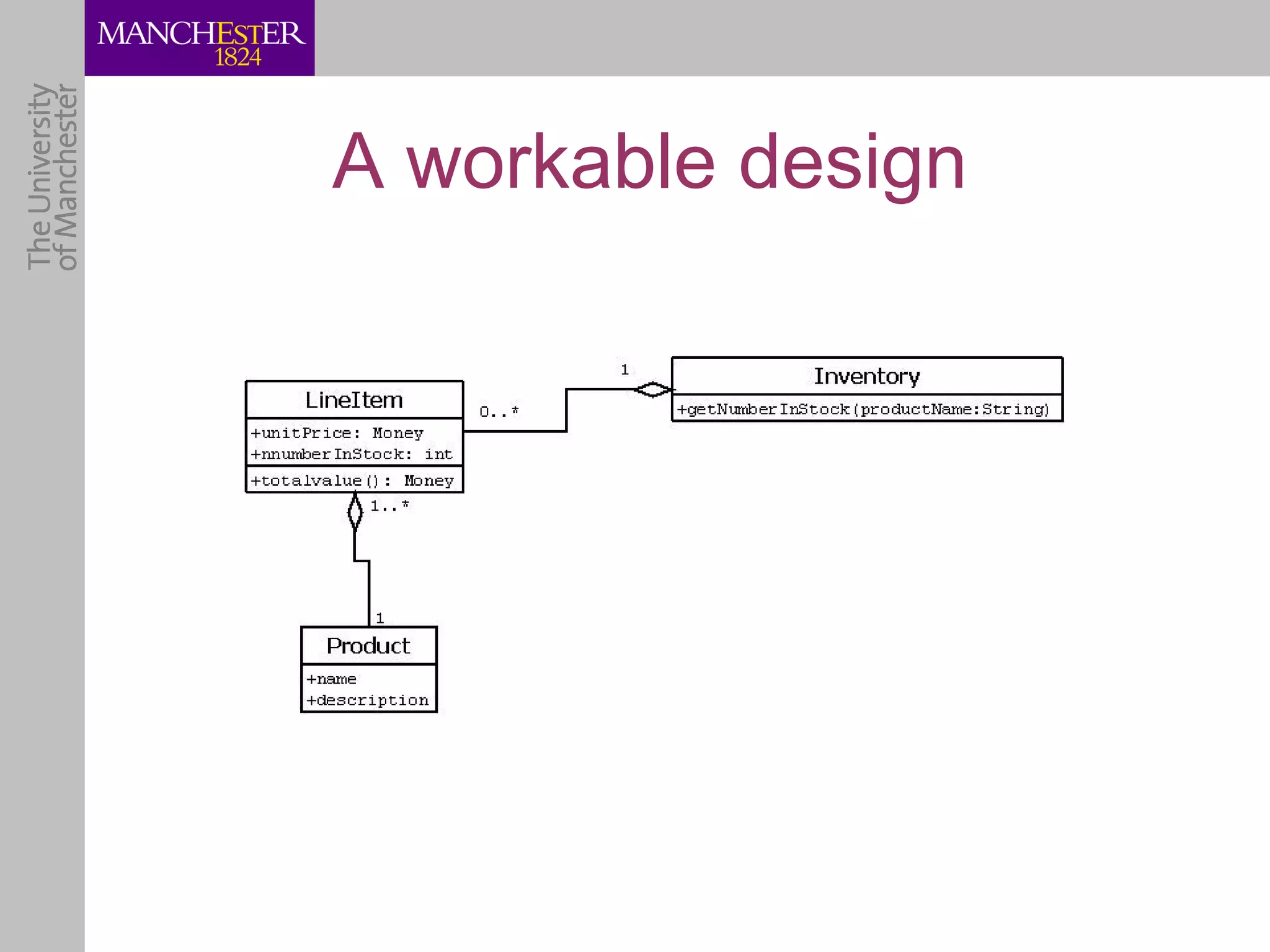
• In this case a line item, a (product, price, number)
  combination.
• Also, we should represent products as instances of a
  Product class.
A workable design
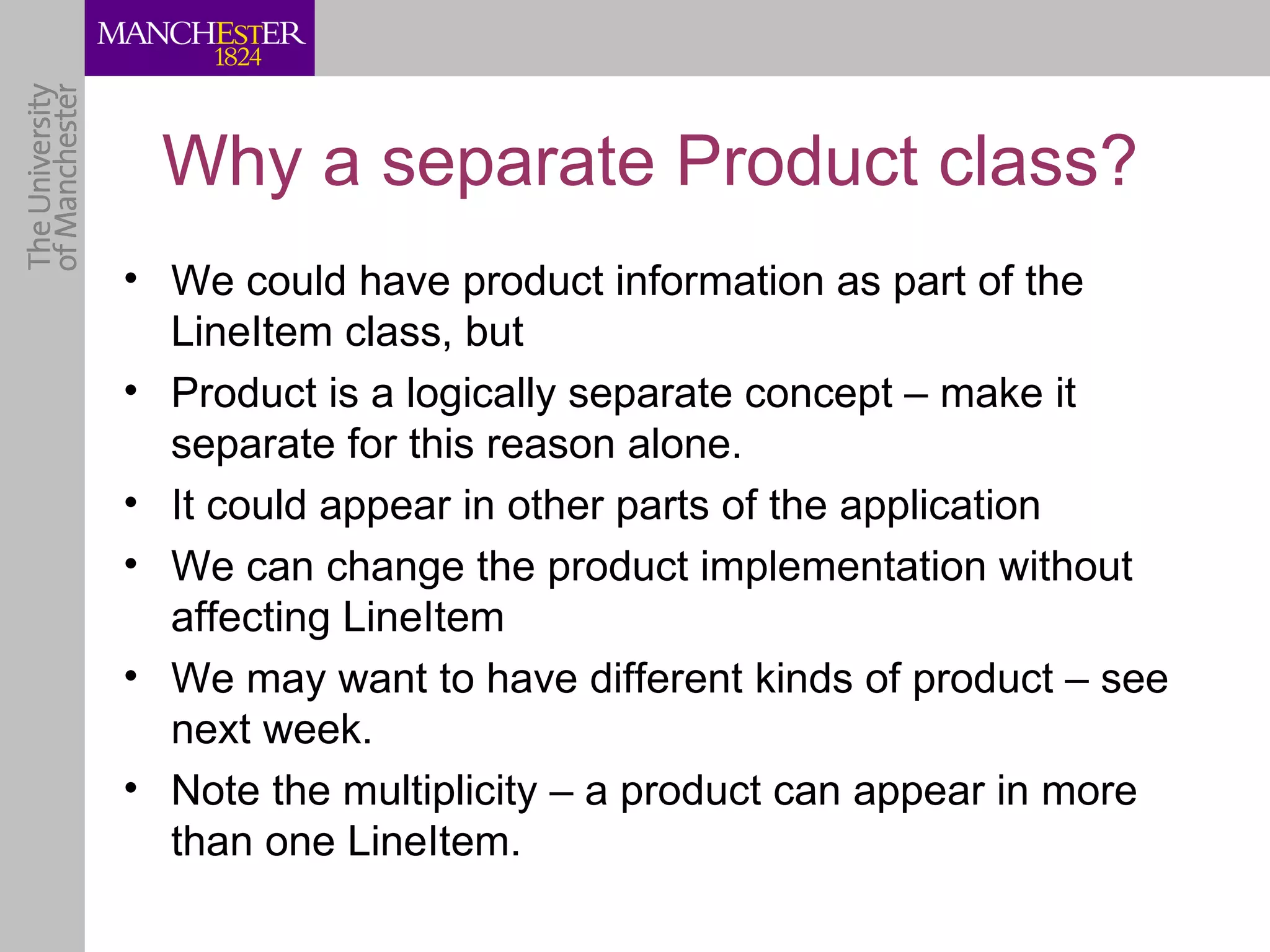
Why a separate Product class?
• We could have product information as part of the
  LineItem class, but
• Product is a logically separate concept – make it
  separate for this reason alone.
• It could appear in other parts of the application
• We can change the product implementation without
  affecting LineItem
• We may want to have different kinds of product – see
  next week.
• Note the multiplicity – a product can appear in more
  than one LineItem.
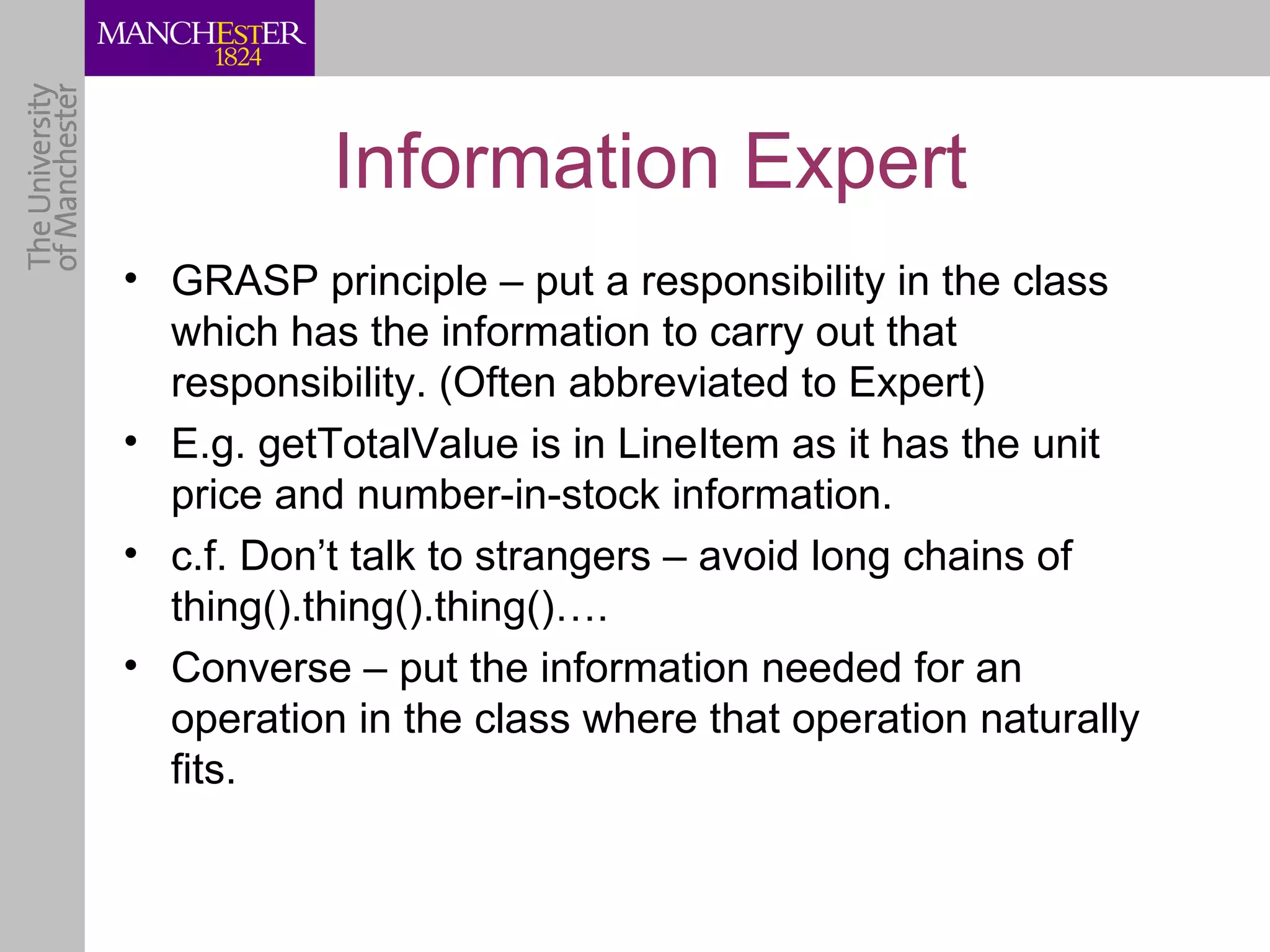
Information Expert
• GRASP principle – put a responsibility in the class
  which has the information to carry out that
  responsibility. (Often abbreviated to Expert)
• E.g. getTotalValue is in LineItem as it has the unit
  price and number-in-stock information.
• c.f. Don’t talk to strangers – avoid long chains of
  thing().thing().thing()….
• Converse – put the information needed for an
  operation in the class where that operation naturally
  fits.
To think about
• How could the LineItem class be reused elsewhere in
  the application?
• Why is the multiplicity: Product 1 -> 1..* LineItem
  (Hint when considering multiplicities always look at
  both ends, so this question has two answers)?
• Why is the unit price information in LineItem rather
  than Product?
• What information in the case study have we yet to
  take account of?
• How could your design for iteration 1 be improved in
  terms of coupling and cohesion?

Week4 grasp-into

  • 1.
    COMP23420 week 4: GRASP design principles (1) John Sargeant (johns@cs.man.ac.uk) Please remember to switch off all electronic devices when in lectures.
  • 2.
    Aspects of SE 3.Building the right software 4. Building the software right Most of the course so far has been about 1. Now we will focus on 2.
  • 3.
    Refactoring • Most non-trivialSW systems end up as Big Balls of Mud – see http://www.laputan.org/mud/ • OO techniques help, up to a point, but don’t solve the problem • Subsystems interact in unpredictable ways • A design which looks good initially may be unsuitable later. • Refactoring – changing the code purely to improve the design – is vital. • Never refactor and add/change functionality at the same time.
  • 4.
    GRASP • How dowe know what’s a good design? • Only by experience, but much of that experience has recently been codified as Patterns. • GRASP = General Responsibility Assignment Software Patterns • A set of principles for assigning responsibilities to classes – the key skill in OO software design (observation: even strong programmers are often weak designers) • GRASP provides the “building blocks” for Design Patterns (COMP33411)
  • 5.
    Case study You havebeen hired to develop an integrated information system for the Irwell online store. They originated as a book store but now sell other forms of media such as CDs and DVDs. They also intend to branch out into selling electronic devices such as laptops and PDAs although they don’t intend to become a general store. Initially you will develop an inventory system: an inventory lists the products a company has in stock, along with information such as prices.
  • 6.
  • 7.
    Cohesion and coupling •The most fundamental design principles of all • High Cohesion: a class must represent a single well- defined entity • Low coupling: minimise dependencies between classes • NB: coupling is not just the number of connections between classes – how complex those connections are is also important • The Inventory system class has very poor cohesion – it represents at least three different entities.
  • 8.
    Types of coupling •Internal coupling – between classes within a subsystem • External coupling – between the subsystem and the rest of the system The naïve design has high (i.e. bad) external coupling, a “bloated interface”.
  • 9.
  • 10.
    Improvements • Much bettercohesion, each class is at least all one kind of thing. • The UI is separated from the business logic – model- view separation. • External coupling is reduced, e.g. code dealing with the inventory is not coupled to the UI. • The UI and the Inventory, (and maybe the database interface) need to be decomposed further. • UIs should be divided into small components each with a well-defined role. Avoid huge constructors and GridBagLayouts where possible.
  • 11.
    Pure fabrication A Purefabrication is a design class which does not correspond to anything in the domain, e.g. • Collections • Interfaces to external systems, e.g. database connectors • Factories – classes whose sole job is to create objects of other classes. • UI components • Indirections to, and abstractions of, other classes. Over time, the PFs usually outnumber the domain- inspired classes.
  • 12.
    Decomposing the Inventory •A possible implementation has three lists, of products, prices, and numbers in stock. • These have to be kept consistent. • When this happens, it usually means we are missing something. • In this case a line item, a (product, price, number) combination. • Also, we should represent products as instances of a Product class.
  • 13.
  • 14.
    Why a separateProduct class? • We could have product information as part of the LineItem class, but • Product is a logically separate concept – make it separate for this reason alone. • It could appear in other parts of the application • We can change the product implementation without affecting LineItem • We may want to have different kinds of product – see next week. • Note the multiplicity – a product can appear in more than one LineItem.
  • 15.
    Information Expert • GRASPprinciple – put a responsibility in the class which has the information to carry out that responsibility. (Often abbreviated to Expert) • E.g. getTotalValue is in LineItem as it has the unit price and number-in-stock information. • c.f. Don’t talk to strangers – avoid long chains of thing().thing().thing()…. • Converse – put the information needed for an operation in the class where that operation naturally fits.
  • 16.
    To think about •How could the LineItem class be reused elsewhere in the application? • Why is the multiplicity: Product 1 -> 1..* LineItem (Hint when considering multiplicities always look at both ends, so this question has two answers)? • Why is the unit price information in LineItem rather than Product? • What information in the case study have we yet to take account of? • How could your design for iteration 1 be improved in terms of coupling and cohesion?

Editor's Notes