Preparing for The Zone: Understanding, 
Defining and Sharing a University Wide 
Digital Future 
Sheila MacNeill, GCU 
Keith Smyth, UHI 
Bill Johnston, University of Strathclyde 
ALT-C 2014
“The new competition, the real threat . . . is the emergence of 
entirely new models of university which are seeking to exploit the 
radically changed circumstances that are the result of 
globalisation and the digital revolution.” 
An Avalanche is coming, Higher Education and the Revolution Ahead IPPR , March 
2013 
(http://www.ippr.org/publication/55/10432/an-avalanche-is-coming-higher-education- 
and-the-revolution-ahead)
“There is no doubt that digital technologies have had a 
profound impact upon the management of learning. 
Institutions can now recruit, register, monitor, and report on 
students with a new economy, efficiency, and (sometimes) 
creativity yet, evidence of digital technologies producing real 
transformation in learning and teaching remains elusive” 
Decoding Learning, the proof, promise and potential of digital education 
Nesta, November 2012 
(http://www.nesta.org.uk/library/documentsDecodingLearningReport_v12.pdf)
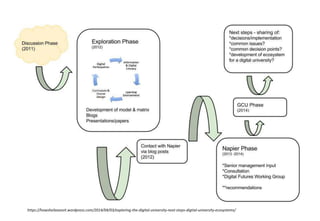
A Digital University: key themes 
Digital 
Participation 
Information 
Literacy 
Curriculum & 
Course Design 
Learning 
Environments
Digital University Matrix 
Digital Participation Information Literacy 
*Glocalization 
*Widening access 
*Civic role and responsibilities 
*Community engagement 
*Networks (human and digital) 
*Technological affordances 
*High level concepts and perceptions 
influencing practice 
*Staff & student engagement and 
development 
*Effective development and use of 
infrastructure 
Curriculum and Course Design Learning Environment 
*Constructive alignment 
*Curriculum representations, course 
management, pedagogical innovation 
*Recruitment and marketing 
*Reporting, data, analytics 
*Physical and digital 
*Pedagogical and social 
*Research and enquiry 
*Staff and Resources
https://howsheilaseesit.wordpress.com/2014/04/03/exploring-the-digital-university-next-steps-digtial-university-ecosystems/
Case Study 1: 
Edinburgh Napier University : 
Digital Futures Working Group
Background 
• Initial round table discussion about current digital practice 
and provision within the University in September 2012 
• ‘Digital Futures: exploring Edinburgh Napier University’s 
technological ambitions’ Symposium December 2012 
• Digital Futures Working Group formed to further explore 
current practice and future possibilities in six key areas, with 
input from external critical friends
Developing digital literacies 
Digital student support provision 
Digitally enhanced education 
Digital communication and outreach 
Digital research and leadership 
Digital infrastructure and integration
Three key outputs 
1. An ‘external benchmarking’ report summarising policy and 
examples of current practice within the sector 
2. An internal position report summarising current and emerging 
practice and developments relating to each theme 
3. A final report setting out short term priorities and 
recommendations to 2016/17 and longer term to 2019/20
Key ‘short term’ issues 
• Consistency of the student online learning experience 
• Distribution of support for staff to engage with technology-enhanced 
learning, teaching and assessment, and the creation 
of a ‘hub’ to support good and innovative practice 
• Embedding the development of digital literacies within 
programmes, and harnessing discipline specific technology 
• Improving how we use digital approaches for scholarship, 
research and knowledge exchange opportunities 
• Consolidating outward-facing digital resources
Emerging aspirations 
• A digitally enhanced and digitally distributed curriculum 
• Engagement within professional communities 
• Locating the digital in a programme focused approach including 
collaboration and contributing to public bodies of knowledge 
• Locating discussions about digital practice in professional review 
• Digital innovation funding (open to all) 
• Strategic funding in key areas of digital research and scholarship, 
digital knowledge transfer, and expanding online CPD 
• Digital outreach and digitally supported social interaction 
• Harnessing ‘open educational practices’ in ways that make sense 
for a post-1992 institution with strong widening access agenda
Case Study 2: 
GCU 
Developing our Digital Future
Digital Participation Digital & Information Literacy 
Our vision is to be a successful international university 
delivering access and excellence, with a strong commitment 
to the common good. 
Create successful global graduates and citizens and deliver 
economic and social benefit for the communities we serve 
Globally networked 
Global Learning 
Enriching cities and communities 
Engaging globally 
Innovating for social impact 
Digital Learning/technology 
Inclusive, accessible learning 
Collaborative working within GCU and with our partners 
Globally-recognised profile, positioning and esteem 
Digital Development 
Curriculum& Course Design Learning Environment 
Engaged Learning 
Personalised Learning 
Flexible Learning 
Real world problem solving 
Transforming lives through education and research 
Our mission as a University is to provide an outstanding 
inclusive learning environment 
Flexible Learning 
Broader and deeper learning 
Buildings are better connected 
Social learning spaces and improved academic teaching areas, 
services and facilities 
A vibrant and dynamic technological and physical 
infrastructure 
Current 
mission/vision/KPI 
s 
Strategy for 
Learning 
Heart of the 
Campus 
Developing 2020 
Strategy
Digital University Consultation Day 
• Cross Institution Event 
• Individual and institutional experience of digital participation 
• Present, short-term (2015), longer term (2020): realities 
and aspirations
Emerging Themes 
• Infrastructure – digital and physical 
• Digital Literacy – staff and students 
• Learning and Teaching technology implementation plans 
• Learning Analytics 
• Open Education an digital participation 
• Development of a GCU specific digital university definition 
and identity 
• Cohering around student engagement
Next steps 
• Edinburgh Napier are planning for the implementation stage of 
their digital futures consultation, including governance and 
allocation of resources. http://staff.napier.ac.uk/services/vice-principal-academic/ 
academic/strategyactivity/DigitalFutures/Pages/Digital-Futures.aspx. 
• GCU continuing developing institutional approach. 
• We are interested in engaging with others to collectively 
explore the concept and implications of the digital university
Contact details 
Sheila MacNeill 
sheila.macneill@gcu.ac.uk @sheilmcn 
Keith Smyth 
keith.smyth@uhi.ac.uk @smythkrs 
Bill Johnston 
b.johnston@strath.ac.uk

Understanding, Defining and Sharing a University Wide Digital Future

  • 1.
    Preparing for TheZone: Understanding, Defining and Sharing a University Wide Digital Future Sheila MacNeill, GCU Keith Smyth, UHI Bill Johnston, University of Strathclyde ALT-C 2014
  • 2.
    “The new competition,the real threat . . . is the emergence of entirely new models of university which are seeking to exploit the radically changed circumstances that are the result of globalisation and the digital revolution.” An Avalanche is coming, Higher Education and the Revolution Ahead IPPR , March 2013 (http://www.ippr.org/publication/55/10432/an-avalanche-is-coming-higher-education- and-the-revolution-ahead)
  • 3.
    “There is nodoubt that digital technologies have had a profound impact upon the management of learning. Institutions can now recruit, register, monitor, and report on students with a new economy, efficiency, and (sometimes) creativity yet, evidence of digital technologies producing real transformation in learning and teaching remains elusive” Decoding Learning, the proof, promise and potential of digital education Nesta, November 2012 (http://www.nesta.org.uk/library/documentsDecodingLearningReport_v12.pdf)
  • 4.
    A Digital University:key themes Digital Participation Information Literacy Curriculum & Course Design Learning Environments
  • 5.
    Digital University Matrix Digital Participation Information Literacy *Glocalization *Widening access *Civic role and responsibilities *Community engagement *Networks (human and digital) *Technological affordances *High level concepts and perceptions influencing practice *Staff & student engagement and development *Effective development and use of infrastructure Curriculum and Course Design Learning Environment *Constructive alignment *Curriculum representations, course management, pedagogical innovation *Recruitment and marketing *Reporting, data, analytics *Physical and digital *Pedagogical and social *Research and enquiry *Staff and Resources
  • 6.
  • 7.
    Case Study 1: Edinburgh Napier University : Digital Futures Working Group
  • 8.
    Background • Initialround table discussion about current digital practice and provision within the University in September 2012 • ‘Digital Futures: exploring Edinburgh Napier University’s technological ambitions’ Symposium December 2012 • Digital Futures Working Group formed to further explore current practice and future possibilities in six key areas, with input from external critical friends
  • 9.
    Developing digital literacies Digital student support provision Digitally enhanced education Digital communication and outreach Digital research and leadership Digital infrastructure and integration
  • 10.
    Three key outputs 1. An ‘external benchmarking’ report summarising policy and examples of current practice within the sector 2. An internal position report summarising current and emerging practice and developments relating to each theme 3. A final report setting out short term priorities and recommendations to 2016/17 and longer term to 2019/20
  • 11.
    Key ‘short term’issues • Consistency of the student online learning experience • Distribution of support for staff to engage with technology-enhanced learning, teaching and assessment, and the creation of a ‘hub’ to support good and innovative practice • Embedding the development of digital literacies within programmes, and harnessing discipline specific technology • Improving how we use digital approaches for scholarship, research and knowledge exchange opportunities • Consolidating outward-facing digital resources
  • 12.
    Emerging aspirations •A digitally enhanced and digitally distributed curriculum • Engagement within professional communities • Locating the digital in a programme focused approach including collaboration and contributing to public bodies of knowledge • Locating discussions about digital practice in professional review • Digital innovation funding (open to all) • Strategic funding in key areas of digital research and scholarship, digital knowledge transfer, and expanding online CPD • Digital outreach and digitally supported social interaction • Harnessing ‘open educational practices’ in ways that make sense for a post-1992 institution with strong widening access agenda
  • 13.
    Case Study 2: GCU Developing our Digital Future
  • 15.
    Digital Participation Digital& Information Literacy Our vision is to be a successful international university delivering access and excellence, with a strong commitment to the common good. Create successful global graduates and citizens and deliver economic and social benefit for the communities we serve Globally networked Global Learning Enriching cities and communities Engaging globally Innovating for social impact Digital Learning/technology Inclusive, accessible learning Collaborative working within GCU and with our partners Globally-recognised profile, positioning and esteem Digital Development Curriculum& Course Design Learning Environment Engaged Learning Personalised Learning Flexible Learning Real world problem solving Transforming lives through education and research Our mission as a University is to provide an outstanding inclusive learning environment Flexible Learning Broader and deeper learning Buildings are better connected Social learning spaces and improved academic teaching areas, services and facilities A vibrant and dynamic technological and physical infrastructure Current mission/vision/KPI s Strategy for Learning Heart of the Campus Developing 2020 Strategy
  • 16.
    Digital University ConsultationDay • Cross Institution Event • Individual and institutional experience of digital participation • Present, short-term (2015), longer term (2020): realities and aspirations
  • 21.
    Emerging Themes •Infrastructure – digital and physical • Digital Literacy – staff and students • Learning and Teaching technology implementation plans • Learning Analytics • Open Education an digital participation • Development of a GCU specific digital university definition and identity • Cohering around student engagement
  • 22.
    Next steps •Edinburgh Napier are planning for the implementation stage of their digital futures consultation, including governance and allocation of resources. http://staff.napier.ac.uk/services/vice-principal-academic/ academic/strategyactivity/DigitalFutures/Pages/Digital-Futures.aspx. • GCU continuing developing institutional approach. • We are interested in engaging with others to collectively explore the concept and implications of the digital university
  • 23.
    Contact details SheilaMacNeill sheila.macneill@gcu.ac.uk @sheilmcn Keith Smyth keith.smyth@uhi.ac.uk @smythkrs Bill Johnston b.johnston@strath.ac.uk

Editor's Notes

  • #5 The logic of our overall discussion starts with the macro concept of Digital Participation which provides the wider societal backdrop to educational development. Information Literacy enables digital participation and in educational institutions is supported by Learning Environments which are themselves constantly evolving. All of this has significant implications for Curriculum and Course Design.