Laszlo Vajta Vice Rector of innovation BME Innovation strategy of the Budapest University   of Technology and   Economics  (BME)
Content BME Intro Research & Development Technology Transfer New initiatives Your questions are always welcome!
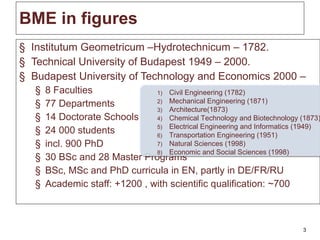
BME in figures Institutum Geometricum –Hydrotechnicum – 1782. Technical University of Budapest 1949 – 2000. Budapest University of Technology and Economics 2000 – 8 Faculties 77 Departments 14 Doctorate Schools 24 000 students incl. 900 PhD 30 BSc and 28 Master Programs BSc, MSc and PhD curricula in EN, partly in DE/FR/RU Academic staff: +1200 , with scientific qualification: ~700 Civil Engineering (1782) Mechanical Engineering (1871) Architecture(1873) Chemical Technology and Biotechnology (1873) Electrical Engineering and Informatics (1949) Transportation Engineering (1951) Natural Sciences (1998) Economic and Social Sciences (1998)
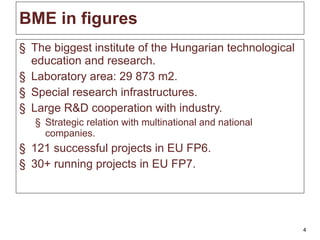
BME in figures The biggest institute of the Hungarian technological education and research. Laboratory area: 29 873 m2. Special research infrastructures. Large R&D cooperation with industry.  Strategic relation with multinational and national companies. 121 successful projects in EU FP6. 30 +  running projects in EU FP7.
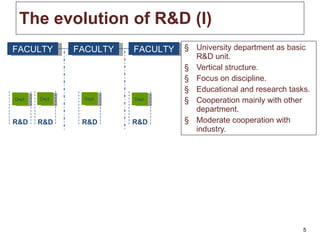
The evolution of R&D  (I) University department as basic R&D unit. Vertical structure. Focus on discipline. Educational and research tasks. Cooperation mainly with other department. Moderate cooperation with industry. Dept. Dept. R&D R&D Dept. R&D Dept. R&D FACULTY FACULTY FACULTY
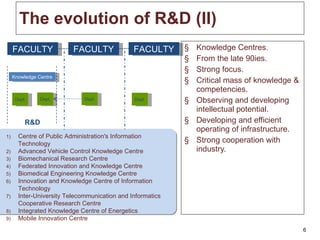
The evolution of R&D  (II) Knowledge Centres. From the late 90ies. Strong focus. Critical mass of knowledge & competencies. Observing and developing intellectual potential. Developing and efficient operating of infrastructure. Strong cooperation with industry. FACULTY FACULTY FACULTY Dept. Dept. R&D Dept. Dept. Knowledge Centre Centre of Public Administration's Information Technology Advanced Vehicle Control Knowledge Centre Biomechanical Research Centre Federated Innovation and Knowledge Centre Biomedical Engineering Knowledge Centre Innovation and Knowledge Centre of Information Technology Inter-University Telecommunication and Informatics Cooperative Research Centre Integrated Knowledge Centre of Energetics Mobile Innovation Centre
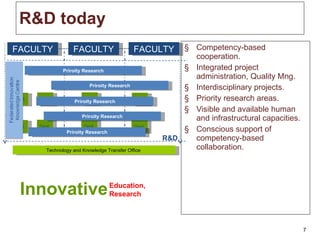
R&D today Competency-based cooperation. Integrated project administration, Quality Mng. Interdisciplinary projects. Priority research areas. Visible and available human and infrastructural capacities.  Conscious support of competency-based collaboration. Dept. Dept. Dept. Dept. Dept. Dept. Dept. Dept. FACULTY FACULTY FACULTY R&D Priroity Research Priroity Research Priroity Research Priroity Research Priroity Research Education , Research Innovative Technology and Knowledge Transfer  Office
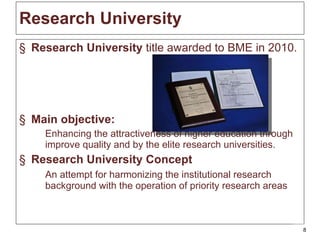
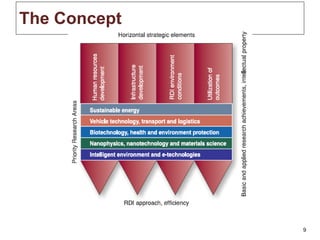
Research University Research University  title awarded to BME in 2010. Main objective: Enhancing the attractiveness of higher education through improve quality and by the elite research universities. Research University Concept An attempt for harmonizing the institutional research background with the operation of priority research areas
The Concept
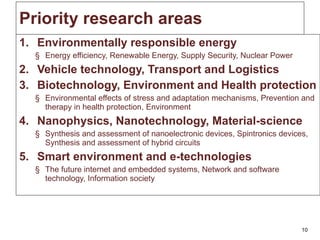
Priority research areas Environmentally responsible energy Energy efficiency, Renewable Energy, Supply Security, Nuclear Power Vehicle technology, Transport and Logistics Biotechnology, Environment and Health protection Environmental effects of stress and adaptation mechanisms, Prevention and therapy in health protection, Environment Nanophysics, Nanotechnology, Material-science Synthesis and assessment of nanoelectronic devices, Spintronics devices, Synthesis and assessment of hybrid circuits Smart environment and e-technologies The future internet and embedded systems, Network and software technology, Information society
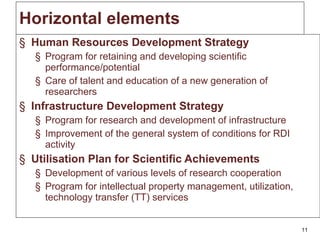
Horizontal elements Human Resources Development Strategy Program for retaining and developing scientific performance/potential Care of talent and education of a new generation of researchers Infrastructure Development Strategy  Program for research and development of infrastructure Improvement of the general system of conditions for RDI activity Utilisation Plan for Scientific Achievements Development of various levels of research cooperation Program for intellectual property management, utilization,  technology transfer (TT) services
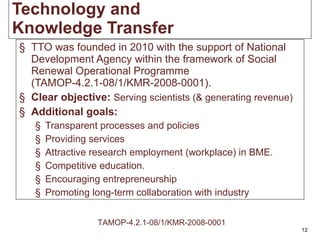
Tech nology   and Knowledge   Transfer TTO was founded in 2010 with the support of National Development Agency within the framework of Social Renewal Operational Programme (TAMOP-4.2.1-08/1/KMR-2008-0001). Clear objective:   Serving scientists (& generating revenue) Additional goals: Transparent processes and policies Providing services A ttractive research  employment ( workplace )  in BME. Competitive education. Encouraging entrepreneurship Promoting long-term collaboration with industry TAMOP-4.2.1-08/1/KMR-2008-0001
Direct goals: Shape up the appropriate organizational condition. Measuring and registering knowledge-pool and innovative results.  IP protection and exploitation. Promoting spin-off  setups Ensuring R&D collaboration with industry. TTO’s service portfolio is under tailoring for BME. TTO serves as an interface between scientists and "the outside world” Technology and Knowledge Transfer TAMOP-4.2.1-08/1/KMR-2008-0001
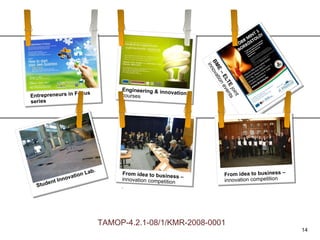
From idea to business –  innovation competition TAMOP-4.2.1-08/1/KMR-2008-0001 From idea to business –  innovation competition . Student Innovation Lab. Entrepreneurs in Focus series Engineering & innovation  courses BME – ELTE  joint innovation events
New initiatives  [1] – DBP DEMOLA Budapest An open innovation environment for the creators of the next generation of services, products and social practices. An opportunity for students to contribute real-life innovations with end-users An opportunity for organisations to run agile development projects in exploring novel technology enabled products and services
What is Demola? Initial concepts and guidance come from companies Real market potential Interesting project topics and valuable experience Multidisciplinary student teams (all Faculties) Tools and inspiring atmosphere  Results are honed into real products and services to be part of the companies’ operations, or TAMOP-4.2.1-08/1/KMR-2008-0001
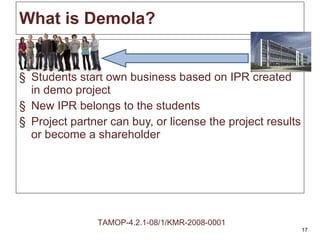
What is Demola? Students start own business based on IPR created in demo project New IPR belongs to the students Project partner can buy, or license the project results or become a shareholder TAMOP-4.2.1-08/1/KMR-2008-0001
New initiatives [1]  – DBP DEMOLA Budapest C ombines fresh ideas of students with needs and support from project partners F ocus es  on creative action not on producing papers T urn s  needs, ideas and know-how into demos of products and services [more info  www.demola.hu ]
New initiatives [ 2 ]  – UBI  University-based Incubator (UBI) A  model – to decrease risk and funding needs Existing problems in creating start-ups  in co-operation with the university Lack of government funding for start-ups Too high risk for private investors University R&D and educational projects often far from business oriented approach Lack of entrepreneurial knowledge and spirit
New initiatives [ 2 ]  – UBI
New initiatives [ 2 ]  – UBI  University Experience in running R&D projects Infrastructure (offices, labs, overhead costs) Significantly lowering the risk of the private investment (double screening) Incubator  Experience in selecting the projects Investment Market oriented and entrepreneurial approach Contributions of the parties
New initiatives [ 2 ]  – UBI Expected advantages Creating value from university research Offering untapped deal-flow for the investors of the incubator Advancing entrepreneurial experience and spirit at the university Reducing the cash investment needed Even with no-go decision the educational goals can be reached
New initiatives  [3] Industrial Campus Zone Special and dedicated R&D environment for industry Research teams of industrial and university experts Joint management and operational tasks Special graduate, postgraduate and training curricula Harmonized research and development strategies
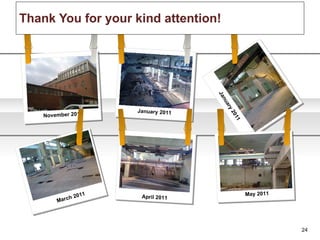
Thank You for your kind attention! May 2011 April 2011 March 2011 November 2010 January 2011 January 2011

Bme inno strat-v2

  • 1.
    Laszlo Vajta ViceRector of innovation BME Innovation strategy of the Budapest University of Technology and Economics (BME)
  • 2.
    Content BME IntroResearch & Development Technology Transfer New initiatives Your questions are always welcome!
  • 3.
    BME in figuresInstitutum Geometricum –Hydrotechnicum – 1782. Technical University of Budapest 1949 – 2000. Budapest University of Technology and Economics 2000 – 8 Faculties 77 Departments 14 Doctorate Schools 24 000 students incl. 900 PhD 30 BSc and 28 Master Programs BSc, MSc and PhD curricula in EN, partly in DE/FR/RU Academic staff: +1200 , with scientific qualification: ~700 Civil Engineering (1782) Mechanical Engineering (1871) Architecture(1873) Chemical Technology and Biotechnology (1873) Electrical Engineering and Informatics (1949) Transportation Engineering (1951) Natural Sciences (1998) Economic and Social Sciences (1998)
  • 4.
    BME in figuresThe biggest institute of the Hungarian technological education and research. Laboratory area: 29 873 m2. Special research infrastructures. Large R&D cooperation with industry. Strategic relation with multinational and national companies. 121 successful projects in EU FP6. 30 + running projects in EU FP7.
  • 5.
    The evolution ofR&D (I) University department as basic R&D unit. Vertical structure. Focus on discipline. Educational and research tasks. Cooperation mainly with other department. Moderate cooperation with industry. Dept. Dept. R&D R&D Dept. R&D Dept. R&D FACULTY FACULTY FACULTY
  • 6.
    The evolution ofR&D (II) Knowledge Centres. From the late 90ies. Strong focus. Critical mass of knowledge & competencies. Observing and developing intellectual potential. Developing and efficient operating of infrastructure. Strong cooperation with industry. FACULTY FACULTY FACULTY Dept. Dept. R&D Dept. Dept. Knowledge Centre Centre of Public Administration's Information Technology Advanced Vehicle Control Knowledge Centre Biomechanical Research Centre Federated Innovation and Knowledge Centre Biomedical Engineering Knowledge Centre Innovation and Knowledge Centre of Information Technology Inter-University Telecommunication and Informatics Cooperative Research Centre Integrated Knowledge Centre of Energetics Mobile Innovation Centre
  • 7.
    R&D today Competency-basedcooperation. Integrated project administration, Quality Mng. Interdisciplinary projects. Priority research areas. Visible and available human and infrastructural capacities. Conscious support of competency-based collaboration. Dept. Dept. Dept. Dept. Dept. Dept. Dept. Dept. FACULTY FACULTY FACULTY R&D Priroity Research Priroity Research Priroity Research Priroity Research Priroity Research Education , Research Innovative Technology and Knowledge Transfer Office
  • 8.
    Research University ResearchUniversity title awarded to BME in 2010. Main objective: Enhancing the attractiveness of higher education through improve quality and by the elite research universities. Research University Concept An attempt for harmonizing the institutional research background with the operation of priority research areas
  • 9.
  • 10.
    Priority research areasEnvironmentally responsible energy Energy efficiency, Renewable Energy, Supply Security, Nuclear Power Vehicle technology, Transport and Logistics Biotechnology, Environment and Health protection Environmental effects of stress and adaptation mechanisms, Prevention and therapy in health protection, Environment Nanophysics, Nanotechnology, Material-science Synthesis and assessment of nanoelectronic devices, Spintronics devices, Synthesis and assessment of hybrid circuits Smart environment and e-technologies The future internet and embedded systems, Network and software technology, Information society
  • 11.
    Horizontal elements HumanResources Development Strategy Program for retaining and developing scientific performance/potential Care of talent and education of a new generation of researchers Infrastructure Development Strategy Program for research and development of infrastructure Improvement of the general system of conditions for RDI activity Utilisation Plan for Scientific Achievements Development of various levels of research cooperation Program for intellectual property management, utilization, technology transfer (TT) services
  • 12.
    Tech nology and Knowledge Transfer TTO was founded in 2010 with the support of National Development Agency within the framework of Social Renewal Operational Programme (TAMOP-4.2.1-08/1/KMR-2008-0001). Clear objective: Serving scientists (& generating revenue) Additional goals: Transparent processes and policies Providing services A ttractive research employment ( workplace ) in BME. Competitive education. Encouraging entrepreneurship Promoting long-term collaboration with industry TAMOP-4.2.1-08/1/KMR-2008-0001
  • 13.
    Direct goals: Shapeup the appropriate organizational condition. Measuring and registering knowledge-pool and innovative results. IP protection and exploitation. Promoting spin-off setups Ensuring R&D collaboration with industry. TTO’s service portfolio is under tailoring for BME. TTO serves as an interface between scientists and "the outside world” Technology and Knowledge Transfer TAMOP-4.2.1-08/1/KMR-2008-0001
  • 14.
    From idea tobusiness – innovation competition TAMOP-4.2.1-08/1/KMR-2008-0001 From idea to business – innovation competition . Student Innovation Lab. Entrepreneurs in Focus series Engineering & innovation courses BME – ELTE joint innovation events
  • 15.
    New initiatives [1] – DBP DEMOLA Budapest An open innovation environment for the creators of the next generation of services, products and social practices. An opportunity for students to contribute real-life innovations with end-users An opportunity for organisations to run agile development projects in exploring novel technology enabled products and services
  • 16.
    What is Demola?Initial concepts and guidance come from companies Real market potential Interesting project topics and valuable experience Multidisciplinary student teams (all Faculties) Tools and inspiring atmosphere Results are honed into real products and services to be part of the companies’ operations, or TAMOP-4.2.1-08/1/KMR-2008-0001
  • 17.
    What is Demola?Students start own business based on IPR created in demo project New IPR belongs to the students Project partner can buy, or license the project results or become a shareholder TAMOP-4.2.1-08/1/KMR-2008-0001
  • 18.
    New initiatives [1] – DBP DEMOLA Budapest C ombines fresh ideas of students with needs and support from project partners F ocus es on creative action not on producing papers T urn s needs, ideas and know-how into demos of products and services [more info www.demola.hu ]
  • 19.
    New initiatives [2 ] – UBI University-based Incubator (UBI) A model – to decrease risk and funding needs Existing problems in creating start-ups in co-operation with the university Lack of government funding for start-ups Too high risk for private investors University R&D and educational projects often far from business oriented approach Lack of entrepreneurial knowledge and spirit
  • 20.
    New initiatives [2 ] – UBI
  • 21.
    New initiatives [2 ] – UBI University Experience in running R&D projects Infrastructure (offices, labs, overhead costs) Significantly lowering the risk of the private investment (double screening) Incubator Experience in selecting the projects Investment Market oriented and entrepreneurial approach Contributions of the parties
  • 22.
    New initiatives [2 ] – UBI Expected advantages Creating value from university research Offering untapped deal-flow for the investors of the incubator Advancing entrepreneurial experience and spirit at the university Reducing the cash investment needed Even with no-go decision the educational goals can be reached
  • 23.
    New initiatives [3] Industrial Campus Zone Special and dedicated R&D environment for industry Research teams of industrial and university experts Joint management and operational tasks Special graduate, postgraduate and training curricula Harmonized research and development strategies
  • 24.
    Thank You foryour kind attention! May 2011 April 2011 March 2011 November 2010 January 2011 January 2011