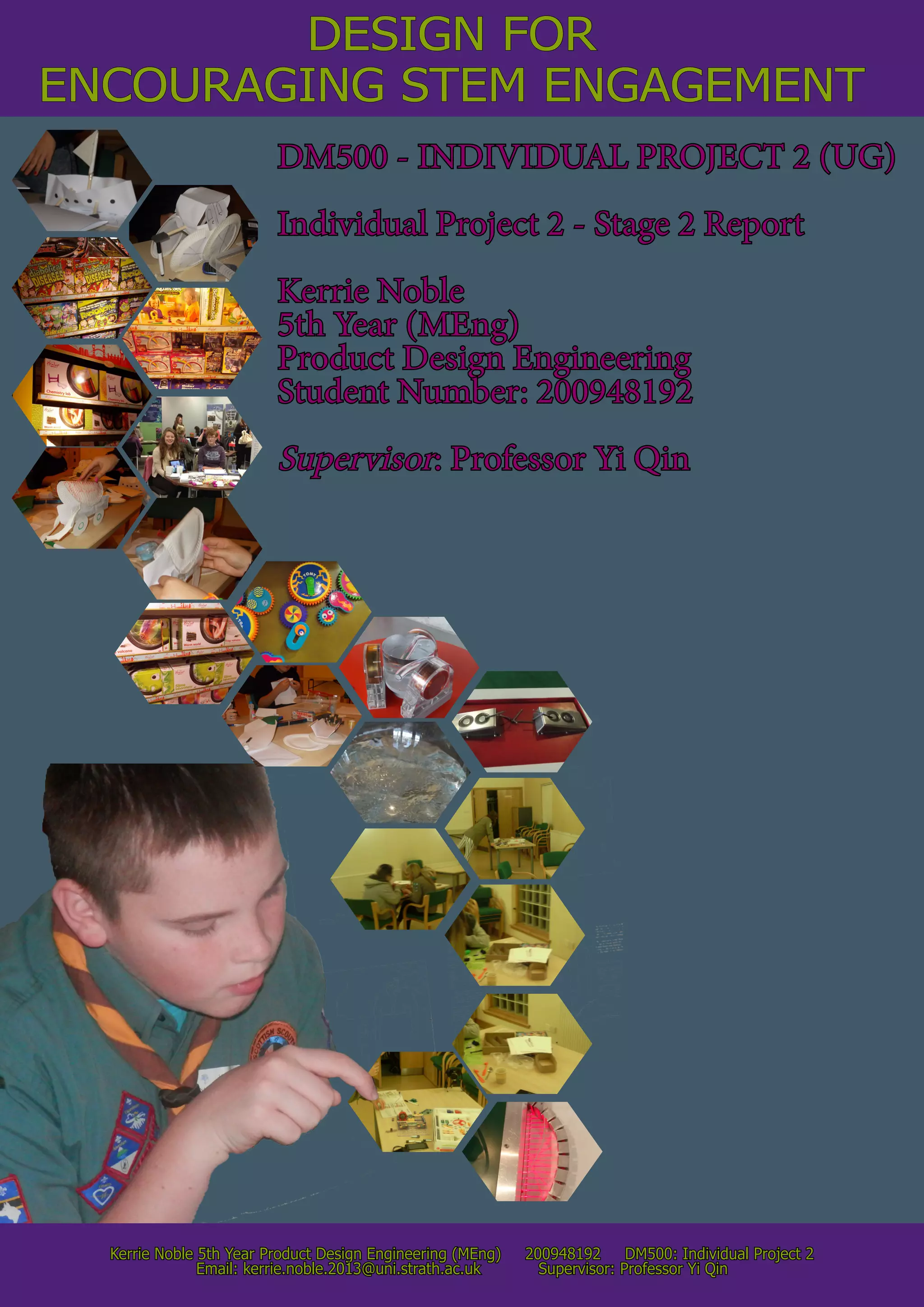
ENCOURAGING STEM ENGAGEMENT
Kerrie Noble 5th Year Product Design Engineering (MEng) 200948192 DM500: Individual Project 2
Email: kerrie.noble.2013@uni.strath.ac.uk Supervisor: Professor Yi Qin
DM500 - INDIVIDUAL PROJECT 2 (UG)
Individual Project 2 - Stage 2 Report
Kerrie Noble
5th Year (MEng)
Product Design Engineering
Student Number: 200948192
Supervisor: Professor Yi Qin
DESIGN FOR
Encouraging STEM Engagement Within Extra-Curricular Groups
1
Kerrie Noble | DMEM, UNIVERSITY OF STRATHCLYDE, GLASGOW – SUBMISSION 16/01/14
Statement of Academic Honesty
I declare that this submission is entirely my own original work.
This is the final version of my submission.
I declare that, except where fully referenced direct quotations have been included, no aspect of this
submission has been copied from any other source.
I declare that all other works cited in this submission have been appropriately referenced.
I understand that any act of Academic Dishonesty such as plagiarism or collusion may result in the non-
award of my degree.
Signed ……...........……... Date 22/01/2014
Encouraging STEM Engagement Within Extra-Curricular Groups
2
Kerrie Noble | DMEM, UNIVERSITY OF STRATHCLYDE, GLASGOW – SUBMISSION 16/01/14
Acknowledgements
Many people have contributed to the compilation of stage two of this project and have made the process
easier, more informative and helped me to achieve a better outcome in many ways.
Firstly I would like to thank the staff and students within the department of Design Manufacture and
Engineering Management, particularly my supervisor Professor Yi Qin, whose help, input and guidance
has been greatly appreciated and much needed throughout the completion of stage 1 of this project.
Hilary Grierson, for her support with the Individual Projects class. And finally Bekki MacKechnie and
John Dawson for their help with the testing of prototypes and models during early stages of the
development of the final concept.
Thanks must also be extended to the leaders and young people within the 105th Dennistoun Scout Group
who have accommodated and supported this project at a number of crucial stages, including testing and
evaluation stages.
I would also like to thank David Patterson, the events manager at the Glasgow Science Centre, for
agreeing to my participation in many of their late-night group events where is was allowed to freely
observe the interaction between the young people and many of their science exhibits and activities.
Also, thanks must be given to Tracey Howe, as a member/chair of the Glasgow City of Science initiative
her support and cooperation for the project was critical and her valuable feedback was much
appreciated.
Finally the last contributors I would like to thank are Michael MacLennan and Nevin Forbes. For being
able to devote some of your free time to providing detailed and insightful feedback on both early-stage
and developed conceptual designs, without which progress would have been slow.
Also thanks must be extended to my family without whose support it would not be possible to be in this
position now. Your support has not gone unnoticed.
Encouraging STEM Engagement Within Extra-Curricular Groups
3
Kerrie Noble | DMEM, UNIVERSITY OF STRATHCLYDE, GLASGOW – SUBMISSION 16/01/14
Abstract
The stage 2 report for this project covers content in relation to 4 sections of the project (as outlined in
the project methodology introduced in stage 1), primarily the conceptual design phase, the detail design
phase, the evaluate and test phase and the release phase. Content in relation to the outlining of the
project solution, initial modelling, prototyping, testing, refining, and business requirements are all
contained within this stage of the project.
On completion of the initial activities of the conceptual design phase, at the end of stage 1, stage 2 looks
at taking these activities and further developing the design ideas emerging from this phase of the project,
while also incorporating evaluation in the form of user and expert feedback to ensure suitability and
functionality of the product. These activities will result in the selection of a final design concept. The
activities discussed include;
• Continuation of the random word generation with potential 14 year old users
• Development and use of a morphological chart
• Development of a function means tree
• An identification of weighted specification criteria
• Completion of a weighting and rating matrix
• Identification and explanation of the final design concept
On completion of this phase, detailed design and evaluate and test phases will be conducted
simultaneously, with the objective of developing the design concept further while also gaining potential
user feedback to guide the development process. The activities discussed include;
• Initial stages of model making
• Initial testing of assembly model 1 and 2
• Observational embodiment design study
• Detailed embodiment design
• Production of the final prototype
• Design for function
• Design for Manufacture
• Design for Sustainability
• And a 3 phase approach to final prototype testing
On completion of these phases of the project, the project will enter the final phase by considering the
approach to developing a business setup for launching the final conceptual design. This will be
highlighted through the business model canvas, included in the portfolio, and a detailed business plan,
included as a separate report to accompany the project.
Encouraging STEM Engagement Within Extra-Curricular Groups
4
Kerrie Noble | DMEM, UNIVERSITY OF STRATHCLYDE, GLASGOW – SUBMISSION 16/01/14
A summary of project management and design approaches are also included along with a project
reflection at the end of stage 2. CAD renderings and manufacturing drawings relating to the final
concept design are also included at the end of the stage 2 portfolio.
Encouraging STEM Engagement Within Extra-Curricular Groups
5
Kerrie Noble | DMEM, UNIVERSITY OF STRATHCLYDE, GLASGOW – SUBMISSION 16/01/14
List of Figures
Figure 4.13. 1 - A diagram outlining the continuing approach to the conceptual
development phase. ............................................................................................................19
Figure 4.24. 1- The initial approach to the conceptual design phase of the project..28
Figure 5. 1 - A diagram showing the current position of project development on the
outlined project methodology............................................................................................31
Figure 5.1. 1 - The continuing conceptual design phase approach for stage 2..........31
Figure 5.2. 1 - An image of the focus group of students generating concepts from
random word generation outcomes..................................................................................32
Figure 5.6. 1 - An image showing the identification of weighting criteria for the
evaluation categories. .........................................................................................................91
Figure 6. 1 - A diagram outlining the current project progress against the outlined
methodology. ......................................................................................................................105
Figure 6.1. 1- A diagram outlining the approach to be taken within the detailed
design phase of the project. .............................................................................................106
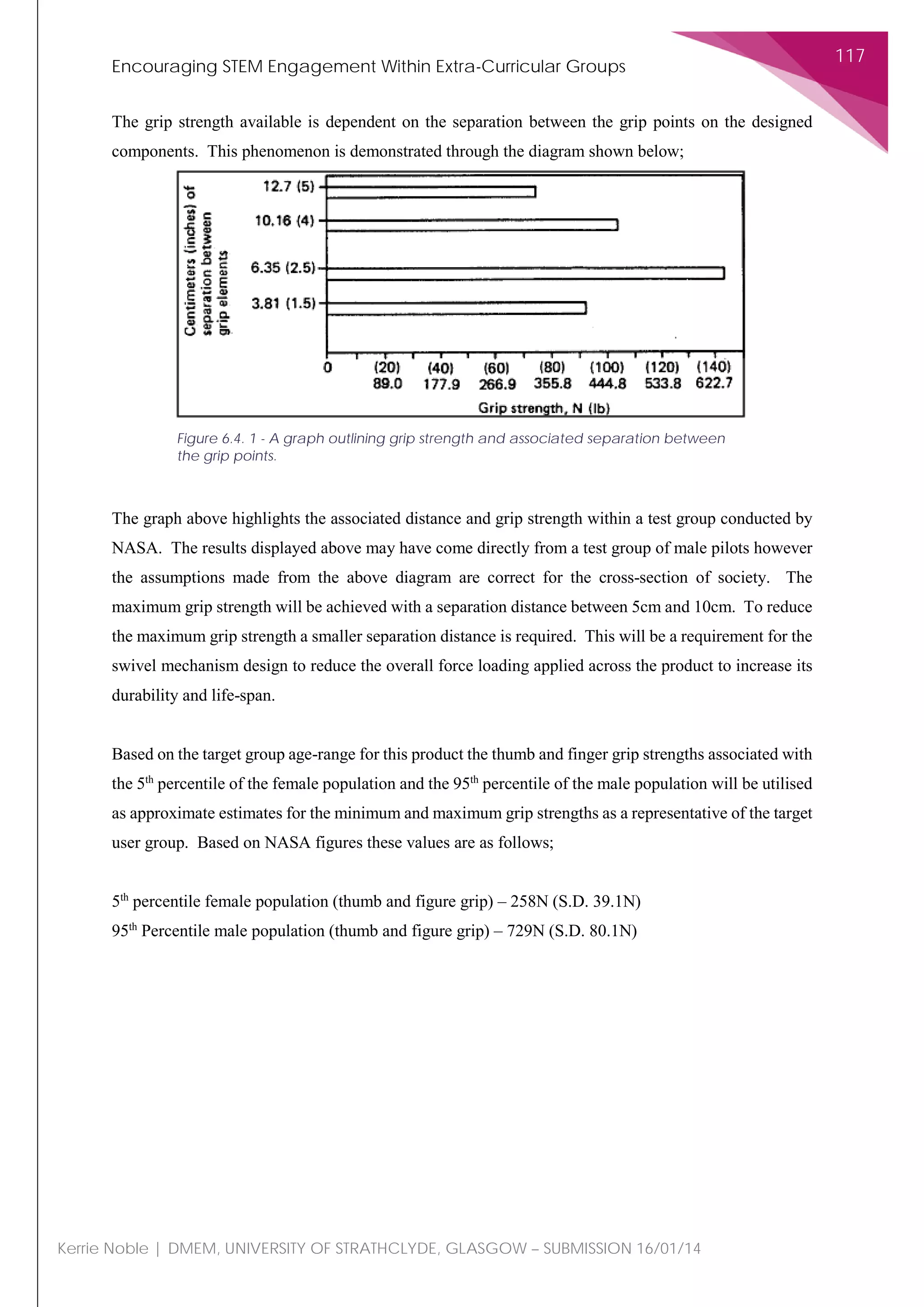
Figure 6.4. 1 - A graph outlining grip strength and associated separation between
the grip points. .....................................................................................................................117
Figure 6.4. 2 - A diagram outlining the human grip and movement positions
corresponding to specific movement values. ................................................................118
Figure 6.4. 3 - A diagram outlining the push/pull strength discussed within the
embodiment design. ..........................................................................................................119
Figure 6.4. 4 - A diagram outlining the process of fastening selection........................121
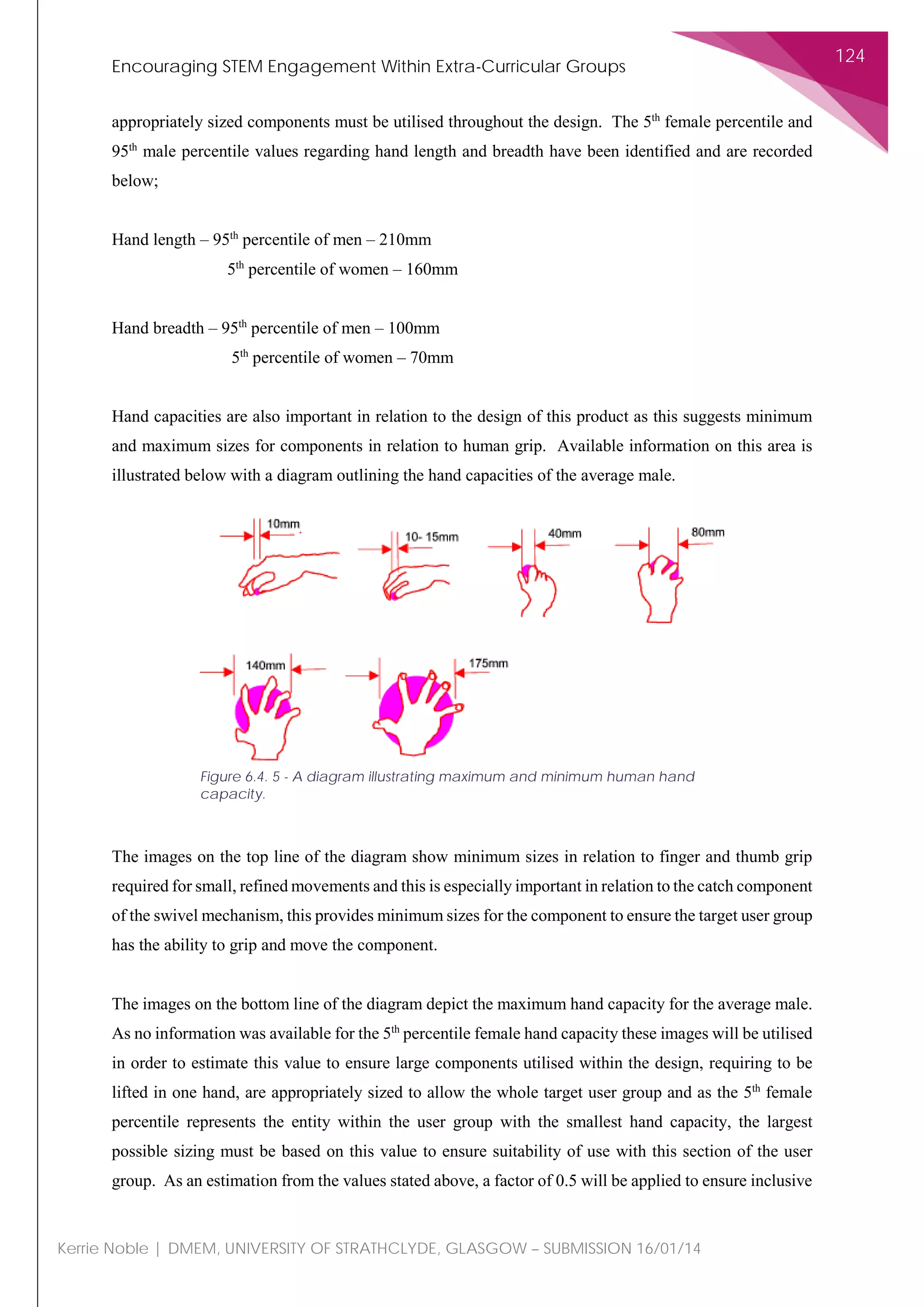
Figure 6.4. 5 - A diagram illustrating maximum and minimum human hand capacity.
................................................................................................................................................124
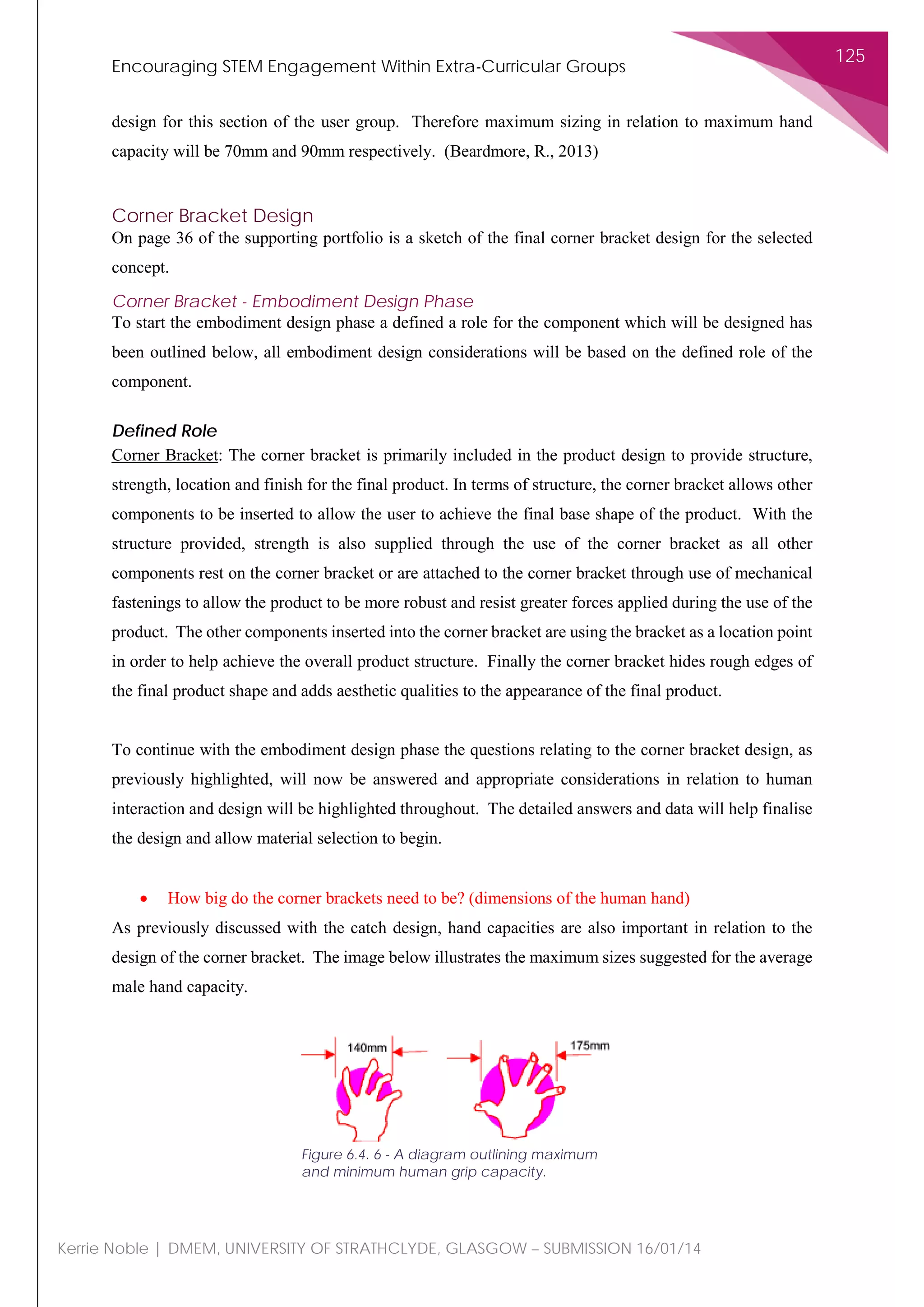
Figure 6.4. 6 - A diagram outlining maximum and minimum human grip capacity..125
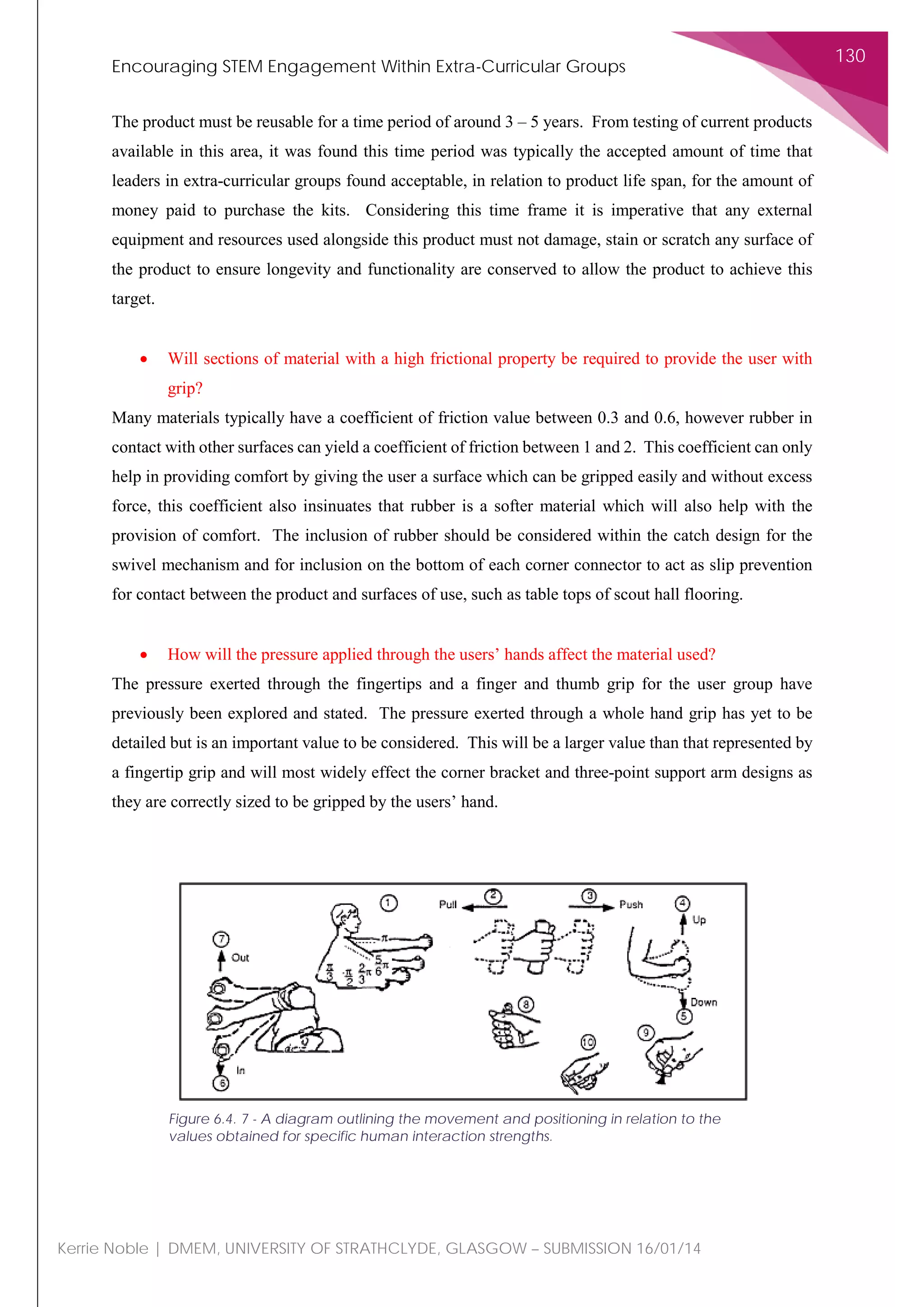
Figure 6.4. 7 - A diagram outlining the movement and positioning in relation to the
values obtained for specific human interaction strengths............................................130
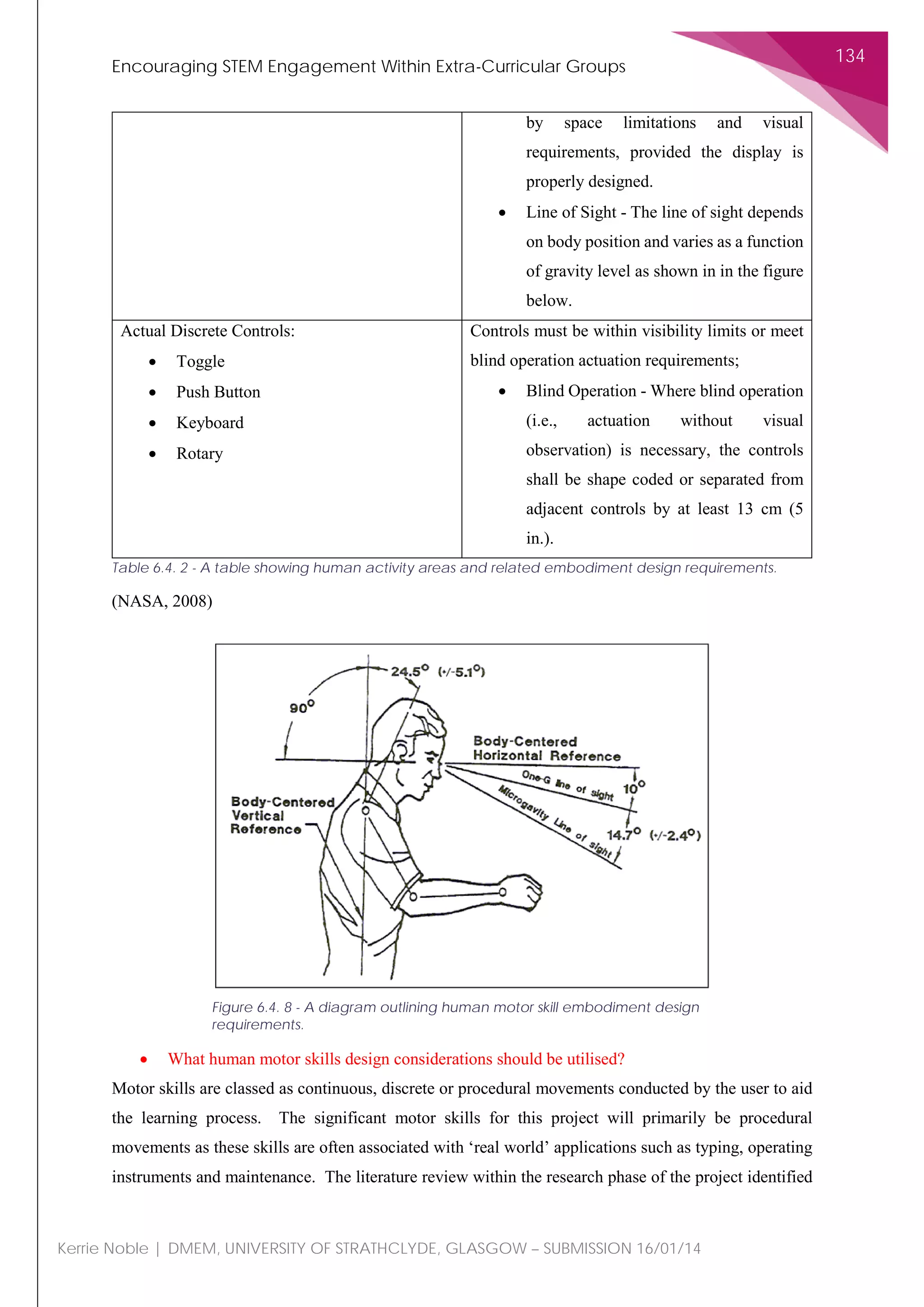
Figure 6.4. 8 - A diagram outlining human motor skill embodiment design
requirements. .......................................................................................................................134
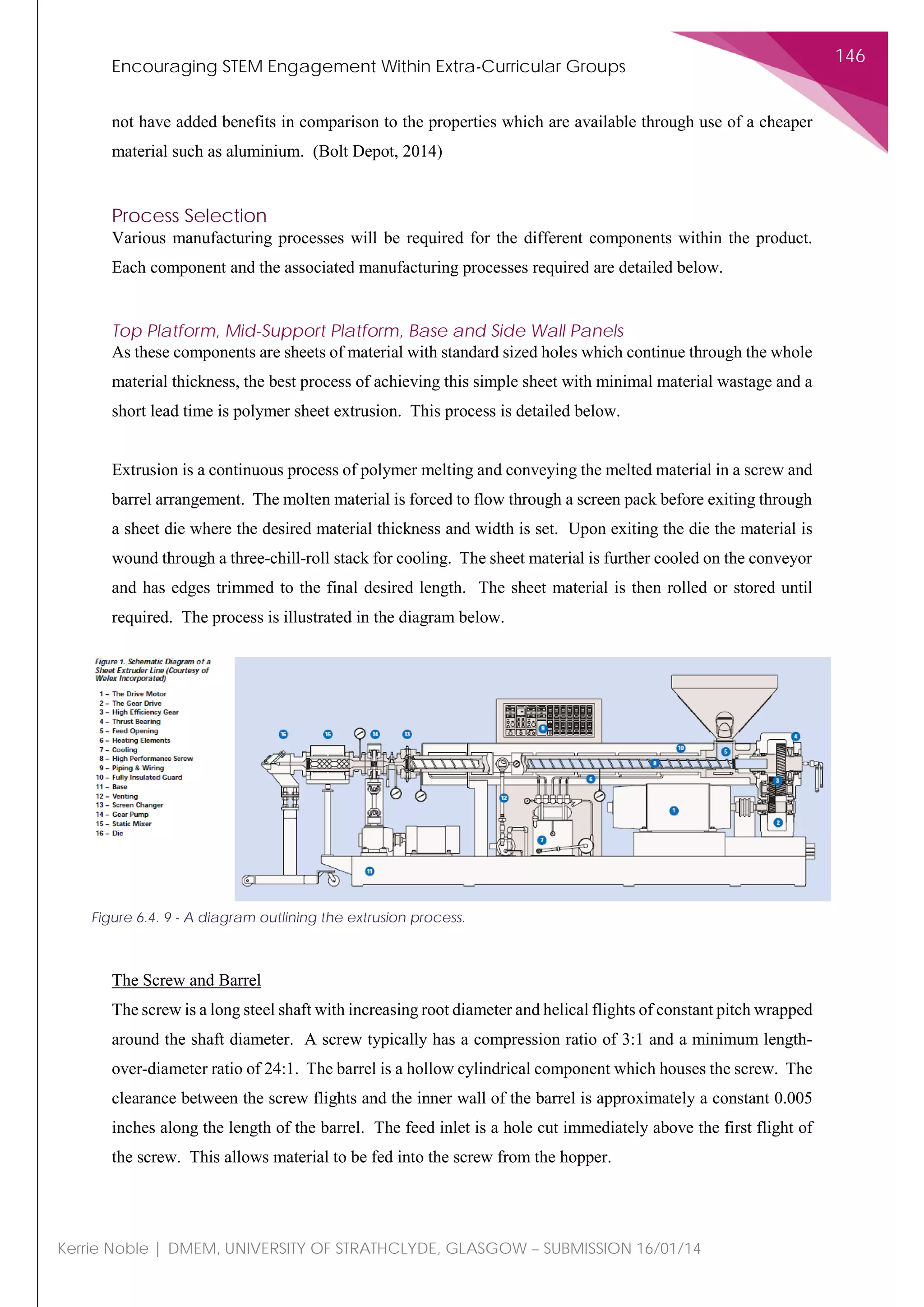
Figure 6.4. 9 - A diagram outlining the extrusion process. .............................................146
Encouraging STEM Engagement Within Extra-Curricular Groups
6
Kerrie Noble | DMEM, UNIVERSITY OF STRATHCLYDE, GLASGOW – SUBMISSION 16/01/14
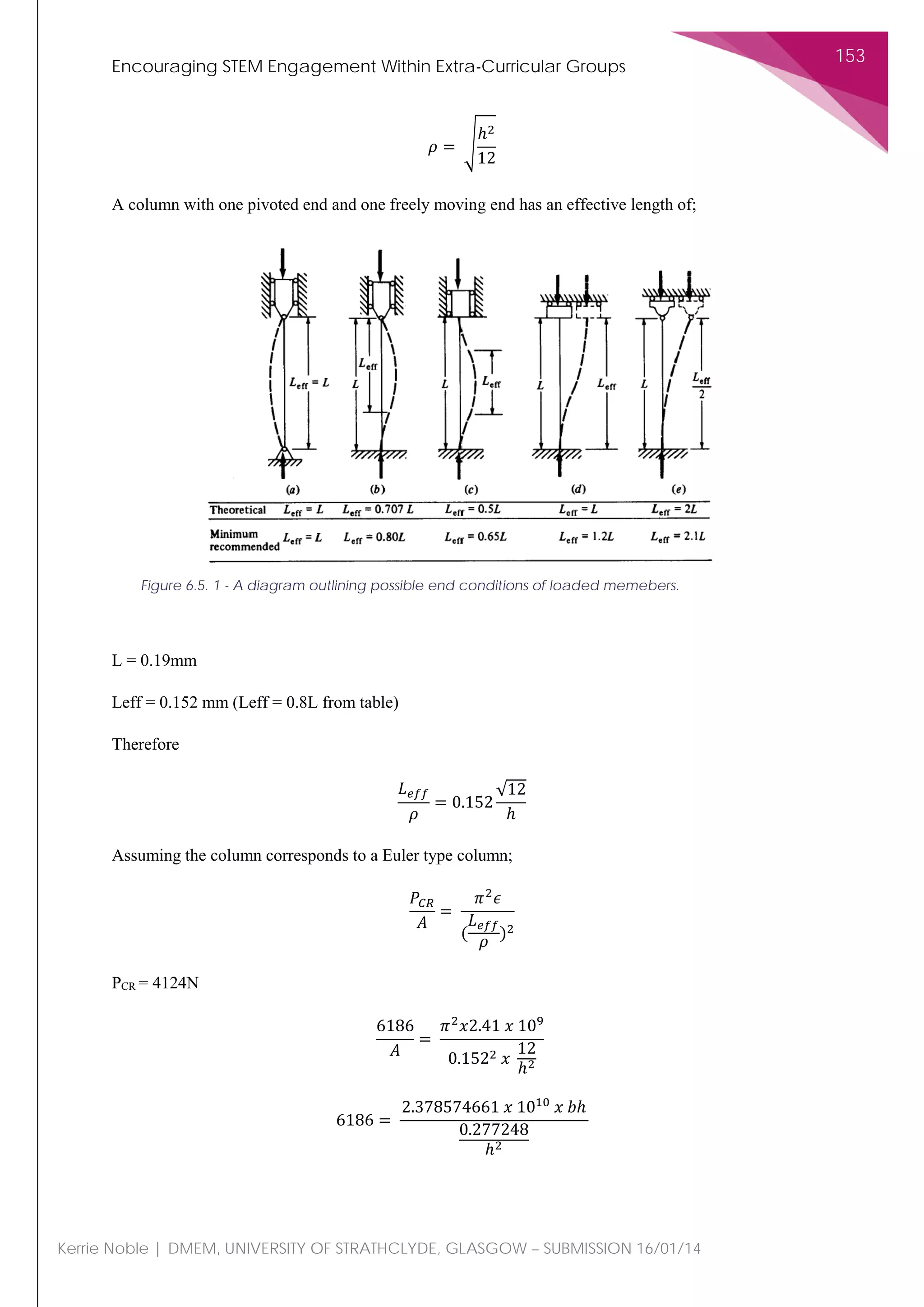
Figure 6.5. 1 - A diagram outlining possible end conditions of loaded memebers...153
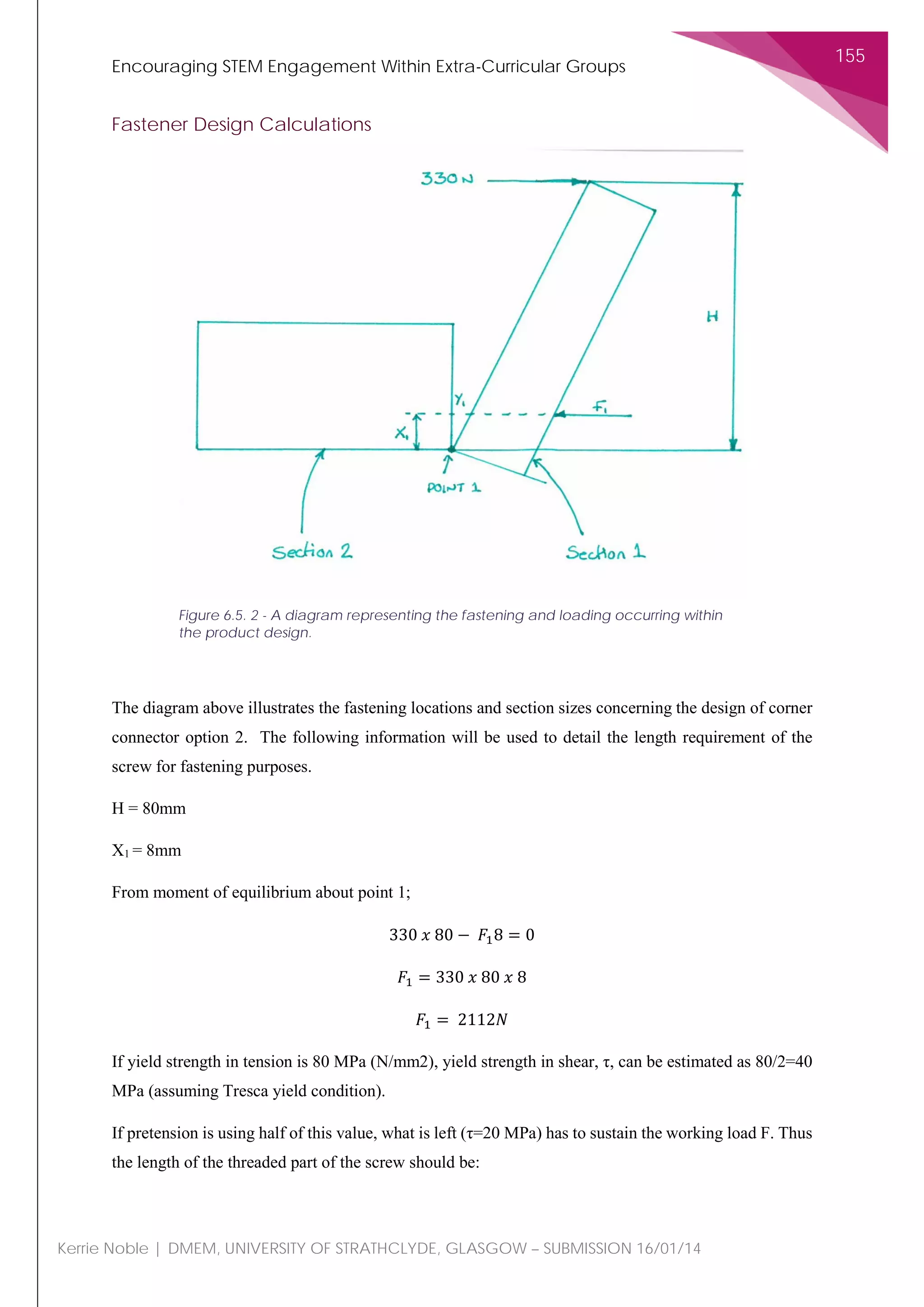
Figure 6.5. 2 - A diagram representing the fastening and loading occurring within the
product design. ...................................................................................................................155
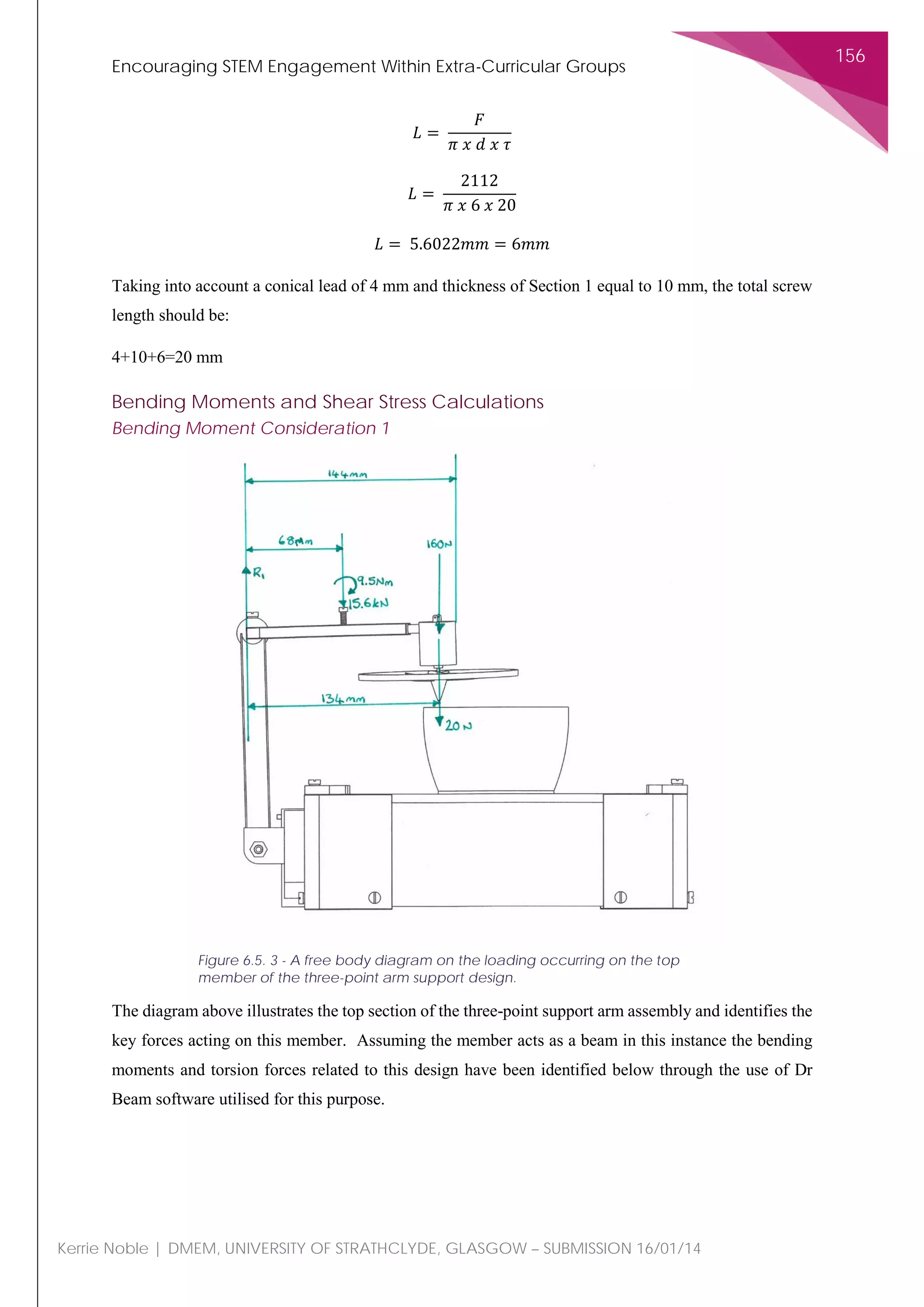
Figure 6.5. 3 - A free body diagram on the loading occurring on the top member of
the three-point arm support design..................................................................................156
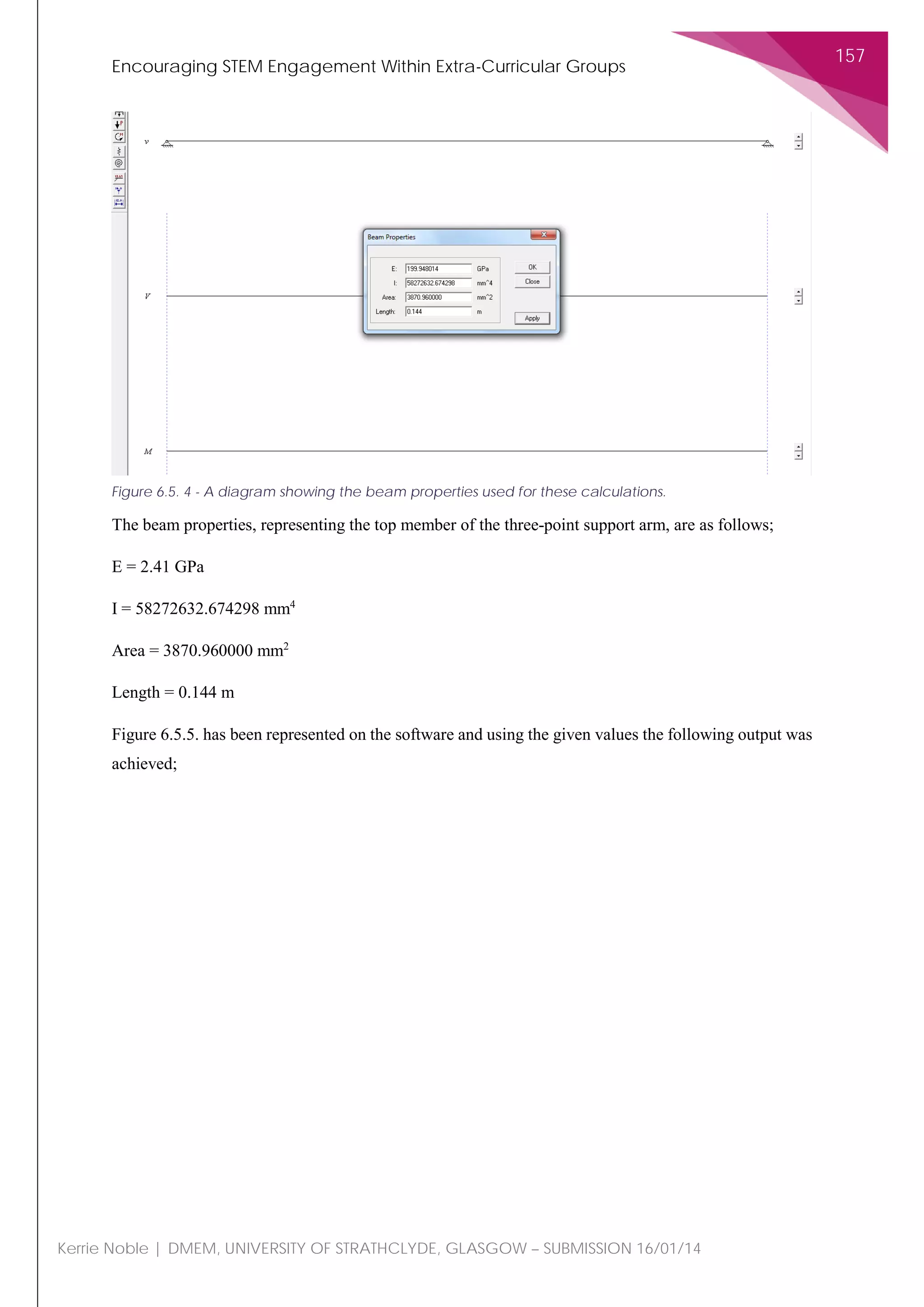
Figure 6.5. 4 - A diagram showing the beam properties used for these calculations.
................................................................................................................................................157
Figure 6.5. 5 - A representation of the loaded beam. ...................................................158
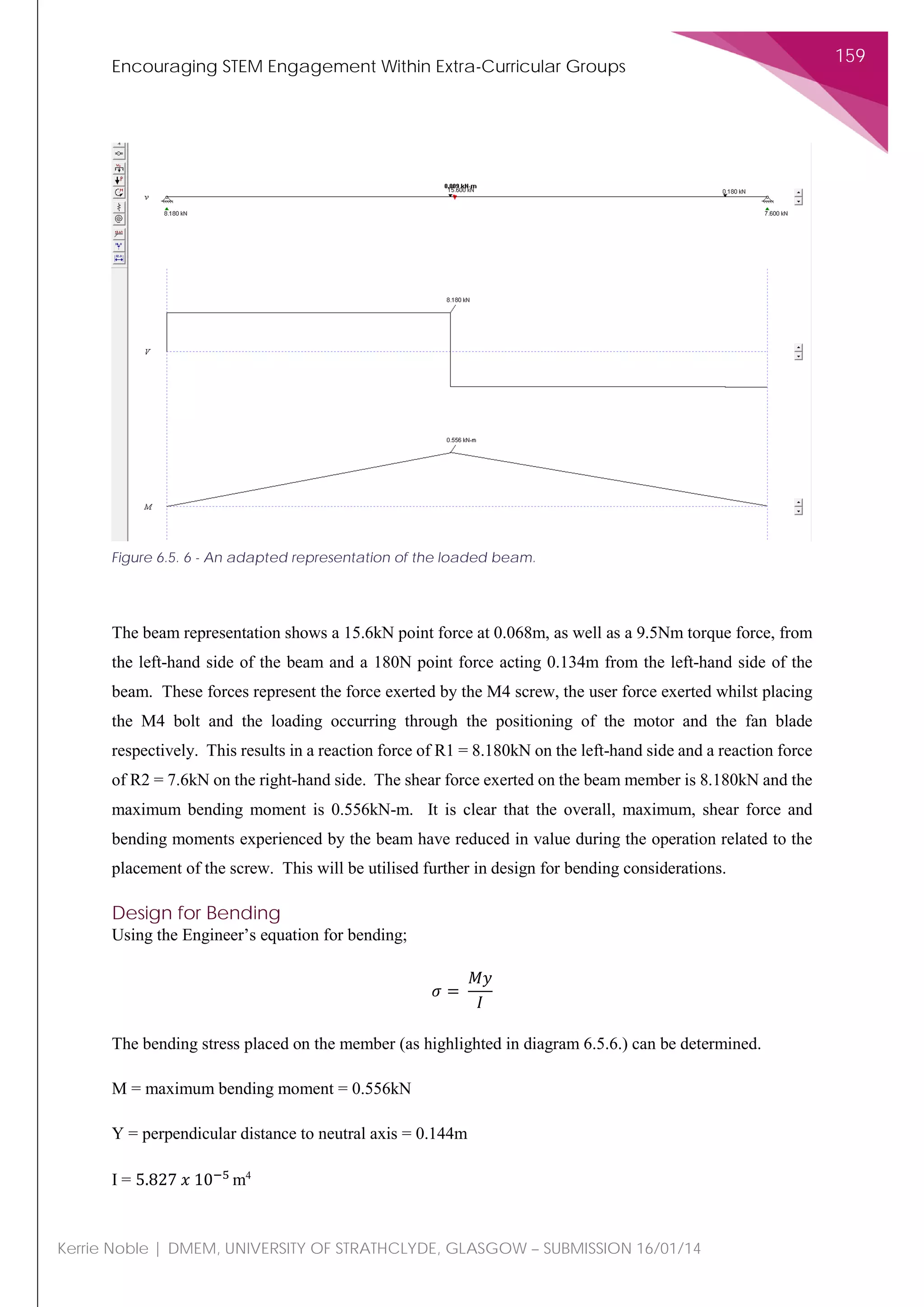
Figure 6.5. 6 - An adapted representation of the loaded beam.................................159
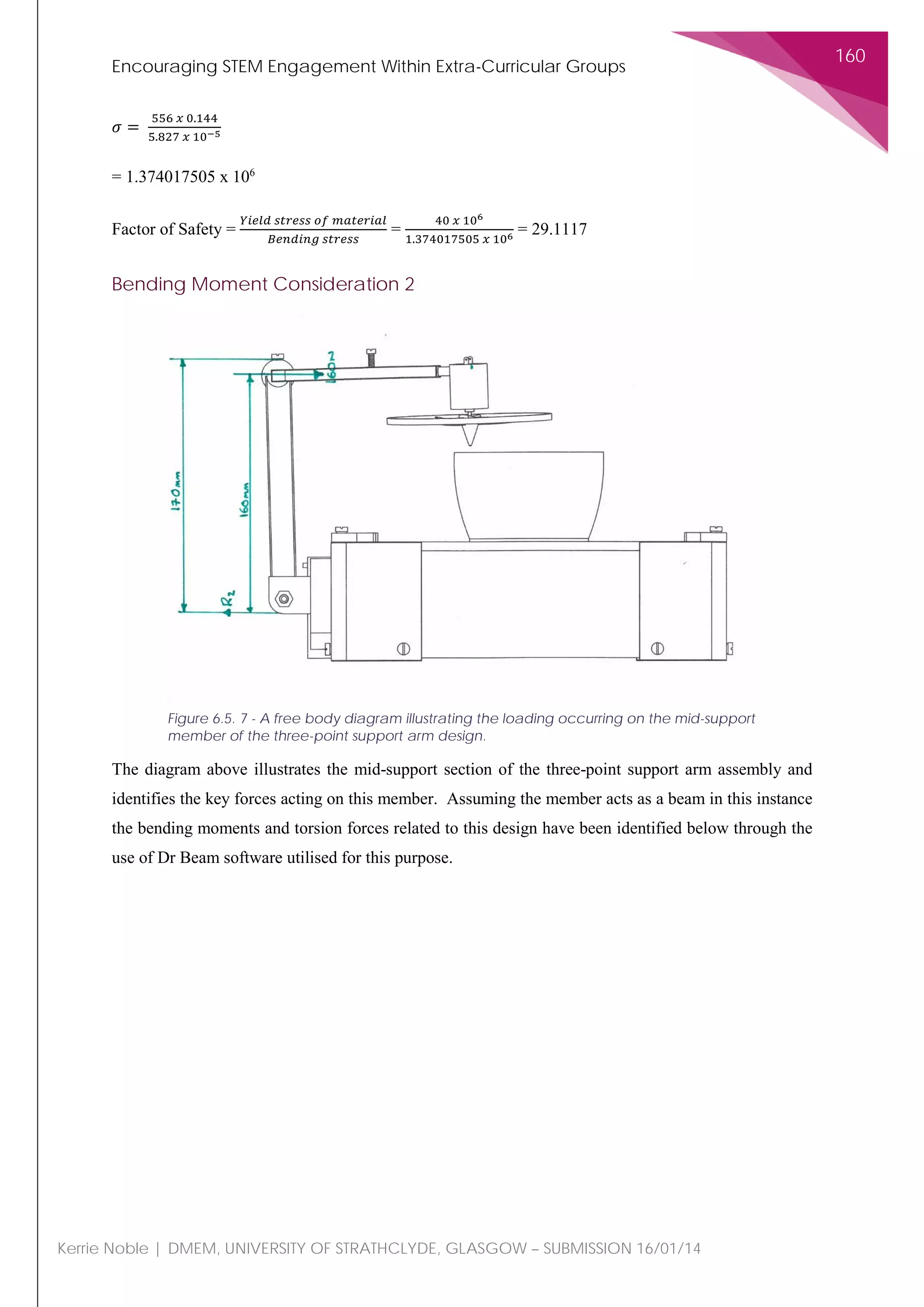
Figure 6.5. 7 - A free body diagram illustrating the loading occurring on the mid-
support member of the three-point support arm design. .............................................160
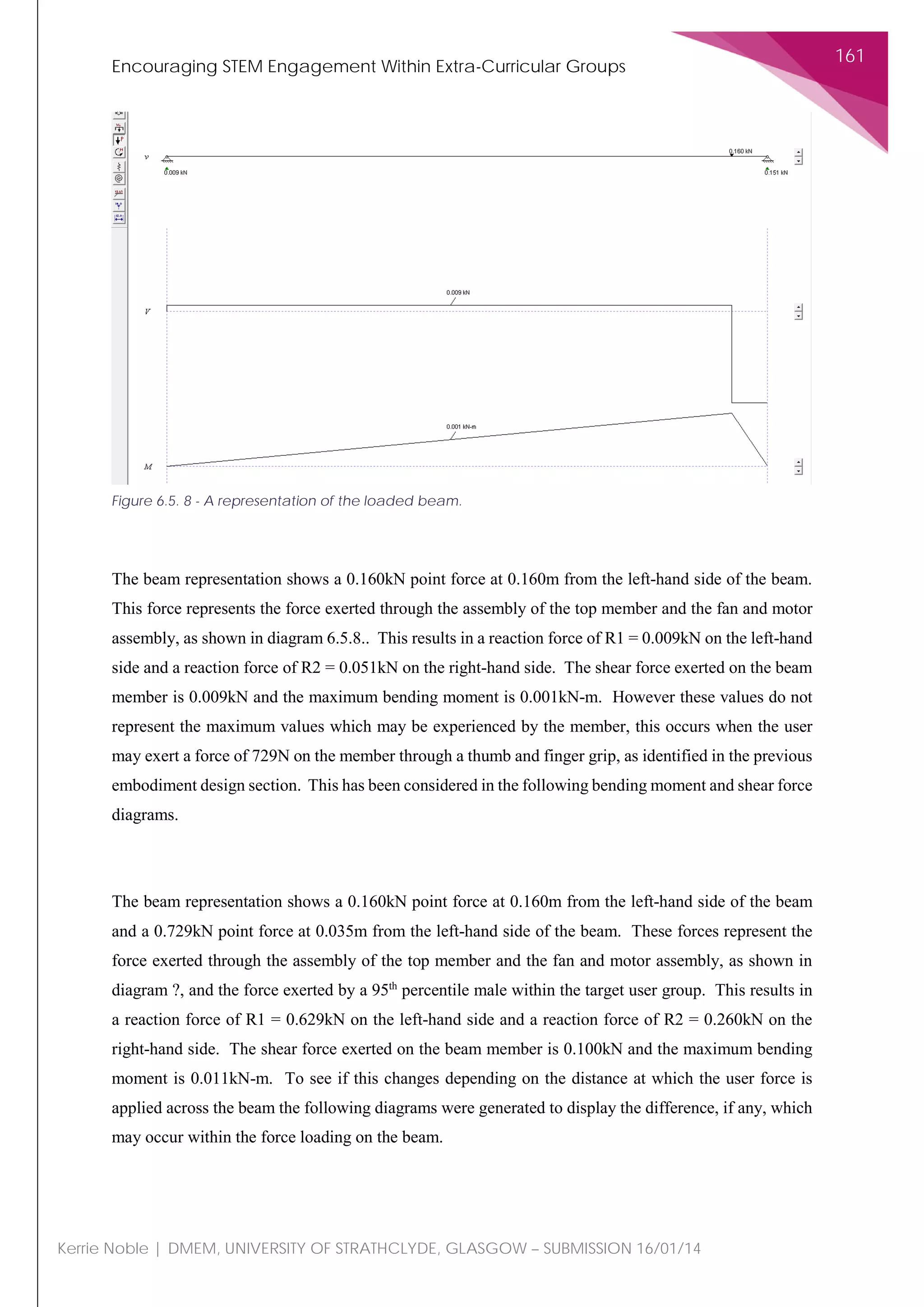
Figure 6.5. 8 - A representation of the loaded beam. ...................................................161
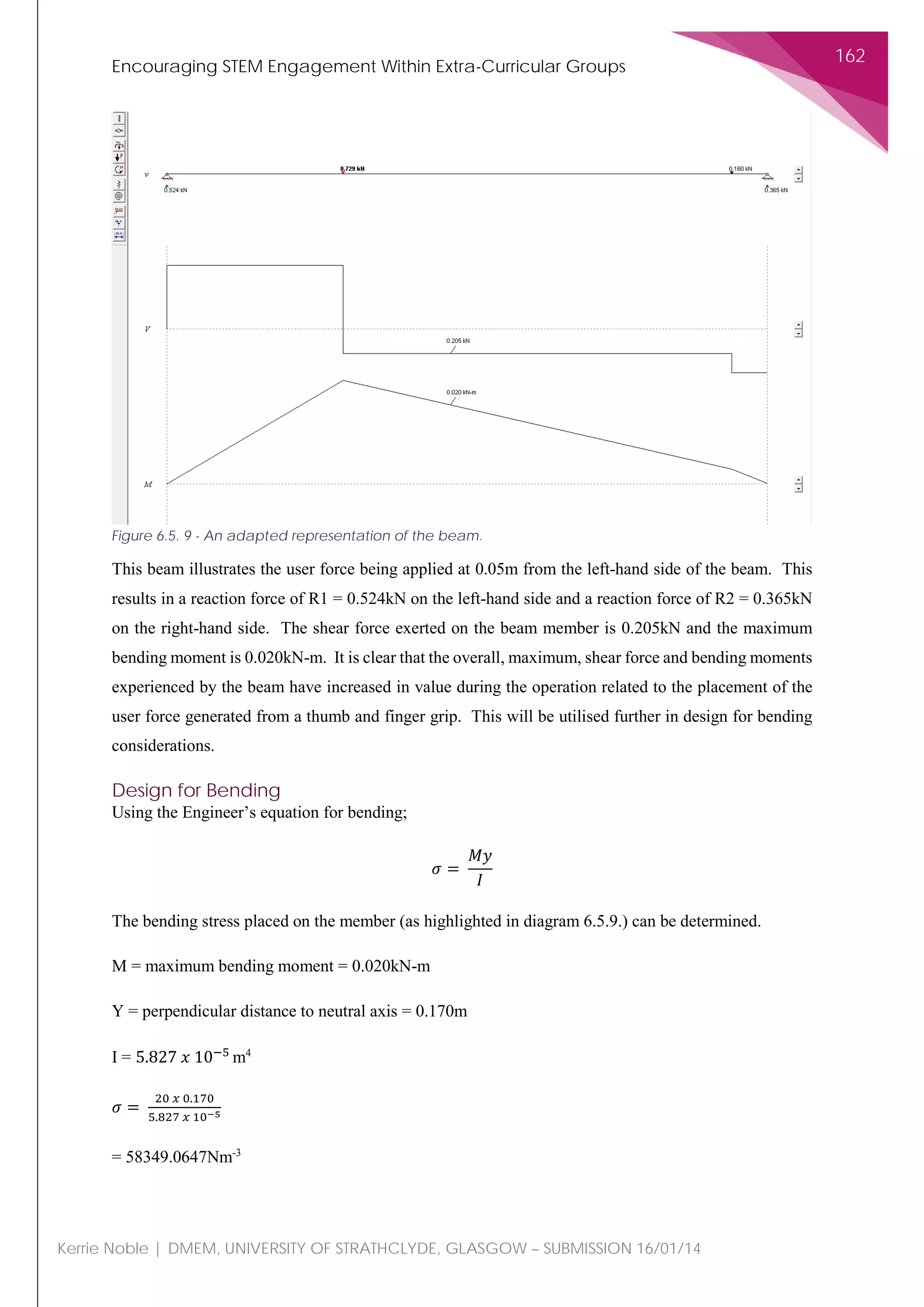
Figure 6.5. 9 - An adapted representation of the beam...............................................162
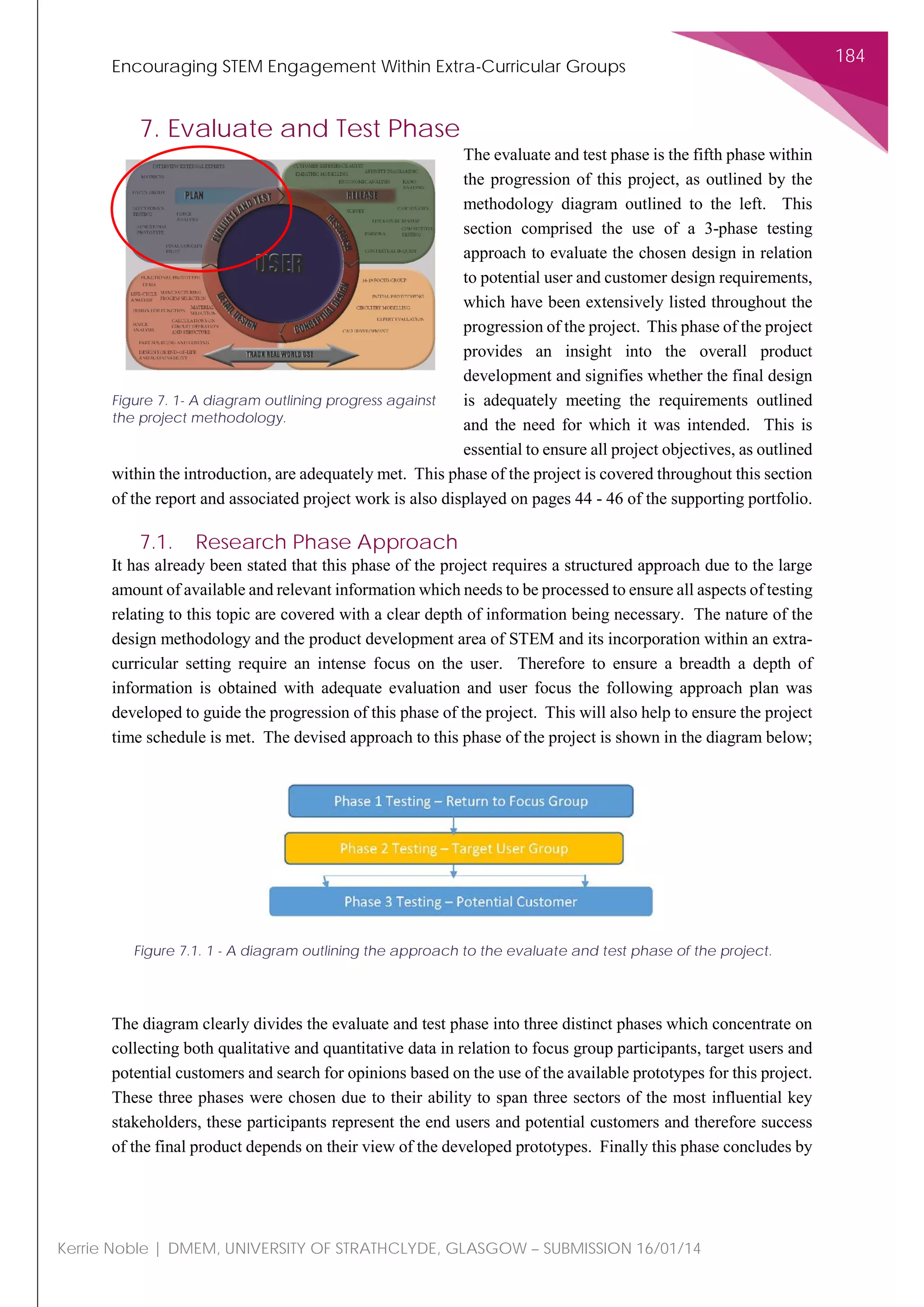
Figure 7. 1- A diagram outlining progress against the project methodology.............184
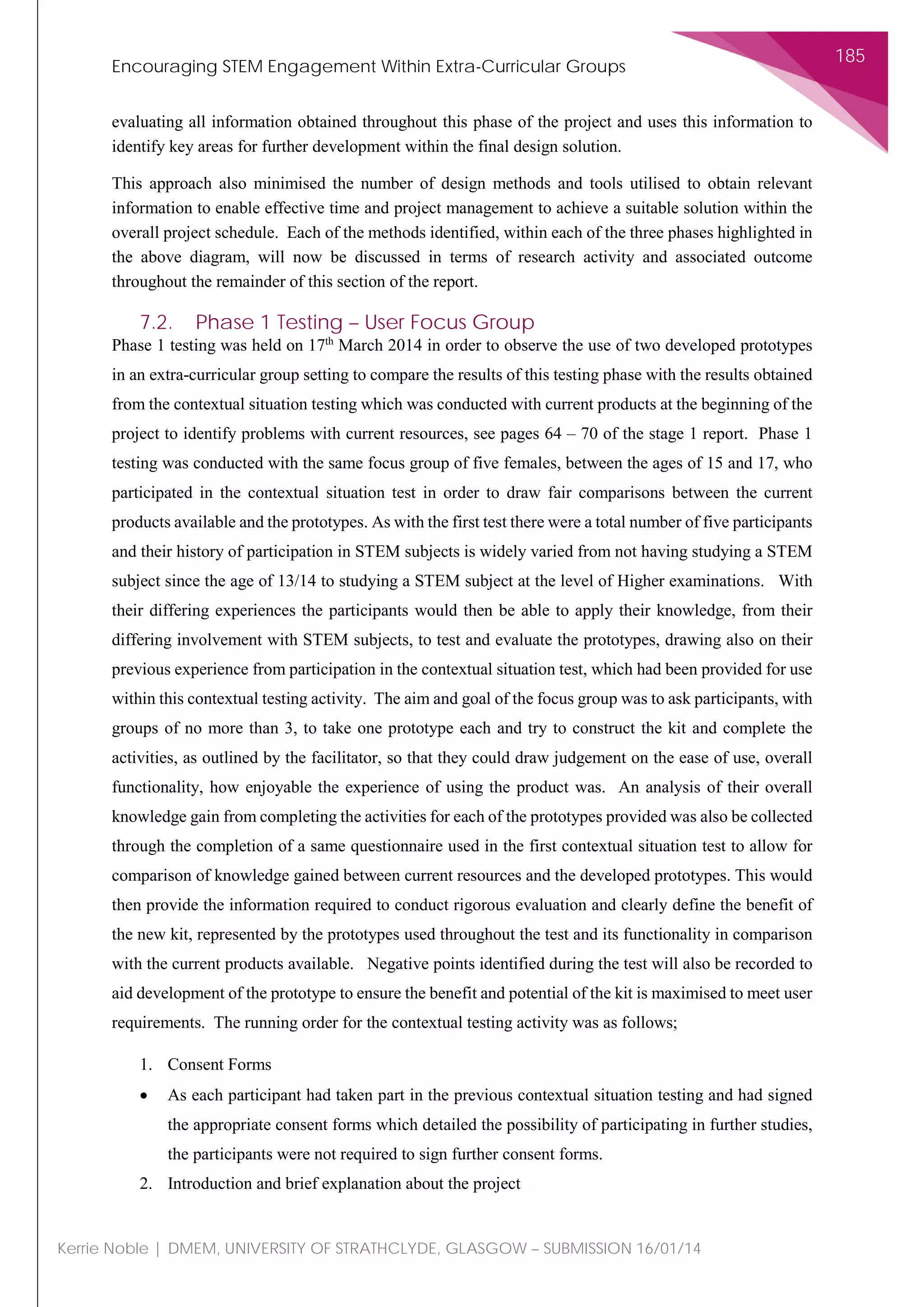
Figure 7.1. 1 - A diagram outlining the approach to the evaluate and test phase of
the project............................................................................................................................184
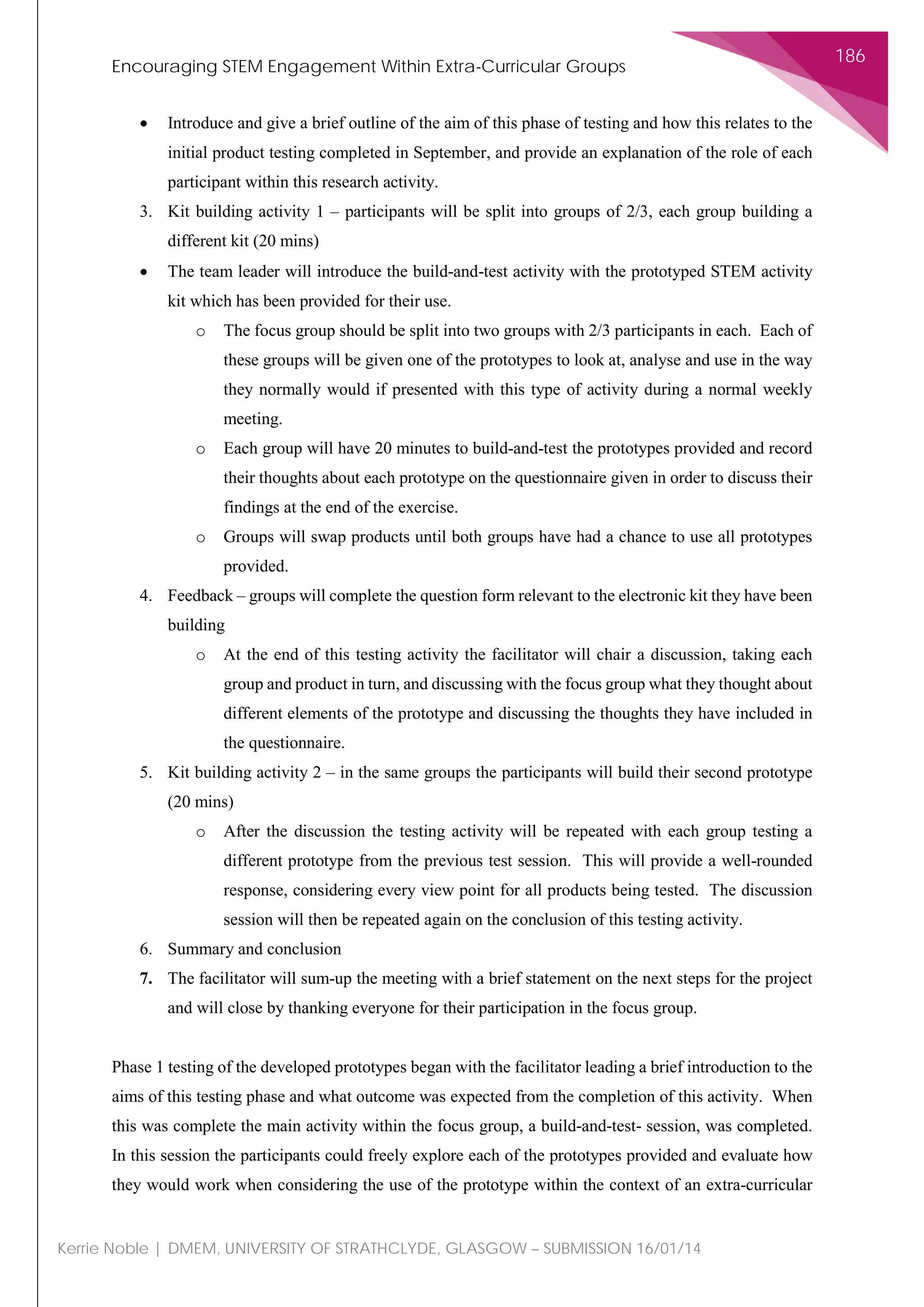
Figure 7.2. 1 - A diagram showing the construction of the prototype during the build
and test activity...................................................................................................................187
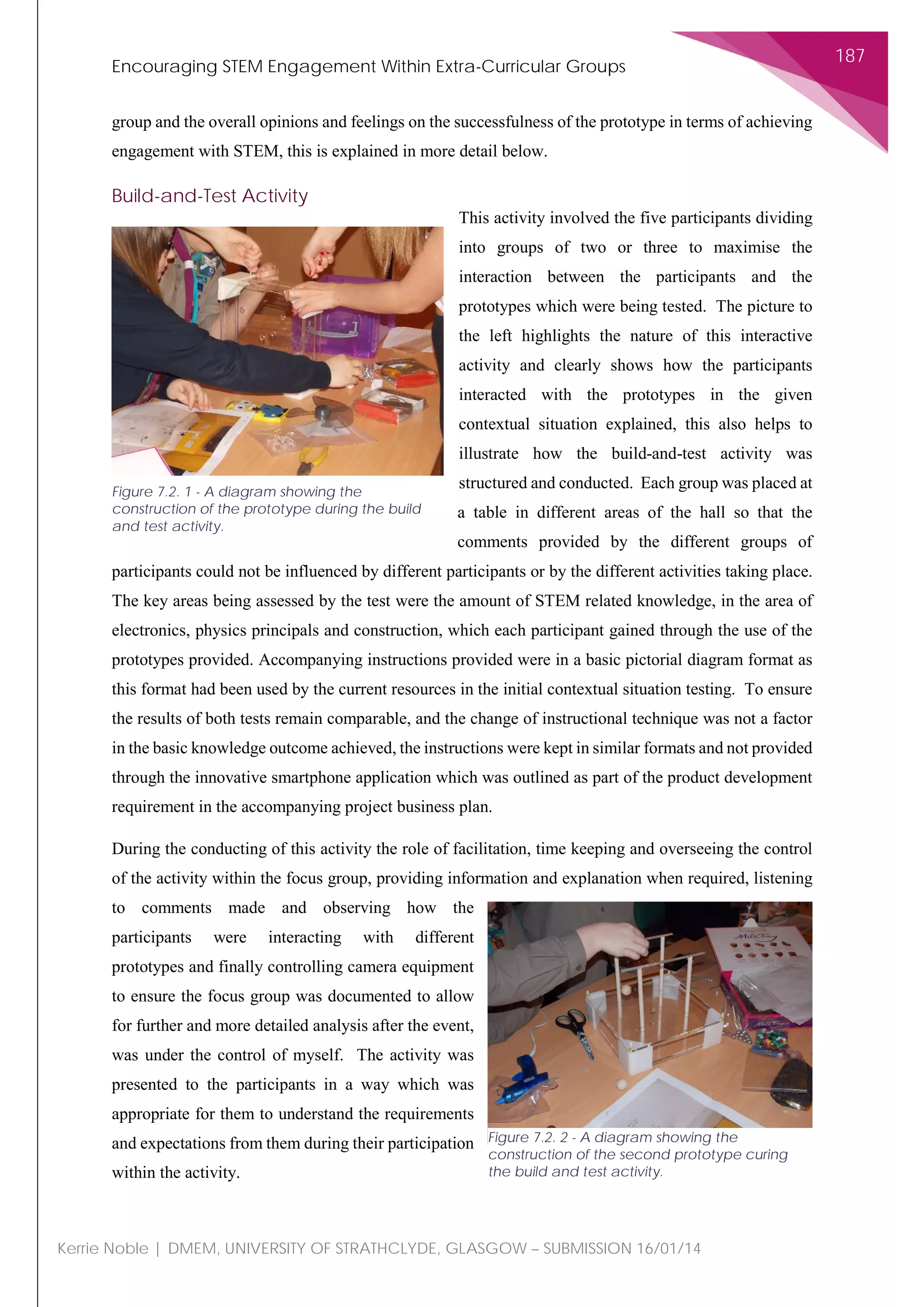
Figure 7.2. 2 - A diagram showing the construction of the second prototype curing
the build and test activity. .................................................................................................187
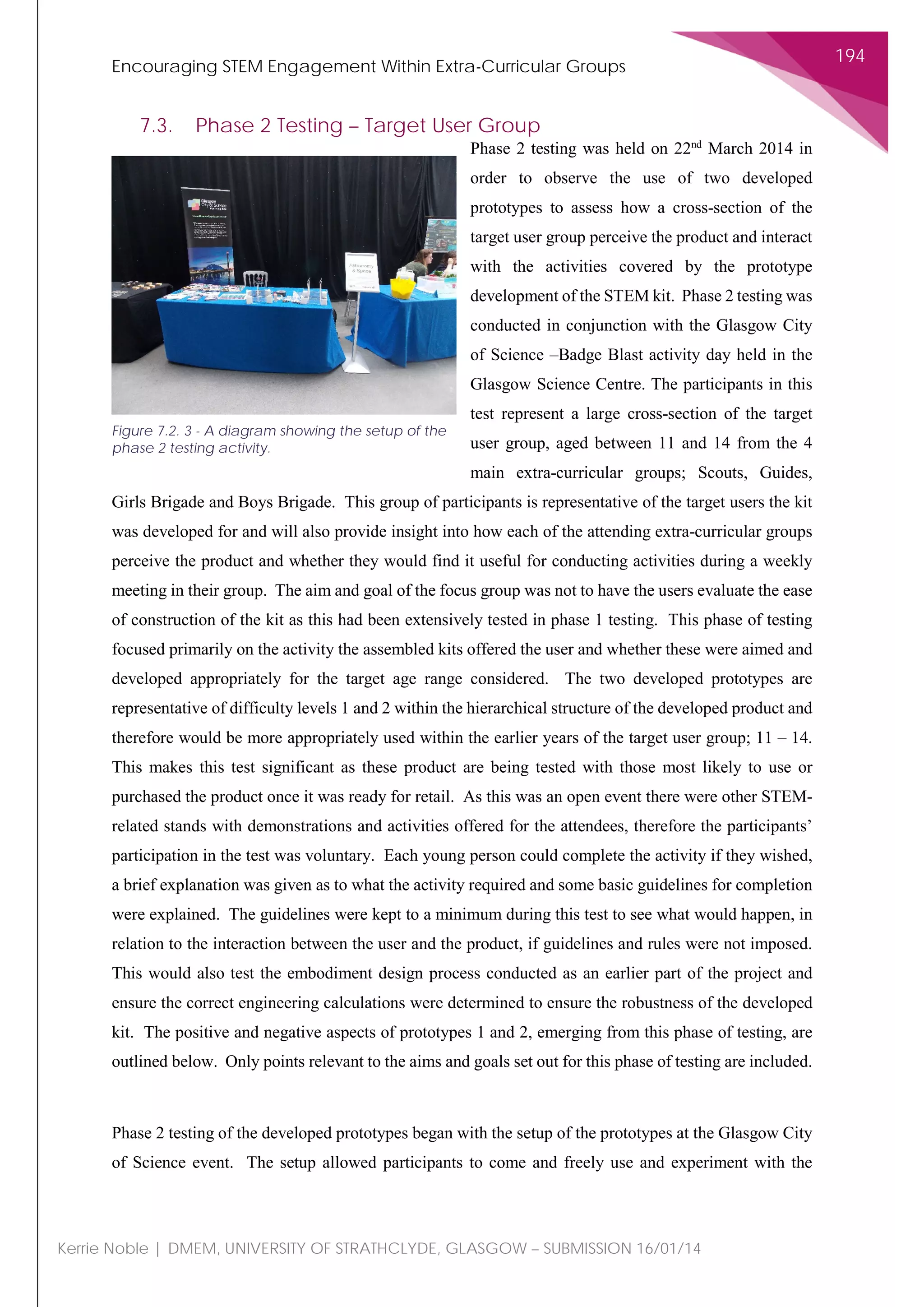
Figure 7.2. 3 - A diagram showing the setup of the phase 2 testing activity..............194
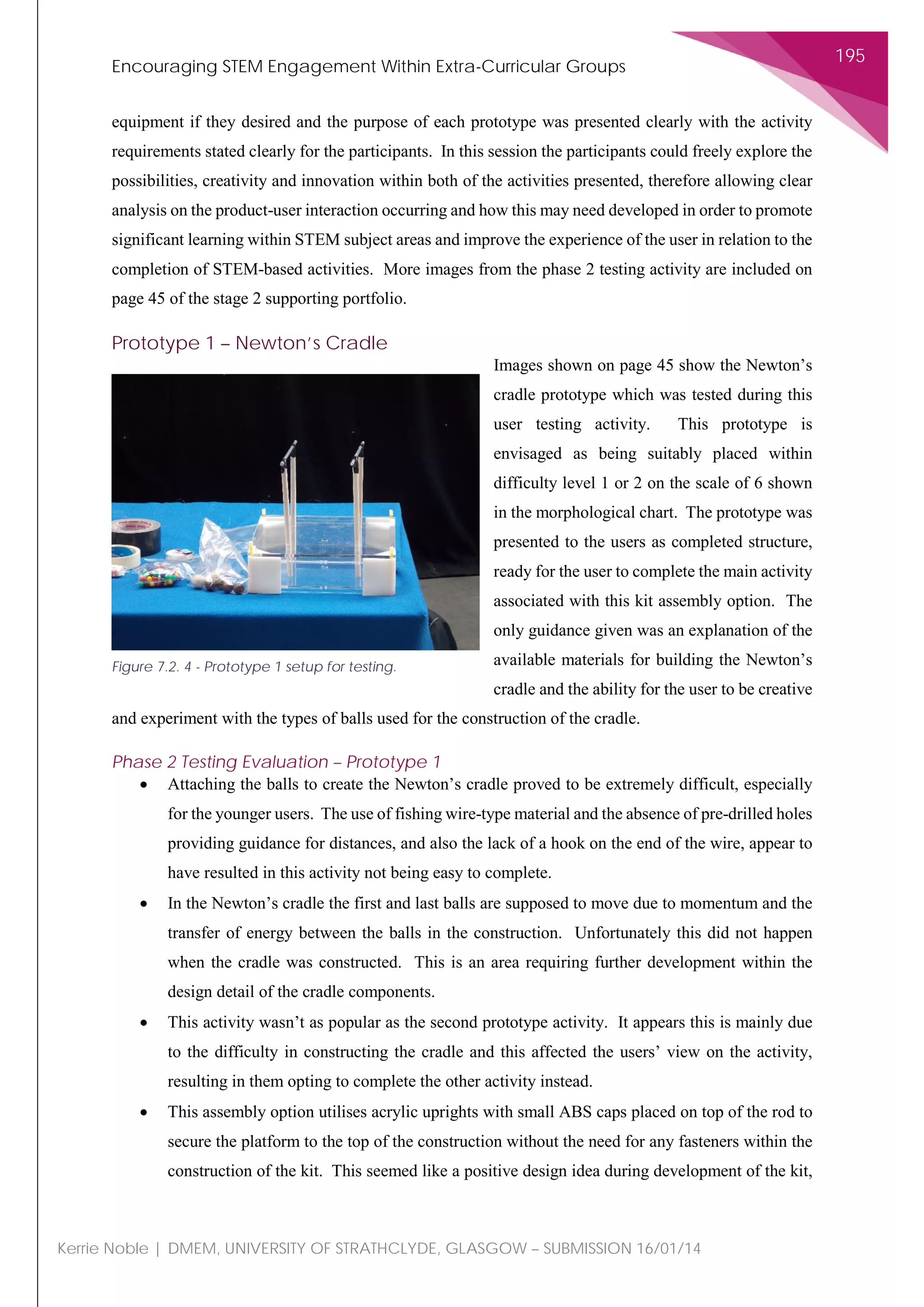
Figure 7.2. 4 - Prototype 1 setup for testing......................................................................195
Figure 7.2. 5 - Prototype 2 setup for testing......................................................................196
List of Tables
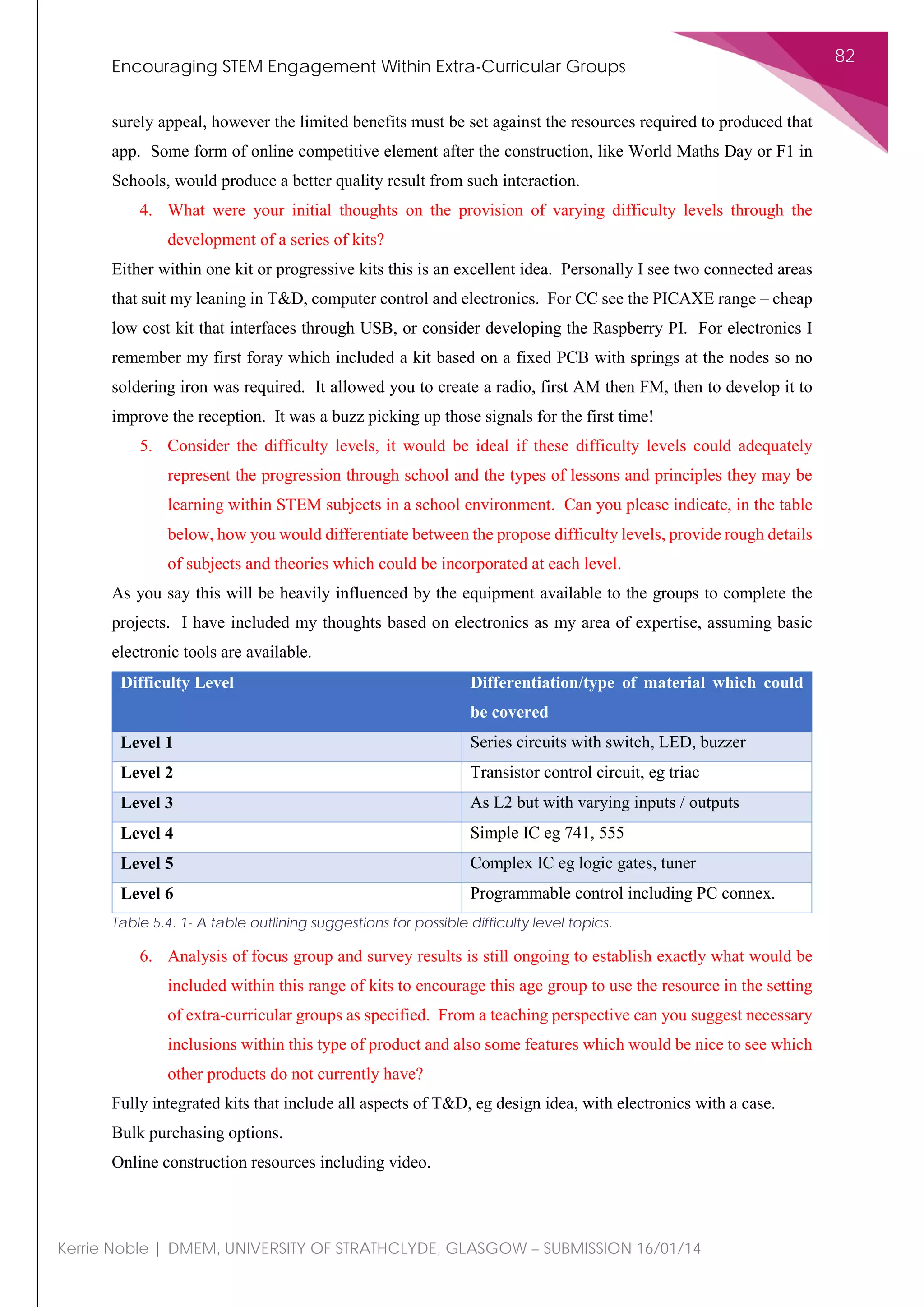
Table 5.4. 1- A table outlining suggestions for possible difficulty level topics. ..............82
Table 5.6. 1 - A table outlining the scale for the scoring of concepts. ..........................94
Table 5.7. 1 - A matrix outlining customer pain points with current products and
stating how the new product addresses these issues....................................................104
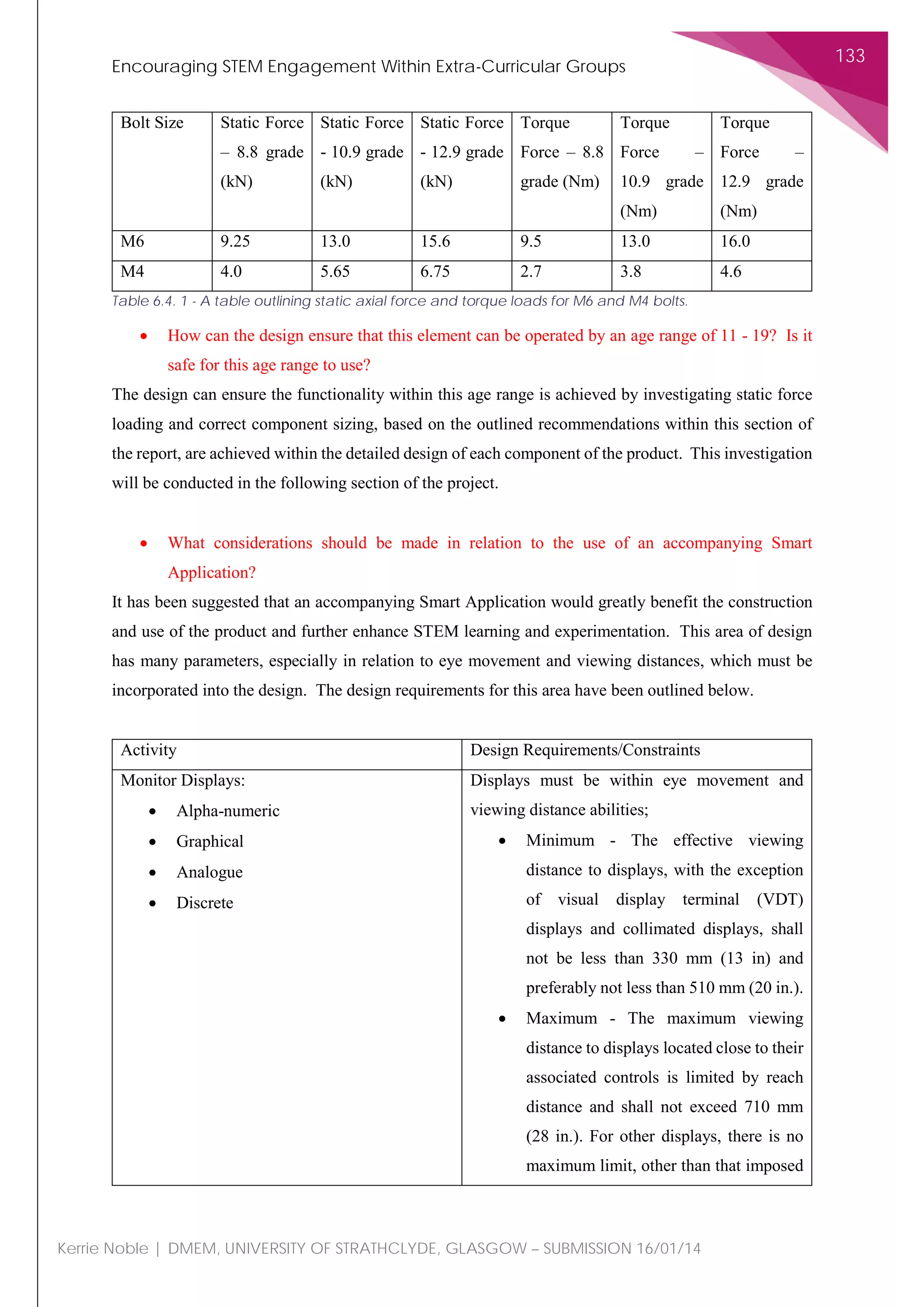
Table 6.4. 1 - A table outlining static axial force and torque loads for M6 and M4
bolts. ......................................................................................................................................133
Table 6.4. 2 - A table showing human activity areas and related embodiment design
requirements. .......................................................................................................................134
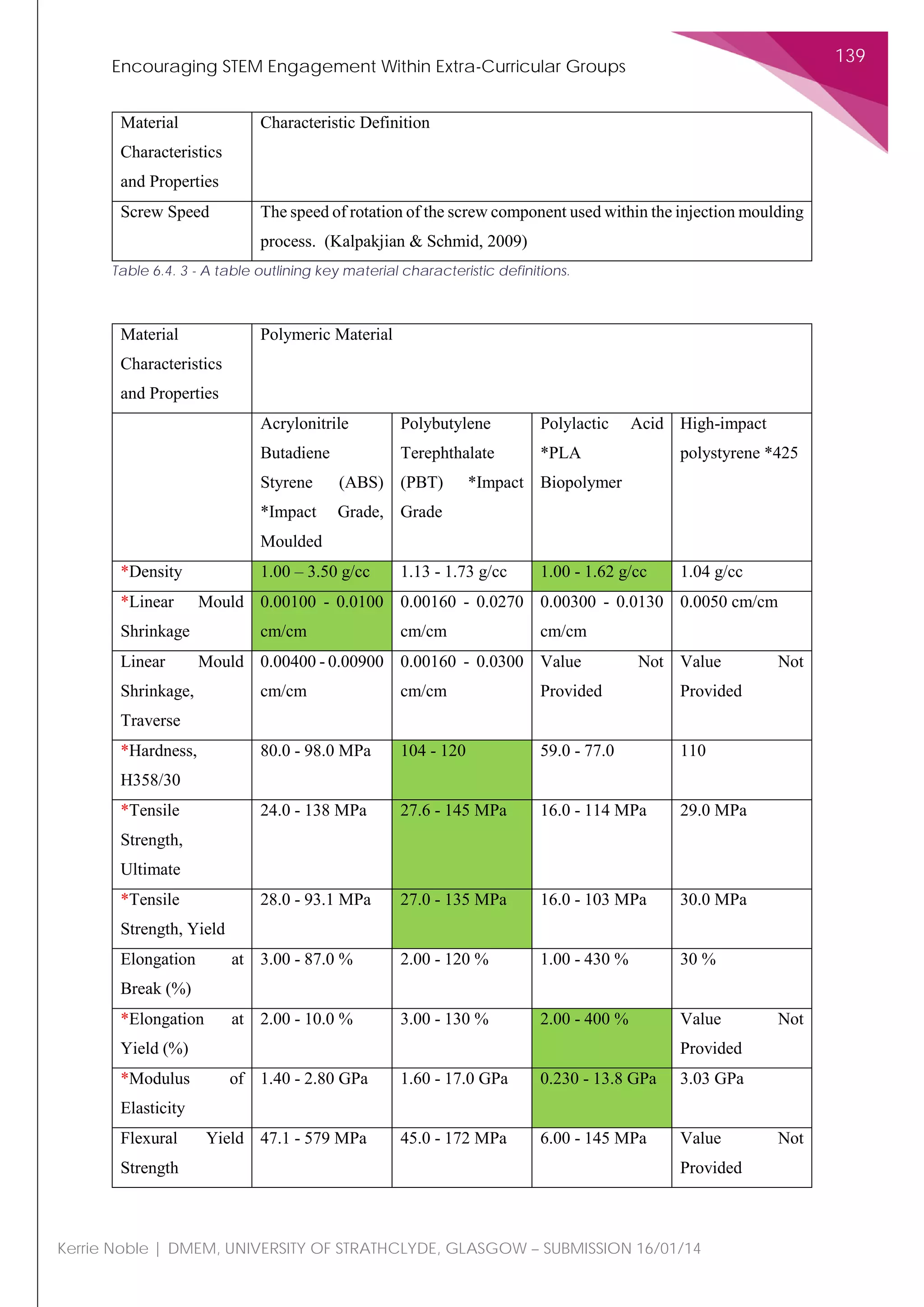
Table 6.4. 3 - A table outlining key material characteristic definitions. .......................139
Encouraging STEM Engagement Within Extra-Curricular Groups
7
Kerrie Noble | DMEM, UNIVERSITY OF STRATHCLYDE, GLASGOW – SUBMISSION 16/01/14
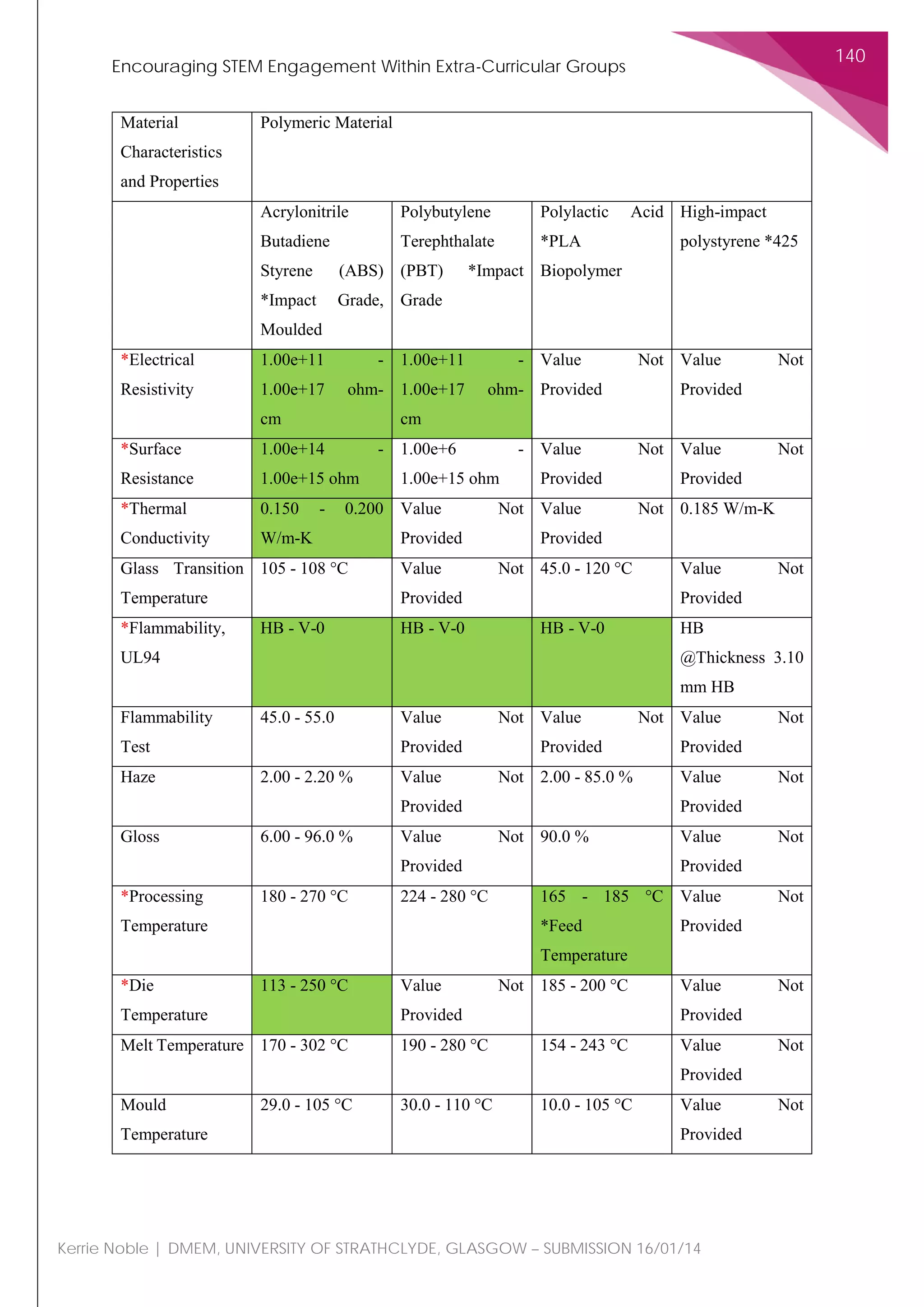
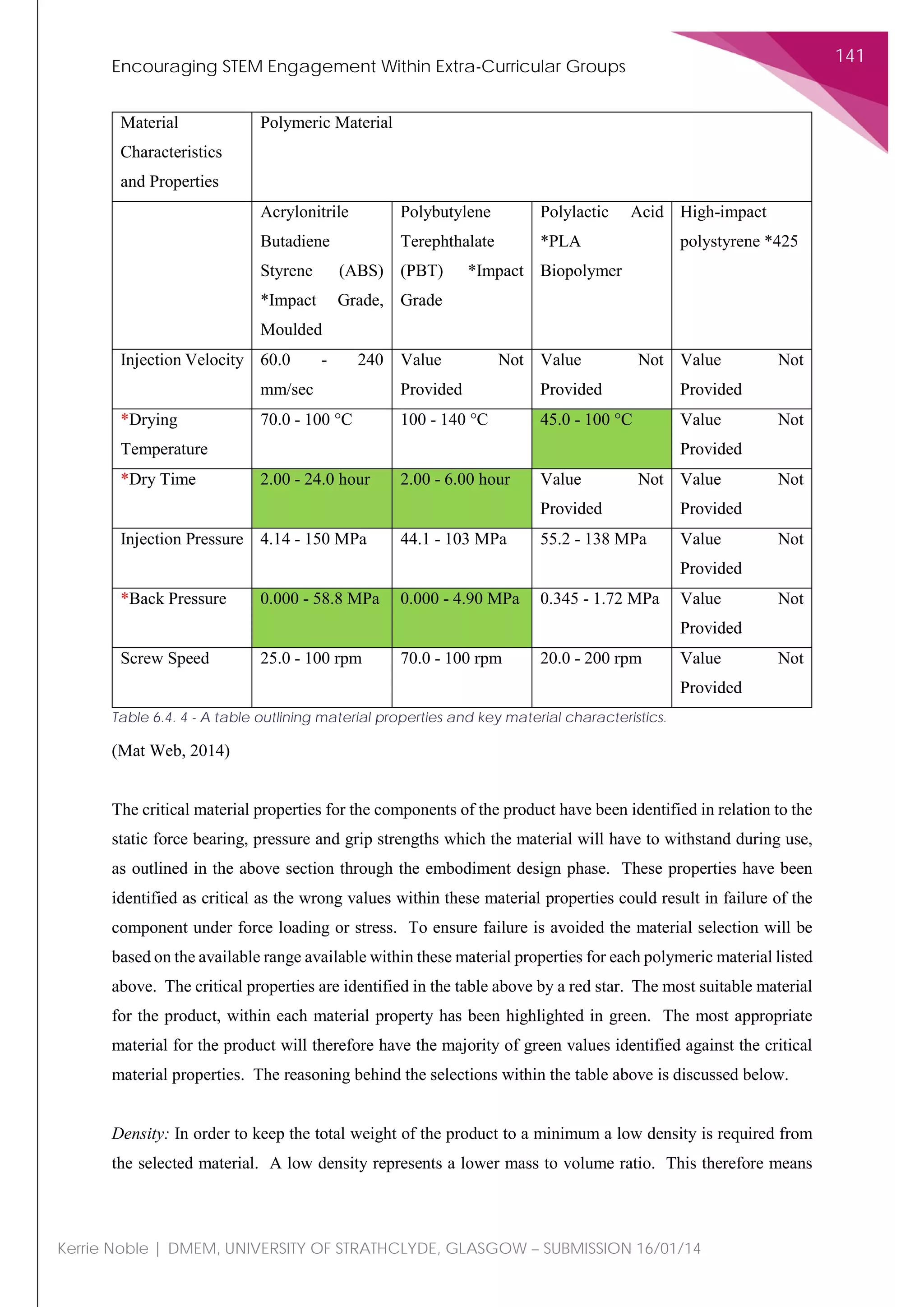
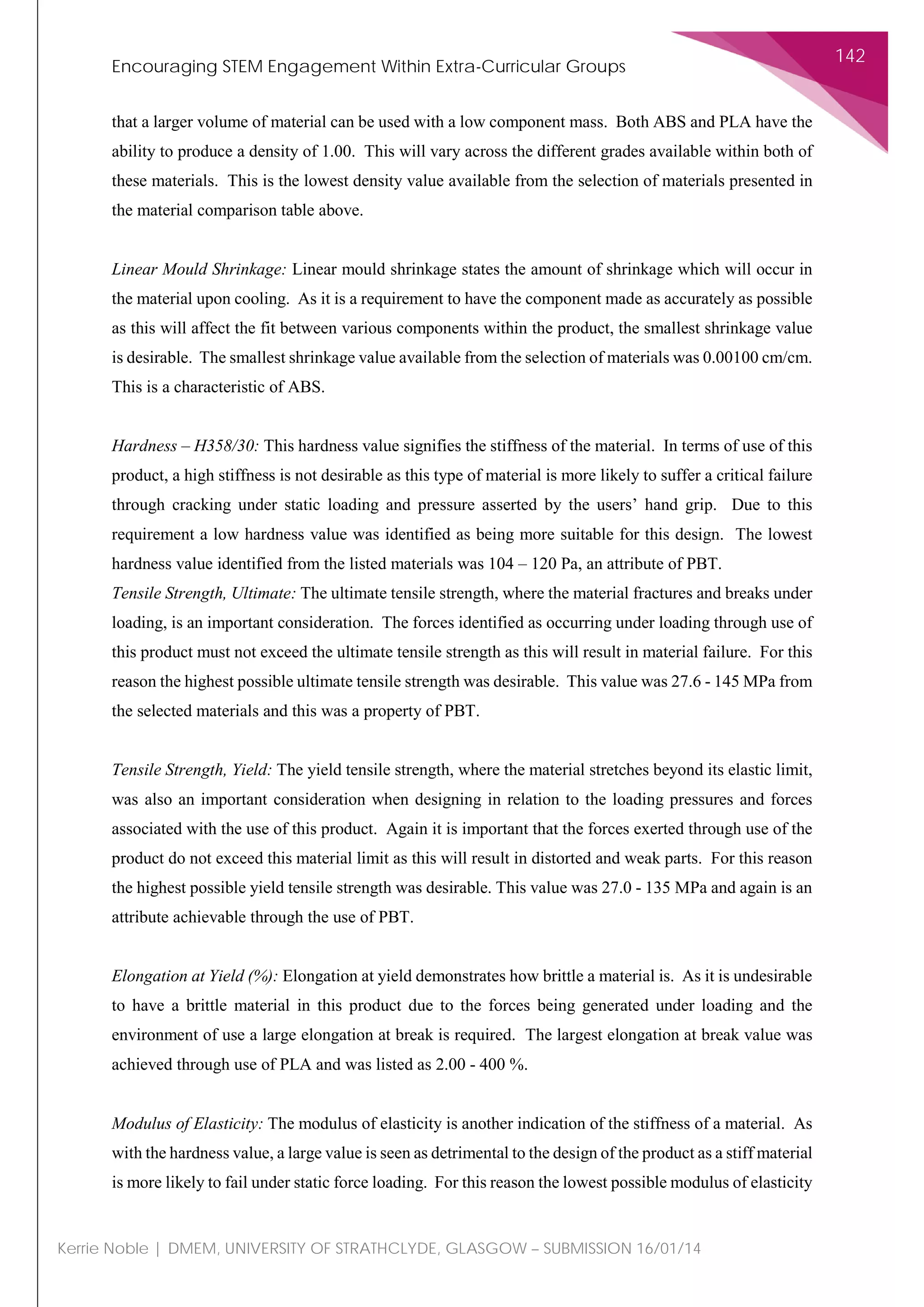
Table 6.4. 4 - A table outlining material properties and key material characteristics.
................................................................................................................................................141
Encouraging STEM Engagement Within Extra-Curricular Groups
8
Kerrie Noble | DMEM, UNIVERSITY OF STRATHCLYDE, GLASGOW – SUBMISSION 16/01/14
Table of Contents
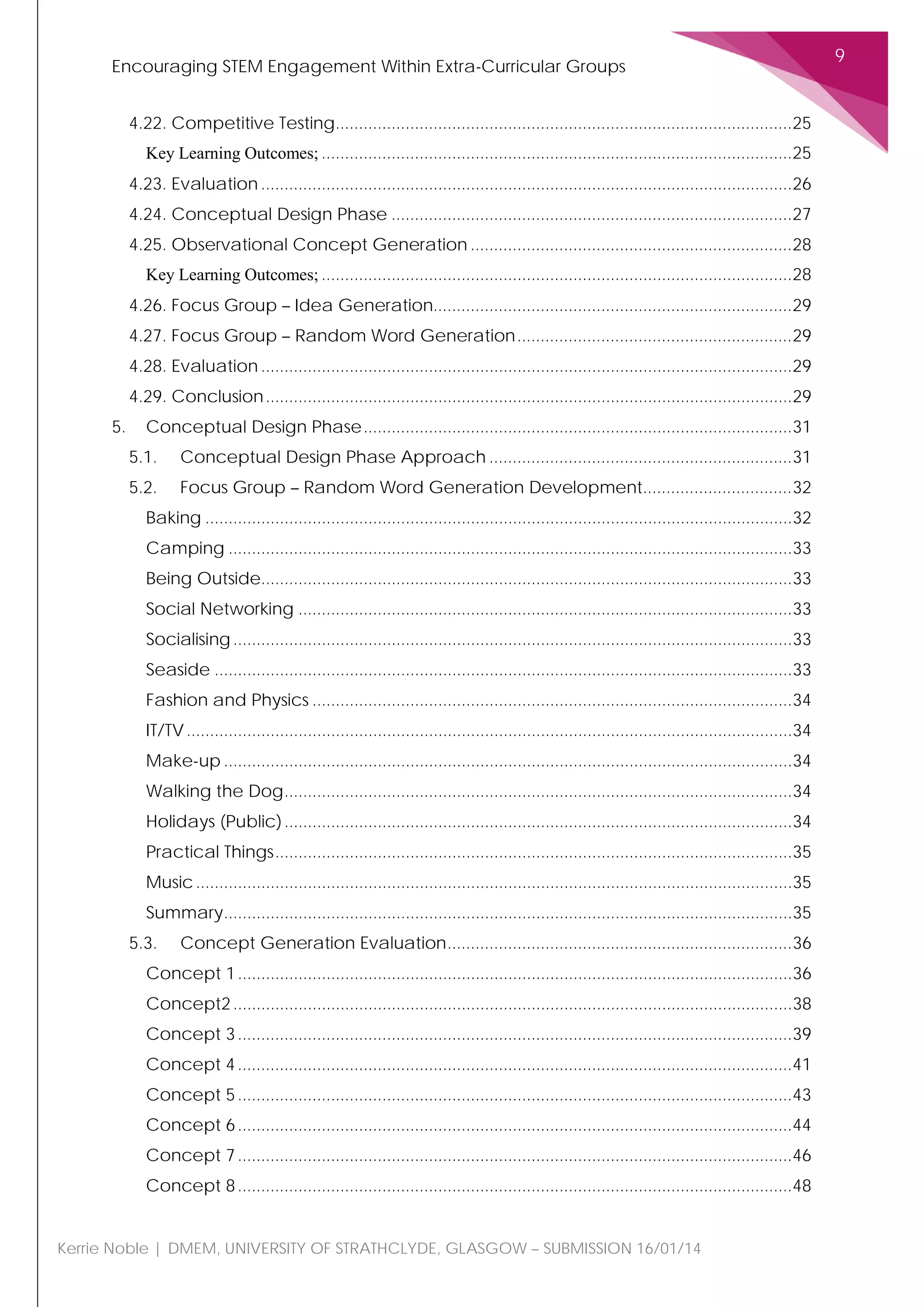
Statement of Academic Honesty .........................................................................................1
Acknowledgements................................................................................................................2
Abstract ....................................................................................................................................3
List of Figures.............................................................................................................................5
List of Tables..............................................................................................................................6
4. Review of Stage 1..............................................................................................................14
4.1. Background.................................................................................................................14
4.2. Project Definition.........................................................................................................14
4.3. Project Aim ..................................................................................................................15
4.4. Project Objectives ......................................................................................................15
4.5. Project Deliverables/Desired Outcomes.................................................................16
4.6. Performance Measures..............................................................................................16
4.7. Exclusions .....................................................................................................................16
4.8. Constraints ...................................................................................................................17
4.9. Interface.......................................................................................................................18
4.10 Key Project Stakeholders ..........................................................................................18
4.11. Risks.............................................................................................................................18
4.12. Methodology.............................................................................................................18
4.13. Research Phase ........................................................................................................19
4.14. Literature Review ......................................................................................................20
Key Learning Outcomes; .....................................................................................................20
4.15. Review of Extra-Curricular Groups..........................................................................21
4.16. Case Study – GoldieBlox..........................................................................................21
Key Learning Outcomes; .....................................................................................................21
4.17. Case Study – Key Interest Areas .............................................................................21
Key Learning Outcomes; .....................................................................................................21
4.18. Online Survey – Adult Volunteers in Extra-Curricular Groups..............................22
Key Learning Outcomes; .....................................................................................................22
4.19. Online Survey – 14 – 19 year old students .............................................................23
Key Learning Outcomes; .....................................................................................................23
4.20. Expert Interviews .......................................................................................................24
Key Learning Outcomes; .....................................................................................................24
4.21. Contextual Situation Testing....................................................................................25
Key Learning Outcomes; .....................................................................................................25
Encouraging STEM Engagement Within Extra-Curricular Groups
9
Kerrie Noble | DMEM, UNIVERSITY OF STRATHCLYDE, GLASGOW – SUBMISSION 16/01/14
4.22. Competitive Testing..................................................................................................25
Key Learning Outcomes; .....................................................................................................25
4.23. Evaluation ..................................................................................................................26
4.24. Conceptual Design Phase ......................................................................................27
4.25. Observational Concept Generation .....................................................................28
Key Learning Outcomes; .....................................................................................................28
4.26. Focus Group – Idea Generation.............................................................................29
4.27. Focus Group – Random Word Generation...........................................................29
4.28. Evaluation ..................................................................................................................29
4.29. Conclusion.................................................................................................................29
5. Conceptual Design Phase............................................................................................31
5.1. Conceptual Design Phase Approach .................................................................31
5.2. Focus Group – Random Word Generation Development................................32
Baking ..............................................................................................................................32
Camping .........................................................................................................................33
Being Outside..................................................................................................................33
Social Networking ..........................................................................................................33
Socialising........................................................................................................................33
Seaside ............................................................................................................................33
Fashion and Physics .......................................................................................................34
IT/TV..................................................................................................................................34
Make-up ..........................................................................................................................34
Walking the Dog.............................................................................................................34
Holidays (Public).............................................................................................................34
Practical Things...............................................................................................................35
Music................................................................................................................................35
Summary..........................................................................................................................35
5.3. Concept Generation Evaluation..........................................................................36
Concept 1.......................................................................................................................36
Concept2........................................................................................................................38
Concept 3.......................................................................................................................39
Concept 4.......................................................................................................................41
Concept 5.......................................................................................................................43
Concept 6.......................................................................................................................44
Concept 7.......................................................................................................................46
Concept 8.......................................................................................................................48
Encouraging STEM Engagement Within Extra-Curricular Groups
10
Kerrie Noble | DMEM, UNIVERSITY OF STRATHCLYDE, GLASGOW – SUBMISSION 16/01/14
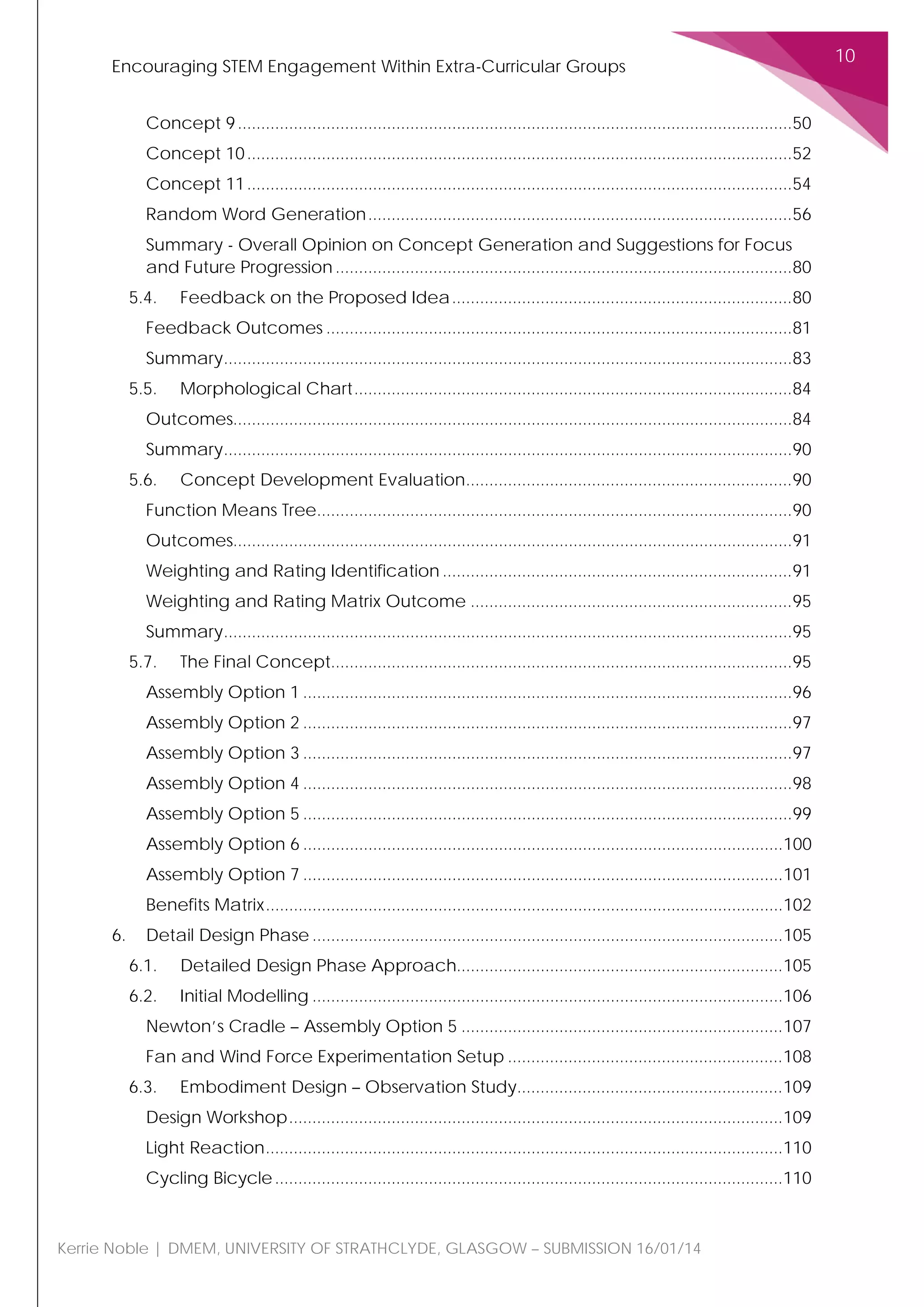
Concept 9.......................................................................................................................50
Concept 10.....................................................................................................................52
Concept 11.....................................................................................................................54
Random Word Generation...........................................................................................56
Summary - Overall Opinion on Concept Generation and Suggestions for Focus
and Future Progression ..................................................................................................80
5.4. Feedback on the Proposed Idea.........................................................................80
Feedback Outcomes ....................................................................................................81
Summary..........................................................................................................................83
5.5. Morphological Chart..............................................................................................84
Outcomes........................................................................................................................84
Summary..........................................................................................................................90
5.6. Concept Development Evaluation......................................................................90
Function Means Tree......................................................................................................90
Outcomes........................................................................................................................91
Weighting and Rating Identification ...........................................................................91
Weighting and Rating Matrix Outcome .....................................................................95
Summary..........................................................................................................................95
5.7. The Final Concept...................................................................................................95
Assembly Option 1 .........................................................................................................96
Assembly Option 2 .........................................................................................................97
Assembly Option 3 .........................................................................................................97
Assembly Option 4 .........................................................................................................98
Assembly Option 5 .........................................................................................................99
Assembly Option 6 .......................................................................................................100
Assembly Option 7 .......................................................................................................101
Benefits Matrix...............................................................................................................102
6. Detail Design Phase .....................................................................................................105
6.1. Detailed Design Phase Approach......................................................................105
6.2. Initial Modelling .....................................................................................................106
Newton’s Cradle – Assembly Option 5 .....................................................................107
Fan and Wind Force Experimentation Setup ...........................................................108
6.3. Embodiment Design – Observation Study.........................................................109
Design Workshop..........................................................................................................109
Light Reaction...............................................................................................................110
Cycling Bicycle.............................................................................................................110
Encouraging STEM Engagement Within Extra-Curricular Groups
11
Kerrie Noble | DMEM, UNIVERSITY OF STRATHCLYDE, GLASGOW – SUBMISSION 16/01/14
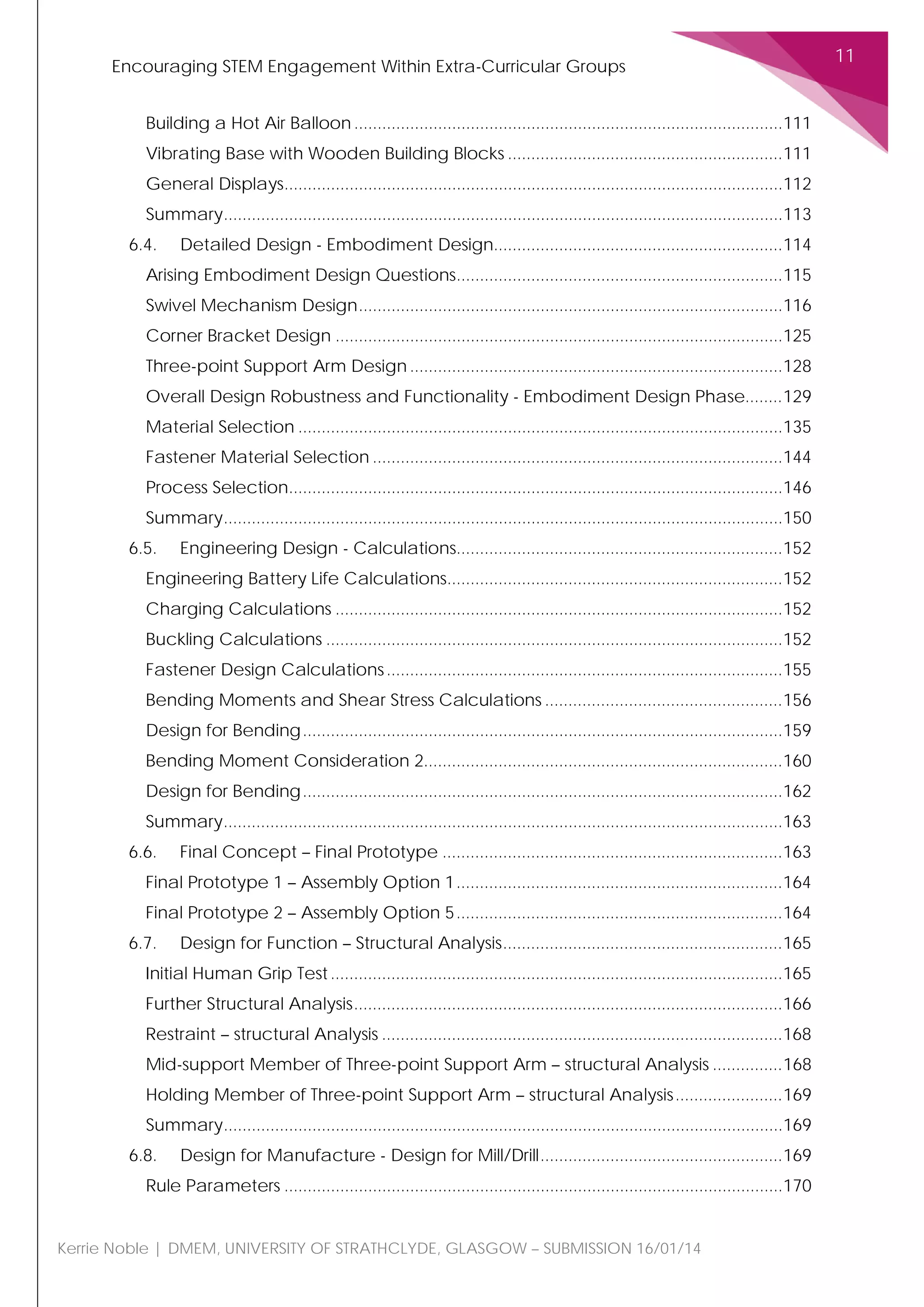
Building a Hot Air Balloon............................................................................................111
Vibrating Base with Wooden Building Blocks ...........................................................111
General Displays...........................................................................................................112
Summary........................................................................................................................113
6.4. Detailed Design - Embodiment Design..............................................................114
Arising Embodiment Design Questions......................................................................115
Swivel Mechanism Design...........................................................................................116
Corner Bracket Design ................................................................................................125
Three-point Support Arm Design ................................................................................128
Overall Design Robustness and Functionality - Embodiment Design Phase........129
Material Selection ........................................................................................................135
Fastener Material Selection ........................................................................................144
Process Selection..........................................................................................................146
Summary........................................................................................................................150
6.5. Engineering Design - Calculations......................................................................152
Engineering Battery Life Calculations........................................................................152
Charging Calculations ................................................................................................152
Buckling Calculations ..................................................................................................152
Fastener Design Calculations.....................................................................................155
Bending Moments and Shear Stress Calculations ...................................................156
Design for Bending.......................................................................................................159
Bending Moment Consideration 2.............................................................................160
Design for Bending.......................................................................................................162
Summary........................................................................................................................163
6.6. Final Concept – Final Prototype .........................................................................163
Final Prototype 1 – Assembly Option 1......................................................................164
Final Prototype 2 – Assembly Option 5......................................................................164
6.7. Design for Function – Structural Analysis............................................................165
Initial Human Grip Test.................................................................................................165
Further Structural Analysis............................................................................................166
Restraint – structural Analysis ......................................................................................168
Mid-support Member of Three-point Support Arm – structural Analysis ...............168
Holding Member of Three-point Support Arm – structural Analysis.......................169
Summary........................................................................................................................169
6.8. Design for Manufacture - Design for Mill/Drill....................................................169
Rule Parameters ...........................................................................................................170
Encouraging STEM Engagement Within Extra-Curricular Groups
12
Kerrie Noble | DMEM, UNIVERSITY OF STRATHCLYDE, GLASGOW – SUBMISSION 16/01/14
Component 1 – Mid platform.....................................................................................170
Fillets on outside edges ...............................................................................................171
6.9. Design for Manufacture - Design for Injection Moulding................................171
Rule Parameters ...........................................................................................................171
Analysis for corner bracket option 1..........................................................................171
Analysis for corner bracket option 2A.......................................................................172
Summary........................................................................................................................172
6.10. Design for Sustainability....................................................................................173
Assembly Option 1 .......................................................................................................173
Environmental Impact.................................................................................................175
Design for Sustainability - Assembly Option 2...........................................................182
Summary........................................................................................................................182
7. Evaluate and Test Phase.............................................................................................184
7.1. Research Phase Approach.................................................................................184
7.2. Phase 1 Testing – User Focus Group ...................................................................185
Build-and-Test Activity..................................................................................................187
Prototype 1 – Newton’s Cradle..................................................................................188
Prototype 2 – Building Design and Electronic Fan Construction ...........................189
Analysis of Questionnaire Knowledge Capture Answers .......................................191
Summary........................................................................................................................192
7.3. Phase 2 Testing – Target User Group ..................................................................194
Prototype 1 – Newton’s Cradle..................................................................................195
Prototype 2 – Building Design and Electronic Fan Construction ...........................196
General Evaluation Observations..............................................................................197
Comments Made During Testing ...............................................................................197
Summary........................................................................................................................198
7.4. Phase 3 Testing – Interview with Target Customer ...........................................199
Interview Outcomes.....................................................................................................199
Summary........................................................................................................................201
8. Release Phase...........................................................................................................202
9. Conclusion ....................................................................................................................203
9.1. Testing.....................................................................................................................203
9.2. Project Objectives ................................................................................................204
9.3. Reflection...............................................................................................................206
References ...........................................................................................................................209
Appendix 1 – PDS Version 8................................................................................................216
Encouraging STEM Engagement Within Extra-Curricular Groups
13
Kerrie Noble | DMEM, UNIVERSITY OF STRATHCLYDE, GLASGOW – SUBMISSION 16/01/14
Appendix 2 – Detailed Structural Analysis Reports .........................................................222
Encouraging STEM Engagement Within Extra-Curricular Groups
14
Kerrie Noble | DMEM, UNIVERSITY OF STRATHCLYDE, GLASGOW – SUBMISSION 16/01/14
4. Review of Stage 1
This section of the stage 2 report summarises the main learning outcomes achieved throughout the
research phase and initial conceptual design phase of the project which were completed within stage 1.
4.1. Background
Current government led campaigns have been introduced to enhance science, technology, engineering
and mathematics (stem) teaching throughout the UK. However, demand for skills in STEM related
areas continues to grow at a pace which is faster than the predicted supply of graduates and young
people who are obtaining qualifications in this area. STEM is therefore becoming the attention and
focus of government frameworks and strategies on how to address the skills shortage within this area.
Encouraging people to participate in these activities is also suffering from great pressure being exerted
by the shortage of qualified school teachers in this area.
Lord Sainsbury led a government review into UK Science and Innovation policies and identified a few
key areas of interest where improvement in the area of STEM engagement could be made by;
o Improving resource provision for the STEM frameworks which are in place
o Improve teaching provision in the 14 – 19 years age group to ensure young people are
not discouraged in taking subjects in this area due to previous experiences or low ability
teaching provision
o Increase teacher training in key STEM subjects
o ‘Extra-curricular activities can play an important role in enthusing young people and
demonstrating the exciting opportunities that studying science can open-up.’
4.2. Project Definition
The scope for the project was defined as;
• The project aimed to conduct research into types of STEM kits available for use in an extra-
curricular context
• Identify key issues with existing products
• Produce a more fitting solution for use by 14 – 19 year olds within extra-curricular groups
• Test suggested solutions and reassess to ensure the outcome adequately fulfils the identified
need for a product to promote and encourage STEM engagement in extra-curricular groups
• Include input from several established organisations who deal with STEM engagement on a
more regular basis and use this knowledge within the given context
Encouraging STEM Engagement Within Extra-Curricular Groups
15
Kerrie Noble | DMEM, UNIVERSITY OF STRATHCLYDE, GLASGOW – SUBMISSION 16/01/14
4.3. Project Aim
Aim to develop a scientific-based kit, for the 14 – 19 years age group, which is suitable for use in an
extra-curricular environment to encourage more participation in STEM subjects.
4.4. Project Objectives
The project objectives were listed as;
• Develop a reliable and durable product which can be suitably re-used in order to reduce the cost
and impractical nature of providing replacement parts. Funding has already been outlined as a
key issue so a re-usable product will eliminate this major issue, also a re-usable product is more
likely to sustain interest in STEM according to some early feedback received around the project
• Explore the key area of design for assembly to ensure the kit is easy to use by minimising parts
while still maintaining a high level of functionality. A kit which is easy to use without the need
for expert knowledge is very desirable as it builds more of a sense of achievement for the young
people concerned in this area.
• Develop a product which is inherently easy to use but also requires the end user to think and
actively engage to encourage understanding of some basic scientific principles. Deep learning
through doing is required in order to help young people within the curriculum, this can only be
achieved through a kit which is easy to use but does not provide all answers freely, there must
be an element of self-teaching.
• Explore the idea of having one modular product which can be configured into many different
layouts to provide the user with the opportunity of exploring more than one area of STEM with
the need to only purchase one kit.
• Develop a product which can be easily and cheaply manufactured but also has the capability of
being re-used several times.
• Develop a product which allows young people, aged 14 – 19, to use the kit without the need for
any supervision or expert input.
• Explore the idea of STEM involvement in an extra-curricular environment to further define the
problem, need and aim for the project. Also identify key products which are currently being
used in this area and outline the key issues which exist with the use of these products and how
these could be addressed.
• Explore some of the basic scientific principles which could be adapted into a small scale form
which could provide ideas for an electronic-based scientific kit for the 14 – 19 age range.
• Develop the idea through model making and CAD. Specifically exploring the areas of modular
kit building and the key area of circuit construction which will reduce the need for specialist
Encouraging STEM Engagement Within Extra-Curricular Groups
16
Kerrie Noble | DMEM, UNIVERSITY OF STRATHCLYDE, GLASGOW – SUBMISSION 16/01/14
equipment such as solder and soldering irons, whilst also providing the re-usable functionality
which has been clearly identified as a user requirement.
• Test and validate the design and idea by testing a working model through scouts and schools
and talking to organisations who run STEM workshops or promote STEM within the
community. Engineering testing of elements such as structure stability, force analysis and
electrical component testing within the circuit structure will also be key to this project.
4.5. Project Deliverables/Desired Outcomes
The key deliverables and outcomes for the project were stated as;
• A complete drawing set. Detailing manufacturing drawings and requirements for the
production of the circuitry and plastic component assembly aspects of the educational kit.
• A report and portfolio explaining how this design was achieved. This will detail all the
activities undertaken in order to arrive at the final design. A detailed list of activities showing
the approach being taken for this project are outlined in Appendix 3.
• A prototypes and models to demonstrate key features. Prototypes of key ideas, especially in
the area concerning the construction of the electronic circuit aspect of the project, will be
produced at various stages throughout the project.
4.6. Performance Measures
Identify achievement of the main project aims and objectives through proposed pilot of developed kit
within scout groups and schools. Collating required feedback to adjust and change parts of the design
as necessary to ensure the objectives are met with the highest possible standard. This measurement
may change to accommodate testing final prototypes with the Glasgow science centre during an evening
event aimed at extra-curricular groups. Small test groups were to be used to ensure quality, focused
feedback is obtained. Ensuring the design meets the requirements of external organisations through
constant engagement and involvement with contacts in this area to allow the end users’ views to be
incorporated in evaluation and design decision making was key to success and performance will be
judged on their overall opinion on the usefulness of the product.
4.7. Exclusions
The project will assess how the aim, outlined above, can best be achieved through the design and
development of a re-usable kit, however, it will not define new ways of conducting existing scientific
experiments, and it will look at a way of simplifying these experiments to make them more accessible
for this age range
Encouraging STEM Engagement Within Extra-Curricular Groups
17
Kerrie Noble | DMEM, UNIVERSITY OF STRATHCLYDE, GLASGOW – SUBMISSION 16/01/14
4.8. Constraints
Constraints consistent with the product end user being identified as 14 – 19 year olds were identified
as;
• Language consideration – The 2011 Census revealed that although 92.3% of the population in
the UK speak English, there are significant minorities of the population who speak Polish,
Punjabi or Urdu as their main language. As this project focuses on education and young people
with the view of encouraging participation in STEM subjects, language must be considered as
this should not be a barrier to preventing the use of the product. This constraint therefore needs
careful consideration throughout the project. (Mirror, 2013)
• Facilities available – The facilities available to extra-curricular clubs such as scouts, guides and
young engineers will have a significant impact on the design and development of this product.
From personal years of experience of involvement with this type of extra-curricular club,
facilities are limited. The majority of these clubs do not have access to lab-specific equipment
such as safety glasses, lab coats, soldering irons etc. This presents a need for the product to
have the ability to be assembled and used without requiring the use of any of this lab-specific
equipment.
• Ability – The report titled, ‘Subject Choice in STEM: Factors Influencing Young People (14 –
19) in Education’, (2010), outlined many personal and contextual issues affecting young people
and their relationship with STEM subjects. One of the main influences, as stated in this report,
was their ability or previous experience of these subjects. It is important, when considering
extra-curricular groups where a large number of children attend, to consider the fact that the
children present in these groups will have a large range of abilities and many different
backgrounds and experiences when considering involvement in STEM. One objective for this
project is to eliminate this personal factor and make the use of this kit, and STEM as a whole,
accessible to children aged 14 – 19 regardless of their previous experience or ability. Therefore,
this requires the resulting product to be simple and easy to understand while also providing
enough knowledge on a particular area so as to appeal to many ability ranges within this age
group.
• Disability awareness – A report titled ‘Disability in the United Kingdom 2012: Facts and
Figures’ outlines some of the main disabilities affecting both male and female students in the
14 – 19 age range. The report highlights that almost 1 in every 5 people in the UK have a
disability with around 1 in 20 children being disabled. In terms of age and gender only 9% of
disabled adults are under the age of 35 and in 2010/11 the most common impairments for
children were communication, learning and mobility based. Amongst children, boys also
experience a higher rate of disability than girls and are more likely to experience coordination,
learning and communication difficulties. These are therefore the most prevalent disabilities
Encouraging STEM Engagement Within Extra-Curricular Groups
18
Kerrie Noble | DMEM, UNIVERSITY OF STRATHCLYDE, GLASGOW – SUBMISSION 16/01/14
occurring in the target age group and consideration of use with disabilities must have a
significant place in the development of the product. (Papworth Trust, 2012)
4.9. Interface
The final product will have many viable interfaces with outside organisations. The first such
organisations would be STEM Net and the Institution of Engineering and Technology (IET) as these
organisations are playing a primary role in encouraging young people to participate in STEM and
regularly try to organise STEM related activities within schools with the aim of generating interest in
this area. These organisations have the ability to stock a full range of developed kits with the ability to
loan kits, on request, to local groups and schools, therefore providing an accessible and reliable
resource. As the product focuses on use in an extra-curricular environment, this would cover use at
home, and in other organisations such as scouts, guides, GB, BB and many others. An interface between
these organisations and the product therefore also exists.
4.10 Key Project Stakeholders
The key stakeholders which have been identified throughout the literature relating to this project are
organisations such as the IET and STEM Net who promote and encourage participation within the area
of STEM, the students who will be using the finished product, the customers who will buy the finished
product and the members of the community who run the extra-curricular groups, identified as the main
area of use for this type of product.
4.11. Risks
Extensive user testing and involvement in the product development process will help to reduce any
potential risks of failure associated with bringing the product to market. The type of user activity
required is explored through the methodology used throughout the project and this is explored further
in the next section of this project brief.
Further to the risks associated with placing a product on the market, there are the general risks associated
with product modelling and prototyping during the development process. These risks have been
considered and are highlighted in the accompanying risk assessment. Furthermore, any risks involving
ethics within the project have been eliminated through the completion of the university ethics checklist
which also accompanies the project brief.
4.12. Methodology
As mentioned previously the project methodology will centre on extensive user involvement through
research, development and testing. In order to fulfil this two specific methodologies have been
combined to outline the methodology which will be utilised throughout the project.
Encouraging STEM Engagement Within Extra-Curricular Groups
19
Kerrie Noble | DMEM, UNIVERSITY OF STRATHCLYDE, GLASGOW – SUBMISSION 16/01/14
The UCD methodology structure, as outlined by Chandra Harrison, Sam Medrington and Whan
Stransom, has been utilised and combined with the extensive focus and principal of ensuring the user
is at the centre of the process as illustrated by the UCD process highlighted by Experience UI. This
structure has been used to clearly define each stage of the project and illustrate the iterative nature of
the project, as constant development is an important consideration in this area as STEM changes to
coincide with the school curriculum changes. The structure also shows the importance of evaluation at
every stage of product development as feedback and user validation is key within this project. The
structure and the methods being used is clearly shown in the diagram included on page 6 of the
supporting portfolio. (Harrison, Medrington & Stransom, 2013) (Experience UI, 2009)
4.13. Research Phase
It has already been stated that this phase of the project requires a structured approach due to the large
amount of available and relevant information which needs to be processed to ensure all aspects of
research relating to this topic are covered with a clear depth of information being necessary. The nature
of the design methodology and the product development area of STEM and its incorporation within an
extra-curricular setting require an intense focus on the user. Therefore to ensure a breadth a depth of
information is obtained with adequate evaluation and user focus the following approach plan was
developed to guide the progression of this phase of the project. This will also help to ensure the project
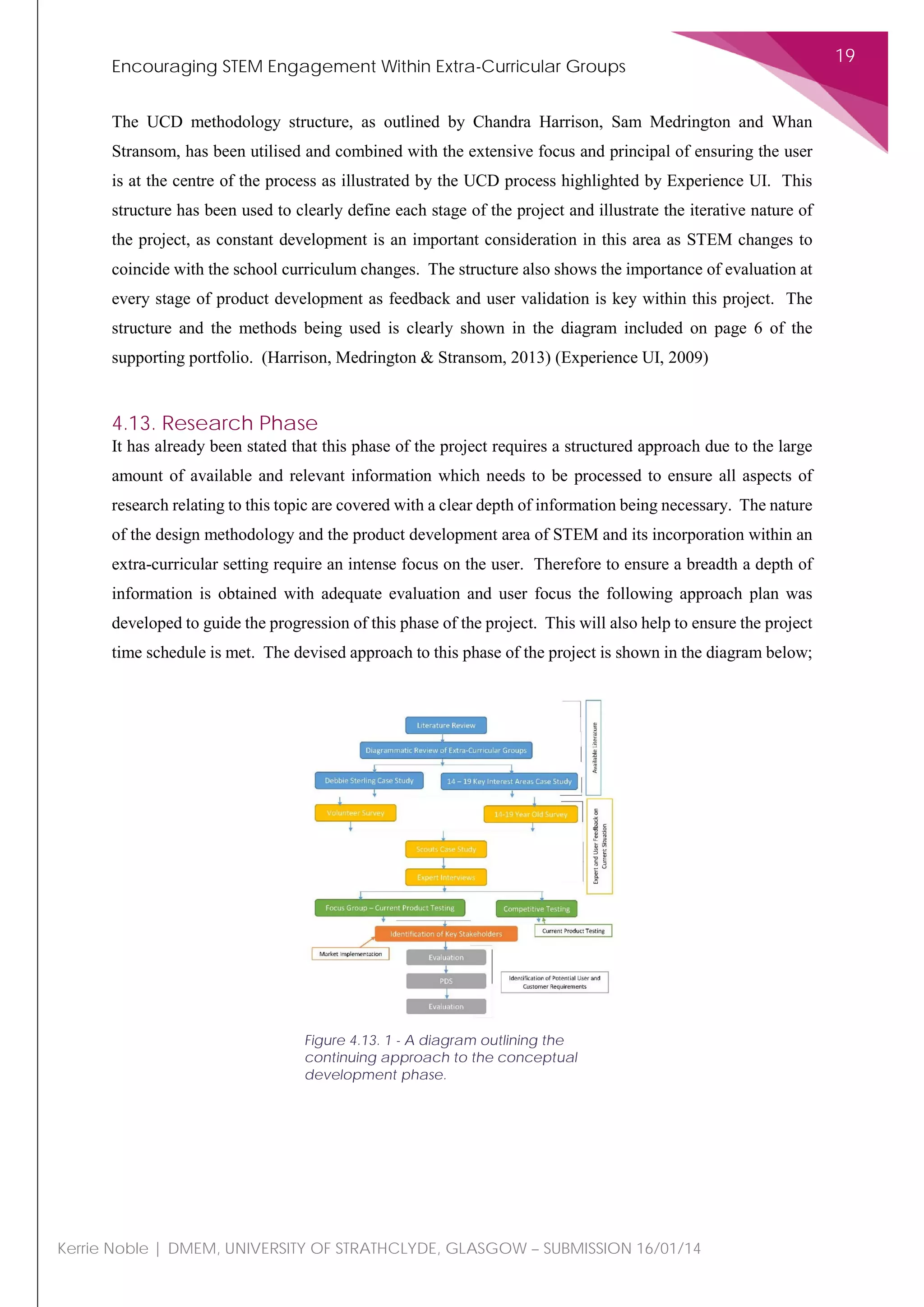
time schedule is met. The devised approach to this phase of the project is shown in the diagram below;
Figure 4.13. 1 - A diagram outlining the
continuing approach to the conceptual
development phase.
Encouraging STEM Engagement Within Extra-Curricular Groups
20
Kerrie Noble | DMEM, UNIVERSITY OF STRATHCLYDE, GLASGOW – SUBMISSION 16/01/14
4.14. Literature Review
Key Learning Outcomes;
• The world economy is changing and developing through time and highlights the aims and
objective of the UK economy in relation to how the government foresee the country competing
within an ever increasing globalised economic race.
• 80% of the people surveyed agreed that science, on the whole, makes our lives easier.
• 88% of those surveyed agreed that scientists make a valuable contribution to society.
• Younger participants focused on technology and gadgets to make life easier.
• UK business and education is currently failing to maintain or increase the number of high-
calibre engineers entering industry. The failure within this area is set to become apparent
throughout the period of the next 10 years and will present repercussions for both the
productivity and creativity achieved within UK business.
• Engineering university entrants remaining static between 1994 and 2004 despite the total
number of university entrants rising by 40%.
• Women account for only 20% of all bachelor’s degrees within engineering, computer science
and physics.
• Less than 33% of STEM graduates were women in 2000 and the level was still the same in
2009.
• Men account for more than 80% of graduates in engineering, manufacturing and construction.
• Engineering recorded the lowest number of responses in relation to the enjoyment of studying
that subject.
• A survey of 500 students found that 70% of respondents believed it was harder to obtain an A-
grade in science subjects than it was in the subjects they perceived to be easier and ‘softer’
options.
• 51% of survey respondents indicated that teaching in science was similar to the teaching in
other subjects, however, 22% said the teaching quality in science subjects was better than
teaching in other subjects while 18% stated they thought it worse than teaching in other subjects.
• Reinforce their learning in a positive manner as anxiety, criticism or ridicule may have
unpredicted and unwanted effects within the context of the learner’s deep learning.
• Generating meaningful learning through the use of a multimedia medium must consider
important aspects of material presentation and how this must be organised in a coherent manner
in order to achieve successful integration.
• To help encourage deep learning, the technique of using text as a narration for the image should
be explored.
• Simple user interaction affects the process and outcome of cognitive tasks given during a
practical activity.
Encouraging STEM Engagement Within Extra-Curricular Groups
21
Kerrie Noble | DMEM, UNIVERSITY OF STRATHCLYDE, GLASGOW – SUBMISSION 16/01/14
4.15. Review of Extra-Curricular Groups
Many extra-curricular groups and societies exist within the UK, covering many aspects from military
cadets to young engineers clubs. Many of these groups provide activities or training in STEM related
subjects and therefore could potentially benefit from product development in relation to improving
STEM engagement and providing more useful resources to help with running STEM-related activities.
A review of some potentially important extra-curricular groups is shown on page 7 of the supporting
portfolio.
4.16. Case Study – GoldieBlox
Key Learning Outcomes;
• Girls tend to lose interest in STEM subjects at an early age and therefore highlight the need to
include extensive female incorporation within the research and development area to ensure a
truly unisex product is developed which captures engagement from both male and female
students within the target age group.
• Incorporating user testing of rudimental prototypes will provide essential feedback and ensure
the product development is meeting the requirements of the target market.
• Utilising key areas which interest the target market will help to generate and create product
buy-in as the product can utilise existing areas where the target market feel comfortable,
essential within the area of STEM in order to over-come the negative thinking which surrounds
STEM school subjects.
• Only 20% of STEM graduates are women.
4.17. Case Study – Key Interest Areas
Key Learning Outcomes;
• Social networking is an integral part of life for the target market age group, therefore any
product development for this group should seek to integrate the product functionality with use
of a social networking facility to generate product buy-in and enthusiasm.
• Social networking offers social mobility and interaction as key traits of the system, these
characteristics are inherently important within the area of STEM in order to develop creativity
and experimentation and so product development for the area of STEM should seek to include
the high levels of interaction and social mobility demonstrated through social networking
platforms.
• Social networking affords users the freedom to post questions, share stories and ask for support
from people with similar interests. This is an essential quality needed within STEM product
development as the literature review has already demonstrated that lack of support and negative
Encouraging STEM Engagement Within Extra-Curricular Groups
22
Kerrie Noble | DMEM, UNIVERSITY OF STRATHCLYDE, GLASGOW – SUBMISSION 16/01/14
thinking around ability are key reasons for discouraging engagement within this area.
Therefore a link with social networking freedom of questioning should be incorporated into the
product design.
• Detail and relevance have been highlighted as successful characteristics evident within popular
video games. It appears detail and realism create a relevance to daily life which seems to be
important to the target age group and so the area of STEM product development needs to take
inspiration from the video game market and demonstrate real detail and relevance to young
learners.
• Customisation generates interest, allowing the user to gain some control over the activity which
seems to be particularly appealing to the target age group, therefore customisation should be a
key element within any concept development.
• Challenge further generates product buy-in and engagement as the target age group see this as
a challenge which must be solved, therefore generating continuous interest and determination
to conquer the challenge. This is typically achieved through the use of varying difficulty levels
and this feature should be implemented within product development within the STEM area.
• Storyline adds to the progression of the game or activity and provides a believable background
and relevance. This should be considered within STEM products to help provide detailed
background to the activities which are presented and enable young learners to see the benefit
of engaging with the product.
• The most successful characteristic associated with the gaming industry is the extensive
marketing prior to the game launch. This is used effectively to promote the game and generate
large interest to ensure product sales. Marketing of STEM products must be a key element of
consideration for improving engagement.
4.18. Online Survey – Adult Volunteers in Extra-Curricular Groups
Key Learning Outcomes;
• The survey suggests that many volunteers within extra-curricular groups have a background in
education or engineering related professions and therefore this suggests that providing STEM-
related activities should not be a problem, however the remainder of the survey showed that
very few groups are completing any STEM-related activities over the course of a year.
• Many volunteers class themselves as being experts in relation to running STEM-based
activities, however, the remainder of the survey results suggest that these skills and the
experience are not utilised to run STEM activities within an extra-curricular group.
• 52% of the survey respondents had run 0 or 1 STEM-based activities within the course of a
year.
Encouraging STEM Engagement Within Extra-Curricular Groups
23
Kerrie Noble | DMEM, UNIVERSITY OF STRATHCLYDE, GLASGOW – SUBMISSION 16/01/14
• The majority of STEM-based activities completed were electronics based and this involved
simple construction of a basic circuit.
• The majority of volunteers within extra-curricular groups only spend between 0 and 1 hours
running an activity, in particular STEM-based activities.
• The time spent on the activity and the number of activities completed in this area generally
relies on the ability and interest of the young people within the group.
• Group volunteers tend to run activities for 0 – 5 children or more than 20 children, this can
increase to numbers closer to 70 children at times.
• Many groups are currently buying or sourcing specialist equipment in order to run STEM-based
activities as they feel current available resources are not adequate.
• Many volunteers think that current STEM resources are limited or are too basic and so would
not interest the 14 – 19 year old age group.
• 31% of responses showed that adult volunteers do not think current resources are challenging
or engaging enough and for that reason have not run a STEM-based activity.
• Many volunteers think more resources for STEM activities need to be easily available at a
reasonable price.
• 43% of volunteers are not aware of any current STEM resources for extra-curricular groups and
44% stated they are aware of current resources but do not use them or don’t like them.
• Many volunteers believe resources need to be improved by adding fun, creating links with other
interests and providing the young learner with a sense of achievement.
4.19. Online Survey – 14 – 19 year old students
Key Learning Outcomes;
• The most popular subjects studied at school are maths, with 90% of survey responses, and
physics with 73% of survey responses however low numbers of survey participants continued
studying these subjects to the ages of 16, 17 and 18, and only 4 survey respondents continued
studying STEM subjects at university.
• The majority of survey respondents stated their reasoning for not continuing study in these
subject areas was due to either a loss of interest or they perceived the subject to be too difficult,
making attaining a good grade difficult.
• Respondents rated their ability in science, technology and maths quite highly, all achieving
average ability ratings of over 60%, however general attitude towards ability in engineering is
very low with this subject area only achieving and average ability rating of 49%.
• 88% of the survey participants indicated having a very high interest in STEM subject areas,
however this did not translate into participation or engagement with these areas at home or in
extra-curricular groups.
Encouraging STEM Engagement Within Extra-Curricular Groups
24
Kerrie Noble | DMEM, UNIVERSITY OF STRATHCLYDE, GLASGOW – SUBMISSION 16/01/14
• 83% of respondents have never completed a STEM-related activity during their time in an extra-
curricular group and any activities that were completed within this situation did not include any
mathematics related activities.
• 81% of respondents indicated not having used any STEM-related kits at home and stated the
main reasons for this were due to a lack of time, a lack of useful instructions or they found the
kits were not challenging enough as they were aimed at a younger age group.
• A large proportion of respondents, 27%, indicated that their overall opinion in relation to STEM
was that they thought these subjects were too difficult for them to become involved but they
looked ‘cool’.
• 60% of the survey respondents were not aware of any available opportunities in relation to
STEM subjects and careers within this area.
• The most popular suggestions regarding how to improve current resources were to incorporate
more practical group activities by using/designing resources to require large amounts of
teamwork, and to ensure the kits could be used in an everyday situation after the completion of
the initial activity/construction task.
4.20. Expert Interviews
Key Learning Outcomes;
• STEM Ambassadors currently do not use a large variety of electronic kits as the requirement
of additional equipment is so high. If the requirement of extra equipment was reduced it would
become much more practical to run electronic based activities with young people.
• Equipment currently used by STEM Ambassadors can cost anything between £1 for the simpler
components up to £300 for the construction kits available.
• These programmes are always keen to look for new suitable resources.
• Storage is a large issue for these organisations, a kit should require minimal storage to allow
organisations such as this to store the product in order to use it within the community more
effectively.
• Some large firms have developed some simple activities to use within school based activities
but there is generally no link between STEM Net and extra-curricular groups at the present
time.
• Two of the current pieces of equipment widely used by STEM Net are LEGO Mindstorm and
K’NEX however, these are generally used with children of primary school age.
• Any product used by STEM Net must be fun and interactive but also promote learning. Simply
following instructions does not fulfil the aims of STEM and does not promote a sense of
achievement within the children.
Encouraging STEM Engagement Within Extra-Curricular Groups
25
Kerrie Noble | DMEM, UNIVERSITY OF STRATHCLYDE, GLASGOW – SUBMISSION 16/01/14
• If a resource could simulate some real-life situations it would be of benefit as it is believed this
has the ability to more readily grab the attention of young people.
• Must be easily used by everyone, regardless of background or ability.
• STEM resources for the 14-19 age range are not currently widely available.
• Interaction or a link with popular activities among the age group, such as computer games or
social media, would be a great way of developing interest as well as providing encouragement
to engage and share with other learners who help support other users. A place where ideas can
be freely shared and help from peers is available. This reduces the formality associated with
the school learning environment.
• A sense of achievement must be imparted, either by answering question correctly in order to
complete the activity, competing in a national competition or being able to progress through
levels of difficulty.
4.21. Contextual Situation Testing
Key Learning Outcomes;
• Current kits being used within extra-curricular kits, especially those generally used within
scouts, do not fulfil key learning requirements or portray knowledge within the area they were
designed to represent.
• Young learners between the ages of 14 – 19 have indicated that they enjoy participating in these
types of activity and would like to have more of a challenge in relation to the kits being used.
• The instructions provided with the kits can sometimes seem confusing and this leaves activity
participants feeling frustrated.
4.22. Competitive Testing
Key Learning Outcomes;
• An average price for STEM related kits is between £20 - £40.
• Most of the current available resources and kits are suitable for children from the age of 7 or 8
and become too simplistic or less interesting for the target market group of 14 – 19 year olds.
• Many available kits offer the possibility for the user to complete between 5 and 10 projects
through the use of the same kit, however these kits suffer from having the problem of using
perishable items within the kit meaning each project can only be completed once. Other kits
providing the option of completing more than one project also have the problem of not
conveying different knowledge areas within the different projects so users only gain limited
understanding of one area.
• Having an understanding or previous knowledge of the area in which the kit is based is also
essential for many of the products analysed. As adult volunteers within many of the extra-
Encouraging STEM Engagement Within Extra-Curricular Groups
26
Kerrie Noble | DMEM, UNIVERSITY OF STRATHCLYDE, GLASGOW – SUBMISSION 16/01/14
curricular groups do not have extensive knowledge in these areas the use of these kits within a
typical group session becomes difficult.
• The products can often contain confusing instructions which results in the user losing interest
or becoming frustrated when they cannot complete the activity.
• Storage of the kits appears to be a major concern when placed in the context of use within extra-
curricular groups. Many of the products analysed require the group to purchase a large quantity
of product in order to cater for large groups of children, therefore a lack of storage represents
difficulty for the group to run activities using these kits.
4.23. Evaluation
The research phase of this project has extensively covered key areas concerning;
• Performance
• Product Lifespan
• Materials
• Testing
• Market Constraints/Requirements
• Customer Constraints/Requirements
• Cost
• Documentation
• Environment
Other important considerations, such as legal requirements, patents and safety issues have not been
included within the project report, however these requirements are clearly outlined within the Product
Design Specification, which is discussed further below.
The current problem with regards to STEM engagement within extra-curricular groups has been clearly
defined and justified, with many participants indicating the same major problems within this area,
including;
• Lack of interest and engagement in relation to STEM activities from young people in the 14 –
19 year category.
• A lack of knowledge or awareness of available resources to help extra-curricular groups with
becoming involved in, and completing, STEM activities.
• A feeling that running STEM-related activities within extra-curricular groups requires adult
volunteers to possess knowledge within these areas in order to run the related activities with
the young people in the group.
Encouraging STEM Engagement Within Extra-Curricular Groups
27
Kerrie Noble | DMEM, UNIVERSITY OF STRATHCLYDE, GLASGOW – SUBMISSION 16/01/14
• Current commercially available kits are too simplistic for the identified target age group, 14 –
19 year olds, as the kits are aimed at children from the age of 8, therefore meaning that 14 year
students do not obtain any benefit through using the kit as it is not suitably aimed at young
people in this area.
The information identified and obtained from various sources all validate the initial problem statement
and aim for this project, previously stated as;
In order to continue to promote and encourage STEM participation amongst young learners and reduce
the pressure currently felt by teaching staff and schools there is a need to develop a STEM-based
educational kit which can be used in extra-curricular environments such as Young Engineer’s clubs,
Scouts, Guides and other youth organisations.
Project Aim - Design and develop a scientific-based kit, for the 14-19 years age group, which is suitable
for use in an extra-curricular environment to encourage more participation in STEM subjects.
These areas have been considered and interpreted in order to provide customer requirements which have
been used to develop a product design specification, this is discussed further below.
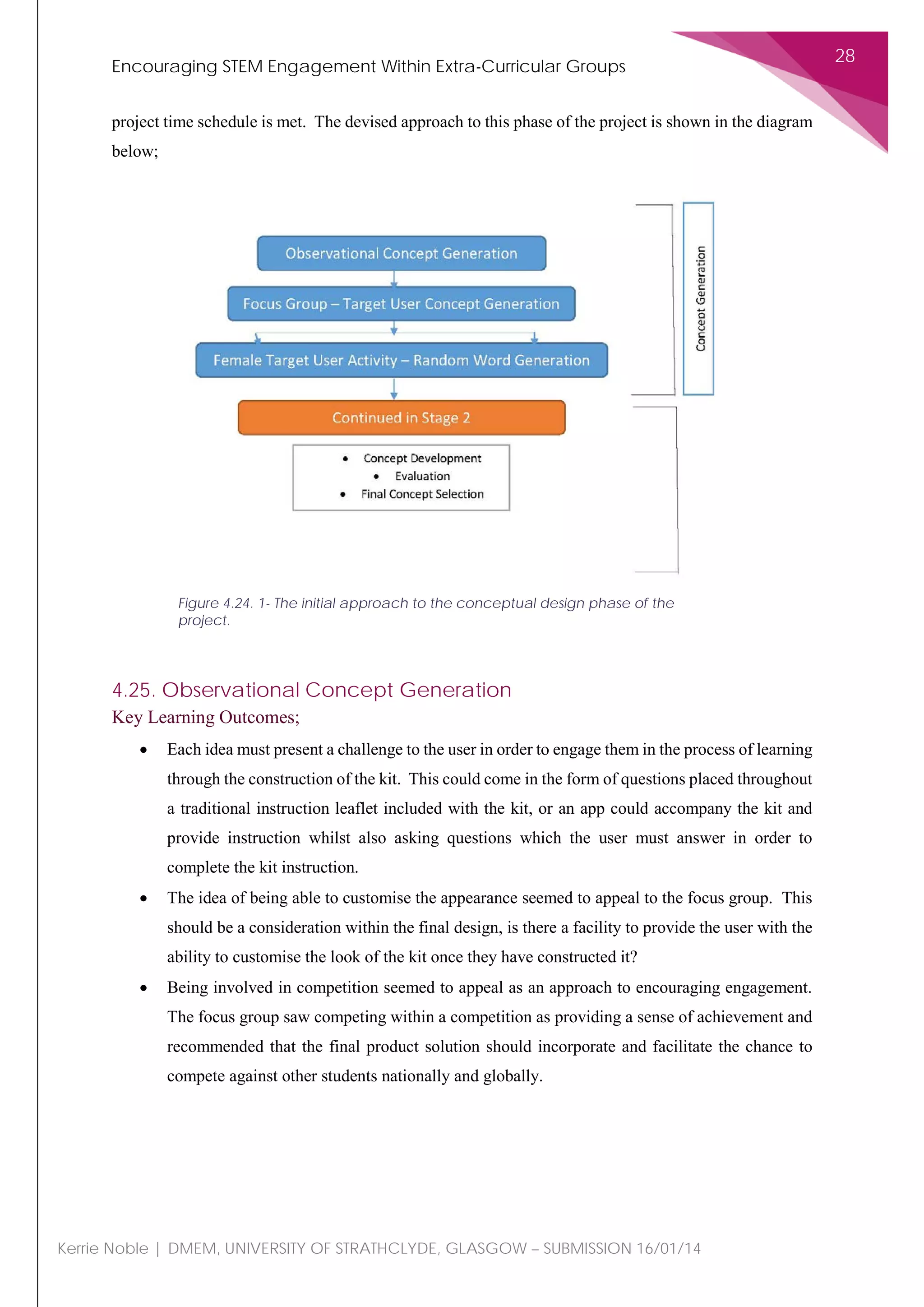
4.24. Conceptual Design Phase
It has already been stated that this phase of the project requires a structured approach due to the
divergent and convergent nature of this phase of the project and also due to the numerous STEM areas
which can be explored with the possibility of concept generation occurring within any of these areas.
The nature of the design methodology and the product development area of STEM and its incorporation
within an extra-curricular setting require an intense focus on the user. Therefore to ensure a breadth a
depth of information is obtained with adequate evaluation and user focus the following approach plan
was developed to guide the progression of this phase of the project. This will also help to ensure the
Encouraging STEM Engagement Within Extra-Curricular Groups
28
Kerrie Noble | DMEM, UNIVERSITY OF STRATHCLYDE, GLASGOW – SUBMISSION 16/01/14
project time schedule is met. The devised approach to this phase of the project is shown in the diagram
below;
4.25. Observational Concept Generation
Key Learning Outcomes;
• Each idea must present a challenge to the user in order to engage them in the process of learning
through the construction of the kit. This could come in the form of questions placed throughout
a traditional instruction leaflet included with the kit, or an app could accompany the kit and
provide instruction whilst also asking questions which the user must answer in order to
complete the kit instruction.
• The idea of being able to customise the appearance seemed to appeal to the focus group. This
should be a consideration within the final design, is there a facility to provide the user with the
ability to customise the look of the kit once they have constructed it?
• Being involved in competition seemed to appeal as an approach to encouraging engagement.
The focus group saw competing within a competition as providing a sense of achievement and
recommended that the final product solution should incorporate and facilitate the chance to
compete against other students nationally and globally.
Figure 4.24. 1- The initial approach to the conceptual design phase of the
project.
Encouraging STEM Engagement Within Extra-Curricular Groups
29
Kerrie Noble | DMEM, UNIVERSITY OF STRATHCLYDE, GLASGOW – SUBMISSION 16/01/14
4.26. Focus Group – Idea Generation
In order to gather ideas which would be applicable, interesting and engaging for the age group in
consideration, a focus group was held on Monday 7th
October. Participating in this focus group were 5
girls between the ages of 16 and 18 who attend a local Explorer Scout unit in Dennistoun, Glasgow.
The aim of this focus group was to obtain a few initial concepts in order to gauge design ideas and areas
of interest for the 14-19 year old age group which the final product solution will have to appeal to.
4.27. Focus Group – Random Word Generation
On Friday 1st
November 2013 North Ayrshire Council ran a workshop aimed at encouraging S3 female
students to consider a future within the area of STEM. As part of this workshop an activity was
conducted in order to identify key areas of interest to this age group of girls. As identified throughout
the literature review, girls are less likely to participate in STEM subjects, losing interest as early as the
age of 8. Therefore this concept generation activity provided an opportunity to engage with potential
female users and identify areas which could incorporated within a concept design to ensure buy-in and
high interest levels which could increase participation levels with female students.
4.28. Evaluation
The original project plan had indicated that a selection of models should be completed by this stage
allowing for evaluation and selection of a final concept. Due to other commitments requiring more
time than previously thought when devising the original project plan, modelling, evaluation and final
concept selection has not taken place within stage one. However, ideas for final concepts and evaluation
have already begun in order to ensure these activities are completed relatively early in the remaining
time assigned for this project, ensuring the project will still be completed fully within the time frame
given. This re-evaluation of the project management and time considerations has been included in an
updated version of the project Gantt chart which has been included in Appendix 5. Stage 2 will begin
with more concept generation before converging into a concept development and evaluation phase
before selecting a final solution.
4.29. Conclusion
By completing the stage 1 folio the following project objectives, outlined on page 11 of the stage 1
report, were been met;
• Explore the idea of STEM involvement in an extra-curricular environment to further define the
problem, need and aim for the project. Also identify key products which are currently being
used in this area and outline the key issues which exist with the use of these products and how
these could be addressed.
Encouraging STEM Engagement Within Extra-Curricular Groups
30
Kerrie Noble | DMEM, UNIVERSITY OF STRATHCLYDE, GLASGOW – SUBMISSION 16/01/14
• Explore some of the basic scientific principles which could be adapted into a small scale form
which could provide ideas for an electronic-based scientific kit for the 14 – 19 age range.
• Explore the idea of having one modular product which can be configured into many different
layouts to provide the user with the opportunity of exploring more than one area of STEM with
the need to only purchase one kit.
The issues surrounding STEM engagement and current schemes in place to address some of these issues
have been investigated throughout the literature which identified a need for incorporating STEM
engagement activities within extra-curricular groups such as scouts. The problem, need and aim of the
project were then further defined through a series of research outcomes obtained from the use of a
sequential and methodical approach utilising many design research methods to clearly identify customer
and user requirements for product development regarding the area of STEM resources for the identified
situation.
Current commercially available products were also identified and analysed. This analysis identified
key positive and negative aspects of various available resources being sold within a high-street toy store.
The analysis also investigated the implications associated with the use of these products within an extra-
curricular group, particularly scouts as this group was easy to relate to due to the product testing which
was conducted within this group prior to the competitive testing discussed in section 2.10.
On conclusion of the research phase of the project, key scientific principles were identified through an
observational study of interactive displays used within Glasgow Science Centre. This outlined some of
the principles involving interactive elements which could easily be transferred into a small-scale
product for use within an extra-curricular group. The ideas generated as a result of the initial
observational study were discussed in detail, including highlighting user challenge and potential
questions which could be used to enhance the use of the conceptual design and promote learning within
key STEM areas. These designs also highlighted the idea of generating a kit which focused on modular
design and construction. Other conceptual designs were also considered, including designs generated
by potential users, which were explored through the use of a focus group activity in order to identify
products the target user market would be interested in buying. The conceptual design produced from
the focus group activity are discussed throughout section 3.3.
The consideration of the target user group was integrated into the process through the use of a further
method, random word generation, which identified key areas of interest within the 14 – 19 year old age
group, in particular interests of female students within this age group. Female students provided the
focus for this activity as female participation in STEM subjects was highlighted as a key issue
throughout the literature review and further research.
Encouraging STEM Engagement Within Extra-Curricular Groups
31
Kerrie Noble | DMEM, UNIVERSITY OF STRATHCLYDE, GLASGOW – SUBMISSION 16/01/14
5. Conceptual Design Phase
The conceptual design phase is the third phase
within the progression of this project, as outlined by
the methodology diagram to the left. This section
comprised the use of several design methods and
techniques in order to generate basic conceptual
ideas based on current scientific experimentation
and school subject areas, target age group
requirements and specific focus on interests of
female students between the ages of 14 and 19.
This phase of the project covers a large range of
conceptual possibilities within many STEM areas
before moving into more detailed conceptual
development with accompanying evaluation and
final concept selection. This is essential to ensure
the selection of the best solution, therefore this requires a divergent and convergent structure to allow
for a wide range of possibilities to gradually become narrower before a final solution is chosen. This
phase of the project is covered throughout this section of the report and associated project work is also
displayed on pages 6 - 28 of the supporting portfolio.
5.1. Conceptual Design Phase Approach
This project phase began towards the end of stage 1 of this project, outlining the need for s astructured
approach and highlighting the customised approach taken through the use of a design flowchart, stating
the design methods deployed and the order in which the methods were conducted. The same approach
is being utilised throughout the continuation of this phase of the project within stage 2. The diagram
below shows the approach being taken for the completion of this phase of stage 2;
Figure 5.1. 1 - The continuing conceptual design phase approach for stage 2.
This secondary step within the conceptual design phase of the project will combine elements of
conceptual design with elements of evaluation and testing to ensure the project is progressing in a
Figure 5. 1 - A diagram showing the current
position of project development on the outlined
project methodology.
Encouraging STEM Engagement Within Extra-Curricular Groups
32
Kerrie Noble | DMEM, UNIVERSITY OF STRATHCLYDE, GLASGOW – SUBMISSION 16/01/14
direction which is desirable to all key stakeholders. This phase begins with the continuation of the
random word generation activity which is further developed within the next section of the report.
5.2. Focus Group – Random Word Generation Development
On Friday 1st November 2013 North Ayrshire Council ran a workshop aimed at encouraging S3 female
students to consider a future within the area of STEM. As part of this workshop an activity was
conducted in order to identify key areas of interest to this age group of girls. As identified throughout
the literature review, girls are less likely to participate in STEM subjects, losing interest as early as the
age of 8. Therefore this concept generation activity provided an opportunity to engage with potential
female users and identify areas which could incorporated within a concept design to ensure buy-in and
high interest levels which could increase participation levels with female students. The resulting
brainstorming graph from this activity is included on page 40 of the stage 1 supporting portfolio.
The brainstorming graph generated from this
activity was then further developed within a
concept generation session, held with 4 product
design students. The aim of the concept
generation session was to take the random
words generated by the S3 girls and generate
ideas for STEM-based kits/products that could
be created which corresponded the areas of
interest they had highlighted through the words
which had been generated as part of the activity.
The group of product design students were
given no rules for concept generation other than
the idea had to relate to the production of a STEM-based product which could be easily used in an extra-
curricular group to demonstrate some principal in relation to a STEM subject. The outputs from the
concept generation session are illustrated on pages 6 - 9 of the stage 2 supporting portfolio and are
discussed in further detail below.
Baking
Idea 1 (Image 60) – This idea shows a physics and construction based kit which aims to allow the user
to build their own mini-oven. This would be a long-term project, such as building a kit car, which
would be completed in stages over several week with the aim of teaching the user about all elements
which are need to build an oven before they can use it for baking purposes.
Idea 2 (Image 61) – This idea was based on chemicals and how baking represents the mixing of different
elements to form compounds, like cake baking.
Figure 5.2. 1 - An image of the focus group of
students generating concepts from random word
generation outcomes.
Encouraging STEM Engagement Within Extra-Curricular Groups
33
Kerrie Noble | DMEM, UNIVERSITY OF STRATHCLYDE, GLASGOW – SUBMISSION 16/01/14
Camping
Idea 1 (Image 62) – When camping, it is becoming more popular to own pieces of equipment which
require the use of a renewable source of energy, such as camping stoves, portable hand-held tv etc. This
kit would provide the pieces necessary for building several different configurations which would supply
the user with a renewable power source when camping.
Idea 2 (Image 63) – This concept explores the idea of combining camping with a STEM kit by hiding
the kit in the bottom of a rucksack. The kit would cover areas such as weight, gravity and centre of
gravity, all of which are important when trying to pack a rucksack to ensure the weight is distributed
evenly to make for a comfortable user experience.
Being Outside
Idea 1 (Image 64) – This concept suggests using the childhood game of hide and seek, but with a STEM
twist. Hide and seek would involve the users hunting for a STEM-related object by finding and
following clues.
Idea 2 (Image 65) – This idea would encourage the user to think about weather and its effect on
materials. The kit would explain the process of water-proofing and provide the correct elements to
allow the user to water-proof an object of their choice.
Idea 3 (Image 66) – As there are a lot of natural resources outdoors, this concept suggest the idea of the
user making their own kit, with focus on a particular STEM area, by using the natural resources
available to them.
Social Networking
Idea 1 (Image 67) – The idea for the area of social networking considers using online-based games.
This suggestion specifically mentions using anagrams of STEM-based subject words to teach the user
key STEM terminology.
Socialising
Idea 1 (Image 68) – Socialising in this age group is generally through use of mobile phones and other
portable devices. This concept suggests having a kit where the user can develop and make an accessory
for their phone/mobile device. The accessory would show the user how regularly they use their phone
everyday, the energy usage and the current life of the battery if the phone continues to use this energy.
The product would also have the hidden surprise of an electric shock if the user was using too much
energy.
Seaside
Idea 1 (Image 72) – This concept is based on the idea of the user understanding the principals of a
hydro-electric turbine before constructing their own miniature version of this technology.
Encouraging STEM Engagement Within Extra-Curricular Groups
34
Kerrie Noble | DMEM, UNIVERSITY OF STRATHCLYDE, GLASGOW – SUBMISSION 16/01/14
Fashion and Physics
Idea 1 (Image 69) – To encourage more participation by females in this age group, this concept suggests
combining fashion and physics. The kit would supply the elements for the user to produce their own
piece of customised clothing, which also includes a programmable aspect such as lights, a personalised
message etc.
Idea 2 (Image 70) – The theme of combining female aspects with physics continued with the generation
of this concept. This idea considers the use of more female-oriented colours, such as pink, in the
construction of STEM-based instrumentation and resources.
Idea 3 (Image 71) – This concept is an expansion of the concept suggested in idea 1.
IT/TV
Idea 1 (Image 73) – This concept suggested combining STEM-based activities with current popular
television programmes, such as the Big Bang Theory. A programme of activities could be developed
to be completed in tangent to the theories and STEM aspects covered within the television series.
Idea 2 (Image 74) – The second idea in this category is looking at a popular and developing idea within
the current STEM market, the use, adaptation and development of Raspberry Pi. As an entity,
Raspberry Pi is just a programmable circuit board, however, this concept suggests developing a range
of kits which can use Raspberry Pi but also supply the necessary elements to make a fully-functioning
product, in this case the concept suggests making a TV.
Make-up
Idea 1 (Image 76) – This concept suggest supply all the required elements to produce a chemistry-based
set which allows the user to make their own make-up.
Idea 2 (Image 78) – The second concept develops the idea expressed in the first concept in this area,
and suggests developing a kit to allow the user to make their own perfume.
Idea 3 (Image 79) – The third concept is the most developed concept within this area. This concept
suggests developing construction-based kit with programmable elements to achieve a fully-functioning
robotic arm which the user has full control over. This would allow a different and changing outcome
every time the kit was constructed and provides a high-level of learning.
Walking the Dog
Idea 1 (Image 75) – This concept looks at the possibility of making dog walking more interactive with
kits based on making simple dog accessories more high-tech. The image shows a lead with an
interactive touch screen.
Holidays (Public)
Idea 1 (Image 77) – Public holidays have a lot of theme-based accessories associated with the
celebration. The idea demonstrated for this area is the use of iconic public holiday products and
Encouraging STEM Engagement Within Extra-Curricular Groups
35
Kerrie Noble | DMEM, UNIVERSITY OF STRATHCLYDE, GLASGOW – SUBMISSION 16/01/14
providing the user with a kit which allows them to make, decorate, programme and design their own
holiday-themed product.
Practical Things
Idea 1 (Image 90) – This concept again looks at the use of robots within s STEM-based kit. The idea
is that the user will be provided with a basic kit of components which will allow them to arrange the
components in any way to build several designs of programmable robots.
Idea 2 (Image 91) – This concept concentrates on trying to developing learning and engagement across
all STEM subjects and suggests supplying the user with a simple base product which has numerous
‘card’ elements to it. The facilitator within the group would then setup the product to relate to the
STEM subject of their choice and the young people would then use this in a similar way to the game
articulate, where the young people would take it in turns to pick a card. The card would then provide
instructions for a STEM-based activity that they must complete with the group.
Music
Idea 1 (Image 92) – This concept suggests providing a kit for the user to build their own synthesiser so
they can compose their own music once the kit has been completed.
Summary
A concept generation session was held with 4 product design students and centred on the random word
generation which was conducted with the group of S3 female students on 1st
November 2013. The
design students used the key headings and areas which were gathered as outcomes of the random word
generation activity to guide their concept generation process. The outcome of this process is illustrated
on pages 6 - 9 of the stage 2 supporting portfolio and the key learning points taken from this exercise
are outlined below.
Key Learning Points;
• A majority of the concepts generated through this activity concentrated on the use of
construction-based kits. This is significant as it perhaps suggests the route which further
concept development should take as this is clearly a design suggestion for this area of product
development.
• Many concepts suggest the use and integration of products such as Raspberry Pi and use this to
develop the basic structure of the kit to enable the user to build a fully-functioning product
which will be of more benefit in terms of the enjoyment and use they achieve from the product.
• A lot of the concepts generated seem to focus on a particular area of STEM, however, one
concept had suggested the inclusion of all STEM subject areas when considering the
development of this product. This idea must be taken forward and the inclusion of all STEM
subject areas is necessary for achieving increased interest and participation in this area.
Encouraging STEM Engagement Within Extra-Curricular Groups
36
Kerrie Noble | DMEM, UNIVERSITY OF STRATHCLYDE, GLASGOW – SUBMISSION 16/01/14
• Some of the concepts generated through this activity are similar to existing products, this is
probably as a result of the students having experience of using products such as LEGO
Mindstorm. However, it has already been established that these types of product do not work
or integrate well with use in an extra-curricular group context. This is primarily due to the need
for knowledge and expertise relating to the use of the product which simply does not exist in
this type of situation. Therefore this highlights the need to retain this information at the
forefront of critical evaluation and selection decisions as the need for expertise and knowledge
in order to operate the final developed product must be avoided as a critical success factor of
the product integration.
5.3. Concept Generation Evaluation
A focus group was held with the goal of evaluating the concept generation stage, within the conceptual
design phase of the project methodology and approach, to enable identification of suitable solutions
which could be further developed throughout the following stage of concept development. The focus
group was an eclectic mix of students, potential users and experts in the field from Glasgow City of
Science and the Glasgow Science centre. The feedback, in relation to each previously developed
concept and each concept generation stage outlined in the report, is outlined below.
Concept 1
Concept 1 is discussed on page 79 of the stage 1 report and is shown on page 36 of the stage 1 supporting
portfolio. Concept 1 took inspiration from the interactive and modular displays which were identified
at the Glasgow Science Centre. The kit aimed to generate knowledge in relation to practical
experimental areas within physics, including velocity at points on a circle, optical illusions created
through rotating objects and height in relation to rotational velocity within a parabolic structure. This
idea provided user freedom, allowing for experimentation and creativity to generate ideas for new
experiments and activities after completion of the basic experimental instructions which have been
provided as part of the kit. The kit also required full user construction before experimentation in any
area could be undertaken and this would build knowledge and skills in further areas.
The focus group provided the following feedback in relation to concept 1;
• The incorporation of several different STEM areas in one product is a good way of helping or
improving learning in many areas across the school curriculum, however the different options
presented within this concept will require significant amounts of clear and concise narration
accompanying the product to ensure the user generates meaningful learning in these areas to
induce key STEM principals rather than just encouraging play.
• Initial users of the kit may be apprehensive or concerned about their ability within the school
subjects represented by this kit, as indicated through the accompanying research, so the user
Encouraging STEM Engagement Within Extra-Curricular Groups
37
Kerrie Noble | DMEM, UNIVERSITY OF STRATHCLYDE, GLASGOW – SUBMISSION 16/01/14
learning must be made in a positive manner with a link provided between the kit and expert
input.
• Concept one provides a great opportunity for developing teamwork and sharing amongst
friends, peers and others with interests in similar areas. As social networking has been
highlighted as an integral part of the lives of the young people being highlighted as the target
market for this product, concept one lends itself to being linked and used alongside a social
network capability which could be linked with the product. If this can be incorporated into the
overall design and idea of concept one then the social mobility and interaction characteristics
which are inherent within social networking will be well utilised and beneficial to promoting
the STEM principals presented within the conceptual design.
• The conceptual design illustrates ideas which are relevant to the target market.
• Existing products tend to have a problem where they begin by being extremely easy and the
next stage jumps to being extremely difficult which, from the experience of the focus group,
contributes to disengagement with the product. The focus group thought this design provided
great opportunity to introduce different difficulty levels to accommodate a range of user
abilities to maintain and improve user engagement and interest.
• With provision of good, detailed instructions there should be no need for pre-requisite
experience or knowledge in relation to the use of this kit, therefore volunteers within extra-
curricular groups will not feel they require training or knowledge in an unknown area.
• The use of the kit could probably be spread over a few weeks to fit the amount of time available
within the weekly meetings, previously highlighted as 0 – 1 hours, which is typical within extra-
curricular groups.
• The focus group suggested that links with other interests was perhaps lacking in this conceptual
design, however, they still believed the link with social media and the sharing of ideas could
provide fun and relevance within the target market.
• The focus group suggested that this was a good example of a conceptual design as it focused
on areas which were not well covered within the school curriculum and so was directly
addressing key areas where STEM engagement was a particular issue.
• The focus group felt this conceptual design could resolve the issue related to storage by
including more than one activity within the product. By incorporating modular design the
group would essential have access to 5 or more activities and would only require the storage
space associated with one of the currently available products.
• Learning appears to be well promoted within this conceptual design. A sense of achievement
would occur on completion of the product and subsequent testing.
Encouraging STEM Engagement Within Extra-Curricular Groups
38
Kerrie Noble | DMEM, UNIVERSITY OF STRATHCLYDE, GLASGOW – SUBMISSION 16/01/14
Concept2
Concept 2 is discussed on page 80 of the stage 1 report and is shown on page 36 of the stage 1 supporting
portfolio. Concept 2 takes inspiration from the stress/strain display discussed previously in section 3.2
in the stage 1 report. This design was a smaller version of the display discussed here, allowing for
experimentation within this area to occur within the setting of an extra-curricular group. The kit design
was modular, with several different spanner designs, including different tip designs, lengths and
thicknesses, with adjustable UV light units. Different sized nuts and bolts were placed on the kit
platform and the user was left to experiment with the stress and strain occurring within different
spanners, with the ability to investigate the effect of length, thickness and tip design has on the
generation of stress and strain within the spanner.
The focus group provided the following feedback in relation to concept 2;
• The level of incorporation of different STEM areas in one product is not as evident as what was
presented in concept 1, this will limit the appeal of the product and the level of STEM
engagement which may be achievable. The exploration of STEM is still available, however
this concept design on its own may not benefit the extra-curricular groups as much as concept
1. Due to the nature of the product the focus group also felt the narration accompanying the
use of this product would also need to be greater and more precise in comparison to concept
one as the STEM area was more specific and not widely covered within the curriculum.
• Initial users of the kit may be apprehensive or concerned about their ability within the school
subjects represented by this kit, as indicated through the accompanying research, the user
learning must be made in a positive manner with a link provided between the kit and expert
input.
• Concept two does not provide the same opportunity for developing teamwork and sharing
amongst friends, peers and others with interests in similar areas in comparison to the
opportunity which could be developed using concept one. As social networking has been
highlighted as an integral part of the lives of the young people being highlighted as the target
market for this product, concept two does not lend itself to being linked and used alongside a
social network capability as the level of external input required and routes for possible
experimentation are limited within this design. If this area can be incorporated into the overall
design and idea of concept two then the social mobility and interaction characteristics which
are inherent within social networking will be well utilised and beneficial to promoting the
STEM principals which are not currently presented within the conceptual design.
• The conceptual design illustrates ideas which are relevant to the target market. However, the
focus group thought the ideas presented in this idea were of less relevance than those presented
in concept one.
Encouraging STEM Engagement Within Extra-Curricular Groups
39
Kerrie Noble | DMEM, UNIVERSITY OF STRATHCLYDE, GLASGOW – SUBMISSION 16/01/14
• Existing products tend to have a problem where they begin by being extremely easy and the
next stage jumps to being extremely difficult which, from the experience of the focus group,
contributes to disengagement with the product. The focus group thought this design provided
great opportunity to introduce different difficulty levels to accommodate a range of user
abilities to maintain and improve user engagement and interest. However, in comparison to
concept one, where this could be achieved by exploring several areas in relation science,
concept two only allows this to happen through questioning. The focus group suggested this
may not be as effective as the opportunity for progression displayed in concept one.
• With provision of good, detailed instructions there should be no need for pre-requisite
experience or knowledge in relation to the use of this kit, therefore volunteers within extra-
curricular groups will not feel they require training or knowledge in an unknown area.
• The use of the kit could probably be spread over a few weeks to fit the amount of time available
within the weekly meetings, previously highlighted as 0 – 1 hours, which is typical within extra-
curricular groups.
• The focus group suggested that links with other interests was perhaps lacking in this conceptual
design, similarly to concept one, however, they still believed the link with social media and the
sharing of ideas could provide fun once development of features and progression of this design
had taken place.
• The focus group suggested that this was a good example of a conceptual design as it focused
on an area which is not well covered within the school curriculum and so was directly
addressing key areas where STEM engagement was a particular issue.
• The focus group felt this conceptual design may not be as successful as concept one in
addressing the issue of storage experienced by extra-curricular groups. By incorporating
modular design allowing for the incorporation of numerous scientific principals the group
would essential have access to 5 or more activities and would only require the storage space
associated with one of the currently available products.
• Learning appears to be well promoted within this conceptual design. A sense of achievement
would occur on completion of the product and subsequent testing. Although the focus group
did feel that this concept design was more reliant on questioning rather than experimentation
and therefore felt it lacked so of the more positive characteristics which appeared to be
displayed in concept one.
Concept 3
Concept 3 is discussed on page 81 of the stage 1 report and is shown on page 36 of the stage 1 supporting
portfolio. Concept 3 took inspiration from the magnetism display outlined in the observational study,
section 3.2, this kit aimed to develop the same key learning principals using a more accessible and
practical solution. The kit in concept 3 also introduced new possibilities for experimentation within
Encouraging STEM Engagement Within Extra-Curricular Groups
40
Kerrie Noble | DMEM, UNIVERSITY OF STRATHCLYDE, GLASGOW – SUBMISSION 16/01/14
this physics subject matter, the length between the electromagnetic units is adjustable, the angular
positioning of the electromagnets can be changed to investigate this effect on bridge structure and many
metallic pieces are available, ranging from aluminium to iron to allow the user to investigate variance
of magnetism across different metallic structures. This provided a goal to develop many skills within
the area of magnetism and bridge design and construction in relation to the small metallic pieces and
how these can be used to bridge the gap between the electromagnetic units.
The focus group provided the following feedback in relation to concept 3;
• The incorporation of offering the ability to complete several experiments in relation to one
STEM area within one product is a good way of helping or improving learning in an area which
is widely taught across the school curriculum, however the different options presented within
this concept will require significant amounts of clear and concise narration accompanying the
product to ensure the user generates meaningful learning in these areas to induce key STEM
principals rather than just encouraging play.
• Initial users of the kit may be apprehensive or concerned about their ability within the school
subjects represented by this kit, as indicated through the accompanying research, so the user
learning must be made in a positive manner with a link provided between the kit and expert
input.
• Concept three provides a great opportunity for developing teamwork and sharing amongst
friends, peers and others with interests in similar areas. As social networking has been
highlighted as an integral part of the lives of the young people being highlighted as the target
market for this product, concept three lends itself to being linked and used alongside a social
network capability which could be linked with the product. If this can be incorporated into the
overall design and idea of concept three then the social mobility and interaction characteristics
which are inherent within social networking will be well utilised and beneficial to promoting
the STEM principals presented within the conceptual design.
• The conceptual design illustrates ideas which are relevant to the target market.
• Existing products tend to have a problem where they begin by being extremely easy and the
next stage jumps to being extremely difficult which, from the experience of the focus group,
contributes to disengagement with the product. The focus group thought this design provided
great opportunity to introduce different difficulty levels to accommodate a range of user
abilities to maintain and improve user engagement and interest.
• With provision of good, detailed instructions there should be no need for pre-requisite
experience or knowledge in relation to the use of this kit, therefore volunteers within extra-
curricular groups will not feel they require training or knowledge in an unknown area.
Encouraging STEM Engagement Within Extra-Curricular Groups
41
Kerrie Noble | DMEM, UNIVERSITY OF STRATHCLYDE, GLASGOW – SUBMISSION 16/01/14
• The use of the kit could probably be spread over a few weeks to fit the amount of time available
within the weekly meetings, previously highlighted as 0 – 1 hours, which is typical within extra-
curricular groups.
• The focus group suggested that links with other interests was perhaps lacking in this conceptual
design, however, they still believed the link with social media and the sharing of ideas could
provide fun and relevance within the target market.
• The focus group suggested that this was a good example of a conceptual design as it focused
on an area which was taught within the school curriculum and so was directly addressing key
areas where STEM engagement was a particular issue for the target market as previous
experience of this particular STEM area may have caused user to disengage from this area of
learning. It was also viewed as particularly important as the product could be used to directly
help learning and provide more knowledge in an area of the school curriculum and this could
provide the drive for the purchase of the kit.
• The focus group felt this conceptual design could resolve the issue related to storage by
including more than one activity within the product. By incorporating modular design the
group would essential have access to 5 or more activities and would only require the storage
space associated with one of the currently available products.
• Learning appears to be well promoted within this conceptual design. A sense of achievement
would occur on completion of the product and subsequent testing.
Concept 4
Concept 4 is discussed on page 81 of the stage 1 report and is shown on page 37 of the stage 1 supporting
portfolio. The design of this concept was inspired by the display within the Glasgow Science Centre
which illustrated the effect of air flow and force on liquids within a parabolic shape. The pivoted arm
has a motor placed at the end of the arm driving a fan blade, creating a large down-force due to the
movement of air being produced by the fan blade. This can be used to investigate the effects of large
wind forces on varying structures, including liquids which can be placed in the parabolic bowl, which
is also supplied as part of the kit. This kit is primarily aimed at promoting scientific thinking and having
fun while learning.
The focus group provided the following feedback in relation to concept 4;
• The incorporation of several different STEM areas in one product is a good way of helping or
improving learning in many areas across the school curriculum, however the different options
presented within this concept will require significant amounts of clear and concise narration
accompanying the product to ensure the user generates meaningful learning in these areas to
induce key STEM principals rather than just encouraging play.
Encouraging STEM Engagement Within Extra-Curricular Groups
42
Kerrie Noble | DMEM, UNIVERSITY OF STRATHCLYDE, GLASGOW – SUBMISSION 16/01/14
• Initial users of the kit may be apprehensive or concerned about their ability within the school
subjects represented by this kit, as indicated through the accompanying research, so the user
learning must be made in a positive manner with a link provided between the kit and expert
input.
• Concept four provides a great opportunity for developing teamwork and sharing amongst
friends, peers and others with interests in similar areas. As social networking has been
highlighted as an integral part of the lives of the young people being highlighted as the target
market for this product, concept four lends itself to being linked and used alongside a social
network capability which could be linked with the product. If this can be incorporated into the
overall design and idea of concept four then the social mobility and interaction characteristics
which are inherent within social networking will be well utilised and beneficial to promoting
the STEM principals presented within the conceptual design.
• The conceptual design illustrates ideas which are relevant to the target market.
• Existing products tend to have a problem where they begin by being extremely easy and the
next stage jumps to being extremely difficult which, from the experience of the focus group,
contributes to disengagement with the product. The focus group thought this design provided
great opportunity to introduce different difficulty levels to accommodate a range of user
abilities to maintain and improve user engagement and interest.
• With provision of good, detailed instructions there should be no need for pre-requisite
experience or knowledge in relation to the use of this kit, therefore volunteers within extra-
curricular groups will not feel they require training or knowledge in an unknown area.
• The use of the kit could probably be spread over a few weeks to fit the amount of time available
within the weekly meetings, previously highlighted as 0 – 1 hours, which is typical within extra-
curricular groups.
• The focus group suggested that links with other interests was perhaps lacking in this conceptual
design, however, they still believed the link with social media and the sharing of ideas could
provide fun and relevance within the target market.
• The focus group suggested that this was a good example of a conceptual design as it focused
on areas which were not well covered within the school curriculum and so was directly
addressing key areas where STEM engagement was a particular issue.
• The focus group felt this conceptual design could resolve the issue related to storage by
including more than one activity within the product. By incorporating modular design the
group would essential have access to 5 or more activities and would only require the storage
space associated with one of the currently available products.
• Learning appears to be well promoted within this conceptual design. A sense of achievement
would occur on completion of the product and subsequent testing.
Encouraging STEM Engagement Within Extra-Curricular Groups
43
Kerrie Noble | DMEM, UNIVERSITY OF STRATHCLYDE, GLASGOW – SUBMISSION 16/01/14
Concept 5
Concept 5 is discussed on page 82 of the stage 1 report and is shown on page 37 of the stage 1 supporting
portfolio. Concept 5 considers use of light reflection and refraction through the use of modular blocks
containing lasers. This concept design took inspiration from a similar display within the Glasgow
Science Centre. The idea behind the kit was to provide various components within the kit, including
different types of mirrors, different coloured and varying frequency laser modules and prisms of
different sizes to allow the user to develop their own experiments and investigations into the areas of
light reflection, refraction and the light spectrum. The modular design of this concept would allow
users to construct and join components in any way to investigate any affects this would have on the
areas outlined.
The focus group provided the following feedback in relation to concept 5;
• The level of incorporation of different STEM areas in one product is not as evident as what was
presented in concept one or four, this will limit the appeal of the product and the level of STEM
engagement which may be achievable. The exploration of STEM is still available, however
this concept design on its own may not benefit the extra-curricular groups as much as concepts
one or four. Due to the nature of the product the focus group also felt the narration
accompanying the use of this product would also need to be greater and more precise in
comparison to concept one as the STEM area was more specific and not widely covered within
the curriculum.
• Initial users of the kit may be apprehensive or concerned about their ability within the school
subjects represented by this kit, as indicated through the accompanying research, the user
learning must be made in a positive manner with a link provided between the kit and expert
input.
• Concept five does not provide the same opportunity for developing teamwork and sharing
amongst friends, peers and others with interests in similar areas in comparison to the
opportunity which could be developed using concepts one or four. As social networking has
been highlighted as an integral part of the lives of the young people being highlighted as the
target market for this product, concept five does not lend itself to being linked and used
alongside a social network capability as the level of external input required and routes for
possible experimentation are limited within this design. If this area can be incorporated into
the overall design and idea of concept five then the social mobility and interaction
characteristics which are inherent within social networking will be well utilised and beneficial
to promoting the STEM principals which are not currently presented within the conceptual
design.
Encouraging STEM Engagement Within Extra-Curricular Groups
44
Kerrie Noble | DMEM, UNIVERSITY OF STRATHCLYDE, GLASGOW – SUBMISSION 16/01/14
• The conceptual design illustrates ideas which are relevant to the target market. However, the
focus group thought the ideas presented in this design were of less relevance than those
presented in concepts one or four.
• Existing products tend to have a problem where they begin by being extremely easy and the
next stage jumps to being extremely difficult which, from the experience of the focus group,
contributes to disengagement with the product. The focus group thought this design provided
great opportunity to introduce different difficulty levels to accommodate a range of user
abilities to maintain and improve user engagement and interest. The focus group suggested this
may not be as effective as the opportunity for progression displayed in concepts one and four.
• With provision of good, detailed instructions there should be no need for pre-requisite
experience or knowledge in relation to the use of this kit, therefore volunteers within extra-
curricular groups will not feel they require training or knowledge in an unknown area.
• The use of the kit could probably be spread over a few weeks to fit the amount of time available
within the weekly meetings, previously highlighted as 0 – 1 hours, which is typical within extra-
curricular groups.
• The focus group suggested that links with other interests was perhaps lacking in this conceptual
design, similarly to concept one, however, they still believed the link with social media and the
sharing of ideas could provide fun once development of features and progression of this design
had taken place.
• The focus group suggested that this was a good example of a conceptual design as it focused
on an area which is not well covered within the school curriculum and so was directly
addressing key areas where STEM engagement was a particular issue.
• The focus group felt this conceptual design may not be as successful as concepts one or four in
addressing the issue of storage experienced by extra-curricular groups. By incorporating
modular design allowing for the incorporation of numerous scientific principals the group
would essential have access to 5 or more activities and would only require the storage space
associated with one of the currently available products.
• Learning appears to be well promoted within this conceptual design. A sense of achievement
would occur on completion of the product and subsequent testing. Although the focus group
did feel that this concept design was more reliant on questioning rather than experimentation
and therefore felt it lacked so of the more positive characteristics which appeared to be
displayed in concepts one and four.
Concept 6
Concept 6 is discussed on page 83 of the stage 1 report and is shown on page 37 of the stage 1 supporting
portfolio. Concept 6 incorporated an idea which was shown within one of the highlighted displays at
the Glasgow Science Centre, section 3.2 in the stage 1 report. The illustration and knowledge behind
Encouraging STEM Engagement Within Extra-Curricular Groups
45
Kerrie Noble | DMEM, UNIVERSITY OF STRATHCLYDE, GLASGOW – SUBMISSION 16/01/14
the movement of liquids through various solid materials is what this concept aimed to display. The kit
required assembly, therefore generating additional skills in construction and electronics and can then
be used to investigate the phenomenon of the movement of liquid substances. This will provide the
user with a chance to investigate the use of any type of liquid or solid substance and devise and conduct
their own experiments relating to this area.
The focus group provided the following feedback in relation to concept 6;
• The level of incorporation of different STEM areas in one product is not as evident as what was
presented in in previous concepts, this will limit the appeal of the product and the level of
STEM engagement which may be achievable. The exploration of STEM is still available,
however this concept design on its own may not benefit the extra-curricular groups as much as
earlier concepts which were explored. Due to the nature of the product the focus group also
felt the narration accompanying the use of this product would also need to be greater and more
precise in comparison to concept one as the STEM area was more specific and not widely
covered within the curriculum.
• Initial users of the kit may be apprehensive or concerned about their ability within the school
subjects represented by this kit, as indicated through the accompanying research, the user
learning must be made in a positive manner with a link provided between the kit and expert
input.
• Concept six does not provide the same opportunity for developing teamwork and sharing
amongst friends, peers and others with interests in similar areas in comparison to the
opportunity which could be developed using previous concepts. As social networking has been
highlighted as an integral part of the lives of the young people being highlighted as the target
market for this product, concept six does not lend itself to being linked and used alongside a
social network capability as the level of external input required and routes for possible
experimentation are limited or not applicable within this design. If this area can be incorporated
into the overall design and idea of concept six then the social mobility and interaction
characteristics which are inherent within social networking will be well utilised and beneficial
to promoting the STEM principals which are not currently presented within the conceptual
design.
• The conceptual design illustrates ideas which are relevant to the target market. However, the
focus group thought the ideas presented in this idea were of less relevance than those presented
in previous concepts.
• Existing products tend to have a problem where they begin by being extremely easy and the
next stage jumps to being extremely difficult which, from the experience of the focus group,
contributes to disengagement with the product. The focus group thought this design may suffer
from the same problem, as they perceived the associated difficulty level with this conceptual
Encouraging STEM Engagement Within Extra-Curricular Groups
46
Kerrie Noble | DMEM, UNIVERSITY OF STRATHCLYDE, GLASGOW – SUBMISSION 16/01/14
design to be very low, with no apparent strategy for how higher degrees of difficulty could be
incorporated within the design.
• With provision of good, detailed instructions there should be no need for pre-requisite
experience or knowledge in relation to the use of this kit, therefore volunteers within extra-
curricular groups will not feel they require training or knowledge in an unknown area.
• The use of the kit could probably be spread over a few weeks to fit the amount of time available
within the weekly meetings, previously highlighted as 0 – 1 hours, which is typical within extra-
curricular groups.
• The focus group suggested that links with other interests was perhaps lacking in this conceptual
design, similarly to previously examined concepts, however, they still believed the link with
social media and the sharing of ideas could provide fun once development of features and
progression of this design had taken place.
• The focus group suggested that this perhaps the poorest conceptual design presented up to this
point. They felt this design lacked some key, fundamental areas which had been displayed in
previous concepts such as concepts one, three and four.
• The focus group felt this conceptual design may not be as successful as concepts one, three or
four in addressing the issue of storage experienced by extra-curricular groups. By incorporating
modular design allowing for the incorporation of numerous scientific principals the group
would essential have access to 5 or more activities and would only require the storage space
associated with one of the currently available products.
• Learning appears to be well promoted within this conceptual design. A sense of achievement
would occur on completion of the product and subsequent testing. Although the focus group
did feel that this concept design was more reliant on questioning rather than experimentation
and therefore felt it lacked so of the more positive characteristics which appeared to be
displayed in previous concepts.
Concept 7
Concept 7 is discussed on page 86 of the stage 1 report and is shown on page 38 of the stage 1 supporting
portfolio. The old-fashioned horse cart. The idea of using simple fastenings to build the cart and create
the electronic circuit using traditional methods like soldering means the simplicity of the building of
the kit is kept low however stills teaches techniques which will be useful for the user in the context of
the real world. This would be customised as it would be entirely the choice of the user as to the choice
of components used and the layout of the circuit, support would still be supplied through a community
interface, either through the internet or via an app. Completion of the kit could be used to tow a trailer
etc., through the use of magnets, thus teaching the user about mechanical and magnetic forces. This
could also form the basis of a competition as the kit could be customisable in terms of the exterior
appearance the speed etc. achieved through the design of the circuit.
Encouraging STEM Engagement Within Extra-Curricular Groups
47
Kerrie Noble | DMEM, UNIVERSITY OF STRATHCLYDE, GLASGOW – SUBMISSION 16/01/14
The focus group provided the following feedback in relation to concept 7;
• The level of incorporation of different STEM areas in one product is not as evident as what was
presented in in previous concepts, this will limit the appeal of the product and the level of
STEM engagement which may be achievable. The exploration of STEM is still available,
however this concept design on its own may not benefit the extra-curricular groups as much as
earlier concepts which were explored. Due to the nature of the product the focus group also
felt the narration accompanying the use of this product would also need to be greater and more
precise in comparison to concept one as the STEM area was more specific and not widely
covered within the curriculum.
• Initial users of the kit may be apprehensive or concerned about their ability within the school
subjects represented by this kit, as indicated through the accompanying research, the user
learning must be made in a positive manner with a link provided between the kit and expert
input. This is primarily due to the nature of the design and its focus, which is clearly embedded
in the area of technology and engineering.
• Concept seven does not provide promotes a greater use of teamwork for product completion
compared to other products presented, such as concept 6. This was a key customer design
requirement. As social networking has been highlighted as an integral part of the lives of the
young people, being highlighted as the target market for this product, concept seven lends itself
to being linked and used alongside a social network capability as the level of external input
required and routes for possible experimentation and customisation are numerous. If this area
can be incorporated further into the overall design and idea of concept seven then the social
mobility and interaction characteristics which are inherent within social networking will be well
utilised and beneficial to promoting the STEM principals.
• The conceptual design illustrates ideas which are relevant to the target market. However, the
focus group thought the ideas presented in this idea were of less relevance than those presented
in previous concepts.
• Existing products tend to have a problem where they begin by being extremely easy and the
next stage jumps to being extremely difficult which, from the experience of the focus group,
contributes to disengagement with the product. The focus group thought this design may suffer
from the same problem, as they perceived the associated difficulty level with this conceptual
design to be very high, with no apparent strategy for how the user may feel when presented
with the task of completing all tasks associated with the use of this product.
• With provision of good, detailed instructions there should be no need for pre-requisite
experience or knowledge in relation to the use of this kit, therefore volunteers within extra-
curricular groups will not feel they require training or knowledge in an unknown area.
Encouraging STEM Engagement Within Extra-Curricular Groups
48
Kerrie Noble | DMEM, UNIVERSITY OF STRATHCLYDE, GLASGOW – SUBMISSION 16/01/14
• The use of the kit could probably be spread over a few weeks to fit the amount of time available
within the weekly meetings, previously highlighted as 0 – 1 hours, which is typical within extra-
curricular groups.
• The focus group suggested that links with other interests was perhaps lacking in this conceptual
design, similarly to previously examined concepts, however, they still believed the link with
social media and the sharing of ideas could provide fun once development of features and
progression of this design had taken place. This tended to be extremely relevant to the issue of
female participation. Building kits in a similar manner to the idea presented with this concept
tend towards female alienation.
• The focus group suggested that this was perhaps one of the poorest conceptual design presented
up to this point. They felt this design lacked some key, fundamental areas which had been
displayed in previous concepts such as concepts one, three and four.
• The focus group felt this conceptual design may not be as successful as concepts one, three or
four in addressing the issue of storage experienced by extra-curricular groups. By incorporating
modular design allowing for the incorporation of numerous scientific principals the group
would essential have access to 5 or more activities and would only require the storage space
associated with one of the currently available products.
• Learning appears to be well promoted within this conceptual design. A sense of achievement
would occur on completion of the product and subsequent testing. Although the focus group
did feel that this concept design was more reliant on questioning rather than experimentation
and therefore felt it lacked so of the more positive characteristics which appeared to be
displayed in previous concepts.
Concept 8
Concept 8 is discussed on page 87 of the stage 1 report and is shown on page 38 of the stage 1 supporting
portfolio. The automated rowing boat. This idea was centred on building an automatic rowing boat,
requiring the use of sophisticated driven mechanisms to drive the paddles in order to create the rowing
motion. An electronic circuit would be needed to provide the drive to the mechanisms. This would
provide the user with a good knowledge of electronics and mechanics. The boat could then be used in
water to the user would have to think about material and water-proofing which may be required. This
would also provide a good sense of achievement when they are able to watch the boat sailing on water
in a real-life situation.
The focus group provided the following feedback in relation to concept 8;
• The level of incorporation of different STEM areas in one product is not as evident as what was
presented in in previous concepts, this will limit the appeal of the product and the level of
STEM engagement which may be achievable. The exploration of STEM is still available,
Encouraging STEM Engagement Within Extra-Curricular Groups
49
Kerrie Noble | DMEM, UNIVERSITY OF STRATHCLYDE, GLASGOW – SUBMISSION 16/01/14
however this concept design on its own may not benefit the extra-curricular groups as much as
earlier concepts which were explored. Due to the nature of the product the focus group also
felt the narration accompanying the use of this product would also need to be greater and more
precise in comparison to concept one as the STEM area was more specific and not widely
covered within the curriculum.
• Initial users of the kit may be apprehensive or concerned about their ability within the school
subjects represented by this kit, as indicated through the accompanying research, the user
learning must be made in a positive manner with a link provided between the kit and expert
input. This is primarily due to the nature of the design and its focus, which is clearly embedded
in the area of technology and engineering.
• Concept eight does not provide promotes a greater use of teamwork for product completion
compared to other products presented, such as concept 6. This was a key customer design
requirement. As social networking has been highlighted as an integral part of the lives of the
young people, being highlighted as the target market for this product, concept eight lends itself
to being linked and used alongside a social network capability as the level of external input
required and routes for possible experimentation and customisation are numerous. If this area
can be incorporated further into the overall design and idea of concept seven then the social
mobility and interaction characteristics which are inherent within social networking will be well
utilised and beneficial to promoting the STEM principals.
• The conceptual design illustrates ideas which are relevant to the target market. However, the
focus group thought the ideas presented in this idea were of less relevance than those presented
in previous concepts.
• Existing products tend to have a problem where they begin by being extremely easy and the
next stage jumps to being extremely difficult which, from the experience of the focus group,
contributes to disengagement with the product. The focus group thought this design may suffer
from the same problem, as they perceived the associated difficulty level with this conceptual
design to be very high, with no apparent strategy for how the user may feel when presented
with the task of completing all tasks associated with the use of this product.
• With provision of good, detailed instructions there should be no need for pre-requisite
experience or knowledge in relation to the use of this kit, therefore volunteers within extra-
curricular groups will not feel they require training or knowledge in an unknown area.
• The use of the kit could probably be spread over a few weeks to fit the amount of time available
within the weekly meetings, previously highlighted as 0 – 1 hours, which is typical within extra-
curricular groups.
• The focus group suggested that links with other interests was perhaps lacking in this conceptual
design, similarly to previously examined concepts, however, they still believed the link with
Encouraging STEM Engagement Within Extra-Curricular Groups
50
Kerrie Noble | DMEM, UNIVERSITY OF STRATHCLYDE, GLASGOW – SUBMISSION 16/01/14
social media and the sharing of ideas could provide fun once development of features and
progression of this design had taken place. This tended to be extremely relevant to the issue of
female participation. Building kits in a similar manner to the idea presented with this concept
tend towards female alienation.
• The focus group suggested that this was perhaps one of the poorest conceptual design presented
up to this point. They felt this design lacked some key, fundamental areas which had been
displayed in previous concepts such as concepts one, three and four.
• The focus group felt this conceptual design may not be as successful as concepts one, three or
four in addressing the issue of storage experienced by extra-curricular groups. By incorporating
modular design allowing for the incorporation of numerous scientific principals the group
would essential have access to 5 or more activities and would only require the storage space
associated with one of the currently available products.
• Learning appears to be well promoted within this conceptual design. A sense of achievement
would occur on completion of the product and subsequent testing. Although the focus group
did feel that this concept design was more reliant on questioning rather than experimentation
and therefore felt it lacked so of the more positive characteristics which appeared to be
displayed in previous concepts.
Concept 9
Concept 9 is discussed on page 88 of the stage 1 report and is shown on page 39 of the stage 1 supporting
portfolio. The remote-controlled monster truck. This is an idea to have a kit-built monster truck which
would have the main basic components such as the axles, circuitry, a chassis and a basic outer shell
however, the rest of the design would be made by the user, or group of users. This would then facilitate
learning about the electronic circuitry involved in powering a vehicle, along with the drive components
required. It would also give the user a key role and help sustain their interest in the project by giving
them control over the final design output, in terms of the styling and appearance of the final product.
This could then be used in a nation-wide competition where design and function were judged against
other groups of users.
The focus group provided the following feedback in relation to concept 9;
• The level of incorporation of different STEM areas in one product is not as evident as what was
presented in in previous concepts, this will limit the appeal of the product and the level of
STEM engagement which may be achievable. The exploration of STEM is still available,
however this concept design on its own may not benefit the extra-curricular groups as much as
earlier concepts which were explored. Due to the nature of the product the focus group also
felt the narration accompanying the use of this product would also need to be greater and more
Encouraging STEM Engagement Within Extra-Curricular Groups
51
Kerrie Noble | DMEM, UNIVERSITY OF STRATHCLYDE, GLASGOW – SUBMISSION 16/01/14
precise in comparison to concept one as the STEM area was more specific and not widely
covered within the curriculum.
• Initial users of the kit may be apprehensive or concerned about their ability within the school
subjects represented by this kit, as indicated through the accompanying research, the user
learning must be made in a positive manner with a link provided between the kit and expert
input. This is primarily due to the nature of the design and its focus, which is clearly embedded
in the area of technology and engineering.
• Concept nine does not provide promotes a greater use of teamwork for product completion
compared to other products presented, such as concept 6. This was a key customer design
requirement. As social networking has been highlighted as an integral part of the lives of the
young people, being highlighted as the target market for this product, concept nine lends itself
to being linked and used alongside a social network capability as the level of external input
required and routes for possible experimentation and customisation are numerous. If this area
can be incorporated further into the overall design and idea of concept seven then the social
mobility and interaction characteristics which are inherent within social networking will be well
utilised and beneficial to promoting the STEM principals.
• The conceptual design illustrates ideas which are relevant to the target market. However, the
focus group thought the ideas presented in this idea were of less relevance than those presented
in previous concepts.
• Existing products tend to have a problem where they begin by being extremely easy and the
next stage jumps to being extremely difficult which, from the experience of the focus group,
contributes to disengagement with the product. The focus group thought this design may suffer
from the same problem, as they perceived the associated difficulty level with this conceptual
design to be very high, with no apparent strategy for how the user may feel when presented
with the task of completing all tasks associated with the use of this product.
• With provision of good, detailed instructions there should be no need for pre-requisite
experience or knowledge in relation to the use of this kit, therefore volunteers within extra-
curricular groups will not feel they require training or knowledge in an unknown area.
• The use of the kit could probably be spread over a few weeks to fit the amount of time available
within the weekly meetings, previously highlighted as 0 – 1 hours, which is typical within extra-
curricular groups.
• The focus group suggested that links with other interests was perhaps lacking in this conceptual
design, similarly to previously examined concepts, however, they still believed the link with
social media and the sharing of ideas could provide fun once development of features and
progression of this design had taken place. This tended to be extremely relevant to the issue of
Encouraging STEM Engagement Within Extra-Curricular Groups
52
Kerrie Noble | DMEM, UNIVERSITY OF STRATHCLYDE, GLASGOW – SUBMISSION 16/01/14
female participation. Building kits in a similar manner to the idea presented with this concept
tend towards female alienation.
• The focus group suggested that this was perhaps one of the poorest conceptual design presented
up to this point. They felt this design lacked some key, fundamental areas which had been
displayed in previous concepts such as concepts one, three and four.
• The focus group felt this conceptual design may not be as successful as concepts one, three or
four in addressing the issue of storage experienced by extra-curricular groups. By incorporating
modular design allowing for the incorporation of numerous scientific principals the group
would essential have access to 5 or more activities and would only require the storage space
associated with one of the currently available products.
• Learning appears to be well promoted within this conceptual design. A sense of achievement
would occur on completion of the product and subsequent testing. Although the focus group
did feel that this concept design was more reliant on questioning rather than experimentation
and therefore felt it lacked so of the more positive characteristics which appeared to be
displayed in previous concepts.
Concept 10
Concept 10 is discussed on page 89 of the stage 1 report and is shown on page 39 of the stage 1
supporting portfolio. The remote-controlled rocket. This is an idea to have a kit-built, remote-
controlled rocket which would have the main basic components such as the propeller blade, circuitry
and a basic outer shell however, the rest of the design would be made by the user, or group of users.
This would then facilitate learning about the electronic circuitry involved in providing thrust for the
upward flight of the rocket, along with the drive components required to provide the motion for the
propellers needed to lift the rocket. It would also give the user a key role and help sustain their interest
in the project by giving them control over the final design output, in terms of the styling and appearance
of the final product. This could then be used in a nation-wide competition where design and function
were judged against other groups of users.
The focus group provided the following feedback in relation to concept 10;
• The level of incorporation of different STEM areas in one product is not as evident as what was
presented in in previous concepts, this will limit the appeal of the product and the level of
STEM engagement which may be achievable. The exploration of STEM is still available,
however this concept design on its own may not benefit the extra-curricular groups as much as
earlier concepts which were explored. Due to the nature of the product the focus group also
felt the narration accompanying the use of this product would also need to be greater and more
precise in comparison to concept one as the STEM area was more specific and not widely
covered within the curriculum.
Encouraging STEM Engagement Within Extra-Curricular Groups
53
Kerrie Noble | DMEM, UNIVERSITY OF STRATHCLYDE, GLASGOW – SUBMISSION 16/01/14
• Initial users of the kit may be apprehensive or concerned about their ability within the school
subjects represented by this kit, as indicated through the accompanying research, the user
learning must be made in a positive manner with a link provided between the kit and expert
input. This is primarily due to the nature of the design and its focus, which is clearly embedded
in the area of technology and engineering.
• Concept ten does not provide promotes a greater use of teamwork for product completion
compared to other products presented, such as concept 6. This was a key customer design
requirement. As social networking has been highlighted as an integral part of the lives of the
young people, being highlighted as the target market for this product, concept ten lends itself
to being linked and used alongside a social network capability as the level of external input
required and routes for possible experimentation and customisation are numerous. If this area
can be incorporated further into the overall design and idea of concept seven then the social
mobility and interaction characteristics which are inherent within social networking will be well
utilised and beneficial to promoting the STEM principals.
• The conceptual design illustrates ideas which are relevant to the target market. However, the
focus group thought the ideas presented in this idea were of less relevance than those presented
in previous concepts.
• Existing products tend to have a problem where they begin by being extremely easy and the
next stage jumps to being extremely difficult which, from the experience of the focus group,
contributes to disengagement with the product. The focus group thought this design may suffer
from the same problem, as they perceived the associated difficulty level with this conceptual
design to be very high, with no apparent strategy for how the user may feel when presented
with the task of completing all tasks associated with the use of this product.
• With provision of good, detailed instructions there should be no need for pre-requisite
experience or knowledge in relation to the use of this kit, therefore volunteers within extra-
curricular groups will not feel they require training or knowledge in an unknown area.
• The use of the kit could probably be spread over a few weeks to fit the amount of time available
within the weekly meetings, previously highlighted as 0 – 1 hours, which is typical within extra-
curricular groups.
• The focus group suggested that links with other interests was perhaps lacking in this conceptual
design, similarly to previously examined concepts, however, they still believed the link with
social media and the sharing of ideas could provide fun once development of features and
progression of this design had taken place. This tended to be extremely relevant to the issue of
female participation. Building kits in a similar manner to the idea presented with this concept
tend towards female alienation.
Encouraging STEM Engagement Within Extra-Curricular Groups
54
Kerrie Noble | DMEM, UNIVERSITY OF STRATHCLYDE, GLASGOW – SUBMISSION 16/01/14
• The focus group suggested that this was perhaps one of the poorest conceptual design presented
up to this point. They felt this design lacked some key, fundamental areas which had been
displayed in previous concepts such as concepts one, three and four.
• The focus group felt this conceptual design may not be as successful as concepts one, three or
four in addressing the issue of storage experienced by extra-curricular groups. By incorporating
modular design allowing for the incorporation of numerous scientific principals the group
would essential have access to 5 or more activities and would only require the storage space
associated with one of the currently available products.
• Learning appears to be well promoted within this conceptual design. A sense of achievement
would occur on completion of the product and subsequent testing. Although the focus group
did feel that this concept design was more reliant on questioning rather than experimentation
and therefore felt it lacked so of the more positive characteristics which appeared to be
displayed in previous concepts.
Concept 11
Concept 11 is discussed on page 90 of the stage 1 report and is shown on page 39 of the stage 1
supporting portfolio. The solar powered clockwork flower. This idea presented by the focus group was
a mechanically operated flower which would combine using knowledge in the area of solar power and
mechanical drive mechanisms in order to operate the flower. The idea is that the flower will be bent in
two, once the sun rises it will charge the solar panel, connected to the electronic circuit, and this in turn
will start to operate the mechanisms which will slowly make the flower rise to its up-right position.
Once in the up-right position a butterfly, situated on one of the flower petals, will move. The focus
group thought this would help teach young learners about renewable energy, mechanisms and
programming through the need for the flower to complete this autonomously. They thought it would
also be nice decoration once completed and would not gather dust like much of the kits commercially
available now.
The focus group provided the following feedback in relation to concept 11;
• The level of incorporation of different STEM areas in one product is not as evident as what was
presented in in previous concepts, this will limit the appeal of the product and the level of
STEM engagement which may be achievable. The exploration of STEM is still available,
however this concept design on its own may not benefit the extra-curricular groups as much as
earlier concepts which were explored. Due to the nature of the product the focus group also
felt the narration accompanying the use of this product would also need to be greater and more
precise in comparison to concept one as the STEM area was more specific and not widely
covered within the curriculum.
Encouraging STEM Engagement Within Extra-Curricular Groups
55
Kerrie Noble | DMEM, UNIVERSITY OF STRATHCLYDE, GLASGOW – SUBMISSION 16/01/14
• Initial users of the kit may be apprehensive or concerned about their ability within the school
subjects represented by this kit, as indicated through the accompanying research, the user
learning must be made in a positive manner with a link provided between the kit and expert
input. This is primarily due to the nature of the design and its focus, which is clearly embedded
in the area of technology and engineering.
• Concept eleven does not provide promotes a greater use of teamwork for product completion
compared to other products presented, such as concept 6. This was a key customer design
requirement. As social networking has been highlighted as an integral part of the lives of the
young people, being highlighted as the target market for this product, concept eleven lends
itself to being linked and used alongside a social network capability as the level of external
input required and routes for possible experimentation and customisation are numerous. If this
area can be incorporated further into the overall design and idea of concept seven then the social
mobility and interaction characteristics which are inherent within social networking will be well
utilised and beneficial to promoting the STEM principals.
• The conceptual design illustrates ideas which are relevant to the target market. However, the
focus group thought the ideas presented in this idea were of less relevance than those presented
in previous concepts.
• Existing products tend to have a problem where they begin by being extremely easy and the
next stage jumps to being extremely difficult which, from the experience of the focus group,
contributes to disengagement with the product. The focus group thought this design may suffer
from the same problem, as they perceived the associated difficulty level with this conceptual
design to be very high, with no apparent strategy for how the user may feel when presented
with the task of completing all tasks associated with the use of this product.
• With provision of good, detailed instructions there should be no need for pre-requisite
experience or knowledge in relation to the use of this kit, therefore volunteers within extra-
curricular groups will not feel they require training or knowledge in an unknown area.
• The use of the kit could probably be spread over a few weeks to fit the amount of time available
within the weekly meetings, previously highlighted as 0 – 1 hours, which is typical within extra-
curricular groups.
• The focus group suggested that links with other interests was perhaps lacking in this conceptual
design, similarly to previously examined concepts, however, they still believed the link with
social media and the sharing of ideas could provide fun once development of features and
progression of this design had taken place. This tended to be extremely relevant to the issue of
female participation. Building kits in a similar manner to the idea presented with this concept
tend towards female alienation.
Encouraging STEM Engagement Within Extra-Curricular Groups
56
Kerrie Noble | DMEM, UNIVERSITY OF STRATHCLYDE, GLASGOW – SUBMISSION 16/01/14
• The focus group suggested that this was perhaps one of the poorest conceptual design presented
up to this point. They felt this design lacked some key, fundamental areas which had been
displayed in previous concepts such as concepts one, three and four.
• The focus group felt this conceptual design may not be as successful as concepts one, three or
four in addressing the issue of storage experienced by extra-curricular groups. By incorporating
modular design allowing for the incorporation of numerous scientific principals the group
would essential have access to 5 or more activities and would only require the storage space
associated with one of the currently available products.
• Learning appears to be well promoted within this conceptual design. A sense of achievement
would occur on completion of the product and subsequent testing. Although the focus group
did feel that this concept design was more reliant on questioning rather than experimentation
and therefore felt it lacked so of the more positive characteristics which appeared to be
displayed in previous concepts.
Random Word Generation
The random word concept generation activity, conducted by a group of fellow students using the
provision of key interest areas which were established by a group of S3 female students, resulted in the
production of various other conceptual ideas, with specific attention being placed on female interest
areas and how these could be incorporated within a STEM-based product to encourage greater
participation in STEM from female students. The results from this activity are discussed in the previous
section of the stage 2 report and the illustrations of the emerging conceptual designs are shown on pages
6 - 9 of the stage 2 supporting portfolio. Each conceptual design was also evaluated by the focus group
of students, users and experts and the resulting outcomes of the evaluation are recorded below;
Baking
Idea 1 (Image 60) – This idea shows a physics and construction based kit which aims to allow the user
to build their own mini-oven. This would be a long-term project, such as building a kit car, which
would be completed in stages over several week with the aim of teaching the user about all elements
which are need to build an oven before they can use it for baking purposes.
• The level of incorporation of different STEM areas in one product is not as evident as what was
presented in in previous concepts, this will limit the appeal of the product and the level of
STEM engagement which may be achievable. The exploration of STEM is still available,
however this concept design on its own may not benefit the extra-curricular groups as much as
earlier concepts which were explored. Due to the nature of the product the focus group also
felt the narration accompanying the use of this product would also need to be greater and more
precise in comparison to concept one as the STEM area was more specific and not widely
covered within the curriculum.
Encouraging STEM Engagement Within Extra-Curricular Groups
57
Kerrie Noble | DMEM, UNIVERSITY OF STRATHCLYDE, GLASGOW – SUBMISSION 16/01/14
• Initial users of the kit may be apprehensive or concerned about their ability within the school
subjects represented by this kit, as indicated through the accompanying research, the user
learning must be made in a positive manner with a link provided between the kit and expert
input. This is primarily due to the nature of the design and its focus, which is clearly embedded
in the area of technology and engineering.
• The conceptual design illustrates ideas which are relevant to the target market. However, the
focus group thought the ideas presented in this idea were of less relevance than those presented
in previous concepts.
• With provision of good, detailed instructions there should be no need for pre-requisite
experience or knowledge in relation to the use of this kit, therefore volunteers within extra-
curricular groups will not feel they require training or knowledge in an unknown area.
• The use of the kit could probably be spread over a few weeks to fit the amount of time available
within the weekly meetings, previously highlighted as 0 – 1 hours, which is typical within extra-
curricular groups.
• The focus group felt this conceptual design may not be as successful as concepts one, three or
four in addressing the issue of storage experienced by extra-curricular groups. By incorporating
modular design allowing for the incorporation of numerous scientific principals the group
would essential have access to 5 or more activities and would only require the storage space
associated with one of the currently available products.
• Learning appears to be well promoted within this conceptual design. A sense of achievement
would occur on completion of the product and subsequent testing. Although the focus group
did feel that this concept design was more reliant on questioning rather than experimentation
and therefore felt it lacked so of the more positive characteristics which appeared to be
displayed in previous concepts.
Idea 2 (Image 61) – This idea was based on chemicals and how baking represents the mixing of different
elements to form compounds, like cake baking.
• The level of incorporation of different STEM areas in one product is not as evident as what was
presented in in previous concepts, this will limit the appeal of the product and the level of
STEM engagement which may be achievable. The exploration of STEM is still available,
however this concept design on its own may not benefit the extra-curricular groups as much as
earlier concepts which were explored. Due to the nature of the product the focus group also
felt the narration accompanying the use of this product would also need to be greater and more
precise in comparison to concept one as the STEM area was more specific and not widely
covered within the curriculum.
Encouraging STEM Engagement Within Extra-Curricular Groups
58
Kerrie Noble | DMEM, UNIVERSITY OF STRATHCLYDE, GLASGOW – SUBMISSION 16/01/14
• Initial users of the kit may be apprehensive or concerned about their ability within the school
subjects represented by this kit, as indicated through the accompanying research, the user
learning must be made in a positive manner with a link provided between the kit and expert
input. This is primarily due to the nature of the design and its focus, which is clearly embedded
in the area of technology and engineering.
• The conceptual design illustrates ideas which are relevant to the target market. However, the
focus group thought the ideas presented in this idea were of less relevance than those presented
in previous concepts.
• With provision of good, detailed instructions there should be no need for pre-requisite
experience or knowledge in relation to the use of this kit, therefore volunteers within extra-
curricular groups will not feel they require training or knowledge in an unknown area.
• The use of the kit could probably be spread over a few weeks to fit the amount of time available
within the weekly meetings, previously highlighted as 0 – 1 hours, which is typical within extra-
curricular groups.
• The focus group felt this conceptual design may not be as successful as concepts one, three or
four in addressing the issue of storage experienced by extra-curricular groups. By incorporating
modular design allowing for the incorporation of numerous scientific principals the group
would essential have access to 5 or more activities and would only require the storage space
associated with one of the currently available products.
• Learning appears to be well promoted within this conceptual design. A sense of achievement
would occur on completion of the product and subsequent testing. Although the focus group
did feel that this concept design was more reliant on questioning rather than experimentation
and therefore felt it lacked so of the more positive characteristics which appeared to be
displayed in previous concepts.
Camping
Idea 1 (Image 62) – When camping, it is becoming more popular to own pieces of equipment which
require the use of a renewable source of energy, such as camping stoves, portable hand-held tv etc. This
kit would provide the pieces necessary for building several different configurations which would supply
the user with a renewable power source when camping.
• The level of incorporation of different STEM areas in one product is not as evident as what was
presented in in previous concepts, this will limit the appeal of the product and the level of
STEM engagement which may be achievable. The exploration of STEM is still available,
however this concept design on its own may not benefit the extra-curricular groups as much as
earlier concepts which were explored. Due to the nature of the product the focus group also
felt the narration accompanying the use of this product would also need to be greater and more
Encouraging STEM Engagement Within Extra-Curricular Groups
59
Kerrie Noble | DMEM, UNIVERSITY OF STRATHCLYDE, GLASGOW – SUBMISSION 16/01/14
precise in comparison to concept one as the STEM area was more specific and not widely
covered within the curriculum.
• Initial users of the kit may be apprehensive or concerned about their ability within the school
subjects represented by this kit, as indicated through the accompanying research, the user
learning must be made in a positive manner with a link provided between the kit and expert
input. This is primarily due to the nature of the design and its focus, which is clearly embedded
in the area of technology and engineering.
• The conceptual design illustrates ideas which are relevant to the target market. However, the
focus group thought the ideas presented in this idea were of less relevance than those presented
in previous concepts.
• With provision of good, detailed instructions there should be no need for pre-requisite
experience or knowledge in relation to the use of this kit, therefore volunteers within extra-
curricular groups will not feel they require training or knowledge in an unknown area.
• The use of the kit could probably be spread over a few weeks to fit the amount of time available
within the weekly meetings, previously highlighted as 0 – 1 hours, which is typical within extra-
curricular groups.
• The focus group felt this conceptual design may not be as successful as concepts one, three or
four in addressing the issue of storage experienced by extra-curricular groups. By incorporating
modular design allowing for the incorporation of numerous scientific principals the group
would essential have access to 5 or more activities and would only require the storage space
associated with one of the currently available products.
• Learning appears to be well promoted within this conceptual design. A sense of achievement
would occur on completion of the product and subsequent testing. Although the focus group
did feel that this concept design was more reliant on questioning rather than experimentation
and therefore felt it lacked so of the more positive characteristics which appeared to be
displayed in previous concepts.
Idea 2 (Image 63) – This concept explores the idea of combining camping with a STEM kit by hiding
the kit in the bottom of a rucksack. The kit would cover areas such as weight, gravity and centre of
gravity, all of which are important when trying to pack a rucksack to ensure the weight is distributed
evenly to make for a comfortable user experience.
• The level of incorporation of different STEM areas in one product is not as evident as what was
presented in in previous concepts, this will limit the appeal of the product and the level of
STEM engagement which may be achievable. The exploration of STEM is still available,
however this concept design on its own may not benefit the extra-curricular groups as much as
earlier concepts which were explored. Due to the nature of the product the focus group also
Encouraging STEM Engagement Within Extra-Curricular Groups
60
Kerrie Noble | DMEM, UNIVERSITY OF STRATHCLYDE, GLASGOW – SUBMISSION 16/01/14
felt the narration accompanying the use of this product would also need to be greater and more
precise in comparison to concept one as the STEM area was more specific and not widely
covered within the curriculum.
• Initial users of the kit may be apprehensive or concerned about their ability within the school
subjects represented by this kit, as indicated through the accompanying research, the user
learning must be made in a positive manner with a link provided between the kit and expert
input. This is primarily due to the nature of the design and its focus, which is clearly embedded
in the area of technology and engineering.
• The conceptual design illustrates ideas which are relevant to the target market. However, the
focus group thought the ideas presented in this idea were of less relevance than those presented
in previous concepts.
• With provision of good, detailed instructions there should be no need for pre-requisite
experience or knowledge in relation to the use of this kit, therefore volunteers within extra-
curricular groups will not feel they require training or knowledge in an unknown area.
• The use of the kit could probably be spread over a few weeks to fit the amount of time available
within the weekly meetings, previously highlighted as 0 – 1 hours, which is typical within extra-
curricular groups.
• The focus group felt this conceptual design may not be as successful as concepts one, three or
four in addressing the issue of storage experienced by extra-curricular groups. By incorporating
modular design allowing for the incorporation of numerous scientific principals the group
would essential have access to 5 or more activities and would only require the storage space
associated with one of the currently available products.
• Learning appears to be well promoted within this conceptual design. A sense of achievement
would occur on completion of the product and subsequent testing. Although the focus group
did feel that this concept design was more reliant on questioning rather than experimentation
and therefore felt it lacked so of the more positive characteristics which appeared to be
displayed in previous concepts.
Being Outside
Idea 1 (Image 64) – This concept suggests using the childhood game of hide and seek, but with a STEM
twist. Hide and seek would involve the users hunting for a STEM-related object by finding and
following clues.
• The level of incorporation of different STEM areas in one product is not as evident as what was
presented in in previous concepts, this will limit the appeal of the product and the level of
STEM engagement which may be achievable. The exploration of STEM is still available,
however this concept design on its own may not benefit the extra-curricular groups as much as
earlier concepts which were explored. Due to the nature of the product the focus group also
Encouraging STEM Engagement Within Extra-Curricular Groups
61
Kerrie Noble | DMEM, UNIVERSITY OF STRATHCLYDE, GLASGOW – SUBMISSION 16/01/14
felt the narration accompanying the use of this product would also need to be greater and more
precise in comparison to concept one as the STEM area was more specific and not widely
covered within the curriculum.
• Initial users of the kit may be apprehensive or concerned about their ability within the school
subjects represented by this kit, as indicated through the accompanying research, the user
learning must be made in a positive manner with a link provided between the kit and expert
input. This is primarily due to the nature of the design and its focus, which is clearly embedded
in the area of technology and engineering.
• The conceptual design illustrates ideas which are relevant to the target market. However, the
focus group thought the ideas presented in this idea were of less relevance than those presented
in previous concepts.
• With provision of good, detailed instructions there should be no need for pre-requisite
experience or knowledge in relation to the use of this kit, therefore volunteers within extra-
curricular groups will not feel they require training or knowledge in an unknown area.
• The use of the kit could probably be spread over a few weeks to fit the amount of time available
within the weekly meetings, previously highlighted as 0 – 1 hours, which is typical within extra-
curricular groups.
• The focus group felt this conceptual design may not be as successful as concepts one, three or
four in addressing the issue of storage experienced by extra-curricular groups. By incorporating
modular design allowing for the incorporation of numerous scientific principals the group
would essential have access to 5 or more activities and would only require the storage space
associated with one of the currently available products.
• Learning appears to be well promoted within this conceptual design. A sense of achievement
would occur on completion of the product and subsequent testing. Although the focus group
did feel that this concept design was more reliant on questioning rather than experimentation
and therefore felt it lacked so of the more positive characteristics which appeared to be
displayed in previous concepts.
Idea 2 (Image 65) – This idea would encourage the user to think about weather and its effect on
materials. The kit would explain the process of water-proofing and provide the correct elements to
allow the user to water-proof an object of their choice.
• The level of incorporation of different STEM areas in one product is not as evident as what was
presented in in previous concepts, this will limit the appeal of the product and the level of
STEM engagement which may be achievable. The exploration of STEM is still available,
however this concept design on its own may not benefit the extra-curricular groups as much as
earlier concepts which were explored. Due to the nature of the product the focus group also
Encouraging STEM Engagement Within Extra-Curricular Groups
62
Kerrie Noble | DMEM, UNIVERSITY OF STRATHCLYDE, GLASGOW – SUBMISSION 16/01/14
felt the narration accompanying the use of this product would also need to be greater and more
precise in comparison to concept one as the STEM area was more specific and not widely
covered within the curriculum.
• Initial users of the kit may be apprehensive or concerned about their ability within the school
subjects represented by this kit, as indicated through the accompanying research, the user
learning must be made in a positive manner with a link provided between the kit and expert
input. This is primarily due to the nature of the design and its focus, which is clearly embedded
in the area of technology and engineering.
• The conceptual design illustrates ideas which are relevant to the target market. However, the
focus group thought the ideas presented in this idea were of less relevance than those presented
in previous concepts.
• With provision of good, detailed instructions there should be no need for pre-requisite
experience or knowledge in relation to the use of this kit, therefore volunteers within extra-
curricular groups will not feel they require training or knowledge in an unknown area.
• The use of the kit could probably be spread over a few weeks to fit the amount of time available
within the weekly meetings, previously highlighted as 0 – 1 hours, which is typical within extra-
curricular groups.
• The focus group felt this conceptual design may not be as successful as concepts one, three or
four in addressing the issue of storage experienced by extra-curricular groups. By incorporating
modular design allowing for the incorporation of numerous scientific principals the group
would essential have access to 5 or more activities and would only require the storage space
associated with one of the currently available products.
• Learning appears to be well promoted within this conceptual design. A sense of achievement
would occur on completion of the product and subsequent testing. Although the focus group
did feel that this concept design was more reliant on questioning rather than experimentation
and therefore felt it lacked so of the more positive characteristics which appeared to be
displayed in previous concepts.
Idea 3 (Image 66) – As there are a lot of natural resources outdoors, this concept suggest the idea of the
user making their own kit, with focus on a particular STEM area, by using the natural resources
available to them.
• The level of incorporation of different STEM areas in one product is not as evident as what was
presented in in previous concepts, this will limit the appeal of the product and the level of
STEM engagement which may be achievable. The exploration of STEM is still available,
however this concept design on its own may not benefit the extra-curricular groups as much as
earlier concepts which were explored. Due to the nature of the product the focus group also
Encouraging STEM Engagement Within Extra-Curricular Groups
63
Kerrie Noble | DMEM, UNIVERSITY OF STRATHCLYDE, GLASGOW – SUBMISSION 16/01/14
felt the narration accompanying the use of this product would also need to be greater and more
precise in comparison to concept one as the STEM area was more specific and not widely
covered within the curriculum.
• Initial users of the kit may be apprehensive or concerned about their ability within the school
subjects represented by this kit, as indicated through the accompanying research, the user
learning must be made in a positive manner with a link provided between the kit and expert
input. This is primarily due to the nature of the design and its focus, which is clearly embedded
in the area of technology and engineering.
• The conceptual design illustrates ideas which are relevant to the target market. However, the
focus group thought the ideas presented in this idea were of less relevance than those presented
in previous concepts.
• With provision of good, detailed instructions there should be no need for pre-requisite
experience or knowledge in relation to the use of this kit, therefore volunteers within extra-
curricular groups will not feel they require training or knowledge in an unknown area.
• The use of the kit could probably be spread over a few weeks to fit the amount of time available
within the weekly meetings, previously highlighted as 0 – 1 hours, which is typical within extra-
curricular groups.
• The focus group felt this conceptual design may not be as successful as concepts one, three or
four in addressing the issue of storage experienced by extra-curricular groups. By incorporating
modular design allowing for the incorporation of numerous scientific principals the group
would essential have access to 5 or more activities and would only require the storage space
associated with one of the currently available products.
• Learning appears to be well promoted within this conceptual design. A sense of achievement
would occur on completion of the product and subsequent testing. Although the focus group
did feel that this concept design was more reliant on questioning rather than experimentation
and therefore felt it lacked so of the more positive characteristics which appeared to be
displayed in previous concepts.
Social Networking
Idea 1 (Image 67) – The idea for the area of social networking considers using online-based games.
This suggestion specifically mentions using anagrams of STEM-based subject words to teach the user
key STEM terminology.
• The level of incorporation of different STEM areas in one product is not as evident as what was
presented in in previous concepts, this will limit the appeal of the product and the level of
STEM engagement which may be achievable. The exploration of STEM is still available,
however this concept design on its own may not benefit the extra-curricular groups as much as
earlier concepts which were explored. Due to the nature of the product the focus group also
Encouraging STEM Engagement Within Extra-Curricular Groups
64
Kerrie Noble | DMEM, UNIVERSITY OF STRATHCLYDE, GLASGOW – SUBMISSION 16/01/14
felt the narration accompanying the use of this product would also need to be greater and more
precise in comparison to concept one as the STEM area was more specific and not widely
covered within the curriculum.
• Initial users of the kit may be apprehensive or concerned about their ability within the school
subjects represented by this kit, as indicated through the accompanying research, the user
learning must be made in a positive manner with a link provided between the kit and expert
input. This is primarily due to the nature of the design and its focus, which is clearly embedded
in the area of technology and engineering.
• The conceptual design illustrates ideas which are relevant to the target market. However, the
focus group thought the ideas presented in this idea were of less relevance than those presented
in previous concepts.
• With provision of good, detailed instructions there should be no need for pre-requisite
experience or knowledge in relation to the use of this kit, therefore volunteers within extra-
curricular groups will not feel they require training or knowledge in an unknown area.
• The use of the kit could probably be spread over a few weeks to fit the amount of time available
within the weekly meetings, previously highlighted as 0 – 1 hours, which is typical within extra-
curricular groups.
• The focus group felt this conceptual design may not be as successful as concepts one, three or
four in addressing the issue of storage experienced by extra-curricular groups. By incorporating
modular design allowing for the incorporation of numerous scientific principals the group
would essential have access to 5 or more activities and would only require the storage space
associated with one of the currently available products.
• Learning appears to be well promoted within this conceptual design. A sense of achievement
would occur on completion of the product and subsequent testing. Although the focus group
did feel that this concept design was more reliant on questioning rather than experimentation
and therefore felt it lacked so of the more positive characteristics which appeared to be
displayed in previous concepts.
Socialising
Idea 1 (Image 68) – Socialising in this age group is generally through use of mobile phones and other
portable devices. This concept suggests having a kit where the user can develop and make an accessory
for their phone/mobile device. The accessory would show the user how regularly they use their phone
everyday, the energy usage and the current life of the battery if the phone continues to use this energy.
The product would also have the hidden surprise of an electric shock if the user was using too much
energy.
• The level of incorporation of different STEM areas in one product is not as evident as what was
presented in in previous concepts, this will limit the appeal of the product and the level of
Encouraging STEM Engagement Within Extra-Curricular Groups
65
Kerrie Noble | DMEM, UNIVERSITY OF STRATHCLYDE, GLASGOW – SUBMISSION 16/01/14
STEM engagement which may be achievable. The exploration of STEM is still available,
however this concept design on its own may not benefit the extra-curricular groups as much as
earlier concepts which were explored. Due to the nature of the product the focus group also
felt the narration accompanying the use of this product would also need to be greater and more
precise in comparison to concept one as the STEM area was more specific and not widely
covered within the curriculum.
• Initial users of the kit may be apprehensive or concerned about their ability within the school
subjects represented by this kit, as indicated through the accompanying research, the user
learning must be made in a positive manner with a link provided between the kit and expert
input. This is primarily due to the nature of the design and its focus, which is clearly embedded
in the area of technology and engineering.
• The conceptual design illustrates ideas which are relevant to the target market. However, the
focus group thought the ideas presented in this idea were of less relevance than those presented
in previous concepts.
• With provision of good, detailed instructions there should be no need for pre-requisite
experience or knowledge in relation to the use of this kit, therefore volunteers within extra-
curricular groups will not feel they require training or knowledge in an unknown area.
• The use of the kit could probably be spread over a few weeks to fit the amount of time available
within the weekly meetings, previously highlighted as 0 – 1 hours, which is typical within extra-
curricular groups.
• The focus group felt this conceptual design may not be as successful as concepts one, three or
four in addressing the issue of storage experienced by extra-curricular groups. By incorporating
modular design allowing for the incorporation of numerous scientific principals the group
would essential have access to 5 or more activities and would only require the storage space
associated with one of the currently available products.
• Learning appears to be well promoted within this conceptual design. A sense of achievement
would occur on completion of the product and subsequent testing. Although the focus group
did feel that this concept design was more reliant on questioning rather than experimentation
and therefore felt it lacked so of the more positive characteristics which appeared to be
displayed in previous concepts.
Seaside
Idea 1 (Image 72) – This concept is based on the idea of the user understanding the principals of a
hydro-electric turbine before constructing their own miniature version of this technology.
• The level of incorporation of different STEM areas in one product is not as evident as what was
presented in in previous concepts, this will limit the appeal of the product and the level of
STEM engagement which may be achievable. The exploration of STEM is still available,
Encouraging STEM Engagement Within Extra-Curricular Groups
66
Kerrie Noble | DMEM, UNIVERSITY OF STRATHCLYDE, GLASGOW – SUBMISSION 16/01/14
however this concept design on its own may not benefit the extra-curricular groups as much as
earlier concepts which were explored. Due to the nature of the product the focus group also
felt the narration accompanying the use of this product would also need to be greater and more
precise in comparison to concept one as the STEM area was more specific and not widely
covered within the curriculum.
• Initial users of the kit may be apprehensive or concerned about their ability within the school
subjects represented by this kit, as indicated through the accompanying research, the user
learning must be made in a positive manner with a link provided between the kit and expert
input. This is primarily due to the nature of the design and its focus, which is clearly embedded
in the area of technology and engineering.
• The conceptual design illustrates ideas which are relevant to the target market. However, the
focus group thought the ideas presented in this idea were of less relevance than those presented
in previous concepts.
• With provision of good, detailed instructions there should be no need for pre-requisite
experience or knowledge in relation to the use of this kit, therefore volunteers within extra-
curricular groups will not feel they require training or knowledge in an unknown area.
• The use of the kit could probably be spread over a few weeks to fit the amount of time available
within the weekly meetings, previously highlighted as 0 – 1 hours, which is typical within extra-
curricular groups.
• The focus group felt this conceptual design may not be as successful as concepts one, three or
four in addressing the issue of storage experienced by extra-curricular groups. By incorporating
modular design allowing for the incorporation of numerous scientific principals the group
would essential have access to 5 or more activities and would only require the storage space
associated with one of the currently available products.
• Learning appears to be well promoted within this conceptual design. A sense of achievement
would occur on completion of the product and subsequent testing. Although the focus group
did feel that this concept design was more reliant on questioning rather than experimentation
and therefore felt it lacked so of the more positive characteristics which appeared to be
displayed in previous concepts.
Fashion and Physics
Idea 1 (Image 69) – To encourage more participation by females in this age group, this concept suggests
combining fashion and physics. The kit would supply the elements for the user to produce their own
piece of customised clothing, which also includes a programmable aspect such as lights, a personalised
message etc.
• The level of incorporation of different STEM areas in one product is not as evident as what was
presented in in previous concepts, this will limit the appeal of the product and the level of
Encouraging STEM Engagement Within Extra-Curricular Groups
67
Kerrie Noble | DMEM, UNIVERSITY OF STRATHCLYDE, GLASGOW – SUBMISSION 16/01/14
STEM engagement which may be achievable. The exploration of STEM is still available,
however this concept design on its own may not benefit the extra-curricular groups as much as
earlier concepts which were explored. Due to the nature of the product the focus group also
felt the narration accompanying the use of this product would also need to be greater and more
precise in comparison to concept one as the STEM area was more specific and not widely
covered within the curriculum.
• Initial users of the kit may be apprehensive or concerned about their ability within the school
subjects represented by this kit, as indicated through the accompanying research, the user
learning must be made in a positive manner with a link provided between the kit and expert
input. This is primarily due to the nature of the design and its focus, which is clearly embedded
in the area of technology and engineering.
• The conceptual design illustrates ideas which are relevant to the target market. However, the
focus group thought the ideas presented in this idea were of less relevance than those presented
in previous concepts.
• With provision of good, detailed instructions there should be no need for pre-requisite
experience or knowledge in relation to the use of this kit, therefore volunteers within extra-
curricular groups will not feel they require training or knowledge in an unknown area.
• The use of the kit could probably be spread over a few weeks to fit the amount of time available
within the weekly meetings, previously highlighted as 0 – 1 hours, which is typical within extra-
curricular groups.
• The focus group felt this conceptual design may not be as successful as concepts one, three or
four in addressing the issue of storage experienced by extra-curricular groups. By incorporating
modular design allowing for the incorporation of numerous scientific principals the group
would essential have access to 5 or more activities and would only require the storage space
associated with one of the currently available products.
• Learning appears to be well promoted within this conceptual design. A sense of achievement
would occur on completion of the product and subsequent testing. Although the focus group
did feel that this concept design was more reliant on questioning rather than experimentation
and therefore felt it lacked so of the more positive characteristics which appeared to be
displayed in previous concepts.
Idea 2 (Image 70) – The theme of combining female aspects with physics continued with the generation
of this concept. This idea considers the use of more female-oriented colours, such as pink, in the
construction of STEM-based instrumentation and resources.
• The level of incorporation of different STEM areas in one product is not as evident as what was
presented in in previous concepts, this will limit the appeal of the product and the level of
Encouraging STEM Engagement Within Extra-Curricular Groups
68
Kerrie Noble | DMEM, UNIVERSITY OF STRATHCLYDE, GLASGOW – SUBMISSION 16/01/14
STEM engagement which may be achievable. The exploration of STEM is still available,
however this concept design on its own may not benefit the extra-curricular groups as much as
earlier concepts which were explored. Due to the nature of the product the focus group also
felt the narration accompanying the use of this product would also need to be greater and more
precise in comparison to concept one as the STEM area was more specific and not widely
covered within the curriculum.
• Initial users of the kit may be apprehensive or concerned about their ability within the school
subjects represented by this kit, as indicated through the accompanying research, the user
learning must be made in a positive manner with a link provided between the kit and expert
input. This is primarily due to the nature of the design and its focus, which is clearly embedded
in the area of technology and engineering.
• The conceptual design illustrates ideas which are relevant to the target market. However, the
focus group thought the ideas presented in this idea were of less relevance than those presented
in previous concepts.
• With provision of good, detailed instructions there should be no need for pre-requisite
experience or knowledge in relation to the use of this kit, therefore volunteers within extra-
curricular groups will not feel they require training or knowledge in an unknown area.
• The use of the kit could probably be spread over a few weeks to fit the amount of time available
within the weekly meetings, previously highlighted as 0 – 1 hours, which is typical within extra-
curricular groups.
• The focus group felt this conceptual design may not be as successful as concepts one, three or
four in addressing the issue of storage experienced by extra-curricular groups. By incorporating
modular design allowing for the incorporation of numerous scientific principals the group
would essential have access to 5 or more activities and would only require the storage space
associated with one of the currently available products.
• Learning appears to be well promoted within this conceptual design. A sense of achievement
would occur on completion of the product and subsequent testing. Although the focus group
did feel that this concept design was more reliant on questioning rather than experimentation
and therefore felt it lacked so of the more positive characteristics which appeared to be
displayed in previous concepts.
Idea 3 (Image 71) – This concept is an expansion of the concept suggested in idea 1.
• The level of incorporation of different STEM areas in one product is not as evident as what was
presented in in previous concepts, this will limit the appeal of the product and the level of
STEM engagement which may be achievable. The exploration of STEM is still available,
however this concept design on its own may not benefit the extra-curricular groups as much as
Encouraging STEM Engagement Within Extra-Curricular Groups
69
Kerrie Noble | DMEM, UNIVERSITY OF STRATHCLYDE, GLASGOW – SUBMISSION 16/01/14
earlier concepts which were explored. Due to the nature of the product the focus group also
felt the narration accompanying the use of this product would also need to be greater and more
precise in comparison to concept one as the STEM area was more specific and not widely
covered within the curriculum.
• Initial users of the kit may be apprehensive or concerned about their ability within the school
subjects represented by this kit, as indicated through the accompanying research, the user
learning must be made in a positive manner with a link provided between the kit and expert
input. This is primarily due to the nature of the design and its focus, which is clearly embedded
in the area of technology and engineering.
• The conceptual design illustrates ideas which are relevant to the target market. However, the
focus group thought the ideas presented in this idea were of less relevance than those presented
in previous concepts.
• With provision of good, detailed instructions there should be no need for pre-requisite
experience or knowledge in relation to the use of this kit, therefore volunteers within extra-
curricular groups will not feel they require training or knowledge in an unknown area.
• The use of the kit could probably be spread over a few weeks to fit the amount of time available
within the weekly meetings, previously highlighted as 0 – 1 hours, which is typical within extra-
curricular groups.
• The focus group felt this conceptual design may not be as successful as concepts one, three or
four in addressing the issue of storage experienced by extra-curricular groups. By incorporating
modular design allowing for the incorporation of numerous scientific principals the group
would essential have access to 5 or more activities and would only require the storage space
associated with one of the currently available products.
• Learning appears to be well promoted within this conceptual design. A sense of achievement
would occur on completion of the product and subsequent testing. Although the focus group
did feel that this concept design was more reliant on questioning rather than experimentation
and therefore felt it lacked so of the more positive characteristics which appeared to be
displayed in previous concepts.
IT/TV
Idea 1 (Image 73) – This concept suggested combining STEM-based activities with current popular
television programmes, such as the Big Bang Theory. A programme of activities could be developed
to be completed in tangent to the theories and STEM aspects covered within the television series.
• The level of incorporation of different STEM areas in one product is not as evident as what was
presented in in previous concepts, this will limit the appeal of the product and the level of
STEM engagement which may be achievable. The exploration of STEM is still available,
however this concept design on its own may not benefit the extra-curricular groups as much as
Encouraging STEM Engagement Within Extra-Curricular Groups
70
Kerrie Noble | DMEM, UNIVERSITY OF STRATHCLYDE, GLASGOW – SUBMISSION 16/01/14
earlier concepts which were explored. Due to the nature of the product the focus group also
felt the narration accompanying the use of this product would also need to be greater and more
precise in comparison to concept one as the STEM area was more specific and not widely
covered within the curriculum.
• Initial users of the kit may be apprehensive or concerned about their ability within the school
subjects represented by this kit, as indicated through the accompanying research, the user
learning must be made in a positive manner with a link provided between the kit and expert
input. This is primarily due to the nature of the design and its focus, which is clearly embedded
in the area of technology and engineering.
• The conceptual design illustrates ideas which are relevant to the target market. However, the
focus group thought the ideas presented in this idea were of less relevance than those presented
in previous concepts.
• With provision of good, detailed instructions there should be no need for pre-requisite
experience or knowledge in relation to the use of this kit, therefore volunteers within extra-
curricular groups will not feel they require training or knowledge in an unknown area.
• The use of the kit could probably be spread over a few weeks to fit the amount of time available
within the weekly meetings, previously highlighted as 0 – 1 hours, which is typical within extra-
curricular groups.
• The focus group felt this conceptual design may not be as successful as concepts one, three or
four in addressing the issue of storage experienced by extra-curricular groups. By incorporating
modular design allowing for the incorporation of numerous scientific principals the group
would essential have access to 5 or more activities and would only require the storage space
associated with one of the currently available products.
• Learning appears to be well promoted within this conceptual design. A sense of achievement
would occur on completion of the product and subsequent testing. Although the focus group
did feel that this concept design was more reliant on questioning rather than experimentation
and therefore felt it lacked so of the more positive characteristics which appeared to be
displayed in previous concepts.
Idea 2 (Image 74) – The second idea in this category is looking at a popular and developing idea within
the current STEM market, the use, adaptation and development of Raspberry Pi. As an entity,
Raspberry Pi is just a programmable circuit board, however, this concept suggests developing a range
of kits which can use Raspberry Pi but also supply the necessary elements to make a fully-functioning
product, in this case the concept suggests making a TV.
• The level of incorporation of different STEM areas in one product is not as evident as what was
presented in in previous concepts, this will limit the appeal of the product and the level of
Encouraging STEM Engagement Within Extra-Curricular Groups
71
Kerrie Noble | DMEM, UNIVERSITY OF STRATHCLYDE, GLASGOW – SUBMISSION 16/01/14
STEM engagement which may be achievable. The exploration of STEM is still available,
however this concept design on its own may not benefit the extra-curricular groups as much as
earlier concepts which were explored. Due to the nature of the product the focus group also
felt the narration accompanying the use of this product would also need to be greater and more
precise in comparison to concept one as the STEM area was more specific and not widely
covered within the curriculum.
• Initial users of the kit may be apprehensive or concerned about their ability within the school
subjects represented by this kit, as indicated through the accompanying research, the user
learning must be made in a positive manner with a link provided between the kit and expert
input. This is primarily due to the nature of the design and its focus, which is clearly embedded
in the area of technology and engineering.
• The conceptual design illustrates ideas which are relevant to the target market. However, the
focus group thought the ideas presented in this idea were of less relevance than those presented
in previous concepts.
• With provision of good, detailed instructions there should be no need for pre-requisite
experience or knowledge in relation to the use of this kit, therefore volunteers within extra-
curricular groups will not feel they require training or knowledge in an unknown area.
• The use of the kit could probably be spread over a few weeks to fit the amount of time available
within the weekly meetings, previously highlighted as 0 – 1 hours, which is typical within extra-
curricular groups.
• The focus group felt this conceptual design may not be as successful as concepts one, three or
four in addressing the issue of storage experienced by extra-curricular groups. By incorporating
modular design allowing for the incorporation of numerous scientific principals the group
would essential have access to 5 or more activities and would only require the storage space
associated with one of the currently available products.
• Learning appears to be well promoted within this conceptual design. A sense of achievement
would occur on completion of the product and subsequent testing. Although the focus group
did feel that this concept design was more reliant on questioning rather than experimentation
and therefore felt it lacked so of the more positive characteristics which appeared to be
displayed in previous concepts.
Make-up
Idea 1 (Image 76) – This concept suggest supply all the required elements to produce a chemistry-based
set which allows the user to make their own make-up.
• The level of incorporation of different STEM areas in one product is not as evident as what was
presented in in previous concepts, this will limit the appeal of the product and the level of
STEM engagement which may be achievable. The exploration of STEM is still available,
Encouraging STEM Engagement Within Extra-Curricular Groups
72
Kerrie Noble | DMEM, UNIVERSITY OF STRATHCLYDE, GLASGOW – SUBMISSION 16/01/14
however this concept design on its own may not benefit the extra-curricular groups as much as
earlier concepts which were explored. Due to the nature of the product the focus group also
felt the narration accompanying the use of this product would also need to be greater and more
precise in comparison to concept one as the STEM area was more specific and not widely
covered within the curriculum.
• Initial users of the kit may be apprehensive or concerned about their ability within the school
subjects represented by this kit, as indicated through the accompanying research, the user
learning must be made in a positive manner with a link provided between the kit and expert
input. This is primarily due to the nature of the design and its focus, which is clearly embedded
in the area of technology and engineering.
• The conceptual design illustrates ideas which are relevant to the target market. However, the
focus group thought the ideas presented in this idea were of less relevance than those presented
in previous concepts.
• With provision of good, detailed instructions there should be no need for pre-requisite
experience or knowledge in relation to the use of this kit, therefore volunteers within extra-
curricular groups will not feel they require training or knowledge in an unknown area.
• The use of the kit could probably be spread over a few weeks to fit the amount of time available
within the weekly meetings, previously highlighted as 0 – 1 hours, which is typical within extra-
curricular groups.
• The focus group felt this conceptual design may not be as successful as concepts one, three or
four in addressing the issue of storage experienced by extra-curricular groups. By incorporating
modular design allowing for the incorporation of numerous scientific principals the group
would essential have access to 5 or more activities and would only require the storage space
associated with one of the currently available products.
• Learning appears to be well promoted within this conceptual design. A sense of achievement
would occur on completion of the product and subsequent testing. Although the focus group
did feel that this concept design was more reliant on questioning rather than experimentation
and therefore felt it lacked so of the more positive characteristics which appeared to be
displayed in previous concepts.
Idea 2 (Image 78) – The second concept develops the idea expressed in the first concept in this area,
and suggests developing a kit to allow the user to make their own perfume.
• The level of incorporation of different STEM areas in one product is not as evident as what was
presented in in previous concepts, this will limit the appeal of the product and the level of
STEM engagement which may be achievable. The exploration of STEM is still available,
however this concept design on its own may not benefit the extra-curricular groups as much as
Encouraging STEM Engagement Within Extra-Curricular Groups
73
Kerrie Noble | DMEM, UNIVERSITY OF STRATHCLYDE, GLASGOW – SUBMISSION 16/01/14
earlier concepts which were explored. Due to the nature of the product the focus group also
felt the narration accompanying the use of this product would also need to be greater and more
precise in comparison to concept one as the STEM area was more specific and not widely
covered within the curriculum.
• Initial users of the kit may be apprehensive or concerned about their ability within the school
subjects represented by this kit, as indicated through the accompanying research, the user
learning must be made in a positive manner with a link provided between the kit and expert
input. This is primarily due to the nature of the design and its focus, which is clearly embedded
in the area of technology and engineering.
• The conceptual design illustrates ideas which are relevant to the target market. However, the
focus group thought the ideas presented in this idea were of less relevance than those presented
in previous concepts.
• With provision of good, detailed instructions there should be no need for pre-requisite
experience or knowledge in relation to the use of this kit, therefore volunteers within extra-
curricular groups will not feel they require training or knowledge in an unknown area.
• The use of the kit could probably be spread over a few weeks to fit the amount of time available
within the weekly meetings, previously highlighted as 0 – 1 hours, which is typical within extra-
curricular groups.
• The focus group felt this conceptual design may not be as successful as concepts one, three or
four in addressing the issue of storage experienced by extra-curricular groups. By incorporating
modular design allowing for the incorporation of numerous scientific principals the group
would essential have access to 5 or more activities and would only require the storage space
associated with one of the currently available products.
• Learning appears to be well promoted within this conceptual design. A sense of achievement
would occur on completion of the product and subsequent testing. Although the focus group
did feel that this concept design was more reliant on questioning rather than experimentation
and therefore felt it lacked so of the more positive characteristics which appeared to be
displayed in previous concepts.
Idea 3 (Image 79) – The third concept is the most developed concept within this area. This concept
suggests developing construction-based kit with programmable elements to achieve a fully-functioning
robotic arm which the user has full control over. This would allow a different and changing outcome
every time the kit was constructed and provides a high-level of learning.
• The level of incorporation of different STEM areas in one product is not as evident as what was
presented in in previous concepts, this will limit the appeal of the product and the level of
STEM engagement which may be achievable. The exploration of STEM is still available,
Encouraging STEM Engagement Within Extra-Curricular Groups
74
Kerrie Noble | DMEM, UNIVERSITY OF STRATHCLYDE, GLASGOW – SUBMISSION 16/01/14
however this concept design on its own may not benefit the extra-curricular groups as much as
earlier concepts which were explored. Due to the nature of the product the focus group also
felt the narration accompanying the use of this product would also need to be greater and more
precise in comparison to concept one as the STEM area was more specific and not widely
covered within the curriculum.
• Initial users of the kit may be apprehensive or concerned about their ability within the school
subjects represented by this kit, as indicated through the accompanying research, the user
learning must be made in a positive manner with a link provided between the kit and expert
input. This is primarily due to the nature of the design and its focus, which is clearly embedded
in the area of technology and engineering.
• The conceptual design illustrates ideas which are relevant to the target market. However, the
focus group thought the ideas presented in this idea were of less relevance than those presented
in previous concepts.
• With provision of good, detailed instructions there should be no need for pre-requisite
experience or knowledge in relation to the use of this kit, therefore volunteers within extra-
curricular groups will not feel they require training or knowledge in an unknown area.
• The use of the kit could probably be spread over a few weeks to fit the amount of time available
within the weekly meetings, previously highlighted as 0 – 1 hours, which is typical within extra-
curricular groups.
• The focus group felt this conceptual design may not be as successful as concepts one, three or
four in addressing the issue of storage experienced by extra-curricular groups. By incorporating
modular design allowing for the incorporation of numerous scientific principals the group
would essential have access to 5 or more activities and would only require the storage space
associated with one of the currently available products.
• Learning appears to be well promoted within this conceptual design. A sense of achievement
would occur on completion of the product and subsequent testing. Although the focus group
did feel that this concept design was more reliant on questioning rather than experimentation
and therefore felt it lacked so of the more positive characteristics which appeared to be
displayed in previous concepts.
Walking the Dog
Idea 1 (Image 75) – This concept looks at the possibility of making dog walking more interactive with
kits based on making simple dog accessories more high-tech. The image shows a lead with an
interactive touch screen.
• The level of incorporation of different STEM areas in one product is not as evident as what was
presented in in previous concepts, this will limit the appeal of the product and the level of
STEM engagement which may be achievable. The exploration of STEM is still available,
Encouraging STEM Engagement Within Extra-Curricular Groups
75
Kerrie Noble | DMEM, UNIVERSITY OF STRATHCLYDE, GLASGOW – SUBMISSION 16/01/14
however this concept design on its own may not benefit the extra-curricular groups as much as
earlier concepts which were explored. Due to the nature of the product the focus group also
felt the narration accompanying the use of this product would also need to be greater and more
precise in comparison to concept one as the STEM area was more specific and not widely
covered within the curriculum.
• Initial users of the kit may be apprehensive or concerned about their ability within the school
subjects represented by this kit, as indicated through the accompanying research, the user
learning must be made in a positive manner with a link provided between the kit and expert
input. This is primarily due to the nature of the design and its focus, which is clearly embedded
in the area of technology and engineering.
• The conceptual design illustrates ideas which are relevant to the target market. However, the
focus group thought the ideas presented in this idea were of less relevance than those presented
in previous concepts.
• With provision of good, detailed instructions there should be no need for pre-requisite
experience or knowledge in relation to the use of this kit, therefore volunteers within extra-
curricular groups will not feel they require training or knowledge in an unknown area.
• The use of the kit could probably be spread over a few weeks to fit the amount of time available
within the weekly meetings, previously highlighted as 0 – 1 hours, which is typical within extra-
curricular groups.
• The focus group felt this conceptual design may not be as successful as concepts one, three or
four in addressing the issue of storage experienced by extra-curricular groups. By incorporating
modular design allowing for the incorporation of numerous scientific principals the group
would essential have access to 5 or more activities and would only require the storage space
associated with one of the currently available products.
• Learning appears to be well promoted within this conceptual design. A sense of achievement
would occur on completion of the product and subsequent testing. Although the focus group
did feel that this concept design was more reliant on questioning rather than experimentation
and therefore felt it lacked so of the more positive characteristics which appeared to be
displayed in previous concepts.
Holidays (Public)
Idea 1 (Image 77) – Public holidays have a lot of theme-based accessories associated with the
celebration. The idea demonstrated for this area is the use of iconic public holiday products and
providing the user with a kit which allows them to make, decorate, programme and design their own
holiday-themed product.
• The level of incorporation of different STEM areas in one product is not as evident as what was
presented in in previous concepts, this will limit the appeal of the product and the level of
Encouraging STEM Engagement Within Extra-Curricular Groups
76
Kerrie Noble | DMEM, UNIVERSITY OF STRATHCLYDE, GLASGOW – SUBMISSION 16/01/14
STEM engagement which may be achievable. The exploration of STEM is still available,
however this concept design on its own may not benefit the extra-curricular groups as much as
earlier concepts which were explored. Due to the nature of the product the focus group also
felt the narration accompanying the use of this product would also need to be greater and more
precise in comparison to concept one as the STEM area was more specific and not widely
covered within the curriculum.
• Initial users of the kit may be apprehensive or concerned about their ability within the school
subjects represented by this kit, as indicated through the accompanying research, the user
learning must be made in a positive manner with a link provided between the kit and expert
input. This is primarily due to the nature of the design and its focus, which is clearly embedded
in the area of technology and engineering.
• The conceptual design illustrates ideas which are relevant to the target market. However, the
focus group thought the ideas presented in this idea were of less relevance than those presented
in previous concepts.
• With provision of good, detailed instructions there should be no need for pre-requisite
experience or knowledge in relation to the use of this kit, therefore volunteers within extra-
curricular groups will not feel they require training or knowledge in an unknown area.
• The use of the kit could probably be spread over a few weeks to fit the amount of time available
within the weekly meetings, previously highlighted as 0 – 1 hours, which is typical within extra-
curricular groups.
• The focus group felt this conceptual design may not be as successful as concepts one, three or
four in addressing the issue of storage experienced by extra-curricular groups. By incorporating
modular design allowing for the incorporation of numerous scientific principals the group
would essential have access to 5 or more activities and would only require the storage space
associated with one of the currently available products.
• Learning appears to be well promoted within this conceptual design. A sense of achievement
would occur on completion of the product and subsequent testing. Although the focus group
did feel that this concept design was more reliant on questioning rather than experimentation
and therefore felt it lacked so of the more positive characteristics which appeared to be
displayed in previous concepts.
Practical Things
Idea 1 (Image 90) – This concept again looks at the use of robots within s STEM-based kit. The idea
is that the user will be provided with a basic kit of components which will allow them to arrange the
components in any way to build several designs of programmable robots.
• The level of incorporation of different STEM areas in one product is not as evident as what was
presented in in previous concepts, this will limit the appeal of the product and the level of
Encouraging STEM Engagement Within Extra-Curricular Groups
77
Kerrie Noble | DMEM, UNIVERSITY OF STRATHCLYDE, GLASGOW – SUBMISSION 16/01/14
STEM engagement which may be achievable. The exploration of STEM is still available,
however this concept design on its own may not benefit the extra-curricular groups as much as
earlier concepts which were explored. Due to the nature of the product the focus group also
felt the narration accompanying the use of this product would also need to be greater and more
precise in comparison to concept one as the STEM area was more specific and not widely
covered within the curriculum.
• Initial users of the kit may be apprehensive or concerned about their ability within the school
subjects represented by this kit, as indicated through the accompanying research, the user
learning must be made in a positive manner with a link provided between the kit and expert
input. This is primarily due to the nature of the design and its focus, which is clearly embedded
in the area of technology and engineering.
• The conceptual design illustrates ideas which are relevant to the target market. However, the
focus group thought the ideas presented in this idea were of less relevance than those presented
in previous concepts.
• With provision of good, detailed instructions there should be no need for pre-requisite
experience or knowledge in relation to the use of this kit, therefore volunteers within extra-
curricular groups will not feel they require training or knowledge in an unknown area.
• The use of the kit could probably be spread over a few weeks to fit the amount of time available
within the weekly meetings, previously highlighted as 0 – 1 hours, which is typical within extra-
curricular groups.
• The focus group felt this conceptual design may not be as successful as concepts one, three or
four in addressing the issue of storage experienced by extra-curricular groups. By incorporating
modular design allowing for the incorporation of numerous scientific principals the group
would essential have access to 5 or more activities and would only require the storage space
associated with one of the currently available products.
• Learning appears to be well promoted within this conceptual design. A sense of achievement
would occur on completion of the product and subsequent testing. Although the focus group
did feel that this concept design was more reliant on questioning rather than experimentation
and therefore felt it lacked so of the more positive characteristics which appeared to be
displayed in previous concepts.
Idea 2 (Image 91) – This concept concentrates on trying to developing learning and engagement across
all STEM subjects and suggests supplying the user with a simple base product which has numerous
‘card’ elements to it. The facilitator within the group would then setup the product to relate to the
STEM subject of their choice and the young people would then use this in a similar way to the game
Encouraging STEM Engagement Within Extra-Curricular Groups
78
Kerrie Noble | DMEM, UNIVERSITY OF STRATHCLYDE, GLASGOW – SUBMISSION 16/01/14
articulate, where the young people would take it in turns to pick a card. The card would then provide
instructions for a STEM-based activity that they must complete with the group.
• The level of incorporation of different STEM areas in one product is not as evident as what was
presented in in previous concepts, this will limit the appeal of the product and the level of
STEM engagement which may be achievable. The exploration of STEM is still available,
however this concept design on its own may not benefit the extra-curricular groups as much as
earlier concepts which were explored. Due to the nature of the product the focus group also
felt the narration accompanying the use of this product would also need to be greater and more
precise in comparison to concept one as the STEM area was more specific and not widely
covered within the curriculum.
• Initial users of the kit may be apprehensive or concerned about their ability within the school
subjects represented by this kit, as indicated through the accompanying research, the user
learning must be made in a positive manner with a link provided between the kit and expert
input. This is primarily due to the nature of the design and its focus, which is clearly embedded
in the area of technology and engineering.
• The conceptual design illustrates ideas which are relevant to the target market. However, the
focus group thought the ideas presented in this idea were of less relevance than those presented
in previous concepts.
• With provision of good, detailed instructions there should be no need for pre-requisite
experience or knowledge in relation to the use of this kit, therefore volunteers within extra-
curricular groups will not feel they require training or knowledge in an unknown area.
• The use of the kit could probably be spread over a few weeks to fit the amount of time available
within the weekly meetings, previously highlighted as 0 – 1 hours, which is typical within extra-
curricular groups.
• The focus group felt this conceptual design may not be as successful as concepts one, three or
four in addressing the issue of storage experienced by extra-curricular groups. By incorporating
modular design allowing for the incorporation of numerous scientific principals the group
would essential have access to 5 or more activities and would only require the storage space
associated with one of the currently available products.
• Learning appears to be well promoted within this conceptual design. A sense of achievement
would occur on completion of the product and subsequent testing. Although the focus group
did feel that this concept design was more reliant on questioning rather than experimentation
and therefore felt it lacked so of the more positive characteristics which appeared to be
displayed in previous concepts.
Encouraging STEM Engagement Within Extra-Curricular Groups
79
Kerrie Noble | DMEM, UNIVERSITY OF STRATHCLYDE, GLASGOW – SUBMISSION 16/01/14
Music
Idea 1 (Image 92) – This concept suggests providing a kit for the user to build their own synthesiser so
they can compose their own music once the kit has been completed.
• The level of incorporation of different STEM areas in one product is not as evident as what was
presented in in previous concepts, this will limit the appeal of the product and the level of
STEM engagement which may be achievable. The exploration of STEM is still available,
however this concept design on its own may not benefit the extra-curricular groups as much as
earlier concepts which were explored. Due to the nature of the product the focus group also
felt the narration accompanying the use of this product would also need to be greater and more
precise in comparison to concept one as the STEM area was more specific and not widely
covered within the curriculum.
• Initial users of the kit may be apprehensive or concerned about their ability within the school
subjects represented by this kit, as indicated through the accompanying research, the user
learning must be made in a positive manner with a link provided between the kit and expert
input. This is primarily due to the nature of the design and its focus, which is clearly embedded
in the area of technology and engineering.
• The conceptual design illustrates ideas which are relevant to the target market. However, the
focus group thought the ideas presented in this idea were of less relevance than those presented
in previous concepts.
• With provision of good, detailed instructions there should be no need for pre-requisite
experience or knowledge in relation to the use of this kit, therefore volunteers within extra-
curricular groups will not feel they require training or knowledge in an unknown area.
• The use of the kit could probably be spread over a few weeks to fit the amount of time available
within the weekly meetings, previously highlighted as 0 – 1 hours, which is typical within extra-
curricular groups.
• The focus group felt this conceptual design may not be as successful as concepts one, three or
four in addressing the issue of storage experienced by extra-curricular groups. By incorporating
modular design allowing for the incorporation of numerous scientific principals the group
would essential have access to 5 or more activities and would only require the storage space
associated with one of the currently available products.
• Learning appears to be well promoted within this conceptual design. A sense of achievement
would occur on completion of the product and subsequent testing. Although the focus group
did feel that this concept design was more reliant on questioning rather than experimentation
and therefore felt it lacked so of the more positive characteristics which appeared to be
displayed in previous concepts.
Encouraging STEM Engagement Within Extra-Curricular Groups
80
Kerrie Noble | DMEM, UNIVERSITY OF STRATHCLYDE, GLASGOW – SUBMISSION 16/01/14
Summary - Overall Opinion on Concept Generation and Suggestions for
Focus and Future Progression
As the concept generation phase of the project is significant in relation to the progression and quality
of the outcome of the project it was important to gauge reaction and evaluative feedback in relation to
each of the design suggestions emerging at this stage of the project. To help with this process a feedback
session was conducted with students, potential users and customers of the product and experts in the
field of STEM engagement from Glasgow City of Science and the Glasgow Science Centre. Each
participant in this feedback exercise was provided with an illustration of each of the concepts outlined
thus far in the project and was asked for constructive feedback on the design in relation to the key
customer design requirements which were outlined within the research phase summarised in the stage
1 report.
Key Learning Outcomes;
• Some concepts emerged as stronger contenders to be considered for the final concept design in
comparison to some of the other conceptual designs presented, namely concepts one, three and
four. This was primarily due to the feeling that some concepts were lacking in fundamental
design requirements, such as storage, STEM learning and degrees of challenge provided to the
user.
• Another key issue which kept arising during the evaluation feedback was the issue around the
perceived difficulty of the product. Feedback suggests that current products have a fundamental
issue, they are either too easy or too difficult for first time users within this age range. Feedback
has highlighted the importance of firstly, appealing to the user within this age range, but also
ensuring the product remains achievable regardless of academic ability of the user while also
continuing to provide a challenge. The suggested way of overcoming this issue through the
design is to develop a kit-based product which spans different difficulty levels to provide for
all user abilities and introduce achievable product progression.
• The second most important opinion emerging from the feedback was the need for a smartphone
application to accompany the product. This was suggested as a medium for ensuring the
instructions are detailed and interactive to avoid confusion and help to promote and encourage
more learning during the process of construction and use.
• The issue of how well the product relates to STEM subject teaching and school curriculums
was also raised. It was suggested that this needed to be considered within concept development
as there was a risk of the developed product being alienated within the market due to the product
not being relevant or helpful for the user group.
5.4. Feedback on the Proposed Idea
To obtain an overall view on the teaching and learning aspect, as well as identifying relevance of any
developed product to the current teaching and curriculum of STEM subjects, feedback on the proposed
Encouraging STEM Engagement Within Extra-Curricular Groups
81
Kerrie Noble | DMEM, UNIVERSITY OF STRATHCLYDE, GLASGOW – SUBMISSION 16/01/14
idea was sought at an early stage within the project. The participants in this feedback session were a
group of technology and design teachers who have many years experience between them, especially
with the 11 – 14 year old age group, however some of the participants have also taught in a more typical
11 – 18 secondary school. This feedback was primarily focused on looking at aspects which have
clearly been identified within many of the emerging concepts at this stage and also consulting on ideas
and comments which have emerging from initial evaluation, as outlined in the previous section of the
stage 2 report. This makes this feedback significant as opinion on how relevant the product is to current
teaching within STEM subjects and how this is perceived may affect the perception of the product
gained by potential customers in the future. Also, it has now been identified that schools may also be
a potential customer for the product if it integrates with their curriculum teaching and therefore this
feedback can prove whether the development is taking the correct direction and focus to enable the
teaching profession to see this as a viable resource for helping with their teaching plans.
These participants were invited to provide feedback on the proposed idea due to their collective
experience in relation to teaching in a STEM subject area and also due to their own academic
background in engineering. The participants were provided with a detailed explanation of the aims,
background and reasoning for the project before detailed overviews of the current project direction was
provided. This included end goals, possible avenues for potential concept development and a more
general insight as to where this product would fit within the market and establish if the product would
truly overcome the negative aspects which currently drive the negative attitude and experience of STEM
within the 14 – 19 age range. The outcomes provided to the feedback questions are outlined below.
Feedback Outcomes
1. Do you think the age range (14-19) is the correct target market? Does this compliment the age
range which students are making critical decisions about subject choices?
As GCSE subject choices are made in Y10, 14 is too late an age to start influencing these choices. My
experience in an 11 to 18 school suggests that these choices will be made based on the impact the subject
has made in Y09 and Y10. Hence target that age with specific resources.
2. What are your thoughts on the how much the user will learn through constructing this kit with
the outlined inclusion of questioning within the assembly instructions?
The majority will not be focussed on the questions or the answers, but rather on getting the job done
(the project made). More successful learning will occur if the project can be made relatively quickly
and then altered / adapted / improved with further detailed work involving questioning
3. Do you have any feelings towards the group interaction aspect of the proposal through the app
and online communities and the overall benefits or negatives this may have for the user?
Society as a whole wastes large amounts of time talking about things instead of doing them. This is the
antithesis of the engineering mindset. To pander to today’s en vogue social networking an app would
Encouraging STEM Engagement Within Extra-Curricular Groups
82
Kerrie Noble | DMEM, UNIVERSITY OF STRATHCLYDE, GLASGOW – SUBMISSION 16/01/14
surely appeal, however the limited benefits must be set against the resources required to produced that
app. Some form of online competitive element after the construction, like World Maths Day or F1 in
Schools, would produce a better quality result from such interaction.
4. What were your initial thoughts on the provision of varying difficulty levels through the
development of a series of kits?
Either within one kit or progressive kits this is an excellent idea. Personally I see two connected areas
that suit my leaning in T&D, computer control and electronics. For CC see the PICAXE range – cheap
low cost kit that interfaces through USB, or consider developing the Raspberry PI. For electronics I
remember my first foray which included a kit based on a fixed PCB with springs at the nodes so no
soldering iron was required. It allowed you to create a radio, first AM then FM, then to develop it to
improve the reception. It was a buzz picking up those signals for the first time!
5. Consider the difficulty levels, it would be ideal if these difficulty levels could adequately
represent the progression through school and the types of lessons and principles they may be
learning within STEM subjects in a school environment. Can you please indicate, in the table
below, how you would differentiate between the propose difficulty levels, provide rough details
of subjects and theories which could be incorporated at each level.
As you say this will be heavily influenced by the equipment available to the groups to complete the
projects. I have included my thoughts based on electronics as my area of expertise, assuming basic
electronic tools are available.
Difficulty Level Differentiation/type of material which could
be covered
Level 1 Series circuits with switch, LED, buzzer
Level 2 Transistor control circuit, eg triac
Level 3 As L2 but with varying inputs / outputs
Level 4 Simple IC eg 741, 555
Level 5 Complex IC eg logic gates, tuner
Level 6 Programmable control including PC connex.
Table 5.4. 1- A table outlining suggestions for possible difficulty level topics.
6. Analysis of focus group and survey results is still ongoing to establish exactly what would be
included within this range of kits to encourage this age group to use the resource in the setting
of extra-curricular groups as specified. From a teaching perspective can you suggest necessary
inclusions within this type of product and also some features which would be nice to see which
other products do not currently have?
Fully integrated kits that include all aspects of T&D, eg design idea, with electronics with a case.
Bulk purchasing options.
Online construction resources including video.
Encouraging STEM Engagement Within Extra-Curricular Groups
83
Kerrie Noble | DMEM, UNIVERSITY OF STRATHCLYDE, GLASGOW – SUBMISSION 16/01/14
Varying outcomes, not just stock jobs, but with a built in “easy” solution for the more unsure pupil.
7. What is your overall opinion on how effective this will be in engaging with the target age group
and encouraging them to think about STEM subject areas in a more positive manner? Do you
think this will help combat the poor careers advice which is sometimes given in regards to
STEM opportunities within studying or in terms of career options?
Worked for me in the dim dark past of my life!
It won’t combat poor careers advice, but it may generate enough interest that pupils will be able to see
past it.
Summary
This feedback was sought to gauge opinion on the direction of concept development to be taken after
the initial ideas for the STEM engagement kit have been generated and evaluated. This was also an
opportunity to involve the teaching profession, highlighted as new potential customers for the developed
product as it could be integrated as part of their teaching and learning strategy within the classroom
environment if the product was relevant and useful. The outcomes and key learning points obtained
from this feedback session are summarised below.
Key Learning Points;
• The age range needs to be changed from 14 – 19 to 11 – 19 to generate interest in STEM
subjects and increase engagement and participation before critical subject choices are made in
Year 10, ag 14. The product needs to aim to develop interest before these choices are made as
the choices are key in deciding the future direction of the student in terms of further and higher
education and their career path.
• The user may not be concerned with answering questions or getting the correct answer to the
question, however it is a major part of generating valuable and lasting learning as part of the
process of using any product like this. To improve the successful amount of relevant learning,
the product must be adaptable, it should provide the option for the user to change and customise
the final outcome.
• The use of a social network style application would appeal to today’s generation of users,
however thought should be given to an online community competition style event, similar to
F1 in schools, to improve the quality of user interaction.
• The idea of incorporating and establishing different difficulty levels within the product is
excellent. It provides the user with a challenge which is aimed at their present capability and
allows progression once they become interested and engaged with the use of the product.
• Fully integrated kits, bulk purchasing options and online resources are necessary additions
which are key concerns and selling points for potential users. The kit design must be maximised
to allow all of these elements to be incorporated.
Encouraging STEM Engagement Within Extra-Curricular Groups
84
Kerrie Noble | DMEM, UNIVERSITY OF STRATHCLYDE, GLASGOW – SUBMISSION 16/01/14
• The product has the potential to become effective with engaging with the target age group. The
product itself may not overcome bad careers advice but it may help get young people interested
to a point where they can overcome the bad careers advice given and pursue the option of a
career in STEM through personal experience, provided by the product.
5.5. Morphological Chart
In this case the morphological chart was used to combine ideas that met the customer design
requirements, as identified throughout stage 1 of the project, and incorporate the design requirements
with the outcomes from the concept generation evaluation feedback focus group. These requirements
and suggestions were outlined at the end of the previous report section.
The morphological chart has combined the previously highlighted concepts emerging from the concept
generation phase of the project with relevant subjects taken from the school curriculum in STEM-based
subjects. This was a direct result of evaluation feedback which highlighted the need for more thought
on how the product would be relevant and useful to the user by linking with school subjects. Another
suggestion from the evaluation feedback was to incorporate the idea of difficulty levels to allow for
user progression and providing allowances for differing levels of ability amongst the user group. In
this development, there are 6 levels of difficulty considered and the feedback received from the teaching
professional has helped shape the content of each level so it appropriately reflects the age group being
considered within the design and use of the product.
The chart can be found on pages 10 - 13 of the stage 2 supporting portfolio.
Outcomes
The morphological chart produced 6 distinct, developed concepts. Each of these concepts were
produced as a result of combining several ideas generated within the concept generation phase of the
project. This was important as feedback had suggested there was still a significant problem in relation
to storage of the product within the context of extra-curricular groups, the suggested solution to this
was to develop a STEM kit which would be modular in design, allowing the user to construct several
different objects through the use of one kit, therefore reducing the amount of storage required for the
product. The developed concepts emerging from the morphological chart are discussed below;
Blue Concept
The blue concept is shown on pages 14 - 15 of the stage 2 supporting portfolio. This concept
concentrates on trying to developing learning and engagement across all STEM subjects and suggests
supplying the user with a simple base product which has numerous ‘card’ elements to it. The facilitator
within the group would then setup the product to relate to the STEM subject of their choice and the
young people would then use this in a similar way to the game articulate, where the young people would
Encouraging STEM Engagement Within Extra-Curricular Groups
85
Kerrie Noble | DMEM, UNIVERSITY OF STRATHCLYDE, GLASGOW – SUBMISSION 16/01/14
take it in turns to pick a card. The card would then provide instructions for a STEM-based activity that
they must complete with the group.
Challenges for the User
The main STEM-related challenges presented to the user within this kit idea are widely varied due to
the nature of the design within the product. The product proposes utilising and covering aspects of each
of the STEM subject areas, across 6 difficulty levels , which will allow questioning and activities related
to any topic within these subjects.
• Challenge for this idea has been rated as MEDIUM-HIGH.
Questions for the user
• Similarly to the challenge presented for the user through the use of this product, the questions
facing the user will be widely varied, covering topics from all STEM subject areas.
Brown Concept
The brown concept is shown on page 16 of the stage 2 supporting portfolio. This concept takes
inspiration from the basic chemistry-based principals which describe and predict how materials and
everyday objects will react, or what properties they may exhibit, due to the structure of the material
used to produce the product. This product also looks at introducing the idea of reaction forces, polarity
and bonding types in relation to how particles within an atom interact with one another and how this
predicts the material behaviour.
Challenges for the User
The main STEM-related challenges presented to the user within this kit idea are;
• Building knowledge and practical skills in relation to construction and design. Also considering
how these principals relate to the construction of objects in real life, considering the structure
of atoms and how this affects the material properties and behaviour.
• Knowledge of chemical reaction forces.
• Challenge for this idea has been rated as LOW-MEDIUM.
Questions for the user
The questions used throughout the instructions given to ensure the user is thinking and learning while
building the kit could be as follows;
• What is the difference between an element, compound and mixture and how does this affect the
associated material properties?
• What forces occur between the electrons and protons contained within the atom?
Encouraging STEM Engagement Within Extra-Curricular Groups
86
Kerrie Noble | DMEM, UNIVERSITY OF STRATHCLYDE, GLASGOW – SUBMISSION 16/01/14
• Describe the structure and any applicable atomic structure-related information which is
associated with the structure and make-up of aluminium.
Dark Green Concept
The dark green concept is shown on page 17 of the stage 2 supporting portfolio. Taking inspiration
from the original format of Mechano sets, with basic component parts allowing for construction of any
given shape, this concept builds on this idea by investigating this type of basic component kit being
used to produce real products, such as ovens, microscopes etc. The assembly components would be
sold separately, with a list provided for the user as a guide to what components the building of an oven
requires. This would be supplied via an online retail website specialising in the sale, innovation and
maintenance of this product. The challenges and questioning for the user are outlined below.
Challenges for the User
The main STEM-related challenges presented to the user within this kit idea are;
• Building knowledge and practical skills in relation to construction and design. These will be
developed during the simple construction of the kit, however additional skills related
conceptual design thinking and engineering principals which are applicable during various
engineering disciplines.
• Knowledge of mechanical forces. Forces have a major effect on the successful construction of
all products, force loading and bearing can determine success or failure and this is a key element
of learning for the user of this product. The user must therefore be encouraged to think about
these factors during the use of the kit and how forces and type of material have an effect on the
product design they utilise.
• Knowledge on the structure and operation of everyday objects.
• Challenge for this idea has been rated as MEDIUM-HIGH.
Questions for the user
The questions used throughout the instructions given to ensure the user is thinking and learning while
building the kit could be as follows;
• What is torque and how does this affect the use of the kit? What torque value should the motor
used within this kit have?
• What is the best basic structure to use for construction when designing to withstand high force
loading?
• If the length of the container is ‘X’ and the speed of water through sand is ‘X’, how long will
it take the water to travel the length of the container?
• What is the definition of the terms stress and strain and how do these definitions relate to the
use of common hand tools?
Encouraging STEM Engagement Within Extra-Curricular Groups
87
Kerrie Noble | DMEM, UNIVERSITY OF STRATHCLYDE, GLASGOW – SUBMISSION 16/01/14
• If your hand is place ‘X’ cm from the pivot, how much torsional force is being generated? What
values of stress and strain forces are therefore occurring within the spanner?
• Describe/sketch the optimal design for a spanner to reduce the stress and strain forces occurring
when turning an M8 screw.
Light Green Concept
The light green concept is shown on page 18 of the stage 2 supporting portfolio. The design of this
concept was inspired by the original concepts emerging from the concept generation activity which
surrounded an observational study conducted at the Glasgow Science Centre. The product is based on
a modular construction which would allow the user to assembly the kit in many different assembly
combinations, leading to the completion of activities across several different STEM-related areas. The
idea presented here is to provide the user interaction and experimentation with the types of activity
available within the Glasgow Science centre but on a smaller scale which is more accessible to the user.
Challenges for the User
The main STEM-related challenges presented to the user within this kit idea are;
• Building knowledge and practical skills in relation to construction and design. This is evident
throughout the construction of the kit and through the opportunity for the user to build and test
their own structural related designs as well as the construction and completion of other available
assembly activities illustrated within the concept shown on page 18.
• Understanding and knowledge in the areas of velocity, speed and rotational forces, developed
through the completion of each activity completed using the kit. As well as gaining knowledge
in mechanical forces, mechanical fastenings and an overall appreciation of the process of
experimentation.
• Development of scientific methodological approaches to devising, completing and evaluating
experiments.
• Knowledge in areas related to civil engineering with structure design and designing everyday
objects to cope with changing weather patterns and adverse storms. Also knowledge relating
to other engineering disciplines and physics, with the opportunity of further development of the
kit to include the other relevant STEM subjects.
• Challenge for this idea has been rated as MEDIUM-HIGH.
Questions for the user
The questions used throughout the instructions given to ensure the user is thinking and learning while
building the kit could be as follows;
• What is torque and how does this affect the use of the kit within any of the experimentation
activities? What torque value should the motor used within this kit have?
Encouraging STEM Engagement Within Extra-Curricular Groups
88
Kerrie Noble | DMEM, UNIVERSITY OF STRATHCLYDE, GLASGOW – SUBMISSION 16/01/14
• If the platform is rotating at a velocity of ‘X’, what height will 20ml of water reach inside the
parabola? What would happen if water was replaced with sand? Can you suggest any reasons
for why this may occur?
• What is the tallest structure that will remain standing in when the fan blade is rotating at a
velocity of ‘X’?
• What is the best basic structure to use for construction when designing to withstand high winds?
• How does the atomic structure of a solid differ from the atomic structure of a liquid?
• If the length of the container is ‘X’ and the speed of water through sand is ‘X’, how long will
it take the water to travel the length of the container?
• If the laser has an incidence angle of ‘X’ and is projected along a length of ‘X’, how many
times will the light refract along this length?
• Describe what is meant by the term, ‘normal line’ and how this relates to the incidence angle
of the light beam.
• How does the wavelength of a light beam relate to the colour of the light beam? What is the
definition of the terms stress and strain and how do these definitions relate to the use of common
hand tools?
• If your hand is place ‘X’ cm from the pivot, how much torsional force is being generated? What
values of stress and strain forces are therefore occurring within the spanner?
• Describe/sketch the optimal design for a spanner to reduce the stress and strain forces occurring
when turning an M8 screw.
Orange Concept
The orange concept is shown on page 19 of the portfolio. The orange concept considers the idea of
further development and re0design of the snap circuits kit which is currently used within one of the
extra-curricular groups, as demonstrated in the contextual situation testing shown in stage 1. This
concept would update and improve the design of the snap circuit and also provide basic component
shapes to allow the user to place the circuit and use it as an entity within a simple product, such as a
torch. This would place the circuit
Challenges for the User
The main STEM-related challenges presented to the user within this kit idea are;
• Building knowledge and practical skills in relation to construction and design. These will be
developed during the simple construction of the kit, however additional skills related
conceptual design thinking and engineering principals which are applicable during electronic
circuit construction.
• Knowledge of mechanical forces.
Encouraging STEM Engagement Within Extra-Curricular Groups
89
Kerrie Noble | DMEM, UNIVERSITY OF STRATHCLYDE, GLASGOW – SUBMISSION 16/01/14
• Development of knowledge in relation to material structure, in particular metallic structure, and
how this determines magnetism.
• General engineering principals relating to electronic and electrical engineering.
• Challenge for this idea has been rated as MEDIUM-HIGH.
Questions for the user
The questions used throughout the instructions given to ensure the user is thinking and learning while
building the kit could be as follows;
• Can you list any of the basic components which were used to assemble your kit?
• Can you draw any of the symbols which represent the components you used to assemble the
kit?
• Can you explain anything about the importance of the values listed on the electronic
components contained within the kit?
• Can you explain in simple terms how the circuit in the kit works?
• Can you name you name any of the common measurement units used for any of the electronic
components within the kit?
• Can you identify any safety procedure associated with the use of electronic components?
Pink Concept
The pink concept is shown on page 20 of the stage 2 supporting portfolio. The pink concept combines
5 ideas which were previously discussed. The ideas shown in this concept were originally produced as
part of a focus group detailed with generating concepts in relation to STEM products which would
improve engagement with STEM for people within their age group. During concept generation
evaluation feedback, it became clear that the focus group did not rate these concepts highly as the
perception of difficulty associated with the product was too high, learning surrounding STEM subjects
was limited within each of the separate design ideas and the product appearance would possibly alienate
female use within the target market. This was addressed by combining all of the separate product ideas
into one large STEM kit, which provided the opportunity for customisation, which would hopefully
improve the product image for the female user. The challenges and questioning associated with the use
and instructions potentially provided with this product are outlined below.
Challenges for the User
The main STEM-related challenges presented to the user within this kit idea are;
• Learning proper soldering technique and deducing the orientation of components within the
electrical circuit and understanding the importance of doing this.
Encouraging STEM Engagement Within Extra-Curricular Groups
90
Kerrie Noble | DMEM, UNIVERSITY OF STRATHCLYDE, GLASGOW – SUBMISSION 16/01/14
• Knowledge of mechanical forces and bearings. This is essential knowledge when considering
the movement of the cart. Would the bearings be the correct size and type and what tyres are
best in order to provide the cart with enough traction?
• The use of magnets presents the challenge of understanding magnetic forces and magnetic poles
and how these would be incorporated within the design.
• Challenge for this idea has been rated as MEDIUM-HIGH
Questions for the user
The questions used throughout the instructions given to ensure the user is thinking and learning while
building the kit could be as follows;
• What value of resistor/power source/capacitor is required for the circuit for the cart?
• If you have a wheel of ‘x’ diameter and the cart weighs ‘x’ kg what is the gravitational force
acting on the cart?
• If there is a coefficient value of ‘x’ does the cart have enough traction to move along the ground?
• What diameter axle is required to ensure the weight of the cart is sufficiently supported to
ensure the axle does not fail through buckling?
• What magnetic strength is required to ensure the trailer stays attached to the cart whilst they are
moving along the surface?
• What material can you use to make the boat waterproof to ensure the vessel does not sink?
• What torsional value, speed and gearing do you require from the motor to ensure the
mechanisms are driven with enough force to make the boat move, but not enough to cause
damage to the boat?
• What types of linking mechanism are required to link the motor to the paddle output?
• What changes could you make to the mechanism set-up to produce a different, alternating
rowing motion?
Summary
10 concepts were generated using the morphological chart some of which were viable some of which
were not. The reason for this is the large amount of functions that were required, and the randomised
concepts that were chosen. This method lead to a variety of useful concepts as well, which the team
discussed and explored. Sensible development is necessary for the concepts to make them more viable
and improve them.
5.6. Concept Development Evaluation
Function Means Tree
The functional means tree was an appropriate way of achieving a functional decomposition of the use
of such a product in the contextual situation, such as how the product may conceivably be used within
Encouraging STEM Engagement Within Extra-Curricular Groups
91
Kerrie Noble | DMEM, UNIVERSITY OF STRATHCLYDE, GLASGOW – SUBMISSION 16/01/14
a scout group. This section of the report discusses the generation process surrounding the function
means tree and the key outcomes achieved through completing this activity.
Discuss process of development of the function means tree
The function means tree was generated, shown on page 21 of the supporting portfolio, based on
information gathered from the contextual situation testing activity discussed and outlined within the
research phase of the stage 1 report and supporting portfolio.
Outcomes
The main outcomes achieved from this functional decomposition activity were;
• The categorising of the main process of use of the product into 5 steps;
• Removed from storage
• Setup activity on available work space
• Conduct activity
• Deconstruct activity and re-pack
• Place activity into storage
• Each of these areas then contain further details of the functional aspects of different areas
of the product design and customer design requirements which are there as key indicators
to decision making as to what type of activity or product may be beneficial or suitable for
use in this context, such as storage requirements and available resources.
• This provided a functional matrix which was utilised for conducting detailed evaluation of
the concepts generated the previous concept generation and concept development sections
of the product.
Weighting and Rating Identification
In order to ensure each concept was evaluated relatively, based on
the main specification points stated in the PDS, attached in
Appendix 1, weightings for each of the evaluation criteria used
need to be identified. The weightings were established by creating
a hierarchical structure, illustrating the importance of specification
criteria utilised in this form of evaluation. This hierarchical
structure is shown on page 22 of the stage 2 supporting portfolio.
The initial structure was developed using post-it notes to allow the
final weightings to be calculated. It was important to ensure that
the criteria were weighted correctly, in relation to the customer
requirements identified through the project research, as this is the
only point of reference for the evaluation. It is essential that this
Figure 5.6. 1 - An image showing
the identification of weighting
criteria for the evaluation
categories.
Encouraging STEM Engagement Within Extra-Curricular Groups
92
Kerrie Noble | DMEM, UNIVERSITY OF STRATHCLYDE, GLASGOW – SUBMISSION 16/01/14
evaluation produces a solution which is most beneficial and suitable for use by the target user group,
therefore making the correct weighting identification significant.
The final structure highlights 8 major specification criteria on which the weighting and rating matrix
evaluation of the developed concepts will be based;
• Safety
• Performance
• Storage
• Cost
• Durability
• Weight
• Product life span
• Ease of manufacture
Each of these criteria categories were then divided into appropriate sub-categories which are listed and
explained below;
• Safety
o Product safety – This refers to the safety/structural integrity and functional strength of
the product considering human interaction affects and forces applied during use.
o User safety – This refers to the safety of the user, especially with entrapment of limbs,
during their use of the product.
• Performance
o Ease of assembly – This refers to how easy the user will find the assembly of the
product.
o Ability to convey STEM knowledge – This refers to how effective the product is with
its communication of STEM-based knowledge and principals and how easy it is for the
user to interpret this.
o Ease of use in surrounding environment – This refers to how easy the product is to use
in the surroundings of the context for use, i.e. does the product require additional
components and if so how likely are items to find in the surroundings of the context of
use.
• Storage
o Storage volume – This refers to the volume required for storing the product.
o Ease of storage – This refers to the ease of storage and how the product construction
lends itself to storage within the context of use.
• Cost
Encouraging STEM Engagement Within Extra-Curricular Groups
93
Kerrie Noble | DMEM, UNIVERSITY OF STRATHCLYDE, GLASGOW – SUBMISSION 16/01/14
o Manufacture cost – This refers to the manufacturing cost associated with the product.
o Retail cost – This refers to the estimated retail cost of the product.
• Durability
o Durability of moving parts – This refers to how likely the moving parts are to break
during use and also how easy they are to replace if this is required.
o Durability of fixed parts – This refers to how likely the fixed components are to break
during use and how easy they are to replace if required.
• Weight
o Product weight – This refers to the overall weight associated with the product.
• Product life span
o Life span of product components – This refers to the life span of the individual
components within the product and the length of time they are expected to be
serviceable.
o Retail life span – This refers to the estimated length of time the product can plausibly
be retailed to the consumer before sales reduce significantly.
• Ease of manufacture
o Ease of product manufacture – This refers to how easy the manufacturing process for
the product may be.
Having clearly defined the categories and sub-categories on which the evaluation of each developed
concept would be based, the weightings for each sub-category were defined through a mathematical
process. This process assigned specific values to each of the main categories based on their positioning
within the hierarchy of importance.
The main categories of safety, performance and storage were identified as being the most significant
criteria and therefore were placed on level 4 of the hierarchical structure. This means when calculating
the weightings for the evaluation criteria, each of these categories were assigned a numeric value of 4
to be used within the weighting calculations. Cost and durability were placed in level 3, weight was
placed in level 2 and product lifespan and ease of manufacture were both placed within level 1 and
assigned the corresponding numeric values to their positioning within the hierarchy.
To determine the weighting value each of the numeric values assigned to each of the main categories
of evaluation were added;
4+4+4+3+3+2+1+1 = 22
This value was divided into 100 to provide a basic criteria weight of 0.0454.
Encouraging STEM Engagement Within Extra-Curricular Groups
94
Kerrie Noble | DMEM, UNIVERSITY OF STRATHCLYDE, GLASGOW – SUBMISSION 16/01/14
This was then multiplied by the numeric value assigned to each main evaluation category, assigned in
relation to their position within the hierarchical structure, and the category weighting value was
established and recorded on the weighting and rating matrix shown on page 22 of the stage 2 supporting
portfolio. This structure also shows how each of the sub-categories were weighted, in relation to their
importance as part of the customer design requirement, as part of the main category. In the weighting
and rating matrix, the basic criteria weight and the multiplied by the numeric value assigned in relation
to hierarchical position were multiplied by the weighted factor for each subcategory to produce and
overall rating, stating a numerical value identifying how well the particular concept performed in
relation to each sub-category, accounting for importance of main evaluation criteria categories and the
weighting of sub-category criteria.
As different sub-categories can have different positive and negative positioning, i.e. having low weight
within the product is a positive, however having low durability is a negative, this was an also an aspect
which needed to be considered within the weighting and rating outcome. To accommodate this aspect
within the evaluation a scale was devised. The scale is outlined below;
Extremely
Low
1 9
Very Low 2 8
Low 3 7
Med/Low 4 6
Medium 5 5
Med/High 6 4
High 7 3
Very High 8 2
Extremely
High
9 1
Table 5.6. 1 - A table outlining the scale for the scoring of concepts.
The scale accounts for both possibilities, i.e. having both high and low product characteristics being
classed as a positive aspect of the product design.
This scale along with the weighting criteria was used to complete the weighting and rating matrix. The
output of this exercise is shown on page 23 of the supporting portfolio.
Encouraging STEM Engagement Within Extra-Curricular Groups
95
Kerrie Noble | DMEM, UNIVERSITY OF STRATHCLYDE, GLASGOW – SUBMISSION 16/01/14
Weighting and Rating Matrix Outcome
The weighting and rating matrix assess and scores each of the 6 concepts relative to one another,
therefore the concept achieving the highest total score as an outcome of this exercise is clearly the best
solution to the design brief, in relation to the concepts considered within the matrix. The scores were
calculated, as outlined above, resulting in the light green concept achieving the highest overall score,
significantly out-scoring each of the other concepts by at least 2 points. This identifies the light green
concept as the strongest conceptual idea and this was chosen as the final design solution in relation to
the outlined contextual problem expressed throughout the research phase of the project.
Summary
This evaluation process was conducted with the developed concepts generated through the use of the
morphological chart. The weighting and rating matrix was used for its ability to assess concepts in
relation to the key customer design requirements for the product development. A functional
decomposition helped in the process to identify which design requirements were key to the success of
the product design and these were placed into a hierarchical structure to depict the levels of significance
and importance which were relevant to each of the main evaluation criteria categories. The categories
were divided into sub-categories, where applicable, and were assigned numeric values, in relation to
their hierarchical position and a basic weight value, dependant on the number of criteria used within the
evaluation. The sub-categories were assigned a specific weighting and each concept was rated relative
to the other concepts being considered. This produced an overall numeric rating for each concept,
therefore identifying the strongest concept in relation to the customer design requirements, having also
taken consideration of the importance, significance and weighting of each evaluation criteria. The light
green concept was identified as the strongest design concept from this exercise.
Key Learning Outcomes;
• The light green concept is the most suitable concept in relation to the customer design
requirements, significantly out-scoring the other developed concepts considered within this
evaluation process. The design of this concept will now be further developed and refined
and presented as the final design solution in relation to STEM engagement within extra-
curricular groups.
5.7. The Final Concept
The final concept emerging from the weighting and rating matrix was the light green concept which
centred on a modular STEM-based kit, providing many assembly options, which was reconfigurable
through the use of modular design. The design focuses on providing access to similar activities and
experiments which are available in centres, such as Glasgow Science Centre, and making them practical
and available on a smaller scale to allow the user to have greater access to this type of knowledge. The
details surrounding each of the illustrated assembly options are given below and are also outlined
through illustrations and modelling on pages 24 – 28 of the stage 2 supporting portfolio.
Encouraging STEM Engagement Within Extra-Curricular Groups
96
Kerrie Noble | DMEM, UNIVERSITY OF STRATHCLYDE, GLASGOW – SUBMISSION 16/01/14
Assembly Option 1
Assembly option 1 is shown on page 26 of the portfolio, image 87. The design of this concept was
inspired by the display within the Glasgow Science Centre which illustrated the effect of air flow and
force on liquids within a parabolic shape. The pivoted arm has a motor placed at the end of the arm
driving a fan blade, creating a large down-force due to the movement of air being produced by the fan
blade. This can be used to investigate the effects of large wind forces on varying structures, including
liquids which can be placed in the parabolic bowl, which is also supplied as part of the kit. This kit is
primarily aimed at promoting scientific thinking and having fun while learning.
Image 88 illustrates a typical layout and full construction of this assembly option. This initial model
was developed and tested by a group of students. Full discussions and outcomes from this activity are
discussed further within the following section of the report.
Challenges for the User
The main STEM-related challenges presented to the user within this kit option are;
• Building knowledge and practical skills in relation to construction and design. This is evident
throughout the construction of the kit and through the opportunity for the user to build and test
their own structure designs.
• Understanding and knowledge in the areas of velocity, speed and rotational forces, developed
through the completion of each activity completed using the kit.
• Development of scientific methodological approaches to devising, completing and evaluating
experiments.
• Knowledge in areas related to civil engineering with structure design and designing everyday
objects to cope with changing weather patterns and adverse storms.
• Challenge for this idea has been rated as MEDIUM-HIGH.
Questions for the user
The questions used throughout the instructions given to ensure the user is thinking and learning while
building the kit could be as follows;
• What is torque and how does this affect the use of the kit within any of the experimentation
activities? What torque value should the motor used within this kit have?
• If the platform is rotating at a velocity of ‘X’, what height will 20ml of water reach inside the
parabola? What would happen if water was replaced with sand? Can you suggest any reasons
for why this may occur?
• What is the tallest structure that will remain standing in when the fan blade is rotating at a
velocity of ‘X’?
• What is the best basic structure to use for construction when designing to withstand high winds?
Encouraging STEM Engagement Within Extra-Curricular Groups
97
Kerrie Noble | DMEM, UNIVERSITY OF STRATHCLYDE, GLASGOW – SUBMISSION 16/01/14
Assembly Option 2
Assembly option 2 is shown on page 24 of the portfolio. Assembly option 2 considers use of light
reflection and refraction through the use of modular blocks containing lasers. This concept design took
inspiration from a similar display within the Glasgow Science Centre. The idea behind the kit is to
provide various components within the kit, including different types of mirrors, different coloured and
varying frequency laser modules and prisms of different sizes to allow the user to develop their own
experiments and investigations into the areas of light reflection, refraction and the light spectrum. The
modular design of this concept would allow users to construct and join components in any way to
investigate any affects this would have on the areas outlined.
Challenges for the User
The main STEM-related challenges presented to the user within this kit option are;
• Knowledge of light reflection, refraction, wavelengths and other associated areas. The use of
the laser and experimentation surrounding these areas will require the user to answer questions
which will generate significant learning in these areas.
• Knowledge of the spectrum of light. Part of the kit will allow the user to investigate the
spectrum of light and how this is associated with the wavelength of different colours of light.
• Encouraging creativity and self-led investigation. The kit will not be provided with a lot of set
rules or experiments, encouraging the user to develop their own.
• Generating scientific thinking in terms of the approach taken to conducting scientific
experiments.
• Challenge for this idea has been rated as MEDIUM-HIGH.
Questions for the user
The questions used throughout the instructions given to ensure the user is thinking and learning while
building the kit could be as follows;
• If the laser has an incidence angle of ‘X’ and is projected along a length of ‘X’, how many
times will the light refract along this length?
• Describe what is meant by the term, ‘normal line’ and how this relates to the incidence angle
of the light beam.
• How does the wavelength of a light beam relate to the colour of the light beam?
Assembly Option 3
Assembly option 3 is shown on page 25 of the portfolio. This idea takes inspiration from the interactive
and modular displays which were identified at the Glasgow Science Centre. The kit will generate
knowledge in relation to practical experimental areas within physics, including velocity at points on a
circle, optical illusions created through rotating objects and height in relation to rotational velocity
Encouraging STEM Engagement Within Extra-Curricular Groups
98
Kerrie Noble | DMEM, UNIVERSITY OF STRATHCLYDE, GLASGOW – SUBMISSION 16/01/14
within a parabolic structure. This idea generates user freedom, allowing for experimentation and
creativity to generate ideas for new experiments and activities after completion of the basic
experimental instructions which have been provided as part of the kit. The kit would also require full
user construction before experimentation in any area could be undertaken and this will build knowledge
and skills in further areas.
Challenges for the User
The main STEM-related challenges presented to the user within this kit option are;
• Building knowledge and practical skills in relation to construction and design. These will be
evident during the initial building of the kit and throughout any moderations made by the user
in order to complete any experimental investigations devised by the user themselves.
• Knowledge of mechanical forces and bearings. This is essential when considering the rotational
movement and velocity associated with the movement of the circular platform.
• Understanding and knowledge in the areas of velocity, speed and rotational forces, developed
through the completion of each activity completed using the kit.
• Development of scientific methodological approaches to devising, completing and evaluating
experiments.
• Challenge for this idea has been rated as MEDIUM-HIGH.
Questions for the user
The questions used throughout the instructions given to ensure the user is thinking and learning while
building the kit could be as follows;
• What is torque and how does this affect the use of the kit within any of the experimentation
activities? What torque value should the motor used within this kit have?
• If the platform is rotating at a velocity of ‘X’, what height will 20ml of water reach inside the
parabola? What would happen if water was replaced with sand? Can you suggest any reasons
for why this may occur?
• If the motor is rotating at a velocity of ‘X’ and you place an object 10mm from the centre of
the platform, what is the rotational velocity of the object? If the object is moving at a rotational
velocity of ‘X’ how far away from the centre of the platform has the object been placed?
Assembly Option 4
Assembly option 4 is shown on page 24 of the portfolio. This idea takes inspiration from some of the
simple building activity displays which were observed during the observation study conducted at the
Glasgow Science Centre. This ideas would involve the user taking simple components, such as a length
of aluminium rod and some connectors, and designing and building their own tower or bridge structure
with the available material. This allows the user to consider engineering principals such as force
Encouraging STEM Engagement Within Extra-Curricular Groups
99
Kerrie Noble | DMEM, UNIVERSITY OF STRATHCLYDE, GLASGOW – SUBMISSION 16/01/14
loading, buckling and structural rigidity. The user of this assembly option will also learn details
concerning the best structural shapes for providing strength.
Challenges for the User
The main STEM-related challenges presented to the user within this kit option are;
• Building knowledge and practical skills in relation to construction and design. These will be
evident during the initial building of the kit and throughout any moderations made by the user
in order to complete any experimental investigations devised by the user themselves.
• Knowledge of mechanical forces. This is essential when considering the load bearing occurring
on specific members of the structural design.
• Understanding and knowledge in the areas of material strength, force loading, buckling and
structural rigidity, developed through the completion of each activity completed using the kit.
• Development of scientific methodological approaches to devising, completing and evaluating
experiments.
• Challenge for this idea has been rated as MEDIUM-HIGH.
Questions for the user
The questions used throughout the instructions given to ensure the user is thinking and learning while
building the kit could be as follows;
• If a 10mm diameter rod was placed in a bridge design as a load-bearing truss, which had to
provided structural rigidity for a 20kg load, conduct experiments and appropriate calculations
to investigate if the rod at this diameter is strong enough to support the load? (rod material –
aluminium)
• Using appropriate methods develop a bending moment diagram of your completed structure.
• Within the structure you have completed, choose one load bearing truss and investigate if that
member of the design will fail under compressive buckling.
Assembly Option 5
Assembly option 5 is shown on page 27 of the portfolio. Image 89 details a difficulty level 1 assembly
option. The goal of this assembly is for the user to achieve a complete Newton’s cradle arrangement
which can be utilised to help investigate the principals behind elastic and inelastic collisions and also
what impact size has on the force created during a collision. This would not be a standard Newton’s
cradle assembly as the balls used would not necessarily be ball bearings but a range of different sizes,
shapes and materials to promote experimentation and investigation into understanding the principals
behind the working structure of the completed assembly.
Encouraging STEM Engagement Within Extra-Curricular Groups
100
Kerrie Noble | DMEM, UNIVERSITY OF STRATHCLYDE, GLASGOW – SUBMISSION 16/01/14
Image 90 illustrates a typical layout and full construction of this assembly option. This initial model
was developed and tested by a group of students. Full discussions and outcomes from this activity are
discussed further within the following section of the report.
Challenges for the User
The main STEM-related challenges presented to the user within this kit option are;
• Building knowledge and practical skills in relation to construction and design. These will be
evident during the initial building of the kit and throughout any moderations made by the user
in order to complete any experimental investigations devised by the user themselves.
• Knowledge of mechanical forces, momentum, collisions and conservation of energy. This is
essential when considering the movement of the ball bearings within the constructed cradle
design.
• Understanding and knowledge in the areas of material strength, and how this affects the type
of collision occurring within the cradle and the conservation of energy.
• Development of scientific methodological approaches to devising, completing and evaluating
experiments.
• Challenge for this idea has been rated as MEDIUM-HIGH.
Questions for the user
The questions used throughout the instructions given to ensure the user is thinking and learning while
building the kit could be as follows;
• What is an inelastic collision?
• Explain the term ‘conservation of energy’ and how this principal is applied through the
Newton’s cradle.
• If a ball of 6mm diameter, and a ball of 20mm diameter are used within the construction of the
cradle, explain what you would expect to occur within the collision between these two balls.
Complete to appropriate equations to show the forces occurring during the collision and the
associated energy transfer between the balls during and after collision has occurred.
Assembly Option 6
Assembly option 6 is shown on page 25 of the portfolio. This assembly option takes inspiration from
the stress/strain display discussed previously. This design will a smaller version of the display, allowing
for experimentation within this area to occur within the setting of an extra-curricular group. The kit
design will be modular, with several different spanner designs, including different tip designs, lengths
and thicknesses, with adjustable UV light units. Different sized nuts and bolts will be placed on the kit
platform and the user will be left to experiment with the stress and strain occurring within different
Encouraging STEM Engagement Within Extra-Curricular Groups
101
Kerrie Noble | DMEM, UNIVERSITY OF STRATHCLYDE, GLASGOW – SUBMISSION 16/01/14
spanners, with the ability to investigate the effect of length, thickness and tip design has on the
generation of stress and strain within the spanner.
Challenges for the User
The main STEM-related challenges presented to the user within this kit option are;
• Building knowledge and practical skills in relation to construction and design. These will be
developed during the simple construction of the kit, however additional skills related to the use
of hand tools will also be developed when using the spanners provided within the kit.
• Knowledge of mechanical forces. Generated through the identification and experimentation
surrounding stress and strain forces, how these relate to torsional forces and how these can be
overcome through design. There may also be the possibility that this experiment could be
adapted to display stress and strain forces occurring within other tools, such as screwdrivers.
• Knowledge of simple mechanical fastenings and the associated standard sizing applied to this
area.
• Development of knowledge in relation to material and how stress and strain effects can be
shown with the use of UV lights.
• Challenge for this idea has been rated as LOW-MEDIUM.
Questions for the user
The questions used throughout the instructions given to ensure the user is thinking and learning while
building the kit could be as follows;
• What is the definition of the terms stress and strain and how do these definitions relate to the
use of common hand tools?
• If your hand is place ‘X’ cm from the pivot, how much torsional force is being generated? What
values of stress and strain forces are therefore occurring within the spanner?
• Describe/sketch the optimal design for a spanner to reduce the stress and strain forces occurring
when turning an M8 screw.
Assembly Option 7
Assembly option 7 is shown in on page 28 of the portfolio. This assembly option takes inspiration from
the current trend of programming and robotic control. This assembly option would require the use of a
programmable circuit, such as Arduino or Raspberry Pi, in order to achieve full functionality within
this kit assembly option. The user would be required to construct, programme and experiment with the
fully assembled robotic arm.
Challenges for the User
The main STEM-related challenges presented to the user within this kit option are;
Encouraging STEM Engagement Within Extra-Curricular Groups
102
Kerrie Noble | DMEM, UNIVERSITY OF STRATHCLYDE, GLASGOW – SUBMISSION 16/01/14
• A combination of all of the previous user challenges listed within all of the other assembly
options for the final STEM kit design.
• Challenge for this idea has been rated as HIGH.
Questions for the user
The questions used throughout the instructions given to ensure the user is thinking and learning while
building the kit could be as follows;
• A combination of all of the other user questions detailed for the previous assembly options
within the final design of the STEM kit.
Benefits Matrix
To clearly identify how this product differentiates itself on the market from current options, and in doing
this how it fulfils the outlined customer design requirements and issues current faced by potential
customers, a benefits matrix has been constructed. The matrix outlines the major customer pain points
before explaining how the final concept addresses these issues.
Customer Pain Points Benefits
Current available resources are suitable
for ages 7 – 11 or 19 and over, I cannot
find suitable resources for young people
between the ages of 11 and 19.
The new product has different difficulty levels
which users can complete progressively. Starting at
the simple, introductory level and finishing with a
complex level requiring a large amount of
construction, programming and learning through
practical application. This is similar to the way in
which video games are constructed, popular with
this age group, so this structure would provide
significant challenge and relevance to this group to
encourage purchase and use of the kit.
The available resources always include
the use of perishable items, rendering the
product useless once those items have
been used as it is impossible to find a
replacement supply of specialist
chemicals.
The kit uses standard components provided as part
of the kit design. Some external components may be
required, however any additional components
required will be widely available products which are
sold within a local supermarket or are in good
supply within a typical kitchen cupboard.
Encouraging STEM Engagement Within Extra-Curricular Groups
103
Kerrie Noble | DMEM, UNIVERSITY OF STRATHCLYDE, GLASGOW – SUBMISSION 16/01/14
Customer Pain Points Benefits
Available resources generally require
expert knowledge or previous knowledge
of the use of the product so someone can
act as a mentor to guide the young person
through the construction and the use of
the resource. This knowledge is not
available to us.
The kit is provided with access codes for a smart
application and an online community. Additional
codes may be purchased for a small price. This aims
to provide all information relevant to the
construction and use of the product therefore
eliminating the need for external knowledge or
input. The online community also opens
communication channels with other users of the
product so support and sharing of ideas is primarily
developed through user-to-user interaction.
The instructions are confusing.
The instructions will be interactive, providing
information and asking questions at appropriate
intervals to promote thinking and problem solving.
These will be available through the smart
application and will help reduce the confusion
experienced by the user.
I do not feel as though the young people
are learning through the process of using
the current resources. They are based on
step-by-step guidelines which tell the
young person what they should do, it
does not promote thinking or problem
solving.
The questioning throughout the instructions
provided by the smart application and the other
activities and information available within the app
and the online community will promote deeper
learning through the use of this product.
I cannot use on product with a group of 3
or 4 young people as the components in
the kit are too small to allow a group of
young people to construct or use the kit.
The kit has utilised modular design and includes
enough components to construct more than one
assembly at a time. The construction also requires
teamwork, as proven through prototype testing, to
ensure that the product is suitable for use in groups.
Encouraging STEM Engagement Within Extra-Curricular Groups
104
Kerrie Noble | DMEM, UNIVERSITY OF STRATHCLYDE, GLASGOW – SUBMISSION 16/01/14
Customer Pain Points Benefits
I have an issue with storage and the
current resources require a large amount
of storage room.
The modular 6, spanning 6 difficulty levels,
provides many assembly options, therefore
effectively providing several products within 1.
This product should therefore require less storage
space than 6 individual products all packaged and
stored separately. This is primarily due to the
modular design and construction of the product
which allows space-saving packing.
I don’t know where to purchase or order
this type of resource from.
The retail and sales channels have been specified to
ensure the channels are already widely used by the
target extra-curricular groups to maximise the
visual appearance and perception of the product.
I am not very good at science or STEM-
related subjects so I normally wouldn’t
use that type of product because I would
get stuck or confused.
The product will be advertised as offering similar
challenge and excitement as that offered by video
games and the sharing ability provided through the
online community and the app will be optimised in
advertising to illustrate how easy it will be to get
advice or support if required.
Current products are not robust enough
and do not stand-up to repetitive use, or
they are not robust enough to allow the
user to experiment with them as they
wish.
The product has undergone extensive rounds of
detailed design, with specific attention to design
engineering to ensure the product is robust and has
been designed for functionality, see the design for
function section in the stage 2 project report.
Table 5.7. 1 - A matrix outlining customer pain points with current products and stating how the new
product addresses these issues.
Encouraging STEM Engagement Within Extra-Curricular Groups
105
Kerrie Noble | DMEM, UNIVERSITY OF STRATHCLYDE, GLASGOW – SUBMISSION 16/01/14
6. Detail Design Phase
The detail design phase is the fourth phase within
the progression of this project, as outlined by the
methodology diagram outlined to the left. This
section comprised the use of several engineering
design methods and techniques in order to provide
a detailed design of the chosen concept before
commencing final prototyping and user testing.
This phase of the project provides a knowledge
base on which the remainder of the project is built
upon, it is therefore essential that this phase is
comprehensive and structured in nature in order to
ensure all aspects of research relating to this topic are covered with depth while also ensuring the project
remains on target in terms of time and project management. This is essential to ensure all project
objectives, as outlined within the introduction, are adequately met. This phase of the project is covered
throughout this section of the report and associated project work is also displayed on pages 29 - 43 of
the supporting portfolio.
6.1. Detailed Design Phase Approach
It has already been stated that this phase of the project requires a structured approach due to the large
amount of available and relevant information which needs to be processed to ensure all aspects of detail
relating to this topic are covered with a clear depth of information being necessary. The nature of the
design methodology and the product development area of STEM and its incorporation within an extra-
curricular setting require an intense focus on the user. Therefore to ensure a breadth a depth of
information is obtained with adequate evaluation and user focus the following approach plan was
developed to guide the progression of this phase of the project. This will also help to ensure the project
time schedule is met. The devised approach to this phase of the project is shown in the diagram below;
Figure 6. 1 - A diagram outlining the current
project progress against the outlined
methodology.
Encouraging STEM Engagement Within Extra-Curricular Groups
106
Kerrie Noble | DMEM, UNIVERSITY OF STRATHCLYDE, GLASGOW – SUBMISSION 16/01/14
The diagram clearly divides the detailed design phase into nine distinct areas which concentrate on
collecting qualitative and quantitative data in relation to testing of the final concept and researching and
calculating necessary elements of the design to ensure the structure of the design is sufficient to
withstand loading during use. The approach progresses in a sequential and methodical manner by first
generating initial models of the selected design to investigate possible structures.
Some of the design methods identified within the initial project planning sheets for this phase of the
project, highlighted methods which were not incorporated in the final detailed design phase approach.
This was due to the feeling that some areas would be repeated if all the initial design methods were used
within the final detailed design phase approach. This approach also ensures input from key
stakeholders, customers and end users to ensure the finalised design is still meeting all user and
customer design requirements. This approach also minimised the number of design methods and tools
utilised to obtain relevant information to enable effective time and project management to achieve a
suitable solution within the overall project schedule. Each of the methods identified, within each of the
nine areas highlighted in the above diagram, will now be discussed in terms of research activity and
associated outcome throughout the remainder of this section of the report.
6.2. Initial Modelling
The initial process of developing an early-stage model of the final design solution is illustrated on page
29, images 93 – 99, of the stage 2 supporting portfolio.
Figure 6.1. 1- A diagram outlining the approach to be taken within the detailed
design phase of the project.
Encouraging STEM Engagement Within Extra-Curricular Groups
107
Kerrie Noble | DMEM, UNIVERSITY OF STRATHCLYDE, GLASGOW – SUBMISSION 16/01/14
Images 93 – 97 show the construction of the base model. This model utilised an MDF frame structure
to support the addition of side walls and platforms which were produced from cardboard and glued to
the support frame. This created the base structure of each of the kit assembly options which can be seen
in the sketches and description of the outlined final design. The platform in the centre of the base, as
shown in images 94 and 95, provides a point of attachment for electronic components required within
some of the assembly design options. The 4 acrylic tube components, shown in image 95, 96 and 97,
are acting as location points for the assembly platform, a flat sheet of cardboard, which is customised
depending on the assembly option required.
Image 98 shows a completed model of assembly option 5, the Newton’s cradle option. This model also
contains the use of aluminium and MDF rods to create the structure of the cradle. The aluminium was
an addition upon testing of an initial model which included only MDF supports for this structure. The
initial model found that too much friction was generated between the MDF and the string be used for
the attachment of the ball bearings, therefore aluminium rod was used to try and eliminate this at is was
causing issues with the movement of the ball bearings.
Image 99 shows a completed model of assembly option 1, the ban-based experiment. This model also
includes use of a three-point, rotation mechanism, based on the design of the arm of a desk fan. This
arm will support and house the components required for the use and placement of a motor and propeller
blade required for this assembly option. The idea of utilising magnetic components to complete the
modular design of the final kit is also investigated through this model as the mechanism assembly is
mounted to a box, situated on a side wall panel of the model. The side wall panel is then attached to
the main base through use of common magnets.
Both models are fully functioning, rough prototypes of the final design and therefore were suitable for
early testing and evaluation. The early testing and evaluation was conducted with a group of students
with the aim of identifying major issues with construction and receiving feedback on the overall idea
and possible suggestions for other experiments based on the initial assembly options which could be
incorporated within the final design. The main outcomes from this early-stage testing and evaluation
are recorded below.
Newton’s Cradle – Assembly Option 5
Page 30 of the stage 2 supporting portfolio documents the testing process of this particular rough model
of the final design. The participants in the test conducted the experiment in the mind-set of the end user
of the product, namely 11 – 17 year old students, and assembled the model, following the process
outlined, until its completion. Upon completion of the model the participants provided feedback in
relation to the model assembly, the experiment topic and other general issues or positive points arising
from the initial test. The test feedback is summarised in the following bullet points.
• Basic idea is good
Encouraging STEM Engagement Within Extra-Curricular Groups
108
Kerrie Noble | DMEM, UNIVERSITY OF STRATHCLYDE, GLASGOW – SUBMISSION 16/01/14
• String was not a good way of attaching the balls to the bar supports of the newton’s cradle,
fishing wire would probably be a better idea and including some pre-drilled holes in the bar
supports
• Having set distances/lengths that the user can rely on for the first use of this model would be a
good way of introducing them to this subject with the possibility of increasing their
understanding before allowing them to experiment
• Has the potential to be combined with other elements to allow for more experimentation
• Parts of the setup can be fidgety/awkward, perhaps using hooks would make the set-up process
faster to allow more time for experimentation and use rather than spending more time on the
setup
• Getting the balls to line up correctly is quite hard, the suggestion of having set
distances/lengths/adding hooks could possibly eliminate this problem
Ideas for combining this base model with other elements
• Combine the uprights with a modular construction for a helter-skelter to allow for
experimentation surrounding the measurement of speed and how this is affected by mass
• Use the uprights for momentum experiments, e.g. rolling a bar along the uprights with a mass
situated in the middle to see how mass and its distribution affects momentum
Fan and Wind Force Experimentation Setup
Page 31 of the stage 2 supporting portfolio documents the testing process of this particular rough model
of the final design. The testing process utilised for the testing of the Newton’s cradle model was
repeated, with the same aims and goals, for this concept. The test feedback is summarised in the
following bullet points.
• Really enjoyed the fan setup
• Like the sense of danger which is present within this setup, it instantly adds excitement to the
product
• The setup possibly requires an additional element such as extra experiments which could
incorporate the use of the fan
Ideas for other experiments to incorporate with the fan setup
• Add fairy liquid to the water and use the fan to create bubbles to generate discussion and
learning of how his happens
• Use paper aeroplanes with the fan to show the effects of drag and streamlining and how this is
important with overcoming forces associated with air flow
• Adapt the use of the fan so it becomes a ‘wind turbine’ which operates a light bulb to generate
learning associated with the use of renewable energy
Encouraging STEM Engagement Within Extra-Curricular Groups
109
Kerrie Noble | DMEM, UNIVERSITY OF STRATHCLYDE, GLASGOW – SUBMISSION 16/01/14
6.3. Embodiment Design – Observation Study
Observation at uniformed organisation night-time event at Glasgow Science Centre
On Friday 14th
February the Glasgow Science Centre held and after-hours event for an extra-curricular
group, specifically Brownies, at a group of young people aged between 7 and 10. Although this age
group is out-with the target age group consideration of the project it was highlighted that the interaction
between these users and the target age group of the project would be very similar. Having recognised
this aspect as being important in relation to the functionality and success of the product, an observation
study was conducted during this event. The main observations are illustrated on pages 32 and 33 of the
stage 2 supporting portfolio. (Please note that all images from the event were taken and have been
included in the project with permission of the Science Centre events manager and the participants and
subjects of the images.) The observations made were spread over a range of activities and displays used
within the Glasgow Science Centre and many relate to the design of the final solution for this project.
Therefore the observations obtained can be directly translated into product-specific requirements
through the embodiment design process. The activities and main observations are discussed and
summarised in the follow report section.
Design Workshop
• Workshop was designed around the building of paper aeroplanes with differing degrees of
difficulty.
Positives
• Very practical activity with good interaction between the user and the task equipment
• Introduces a topic which is not extensively covered within the classroom in a very simplistic
manner
Negatives
• Only instructions provided were lines printed on the various coloured paper used for each
aeroplane design. For the age group this was aimed at, the instructions given and the lack of
visual aids to help them comprehend how the piece of paper was constructed to make an
aeroplane made the task almost incomprehensible. This made interaction with this activity
difficult.
• The activity required constant supervision to ensure participants understood how to complete
the task.
• The user learning and understanding of drag, streamlining etc. is conducted through verbal
explanation and this requires expert knowledge and input.
• This activity didn’t appear to be as popular as other exhibits and this may be attributed to a
number of different factors, including;
o Lack of detailed instructions
Encouraging STEM Engagement Within Extra-Curricular Groups
110
Kerrie Noble | DMEM, UNIVERSITY OF STRATHCLYDE, GLASGOW – SUBMISSION 16/01/14
o Confusion over the task to be completed
o Possible issues arising from having completed similar tasks before reducing the novelty
factor associated with this type of activity
Light Reaction
• Light reaction display was used for testing the users’ reaction times.
• Is setup to be used as a competition between 2 users so that the difference in reaction times can
be compared. Illustrated by images 124 – 127 on page 33 of the supporting portfolio.
Positives
• Appears to be a very popular display, was never unused during the time spent observing use of
this type of display.
• Has the ability to keep the user alert and constantly thinking of the next move or action and this
is probably a reflection on why this activity display was one of the most popular displays within
the science centre, the user doesn’t have the opportunity to become bored during their first use
of the display as the display is changing in an unknown pattern.
Negatives
• After the first use of the light reaction display, the user becomes bored quickly as the task and
the process don’t change. The programme only appears to have one setting and does not
introduce more difficulty to challenge the user and encourage continued use.
• This type of display encourages the user to actively hit the display as hard as possible. Although
the force applied to the display does not affect the outcome, the layout and sizing appears to
contribute to this affect. This therefore resulted in the breaking of key components of a
programme malfunction.
Cycling Bicycle
• Less interactive display used for more demonstrative purposes to show the use of mechanisms
and how these can be used together to produce movement and propulsion as an outcome.
• Also illustrates the human body as a moving object and therefore manages to demonstrate two
keys areas of science teaching with the use of one display.
Positives
• The construction of the display allowed the user to see all the components within the mechanical
design of the human and the bicycle and retained the users’ attention as they watched how the
mechanisms connected to produce movement, i.e. the human cycling the bicycle.
Negatives
• The operation buttons for this display are quite small, to suggest the use of finger-tip operation,
however during the observation study the users did not operate the buttons in the intended way.
Encouraging STEM Engagement Within Extra-Curricular Groups
111
Kerrie Noble | DMEM, UNIVERSITY OF STRATHCLYDE, GLASGOW – SUBMISSION 16/01/14
On several occasions two hands were being used to operate this display, therefore increasing
the force loading on the button and other objects around the display.
• The initial engagement shown with the display only lasted for a couple of minutes before the
user became bored and disinterested quickly. The display became repetitive and was not able
to retain interest after a short period of time.
Building a Hot Air Balloon
• This construction-based activity had the primary focus of teaching construction skills and also
providing learning in the area of air currents and the difference between cold and hot air
currents. This activity is demonstrated in image 120 on page 32 of the supporting portfolio.
Positives
• The users appeared to be engaged and enthusiastic about completing the given activity as it
involved a lot of practical elements, such as construction of the balloon and the releasing of the
balloon at the end of the activity.
• The release of the ‘hot air balloons’ at the end of the construction activity introduces an element
of competition to the user. This appeared to be a huge positive element of the activity.
Negatives
• The user requires constant assistance from adult supervision, the instructions provided for the
activity are not clear and therefore the independence of the user is limited.
• Plastic bags were used as a key element within this construction activity. This appeared to be
the wrong type of material for inclusion in this type of activity as they became ripped easily.
Therefore this destroyed the objective and aim of the activity, leaving the user deflated.
Vibrating Base with Wooden Building Blocks
• This construction-based activity had the primary focus of teaching construction skills and also
providing learning in the area of the effects of vibration forces on building structures. This
activity is demonstrated in image 119 on page 32 of the stage 2 supporting portfolio.
Positives
• This initially appeared to be quite a popular activity due to the practical element of building
and the challenge the vibrating base represented to the user.
Negatives
• On observing this activity one of the users was heard saying that this activity was too hard. The
lack of a functioning output as the user did not have enough knowledge relating to the structure
of buildings for resistance to earthquake movement, a lot of the structural designs didn’t work
and therefore did not provide the user with a suitable outcome.
Encouraging STEM Engagement Within Extra-Curricular Groups
112
Kerrie Noble | DMEM, UNIVERSITY OF STRATHCLYDE, GLASGOW – SUBMISSION 16/01/14
General Displays
• The observation of general display items within the Science Centre was primarily to observe
how users interacted with operational buttons and handles and also help create a picture of the
popularity of displays with this user age group. The general display observations are shown
across pages 32 and 33 of the stage 2 supporting portfolio.
Positives
• Displays which have large operational buttons allow the user to operate the display with the
palm of the hand instead of the finger. Tip appears to be a good quality as it makes operation
of the display easier.
• Directional/instructional arrows have been placed on displays to help user understanding.
• The crane exhibit is popular as it focuses on use of an everyday item and promotes a large
amount of user-display interaction, creating a link with the user as they can relate to this object
more than other displays within the centre.
• The spinning top seems to be a popular activity.
• Touchscreen displays tend to promote a calmer user-display interaction and are as popular, or
more popular, than the physical displays. This type of interaction appeared to have a large
positive affect on the overall STEM-related learning obtained by the user.
• Users appear to like using some of the displays to blow wind in their face.
Negatives
• Any display item which utilises buttons as a form of control tends to experience large pushing
forces during use as interaction with the display becomes extremely rough.
• If younger users do not totally understand the aim of the activity of the operation of the display
they disengage and become bored very quickly.
• Gears and mechanisms within the displays can break on occasion due to the force generated
during use of the display and the repetition occurring through constant use on a daily basis, as
the volume of people passing through the centre is quite large.
• Equally, if users do not get a reaction from the display through the use of the controls, the
controls will suffer repetitive hitting with increasing force.
• Steering wheel control suffer rapid directional changes and therefore highlight the requirement
of product material to have high resistance to wearing and material strength.
• The zoetrope was not one of the most popular displays within the centre and this may be
primarily due to the lack of interaction the user has with this type of display.
• The larger the display, the rougher the user interaction becomes.
• Pulling, pushing, tugging and turning are all the main movements associated with user
movement of operational controls for the majority of the displays observed during this activity.
Encouraging STEM Engagement Within Extra-Curricular Groups
113
Kerrie Noble | DMEM, UNIVERSITY OF STRATHCLYDE, GLASGOW – SUBMISSION 16/01/14
• Some displays involve the use of external objects being used in conjunction with the display.
This provoked a thought surrounding the possible use of external components within the final
concept design. Thought should be given to the force which this type of interaction may induce.
• Some exhibits were not robust enough to withstand the interaction and therefore a few exhibits
broke during the observation.
• User sometimes tend to use their feet to interact with some of the displays.
• A science centre employee suggested that children, especially when over-excited, tend not to
read the instructions provided and instead prefer just to bash buttons.
• Handles with a lot of rotational resistance can be too hard for the user to operate effectively. In
one instance during the observation it took 2 children and 1 adult user to operate the display
control.
Summary
On the 14th
of February 2014, 300 Brownies from the Girl Guide Association took part in a late-night
event hosted by the Glasgow Science Centre. The girls had access to all floors of the science centre
and 2 workshops;
• Design workshop – the young person was encouraged to make paper aeroplanes
• Construction workshop – the young person was encouraged to build a hot air balloon
As part of the effort to further understanding of the user-product interaction which may occur with the
final design concept for this project, an observational study was conducted.
Key Learning Outcomes;
• Activities appeared to be unpopular due to a number of different factors, including;
o Lack of detailed instructions
o Confusion over the task to be completed
o Possible issues arising from having completed similar tasks before reducing the novelty
factor associated with this type of activity
• The ability to keep the user alert and constantly thinking of the next move or action and this is
probably a reflection on why some activity displays more popular than others within the science
centre, the user doesn’t have the opportunity to become bored during their first use of the
display as the display is changing in an unknown pattern.
• The construction of some displays allowed the user to see all the components within the
mechanical design of the human and the bicycle and retained the users’ attention as they
watched how the mechanisms connected to produce movement, i.e. the human cycling the
bicycle.
Encouraging STEM Engagement Within Extra-Curricular Groups
114
Kerrie Noble | DMEM, UNIVERSITY OF STRATHCLYDE, GLASGOW – SUBMISSION 16/01/14
• The lack of a functioning output as the user did not have enough knowledge relating to the
structure of buildings for resistance to earthquake movement, a lot of the structural designs
didn’t work and therefore did not provide the user with a suitable outcome.
• Touchscreen displays tend to promote a calmer user-display interaction and are as popular, or
more popular, than the physical displays. This type of interaction appeared to have a large
positive affect on the overall STEM-related learning obtained by the user.
• Some displays involve the use of external objects being used in conjunction with the display.
This provoked a thought surrounding the possible use of external components within the final
concept design. Thought should be given to the force which this type of interaction may induce.
• Some exhibits were not robust enough to withstand the interaction and therefore a few exhibits
broke during the observation.
6.4. Detailed Design - Embodiment Design
Earlier within this project, through extensive market and user research a requirement to design and
develop a science-based kit for the 14-19 years age group, which was suitable for use in extra-curricular
environments, to encourage more participation within STEM activities was identified. Through further
research, within stage 2 of the project, the age group covered by this requirement was widened to
incorporate the 11 – 13 years age range also. In the previous section, the main forms of human
interaction and technology and fastening requirements for the chosen design was highlighted through a
detailed observation of a Brownies event organised by the Glasgow Science Centre. This section
highlighted some key considerations such as fastening points, load bearing parts and the forces which
may potentially act on any part of the design through human interaction and this section aims to consider
and identify how the design of the final solution may be optimised and adapted to ensure the user feels
comfortable using the product and to ensure longevity of the final design through designing for
manufacture. This will be discussed within the following section and following sections.
The main components requiring consideration within this phase of the project are the fastenings required
for securing different components to form a secure and stable base part of the design, the corner bracket,
moving mechanisms and components, motor selection, material selection and design for ergonomic
interaction. Points have been taken from the PDS, updated from the initial version shown on pages 31
- 34 of the stage 1 supporting portfolio, to include information obtained from further research conducted
throughout the duration of the project. The aim through conducting this section is to highlight key areas
of the design which require further definition and refinement.
Encouraging STEM Engagement Within Extra-Curricular Groups
115
Kerrie Noble | DMEM, UNIVERSITY OF STRATHCLYDE, GLASGOW – SUBMISSION 16/01/14
Arising Embodiment Design Questions
Many questions, relating to the operation and sizing of key functional components on different design
options being considered for use within the final design have been considered. These relate to size,
forces for operation, forces which parts must withstand and surrounding environment requirements in
terms of material selection. The questions considered are listed below;
• How much pressure has to be applied to work the swivel mechanism designed for housing the
fan unit?
• What is the maximum potential force which could be applied during use of the product within
the 11 – 19 years age range?
• Will the pressure asserted on the swivel mechanism have an adverse frictional effect on the
material? If so how much wear will this create on the material?
• How big do the corner brackets need to be? (dimensions of the human hand)
• How do the swivel mechanism components interact with each other and how does this
component interact with the base? Does this affect the material used for the mechanism?
• How do the corner brackets interact with the main frame of the product and will this affect the
material used?
• How do the models and items built as a requirement for fulfilling some of the set tasks interact
with the main base of the product and how does this affect the material used?
• How will the pressure applied through the users’ hands affect the material used?
• Will sections of material with a high frictional property be required to provide the user with
grip?
• How hard/soft should the material be to provide optimum comfort for construction and use?
• How much force will be required to insert and remove the fastenings used with this product?
• How do the fastenings used interact with the corner bracket and will this affect the material
used within the product?
• How do the fastenings used interact with the side panels on the main body of the product and
will this affect the material used within the product?
• How can the design ensure that this element can be operated by an age range of 11 - 19? Is it
safe for this age range to use?
• How does the operation of the fan unit and the motor interact with the three-point arm
mechanism and will this affect the material used?
• What considerations should be made in relation to the use of an accompanying Smart
Application?
• What human motor skills design considerations should be utilised?
Encouraging STEM Engagement Within Extra-Curricular Groups
116
Kerrie Noble | DMEM, UNIVERSITY OF STRATHCLYDE, GLASGOW – SUBMISSION 16/01/14
Through addressing each of these points the components of the product should be further defined and
the design refined to ensure the embodiment design phase has been fulfilled and enable the selection of
component material and manufacturing processes.
Swivel Mechanism Design
On page 39 of the supporting portfolio is a sketch of the final swivel mechanism design for the selected
concept.
Swivel Mechanism - Embodiment Design Phase
To start the embodiment design Phase a defined a role for the component which will be designed has
been outlined below, all embodiment design considerations will be based on the defined role of the
component.
Defined Role
Catch: The catches are primarily there to provide a securing mechanism which acts as a lock for the
placement of the top platform in order to reduce movement and slippage between components and also
to ensure a more robust design when considering the outcome and lessons learnt from the observational
study outlined in the previous section. The secondary function of this part is more aesthetic rather than
functional, the component ensures the final product looks secure, stable and functional for the intended
purpose.
Corner connector: The corner connector, although a separate component has an interface with the swivel
mechanism. The corner connector provides the securing point and base for the entire mechanism design
and therefore must be designed accordingly. This will be considered further at a later point in this
section of the report.
To continue with the embodiment design phase the questions relating to the swivel mechanism design,
as previously highlighted, will now be answered and appropriate considerations in relation to human
interaction and design will be highlighted throughout. The detailed answers and data will help finalise
the design and allow material selection to begin.
• How much pressure has to be applied to work the swivel mechanism?
The intention for the swivel mechanism design is for the user to grip the catch and rotate this component
around its centre of rotation, in this case the centre of rotation will occur around the bolt used to connect
the catch to the corner connector. The amount of pressure and force required here will have an effect
on the material chosen and the design must make consideration for the maximum and minimum force
of thumb and finger grip within the 11 – 19 years target age range.
Encouraging STEM Engagement Within Extra-Curricular Groups
117
Kerrie Noble | DMEM, UNIVERSITY OF STRATHCLYDE, GLASGOW – SUBMISSION 16/01/14
The grip strength available is dependent on the separation between the grip points on the designed
components. This phenomenon is demonstrated through the diagram shown below;
The graph above highlights the associated distance and grip strength within a test group conducted by
NASA. The results displayed above may have come directly from a test group of male pilots however
the assumptions made from the above diagram are correct for the cross-section of society. The
maximum grip strength will be achieved with a separation distance between 5cm and 10cm. To reduce
the maximum grip strength a smaller separation distance is required. This will be a requirement for the
swivel mechanism design to reduce the overall force loading applied across the product to increase its
durability and life-span.
Based on the target group age-range for this product the thumb and finger grip strengths associated with
the 5th
percentile of the female population and the 95th
percentile of the male population will be utilised
as approximate estimates for the minimum and maximum grip strengths as a representative of the target
user group. Based on NASA figures these values are as follows;
5th
percentile female population (thumb and figure grip) – 258N (S.D. 39.1N)
95th
Percentile male population (thumb and figure grip) – 729N (S.D. 80.1N)
Figure 6.4. 1 - A graph outlining grip strength and associated separation between
the grip points.
Encouraging STEM Engagement Within Extra-Curricular Groups
118
Kerrie Noble | DMEM, UNIVERSITY OF STRATHCLYDE, GLASGOW – SUBMISSION 16/01/14
It is assumed that the product will be used when the user is resting in a normal seated position with the
arm resting on the table, bent at the elbow and resting parallel to the ground. This is represented in the
diagram above in image 1 where the degree of elbow flexion is stated as Ω/2. Images 9 and 10 depict
two types of finger and thumb grip. Image 9 illustrates the use of the fingertip to grip a component and
image 10 considers the palmer grip where the component is placed between the fingertip and the upper
knuckle. These types of grip will demonstrated through use of the product and therefore the design
must withstand the force applied and also ensure the design is fully operational and does not require
more force than required to function as intended. The corresponding forces are listed below;
Thumb and Finger (Palmer)
Sustained hold – 35N
Momentary Hold – 60N
Thumb and Finger (Tips)
Sustained Hold – 35N
Momentary Hold – 60N
The following section has highlighted that in a momentary hold, as required by the operation of the
swivel mechanism, the force exerted by the thumb and finger grip is 60N. This highlights the
requirement for the swivel mechanism to operate at a force of less than 60N to ensure the mechanism
works as intended. This information also illustrates that the material must be of sufficient strength to
withstand a small compression force of 60N which will be exerted along the material edge thickness,
this is the smallest surface area on the component shape and requires consideration as the stated material
strength observations may not be applicable in this direction. (NASA, 2008)
Figure 6.4. 2 - A diagram outlining the human grip and movement positions
corresponding to specific movement values.
Encouraging STEM Engagement Within Extra-Curricular Groups
119
Kerrie Noble | DMEM, UNIVERSITY OF STRATHCLYDE, GLASGOW – SUBMISSION 16/01/14
• Will the pressure asserted on the swivel mechanism have an adverse frictional effect on the
material? If so how much wear will this create on the material? [2]
While designing for strength conditions there are many considerations to design for and the most
appropriate considerations for this project are;
• Arm/Hand and Thumb-Finger strength – As addressed by the previous question, the force
exerted by the thumb and finger grip strength may have a significant impact on the swivel
mechanism design with regards to the material and the operational ability of the component.
• Static Push/Pull Force – As the user is required to push and pull the component to induce
rotation this force application also requires consideration. Again the 5th
percentile female static
push force and the 95th
percentile female static push force will be considered within this project
to demonstrate the extremities relating to the force applications associated with product
operation across the target user group.
• Compression Force (Fastenings) – The swivel mechanism is a statically loaded bolted joint
when not under the influence of user applied forces. This means that the load bearing
mechanism component needs to have sufficient material strength to withstand the static load
bearing of an M6 bolt which is specified within the current design.
These points will be further considered below.
Static Push/Pull Strength
As with the section above where thumb and finger strength has been considered, the stated values within
the static push/pull strength analysis are also taken assuming that the product will be utilised within the
normal seated position, therefore meaning the users’ arm is bent at 90 degrees with the arm parallel to
the ground so elbow flexion is taken as Ω/2.
5th
percentile male push strength
Figure 6.4. 3 - A diagram
outlining the push/pull strength
discussed within the
embodiment design.
Encouraging STEM Engagement Within Extra-Curricular Groups
120
Kerrie Noble | DMEM, UNIVERSITY OF STRATHCLYDE, GLASGOW – SUBMISSION 16/01/14
Pull
Left arm strength - 142N
Right arm strength – 165N
Push
Left arm strength – 98N
Right arm strength – 160N
*Please note that 5th
percentile male data has been used for this analysis as this was the information
available at the time.
As this is the 5th
percentile male data for push and pull strength a factor of 0.5 and 2 will be applied to
estimate the 5th
percentile female equivalent and the 95th
percentile male equivalent strength values, this
will ensure the final product design will account for the maximum and minimum strength values within
the target user group based on best estimations taken from the information available. (NASA, 2008)
Compression Force (Fastenings)
The swivel mechanism can also be classed as a statically loaded bolted joint with the use of a bolt to
provide a location point and a point of rotation. The forces applied by the user during the use of the
product have been considered through analysis of the various forces which can be applied through the
thumb and finger. As the component will still be statically loaded due to the bolt when the user is not
moving the mechanism, this force must also be considered within the component design. The diagram
below illustrates the flowchart which outlines considerations for bolted joint designs;
Encouraging STEM Engagement Within Extra-Curricular Groups
121
Kerrie Noble | DMEM, UNIVERSITY OF STRATHCLYDE, GLASGOW – SUBMISSION 16/01/14
This outlines the process to follow when considering detailed design on a bolted joint and the required
associated calculations will be outlined in the following detailed design section of the project. The
static forces asserted by an M6 bolt, as required by the current product design, have been outlined
below;
M6 Statically Loaded Bolt Joint
Maximum Axial Force (kN) (for bolt/screws of grade 8.8, 10.9, 12.9)
8.8 – 9.25kN
10.9 – 13.0kN
12.9 – 15.6kN
Figure 6.4. 4 - A diagram outlining the process of fastening selection.
Encouraging STEM Engagement Within Extra-Curricular Groups
122
Kerrie Noble | DMEM, UNIVERSITY OF STRATHCLYDE, GLASGOW – SUBMISSION 16/01/14
*Note: The maximum axial force is based on not exceeding a combined stress of 90% of the yield stress
(or 0.2% proof stress for materials which do not exhibit a yield point) acting on the stress area.
Torque to Produce this Force (Nm) (for bolt/screws of grade 8.8, 10.9, 12.9)
8.8 – 9.5Nm
10.9 – 13.0Nm
12.9 – 16.0Nm
*Note: The torque to create the maximum axial force is based on a coefficient of friction of 0.125 at the
thread and the bolt head.
This section has shown that the maximum and minimum static push and pull forces within the target
user group will be estimated as 2 and 0.5 respectively of the values stated within the section. It has also
highlighted the maximum axial forces, dependent on bolt grade and identified the associated torque
required to achieve the maximum axial force which will be utilised to undertake an analytical process
identifying weak areas of the final design within the following detailed design section. (The Design
Society, 2011)
• How do the swivel mechanism components interact with each other and how does this
component interact with the base? Does this affect the material used for the mechanism?
As previously explained, and illustrated in the images contained on page 39 of the supporting portfolio,
the swivel mechanism consists of 4 different interacting components, the M6 bolt which provides the
secure fastening and rotation point for the mechanism, two M6 washers which separate the catch from
the top surface of the corner bracket and the bottom surface of the bolt head, the catch which rotates
around an axis created by the M6 bolt and the all rests on top of the corner bracket into which the M6
bolt is inserted to secure the mechanism assembly.
The friction to be considered within this component is dry friction. (Beer & Johnson, 1996) This will
occur because of the rotational movement of the catch component when moved by the user as the catch
interacts with the washer and the corner bracket component as component materials pas over one
another. This will introduce kinetic friction into the component, occurring when the catch rotates. This
may lead to wear within the material which can cause performance degradation as well as damage to
the components. (Peerson & Volokitin, 2002) As the component placed under this frictional force is
likely to be made from a plastic-based material this will need to be carefully considered within the
material selection for this component.
Encouraging STEM Engagement Within Extra-Curricular Groups
123
Kerrie Noble | DMEM, UNIVERSITY OF STRATHCLYDE, GLASGOW – SUBMISSION 16/01/14
The most probable type of wear to occur will be two body abrasive wear. This occurs when the surface
roughness/peaks of one material cut into another, this will occur during the twisting action needed in
the catch operation. The main causes of this are lack of lubrication of excess surface roughness,
therefore a way of lubricating the component will need to be included within the design and the surface
finish of the material has to be considered to keep the wear on the material to a minimum. (Scott, R.,
2008)
The equation stated below suggests that the wear rate is proportional to the inverse of the double strain
energy of the softer material. This suggests that wear can potentially be reduced by using materials of
similar hardness within the swivel mechanism design. This will be considered further within the
detailed design section. (Gustafsson, E., 2013) This may affect the material selection process and also
have cost implications.
𝑘𝑘 ∝
1
𝜎𝜎𝑦𝑦 𝜀𝜀𝑦𝑦
Other factors will need to be considered during the material selection process; (England, G., 2011)
• Cost
• Life expectancy
• Corrosion
• Counter surface
• Effect of process on substrate material
• Surface finish or profile
• Temperature
• Lubrication
• Abrasives
• Loads and speeds
• Impact, shock or fatigue
• Ability to work hard
• Severity and angle of attack
• Coefficient of friction
• Porosity
• How big does the catch need to be? (dimensions of the human hand)
The product involves construction and movement in relation to fingertip grip and grasping components
using the human hand. Having identified this requirement for the final design of the product,
Encouraging STEM Engagement Within Extra-Curricular Groups
124
Kerrie Noble | DMEM, UNIVERSITY OF STRATHCLYDE, GLASGOW – SUBMISSION 16/01/14
appropriately sized components must be utilised throughout the design. The 5th
female percentile and
95th
male percentile values regarding hand length and breadth have been identified and are recorded
below;
Hand length – 95th
percentile of men – 210mm
5th
percentile of women – 160mm
Hand breadth – 95th
percentile of men – 100mm
5th
percentile of women – 70mm
Hand capacities are also important in relation to the design of this product as this suggests minimum
and maximum sizes for components in relation to human grip. Available information on this area is
illustrated below with a diagram outlining the hand capacities of the average male.
The images on the top line of the diagram show minimum sizes in relation to finger and thumb grip
required for small, refined movements and this is especially important in relation to the catch component
of the swivel mechanism, this provides minimum sizes for the component to ensure the target user group
has the ability to grip and move the component.
The images on the bottom line of the diagram depict the maximum hand capacity for the average male.
As no information was available for the 5th
percentile female hand capacity these images will be utilised
in order to estimate this value to ensure large components utilised within the design, requiring to be
lifted in one hand, are appropriately sized to allow the whole target user group and as the 5th
female
percentile represents the entity within the user group with the smallest hand capacity, the largest
possible sizing must be based on this value to ensure suitability of use with this section of the user
group. As an estimation from the values stated above, a factor of 0.5 will be applied to ensure inclusive
Figure 6.4. 5 - A diagram illustrating maximum and minimum human hand
capacity.
Encouraging STEM Engagement Within Extra-Curricular Groups
125
Kerrie Noble | DMEM, UNIVERSITY OF STRATHCLYDE, GLASGOW – SUBMISSION 16/01/14
design for this section of the user group. Therefore maximum sizing in relation to maximum hand
capacity will be 70mm and 90mm respectively. (Beardmore, R., 2013)
Corner Bracket Design
On page 36 of the supporting portfolio is a sketch of the final corner bracket design for the selected
concept.
Corner Bracket - Embodiment Design Phase
To start the embodiment design phase a defined a role for the component which will be designed has
been outlined below, all embodiment design considerations will be based on the defined role of the
component.
Defined Role
Corner Bracket: The corner bracket is primarily included in the product design to provide structure,
strength, location and finish for the final product. In terms of structure, the corner bracket allows other
components to be inserted to allow the user to achieve the final base shape of the product. With the
structure provided, strength is also supplied through the use of the corner bracket as all other
components rest on the corner bracket or are attached to the corner bracket through use of mechanical
fastenings to allow the product to be more robust and resist greater forces applied during the use of the
product. The other components inserted into the corner bracket are using the bracket as a location point
in order to help achieve the overall product structure. Finally the corner bracket hides rough edges of
the final product shape and adds aesthetic qualities to the appearance of the final product.
To continue with the embodiment design phase the questions relating to the corner bracket design, as
previously highlighted, will now be answered and appropriate considerations in relation to human
interaction and design will be highlighted throughout. The detailed answers and data will help finalise
the design and allow material selection to begin.
• How big do the corner brackets need to be? (dimensions of the human hand)
As previously discussed with the catch design, hand capacities are also important in relation to the
design of the corner bracket. The image below illustrates the maximum sizes suggested for the average
male hand capacity.
Figure 6.4. 6 - A diagram outlining maximum
and minimum human grip capacity.
Encouraging STEM Engagement Within Extra-Curricular Groups
126
Kerrie Noble | DMEM, UNIVERSITY OF STRATHCLYDE, GLASGOW – SUBMISSION 16/01/14
As no information was available for the 5th
percentile female hand capacity these images will be utilised
in order to estimate this value to ensure large components utilised within the design, requiring to be
lifted in one hand, are appropriately sized to allow the whole target user group and as the 5th
female
percentile represents the entity within the user group with the smallest hand capacity, the largest
possible sizing must be based on this value to ensure suitability of use with this section of the user
group. As an estimation from the values stated above, a factor of 0.5 will be applied to ensure inclusive
design for this section of the user group. Therefore maximum sizing in relation to maximum hand
capacity will be 70mm and 90mm respectively. Similarly to the discussion surrounding the sizing of
the catch component stated above. (Beardmore, R., 2013)
• How do the corner brackets interact with the main frame of the product and will this affect the
material used?
As previously mentioned, each of these components has a key defined role to perform within the
product.
Corner Bracket: The corner bracket is primarily included in the product design to provide structure,
strength, location and finish for the final product. In terms of structure, the corner bracket allows other
components to be inserted to allow the user to achieve the final base shape of the product. With the
structure provided, strength is also supplied through the use of the corner bracket as all other
components rest on the corner bracket or are attached to the corner bracket through use of mechanical
fastenings to allow the product to be more robust and resist greater forces applied during the use of the
product. The other components inserted into the corner bracket are using the bracket as a location point
in order to help achieve the overall product structure. Finally the corner bracket hides rough edges of
the final product shape and adds aesthetic qualities to the appearance of the final product.
Side Panel: The side panel offers similar properties and characteristics as the corner bracket. Structure,
strength and finish are key. The structure is provided through the panel’s interaction with the corner
bracket, providing outer side panels and platforms on which the associated activities can be completed
by the user. The side panels and platforms ultimately also provide strength, and act as support structures
which would not otherwise exist. Finish is also improved by the incorporation of the side panels and
platforms as they improve the aesthetics appearance of the product by displaying clear finished edges
which contain other lose components which avoids hazards and tangled wires.
Each of these components are integral to one another, the corner brackets, side panels and platforms
work together to provide the basic product shape and form. As these products are designed to have
Encouraging STEM Engagement Within Extra-Curricular Groups
127
Kerrie Noble | DMEM, UNIVERSITY OF STRATHCLYDE, GLASGOW – SUBMISSION 16/01/14
surface-to-surface contact, friction will be introduced and the effects of this on both components
requires consideration.
The friction to be considered within this component is dry friction. (Beer & Johnson, 1996) This will
occur because of the linear motion generated from the construction of the product. This induces friction
occurring from two planar surfaces moving in opposing directions while remaining in contact with one
another. This will introduce kinetic friction into the component, occurring when the catch rotates. This
may lead to wear within the material which can cause performance degradation as well as damage to
the components. (Peerson & Volokitin, 2002) As the component placed under this frictional force is
likely to be made from a plastic-based material this will need to be carefully considered within the
material selection for this component.
The most probable type of wear to occur will be two body abrasive wear. This occurs when the surface
roughness/peaks of one material cut into another, this will occur during the twisting action needed in
the catch operation. The main causes of this are lack of lubrication of excess surface roughness,
therefore a way of lubricating the component will need to be included within the design and the surface
finish of the material has to be considered to keep the wear on the material to a minimum. (Scott, R.,
2008)
The equation stated below suggests that the wear rate is proportional to the inverse of the double strain
energy of the softer material. This suggests that wear can potentially be reduced by using materials of
similar hardness within the swivel mechanism design. This will be considered further within the
detailed design section. (Gustafsson, E., 2013) This may affect the material selection process and also
have cost implications.
𝑘𝑘 ∝
1
𝜎𝜎𝑦𝑦 𝜀𝜀𝑦𝑦
• How do the fastenings used interact with the side panels on the main body of the product and
will this affect the material used within the product?
The consideration discussed above also apply to the interaction between the mechanical fastenings and
the side panels. This is also a similar interaction to that discussed in relation to the interaction between
the swivel mechanism and the mechanical fastenings. All the considerations which have already been
stated also apply to this situation. As the mechanical fastenings used in this instance are also M6 bolts
the static loading forces and the associated torque forces are the same.
Encouraging STEM Engagement Within Extra-Curricular Groups
128
Kerrie Noble | DMEM, UNIVERSITY OF STRATHCLYDE, GLASGOW – SUBMISSION 16/01/14
Three-point Support Arm Design
On page 34 of the supporting portfolio is a sketch of the final three-point support arm design for the
selected concept.
Three-Point Support Arm - Embodiment Design Phase
To start the embodiment design phase a defined a role for the component which will be designed has
been outlined below, all embodiment design considerations will be based on the defined role of the
component.
Defined Role
Three-Point Support Arm: The support arm is designed to pivot at three different points to ensure the
fan blade assembly attached to the end of the arm has 6 degrees of freedom to increase the possibilities
the user has through experimentation using the product. The primary function of this component is to
provide support for the fan blade structure.
To continue with the embodiment design phase the questions relating to the three-point support arm
design, as previously highlighted, will now be answered and appropriate considerations in relation to
human interaction and design will be highlighted throughout. The detailed answers and data will help
finalise the design and allow material selection to begin.
• How does the operation of the fan unit and the motor interact with the three-point arm
mechanism and will this affect the material used?
The fan unit is a separate assembly which acts as an insert which is placed on the end of the three-point
support arm. The fan unit is attached through the use of a cylindrical shaft to provide the final pivot
point and therefore achieving the 6 degrees of freedom required by the design. This unit will be held
stationary in position with the use of an M4 bolt acting as a clamp. The bolt is placed in the screw
thread positioned on the top surface of the upper arm of the three-point support arm design. As the bolt
tightens within the screw thread and the tip of the bolt touches the shaft of the fan unit, a tight connection
is formed and the shaft and the bolt can no longer move in longitudinal directions.
With the inclusion of the fan unit on the end of the support arm, a significant amount of weight will
have been added to the overall structure. This will have a clear effect on each of the pivoting points
along the support arm design. This will need to be considered carefully to ensure functionality of the
support arm is retained with the addition of extra weight and the forces acting on the support arm need
to be identified. The rotation and speed of the fan blade will also introduce torque forces to the support
arm structure. These must also be included in any calculations to ensure the structural design is suitable
to withstand these forces as well as the forces applied through human interaction from thumb and finger
Encouraging STEM Engagement Within Extra-Curricular Groups
129
Kerrie Noble | DMEM, UNIVERSITY OF STRATHCLYDE, GLASGOW – SUBMISSION 16/01/14
grip as well as palmer grip and pushing and pulling forces which have been explored in previous
sections of this report.
Having considered the generation of these various forces and the possible effect on the design, the effect
on material selection must also be identified. The total force application may be significant for this
small structure and therefore failure in one or more planar directions may be possible. This may require
consideration of stronger polymeric materials to withstand higher forces which are present within this
component which are not inherent within other components utilised within the product.
Overall Design Robustness and Functionality - Embodiment Design Phase
• What is the maximum potential force which could be applied during use of the product within
the 11 – 19 years age range?
We have already established that the 5th
percentile male human push force is 116N – 160N. As this
product must functionally suitable for use throughout the target user group. In regards to this
requirement, the push force of the 95th
male percentile must be identified as this is the maximum
possible force which the product will encounter, assuming male users have a larger push strength than
female users. This specific information is not currently available, however, it is stated that the 5th
percentile male grip strength is almost half of the 95th
percentile male grip strength, so using this
approximation it is suitable to assume that the 95th
percentile male push strength is double that of the
5th
percentile male push strength. This would give a maximum push strength, which the product could
possibly face, of 232N – 320N. (NASA, 2008) As polymeric materials fail suddenly when placed under
large forces close to the yield strength of the material, the polymeric material used within the design
will only consider materials which have a yield strength 4 times greater than that of the 95th
percentile
push force. This will provide the product with a large factor of safety which is inherently built into the
design to prevent total failure under compressive loading. (Kalpakjian & Schmid, 2009)
Under compressive forces, polymeric material can experience brittle failure. Small cracks spread
through the material quickly which induces a failure within the material which often spreads.
Composite materials tend to have higher tensile strengths than compressive strengths but react in much
the same way. (Kalpakjian & Schmid, 2009) This would be disastrous if this were to happen during
the use of this product, therefore the probability of material failure under compressive force within the
three-point support arm must be significantly reduced during the design process, therefore by over-
estimating the amount of force this component might be subject to, failure will be less likely to occur
due to static force loading.
• How do the models and items built as a requirement for fulfilling some of the set tasks interact
with the main base of the product and how does this affect the material used?
Encouraging STEM Engagement Within Extra-Curricular Groups
130
Kerrie Noble | DMEM, UNIVERSITY OF STRATHCLYDE, GLASGOW – SUBMISSION 16/01/14
The product must be reusable for a time period of around 3 – 5 years. From testing of current products
available in this area, it was found this time period was typically the accepted amount of time that
leaders in extra-curricular groups found acceptable, in relation to product life span, for the amount of
money paid to purchase the kits. Considering this time frame it is imperative that any external
equipment and resources used alongside this product must not damage, stain or scratch any surface of
the product to ensure longevity and functionality are conserved to allow the product to achieve this
target.
• Will sections of material with a high frictional property be required to provide the user with
grip?
Many materials typically have a coefficient of friction value between 0.3 and 0.6, however rubber in
contact with other surfaces can yield a coefficient of friction between 1 and 2. This coefficient can only
help in providing comfort by giving the user a surface which can be gripped easily and without excess
force, this coefficient also insinuates that rubber is a softer material which will also help with the
provision of comfort. The inclusion of rubber should be considered within the catch design for the
swivel mechanism and for inclusion on the bottom of each corner connector to act as slip prevention
for contact between the product and surfaces of use, such as table tops of scout hall flooring.
• How will the pressure applied through the users’ hands affect the material used?
The pressure exerted through the fingertips and a finger and thumb grip for the user group have
previously been explored and stated. The pressure exerted through a whole hand grip has yet to be
detailed but is an important value to be considered. This will be a larger value than that represented by
a fingertip grip and will most widely effect the corner bracket and three-point support arm designs as
they are correctly sized to be gripped by the users’ hand.
Figure 6.4. 7 - A diagram outlining the movement and positioning in relation to the
values obtained for specific human interaction strengths.
Encouraging STEM Engagement Within Extra-Curricular Groups
131
Kerrie Noble | DMEM, UNIVERSITY OF STRATHCLYDE, GLASGOW – SUBMISSION 16/01/14
Static Hand Grip Strength
As with previous sections the forces exerted by the user on the product have been considered, the stated
values within the static hand grip strength analysis are also taken assuming that the product will be
utilised within the normal seated position, therefore meaning the users’ arm is bent at 90 degrees with
the arm parallel to the ground so elbow flexion is taken as Ω/2. The 95th
percentile male grip strength
will be identified as this represents the largest possible force which may be exerted on the product.
5th
percentile male hand grip strength
Momentary Hold
Left arm strength - 250N
Right arm strength – 260N
Sustained Hold
Left arm strength – 145N
Right arm strength – 155N
*Please note that 5th
percentile male data has been used for this analysis as this was the information
available at the time.
As this is the 5th
percentile male data for hand grip strength a factor of 0.5 and 2 will be applied to
estimate the 5th
percentile female equivalent and the 95th
percentile male equivalent strength values, this
will ensure the final product design will account for the maximum and minimum strength values within
the target user group based on best estimations taken from the information available. The force analysis
conducted within the detailed design section will utilised the 95th
male percentile value. (NASA, 2008)
• Will the extremities experienced through storage of the product have an effect on the material
used?
Many extra-curricular groups store equipment in available spaces within church halls and other space
utilised by the group. Many of these storage spaces are cold, wet, damp and unlit. The product must
therefore withstand these conditions and maintain functionality after being stored under this
environment for long periods of time. To identify temperature values which may be encountered under
these storage conditions, the maximum and minimum climate temperatures for the UK have been
considered.
Highest recorded temperature (UK) – 32.9°C
Lowest recorded temperature (UK) - -27.2°C (Met Office, 2014)
Encouraging STEM Engagement Within Extra-Curricular Groups
132
Kerrie Noble | DMEM, UNIVERSITY OF STRATHCLYDE, GLASGOW – SUBMISSION 16/01/14
The identification of these temperatures has identified issues with various materials during use in these
temperatures. In cold temperatures metal can become very brittle and this can cause shattering of the
material. This is influenced by the crystalline structure of metals, (Johnson, A., 2012), and the
molecular arrangement within rubber makes it softer and easier to stretch in cold temperatures.
(Dowson, D., 1997)
At high temperatures, the atoms within a metal lose their structured form and move farther and farther
apart until the solid metal begins to flow and becomes a liquid. (Kalpakjian & Schmid, 2009) This
would result in complete destruction of any part of the component using metal if the melting point was
exceeded. Rubber material stretches and becomes softer, with less of a structured shape when exposed
to high temperatures. (Freudenrich, C., 2014) For the completion of this product the selected materials
must remain in their solid state between the temperatures identified above.
• What surface finish should the material be able to provide so optimum comfort for the user can
be reached?
Almost any part made from any material can be finished to provide toughness, durability and strength
the limitations are the time and cost of providing certain surface finishes, another consideration is the
effect on part accuracy through the application of some surface finishing processes. When a part is
constructed with complex geometrical surfaces, including deep cavities or small details. Common
surface finish techniques used when preparing a part for painting are the application of filer or primer.
These techniques preserve dimensional accuracy however are very time consuming.
Surface finishing for thermoplastic materials may be applied by ‘melting’ the outer surface with a
solvent. The solvent causes the material to liquefy which fills in the low areas on the material surface.
This technique also provides the benefit of sealing porous surfaces. However, this technique can distort
part features and also requires a long time period for completion of the process.
Surface finishes used on top quality consumer products, possibly utilising a combination of surface
finishing techniques, is approximately 32 – 63 microns. A surface value within this range should be
achieved by the product design and an appropriate surface finishing technique must be identified and
applied. (Stratasys, 2014)
• How much force will be required to insert and remove the fastenings used with this product?
The mechanical fastenings utilised within the product are M6 and M4 bolts. Each of these fastenings
have associated static force loading and torque force requirements for the rotation of the component.
The associated static forces and torque forces for each of these components have been identified below.
Encouraging STEM Engagement Within Extra-Curricular Groups
133
Kerrie Noble | DMEM, UNIVERSITY OF STRATHCLYDE, GLASGOW – SUBMISSION 16/01/14
Bolt Size Static Force
– 8.8 grade
(kN)
Static Force
- 10.9 grade
(kN)
Static Force
- 12.9 grade
(kN)
Torque
Force – 8.8
grade (Nm)
Torque
Force –
10.9 grade
(Nm)
Torque
Force –
12.9 grade
(Nm)
M6 9.25 13.0 15.6 9.5 13.0 16.0
M4 4.0 5.65 6.75 2.7 3.8 4.6
Table 6.4. 1 - A table outlining static axial force and torque loads for M6 and M4 bolts.
• How can the design ensure that this element can be operated by an age range of 11 - 19? Is it
safe for this age range to use?
The design can ensure the functionality within this age range is achieved by investigating static force
loading and correct component sizing, based on the outlined recommendations within this section of
the report, are achieved within the detailed design of each component of the product. This investigation
will be conducted in the following section of the project.
• What considerations should be made in relation to the use of an accompanying Smart
Application?
It has been suggested that an accompanying Smart Application would greatly benefit the construction
and use of the product and further enhance STEM learning and experimentation. This area of design
has many parameters, especially in relation to eye movement and viewing distances, which must be
incorporated into the design. The design requirements for this area have been outlined below.
Activity Design Requirements/Constraints
Monitor Displays:
• Alpha-numeric
• Graphical
• Analogue
• Discrete
Displays must be within eye movement and
viewing distance abilities;
• Minimum - The effective viewing
distance to displays, with the exception
of visual display terminal (VDT)
displays and collimated displays, shall
not be less than 330 mm (13 in) and
preferably not less than 510 mm (20 in.).
• Maximum - The maximum viewing
distance to displays located close to their
associated controls is limited by reach
distance and shall not exceed 710 mm
(28 in.). For other displays, there is no
maximum limit, other than that imposed
Encouraging STEM Engagement Within Extra-Curricular Groups
134
Kerrie Noble | DMEM, UNIVERSITY OF STRATHCLYDE, GLASGOW – SUBMISSION 16/01/14
by space limitations and visual
requirements, provided the display is
properly designed.
• Line of Sight - The line of sight depends
on body position and varies as a function
of gravity level as shown in in the figure
below.
Actual Discrete Controls:
• Toggle
• Push Button
• Keyboard
• Rotary
Controls must be within visibility limits or meet
blind operation actuation requirements;
• Blind Operation - Where blind operation
(i.e., actuation without visual
observation) is necessary, the controls
shall be shape coded or separated from
adjacent controls by at least 13 cm (5
in.).
Table 6.4. 2 - A table showing human activity areas and related embodiment design requirements.
(NASA, 2008)
• What human motor skills design considerations should be utilised?
Motor skills are classed as continuous, discrete or procedural movements conducted by the user to aid
the learning process. The significant motor skills for this project will primarily be procedural
movements as these skills are often associated with ‘real world’ applications such as typing, operating
instruments and maintenance. The literature review within the research phase of the project identified
Figure 6.4. 8 - A diagram outlining human motor skill embodiment design
requirements.
Encouraging STEM Engagement Within Extra-Curricular Groups
135
Kerrie Noble | DMEM, UNIVERSITY OF STRATHCLYDE, GLASGOW – SUBMISSION 16/01/14
the need for attention to learning processes and highlighted some key theories on cognitive learning
processes. Specific theories and thinking with key relevance to this project have been identified and
are summarised below.
Behavioural psychology identifies variables between individual sensory motor skills and investigates
the effect of massed versus spaced practice, part versus whole task learning and feedback/reinforcement
schedules. This research area has also identified the benefits of long-term retention of motor skills and
how this is best achieved through continuous repetition of tasks. Motor skills development does not
change under massed or spaced task completion but are mainly affected by the quality and quantity of
the feedback given during and after the completion of the task. This requires the development of this
product to incorporate a feedback mechanism to ensure long-term motor skills development is achieved.
In relation to feedback and motor skills development, Marteniuk’s theoretical framework further
emphasises the importance of this feedback and selective attention leading to action determination. This
theory suggests two ways of achieving and facilitating the learning and teaching of motor skills;
• Reduce the rate of information presentation
• Reduce the amount of information within the presentation (Marteniuk, 1976)
Theorists suggest that prompting and guidance is also key to learning and developing motor skills,
especially when related to experimentation and discovery tasks. Singer, 1975, suggests that guided
learning is a requirement when completing a task requiring high proficiency. The theory also states that
guided learning is a requirement in early stage learning and development which should then lead to a
problem solving strategy in later trial and error learning stages. This research suggests that learning
strategies should be selected appropriately according to the task requirement. (Singer, 1975)
Material Selection
Having previously observed the use of current products on the market and analysed the materials from
which these products are made, a list of possible materials was made, this list represents the best possible
material choices for the product as they are already currently used within this sector in the industry and
therefore will not require further testing as to the suitability of their use within a product for children.
The list of possible materials is shown below;
1. Polyvinylchloride (PVC)
2. Acrylonitrile Butadiene Styrene (ABS)
3. Polybutylene Terephthalate (PBT)
4. Polylactic Acid
Encouraging STEM Engagement Within Extra-Curricular Groups
136
Kerrie Noble | DMEM, UNIVERSITY OF STRATHCLYDE, GLASGOW – SUBMISSION 16/01/14
5. High-impact polystyrene
Extensive research has been conducted to identify materials which are particular suitable to use in
children’s toys in terms of harmfulness, toxicity and sustainability. The toxicity impact of plastics still
remains untested, however, material science knowledge indicates the presence of chemical additives
within some polymeric materials which are deemed as unsuitable for use in children’s toys as they are
sometimes harmful to the human body. Some plastics have been identified and listed as dangerous,
such as Bisphenol-A or phthalates. Other plastics to be avoided also include those marked with a 3 or
PVC. These plastics contain harmful additives and the use of phthalates in children’s toys has recently
been banned due to the harmful effects they may exhibit.
A common plastic material used within children’s toys is polystyrene, which is rigid, brittle and
inexpensive, however the brittle nature of this material means that this material cannot be used within
this product design due to the static load bearing present. High-impact polystyrene was introduced and
is commonly used to produce toy figurines and other novelty toy items, this material will be considered
within this material selection process.
A large proportion of children’s toys are manufactured using PBT, which provides good surface finish
properties. These toys are often more brightly coloured and more impact resistant than other toys on
the market. The future of plastics is also indicating that a new material form, known as Polylatic Acid,
may become common within the manufacture of toys, therefore this material will also be considered
within this selection process. (Johnson, T., 2014)
Having gathered more information on the use of plastics in children’s toys, one material previously
listed within the possible materials has been eliminated, PVC. Based on the information provided above
this material was eliminated from the list due to its toxicity and harmful additives which makes this
material unsuitable for use in products aimed at children. The table below considers the characteristics
of the remaining materials and combines the information contained within the embodiment design phase
to eliminate unsuitable materials and allow selection of the most appropriate material for use in the
product.
Material
Characteristics
and Properties
Characteristic Definition
Density Density is the mass per unit volume of the material. A higher density represents
a higher mass per volume for that material. (Micro Chem, 2014)
Encouraging STEM Engagement Within Extra-Curricular Groups
137
Kerrie Noble | DMEM, UNIVERSITY OF STRATHCLYDE, GLASGOW – SUBMISSION 16/01/14
Material
Characteristics
and Properties
Characteristic Definition
Linear Mould
Shrinkage
The linear thermal contraction and expansion of the material. A cooling polymer
will contract as it cools so reducing in size. (Lyondell, 2014)
Linear Mould
Shrinkage,
Traverse
Dimensional loss in a moulded rubber product that occurs during cooling after
it has been removed from the mould. (Polymer Engineering Guide, 2012)
Hardness,
H358/30
Measurement of the resistance to indentation. (Polymer Engineering Guide,
2012)
Tensile Strength,
Ultimate
The force required to pull the material until it breaks. The ultimate value states
the force at which the material breaks. (Micro Chem, 2014)
Tensile Strength,
Yield
The force required to pull the material until it breaks. The yield value states the
force at which the material has been stretched beyond its elastic limit. (Micro
Chem, 2014)
Elongation at
Break (%)
The elongation measured at the point of rupture. A high value is important if
substantial stretching is required during fitting of the product. (Polymer
Engineering Guide, 2012)
Elongation at
Yield (%)
Elongation at yield is the amount the material has stretched when it reaches its
yield point, the point where the material has been stretched beyond its elastic
limit. (Polymer Engineering Guide, 2012)
Modulus of
Elasticity
The stiffness of the material. This is the rate of change of stress with strain and
determines at what value the material is likely to fracture under stress and strain.
(Micro Chem, 2014)
Flexural Yield
Strength
The ability to resist deformation under load. (Mat Web, 2014)
Electrical
Resistivity
Indicates how strongly the material opposes the flow of electric current.
(Translators Café, 2014)
Surface
Resistance
The electrical resistance of the surface of an insulator material. (Keithley, 2001)
Thermal
Conductivity
The material’s ability to conduct heat. (Micro Chem, 2014)
Glass Transition
Temperature
The glass transition temperature is the temperature below which molecules of
the material have little relative movement. Above this temperature non-covalent
bonds between the polymer chains become weak in comparison to thermal
Encouraging STEM Engagement Within Extra-Curricular Groups
138
Kerrie Noble | DMEM, UNIVERSITY OF STRATHCLYDE, GLASGOW – SUBMISSION 16/01/14
Material
Characteristics
and Properties
Characteristic Definition
motion, and the polymer becomes rubbery and capable of elastic or plastic
deformation without fracture. This is not true for thermosetting plastics. This
characteristic ensures plastics will not crack and fracture in the same way as a
metallic structure. (Micro Chem, 2014)
Flammability,
UL94
A flammability test which categorises materials into groups depending on their
resistance to ignition. (UL, 2014)
Flammability
Test
A measurement of a material’s ability to ignite and burn. (ASTM, 2014)
Haze A measure of scattering calculated by the ratio of diffuse transmission and total
transmission. (Dow Corning, 2012)
Gloss The comparison of luminous reflectance from a test sample of material with a
calibrated gloss standard. (NIST, 2006)
Processing
Temperature
The optimal temperature required for the processing and manufacture of the
material. (Case Western Reserve University, 2014)
Die Temperature The ideal temperature required for the die for processing and moulding the
material. (Williamson Corporation, 2014)
Melt Temperature The temperature of the molten plastic just prior to entering the mould or extruded
through the die. (Argotec, 2014)
Mould
Temperature
The ideal temperature for the mould of the material to occur to generate the
required shape. (Argotec, 2014)
Injection Velocity The velocity at which the material is injected into the mould/die to begin the
manufacturing process, most associated with the injection moulding process.
(Tian, Y., & Gao, F., 1999)
Drying
Temperature
The temperature at which the plastic material starts to solidify and harden after
the molten states the material was in during the manufacturing process.
(Kalpakjian & Schmid, 2009)
Dry Time The amount of time taken for the material to change from the molten state to the
solid state. (Kalpakjian & Schmid, 2009)
Injection Pressure The pressure at which the material is injected into the manufacturing process.
Usually associated with the injection moulding process. (Kalpakjian & Schmid,
2009)
Back Pressure The pressure opposing the desired flow of material within the mould during the
manufacturing process. (Merriam-Webster, 2014)
Encouraging STEM Engagement Within Extra-Curricular Groups
139
Kerrie Noble | DMEM, UNIVERSITY OF STRATHCLYDE, GLASGOW – SUBMISSION 16/01/14
Material
Characteristics
and Properties
Characteristic Definition
Screw Speed The speed of rotation of the screw component used within the injection moulding
process. (Kalpakjian & Schmid, 2009)
Table 6.4. 3 - A table outlining key material characteristic definitions.
Material
Characteristics
and Properties
Polymeric Material
Acrylonitrile
Butadiene
Styrene (ABS)
*Impact Grade,
Moulded
Polybutylene
Terephthalate
(PBT) *Impact
Grade
Polylactic Acid
*PLA
Biopolymer
High-impact
polystyrene *425
*Density 1.00 – 3.50 g/cc 1.13 - 1.73 g/cc 1.00 - 1.62 g/cc 1.04 g/cc
*Linear Mould
Shrinkage
0.00100 - 0.0100
cm/cm
0.00160 - 0.0270
cm/cm
0.00300 - 0.0130
cm/cm
0.0050 cm/cm
Linear Mould
Shrinkage,
Traverse
0.00400 - 0.00900
cm/cm
0.00160 - 0.0300
cm/cm
Value Not
Provided
Value Not
Provided
*Hardness,
H358/30
80.0 - 98.0 MPa 104 - 120 59.0 - 77.0 110
*Tensile
Strength,
Ultimate
24.0 - 138 MPa 27.6 - 145 MPa 16.0 - 114 MPa 29.0 MPa
*Tensile
Strength, Yield
28.0 - 93.1 MPa 27.0 - 135 MPa 16.0 - 103 MPa 30.0 MPa
Elongation at
Break (%)
3.00 - 87.0 % 2.00 - 120 % 1.00 - 430 % 30 %
*Elongation at
Yield (%)
2.00 - 10.0 % 3.00 - 130 % 2.00 - 400 % Value Not
Provided
*Modulus of
Elasticity
1.40 - 2.80 GPa 1.60 - 17.0 GPa 0.230 - 13.8 GPa 3.03 GPa
Flexural Yield
Strength
47.1 - 579 MPa 45.0 - 172 MPa 6.00 - 145 MPa Value Not
Provided
Encouraging STEM Engagement Within Extra-Curricular Groups
140
Kerrie Noble | DMEM, UNIVERSITY OF STRATHCLYDE, GLASGOW – SUBMISSION 16/01/14
Material
Characteristics
and Properties
Polymeric Material
Acrylonitrile
Butadiene
Styrene (ABS)
*Impact Grade,
Moulded
Polybutylene
Terephthalate
(PBT) *Impact
Grade
Polylactic Acid
*PLA
Biopolymer
High-impact
polystyrene *425
*Electrical
Resistivity
1.00e+11 -
1.00e+17 ohm-
cm
1.00e+11 -
1.00e+17 ohm-
cm
Value Not
Provided
Value Not
Provided
*Surface
Resistance
1.00e+14 -
1.00e+15 ohm
1.00e+6 -
1.00e+15 ohm
Value Not
Provided
Value Not
Provided
*Thermal
Conductivity
0.150 - 0.200
W/m-K
Value Not
Provided
Value Not
Provided
0.185 W/m-K
Glass Transition
Temperature
105 - 108 °C Value Not
Provided
45.0 - 120 °C Value Not
Provided
*Flammability,
UL94
HB - V-0 HB - V-0 HB - V-0 HB
@Thickness 3.10
mm HB
Flammability
Test
45.0 - 55.0 Value Not
Provided
Value Not
Provided
Value Not
Provided
Haze 2.00 - 2.20 % Value Not
Provided
2.00 - 85.0 % Value Not
Provided
Gloss 6.00 - 96.0 % Value Not
Provided
90.0 % Value Not
Provided
*Processing
Temperature
180 - 270 °C 224 - 280 °C 165 - 185 °C
*Feed
Temperature
Value Not
Provided
*Die
Temperature
113 - 250 °C Value Not
Provided
185 - 200 °C Value Not
Provided
Melt Temperature 170 - 302 °C 190 - 280 °C 154 - 243 °C Value Not
Provided
Mould
Temperature
29.0 - 105 °C 30.0 - 110 °C 10.0 - 105 °C Value Not
Provided
Encouraging STEM Engagement Within Extra-Curricular Groups
141
Kerrie Noble | DMEM, UNIVERSITY OF STRATHCLYDE, GLASGOW – SUBMISSION 16/01/14
Material
Characteristics
and Properties
Polymeric Material
Acrylonitrile
Butadiene
Styrene (ABS)
*Impact Grade,
Moulded
Polybutylene
Terephthalate
(PBT) *Impact
Grade
Polylactic Acid
*PLA
Biopolymer
High-impact
polystyrene *425
Injection Velocity 60.0 - 240
mm/sec
Value Not
Provided
Value Not
Provided
Value Not
Provided
*Drying
Temperature
70.0 - 100 °C 100 - 140 °C 45.0 - 100 °C Value Not
Provided
*Dry Time 2.00 - 24.0 hour 2.00 - 6.00 hour Value Not
Provided
Value Not
Provided
Injection Pressure 4.14 - 150 MPa 44.1 - 103 MPa 55.2 - 138 MPa Value Not
Provided
*Back Pressure 0.000 - 58.8 MPa 0.000 - 4.90 MPa 0.345 - 1.72 MPa Value Not
Provided
Screw Speed 25.0 - 100 rpm 70.0 - 100 rpm 20.0 - 200 rpm Value Not
Provided
Table 6.4. 4 - A table outlining material properties and key material characteristics.
(Mat Web, 2014)
The critical material properties for the components of the product have been identified in relation to the
static force bearing, pressure and grip strengths which the material will have to withstand during use,
as outlined in the above section through the embodiment design phase. These properties have been
identified as critical as the wrong values within these material properties could result in failure of the
component under force loading or stress. To ensure failure is avoided the material selection will be
based on the available range available within these material properties for each polymeric material listed
above. The critical properties are identified in the table above by a red star. The most suitable material
for the product, within each material property has been highlighted in green. The most appropriate
material for the product will therefore have the majority of green values identified against the critical
material properties. The reasoning behind the selections within the table above is discussed below.
Density: In order to keep the total weight of the product to a minimum a low density is required from
the selected material. A low density represents a lower mass to volume ratio. This therefore means
Encouraging STEM Engagement Within Extra-Curricular Groups
142
Kerrie Noble | DMEM, UNIVERSITY OF STRATHCLYDE, GLASGOW – SUBMISSION 16/01/14
that a larger volume of material can be used with a low component mass. Both ABS and PLA have the
ability to produce a density of 1.00. This will vary across the different grades available within both of
these materials. This is the lowest density value available from the selection of materials presented in
the material comparison table above.
Linear Mould Shrinkage: Linear mould shrinkage states the amount of shrinkage which will occur in
the material upon cooling. As it is a requirement to have the component made as accurately as possible
as this will affect the fit between various components within the product, the smallest shrinkage value
is desirable. The smallest shrinkage value available from the selection of materials was 0.00100 cm/cm.
This is a characteristic of ABS.
Hardness – H358/30: This hardness value signifies the stiffness of the material. In terms of use of this
product, a high stiffness is not desirable as this type of material is more likely to suffer a critical failure
through cracking under static loading and pressure asserted by the users’ hand grip. Due to this
requirement a low hardness value was identified as being more suitable for this design. The lowest
hardness value identified from the listed materials was 104 – 120 Pa, an attribute of PBT.
Tensile Strength, Ultimate: The ultimate tensile strength, where the material fractures and breaks under
loading, is an important consideration. The forces identified as occurring under loading through use of
this product must not exceed the ultimate tensile strength as this will result in material failure. For this
reason the highest possible ultimate tensile strength was desirable. This value was 27.6 - 145 MPa from
the selected materials and this was a property of PBT.
Tensile Strength, Yield: The yield tensile strength, where the material stretches beyond its elastic limit,
was also an important consideration when designing in relation to the loading pressures and forces
associated with the use of this product. Again it is important that the forces exerted through use of the
product do not exceed this material limit as this will result in distorted and weak parts. For this reason
the highest possible yield tensile strength was desirable. This value was 27.0 - 135 MPa and again is an
attribute achievable through the use of PBT.
Elongation at Yield (%): Elongation at yield demonstrates how brittle a material is. As it is undesirable
to have a brittle material in this product due to the forces being generated under loading and the
environment of use a large elongation at break is required. The largest elongation at break value was
achieved through use of PLA and was listed as 2.00 - 400 %.
Modulus of Elasticity: The modulus of elasticity is another indication of the stiffness of a material. As
with the hardness value, a large value is seen as detrimental to the design of the product as a stiff material
is more likely to fail under static force loading. For this reason the lowest possible modulus of elasticity
Encouraging STEM Engagement Within Extra-Curricular Groups
143
Kerrie Noble | DMEM, UNIVERSITY OF STRATHCLYDE, GLASGOW – SUBMISSION 16/01/14
from the possible materials was required as this suggests a more pliable material. The lowest value was
a characteristic of PLA and was listed as 0.230 - 13.8 GPa.
Electrical Resistivity: Considering the safety to the user, electrical resistivity is desirable to ensure the
user is not in danger of receiving an electric shock from the product as both electrical items and the
components will interact with one another. For this reason the highest electrical resistivity value was
desirable as this demonstrates the material which is most resistive to electrical current. Two of the
listed materials, ABS and PBT, demonstrated equal electrical resistivity of 1.00e+11 - 1.00e+17 ohm-
cm.
Surface Resistance: The surface resistance indicates the ability of the surface to resist the flow of
electrical current. As most of the electrical components will be placed on the surface of different
components made from the selected material this is an important attribute. A high resistivity is required
and the highest resistivity value from the listed materials was 1.00e+14 - 1.00e+15 ohm as demonstrated
by ABS.
Thermal Conductivity: It is important that the components do not conduct heat as this is a safety issue
when using a product with children. Therefore the lowest thermal conductivity is desirable for this
material selection. The lowest value stated from the list of possible materials was 0.150 - 0.200 W/m-
K as demonstrated by ABS.
Flammability UL94: The product must meet appropriate safety standards, including flame retardant
tests, therefore the selected material must be in the highest grade of the flammability UL94 grading
system. All of the listed materials met this criteria.
Processing Temperature: In material selection for this product a low processing temperature was
desirable. As the product will be made primarily from polymeric material it is important to reduce the
sustainability issues surrounding the use of this type of material through other means. Reducing the
sustainability issues can be achieved by processing the material at as low a temperature as possible as
this is reduces environmental pollution associated with the manufacture of the product. The material
providing the ability to be manufactured at a lower temperature is PLA.
Die Temperature: For the same reasons as stated in the processing temperature selection requirements,
a lower die temperature was deemed to be desirable. The material requiring the lowest die temperature
for the manufacturing process was ABS.
Encouraging STEM Engagement Within Extra-Curricular Groups
144
Kerrie Noble | DMEM, UNIVERSITY OF STRATHCLYDE, GLASGOW – SUBMISSION 16/01/14
Drying Temperature: For the same reasons as stated in the processing temperature selection
requirements, a lower drying temperature was deemed to be desirable. The material requiring the lowest
drying temperature for the manufacturing process was PLA.
Dry Time: A long dry time adds to the manufacturing lead time associated with the product, therefore
meaning the time taken from the start of the production process to the product being sold is increased.
To be competitive within the market this lead time needs to be as short as possible. The materials with
the fastest dry time were ABS and PBT, both having the ability to be dried within 2 hours, dependent
on the grade of material and the drying temperature used.
Back Pressure: Back pressure within the die prohibits the movement of the molten material through the
die. As this may distort the outcome of the process and induce weaknesses within the material the
lowest back pressure value was thought to be desirable. Both ABS and PBT can achieve back pressure
values of 0 dependent on the grade of material and temperature.
After this consideration the selected material for this product is Acrylonitrile Butadiene Styrene (ABS)
*Impact Grade, Moulded. A grade of rubber will also be used to provide a non-slip surface on the
bottom surface of the corner bracket to increase the coefficient of friction between the product and the
surface of use, e.g. a table top surface. The manufacturing processes required will be selected and
discussed accordingly.
Fastener Material Selection
Fasteners are available in a wide range of materials and selecting the most appropriate fastener material
in relation to the other materials utilised within the product is essential. Selecting a fastener made from
very hard material can have a detrimental effect on the amount of wear the other material will be
subjected to. As ABS has been selected as the material which all other components within this product
will be manufactured, an appropriate fastener material will be chosen with consideration given to the
interaction between the two component materials.
Stainless Steel: Stainless steel is known for its corrosion resistance properties and as this property
inherent within the structure of the metal, this property will remain regardless of surface scratching
which may occur during use. Stainless steel also has less carbon content within the material structure
therefore making it stronger than steel but not as strong as hardened steel fasteners. 18-8 grade stainless
steel is the most common stainless steel grade used for mechanical fastenings.
Encouraging STEM Engagement Within Extra-Curricular Groups
145
Kerrie Noble | DMEM, UNIVERSITY OF STRATHCLYDE, GLASGOW – SUBMISSION 16/01/14
Steel: Steel is the most common material used within fasteners and is also available with various surface
treatments, including zinc plating, galvanisation and chrome plating. There are four common grades
associated with steel fastening materials;
1. Grade 2 – Standard hardware grade steel and the least expensive. Can be found plated with
silver or yellow zinc coating or galvanised for corrosion resistance.
2. Grade 5 – Bolts in this grade are hardened to increase strength and are most commonly used
within the automotive industry. Can be found plated with silver or yellow zinc coating or
galvanised for corrosion resistance.
3. Grade 8 – Grade 8 bolts have undergone more hardening than the grade 5 bolts. This makes
these bolts stronger than grade 5 bolts and are used in demanding conditions such as automotive
suspension units.
4. Alloy steel – This grade of material is made from high strength steel alloy and have undergone
a heat treatment process. Bolts in this grade are not normally plated and have a dull black
appearance, they are strong but extremely brittle.
Silicon Bronze: Fastenings made from this material are most commonly found in marine applications.
This material is preferred in these environments, as opposed to stainless steel, because of its extreme
corrosive resistance properties and its higher strength values in comparison with brass. It is also used
in woodwork because of its appearance properties but has a high associated cost.
Brass: Brass is corrosive resistant and electrically conductive but is only used as a fastener material due
to its appearance properties due to the material’s softness.
Aluminium: Aluminium is light, soft and corrosion resistant. Similar to stainless steel the material
corrosion resistance properties are inherent to the material structure and are not affected by surface
scratching. Aluminium alloys are common as fastening materials to increase the strength properties
available and are commonly made from elements such as manganese, silicon, iron, magnesium, zinc,
copper, and silicon.
The fastener material selected for use in this product will be an aluminium alloy. This is due to the
corrosion resistance properties and the ability to increase strength properties of the material. Stainless
steel has similar available properties but is harder than aluminium which may cause issues with wear
when the fastener makes contact with other materials in the product, in particular the ABS structural
components. The use of steel fastenings has similar issues with hardness. Brass is a softer material
however has no strength properties required for the product. Silicone bronze is too expensive and does
Encouraging STEM Engagement Within Extra-Curricular Groups
146
Kerrie Noble | DMEM, UNIVERSITY OF STRATHCLYDE, GLASGOW – SUBMISSION 16/01/14
not have added benefits in comparison to the properties which are available through use of a cheaper
material such as aluminium. (Bolt Depot, 2014)
Process Selection
Various manufacturing processes will be required for the different components within the product.
Each component and the associated manufacturing processes required are detailed below.
Top Platform, Mid-Support Platform, Base and Side Wall Panels
As these components are sheets of material with standard sized holes which continue through the whole
material thickness, the best process of achieving this simple sheet with minimal material wastage and a
short lead time is polymer sheet extrusion. This process is detailed below.
Extrusion is a continuous process of polymer melting and conveying the melted material in a screw and
barrel arrangement. The molten material is forced to flow through a screen pack before exiting through
a sheet die where the desired material thickness and width is set. Upon exiting the die the material is
wound through a three-chill-roll stack for cooling. The sheet material is further cooled on the conveyor
and has edges trimmed to the final desired length. The sheet material is then rolled or stored until
required. The process is illustrated in the diagram below.
The Screw and Barrel
The screw is a long steel shaft with increasing root diameter and helical flights of constant pitch wrapped
around the shaft diameter. A screw typically has a compression ratio of 3:1 and a minimum length-
over-diameter ratio of 24:1. The barrel is a hollow cylindrical component which houses the screw. The
clearance between the screw flights and the inner wall of the barrel is approximately a constant 0.005
inches along the length of the barrel. The feed inlet is a hole cut immediately above the first flight of
the screw. This allows material to be fed into the screw from the hopper.
Figure 6.4. 9 - A diagram outlining the extrusion process.
Encouraging STEM Engagement Within Extra-Curricular Groups
147
Kerrie Noble | DMEM, UNIVERSITY OF STRATHCLYDE, GLASGOW – SUBMISSION 16/01/14
The Compression Ratio
This ratio is the ratio of the volume in the first flight in the feed section to the last flight in the metering
section. The typical ratio is 3:1 as a higher ratio can cause excess shearing and degradation within the
resin. A lower ratio provides inadequate shear and poor mixing of molten polymer material in the
barrel.
The Length/Diameter Ratio
The L/D ratio, as previously stated, is 24:1 or greater. The L/D ratio states that the barrel length is 24
times greater than the diameter of the barrel. This ratio ensure adequate time is given to residence,
allowing the polymer material to mix and melt.
Screw Zones
The extruder screw is divided into three zones, the feed zone, the compression zone and the metering
zone.
The feed zone: Within this zone the screw has a constant pitch and channel depth. This zone is primarily
responsible for heating and mixing the material entering at the feed inlet, this is achieved by conduction
heating coming from heaters placed around the barrel. This zone has the deepest channels of any screw
section and often operates at a temperature which is less than the rest of the screw extruder. This is
designed to maximise the forward progression of the melted polymer material along the screw zones
within the barrel.
The compression zone: This zone may also be known as the transition zone and has a cone shaped root
and reduced channel depth in comparison to the feed zone. This section is where the soft material
pellets are melted whilst also eliminating trapped air. Additional heat is generated by the friction
between the polymer material and the flight and barrel surfaces and this is combined with heat
generating from external heaters to ensure the material reaches a molten state. This zones accounts for
approximately 50% of the total length of the screw.
The metering zone: The metering zone is the last zone of the screw, from the end of the compression
zone to the screw tip. This zone comprises a constant cross-section and shallower channel depth than
both the preceding zones. These dimensions subject the polymer to harsher shearing and mixing, steps
taken to homogenise the polymer physically and thermally. A constant polymer temperature is critical
to avoiding delamination, warping and other imperfections which may affect the finished product.
The Sheet Die
Encouraging STEM Engagement Within Extra-Curricular Groups
148
Kerrie Noble | DMEM, UNIVERSITY OF STRATHCLYDE, GLASGOW – SUBMISSION 16/01/14
The sheet die is used to spread the polymer, in its molten state, to a pre-determined width and constant
thickness required for the polymer sheet production. The die typically has an internal adjustable choker
bar to uniformly distribute polymer flow across the width of the die. The die also has a flexible upper
lip to allow fine adjustment of the final sheet thickness. The die manufacturer will require the following
information;
• Viscosity versus shear rate of the polymer
• Thickness range of the final product
• Sheet width
• Throughput weight
Sheet Cooling
On exit from the sheet die the polymer sheet will undergo different stages of cooling, detailed below.
Polishing roll stack: This comprises the use of three, highly polished, chrome-plated rolls which have
cooling passages to maximise heat transfer from the polymer and minimise side-to-side temperature
gradients. Each roll has a fluid temperature control unit and pump. The cooling fluid therefore
circulates at an adequate rate to cool the sheet and provide it with a smooth finish. A roll has precise
surface flatness and roundness to achieve a smooth sheet, each of these rolls are set at exact distances
which are equal to the desired final thickness of the sheet material.
Cooling conveyor: The cooling conveyor is typically 10 to 20 feet in length and allows the sheet material
to lay flat whilst unforced ambient air cools the polymer material, this minimises warping of the final
product. Near the end of this cooling stage the polymer sheet will have the edge trimmed and cut to the
desired width of the final sheet product.
Pull roll: The pull roll comprises of two rolls covered in rubber to provide good traction for the sheet
polymer which is placed under tension to ensure good contact between the sheet surfaces and the
polishing rolls. The polymer sheet is then either wound on a roll or sheared and stored for later use.
(Lyondell Chemical Company, 2014)
Laser Cutting
Laser cutting combines computer parameters and a high-powered beam to cut through materials.
Everything which falls within the path of the laser guided beam is vaporised, burned or melted. One of
the major benefits of this processing technology, especially in relation to the design of this product, is
Encouraging STEM Engagement Within Extra-Curricular Groups
149
Kerrie Noble | DMEM, UNIVERSITY OF STRATHCLYDE, GLASGOW – SUBMISSION 16/01/14
the very high quality surface finish achieved through this process. Parts produced using this method
rarely need any finishing or surface treatment.
There are two main formats within laser cutting technology, gantry and galvanometer. The gantry
format positions the laser perpendicularly to the material and the machine directs the beam over the
surface of the material. Gantry is a slower setup in comparison to the galvanometer process and
therefore is more commonly used for producing prototypes or one-off products due to the time taken
for production. Galvanometer setups use mirrored angles to reposition the laser beam, again based on
computer parameters, and this setup can achieve process speeds of up to 100 feet per minute.
Basic Process mechanics: Common stimulation and amplification techniques associated with the use
of lasers are used to convert electrical energy into a high-density beam of light. Stimulation occurs when
electrons are excited by an external source and amplification occurs within the optical resonator in a
cavity that is set between two mirrors. If a photon is not aligned with the resonator, the mirrors do not
redirect it. This ensures that only the properly oriented photons are amplified to create a coherent beam.
Properties of laser light: The main optical properties associated with laser light include coherence,
mono-chromaticity, diffraction and radiance. Coherence identifies the relationship between magnetic
and electronic components of the electromagnetic wave. Mono-chromaticity is the measurement of the
width of the spectral line. Diffraction occurs when light bends around sharp-edged surfaces. Radiance
is the amount of power per unit area emitted at a given solid angle and is influenced by the design of
the laser cavity.
The use of this process in the manufacturing of this product eliminates the need for drilling and various
finishing processes and reduces the lead time taken to introduce the product to the market. The fact that
this product is also based on the idea of a modular kit which is constructed from a group of simple
components which can be built and re-built in different combinations means that part production levels
will be relatively high and therefore justifies the use of this process. (Thomasnet, 2014)
Three-point Support Arm and Corner Bracket
As these components are more geometrically complex than the side walls and platforms which have
been considered in the process selection above, simple processes such as extrusion and laser cutting are
not suitable to produce the required shape detailed for this design. This means that a different
manufacturing process must be used to fabricate these parts. In order to select a suitable process the
following parameters were considered;
• Quantity and production rate
Encouraging STEM Engagement Within Extra-Curricular Groups
150
Kerrie Noble | DMEM, UNIVERSITY OF STRATHCLYDE, GLASGOW – SUBMISSION 16/01/14
• Dimensional accuracy and surface finish
• Form and detail of the product
• Nature of material
• Size of final product
Having considered all of the parameters outlined above it is clear that the production volume,
dimensional accuracy, surface finish and size of the product require the use of the injection moulding
process as this is the only process, aside from liquid resin casting, which is capable of producing this
shape. Liquid resin casting was discarded from consideration for the manufacturing process due to its
low production volume, this technique is typically used for prototyping parts. (Resin Supplies, 2014)
Summary
With the information from above I have been able to amend the points of the PDS which I also previous
outlined as being important within this component of the design. The use of specific values shows that
the embodiment design phase has taken place and that all interactions and situations which the
handle/brake lever component will face have been considered.
1.1 The product must have a high robustness in quality to withstand the everyday stress. The
everyday stress the handle must deal with will range between 13.7Nm and 729N.
1.2 The product must be fully functional for a minimum of 10 years.
1.3 The product should be the correct shape to make the user feel comfortable during use. This
will involve designing a curved component which fits into the hand and entices a natural
grip to occur.
1.4 The product’s design should be aesthetically pleasing and so should utilise smooth curved
shapes and a colour scheme which would be perceived as attractive by a large percentage
of the public
1.5 The product must comply with all relevant British Safety Standards.
1.6 As the product is used with children extra attention should be paid to the design of any
small parts and should be avoided if possible.
1.7 There should be no sharp edges.
1.8 There should be no danger of trapping the users’ fingers in the mechanisms.
1.9 Must meet safety standard set out in BSI Catalogue under Ergonomics 13.180
1.10 Must meet safety standard set out in BSI Catalogue under Fire Protection 13.220.
1.11 The product should be ergonomically designed for the user so that pushing it is as
comfortable as possible. This involves the size of the handle which should be 160mm in
length and 70mm in breadth, this is the maximum size expected.
Encouraging STEM Engagement Within Extra-Curricular Groups
151
Kerrie Noble | DMEM, UNIVERSITY OF STRATHCLYDE, GLASGOW – SUBMISSION 16/01/14
1.12 Sharp edges will not be included in the design of this product to comply with British Safety
Standards.
1.13 The product should be made from an eco-friendly material which is easy to clean, durable
and waterproof to suit the area in which it will be placed.
1.14 The product should not contain animal leather as some people may have moral objections
to this. Microfibers are available alternative to provide the same look but without
offending users.
1.15 Fabric used in the product must be easily removed from the frame of the product and easily
cleared as the product is used with children this is required for hygiene reasons.
1.16 Any metallic materials, PVC or polythene are ideal materials for this product as they have
a smooth surfaces for easy cleaning, appropriate robust properties, water resistant and offer
a long life cycle. They don’t require much maintenance, are easily coloured and moulded
and are relativity easily recycled.
1.17 The material ideally should have resistant to water, salt, dust, wind, ice, rocks, common
solvents, oil, gasoline and wind speeds up to 50 mph.
1.18 Any moving parts should not pose a hazard to the user. Using existing technology, that
that in medicine bottle caps will ensure that safety is of paramount concern within the
design.
1.19 The product’s construction should be of a high quality to ensure customer satisfaction
1.20 The product should be very reliable as it will be under constant strain through daily use
1.21 All materials must meet the standards required (see standard specifications - 3)
1.22 The product must adhere to British Safety standards as it is being used in a public area.
1.23 The product must be suitable for batch production.
1.24 It must have a maximum 5% failure rate over service life.
1.25 The product needs to out-perform competition through performance and aesthetic.
1.26 The product should be cheaper and more widely available than the competitions.
1.27 The material should be waterproof so it is easy to maintain.
1.28 The product is to require no regular servicing of maintenance except routine cleaning of
material and surfaces.
1.29 The product should be cheaper than our main competition.
1.30 The cost of the product should be kept to a minimum, ideally less than £500.
1.31 This product must be suitable for mass production. This will involve standardised parts
and sizes for quick and easy production.
1.32 Corrosion resistance may be considered by the use of special materials or surface
protection methods.
1.33 The handle component should perform and not be damaged by temperatures in the range
of -30o
C to 40o
C.
Encouraging STEM Engagement Within Extra-Curricular Groups
152
Kerrie Noble | DMEM, UNIVERSITY OF STRATHCLYDE, GLASGOW – SUBMISSION 16/01/14
1.34 Chemicals must provide no effect on the materials used within the product.
6.5. Engineering Design - Calculations
Engineering Battery Life Calculations
• Ampere hour rating of battery – 2.7amp/hr
(http://www.cloudynights.com/ubbarchive/showflat.php/Cat/0/Number/1514782/page/6/view/
collapsed/sb/7/o/all)
• Current devices require 20mA for the rotation of one motor
(http://www.maplin.co.uk/p/motors-n72ch)
• Life of battery for ideal conditions is 2.7/0.02 = 135 hours
Charging Calculations
If the product were to removed alkaline batteries and replace the power source with a rechargeable
battery pack the following charging time would apply;
• Dyno torch – offers 15 minutes of illumination for 1 minute of charging. The illumination
requires the same mA supply as the motor used in the kit.
• This means for 12 seconds of charging we should get 3 minutes of motor rotation. (based on
charging rate occurring at 2 – 3 revolutions per second)
(http://www.comparestoreprices.co.uk/gadgets/unbranded-dynamo-torch.asp)
Buckling Calculations
This has been based on the maximum force which may be exerted by the target user group, 729N thumb
and finger grip from the 95th
male percentile, when the three-point support are is at an angle of 45°.
729N has to be given a factor of safety to ensure the arm does not fail under buckling. A factor of safety
of 4 will be used therefore making force F = 4374N
Force Analysis at Point A;
Force F = 4374/sin 45°
Force F = 6185.770122N = 6.186kN
This is the force on the column and it is in compression.
The material to be used is ABS PC with Ε = 2.41 x 10⁹
and σ = 40 x 106
For a rectangular column, with b the section breadth and h the section height,
𝐼𝐼 =
𝑏𝑏ℎ3
12
𝐴𝐴 = 𝑏𝑏ℎ
Encouraging STEM Engagement Within Extra-Curricular Groups
153
Kerrie Noble | DMEM, UNIVERSITY OF STRATHCLYDE, GLASGOW – SUBMISSION 16/01/14
𝜌𝜌 = �
ℎ2
12
A column with one pivoted end and one freely moving end has an effective length of;
L = 0.19mm
Leff = 0.152 mm (Leff = 0.8L from table)
Therefore
𝐿𝐿𝑒𝑒𝑒𝑒𝑒𝑒
𝜌𝜌
= 0.152
√12
ℎ
Assuming the column corresponds to a Euler type column;
𝑃𝑃𝐶𝐶𝐶𝐶
𝐴𝐴
=
𝜋𝜋2
𝜖𝜖
(
𝐿𝐿𝑒𝑒𝑒𝑒𝑒𝑒
𝜌𝜌 )2
PCR = 4124N
6186
𝐴𝐴
=
𝜋𝜋2
𝑥𝑥2.41 𝑥𝑥 109
0.1522 𝑥𝑥
12
ℎ2
6186 =
2.378574661 𝑥𝑥 1010
𝑥𝑥 𝑏𝑏ℎ
0.277248
ℎ2
Figure 6.5. 1 - A diagram outlining possible end conditions of loaded memebers.
Encouraging STEM Engagement Within Extra-Curricular Groups
154
Kerrie Noble | DMEM, UNIVERSITY OF STRATHCLYDE, GLASGOW – SUBMISSION 16/01/14
6186 =
2.378574661 𝑥𝑥 1010
𝑥𝑥 𝑏𝑏ℎ3
0.277248
𝑏𝑏ℎ3
=
6186 𝑥𝑥 0.277248
2.378574661 𝑥𝑥 1010
Assuming a minimum value for b of 7mm
𝑏𝑏ℎ3
= 7.21036385 𝑥𝑥 10−3
ℎ3
= 1.030062341 𝑥𝑥 10−5
ℎ = 0.021758 𝑚𝑚 = 21.8𝑚𝑚𝑚𝑚
In order to check the column is an Euler column;
𝐿𝐿𝑒𝑒𝑒𝑒𝑒𝑒
𝜌𝜌
= 𝜋𝜋 𝑥𝑥 0.152
√12
21.8 𝑥𝑥 10−3
𝐿𝐿𝑒𝑒𝑒𝑒𝑒𝑒
𝜌𝜌
= 75.88
*The above calculation is based on using ABS thermoplastic, as selected during the embodiment design
section of the project with all relevant material data taken from the Solidworks CAD model.
The break point between Euler and Johnson buckling occurs when
𝐿𝐿𝐿𝐿𝐿𝐿𝐿𝐿
𝜌𝜌
= 75.7, therefore this means
that if ABS is used the column behaves as an Euler column and the minimum dimension requirements
for the rectangular cross section are;
B = 7mm
H = 21.8mm
Encouraging STEM Engagement Within Extra-Curricular Groups
155
Kerrie Noble | DMEM, UNIVERSITY OF STRATHCLYDE, GLASGOW – SUBMISSION 16/01/14
Fastener Design Calculations
The diagram above illustrates the fastening locations and section sizes concerning the design of corner
connector option 2. The following information will be used to detail the length requirement of the
screw for fastening purposes.
H = 80mm
X1 = 8mm
From moment of equilibrium about point 1;
330 𝑥𝑥 80 − 𝐹𝐹18 = 0
𝐹𝐹1 = 330 𝑥𝑥 80 𝑥𝑥 8
𝐹𝐹1 = 2112𝑁𝑁
If yield strength in tension is 80 MPa (N/mm2), yield strength in shear, τ, can be estimated as 80/2=40
MPa (assuming Tresca yield condition).
If pretension is using half of this value, what is left (τ=20 MPa) has to sustain the working load F. Thus
the length of the threaded part of the screw should be:
Figure 6.5. 2 - A diagram representing the fastening and loading occurring within
the product design.
Encouraging STEM Engagement Within Extra-Curricular Groups
156
Kerrie Noble | DMEM, UNIVERSITY OF STRATHCLYDE, GLASGOW – SUBMISSION 16/01/14
𝐿𝐿 =
𝐹𝐹
𝜋𝜋 𝑥𝑥 𝑑𝑑 𝑥𝑥 𝜏𝜏
𝐿𝐿 =
2112
𝜋𝜋 𝑥𝑥 6 𝑥𝑥 20
𝐿𝐿 = 5.6022𝑚𝑚𝑚𝑚 = 6𝑚𝑚𝑚𝑚
Taking into account a conical lead of 4 mm and thickness of Section 1 equal to 10 mm, the total screw
length should be:
4+10+6=20 mm
Bending Moments and Shear Stress Calculations
Bending Moment Consideration 1
The diagram above illustrates the top section of the three-point support arm assembly and identifies the
key forces acting on this member. Assuming the member acts as a beam in this instance the bending
moments and torsion forces related to this design have been identified below through the use of Dr
Beam software utilised for this purpose.
Figure 6.5. 3 - A free body diagram on the loading occurring on the top
member of the three-point arm support design.
Encouraging STEM Engagement Within Extra-Curricular Groups
157
Kerrie Noble | DMEM, UNIVERSITY OF STRATHCLYDE, GLASGOW – SUBMISSION 16/01/14
The beam properties, representing the top member of the three-point support arm, are as follows;
E = 2.41 GPa
I = 58272632.674298 mm4
Area = 3870.960000 mm2
Length = 0.144 m
Figure 6.5.5. has been represented on the software and using the given values the following output was
achieved;
Figure 6.5. 4 - A diagram showing the beam properties used for these calculations.
Encouraging STEM Engagement Within Extra-Curricular Groups
158
Kerrie Noble | DMEM, UNIVERSITY OF STRATHCLYDE, GLASGOW – SUBMISSION 16/01/14
The beam representation shows a 15.6kN point force at 0.068m from the left-hand side of the beam and
a 180N point force acting 0.134m from the left-hand side of the beam. These forces represent the force
exerted by the M4 screw and the loading occurring through the positioning of the motor and the fan
blade respectively. This results in a reaction force of R1 = 8.246kN on the left-hand side and a reaction
force of R2 = 7.534kN on the right-hand side. The shear force exerted on the beam member is 8.246kN
and the maximum bending moment is 0.560kN-m. However these values do not represent the maximum
values which may be experienced by the member, this occurs when a torque force, associated with the
placement of the M4 bolt, is also being exerted on the member. This has been considered in the
following bending moment and shear force diagrams.
Figure 6.5. 5 - A representation of the loaded beam.
Encouraging STEM Engagement Within Extra-Curricular Groups
159
Kerrie Noble | DMEM, UNIVERSITY OF STRATHCLYDE, GLASGOW – SUBMISSION 16/01/14
The beam representation shows a 15.6kN point force at 0.068m, as well as a 9.5Nm torque force, from
the left-hand side of the beam and a 180N point force acting 0.134m from the left-hand side of the
beam. These forces represent the force exerted by the M4 screw, the user force exerted whilst placing
the M4 bolt and the loading occurring through the positioning of the motor and the fan blade
respectively. This results in a reaction force of R1 = 8.180kN on the left-hand side and a reaction force
of R2 = 7.6kN on the right-hand side. The shear force exerted on the beam member is 8.180kN and the
maximum bending moment is 0.556kN-m. It is clear that the overall, maximum, shear force and
bending moments experienced by the beam have reduced in value during the operation related to the
placement of the screw. This will be utilised further in design for bending considerations.
Design for Bending
Using the Engineer’s equation for bending;
𝜎𝜎 =
𝑀𝑀𝑀𝑀
𝐼𝐼
The bending stress placed on the member (as highlighted in diagram 6.5.6.) can be determined.
M = maximum bending moment = 0.556kN
Y = perpendicular distance to neutral axis = 0.144m
I = 5.827 𝑥𝑥 10−5
m4
Figure 6.5. 6 - An adapted representation of the loaded beam.
Encouraging STEM Engagement Within Extra-Curricular Groups
160
Kerrie Noble | DMEM, UNIVERSITY OF STRATHCLYDE, GLASGOW – SUBMISSION 16/01/14
𝜎𝜎 =
556 𝑥𝑥 0.144
5.827 𝑥𝑥 10−5
= 1.374017505 x 10⁶
Factor of Safety =
𝑌𝑌𝑌𝑌𝑌𝑌𝑌𝑌 𝑌𝑌 𝑠𝑠𝑠𝑠𝑠𝑠𝑠𝑠𝑠𝑠𝑠𝑠 𝑜𝑜𝑜𝑜 𝑚𝑚𝑚𝑚𝑚𝑚𝑚𝑚𝑚𝑚𝑚𝑚𝑚𝑚𝑚𝑚
𝐵𝐵𝐵𝐵𝐵𝐵𝐵𝐵𝐵𝐵𝐵𝐵𝐵𝐵 𝑠𝑠𝑠𝑠𝑠𝑠𝑠𝑠𝑠𝑠𝑠𝑠
=
40 𝑥𝑥 106
1.374017505 𝑥𝑥 106 = 29.1117
Bending Moment Consideration 2
The diagram above illustrates the mid-support section of the three-point support arm assembly and
identifies the key forces acting on this member. Assuming the member acts as a beam in this instance
the bending moments and torsion forces related to this design have been identified below through the
use of Dr Beam software utilised for this purpose.
Figure 6.5. 7 - A free body diagram illustrating the loading occurring on the mid-support
member of the three-point support arm design.
Encouraging STEM Engagement Within Extra-Curricular Groups
161
Kerrie Noble | DMEM, UNIVERSITY OF STRATHCLYDE, GLASGOW – SUBMISSION 16/01/14
The beam representation shows a 0.160kN point force at 0.160m from the left-hand side of the beam.
This force represents the force exerted through the assembly of the top member and the fan and motor
assembly, as shown in diagram 6.5.8.. This results in a reaction force of R1 = 0.009kN on the left-hand
side and a reaction force of R2 = 0.051kN on the right-hand side. The shear force exerted on the beam
member is 0.009kN and the maximum bending moment is 0.001kN-m. However these values do not
represent the maximum values which may be experienced by the member, this occurs when the user
may exert a force of 729N on the member through a thumb and finger grip, as identified in the previous
embodiment design section. This has been considered in the following bending moment and shear force
diagrams.
The beam representation shows a 0.160kN point force at 0.160m from the left-hand side of the beam
and a 0.729kN point force at 0.035m from the left-hand side of the beam. These forces represent the
force exerted through the assembly of the top member and the fan and motor assembly, as shown in
diagram ?, and the force exerted by a 95th
percentile male within the target user group. This results in
a reaction force of R1 = 0.629kN on the left-hand side and a reaction force of R2 = 0.260kN on the
right-hand side. The shear force exerted on the beam member is 0.100kN and the maximum bending
moment is 0.011kN-m. To see if this changes depending on the distance at which the user force is
applied across the beam the following diagrams were generated to display the difference, if any, which
may occur within the force loading on the beam.
Figure 6.5. 8 - A representation of the loaded beam.
Encouraging STEM Engagement Within Extra-Curricular Groups
162
Kerrie Noble | DMEM, UNIVERSITY OF STRATHCLYDE, GLASGOW – SUBMISSION 16/01/14
This beam illustrates the user force being applied at 0.05m from the left-hand side of the beam. This
results in a reaction force of R1 = 0.524kN on the left-hand side and a reaction force of R2 = 0.365kN
on the right-hand side. The shear force exerted on the beam member is 0.205kN and the maximum
bending moment is 0.020kN-m. It is clear that the overall, maximum, shear force and bending moments
experienced by the beam have increased in value during the operation related to the placement of the
user force generated from a thumb and finger grip. This will be utilised further in design for bending
considerations.
Design for Bending
Using the Engineer’s equation for bending;
𝜎𝜎 =
𝑀𝑀𝑀𝑀
𝐼𝐼
The bending stress placed on the member (as highlighted in diagram 6.5.9.) can be determined.
M = maximum bending moment = 0.020kN-m
Y = perpendicular distance to neutral axis = 0.170m
I = 5.827 𝑥𝑥 10−5
m4
𝜎𝜎 =
20 𝑥𝑥 0.170
5.827 𝑥𝑥 10−5
= 58349.0647Nm-3
Figure 6.5. 9 - An adapted representation of the beam.
Encouraging STEM Engagement Within Extra-Curricular Groups
163
Kerrie Noble | DMEM, UNIVERSITY OF STRATHCLYDE, GLASGOW – SUBMISSION 16/01/14
Factor of Safety =
𝑌𝑌𝑌𝑌𝑌𝑌𝑌𝑌 𝑌𝑌 𝑠𝑠𝑠𝑠𝑠𝑠𝑠𝑠𝑠𝑠𝑠𝑠 𝑜𝑜𝑜𝑜 𝑚𝑚𝑚𝑚𝑚𝑚𝑚𝑚𝑚𝑚𝑚𝑚𝑚𝑚𝑚𝑚
𝐵𝐵𝐵𝐵𝐵𝐵𝐵𝐵𝐵𝐵𝐵𝐵𝐵𝐵 𝑠𝑠𝑠𝑠𝑠𝑠𝑠𝑠𝑠𝑠𝑠𝑠
=
40 𝑥𝑥 106
32091.1986
= 685.53
Summary
This section has outlined calculations for the detailed design of the three-point support arm in relation
to battery life, charging time considerations for the use of a renewable power source, buckling
calculations, fastener design calculations and bending moment and shear stress considerations leading
to the identification of factor of safety within the design relating to the occurrence of bending within
particular members of the support arm. This has analysed the detail design considerations made to this
point, including material selection and fastening selection, and have concluded that selections made in
the previous embodiment design section have proven to be appropriate in relation to the design of the
support arm, thus ensuring the design will be fit for the intended functionality. The following key points
were identified;
Key Learning Points;
• Battery life – assuming ideal conditions = 135 hours
• Charging Time – assuming a renewable energy source was used instead of the current battery
pack arrangement – 12 seconds of charging would provide 3 minutes of use.
• Buckling calculations – assuming the use of a rectangular member – b = 7mm and h = 21.8mm
minimum to avoid failing under tension loading.
• Fastener design calculations – force required from fastening = 2112 N, which is less than the
maximum available of 15.6kN available from the selected fastening and a minimum length of
20mm.
• Bending moments and shear force – the maximum bending moments and shear forces identified
in the top and mid-support members of the three-point support arm are as follows;
Top Member
o Maximum shear force – 8.180kN
o Maximum bending moment – 0.556kN-m
o Design for bending factor of safety – 29.1117
Mid-support Member
• Maximum shear force – 0.205kN
• Maximum bending moment – 0.020kN-m
• Design for bending factor of safety – 685.53
6.6. Final Concept – Final Prototype
Final prototypes of the chosen design where produced, via 3D printing and laser cutting technologies.
The prototypes built consider all engineering and embodiment design data collected to this point within
the project. The specific values, regarding appropriate sizing of parts for grip within the target age
Encouraging STEM Engagement Within Extra-Curricular Groups
164
Kerrie Noble | DMEM, UNIVERSITY OF STRATHCLYDE, GLASGOW – SUBMISSION 16/01/14
group have been implemented and therefore can be tested to validate the overall design of 2 out of the
possible 7 assembly options illustrated as part of the final design solution. Images and descriptions of
the final prototypes are shown on pages 34 and 35 of the stage 2 supporting portfolio and further
discussion details the design and features of the prototype below.
Final Prototype 1 – Assembly Option 1
The images shown on page 34 of the stage 2 supporting portfolio demonstrate the developed prototype
of one of the assembly options concerning the final concept design. The prototype uses 3D printing and
laser cutting to achieve a representation of the final design. In this image the electronic circuit is not
pictured, however this is a ‘constructible’ electronic circuit which comprises a small 3v motor, a
propeller and a battery pack. The motor has been adapted, with the addition of a shaft, to allow the unit
to be placed into the three-point support arm designed for housing the motor.
The three-point support arm feature provides 3 points of rotation, as noted in the image, which provides
the user with greater flexibility when completed related activities. This does not limit the scope of the
activity due to the modular and inclusive nature of the design of the concept.
Having two different designs for platforms used within the design reduces the number of overall parts
required for the product, but also ensures all components can be fitted securely and without confusion.
Each activity/assembly within the kit will have its own top platform, with correct design for the required
activity. Under the top platform is another supporting platform which has the required hole placement
for every activity, therefore when the top platform is placed correctly only the required hole positions
are given to the user.
This design option uses a tall corner connector which has provision for mechanical fastenings for
construction of the product. The connector also has a restraint placed on the top surface to ensure the
top platform is kept in place once on the product. This design is significantly different from the corner
connector shown on the prototype on the following page and both will be tested to highlight the best
design for use in the final product.
Final Prototype 2 – Assembly Option 5
The images shown on page 35 of the stage 2 supporting portfolio demonstrate the developed prototype
of the second of the assembly options concerning the final concept design. The prototype uses 3D
printing and laser cutting to achieve a representation of the final design. In this image the fully
constructed Newton’s cradle is not pictured, however this achieved by using other materials which
would be supplied as basic components with the kit, this includes different sized bead, made from
different materials, and fishing wire. Aluminium has been used for the construction of the top crossbar
for the Newton’s cradle to reduce friction between the wire and the frame.
Encouraging STEM Engagement Within Extra-Curricular Groups
165
Kerrie Noble | DMEM, UNIVERSITY OF STRATHCLYDE, GLASGOW – SUBMISSION 16/01/14
The design idea surrounding the construction of the Newton’s cradle is the use of standardised rod
sections to construct the structure and these would then be glued by the user during the completion of
the activity, reducing the amount of plastic-based material required for the product. However all parts
of the structure should be made from aluminium to accommodate this.
Having two different designs for platforms used within the design reduces the number of overall parts
required for the product, but also ensures all components can be fitted securely and without confusion.
Each activity/assembly within the kit will have its own top platform, with correct design for the required
activity. Under the top platform is another supporting platform which has the required hole placement
for every activity, therefore when the top platform is placed correctly only the required hole positions
are given to the user.
This design option uses a shorter corner connector which has no need to use mechanical fastenings. The
product is constructed by using tightly tolerance fits between the corner bracket and the side walls of
the structure. The product is held together by the strength in the shape created upon construction. The
platforms are held in place by an acrylic rod and rod cap arrangement acting as a location point.
6.7. Design for Function – Structural Analysis
Design for function is an integral design consideration for this product as it must withstand a large
amount of force and loading during use, as the nature of the interaction may be considered as rough,
highlighted in previous sections from the embodiment design observation study to the engineering
design calculations. To ensure each component within the design is suitably proportioned to withstand
to occurrence of possible large forces, a structural analysis of various components was conducted and
the outcome of the analysis is summarised below. The analysis is also shown on pages 36 – 40 of the
stage 2 supporting portfolio.
Initial Human Grip Test
Corner Bracket – Design Option 1
Design option 1 of the corner bracket takes the form of an ‘L’ shaped joining bracket, which does not
utilise mechanical fastenings to secure the side wall and platform components in place. To investigate
the structural strength of this design, a finite element analysis assessment (FEA) was conducted and the
results are displayed on page 37 of the portfolio. Prior to the FEA analysis some basic human grip
testing was conducted, on 3 variations of a corner bracket design; design option 1, with the use of no
mechanical fastenings, design option 2A, with mechanical fastenings and half the wall thickness as
option 1, and design option 2B, with mechanical fastenings and the same wall thickness as option 1.
The results of this initial human interaction testing are shown on page 36 of the portfolio and are
summarised below.
Image 132 is a CAD model of the corner connector option 1, as shown in use in the prototype on the
previous page. This connector has no requirement for mechanical fastenings within the design. The side
Encouraging STEM Engagement Within Extra-Curricular Groups
166
Kerrie Noble | DMEM, UNIVERSITY OF STRATHCLYDE, GLASGOW – SUBMISSION 16/01/14
walls simply slot into the connector, the construction has four connectors and is held together by the
strength created by the completed shape. The platforms are held in place by an acrylic rod and rod cap
location point. This item was 3D printed and was tested alongside the connector design shown in image
133.
Corner connector one shows severe displacement under thumb and finger force, which will typically be
exerted during use. The design however, withstands the force without reaching the material yield
strength.
Corner Bracket – Design Option 2
Image 133 is a CAD model of the corner connector option 2, as shown in fan-based prototype
highlighted in the previous section. This corner connector was also produced using 3D printing,
however two different variants of the design were produced, each with differing wall thickness. One
printed connector had the same wall thickness as corner connector 1 and the other had half of the wall
thickness of corner connector 1. The printed test pieces are detailed below. This test was conducted
with the aim of deciding on the optimal design solution, in terms of structural analysis for the corner
connector design.
Design Option 2A
Corner connector two, option 1, also shows significant displacement. However the half thickness walls
on this design mean that the connector has cracked during the production process and during tested and
therefore this design is eliminated.
Design Option 2B
Corner connector two, option 2, with wall thickness the same as corner connector 1, exhibits the same
properties in this initial test as the first corner connector design. Therefore both of these designs will be
analysed in more detail in relation to structural strength.
Further Structural Analysis
More detailed and extensive structural analysis was conducted through the use of computer-based FEA
for each of the integral load-bearing components within the design; corner bracket design option 1,
corner bracket design option 2, the restraint, the mid-support member of the three-point support arm
and the holder of the three-point support arm. The components were analysed in relation to the thumb
and finger grip strength and hand grip strength values of the target user group, as identified in the
embodiment design section. The analysis results show both stress force and displacement occurring
within the design. Each component is discussed separately below.
Corner Bracket – Design Option 1
Image 137 illustrates the maximum stress force exerted on corner connector 1 which is 33, 598,332
N/mm2. This is experienced in the top right/left corner of each side wall slot. This is less than the yield
strength of the material, therefore the design does not fail under loading.
Encouraging STEM Engagement Within Extra-Curricular Groups
167
Kerrie Noble | DMEM, UNIVERSITY OF STRATHCLYDE, GLASGOW – SUBMISSION 16/01/14
Image 138 illustrates the maximum displacement on corner connector 1 which is 2.4 mm. This is
experienced in the centre of each side wall slot. This seems like a large amount of displacement,
however due to material properties, the component will not experience cracking under this
displacement.
Image 139 illustrates the maximum stress force exerted on corner connector 1 which is 120.439 N/mm2.
This is experienced in the centre of the upper and lower surface of the platform support housing. This
is less than the yield strength of the material, therefore the design does not fail under loading.
Image 140 illustrates the maximum displacement on corner connector 1 which is 7 mm. This is
experienced in the centre of the front surface of each platform support housing feature. This seems like
a large amount of displacement, however the displacement cannot reach this value due to interaction
with other surfaces and faces on the component.
Image 141 shows the outcome of the optimisation process conducted on the component design. This
reached a conclusion that the minimum wall thickness for the component is 1.5mm. A 2mm wall
thickness will ensure structural integrity during use.
A more detailed view of the results of this FEA analysis are included in the analysis report in Appendix
2.
Corner Bracket – Design Option 2B
Image 142 illustrates the maximum stress force exerted on corner connector 2 which is 104.132 N/mm2.
This is experienced around the holes of each side wall slot. This is less than the yield strength of the
material, therefore the design does not fail under loading, and is less than the stress in corner connector
1.
Image 143 illustrates the maximum displacement on corner connector 2 which is 2.5 mm. This is
experienced in the centre of each side wall slot. This seems like a large amount of displacement,
however due to material properties, the component will not experience cracking under this
displacement. This is similar to the displacement shown in the corner connector 1 design.
Image 144 illustrates the maximum stress force exerted on corner connector 2 which is 86.092 N/mm2.
This is experienced in the centre of the upper and lower surface of the platform support housing. This
is significantly less than the stress under loading experienced by corner connector 1.
Image 145 illustrates the maximum displacement on corner connector 2 which is 5.4 mm. This is
experienced in the centre of the front surface of each platform support housing feature. This again is
significantly less than the displacement exhibited by the corner connector 1 design and suggests corner
connector 2 is the better design when considering structural integrity.
Encouraging STEM Engagement Within Extra-Curricular Groups
168
Kerrie Noble | DMEM, UNIVERSITY OF STRATHCLYDE, GLASGOW – SUBMISSION 16/01/14
Image 146 shows the outcome of the optimisation process conducted on the component design. This
reached a conclusion that the minimum wall thickness for the component is 2mm. A 2mm wall thickness
will ensure structural integrity during use.
A more detailed view of the results of this FEA analysis are included in the analysis report in Appendix
2.
Restraint – structural Analysis
This page of the portfolio examines the structural integrity of the restraint used as part of the initial fan-
based prototype design. This is a contrast design feature with the Newton’s cradle prototype design.
This components is used as a securing fastener which is placed on the top corner of the second corner
connector design. This component, when gripped and pushed around the rotation point, which in this
case is the screw, will swivel in any direction, so allowing the user to place the required platform on to
the top surface of the platform support housing feature of the corner connector. The restraint will then
be swivelled back into its original position, therefore ensuring that the platform remains in position for
the duration of use.
Image 147 illustrates the maximum stress force exerted on the restraint design which is 19.460 N/mm2.
This is experienced around the inside of the hole which is used for mechanical fastening to the product.
This is less than the yield strength of the material, therefore the design does not fail under loading.
Image 148 illustrates the maximum displacement on the restraint design which is 0.15 mm. This is
experienced vertical plane, where the end of the restraint moves in an upward and downward motion
due to the forces being placed on the component. The forces placed on this image include both grip
and push and pull forces and the user will exert both on this component during use of the product.
A more detailed view of the results of this FEA analysis are included in the analysis report in Appendix
2.
Mid-support Member of Three-point Support Arm – structural Analysis
Image 149 illustrates the maximum stress force exerted on the mid support section of the three-point
support arm design, which is 22.834 N/mm2. This is experienced on the side wall between the inner
supports of the design.
Image 150 illustrates the maximum displacement on the mid support section of the three-point support
arm design, which is 0.45 mm. This is experienced on the side panels of the support design near the top
feature provided for supporting the top length of the three-point arm support design.
A more detailed view of the results of this FEA analysis are included in the analysis report in Appendix
2.
Encouraging STEM Engagement Within Extra-Curricular Groups
169
Kerrie Noble | DMEM, UNIVERSITY OF STRATHCLYDE, GLASGOW – SUBMISSION 16/01/14
Holding Member of Three-point Support Arm – structural Analysis
Image 151 illustrates the maximum stress force exerted on the base support of the three-point support
arm which is 143.913 N/mm2. This is experienced on the top left of the outer surface of each hole
placed on the arm support joint.
Image 152 illustrates the maximum displacement on the base support of the three-point support arm
which is 2.4 mm. This is experienced in the centre of each side wall slot. This seems like a large amount
of displacement, however due to material properties, the component will not experience cracking under
this displacement.
A more detailed view of the results of this FEA analysis are included in the analysis report in Appendix
2.
Summary
An initial human grip test was conducted on three variants of the corner bracket design, to enable a
limited determination of which design exhibited the best structural strength properties. Through this
test the corner bracket design option 2A was eliminated from the design for function analysis, due to
failure under loading as it cracked and split during the test.
Following this initial human interaction test, a thorough structural analysis was conducted on the key,
load-bearing components within the design to ensure the component would avoid failure under loading,
in this case relating to the application of force by the user.
Key Learning Points;
• Corner bracket design option 2A was eliminated as a possibility as it failed under loading.
• All analysis showed that each of the designs experience significant forces when considered
thumb and finger, and whole hand grip applied by the user. However, all applied forces are
within material yield strength limits, showing that no component will fail under loading.
• Corner bracket design option 2B appears to be the best overall corner bracket design as it
experiences reduced force and therefore has a greater factor of safety in relation to the material
yield strength.
6.8. Design for Manufacture - Design for Mill/Drill
Design for manufacture is a major consideration for the chosen product design as the manufacturing
processes should be kept to a minimum to ensure the associated manufacturing cost and the retail price
of the product are kept affordable for the user. This section of the report outlines the rules upon which
the ABS sheet components within the final design were assessed in relation to the mill/drill operations
required for producing the necessary holes within the components.
Encouraging STEM Engagement Within Extra-Curricular Groups
170
Kerrie Noble | DMEM, UNIVERSITY OF STRATHCLYDE, GLASGOW – SUBMISSION 16/01/14
Rule Parameters
The following parameters outline the key criteria upon which the components were assessed for design
for manufacture;
• Hole depth to diameter ratio – 3
• Maximum % of hole area inside part – 100%
• Mill tool depth to diameter ratio – 3 or more
• Minimum linear tolerance zone - +/- 0.08mm
• Minimum angular tolerance zone – 1 degree
• Analysis Outcome for sheet polymer components
Component 1 – Mid platform
The first component assessed for the design for manufacture – mill/drill operations was the mid-
platform used within the base of the kit assembly, see manufacturing drawing on page 75 of the stage
2 supporting portfolio. The component was analysed on the rules outlined above and the following
results were achieved;
• Rules passed 9 out of 10
o Hole depth diameter ratio – this is a key rule which should be passed to avoid errors
within the sheet plastic which could lead to cracking and failure under loading due to
cracks and chips on the surface.
o Inaccessible features – another important mill/drill rule to pass as inaccessible features
require the combination of several drilling operations, during which the position of the
component must be moved several times to access all features, increasing the cost of
the component.
o Mill sharp internal corners – the component has no sharp internal corners requiring
precise setup and specialist cutters.
o Partial hole rule – all holes used within the design lie entirely on the surface of the
component, this again preserves the structural integrity and strength of the component,
and avoids collision between the cutter/drill bit and the work clamp.
o Deep pocket/slot – there are no deep pockets on the design as the length of the cutting
tools/drill bits are limited.
o Hole entry/exit surface – The entrance and exit surfaces of each hole are perpendicular
to one another again avoiding processing complexity and cost.
o Holes with flat bottom – All holes included in the design are through-holes and
therefore flat-bottomed holes have been avoided.
o Hole intersects cavity – There are no cavities within this design and therefore the
component has also passed this mill/drill related rule.
Encouraging STEM Engagement Within Extra-Curricular Groups
171
Kerrie Noble | DMEM, UNIVERSITY OF STRATHCLYDE, GLASGOW – SUBMISSION 16/01/14
o Standard hole sizes – All holes within the design are drilled to standard sizes to
eliminate the requirement of specialist cutters/drill bits.
• Rules failed – 1 out of 10
Fillets on outside edges
When milling and drilling, fillets placed on the outside edge of a component require specialist tooling
and a more precise setup, therefore increasing the manufacturing time and cost of the component. This
failure occurred on 4 instances throughout the analysis of this component. This is illustrated and shown
in more detail on page 41 of the stage 2 supporting portfolio.
6.9. Design for Manufacture - Design for Injection Moulding
Design for manufacture is a major consideration for the chosen product design as the manufacturing
processes should be kept to a minimum to ensure the associated manufacturing cost and the retail price
of the product are kept affordable for the user. This section of the report outlines the rules upon which
the 3D ABS components, specifically the corner connector options, within the final design were
assessed in relation to the injection moulding operations required for producing the necessary
component shape and complexity.
Rule Parameters
The following parameters outline the key criteria upon which the components were assessed for design
for manufacture;
• Minimum Wall Thickness – 2mm (Rule 1)
• Maximum Wall Thickness – 5mm (Rule 2)
Analysis for corner bracket option 1
The first component assessed for the design for manufacture – injection moulding operations was the
corner connector design option 1, as previously outlined in the design for function section of the report
and portfolio. The component was analysed on the rules outlined above and the following results were
achieved;
Rule 1 – Analysis Outcome
In relation to the minimum wall thickness required, the part failed this rule on 39 out of 60 instances
across the part design.
The minimum wall thickness on these occasions ranged between 1.95mm and 1.97mm instead of the
stated 2mm upon which the analysis was based. This may have been illustrated as a failing within the
analysis, however a tolerance of 0.5 is applied on all linear tolerances, therefore suggesting that the
range of minimum wall thickness is still acceptable for the integrity and functionality of the component
design. This is discussed in more detail on page 42 of the stage 2 supporting portfolio.
Encouraging STEM Engagement Within Extra-Curricular Groups
172
Kerrie Noble | DMEM, UNIVERSITY OF STRATHCLYDE, GLASGOW – SUBMISSION 16/01/14
Rule 2 – Analysis Outcome
The component passed this rule on all instances, therefore meaning the wall thickness never exceeded
a maximum of 5mm, thus saving material wastage and cost associated with the design.
Analysis for corner bracket option 2A
The second component assessed for the design for manufacture – injection moulding operations was
the corner connector design option 2A, as previously outlined in the design for function section of the
report and portfolio. The component was analysed on the rules outlined above and the following results
were achieved;
Rule 1 – Analysis Outcome
Component passed the analysis on this rule on every instance. Therefore meaning the wall thickness
of the component was never below a minimum of 2mm. This is a significant finding as 2mm wall
thickness is the recommended minimum for producing parts in ABS material. This therefore places the
corner bracket design option 2A above the design option 1 as this success results in a more structurally
integral and strong part, capable of withstanding greater force applied during use.
Rule 2 – Analysis Outcome
The component failed analysis on this rule for 14 out of 40 instances. The maximum wall thickness
ranged between 6mm and 15.41mm. Although this appears to be a significant failure, failure under this
rule is preferable over failure under the minimum wall thickness rule, as discussed above, simply due
to the fact the component will not fail due to the wall thickness being too great, however failure will
occur if the wall thickness is too small.
Both of the rules and analysis of the corner bracket option 2B design are discussed and illustrated on
page 42 of the stage 2 supporting portfolio.
Summary
The two remaining corner connector designs were analysed in relation to their suitability for design for
manufacture with regards to the injection moulding process. The rules were stated as;
• Minimum Wall Thickness – 2mm (Rule 1)
• Maximum Wall Thickness – 5mm (Rule 2)
Key Learning Outcomes;
• Corner bracket design option 2B is a more desirable design option due to the structural integrity
it possesses which is not evident within design option 1. This was demonstrated through 2B’s
ability to pass the minimum wall thickness rule within the design for manufacture analysis.
Encouraging STEM Engagement Within Extra-Curricular Groups
173
Kerrie Noble | DMEM, UNIVERSITY OF STRATHCLYDE, GLASGOW – SUBMISSION 16/01/14
6.10. Design for Sustainability
Current products have shown that the consumption of materials and the processes used through
production are not sustainable for the long term future, therefore introducing new products requires
detailed consideration to the sustainability of the product in terms of both material and the process used.
Supply chain management, corporate reporting and related international standards are being introduced
and incorporated within many companies and consideration of these within the production process and
the design of new products to meet customer needs is increasing efficiency throughout the design and
innovation process.
Product design is only beneficial if generates value that fits within the future and without consideration
of the environmental impact, it cannot be established is this product will fit in the future. Within a
developed economy design for sustainability means reducing fossil fuel energy usage, reducing
incorporation of toxic substances and improving the rate of recycling and reuse. To ensure this product
is capable of being implemented these issues surrounding environmental impact and sustainable design
will be addressed throughout the following section of the report. (D4S, 2014)
Assembly Option 1
As the final product will have many assembly options due to the modular nature of the design, of which
6 assembly options have been outlined, two basic assembly options have been detailed through the use
of CAED to detail the design and provide a proof of concept. As both of these initial design options
have been detailed the design for sustainability analysis will be conducted on these finalised designs.
The following information refers to the design of assembly option 1, as detailed on previous pages of
the report and supporting portfolio.
Assembly Process
This part of the analysis identifies and places values on activities specifically relating to the assembly
process and sequence of the final design. As the final design does not require assembly as part of the
production process, this has been accounted for in the information provided for this stage of the analysis.
Region – Asia. Similarly to the current products available on the market, this product will be produced
in the Asian region, specifically China or Taiwan as this will significantly reduce the production cost
in comparison to manufacture in other regions across the world.
Built to last – 10 years. As established through extensive user research, extra-curricular groups rely on
government funding and many are charitable organisations. Therefore when purchasing equipment for
use within the group value for money is a large concern and forms a large part of the decision making
process when they are considering purchasing equipment. For this reason groups mainly purchase
Encouraging STEM Engagement Within Extra-Curricular Groups
174
Kerrie Noble | DMEM, UNIVERSITY OF STRATHCLYDE, GLASGOW – SUBMISSION 16/01/14
equipment which has a long life span to enable them to use one piece of equipment for many years
without the prospect of having to replace the equipment for a number of years. For the reasons stated
above the product has been built and designed to last for around 10 years.
Energy required for assembly process - none. As previously mentioned the product does not require
assembly as part of the manufacturing process and therefore the energy consumption associated with
this is 0.
Use
This section outlines environmental impact associated with the use of the product. Initial stages of
marketing and use of the final product will be based on the product being utilised within the UK in
several types of extra-curricular group.
Region – Europe. The initial region of use is Europe, however if the business and use of the product
was to grow there is potential for use in other regions also and this should be considered before
undertaking opportunities in this area to ensure the environmental impact is considered and the product
is optimised to ensure the impact is reduced to the minimum possible.
Energy needs over life span – minimal so not included. As the design of the product only requires
battery energy over its lifespan, the environmental impact associated with this in comparison to the
impact of using kWh supplies of mains electricity is minimal and therefore the energy needs over the
product lifespan for this analysis have been set at 0.
Distance between Britain and china as the crow flies – 5071 miles (8161 km). Due to the production
process occurring in the Asian region and the primary use of the product set in Europe, the transport
requirements between product manufacture to point of sale must be considered within the analysis. The
distance, as the crow flies, between Britain and China, a major, central manufacturing district in Asia,
is 5071 miles (8161km) and this value has been implemented within the analysis.
End of Life
Part of the analysis considers the environmental impact associated with the product’s end of life
strategy. As the product is constructed using mainly polymer based materials, the end of life strategy
is primarily based on recycling as the majority of polymer materials can easily be recycled, providing
there are no toxic or flame retardant additives within the polymeric material. Allowing for some use of
additives and considering the use of aluminium alloys within the fastening material the end of life
strategy has been weighted as shown below;
Encouraging STEM Engagement Within Extra-Curricular Groups
175
Kerrie Noble | DMEM, UNIVERSITY OF STRATHCLYDE, GLASGOW – SUBMISSION 16/01/14
Recycle – 80%
Incinerate – 10%
Landfill – 10%
Environmental Impact
The overall environmental impact relating to the product design is compared to a basic standard which
is programmed into the analysis tool used, a design for sustainability tool embedded in the Solidworks
programme. The impact is assessed across four areas; carbon footprint, energy consumption, air
acidification and water eutrophication. The analytical output showing the environmental impact of this
product design against the basic standard is shown on page 43 of the supporting portfolio.
The assessment is based on the impact occurring over a 5 year time period of product use. The analysis
shows that the design of this product has a significantly lower environmental impact across all four
environmental considerations when compared to the basic standard expected. The carbon footprint for
this product is 86% lower than the basic standard. The energy consumption for this product is 86% less
than the basic standard. The air acidification is 87% lower than the basic standard. The water
eutrophication is 86% lower than the basic standard. These results are showing proof that this product
has been designed with key considerations in relation to the environmental impact and therefore has
been designed to be fit for the future, assuming that all data is accurate. Each environmental impact
area, listed above, will now be discussed and considered in more detail below.
Carbon footprint
Carbon footprint concerns the overall amount of greenhouse gases being emitted as a result of the
production and use of the product. The measurement for carbon footprint is tonnes of carbon dioxide
equivalent, which allows all greenhouse gases to be compared on an equal footing. The CO2e is
calculated by multiplying each of the six greenhouse gas emissions by their 100 year global warming
potential. The six greenhouse gases are carbon dioxide, methane, nitrous oxide, hydrofluorocarbons,
perfluorocarbons, and sulphur hexafluoride.
In relation to this product there are 3 different types of carbon foot-printing to consider in the carbon
footprint calculation; organisational carbon footprint, value chain carbon footprint and product carbon
footprint. These three carbon footprint areas consider emissions from buildings being used to produce
the product, offices, transport vehicles, production machinery and the product itself. This covers the
product development cycle from idea to product use, including consideration of the offices and
buildings which are used by the organisation and manufacturing companies. The following analysis
did not include organisational carbon footprint within the calculations however the other two types of
carbon foot-printing were included. (Carbon Trust, 2014)
Encouraging STEM Engagement Within Extra-Curricular Groups
176
Kerrie Noble | DMEM, UNIVERSITY OF STRATHCLYDE, GLASGOW – SUBMISSION 16/01/14
The carbon footprint analysis included calculations in five separate areas; material, manufacture, use,
end of life and transportation. The analysis output is included in image 161 on page 43 of the support
portfolio.
Material
The design compared to the basic standard for carbon footprint for material is significantly better. For
the current solution the analysis has rated this product as being 22% better than the previous solution,
the basic standard used by the software.
Manufacture
The design compared to the basic standard for carbon footprint for manufacturing is significantly better.
For the current solution the analysis has rated this product as being 21% better than the previous
solution, the basic standard used by the software.
Use
The design compared to the basic standard for carbon footprint for use is rated as the same. The basic
standard used by the programme suggests that a product ideally should not produce a carbon footprint
through use during its lifespan so this is reflected in the analytical results achieved from the software.
End of life
The design compared to the basic standard for carbon footprint for end of life is slightly better. For the
current solution the analysis has rated this product as being 0.406% better than the previous solution,
the basic standard used by the software. This is not a significant improvement on the basic standard,
however the basic standard is set low as it is widely accepted that the ideal situation would be for the
product to produce little to no carbon footprint during its end of life process.
Transportation
The design compared to the basic standard for carbon footprint for transportation is significantly better.
For the current solution the analysis has rated this product as being 17% better than the previous
solution, the basic standard used by the software.
Material Financial Impact
The results discussed above have resulted in the design having a significantly lower material financial
impact in comparison to the basic standard set by the software. The design has an 88% lower financial
impact in comparison to the standard. The actual financial values associated with the impact are;
Encouraging STEM Engagement Within Extra-Curricular Groups
177
Kerrie Noble | DMEM, UNIVERSITY OF STRATHCLYDE, GLASGOW – SUBMISSION 16/01/14
Current – 28.3 USD
Previous – 232.50 USD
This illustrates a very significant financial implication reduction.
Energy Consumption
All energy consumption, within any stage of the product development process, has an environmental
impact. In relation to this design there are two main ways of reducing the product energy consumption
impact; efficient use of energy and reducing energy use, and using resources in a more efficient way.
Efficient use of energy and reducing energy use
Reducing energy use and using energy in an efficient manner can reduce impacts in areas from the
extraction of raw material, manufacturing and transformation, distribution and general consumption.
Addressing issues in these areas can reduce GHG emissions, air pollution, impacts to surface and ground
waters, habitat fragmentation etc. In relation to design, the EU have constructed key targets which
affect the design and production of products being produced, used and sold within the European Union.
As this product will be used, distributed and sold within the UK and the company offices will be within
the UK, consideration must be given to the laws and rules enforced by the EU Commission.
Using resources in a more efficient way
This area of environmental impact concerns the res-use and recycling of materials and assess how these
materials can be used in a more efficient manner. This area also considers the recycling process itself
and looks at how the energy consumption within the process can be reduced. (EU Commission, 2014)
The energy consumption analysis included calculations in five separate areas; material, manufacture,
use, end of life and transportation. The analysis output is included in image 163 on page 43 of the
support portfolio.
Material
The design compared to the basic standard for energy consumption for material is significantly better.
For the current solution the analysis has rated this product as requiring 480MJ of energy consumption
in relation to product material compared to 3900MJ which is the basic standard used.
Manufacture
The design compared to the basic standard for energy consumption for manufacturing is significantly
better. For the current solution the analysis has rated this product as requiring 210MJ of energy
consumption in relation to product material compared to 1700MJ which is the basic standard used.
Encouraging STEM Engagement Within Extra-Curricular Groups
178
Kerrie Noble | DMEM, UNIVERSITY OF STRATHCLYDE, GLASGOW – SUBMISSION 16/01/14
Use
The design does not use a significant amount of energy during the use of the product therefore this was
not included in the analysis. As this was not included within the analysis there is no comparison
available for this section for energy consumption.
End of Life
The design compared to the basic standard for energy consumption for material is significantly better.
For the current solution the analysis has rated this product as requiring 0.307MJ of energy consumption
in relation to product material compared to 1.5MJ which is the basic standard used.
Transportation
The design compared to the basic standard for energy consumption for material is significantly better.
For the current solution the analysis has rated this product as requiring 250MJ of energy consumption
in relation to product material compared to 1300MJ which is the basic standard used.
Material financial impact
The results discussed above have resulted in the design having a significantly lower material financial
impact in comparison to the basic standard set by the software. The design has an 88% lower financial
impact in comparison to the standard. The actual financial values associated with the impact are;
Current – 28.3 USD
Previous – 232.50 USD
This illustrates a very significant financial implication reduction.
Air Acidification
Air acidification, also known as acid deposition, is a mix of air pollutants which lead to acidification of
sail and water when the air pollutants fall as acid rain. This term also considers the take up of pollutants
by the ground in the absence of rain, this is known as dry deposition. Pollutants which contribute to
this type of acidification and environmental impact are; sulphur dioxide, sulphate, nitrogen oxide, nitric
acid, nitrate, peroxyacetyle nitrate, ammonia and ammonium.
Acid rain is continuously blamed for degradation such as damage to aquatic ecosystems and forestry in
Scandanavia, Canada, US and Galloway. Once a pH of less than 3 is recorded it is likely that rain will
cause visible damage to forestry and cause ‘burning’ to the leaf. The acidification also affects animal
Encouraging STEM Engagement Within Extra-Curricular Groups
179
Kerrie Noble | DMEM, UNIVERSITY OF STRATHCLYDE, GLASGOW – SUBMISSION 16/01/14
life with negative impacts being observed in birds and non-survival of crustaceans in acidic water.
(APIS, 2011)
As with all other environmental considerations, the pollutants produced as a result of the production,
use and recycling of this product must be considered within the design to ensure the environmental
damage caused by the product is minimised to ensure the future sustainability of the product. The air
acidification analysis included calculations in five separate areas; material, manufacture, use, end of
life and transportation. The analysis output is included in image 162 on page 43 of the support portfolio.
Material
The design compared to the basic standard for air acidification for material is significantly better. For
the current solution the analysis has rated this product as producing 0.043 kg SO2 compared to 0.348
kg SO2 produced as the basic standard.
Manufacture
The design compared to the basic standard for air acidification for manufacture is significantly better.
For the current solution the analysis has rated this product as producing 0.301 kg SO2 compared to 2.5
kg SO2 produced as the basic standard.
Use
The design compared to the basic standard for air acidification for use is rated as the same. The basic
standard used by the programme suggests that a product ideally should not produce air pollutants
through use during its lifespan so this is reflected in the analytical results achieved from the software.
End of Life
The design compared to the basic standard for air acidification for end of life is significantly better. For
the current solution the analysis has rated this product as producing 2.7E-4 kg SO2 compared to 1.3E-
3 kg SO2 produced as the basic standard.
Transportation
The design compared to the basic standard for air acidification for manufacture is significantly better.
For the current solution the analysis has rated this product as producing 0.054 kg SO2 compared to
0.283 kg SO2 produced as the basic standard.
Material financial impact
Encouraging STEM Engagement Within Extra-Curricular Groups
180
Kerrie Noble | DMEM, UNIVERSITY OF STRATHCLYDE, GLASGOW – SUBMISSION 16/01/14
The results discussed above have resulted in the design having a significantly lower material financial
impact in comparison to the basic standard set by the software. The design has an 88% lower financial
impact in comparison to the standard. The actual financial values associated with the impact are;
Current – 28.3 USD
Previous – 232.50 USD
This illustrates a very significant financial implication reduction.
Water Eutrophication
Water eutrophication is the introduction of pollutants to water which results in excessive plant and algae
growth, limiting the presence of factors required for photosynthesis. Activities, especially those related
to production, increase the rate at which eutrophication occurs through point-source discharges and
non-point loadings of limited nutrients. Both of these can have dramatic effects on drinking sources,
fisheries and bodies of water used for recreational purposes. The estimated cost of damage caused by
excessive water eutrophication in the US is an annual $2.2 billion.
Consequences
The main consequence associated with water eutrophication is the creation and growth of noxious,
smelling blooms of phytoplankton which reduces water clarity and is harmful to water quality. These
blooms limit light penetration and causes die-off, for both plant life and water-based species.
Controls
The extent of water degradation and the occurrence of excessive water eutrophication poses a serious
threat to portable sources of drinking water, fisheries and bodies of water used for recreational purposes.
Many legislative attempts have been made to regulate the occurrence of point-source water
eutrophication, however levels of water eutrophication still remain high. However, these legislations
still operate and govern the production pollutant count occurring from production outlets. (Knowledge
Project, 2013)
As with all other environmental considerations, the pollutants produced as a result of the production,
use and recycling of this product must be considered within the design to ensure the environmental
damage caused by the product is minimised to ensure the future sustainability of the product. The water
eutrophication analysis included calculations in five separate areas; material, manufacture, use, end of
life and transportation. The analysis output is included in image 165 on page 43 of the support portfolio.
Material
Encouraging STEM Engagement Within Extra-Curricular Groups
181
Kerrie Noble | DMEM, UNIVERSITY OF STRATHCLYDE, GLASGOW – SUBMISSION 16/01/14
The design compared to the basic standard for water eutrophication for material is significantly better.
For the current solution the analysis has rated this product as producing 6.1E-3 kg PO4 compared to
0.050 kg PO4 produced as the basic standard.
Manufacturing
The design compared to the basic standard for water eutrophication for manufacturing is significantly
better. For the current solution the analysis has rated this product as producing 0.012 kg PO4 compared
to 0.095 kg PO4 produced as the basic standard.
Use
The design compared to the basic standard for water eutrophication for use is rated as the same. The
basic standard used by the programme suggests that a product ideally should not produce water
pollutants through use during its lifespan so this is reflected in the analytical results achieved from the
software.
End of Life
The design compared to the basic standard for water eutrophication for manufacturing is significantly
better. For the current solution the analysis has rated this product as producing 2.9E-4 kg PO4 compared
to 1.5E-3 kg PO4 produced as the basic standard.
Transportation
The design compared to the basic standard for water eutrophication for manufacturing is significantly
better. For the current solution the analysis has rated this product as producing 0.012 kg PO4 compared
to 0.061 kg PO4 produced as the basic standard.
Material financial impact
The results discussed above have resulted in the design having a significantly lower material financial
impact in comparison to the basic standard set by the software. The design has an 88% lower financial
impact in comparison to the standard. The actual financial values associated with the impact are;
Current – 28.3 USD
Previous – 232.50 USD
This illustrates a very significant financial implication reduction.
Encouraging STEM Engagement Within Extra-Curricular Groups
182
Kerrie Noble | DMEM, UNIVERSITY OF STRATHCLYDE, GLASGOW – SUBMISSION 16/01/14
Design for Sustainability - Assembly Option 2
Assembly option 2 for the product was also placed into the system for analysis however, the system
was unable to attain values and information for kit assembly option 2 due to the system not being able
to identify financial impact information for some of the component materials within the assembly. It
can be assumed that with similar materials and the same manufacturing and assembly options being
utilised as in assembly option 1 the outcomes will be similar for assembly option 2.
Summary
The design of the product needs to be fit for the future to be deemed as a suitable, value-generating
design. As being fit for the future requires sustainability in relation to material usage and consideration
of the environmental impact created as a result of the production and use of the product, analysis of the
design sustainability is required as proof of concept in relation to sustainability. As this is a key issue,
especially surrounding the use of polymer-based material, the design was analysed under 4 key areas
of environmental impact; energy consumption, air acidification, water eutrophication and carbon
footprint. The analysis considered each of these environmental areas and mapped the environmental
effects across 5 product characteristics; material, manufacturing, use, end of life and transportation.
The product design was compared to the basic standard required which is set as the default of the
programme used for conducting the analysis.
Key Learning Outcomes;
• The financial implications for the design are set at 28.30 USD compared to the 232.50 USD
associated with the basic standard required. This is a decrease of 88%.
• Carbon footprint. The design is 22% lower on carbon footprint for material, 21% lower for
manufacturing, 0.406% lower for end of life and 17% lower for transportation in comparison
for the minimum standard required.
• Energy consumption. The product utilises 480MJ of energy in relation to material preparation.
The product utilises 210MJ of energy within the manufacturing processes required. The
product utilises 0.307MJ of energy in the selected end of life processes and 250MJ for
transportation. No energy consumption occurs during use and all of these values are
significantly better than the basic standard required.
• Air acidification. The product produces 0.043 kg SO2 in relation to material preparation. The
product produces 0.301 kg SO2 within the manufacturing processes required. The product
produces 2.7E-4 kg SO2 in the selected end of life processes and 0.054 kg SO2 for
transportation. No air acidification occurs during use and all of these values are significantly
better than the basic standard required.
• Water eutrophication. The product produces 6.1E-3 kg PO4 in relation to material preparation.
The product produces 0.012 kg PO4 within the manufacturing processes required. The product
produces 2.9E-4 kg PO4 in the selected end of life processes and 0.012 kg PO4 for
Encouraging STEM Engagement Within Extra-Curricular Groups
183
Kerrie Noble | DMEM, UNIVERSITY OF STRATHCLYDE, GLASGOW – SUBMISSION 16/01/14
transportation. No air acidification occurs during use and all of these values are significantly
better than the basic standard required.
Encouraging STEM Engagement Within Extra-Curricular Groups
184
Kerrie Noble | DMEM, UNIVERSITY OF STRATHCLYDE, GLASGOW – SUBMISSION 16/01/14
7. Evaluate and Test Phase
The evaluate and test phase is the fifth phase within
the progression of this project, as outlined by the
methodology diagram outlined to the left. This
section comprised the use of a 3-phase testing
approach to evaluate the chosen design in relation
to potential user and customer design requirements,
which have been extensively listed throughout the
progression of the project. This phase of the project
provides an insight into the overall product
development and signifies whether the final design
is adequately meeting the requirements outlined
and the need for which it was intended. This is
essential to ensure all project objectives, as outlined
within the introduction, are adequately met. This phase of the project is covered throughout this section
of the report and associated project work is also displayed on pages 44 - 46 of the supporting portfolio.
7.1. Research Phase Approach
It has already been stated that this phase of the project requires a structured approach due to the large
amount of available and relevant information which needs to be processed to ensure all aspects of testing
relating to this topic are covered with a clear depth of information being necessary. The nature of the
design methodology and the product development area of STEM and its incorporation within an extra-
curricular setting require an intense focus on the user. Therefore to ensure a breadth a depth of
information is obtained with adequate evaluation and user focus the following approach plan was
developed to guide the progression of this phase of the project. This will also help to ensure the project
time schedule is met. The devised approach to this phase of the project is shown in the diagram below;
The diagram clearly divides the evaluate and test phase into three distinct phases which concentrate on
collecting both qualitative and quantitative data in relation to focus group participants, target users and
potential customers and search for opinions based on the use of the available prototypes for this project.
These three phases were chosen due to their ability to span three sectors of the most influential key
stakeholders, these participants represent the end users and potential customers and therefore success
of the final product depends on their view of the developed prototypes. Finally this phase concludes by
Figure 7. 1- A diagram outlining progress against
the project methodology.
Figure 7.1. 1 - A diagram outlining the approach to the evaluate and test phase of the project.
Encouraging STEM Engagement Within Extra-Curricular Groups
185
Kerrie Noble | DMEM, UNIVERSITY OF STRATHCLYDE, GLASGOW – SUBMISSION 16/01/14
evaluating all information obtained throughout this phase of the project and uses this information to
identify key areas for further development within the final design solution.
This approach also minimised the number of design methods and tools utilised to obtain relevant
information to enable effective time and project management to achieve a suitable solution within the
overall project schedule. Each of the methods identified, within each of the three phases highlighted in
the above diagram, will now be discussed in terms of research activity and associated outcome
throughout the remainder of this section of the report.
7.2. Phase 1 Testing – User Focus Group
Phase 1 testing was held on 17th
March 2014 in order to observe the use of two developed prototypes
in an extra-curricular group setting to compare the results of this testing phase with the results obtained
from the contextual situation testing which was conducted with current products at the beginning of the
project to identify problems with current resources, see pages 64 – 70 of the stage 1 report. Phase 1
testing was conducted with the same focus group of five females, between the ages of 15 and 17, who
participated in the contextual situation test in order to draw fair comparisons between the current
products available and the prototypes. As with the first test there were a total number of five participants
and their history of participation in STEM subjects is widely varied from not having studying a STEM
subject since the age of 13/14 to studying a STEM subject at the level of Higher examinations. With
their differing experiences the participants would then be able to apply their knowledge, from their
differing involvement with STEM subjects, to test and evaluate the prototypes, drawing also on their
previous experience from participation in the contextual situation test, which had been provided for use
within this contextual testing activity. The aim and goal of the focus group was to ask participants, with
groups of no more than 3, to take one prototype each and try to construct the kit and complete the
activities, as outlined by the facilitator, so that they could draw judgement on the ease of use, overall
functionality, how enjoyable the experience of using the product was. An analysis of their overall
knowledge gain from completing the activities for each of the prototypes provided was also be collected
through the completion of a same questionnaire used in the first contextual situation test to allow for
comparison of knowledge gained between current resources and the developed prototypes. This would
then provide the information required to conduct rigorous evaluation and clearly define the benefit of
the new kit, represented by the prototypes used throughout the test and its functionality in comparison
with the current products available. Negative points identified during the test will also be recorded to
aid development of the prototype to ensure the benefit and potential of the kit is maximised to meet user
requirements. The running order for the contextual testing activity was as follows;
1. Consent Forms
• As each participant had taken part in the previous contextual situation testing and had signed
the appropriate consent forms which detailed the possibility of participating in further studies,
the participants were not required to sign further consent forms.
2. Introduction and brief explanation about the project
Encouraging STEM Engagement Within Extra-Curricular Groups
186
Kerrie Noble | DMEM, UNIVERSITY OF STRATHCLYDE, GLASGOW – SUBMISSION 16/01/14
• Introduce and give a brief outline of the aim of this phase of testing and how this relates to the
initial product testing completed in September, and provide an explanation of the role of each
participant within this research activity.
3. Kit building activity 1 – participants will be split into groups of 2/3, each group building a
different kit (20 mins)
• The team leader will introduce the build-and-test activity with the prototyped STEM activity
kit which has been provided for their use.
o The focus group should be split into two groups with 2/3 participants in each. Each of
these groups will be given one of the prototypes to look at, analyse and use in the way
they normally would if presented with this type of activity during a normal weekly
meeting.
o Each group will have 20 minutes to build-and-test the prototypes provided and record
their thoughts about each prototype on the questionnaire given in order to discuss their
findings at the end of the exercise.
o Groups will swap products until both groups have had a chance to use all prototypes
provided.
4. Feedback – groups will complete the question form relevant to the electronic kit they have been
building
o At the end of this testing activity the facilitator will chair a discussion, taking each
group and product in turn, and discussing with the focus group what they thought about
different elements of the prototype and discussing the thoughts they have included in
the questionnaire.
5. Kit building activity 2 – in the same groups the participants will build their second prototype
(20 mins)
o After the discussion the testing activity will be repeated with each group testing a
different prototype from the previous test session. This will provide a well-rounded
response, considering every view point for all products being tested. The discussion
session will then be repeated again on the conclusion of this testing activity.
6. Summary and conclusion
7. The facilitator will sum-up the meeting with a brief statement on the next steps for the project
and will close by thanking everyone for their participation in the focus group.
Phase 1 testing of the developed prototypes began with the facilitator leading a brief introduction to the
aims of this testing phase and what outcome was expected from the completion of this activity. When
this was complete the main activity within the focus group, a build-and-test- session, was completed.
In this session the participants could freely explore each of the prototypes provided and evaluate how
they would work when considering the use of the prototype within the context of an extra-curricular
Encouraging STEM Engagement Within Extra-Curricular Groups
187
Kerrie Noble | DMEM, UNIVERSITY OF STRATHCLYDE, GLASGOW – SUBMISSION 16/01/14
group and the overall opinions and feelings on the successfulness of the prototype in terms of achieving
engagement with STEM, this is explained in more detail below.
Build-and-Test Activity
This activity involved the five participants dividing
into groups of two or three to maximise the
interaction between the participants and the
prototypes which were being tested. The picture to
the left highlights the nature of this interactive
activity and clearly shows how the participants
interacted with the prototypes in the given
contextual situation explained, this also helps to
illustrate how the build-and-test activity was
structured and conducted. Each group was placed at
a table in different areas of the hall so that the
comments provided by the different groups of
participants could not be influenced by different participants or by the different activities taking place.
The key areas being assessed by the test were the amount of STEM related knowledge, in the area of
electronics, physics principals and construction, which each participant gained through the use of the
prototypes provided. Accompanying instructions provided were in a basic pictorial diagram format as
this format had been used by the current resources in the initial contextual situation testing. To ensure
the results of both tests remain comparable, and the change of instructional technique was not a factor
in the basic knowledge outcome achieved, the instructions were kept in similar formats and not provided
through the innovative smartphone application which was outlined as part of the product development
requirement in the accompanying project business plan.
During the conducting of this activity the role of facilitation, time keeping and overseeing the control
of the activity within the focus group, providing information and explanation when required, listening
to comments made and observing how the
participants were interacting with different
prototypes and finally controlling camera equipment
to ensure the focus group was documented to allow
for further and more detailed analysis after the event,
was under the control of myself. The activity was
presented to the participants in a way which was
appropriate for them to understand the requirements
and expectations from them during their participation
within the activity.
Figure 7.2. 1 - A diagram showing the
construction of the prototype during the build
and test activity.
Figure 7.2. 2 - A diagram showing the
construction of the second prototype curing
the build and test activity.
Encouraging STEM Engagement Within Extra-Curricular Groups
188
Kerrie Noble | DMEM, UNIVERSITY OF STRATHCLYDE, GLASGOW – SUBMISSION 16/01/14
The output of this activity was collated and each prototype was analysed in turn to find the positive and
negative aspects present in each design. The main summarised outcomes are discussed further below.
Prototype 1 – Newton’s Cradle
Images on page 44 show the Newton’s cradle prototype which was tested during this focus group
activity. This prototype is envisaged as being suitably placed within difficulty level 1 or 2 on the scale
of 6 shown in the morphological chart. The prototype was presented to the focus group as singular
components placed in a box. The only guidance given was the pictorial diagram illustrating what the
final prototype, when constructed, should look like.
Questionnaire Evaluation
o Negative: The Newton’s cradle ball arrangement was hard to setup and didn’t perform
in the way expected when construction of the prototype was complete.
o Positive: The overall knowledge capture through the use of this kit was medium to
high and was significantly better than the knowledge capture achieved by using the
current resources during the initial contextual situation test. (This is discussed further
in a later section in this report).
o Negative: The instructions provided are a simplistic picture representation of the
finished kit, this does not provide the learning required which was identified through
the Science Connects Interview contained earlier in the project.
o Positive: The prototype had enough complexity and required thoughtful construction,
therefore requiring teamwork to gain successful completion of the activity.
o Positive: The focus group participants were really excited and enthusiastic about using
the kit from the outset. The enthusiasm for the activity stems from the use Newton’s
cradle which is an item a majority of young people will have seen but never had the
chance to make one of their own. Making this item appeared appealing to the focus
group and proved to be a success.
o Positive: The focus group found that the kit required some creative thinking in relation
to the construction of the prototype and enjoyed this aspect of the activity as it provided
them with a challenge and a problem solving exercise.
Image Reference Evaluation
o Negative: The way in which the instructions are compiled do not encourage the
participants to use correct terminology for the components provided.
o Negative: Confusion is created as to the construction of the Newton’s cradle element
of the prototype as there are no written instructions to follow. The only instruction
provided is an image of the completed cradle. However, this also had positive impacts
as it made the user think for themselves and develop a creative solution which was one
of the main aims of the development of this product.
Encouraging STEM Engagement Within Extra-Curricular Groups
189
Kerrie Noble | DMEM, UNIVERSITY OF STRATHCLYDE, GLASGOW – SUBMISSION 16/01/14
o Positive: Encourages significant collaboration throughout the construction process,
both construction of the base component and the Newton’s cradle element were
complex, requiring enough cognitive processing, to allow several people to work on
the completion of the prototype at once.
o Negative: Some smaller components are at risk of being lost due to their size. The
acrylic rod caps used in this prototype were extremely small component elements of
the design and the users spent a large majority of time searching for items that had been
dropped or lost.
o Positive: Required no input from a more experienced person when the user faced
challenges when constructing the prototype. Challenges did occur during the assembly
process but the nature of the product led them to overcoming the problem on their own.
o Positive: The modular construction, requiring no fastenings, was secure unlike the
current products tested where the product easily fell apart while the user was still trying
to complete the assembly.
o Positive: The instantaneous output achieved on completion of the prototype provides
a great sense of achievement and instant fun. This was diminished when the cradle
element did not work as expected and this provides a point of design re-development
when considering taking the prototype forward.
o Positive: The components provided appear to be of a good size to allow the user to
handle each component with ease.
Prototype 2 – Building Design and Electronic Fan Construction
Images shown on page 44 show the second assembly option available within the kit prototype which
was tested during this focus group activity. The product was presented to the focus group as singular
components, unopened, in a box. The only guidance given was that the participants should follow the
instructions supplied to construct, test and experiment with the prototype.
Questionnaire Evaluation
o Negative: Some components, primarily the 3D printed components, were too tight
fitting and caused problems with the construction of the prototype. This was primarily
due to the shrinkage occurring during the cooling process of the component and should
be accounted for in the final component design.
o Negative: Many participants found the instructions were not helpful in the completion
of the kit as they were too hard to follow and understand. The pictorial instruction
approach proved to be too hard to understand. A form of interactivity is required so
the user can follow a step-by-step process with the possibility of being able to view the
construction process in 3D, similar to the user interface of a CAD system.
Encouraging STEM Engagement Within Extra-Curricular Groups
190
Kerrie Noble | DMEM, UNIVERSITY OF STRATHCLYDE, GLASGOW – SUBMISSION 16/01/14
o Positive: The overall knowledge capture through the use of this kit was medium to
high and was significantly better than the knowledge capture achieved by using the
current resources during the initial contextual situation test. (This is discussed further
in a later section in this report).
o Positive: The screw placement in this prototype in comparison to one of the current
products tested in the initial focus group testing proved to be more successful. No user
found screw placement challenging as all the screw locations were accessible form the
outer surface of the product.
o Positive: Liked the kit as they felt it was hard and pushed them to challenge themselves.
The participants were asking questions about elements of the prototype and were keen
to learn more about the elements considered within the prototype.
o Positive: The construction design using the fastenings allowed the users to move the
prototype from the table. This would prove useful for storage purposes and would
mean users could complete the construction and use of the kit in stages over a number
of weeks instead of rushing and having to complete smaller activities due to the time
available for this type of activity in an extra-curricular group.
o Positive: One completion of the set task for the testing activity, the focus group
participants started to experiment further with the prototype without being prompted.
This is evidence that the kit is achieving the required behaviour within the user and
encouraging them to develop the creative and inquisitive mind which is required within
many STEM fields.
Image Reference Evaluation
o Negative: Instructions provided appeared unclear and not helpful as there were some
instances where the focus group participants got assembly sections wrong during the
build of the kit were primarily due to vagueness within the instructions provided.
o Negative: The unclear instructions meant that participants resorted to trying to fit
components in several places on the product before eventually placing it correctly
through a process of trial and error.
o Positive: Found the building of the kit hard but this was a positive as it appeared to
spur the participants and increase their determination to finish building the kit as they
saw this as a challenge and this seemed appealing to them.
o Positive: Components were joined in two main ways, through fastening and non-
fastening methods, both of these joining methods proved easy to use, creating a stable
product which was easy to use for experimentation without the user fearing collapse of
the prototype.
o Positive: Again there was evidence of collaboration during the construction of the kit.
Encouraging STEM Engagement Within Extra-Curricular Groups
191
Kerrie Noble | DMEM, UNIVERSITY OF STRATHCLYDE, GLASGOW – SUBMISSION 16/01/14
Analysis of Questionnaire Knowledge Capture Answers
Each participant was provided with a questionnaire which they were asked to complete after the
prototype testing. The first 6 questions aimed to identify any key knowledge areas which were fulfilled
through the use of the product. The responses to those questions, for both prototype 1 and 2, are outlined
below. A sample of the questionnaire is also included in Appendix 4 of the stage 1 project report.
1. Can you list any of the basic components which were used to assemble your kit?
Prototype 1 – The kit used for prototype 1 contained over 29 components, with 10 distinct different
components making the overall product composition. These were used along with supplied materials
for the users to construct a Newton’s cradle, which could be traditional with the use of ball bearings, or
they could use balls made from other materials to investigate the effects of elastic and inelastic
collisions. All participants within this testing activity could only correctly identify 9 out of 10
components, resulting in a 90% success rate. This is a significant improvement in comparison to the
1.8% success rate identified through the testing of product 1 in the stage 1 contextual situation testing
activity.
Prototype 2 – Prototype 2 contained around 81 components, with 18 distinctly different components
making the overall product composition. The total number of correct components identified amongst
all 5 participants within this test was 15 out of 18. This results in an 83.3% success rate. This success
is significantly better than the rate achieved by product 2 within the initial contextual situation testing
but is lower than that achieved by prototype 1 and this may be primarily due to the introduction of
electronic components and a larger number of components used within the kit.
2. Can you draw any of the symbols which represent the components you used to assemble
the kit?
For both prototype 1 and 2, no participant could correctly draw the symbol associated with any
electronic component used within the kits which were tested. Prototype 1 did not include any electronic
components and therefore cannot be included in this analysis. Prototype 2 did utilise electronic
components, however, the instructions given to the participant did not focus on this aspect of the kit
and therefore this can be pin-pointed as the reason why no participant was able to demonstrate gained
knowledge in this area. This suggests that electronic component symbols and their meaning, along with
relevant information regarding the component, must be an inclusion in the developed smartphone
application to ensure learning is being promoted in this area.
3. Can you explain anything about the importance of the values listed on the electronic
components contained within the kit?
All 5 participants provided a correct answer by identifying the use of values listed on a battery and a
motor. The correct answer was achieved through using prototype 2. There are a couple of possible
explanations for the users obtaining the correct answer in this case, the use of fewer electronic
Encouraging STEM Engagement Within Extra-Curricular Groups
192
Kerrie Noble | DMEM, UNIVERSITY OF STRATHCLYDE, GLASGOW – SUBMISSION 16/01/14
components is the first reason, and the second reason is that the user engaged with the prototype kit
more than the current resources and therefore was learning significantly more about the activity they
were completing. This illustrates the prototypes ability to generate interest and learning, a key objective
from the outset of the project.
4. Can you explain in simple terms how activity/model within the prototype works?
As the aim of the kit is to teach young people key principals underpinning all STEM subject areas this
was a key consideration during this phase of testing. Previously, in the contextual situation testing, no
participant had been able to answer questions related to exactly how the components and electronics
within the product had functioned. In this test all participants were able to correctly identify how the
electrical circuit operated in order to produce rotation of the propeller in prototype 2. However,
participants struggled to identify the laws of physics and how this impact the functional ability of the
Newton’s cradle. This may be primarily due to the issues with obtaining correct functionality of this
prototype. This result has shown good improvement on the results achieved from the initial contextual
situation testing, however suggests there is still room for improvement in this area of the product design.
This potentially can also be addressed by the development of the smartphone application to accompany
the kit.
5. Can you name any of the common measurement units associated with the activity you
have just completed using the kit?
All 5 participants provided no answer to this question for either prototype 1 or 2. This highlights a
failure of the kit to provide basic knowledge such as measurement unit associated with different STEM-
based activities. This is an important factor to address moving forward with the development of the kit
and again this can be addressed through the use of an interactive smartphone application to accompany
the use of the kit.
6. Can you identify any safety procedure associated with the use of kits tested?
The final question investigated learning in an area which is specifically stated as a requirement in
relation to many extra-curricular group badge-work requirements, particularly scouts and guides.
Participants did provide some relevant answers in relation to this question however the answers could
have been given in more detail and other, less obvious, safety precautions were omitted. This therefore
suggests that learning in this area through the use of the kit also still needs to be improved.
*Please note that the same questionnaire which was used in the initial contextual situation testing was
re-used for this phase 1 prototype testing however some of the wording in the questions was changed
in relation to the different types of activities being tested.
Summary
Phase 1 prototype testing took place with the same participants who had completed the initial contextual
situation testing in the research phase of the project, covered in the stage 1 project report. This allowed
Encouraging STEM Engagement Within Extra-Curricular Groups
193
Kerrie Noble | DMEM, UNIVERSITY OF STRATHCLYDE, GLASGOW – SUBMISSION 16/01/14
direct comparison between the developed prototypes and the existing resources which are currently
used within some extra-curricular groups. The same questionnaires were distributed and the results
obtained showed significant improvement across many areas relating to ease of use and depth of
learning however, the testing has also identified some areas which still require significant development.
The key results obtained from this phase of testing are summarised below.
Key Learning Outcomes;
• Current kits being used within extra-curricular groups, especially those generally used within
scouts, do not fulfil key learning requirements or portray knowledge within the area they were
designed to represent. The results from this test show that the developed prototypes were more
successful in generated learning of key STEM principals and encouraging experimentation and
creative problem solving.
• Young learners between the ages of 11 – 19 have indicated that they enjoyed participating in
this testing session and completing the activities given. They were enthusiastic and engaged
throughout the testing session and were keen to complete an activity similar to those tested
again. They enjoyed the challenge which was given to them through the use of the kit.
• The instructions provided with the kits can sometimes seem confusing and this leaves activity
participants feeling frustrated.
• Participants correctly identify 9 out of 10 components, resulting in a 90% success rate in
relation to prototype 1, compared to a success rate of 1.8% in the initial contextual situation
testing.
• Participants correctly identify 15 out of 18 components, resulting in an 83.3% success rate in
relation to prototype 2.
• For both prototype 1 and 2, no participant could correctly draw the symbol associated with any
electronic component used within the kits which were tested.
• All 5 participants provided a correct answer by identifying the use of values listed on a battery
and a motor.
• All participants were able to correctly identify how the electrical circuit operated in order to
produce rotation of the propeller in prototype 2.
• Participants struggled to identify the laws of physics and how this impact the functional ability
of the Newton’s cradle.
• The kit failed to provide basic knowledge such as measurement unit associated with different
STEM-based activities.
• Participants did provide some relevant answers in relation to this question on safety precautions
however, the answers could have been given in more detail and other, less obvious, safety
precautions were omitted.
Encouraging STEM Engagement Within Extra-Curricular Groups
194
Kerrie Noble | DMEM, UNIVERSITY OF STRATHCLYDE, GLASGOW – SUBMISSION 16/01/14
7.3. Phase 2 Testing – Target User Group
Phase 2 testing was held on 22nd
March 2014 in
order to observe the use of two developed
prototypes to assess how a cross-section of the
target user group perceive the product and interact
with the activities covered by the prototype
development of the STEM kit. Phase 2 testing was
conducted in conjunction with the Glasgow City
of Science –Badge Blast activity day held in the
Glasgow Science Centre. The participants in this
test represent a large cross-section of the target
user group, aged between 11 and 14 from the 4
main extra-curricular groups; Scouts, Guides,
Girls Brigade and Boys Brigade. This group of participants is representative of the target users the kit
was developed for and will also provide insight into how each of the attending extra-curricular groups
perceive the product and whether they would find it useful for conducting activities during a weekly
meeting in their group. The aim and goal of the focus group was not to have the users evaluate the ease
of construction of the kit as this had been extensively tested in phase 1 testing. This phase of testing
focused primarily on the activity the assembled kits offered the user and whether these were aimed and
developed appropriately for the target age range considered. The two developed prototypes are
representative of difficulty levels 1 and 2 within the hierarchical structure of the developed product and
therefore would be more appropriately used within the earlier years of the target user group; 11 – 14.
This makes this test significant as these product are being tested with those most likely to use or
purchased the product once it was ready for retail. As this was an open event there were other STEM-
related stands with demonstrations and activities offered for the attendees, therefore the participants’
participation in the test was voluntary. Each young person could complete the activity if they wished,
a brief explanation was given as to what the activity required and some basic guidelines for completion
were explained. The guidelines were kept to a minimum during this test to see what would happen, in
relation to the interaction between the user and the product, if guidelines and rules were not imposed.
This would also test the embodiment design process conducted as an earlier part of the project and
ensure the correct engineering calculations were determined to ensure the robustness of the developed
kit. The positive and negative aspects of prototypes 1 and 2, emerging from this phase of testing, are
outlined below. Only points relevant to the aims and goals set out for this phase of testing are included.
Phase 2 testing of the developed prototypes began with the setup of the prototypes at the Glasgow City
of Science event. The setup allowed participants to come and freely use and experiment with the
Figure 7.2. 3 - A diagram showing the setup of the
phase 2 testing activity.
Encouraging STEM Engagement Within Extra-Curricular Groups
195
Kerrie Noble | DMEM, UNIVERSITY OF STRATHCLYDE, GLASGOW – SUBMISSION 16/01/14
equipment if they desired and the purpose of each prototype was presented clearly with the activity
requirements stated clearly for the participants. In this session the participants could freely explore the
possibilities, creativity and innovation within both of the activities presented, therefore allowing clear
analysis on the product-user interaction occurring and how this may need developed in order to promote
significant learning within STEM subject areas and improve the experience of the user in relation to the
completion of STEM-based activities. More images from the phase 2 testing activity are included on
page 45 of the stage 2 supporting portfolio.
Prototype 1 – Newton’s Cradle
Images shown on page 45 show the Newton’s
cradle prototype which was tested during this
user testing activity. This prototype is
envisaged as being suitably placed within
difficulty level 1 or 2 on the scale of 6 shown
in the morphological chart. The prototype was
presented to the users as completed structure,
ready for the user to complete the main activity
associated with this kit assembly option. The
only guidance given was an explanation of the
available materials for building the Newton’s
cradle and the ability for the user to be creative
and experiment with the types of balls used for the construction of the cradle.
Phase 2 Testing Evaluation – Prototype 1
• Attaching the balls to create the Newton’s cradle proved to be extremely difficult, especially
for the younger users. The use of fishing wire-type material and the absence of pre-drilled holes
providing guidance for distances, and also the lack of a hook on the end of the wire, appear to
have resulted in this activity not being easy to complete.
• In the Newton’s cradle the first and last balls are supposed to move due to momentum and the
transfer of energy between the balls in the construction. Unfortunately this did not happen
when the cradle was constructed. This is an area requiring further development within the
design detail of the cradle components.
• This activity wasn’t as popular as the second prototype activity. It appears this is mainly due
to the difficulty in constructing the cradle and this affected the users’ view on the activity,
resulting in them opting to complete the other activity instead.
• This assembly option utilises acrylic uprights with small ABS caps placed on top of the rod to
secure the platform to the top of the construction without the need for any fasteners within the
construction of the kit. This seemed like a positive design idea during development of the kit,
Figure 7.2. 4 - Prototype 1 setup for testing.
Encouraging STEM Engagement Within Extra-Curricular Groups
196
Kerrie Noble | DMEM, UNIVERSITY OF STRATHCLYDE, GLASGOW – SUBMISSION 16/01/14
however the test showed that the ABS caps are easily displaced and lost and the construction
of the kit requires a solution which is more secure during use.
• The observation showed that previous completion of this activity, resulting in more balls being
placed on the cradle, positively impacted the users’ perception of the activity. Watching others
complete the activity encouraged more participation in this activity, however participants were
keen to play with a completed Newton’s cradle and not participate in the building of the object.
Prototype 2 – Building Design and Electronic Fan Construction
Images shown on page 45 show the Building
Design prototype which was tested during this
user testing activity. This prototype is
envisaged as being suitably placed within
difficulty level 1 or 2 on the scale of 6 shown
in the morphological chart. The prototype was
presented to the users as completed structure,
ready for the user to complete the main
activity associated with this kit assembly
option. The only guidance given was an
explanation of the available materials for
creating building structures to be tested for
their stability under the force of wind and the ability for the user to be creative and experiment with
size, shape and materials used for making their building structure.
Phase 2 Testing Evaluation – Prototype 2
• Observations showed that the three-point support arm connection to the main base of the
assembly was not secure. The magnets holding the arm in place do not meet at the top and so
the arm was slipping and moving under the downward force of weight during use.
• During the development of the design the option of having the propeller blade detachable from
the main arm had not occurred. Throughout the testing it became apparent that a detachable
propeller blade would be a desirable feature on the final product. This is mainly due to the user
wanting to handle this component and test the structure they had built, as part of the activity, to
destruction.
• The corner connector design on this assembly option utilised fasteners, placed strategically to
ensure robust assembly of kit components to produce the final product. This design proved
much more successful than the alternative tested through the testing of prototype 1. This
enhanced the user experience of using the kit as they were able use a more robust
experimentation technique which led to increased engagement and enthusiasm for the activity.
Figure 7.2. 5 - Prototype 2 setup for testing.
Encouraging STEM Engagement Within Extra-Curricular Groups
197
Kerrie Noble | DMEM, UNIVERSITY OF STRATHCLYDE, GLASGOW – SUBMISSION 16/01/14
• Having allowed all participants to use any of the materials placed on the table, along with setting
only a few basic ground rules in terms of the aim of the activity and the direction the participant
should take with the design of their structure, more interest and creativity was generated
surrounding the activity. Giving the user controlled variability seems to maximise the potential
of the product.
General Evaluation Observations
• General feedback received on the prototypes suggested that the target user group thought this
product and kit assembly design was a good idea which would actively help extra-curricular
groups complete a wider variety of STEM-related activities on a more regular basis.
• The event organised by Glasgow City of Science included other exhibits which were offering
various different activities which the participants could complete as part of a requirement to
obtain a STEM badge. However, the prototype testing was not part of the requirement for the
young participants to complete the badge. This perhaps should have suggested that the
prototypes may draw much less attention during this type of event as there was no requirement
of incentive for the participants to complete the activities offered through the use of the
prototypes. In reality the prototypes attracted the same, or more, attention from the participants
over the course of the day, and this included extra-curricular groups who were attending the
event as well as members of the general public who had paid to enter the Glasgow Science
Centre.
Comments Made During Testing
Throughout the phase 2 testing activity comments made by the young participants, aged 11 – 14, and
other accompanying adults were recorded to further identify positive and negative aspects of the design
of the STEM kit. Some of the comments are shown below;
• “I have a friend who helps in guides and is always talking about how she finds it difficult to
find products to help her conduct science experiments with the girls. I think this idea is great
and will really help with this problem.” This comment again proves the need for the
introduction of a new STEM resource to help within extra-curricular groups as STEM provision
for this area is lacking. This person clearly thought that the prototypes on display which were
being tested throughout the day would be a great asset if provided as a resource for these extra-
curricular groups.
• “We have a Newton’s cradle at home and we have covered some of this in school. Being able
to build one is really cool and I’ll have to tell my school teacher about it.” Although some
parts of prototype 1 were not successful, this participant thought the idea of providing the
opportunity of building a Newton’s cradle, an object which is commonly seen, was an
Encouraging STEM Engagement Within Extra-Curricular Groups
198
Kerrie Noble | DMEM, UNIVERSITY OF STRATHCLYDE, GLASGOW – SUBMISSION 16/01/14
interesting activity in their opinion. This also shows that this prototype is clearly fulfilling
learning requirements which link to the school curriculum which is also beneficial.
• “I’m a fisherman myself and I know from experience that tying slip knots in fishing line means
you never get the same knot twice. Our science experiment uses a hook with an eye and they
all rest at the same level so you could use a similar idea for the Newton’s cradle design.” This
statement was made by an employee from Glasgow Caledonian University who was also
working at an exhibit during the event. The employee had seen the interest being generated
through the participants using the prototypes and wanted to learn more about what the
prototypes were for and how they had been created. This also led to a design suggestion for
improving the functionality of the Newton’s cradle prototype design.
• “This is really cool.” (A young person talking about the actual components making the product
and not the activity they were completing at the time.)
• “This is the best activity I’ve done all day.” (A young person talking about their experience
using prototype 2 to build and test structural designs to test their ability to withstand wind
generated force.)
Summary
Phase 2 prototype testing took place at a science event for extra-curricular groups organised by Glasgow
City of Science and the Glasgow Science Centre. The participants at the event ranged between the ages
of 11 and 14 and were part of the 4 main extra-curricular groups; Scouts, Guides, Girls Brigade and
Boys Brigade. The participants were offered the opportunity to complete STEM-based activities using
the developed prototypes with the aim of evaluating the activities to ensure they were aimed at the
correct level for the user and they generated sufficient learning across STEM subjects as well as
generating enthusiasm and excitement for the user. The main findings from this phase of testing are
summarised below.
Key Learning Outcomes;
• The Newton’s cradle activity needs more thought within the development of the design as user
found this too hard to complete and as a result the cradle didn’t function as intended.
• Corner connectors should be based on the design used in prototype 2 as this provides a more
secure structure which is necessary with the type of interaction which was demonstrated
throughout the testing period.
• The three-point support arm attachment needs development as its attachment to the main body
of the prototype was not secure enough. Using stronger magnets may help to solve this
problem.
• The idea of developing the three-point arm to have a detachable fan blade to allow greater user
interaction was clear throughout this testing. This is an area to develop to ensure future
progress.
Encouraging STEM Engagement Within Extra-Curricular Groups
199
Kerrie Noble | DMEM, UNIVERSITY OF STRATHCLYDE, GLASGOW – SUBMISSION 16/01/14
• General feedback from the user suggested that they enjoyed using the product, it was relevant
to topics they had covered in STEM subjects in school, and the product itself looked appealing
to the user.
• Some feedback received from adult volunteers within the group also highlighted how useful
they thought the product would be and again highlighted the need for this type of resource for
use in this context.
7.4. Phase 3 Testing – Interview with Target Customer
(Interview with an adult volunteer within the Scout Association)
Phase 3 testing was held on 4th
April 2014 in order to obtain the opinion expressed by an adult volunteer
within an extra-curricular group surrounding the product and its suitability for use in this context. The
participant in this test was Michael MacLennan, an engineering graduate and a member of the Scout
Association from the age of 5, Michael has now been involved as a leader in the organisation for several
years. This phase of testing focused primarily on the opinions of the potential customer instead of the
physical testing of the prototype to obtain an overall view on the relevance of the developed kit instead
of evaluating points for improvement within the design. This makes this test significant as the success
of the introduction of the product depends on the customers’ view of whether the kit is relevant and,
ultimately, whether they would consider purchasing the kit if it was launched on the market. Similar to
the feedback received on the proposed idea earlier in stage 2, this feedback ensures the product is best
placed to meet the customer requirements as outlined in the PDS.
Michael was chosen to participate in phase 3 testing because of his engineering expertise and his
awareness of how STEM is incorporated into the Scout Association programme at base level. The
testing began with an explanation of what the development of a STEM kit for this area was aiming to
achieve. This was followed by a presentation of the final idea and the opportunity for the participant to
spend time using the available prototypes to gauge how these might work and be used alongside a
programme within a scout troop. After the participant had considered the idea and evaluated the
prototypes, a questionnaire was completed where his opinions on the idea and development of the
product were recorded. The outcomes from the questionnaire are recorded below.
Interview Outcomes
1. Do you think the age range (11-19) is the correct target market? Does this compliment the age
range which would benefit the most from having available resources, such as this, to help with
completion of activities within an extra-curricular group such as Scouts?
As young people can become involved in Scouts at the age of 10 then I think this age group would fit
comfortably within the ages associated with the different levels within organisations such as Scouts.
Also, once a young person starts within the Scouts section of the organisation, all activities completed
Encouraging STEM Engagement Within Extra-Curricular Groups
200
Kerrie Noble | DMEM, UNIVERSITY OF STRATHCLYDE, GLASGOW – SUBMISSION 16/01/14
become more challenging and we try to encourage them to think creatively. Having considered this I
would say the developed resource is targeted correctly in terms of age range.
2. What are your thoughts on the how much the user will learn through constructing this kit with
the outlined inclusion of questioning within the assembly instructions?
I think for use within a group setting, it may be that the young people will not immediately be concerned
about the questions or achieving the correct answer to the question unless this is directly linked with
the ability to complete the final product. I agree that learning should be an integral part of the kit to
ensure the benefits of running these types of activity within the group are maximised. It is also
beneficial that the product is open to challenging the user and allowing the possibility of change. This
allows for a learning cycle, where the user can learn through the initial completion of the set task and
then change the process and aim as time progresses using the knowledge they captured from their first
attempt.
3. Do you have any feelings towards the group interaction aspect of the proposal through the app
and online communities and the overall benefits or negatives this may have for the user?
I like the idea of having a group interaction aspect. Learning from what has previously been done is
sometimes the best type of learning you can get in my opinion. Also the use of smartphone applications
and an online community are technological elements which are widely used throughout society and
therefore the users would feel comfortable with this aspect of the product. I do believe there would be
benefit in spending time to develop these areas of the product design. There may also be benefit in
organising a competitive aspect associated with using the product. A competition based on the best
adaptation or development of the activities completed using the product would not only be beneficial
to users, who can take inspiration and learn from what other users are doing, but it continually allows
the product range and capability to grow and develop at the same time, keeping the product fresh and
innovative.
4. What were your initial thoughts on the provision of varying difficulty levels through the
development of a series of kits?
This is a great aspect of the developed kit idea. This is the problem with so many resources that are
available. They either start at a level which is too complex for many of the young people within the
group or they are too simplistic for some and therefore they do not get a challenge from completing the
activity. In comparison, this idea would potentially suit all abilities within the group and allows young
people to progress from one stage to another and promotes progressive learning.
5. Analysis of focus group and user feedback is still ongoing to establish exactly what would be
included within this range of kits to encourage this age group to use the resource in the setting
of extra-curricular groups as specified. From an engineering perspective can you suggest
Encouraging STEM Engagement Within Extra-Curricular Groups
201
Kerrie Noble | DMEM, UNIVERSITY OF STRATHCLYDE, GLASGOW – SUBMISSION 16/01/14
necessary inclusions within this type of product and also some features which would be nice to
see which other products do not currently have?
From an engineering perspective it should be relevant to what is being achieved in the industry currently
and keeping up-to-date with the latest technology emerging would be very beneficial and generate a lot
of interest within the target user group. Developing the difficulty level 6 idea which was presented, the
programmable robot arm, and including other technology like this would be great. Also including and
developing things like Raspberry Pi would be beneficial, giving the user the opportunity to work with
high-tech products and would increase the learning associated with the product. Being able to achieve
different outcomes from one kit is great, it really expands the opportunities available.
From a scouting perspective being able to gain easily purchase the product would be a key concern, as
many current resources are not widely advertised in a way which is visible to most people involved in
scouting.
6. What is your overall opinion on how effective this will be in engaging with the target age group
and encouraging them to think about STEM subject areas in a more positive manner? Do you
think this will help combat the poor careers advice which is sometimes given in regards to
STEM opportunities within studying or in terms of career options?
I think this product will be very effective in achieving and generating more interest in STEM and in
providing needed resources for use by groups such as Scouts and Guides. I also think if the use of the
product and the development of a smartphone application could somehow incorporate careers guidance
then that would help eliminate some of that problem.
Summary
Phase 3 testing was conducted in order to gauge the opinion of potential customers in relation to the
developed prototypes and how they potentially saw this fitting within the programme provided by their
respective extra-curricular group. For this test, Michael MacLennan, an engineering graduate and
Assistant Scout Leader, had a chance to analyse the final solution, test and use the developed prototypes
and use his knowledge and experience to look at the possibility of introducing this type of product into
his scout troop and what impact this might have. The observations from this test were recorded on a
questionnaire and the key points emerging from this test are summarised below.
Key Learning Points;
• The resource is being targeted at the correct age group for use in extra-curricular groups. The
11 – 19 year old age range coincides with the age limits placed on most senior sections within
any extra-curricular group and therefore could be utilised and implemented within group
programmes without any major concern.
• In relation to the use of questioning as part of the product instructions, young people may not
be immediately concerned with this element. If this is used to develop and promote learning
then it needs to be integral to the progression of the task and other options need to be made
Encouraging STEM Engagement Within Extra-Curricular Groups
202
Kerrie Noble | DMEM, UNIVERSITY OF STRATHCLYDE, GLASGOW – SUBMISSION 16/01/14
available which don’t involve questioning. Learning should also be incorporated in other ways
through the use of the smartphone application or with the sharing availability through the use
of an online community.
• Group interaction is a great aspect of the product and this should be encouraged and an integral
consideration within any further development of the product.
• Varying difficulty levels is great. It means the more capable young people can be pushed and
challenged, but those who need extra support can still be involved in the use of the kit and can
still be challenged in a way which is suited to their individual ability.
• The product should incorporate technology and features which are current within industry to
generate and retain interest, while also teaching up-to-date techniques and theories.
• Bulk purchasing and visible advertising is important to make customers aware of the product
availability.
• Overall, the development of an accompanying smartphone application should be completed as
an integral part of the resource.
• Opinion suggests that this development is solving a current problem with the type of resources
available and the ability extra-curricular groups have to purchase and use STEM-based
resources and further development in this area should continue.
8. Release Phase
This is the final phase of the project and considers the business requirements associated with the
production and retail of the finalised design. The initial process of identifying key business
requirements was conducted through the use of the business model canvas, which is included on page
47 of the supporting portfolio. This initial identification of elements was then utilised and developed
into a business plan which is a separate document to accompany the project.
Encouraging STEM Engagement Within Extra-Curricular Groups
203
Kerrie Noble | DMEM, UNIVERSITY OF STRATHCLYDE, GLASGOW – SUBMISSION 16/01/14
9. Conclusion
9.1. Testing
The evaluation and testing phase of the project highlighted some positive feedback in relation to the
developed prototypes which were tested;
• The resource is being targeted at the correct age group for use in extra-curricular groups. The
11 – 19 year old age range coincides with the age limits placed on most senior sections within
any extra-curricular group and therefore could be utilised and implemented within group
programmes without any major concern.
• Group interaction is a great aspect of the product and this should be encouraged and an integral
consideration within any further development of the product.
• Varying difficulty levels is great. It means the more capable young people can be pushed and
challenged, but those who need extra support can still be involved in the use of the kit and can
still be challenged in a way which is suited to their individual ability.
• Opinion suggests that this development is solving a current problem with the type of resources
available and the ability extra-curricular groups have to purchase and use STEM-based
resources and further development in this area should continue. The Newton’s cradle activity
needs more thought within the development of the design as user found this too hard to
complete and as a result the cradle didn’t function as intended.
• General feedback from the user suggested that they enjoyed using the product, it was relevant
to topics they had covered in STEM subjects in school, and the product itself looked appealing
to the user.
• Some feedback received from adult volunteers within the group also highlighted how useful
they thought the product would be and again highlighted the need for this type of resource for
use in this context. Current kits being used within extra-curricular groups, especially those
generally used within scouts, do not fulfil key learning requirements or portray knowledge
within the area they were designed to represent. The results from this test show that the
developed prototypes were more successful in generated learning of key STEM principals and
encouraging experimentation and creative problem solving.
• Young learners between the ages of 11 – 19 have indicated that they enjoyed participating in
this testing session and completing the activities given. They were enthusiastic and engaged
throughout the testing session and were keen to complete an activity similar to those tested
again. They enjoyed the challenge which was given to them through the use of the kit.
This positive feedback was also combined with feedback regarding particular areas for future
development;
Encouraging STEM Engagement Within Extra-Curricular Groups
204
Kerrie Noble | DMEM, UNIVERSITY OF STRATHCLYDE, GLASGOW – SUBMISSION 16/01/14
Circuit construction – One of the main suggestions emerging from the testing was issues surrounding
the design of the circuit construction. The electronic circuit used within the testing used existing
construction methods which resulted in the circuit malfunctioning due to loose connections during the
testing phases. To overcome this issue some design suggestions to improve this area have been
suggested and are illustrated on page 46 of the stage 2 supporting portfolio.
Smartphone application/online community – The second major area for further development was
highlighted as the development of a smartphone application. This was seen as a ‘must’ within the nest
development steps for the product as the ability to provide interactive and detailed instructions for use
of the product, alongside other useful information such as careers options, local STEM-related visitor
attractions and key STEM-related resources for further study of the principals exhibited within the
product was seen as a great benefit to the final product. It was suggested this should be accompanied
by an online networking community allowing for communication and sharing between users.
9.2. Project Objectives
The successful conclusion of the project depends on whether the initial project objectives have been
met throughout the duration of the project. This part of the conclusion assess the project objectives and
looks at whether these have been met within the project outcome.
Develop a reliable and durable product which can be suitably re-used in order to reduce the cost and
impractical nature of providing replacement parts. Funding has already been outlined as a key issue
so a re-usable product will eliminate this major issue, also a re-usable product is more likely to sustain
interest in STEM according to some early feedback received around the project. – The final design
utilises a modular construction, without the use of perishable components or items. This ultimately
means the final design has succeeded in meeting this project objective as the kit is re-usable and
therefore more likely to sustain interest within key STEM subject areas.
Explore the key area of Design for Assembly to ensure the kit is easy to use by minimising parts while
still maintaining a high level of functionality. A kit which is easy to use without the need for expert
knowledge is very desirable as it builds more of a sense of achievement for the young people in this
area. – Design for assembly was not widely considered as a separate entity within the progression of
the project as it was decided within the duration of the project that user testing would highlight any
negative issues surrounding the assembly of the kit. Instead the area of design for manufacture was
considered to ensure the cost of production was kept to a minimum without compromising the structural
strength of any of the components.
Encouraging STEM Engagement Within Extra-Curricular Groups
205
Kerrie Noble | DMEM, UNIVERSITY OF STRATHCLYDE, GLASGOW – SUBMISSION 16/01/14
Develop a product which is inherently easy to use but also requires the end user to think and actively
engage to encourage understanding of some basic scientific principles. Deep learning through doing
is required in order to help young people within the curriculum, this can only be achieved through a kit
which is easy to use but does not provide all answers freely, and there must be an element of self-
teaching. - The three-phase testing approach provided some good feedback with regards to how easy
the target market found use of the product. However, there were areas of difficulty with the ease of use
and these have been addressed within the main conclusion to the project.
Explore the idea of having one modular product which can be configured into many different layouts
to provide the user with the opportunity of exploring more than one area of STEM with the need to only
purchase one kit.- The final kit is ultimately a modular product which can be configured into many
different layouts, as demonstrated throughout stage 2 of the project with many assembly options
highlighted as part of the final design solution.
Develop a product which can be easily and cheaply manufactured but also has the capability of being
re-used several times. - Design for manufacture has been widely considered for each of the components
within the final design of the STEM kit, with particular attention being placed on manufacturing cost.
Develop a product which allows young people, aged 14 – 19, to use the kit without the need for any
supervision or expert input. – The target age group was changed during the project to represent some
feedback obtained from a teaching professional, primarily as it was thought to retain interest in STEM
subject areas, the age of 14 was too late with regards to school subject decisions. With regards to the
new age group, the kit does allow young people to use the product and investigate different STEM
subjects without the need for supervision, as highlighted throughout the product testing phases.
However, there are still improvements which could be made, ie. The development of a smartphone
application and an online networking community.
Explore the idea of STEM involvement in an extra-curricular environment to further define the problem,
need and aim for the project. Also identify key products which are currently being used in this area
and outline the key issues which exist with the use of these products and how these could be addressed.
- This was successfully achieved within the second phase of the project, with a wide range of research
techniques being utilised to gain extensive detail on the problem area and the customer design
requirements. Particular attention was paid to utilising user-centred methods to ensure the user and
customer were the central focus of research outputs and interaction between the user and current
products could be observed.
Explore some of the basic scientific principles which could be adapted into a small scale form which
could provide ideas for an electronic-based scientific kit for the 14 – 19 age range. – The final design
Encouraging STEM Engagement Within Extra-Curricular Groups
206
Kerrie Noble | DMEM, UNIVERSITY OF STRATHCLYDE, GLASGOW – SUBMISSION 16/01/14
took inspiration from the displays used within the Glasgow Science Centre and focused on trying to
provide similar interaction and learning experiences through the provision of the same activities and
display, except on a smaller scale.
Develop the idea through model making and CAD. Specifically exploring the areas of modular kit
building and the key area of circuit construction which will reduce the need for specialist equipment
such as solder and soldering irons, whilst also providing the re-usable functionality which has been
clearly identified as a user requirement. – The product documentation has shown clear progression
through the use of modelling, from paper-based models during concept generation in stage 1, to the use
of cardboard and rough modelling and final prototyping using 3D printing technology in stage 2. The
development of CAD –based models is also clear throughout stage 2.
Test and validate the design and idea by testing a working model through scouts and schools and talking
to organisations who run STEM workshops or promote STEM within the community. Engineering
testing of elements such as structure stability, force analysis and electrical component testing within
the circuit structure will also be key to this project. – A three-phase testing approach was adopted to
ensure all key stakeholders had the opportunity to test the developed prototype and express their views
on the design. This progress began with a return to the focus group who had provided the initial concept
generation ideas, as concept generators they already had an idea of what they wanted in a product and
so their input to the design would test whether this product really appealed to the target user group. The
second phase re-tested the product with a wider range of end users, spanning various ages within the
target user group and including participants from several different extra-curricular groups. The final
test asked a group volunteer to provide feedback on the design, this person represents a potential
customer/buyer of the product and their view matters in terms of saleability of the product.
9.3. Reflection
Throughout the duration of the project progression there has been a chance to reflect on the activities
and progression within each phase of the methodology. Some of the thoughts which I have noted on
the project are outlined below.
Research Phase – The outcome of the research project was detailed and overall achieved the main
objective of considering a broad range perspective in relation to the given problem context. The main
criticism of this phase of the project is the repetitive nature of the outcomes of some of the design
methods used. On reflection it was perhaps possible to reduce the amount of information relayed in
this phase by re-evaluating the design methods and research data collection methods used. Some of the
methods appeared to have achieved similar outcomes and if this phase were to be repeated then one
method would have been utilised instead of 2, with the same outcome being achieved. A
Encouraging STEM Engagement Within Extra-Curricular Groups
207
Kerrie Noble | DMEM, UNIVERSITY OF STRATHCLYDE, GLASGOW – SUBMISSION 16/01/14
reconsideration of the exact sequence of the methods within this phase may also have avoided some of
the repetition occurring within the outcomes.
On a positive reflection, the user focus required for this type of design project was evident within the
recording of the research phase activities and the design methods utilised within this phase were chosen
correctly with the aim of ensuring the user and customer were the key consultants providing qualitative
and quantitative data on the problem area.
Conceptual Design Phase – On reflecting upon the participants used throughout this phase of the
project, it appears that many of the participants were female. Although this was a conscious decision
at the beginning of this project phase, it appears to have created an imbalance between male and female
user opinions in relation to the project. If this stage were to be repeated, widening the participant scope
would be beneficial so as exclusion of half of the target user market does not occur.
This phase of the project also saw the changing of the target market age group, due to feedback received
from a teaching professional and how they saw the product affecting the participation in STEM-based
school subjects. This is perhaps an area of research which was neglected in the previous project phase.
It would have been more beneficial and less disruptive to the progression of the project if this age range
definition had been obtained as part of the user/customer research.
Detailed Design Phase – The detailed design phase was well structured, combining evaluation, testing
and design development, this helped to ensure the customer design requirements were always at the
forefront of the product development. This could have been improved with further modelling and
testing, however time constraints for the project and the requirement to produce detailed, working, final
prototypes in order to conducted the final phase of the project limited this development.
Evaluate and Test Phase – The evaluation and test phase was extremely successful and the idea of
conducting testing in three phases, beginning by returning to a focus group which initially developed
conceptual ideas and ending by speaking to potential customer has ensured a rounded view of the
developed product. If time and design iteration had allowed, further development of the other assembly
options within the final design would have been beneficial in allowing an oversight on the potential and
success and failings of the fully described final kit design.
Release Phase – The release phase utilised the business model canvas in helping to identify key business
requirements before implementing the findings within a business plan. I found that some elements of
the business plan were quite repetitive, however this may be due to the lack of experience in utilising
both of these methods. A full, detailed business plan was produced, including 5 yearly financial
projections, however with lack of experience it may not be accurate and requires further development,
however the learning process of completing this step can be used within the next project.
Encouraging STEM Engagement Within Extra-Curricular Groups
208
Kerrie Noble | DMEM, UNIVERSITY OF STRATHCLYDE, GLASGOW – SUBMISSION 16/01/14
Project Planning and Management – Project planning and management throughout the duration of the
project appeared to be very successful, especially in stage 2 where a revision of the Gantt chart was not
required as the majority of the design process activities and time scales remained very similar to the
revisions made to the Gantt chart at the end of stage 1, therefore an updated project plan has not been
submitted with this stage submission of the project. This was a very successful element of the project
and I believe the use of the project planning sheets, outlining the design methods to be used throughout
each phase of the project, played a key part in the successful control and management of the project.
Encouraging STEM Engagement Within Extra-Curricular Groups
209
Kerrie Noble | DMEM, UNIVERSITY OF STRATHCLYDE, GLASGOW – SUBMISSION 16/01/14
References
Adams, J.A. (1987). Historical review and appraisal of research on the learning, retention, and transfer
of human motor skills. Psychological Bulletin, 101, 41-74
APIS, 2011, Acid Deposition, [ONLINE] Available at;
http://www.apis.ac.uk/overview/pollutants/overview_Acid_deposition.htm, accessed 22/04/2014
Argotec, 2014, Glossary, [ONLINE] Available at; http://www.argotec.com/RF_Glossary.html,
accessed 22/04/2014
ASTM, 2014, Fire standards and flammability standards, [ONLINE] Available at;
http://www.astm.org/Standards/fire-and-flammability-standards.html , accessed 22/04/2014
BBC News, 2013 Scottish Scout Numbers on the Rise, Online, Available at www.bbc.co.uk/news/uk-
scotland-22230007, Accessed 17/10/13
BCS, 2013, Grand Theft Auto V, [ONLINE] Available at;
http://www.bcs.org/content/conWebDoc/51507 accessed 10 January 2014
Beardmore, R., 2013, Anthropometric Data, [ONLINE] Available at;
http://www.roymech.co.uk/Useful_Tables/Human/Human_sizes.html , accessed 22/04/2014
Beer, Ferdinand P.; E. Russel Johnston, Jr. (1996). Vector Mechanics for Engineers (Sixth ed.).
McGraw-Hill. p. 397. ISBN 0-07-297688-8.
Biggs, J., 1993, “What do inventories of students’ learning processes really measure? A theoretical
review and clarification,” British Journal of Educational Psychology, 63 (1): 3-19
Bolt Depot, 2014, About fastener materials, [ONLINE] Available at;
http://www.boltdepot.com/fastener-information/materials-and-grades/materials.aspx, accessed
22/04/2014
Boyce, G., Williams, S., Kelly, A., & Yee, H., 2001, “Fostering deep and elaborative learning and
generic (soft) skill development: Strategic use of case studies in accounting education,” Accounting
Education, 10 (1), 37-60
Carbon Trust, 2014, Carbon Footprinting Guide, [ONLINE] Available at;
http://www.carbontrust.com/resources/guides/carbon-footprinting-and-reporting/carbon-footprinting,
accessed 22/04/2014
Case Western Reserve University, 2014, Thermal properties of polymers, [ONLINE] Available at;
http://plc.cwru.edu/tutorial/enhanced/files/polymers/therm/therm.htm, accessed 22/04/2014
D4S, 2014, Design for Sustainability, [ONLINE] Available at; http://www.d4s-de.org/, accessed
22/04/2014
Encouraging STEM Engagement Within Extra-Curricular Groups
210
Kerrie Noble | DMEM, UNIVERSITY OF STRATHCLYDE, GLASGOW – SUBMISSION 16/01/14
Department for Business Innovation and Skills, 2012, Engaging the Public in Science and Engineering,
Online, Available at https://www.gov.uk/government/policies/engaging-the-public-in-science-and-
engineering--3/supporting-pages/inspiring-students-to-study-science-technology-engineering-and-
mathematics, Accessed 14/10/13
Department for Business, Innovation and Skills, 2012, Engaging the Public in Science and Engineering,
Online, Available at https://www.gov.uk/government/policies/engaging-the-public-in-science-and-
engineering--3, Accessed 14/10/13
Department for Education, 2008, After-school Science and Engineering Clubs Evaluation: Final Report,
London
Department for Education, 2010, The STEM Cohesion Programme: Final Report, London
Department of Further Education, Employment, Science and Technology (Australia), 2013, Female
Participation in STEM Study and Work in South Australia 2012, Adelaide
Dow Corning, 2012, Application centre glossary, [ONLINE] Available at;
http://www.google.co.uk/url?sa=t&rct=j&q=&esrc=s&source=web&cd=1&ved=0CC8QFjAA&url=h
ttp%3A%2F%2Fwww.dowcorning.com%2Fcontent%2Fpublishedlit%2F11-2092.pdf&ei=O2g8U-3-
B4LRhAe374CQCg&usg=AFQjCNEjhs0v5RvdqM4ArjwiJv0tqBMz-A&sig2=N92eRTSK2-
vcOXZfB7YNXQ , accessed 22/04/2014
Dowson, Duncan (1997). History of Tribology, 2nd Edition. Professional Engineering Publishing.
ISBN 1-86058-070-X.
England, G., 2011, Reducing Wear by Using Thermal Spray Coatings, [ONLINE] Available at;
http://www.gordonengland.co.uk/wear.htm#TSC1, accessed 22/04/2014
EU Commission, 2014, Energy and Environment, [ONLINE] Available at;
http://ec.europa.eu/environment/integration/energy/index_en.htm, accessed 22/04/2014
Eurostat (European Commission), 2011, Education Statistics, Brussels
Evidence for Policy and Practice Information and Co-ordinating Centre, 2010, Subject Choice in
STEM: Factors Influencing Young People (aged 14-19) in Education (A systematic review of the UK
literature), University of London
Experience UI, 2009, User Centred Design Definition, Online, Available at; experience.expressionz.in,
Accessed 14/10/13
Facebook, 2014, 1st
Facebook Scout Group, [ONLINE] Available at;
https://www.facebook.com/groups/2450689742/ accessed 9 January 2014
Encouraging STEM Engagement Within Extra-Curricular Groups
211
Kerrie Noble | DMEM, UNIVERSITY OF STRATHCLYDE, GLASGOW – SUBMISSION 16/01/14
Freudenrich, C., 2014, How rubber works, [ONLINE] Available at;
http://science.howstuffworks.com/rubber.htm/printable , accessed 22/04/2014
Girl Scouts of America Research Institute, 2012, Generation STEM: What Girls Say About Science,
Technology, Engineering and Maths, Lockheed Martin
GoldieBlox, 2013, GoldieBlox: Building games for girls to inspire future engineers, Online, Available
at www.goldieblox.com/pages/about, Accessed 18/10/13
Gustafsson, E., 2013, Investigation of friction between plastic parts, Master's thesis in Polymer
tribology, [ONLINE] Available at;
http://www.google.co.uk/url?sa=t&rct=j&q=&esrc=s&source=web&cd=4&ved=0CEwQFjAD&url=h
ttp%3A%2F%2Fpublications.lib.chalmers.se%2Frecords%2Ffulltext%2F181751%2F181751.pdf&ei
=2Jo5U762L4iA7Qa-
FQ&usg=AFQjCNGrWQ05wZjVPkXNFIaVSQ8dUn16mw&sig2=L7LRs9rRJfo557QlpKHwIg ,
accessed 22/04/2014
Hamaker, J., 2009, The Rise of Social Networking Sites and Their Effects on Our Lives, [ONLINE]
Available at; http://ezinearticles.com/?The-Rise-of-Social-Networking-Sites-and-Their-Effects-on-
Our-Lives&id=2887717 accessed 9 January 2014
Harrison, Medrington & Stransom, 2013, User Centred Design Research Methods for Mobile Industry
Practitioners, WI Journal of Mobile Media, Sound Moves, Vol.7 No.1, March 2013
IMBD, 2013, Most Popular Video Games Released in 2013, [ONLINE] Available at;
http://www.imdb.com/search/title?sort=moviemeter&title_type=game&year=2013,2013 accessed 9
January 2014
IPSOS MORI Social Research Institute, 2011, Public Attitudes to Science, Department for Business
Innovation and Skills, London
Johnson, T., 2014, Plastics in children’s toys, [ONLINE] Available at;
http://composite.about.com/od/Plastics/a/Plastics-In-Children-S-Toys.htm , accessed 22/04/2014
Kalpakjian & Schmid, 2009, Manufacturing Engineering and Technology, Sixth Edition, Prentice Hall,
Singapore
Keithley, 2001, Volume and Surface Resistivity Measurements of Insulating Materials Using the Model
6517A Electrometer/High Resistance Meter, [ONLINE] Available at;
http://www.google.co.uk/url?sa=t&rct=j&q=&esrc=s&source=web&cd=2&ved=0CDYQFjAB&url=
http%3A%2F%2Fwww.keithley.co.uk%2Fdata%3Fasset%3D6069&ei=SmY8U8qTDMqshQeQyYG
gCw&usg=AFQjCNGjYOiwffUs37foyRMum9HolCE9Vg&sig2=7nBjMy2n0EXk12z541i7iw ,
accessed 22/04/2014
Encouraging STEM Engagement Within Extra-Curricular Groups
212
Kerrie Noble | DMEM, UNIVERSITY OF STRATHCLYDE, GLASGOW – SUBMISSION 16/01/14
Kent, R., 2009, What’s your process energy fingerprint?, [ONLINE] Available at;
http://www.ptonline.com/articles/whats-your-process-energy-fingerprint, accessed 22/04/2014
K’NEX, 2013, Online, Available at www.knex.com/products, Accessed 17/10/13
Knowledge Project, 2013, Eutrophication: Causes, Consequences and Controls in Aquatic Ecosystems,
[ONLINE] Available at; http://www.nature.com/scitable/knowledge/library/eutrophication-causes-
consequences-and-controls-in-aquatic-102364466, accessed 22/04/2014
Lego Mindstorm picture http://education.lego.com/en-gb/lego-education-product-
database/mindstorms/9797-lego-mindstorms-education-base-set
Lego education2, 2013, http://shop.legoeducation.com/gb/product/lego-mindstorms-education-nxt-
base-set-9797-29/
Lord Sainsubury, 2007, The Race to The Top: A Review of Government’s Science and Innovation
Policies, October 2007
Lyondell, 2014, Mould shrinkage, [ONLINE] Available at;
http://www.google.co.uk/url?sa=t&rct=j&q=&esrc=s&source=web&cd=2&ved=0CDgQFjAB&url=h
ttp%3A%2F%2Fwww.lyondellbasell.com%2Ftechlit%2Ftechlit%2FTech%2520Topics%2FGeneral%
2FMold%2520Shrinkage.pdf&ei=fGI8U7zRApOShQflsoHADw&usg=AFQjCNGta2DvS0-
Sh_rAIXBeyYw5BVPBmg&sig2=6WFmJs5-mll4o5fFKcX5TQ&bvm=bv.63934634,d.ZWU ,
accessed 22/04/2014
Lyondell Chemical Company, 2014, A guide to polyolefin sheet extrusion, [ONLINE] Available at;
http://www.lyondellbasell.com/techlit/techlit/Brochures/Sheet%20Extrusion%209531.pdf, accessed
22/04/2014
Mashable, 2013, Social Networking, [ONLINE] Available at; http://mashable.com/category/social-
networking/ accessed 9 January 2014 (and social networking image)
Marteniuk, R. (1976). Information Processing in Motor Skills. New York: Holt, Rinehart & Winston.
Marton, F., & Säljö, R., 1976a, “Qualitative differences in learning I. Outcomes and processes,” British
Journal of Educational Psychology, 46, 4-11
Marton, F., & Säljö, R., 1976b, “On qualitative differences in learning II. Outcomes as a function of the
learners’ conception of the task,” British Journal of Educational Psychology, 46, 115-127
Mat Web, 2014, Material property search, [ONLINE] Available at;
http://www.matweb.com/search/search.aspx , accessed 22/04/2014
Mayer, R.E., & Chandler, P., 2001, “When learning is just a click away: Does simple user interaction
foster deep understanding of multimedia messages?”, Journal of Educational Psychology, Vol. 93, No.
2, 390-397, American Psychological Association INC.
Encouraging STEM Engagement Within Extra-Curricular Groups
213
Kerrie Noble | DMEM, UNIVERSITY OF STRATHCLYDE, GLASGOW – SUBMISSION 16/01/14
Mayer, R.E., & Moreno, R., 2003, “Nine ways to reduce cognitive load in multimedia learning,”
Educational Psychologist, 38 (1) 43-52, Lawrence Erlbaum Associates, INC.
Merriam-Webster, 2014, Back-pressure, [ONLINE] Available at; http://www.merriam-
webster.com/dictionary/back%20pressure, accessed 22/04/2014
Met Office, 2014, Monthly temperature records by country, [ONLINE] Available at;
http://www.metoffice.gov.uk/climate/uk/extremes/monthly_temperature_country.html#highest_daily_
maximum_england , accessed 22/04/2014
Micro Chem, 2014,Material properties definitions, [ONLINE] Available at;
http://www.microchem.com/Tech-MaterialPropDefs.htm , accessed 22/04/2014
Mirror, 2013, 2011 Census: The main 20 languages spoken in the UK, available at
http://www.mirror.co.uk/news/uk-news/2011-census-top-20-languages-1563629, accessed 30
September 2013
Mischel, W., 2013, “Personality and Assessment,” Psychology Press, Taylor and Francis Group, 15
April 2013, Hove, United Kingdom
National Academy of Engineering, 2013, Engineer Girl: Debbie Sterling, Online, Available at
www.engineergirl.org/Engineers/Directory/13512.aspx, Accessed 18/10/13
NASA, 2008, Volume I, Section 4: 4 HUMAN PERFORMANCE CAPABILITIES, [ONLINE]
Available at; http://msis.jsc.nasa.gov/sections/section04.htm , accessed 22/04/2014
NIST, 2006, Specular Gloss, [ONLINE] Available ay;
http://www.google.co.uk/url?sa=t&rct=j&q=&esrc=s&source=web&cd=7&ved=0CF0QFjAG&url=ht
tp%3A%2F%2Fwww.nist.gov%2Fcalibrations%2Fupload%2Fsp250-70.pdf&ei=6mg8U-
meDYKrhQff3IHwCA&usg=AFQjCNFI7jdI51nrC6oqD_mrzJTdwKpRlA&sig2=tYlVVbjhSoXLzQ-
fqymYGQ , accessed 22/04/2014
Office for National Statistics, Historic UK Population Pyramid, Census Figures 2011, Online, Available
at www.ons.gov.uk/ons/interactive/historic-uk-population-pyramid/index.html, Accessed 14/10/13
Persson, B. N.; Volokitin, A. I (2002). "Theory of rubber friction: Nonstationary sliding". Physical
Review B 65 (13): 134106. Bibcode:2002PhRvB..65m4106P. doi:10.1103/PhysRevB.65.13410
Pintirch, P.R., 2002, “The role of metacognitive knowledge in learning, teaching and assessing,” Theory
into Practice, Vol. 41, No. 4, Revising Bloom’s Taxonomy, 219-225
Polymer Engineering Guide, 2012, Elastomer engineering guide, [ONLINE] Available at;
http://www.google.co.uk/url?sa=t&rct=j&q=&esrc=s&source=web&cd=6&ved=0CFkQFjAF&url=ht
tp%3A%2F%2Fwww.jameswalker.biz%2Fen%2Fpdf_docs%2F148-elastomer-engineering-
guide&ei=OmM8U72JM8-
Encouraging STEM Engagement Within Extra-Curricular Groups
214
Kerrie Noble | DMEM, UNIVERSITY OF STRATHCLYDE, GLASGOW – SUBMISSION 16/01/14
AhAegk4CABw&usg=AFQjCNH7wIHA9RDs8IUjylQbpICq84QOgA&sig2=TnZv3fl1OWzLuqh7w
zYAXQ , accessed 22/04/2014
TEDxTalks, 2013, Inspiring the next generation of female engineers: Debbie Sterling at TEDxPSU,
Online, Available at www.youtube.com/watch?v=FEeTLopLkEo, Accessed 19/10/13
The design society, 2011, Design Procedures for Statically Loaded Bolted Joints, [ONLINE] Available
at; http://www.bath.ac.uk/idmrc/themes/projects/delores/co-design-website/dpg/bol/bol3.html ,
accessed 22/04/2014
Resin Supplies, 2014, Casting Resins, [ONLINE] Available at; http://www.resin-
supplies.co.uk/casting%20resin%20detailed.htm , accessed 22/04/2014
The Royal Academy of Engineering, 2007, Educating Engineers for the 21st Century, London
The Russell Group of Universities, (February 2009), STEM-Briefing, London
Sandoval, W. A., 2004, “Understanding student’s practical epistemologies and their influence on
learning through inquiry,” Sci Ed, 89: 634-656, Wiley Periodicals INC.
Scott, R., 2008, Basic Wear Modes in Lubricated Systems, [ONLINE] Available at;
http://www.machinerylubrication.com/Read/1375/wear-modes-lubricated , accessed 22/04/2014
Singer, R.N. (1975). Motor Learning and Human Performance (2nd Ed.). New York: Macmillan
Skinner, B. F., 2012, “I The Science of Learning and the Art of Teaching,” Readings in Educational
Psychology, Learning and Teaching, E. Stones, Routledge Library Editions: Education, 4th
May 2012,
pp. 301-309
Startasys, 2014, Finishing Touch Smoothing Station: Expanding Possibilities, [ONLINE] Available at;
http://www.stratasys.com/applications/finishing/smoothing-fdm-parts , accessed 22/04/2014
Stevens, H., 2012, Employer Engagement in STEM Learning in the Heart of the South West, University
of Exeter
Sweller, 1999, “Instructional Design in Technical Areas,” Camberwell, Australia, Acer Press
Thomasnet, 2014, What is laser cutting?, [ONLINE] Available at;
http://www.thomasnet.com/articles/custom-manufacturing-fabricating/laser-cutting-technology,
accessed 22/04/2014
Tian, Y., & Gao, F., 1999, Ind. Eng. Chem. Res., 1999, 38 (9), pp 3396–3406, DOI: 10.1021/ie980535p
Publication Date (Web): August 14, 1999 Copyright © 1999 American Chemical Society
Translators Café, 2014, Electrical Resistivity, [ONLINE] Available at;
http://www.translatorscafe.com/cafe/EN/units-converter/electric-resistivity/d/ , accessed 22/04/2014
UL, 2014, UL 94, the Standard for Safety of Flammability of Plastic Materials for Parts in Devices and
Appliances testing, [ONLINE] Available at;
Encouraging STEM Engagement Within Extra-Curricular Groups
215
Kerrie Noble | DMEM, UNIVERSITY OF STRATHCLYDE, GLASGOW – SUBMISSION 16/01/14
http://www.ul.com/global/eng/pages/offerings/industries/chemicals/plastics/testing/flame/ , accessed
22/04/2014
Understanding energy consumption in injection moulding machine, [ONLINE] Available at;
http://www.pitfallsinmolding.com/energyeffic1.html, accessed 22/04/2014
Wiki Answers, 2014, How many miles from England to China?, [ONLINE] Available at;
http://wiki.answers.com/Q/How_many_miles_from_England_to_China#slide=3&article=How_many
_miles_from_England_to_China, accessed 22/04/2014
Williamson Corporation, 2014, Die Temperature, [ONLNE] Available at;
http://www.williamsonir.com/die-temperature, accessed 22/04/2014
Yahoo Answers, 2011, What materials are used for children’s toys?, [ONLINE] Available at;
https://uk.answers.yahoo.com/question/index?qid=20110418143658AAZvzSy , accessed 22/04/2014
Encouraging STEM Engagement Within Extra-Curricular Groups
216
Kerrie Noble | DMEM, UNIVERSITY OF STRATHCLYDE, GLASGOW – SUBMISSION 16/01/14
Appendix 1 – PDS Version 8
Individual Project 2 – Kerrie Noble
Product Design Specification
Improving STEM Engagement within Extra-Curricular Groups
Version 8
1. Performance
1.1 The product should be durable to withstand repetitive use and the extremities of the
environment.
1.2 The product must have a high robustness in quality to withstand the stresses it will
experience during use and storage.
1.3 It is expected that the product is suitable for use in an extra-curricular group with an
average activity time of 0 – 1 hours available for using the product.
1.4 The product must have the ability to cater for a large number of young people, between 5
and 50 people within a group.
1.5 All material used must be fully functional within a temperature range of -40oC - +70oC. This
includes a storage and transport environment of -40oC - +70oC.
1.6 The product must be fully functional for a minimum of 10 years.
1.7 The product should be easy for the user to store when not in use.
1.8 The product should allow for interchangeable to allow for creativity and experimentation.
1.9 To ensure biocompatibility all patient contact materials should be latex free and tested in
accordance with ISO 10993-1. To ensure safety standards are reached with regards to the
suitable use of the product without possibility of causing harm to any user.
1.10 The battery, when required and fully charged, should typically last for around 100 hours.
1.11 The product should be small, light and easy to carry.
1.12 A large, easy to read display, where required, should be incorporated into the design.
1.13 The product should be suitable for use by children between the ages of 14 and 19.
1.14 The device must be compatible with laptops and other standard electronic equipment
where necessary to ensure any included component will function correctly and allow the
product to achieve the outcome it was designed for.
1.15 The device must not fail under tensile loading of 729N, or other forces commonly associated
with occurrence during experimentation or interactive activities.
1.16 The device must actively encourage deep and meaningful learning of key STEM principles
through the use of guidance and questioning instead of stated instructions.
1.17 Chemicals must provide no effect on the materials used within the product.
1.18 The product must ideally have a high robustness in quality to withstand every day stress.
The everyday stress the components must deal with will range between 13.7Nm and 729N.
2. Aesthetics
2.1 The product should utilize standard practice colour coding used safety markings associated
with the use of the components included within the kit. Specific colour-coding related to
any component used and standard conventions within the STEM area should also be
incorporated
2.2 The function of the product should be considered over the aesthetic appearance of the
product, however the product should be aesthetically pleasing where possible
2.3 The product should appear modern by utilizing flowing shapes and curves, without
compromising on any aspect of performance
Encouraging STEM Engagement Within Extra-Curricular Groups
217
Kerrie Noble | DMEM, UNIVERSITY OF STRATHCLYDE, GLASGOW – SUBMISSION 16/01/14
3. Standards specifications
3.1 The product must comply with all relevant British Safety Standards.
• Care Quality Commission
• Health and Safety Executive
• CE Marking – Medical Device Directive
• European Commission rules on medical devices
• Export Control Act 2002
• Department for Business Innovation and Skills; Sanctions, Embargoes and Restrictions
• See also sections 7 and 8
3.2 As the product makes contact with the human body, a voltage of no more than? may be used
within the product. A material should be non-electrically conducting to prevent device and
component failure which could cause harm to the user.
3.3 There should be no sharp edges.
3.4 There should be no danger of trapping the users’ fingers in any moving parts which may be
incorporated in the design.
3.5 Must meet safety standard set out in BSI Catalogue under Ergonomics 13.180
3.6 Must meet safety standard set out in BSI Catalogue under Fire Protection 13.220.
4. Ergonomics
4.1 The product should be ergonomically designed for the user so that the component providing
contact with the human is correctly sized and shaped so that a secure connection is
provided whilst also being comfortable for the user.
4.2 The product should be ergonomically designed for the user so that they are as comfortable
as possible
4.3 Sharp edges will not be included in the design of this product to comply with British Safety
Standards.
4.4 The product should be ergonomically designed for the user so that construction of the kit is
easily achieved with suitably sized components. This will also make conducting
experiments and general use of the kit easier and a more pleasant experience.
4.5 The product should be ergonomically designed for the user so that pushing, pulling, and
gripping components is as comfortable as possible. This involves the size of components
being 160mm in length and 70mm in breadth, this is the maximum size expected.
5. Materials
5.1 The product should be made from an eco-friendly material which is easy to clean, durable
and waterproof to suit the environment in which it is being used.
5.2 Any polymeric material within the product should be researched into its suitability with
regards to weight, durability and reaction to the contact with any chemicals which may be
involved.
5.3 The material ideally should have resistance to rain, dust and chemicals to provide ultimate
durability for the product.
5.4 Any material required to be water resistant must withstand 9.8kPa of pressure (over 1,000
milliliters of water) without leaking or 1m depth waterproof for 30 minutes.
5.5 Chemicals must provide no effect on the material used within the product.
5.6 Corrosion resistance may be considered by the use of special materials or surface protection
methods.
6. Product Lifespan
6.1 The product should be fully functional for a minimum of 10 years.
6.2 Spare parts will be available for as long as the product is in production plus 10 years.
6.3 The product warranty should cover a period of 6 months after purchase.
Encouraging STEM Engagement Within Extra-Curricular Groups
218
Kerrie Noble | DMEM, UNIVERSITY OF STRATHCLYDE, GLASGOW – SUBMISSION 16/01/14
7. Legal
7.1 The product must conform to all safety standards (3.1…)
• Working time directive – maximum of 48 hours unless the employee voluntarily opts to work
more
• National minimum wage - £5.80 for workers 22 and over
• Holiday entitlement – 28 days if working 5 days per week
• Maternity leave – up to 52 weeks
• Paternity leave – up to 2 consecutive weeks
• Human rights Act 1998
• Health and Safety at Work Act 1974
• ISO 8124-1:2012 Safety of toys -- Part 1: Safety aspects related to mechanical and physical
properties
• ISO 8124-2:2007 Safety of toys -- Part 2: Flammability
• ISO 8124-3:2010 Safety of toys -- Part 3: Migration of certain elements.
• ISO 8124-4:2010/Amd 1:2012 Inflatable activity toys
8. Safety
8.1 As the product is primarily being used by children between the ages of 14 and 19,
consideration must be given to common safety procedures used within scientific
experimentation, including the use of safety goggles. These safety items should be provided
with the product when required.
8.2 Sharp corners are to be avoided to minimise the risk to users.
8.3 There should be no danger of trapping the users’ fingers in any moving parts which may be
used within the product, and they should be clearly marked and guarded where possible.
8.4 Any moving parts should not pose a hazard to the user.
8.5 Markings should be clearly shown on the product to indicate how much fluid is contained
within any holding vessel or other piece of equipment used for holding substances.
8.6 The product should be designed with suitable consideration given to the avoidance of
harmful effects of included substances or components. User safety is a key consideration.
9. Testing
9.1 The parts of the STEM engagement kit being manufactured or purchased from another
company will undergo an inspection to ensure quality control. 1 in every 20 items will be
inspected.
9.2 Prototypes of the STEM engagement kit must meet the product design specification and will
be tested.
9.3 The product should be tested in accordance with ISO/TC 181 Safety of toys.
10. Patents
10.1 As scientific methods or discoveries cannot be patented, there are currently no patents
which affect the development of this product. However, when a final solution is chosen the
patent database will be checked again to ensure patents relating to specific design features
are not being compromised.
11. Quality/ reliability
11.1 The product’s construction should be of a high quality to ensure customer satisfaction
11.2 The product should be very reliable as it will be under constant strain through regular use
11.3 All materials must meet the standards required (see standard specifications - 3)
11.4 The product must adhere to British Safety standards as it is being used by consumers in a
medical scenario (see legal - 7).
Encouraging STEM Engagement Within Extra-Curricular Groups
219
Kerrie Noble | DMEM, UNIVERSITY OF STRATHCLYDE, GLASGOW – SUBMISSION 16/01/14
11.5 The product must be suitable for mass production.
11.6 It must have a maximum 5% failure rate over service life.
11.7 The dimensions of the specified parts must fall within 2%−
+
to pass all quality control checks
to ensure good operation and a high quality finish for the product.
12. Competition
12.1 The product needs to out-perform competition through performance and aesthetics.
12.2 The product should be cheaper and more widely available than the competitors.
13. Maintenance
13.1 Parts which may need maintenance should be easily accessible
13.2 The material should be resistant to all fluids involved with the use of the product so it is
easy to maintain (see materials section, 5.2).
13.3 The product is to require no regular servicing of maintenance except routine cleaning of
material and surfaces.
13.4 Any part of the vessel must have a suitable finish for easy cleaning and removal of
dust/fluid.
13.5 Where possible symbols should be used to convey meanings and instructions.
13.6 The product should require no regular service or maintenance except routine cleaning of
material and surfaces.
13.7 The product should be waterproof so it is easy to maintain.
14. Weight (Only concerning overall weight of the product)
14.1 The product should be lightweight – ideally no heavier than _ kg.
14.2 This product should use latest technology if possible to reduce weight, and to provide
relevant experience in relation to STEM subjects and current capabilities which are present
within each of these areas.
15. Market Constraints
15.1 The product must be reliable.
15.2 The product must be comfortable for the user.
15.3 The product should be cheaper than our main competition.
15.4 The product must adhere to all legal legislation and British Safety Institution standards (see
sections on legal and safety)
16. Size
16.1 The product should be small enough to fit unobtrusively into a plastic storage container, _.
The device must also be of a suitable size to fit securely on a storage shelf or within a small
storage cupboard, _.
16.2 The product should include suitable use of appropriate mechanisms to allow the device to
be reduced in size for storage purposes, due to identification of limited storage space.
16.3 The dimensions of the product should be within the approximate region of 160mm in length
and 70mm in breadth.
17. Customer
17.1 To provide customer satisfaction, the product should provide good ergonomic fit to the
users’ hand measurements, be durable for regular use, especially around the area of the
cable connections and fastenings.
17.2 The product is not intended to replace the teaching within the school curriculum, it is meant
as a simple aid to help adult volunteers within extra-curricular groups run STEM-related
activities with young people between the ages of 14 and 19.
Encouraging STEM Engagement Within Extra-Curricular Groups
220
Kerrie Noble | DMEM, UNIVERSITY OF STRATHCLYDE, GLASGOW – SUBMISSION 16/01/14
18. Product Cost
18.1 The cost of the product should be kept to a minimum to be considered affordable for use in
extra-curricular groups which receive little or no funding, approximate target cost of
between £20 and £80.
18.2 The cost of the product should ideally be significantly less than our competitors but should
not compromise the quality and reliability of the product
18.3 The cost of packaging and shipping should be no more than 15% of the manufacturing cost,
if possible the device should be produced within the country of use to eliminate some of the
manufacturing cost and provide jobs to boost the local economy.
18.4 The product cost should ideally be less than £50.
18.5 The product should be cheaper than the main competitors.
19. Life in Service
19.1 Must be fully functional and last for a minimum of ? years, but if economically viable, a ?
years life in service would be preferred.
19.2 While the product is in service, it must maintain a higher performance than its nearest
competitor to fulfil its competitive edge.
19.3 The device must provide sufficient access to allow components to be changed easily to
maintain the performance of the product for a longer period of time.
20. Quantity
20.1 This product must be suitable for batch production.
20.2 Fast, simple production is necessary to sustain the level of requirement needed, e.g. 1000’s
of extra-curricular groups are active throughout the UK and cater for a large number of
children in the 14 – 19 year old age bracket.
20.3 The product must be suitable for mass production, this will involve standard parts and sizes
for quick and easy production.
21. Documentation
21.1 A detailed user manual and maintenance instructions should be included.
21.2 It should be simple and relatively easy to follow.
21.3 Alternative documentation should be available on request, such as in coloured paper for
dyslexic users and written British Sign Language for deaf sign language users and it should
also be available in multiple languages.
21.4 User manual and maintenance instruction should be interactive and encourage deep
learning of key principles being portrayed by the product. This should be achieved through
the use of an application or a website with easy accessibility.
22. Environment
22.1 The pollution level must be minimised during manufacturing.
22.2 The product must be fully functional with the limited resources available within halls
commonly used by extra-curricular groups.
22.3 Corrosion resistance may be considered by the use of special materials or surface protection
methods.
22.4 The unit should perform and not be damaged by temperatures in the range of -40oC to
+70oC.
22.5 Materials must be recyclable at the end of the product’s life.
22.6 The product must be stain-proof as a wide range of chemicals may be required for cleaning
and it shouldn’t degrade the material used. This is necessary for prolonging the useful life of
the product.
Encouraging STEM Engagement Within Extra-Curricular Groups
221
Kerrie Noble | DMEM, UNIVERSITY OF STRATHCLYDE, GLASGOW – SUBMISSION 16/01/14
22.7 Chemicals must provide no effect on the materials used within the product.
23. Packing
23.1 Must reduce packaging of the product to a minimum to eliminate waste and pollution.
23.2 The size of the box that the product must pack into should be of a suitable size so that the
total number of boxes being transported at any time, in a typical sized heavy truck, reaches
the minimal number of transportation boxes this type of vehicle can carry. A typical size of
the trailer (body) on the heavy truck is 2.64m (height) by 2.54 (width) and 13.5 (length).
23.3 The parts must be safe enough to transport (wrapping may be essential) so damage does
not occur to the device during transit and the product does not cause harm to those
transporting the product.
23.4 If possible, use recycled material for the packaging to help reduce the environmental
footprint of the product.
24. Manufacturing Facility
24.1 Machined parts must come in standardised sizes to ensure quick and easy manufacturing
time.
24.2 Simple assembly must be included to reduce the length of time between completion and the
product being used.
24.3 Common assembly parts should be used if possible to reduce price and time considerations.
24.4 Injection moulded parts should be designed efficiently to avoid material wastage within the
manufacturing process, therefore reducing production costs.
25. Disposal
25.1 After the products lifecycle the product should be easily disposable.
25.2 The materials used should be easily recyclable where possible.
25.3 Consideration should be given to harmful chemicals or components contained within the kit
and appropriate disposal methods should be outlined.
26. Time Scale
26.1 Production to start nine months from specification date
27. Target Cost
27.1 The design must consider the market area this product is being designed for. The product
will be batch produced and therefore the target cost should be set relative to this.
27.2 The target cost for this product should within the range of currently available products
ranging between £20 and £80.
27.3 The product should ideally cost less than £50.
Encouraging STEM Engagement Within Extra-Curricular Groups
222
Kerrie Noble | DMEM, UNIVERSITY OF STRATHCLYDE, GLASGOW – SUBMISSION 16/01/14
Appendix 2 – Detailed Structural Analysis Reports
Assumptions
Model Information
Model name: corner-backet-1
Current Configuration: Default
Solid Bodies
Document Name and
Reference
Treated As Volumetric Properties
Document Path/Date
Modified
Cut-Extrude5
Solid Body
Mass:0.0502851 kg
Volume:4.69955e-005 m^3
Density:1070 kg/m^3
Weight:0.492794 N
E:UniYear 55th Year
ProjectIndividual Project
2 - CAD Modelscorner-
backet-1.SLDPRT
Apr 19 15:12:54 2014
Analyzed with SolidWorks Simulation Simulation of corner-backet-1 2
Material Properties
Model Reference Properties Components
Name: ABS PC
Model type: Linear Elastic Isotropic
Default failure
criterion:
Unknown
Tensile strength: 4e+007 N/m^2
SolidBody 1(Cut-
Extrude5)(corner-backet-1)
Loads and Fixtures
Fixture name Fixture Image Fixture Details
Fixed-1
Entities: 1 face(s)
Type: Fixed Geometry
Load name Load Image Load Details
Force-1
Entities: 2 face(s)
Type: Apply normal force
Value: 260 N
Analyzed with SolidWorks Simulation Simulation of corner-backet-1 3
Mesh Information
Mesh type Solid Mesh
Mesher Used: Standard mesh
Automatic Transition: Off
Include Mesh Auto Loops: Off
Jacobian points 4 Points
Element Size 1.22174 mm
Tolerance 0.061087 mm
Mesh Quality High
Mesh Information - Details
Total Nodes 314010
Total Elements 190247
Maximum Aspect Ratio 16.986
% of elements with Aspect Ratio < 3 99.9
% of elements with Aspect Ratio > 10 0.000526
% of distorted elements(Jacobian) 0
Time to complete mesh(hh;mm;ss): 00:00:22
Computer name: CML-LIBEATN-BF
Analyzed with SolidWorks Simulation Simulation of corner-backet-1 4
Study Results
Name Type Min Max
Stress VON: von Mises Stress 7179.04 N/m^2
Node: 232510
3.35983e+007 N/m^2
Node: 171456
corner-backet-1-SimulationXpress Study-Stress-Stress
Name Type Min Max
Displacement URES: Resultant Displacement 0 mm
Node: 1
2.43454 mm
Node: 170422
Analyzed with SolidWorks Simulation Simulation of corner-backet-1 6
corner-backet-1-SimulationXpress Study-Displacement-Displacement
Name Type
Deformation Deformed Shape
corner-backet-1-SimulationXpress Study-Displacement-Deformation
Analyzed with SolidWorks Simulation Simulation of corner-backet-1 7
Assumptions
Model Information
Model name: corner-backet-1
Current Configuration: Default
Solid Bodies
Document Name and
Reference
Treated As Volumetric Properties
Document Path/Date
Modified
Cut-Extrude5
Solid Body
Mass:0.0496977 kg
Volume:4.64464e-005 m^3
Density:1070 kg/m^3
Weight:0.487037 N
E:UniYear 55th Year
ProjectIndividual Project
2 - CAD Modelscorner-
backet-1.SLDPRT
Apr 19 15:38:48 2014
Analyzed with SolidWorks Simulation Simulation of corner-backet-1 2
Material Properties
Model Reference Properties Components
Name: ABS PC
Model type: Linear Elastic Isotropic
Default failure
criterion:
Unknown
Tensile strength: 40 N/mm^2
SolidBody 1(Cut-
Extrude5)(corner-backet-1)
Loads and Fixtures
Fixture name Fixture Image Fixture Details
Fixed-2
Entities: 1 face(s)
Type: Fixed Geometry
Load name Load Image Load Details
Force-2
Entities: 4 face(s)
Type: Apply normal force
Value: 729 N
Analyzed with SolidWorks Simulation Simulation of corner-backet-1 3
Mesh Information
Mesh type Solid Mesh
Mesher Used: Standard mesh
Automatic Transition: Off
Include Mesh Auto Loops: Off
Jacobian points 4 Points
Element Size 1.22174 mm
Tolerance 0.061087 mm
Mesh Quality High
Mesh Information - Details
Total Nodes 305493
Total Elements 183828
Maximum Aspect Ratio 4.998
% of elements with Aspect Ratio < 3 99.9
% of elements with Aspect Ratio > 10 0
% of distorted elements(Jacobian) 0
Time to complete mesh(hh;mm;ss): 00:00:25
Computer name: CML-LIBEATN-BF
Analyzed with SolidWorks Simulation Simulation of corner-backet-1 4
Study Results
Name Type Min Max
Stress VON: von Mises Stress 0.0181681 N/mm^2 (MPa)
Node: 301777
120.439 N/mm^2 (MPa)
Node: 223408
corner-backet-1-SimulationXpress Study-Stress-Stress
Name Type Min Max
Displacement URES: Resultant Displacement 0 mm
Node: 1
7.4167 mm
Node: 294510
Analyzed with SolidWorks Simulation Simulation of corner-backet-1 6
corner-backet-1-SimulationXpress Study-Displacement-Displacement
Name Type
Deformation Deformed Shape
corner-backet-1-SimulationXpress Study-Displacement-Deformation
Analyzed with SolidWorks Simulation Simulation of corner-backet-1 7
Assumptions
Model Information
Model name: corner-backet-2
Current Configuration: Default
Solid Bodies
Document Name and
Reference
Treated As Volumetric Properties
Document Path/Date
Modified
Fillet10
Solid Body
Mass:0.0663829 kg
Volume:6.20401e-005 m^3
Density:1070 kg/m^3
Weight:0.650552 N
E:UniYear 55th Year
ProjectIndividual Project
2 - CAD Modelscorner-
backet-2.SLDPRT
Apr 19 15:05:46 2014
Analyzed with SolidWorks Simulation Simulation of corner-backet-2 2
Material Properties
Model Reference Properties Components
Name: ABS PC
Model type: Linear Elastic Isotropic
Default failure
criterion:
Unknown
Tensile strength: 40 N/mm^2
SolidBody 1(Fillet10)(corner-
backet-2)
Loads and Fixtures
Fixture name Fixture Image Fixture Details
Fixed-1
Entities: 4 face(s)
Type: Fixed Geometry
Load name Load Image Load Details
Force-1
Entities: 2 face(s)
Type: Apply normal force
Value: 260 N
Analyzed with SolidWorks Simulation Simulation of corner-backet-2 3
Mesh Information
Mesh type Solid Mesh
Mesher Used: Standard mesh
Automatic Transition: Off
Include Mesh Auto Loops: Off
Jacobian points 4 Points
Element Size 2.05124 mm
Tolerance 0.389737 mm
Mesh Quality High
Mesh Information - Details
Total Nodes 99340
Total Elements 58411
Maximum Aspect Ratio 35.719
% of elements with Aspect Ratio < 3 98.9
% of elements with Aspect Ratio > 10 0.104
% of distorted elements(Jacobian) 0
Time to complete mesh(hh;mm;ss): 00:00:18
Computer name: CML-LIBEATN-BF
Analyzed with SolidWorks Simulation Simulation of corner-backet-2 4
Study Results
Name Type Min Max
Stress VON: von Mises Stress 0.0105753 N/mm^2 (MPa)
Node: 5840
104.132 N/mm^2 (MPa)
Node: 434
corner-backet-2-SimulationXpress Study-Stress-Stress
Name Type Min Max
Displacement URES: Resultant Displacement 0 mm
Node: 377
2.52805 mm
Node: 83402
Analyzed with SolidWorks Simulation Simulation of corner-backet-2 6
corner-backet-2-SimulationXpress Study-Displacement-Displacement
Name Type
Deformation Deformed Shape
corner-backet-2-SimulationXpress Study-Displacement-Deformation
Analyzed with SolidWorks Simulation Simulation of corner-backet-2 7
Assumptions
Model Information
Model name: corner-backet-2
Current Configuration: Default
Solid Bodies
Document Name and
Reference
Treated As Volumetric Properties
Document Path/Date
Modified
Fillet10
Solid Body
Mass:0.0640944 kg
Volume:5.99013e-005 m^3
Density:1070 kg/m^3
Weight:0.628125 N
E:UniYear 55th Year
ProjectIndividual Project
2 - CAD Modelscorner-
backet-2.SLDPRT
Apr 19 15:05:46 2014
Analyzed with SolidWorks Simulation Simulation of corner-backet-2 2
Material Properties
Model Reference Properties Components
Name: ABS PC
Model type: Linear Elastic Isotropic
Default failure
criterion:
Unknown
Tensile strength: 40 N/mm^2
SolidBody 1(Fillet10)(corner-
backet-2)
Loads and Fixtures
Fixture name Fixture Image Fixture Details
Fixed-2
Entities: 4 face(s)
Type: Fixed Geometry
Load name Load Image Load Details
Force-2
Entities: 4 face(s)
Type: Apply normal force
Value: 729 N
Analyzed with SolidWorks Simulation Simulation of corner-backet-2 3
Mesh Information
Mesh type Solid Mesh
Mesher Used: Standard mesh
Automatic Transition: Off
Include Mesh Auto Loops: Off
Jacobian points 4 Points
Element Size 2.05124 mm
Tolerance 0.389737 mm
Mesh Quality High
Mesh Information - Details
Total Nodes 97974
Total Elements 57371
Maximum Aspect Ratio 27.523
% of elements with Aspect Ratio < 3 98.8
% of elements with Aspect Ratio > 10 0.108
% of distorted elements(Jacobian) 0
Time to complete mesh(hh;mm;ss): 00:00:20
Computer name: CML-LIBEATN-BF
Analyzed with SolidWorks Simulation Simulation of corner-backet-2 4
Study Results
Name Type Min Max
Stress VON: von Mises Stress 0.0126223 N/mm^2 (MPa)
Node: 4615
86.0952 N/mm^2 (MPa)
Node: 40322
corner-backet-2-SimulationXpress Study-Stress-Stress
Name Type Min Max
Displacement URES: Resultant Displacement 0 mm
Node: 377
5.39077 mm
Node: 780
Analyzed with SolidWorks Simulation Simulation of corner-backet-2 6
corner-backet-2-SimulationXpress Study-Displacement-Displacement
Name Type
Deformation Deformed Shape
corner-backet-2-SimulationXpress Study-Displacement-Deformation
Analyzed with SolidWorks Simulation Simulation of corner-backet-2 7

Stage 2 Report

  • 1.
    ENCOURAGING STEM ENGAGEMENT KerrieNoble 5th Year Product Design Engineering (MEng) 200948192 DM500: Individual Project 2 Email: kerrie.noble.2013@uni.strath.ac.uk Supervisor: Professor Yi Qin DM500 - INDIVIDUAL PROJECT 2 (UG) Individual Project 2 - Stage 2 Report Kerrie Noble 5th Year (MEng) Product Design Engineering Student Number: 200948192 Supervisor: Professor Yi Qin DESIGN FOR
  • 2.
    Encouraging STEM EngagementWithin Extra-Curricular Groups 1 Kerrie Noble | DMEM, UNIVERSITY OF STRATHCLYDE, GLASGOW – SUBMISSION 16/01/14 Statement of Academic Honesty I declare that this submission is entirely my own original work. This is the final version of my submission. I declare that, except where fully referenced direct quotations have been included, no aspect of this submission has been copied from any other source. I declare that all other works cited in this submission have been appropriately referenced. I understand that any act of Academic Dishonesty such as plagiarism or collusion may result in the non- award of my degree. Signed ……...........……... Date 22/01/2014
  • 3.
    Encouraging STEM EngagementWithin Extra-Curricular Groups 2 Kerrie Noble | DMEM, UNIVERSITY OF STRATHCLYDE, GLASGOW – SUBMISSION 16/01/14 Acknowledgements Many people have contributed to the compilation of stage two of this project and have made the process easier, more informative and helped me to achieve a better outcome in many ways. Firstly I would like to thank the staff and students within the department of Design Manufacture and Engineering Management, particularly my supervisor Professor Yi Qin, whose help, input and guidance has been greatly appreciated and much needed throughout the completion of stage 1 of this project. Hilary Grierson, for her support with the Individual Projects class. And finally Bekki MacKechnie and John Dawson for their help with the testing of prototypes and models during early stages of the development of the final concept. Thanks must also be extended to the leaders and young people within the 105th Dennistoun Scout Group who have accommodated and supported this project at a number of crucial stages, including testing and evaluation stages. I would also like to thank David Patterson, the events manager at the Glasgow Science Centre, for agreeing to my participation in many of their late-night group events where is was allowed to freely observe the interaction between the young people and many of their science exhibits and activities. Also, thanks must be given to Tracey Howe, as a member/chair of the Glasgow City of Science initiative her support and cooperation for the project was critical and her valuable feedback was much appreciated. Finally the last contributors I would like to thank are Michael MacLennan and Nevin Forbes. For being able to devote some of your free time to providing detailed and insightful feedback on both early-stage and developed conceptual designs, without which progress would have been slow. Also thanks must be extended to my family without whose support it would not be possible to be in this position now. Your support has not gone unnoticed.
  • 4.
    Encouraging STEM EngagementWithin Extra-Curricular Groups 3 Kerrie Noble | DMEM, UNIVERSITY OF STRATHCLYDE, GLASGOW – SUBMISSION 16/01/14 Abstract The stage 2 report for this project covers content in relation to 4 sections of the project (as outlined in the project methodology introduced in stage 1), primarily the conceptual design phase, the detail design phase, the evaluate and test phase and the release phase. Content in relation to the outlining of the project solution, initial modelling, prototyping, testing, refining, and business requirements are all contained within this stage of the project. On completion of the initial activities of the conceptual design phase, at the end of stage 1, stage 2 looks at taking these activities and further developing the design ideas emerging from this phase of the project, while also incorporating evaluation in the form of user and expert feedback to ensure suitability and functionality of the product. These activities will result in the selection of a final design concept. The activities discussed include; • Continuation of the random word generation with potential 14 year old users • Development and use of a morphological chart • Development of a function means tree • An identification of weighted specification criteria • Completion of a weighting and rating matrix • Identification and explanation of the final design concept On completion of this phase, detailed design and evaluate and test phases will be conducted simultaneously, with the objective of developing the design concept further while also gaining potential user feedback to guide the development process. The activities discussed include; • Initial stages of model making • Initial testing of assembly model 1 and 2 • Observational embodiment design study • Detailed embodiment design • Production of the final prototype • Design for function • Design for Manufacture • Design for Sustainability • And a 3 phase approach to final prototype testing On completion of these phases of the project, the project will enter the final phase by considering the approach to developing a business setup for launching the final conceptual design. This will be highlighted through the business model canvas, included in the portfolio, and a detailed business plan, included as a separate report to accompany the project.
  • 5.
    Encouraging STEM EngagementWithin Extra-Curricular Groups 4 Kerrie Noble | DMEM, UNIVERSITY OF STRATHCLYDE, GLASGOW – SUBMISSION 16/01/14 A summary of project management and design approaches are also included along with a project reflection at the end of stage 2. CAD renderings and manufacturing drawings relating to the final concept design are also included at the end of the stage 2 portfolio.
  • 6.
    Encouraging STEM EngagementWithin Extra-Curricular Groups 5 Kerrie Noble | DMEM, UNIVERSITY OF STRATHCLYDE, GLASGOW – SUBMISSION 16/01/14 List of Figures Figure 4.13. 1 - A diagram outlining the continuing approach to the conceptual development phase. ............................................................................................................19 Figure 4.24. 1- The initial approach to the conceptual design phase of the project..28 Figure 5. 1 - A diagram showing the current position of project development on the outlined project methodology............................................................................................31 Figure 5.1. 1 - The continuing conceptual design phase approach for stage 2..........31 Figure 5.2. 1 - An image of the focus group of students generating concepts from random word generation outcomes..................................................................................32 Figure 5.6. 1 - An image showing the identification of weighting criteria for the evaluation categories. .........................................................................................................91 Figure 6. 1 - A diagram outlining the current project progress against the outlined methodology. ......................................................................................................................105 Figure 6.1. 1- A diagram outlining the approach to be taken within the detailed design phase of the project. .............................................................................................106 Figure 6.4. 1 - A graph outlining grip strength and associated separation between the grip points. .....................................................................................................................117 Figure 6.4. 2 - A diagram outlining the human grip and movement positions corresponding to specific movement values. ................................................................118 Figure 6.4. 3 - A diagram outlining the push/pull strength discussed within the embodiment design. ..........................................................................................................119 Figure 6.4. 4 - A diagram outlining the process of fastening selection........................121 Figure 6.4. 5 - A diagram illustrating maximum and minimum human hand capacity. ................................................................................................................................................124 Figure 6.4. 6 - A diagram outlining maximum and minimum human grip capacity..125 Figure 6.4. 7 - A diagram outlining the movement and positioning in relation to the values obtained for specific human interaction strengths............................................130 Figure 6.4. 8 - A diagram outlining human motor skill embodiment design requirements. .......................................................................................................................134 Figure 6.4. 9 - A diagram outlining the extrusion process. .............................................146
  • 7.
    Encouraging STEM EngagementWithin Extra-Curricular Groups 6 Kerrie Noble | DMEM, UNIVERSITY OF STRATHCLYDE, GLASGOW – SUBMISSION 16/01/14 Figure 6.5. 1 - A diagram outlining possible end conditions of loaded memebers...153 Figure 6.5. 2 - A diagram representing the fastening and loading occurring within the product design. ...................................................................................................................155 Figure 6.5. 3 - A free body diagram on the loading occurring on the top member of the three-point arm support design..................................................................................156 Figure 6.5. 4 - A diagram showing the beam properties used for these calculations. ................................................................................................................................................157 Figure 6.5. 5 - A representation of the loaded beam. ...................................................158 Figure 6.5. 6 - An adapted representation of the loaded beam.................................159 Figure 6.5. 7 - A free body diagram illustrating the loading occurring on the mid- support member of the three-point support arm design. .............................................160 Figure 6.5. 8 - A representation of the loaded beam. ...................................................161 Figure 6.5. 9 - An adapted representation of the beam...............................................162 Figure 7. 1- A diagram outlining progress against the project methodology.............184 Figure 7.1. 1 - A diagram outlining the approach to the evaluate and test phase of the project............................................................................................................................184 Figure 7.2. 1 - A diagram showing the construction of the prototype during the build and test activity...................................................................................................................187 Figure 7.2. 2 - A diagram showing the construction of the second prototype curing the build and test activity. .................................................................................................187 Figure 7.2. 3 - A diagram showing the setup of the phase 2 testing activity..............194 Figure 7.2. 4 - Prototype 1 setup for testing......................................................................195 Figure 7.2. 5 - Prototype 2 setup for testing......................................................................196 List of Tables Table 5.4. 1- A table outlining suggestions for possible difficulty level topics. ..............82 Table 5.6. 1 - A table outlining the scale for the scoring of concepts. ..........................94 Table 5.7. 1 - A matrix outlining customer pain points with current products and stating how the new product addresses these issues....................................................104 Table 6.4. 1 - A table outlining static axial force and torque loads for M6 and M4 bolts. ......................................................................................................................................133 Table 6.4. 2 - A table showing human activity areas and related embodiment design requirements. .......................................................................................................................134 Table 6.4. 3 - A table outlining key material characteristic definitions. .......................139
  • 8.
    Encouraging STEM EngagementWithin Extra-Curricular Groups 7 Kerrie Noble | DMEM, UNIVERSITY OF STRATHCLYDE, GLASGOW – SUBMISSION 16/01/14 Table 6.4. 4 - A table outlining material properties and key material characteristics. ................................................................................................................................................141
  • 9.
    Encouraging STEM EngagementWithin Extra-Curricular Groups 8 Kerrie Noble | DMEM, UNIVERSITY OF STRATHCLYDE, GLASGOW – SUBMISSION 16/01/14 Table of Contents Statement of Academic Honesty .........................................................................................1 Acknowledgements................................................................................................................2 Abstract ....................................................................................................................................3 List of Figures.............................................................................................................................5 List of Tables..............................................................................................................................6 4. Review of Stage 1..............................................................................................................14 4.1. Background.................................................................................................................14 4.2. Project Definition.........................................................................................................14 4.3. Project Aim ..................................................................................................................15 4.4. Project Objectives ......................................................................................................15 4.5. Project Deliverables/Desired Outcomes.................................................................16 4.6. Performance Measures..............................................................................................16 4.7. Exclusions .....................................................................................................................16 4.8. Constraints ...................................................................................................................17 4.9. Interface.......................................................................................................................18 4.10 Key Project Stakeholders ..........................................................................................18 4.11. Risks.............................................................................................................................18 4.12. Methodology.............................................................................................................18 4.13. Research Phase ........................................................................................................19 4.14. Literature Review ......................................................................................................20 Key Learning Outcomes; .....................................................................................................20 4.15. Review of Extra-Curricular Groups..........................................................................21 4.16. Case Study – GoldieBlox..........................................................................................21 Key Learning Outcomes; .....................................................................................................21 4.17. Case Study – Key Interest Areas .............................................................................21 Key Learning Outcomes; .....................................................................................................21 4.18. Online Survey – Adult Volunteers in Extra-Curricular Groups..............................22 Key Learning Outcomes; .....................................................................................................22 4.19. Online Survey – 14 – 19 year old students .............................................................23 Key Learning Outcomes; .....................................................................................................23 4.20. Expert Interviews .......................................................................................................24 Key Learning Outcomes; .....................................................................................................24 4.21. Contextual Situation Testing....................................................................................25 Key Learning Outcomes; .....................................................................................................25
  • 10.
    Encouraging STEM EngagementWithin Extra-Curricular Groups 9 Kerrie Noble | DMEM, UNIVERSITY OF STRATHCLYDE, GLASGOW – SUBMISSION 16/01/14 4.22. Competitive Testing..................................................................................................25 Key Learning Outcomes; .....................................................................................................25 4.23. Evaluation ..................................................................................................................26 4.24. Conceptual Design Phase ......................................................................................27 4.25. Observational Concept Generation .....................................................................28 Key Learning Outcomes; .....................................................................................................28 4.26. Focus Group – Idea Generation.............................................................................29 4.27. Focus Group – Random Word Generation...........................................................29 4.28. Evaluation ..................................................................................................................29 4.29. Conclusion.................................................................................................................29 5. Conceptual Design Phase............................................................................................31 5.1. Conceptual Design Phase Approach .................................................................31 5.2. Focus Group – Random Word Generation Development................................32 Baking ..............................................................................................................................32 Camping .........................................................................................................................33 Being Outside..................................................................................................................33 Social Networking ..........................................................................................................33 Socialising........................................................................................................................33 Seaside ............................................................................................................................33 Fashion and Physics .......................................................................................................34 IT/TV..................................................................................................................................34 Make-up ..........................................................................................................................34 Walking the Dog.............................................................................................................34 Holidays (Public).............................................................................................................34 Practical Things...............................................................................................................35 Music................................................................................................................................35 Summary..........................................................................................................................35 5.3. Concept Generation Evaluation..........................................................................36 Concept 1.......................................................................................................................36 Concept2........................................................................................................................38 Concept 3.......................................................................................................................39 Concept 4.......................................................................................................................41 Concept 5.......................................................................................................................43 Concept 6.......................................................................................................................44 Concept 7.......................................................................................................................46 Concept 8.......................................................................................................................48
  • 11.
    Encouraging STEM EngagementWithin Extra-Curricular Groups 10 Kerrie Noble | DMEM, UNIVERSITY OF STRATHCLYDE, GLASGOW – SUBMISSION 16/01/14 Concept 9.......................................................................................................................50 Concept 10.....................................................................................................................52 Concept 11.....................................................................................................................54 Random Word Generation...........................................................................................56 Summary - Overall Opinion on Concept Generation and Suggestions for Focus and Future Progression ..................................................................................................80 5.4. Feedback on the Proposed Idea.........................................................................80 Feedback Outcomes ....................................................................................................81 Summary..........................................................................................................................83 5.5. Morphological Chart..............................................................................................84 Outcomes........................................................................................................................84 Summary..........................................................................................................................90 5.6. Concept Development Evaluation......................................................................90 Function Means Tree......................................................................................................90 Outcomes........................................................................................................................91 Weighting and Rating Identification ...........................................................................91 Weighting and Rating Matrix Outcome .....................................................................95 Summary..........................................................................................................................95 5.7. The Final Concept...................................................................................................95 Assembly Option 1 .........................................................................................................96 Assembly Option 2 .........................................................................................................97 Assembly Option 3 .........................................................................................................97 Assembly Option 4 .........................................................................................................98 Assembly Option 5 .........................................................................................................99 Assembly Option 6 .......................................................................................................100 Assembly Option 7 .......................................................................................................101 Benefits Matrix...............................................................................................................102 6. Detail Design Phase .....................................................................................................105 6.1. Detailed Design Phase Approach......................................................................105 6.2. Initial Modelling .....................................................................................................106 Newton’s Cradle – Assembly Option 5 .....................................................................107 Fan and Wind Force Experimentation Setup ...........................................................108 6.3. Embodiment Design – Observation Study.........................................................109 Design Workshop..........................................................................................................109 Light Reaction...............................................................................................................110 Cycling Bicycle.............................................................................................................110
  • 12.
    Encouraging STEM EngagementWithin Extra-Curricular Groups 11 Kerrie Noble | DMEM, UNIVERSITY OF STRATHCLYDE, GLASGOW – SUBMISSION 16/01/14 Building a Hot Air Balloon............................................................................................111 Vibrating Base with Wooden Building Blocks ...........................................................111 General Displays...........................................................................................................112 Summary........................................................................................................................113 6.4. Detailed Design - Embodiment Design..............................................................114 Arising Embodiment Design Questions......................................................................115 Swivel Mechanism Design...........................................................................................116 Corner Bracket Design ................................................................................................125 Three-point Support Arm Design ................................................................................128 Overall Design Robustness and Functionality - Embodiment Design Phase........129 Material Selection ........................................................................................................135 Fastener Material Selection ........................................................................................144 Process Selection..........................................................................................................146 Summary........................................................................................................................150 6.5. Engineering Design - Calculations......................................................................152 Engineering Battery Life Calculations........................................................................152 Charging Calculations ................................................................................................152 Buckling Calculations ..................................................................................................152 Fastener Design Calculations.....................................................................................155 Bending Moments and Shear Stress Calculations ...................................................156 Design for Bending.......................................................................................................159 Bending Moment Consideration 2.............................................................................160 Design for Bending.......................................................................................................162 Summary........................................................................................................................163 6.6. Final Concept – Final Prototype .........................................................................163 Final Prototype 1 – Assembly Option 1......................................................................164 Final Prototype 2 – Assembly Option 5......................................................................164 6.7. Design for Function – Structural Analysis............................................................165 Initial Human Grip Test.................................................................................................165 Further Structural Analysis............................................................................................166 Restraint – structural Analysis ......................................................................................168 Mid-support Member of Three-point Support Arm – structural Analysis ...............168 Holding Member of Three-point Support Arm – structural Analysis.......................169 Summary........................................................................................................................169 6.8. Design for Manufacture - Design for Mill/Drill....................................................169 Rule Parameters ...........................................................................................................170
  • 13.
    Encouraging STEM EngagementWithin Extra-Curricular Groups 12 Kerrie Noble | DMEM, UNIVERSITY OF STRATHCLYDE, GLASGOW – SUBMISSION 16/01/14 Component 1 – Mid platform.....................................................................................170 Fillets on outside edges ...............................................................................................171 6.9. Design for Manufacture - Design for Injection Moulding................................171 Rule Parameters ...........................................................................................................171 Analysis for corner bracket option 1..........................................................................171 Analysis for corner bracket option 2A.......................................................................172 Summary........................................................................................................................172 6.10. Design for Sustainability....................................................................................173 Assembly Option 1 .......................................................................................................173 Environmental Impact.................................................................................................175 Design for Sustainability - Assembly Option 2...........................................................182 Summary........................................................................................................................182 7. Evaluate and Test Phase.............................................................................................184 7.1. Research Phase Approach.................................................................................184 7.2. Phase 1 Testing – User Focus Group ...................................................................185 Build-and-Test Activity..................................................................................................187 Prototype 1 – Newton’s Cradle..................................................................................188 Prototype 2 – Building Design and Electronic Fan Construction ...........................189 Analysis of Questionnaire Knowledge Capture Answers .......................................191 Summary........................................................................................................................192 7.3. Phase 2 Testing – Target User Group ..................................................................194 Prototype 1 – Newton’s Cradle..................................................................................195 Prototype 2 – Building Design and Electronic Fan Construction ...........................196 General Evaluation Observations..............................................................................197 Comments Made During Testing ...............................................................................197 Summary........................................................................................................................198 7.4. Phase 3 Testing – Interview with Target Customer ...........................................199 Interview Outcomes.....................................................................................................199 Summary........................................................................................................................201 8. Release Phase...........................................................................................................202 9. Conclusion ....................................................................................................................203 9.1. Testing.....................................................................................................................203 9.2. Project Objectives ................................................................................................204 9.3. Reflection...............................................................................................................206 References ...........................................................................................................................209 Appendix 1 – PDS Version 8................................................................................................216
  • 14.
    Encouraging STEM EngagementWithin Extra-Curricular Groups 13 Kerrie Noble | DMEM, UNIVERSITY OF STRATHCLYDE, GLASGOW – SUBMISSION 16/01/14 Appendix 2 – Detailed Structural Analysis Reports .........................................................222
  • 15.
    Encouraging STEM EngagementWithin Extra-Curricular Groups 14 Kerrie Noble | DMEM, UNIVERSITY OF STRATHCLYDE, GLASGOW – SUBMISSION 16/01/14 4. Review of Stage 1 This section of the stage 2 report summarises the main learning outcomes achieved throughout the research phase and initial conceptual design phase of the project which were completed within stage 1. 4.1. Background Current government led campaigns have been introduced to enhance science, technology, engineering and mathematics (stem) teaching throughout the UK. However, demand for skills in STEM related areas continues to grow at a pace which is faster than the predicted supply of graduates and young people who are obtaining qualifications in this area. STEM is therefore becoming the attention and focus of government frameworks and strategies on how to address the skills shortage within this area. Encouraging people to participate in these activities is also suffering from great pressure being exerted by the shortage of qualified school teachers in this area. Lord Sainsbury led a government review into UK Science and Innovation policies and identified a few key areas of interest where improvement in the area of STEM engagement could be made by; o Improving resource provision for the STEM frameworks which are in place o Improve teaching provision in the 14 – 19 years age group to ensure young people are not discouraged in taking subjects in this area due to previous experiences or low ability teaching provision o Increase teacher training in key STEM subjects o ‘Extra-curricular activities can play an important role in enthusing young people and demonstrating the exciting opportunities that studying science can open-up.’ 4.2. Project Definition The scope for the project was defined as; • The project aimed to conduct research into types of STEM kits available for use in an extra- curricular context • Identify key issues with existing products • Produce a more fitting solution for use by 14 – 19 year olds within extra-curricular groups • Test suggested solutions and reassess to ensure the outcome adequately fulfils the identified need for a product to promote and encourage STEM engagement in extra-curricular groups • Include input from several established organisations who deal with STEM engagement on a more regular basis and use this knowledge within the given context
  • 16.
    Encouraging STEM EngagementWithin Extra-Curricular Groups 15 Kerrie Noble | DMEM, UNIVERSITY OF STRATHCLYDE, GLASGOW – SUBMISSION 16/01/14 4.3. Project Aim Aim to develop a scientific-based kit, for the 14 – 19 years age group, which is suitable for use in an extra-curricular environment to encourage more participation in STEM subjects. 4.4. Project Objectives The project objectives were listed as; • Develop a reliable and durable product which can be suitably re-used in order to reduce the cost and impractical nature of providing replacement parts. Funding has already been outlined as a key issue so a re-usable product will eliminate this major issue, also a re-usable product is more likely to sustain interest in STEM according to some early feedback received around the project • Explore the key area of design for assembly to ensure the kit is easy to use by minimising parts while still maintaining a high level of functionality. A kit which is easy to use without the need for expert knowledge is very desirable as it builds more of a sense of achievement for the young people concerned in this area. • Develop a product which is inherently easy to use but also requires the end user to think and actively engage to encourage understanding of some basic scientific principles. Deep learning through doing is required in order to help young people within the curriculum, this can only be achieved through a kit which is easy to use but does not provide all answers freely, there must be an element of self-teaching. • Explore the idea of having one modular product which can be configured into many different layouts to provide the user with the opportunity of exploring more than one area of STEM with the need to only purchase one kit. • Develop a product which can be easily and cheaply manufactured but also has the capability of being re-used several times. • Develop a product which allows young people, aged 14 – 19, to use the kit without the need for any supervision or expert input. • Explore the idea of STEM involvement in an extra-curricular environment to further define the problem, need and aim for the project. Also identify key products which are currently being used in this area and outline the key issues which exist with the use of these products and how these could be addressed. • Explore some of the basic scientific principles which could be adapted into a small scale form which could provide ideas for an electronic-based scientific kit for the 14 – 19 age range. • Develop the idea through model making and CAD. Specifically exploring the areas of modular kit building and the key area of circuit construction which will reduce the need for specialist
  • 17.
    Encouraging STEM EngagementWithin Extra-Curricular Groups 16 Kerrie Noble | DMEM, UNIVERSITY OF STRATHCLYDE, GLASGOW – SUBMISSION 16/01/14 equipment such as solder and soldering irons, whilst also providing the re-usable functionality which has been clearly identified as a user requirement. • Test and validate the design and idea by testing a working model through scouts and schools and talking to organisations who run STEM workshops or promote STEM within the community. Engineering testing of elements such as structure stability, force analysis and electrical component testing within the circuit structure will also be key to this project. 4.5. Project Deliverables/Desired Outcomes The key deliverables and outcomes for the project were stated as; • A complete drawing set. Detailing manufacturing drawings and requirements for the production of the circuitry and plastic component assembly aspects of the educational kit. • A report and portfolio explaining how this design was achieved. This will detail all the activities undertaken in order to arrive at the final design. A detailed list of activities showing the approach being taken for this project are outlined in Appendix 3. • A prototypes and models to demonstrate key features. Prototypes of key ideas, especially in the area concerning the construction of the electronic circuit aspect of the project, will be produced at various stages throughout the project. 4.6. Performance Measures Identify achievement of the main project aims and objectives through proposed pilot of developed kit within scout groups and schools. Collating required feedback to adjust and change parts of the design as necessary to ensure the objectives are met with the highest possible standard. This measurement may change to accommodate testing final prototypes with the Glasgow science centre during an evening event aimed at extra-curricular groups. Small test groups were to be used to ensure quality, focused feedback is obtained. Ensuring the design meets the requirements of external organisations through constant engagement and involvement with contacts in this area to allow the end users’ views to be incorporated in evaluation and design decision making was key to success and performance will be judged on their overall opinion on the usefulness of the product. 4.7. Exclusions The project will assess how the aim, outlined above, can best be achieved through the design and development of a re-usable kit, however, it will not define new ways of conducting existing scientific experiments, and it will look at a way of simplifying these experiments to make them more accessible for this age range
  • 18.
    Encouraging STEM EngagementWithin Extra-Curricular Groups 17 Kerrie Noble | DMEM, UNIVERSITY OF STRATHCLYDE, GLASGOW – SUBMISSION 16/01/14 4.8. Constraints Constraints consistent with the product end user being identified as 14 – 19 year olds were identified as; • Language consideration – The 2011 Census revealed that although 92.3% of the population in the UK speak English, there are significant minorities of the population who speak Polish, Punjabi or Urdu as their main language. As this project focuses on education and young people with the view of encouraging participation in STEM subjects, language must be considered as this should not be a barrier to preventing the use of the product. This constraint therefore needs careful consideration throughout the project. (Mirror, 2013) • Facilities available – The facilities available to extra-curricular clubs such as scouts, guides and young engineers will have a significant impact on the design and development of this product. From personal years of experience of involvement with this type of extra-curricular club, facilities are limited. The majority of these clubs do not have access to lab-specific equipment such as safety glasses, lab coats, soldering irons etc. This presents a need for the product to have the ability to be assembled and used without requiring the use of any of this lab-specific equipment. • Ability – The report titled, ‘Subject Choice in STEM: Factors Influencing Young People (14 – 19) in Education’, (2010), outlined many personal and contextual issues affecting young people and their relationship with STEM subjects. One of the main influences, as stated in this report, was their ability or previous experience of these subjects. It is important, when considering extra-curricular groups where a large number of children attend, to consider the fact that the children present in these groups will have a large range of abilities and many different backgrounds and experiences when considering involvement in STEM. One objective for this project is to eliminate this personal factor and make the use of this kit, and STEM as a whole, accessible to children aged 14 – 19 regardless of their previous experience or ability. Therefore, this requires the resulting product to be simple and easy to understand while also providing enough knowledge on a particular area so as to appeal to many ability ranges within this age group. • Disability awareness – A report titled ‘Disability in the United Kingdom 2012: Facts and Figures’ outlines some of the main disabilities affecting both male and female students in the 14 – 19 age range. The report highlights that almost 1 in every 5 people in the UK have a disability with around 1 in 20 children being disabled. In terms of age and gender only 9% of disabled adults are under the age of 35 and in 2010/11 the most common impairments for children were communication, learning and mobility based. Amongst children, boys also experience a higher rate of disability than girls and are more likely to experience coordination, learning and communication difficulties. These are therefore the most prevalent disabilities
  • 19.
    Encouraging STEM EngagementWithin Extra-Curricular Groups 18 Kerrie Noble | DMEM, UNIVERSITY OF STRATHCLYDE, GLASGOW – SUBMISSION 16/01/14 occurring in the target age group and consideration of use with disabilities must have a significant place in the development of the product. (Papworth Trust, 2012) 4.9. Interface The final product will have many viable interfaces with outside organisations. The first such organisations would be STEM Net and the Institution of Engineering and Technology (IET) as these organisations are playing a primary role in encouraging young people to participate in STEM and regularly try to organise STEM related activities within schools with the aim of generating interest in this area. These organisations have the ability to stock a full range of developed kits with the ability to loan kits, on request, to local groups and schools, therefore providing an accessible and reliable resource. As the product focuses on use in an extra-curricular environment, this would cover use at home, and in other organisations such as scouts, guides, GB, BB and many others. An interface between these organisations and the product therefore also exists. 4.10 Key Project Stakeholders The key stakeholders which have been identified throughout the literature relating to this project are organisations such as the IET and STEM Net who promote and encourage participation within the area of STEM, the students who will be using the finished product, the customers who will buy the finished product and the members of the community who run the extra-curricular groups, identified as the main area of use for this type of product. 4.11. Risks Extensive user testing and involvement in the product development process will help to reduce any potential risks of failure associated with bringing the product to market. The type of user activity required is explored through the methodology used throughout the project and this is explored further in the next section of this project brief. Further to the risks associated with placing a product on the market, there are the general risks associated with product modelling and prototyping during the development process. These risks have been considered and are highlighted in the accompanying risk assessment. Furthermore, any risks involving ethics within the project have been eliminated through the completion of the university ethics checklist which also accompanies the project brief. 4.12. Methodology As mentioned previously the project methodology will centre on extensive user involvement through research, development and testing. In order to fulfil this two specific methodologies have been combined to outline the methodology which will be utilised throughout the project.
  • 20.
    Encouraging STEM EngagementWithin Extra-Curricular Groups 19 Kerrie Noble | DMEM, UNIVERSITY OF STRATHCLYDE, GLASGOW – SUBMISSION 16/01/14 The UCD methodology structure, as outlined by Chandra Harrison, Sam Medrington and Whan Stransom, has been utilised and combined with the extensive focus and principal of ensuring the user is at the centre of the process as illustrated by the UCD process highlighted by Experience UI. This structure has been used to clearly define each stage of the project and illustrate the iterative nature of the project, as constant development is an important consideration in this area as STEM changes to coincide with the school curriculum changes. The structure also shows the importance of evaluation at every stage of product development as feedback and user validation is key within this project. The structure and the methods being used is clearly shown in the diagram included on page 6 of the supporting portfolio. (Harrison, Medrington & Stransom, 2013) (Experience UI, 2009) 4.13. Research Phase It has already been stated that this phase of the project requires a structured approach due to the large amount of available and relevant information which needs to be processed to ensure all aspects of research relating to this topic are covered with a clear depth of information being necessary. The nature of the design methodology and the product development area of STEM and its incorporation within an extra-curricular setting require an intense focus on the user. Therefore to ensure a breadth a depth of information is obtained with adequate evaluation and user focus the following approach plan was developed to guide the progression of this phase of the project. This will also help to ensure the project time schedule is met. The devised approach to this phase of the project is shown in the diagram below; Figure 4.13. 1 - A diagram outlining the continuing approach to the conceptual development phase.
  • 21.
    Encouraging STEM EngagementWithin Extra-Curricular Groups 20 Kerrie Noble | DMEM, UNIVERSITY OF STRATHCLYDE, GLASGOW – SUBMISSION 16/01/14 4.14. Literature Review Key Learning Outcomes; • The world economy is changing and developing through time and highlights the aims and objective of the UK economy in relation to how the government foresee the country competing within an ever increasing globalised economic race. • 80% of the people surveyed agreed that science, on the whole, makes our lives easier. • 88% of those surveyed agreed that scientists make a valuable contribution to society. • Younger participants focused on technology and gadgets to make life easier. • UK business and education is currently failing to maintain or increase the number of high- calibre engineers entering industry. The failure within this area is set to become apparent throughout the period of the next 10 years and will present repercussions for both the productivity and creativity achieved within UK business. • Engineering university entrants remaining static between 1994 and 2004 despite the total number of university entrants rising by 40%. • Women account for only 20% of all bachelor’s degrees within engineering, computer science and physics. • Less than 33% of STEM graduates were women in 2000 and the level was still the same in 2009. • Men account for more than 80% of graduates in engineering, manufacturing and construction. • Engineering recorded the lowest number of responses in relation to the enjoyment of studying that subject. • A survey of 500 students found that 70% of respondents believed it was harder to obtain an A- grade in science subjects than it was in the subjects they perceived to be easier and ‘softer’ options. • 51% of survey respondents indicated that teaching in science was similar to the teaching in other subjects, however, 22% said the teaching quality in science subjects was better than teaching in other subjects while 18% stated they thought it worse than teaching in other subjects. • Reinforce their learning in a positive manner as anxiety, criticism or ridicule may have unpredicted and unwanted effects within the context of the learner’s deep learning. • Generating meaningful learning through the use of a multimedia medium must consider important aspects of material presentation and how this must be organised in a coherent manner in order to achieve successful integration. • To help encourage deep learning, the technique of using text as a narration for the image should be explored. • Simple user interaction affects the process and outcome of cognitive tasks given during a practical activity.
  • 22.
    Encouraging STEM EngagementWithin Extra-Curricular Groups 21 Kerrie Noble | DMEM, UNIVERSITY OF STRATHCLYDE, GLASGOW – SUBMISSION 16/01/14 4.15. Review of Extra-Curricular Groups Many extra-curricular groups and societies exist within the UK, covering many aspects from military cadets to young engineers clubs. Many of these groups provide activities or training in STEM related subjects and therefore could potentially benefit from product development in relation to improving STEM engagement and providing more useful resources to help with running STEM-related activities. A review of some potentially important extra-curricular groups is shown on page 7 of the supporting portfolio. 4.16. Case Study – GoldieBlox Key Learning Outcomes; • Girls tend to lose interest in STEM subjects at an early age and therefore highlight the need to include extensive female incorporation within the research and development area to ensure a truly unisex product is developed which captures engagement from both male and female students within the target age group. • Incorporating user testing of rudimental prototypes will provide essential feedback and ensure the product development is meeting the requirements of the target market. • Utilising key areas which interest the target market will help to generate and create product buy-in as the product can utilise existing areas where the target market feel comfortable, essential within the area of STEM in order to over-come the negative thinking which surrounds STEM school subjects. • Only 20% of STEM graduates are women. 4.17. Case Study – Key Interest Areas Key Learning Outcomes; • Social networking is an integral part of life for the target market age group, therefore any product development for this group should seek to integrate the product functionality with use of a social networking facility to generate product buy-in and enthusiasm. • Social networking offers social mobility and interaction as key traits of the system, these characteristics are inherently important within the area of STEM in order to develop creativity and experimentation and so product development for the area of STEM should seek to include the high levels of interaction and social mobility demonstrated through social networking platforms. • Social networking affords users the freedom to post questions, share stories and ask for support from people with similar interests. This is an essential quality needed within STEM product development as the literature review has already demonstrated that lack of support and negative
  • 23.
    Encouraging STEM EngagementWithin Extra-Curricular Groups 22 Kerrie Noble | DMEM, UNIVERSITY OF STRATHCLYDE, GLASGOW – SUBMISSION 16/01/14 thinking around ability are key reasons for discouraging engagement within this area. Therefore a link with social networking freedom of questioning should be incorporated into the product design. • Detail and relevance have been highlighted as successful characteristics evident within popular video games. It appears detail and realism create a relevance to daily life which seems to be important to the target age group and so the area of STEM product development needs to take inspiration from the video game market and demonstrate real detail and relevance to young learners. • Customisation generates interest, allowing the user to gain some control over the activity which seems to be particularly appealing to the target age group, therefore customisation should be a key element within any concept development. • Challenge further generates product buy-in and engagement as the target age group see this as a challenge which must be solved, therefore generating continuous interest and determination to conquer the challenge. This is typically achieved through the use of varying difficulty levels and this feature should be implemented within product development within the STEM area. • Storyline adds to the progression of the game or activity and provides a believable background and relevance. This should be considered within STEM products to help provide detailed background to the activities which are presented and enable young learners to see the benefit of engaging with the product. • The most successful characteristic associated with the gaming industry is the extensive marketing prior to the game launch. This is used effectively to promote the game and generate large interest to ensure product sales. Marketing of STEM products must be a key element of consideration for improving engagement. 4.18. Online Survey – Adult Volunteers in Extra-Curricular Groups Key Learning Outcomes; • The survey suggests that many volunteers within extra-curricular groups have a background in education or engineering related professions and therefore this suggests that providing STEM- related activities should not be a problem, however the remainder of the survey showed that very few groups are completing any STEM-related activities over the course of a year. • Many volunteers class themselves as being experts in relation to running STEM-based activities, however, the remainder of the survey results suggest that these skills and the experience are not utilised to run STEM activities within an extra-curricular group. • 52% of the survey respondents had run 0 or 1 STEM-based activities within the course of a year.
  • 24.
    Encouraging STEM EngagementWithin Extra-Curricular Groups 23 Kerrie Noble | DMEM, UNIVERSITY OF STRATHCLYDE, GLASGOW – SUBMISSION 16/01/14 • The majority of STEM-based activities completed were electronics based and this involved simple construction of a basic circuit. • The majority of volunteers within extra-curricular groups only spend between 0 and 1 hours running an activity, in particular STEM-based activities. • The time spent on the activity and the number of activities completed in this area generally relies on the ability and interest of the young people within the group. • Group volunteers tend to run activities for 0 – 5 children or more than 20 children, this can increase to numbers closer to 70 children at times. • Many groups are currently buying or sourcing specialist equipment in order to run STEM-based activities as they feel current available resources are not adequate. • Many volunteers think that current STEM resources are limited or are too basic and so would not interest the 14 – 19 year old age group. • 31% of responses showed that adult volunteers do not think current resources are challenging or engaging enough and for that reason have not run a STEM-based activity. • Many volunteers think more resources for STEM activities need to be easily available at a reasonable price. • 43% of volunteers are not aware of any current STEM resources for extra-curricular groups and 44% stated they are aware of current resources but do not use them or don’t like them. • Many volunteers believe resources need to be improved by adding fun, creating links with other interests and providing the young learner with a sense of achievement. 4.19. Online Survey – 14 – 19 year old students Key Learning Outcomes; • The most popular subjects studied at school are maths, with 90% of survey responses, and physics with 73% of survey responses however low numbers of survey participants continued studying these subjects to the ages of 16, 17 and 18, and only 4 survey respondents continued studying STEM subjects at university. • The majority of survey respondents stated their reasoning for not continuing study in these subject areas was due to either a loss of interest or they perceived the subject to be too difficult, making attaining a good grade difficult. • Respondents rated their ability in science, technology and maths quite highly, all achieving average ability ratings of over 60%, however general attitude towards ability in engineering is very low with this subject area only achieving and average ability rating of 49%. • 88% of the survey participants indicated having a very high interest in STEM subject areas, however this did not translate into participation or engagement with these areas at home or in extra-curricular groups.
  • 25.
    Encouraging STEM EngagementWithin Extra-Curricular Groups 24 Kerrie Noble | DMEM, UNIVERSITY OF STRATHCLYDE, GLASGOW – SUBMISSION 16/01/14 • 83% of respondents have never completed a STEM-related activity during their time in an extra- curricular group and any activities that were completed within this situation did not include any mathematics related activities. • 81% of respondents indicated not having used any STEM-related kits at home and stated the main reasons for this were due to a lack of time, a lack of useful instructions or they found the kits were not challenging enough as they were aimed at a younger age group. • A large proportion of respondents, 27%, indicated that their overall opinion in relation to STEM was that they thought these subjects were too difficult for them to become involved but they looked ‘cool’. • 60% of the survey respondents were not aware of any available opportunities in relation to STEM subjects and careers within this area. • The most popular suggestions regarding how to improve current resources were to incorporate more practical group activities by using/designing resources to require large amounts of teamwork, and to ensure the kits could be used in an everyday situation after the completion of the initial activity/construction task. 4.20. Expert Interviews Key Learning Outcomes; • STEM Ambassadors currently do not use a large variety of electronic kits as the requirement of additional equipment is so high. If the requirement of extra equipment was reduced it would become much more practical to run electronic based activities with young people. • Equipment currently used by STEM Ambassadors can cost anything between £1 for the simpler components up to £300 for the construction kits available. • These programmes are always keen to look for new suitable resources. • Storage is a large issue for these organisations, a kit should require minimal storage to allow organisations such as this to store the product in order to use it within the community more effectively. • Some large firms have developed some simple activities to use within school based activities but there is generally no link between STEM Net and extra-curricular groups at the present time. • Two of the current pieces of equipment widely used by STEM Net are LEGO Mindstorm and K’NEX however, these are generally used with children of primary school age. • Any product used by STEM Net must be fun and interactive but also promote learning. Simply following instructions does not fulfil the aims of STEM and does not promote a sense of achievement within the children.
  • 26.
    Encouraging STEM EngagementWithin Extra-Curricular Groups 25 Kerrie Noble | DMEM, UNIVERSITY OF STRATHCLYDE, GLASGOW – SUBMISSION 16/01/14 • If a resource could simulate some real-life situations it would be of benefit as it is believed this has the ability to more readily grab the attention of young people. • Must be easily used by everyone, regardless of background or ability. • STEM resources for the 14-19 age range are not currently widely available. • Interaction or a link with popular activities among the age group, such as computer games or social media, would be a great way of developing interest as well as providing encouragement to engage and share with other learners who help support other users. A place where ideas can be freely shared and help from peers is available. This reduces the formality associated with the school learning environment. • A sense of achievement must be imparted, either by answering question correctly in order to complete the activity, competing in a national competition or being able to progress through levels of difficulty. 4.21. Contextual Situation Testing Key Learning Outcomes; • Current kits being used within extra-curricular kits, especially those generally used within scouts, do not fulfil key learning requirements or portray knowledge within the area they were designed to represent. • Young learners between the ages of 14 – 19 have indicated that they enjoy participating in these types of activity and would like to have more of a challenge in relation to the kits being used. • The instructions provided with the kits can sometimes seem confusing and this leaves activity participants feeling frustrated. 4.22. Competitive Testing Key Learning Outcomes; • An average price for STEM related kits is between £20 - £40. • Most of the current available resources and kits are suitable for children from the age of 7 or 8 and become too simplistic or less interesting for the target market group of 14 – 19 year olds. • Many available kits offer the possibility for the user to complete between 5 and 10 projects through the use of the same kit, however these kits suffer from having the problem of using perishable items within the kit meaning each project can only be completed once. Other kits providing the option of completing more than one project also have the problem of not conveying different knowledge areas within the different projects so users only gain limited understanding of one area. • Having an understanding or previous knowledge of the area in which the kit is based is also essential for many of the products analysed. As adult volunteers within many of the extra-
  • 27.
    Encouraging STEM EngagementWithin Extra-Curricular Groups 26 Kerrie Noble | DMEM, UNIVERSITY OF STRATHCLYDE, GLASGOW – SUBMISSION 16/01/14 curricular groups do not have extensive knowledge in these areas the use of these kits within a typical group session becomes difficult. • The products can often contain confusing instructions which results in the user losing interest or becoming frustrated when they cannot complete the activity. • Storage of the kits appears to be a major concern when placed in the context of use within extra- curricular groups. Many of the products analysed require the group to purchase a large quantity of product in order to cater for large groups of children, therefore a lack of storage represents difficulty for the group to run activities using these kits. 4.23. Evaluation The research phase of this project has extensively covered key areas concerning; • Performance • Product Lifespan • Materials • Testing • Market Constraints/Requirements • Customer Constraints/Requirements • Cost • Documentation • Environment Other important considerations, such as legal requirements, patents and safety issues have not been included within the project report, however these requirements are clearly outlined within the Product Design Specification, which is discussed further below. The current problem with regards to STEM engagement within extra-curricular groups has been clearly defined and justified, with many participants indicating the same major problems within this area, including; • Lack of interest and engagement in relation to STEM activities from young people in the 14 – 19 year category. • A lack of knowledge or awareness of available resources to help extra-curricular groups with becoming involved in, and completing, STEM activities. • A feeling that running STEM-related activities within extra-curricular groups requires adult volunteers to possess knowledge within these areas in order to run the related activities with the young people in the group.
  • 28.
    Encouraging STEM EngagementWithin Extra-Curricular Groups 27 Kerrie Noble | DMEM, UNIVERSITY OF STRATHCLYDE, GLASGOW – SUBMISSION 16/01/14 • Current commercially available kits are too simplistic for the identified target age group, 14 – 19 year olds, as the kits are aimed at children from the age of 8, therefore meaning that 14 year students do not obtain any benefit through using the kit as it is not suitably aimed at young people in this area. The information identified and obtained from various sources all validate the initial problem statement and aim for this project, previously stated as; In order to continue to promote and encourage STEM participation amongst young learners and reduce the pressure currently felt by teaching staff and schools there is a need to develop a STEM-based educational kit which can be used in extra-curricular environments such as Young Engineer’s clubs, Scouts, Guides and other youth organisations. Project Aim - Design and develop a scientific-based kit, for the 14-19 years age group, which is suitable for use in an extra-curricular environment to encourage more participation in STEM subjects. These areas have been considered and interpreted in order to provide customer requirements which have been used to develop a product design specification, this is discussed further below. 4.24. Conceptual Design Phase It has already been stated that this phase of the project requires a structured approach due to the divergent and convergent nature of this phase of the project and also due to the numerous STEM areas which can be explored with the possibility of concept generation occurring within any of these areas. The nature of the design methodology and the product development area of STEM and its incorporation within an extra-curricular setting require an intense focus on the user. Therefore to ensure a breadth a depth of information is obtained with adequate evaluation and user focus the following approach plan was developed to guide the progression of this phase of the project. This will also help to ensure the
  • 29.
    Encouraging STEM EngagementWithin Extra-Curricular Groups 28 Kerrie Noble | DMEM, UNIVERSITY OF STRATHCLYDE, GLASGOW – SUBMISSION 16/01/14 project time schedule is met. The devised approach to this phase of the project is shown in the diagram below; 4.25. Observational Concept Generation Key Learning Outcomes; • Each idea must present a challenge to the user in order to engage them in the process of learning through the construction of the kit. This could come in the form of questions placed throughout a traditional instruction leaflet included with the kit, or an app could accompany the kit and provide instruction whilst also asking questions which the user must answer in order to complete the kit instruction. • The idea of being able to customise the appearance seemed to appeal to the focus group. This should be a consideration within the final design, is there a facility to provide the user with the ability to customise the look of the kit once they have constructed it? • Being involved in competition seemed to appeal as an approach to encouraging engagement. The focus group saw competing within a competition as providing a sense of achievement and recommended that the final product solution should incorporate and facilitate the chance to compete against other students nationally and globally. Figure 4.24. 1- The initial approach to the conceptual design phase of the project.
  • 30.
    Encouraging STEM EngagementWithin Extra-Curricular Groups 29 Kerrie Noble | DMEM, UNIVERSITY OF STRATHCLYDE, GLASGOW – SUBMISSION 16/01/14 4.26. Focus Group – Idea Generation In order to gather ideas which would be applicable, interesting and engaging for the age group in consideration, a focus group was held on Monday 7th October. Participating in this focus group were 5 girls between the ages of 16 and 18 who attend a local Explorer Scout unit in Dennistoun, Glasgow. The aim of this focus group was to obtain a few initial concepts in order to gauge design ideas and areas of interest for the 14-19 year old age group which the final product solution will have to appeal to. 4.27. Focus Group – Random Word Generation On Friday 1st November 2013 North Ayrshire Council ran a workshop aimed at encouraging S3 female students to consider a future within the area of STEM. As part of this workshop an activity was conducted in order to identify key areas of interest to this age group of girls. As identified throughout the literature review, girls are less likely to participate in STEM subjects, losing interest as early as the age of 8. Therefore this concept generation activity provided an opportunity to engage with potential female users and identify areas which could incorporated within a concept design to ensure buy-in and high interest levels which could increase participation levels with female students. 4.28. Evaluation The original project plan had indicated that a selection of models should be completed by this stage allowing for evaluation and selection of a final concept. Due to other commitments requiring more time than previously thought when devising the original project plan, modelling, evaluation and final concept selection has not taken place within stage one. However, ideas for final concepts and evaluation have already begun in order to ensure these activities are completed relatively early in the remaining time assigned for this project, ensuring the project will still be completed fully within the time frame given. This re-evaluation of the project management and time considerations has been included in an updated version of the project Gantt chart which has been included in Appendix 5. Stage 2 will begin with more concept generation before converging into a concept development and evaluation phase before selecting a final solution. 4.29. Conclusion By completing the stage 1 folio the following project objectives, outlined on page 11 of the stage 1 report, were been met; • Explore the idea of STEM involvement in an extra-curricular environment to further define the problem, need and aim for the project. Also identify key products which are currently being used in this area and outline the key issues which exist with the use of these products and how these could be addressed.
  • 31.
    Encouraging STEM EngagementWithin Extra-Curricular Groups 30 Kerrie Noble | DMEM, UNIVERSITY OF STRATHCLYDE, GLASGOW – SUBMISSION 16/01/14 • Explore some of the basic scientific principles which could be adapted into a small scale form which could provide ideas for an electronic-based scientific kit for the 14 – 19 age range. • Explore the idea of having one modular product which can be configured into many different layouts to provide the user with the opportunity of exploring more than one area of STEM with the need to only purchase one kit. The issues surrounding STEM engagement and current schemes in place to address some of these issues have been investigated throughout the literature which identified a need for incorporating STEM engagement activities within extra-curricular groups such as scouts. The problem, need and aim of the project were then further defined through a series of research outcomes obtained from the use of a sequential and methodical approach utilising many design research methods to clearly identify customer and user requirements for product development regarding the area of STEM resources for the identified situation. Current commercially available products were also identified and analysed. This analysis identified key positive and negative aspects of various available resources being sold within a high-street toy store. The analysis also investigated the implications associated with the use of these products within an extra- curricular group, particularly scouts as this group was easy to relate to due to the product testing which was conducted within this group prior to the competitive testing discussed in section 2.10. On conclusion of the research phase of the project, key scientific principles were identified through an observational study of interactive displays used within Glasgow Science Centre. This outlined some of the principles involving interactive elements which could easily be transferred into a small-scale product for use within an extra-curricular group. The ideas generated as a result of the initial observational study were discussed in detail, including highlighting user challenge and potential questions which could be used to enhance the use of the conceptual design and promote learning within key STEM areas. These designs also highlighted the idea of generating a kit which focused on modular design and construction. Other conceptual designs were also considered, including designs generated by potential users, which were explored through the use of a focus group activity in order to identify products the target user market would be interested in buying. The conceptual design produced from the focus group activity are discussed throughout section 3.3. The consideration of the target user group was integrated into the process through the use of a further method, random word generation, which identified key areas of interest within the 14 – 19 year old age group, in particular interests of female students within this age group. Female students provided the focus for this activity as female participation in STEM subjects was highlighted as a key issue throughout the literature review and further research.
  • 32.
    Encouraging STEM EngagementWithin Extra-Curricular Groups 31 Kerrie Noble | DMEM, UNIVERSITY OF STRATHCLYDE, GLASGOW – SUBMISSION 16/01/14 5. Conceptual Design Phase The conceptual design phase is the third phase within the progression of this project, as outlined by the methodology diagram to the left. This section comprised the use of several design methods and techniques in order to generate basic conceptual ideas based on current scientific experimentation and school subject areas, target age group requirements and specific focus on interests of female students between the ages of 14 and 19. This phase of the project covers a large range of conceptual possibilities within many STEM areas before moving into more detailed conceptual development with accompanying evaluation and final concept selection. This is essential to ensure the selection of the best solution, therefore this requires a divergent and convergent structure to allow for a wide range of possibilities to gradually become narrower before a final solution is chosen. This phase of the project is covered throughout this section of the report and associated project work is also displayed on pages 6 - 28 of the supporting portfolio. 5.1. Conceptual Design Phase Approach This project phase began towards the end of stage 1 of this project, outlining the need for s astructured approach and highlighting the customised approach taken through the use of a design flowchart, stating the design methods deployed and the order in which the methods were conducted. The same approach is being utilised throughout the continuation of this phase of the project within stage 2. The diagram below shows the approach being taken for the completion of this phase of stage 2; Figure 5.1. 1 - The continuing conceptual design phase approach for stage 2. This secondary step within the conceptual design phase of the project will combine elements of conceptual design with elements of evaluation and testing to ensure the project is progressing in a Figure 5. 1 - A diagram showing the current position of project development on the outlined project methodology.
  • 33.
    Encouraging STEM EngagementWithin Extra-Curricular Groups 32 Kerrie Noble | DMEM, UNIVERSITY OF STRATHCLYDE, GLASGOW – SUBMISSION 16/01/14 direction which is desirable to all key stakeholders. This phase begins with the continuation of the random word generation activity which is further developed within the next section of the report. 5.2. Focus Group – Random Word Generation Development On Friday 1st November 2013 North Ayrshire Council ran a workshop aimed at encouraging S3 female students to consider a future within the area of STEM. As part of this workshop an activity was conducted in order to identify key areas of interest to this age group of girls. As identified throughout the literature review, girls are less likely to participate in STEM subjects, losing interest as early as the age of 8. Therefore this concept generation activity provided an opportunity to engage with potential female users and identify areas which could incorporated within a concept design to ensure buy-in and high interest levels which could increase participation levels with female students. The resulting brainstorming graph from this activity is included on page 40 of the stage 1 supporting portfolio. The brainstorming graph generated from this activity was then further developed within a concept generation session, held with 4 product design students. The aim of the concept generation session was to take the random words generated by the S3 girls and generate ideas for STEM-based kits/products that could be created which corresponded the areas of interest they had highlighted through the words which had been generated as part of the activity. The group of product design students were given no rules for concept generation other than the idea had to relate to the production of a STEM-based product which could be easily used in an extra- curricular group to demonstrate some principal in relation to a STEM subject. The outputs from the concept generation session are illustrated on pages 6 - 9 of the stage 2 supporting portfolio and are discussed in further detail below. Baking Idea 1 (Image 60) – This idea shows a physics and construction based kit which aims to allow the user to build their own mini-oven. This would be a long-term project, such as building a kit car, which would be completed in stages over several week with the aim of teaching the user about all elements which are need to build an oven before they can use it for baking purposes. Idea 2 (Image 61) – This idea was based on chemicals and how baking represents the mixing of different elements to form compounds, like cake baking. Figure 5.2. 1 - An image of the focus group of students generating concepts from random word generation outcomes.
  • 34.
    Encouraging STEM EngagementWithin Extra-Curricular Groups 33 Kerrie Noble | DMEM, UNIVERSITY OF STRATHCLYDE, GLASGOW – SUBMISSION 16/01/14 Camping Idea 1 (Image 62) – When camping, it is becoming more popular to own pieces of equipment which require the use of a renewable source of energy, such as camping stoves, portable hand-held tv etc. This kit would provide the pieces necessary for building several different configurations which would supply the user with a renewable power source when camping. Idea 2 (Image 63) – This concept explores the idea of combining camping with a STEM kit by hiding the kit in the bottom of a rucksack. The kit would cover areas such as weight, gravity and centre of gravity, all of which are important when trying to pack a rucksack to ensure the weight is distributed evenly to make for a comfortable user experience. Being Outside Idea 1 (Image 64) – This concept suggests using the childhood game of hide and seek, but with a STEM twist. Hide and seek would involve the users hunting for a STEM-related object by finding and following clues. Idea 2 (Image 65) – This idea would encourage the user to think about weather and its effect on materials. The kit would explain the process of water-proofing and provide the correct elements to allow the user to water-proof an object of their choice. Idea 3 (Image 66) – As there are a lot of natural resources outdoors, this concept suggest the idea of the user making their own kit, with focus on a particular STEM area, by using the natural resources available to them. Social Networking Idea 1 (Image 67) – The idea for the area of social networking considers using online-based games. This suggestion specifically mentions using anagrams of STEM-based subject words to teach the user key STEM terminology. Socialising Idea 1 (Image 68) – Socialising in this age group is generally through use of mobile phones and other portable devices. This concept suggests having a kit where the user can develop and make an accessory for their phone/mobile device. The accessory would show the user how regularly they use their phone everyday, the energy usage and the current life of the battery if the phone continues to use this energy. The product would also have the hidden surprise of an electric shock if the user was using too much energy. Seaside Idea 1 (Image 72) – This concept is based on the idea of the user understanding the principals of a hydro-electric turbine before constructing their own miniature version of this technology.
  • 35.
    Encouraging STEM EngagementWithin Extra-Curricular Groups 34 Kerrie Noble | DMEM, UNIVERSITY OF STRATHCLYDE, GLASGOW – SUBMISSION 16/01/14 Fashion and Physics Idea 1 (Image 69) – To encourage more participation by females in this age group, this concept suggests combining fashion and physics. The kit would supply the elements for the user to produce their own piece of customised clothing, which also includes a programmable aspect such as lights, a personalised message etc. Idea 2 (Image 70) – The theme of combining female aspects with physics continued with the generation of this concept. This idea considers the use of more female-oriented colours, such as pink, in the construction of STEM-based instrumentation and resources. Idea 3 (Image 71) – This concept is an expansion of the concept suggested in idea 1. IT/TV Idea 1 (Image 73) – This concept suggested combining STEM-based activities with current popular television programmes, such as the Big Bang Theory. A programme of activities could be developed to be completed in tangent to the theories and STEM aspects covered within the television series. Idea 2 (Image 74) – The second idea in this category is looking at a popular and developing idea within the current STEM market, the use, adaptation and development of Raspberry Pi. As an entity, Raspberry Pi is just a programmable circuit board, however, this concept suggests developing a range of kits which can use Raspberry Pi but also supply the necessary elements to make a fully-functioning product, in this case the concept suggests making a TV. Make-up Idea 1 (Image 76) – This concept suggest supply all the required elements to produce a chemistry-based set which allows the user to make their own make-up. Idea 2 (Image 78) – The second concept develops the idea expressed in the first concept in this area, and suggests developing a kit to allow the user to make their own perfume. Idea 3 (Image 79) – The third concept is the most developed concept within this area. This concept suggests developing construction-based kit with programmable elements to achieve a fully-functioning robotic arm which the user has full control over. This would allow a different and changing outcome every time the kit was constructed and provides a high-level of learning. Walking the Dog Idea 1 (Image 75) – This concept looks at the possibility of making dog walking more interactive with kits based on making simple dog accessories more high-tech. The image shows a lead with an interactive touch screen. Holidays (Public) Idea 1 (Image 77) – Public holidays have a lot of theme-based accessories associated with the celebration. The idea demonstrated for this area is the use of iconic public holiday products and
  • 36.
    Encouraging STEM EngagementWithin Extra-Curricular Groups 35 Kerrie Noble | DMEM, UNIVERSITY OF STRATHCLYDE, GLASGOW – SUBMISSION 16/01/14 providing the user with a kit which allows them to make, decorate, programme and design their own holiday-themed product. Practical Things Idea 1 (Image 90) – This concept again looks at the use of robots within s STEM-based kit. The idea is that the user will be provided with a basic kit of components which will allow them to arrange the components in any way to build several designs of programmable robots. Idea 2 (Image 91) – This concept concentrates on trying to developing learning and engagement across all STEM subjects and suggests supplying the user with a simple base product which has numerous ‘card’ elements to it. The facilitator within the group would then setup the product to relate to the STEM subject of their choice and the young people would then use this in a similar way to the game articulate, where the young people would take it in turns to pick a card. The card would then provide instructions for a STEM-based activity that they must complete with the group. Music Idea 1 (Image 92) – This concept suggests providing a kit for the user to build their own synthesiser so they can compose their own music once the kit has been completed. Summary A concept generation session was held with 4 product design students and centred on the random word generation which was conducted with the group of S3 female students on 1st November 2013. The design students used the key headings and areas which were gathered as outcomes of the random word generation activity to guide their concept generation process. The outcome of this process is illustrated on pages 6 - 9 of the stage 2 supporting portfolio and the key learning points taken from this exercise are outlined below. Key Learning Points; • A majority of the concepts generated through this activity concentrated on the use of construction-based kits. This is significant as it perhaps suggests the route which further concept development should take as this is clearly a design suggestion for this area of product development. • Many concepts suggest the use and integration of products such as Raspberry Pi and use this to develop the basic structure of the kit to enable the user to build a fully-functioning product which will be of more benefit in terms of the enjoyment and use they achieve from the product. • A lot of the concepts generated seem to focus on a particular area of STEM, however, one concept had suggested the inclusion of all STEM subject areas when considering the development of this product. This idea must be taken forward and the inclusion of all STEM subject areas is necessary for achieving increased interest and participation in this area.
  • 37.
    Encouraging STEM EngagementWithin Extra-Curricular Groups 36 Kerrie Noble | DMEM, UNIVERSITY OF STRATHCLYDE, GLASGOW – SUBMISSION 16/01/14 • Some of the concepts generated through this activity are similar to existing products, this is probably as a result of the students having experience of using products such as LEGO Mindstorm. However, it has already been established that these types of product do not work or integrate well with use in an extra-curricular group context. This is primarily due to the need for knowledge and expertise relating to the use of the product which simply does not exist in this type of situation. Therefore this highlights the need to retain this information at the forefront of critical evaluation and selection decisions as the need for expertise and knowledge in order to operate the final developed product must be avoided as a critical success factor of the product integration. 5.3. Concept Generation Evaluation A focus group was held with the goal of evaluating the concept generation stage, within the conceptual design phase of the project methodology and approach, to enable identification of suitable solutions which could be further developed throughout the following stage of concept development. The focus group was an eclectic mix of students, potential users and experts in the field from Glasgow City of Science and the Glasgow Science centre. The feedback, in relation to each previously developed concept and each concept generation stage outlined in the report, is outlined below. Concept 1 Concept 1 is discussed on page 79 of the stage 1 report and is shown on page 36 of the stage 1 supporting portfolio. Concept 1 took inspiration from the interactive and modular displays which were identified at the Glasgow Science Centre. The kit aimed to generate knowledge in relation to practical experimental areas within physics, including velocity at points on a circle, optical illusions created through rotating objects and height in relation to rotational velocity within a parabolic structure. This idea provided user freedom, allowing for experimentation and creativity to generate ideas for new experiments and activities after completion of the basic experimental instructions which have been provided as part of the kit. The kit also required full user construction before experimentation in any area could be undertaken and this would build knowledge and skills in further areas. The focus group provided the following feedback in relation to concept 1; • The incorporation of several different STEM areas in one product is a good way of helping or improving learning in many areas across the school curriculum, however the different options presented within this concept will require significant amounts of clear and concise narration accompanying the product to ensure the user generates meaningful learning in these areas to induce key STEM principals rather than just encouraging play. • Initial users of the kit may be apprehensive or concerned about their ability within the school subjects represented by this kit, as indicated through the accompanying research, so the user
  • 38.
    Encouraging STEM EngagementWithin Extra-Curricular Groups 37 Kerrie Noble | DMEM, UNIVERSITY OF STRATHCLYDE, GLASGOW – SUBMISSION 16/01/14 learning must be made in a positive manner with a link provided between the kit and expert input. • Concept one provides a great opportunity for developing teamwork and sharing amongst friends, peers and others with interests in similar areas. As social networking has been highlighted as an integral part of the lives of the young people being highlighted as the target market for this product, concept one lends itself to being linked and used alongside a social network capability which could be linked with the product. If this can be incorporated into the overall design and idea of concept one then the social mobility and interaction characteristics which are inherent within social networking will be well utilised and beneficial to promoting the STEM principals presented within the conceptual design. • The conceptual design illustrates ideas which are relevant to the target market. • Existing products tend to have a problem where they begin by being extremely easy and the next stage jumps to being extremely difficult which, from the experience of the focus group, contributes to disengagement with the product. The focus group thought this design provided great opportunity to introduce different difficulty levels to accommodate a range of user abilities to maintain and improve user engagement and interest. • With provision of good, detailed instructions there should be no need for pre-requisite experience or knowledge in relation to the use of this kit, therefore volunteers within extra- curricular groups will not feel they require training or knowledge in an unknown area. • The use of the kit could probably be spread over a few weeks to fit the amount of time available within the weekly meetings, previously highlighted as 0 – 1 hours, which is typical within extra- curricular groups. • The focus group suggested that links with other interests was perhaps lacking in this conceptual design, however, they still believed the link with social media and the sharing of ideas could provide fun and relevance within the target market. • The focus group suggested that this was a good example of a conceptual design as it focused on areas which were not well covered within the school curriculum and so was directly addressing key areas where STEM engagement was a particular issue. • The focus group felt this conceptual design could resolve the issue related to storage by including more than one activity within the product. By incorporating modular design the group would essential have access to 5 or more activities and would only require the storage space associated with one of the currently available products. • Learning appears to be well promoted within this conceptual design. A sense of achievement would occur on completion of the product and subsequent testing.
  • 39.
    Encouraging STEM EngagementWithin Extra-Curricular Groups 38 Kerrie Noble | DMEM, UNIVERSITY OF STRATHCLYDE, GLASGOW – SUBMISSION 16/01/14 Concept2 Concept 2 is discussed on page 80 of the stage 1 report and is shown on page 36 of the stage 1 supporting portfolio. Concept 2 takes inspiration from the stress/strain display discussed previously in section 3.2 in the stage 1 report. This design was a smaller version of the display discussed here, allowing for experimentation within this area to occur within the setting of an extra-curricular group. The kit design was modular, with several different spanner designs, including different tip designs, lengths and thicknesses, with adjustable UV light units. Different sized nuts and bolts were placed on the kit platform and the user was left to experiment with the stress and strain occurring within different spanners, with the ability to investigate the effect of length, thickness and tip design has on the generation of stress and strain within the spanner. The focus group provided the following feedback in relation to concept 2; • The level of incorporation of different STEM areas in one product is not as evident as what was presented in concept 1, this will limit the appeal of the product and the level of STEM engagement which may be achievable. The exploration of STEM is still available, however this concept design on its own may not benefit the extra-curricular groups as much as concept 1. Due to the nature of the product the focus group also felt the narration accompanying the use of this product would also need to be greater and more precise in comparison to concept one as the STEM area was more specific and not widely covered within the curriculum. • Initial users of the kit may be apprehensive or concerned about their ability within the school subjects represented by this kit, as indicated through the accompanying research, the user learning must be made in a positive manner with a link provided between the kit and expert input. • Concept two does not provide the same opportunity for developing teamwork and sharing amongst friends, peers and others with interests in similar areas in comparison to the opportunity which could be developed using concept one. As social networking has been highlighted as an integral part of the lives of the young people being highlighted as the target market for this product, concept two does not lend itself to being linked and used alongside a social network capability as the level of external input required and routes for possible experimentation are limited within this design. If this area can be incorporated into the overall design and idea of concept two then the social mobility and interaction characteristics which are inherent within social networking will be well utilised and beneficial to promoting the STEM principals which are not currently presented within the conceptual design. • The conceptual design illustrates ideas which are relevant to the target market. However, the focus group thought the ideas presented in this idea were of less relevance than those presented in concept one.
  • 40.
    Encouraging STEM EngagementWithin Extra-Curricular Groups 39 Kerrie Noble | DMEM, UNIVERSITY OF STRATHCLYDE, GLASGOW – SUBMISSION 16/01/14 • Existing products tend to have a problem where they begin by being extremely easy and the next stage jumps to being extremely difficult which, from the experience of the focus group, contributes to disengagement with the product. The focus group thought this design provided great opportunity to introduce different difficulty levels to accommodate a range of user abilities to maintain and improve user engagement and interest. However, in comparison to concept one, where this could be achieved by exploring several areas in relation science, concept two only allows this to happen through questioning. The focus group suggested this may not be as effective as the opportunity for progression displayed in concept one. • With provision of good, detailed instructions there should be no need for pre-requisite experience or knowledge in relation to the use of this kit, therefore volunteers within extra- curricular groups will not feel they require training or knowledge in an unknown area. • The use of the kit could probably be spread over a few weeks to fit the amount of time available within the weekly meetings, previously highlighted as 0 – 1 hours, which is typical within extra- curricular groups. • The focus group suggested that links with other interests was perhaps lacking in this conceptual design, similarly to concept one, however, they still believed the link with social media and the sharing of ideas could provide fun once development of features and progression of this design had taken place. • The focus group suggested that this was a good example of a conceptual design as it focused on an area which is not well covered within the school curriculum and so was directly addressing key areas where STEM engagement was a particular issue. • The focus group felt this conceptual design may not be as successful as concept one in addressing the issue of storage experienced by extra-curricular groups. By incorporating modular design allowing for the incorporation of numerous scientific principals the group would essential have access to 5 or more activities and would only require the storage space associated with one of the currently available products. • Learning appears to be well promoted within this conceptual design. A sense of achievement would occur on completion of the product and subsequent testing. Although the focus group did feel that this concept design was more reliant on questioning rather than experimentation and therefore felt it lacked so of the more positive characteristics which appeared to be displayed in concept one. Concept 3 Concept 3 is discussed on page 81 of the stage 1 report and is shown on page 36 of the stage 1 supporting portfolio. Concept 3 took inspiration from the magnetism display outlined in the observational study, section 3.2, this kit aimed to develop the same key learning principals using a more accessible and practical solution. The kit in concept 3 also introduced new possibilities for experimentation within
  • 41.
    Encouraging STEM EngagementWithin Extra-Curricular Groups 40 Kerrie Noble | DMEM, UNIVERSITY OF STRATHCLYDE, GLASGOW – SUBMISSION 16/01/14 this physics subject matter, the length between the electromagnetic units is adjustable, the angular positioning of the electromagnets can be changed to investigate this effect on bridge structure and many metallic pieces are available, ranging from aluminium to iron to allow the user to investigate variance of magnetism across different metallic structures. This provided a goal to develop many skills within the area of magnetism and bridge design and construction in relation to the small metallic pieces and how these can be used to bridge the gap between the electromagnetic units. The focus group provided the following feedback in relation to concept 3; • The incorporation of offering the ability to complete several experiments in relation to one STEM area within one product is a good way of helping or improving learning in an area which is widely taught across the school curriculum, however the different options presented within this concept will require significant amounts of clear and concise narration accompanying the product to ensure the user generates meaningful learning in these areas to induce key STEM principals rather than just encouraging play. • Initial users of the kit may be apprehensive or concerned about their ability within the school subjects represented by this kit, as indicated through the accompanying research, so the user learning must be made in a positive manner with a link provided between the kit and expert input. • Concept three provides a great opportunity for developing teamwork and sharing amongst friends, peers and others with interests in similar areas. As social networking has been highlighted as an integral part of the lives of the young people being highlighted as the target market for this product, concept three lends itself to being linked and used alongside a social network capability which could be linked with the product. If this can be incorporated into the overall design and idea of concept three then the social mobility and interaction characteristics which are inherent within social networking will be well utilised and beneficial to promoting the STEM principals presented within the conceptual design. • The conceptual design illustrates ideas which are relevant to the target market. • Existing products tend to have a problem where they begin by being extremely easy and the next stage jumps to being extremely difficult which, from the experience of the focus group, contributes to disengagement with the product. The focus group thought this design provided great opportunity to introduce different difficulty levels to accommodate a range of user abilities to maintain and improve user engagement and interest. • With provision of good, detailed instructions there should be no need for pre-requisite experience or knowledge in relation to the use of this kit, therefore volunteers within extra- curricular groups will not feel they require training or knowledge in an unknown area.
  • 42.
    Encouraging STEM EngagementWithin Extra-Curricular Groups 41 Kerrie Noble | DMEM, UNIVERSITY OF STRATHCLYDE, GLASGOW – SUBMISSION 16/01/14 • The use of the kit could probably be spread over a few weeks to fit the amount of time available within the weekly meetings, previously highlighted as 0 – 1 hours, which is typical within extra- curricular groups. • The focus group suggested that links with other interests was perhaps lacking in this conceptual design, however, they still believed the link with social media and the sharing of ideas could provide fun and relevance within the target market. • The focus group suggested that this was a good example of a conceptual design as it focused on an area which was taught within the school curriculum and so was directly addressing key areas where STEM engagement was a particular issue for the target market as previous experience of this particular STEM area may have caused user to disengage from this area of learning. It was also viewed as particularly important as the product could be used to directly help learning and provide more knowledge in an area of the school curriculum and this could provide the drive for the purchase of the kit. • The focus group felt this conceptual design could resolve the issue related to storage by including more than one activity within the product. By incorporating modular design the group would essential have access to 5 or more activities and would only require the storage space associated with one of the currently available products. • Learning appears to be well promoted within this conceptual design. A sense of achievement would occur on completion of the product and subsequent testing. Concept 4 Concept 4 is discussed on page 81 of the stage 1 report and is shown on page 37 of the stage 1 supporting portfolio. The design of this concept was inspired by the display within the Glasgow Science Centre which illustrated the effect of air flow and force on liquids within a parabolic shape. The pivoted arm has a motor placed at the end of the arm driving a fan blade, creating a large down-force due to the movement of air being produced by the fan blade. This can be used to investigate the effects of large wind forces on varying structures, including liquids which can be placed in the parabolic bowl, which is also supplied as part of the kit. This kit is primarily aimed at promoting scientific thinking and having fun while learning. The focus group provided the following feedback in relation to concept 4; • The incorporation of several different STEM areas in one product is a good way of helping or improving learning in many areas across the school curriculum, however the different options presented within this concept will require significant amounts of clear and concise narration accompanying the product to ensure the user generates meaningful learning in these areas to induce key STEM principals rather than just encouraging play.
  • 43.
    Encouraging STEM EngagementWithin Extra-Curricular Groups 42 Kerrie Noble | DMEM, UNIVERSITY OF STRATHCLYDE, GLASGOW – SUBMISSION 16/01/14 • Initial users of the kit may be apprehensive or concerned about their ability within the school subjects represented by this kit, as indicated through the accompanying research, so the user learning must be made in a positive manner with a link provided between the kit and expert input. • Concept four provides a great opportunity for developing teamwork and sharing amongst friends, peers and others with interests in similar areas. As social networking has been highlighted as an integral part of the lives of the young people being highlighted as the target market for this product, concept four lends itself to being linked and used alongside a social network capability which could be linked with the product. If this can be incorporated into the overall design and idea of concept four then the social mobility and interaction characteristics which are inherent within social networking will be well utilised and beneficial to promoting the STEM principals presented within the conceptual design. • The conceptual design illustrates ideas which are relevant to the target market. • Existing products tend to have a problem where they begin by being extremely easy and the next stage jumps to being extremely difficult which, from the experience of the focus group, contributes to disengagement with the product. The focus group thought this design provided great opportunity to introduce different difficulty levels to accommodate a range of user abilities to maintain and improve user engagement and interest. • With provision of good, detailed instructions there should be no need for pre-requisite experience or knowledge in relation to the use of this kit, therefore volunteers within extra- curricular groups will not feel they require training or knowledge in an unknown area. • The use of the kit could probably be spread over a few weeks to fit the amount of time available within the weekly meetings, previously highlighted as 0 – 1 hours, which is typical within extra- curricular groups. • The focus group suggested that links with other interests was perhaps lacking in this conceptual design, however, they still believed the link with social media and the sharing of ideas could provide fun and relevance within the target market. • The focus group suggested that this was a good example of a conceptual design as it focused on areas which were not well covered within the school curriculum and so was directly addressing key areas where STEM engagement was a particular issue. • The focus group felt this conceptual design could resolve the issue related to storage by including more than one activity within the product. By incorporating modular design the group would essential have access to 5 or more activities and would only require the storage space associated with one of the currently available products. • Learning appears to be well promoted within this conceptual design. A sense of achievement would occur on completion of the product and subsequent testing.
  • 44.
    Encouraging STEM EngagementWithin Extra-Curricular Groups 43 Kerrie Noble | DMEM, UNIVERSITY OF STRATHCLYDE, GLASGOW – SUBMISSION 16/01/14 Concept 5 Concept 5 is discussed on page 82 of the stage 1 report and is shown on page 37 of the stage 1 supporting portfolio. Concept 5 considers use of light reflection and refraction through the use of modular blocks containing lasers. This concept design took inspiration from a similar display within the Glasgow Science Centre. The idea behind the kit was to provide various components within the kit, including different types of mirrors, different coloured and varying frequency laser modules and prisms of different sizes to allow the user to develop their own experiments and investigations into the areas of light reflection, refraction and the light spectrum. The modular design of this concept would allow users to construct and join components in any way to investigate any affects this would have on the areas outlined. The focus group provided the following feedback in relation to concept 5; • The level of incorporation of different STEM areas in one product is not as evident as what was presented in concept one or four, this will limit the appeal of the product and the level of STEM engagement which may be achievable. The exploration of STEM is still available, however this concept design on its own may not benefit the extra-curricular groups as much as concepts one or four. Due to the nature of the product the focus group also felt the narration accompanying the use of this product would also need to be greater and more precise in comparison to concept one as the STEM area was more specific and not widely covered within the curriculum. • Initial users of the kit may be apprehensive or concerned about their ability within the school subjects represented by this kit, as indicated through the accompanying research, the user learning must be made in a positive manner with a link provided between the kit and expert input. • Concept five does not provide the same opportunity for developing teamwork and sharing amongst friends, peers and others with interests in similar areas in comparison to the opportunity which could be developed using concepts one or four. As social networking has been highlighted as an integral part of the lives of the young people being highlighted as the target market for this product, concept five does not lend itself to being linked and used alongside a social network capability as the level of external input required and routes for possible experimentation are limited within this design. If this area can be incorporated into the overall design and idea of concept five then the social mobility and interaction characteristics which are inherent within social networking will be well utilised and beneficial to promoting the STEM principals which are not currently presented within the conceptual design.
  • 45.
    Encouraging STEM EngagementWithin Extra-Curricular Groups 44 Kerrie Noble | DMEM, UNIVERSITY OF STRATHCLYDE, GLASGOW – SUBMISSION 16/01/14 • The conceptual design illustrates ideas which are relevant to the target market. However, the focus group thought the ideas presented in this design were of less relevance than those presented in concepts one or four. • Existing products tend to have a problem where they begin by being extremely easy and the next stage jumps to being extremely difficult which, from the experience of the focus group, contributes to disengagement with the product. The focus group thought this design provided great opportunity to introduce different difficulty levels to accommodate a range of user abilities to maintain and improve user engagement and interest. The focus group suggested this may not be as effective as the opportunity for progression displayed in concepts one and four. • With provision of good, detailed instructions there should be no need for pre-requisite experience or knowledge in relation to the use of this kit, therefore volunteers within extra- curricular groups will not feel they require training or knowledge in an unknown area. • The use of the kit could probably be spread over a few weeks to fit the amount of time available within the weekly meetings, previously highlighted as 0 – 1 hours, which is typical within extra- curricular groups. • The focus group suggested that links with other interests was perhaps lacking in this conceptual design, similarly to concept one, however, they still believed the link with social media and the sharing of ideas could provide fun once development of features and progression of this design had taken place. • The focus group suggested that this was a good example of a conceptual design as it focused on an area which is not well covered within the school curriculum and so was directly addressing key areas where STEM engagement was a particular issue. • The focus group felt this conceptual design may not be as successful as concepts one or four in addressing the issue of storage experienced by extra-curricular groups. By incorporating modular design allowing for the incorporation of numerous scientific principals the group would essential have access to 5 or more activities and would only require the storage space associated with one of the currently available products. • Learning appears to be well promoted within this conceptual design. A sense of achievement would occur on completion of the product and subsequent testing. Although the focus group did feel that this concept design was more reliant on questioning rather than experimentation and therefore felt it lacked so of the more positive characteristics which appeared to be displayed in concepts one and four. Concept 6 Concept 6 is discussed on page 83 of the stage 1 report and is shown on page 37 of the stage 1 supporting portfolio. Concept 6 incorporated an idea which was shown within one of the highlighted displays at the Glasgow Science Centre, section 3.2 in the stage 1 report. The illustration and knowledge behind
  • 46.
    Encouraging STEM EngagementWithin Extra-Curricular Groups 45 Kerrie Noble | DMEM, UNIVERSITY OF STRATHCLYDE, GLASGOW – SUBMISSION 16/01/14 the movement of liquids through various solid materials is what this concept aimed to display. The kit required assembly, therefore generating additional skills in construction and electronics and can then be used to investigate the phenomenon of the movement of liquid substances. This will provide the user with a chance to investigate the use of any type of liquid or solid substance and devise and conduct their own experiments relating to this area. The focus group provided the following feedback in relation to concept 6; • The level of incorporation of different STEM areas in one product is not as evident as what was presented in in previous concepts, this will limit the appeal of the product and the level of STEM engagement which may be achievable. The exploration of STEM is still available, however this concept design on its own may not benefit the extra-curricular groups as much as earlier concepts which were explored. Due to the nature of the product the focus group also felt the narration accompanying the use of this product would also need to be greater and more precise in comparison to concept one as the STEM area was more specific and not widely covered within the curriculum. • Initial users of the kit may be apprehensive or concerned about their ability within the school subjects represented by this kit, as indicated through the accompanying research, the user learning must be made in a positive manner with a link provided between the kit and expert input. • Concept six does not provide the same opportunity for developing teamwork and sharing amongst friends, peers and others with interests in similar areas in comparison to the opportunity which could be developed using previous concepts. As social networking has been highlighted as an integral part of the lives of the young people being highlighted as the target market for this product, concept six does not lend itself to being linked and used alongside a social network capability as the level of external input required and routes for possible experimentation are limited or not applicable within this design. If this area can be incorporated into the overall design and idea of concept six then the social mobility and interaction characteristics which are inherent within social networking will be well utilised and beneficial to promoting the STEM principals which are not currently presented within the conceptual design. • The conceptual design illustrates ideas which are relevant to the target market. However, the focus group thought the ideas presented in this idea were of less relevance than those presented in previous concepts. • Existing products tend to have a problem where they begin by being extremely easy and the next stage jumps to being extremely difficult which, from the experience of the focus group, contributes to disengagement with the product. The focus group thought this design may suffer from the same problem, as they perceived the associated difficulty level with this conceptual
  • 47.
    Encouraging STEM EngagementWithin Extra-Curricular Groups 46 Kerrie Noble | DMEM, UNIVERSITY OF STRATHCLYDE, GLASGOW – SUBMISSION 16/01/14 design to be very low, with no apparent strategy for how higher degrees of difficulty could be incorporated within the design. • With provision of good, detailed instructions there should be no need for pre-requisite experience or knowledge in relation to the use of this kit, therefore volunteers within extra- curricular groups will not feel they require training or knowledge in an unknown area. • The use of the kit could probably be spread over a few weeks to fit the amount of time available within the weekly meetings, previously highlighted as 0 – 1 hours, which is typical within extra- curricular groups. • The focus group suggested that links with other interests was perhaps lacking in this conceptual design, similarly to previously examined concepts, however, they still believed the link with social media and the sharing of ideas could provide fun once development of features and progression of this design had taken place. • The focus group suggested that this perhaps the poorest conceptual design presented up to this point. They felt this design lacked some key, fundamental areas which had been displayed in previous concepts such as concepts one, three and four. • The focus group felt this conceptual design may not be as successful as concepts one, three or four in addressing the issue of storage experienced by extra-curricular groups. By incorporating modular design allowing for the incorporation of numerous scientific principals the group would essential have access to 5 or more activities and would only require the storage space associated with one of the currently available products. • Learning appears to be well promoted within this conceptual design. A sense of achievement would occur on completion of the product and subsequent testing. Although the focus group did feel that this concept design was more reliant on questioning rather than experimentation and therefore felt it lacked so of the more positive characteristics which appeared to be displayed in previous concepts. Concept 7 Concept 7 is discussed on page 86 of the stage 1 report and is shown on page 38 of the stage 1 supporting portfolio. The old-fashioned horse cart. The idea of using simple fastenings to build the cart and create the electronic circuit using traditional methods like soldering means the simplicity of the building of the kit is kept low however stills teaches techniques which will be useful for the user in the context of the real world. This would be customised as it would be entirely the choice of the user as to the choice of components used and the layout of the circuit, support would still be supplied through a community interface, either through the internet or via an app. Completion of the kit could be used to tow a trailer etc., through the use of magnets, thus teaching the user about mechanical and magnetic forces. This could also form the basis of a competition as the kit could be customisable in terms of the exterior appearance the speed etc. achieved through the design of the circuit.
  • 48.
    Encouraging STEM EngagementWithin Extra-Curricular Groups 47 Kerrie Noble | DMEM, UNIVERSITY OF STRATHCLYDE, GLASGOW – SUBMISSION 16/01/14 The focus group provided the following feedback in relation to concept 7; • The level of incorporation of different STEM areas in one product is not as evident as what was presented in in previous concepts, this will limit the appeal of the product and the level of STEM engagement which may be achievable. The exploration of STEM is still available, however this concept design on its own may not benefit the extra-curricular groups as much as earlier concepts which were explored. Due to the nature of the product the focus group also felt the narration accompanying the use of this product would also need to be greater and more precise in comparison to concept one as the STEM area was more specific and not widely covered within the curriculum. • Initial users of the kit may be apprehensive or concerned about their ability within the school subjects represented by this kit, as indicated through the accompanying research, the user learning must be made in a positive manner with a link provided between the kit and expert input. This is primarily due to the nature of the design and its focus, which is clearly embedded in the area of technology and engineering. • Concept seven does not provide promotes a greater use of teamwork for product completion compared to other products presented, such as concept 6. This was a key customer design requirement. As social networking has been highlighted as an integral part of the lives of the young people, being highlighted as the target market for this product, concept seven lends itself to being linked and used alongside a social network capability as the level of external input required and routes for possible experimentation and customisation are numerous. If this area can be incorporated further into the overall design and idea of concept seven then the social mobility and interaction characteristics which are inherent within social networking will be well utilised and beneficial to promoting the STEM principals. • The conceptual design illustrates ideas which are relevant to the target market. However, the focus group thought the ideas presented in this idea were of less relevance than those presented in previous concepts. • Existing products tend to have a problem where they begin by being extremely easy and the next stage jumps to being extremely difficult which, from the experience of the focus group, contributes to disengagement with the product. The focus group thought this design may suffer from the same problem, as they perceived the associated difficulty level with this conceptual design to be very high, with no apparent strategy for how the user may feel when presented with the task of completing all tasks associated with the use of this product. • With provision of good, detailed instructions there should be no need for pre-requisite experience or knowledge in relation to the use of this kit, therefore volunteers within extra- curricular groups will not feel they require training or knowledge in an unknown area.
  • 49.
    Encouraging STEM EngagementWithin Extra-Curricular Groups 48 Kerrie Noble | DMEM, UNIVERSITY OF STRATHCLYDE, GLASGOW – SUBMISSION 16/01/14 • The use of the kit could probably be spread over a few weeks to fit the amount of time available within the weekly meetings, previously highlighted as 0 – 1 hours, which is typical within extra- curricular groups. • The focus group suggested that links with other interests was perhaps lacking in this conceptual design, similarly to previously examined concepts, however, they still believed the link with social media and the sharing of ideas could provide fun once development of features and progression of this design had taken place. This tended to be extremely relevant to the issue of female participation. Building kits in a similar manner to the idea presented with this concept tend towards female alienation. • The focus group suggested that this was perhaps one of the poorest conceptual design presented up to this point. They felt this design lacked some key, fundamental areas which had been displayed in previous concepts such as concepts one, three and four. • The focus group felt this conceptual design may not be as successful as concepts one, three or four in addressing the issue of storage experienced by extra-curricular groups. By incorporating modular design allowing for the incorporation of numerous scientific principals the group would essential have access to 5 or more activities and would only require the storage space associated with one of the currently available products. • Learning appears to be well promoted within this conceptual design. A sense of achievement would occur on completion of the product and subsequent testing. Although the focus group did feel that this concept design was more reliant on questioning rather than experimentation and therefore felt it lacked so of the more positive characteristics which appeared to be displayed in previous concepts. Concept 8 Concept 8 is discussed on page 87 of the stage 1 report and is shown on page 38 of the stage 1 supporting portfolio. The automated rowing boat. This idea was centred on building an automatic rowing boat, requiring the use of sophisticated driven mechanisms to drive the paddles in order to create the rowing motion. An electronic circuit would be needed to provide the drive to the mechanisms. This would provide the user with a good knowledge of electronics and mechanics. The boat could then be used in water to the user would have to think about material and water-proofing which may be required. This would also provide a good sense of achievement when they are able to watch the boat sailing on water in a real-life situation. The focus group provided the following feedback in relation to concept 8; • The level of incorporation of different STEM areas in one product is not as evident as what was presented in in previous concepts, this will limit the appeal of the product and the level of STEM engagement which may be achievable. The exploration of STEM is still available,
  • 50.
    Encouraging STEM EngagementWithin Extra-Curricular Groups 49 Kerrie Noble | DMEM, UNIVERSITY OF STRATHCLYDE, GLASGOW – SUBMISSION 16/01/14 however this concept design on its own may not benefit the extra-curricular groups as much as earlier concepts which were explored. Due to the nature of the product the focus group also felt the narration accompanying the use of this product would also need to be greater and more precise in comparison to concept one as the STEM area was more specific and not widely covered within the curriculum. • Initial users of the kit may be apprehensive or concerned about their ability within the school subjects represented by this kit, as indicated through the accompanying research, the user learning must be made in a positive manner with a link provided between the kit and expert input. This is primarily due to the nature of the design and its focus, which is clearly embedded in the area of technology and engineering. • Concept eight does not provide promotes a greater use of teamwork for product completion compared to other products presented, such as concept 6. This was a key customer design requirement. As social networking has been highlighted as an integral part of the lives of the young people, being highlighted as the target market for this product, concept eight lends itself to being linked and used alongside a social network capability as the level of external input required and routes for possible experimentation and customisation are numerous. If this area can be incorporated further into the overall design and idea of concept seven then the social mobility and interaction characteristics which are inherent within social networking will be well utilised and beneficial to promoting the STEM principals. • The conceptual design illustrates ideas which are relevant to the target market. However, the focus group thought the ideas presented in this idea were of less relevance than those presented in previous concepts. • Existing products tend to have a problem where they begin by being extremely easy and the next stage jumps to being extremely difficult which, from the experience of the focus group, contributes to disengagement with the product. The focus group thought this design may suffer from the same problem, as they perceived the associated difficulty level with this conceptual design to be very high, with no apparent strategy for how the user may feel when presented with the task of completing all tasks associated with the use of this product. • With provision of good, detailed instructions there should be no need for pre-requisite experience or knowledge in relation to the use of this kit, therefore volunteers within extra- curricular groups will not feel they require training or knowledge in an unknown area. • The use of the kit could probably be spread over a few weeks to fit the amount of time available within the weekly meetings, previously highlighted as 0 – 1 hours, which is typical within extra- curricular groups. • The focus group suggested that links with other interests was perhaps lacking in this conceptual design, similarly to previously examined concepts, however, they still believed the link with
  • 51.
    Encouraging STEM EngagementWithin Extra-Curricular Groups 50 Kerrie Noble | DMEM, UNIVERSITY OF STRATHCLYDE, GLASGOW – SUBMISSION 16/01/14 social media and the sharing of ideas could provide fun once development of features and progression of this design had taken place. This tended to be extremely relevant to the issue of female participation. Building kits in a similar manner to the idea presented with this concept tend towards female alienation. • The focus group suggested that this was perhaps one of the poorest conceptual design presented up to this point. They felt this design lacked some key, fundamental areas which had been displayed in previous concepts such as concepts one, three and four. • The focus group felt this conceptual design may not be as successful as concepts one, three or four in addressing the issue of storage experienced by extra-curricular groups. By incorporating modular design allowing for the incorporation of numerous scientific principals the group would essential have access to 5 or more activities and would only require the storage space associated with one of the currently available products. • Learning appears to be well promoted within this conceptual design. A sense of achievement would occur on completion of the product and subsequent testing. Although the focus group did feel that this concept design was more reliant on questioning rather than experimentation and therefore felt it lacked so of the more positive characteristics which appeared to be displayed in previous concepts. Concept 9 Concept 9 is discussed on page 88 of the stage 1 report and is shown on page 39 of the stage 1 supporting portfolio. The remote-controlled monster truck. This is an idea to have a kit-built monster truck which would have the main basic components such as the axles, circuitry, a chassis and a basic outer shell however, the rest of the design would be made by the user, or group of users. This would then facilitate learning about the electronic circuitry involved in powering a vehicle, along with the drive components required. It would also give the user a key role and help sustain their interest in the project by giving them control over the final design output, in terms of the styling and appearance of the final product. This could then be used in a nation-wide competition where design and function were judged against other groups of users. The focus group provided the following feedback in relation to concept 9; • The level of incorporation of different STEM areas in one product is not as evident as what was presented in in previous concepts, this will limit the appeal of the product and the level of STEM engagement which may be achievable. The exploration of STEM is still available, however this concept design on its own may not benefit the extra-curricular groups as much as earlier concepts which were explored. Due to the nature of the product the focus group also felt the narration accompanying the use of this product would also need to be greater and more
  • 52.
    Encouraging STEM EngagementWithin Extra-Curricular Groups 51 Kerrie Noble | DMEM, UNIVERSITY OF STRATHCLYDE, GLASGOW – SUBMISSION 16/01/14 precise in comparison to concept one as the STEM area was more specific and not widely covered within the curriculum. • Initial users of the kit may be apprehensive or concerned about their ability within the school subjects represented by this kit, as indicated through the accompanying research, the user learning must be made in a positive manner with a link provided between the kit and expert input. This is primarily due to the nature of the design and its focus, which is clearly embedded in the area of technology and engineering. • Concept nine does not provide promotes a greater use of teamwork for product completion compared to other products presented, such as concept 6. This was a key customer design requirement. As social networking has been highlighted as an integral part of the lives of the young people, being highlighted as the target market for this product, concept nine lends itself to being linked and used alongside a social network capability as the level of external input required and routes for possible experimentation and customisation are numerous. If this area can be incorporated further into the overall design and idea of concept seven then the social mobility and interaction characteristics which are inherent within social networking will be well utilised and beneficial to promoting the STEM principals. • The conceptual design illustrates ideas which are relevant to the target market. However, the focus group thought the ideas presented in this idea were of less relevance than those presented in previous concepts. • Existing products tend to have a problem where they begin by being extremely easy and the next stage jumps to being extremely difficult which, from the experience of the focus group, contributes to disengagement with the product. The focus group thought this design may suffer from the same problem, as they perceived the associated difficulty level with this conceptual design to be very high, with no apparent strategy for how the user may feel when presented with the task of completing all tasks associated with the use of this product. • With provision of good, detailed instructions there should be no need for pre-requisite experience or knowledge in relation to the use of this kit, therefore volunteers within extra- curricular groups will not feel they require training or knowledge in an unknown area. • The use of the kit could probably be spread over a few weeks to fit the amount of time available within the weekly meetings, previously highlighted as 0 – 1 hours, which is typical within extra- curricular groups. • The focus group suggested that links with other interests was perhaps lacking in this conceptual design, similarly to previously examined concepts, however, they still believed the link with social media and the sharing of ideas could provide fun once development of features and progression of this design had taken place. This tended to be extremely relevant to the issue of
  • 53.
    Encouraging STEM EngagementWithin Extra-Curricular Groups 52 Kerrie Noble | DMEM, UNIVERSITY OF STRATHCLYDE, GLASGOW – SUBMISSION 16/01/14 female participation. Building kits in a similar manner to the idea presented with this concept tend towards female alienation. • The focus group suggested that this was perhaps one of the poorest conceptual design presented up to this point. They felt this design lacked some key, fundamental areas which had been displayed in previous concepts such as concepts one, three and four. • The focus group felt this conceptual design may not be as successful as concepts one, three or four in addressing the issue of storage experienced by extra-curricular groups. By incorporating modular design allowing for the incorporation of numerous scientific principals the group would essential have access to 5 or more activities and would only require the storage space associated with one of the currently available products. • Learning appears to be well promoted within this conceptual design. A sense of achievement would occur on completion of the product and subsequent testing. Although the focus group did feel that this concept design was more reliant on questioning rather than experimentation and therefore felt it lacked so of the more positive characteristics which appeared to be displayed in previous concepts. Concept 10 Concept 10 is discussed on page 89 of the stage 1 report and is shown on page 39 of the stage 1 supporting portfolio. The remote-controlled rocket. This is an idea to have a kit-built, remote- controlled rocket which would have the main basic components such as the propeller blade, circuitry and a basic outer shell however, the rest of the design would be made by the user, or group of users. This would then facilitate learning about the electronic circuitry involved in providing thrust for the upward flight of the rocket, along with the drive components required to provide the motion for the propellers needed to lift the rocket. It would also give the user a key role and help sustain their interest in the project by giving them control over the final design output, in terms of the styling and appearance of the final product. This could then be used in a nation-wide competition where design and function were judged against other groups of users. The focus group provided the following feedback in relation to concept 10; • The level of incorporation of different STEM areas in one product is not as evident as what was presented in in previous concepts, this will limit the appeal of the product and the level of STEM engagement which may be achievable. The exploration of STEM is still available, however this concept design on its own may not benefit the extra-curricular groups as much as earlier concepts which were explored. Due to the nature of the product the focus group also felt the narration accompanying the use of this product would also need to be greater and more precise in comparison to concept one as the STEM area was more specific and not widely covered within the curriculum.
  • 54.
    Encouraging STEM EngagementWithin Extra-Curricular Groups 53 Kerrie Noble | DMEM, UNIVERSITY OF STRATHCLYDE, GLASGOW – SUBMISSION 16/01/14 • Initial users of the kit may be apprehensive or concerned about their ability within the school subjects represented by this kit, as indicated through the accompanying research, the user learning must be made in a positive manner with a link provided between the kit and expert input. This is primarily due to the nature of the design and its focus, which is clearly embedded in the area of technology and engineering. • Concept ten does not provide promotes a greater use of teamwork for product completion compared to other products presented, such as concept 6. This was a key customer design requirement. As social networking has been highlighted as an integral part of the lives of the young people, being highlighted as the target market for this product, concept ten lends itself to being linked and used alongside a social network capability as the level of external input required and routes for possible experimentation and customisation are numerous. If this area can be incorporated further into the overall design and idea of concept seven then the social mobility and interaction characteristics which are inherent within social networking will be well utilised and beneficial to promoting the STEM principals. • The conceptual design illustrates ideas which are relevant to the target market. However, the focus group thought the ideas presented in this idea were of less relevance than those presented in previous concepts. • Existing products tend to have a problem where they begin by being extremely easy and the next stage jumps to being extremely difficult which, from the experience of the focus group, contributes to disengagement with the product. The focus group thought this design may suffer from the same problem, as they perceived the associated difficulty level with this conceptual design to be very high, with no apparent strategy for how the user may feel when presented with the task of completing all tasks associated with the use of this product. • With provision of good, detailed instructions there should be no need for pre-requisite experience or knowledge in relation to the use of this kit, therefore volunteers within extra- curricular groups will not feel they require training or knowledge in an unknown area. • The use of the kit could probably be spread over a few weeks to fit the amount of time available within the weekly meetings, previously highlighted as 0 – 1 hours, which is typical within extra- curricular groups. • The focus group suggested that links with other interests was perhaps lacking in this conceptual design, similarly to previously examined concepts, however, they still believed the link with social media and the sharing of ideas could provide fun once development of features and progression of this design had taken place. This tended to be extremely relevant to the issue of female participation. Building kits in a similar manner to the idea presented with this concept tend towards female alienation.
  • 55.
    Encouraging STEM EngagementWithin Extra-Curricular Groups 54 Kerrie Noble | DMEM, UNIVERSITY OF STRATHCLYDE, GLASGOW – SUBMISSION 16/01/14 • The focus group suggested that this was perhaps one of the poorest conceptual design presented up to this point. They felt this design lacked some key, fundamental areas which had been displayed in previous concepts such as concepts one, three and four. • The focus group felt this conceptual design may not be as successful as concepts one, three or four in addressing the issue of storage experienced by extra-curricular groups. By incorporating modular design allowing for the incorporation of numerous scientific principals the group would essential have access to 5 or more activities and would only require the storage space associated with one of the currently available products. • Learning appears to be well promoted within this conceptual design. A sense of achievement would occur on completion of the product and subsequent testing. Although the focus group did feel that this concept design was more reliant on questioning rather than experimentation and therefore felt it lacked so of the more positive characteristics which appeared to be displayed in previous concepts. Concept 11 Concept 11 is discussed on page 90 of the stage 1 report and is shown on page 39 of the stage 1 supporting portfolio. The solar powered clockwork flower. This idea presented by the focus group was a mechanically operated flower which would combine using knowledge in the area of solar power and mechanical drive mechanisms in order to operate the flower. The idea is that the flower will be bent in two, once the sun rises it will charge the solar panel, connected to the electronic circuit, and this in turn will start to operate the mechanisms which will slowly make the flower rise to its up-right position. Once in the up-right position a butterfly, situated on one of the flower petals, will move. The focus group thought this would help teach young learners about renewable energy, mechanisms and programming through the need for the flower to complete this autonomously. They thought it would also be nice decoration once completed and would not gather dust like much of the kits commercially available now. The focus group provided the following feedback in relation to concept 11; • The level of incorporation of different STEM areas in one product is not as evident as what was presented in in previous concepts, this will limit the appeal of the product and the level of STEM engagement which may be achievable. The exploration of STEM is still available, however this concept design on its own may not benefit the extra-curricular groups as much as earlier concepts which were explored. Due to the nature of the product the focus group also felt the narration accompanying the use of this product would also need to be greater and more precise in comparison to concept one as the STEM area was more specific and not widely covered within the curriculum.
  • 56.
    Encouraging STEM EngagementWithin Extra-Curricular Groups 55 Kerrie Noble | DMEM, UNIVERSITY OF STRATHCLYDE, GLASGOW – SUBMISSION 16/01/14 • Initial users of the kit may be apprehensive or concerned about their ability within the school subjects represented by this kit, as indicated through the accompanying research, the user learning must be made in a positive manner with a link provided between the kit and expert input. This is primarily due to the nature of the design and its focus, which is clearly embedded in the area of technology and engineering. • Concept eleven does not provide promotes a greater use of teamwork for product completion compared to other products presented, such as concept 6. This was a key customer design requirement. As social networking has been highlighted as an integral part of the lives of the young people, being highlighted as the target market for this product, concept eleven lends itself to being linked and used alongside a social network capability as the level of external input required and routes for possible experimentation and customisation are numerous. If this area can be incorporated further into the overall design and idea of concept seven then the social mobility and interaction characteristics which are inherent within social networking will be well utilised and beneficial to promoting the STEM principals. • The conceptual design illustrates ideas which are relevant to the target market. However, the focus group thought the ideas presented in this idea were of less relevance than those presented in previous concepts. • Existing products tend to have a problem where they begin by being extremely easy and the next stage jumps to being extremely difficult which, from the experience of the focus group, contributes to disengagement with the product. The focus group thought this design may suffer from the same problem, as they perceived the associated difficulty level with this conceptual design to be very high, with no apparent strategy for how the user may feel when presented with the task of completing all tasks associated with the use of this product. • With provision of good, detailed instructions there should be no need for pre-requisite experience or knowledge in relation to the use of this kit, therefore volunteers within extra- curricular groups will not feel they require training or knowledge in an unknown area. • The use of the kit could probably be spread over a few weeks to fit the amount of time available within the weekly meetings, previously highlighted as 0 – 1 hours, which is typical within extra- curricular groups. • The focus group suggested that links with other interests was perhaps lacking in this conceptual design, similarly to previously examined concepts, however, they still believed the link with social media and the sharing of ideas could provide fun once development of features and progression of this design had taken place. This tended to be extremely relevant to the issue of female participation. Building kits in a similar manner to the idea presented with this concept tend towards female alienation.
  • 57.
    Encouraging STEM EngagementWithin Extra-Curricular Groups 56 Kerrie Noble | DMEM, UNIVERSITY OF STRATHCLYDE, GLASGOW – SUBMISSION 16/01/14 • The focus group suggested that this was perhaps one of the poorest conceptual design presented up to this point. They felt this design lacked some key, fundamental areas which had been displayed in previous concepts such as concepts one, three and four. • The focus group felt this conceptual design may not be as successful as concepts one, three or four in addressing the issue of storage experienced by extra-curricular groups. By incorporating modular design allowing for the incorporation of numerous scientific principals the group would essential have access to 5 or more activities and would only require the storage space associated with one of the currently available products. • Learning appears to be well promoted within this conceptual design. A sense of achievement would occur on completion of the product and subsequent testing. Although the focus group did feel that this concept design was more reliant on questioning rather than experimentation and therefore felt it lacked so of the more positive characteristics which appeared to be displayed in previous concepts. Random Word Generation The random word concept generation activity, conducted by a group of fellow students using the provision of key interest areas which were established by a group of S3 female students, resulted in the production of various other conceptual ideas, with specific attention being placed on female interest areas and how these could be incorporated within a STEM-based product to encourage greater participation in STEM from female students. The results from this activity are discussed in the previous section of the stage 2 report and the illustrations of the emerging conceptual designs are shown on pages 6 - 9 of the stage 2 supporting portfolio. Each conceptual design was also evaluated by the focus group of students, users and experts and the resulting outcomes of the evaluation are recorded below; Baking Idea 1 (Image 60) – This idea shows a physics and construction based kit which aims to allow the user to build their own mini-oven. This would be a long-term project, such as building a kit car, which would be completed in stages over several week with the aim of teaching the user about all elements which are need to build an oven before they can use it for baking purposes. • The level of incorporation of different STEM areas in one product is not as evident as what was presented in in previous concepts, this will limit the appeal of the product and the level of STEM engagement which may be achievable. The exploration of STEM is still available, however this concept design on its own may not benefit the extra-curricular groups as much as earlier concepts which were explored. Due to the nature of the product the focus group also felt the narration accompanying the use of this product would also need to be greater and more precise in comparison to concept one as the STEM area was more specific and not widely covered within the curriculum.
  • 58.
    Encouraging STEM EngagementWithin Extra-Curricular Groups 57 Kerrie Noble | DMEM, UNIVERSITY OF STRATHCLYDE, GLASGOW – SUBMISSION 16/01/14 • Initial users of the kit may be apprehensive or concerned about their ability within the school subjects represented by this kit, as indicated through the accompanying research, the user learning must be made in a positive manner with a link provided between the kit and expert input. This is primarily due to the nature of the design and its focus, which is clearly embedded in the area of technology and engineering. • The conceptual design illustrates ideas which are relevant to the target market. However, the focus group thought the ideas presented in this idea were of less relevance than those presented in previous concepts. • With provision of good, detailed instructions there should be no need for pre-requisite experience or knowledge in relation to the use of this kit, therefore volunteers within extra- curricular groups will not feel they require training or knowledge in an unknown area. • The use of the kit could probably be spread over a few weeks to fit the amount of time available within the weekly meetings, previously highlighted as 0 – 1 hours, which is typical within extra- curricular groups. • The focus group felt this conceptual design may not be as successful as concepts one, three or four in addressing the issue of storage experienced by extra-curricular groups. By incorporating modular design allowing for the incorporation of numerous scientific principals the group would essential have access to 5 or more activities and would only require the storage space associated with one of the currently available products. • Learning appears to be well promoted within this conceptual design. A sense of achievement would occur on completion of the product and subsequent testing. Although the focus group did feel that this concept design was more reliant on questioning rather than experimentation and therefore felt it lacked so of the more positive characteristics which appeared to be displayed in previous concepts. Idea 2 (Image 61) – This idea was based on chemicals and how baking represents the mixing of different elements to form compounds, like cake baking. • The level of incorporation of different STEM areas in one product is not as evident as what was presented in in previous concepts, this will limit the appeal of the product and the level of STEM engagement which may be achievable. The exploration of STEM is still available, however this concept design on its own may not benefit the extra-curricular groups as much as earlier concepts which were explored. Due to the nature of the product the focus group also felt the narration accompanying the use of this product would also need to be greater and more precise in comparison to concept one as the STEM area was more specific and not widely covered within the curriculum.
  • 59.
    Encouraging STEM EngagementWithin Extra-Curricular Groups 58 Kerrie Noble | DMEM, UNIVERSITY OF STRATHCLYDE, GLASGOW – SUBMISSION 16/01/14 • Initial users of the kit may be apprehensive or concerned about their ability within the school subjects represented by this kit, as indicated through the accompanying research, the user learning must be made in a positive manner with a link provided between the kit and expert input. This is primarily due to the nature of the design and its focus, which is clearly embedded in the area of technology and engineering. • The conceptual design illustrates ideas which are relevant to the target market. However, the focus group thought the ideas presented in this idea were of less relevance than those presented in previous concepts. • With provision of good, detailed instructions there should be no need for pre-requisite experience or knowledge in relation to the use of this kit, therefore volunteers within extra- curricular groups will not feel they require training or knowledge in an unknown area. • The use of the kit could probably be spread over a few weeks to fit the amount of time available within the weekly meetings, previously highlighted as 0 – 1 hours, which is typical within extra- curricular groups. • The focus group felt this conceptual design may not be as successful as concepts one, three or four in addressing the issue of storage experienced by extra-curricular groups. By incorporating modular design allowing for the incorporation of numerous scientific principals the group would essential have access to 5 or more activities and would only require the storage space associated with one of the currently available products. • Learning appears to be well promoted within this conceptual design. A sense of achievement would occur on completion of the product and subsequent testing. Although the focus group did feel that this concept design was more reliant on questioning rather than experimentation and therefore felt it lacked so of the more positive characteristics which appeared to be displayed in previous concepts. Camping Idea 1 (Image 62) – When camping, it is becoming more popular to own pieces of equipment which require the use of a renewable source of energy, such as camping stoves, portable hand-held tv etc. This kit would provide the pieces necessary for building several different configurations which would supply the user with a renewable power source when camping. • The level of incorporation of different STEM areas in one product is not as evident as what was presented in in previous concepts, this will limit the appeal of the product and the level of STEM engagement which may be achievable. The exploration of STEM is still available, however this concept design on its own may not benefit the extra-curricular groups as much as earlier concepts which were explored. Due to the nature of the product the focus group also felt the narration accompanying the use of this product would also need to be greater and more
  • 60.
    Encouraging STEM EngagementWithin Extra-Curricular Groups 59 Kerrie Noble | DMEM, UNIVERSITY OF STRATHCLYDE, GLASGOW – SUBMISSION 16/01/14 precise in comparison to concept one as the STEM area was more specific and not widely covered within the curriculum. • Initial users of the kit may be apprehensive or concerned about their ability within the school subjects represented by this kit, as indicated through the accompanying research, the user learning must be made in a positive manner with a link provided between the kit and expert input. This is primarily due to the nature of the design and its focus, which is clearly embedded in the area of technology and engineering. • The conceptual design illustrates ideas which are relevant to the target market. However, the focus group thought the ideas presented in this idea were of less relevance than those presented in previous concepts. • With provision of good, detailed instructions there should be no need for pre-requisite experience or knowledge in relation to the use of this kit, therefore volunteers within extra- curricular groups will not feel they require training or knowledge in an unknown area. • The use of the kit could probably be spread over a few weeks to fit the amount of time available within the weekly meetings, previously highlighted as 0 – 1 hours, which is typical within extra- curricular groups. • The focus group felt this conceptual design may not be as successful as concepts one, three or four in addressing the issue of storage experienced by extra-curricular groups. By incorporating modular design allowing for the incorporation of numerous scientific principals the group would essential have access to 5 or more activities and would only require the storage space associated with one of the currently available products. • Learning appears to be well promoted within this conceptual design. A sense of achievement would occur on completion of the product and subsequent testing. Although the focus group did feel that this concept design was more reliant on questioning rather than experimentation and therefore felt it lacked so of the more positive characteristics which appeared to be displayed in previous concepts. Idea 2 (Image 63) – This concept explores the idea of combining camping with a STEM kit by hiding the kit in the bottom of a rucksack. The kit would cover areas such as weight, gravity and centre of gravity, all of which are important when trying to pack a rucksack to ensure the weight is distributed evenly to make for a comfortable user experience. • The level of incorporation of different STEM areas in one product is not as evident as what was presented in in previous concepts, this will limit the appeal of the product and the level of STEM engagement which may be achievable. The exploration of STEM is still available, however this concept design on its own may not benefit the extra-curricular groups as much as earlier concepts which were explored. Due to the nature of the product the focus group also
  • 61.
    Encouraging STEM EngagementWithin Extra-Curricular Groups 60 Kerrie Noble | DMEM, UNIVERSITY OF STRATHCLYDE, GLASGOW – SUBMISSION 16/01/14 felt the narration accompanying the use of this product would also need to be greater and more precise in comparison to concept one as the STEM area was more specific and not widely covered within the curriculum. • Initial users of the kit may be apprehensive or concerned about their ability within the school subjects represented by this kit, as indicated through the accompanying research, the user learning must be made in a positive manner with a link provided between the kit and expert input. This is primarily due to the nature of the design and its focus, which is clearly embedded in the area of technology and engineering. • The conceptual design illustrates ideas which are relevant to the target market. However, the focus group thought the ideas presented in this idea were of less relevance than those presented in previous concepts. • With provision of good, detailed instructions there should be no need for pre-requisite experience or knowledge in relation to the use of this kit, therefore volunteers within extra- curricular groups will not feel they require training or knowledge in an unknown area. • The use of the kit could probably be spread over a few weeks to fit the amount of time available within the weekly meetings, previously highlighted as 0 – 1 hours, which is typical within extra- curricular groups. • The focus group felt this conceptual design may not be as successful as concepts one, three or four in addressing the issue of storage experienced by extra-curricular groups. By incorporating modular design allowing for the incorporation of numerous scientific principals the group would essential have access to 5 or more activities and would only require the storage space associated with one of the currently available products. • Learning appears to be well promoted within this conceptual design. A sense of achievement would occur on completion of the product and subsequent testing. Although the focus group did feel that this concept design was more reliant on questioning rather than experimentation and therefore felt it lacked so of the more positive characteristics which appeared to be displayed in previous concepts. Being Outside Idea 1 (Image 64) – This concept suggests using the childhood game of hide and seek, but with a STEM twist. Hide and seek would involve the users hunting for a STEM-related object by finding and following clues. • The level of incorporation of different STEM areas in one product is not as evident as what was presented in in previous concepts, this will limit the appeal of the product and the level of STEM engagement which may be achievable. The exploration of STEM is still available, however this concept design on its own may not benefit the extra-curricular groups as much as earlier concepts which were explored. Due to the nature of the product the focus group also
  • 62.
    Encouraging STEM EngagementWithin Extra-Curricular Groups 61 Kerrie Noble | DMEM, UNIVERSITY OF STRATHCLYDE, GLASGOW – SUBMISSION 16/01/14 felt the narration accompanying the use of this product would also need to be greater and more precise in comparison to concept one as the STEM area was more specific and not widely covered within the curriculum. • Initial users of the kit may be apprehensive or concerned about their ability within the school subjects represented by this kit, as indicated through the accompanying research, the user learning must be made in a positive manner with a link provided between the kit and expert input. This is primarily due to the nature of the design and its focus, which is clearly embedded in the area of technology and engineering. • The conceptual design illustrates ideas which are relevant to the target market. However, the focus group thought the ideas presented in this idea were of less relevance than those presented in previous concepts. • With provision of good, detailed instructions there should be no need for pre-requisite experience or knowledge in relation to the use of this kit, therefore volunteers within extra- curricular groups will not feel they require training or knowledge in an unknown area. • The use of the kit could probably be spread over a few weeks to fit the amount of time available within the weekly meetings, previously highlighted as 0 – 1 hours, which is typical within extra- curricular groups. • The focus group felt this conceptual design may not be as successful as concepts one, three or four in addressing the issue of storage experienced by extra-curricular groups. By incorporating modular design allowing for the incorporation of numerous scientific principals the group would essential have access to 5 or more activities and would only require the storage space associated with one of the currently available products. • Learning appears to be well promoted within this conceptual design. A sense of achievement would occur on completion of the product and subsequent testing. Although the focus group did feel that this concept design was more reliant on questioning rather than experimentation and therefore felt it lacked so of the more positive characteristics which appeared to be displayed in previous concepts. Idea 2 (Image 65) – This idea would encourage the user to think about weather and its effect on materials. The kit would explain the process of water-proofing and provide the correct elements to allow the user to water-proof an object of their choice. • The level of incorporation of different STEM areas in one product is not as evident as what was presented in in previous concepts, this will limit the appeal of the product and the level of STEM engagement which may be achievable. The exploration of STEM is still available, however this concept design on its own may not benefit the extra-curricular groups as much as earlier concepts which were explored. Due to the nature of the product the focus group also
  • 63.
    Encouraging STEM EngagementWithin Extra-Curricular Groups 62 Kerrie Noble | DMEM, UNIVERSITY OF STRATHCLYDE, GLASGOW – SUBMISSION 16/01/14 felt the narration accompanying the use of this product would also need to be greater and more precise in comparison to concept one as the STEM area was more specific and not widely covered within the curriculum. • Initial users of the kit may be apprehensive or concerned about their ability within the school subjects represented by this kit, as indicated through the accompanying research, the user learning must be made in a positive manner with a link provided between the kit and expert input. This is primarily due to the nature of the design and its focus, which is clearly embedded in the area of technology and engineering. • The conceptual design illustrates ideas which are relevant to the target market. However, the focus group thought the ideas presented in this idea were of less relevance than those presented in previous concepts. • With provision of good, detailed instructions there should be no need for pre-requisite experience or knowledge in relation to the use of this kit, therefore volunteers within extra- curricular groups will not feel they require training or knowledge in an unknown area. • The use of the kit could probably be spread over a few weeks to fit the amount of time available within the weekly meetings, previously highlighted as 0 – 1 hours, which is typical within extra- curricular groups. • The focus group felt this conceptual design may not be as successful as concepts one, three or four in addressing the issue of storage experienced by extra-curricular groups. By incorporating modular design allowing for the incorporation of numerous scientific principals the group would essential have access to 5 or more activities and would only require the storage space associated with one of the currently available products. • Learning appears to be well promoted within this conceptual design. A sense of achievement would occur on completion of the product and subsequent testing. Although the focus group did feel that this concept design was more reliant on questioning rather than experimentation and therefore felt it lacked so of the more positive characteristics which appeared to be displayed in previous concepts. Idea 3 (Image 66) – As there are a lot of natural resources outdoors, this concept suggest the idea of the user making their own kit, with focus on a particular STEM area, by using the natural resources available to them. • The level of incorporation of different STEM areas in one product is not as evident as what was presented in in previous concepts, this will limit the appeal of the product and the level of STEM engagement which may be achievable. The exploration of STEM is still available, however this concept design on its own may not benefit the extra-curricular groups as much as earlier concepts which were explored. Due to the nature of the product the focus group also
  • 64.
    Encouraging STEM EngagementWithin Extra-Curricular Groups 63 Kerrie Noble | DMEM, UNIVERSITY OF STRATHCLYDE, GLASGOW – SUBMISSION 16/01/14 felt the narration accompanying the use of this product would also need to be greater and more precise in comparison to concept one as the STEM area was more specific and not widely covered within the curriculum. • Initial users of the kit may be apprehensive or concerned about their ability within the school subjects represented by this kit, as indicated through the accompanying research, the user learning must be made in a positive manner with a link provided between the kit and expert input. This is primarily due to the nature of the design and its focus, which is clearly embedded in the area of technology and engineering. • The conceptual design illustrates ideas which are relevant to the target market. However, the focus group thought the ideas presented in this idea were of less relevance than those presented in previous concepts. • With provision of good, detailed instructions there should be no need for pre-requisite experience or knowledge in relation to the use of this kit, therefore volunteers within extra- curricular groups will not feel they require training or knowledge in an unknown area. • The use of the kit could probably be spread over a few weeks to fit the amount of time available within the weekly meetings, previously highlighted as 0 – 1 hours, which is typical within extra- curricular groups. • The focus group felt this conceptual design may not be as successful as concepts one, three or four in addressing the issue of storage experienced by extra-curricular groups. By incorporating modular design allowing for the incorporation of numerous scientific principals the group would essential have access to 5 or more activities and would only require the storage space associated with one of the currently available products. • Learning appears to be well promoted within this conceptual design. A sense of achievement would occur on completion of the product and subsequent testing. Although the focus group did feel that this concept design was more reliant on questioning rather than experimentation and therefore felt it lacked so of the more positive characteristics which appeared to be displayed in previous concepts. Social Networking Idea 1 (Image 67) – The idea for the area of social networking considers using online-based games. This suggestion specifically mentions using anagrams of STEM-based subject words to teach the user key STEM terminology. • The level of incorporation of different STEM areas in one product is not as evident as what was presented in in previous concepts, this will limit the appeal of the product and the level of STEM engagement which may be achievable. The exploration of STEM is still available, however this concept design on its own may not benefit the extra-curricular groups as much as earlier concepts which were explored. Due to the nature of the product the focus group also
  • 65.
    Encouraging STEM EngagementWithin Extra-Curricular Groups 64 Kerrie Noble | DMEM, UNIVERSITY OF STRATHCLYDE, GLASGOW – SUBMISSION 16/01/14 felt the narration accompanying the use of this product would also need to be greater and more precise in comparison to concept one as the STEM area was more specific and not widely covered within the curriculum. • Initial users of the kit may be apprehensive or concerned about their ability within the school subjects represented by this kit, as indicated through the accompanying research, the user learning must be made in a positive manner with a link provided between the kit and expert input. This is primarily due to the nature of the design and its focus, which is clearly embedded in the area of technology and engineering. • The conceptual design illustrates ideas which are relevant to the target market. However, the focus group thought the ideas presented in this idea were of less relevance than those presented in previous concepts. • With provision of good, detailed instructions there should be no need for pre-requisite experience or knowledge in relation to the use of this kit, therefore volunteers within extra- curricular groups will not feel they require training or knowledge in an unknown area. • The use of the kit could probably be spread over a few weeks to fit the amount of time available within the weekly meetings, previously highlighted as 0 – 1 hours, which is typical within extra- curricular groups. • The focus group felt this conceptual design may not be as successful as concepts one, three or four in addressing the issue of storage experienced by extra-curricular groups. By incorporating modular design allowing for the incorporation of numerous scientific principals the group would essential have access to 5 or more activities and would only require the storage space associated with one of the currently available products. • Learning appears to be well promoted within this conceptual design. A sense of achievement would occur on completion of the product and subsequent testing. Although the focus group did feel that this concept design was more reliant on questioning rather than experimentation and therefore felt it lacked so of the more positive characteristics which appeared to be displayed in previous concepts. Socialising Idea 1 (Image 68) – Socialising in this age group is generally through use of mobile phones and other portable devices. This concept suggests having a kit where the user can develop and make an accessory for their phone/mobile device. The accessory would show the user how regularly they use their phone everyday, the energy usage and the current life of the battery if the phone continues to use this energy. The product would also have the hidden surprise of an electric shock if the user was using too much energy. • The level of incorporation of different STEM areas in one product is not as evident as what was presented in in previous concepts, this will limit the appeal of the product and the level of
  • 66.
    Encouraging STEM EngagementWithin Extra-Curricular Groups 65 Kerrie Noble | DMEM, UNIVERSITY OF STRATHCLYDE, GLASGOW – SUBMISSION 16/01/14 STEM engagement which may be achievable. The exploration of STEM is still available, however this concept design on its own may not benefit the extra-curricular groups as much as earlier concepts which were explored. Due to the nature of the product the focus group also felt the narration accompanying the use of this product would also need to be greater and more precise in comparison to concept one as the STEM area was more specific and not widely covered within the curriculum. • Initial users of the kit may be apprehensive or concerned about their ability within the school subjects represented by this kit, as indicated through the accompanying research, the user learning must be made in a positive manner with a link provided between the kit and expert input. This is primarily due to the nature of the design and its focus, which is clearly embedded in the area of technology and engineering. • The conceptual design illustrates ideas which are relevant to the target market. However, the focus group thought the ideas presented in this idea were of less relevance than those presented in previous concepts. • With provision of good, detailed instructions there should be no need for pre-requisite experience or knowledge in relation to the use of this kit, therefore volunteers within extra- curricular groups will not feel they require training or knowledge in an unknown area. • The use of the kit could probably be spread over a few weeks to fit the amount of time available within the weekly meetings, previously highlighted as 0 – 1 hours, which is typical within extra- curricular groups. • The focus group felt this conceptual design may not be as successful as concepts one, three or four in addressing the issue of storage experienced by extra-curricular groups. By incorporating modular design allowing for the incorporation of numerous scientific principals the group would essential have access to 5 or more activities and would only require the storage space associated with one of the currently available products. • Learning appears to be well promoted within this conceptual design. A sense of achievement would occur on completion of the product and subsequent testing. Although the focus group did feel that this concept design was more reliant on questioning rather than experimentation and therefore felt it lacked so of the more positive characteristics which appeared to be displayed in previous concepts. Seaside Idea 1 (Image 72) – This concept is based on the idea of the user understanding the principals of a hydro-electric turbine before constructing their own miniature version of this technology. • The level of incorporation of different STEM areas in one product is not as evident as what was presented in in previous concepts, this will limit the appeal of the product and the level of STEM engagement which may be achievable. The exploration of STEM is still available,
  • 67.
    Encouraging STEM EngagementWithin Extra-Curricular Groups 66 Kerrie Noble | DMEM, UNIVERSITY OF STRATHCLYDE, GLASGOW – SUBMISSION 16/01/14 however this concept design on its own may not benefit the extra-curricular groups as much as earlier concepts which were explored. Due to the nature of the product the focus group also felt the narration accompanying the use of this product would also need to be greater and more precise in comparison to concept one as the STEM area was more specific and not widely covered within the curriculum. • Initial users of the kit may be apprehensive or concerned about their ability within the school subjects represented by this kit, as indicated through the accompanying research, the user learning must be made in a positive manner with a link provided between the kit and expert input. This is primarily due to the nature of the design and its focus, which is clearly embedded in the area of technology and engineering. • The conceptual design illustrates ideas which are relevant to the target market. However, the focus group thought the ideas presented in this idea were of less relevance than those presented in previous concepts. • With provision of good, detailed instructions there should be no need for pre-requisite experience or knowledge in relation to the use of this kit, therefore volunteers within extra- curricular groups will not feel they require training or knowledge in an unknown area. • The use of the kit could probably be spread over a few weeks to fit the amount of time available within the weekly meetings, previously highlighted as 0 – 1 hours, which is typical within extra- curricular groups. • The focus group felt this conceptual design may not be as successful as concepts one, three or four in addressing the issue of storage experienced by extra-curricular groups. By incorporating modular design allowing for the incorporation of numerous scientific principals the group would essential have access to 5 or more activities and would only require the storage space associated with one of the currently available products. • Learning appears to be well promoted within this conceptual design. A sense of achievement would occur on completion of the product and subsequent testing. Although the focus group did feel that this concept design was more reliant on questioning rather than experimentation and therefore felt it lacked so of the more positive characteristics which appeared to be displayed in previous concepts. Fashion and Physics Idea 1 (Image 69) – To encourage more participation by females in this age group, this concept suggests combining fashion and physics. The kit would supply the elements for the user to produce their own piece of customised clothing, which also includes a programmable aspect such as lights, a personalised message etc. • The level of incorporation of different STEM areas in one product is not as evident as what was presented in in previous concepts, this will limit the appeal of the product and the level of
  • 68.
    Encouraging STEM EngagementWithin Extra-Curricular Groups 67 Kerrie Noble | DMEM, UNIVERSITY OF STRATHCLYDE, GLASGOW – SUBMISSION 16/01/14 STEM engagement which may be achievable. The exploration of STEM is still available, however this concept design on its own may not benefit the extra-curricular groups as much as earlier concepts which were explored. Due to the nature of the product the focus group also felt the narration accompanying the use of this product would also need to be greater and more precise in comparison to concept one as the STEM area was more specific and not widely covered within the curriculum. • Initial users of the kit may be apprehensive or concerned about their ability within the school subjects represented by this kit, as indicated through the accompanying research, the user learning must be made in a positive manner with a link provided between the kit and expert input. This is primarily due to the nature of the design and its focus, which is clearly embedded in the area of technology and engineering. • The conceptual design illustrates ideas which are relevant to the target market. However, the focus group thought the ideas presented in this idea were of less relevance than those presented in previous concepts. • With provision of good, detailed instructions there should be no need for pre-requisite experience or knowledge in relation to the use of this kit, therefore volunteers within extra- curricular groups will not feel they require training or knowledge in an unknown area. • The use of the kit could probably be spread over a few weeks to fit the amount of time available within the weekly meetings, previously highlighted as 0 – 1 hours, which is typical within extra- curricular groups. • The focus group felt this conceptual design may not be as successful as concepts one, three or four in addressing the issue of storage experienced by extra-curricular groups. By incorporating modular design allowing for the incorporation of numerous scientific principals the group would essential have access to 5 or more activities and would only require the storage space associated with one of the currently available products. • Learning appears to be well promoted within this conceptual design. A sense of achievement would occur on completion of the product and subsequent testing. Although the focus group did feel that this concept design was more reliant on questioning rather than experimentation and therefore felt it lacked so of the more positive characteristics which appeared to be displayed in previous concepts. Idea 2 (Image 70) – The theme of combining female aspects with physics continued with the generation of this concept. This idea considers the use of more female-oriented colours, such as pink, in the construction of STEM-based instrumentation and resources. • The level of incorporation of different STEM areas in one product is not as evident as what was presented in in previous concepts, this will limit the appeal of the product and the level of
  • 69.
    Encouraging STEM EngagementWithin Extra-Curricular Groups 68 Kerrie Noble | DMEM, UNIVERSITY OF STRATHCLYDE, GLASGOW – SUBMISSION 16/01/14 STEM engagement which may be achievable. The exploration of STEM is still available, however this concept design on its own may not benefit the extra-curricular groups as much as earlier concepts which were explored. Due to the nature of the product the focus group also felt the narration accompanying the use of this product would also need to be greater and more precise in comparison to concept one as the STEM area was more specific and not widely covered within the curriculum. • Initial users of the kit may be apprehensive or concerned about their ability within the school subjects represented by this kit, as indicated through the accompanying research, the user learning must be made in a positive manner with a link provided between the kit and expert input. This is primarily due to the nature of the design and its focus, which is clearly embedded in the area of technology and engineering. • The conceptual design illustrates ideas which are relevant to the target market. However, the focus group thought the ideas presented in this idea were of less relevance than those presented in previous concepts. • With provision of good, detailed instructions there should be no need for pre-requisite experience or knowledge in relation to the use of this kit, therefore volunteers within extra- curricular groups will not feel they require training or knowledge in an unknown area. • The use of the kit could probably be spread over a few weeks to fit the amount of time available within the weekly meetings, previously highlighted as 0 – 1 hours, which is typical within extra- curricular groups. • The focus group felt this conceptual design may not be as successful as concepts one, three or four in addressing the issue of storage experienced by extra-curricular groups. By incorporating modular design allowing for the incorporation of numerous scientific principals the group would essential have access to 5 or more activities and would only require the storage space associated with one of the currently available products. • Learning appears to be well promoted within this conceptual design. A sense of achievement would occur on completion of the product and subsequent testing. Although the focus group did feel that this concept design was more reliant on questioning rather than experimentation and therefore felt it lacked so of the more positive characteristics which appeared to be displayed in previous concepts. Idea 3 (Image 71) – This concept is an expansion of the concept suggested in idea 1. • The level of incorporation of different STEM areas in one product is not as evident as what was presented in in previous concepts, this will limit the appeal of the product and the level of STEM engagement which may be achievable. The exploration of STEM is still available, however this concept design on its own may not benefit the extra-curricular groups as much as
  • 70.
    Encouraging STEM EngagementWithin Extra-Curricular Groups 69 Kerrie Noble | DMEM, UNIVERSITY OF STRATHCLYDE, GLASGOW – SUBMISSION 16/01/14 earlier concepts which were explored. Due to the nature of the product the focus group also felt the narration accompanying the use of this product would also need to be greater and more precise in comparison to concept one as the STEM area was more specific and not widely covered within the curriculum. • Initial users of the kit may be apprehensive or concerned about their ability within the school subjects represented by this kit, as indicated through the accompanying research, the user learning must be made in a positive manner with a link provided between the kit and expert input. This is primarily due to the nature of the design and its focus, which is clearly embedded in the area of technology and engineering. • The conceptual design illustrates ideas which are relevant to the target market. However, the focus group thought the ideas presented in this idea were of less relevance than those presented in previous concepts. • With provision of good, detailed instructions there should be no need for pre-requisite experience or knowledge in relation to the use of this kit, therefore volunteers within extra- curricular groups will not feel they require training or knowledge in an unknown area. • The use of the kit could probably be spread over a few weeks to fit the amount of time available within the weekly meetings, previously highlighted as 0 – 1 hours, which is typical within extra- curricular groups. • The focus group felt this conceptual design may not be as successful as concepts one, three or four in addressing the issue of storage experienced by extra-curricular groups. By incorporating modular design allowing for the incorporation of numerous scientific principals the group would essential have access to 5 or more activities and would only require the storage space associated with one of the currently available products. • Learning appears to be well promoted within this conceptual design. A sense of achievement would occur on completion of the product and subsequent testing. Although the focus group did feel that this concept design was more reliant on questioning rather than experimentation and therefore felt it lacked so of the more positive characteristics which appeared to be displayed in previous concepts. IT/TV Idea 1 (Image 73) – This concept suggested combining STEM-based activities with current popular television programmes, such as the Big Bang Theory. A programme of activities could be developed to be completed in tangent to the theories and STEM aspects covered within the television series. • The level of incorporation of different STEM areas in one product is not as evident as what was presented in in previous concepts, this will limit the appeal of the product and the level of STEM engagement which may be achievable. The exploration of STEM is still available, however this concept design on its own may not benefit the extra-curricular groups as much as
  • 71.
    Encouraging STEM EngagementWithin Extra-Curricular Groups 70 Kerrie Noble | DMEM, UNIVERSITY OF STRATHCLYDE, GLASGOW – SUBMISSION 16/01/14 earlier concepts which were explored. Due to the nature of the product the focus group also felt the narration accompanying the use of this product would also need to be greater and more precise in comparison to concept one as the STEM area was more specific and not widely covered within the curriculum. • Initial users of the kit may be apprehensive or concerned about their ability within the school subjects represented by this kit, as indicated through the accompanying research, the user learning must be made in a positive manner with a link provided between the kit and expert input. This is primarily due to the nature of the design and its focus, which is clearly embedded in the area of technology and engineering. • The conceptual design illustrates ideas which are relevant to the target market. However, the focus group thought the ideas presented in this idea were of less relevance than those presented in previous concepts. • With provision of good, detailed instructions there should be no need for pre-requisite experience or knowledge in relation to the use of this kit, therefore volunteers within extra- curricular groups will not feel they require training or knowledge in an unknown area. • The use of the kit could probably be spread over a few weeks to fit the amount of time available within the weekly meetings, previously highlighted as 0 – 1 hours, which is typical within extra- curricular groups. • The focus group felt this conceptual design may not be as successful as concepts one, three or four in addressing the issue of storage experienced by extra-curricular groups. By incorporating modular design allowing for the incorporation of numerous scientific principals the group would essential have access to 5 or more activities and would only require the storage space associated with one of the currently available products. • Learning appears to be well promoted within this conceptual design. A sense of achievement would occur on completion of the product and subsequent testing. Although the focus group did feel that this concept design was more reliant on questioning rather than experimentation and therefore felt it lacked so of the more positive characteristics which appeared to be displayed in previous concepts. Idea 2 (Image 74) – The second idea in this category is looking at a popular and developing idea within the current STEM market, the use, adaptation and development of Raspberry Pi. As an entity, Raspberry Pi is just a programmable circuit board, however, this concept suggests developing a range of kits which can use Raspberry Pi but also supply the necessary elements to make a fully-functioning product, in this case the concept suggests making a TV. • The level of incorporation of different STEM areas in one product is not as evident as what was presented in in previous concepts, this will limit the appeal of the product and the level of
  • 72.
    Encouraging STEM EngagementWithin Extra-Curricular Groups 71 Kerrie Noble | DMEM, UNIVERSITY OF STRATHCLYDE, GLASGOW – SUBMISSION 16/01/14 STEM engagement which may be achievable. The exploration of STEM is still available, however this concept design on its own may not benefit the extra-curricular groups as much as earlier concepts which were explored. Due to the nature of the product the focus group also felt the narration accompanying the use of this product would also need to be greater and more precise in comparison to concept one as the STEM area was more specific and not widely covered within the curriculum. • Initial users of the kit may be apprehensive or concerned about their ability within the school subjects represented by this kit, as indicated through the accompanying research, the user learning must be made in a positive manner with a link provided between the kit and expert input. This is primarily due to the nature of the design and its focus, which is clearly embedded in the area of technology and engineering. • The conceptual design illustrates ideas which are relevant to the target market. However, the focus group thought the ideas presented in this idea were of less relevance than those presented in previous concepts. • With provision of good, detailed instructions there should be no need for pre-requisite experience or knowledge in relation to the use of this kit, therefore volunteers within extra- curricular groups will not feel they require training or knowledge in an unknown area. • The use of the kit could probably be spread over a few weeks to fit the amount of time available within the weekly meetings, previously highlighted as 0 – 1 hours, which is typical within extra- curricular groups. • The focus group felt this conceptual design may not be as successful as concepts one, three or four in addressing the issue of storage experienced by extra-curricular groups. By incorporating modular design allowing for the incorporation of numerous scientific principals the group would essential have access to 5 or more activities and would only require the storage space associated with one of the currently available products. • Learning appears to be well promoted within this conceptual design. A sense of achievement would occur on completion of the product and subsequent testing. Although the focus group did feel that this concept design was more reliant on questioning rather than experimentation and therefore felt it lacked so of the more positive characteristics which appeared to be displayed in previous concepts. Make-up Idea 1 (Image 76) – This concept suggest supply all the required elements to produce a chemistry-based set which allows the user to make their own make-up. • The level of incorporation of different STEM areas in one product is not as evident as what was presented in in previous concepts, this will limit the appeal of the product and the level of STEM engagement which may be achievable. The exploration of STEM is still available,
  • 73.
    Encouraging STEM EngagementWithin Extra-Curricular Groups 72 Kerrie Noble | DMEM, UNIVERSITY OF STRATHCLYDE, GLASGOW – SUBMISSION 16/01/14 however this concept design on its own may not benefit the extra-curricular groups as much as earlier concepts which were explored. Due to the nature of the product the focus group also felt the narration accompanying the use of this product would also need to be greater and more precise in comparison to concept one as the STEM area was more specific and not widely covered within the curriculum. • Initial users of the kit may be apprehensive or concerned about their ability within the school subjects represented by this kit, as indicated through the accompanying research, the user learning must be made in a positive manner with a link provided between the kit and expert input. This is primarily due to the nature of the design and its focus, which is clearly embedded in the area of technology and engineering. • The conceptual design illustrates ideas which are relevant to the target market. However, the focus group thought the ideas presented in this idea were of less relevance than those presented in previous concepts. • With provision of good, detailed instructions there should be no need for pre-requisite experience or knowledge in relation to the use of this kit, therefore volunteers within extra- curricular groups will not feel they require training or knowledge in an unknown area. • The use of the kit could probably be spread over a few weeks to fit the amount of time available within the weekly meetings, previously highlighted as 0 – 1 hours, which is typical within extra- curricular groups. • The focus group felt this conceptual design may not be as successful as concepts one, three or four in addressing the issue of storage experienced by extra-curricular groups. By incorporating modular design allowing for the incorporation of numerous scientific principals the group would essential have access to 5 or more activities and would only require the storage space associated with one of the currently available products. • Learning appears to be well promoted within this conceptual design. A sense of achievement would occur on completion of the product and subsequent testing. Although the focus group did feel that this concept design was more reliant on questioning rather than experimentation and therefore felt it lacked so of the more positive characteristics which appeared to be displayed in previous concepts. Idea 2 (Image 78) – The second concept develops the idea expressed in the first concept in this area, and suggests developing a kit to allow the user to make their own perfume. • The level of incorporation of different STEM areas in one product is not as evident as what was presented in in previous concepts, this will limit the appeal of the product and the level of STEM engagement which may be achievable. The exploration of STEM is still available, however this concept design on its own may not benefit the extra-curricular groups as much as
  • 74.
    Encouraging STEM EngagementWithin Extra-Curricular Groups 73 Kerrie Noble | DMEM, UNIVERSITY OF STRATHCLYDE, GLASGOW – SUBMISSION 16/01/14 earlier concepts which were explored. Due to the nature of the product the focus group also felt the narration accompanying the use of this product would also need to be greater and more precise in comparison to concept one as the STEM area was more specific and not widely covered within the curriculum. • Initial users of the kit may be apprehensive or concerned about their ability within the school subjects represented by this kit, as indicated through the accompanying research, the user learning must be made in a positive manner with a link provided between the kit and expert input. This is primarily due to the nature of the design and its focus, which is clearly embedded in the area of technology and engineering. • The conceptual design illustrates ideas which are relevant to the target market. However, the focus group thought the ideas presented in this idea were of less relevance than those presented in previous concepts. • With provision of good, detailed instructions there should be no need for pre-requisite experience or knowledge in relation to the use of this kit, therefore volunteers within extra- curricular groups will not feel they require training or knowledge in an unknown area. • The use of the kit could probably be spread over a few weeks to fit the amount of time available within the weekly meetings, previously highlighted as 0 – 1 hours, which is typical within extra- curricular groups. • The focus group felt this conceptual design may not be as successful as concepts one, three or four in addressing the issue of storage experienced by extra-curricular groups. By incorporating modular design allowing for the incorporation of numerous scientific principals the group would essential have access to 5 or more activities and would only require the storage space associated with one of the currently available products. • Learning appears to be well promoted within this conceptual design. A sense of achievement would occur on completion of the product and subsequent testing. Although the focus group did feel that this concept design was more reliant on questioning rather than experimentation and therefore felt it lacked so of the more positive characteristics which appeared to be displayed in previous concepts. Idea 3 (Image 79) – The third concept is the most developed concept within this area. This concept suggests developing construction-based kit with programmable elements to achieve a fully-functioning robotic arm which the user has full control over. This would allow a different and changing outcome every time the kit was constructed and provides a high-level of learning. • The level of incorporation of different STEM areas in one product is not as evident as what was presented in in previous concepts, this will limit the appeal of the product and the level of STEM engagement which may be achievable. The exploration of STEM is still available,
  • 75.
    Encouraging STEM EngagementWithin Extra-Curricular Groups 74 Kerrie Noble | DMEM, UNIVERSITY OF STRATHCLYDE, GLASGOW – SUBMISSION 16/01/14 however this concept design on its own may not benefit the extra-curricular groups as much as earlier concepts which were explored. Due to the nature of the product the focus group also felt the narration accompanying the use of this product would also need to be greater and more precise in comparison to concept one as the STEM area was more specific and not widely covered within the curriculum. • Initial users of the kit may be apprehensive or concerned about their ability within the school subjects represented by this kit, as indicated through the accompanying research, the user learning must be made in a positive manner with a link provided between the kit and expert input. This is primarily due to the nature of the design and its focus, which is clearly embedded in the area of technology and engineering. • The conceptual design illustrates ideas which are relevant to the target market. However, the focus group thought the ideas presented in this idea were of less relevance than those presented in previous concepts. • With provision of good, detailed instructions there should be no need for pre-requisite experience or knowledge in relation to the use of this kit, therefore volunteers within extra- curricular groups will not feel they require training or knowledge in an unknown area. • The use of the kit could probably be spread over a few weeks to fit the amount of time available within the weekly meetings, previously highlighted as 0 – 1 hours, which is typical within extra- curricular groups. • The focus group felt this conceptual design may not be as successful as concepts one, three or four in addressing the issue of storage experienced by extra-curricular groups. By incorporating modular design allowing for the incorporation of numerous scientific principals the group would essential have access to 5 or more activities and would only require the storage space associated with one of the currently available products. • Learning appears to be well promoted within this conceptual design. A sense of achievement would occur on completion of the product and subsequent testing. Although the focus group did feel that this concept design was more reliant on questioning rather than experimentation and therefore felt it lacked so of the more positive characteristics which appeared to be displayed in previous concepts. Walking the Dog Idea 1 (Image 75) – This concept looks at the possibility of making dog walking more interactive with kits based on making simple dog accessories more high-tech. The image shows a lead with an interactive touch screen. • The level of incorporation of different STEM areas in one product is not as evident as what was presented in in previous concepts, this will limit the appeal of the product and the level of STEM engagement which may be achievable. The exploration of STEM is still available,
  • 76.
    Encouraging STEM EngagementWithin Extra-Curricular Groups 75 Kerrie Noble | DMEM, UNIVERSITY OF STRATHCLYDE, GLASGOW – SUBMISSION 16/01/14 however this concept design on its own may not benefit the extra-curricular groups as much as earlier concepts which were explored. Due to the nature of the product the focus group also felt the narration accompanying the use of this product would also need to be greater and more precise in comparison to concept one as the STEM area was more specific and not widely covered within the curriculum. • Initial users of the kit may be apprehensive or concerned about their ability within the school subjects represented by this kit, as indicated through the accompanying research, the user learning must be made in a positive manner with a link provided between the kit and expert input. This is primarily due to the nature of the design and its focus, which is clearly embedded in the area of technology and engineering. • The conceptual design illustrates ideas which are relevant to the target market. However, the focus group thought the ideas presented in this idea were of less relevance than those presented in previous concepts. • With provision of good, detailed instructions there should be no need for pre-requisite experience or knowledge in relation to the use of this kit, therefore volunteers within extra- curricular groups will not feel they require training or knowledge in an unknown area. • The use of the kit could probably be spread over a few weeks to fit the amount of time available within the weekly meetings, previously highlighted as 0 – 1 hours, which is typical within extra- curricular groups. • The focus group felt this conceptual design may not be as successful as concepts one, three or four in addressing the issue of storage experienced by extra-curricular groups. By incorporating modular design allowing for the incorporation of numerous scientific principals the group would essential have access to 5 or more activities and would only require the storage space associated with one of the currently available products. • Learning appears to be well promoted within this conceptual design. A sense of achievement would occur on completion of the product and subsequent testing. Although the focus group did feel that this concept design was more reliant on questioning rather than experimentation and therefore felt it lacked so of the more positive characteristics which appeared to be displayed in previous concepts. Holidays (Public) Idea 1 (Image 77) – Public holidays have a lot of theme-based accessories associated with the celebration. The idea demonstrated for this area is the use of iconic public holiday products and providing the user with a kit which allows them to make, decorate, programme and design their own holiday-themed product. • The level of incorporation of different STEM areas in one product is not as evident as what was presented in in previous concepts, this will limit the appeal of the product and the level of
  • 77.
    Encouraging STEM EngagementWithin Extra-Curricular Groups 76 Kerrie Noble | DMEM, UNIVERSITY OF STRATHCLYDE, GLASGOW – SUBMISSION 16/01/14 STEM engagement which may be achievable. The exploration of STEM is still available, however this concept design on its own may not benefit the extra-curricular groups as much as earlier concepts which were explored. Due to the nature of the product the focus group also felt the narration accompanying the use of this product would also need to be greater and more precise in comparison to concept one as the STEM area was more specific and not widely covered within the curriculum. • Initial users of the kit may be apprehensive or concerned about their ability within the school subjects represented by this kit, as indicated through the accompanying research, the user learning must be made in a positive manner with a link provided between the kit and expert input. This is primarily due to the nature of the design and its focus, which is clearly embedded in the area of technology and engineering. • The conceptual design illustrates ideas which are relevant to the target market. However, the focus group thought the ideas presented in this idea were of less relevance than those presented in previous concepts. • With provision of good, detailed instructions there should be no need for pre-requisite experience or knowledge in relation to the use of this kit, therefore volunteers within extra- curricular groups will not feel they require training or knowledge in an unknown area. • The use of the kit could probably be spread over a few weeks to fit the amount of time available within the weekly meetings, previously highlighted as 0 – 1 hours, which is typical within extra- curricular groups. • The focus group felt this conceptual design may not be as successful as concepts one, three or four in addressing the issue of storage experienced by extra-curricular groups. By incorporating modular design allowing for the incorporation of numerous scientific principals the group would essential have access to 5 or more activities and would only require the storage space associated with one of the currently available products. • Learning appears to be well promoted within this conceptual design. A sense of achievement would occur on completion of the product and subsequent testing. Although the focus group did feel that this concept design was more reliant on questioning rather than experimentation and therefore felt it lacked so of the more positive characteristics which appeared to be displayed in previous concepts. Practical Things Idea 1 (Image 90) – This concept again looks at the use of robots within s STEM-based kit. The idea is that the user will be provided with a basic kit of components which will allow them to arrange the components in any way to build several designs of programmable robots. • The level of incorporation of different STEM areas in one product is not as evident as what was presented in in previous concepts, this will limit the appeal of the product and the level of
  • 78.
    Encouraging STEM EngagementWithin Extra-Curricular Groups 77 Kerrie Noble | DMEM, UNIVERSITY OF STRATHCLYDE, GLASGOW – SUBMISSION 16/01/14 STEM engagement which may be achievable. The exploration of STEM is still available, however this concept design on its own may not benefit the extra-curricular groups as much as earlier concepts which were explored. Due to the nature of the product the focus group also felt the narration accompanying the use of this product would also need to be greater and more precise in comparison to concept one as the STEM area was more specific and not widely covered within the curriculum. • Initial users of the kit may be apprehensive or concerned about their ability within the school subjects represented by this kit, as indicated through the accompanying research, the user learning must be made in a positive manner with a link provided between the kit and expert input. This is primarily due to the nature of the design and its focus, which is clearly embedded in the area of technology and engineering. • The conceptual design illustrates ideas which are relevant to the target market. However, the focus group thought the ideas presented in this idea were of less relevance than those presented in previous concepts. • With provision of good, detailed instructions there should be no need for pre-requisite experience or knowledge in relation to the use of this kit, therefore volunteers within extra- curricular groups will not feel they require training or knowledge in an unknown area. • The use of the kit could probably be spread over a few weeks to fit the amount of time available within the weekly meetings, previously highlighted as 0 – 1 hours, which is typical within extra- curricular groups. • The focus group felt this conceptual design may not be as successful as concepts one, three or four in addressing the issue of storage experienced by extra-curricular groups. By incorporating modular design allowing for the incorporation of numerous scientific principals the group would essential have access to 5 or more activities and would only require the storage space associated with one of the currently available products. • Learning appears to be well promoted within this conceptual design. A sense of achievement would occur on completion of the product and subsequent testing. Although the focus group did feel that this concept design was more reliant on questioning rather than experimentation and therefore felt it lacked so of the more positive characteristics which appeared to be displayed in previous concepts. Idea 2 (Image 91) – This concept concentrates on trying to developing learning and engagement across all STEM subjects and suggests supplying the user with a simple base product which has numerous ‘card’ elements to it. The facilitator within the group would then setup the product to relate to the STEM subject of their choice and the young people would then use this in a similar way to the game
  • 79.
    Encouraging STEM EngagementWithin Extra-Curricular Groups 78 Kerrie Noble | DMEM, UNIVERSITY OF STRATHCLYDE, GLASGOW – SUBMISSION 16/01/14 articulate, where the young people would take it in turns to pick a card. The card would then provide instructions for a STEM-based activity that they must complete with the group. • The level of incorporation of different STEM areas in one product is not as evident as what was presented in in previous concepts, this will limit the appeal of the product and the level of STEM engagement which may be achievable. The exploration of STEM is still available, however this concept design on its own may not benefit the extra-curricular groups as much as earlier concepts which were explored. Due to the nature of the product the focus group also felt the narration accompanying the use of this product would also need to be greater and more precise in comparison to concept one as the STEM area was more specific and not widely covered within the curriculum. • Initial users of the kit may be apprehensive or concerned about their ability within the school subjects represented by this kit, as indicated through the accompanying research, the user learning must be made in a positive manner with a link provided between the kit and expert input. This is primarily due to the nature of the design and its focus, which is clearly embedded in the area of technology and engineering. • The conceptual design illustrates ideas which are relevant to the target market. However, the focus group thought the ideas presented in this idea were of less relevance than those presented in previous concepts. • With provision of good, detailed instructions there should be no need for pre-requisite experience or knowledge in relation to the use of this kit, therefore volunteers within extra- curricular groups will not feel they require training or knowledge in an unknown area. • The use of the kit could probably be spread over a few weeks to fit the amount of time available within the weekly meetings, previously highlighted as 0 – 1 hours, which is typical within extra- curricular groups. • The focus group felt this conceptual design may not be as successful as concepts one, three or four in addressing the issue of storage experienced by extra-curricular groups. By incorporating modular design allowing for the incorporation of numerous scientific principals the group would essential have access to 5 or more activities and would only require the storage space associated with one of the currently available products. • Learning appears to be well promoted within this conceptual design. A sense of achievement would occur on completion of the product and subsequent testing. Although the focus group did feel that this concept design was more reliant on questioning rather than experimentation and therefore felt it lacked so of the more positive characteristics which appeared to be displayed in previous concepts.
  • 80.
    Encouraging STEM EngagementWithin Extra-Curricular Groups 79 Kerrie Noble | DMEM, UNIVERSITY OF STRATHCLYDE, GLASGOW – SUBMISSION 16/01/14 Music Idea 1 (Image 92) – This concept suggests providing a kit for the user to build their own synthesiser so they can compose their own music once the kit has been completed. • The level of incorporation of different STEM areas in one product is not as evident as what was presented in in previous concepts, this will limit the appeal of the product and the level of STEM engagement which may be achievable. The exploration of STEM is still available, however this concept design on its own may not benefit the extra-curricular groups as much as earlier concepts which were explored. Due to the nature of the product the focus group also felt the narration accompanying the use of this product would also need to be greater and more precise in comparison to concept one as the STEM area was more specific and not widely covered within the curriculum. • Initial users of the kit may be apprehensive or concerned about their ability within the school subjects represented by this kit, as indicated through the accompanying research, the user learning must be made in a positive manner with a link provided between the kit and expert input. This is primarily due to the nature of the design and its focus, which is clearly embedded in the area of technology and engineering. • The conceptual design illustrates ideas which are relevant to the target market. However, the focus group thought the ideas presented in this idea were of less relevance than those presented in previous concepts. • With provision of good, detailed instructions there should be no need for pre-requisite experience or knowledge in relation to the use of this kit, therefore volunteers within extra- curricular groups will not feel they require training or knowledge in an unknown area. • The use of the kit could probably be spread over a few weeks to fit the amount of time available within the weekly meetings, previously highlighted as 0 – 1 hours, which is typical within extra- curricular groups. • The focus group felt this conceptual design may not be as successful as concepts one, three or four in addressing the issue of storage experienced by extra-curricular groups. By incorporating modular design allowing for the incorporation of numerous scientific principals the group would essential have access to 5 or more activities and would only require the storage space associated with one of the currently available products. • Learning appears to be well promoted within this conceptual design. A sense of achievement would occur on completion of the product and subsequent testing. Although the focus group did feel that this concept design was more reliant on questioning rather than experimentation and therefore felt it lacked so of the more positive characteristics which appeared to be displayed in previous concepts.
  • 81.
    Encouraging STEM EngagementWithin Extra-Curricular Groups 80 Kerrie Noble | DMEM, UNIVERSITY OF STRATHCLYDE, GLASGOW – SUBMISSION 16/01/14 Summary - Overall Opinion on Concept Generation and Suggestions for Focus and Future Progression As the concept generation phase of the project is significant in relation to the progression and quality of the outcome of the project it was important to gauge reaction and evaluative feedback in relation to each of the design suggestions emerging at this stage of the project. To help with this process a feedback session was conducted with students, potential users and customers of the product and experts in the field of STEM engagement from Glasgow City of Science and the Glasgow Science Centre. Each participant in this feedback exercise was provided with an illustration of each of the concepts outlined thus far in the project and was asked for constructive feedback on the design in relation to the key customer design requirements which were outlined within the research phase summarised in the stage 1 report. Key Learning Outcomes; • Some concepts emerged as stronger contenders to be considered for the final concept design in comparison to some of the other conceptual designs presented, namely concepts one, three and four. This was primarily due to the feeling that some concepts were lacking in fundamental design requirements, such as storage, STEM learning and degrees of challenge provided to the user. • Another key issue which kept arising during the evaluation feedback was the issue around the perceived difficulty of the product. Feedback suggests that current products have a fundamental issue, they are either too easy or too difficult for first time users within this age range. Feedback has highlighted the importance of firstly, appealing to the user within this age range, but also ensuring the product remains achievable regardless of academic ability of the user while also continuing to provide a challenge. The suggested way of overcoming this issue through the design is to develop a kit-based product which spans different difficulty levels to provide for all user abilities and introduce achievable product progression. • The second most important opinion emerging from the feedback was the need for a smartphone application to accompany the product. This was suggested as a medium for ensuring the instructions are detailed and interactive to avoid confusion and help to promote and encourage more learning during the process of construction and use. • The issue of how well the product relates to STEM subject teaching and school curriculums was also raised. It was suggested that this needed to be considered within concept development as there was a risk of the developed product being alienated within the market due to the product not being relevant or helpful for the user group. 5.4. Feedback on the Proposed Idea To obtain an overall view on the teaching and learning aspect, as well as identifying relevance of any developed product to the current teaching and curriculum of STEM subjects, feedback on the proposed
  • 82.
    Encouraging STEM EngagementWithin Extra-Curricular Groups 81 Kerrie Noble | DMEM, UNIVERSITY OF STRATHCLYDE, GLASGOW – SUBMISSION 16/01/14 idea was sought at an early stage within the project. The participants in this feedback session were a group of technology and design teachers who have many years experience between them, especially with the 11 – 14 year old age group, however some of the participants have also taught in a more typical 11 – 18 secondary school. This feedback was primarily focused on looking at aspects which have clearly been identified within many of the emerging concepts at this stage and also consulting on ideas and comments which have emerging from initial evaluation, as outlined in the previous section of the stage 2 report. This makes this feedback significant as opinion on how relevant the product is to current teaching within STEM subjects and how this is perceived may affect the perception of the product gained by potential customers in the future. Also, it has now been identified that schools may also be a potential customer for the product if it integrates with their curriculum teaching and therefore this feedback can prove whether the development is taking the correct direction and focus to enable the teaching profession to see this as a viable resource for helping with their teaching plans. These participants were invited to provide feedback on the proposed idea due to their collective experience in relation to teaching in a STEM subject area and also due to their own academic background in engineering. The participants were provided with a detailed explanation of the aims, background and reasoning for the project before detailed overviews of the current project direction was provided. This included end goals, possible avenues for potential concept development and a more general insight as to where this product would fit within the market and establish if the product would truly overcome the negative aspects which currently drive the negative attitude and experience of STEM within the 14 – 19 age range. The outcomes provided to the feedback questions are outlined below. Feedback Outcomes 1. Do you think the age range (14-19) is the correct target market? Does this compliment the age range which students are making critical decisions about subject choices? As GCSE subject choices are made in Y10, 14 is too late an age to start influencing these choices. My experience in an 11 to 18 school suggests that these choices will be made based on the impact the subject has made in Y09 and Y10. Hence target that age with specific resources. 2. What are your thoughts on the how much the user will learn through constructing this kit with the outlined inclusion of questioning within the assembly instructions? The majority will not be focussed on the questions or the answers, but rather on getting the job done (the project made). More successful learning will occur if the project can be made relatively quickly and then altered / adapted / improved with further detailed work involving questioning 3. Do you have any feelings towards the group interaction aspect of the proposal through the app and online communities and the overall benefits or negatives this may have for the user? Society as a whole wastes large amounts of time talking about things instead of doing them. This is the antithesis of the engineering mindset. To pander to today’s en vogue social networking an app would
  • 83.
    Encouraging STEM EngagementWithin Extra-Curricular Groups 82 Kerrie Noble | DMEM, UNIVERSITY OF STRATHCLYDE, GLASGOW – SUBMISSION 16/01/14 surely appeal, however the limited benefits must be set against the resources required to produced that app. Some form of online competitive element after the construction, like World Maths Day or F1 in Schools, would produce a better quality result from such interaction. 4. What were your initial thoughts on the provision of varying difficulty levels through the development of a series of kits? Either within one kit or progressive kits this is an excellent idea. Personally I see two connected areas that suit my leaning in T&D, computer control and electronics. For CC see the PICAXE range – cheap low cost kit that interfaces through USB, or consider developing the Raspberry PI. For electronics I remember my first foray which included a kit based on a fixed PCB with springs at the nodes so no soldering iron was required. It allowed you to create a radio, first AM then FM, then to develop it to improve the reception. It was a buzz picking up those signals for the first time! 5. Consider the difficulty levels, it would be ideal if these difficulty levels could adequately represent the progression through school and the types of lessons and principles they may be learning within STEM subjects in a school environment. Can you please indicate, in the table below, how you would differentiate between the propose difficulty levels, provide rough details of subjects and theories which could be incorporated at each level. As you say this will be heavily influenced by the equipment available to the groups to complete the projects. I have included my thoughts based on electronics as my area of expertise, assuming basic electronic tools are available. Difficulty Level Differentiation/type of material which could be covered Level 1 Series circuits with switch, LED, buzzer Level 2 Transistor control circuit, eg triac Level 3 As L2 but with varying inputs / outputs Level 4 Simple IC eg 741, 555 Level 5 Complex IC eg logic gates, tuner Level 6 Programmable control including PC connex. Table 5.4. 1- A table outlining suggestions for possible difficulty level topics. 6. Analysis of focus group and survey results is still ongoing to establish exactly what would be included within this range of kits to encourage this age group to use the resource in the setting of extra-curricular groups as specified. From a teaching perspective can you suggest necessary inclusions within this type of product and also some features which would be nice to see which other products do not currently have? Fully integrated kits that include all aspects of T&D, eg design idea, with electronics with a case. Bulk purchasing options. Online construction resources including video.
  • 84.
    Encouraging STEM EngagementWithin Extra-Curricular Groups 83 Kerrie Noble | DMEM, UNIVERSITY OF STRATHCLYDE, GLASGOW – SUBMISSION 16/01/14 Varying outcomes, not just stock jobs, but with a built in “easy” solution for the more unsure pupil. 7. What is your overall opinion on how effective this will be in engaging with the target age group and encouraging them to think about STEM subject areas in a more positive manner? Do you think this will help combat the poor careers advice which is sometimes given in regards to STEM opportunities within studying or in terms of career options? Worked for me in the dim dark past of my life! It won’t combat poor careers advice, but it may generate enough interest that pupils will be able to see past it. Summary This feedback was sought to gauge opinion on the direction of concept development to be taken after the initial ideas for the STEM engagement kit have been generated and evaluated. This was also an opportunity to involve the teaching profession, highlighted as new potential customers for the developed product as it could be integrated as part of their teaching and learning strategy within the classroom environment if the product was relevant and useful. The outcomes and key learning points obtained from this feedback session are summarised below. Key Learning Points; • The age range needs to be changed from 14 – 19 to 11 – 19 to generate interest in STEM subjects and increase engagement and participation before critical subject choices are made in Year 10, ag 14. The product needs to aim to develop interest before these choices are made as the choices are key in deciding the future direction of the student in terms of further and higher education and their career path. • The user may not be concerned with answering questions or getting the correct answer to the question, however it is a major part of generating valuable and lasting learning as part of the process of using any product like this. To improve the successful amount of relevant learning, the product must be adaptable, it should provide the option for the user to change and customise the final outcome. • The use of a social network style application would appeal to today’s generation of users, however thought should be given to an online community competition style event, similar to F1 in schools, to improve the quality of user interaction. • The idea of incorporating and establishing different difficulty levels within the product is excellent. It provides the user with a challenge which is aimed at their present capability and allows progression once they become interested and engaged with the use of the product. • Fully integrated kits, bulk purchasing options and online resources are necessary additions which are key concerns and selling points for potential users. The kit design must be maximised to allow all of these elements to be incorporated.
  • 85.
    Encouraging STEM EngagementWithin Extra-Curricular Groups 84 Kerrie Noble | DMEM, UNIVERSITY OF STRATHCLYDE, GLASGOW – SUBMISSION 16/01/14 • The product has the potential to become effective with engaging with the target age group. The product itself may not overcome bad careers advice but it may help get young people interested to a point where they can overcome the bad careers advice given and pursue the option of a career in STEM through personal experience, provided by the product. 5.5. Morphological Chart In this case the morphological chart was used to combine ideas that met the customer design requirements, as identified throughout stage 1 of the project, and incorporate the design requirements with the outcomes from the concept generation evaluation feedback focus group. These requirements and suggestions were outlined at the end of the previous report section. The morphological chart has combined the previously highlighted concepts emerging from the concept generation phase of the project with relevant subjects taken from the school curriculum in STEM-based subjects. This was a direct result of evaluation feedback which highlighted the need for more thought on how the product would be relevant and useful to the user by linking with school subjects. Another suggestion from the evaluation feedback was to incorporate the idea of difficulty levels to allow for user progression and providing allowances for differing levels of ability amongst the user group. In this development, there are 6 levels of difficulty considered and the feedback received from the teaching professional has helped shape the content of each level so it appropriately reflects the age group being considered within the design and use of the product. The chart can be found on pages 10 - 13 of the stage 2 supporting portfolio. Outcomes The morphological chart produced 6 distinct, developed concepts. Each of these concepts were produced as a result of combining several ideas generated within the concept generation phase of the project. This was important as feedback had suggested there was still a significant problem in relation to storage of the product within the context of extra-curricular groups, the suggested solution to this was to develop a STEM kit which would be modular in design, allowing the user to construct several different objects through the use of one kit, therefore reducing the amount of storage required for the product. The developed concepts emerging from the morphological chart are discussed below; Blue Concept The blue concept is shown on pages 14 - 15 of the stage 2 supporting portfolio. This concept concentrates on trying to developing learning and engagement across all STEM subjects and suggests supplying the user with a simple base product which has numerous ‘card’ elements to it. The facilitator within the group would then setup the product to relate to the STEM subject of their choice and the young people would then use this in a similar way to the game articulate, where the young people would
  • 86.
    Encouraging STEM EngagementWithin Extra-Curricular Groups 85 Kerrie Noble | DMEM, UNIVERSITY OF STRATHCLYDE, GLASGOW – SUBMISSION 16/01/14 take it in turns to pick a card. The card would then provide instructions for a STEM-based activity that they must complete with the group. Challenges for the User The main STEM-related challenges presented to the user within this kit idea are widely varied due to the nature of the design within the product. The product proposes utilising and covering aspects of each of the STEM subject areas, across 6 difficulty levels , which will allow questioning and activities related to any topic within these subjects. • Challenge for this idea has been rated as MEDIUM-HIGH. Questions for the user • Similarly to the challenge presented for the user through the use of this product, the questions facing the user will be widely varied, covering topics from all STEM subject areas. Brown Concept The brown concept is shown on page 16 of the stage 2 supporting portfolio. This concept takes inspiration from the basic chemistry-based principals which describe and predict how materials and everyday objects will react, or what properties they may exhibit, due to the structure of the material used to produce the product. This product also looks at introducing the idea of reaction forces, polarity and bonding types in relation to how particles within an atom interact with one another and how this predicts the material behaviour. Challenges for the User The main STEM-related challenges presented to the user within this kit idea are; • Building knowledge and practical skills in relation to construction and design. Also considering how these principals relate to the construction of objects in real life, considering the structure of atoms and how this affects the material properties and behaviour. • Knowledge of chemical reaction forces. • Challenge for this idea has been rated as LOW-MEDIUM. Questions for the user The questions used throughout the instructions given to ensure the user is thinking and learning while building the kit could be as follows; • What is the difference between an element, compound and mixture and how does this affect the associated material properties? • What forces occur between the electrons and protons contained within the atom?
  • 87.
    Encouraging STEM EngagementWithin Extra-Curricular Groups 86 Kerrie Noble | DMEM, UNIVERSITY OF STRATHCLYDE, GLASGOW – SUBMISSION 16/01/14 • Describe the structure and any applicable atomic structure-related information which is associated with the structure and make-up of aluminium. Dark Green Concept The dark green concept is shown on page 17 of the stage 2 supporting portfolio. Taking inspiration from the original format of Mechano sets, with basic component parts allowing for construction of any given shape, this concept builds on this idea by investigating this type of basic component kit being used to produce real products, such as ovens, microscopes etc. The assembly components would be sold separately, with a list provided for the user as a guide to what components the building of an oven requires. This would be supplied via an online retail website specialising in the sale, innovation and maintenance of this product. The challenges and questioning for the user are outlined below. Challenges for the User The main STEM-related challenges presented to the user within this kit idea are; • Building knowledge and practical skills in relation to construction and design. These will be developed during the simple construction of the kit, however additional skills related conceptual design thinking and engineering principals which are applicable during various engineering disciplines. • Knowledge of mechanical forces. Forces have a major effect on the successful construction of all products, force loading and bearing can determine success or failure and this is a key element of learning for the user of this product. The user must therefore be encouraged to think about these factors during the use of the kit and how forces and type of material have an effect on the product design they utilise. • Knowledge on the structure and operation of everyday objects. • Challenge for this idea has been rated as MEDIUM-HIGH. Questions for the user The questions used throughout the instructions given to ensure the user is thinking and learning while building the kit could be as follows; • What is torque and how does this affect the use of the kit? What torque value should the motor used within this kit have? • What is the best basic structure to use for construction when designing to withstand high force loading? • If the length of the container is ‘X’ and the speed of water through sand is ‘X’, how long will it take the water to travel the length of the container? • What is the definition of the terms stress and strain and how do these definitions relate to the use of common hand tools?
  • 88.
    Encouraging STEM EngagementWithin Extra-Curricular Groups 87 Kerrie Noble | DMEM, UNIVERSITY OF STRATHCLYDE, GLASGOW – SUBMISSION 16/01/14 • If your hand is place ‘X’ cm from the pivot, how much torsional force is being generated? What values of stress and strain forces are therefore occurring within the spanner? • Describe/sketch the optimal design for a spanner to reduce the stress and strain forces occurring when turning an M8 screw. Light Green Concept The light green concept is shown on page 18 of the stage 2 supporting portfolio. The design of this concept was inspired by the original concepts emerging from the concept generation activity which surrounded an observational study conducted at the Glasgow Science Centre. The product is based on a modular construction which would allow the user to assembly the kit in many different assembly combinations, leading to the completion of activities across several different STEM-related areas. The idea presented here is to provide the user interaction and experimentation with the types of activity available within the Glasgow Science centre but on a smaller scale which is more accessible to the user. Challenges for the User The main STEM-related challenges presented to the user within this kit idea are; • Building knowledge and practical skills in relation to construction and design. This is evident throughout the construction of the kit and through the opportunity for the user to build and test their own structural related designs as well as the construction and completion of other available assembly activities illustrated within the concept shown on page 18. • Understanding and knowledge in the areas of velocity, speed and rotational forces, developed through the completion of each activity completed using the kit. As well as gaining knowledge in mechanical forces, mechanical fastenings and an overall appreciation of the process of experimentation. • Development of scientific methodological approaches to devising, completing and evaluating experiments. • Knowledge in areas related to civil engineering with structure design and designing everyday objects to cope with changing weather patterns and adverse storms. Also knowledge relating to other engineering disciplines and physics, with the opportunity of further development of the kit to include the other relevant STEM subjects. • Challenge for this idea has been rated as MEDIUM-HIGH. Questions for the user The questions used throughout the instructions given to ensure the user is thinking and learning while building the kit could be as follows; • What is torque and how does this affect the use of the kit within any of the experimentation activities? What torque value should the motor used within this kit have?
  • 89.
    Encouraging STEM EngagementWithin Extra-Curricular Groups 88 Kerrie Noble | DMEM, UNIVERSITY OF STRATHCLYDE, GLASGOW – SUBMISSION 16/01/14 • If the platform is rotating at a velocity of ‘X’, what height will 20ml of water reach inside the parabola? What would happen if water was replaced with sand? Can you suggest any reasons for why this may occur? • What is the tallest structure that will remain standing in when the fan blade is rotating at a velocity of ‘X’? • What is the best basic structure to use for construction when designing to withstand high winds? • How does the atomic structure of a solid differ from the atomic structure of a liquid? • If the length of the container is ‘X’ and the speed of water through sand is ‘X’, how long will it take the water to travel the length of the container? • If the laser has an incidence angle of ‘X’ and is projected along a length of ‘X’, how many times will the light refract along this length? • Describe what is meant by the term, ‘normal line’ and how this relates to the incidence angle of the light beam. • How does the wavelength of a light beam relate to the colour of the light beam? What is the definition of the terms stress and strain and how do these definitions relate to the use of common hand tools? • If your hand is place ‘X’ cm from the pivot, how much torsional force is being generated? What values of stress and strain forces are therefore occurring within the spanner? • Describe/sketch the optimal design for a spanner to reduce the stress and strain forces occurring when turning an M8 screw. Orange Concept The orange concept is shown on page 19 of the portfolio. The orange concept considers the idea of further development and re0design of the snap circuits kit which is currently used within one of the extra-curricular groups, as demonstrated in the contextual situation testing shown in stage 1. This concept would update and improve the design of the snap circuit and also provide basic component shapes to allow the user to place the circuit and use it as an entity within a simple product, such as a torch. This would place the circuit Challenges for the User The main STEM-related challenges presented to the user within this kit idea are; • Building knowledge and practical skills in relation to construction and design. These will be developed during the simple construction of the kit, however additional skills related conceptual design thinking and engineering principals which are applicable during electronic circuit construction. • Knowledge of mechanical forces.
  • 90.
    Encouraging STEM EngagementWithin Extra-Curricular Groups 89 Kerrie Noble | DMEM, UNIVERSITY OF STRATHCLYDE, GLASGOW – SUBMISSION 16/01/14 • Development of knowledge in relation to material structure, in particular metallic structure, and how this determines magnetism. • General engineering principals relating to electronic and electrical engineering. • Challenge for this idea has been rated as MEDIUM-HIGH. Questions for the user The questions used throughout the instructions given to ensure the user is thinking and learning while building the kit could be as follows; • Can you list any of the basic components which were used to assemble your kit? • Can you draw any of the symbols which represent the components you used to assemble the kit? • Can you explain anything about the importance of the values listed on the electronic components contained within the kit? • Can you explain in simple terms how the circuit in the kit works? • Can you name you name any of the common measurement units used for any of the electronic components within the kit? • Can you identify any safety procedure associated with the use of electronic components? Pink Concept The pink concept is shown on page 20 of the stage 2 supporting portfolio. The pink concept combines 5 ideas which were previously discussed. The ideas shown in this concept were originally produced as part of a focus group detailed with generating concepts in relation to STEM products which would improve engagement with STEM for people within their age group. During concept generation evaluation feedback, it became clear that the focus group did not rate these concepts highly as the perception of difficulty associated with the product was too high, learning surrounding STEM subjects was limited within each of the separate design ideas and the product appearance would possibly alienate female use within the target market. This was addressed by combining all of the separate product ideas into one large STEM kit, which provided the opportunity for customisation, which would hopefully improve the product image for the female user. The challenges and questioning associated with the use and instructions potentially provided with this product are outlined below. Challenges for the User The main STEM-related challenges presented to the user within this kit idea are; • Learning proper soldering technique and deducing the orientation of components within the electrical circuit and understanding the importance of doing this.
  • 91.
    Encouraging STEM EngagementWithin Extra-Curricular Groups 90 Kerrie Noble | DMEM, UNIVERSITY OF STRATHCLYDE, GLASGOW – SUBMISSION 16/01/14 • Knowledge of mechanical forces and bearings. This is essential knowledge when considering the movement of the cart. Would the bearings be the correct size and type and what tyres are best in order to provide the cart with enough traction? • The use of magnets presents the challenge of understanding magnetic forces and magnetic poles and how these would be incorporated within the design. • Challenge for this idea has been rated as MEDIUM-HIGH Questions for the user The questions used throughout the instructions given to ensure the user is thinking and learning while building the kit could be as follows; • What value of resistor/power source/capacitor is required for the circuit for the cart? • If you have a wheel of ‘x’ diameter and the cart weighs ‘x’ kg what is the gravitational force acting on the cart? • If there is a coefficient value of ‘x’ does the cart have enough traction to move along the ground? • What diameter axle is required to ensure the weight of the cart is sufficiently supported to ensure the axle does not fail through buckling? • What magnetic strength is required to ensure the trailer stays attached to the cart whilst they are moving along the surface? • What material can you use to make the boat waterproof to ensure the vessel does not sink? • What torsional value, speed and gearing do you require from the motor to ensure the mechanisms are driven with enough force to make the boat move, but not enough to cause damage to the boat? • What types of linking mechanism are required to link the motor to the paddle output? • What changes could you make to the mechanism set-up to produce a different, alternating rowing motion? Summary 10 concepts were generated using the morphological chart some of which were viable some of which were not. The reason for this is the large amount of functions that were required, and the randomised concepts that were chosen. This method lead to a variety of useful concepts as well, which the team discussed and explored. Sensible development is necessary for the concepts to make them more viable and improve them. 5.6. Concept Development Evaluation Function Means Tree The functional means tree was an appropriate way of achieving a functional decomposition of the use of such a product in the contextual situation, such as how the product may conceivably be used within
  • 92.
    Encouraging STEM EngagementWithin Extra-Curricular Groups 91 Kerrie Noble | DMEM, UNIVERSITY OF STRATHCLYDE, GLASGOW – SUBMISSION 16/01/14 a scout group. This section of the report discusses the generation process surrounding the function means tree and the key outcomes achieved through completing this activity. Discuss process of development of the function means tree The function means tree was generated, shown on page 21 of the supporting portfolio, based on information gathered from the contextual situation testing activity discussed and outlined within the research phase of the stage 1 report and supporting portfolio. Outcomes The main outcomes achieved from this functional decomposition activity were; • The categorising of the main process of use of the product into 5 steps; • Removed from storage • Setup activity on available work space • Conduct activity • Deconstruct activity and re-pack • Place activity into storage • Each of these areas then contain further details of the functional aspects of different areas of the product design and customer design requirements which are there as key indicators to decision making as to what type of activity or product may be beneficial or suitable for use in this context, such as storage requirements and available resources. • This provided a functional matrix which was utilised for conducting detailed evaluation of the concepts generated the previous concept generation and concept development sections of the product. Weighting and Rating Identification In order to ensure each concept was evaluated relatively, based on the main specification points stated in the PDS, attached in Appendix 1, weightings for each of the evaluation criteria used need to be identified. The weightings were established by creating a hierarchical structure, illustrating the importance of specification criteria utilised in this form of evaluation. This hierarchical structure is shown on page 22 of the stage 2 supporting portfolio. The initial structure was developed using post-it notes to allow the final weightings to be calculated. It was important to ensure that the criteria were weighted correctly, in relation to the customer requirements identified through the project research, as this is the only point of reference for the evaluation. It is essential that this Figure 5.6. 1 - An image showing the identification of weighting criteria for the evaluation categories.
  • 93.
    Encouraging STEM EngagementWithin Extra-Curricular Groups 92 Kerrie Noble | DMEM, UNIVERSITY OF STRATHCLYDE, GLASGOW – SUBMISSION 16/01/14 evaluation produces a solution which is most beneficial and suitable for use by the target user group, therefore making the correct weighting identification significant. The final structure highlights 8 major specification criteria on which the weighting and rating matrix evaluation of the developed concepts will be based; • Safety • Performance • Storage • Cost • Durability • Weight • Product life span • Ease of manufacture Each of these criteria categories were then divided into appropriate sub-categories which are listed and explained below; • Safety o Product safety – This refers to the safety/structural integrity and functional strength of the product considering human interaction affects and forces applied during use. o User safety – This refers to the safety of the user, especially with entrapment of limbs, during their use of the product. • Performance o Ease of assembly – This refers to how easy the user will find the assembly of the product. o Ability to convey STEM knowledge – This refers to how effective the product is with its communication of STEM-based knowledge and principals and how easy it is for the user to interpret this. o Ease of use in surrounding environment – This refers to how easy the product is to use in the surroundings of the context for use, i.e. does the product require additional components and if so how likely are items to find in the surroundings of the context of use. • Storage o Storage volume – This refers to the volume required for storing the product. o Ease of storage – This refers to the ease of storage and how the product construction lends itself to storage within the context of use. • Cost
  • 94.
    Encouraging STEM EngagementWithin Extra-Curricular Groups 93 Kerrie Noble | DMEM, UNIVERSITY OF STRATHCLYDE, GLASGOW – SUBMISSION 16/01/14 o Manufacture cost – This refers to the manufacturing cost associated with the product. o Retail cost – This refers to the estimated retail cost of the product. • Durability o Durability of moving parts – This refers to how likely the moving parts are to break during use and also how easy they are to replace if this is required. o Durability of fixed parts – This refers to how likely the fixed components are to break during use and how easy they are to replace if required. • Weight o Product weight – This refers to the overall weight associated with the product. • Product life span o Life span of product components – This refers to the life span of the individual components within the product and the length of time they are expected to be serviceable. o Retail life span – This refers to the estimated length of time the product can plausibly be retailed to the consumer before sales reduce significantly. • Ease of manufacture o Ease of product manufacture – This refers to how easy the manufacturing process for the product may be. Having clearly defined the categories and sub-categories on which the evaluation of each developed concept would be based, the weightings for each sub-category were defined through a mathematical process. This process assigned specific values to each of the main categories based on their positioning within the hierarchy of importance. The main categories of safety, performance and storage were identified as being the most significant criteria and therefore were placed on level 4 of the hierarchical structure. This means when calculating the weightings for the evaluation criteria, each of these categories were assigned a numeric value of 4 to be used within the weighting calculations. Cost and durability were placed in level 3, weight was placed in level 2 and product lifespan and ease of manufacture were both placed within level 1 and assigned the corresponding numeric values to their positioning within the hierarchy. To determine the weighting value each of the numeric values assigned to each of the main categories of evaluation were added; 4+4+4+3+3+2+1+1 = 22 This value was divided into 100 to provide a basic criteria weight of 0.0454.
  • 95.
    Encouraging STEM EngagementWithin Extra-Curricular Groups 94 Kerrie Noble | DMEM, UNIVERSITY OF STRATHCLYDE, GLASGOW – SUBMISSION 16/01/14 This was then multiplied by the numeric value assigned to each main evaluation category, assigned in relation to their position within the hierarchical structure, and the category weighting value was established and recorded on the weighting and rating matrix shown on page 22 of the stage 2 supporting portfolio. This structure also shows how each of the sub-categories were weighted, in relation to their importance as part of the customer design requirement, as part of the main category. In the weighting and rating matrix, the basic criteria weight and the multiplied by the numeric value assigned in relation to hierarchical position were multiplied by the weighted factor for each subcategory to produce and overall rating, stating a numerical value identifying how well the particular concept performed in relation to each sub-category, accounting for importance of main evaluation criteria categories and the weighting of sub-category criteria. As different sub-categories can have different positive and negative positioning, i.e. having low weight within the product is a positive, however having low durability is a negative, this was an also an aspect which needed to be considered within the weighting and rating outcome. To accommodate this aspect within the evaluation a scale was devised. The scale is outlined below; Extremely Low 1 9 Very Low 2 8 Low 3 7 Med/Low 4 6 Medium 5 5 Med/High 6 4 High 7 3 Very High 8 2 Extremely High 9 1 Table 5.6. 1 - A table outlining the scale for the scoring of concepts. The scale accounts for both possibilities, i.e. having both high and low product characteristics being classed as a positive aspect of the product design. This scale along with the weighting criteria was used to complete the weighting and rating matrix. The output of this exercise is shown on page 23 of the supporting portfolio.
  • 96.
    Encouraging STEM EngagementWithin Extra-Curricular Groups 95 Kerrie Noble | DMEM, UNIVERSITY OF STRATHCLYDE, GLASGOW – SUBMISSION 16/01/14 Weighting and Rating Matrix Outcome The weighting and rating matrix assess and scores each of the 6 concepts relative to one another, therefore the concept achieving the highest total score as an outcome of this exercise is clearly the best solution to the design brief, in relation to the concepts considered within the matrix. The scores were calculated, as outlined above, resulting in the light green concept achieving the highest overall score, significantly out-scoring each of the other concepts by at least 2 points. This identifies the light green concept as the strongest conceptual idea and this was chosen as the final design solution in relation to the outlined contextual problem expressed throughout the research phase of the project. Summary This evaluation process was conducted with the developed concepts generated through the use of the morphological chart. The weighting and rating matrix was used for its ability to assess concepts in relation to the key customer design requirements for the product development. A functional decomposition helped in the process to identify which design requirements were key to the success of the product design and these were placed into a hierarchical structure to depict the levels of significance and importance which were relevant to each of the main evaluation criteria categories. The categories were divided into sub-categories, where applicable, and were assigned numeric values, in relation to their hierarchical position and a basic weight value, dependant on the number of criteria used within the evaluation. The sub-categories were assigned a specific weighting and each concept was rated relative to the other concepts being considered. This produced an overall numeric rating for each concept, therefore identifying the strongest concept in relation to the customer design requirements, having also taken consideration of the importance, significance and weighting of each evaluation criteria. The light green concept was identified as the strongest design concept from this exercise. Key Learning Outcomes; • The light green concept is the most suitable concept in relation to the customer design requirements, significantly out-scoring the other developed concepts considered within this evaluation process. The design of this concept will now be further developed and refined and presented as the final design solution in relation to STEM engagement within extra- curricular groups. 5.7. The Final Concept The final concept emerging from the weighting and rating matrix was the light green concept which centred on a modular STEM-based kit, providing many assembly options, which was reconfigurable through the use of modular design. The design focuses on providing access to similar activities and experiments which are available in centres, such as Glasgow Science Centre, and making them practical and available on a smaller scale to allow the user to have greater access to this type of knowledge. The details surrounding each of the illustrated assembly options are given below and are also outlined through illustrations and modelling on pages 24 – 28 of the stage 2 supporting portfolio.
  • 97.
    Encouraging STEM EngagementWithin Extra-Curricular Groups 96 Kerrie Noble | DMEM, UNIVERSITY OF STRATHCLYDE, GLASGOW – SUBMISSION 16/01/14 Assembly Option 1 Assembly option 1 is shown on page 26 of the portfolio, image 87. The design of this concept was inspired by the display within the Glasgow Science Centre which illustrated the effect of air flow and force on liquids within a parabolic shape. The pivoted arm has a motor placed at the end of the arm driving a fan blade, creating a large down-force due to the movement of air being produced by the fan blade. This can be used to investigate the effects of large wind forces on varying structures, including liquids which can be placed in the parabolic bowl, which is also supplied as part of the kit. This kit is primarily aimed at promoting scientific thinking and having fun while learning. Image 88 illustrates a typical layout and full construction of this assembly option. This initial model was developed and tested by a group of students. Full discussions and outcomes from this activity are discussed further within the following section of the report. Challenges for the User The main STEM-related challenges presented to the user within this kit option are; • Building knowledge and practical skills in relation to construction and design. This is evident throughout the construction of the kit and through the opportunity for the user to build and test their own structure designs. • Understanding and knowledge in the areas of velocity, speed and rotational forces, developed through the completion of each activity completed using the kit. • Development of scientific methodological approaches to devising, completing and evaluating experiments. • Knowledge in areas related to civil engineering with structure design and designing everyday objects to cope with changing weather patterns and adverse storms. • Challenge for this idea has been rated as MEDIUM-HIGH. Questions for the user The questions used throughout the instructions given to ensure the user is thinking and learning while building the kit could be as follows; • What is torque and how does this affect the use of the kit within any of the experimentation activities? What torque value should the motor used within this kit have? • If the platform is rotating at a velocity of ‘X’, what height will 20ml of water reach inside the parabola? What would happen if water was replaced with sand? Can you suggest any reasons for why this may occur? • What is the tallest structure that will remain standing in when the fan blade is rotating at a velocity of ‘X’? • What is the best basic structure to use for construction when designing to withstand high winds?
  • 98.
    Encouraging STEM EngagementWithin Extra-Curricular Groups 97 Kerrie Noble | DMEM, UNIVERSITY OF STRATHCLYDE, GLASGOW – SUBMISSION 16/01/14 Assembly Option 2 Assembly option 2 is shown on page 24 of the portfolio. Assembly option 2 considers use of light reflection and refraction through the use of modular blocks containing lasers. This concept design took inspiration from a similar display within the Glasgow Science Centre. The idea behind the kit is to provide various components within the kit, including different types of mirrors, different coloured and varying frequency laser modules and prisms of different sizes to allow the user to develop their own experiments and investigations into the areas of light reflection, refraction and the light spectrum. The modular design of this concept would allow users to construct and join components in any way to investigate any affects this would have on the areas outlined. Challenges for the User The main STEM-related challenges presented to the user within this kit option are; • Knowledge of light reflection, refraction, wavelengths and other associated areas. The use of the laser and experimentation surrounding these areas will require the user to answer questions which will generate significant learning in these areas. • Knowledge of the spectrum of light. Part of the kit will allow the user to investigate the spectrum of light and how this is associated with the wavelength of different colours of light. • Encouraging creativity and self-led investigation. The kit will not be provided with a lot of set rules or experiments, encouraging the user to develop their own. • Generating scientific thinking in terms of the approach taken to conducting scientific experiments. • Challenge for this idea has been rated as MEDIUM-HIGH. Questions for the user The questions used throughout the instructions given to ensure the user is thinking and learning while building the kit could be as follows; • If the laser has an incidence angle of ‘X’ and is projected along a length of ‘X’, how many times will the light refract along this length? • Describe what is meant by the term, ‘normal line’ and how this relates to the incidence angle of the light beam. • How does the wavelength of a light beam relate to the colour of the light beam? Assembly Option 3 Assembly option 3 is shown on page 25 of the portfolio. This idea takes inspiration from the interactive and modular displays which were identified at the Glasgow Science Centre. The kit will generate knowledge in relation to practical experimental areas within physics, including velocity at points on a circle, optical illusions created through rotating objects and height in relation to rotational velocity
  • 99.
    Encouraging STEM EngagementWithin Extra-Curricular Groups 98 Kerrie Noble | DMEM, UNIVERSITY OF STRATHCLYDE, GLASGOW – SUBMISSION 16/01/14 within a parabolic structure. This idea generates user freedom, allowing for experimentation and creativity to generate ideas for new experiments and activities after completion of the basic experimental instructions which have been provided as part of the kit. The kit would also require full user construction before experimentation in any area could be undertaken and this will build knowledge and skills in further areas. Challenges for the User The main STEM-related challenges presented to the user within this kit option are; • Building knowledge and practical skills in relation to construction and design. These will be evident during the initial building of the kit and throughout any moderations made by the user in order to complete any experimental investigations devised by the user themselves. • Knowledge of mechanical forces and bearings. This is essential when considering the rotational movement and velocity associated with the movement of the circular platform. • Understanding and knowledge in the areas of velocity, speed and rotational forces, developed through the completion of each activity completed using the kit. • Development of scientific methodological approaches to devising, completing and evaluating experiments. • Challenge for this idea has been rated as MEDIUM-HIGH. Questions for the user The questions used throughout the instructions given to ensure the user is thinking and learning while building the kit could be as follows; • What is torque and how does this affect the use of the kit within any of the experimentation activities? What torque value should the motor used within this kit have? • If the platform is rotating at a velocity of ‘X’, what height will 20ml of water reach inside the parabola? What would happen if water was replaced with sand? Can you suggest any reasons for why this may occur? • If the motor is rotating at a velocity of ‘X’ and you place an object 10mm from the centre of the platform, what is the rotational velocity of the object? If the object is moving at a rotational velocity of ‘X’ how far away from the centre of the platform has the object been placed? Assembly Option 4 Assembly option 4 is shown on page 24 of the portfolio. This idea takes inspiration from some of the simple building activity displays which were observed during the observation study conducted at the Glasgow Science Centre. This ideas would involve the user taking simple components, such as a length of aluminium rod and some connectors, and designing and building their own tower or bridge structure with the available material. This allows the user to consider engineering principals such as force
  • 100.
    Encouraging STEM EngagementWithin Extra-Curricular Groups 99 Kerrie Noble | DMEM, UNIVERSITY OF STRATHCLYDE, GLASGOW – SUBMISSION 16/01/14 loading, buckling and structural rigidity. The user of this assembly option will also learn details concerning the best structural shapes for providing strength. Challenges for the User The main STEM-related challenges presented to the user within this kit option are; • Building knowledge and practical skills in relation to construction and design. These will be evident during the initial building of the kit and throughout any moderations made by the user in order to complete any experimental investigations devised by the user themselves. • Knowledge of mechanical forces. This is essential when considering the load bearing occurring on specific members of the structural design. • Understanding and knowledge in the areas of material strength, force loading, buckling and structural rigidity, developed through the completion of each activity completed using the kit. • Development of scientific methodological approaches to devising, completing and evaluating experiments. • Challenge for this idea has been rated as MEDIUM-HIGH. Questions for the user The questions used throughout the instructions given to ensure the user is thinking and learning while building the kit could be as follows; • If a 10mm diameter rod was placed in a bridge design as a load-bearing truss, which had to provided structural rigidity for a 20kg load, conduct experiments and appropriate calculations to investigate if the rod at this diameter is strong enough to support the load? (rod material – aluminium) • Using appropriate methods develop a bending moment diagram of your completed structure. • Within the structure you have completed, choose one load bearing truss and investigate if that member of the design will fail under compressive buckling. Assembly Option 5 Assembly option 5 is shown on page 27 of the portfolio. Image 89 details a difficulty level 1 assembly option. The goal of this assembly is for the user to achieve a complete Newton’s cradle arrangement which can be utilised to help investigate the principals behind elastic and inelastic collisions and also what impact size has on the force created during a collision. This would not be a standard Newton’s cradle assembly as the balls used would not necessarily be ball bearings but a range of different sizes, shapes and materials to promote experimentation and investigation into understanding the principals behind the working structure of the completed assembly.
  • 101.
    Encouraging STEM EngagementWithin Extra-Curricular Groups 100 Kerrie Noble | DMEM, UNIVERSITY OF STRATHCLYDE, GLASGOW – SUBMISSION 16/01/14 Image 90 illustrates a typical layout and full construction of this assembly option. This initial model was developed and tested by a group of students. Full discussions and outcomes from this activity are discussed further within the following section of the report. Challenges for the User The main STEM-related challenges presented to the user within this kit option are; • Building knowledge and practical skills in relation to construction and design. These will be evident during the initial building of the kit and throughout any moderations made by the user in order to complete any experimental investigations devised by the user themselves. • Knowledge of mechanical forces, momentum, collisions and conservation of energy. This is essential when considering the movement of the ball bearings within the constructed cradle design. • Understanding and knowledge in the areas of material strength, and how this affects the type of collision occurring within the cradle and the conservation of energy. • Development of scientific methodological approaches to devising, completing and evaluating experiments. • Challenge for this idea has been rated as MEDIUM-HIGH. Questions for the user The questions used throughout the instructions given to ensure the user is thinking and learning while building the kit could be as follows; • What is an inelastic collision? • Explain the term ‘conservation of energy’ and how this principal is applied through the Newton’s cradle. • If a ball of 6mm diameter, and a ball of 20mm diameter are used within the construction of the cradle, explain what you would expect to occur within the collision between these two balls. Complete to appropriate equations to show the forces occurring during the collision and the associated energy transfer between the balls during and after collision has occurred. Assembly Option 6 Assembly option 6 is shown on page 25 of the portfolio. This assembly option takes inspiration from the stress/strain display discussed previously. This design will a smaller version of the display, allowing for experimentation within this area to occur within the setting of an extra-curricular group. The kit design will be modular, with several different spanner designs, including different tip designs, lengths and thicknesses, with adjustable UV light units. Different sized nuts and bolts will be placed on the kit platform and the user will be left to experiment with the stress and strain occurring within different
  • 102.
    Encouraging STEM EngagementWithin Extra-Curricular Groups 101 Kerrie Noble | DMEM, UNIVERSITY OF STRATHCLYDE, GLASGOW – SUBMISSION 16/01/14 spanners, with the ability to investigate the effect of length, thickness and tip design has on the generation of stress and strain within the spanner. Challenges for the User The main STEM-related challenges presented to the user within this kit option are; • Building knowledge and practical skills in relation to construction and design. These will be developed during the simple construction of the kit, however additional skills related to the use of hand tools will also be developed when using the spanners provided within the kit. • Knowledge of mechanical forces. Generated through the identification and experimentation surrounding stress and strain forces, how these relate to torsional forces and how these can be overcome through design. There may also be the possibility that this experiment could be adapted to display stress and strain forces occurring within other tools, such as screwdrivers. • Knowledge of simple mechanical fastenings and the associated standard sizing applied to this area. • Development of knowledge in relation to material and how stress and strain effects can be shown with the use of UV lights. • Challenge for this idea has been rated as LOW-MEDIUM. Questions for the user The questions used throughout the instructions given to ensure the user is thinking and learning while building the kit could be as follows; • What is the definition of the terms stress and strain and how do these definitions relate to the use of common hand tools? • If your hand is place ‘X’ cm from the pivot, how much torsional force is being generated? What values of stress and strain forces are therefore occurring within the spanner? • Describe/sketch the optimal design for a spanner to reduce the stress and strain forces occurring when turning an M8 screw. Assembly Option 7 Assembly option 7 is shown in on page 28 of the portfolio. This assembly option takes inspiration from the current trend of programming and robotic control. This assembly option would require the use of a programmable circuit, such as Arduino or Raspberry Pi, in order to achieve full functionality within this kit assembly option. The user would be required to construct, programme and experiment with the fully assembled robotic arm. Challenges for the User The main STEM-related challenges presented to the user within this kit option are;
  • 103.
    Encouraging STEM EngagementWithin Extra-Curricular Groups 102 Kerrie Noble | DMEM, UNIVERSITY OF STRATHCLYDE, GLASGOW – SUBMISSION 16/01/14 • A combination of all of the previous user challenges listed within all of the other assembly options for the final STEM kit design. • Challenge for this idea has been rated as HIGH. Questions for the user The questions used throughout the instructions given to ensure the user is thinking and learning while building the kit could be as follows; • A combination of all of the other user questions detailed for the previous assembly options within the final design of the STEM kit. Benefits Matrix To clearly identify how this product differentiates itself on the market from current options, and in doing this how it fulfils the outlined customer design requirements and issues current faced by potential customers, a benefits matrix has been constructed. The matrix outlines the major customer pain points before explaining how the final concept addresses these issues. Customer Pain Points Benefits Current available resources are suitable for ages 7 – 11 or 19 and over, I cannot find suitable resources for young people between the ages of 11 and 19. The new product has different difficulty levels which users can complete progressively. Starting at the simple, introductory level and finishing with a complex level requiring a large amount of construction, programming and learning through practical application. This is similar to the way in which video games are constructed, popular with this age group, so this structure would provide significant challenge and relevance to this group to encourage purchase and use of the kit. The available resources always include the use of perishable items, rendering the product useless once those items have been used as it is impossible to find a replacement supply of specialist chemicals. The kit uses standard components provided as part of the kit design. Some external components may be required, however any additional components required will be widely available products which are sold within a local supermarket or are in good supply within a typical kitchen cupboard.
  • 104.
    Encouraging STEM EngagementWithin Extra-Curricular Groups 103 Kerrie Noble | DMEM, UNIVERSITY OF STRATHCLYDE, GLASGOW – SUBMISSION 16/01/14 Customer Pain Points Benefits Available resources generally require expert knowledge or previous knowledge of the use of the product so someone can act as a mentor to guide the young person through the construction and the use of the resource. This knowledge is not available to us. The kit is provided with access codes for a smart application and an online community. Additional codes may be purchased for a small price. This aims to provide all information relevant to the construction and use of the product therefore eliminating the need for external knowledge or input. The online community also opens communication channels with other users of the product so support and sharing of ideas is primarily developed through user-to-user interaction. The instructions are confusing. The instructions will be interactive, providing information and asking questions at appropriate intervals to promote thinking and problem solving. These will be available through the smart application and will help reduce the confusion experienced by the user. I do not feel as though the young people are learning through the process of using the current resources. They are based on step-by-step guidelines which tell the young person what they should do, it does not promote thinking or problem solving. The questioning throughout the instructions provided by the smart application and the other activities and information available within the app and the online community will promote deeper learning through the use of this product. I cannot use on product with a group of 3 or 4 young people as the components in the kit are too small to allow a group of young people to construct or use the kit. The kit has utilised modular design and includes enough components to construct more than one assembly at a time. The construction also requires teamwork, as proven through prototype testing, to ensure that the product is suitable for use in groups.
  • 105.
    Encouraging STEM EngagementWithin Extra-Curricular Groups 104 Kerrie Noble | DMEM, UNIVERSITY OF STRATHCLYDE, GLASGOW – SUBMISSION 16/01/14 Customer Pain Points Benefits I have an issue with storage and the current resources require a large amount of storage room. The modular 6, spanning 6 difficulty levels, provides many assembly options, therefore effectively providing several products within 1. This product should therefore require less storage space than 6 individual products all packaged and stored separately. This is primarily due to the modular design and construction of the product which allows space-saving packing. I don’t know where to purchase or order this type of resource from. The retail and sales channels have been specified to ensure the channels are already widely used by the target extra-curricular groups to maximise the visual appearance and perception of the product. I am not very good at science or STEM- related subjects so I normally wouldn’t use that type of product because I would get stuck or confused. The product will be advertised as offering similar challenge and excitement as that offered by video games and the sharing ability provided through the online community and the app will be optimised in advertising to illustrate how easy it will be to get advice or support if required. Current products are not robust enough and do not stand-up to repetitive use, or they are not robust enough to allow the user to experiment with them as they wish. The product has undergone extensive rounds of detailed design, with specific attention to design engineering to ensure the product is robust and has been designed for functionality, see the design for function section in the stage 2 project report. Table 5.7. 1 - A matrix outlining customer pain points with current products and stating how the new product addresses these issues.
  • 106.
    Encouraging STEM EngagementWithin Extra-Curricular Groups 105 Kerrie Noble | DMEM, UNIVERSITY OF STRATHCLYDE, GLASGOW – SUBMISSION 16/01/14 6. Detail Design Phase The detail design phase is the fourth phase within the progression of this project, as outlined by the methodology diagram outlined to the left. This section comprised the use of several engineering design methods and techniques in order to provide a detailed design of the chosen concept before commencing final prototyping and user testing. This phase of the project provides a knowledge base on which the remainder of the project is built upon, it is therefore essential that this phase is comprehensive and structured in nature in order to ensure all aspects of research relating to this topic are covered with depth while also ensuring the project remains on target in terms of time and project management. This is essential to ensure all project objectives, as outlined within the introduction, are adequately met. This phase of the project is covered throughout this section of the report and associated project work is also displayed on pages 29 - 43 of the supporting portfolio. 6.1. Detailed Design Phase Approach It has already been stated that this phase of the project requires a structured approach due to the large amount of available and relevant information which needs to be processed to ensure all aspects of detail relating to this topic are covered with a clear depth of information being necessary. The nature of the design methodology and the product development area of STEM and its incorporation within an extra- curricular setting require an intense focus on the user. Therefore to ensure a breadth a depth of information is obtained with adequate evaluation and user focus the following approach plan was developed to guide the progression of this phase of the project. This will also help to ensure the project time schedule is met. The devised approach to this phase of the project is shown in the diagram below; Figure 6. 1 - A diagram outlining the current project progress against the outlined methodology.
  • 107.
    Encouraging STEM EngagementWithin Extra-Curricular Groups 106 Kerrie Noble | DMEM, UNIVERSITY OF STRATHCLYDE, GLASGOW – SUBMISSION 16/01/14 The diagram clearly divides the detailed design phase into nine distinct areas which concentrate on collecting qualitative and quantitative data in relation to testing of the final concept and researching and calculating necessary elements of the design to ensure the structure of the design is sufficient to withstand loading during use. The approach progresses in a sequential and methodical manner by first generating initial models of the selected design to investigate possible structures. Some of the design methods identified within the initial project planning sheets for this phase of the project, highlighted methods which were not incorporated in the final detailed design phase approach. This was due to the feeling that some areas would be repeated if all the initial design methods were used within the final detailed design phase approach. This approach also ensures input from key stakeholders, customers and end users to ensure the finalised design is still meeting all user and customer design requirements. This approach also minimised the number of design methods and tools utilised to obtain relevant information to enable effective time and project management to achieve a suitable solution within the overall project schedule. Each of the methods identified, within each of the nine areas highlighted in the above diagram, will now be discussed in terms of research activity and associated outcome throughout the remainder of this section of the report. 6.2. Initial Modelling The initial process of developing an early-stage model of the final design solution is illustrated on page 29, images 93 – 99, of the stage 2 supporting portfolio. Figure 6.1. 1- A diagram outlining the approach to be taken within the detailed design phase of the project.
  • 108.
    Encouraging STEM EngagementWithin Extra-Curricular Groups 107 Kerrie Noble | DMEM, UNIVERSITY OF STRATHCLYDE, GLASGOW – SUBMISSION 16/01/14 Images 93 – 97 show the construction of the base model. This model utilised an MDF frame structure to support the addition of side walls and platforms which were produced from cardboard and glued to the support frame. This created the base structure of each of the kit assembly options which can be seen in the sketches and description of the outlined final design. The platform in the centre of the base, as shown in images 94 and 95, provides a point of attachment for electronic components required within some of the assembly design options. The 4 acrylic tube components, shown in image 95, 96 and 97, are acting as location points for the assembly platform, a flat sheet of cardboard, which is customised depending on the assembly option required. Image 98 shows a completed model of assembly option 5, the Newton’s cradle option. This model also contains the use of aluminium and MDF rods to create the structure of the cradle. The aluminium was an addition upon testing of an initial model which included only MDF supports for this structure. The initial model found that too much friction was generated between the MDF and the string be used for the attachment of the ball bearings, therefore aluminium rod was used to try and eliminate this at is was causing issues with the movement of the ball bearings. Image 99 shows a completed model of assembly option 1, the ban-based experiment. This model also includes use of a three-point, rotation mechanism, based on the design of the arm of a desk fan. This arm will support and house the components required for the use and placement of a motor and propeller blade required for this assembly option. The idea of utilising magnetic components to complete the modular design of the final kit is also investigated through this model as the mechanism assembly is mounted to a box, situated on a side wall panel of the model. The side wall panel is then attached to the main base through use of common magnets. Both models are fully functioning, rough prototypes of the final design and therefore were suitable for early testing and evaluation. The early testing and evaluation was conducted with a group of students with the aim of identifying major issues with construction and receiving feedback on the overall idea and possible suggestions for other experiments based on the initial assembly options which could be incorporated within the final design. The main outcomes from this early-stage testing and evaluation are recorded below. Newton’s Cradle – Assembly Option 5 Page 30 of the stage 2 supporting portfolio documents the testing process of this particular rough model of the final design. The participants in the test conducted the experiment in the mind-set of the end user of the product, namely 11 – 17 year old students, and assembled the model, following the process outlined, until its completion. Upon completion of the model the participants provided feedback in relation to the model assembly, the experiment topic and other general issues or positive points arising from the initial test. The test feedback is summarised in the following bullet points. • Basic idea is good
  • 109.
    Encouraging STEM EngagementWithin Extra-Curricular Groups 108 Kerrie Noble | DMEM, UNIVERSITY OF STRATHCLYDE, GLASGOW – SUBMISSION 16/01/14 • String was not a good way of attaching the balls to the bar supports of the newton’s cradle, fishing wire would probably be a better idea and including some pre-drilled holes in the bar supports • Having set distances/lengths that the user can rely on for the first use of this model would be a good way of introducing them to this subject with the possibility of increasing their understanding before allowing them to experiment • Has the potential to be combined with other elements to allow for more experimentation • Parts of the setup can be fidgety/awkward, perhaps using hooks would make the set-up process faster to allow more time for experimentation and use rather than spending more time on the setup • Getting the balls to line up correctly is quite hard, the suggestion of having set distances/lengths/adding hooks could possibly eliminate this problem Ideas for combining this base model with other elements • Combine the uprights with a modular construction for a helter-skelter to allow for experimentation surrounding the measurement of speed and how this is affected by mass • Use the uprights for momentum experiments, e.g. rolling a bar along the uprights with a mass situated in the middle to see how mass and its distribution affects momentum Fan and Wind Force Experimentation Setup Page 31 of the stage 2 supporting portfolio documents the testing process of this particular rough model of the final design. The testing process utilised for the testing of the Newton’s cradle model was repeated, with the same aims and goals, for this concept. The test feedback is summarised in the following bullet points. • Really enjoyed the fan setup • Like the sense of danger which is present within this setup, it instantly adds excitement to the product • The setup possibly requires an additional element such as extra experiments which could incorporate the use of the fan Ideas for other experiments to incorporate with the fan setup • Add fairy liquid to the water and use the fan to create bubbles to generate discussion and learning of how his happens • Use paper aeroplanes with the fan to show the effects of drag and streamlining and how this is important with overcoming forces associated with air flow • Adapt the use of the fan so it becomes a ‘wind turbine’ which operates a light bulb to generate learning associated with the use of renewable energy
  • 110.
    Encouraging STEM EngagementWithin Extra-Curricular Groups 109 Kerrie Noble | DMEM, UNIVERSITY OF STRATHCLYDE, GLASGOW – SUBMISSION 16/01/14 6.3. Embodiment Design – Observation Study Observation at uniformed organisation night-time event at Glasgow Science Centre On Friday 14th February the Glasgow Science Centre held and after-hours event for an extra-curricular group, specifically Brownies, at a group of young people aged between 7 and 10. Although this age group is out-with the target age group consideration of the project it was highlighted that the interaction between these users and the target age group of the project would be very similar. Having recognised this aspect as being important in relation to the functionality and success of the product, an observation study was conducted during this event. The main observations are illustrated on pages 32 and 33 of the stage 2 supporting portfolio. (Please note that all images from the event were taken and have been included in the project with permission of the Science Centre events manager and the participants and subjects of the images.) The observations made were spread over a range of activities and displays used within the Glasgow Science Centre and many relate to the design of the final solution for this project. Therefore the observations obtained can be directly translated into product-specific requirements through the embodiment design process. The activities and main observations are discussed and summarised in the follow report section. Design Workshop • Workshop was designed around the building of paper aeroplanes with differing degrees of difficulty. Positives • Very practical activity with good interaction between the user and the task equipment • Introduces a topic which is not extensively covered within the classroom in a very simplistic manner Negatives • Only instructions provided were lines printed on the various coloured paper used for each aeroplane design. For the age group this was aimed at, the instructions given and the lack of visual aids to help them comprehend how the piece of paper was constructed to make an aeroplane made the task almost incomprehensible. This made interaction with this activity difficult. • The activity required constant supervision to ensure participants understood how to complete the task. • The user learning and understanding of drag, streamlining etc. is conducted through verbal explanation and this requires expert knowledge and input. • This activity didn’t appear to be as popular as other exhibits and this may be attributed to a number of different factors, including; o Lack of detailed instructions
  • 111.
    Encouraging STEM EngagementWithin Extra-Curricular Groups 110 Kerrie Noble | DMEM, UNIVERSITY OF STRATHCLYDE, GLASGOW – SUBMISSION 16/01/14 o Confusion over the task to be completed o Possible issues arising from having completed similar tasks before reducing the novelty factor associated with this type of activity Light Reaction • Light reaction display was used for testing the users’ reaction times. • Is setup to be used as a competition between 2 users so that the difference in reaction times can be compared. Illustrated by images 124 – 127 on page 33 of the supporting portfolio. Positives • Appears to be a very popular display, was never unused during the time spent observing use of this type of display. • Has the ability to keep the user alert and constantly thinking of the next move or action and this is probably a reflection on why this activity display was one of the most popular displays within the science centre, the user doesn’t have the opportunity to become bored during their first use of the display as the display is changing in an unknown pattern. Negatives • After the first use of the light reaction display, the user becomes bored quickly as the task and the process don’t change. The programme only appears to have one setting and does not introduce more difficulty to challenge the user and encourage continued use. • This type of display encourages the user to actively hit the display as hard as possible. Although the force applied to the display does not affect the outcome, the layout and sizing appears to contribute to this affect. This therefore resulted in the breaking of key components of a programme malfunction. Cycling Bicycle • Less interactive display used for more demonstrative purposes to show the use of mechanisms and how these can be used together to produce movement and propulsion as an outcome. • Also illustrates the human body as a moving object and therefore manages to demonstrate two keys areas of science teaching with the use of one display. Positives • The construction of the display allowed the user to see all the components within the mechanical design of the human and the bicycle and retained the users’ attention as they watched how the mechanisms connected to produce movement, i.e. the human cycling the bicycle. Negatives • The operation buttons for this display are quite small, to suggest the use of finger-tip operation, however during the observation study the users did not operate the buttons in the intended way.
  • 112.
    Encouraging STEM EngagementWithin Extra-Curricular Groups 111 Kerrie Noble | DMEM, UNIVERSITY OF STRATHCLYDE, GLASGOW – SUBMISSION 16/01/14 On several occasions two hands were being used to operate this display, therefore increasing the force loading on the button and other objects around the display. • The initial engagement shown with the display only lasted for a couple of minutes before the user became bored and disinterested quickly. The display became repetitive and was not able to retain interest after a short period of time. Building a Hot Air Balloon • This construction-based activity had the primary focus of teaching construction skills and also providing learning in the area of air currents and the difference between cold and hot air currents. This activity is demonstrated in image 120 on page 32 of the supporting portfolio. Positives • The users appeared to be engaged and enthusiastic about completing the given activity as it involved a lot of practical elements, such as construction of the balloon and the releasing of the balloon at the end of the activity. • The release of the ‘hot air balloons’ at the end of the construction activity introduces an element of competition to the user. This appeared to be a huge positive element of the activity. Negatives • The user requires constant assistance from adult supervision, the instructions provided for the activity are not clear and therefore the independence of the user is limited. • Plastic bags were used as a key element within this construction activity. This appeared to be the wrong type of material for inclusion in this type of activity as they became ripped easily. Therefore this destroyed the objective and aim of the activity, leaving the user deflated. Vibrating Base with Wooden Building Blocks • This construction-based activity had the primary focus of teaching construction skills and also providing learning in the area of the effects of vibration forces on building structures. This activity is demonstrated in image 119 on page 32 of the stage 2 supporting portfolio. Positives • This initially appeared to be quite a popular activity due to the practical element of building and the challenge the vibrating base represented to the user. Negatives • On observing this activity one of the users was heard saying that this activity was too hard. The lack of a functioning output as the user did not have enough knowledge relating to the structure of buildings for resistance to earthquake movement, a lot of the structural designs didn’t work and therefore did not provide the user with a suitable outcome.
  • 113.
    Encouraging STEM EngagementWithin Extra-Curricular Groups 112 Kerrie Noble | DMEM, UNIVERSITY OF STRATHCLYDE, GLASGOW – SUBMISSION 16/01/14 General Displays • The observation of general display items within the Science Centre was primarily to observe how users interacted with operational buttons and handles and also help create a picture of the popularity of displays with this user age group. The general display observations are shown across pages 32 and 33 of the stage 2 supporting portfolio. Positives • Displays which have large operational buttons allow the user to operate the display with the palm of the hand instead of the finger. Tip appears to be a good quality as it makes operation of the display easier. • Directional/instructional arrows have been placed on displays to help user understanding. • The crane exhibit is popular as it focuses on use of an everyday item and promotes a large amount of user-display interaction, creating a link with the user as they can relate to this object more than other displays within the centre. • The spinning top seems to be a popular activity. • Touchscreen displays tend to promote a calmer user-display interaction and are as popular, or more popular, than the physical displays. This type of interaction appeared to have a large positive affect on the overall STEM-related learning obtained by the user. • Users appear to like using some of the displays to blow wind in their face. Negatives • Any display item which utilises buttons as a form of control tends to experience large pushing forces during use as interaction with the display becomes extremely rough. • If younger users do not totally understand the aim of the activity of the operation of the display they disengage and become bored very quickly. • Gears and mechanisms within the displays can break on occasion due to the force generated during use of the display and the repetition occurring through constant use on a daily basis, as the volume of people passing through the centre is quite large. • Equally, if users do not get a reaction from the display through the use of the controls, the controls will suffer repetitive hitting with increasing force. • Steering wheel control suffer rapid directional changes and therefore highlight the requirement of product material to have high resistance to wearing and material strength. • The zoetrope was not one of the most popular displays within the centre and this may be primarily due to the lack of interaction the user has with this type of display. • The larger the display, the rougher the user interaction becomes. • Pulling, pushing, tugging and turning are all the main movements associated with user movement of operational controls for the majority of the displays observed during this activity.
  • 114.
    Encouraging STEM EngagementWithin Extra-Curricular Groups 113 Kerrie Noble | DMEM, UNIVERSITY OF STRATHCLYDE, GLASGOW – SUBMISSION 16/01/14 • Some displays involve the use of external objects being used in conjunction with the display. This provoked a thought surrounding the possible use of external components within the final concept design. Thought should be given to the force which this type of interaction may induce. • Some exhibits were not robust enough to withstand the interaction and therefore a few exhibits broke during the observation. • User sometimes tend to use their feet to interact with some of the displays. • A science centre employee suggested that children, especially when over-excited, tend not to read the instructions provided and instead prefer just to bash buttons. • Handles with a lot of rotational resistance can be too hard for the user to operate effectively. In one instance during the observation it took 2 children and 1 adult user to operate the display control. Summary On the 14th of February 2014, 300 Brownies from the Girl Guide Association took part in a late-night event hosted by the Glasgow Science Centre. The girls had access to all floors of the science centre and 2 workshops; • Design workshop – the young person was encouraged to make paper aeroplanes • Construction workshop – the young person was encouraged to build a hot air balloon As part of the effort to further understanding of the user-product interaction which may occur with the final design concept for this project, an observational study was conducted. Key Learning Outcomes; • Activities appeared to be unpopular due to a number of different factors, including; o Lack of detailed instructions o Confusion over the task to be completed o Possible issues arising from having completed similar tasks before reducing the novelty factor associated with this type of activity • The ability to keep the user alert and constantly thinking of the next move or action and this is probably a reflection on why some activity displays more popular than others within the science centre, the user doesn’t have the opportunity to become bored during their first use of the display as the display is changing in an unknown pattern. • The construction of some displays allowed the user to see all the components within the mechanical design of the human and the bicycle and retained the users’ attention as they watched how the mechanisms connected to produce movement, i.e. the human cycling the bicycle.
  • 115.
    Encouraging STEM EngagementWithin Extra-Curricular Groups 114 Kerrie Noble | DMEM, UNIVERSITY OF STRATHCLYDE, GLASGOW – SUBMISSION 16/01/14 • The lack of a functioning output as the user did not have enough knowledge relating to the structure of buildings for resistance to earthquake movement, a lot of the structural designs didn’t work and therefore did not provide the user with a suitable outcome. • Touchscreen displays tend to promote a calmer user-display interaction and are as popular, or more popular, than the physical displays. This type of interaction appeared to have a large positive affect on the overall STEM-related learning obtained by the user. • Some displays involve the use of external objects being used in conjunction with the display. This provoked a thought surrounding the possible use of external components within the final concept design. Thought should be given to the force which this type of interaction may induce. • Some exhibits were not robust enough to withstand the interaction and therefore a few exhibits broke during the observation. 6.4. Detailed Design - Embodiment Design Earlier within this project, through extensive market and user research a requirement to design and develop a science-based kit for the 14-19 years age group, which was suitable for use in extra-curricular environments, to encourage more participation within STEM activities was identified. Through further research, within stage 2 of the project, the age group covered by this requirement was widened to incorporate the 11 – 13 years age range also. In the previous section, the main forms of human interaction and technology and fastening requirements for the chosen design was highlighted through a detailed observation of a Brownies event organised by the Glasgow Science Centre. This section highlighted some key considerations such as fastening points, load bearing parts and the forces which may potentially act on any part of the design through human interaction and this section aims to consider and identify how the design of the final solution may be optimised and adapted to ensure the user feels comfortable using the product and to ensure longevity of the final design through designing for manufacture. This will be discussed within the following section and following sections. The main components requiring consideration within this phase of the project are the fastenings required for securing different components to form a secure and stable base part of the design, the corner bracket, moving mechanisms and components, motor selection, material selection and design for ergonomic interaction. Points have been taken from the PDS, updated from the initial version shown on pages 31 - 34 of the stage 1 supporting portfolio, to include information obtained from further research conducted throughout the duration of the project. The aim through conducting this section is to highlight key areas of the design which require further definition and refinement.
  • 116.
    Encouraging STEM EngagementWithin Extra-Curricular Groups 115 Kerrie Noble | DMEM, UNIVERSITY OF STRATHCLYDE, GLASGOW – SUBMISSION 16/01/14 Arising Embodiment Design Questions Many questions, relating to the operation and sizing of key functional components on different design options being considered for use within the final design have been considered. These relate to size, forces for operation, forces which parts must withstand and surrounding environment requirements in terms of material selection. The questions considered are listed below; • How much pressure has to be applied to work the swivel mechanism designed for housing the fan unit? • What is the maximum potential force which could be applied during use of the product within the 11 – 19 years age range? • Will the pressure asserted on the swivel mechanism have an adverse frictional effect on the material? If so how much wear will this create on the material? • How big do the corner brackets need to be? (dimensions of the human hand) • How do the swivel mechanism components interact with each other and how does this component interact with the base? Does this affect the material used for the mechanism? • How do the corner brackets interact with the main frame of the product and will this affect the material used? • How do the models and items built as a requirement for fulfilling some of the set tasks interact with the main base of the product and how does this affect the material used? • How will the pressure applied through the users’ hands affect the material used? • Will sections of material with a high frictional property be required to provide the user with grip? • How hard/soft should the material be to provide optimum comfort for construction and use? • How much force will be required to insert and remove the fastenings used with this product? • How do the fastenings used interact with the corner bracket and will this affect the material used within the product? • How do the fastenings used interact with the side panels on the main body of the product and will this affect the material used within the product? • How can the design ensure that this element can be operated by an age range of 11 - 19? Is it safe for this age range to use? • How does the operation of the fan unit and the motor interact with the three-point arm mechanism and will this affect the material used? • What considerations should be made in relation to the use of an accompanying Smart Application? • What human motor skills design considerations should be utilised?
  • 117.
    Encouraging STEM EngagementWithin Extra-Curricular Groups 116 Kerrie Noble | DMEM, UNIVERSITY OF STRATHCLYDE, GLASGOW – SUBMISSION 16/01/14 Through addressing each of these points the components of the product should be further defined and the design refined to ensure the embodiment design phase has been fulfilled and enable the selection of component material and manufacturing processes. Swivel Mechanism Design On page 39 of the supporting portfolio is a sketch of the final swivel mechanism design for the selected concept. Swivel Mechanism - Embodiment Design Phase To start the embodiment design Phase a defined a role for the component which will be designed has been outlined below, all embodiment design considerations will be based on the defined role of the component. Defined Role Catch: The catches are primarily there to provide a securing mechanism which acts as a lock for the placement of the top platform in order to reduce movement and slippage between components and also to ensure a more robust design when considering the outcome and lessons learnt from the observational study outlined in the previous section. The secondary function of this part is more aesthetic rather than functional, the component ensures the final product looks secure, stable and functional for the intended purpose. Corner connector: The corner connector, although a separate component has an interface with the swivel mechanism. The corner connector provides the securing point and base for the entire mechanism design and therefore must be designed accordingly. This will be considered further at a later point in this section of the report. To continue with the embodiment design phase the questions relating to the swivel mechanism design, as previously highlighted, will now be answered and appropriate considerations in relation to human interaction and design will be highlighted throughout. The detailed answers and data will help finalise the design and allow material selection to begin. • How much pressure has to be applied to work the swivel mechanism? The intention for the swivel mechanism design is for the user to grip the catch and rotate this component around its centre of rotation, in this case the centre of rotation will occur around the bolt used to connect the catch to the corner connector. The amount of pressure and force required here will have an effect on the material chosen and the design must make consideration for the maximum and minimum force of thumb and finger grip within the 11 – 19 years target age range.
  • 118.
    Encouraging STEM EngagementWithin Extra-Curricular Groups 117 Kerrie Noble | DMEM, UNIVERSITY OF STRATHCLYDE, GLASGOW – SUBMISSION 16/01/14 The grip strength available is dependent on the separation between the grip points on the designed components. This phenomenon is demonstrated through the diagram shown below; The graph above highlights the associated distance and grip strength within a test group conducted by NASA. The results displayed above may have come directly from a test group of male pilots however the assumptions made from the above diagram are correct for the cross-section of society. The maximum grip strength will be achieved with a separation distance between 5cm and 10cm. To reduce the maximum grip strength a smaller separation distance is required. This will be a requirement for the swivel mechanism design to reduce the overall force loading applied across the product to increase its durability and life-span. Based on the target group age-range for this product the thumb and finger grip strengths associated with the 5th percentile of the female population and the 95th percentile of the male population will be utilised as approximate estimates for the minimum and maximum grip strengths as a representative of the target user group. Based on NASA figures these values are as follows; 5th percentile female population (thumb and figure grip) – 258N (S.D. 39.1N) 95th Percentile male population (thumb and figure grip) – 729N (S.D. 80.1N) Figure 6.4. 1 - A graph outlining grip strength and associated separation between the grip points.
  • 119.
    Encouraging STEM EngagementWithin Extra-Curricular Groups 118 Kerrie Noble | DMEM, UNIVERSITY OF STRATHCLYDE, GLASGOW – SUBMISSION 16/01/14 It is assumed that the product will be used when the user is resting in a normal seated position with the arm resting on the table, bent at the elbow and resting parallel to the ground. This is represented in the diagram above in image 1 where the degree of elbow flexion is stated as Ω/2. Images 9 and 10 depict two types of finger and thumb grip. Image 9 illustrates the use of the fingertip to grip a component and image 10 considers the palmer grip where the component is placed between the fingertip and the upper knuckle. These types of grip will demonstrated through use of the product and therefore the design must withstand the force applied and also ensure the design is fully operational and does not require more force than required to function as intended. The corresponding forces are listed below; Thumb and Finger (Palmer) Sustained hold – 35N Momentary Hold – 60N Thumb and Finger (Tips) Sustained Hold – 35N Momentary Hold – 60N The following section has highlighted that in a momentary hold, as required by the operation of the swivel mechanism, the force exerted by the thumb and finger grip is 60N. This highlights the requirement for the swivel mechanism to operate at a force of less than 60N to ensure the mechanism works as intended. This information also illustrates that the material must be of sufficient strength to withstand a small compression force of 60N which will be exerted along the material edge thickness, this is the smallest surface area on the component shape and requires consideration as the stated material strength observations may not be applicable in this direction. (NASA, 2008) Figure 6.4. 2 - A diagram outlining the human grip and movement positions corresponding to specific movement values.
  • 120.
    Encouraging STEM EngagementWithin Extra-Curricular Groups 119 Kerrie Noble | DMEM, UNIVERSITY OF STRATHCLYDE, GLASGOW – SUBMISSION 16/01/14 • Will the pressure asserted on the swivel mechanism have an adverse frictional effect on the material? If so how much wear will this create on the material? [2] While designing for strength conditions there are many considerations to design for and the most appropriate considerations for this project are; • Arm/Hand and Thumb-Finger strength – As addressed by the previous question, the force exerted by the thumb and finger grip strength may have a significant impact on the swivel mechanism design with regards to the material and the operational ability of the component. • Static Push/Pull Force – As the user is required to push and pull the component to induce rotation this force application also requires consideration. Again the 5th percentile female static push force and the 95th percentile female static push force will be considered within this project to demonstrate the extremities relating to the force applications associated with product operation across the target user group. • Compression Force (Fastenings) – The swivel mechanism is a statically loaded bolted joint when not under the influence of user applied forces. This means that the load bearing mechanism component needs to have sufficient material strength to withstand the static load bearing of an M6 bolt which is specified within the current design. These points will be further considered below. Static Push/Pull Strength As with the section above where thumb and finger strength has been considered, the stated values within the static push/pull strength analysis are also taken assuming that the product will be utilised within the normal seated position, therefore meaning the users’ arm is bent at 90 degrees with the arm parallel to the ground so elbow flexion is taken as Ω/2. 5th percentile male push strength Figure 6.4. 3 - A diagram outlining the push/pull strength discussed within the embodiment design.
  • 121.
    Encouraging STEM EngagementWithin Extra-Curricular Groups 120 Kerrie Noble | DMEM, UNIVERSITY OF STRATHCLYDE, GLASGOW – SUBMISSION 16/01/14 Pull Left arm strength - 142N Right arm strength – 165N Push Left arm strength – 98N Right arm strength – 160N *Please note that 5th percentile male data has been used for this analysis as this was the information available at the time. As this is the 5th percentile male data for push and pull strength a factor of 0.5 and 2 will be applied to estimate the 5th percentile female equivalent and the 95th percentile male equivalent strength values, this will ensure the final product design will account for the maximum and minimum strength values within the target user group based on best estimations taken from the information available. (NASA, 2008) Compression Force (Fastenings) The swivel mechanism can also be classed as a statically loaded bolted joint with the use of a bolt to provide a location point and a point of rotation. The forces applied by the user during the use of the product have been considered through analysis of the various forces which can be applied through the thumb and finger. As the component will still be statically loaded due to the bolt when the user is not moving the mechanism, this force must also be considered within the component design. The diagram below illustrates the flowchart which outlines considerations for bolted joint designs;
  • 122.
    Encouraging STEM EngagementWithin Extra-Curricular Groups 121 Kerrie Noble | DMEM, UNIVERSITY OF STRATHCLYDE, GLASGOW – SUBMISSION 16/01/14 This outlines the process to follow when considering detailed design on a bolted joint and the required associated calculations will be outlined in the following detailed design section of the project. The static forces asserted by an M6 bolt, as required by the current product design, have been outlined below; M6 Statically Loaded Bolt Joint Maximum Axial Force (kN) (for bolt/screws of grade 8.8, 10.9, 12.9) 8.8 – 9.25kN 10.9 – 13.0kN 12.9 – 15.6kN Figure 6.4. 4 - A diagram outlining the process of fastening selection.
  • 123.
    Encouraging STEM EngagementWithin Extra-Curricular Groups 122 Kerrie Noble | DMEM, UNIVERSITY OF STRATHCLYDE, GLASGOW – SUBMISSION 16/01/14 *Note: The maximum axial force is based on not exceeding a combined stress of 90% of the yield stress (or 0.2% proof stress for materials which do not exhibit a yield point) acting on the stress area. Torque to Produce this Force (Nm) (for bolt/screws of grade 8.8, 10.9, 12.9) 8.8 – 9.5Nm 10.9 – 13.0Nm 12.9 – 16.0Nm *Note: The torque to create the maximum axial force is based on a coefficient of friction of 0.125 at the thread and the bolt head. This section has shown that the maximum and minimum static push and pull forces within the target user group will be estimated as 2 and 0.5 respectively of the values stated within the section. It has also highlighted the maximum axial forces, dependent on bolt grade and identified the associated torque required to achieve the maximum axial force which will be utilised to undertake an analytical process identifying weak areas of the final design within the following detailed design section. (The Design Society, 2011) • How do the swivel mechanism components interact with each other and how does this component interact with the base? Does this affect the material used for the mechanism? As previously explained, and illustrated in the images contained on page 39 of the supporting portfolio, the swivel mechanism consists of 4 different interacting components, the M6 bolt which provides the secure fastening and rotation point for the mechanism, two M6 washers which separate the catch from the top surface of the corner bracket and the bottom surface of the bolt head, the catch which rotates around an axis created by the M6 bolt and the all rests on top of the corner bracket into which the M6 bolt is inserted to secure the mechanism assembly. The friction to be considered within this component is dry friction. (Beer & Johnson, 1996) This will occur because of the rotational movement of the catch component when moved by the user as the catch interacts with the washer and the corner bracket component as component materials pas over one another. This will introduce kinetic friction into the component, occurring when the catch rotates. This may lead to wear within the material which can cause performance degradation as well as damage to the components. (Peerson & Volokitin, 2002) As the component placed under this frictional force is likely to be made from a plastic-based material this will need to be carefully considered within the material selection for this component.
  • 124.
    Encouraging STEM EngagementWithin Extra-Curricular Groups 123 Kerrie Noble | DMEM, UNIVERSITY OF STRATHCLYDE, GLASGOW – SUBMISSION 16/01/14 The most probable type of wear to occur will be two body abrasive wear. This occurs when the surface roughness/peaks of one material cut into another, this will occur during the twisting action needed in the catch operation. The main causes of this are lack of lubrication of excess surface roughness, therefore a way of lubricating the component will need to be included within the design and the surface finish of the material has to be considered to keep the wear on the material to a minimum. (Scott, R., 2008) The equation stated below suggests that the wear rate is proportional to the inverse of the double strain energy of the softer material. This suggests that wear can potentially be reduced by using materials of similar hardness within the swivel mechanism design. This will be considered further within the detailed design section. (Gustafsson, E., 2013) This may affect the material selection process and also have cost implications. 𝑘𝑘 ∝ 1 𝜎𝜎𝑦𝑦 𝜀𝜀𝑦𝑦 Other factors will need to be considered during the material selection process; (England, G., 2011) • Cost • Life expectancy • Corrosion • Counter surface • Effect of process on substrate material • Surface finish or profile • Temperature • Lubrication • Abrasives • Loads and speeds • Impact, shock or fatigue • Ability to work hard • Severity and angle of attack • Coefficient of friction • Porosity • How big does the catch need to be? (dimensions of the human hand) The product involves construction and movement in relation to fingertip grip and grasping components using the human hand. Having identified this requirement for the final design of the product,
  • 125.
    Encouraging STEM EngagementWithin Extra-Curricular Groups 124 Kerrie Noble | DMEM, UNIVERSITY OF STRATHCLYDE, GLASGOW – SUBMISSION 16/01/14 appropriately sized components must be utilised throughout the design. The 5th female percentile and 95th male percentile values regarding hand length and breadth have been identified and are recorded below; Hand length – 95th percentile of men – 210mm 5th percentile of women – 160mm Hand breadth – 95th percentile of men – 100mm 5th percentile of women – 70mm Hand capacities are also important in relation to the design of this product as this suggests minimum and maximum sizes for components in relation to human grip. Available information on this area is illustrated below with a diagram outlining the hand capacities of the average male. The images on the top line of the diagram show minimum sizes in relation to finger and thumb grip required for small, refined movements and this is especially important in relation to the catch component of the swivel mechanism, this provides minimum sizes for the component to ensure the target user group has the ability to grip and move the component. The images on the bottom line of the diagram depict the maximum hand capacity for the average male. As no information was available for the 5th percentile female hand capacity these images will be utilised in order to estimate this value to ensure large components utilised within the design, requiring to be lifted in one hand, are appropriately sized to allow the whole target user group and as the 5th female percentile represents the entity within the user group with the smallest hand capacity, the largest possible sizing must be based on this value to ensure suitability of use with this section of the user group. As an estimation from the values stated above, a factor of 0.5 will be applied to ensure inclusive Figure 6.4. 5 - A diagram illustrating maximum and minimum human hand capacity.
  • 126.
    Encouraging STEM EngagementWithin Extra-Curricular Groups 125 Kerrie Noble | DMEM, UNIVERSITY OF STRATHCLYDE, GLASGOW – SUBMISSION 16/01/14 design for this section of the user group. Therefore maximum sizing in relation to maximum hand capacity will be 70mm and 90mm respectively. (Beardmore, R., 2013) Corner Bracket Design On page 36 of the supporting portfolio is a sketch of the final corner bracket design for the selected concept. Corner Bracket - Embodiment Design Phase To start the embodiment design phase a defined a role for the component which will be designed has been outlined below, all embodiment design considerations will be based on the defined role of the component. Defined Role Corner Bracket: The corner bracket is primarily included in the product design to provide structure, strength, location and finish for the final product. In terms of structure, the corner bracket allows other components to be inserted to allow the user to achieve the final base shape of the product. With the structure provided, strength is also supplied through the use of the corner bracket as all other components rest on the corner bracket or are attached to the corner bracket through use of mechanical fastenings to allow the product to be more robust and resist greater forces applied during the use of the product. The other components inserted into the corner bracket are using the bracket as a location point in order to help achieve the overall product structure. Finally the corner bracket hides rough edges of the final product shape and adds aesthetic qualities to the appearance of the final product. To continue with the embodiment design phase the questions relating to the corner bracket design, as previously highlighted, will now be answered and appropriate considerations in relation to human interaction and design will be highlighted throughout. The detailed answers and data will help finalise the design and allow material selection to begin. • How big do the corner brackets need to be? (dimensions of the human hand) As previously discussed with the catch design, hand capacities are also important in relation to the design of the corner bracket. The image below illustrates the maximum sizes suggested for the average male hand capacity. Figure 6.4. 6 - A diagram outlining maximum and minimum human grip capacity.
  • 127.
    Encouraging STEM EngagementWithin Extra-Curricular Groups 126 Kerrie Noble | DMEM, UNIVERSITY OF STRATHCLYDE, GLASGOW – SUBMISSION 16/01/14 As no information was available for the 5th percentile female hand capacity these images will be utilised in order to estimate this value to ensure large components utilised within the design, requiring to be lifted in one hand, are appropriately sized to allow the whole target user group and as the 5th female percentile represents the entity within the user group with the smallest hand capacity, the largest possible sizing must be based on this value to ensure suitability of use with this section of the user group. As an estimation from the values stated above, a factor of 0.5 will be applied to ensure inclusive design for this section of the user group. Therefore maximum sizing in relation to maximum hand capacity will be 70mm and 90mm respectively. Similarly to the discussion surrounding the sizing of the catch component stated above. (Beardmore, R., 2013) • How do the corner brackets interact with the main frame of the product and will this affect the material used? As previously mentioned, each of these components has a key defined role to perform within the product. Corner Bracket: The corner bracket is primarily included in the product design to provide structure, strength, location and finish for the final product. In terms of structure, the corner bracket allows other components to be inserted to allow the user to achieve the final base shape of the product. With the structure provided, strength is also supplied through the use of the corner bracket as all other components rest on the corner bracket or are attached to the corner bracket through use of mechanical fastenings to allow the product to be more robust and resist greater forces applied during the use of the product. The other components inserted into the corner bracket are using the bracket as a location point in order to help achieve the overall product structure. Finally the corner bracket hides rough edges of the final product shape and adds aesthetic qualities to the appearance of the final product. Side Panel: The side panel offers similar properties and characteristics as the corner bracket. Structure, strength and finish are key. The structure is provided through the panel’s interaction with the corner bracket, providing outer side panels and platforms on which the associated activities can be completed by the user. The side panels and platforms ultimately also provide strength, and act as support structures which would not otherwise exist. Finish is also improved by the incorporation of the side panels and platforms as they improve the aesthetics appearance of the product by displaying clear finished edges which contain other lose components which avoids hazards and tangled wires. Each of these components are integral to one another, the corner brackets, side panels and platforms work together to provide the basic product shape and form. As these products are designed to have
  • 128.
    Encouraging STEM EngagementWithin Extra-Curricular Groups 127 Kerrie Noble | DMEM, UNIVERSITY OF STRATHCLYDE, GLASGOW – SUBMISSION 16/01/14 surface-to-surface contact, friction will be introduced and the effects of this on both components requires consideration. The friction to be considered within this component is dry friction. (Beer & Johnson, 1996) This will occur because of the linear motion generated from the construction of the product. This induces friction occurring from two planar surfaces moving in opposing directions while remaining in contact with one another. This will introduce kinetic friction into the component, occurring when the catch rotates. This may lead to wear within the material which can cause performance degradation as well as damage to the components. (Peerson & Volokitin, 2002) As the component placed under this frictional force is likely to be made from a plastic-based material this will need to be carefully considered within the material selection for this component. The most probable type of wear to occur will be two body abrasive wear. This occurs when the surface roughness/peaks of one material cut into another, this will occur during the twisting action needed in the catch operation. The main causes of this are lack of lubrication of excess surface roughness, therefore a way of lubricating the component will need to be included within the design and the surface finish of the material has to be considered to keep the wear on the material to a minimum. (Scott, R., 2008) The equation stated below suggests that the wear rate is proportional to the inverse of the double strain energy of the softer material. This suggests that wear can potentially be reduced by using materials of similar hardness within the swivel mechanism design. This will be considered further within the detailed design section. (Gustafsson, E., 2013) This may affect the material selection process and also have cost implications. 𝑘𝑘 ∝ 1 𝜎𝜎𝑦𝑦 𝜀𝜀𝑦𝑦 • How do the fastenings used interact with the side panels on the main body of the product and will this affect the material used within the product? The consideration discussed above also apply to the interaction between the mechanical fastenings and the side panels. This is also a similar interaction to that discussed in relation to the interaction between the swivel mechanism and the mechanical fastenings. All the considerations which have already been stated also apply to this situation. As the mechanical fastenings used in this instance are also M6 bolts the static loading forces and the associated torque forces are the same.
  • 129.
    Encouraging STEM EngagementWithin Extra-Curricular Groups 128 Kerrie Noble | DMEM, UNIVERSITY OF STRATHCLYDE, GLASGOW – SUBMISSION 16/01/14 Three-point Support Arm Design On page 34 of the supporting portfolio is a sketch of the final three-point support arm design for the selected concept. Three-Point Support Arm - Embodiment Design Phase To start the embodiment design phase a defined a role for the component which will be designed has been outlined below, all embodiment design considerations will be based on the defined role of the component. Defined Role Three-Point Support Arm: The support arm is designed to pivot at three different points to ensure the fan blade assembly attached to the end of the arm has 6 degrees of freedom to increase the possibilities the user has through experimentation using the product. The primary function of this component is to provide support for the fan blade structure. To continue with the embodiment design phase the questions relating to the three-point support arm design, as previously highlighted, will now be answered and appropriate considerations in relation to human interaction and design will be highlighted throughout. The detailed answers and data will help finalise the design and allow material selection to begin. • How does the operation of the fan unit and the motor interact with the three-point arm mechanism and will this affect the material used? The fan unit is a separate assembly which acts as an insert which is placed on the end of the three-point support arm. The fan unit is attached through the use of a cylindrical shaft to provide the final pivot point and therefore achieving the 6 degrees of freedom required by the design. This unit will be held stationary in position with the use of an M4 bolt acting as a clamp. The bolt is placed in the screw thread positioned on the top surface of the upper arm of the three-point support arm design. As the bolt tightens within the screw thread and the tip of the bolt touches the shaft of the fan unit, a tight connection is formed and the shaft and the bolt can no longer move in longitudinal directions. With the inclusion of the fan unit on the end of the support arm, a significant amount of weight will have been added to the overall structure. This will have a clear effect on each of the pivoting points along the support arm design. This will need to be considered carefully to ensure functionality of the support arm is retained with the addition of extra weight and the forces acting on the support arm need to be identified. The rotation and speed of the fan blade will also introduce torque forces to the support arm structure. These must also be included in any calculations to ensure the structural design is suitable to withstand these forces as well as the forces applied through human interaction from thumb and finger
  • 130.
    Encouraging STEM EngagementWithin Extra-Curricular Groups 129 Kerrie Noble | DMEM, UNIVERSITY OF STRATHCLYDE, GLASGOW – SUBMISSION 16/01/14 grip as well as palmer grip and pushing and pulling forces which have been explored in previous sections of this report. Having considered the generation of these various forces and the possible effect on the design, the effect on material selection must also be identified. The total force application may be significant for this small structure and therefore failure in one or more planar directions may be possible. This may require consideration of stronger polymeric materials to withstand higher forces which are present within this component which are not inherent within other components utilised within the product. Overall Design Robustness and Functionality - Embodiment Design Phase • What is the maximum potential force which could be applied during use of the product within the 11 – 19 years age range? We have already established that the 5th percentile male human push force is 116N – 160N. As this product must functionally suitable for use throughout the target user group. In regards to this requirement, the push force of the 95th male percentile must be identified as this is the maximum possible force which the product will encounter, assuming male users have a larger push strength than female users. This specific information is not currently available, however, it is stated that the 5th percentile male grip strength is almost half of the 95th percentile male grip strength, so using this approximation it is suitable to assume that the 95th percentile male push strength is double that of the 5th percentile male push strength. This would give a maximum push strength, which the product could possibly face, of 232N – 320N. (NASA, 2008) As polymeric materials fail suddenly when placed under large forces close to the yield strength of the material, the polymeric material used within the design will only consider materials which have a yield strength 4 times greater than that of the 95th percentile push force. This will provide the product with a large factor of safety which is inherently built into the design to prevent total failure under compressive loading. (Kalpakjian & Schmid, 2009) Under compressive forces, polymeric material can experience brittle failure. Small cracks spread through the material quickly which induces a failure within the material which often spreads. Composite materials tend to have higher tensile strengths than compressive strengths but react in much the same way. (Kalpakjian & Schmid, 2009) This would be disastrous if this were to happen during the use of this product, therefore the probability of material failure under compressive force within the three-point support arm must be significantly reduced during the design process, therefore by over- estimating the amount of force this component might be subject to, failure will be less likely to occur due to static force loading. • How do the models and items built as a requirement for fulfilling some of the set tasks interact with the main base of the product and how does this affect the material used?
  • 131.
    Encouraging STEM EngagementWithin Extra-Curricular Groups 130 Kerrie Noble | DMEM, UNIVERSITY OF STRATHCLYDE, GLASGOW – SUBMISSION 16/01/14 The product must be reusable for a time period of around 3 – 5 years. From testing of current products available in this area, it was found this time period was typically the accepted amount of time that leaders in extra-curricular groups found acceptable, in relation to product life span, for the amount of money paid to purchase the kits. Considering this time frame it is imperative that any external equipment and resources used alongside this product must not damage, stain or scratch any surface of the product to ensure longevity and functionality are conserved to allow the product to achieve this target. • Will sections of material with a high frictional property be required to provide the user with grip? Many materials typically have a coefficient of friction value between 0.3 and 0.6, however rubber in contact with other surfaces can yield a coefficient of friction between 1 and 2. This coefficient can only help in providing comfort by giving the user a surface which can be gripped easily and without excess force, this coefficient also insinuates that rubber is a softer material which will also help with the provision of comfort. The inclusion of rubber should be considered within the catch design for the swivel mechanism and for inclusion on the bottom of each corner connector to act as slip prevention for contact between the product and surfaces of use, such as table tops of scout hall flooring. • How will the pressure applied through the users’ hands affect the material used? The pressure exerted through the fingertips and a finger and thumb grip for the user group have previously been explored and stated. The pressure exerted through a whole hand grip has yet to be detailed but is an important value to be considered. This will be a larger value than that represented by a fingertip grip and will most widely effect the corner bracket and three-point support arm designs as they are correctly sized to be gripped by the users’ hand. Figure 6.4. 7 - A diagram outlining the movement and positioning in relation to the values obtained for specific human interaction strengths.
  • 132.
    Encouraging STEM EngagementWithin Extra-Curricular Groups 131 Kerrie Noble | DMEM, UNIVERSITY OF STRATHCLYDE, GLASGOW – SUBMISSION 16/01/14 Static Hand Grip Strength As with previous sections the forces exerted by the user on the product have been considered, the stated values within the static hand grip strength analysis are also taken assuming that the product will be utilised within the normal seated position, therefore meaning the users’ arm is bent at 90 degrees with the arm parallel to the ground so elbow flexion is taken as Ω/2. The 95th percentile male grip strength will be identified as this represents the largest possible force which may be exerted on the product. 5th percentile male hand grip strength Momentary Hold Left arm strength - 250N Right arm strength – 260N Sustained Hold Left arm strength – 145N Right arm strength – 155N *Please note that 5th percentile male data has been used for this analysis as this was the information available at the time. As this is the 5th percentile male data for hand grip strength a factor of 0.5 and 2 will be applied to estimate the 5th percentile female equivalent and the 95th percentile male equivalent strength values, this will ensure the final product design will account for the maximum and minimum strength values within the target user group based on best estimations taken from the information available. The force analysis conducted within the detailed design section will utilised the 95th male percentile value. (NASA, 2008) • Will the extremities experienced through storage of the product have an effect on the material used? Many extra-curricular groups store equipment in available spaces within church halls and other space utilised by the group. Many of these storage spaces are cold, wet, damp and unlit. The product must therefore withstand these conditions and maintain functionality after being stored under this environment for long periods of time. To identify temperature values which may be encountered under these storage conditions, the maximum and minimum climate temperatures for the UK have been considered. Highest recorded temperature (UK) – 32.9°C Lowest recorded temperature (UK) - -27.2°C (Met Office, 2014)
  • 133.
    Encouraging STEM EngagementWithin Extra-Curricular Groups 132 Kerrie Noble | DMEM, UNIVERSITY OF STRATHCLYDE, GLASGOW – SUBMISSION 16/01/14 The identification of these temperatures has identified issues with various materials during use in these temperatures. In cold temperatures metal can become very brittle and this can cause shattering of the material. This is influenced by the crystalline structure of metals, (Johnson, A., 2012), and the molecular arrangement within rubber makes it softer and easier to stretch in cold temperatures. (Dowson, D., 1997) At high temperatures, the atoms within a metal lose their structured form and move farther and farther apart until the solid metal begins to flow and becomes a liquid. (Kalpakjian & Schmid, 2009) This would result in complete destruction of any part of the component using metal if the melting point was exceeded. Rubber material stretches and becomes softer, with less of a structured shape when exposed to high temperatures. (Freudenrich, C., 2014) For the completion of this product the selected materials must remain in their solid state between the temperatures identified above. • What surface finish should the material be able to provide so optimum comfort for the user can be reached? Almost any part made from any material can be finished to provide toughness, durability and strength the limitations are the time and cost of providing certain surface finishes, another consideration is the effect on part accuracy through the application of some surface finishing processes. When a part is constructed with complex geometrical surfaces, including deep cavities or small details. Common surface finish techniques used when preparing a part for painting are the application of filer or primer. These techniques preserve dimensional accuracy however are very time consuming. Surface finishing for thermoplastic materials may be applied by ‘melting’ the outer surface with a solvent. The solvent causes the material to liquefy which fills in the low areas on the material surface. This technique also provides the benefit of sealing porous surfaces. However, this technique can distort part features and also requires a long time period for completion of the process. Surface finishes used on top quality consumer products, possibly utilising a combination of surface finishing techniques, is approximately 32 – 63 microns. A surface value within this range should be achieved by the product design and an appropriate surface finishing technique must be identified and applied. (Stratasys, 2014) • How much force will be required to insert and remove the fastenings used with this product? The mechanical fastenings utilised within the product are M6 and M4 bolts. Each of these fastenings have associated static force loading and torque force requirements for the rotation of the component. The associated static forces and torque forces for each of these components have been identified below.
  • 134.
    Encouraging STEM EngagementWithin Extra-Curricular Groups 133 Kerrie Noble | DMEM, UNIVERSITY OF STRATHCLYDE, GLASGOW – SUBMISSION 16/01/14 Bolt Size Static Force – 8.8 grade (kN) Static Force - 10.9 grade (kN) Static Force - 12.9 grade (kN) Torque Force – 8.8 grade (Nm) Torque Force – 10.9 grade (Nm) Torque Force – 12.9 grade (Nm) M6 9.25 13.0 15.6 9.5 13.0 16.0 M4 4.0 5.65 6.75 2.7 3.8 4.6 Table 6.4. 1 - A table outlining static axial force and torque loads for M6 and M4 bolts. • How can the design ensure that this element can be operated by an age range of 11 - 19? Is it safe for this age range to use? The design can ensure the functionality within this age range is achieved by investigating static force loading and correct component sizing, based on the outlined recommendations within this section of the report, are achieved within the detailed design of each component of the product. This investigation will be conducted in the following section of the project. • What considerations should be made in relation to the use of an accompanying Smart Application? It has been suggested that an accompanying Smart Application would greatly benefit the construction and use of the product and further enhance STEM learning and experimentation. This area of design has many parameters, especially in relation to eye movement and viewing distances, which must be incorporated into the design. The design requirements for this area have been outlined below. Activity Design Requirements/Constraints Monitor Displays: • Alpha-numeric • Graphical • Analogue • Discrete Displays must be within eye movement and viewing distance abilities; • Minimum - The effective viewing distance to displays, with the exception of visual display terminal (VDT) displays and collimated displays, shall not be less than 330 mm (13 in) and preferably not less than 510 mm (20 in.). • Maximum - The maximum viewing distance to displays located close to their associated controls is limited by reach distance and shall not exceed 710 mm (28 in.). For other displays, there is no maximum limit, other than that imposed
  • 135.
    Encouraging STEM EngagementWithin Extra-Curricular Groups 134 Kerrie Noble | DMEM, UNIVERSITY OF STRATHCLYDE, GLASGOW – SUBMISSION 16/01/14 by space limitations and visual requirements, provided the display is properly designed. • Line of Sight - The line of sight depends on body position and varies as a function of gravity level as shown in in the figure below. Actual Discrete Controls: • Toggle • Push Button • Keyboard • Rotary Controls must be within visibility limits or meet blind operation actuation requirements; • Blind Operation - Where blind operation (i.e., actuation without visual observation) is necessary, the controls shall be shape coded or separated from adjacent controls by at least 13 cm (5 in.). Table 6.4. 2 - A table showing human activity areas and related embodiment design requirements. (NASA, 2008) • What human motor skills design considerations should be utilised? Motor skills are classed as continuous, discrete or procedural movements conducted by the user to aid the learning process. The significant motor skills for this project will primarily be procedural movements as these skills are often associated with ‘real world’ applications such as typing, operating instruments and maintenance. The literature review within the research phase of the project identified Figure 6.4. 8 - A diagram outlining human motor skill embodiment design requirements.
  • 136.
    Encouraging STEM EngagementWithin Extra-Curricular Groups 135 Kerrie Noble | DMEM, UNIVERSITY OF STRATHCLYDE, GLASGOW – SUBMISSION 16/01/14 the need for attention to learning processes and highlighted some key theories on cognitive learning processes. Specific theories and thinking with key relevance to this project have been identified and are summarised below. Behavioural psychology identifies variables between individual sensory motor skills and investigates the effect of massed versus spaced practice, part versus whole task learning and feedback/reinforcement schedules. This research area has also identified the benefits of long-term retention of motor skills and how this is best achieved through continuous repetition of tasks. Motor skills development does not change under massed or spaced task completion but are mainly affected by the quality and quantity of the feedback given during and after the completion of the task. This requires the development of this product to incorporate a feedback mechanism to ensure long-term motor skills development is achieved. In relation to feedback and motor skills development, Marteniuk’s theoretical framework further emphasises the importance of this feedback and selective attention leading to action determination. This theory suggests two ways of achieving and facilitating the learning and teaching of motor skills; • Reduce the rate of information presentation • Reduce the amount of information within the presentation (Marteniuk, 1976) Theorists suggest that prompting and guidance is also key to learning and developing motor skills, especially when related to experimentation and discovery tasks. Singer, 1975, suggests that guided learning is a requirement when completing a task requiring high proficiency. The theory also states that guided learning is a requirement in early stage learning and development which should then lead to a problem solving strategy in later trial and error learning stages. This research suggests that learning strategies should be selected appropriately according to the task requirement. (Singer, 1975) Material Selection Having previously observed the use of current products on the market and analysed the materials from which these products are made, a list of possible materials was made, this list represents the best possible material choices for the product as they are already currently used within this sector in the industry and therefore will not require further testing as to the suitability of their use within a product for children. The list of possible materials is shown below; 1. Polyvinylchloride (PVC) 2. Acrylonitrile Butadiene Styrene (ABS) 3. Polybutylene Terephthalate (PBT) 4. Polylactic Acid
  • 137.
    Encouraging STEM EngagementWithin Extra-Curricular Groups 136 Kerrie Noble | DMEM, UNIVERSITY OF STRATHCLYDE, GLASGOW – SUBMISSION 16/01/14 5. High-impact polystyrene Extensive research has been conducted to identify materials which are particular suitable to use in children’s toys in terms of harmfulness, toxicity and sustainability. The toxicity impact of plastics still remains untested, however, material science knowledge indicates the presence of chemical additives within some polymeric materials which are deemed as unsuitable for use in children’s toys as they are sometimes harmful to the human body. Some plastics have been identified and listed as dangerous, such as Bisphenol-A or phthalates. Other plastics to be avoided also include those marked with a 3 or PVC. These plastics contain harmful additives and the use of phthalates in children’s toys has recently been banned due to the harmful effects they may exhibit. A common plastic material used within children’s toys is polystyrene, which is rigid, brittle and inexpensive, however the brittle nature of this material means that this material cannot be used within this product design due to the static load bearing present. High-impact polystyrene was introduced and is commonly used to produce toy figurines and other novelty toy items, this material will be considered within this material selection process. A large proportion of children’s toys are manufactured using PBT, which provides good surface finish properties. These toys are often more brightly coloured and more impact resistant than other toys on the market. The future of plastics is also indicating that a new material form, known as Polylatic Acid, may become common within the manufacture of toys, therefore this material will also be considered within this selection process. (Johnson, T., 2014) Having gathered more information on the use of plastics in children’s toys, one material previously listed within the possible materials has been eliminated, PVC. Based on the information provided above this material was eliminated from the list due to its toxicity and harmful additives which makes this material unsuitable for use in products aimed at children. The table below considers the characteristics of the remaining materials and combines the information contained within the embodiment design phase to eliminate unsuitable materials and allow selection of the most appropriate material for use in the product. Material Characteristics and Properties Characteristic Definition Density Density is the mass per unit volume of the material. A higher density represents a higher mass per volume for that material. (Micro Chem, 2014)
  • 138.
    Encouraging STEM EngagementWithin Extra-Curricular Groups 137 Kerrie Noble | DMEM, UNIVERSITY OF STRATHCLYDE, GLASGOW – SUBMISSION 16/01/14 Material Characteristics and Properties Characteristic Definition Linear Mould Shrinkage The linear thermal contraction and expansion of the material. A cooling polymer will contract as it cools so reducing in size. (Lyondell, 2014) Linear Mould Shrinkage, Traverse Dimensional loss in a moulded rubber product that occurs during cooling after it has been removed from the mould. (Polymer Engineering Guide, 2012) Hardness, H358/30 Measurement of the resistance to indentation. (Polymer Engineering Guide, 2012) Tensile Strength, Ultimate The force required to pull the material until it breaks. The ultimate value states the force at which the material breaks. (Micro Chem, 2014) Tensile Strength, Yield The force required to pull the material until it breaks. The yield value states the force at which the material has been stretched beyond its elastic limit. (Micro Chem, 2014) Elongation at Break (%) The elongation measured at the point of rupture. A high value is important if substantial stretching is required during fitting of the product. (Polymer Engineering Guide, 2012) Elongation at Yield (%) Elongation at yield is the amount the material has stretched when it reaches its yield point, the point where the material has been stretched beyond its elastic limit. (Polymer Engineering Guide, 2012) Modulus of Elasticity The stiffness of the material. This is the rate of change of stress with strain and determines at what value the material is likely to fracture under stress and strain. (Micro Chem, 2014) Flexural Yield Strength The ability to resist deformation under load. (Mat Web, 2014) Electrical Resistivity Indicates how strongly the material opposes the flow of electric current. (Translators Café, 2014) Surface Resistance The electrical resistance of the surface of an insulator material. (Keithley, 2001) Thermal Conductivity The material’s ability to conduct heat. (Micro Chem, 2014) Glass Transition Temperature The glass transition temperature is the temperature below which molecules of the material have little relative movement. Above this temperature non-covalent bonds between the polymer chains become weak in comparison to thermal
  • 139.
    Encouraging STEM EngagementWithin Extra-Curricular Groups 138 Kerrie Noble | DMEM, UNIVERSITY OF STRATHCLYDE, GLASGOW – SUBMISSION 16/01/14 Material Characteristics and Properties Characteristic Definition motion, and the polymer becomes rubbery and capable of elastic or plastic deformation without fracture. This is not true for thermosetting plastics. This characteristic ensures plastics will not crack and fracture in the same way as a metallic structure. (Micro Chem, 2014) Flammability, UL94 A flammability test which categorises materials into groups depending on their resistance to ignition. (UL, 2014) Flammability Test A measurement of a material’s ability to ignite and burn. (ASTM, 2014) Haze A measure of scattering calculated by the ratio of diffuse transmission and total transmission. (Dow Corning, 2012) Gloss The comparison of luminous reflectance from a test sample of material with a calibrated gloss standard. (NIST, 2006) Processing Temperature The optimal temperature required for the processing and manufacture of the material. (Case Western Reserve University, 2014) Die Temperature The ideal temperature required for the die for processing and moulding the material. (Williamson Corporation, 2014) Melt Temperature The temperature of the molten plastic just prior to entering the mould or extruded through the die. (Argotec, 2014) Mould Temperature The ideal temperature for the mould of the material to occur to generate the required shape. (Argotec, 2014) Injection Velocity The velocity at which the material is injected into the mould/die to begin the manufacturing process, most associated with the injection moulding process. (Tian, Y., & Gao, F., 1999) Drying Temperature The temperature at which the plastic material starts to solidify and harden after the molten states the material was in during the manufacturing process. (Kalpakjian & Schmid, 2009) Dry Time The amount of time taken for the material to change from the molten state to the solid state. (Kalpakjian & Schmid, 2009) Injection Pressure The pressure at which the material is injected into the manufacturing process. Usually associated with the injection moulding process. (Kalpakjian & Schmid, 2009) Back Pressure The pressure opposing the desired flow of material within the mould during the manufacturing process. (Merriam-Webster, 2014)
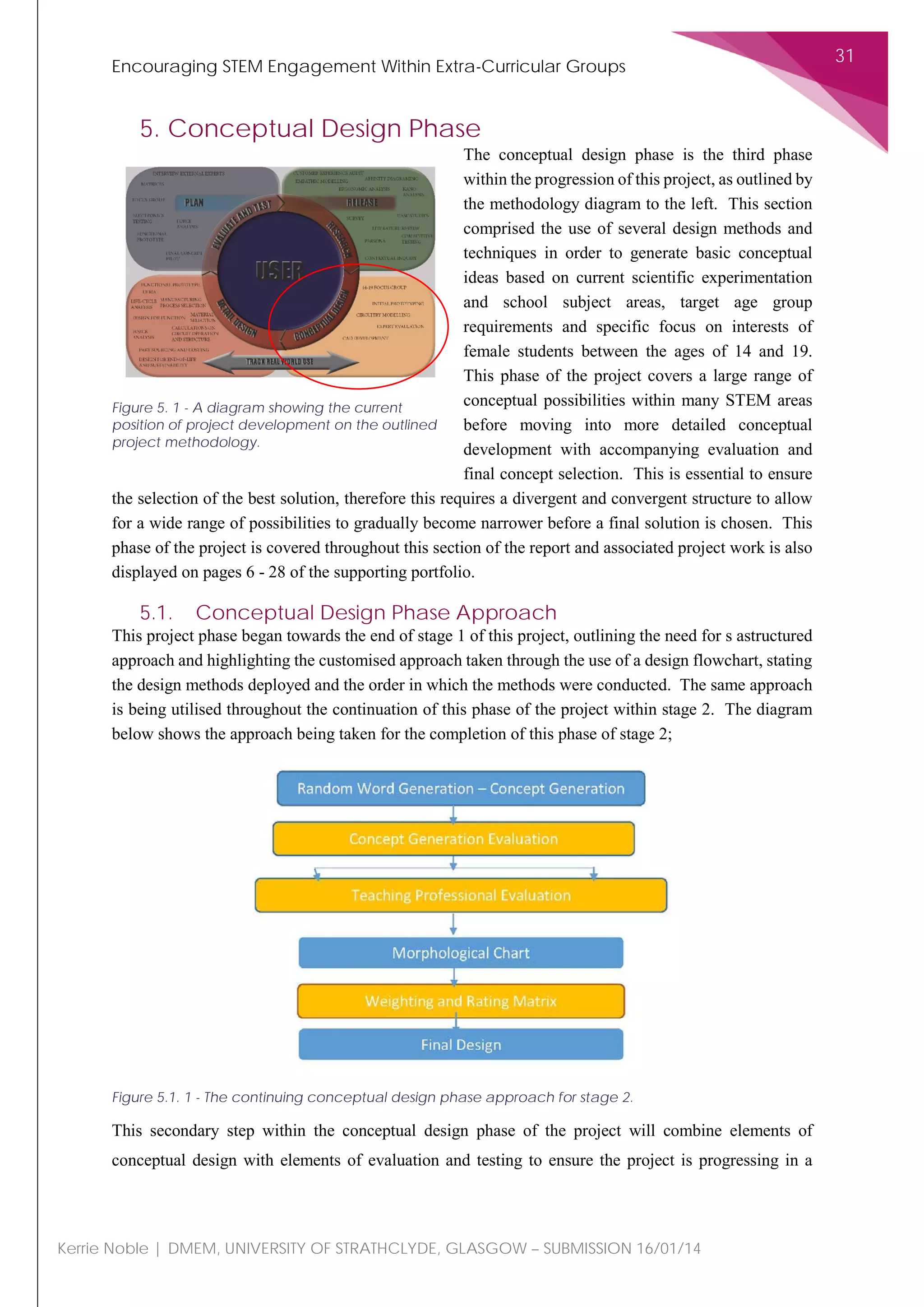
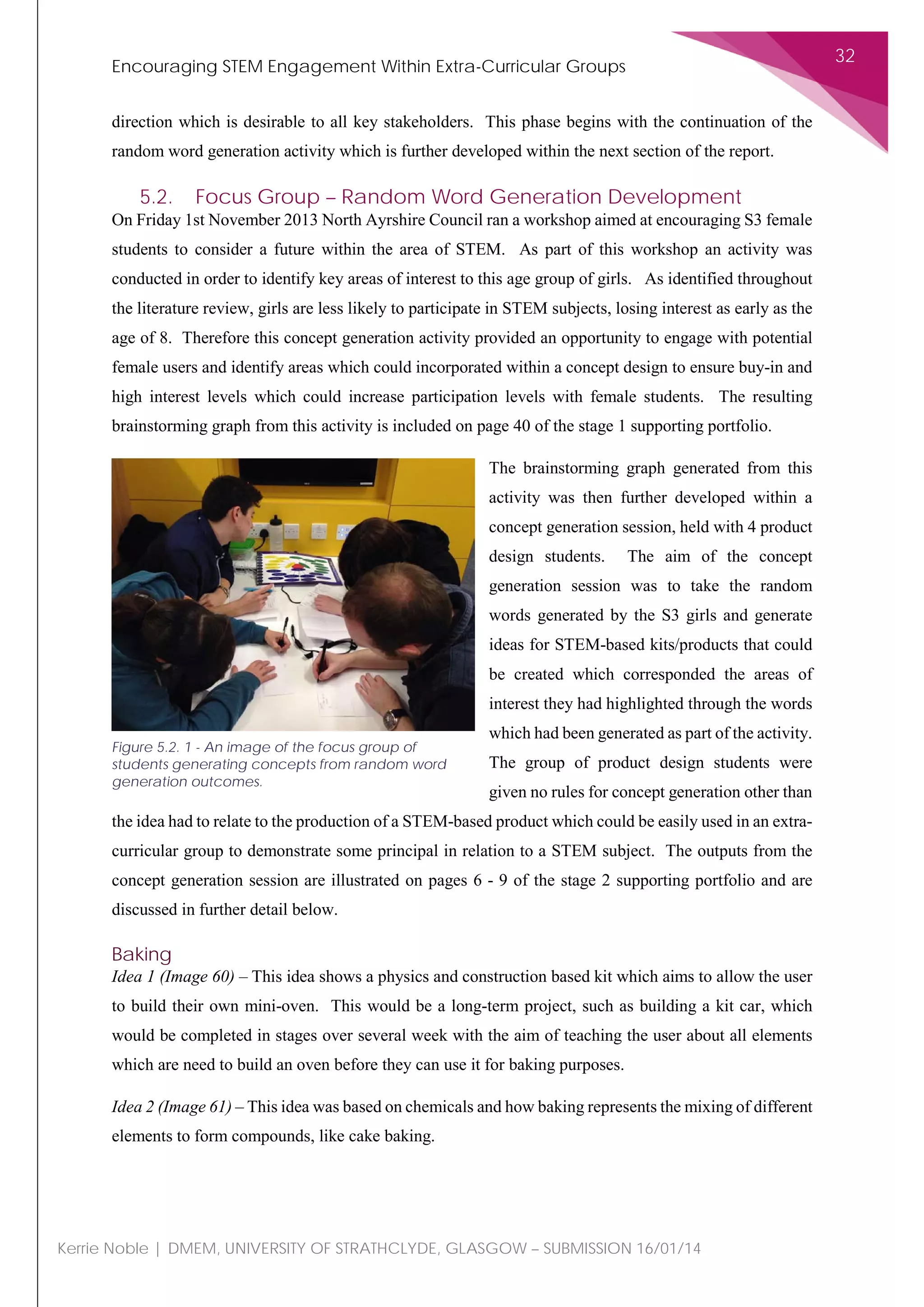
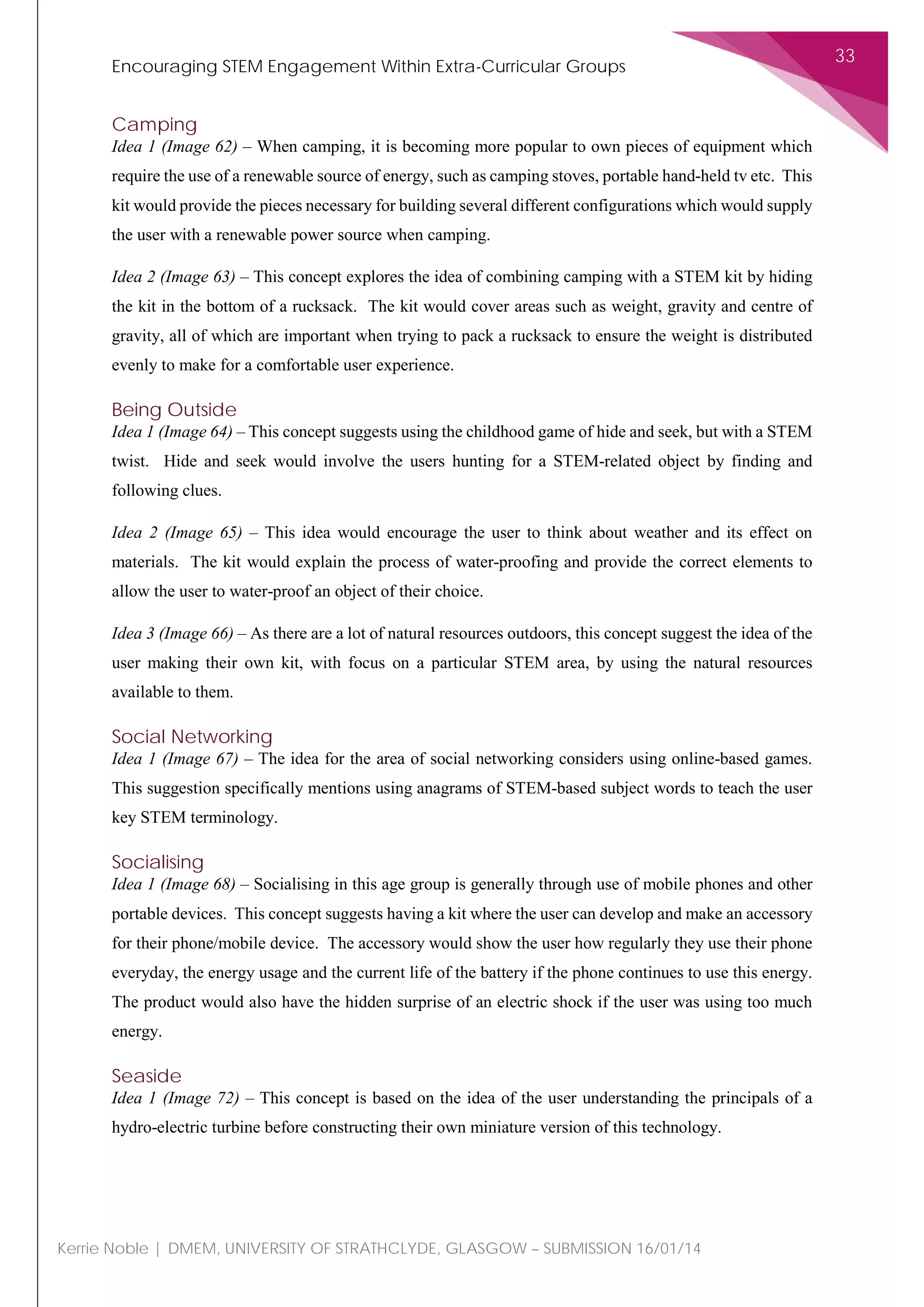
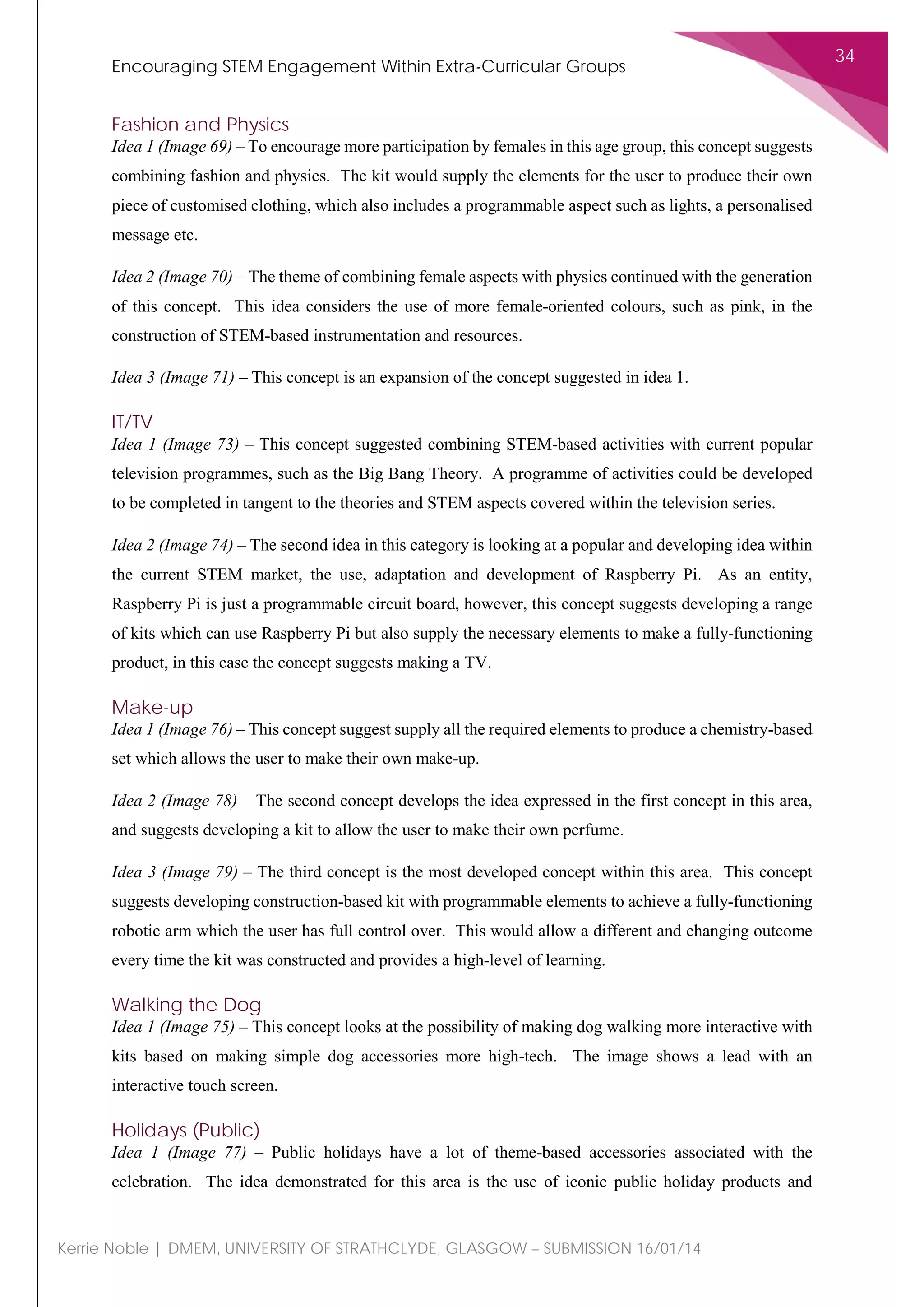
  • 140.
    Encouraging STEM EngagementWithin Extra-Curricular Groups 139 Kerrie Noble | DMEM, UNIVERSITY OF STRATHCLYDE, GLASGOW – SUBMISSION 16/01/14 Material Characteristics and Properties Characteristic Definition Screw Speed The speed of rotation of the screw component used within the injection moulding process. (Kalpakjian & Schmid, 2009) Table 6.4. 3 - A table outlining key material characteristic definitions. Material Characteristics and Properties Polymeric Material Acrylonitrile Butadiene Styrene (ABS) *Impact Grade, Moulded Polybutylene Terephthalate (PBT) *Impact Grade Polylactic Acid *PLA Biopolymer High-impact polystyrene *425 *Density 1.00 – 3.50 g/cc 1.13 - 1.73 g/cc 1.00 - 1.62 g/cc 1.04 g/cc *Linear Mould Shrinkage 0.00100 - 0.0100 cm/cm 0.00160 - 0.0270 cm/cm 0.00300 - 0.0130 cm/cm 0.0050 cm/cm Linear Mould Shrinkage, Traverse 0.00400 - 0.00900 cm/cm 0.00160 - 0.0300 cm/cm Value Not Provided Value Not Provided *Hardness, H358/30 80.0 - 98.0 MPa 104 - 120 59.0 - 77.0 110 *Tensile Strength, Ultimate 24.0 - 138 MPa 27.6 - 145 MPa 16.0 - 114 MPa 29.0 MPa *Tensile Strength, Yield 28.0 - 93.1 MPa 27.0 - 135 MPa 16.0 - 103 MPa 30.0 MPa Elongation at Break (%) 3.00 - 87.0 % 2.00 - 120 % 1.00 - 430 % 30 % *Elongation at Yield (%) 2.00 - 10.0 % 3.00 - 130 % 2.00 - 400 % Value Not Provided *Modulus of Elasticity 1.40 - 2.80 GPa 1.60 - 17.0 GPa 0.230 - 13.8 GPa 3.03 GPa Flexural Yield Strength 47.1 - 579 MPa 45.0 - 172 MPa 6.00 - 145 MPa Value Not Provided
  • 141.
    Encouraging STEM EngagementWithin Extra-Curricular Groups 140 Kerrie Noble | DMEM, UNIVERSITY OF STRATHCLYDE, GLASGOW – SUBMISSION 16/01/14 Material Characteristics and Properties Polymeric Material Acrylonitrile Butadiene Styrene (ABS) *Impact Grade, Moulded Polybutylene Terephthalate (PBT) *Impact Grade Polylactic Acid *PLA Biopolymer High-impact polystyrene *425 *Electrical Resistivity 1.00e+11 - 1.00e+17 ohm- cm 1.00e+11 - 1.00e+17 ohm- cm Value Not Provided Value Not Provided *Surface Resistance 1.00e+14 - 1.00e+15 ohm 1.00e+6 - 1.00e+15 ohm Value Not Provided Value Not Provided *Thermal Conductivity 0.150 - 0.200 W/m-K Value Not Provided Value Not Provided 0.185 W/m-K Glass Transition Temperature 105 - 108 °C Value Not Provided 45.0 - 120 °C Value Not Provided *Flammability, UL94 HB - V-0 HB - V-0 HB - V-0 HB @Thickness 3.10 mm HB Flammability Test 45.0 - 55.0 Value Not Provided Value Not Provided Value Not Provided Haze 2.00 - 2.20 % Value Not Provided 2.00 - 85.0 % Value Not Provided Gloss 6.00 - 96.0 % Value Not Provided 90.0 % Value Not Provided *Processing Temperature 180 - 270 °C 224 - 280 °C 165 - 185 °C *Feed Temperature Value Not Provided *Die Temperature 113 - 250 °C Value Not Provided 185 - 200 °C Value Not Provided Melt Temperature 170 - 302 °C 190 - 280 °C 154 - 243 °C Value Not Provided Mould Temperature 29.0 - 105 °C 30.0 - 110 °C 10.0 - 105 °C Value Not Provided
  • 142.
    Encouraging STEM EngagementWithin Extra-Curricular Groups 141 Kerrie Noble | DMEM, UNIVERSITY OF STRATHCLYDE, GLASGOW – SUBMISSION 16/01/14 Material Characteristics and Properties Polymeric Material Acrylonitrile Butadiene Styrene (ABS) *Impact Grade, Moulded Polybutylene Terephthalate (PBT) *Impact Grade Polylactic Acid *PLA Biopolymer High-impact polystyrene *425 Injection Velocity 60.0 - 240 mm/sec Value Not Provided Value Not Provided Value Not Provided *Drying Temperature 70.0 - 100 °C 100 - 140 °C 45.0 - 100 °C Value Not Provided *Dry Time 2.00 - 24.0 hour 2.00 - 6.00 hour Value Not Provided Value Not Provided Injection Pressure 4.14 - 150 MPa 44.1 - 103 MPa 55.2 - 138 MPa Value Not Provided *Back Pressure 0.000 - 58.8 MPa 0.000 - 4.90 MPa 0.345 - 1.72 MPa Value Not Provided Screw Speed 25.0 - 100 rpm 70.0 - 100 rpm 20.0 - 200 rpm Value Not Provided Table 6.4. 4 - A table outlining material properties and key material characteristics. (Mat Web, 2014) The critical material properties for the components of the product have been identified in relation to the static force bearing, pressure and grip strengths which the material will have to withstand during use, as outlined in the above section through the embodiment design phase. These properties have been identified as critical as the wrong values within these material properties could result in failure of the component under force loading or stress. To ensure failure is avoided the material selection will be based on the available range available within these material properties for each polymeric material listed above. The critical properties are identified in the table above by a red star. The most suitable material for the product, within each material property has been highlighted in green. The most appropriate material for the product will therefore have the majority of green values identified against the critical material properties. The reasoning behind the selections within the table above is discussed below. Density: In order to keep the total weight of the product to a minimum a low density is required from the selected material. A low density represents a lower mass to volume ratio. This therefore means
  • 143.
    Encouraging STEM EngagementWithin Extra-Curricular Groups 142 Kerrie Noble | DMEM, UNIVERSITY OF STRATHCLYDE, GLASGOW – SUBMISSION 16/01/14 that a larger volume of material can be used with a low component mass. Both ABS and PLA have the ability to produce a density of 1.00. This will vary across the different grades available within both of these materials. This is the lowest density value available from the selection of materials presented in the material comparison table above. Linear Mould Shrinkage: Linear mould shrinkage states the amount of shrinkage which will occur in the material upon cooling. As it is a requirement to have the component made as accurately as possible as this will affect the fit between various components within the product, the smallest shrinkage value is desirable. The smallest shrinkage value available from the selection of materials was 0.00100 cm/cm. This is a characteristic of ABS. Hardness – H358/30: This hardness value signifies the stiffness of the material. In terms of use of this product, a high stiffness is not desirable as this type of material is more likely to suffer a critical failure through cracking under static loading and pressure asserted by the users’ hand grip. Due to this requirement a low hardness value was identified as being more suitable for this design. The lowest hardness value identified from the listed materials was 104 – 120 Pa, an attribute of PBT. Tensile Strength, Ultimate: The ultimate tensile strength, where the material fractures and breaks under loading, is an important consideration. The forces identified as occurring under loading through use of this product must not exceed the ultimate tensile strength as this will result in material failure. For this reason the highest possible ultimate tensile strength was desirable. This value was 27.6 - 145 MPa from the selected materials and this was a property of PBT. Tensile Strength, Yield: The yield tensile strength, where the material stretches beyond its elastic limit, was also an important consideration when designing in relation to the loading pressures and forces associated with the use of this product. Again it is important that the forces exerted through use of the product do not exceed this material limit as this will result in distorted and weak parts. For this reason the highest possible yield tensile strength was desirable. This value was 27.0 - 135 MPa and again is an attribute achievable through the use of PBT. Elongation at Yield (%): Elongation at yield demonstrates how brittle a material is. As it is undesirable to have a brittle material in this product due to the forces being generated under loading and the environment of use a large elongation at break is required. The largest elongation at break value was achieved through use of PLA and was listed as 2.00 - 400 %. Modulus of Elasticity: The modulus of elasticity is another indication of the stiffness of a material. As with the hardness value, a large value is seen as detrimental to the design of the product as a stiff material is more likely to fail under static force loading. For this reason the lowest possible modulus of elasticity
  • 144.
    Encouraging STEM EngagementWithin Extra-Curricular Groups 143 Kerrie Noble | DMEM, UNIVERSITY OF STRATHCLYDE, GLASGOW – SUBMISSION 16/01/14 from the possible materials was required as this suggests a more pliable material. The lowest value was a characteristic of PLA and was listed as 0.230 - 13.8 GPa. Electrical Resistivity: Considering the safety to the user, electrical resistivity is desirable to ensure the user is not in danger of receiving an electric shock from the product as both electrical items and the components will interact with one another. For this reason the highest electrical resistivity value was desirable as this demonstrates the material which is most resistive to electrical current. Two of the listed materials, ABS and PBT, demonstrated equal electrical resistivity of 1.00e+11 - 1.00e+17 ohm- cm. Surface Resistance: The surface resistance indicates the ability of the surface to resist the flow of electrical current. As most of the electrical components will be placed on the surface of different components made from the selected material this is an important attribute. A high resistivity is required and the highest resistivity value from the listed materials was 1.00e+14 - 1.00e+15 ohm as demonstrated by ABS. Thermal Conductivity: It is important that the components do not conduct heat as this is a safety issue when using a product with children. Therefore the lowest thermal conductivity is desirable for this material selection. The lowest value stated from the list of possible materials was 0.150 - 0.200 W/m- K as demonstrated by ABS. Flammability UL94: The product must meet appropriate safety standards, including flame retardant tests, therefore the selected material must be in the highest grade of the flammability UL94 grading system. All of the listed materials met this criteria. Processing Temperature: In material selection for this product a low processing temperature was desirable. As the product will be made primarily from polymeric material it is important to reduce the sustainability issues surrounding the use of this type of material through other means. Reducing the sustainability issues can be achieved by processing the material at as low a temperature as possible as this is reduces environmental pollution associated with the manufacture of the product. The material providing the ability to be manufactured at a lower temperature is PLA. Die Temperature: For the same reasons as stated in the processing temperature selection requirements, a lower die temperature was deemed to be desirable. The material requiring the lowest die temperature for the manufacturing process was ABS.
  • 145.
    Encouraging STEM EngagementWithin Extra-Curricular Groups 144 Kerrie Noble | DMEM, UNIVERSITY OF STRATHCLYDE, GLASGOW – SUBMISSION 16/01/14 Drying Temperature: For the same reasons as stated in the processing temperature selection requirements, a lower drying temperature was deemed to be desirable. The material requiring the lowest drying temperature for the manufacturing process was PLA. Dry Time: A long dry time adds to the manufacturing lead time associated with the product, therefore meaning the time taken from the start of the production process to the product being sold is increased. To be competitive within the market this lead time needs to be as short as possible. The materials with the fastest dry time were ABS and PBT, both having the ability to be dried within 2 hours, dependent on the grade of material and the drying temperature used. Back Pressure: Back pressure within the die prohibits the movement of the molten material through the die. As this may distort the outcome of the process and induce weaknesses within the material the lowest back pressure value was thought to be desirable. Both ABS and PBT can achieve back pressure values of 0 dependent on the grade of material and temperature. After this consideration the selected material for this product is Acrylonitrile Butadiene Styrene (ABS) *Impact Grade, Moulded. A grade of rubber will also be used to provide a non-slip surface on the bottom surface of the corner bracket to increase the coefficient of friction between the product and the surface of use, e.g. a table top surface. The manufacturing processes required will be selected and discussed accordingly. Fastener Material Selection Fasteners are available in a wide range of materials and selecting the most appropriate fastener material in relation to the other materials utilised within the product is essential. Selecting a fastener made from very hard material can have a detrimental effect on the amount of wear the other material will be subjected to. As ABS has been selected as the material which all other components within this product will be manufactured, an appropriate fastener material will be chosen with consideration given to the interaction between the two component materials. Stainless Steel: Stainless steel is known for its corrosion resistance properties and as this property inherent within the structure of the metal, this property will remain regardless of surface scratching which may occur during use. Stainless steel also has less carbon content within the material structure therefore making it stronger than steel but not as strong as hardened steel fasteners. 18-8 grade stainless steel is the most common stainless steel grade used for mechanical fastenings.
  • 146.
    Encouraging STEM EngagementWithin Extra-Curricular Groups 145 Kerrie Noble | DMEM, UNIVERSITY OF STRATHCLYDE, GLASGOW – SUBMISSION 16/01/14 Steel: Steel is the most common material used within fasteners and is also available with various surface treatments, including zinc plating, galvanisation and chrome plating. There are four common grades associated with steel fastening materials; 1. Grade 2 – Standard hardware grade steel and the least expensive. Can be found plated with silver or yellow zinc coating or galvanised for corrosion resistance. 2. Grade 5 – Bolts in this grade are hardened to increase strength and are most commonly used within the automotive industry. Can be found plated with silver or yellow zinc coating or galvanised for corrosion resistance. 3. Grade 8 – Grade 8 bolts have undergone more hardening than the grade 5 bolts. This makes these bolts stronger than grade 5 bolts and are used in demanding conditions such as automotive suspension units. 4. Alloy steel – This grade of material is made from high strength steel alloy and have undergone a heat treatment process. Bolts in this grade are not normally plated and have a dull black appearance, they are strong but extremely brittle. Silicon Bronze: Fastenings made from this material are most commonly found in marine applications. This material is preferred in these environments, as opposed to stainless steel, because of its extreme corrosive resistance properties and its higher strength values in comparison with brass. It is also used in woodwork because of its appearance properties but has a high associated cost. Brass: Brass is corrosive resistant and electrically conductive but is only used as a fastener material due to its appearance properties due to the material’s softness. Aluminium: Aluminium is light, soft and corrosion resistant. Similar to stainless steel the material corrosion resistance properties are inherent to the material structure and are not affected by surface scratching. Aluminium alloys are common as fastening materials to increase the strength properties available and are commonly made from elements such as manganese, silicon, iron, magnesium, zinc, copper, and silicon. The fastener material selected for use in this product will be an aluminium alloy. This is due to the corrosion resistance properties and the ability to increase strength properties of the material. Stainless steel has similar available properties but is harder than aluminium which may cause issues with wear when the fastener makes contact with other materials in the product, in particular the ABS structural components. The use of steel fastenings has similar issues with hardness. Brass is a softer material however has no strength properties required for the product. Silicone bronze is too expensive and does
  • 147.
    Encouraging STEM EngagementWithin Extra-Curricular Groups 146 Kerrie Noble | DMEM, UNIVERSITY OF STRATHCLYDE, GLASGOW – SUBMISSION 16/01/14 not have added benefits in comparison to the properties which are available through use of a cheaper material such as aluminium. (Bolt Depot, 2014) Process Selection Various manufacturing processes will be required for the different components within the product. Each component and the associated manufacturing processes required are detailed below. Top Platform, Mid-Support Platform, Base and Side Wall Panels As these components are sheets of material with standard sized holes which continue through the whole material thickness, the best process of achieving this simple sheet with minimal material wastage and a short lead time is polymer sheet extrusion. This process is detailed below. Extrusion is a continuous process of polymer melting and conveying the melted material in a screw and barrel arrangement. The molten material is forced to flow through a screen pack before exiting through a sheet die where the desired material thickness and width is set. Upon exiting the die the material is wound through a three-chill-roll stack for cooling. The sheet material is further cooled on the conveyor and has edges trimmed to the final desired length. The sheet material is then rolled or stored until required. The process is illustrated in the diagram below. The Screw and Barrel The screw is a long steel shaft with increasing root diameter and helical flights of constant pitch wrapped around the shaft diameter. A screw typically has a compression ratio of 3:1 and a minimum length- over-diameter ratio of 24:1. The barrel is a hollow cylindrical component which houses the screw. The clearance between the screw flights and the inner wall of the barrel is approximately a constant 0.005 inches along the length of the barrel. The feed inlet is a hole cut immediately above the first flight of the screw. This allows material to be fed into the screw from the hopper. Figure 6.4. 9 - A diagram outlining the extrusion process.
  • 148.
    Encouraging STEM EngagementWithin Extra-Curricular Groups 147 Kerrie Noble | DMEM, UNIVERSITY OF STRATHCLYDE, GLASGOW – SUBMISSION 16/01/14 The Compression Ratio This ratio is the ratio of the volume in the first flight in the feed section to the last flight in the metering section. The typical ratio is 3:1 as a higher ratio can cause excess shearing and degradation within the resin. A lower ratio provides inadequate shear and poor mixing of molten polymer material in the barrel. The Length/Diameter Ratio The L/D ratio, as previously stated, is 24:1 or greater. The L/D ratio states that the barrel length is 24 times greater than the diameter of the barrel. This ratio ensure adequate time is given to residence, allowing the polymer material to mix and melt. Screw Zones The extruder screw is divided into three zones, the feed zone, the compression zone and the metering zone. The feed zone: Within this zone the screw has a constant pitch and channel depth. This zone is primarily responsible for heating and mixing the material entering at the feed inlet, this is achieved by conduction heating coming from heaters placed around the barrel. This zone has the deepest channels of any screw section and often operates at a temperature which is less than the rest of the screw extruder. This is designed to maximise the forward progression of the melted polymer material along the screw zones within the barrel. The compression zone: This zone may also be known as the transition zone and has a cone shaped root and reduced channel depth in comparison to the feed zone. This section is where the soft material pellets are melted whilst also eliminating trapped air. Additional heat is generated by the friction between the polymer material and the flight and barrel surfaces and this is combined with heat generating from external heaters to ensure the material reaches a molten state. This zones accounts for approximately 50% of the total length of the screw. The metering zone: The metering zone is the last zone of the screw, from the end of the compression zone to the screw tip. This zone comprises a constant cross-section and shallower channel depth than both the preceding zones. These dimensions subject the polymer to harsher shearing and mixing, steps taken to homogenise the polymer physically and thermally. A constant polymer temperature is critical to avoiding delamination, warping and other imperfections which may affect the finished product. The Sheet Die
  • 149.
    Encouraging STEM EngagementWithin Extra-Curricular Groups 148 Kerrie Noble | DMEM, UNIVERSITY OF STRATHCLYDE, GLASGOW – SUBMISSION 16/01/14 The sheet die is used to spread the polymer, in its molten state, to a pre-determined width and constant thickness required for the polymer sheet production. The die typically has an internal adjustable choker bar to uniformly distribute polymer flow across the width of the die. The die also has a flexible upper lip to allow fine adjustment of the final sheet thickness. The die manufacturer will require the following information; • Viscosity versus shear rate of the polymer • Thickness range of the final product • Sheet width • Throughput weight Sheet Cooling On exit from the sheet die the polymer sheet will undergo different stages of cooling, detailed below. Polishing roll stack: This comprises the use of three, highly polished, chrome-plated rolls which have cooling passages to maximise heat transfer from the polymer and minimise side-to-side temperature gradients. Each roll has a fluid temperature control unit and pump. The cooling fluid therefore circulates at an adequate rate to cool the sheet and provide it with a smooth finish. A roll has precise surface flatness and roundness to achieve a smooth sheet, each of these rolls are set at exact distances which are equal to the desired final thickness of the sheet material. Cooling conveyor: The cooling conveyor is typically 10 to 20 feet in length and allows the sheet material to lay flat whilst unforced ambient air cools the polymer material, this minimises warping of the final product. Near the end of this cooling stage the polymer sheet will have the edge trimmed and cut to the desired width of the final sheet product. Pull roll: The pull roll comprises of two rolls covered in rubber to provide good traction for the sheet polymer which is placed under tension to ensure good contact between the sheet surfaces and the polishing rolls. The polymer sheet is then either wound on a roll or sheared and stored for later use. (Lyondell Chemical Company, 2014) Laser Cutting Laser cutting combines computer parameters and a high-powered beam to cut through materials. Everything which falls within the path of the laser guided beam is vaporised, burned or melted. One of the major benefits of this processing technology, especially in relation to the design of this product, is
  • 150.
    Encouraging STEM EngagementWithin Extra-Curricular Groups 149 Kerrie Noble | DMEM, UNIVERSITY OF STRATHCLYDE, GLASGOW – SUBMISSION 16/01/14 the very high quality surface finish achieved through this process. Parts produced using this method rarely need any finishing or surface treatment. There are two main formats within laser cutting technology, gantry and galvanometer. The gantry format positions the laser perpendicularly to the material and the machine directs the beam over the surface of the material. Gantry is a slower setup in comparison to the galvanometer process and therefore is more commonly used for producing prototypes or one-off products due to the time taken for production. Galvanometer setups use mirrored angles to reposition the laser beam, again based on computer parameters, and this setup can achieve process speeds of up to 100 feet per minute. Basic Process mechanics: Common stimulation and amplification techniques associated with the use of lasers are used to convert electrical energy into a high-density beam of light. Stimulation occurs when electrons are excited by an external source and amplification occurs within the optical resonator in a cavity that is set between two mirrors. If a photon is not aligned with the resonator, the mirrors do not redirect it. This ensures that only the properly oriented photons are amplified to create a coherent beam. Properties of laser light: The main optical properties associated with laser light include coherence, mono-chromaticity, diffraction and radiance. Coherence identifies the relationship between magnetic and electronic components of the electromagnetic wave. Mono-chromaticity is the measurement of the width of the spectral line. Diffraction occurs when light bends around sharp-edged surfaces. Radiance is the amount of power per unit area emitted at a given solid angle and is influenced by the design of the laser cavity. The use of this process in the manufacturing of this product eliminates the need for drilling and various finishing processes and reduces the lead time taken to introduce the product to the market. The fact that this product is also based on the idea of a modular kit which is constructed from a group of simple components which can be built and re-built in different combinations means that part production levels will be relatively high and therefore justifies the use of this process. (Thomasnet, 2014) Three-point Support Arm and Corner Bracket As these components are more geometrically complex than the side walls and platforms which have been considered in the process selection above, simple processes such as extrusion and laser cutting are not suitable to produce the required shape detailed for this design. This means that a different manufacturing process must be used to fabricate these parts. In order to select a suitable process the following parameters were considered; • Quantity and production rate
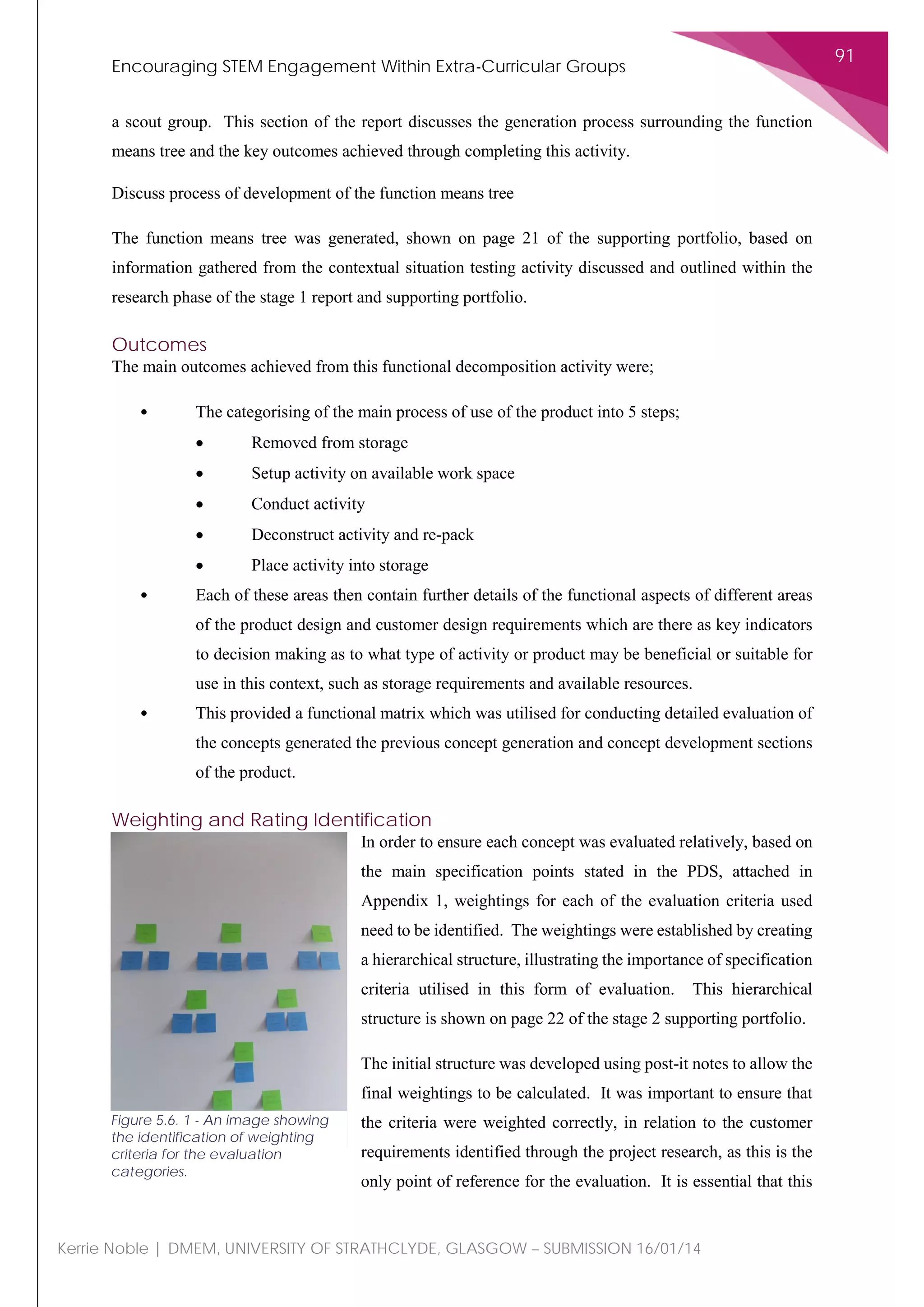
  • 151.
    Encouraging STEM EngagementWithin Extra-Curricular Groups 150 Kerrie Noble | DMEM, UNIVERSITY OF STRATHCLYDE, GLASGOW – SUBMISSION 16/01/14 • Dimensional accuracy and surface finish • Form and detail of the product • Nature of material • Size of final product Having considered all of the parameters outlined above it is clear that the production volume, dimensional accuracy, surface finish and size of the product require the use of the injection moulding process as this is the only process, aside from liquid resin casting, which is capable of producing this shape. Liquid resin casting was discarded from consideration for the manufacturing process due to its low production volume, this technique is typically used for prototyping parts. (Resin Supplies, 2014) Summary With the information from above I have been able to amend the points of the PDS which I also previous outlined as being important within this component of the design. The use of specific values shows that the embodiment design phase has taken place and that all interactions and situations which the handle/brake lever component will face have been considered. 1.1 The product must have a high robustness in quality to withstand the everyday stress. The everyday stress the handle must deal with will range between 13.7Nm and 729N. 1.2 The product must be fully functional for a minimum of 10 years. 1.3 The product should be the correct shape to make the user feel comfortable during use. This will involve designing a curved component which fits into the hand and entices a natural grip to occur. 1.4 The product’s design should be aesthetically pleasing and so should utilise smooth curved shapes and a colour scheme which would be perceived as attractive by a large percentage of the public 1.5 The product must comply with all relevant British Safety Standards. 1.6 As the product is used with children extra attention should be paid to the design of any small parts and should be avoided if possible. 1.7 There should be no sharp edges. 1.8 There should be no danger of trapping the users’ fingers in the mechanisms. 1.9 Must meet safety standard set out in BSI Catalogue under Ergonomics 13.180 1.10 Must meet safety standard set out in BSI Catalogue under Fire Protection 13.220. 1.11 The product should be ergonomically designed for the user so that pushing it is as comfortable as possible. This involves the size of the handle which should be 160mm in length and 70mm in breadth, this is the maximum size expected.
  • 152.
    Encouraging STEM EngagementWithin Extra-Curricular Groups 151 Kerrie Noble | DMEM, UNIVERSITY OF STRATHCLYDE, GLASGOW – SUBMISSION 16/01/14 1.12 Sharp edges will not be included in the design of this product to comply with British Safety Standards. 1.13 The product should be made from an eco-friendly material which is easy to clean, durable and waterproof to suit the area in which it will be placed. 1.14 The product should not contain animal leather as some people may have moral objections to this. Microfibers are available alternative to provide the same look but without offending users. 1.15 Fabric used in the product must be easily removed from the frame of the product and easily cleared as the product is used with children this is required for hygiene reasons. 1.16 Any metallic materials, PVC or polythene are ideal materials for this product as they have a smooth surfaces for easy cleaning, appropriate robust properties, water resistant and offer a long life cycle. They don’t require much maintenance, are easily coloured and moulded and are relativity easily recycled. 1.17 The material ideally should have resistant to water, salt, dust, wind, ice, rocks, common solvents, oil, gasoline and wind speeds up to 50 mph. 1.18 Any moving parts should not pose a hazard to the user. Using existing technology, that that in medicine bottle caps will ensure that safety is of paramount concern within the design. 1.19 The product’s construction should be of a high quality to ensure customer satisfaction 1.20 The product should be very reliable as it will be under constant strain through daily use 1.21 All materials must meet the standards required (see standard specifications - 3) 1.22 The product must adhere to British Safety standards as it is being used in a public area. 1.23 The product must be suitable for batch production. 1.24 It must have a maximum 5% failure rate over service life. 1.25 The product needs to out-perform competition through performance and aesthetic. 1.26 The product should be cheaper and more widely available than the competitions. 1.27 The material should be waterproof so it is easy to maintain. 1.28 The product is to require no regular servicing of maintenance except routine cleaning of material and surfaces. 1.29 The product should be cheaper than our main competition. 1.30 The cost of the product should be kept to a minimum, ideally less than £500. 1.31 This product must be suitable for mass production. This will involve standardised parts and sizes for quick and easy production. 1.32 Corrosion resistance may be considered by the use of special materials or surface protection methods. 1.33 The handle component should perform and not be damaged by temperatures in the range of -30o C to 40o C.
  • 153.
    Encouraging STEM EngagementWithin Extra-Curricular Groups 152 Kerrie Noble | DMEM, UNIVERSITY OF STRATHCLYDE, GLASGOW – SUBMISSION 16/01/14 1.34 Chemicals must provide no effect on the materials used within the product. 6.5. Engineering Design - Calculations Engineering Battery Life Calculations • Ampere hour rating of battery – 2.7amp/hr (http://www.cloudynights.com/ubbarchive/showflat.php/Cat/0/Number/1514782/page/6/view/ collapsed/sb/7/o/all) • Current devices require 20mA for the rotation of one motor (http://www.maplin.co.uk/p/motors-n72ch) • Life of battery for ideal conditions is 2.7/0.02 = 135 hours Charging Calculations If the product were to removed alkaline batteries and replace the power source with a rechargeable battery pack the following charging time would apply; • Dyno torch – offers 15 minutes of illumination for 1 minute of charging. The illumination requires the same mA supply as the motor used in the kit. • This means for 12 seconds of charging we should get 3 minutes of motor rotation. (based on charging rate occurring at 2 – 3 revolutions per second) (http://www.comparestoreprices.co.uk/gadgets/unbranded-dynamo-torch.asp) Buckling Calculations This has been based on the maximum force which may be exerted by the target user group, 729N thumb and finger grip from the 95th male percentile, when the three-point support are is at an angle of 45°. 729N has to be given a factor of safety to ensure the arm does not fail under buckling. A factor of safety of 4 will be used therefore making force F = 4374N Force Analysis at Point A; Force F = 4374/sin 45° Force F = 6185.770122N = 6.186kN This is the force on the column and it is in compression. The material to be used is ABS PC with Ε = 2.41 x 10⁹ and σ = 40 x 106 For a rectangular column, with b the section breadth and h the section height, 𝐼𝐼 = 𝑏𝑏ℎ3 12 𝐴𝐴 = 𝑏𝑏ℎ
  • 154.
    Encouraging STEM EngagementWithin Extra-Curricular Groups 153 Kerrie Noble | DMEM, UNIVERSITY OF STRATHCLYDE, GLASGOW – SUBMISSION 16/01/14 𝜌𝜌 = � ℎ2 12 A column with one pivoted end and one freely moving end has an effective length of; L = 0.19mm Leff = 0.152 mm (Leff = 0.8L from table) Therefore 𝐿𝐿𝑒𝑒𝑒𝑒𝑒𝑒 𝜌𝜌 = 0.152 √12 ℎ Assuming the column corresponds to a Euler type column; 𝑃𝑃𝐶𝐶𝐶𝐶 𝐴𝐴 = 𝜋𝜋2 𝜖𝜖 ( 𝐿𝐿𝑒𝑒𝑒𝑒𝑒𝑒 𝜌𝜌 )2 PCR = 4124N 6186 𝐴𝐴 = 𝜋𝜋2 𝑥𝑥2.41 𝑥𝑥 109 0.1522 𝑥𝑥 12 ℎ2 6186 = 2.378574661 𝑥𝑥 1010 𝑥𝑥 𝑏𝑏ℎ 0.277248 ℎ2 Figure 6.5. 1 - A diagram outlining possible end conditions of loaded memebers.
  • 155.
    Encouraging STEM EngagementWithin Extra-Curricular Groups 154 Kerrie Noble | DMEM, UNIVERSITY OF STRATHCLYDE, GLASGOW – SUBMISSION 16/01/14 6186 = 2.378574661 𝑥𝑥 1010 𝑥𝑥 𝑏𝑏ℎ3 0.277248 𝑏𝑏ℎ3 = 6186 𝑥𝑥 0.277248 2.378574661 𝑥𝑥 1010 Assuming a minimum value for b of 7mm 𝑏𝑏ℎ3 = 7.21036385 𝑥𝑥 10−3 ℎ3 = 1.030062341 𝑥𝑥 10−5 ℎ = 0.021758 𝑚𝑚 = 21.8𝑚𝑚𝑚𝑚 In order to check the column is an Euler column; 𝐿𝐿𝑒𝑒𝑒𝑒𝑒𝑒 𝜌𝜌 = 𝜋𝜋 𝑥𝑥 0.152 √12 21.8 𝑥𝑥 10−3 𝐿𝐿𝑒𝑒𝑒𝑒𝑒𝑒 𝜌𝜌 = 75.88 *The above calculation is based on using ABS thermoplastic, as selected during the embodiment design section of the project with all relevant material data taken from the Solidworks CAD model. The break point between Euler and Johnson buckling occurs when 𝐿𝐿𝐿𝐿𝐿𝐿𝐿𝐿 𝜌𝜌 = 75.7, therefore this means that if ABS is used the column behaves as an Euler column and the minimum dimension requirements for the rectangular cross section are; B = 7mm H = 21.8mm
  • 156.
    Encouraging STEM EngagementWithin Extra-Curricular Groups 155 Kerrie Noble | DMEM, UNIVERSITY OF STRATHCLYDE, GLASGOW – SUBMISSION 16/01/14 Fastener Design Calculations The diagram above illustrates the fastening locations and section sizes concerning the design of corner connector option 2. The following information will be used to detail the length requirement of the screw for fastening purposes. H = 80mm X1 = 8mm From moment of equilibrium about point 1; 330 𝑥𝑥 80 − 𝐹𝐹18 = 0 𝐹𝐹1 = 330 𝑥𝑥 80 𝑥𝑥 8 𝐹𝐹1 = 2112𝑁𝑁 If yield strength in tension is 80 MPa (N/mm2), yield strength in shear, τ, can be estimated as 80/2=40 MPa (assuming Tresca yield condition). If pretension is using half of this value, what is left (τ=20 MPa) has to sustain the working load F. Thus the length of the threaded part of the screw should be: Figure 6.5. 2 - A diagram representing the fastening and loading occurring within the product design.
  • 157.
    Encouraging STEM EngagementWithin Extra-Curricular Groups 156 Kerrie Noble | DMEM, UNIVERSITY OF STRATHCLYDE, GLASGOW – SUBMISSION 16/01/14 𝐿𝐿 = 𝐹𝐹 𝜋𝜋 𝑥𝑥 𝑑𝑑 𝑥𝑥 𝜏𝜏 𝐿𝐿 = 2112 𝜋𝜋 𝑥𝑥 6 𝑥𝑥 20 𝐿𝐿 = 5.6022𝑚𝑚𝑚𝑚 = 6𝑚𝑚𝑚𝑚 Taking into account a conical lead of 4 mm and thickness of Section 1 equal to 10 mm, the total screw length should be: 4+10+6=20 mm Bending Moments and Shear Stress Calculations Bending Moment Consideration 1 The diagram above illustrates the top section of the three-point support arm assembly and identifies the key forces acting on this member. Assuming the member acts as a beam in this instance the bending moments and torsion forces related to this design have been identified below through the use of Dr Beam software utilised for this purpose. Figure 6.5. 3 - A free body diagram on the loading occurring on the top member of the three-point arm support design.
  • 158.
    Encouraging STEM EngagementWithin Extra-Curricular Groups 157 Kerrie Noble | DMEM, UNIVERSITY OF STRATHCLYDE, GLASGOW – SUBMISSION 16/01/14 The beam properties, representing the top member of the three-point support arm, are as follows; E = 2.41 GPa I = 58272632.674298 mm4 Area = 3870.960000 mm2 Length = 0.144 m Figure 6.5.5. has been represented on the software and using the given values the following output was achieved; Figure 6.5. 4 - A diagram showing the beam properties used for these calculations.
  • 159.
    Encouraging STEM EngagementWithin Extra-Curricular Groups 158 Kerrie Noble | DMEM, UNIVERSITY OF STRATHCLYDE, GLASGOW – SUBMISSION 16/01/14 The beam representation shows a 15.6kN point force at 0.068m from the left-hand side of the beam and a 180N point force acting 0.134m from the left-hand side of the beam. These forces represent the force exerted by the M4 screw and the loading occurring through the positioning of the motor and the fan blade respectively. This results in a reaction force of R1 = 8.246kN on the left-hand side and a reaction force of R2 = 7.534kN on the right-hand side. The shear force exerted on the beam member is 8.246kN and the maximum bending moment is 0.560kN-m. However these values do not represent the maximum values which may be experienced by the member, this occurs when a torque force, associated with the placement of the M4 bolt, is also being exerted on the member. This has been considered in the following bending moment and shear force diagrams. Figure 6.5. 5 - A representation of the loaded beam.
  • 160.
    Encouraging STEM EngagementWithin Extra-Curricular Groups 159 Kerrie Noble | DMEM, UNIVERSITY OF STRATHCLYDE, GLASGOW – SUBMISSION 16/01/14 The beam representation shows a 15.6kN point force at 0.068m, as well as a 9.5Nm torque force, from the left-hand side of the beam and a 180N point force acting 0.134m from the left-hand side of the beam. These forces represent the force exerted by the M4 screw, the user force exerted whilst placing the M4 bolt and the loading occurring through the positioning of the motor and the fan blade respectively. This results in a reaction force of R1 = 8.180kN on the left-hand side and a reaction force of R2 = 7.6kN on the right-hand side. The shear force exerted on the beam member is 8.180kN and the maximum bending moment is 0.556kN-m. It is clear that the overall, maximum, shear force and bending moments experienced by the beam have reduced in value during the operation related to the placement of the screw. This will be utilised further in design for bending considerations. Design for Bending Using the Engineer’s equation for bending; 𝜎𝜎 = 𝑀𝑀𝑀𝑀 𝐼𝐼 The bending stress placed on the member (as highlighted in diagram 6.5.6.) can be determined. M = maximum bending moment = 0.556kN Y = perpendicular distance to neutral axis = 0.144m I = 5.827 𝑥𝑥 10−5 m4 Figure 6.5. 6 - An adapted representation of the loaded beam.
  • 161.
    Encouraging STEM EngagementWithin Extra-Curricular Groups 160 Kerrie Noble | DMEM, UNIVERSITY OF STRATHCLYDE, GLASGOW – SUBMISSION 16/01/14 𝜎𝜎 = 556 𝑥𝑥 0.144 5.827 𝑥𝑥 10−5 = 1.374017505 x 10⁶ Factor of Safety = 𝑌𝑌𝑌𝑌𝑌𝑌𝑌𝑌 𝑌𝑌 𝑠𝑠𝑠𝑠𝑠𝑠𝑠𝑠𝑠𝑠𝑠𝑠 𝑜𝑜𝑜𝑜 𝑚𝑚𝑚𝑚𝑚𝑚𝑚𝑚𝑚𝑚𝑚𝑚𝑚𝑚𝑚𝑚 𝐵𝐵𝐵𝐵𝐵𝐵𝐵𝐵𝐵𝐵𝐵𝐵𝐵𝐵 𝑠𝑠𝑠𝑠𝑠𝑠𝑠𝑠𝑠𝑠𝑠𝑠 = 40 𝑥𝑥 106 1.374017505 𝑥𝑥 106 = 29.1117 Bending Moment Consideration 2 The diagram above illustrates the mid-support section of the three-point support arm assembly and identifies the key forces acting on this member. Assuming the member acts as a beam in this instance the bending moments and torsion forces related to this design have been identified below through the use of Dr Beam software utilised for this purpose. Figure 6.5. 7 - A free body diagram illustrating the loading occurring on the mid-support member of the three-point support arm design.
  • 162.
    Encouraging STEM EngagementWithin Extra-Curricular Groups 161 Kerrie Noble | DMEM, UNIVERSITY OF STRATHCLYDE, GLASGOW – SUBMISSION 16/01/14 The beam representation shows a 0.160kN point force at 0.160m from the left-hand side of the beam. This force represents the force exerted through the assembly of the top member and the fan and motor assembly, as shown in diagram 6.5.8.. This results in a reaction force of R1 = 0.009kN on the left-hand side and a reaction force of R2 = 0.051kN on the right-hand side. The shear force exerted on the beam member is 0.009kN and the maximum bending moment is 0.001kN-m. However these values do not represent the maximum values which may be experienced by the member, this occurs when the user may exert a force of 729N on the member through a thumb and finger grip, as identified in the previous embodiment design section. This has been considered in the following bending moment and shear force diagrams. The beam representation shows a 0.160kN point force at 0.160m from the left-hand side of the beam and a 0.729kN point force at 0.035m from the left-hand side of the beam. These forces represent the force exerted through the assembly of the top member and the fan and motor assembly, as shown in diagram ?, and the force exerted by a 95th percentile male within the target user group. This results in a reaction force of R1 = 0.629kN on the left-hand side and a reaction force of R2 = 0.260kN on the right-hand side. The shear force exerted on the beam member is 0.100kN and the maximum bending moment is 0.011kN-m. To see if this changes depending on the distance at which the user force is applied across the beam the following diagrams were generated to display the difference, if any, which may occur within the force loading on the beam. Figure 6.5. 8 - A representation of the loaded beam.
  • 163.
    Encouraging STEM EngagementWithin Extra-Curricular Groups 162 Kerrie Noble | DMEM, UNIVERSITY OF STRATHCLYDE, GLASGOW – SUBMISSION 16/01/14 This beam illustrates the user force being applied at 0.05m from the left-hand side of the beam. This results in a reaction force of R1 = 0.524kN on the left-hand side and a reaction force of R2 = 0.365kN on the right-hand side. The shear force exerted on the beam member is 0.205kN and the maximum bending moment is 0.020kN-m. It is clear that the overall, maximum, shear force and bending moments experienced by the beam have increased in value during the operation related to the placement of the user force generated from a thumb and finger grip. This will be utilised further in design for bending considerations. Design for Bending Using the Engineer’s equation for bending; 𝜎𝜎 = 𝑀𝑀𝑀𝑀 𝐼𝐼 The bending stress placed on the member (as highlighted in diagram 6.5.9.) can be determined. M = maximum bending moment = 0.020kN-m Y = perpendicular distance to neutral axis = 0.170m I = 5.827 𝑥𝑥 10−5 m4 𝜎𝜎 = 20 𝑥𝑥 0.170 5.827 𝑥𝑥 10−5 = 58349.0647Nm-3 Figure 6.5. 9 - An adapted representation of the beam.
  • 164.
    Encouraging STEM EngagementWithin Extra-Curricular Groups 163 Kerrie Noble | DMEM, UNIVERSITY OF STRATHCLYDE, GLASGOW – SUBMISSION 16/01/14 Factor of Safety = 𝑌𝑌𝑌𝑌𝑌𝑌𝑌𝑌 𝑌𝑌 𝑠𝑠𝑠𝑠𝑠𝑠𝑠𝑠𝑠𝑠𝑠𝑠 𝑜𝑜𝑜𝑜 𝑚𝑚𝑚𝑚𝑚𝑚𝑚𝑚𝑚𝑚𝑚𝑚𝑚𝑚𝑚𝑚 𝐵𝐵𝐵𝐵𝐵𝐵𝐵𝐵𝐵𝐵𝐵𝐵𝐵𝐵 𝑠𝑠𝑠𝑠𝑠𝑠𝑠𝑠𝑠𝑠𝑠𝑠 = 40 𝑥𝑥 106 32091.1986 = 685.53 Summary This section has outlined calculations for the detailed design of the three-point support arm in relation to battery life, charging time considerations for the use of a renewable power source, buckling calculations, fastener design calculations and bending moment and shear stress considerations leading to the identification of factor of safety within the design relating to the occurrence of bending within particular members of the support arm. This has analysed the detail design considerations made to this point, including material selection and fastening selection, and have concluded that selections made in the previous embodiment design section have proven to be appropriate in relation to the design of the support arm, thus ensuring the design will be fit for the intended functionality. The following key points were identified; Key Learning Points; • Battery life – assuming ideal conditions = 135 hours • Charging Time – assuming a renewable energy source was used instead of the current battery pack arrangement – 12 seconds of charging would provide 3 minutes of use. • Buckling calculations – assuming the use of a rectangular member – b = 7mm and h = 21.8mm minimum to avoid failing under tension loading. • Fastener design calculations – force required from fastening = 2112 N, which is less than the maximum available of 15.6kN available from the selected fastening and a minimum length of 20mm. • Bending moments and shear force – the maximum bending moments and shear forces identified in the top and mid-support members of the three-point support arm are as follows; Top Member o Maximum shear force – 8.180kN o Maximum bending moment – 0.556kN-m o Design for bending factor of safety – 29.1117 Mid-support Member • Maximum shear force – 0.205kN • Maximum bending moment – 0.020kN-m • Design for bending factor of safety – 685.53 6.6. Final Concept – Final Prototype Final prototypes of the chosen design where produced, via 3D printing and laser cutting technologies. The prototypes built consider all engineering and embodiment design data collected to this point within the project. The specific values, regarding appropriate sizing of parts for grip within the target age
  • 165.
    Encouraging STEM EngagementWithin Extra-Curricular Groups 164 Kerrie Noble | DMEM, UNIVERSITY OF STRATHCLYDE, GLASGOW – SUBMISSION 16/01/14 group have been implemented and therefore can be tested to validate the overall design of 2 out of the possible 7 assembly options illustrated as part of the final design solution. Images and descriptions of the final prototypes are shown on pages 34 and 35 of the stage 2 supporting portfolio and further discussion details the design and features of the prototype below. Final Prototype 1 – Assembly Option 1 The images shown on page 34 of the stage 2 supporting portfolio demonstrate the developed prototype of one of the assembly options concerning the final concept design. The prototype uses 3D printing and laser cutting to achieve a representation of the final design. In this image the electronic circuit is not pictured, however this is a ‘constructible’ electronic circuit which comprises a small 3v motor, a propeller and a battery pack. The motor has been adapted, with the addition of a shaft, to allow the unit to be placed into the three-point support arm designed for housing the motor. The three-point support arm feature provides 3 points of rotation, as noted in the image, which provides the user with greater flexibility when completed related activities. This does not limit the scope of the activity due to the modular and inclusive nature of the design of the concept. Having two different designs for platforms used within the design reduces the number of overall parts required for the product, but also ensures all components can be fitted securely and without confusion. Each activity/assembly within the kit will have its own top platform, with correct design for the required activity. Under the top platform is another supporting platform which has the required hole placement for every activity, therefore when the top platform is placed correctly only the required hole positions are given to the user. This design option uses a tall corner connector which has provision for mechanical fastenings for construction of the product. The connector also has a restraint placed on the top surface to ensure the top platform is kept in place once on the product. This design is significantly different from the corner connector shown on the prototype on the following page and both will be tested to highlight the best design for use in the final product. Final Prototype 2 – Assembly Option 5 The images shown on page 35 of the stage 2 supporting portfolio demonstrate the developed prototype of the second of the assembly options concerning the final concept design. The prototype uses 3D printing and laser cutting to achieve a representation of the final design. In this image the fully constructed Newton’s cradle is not pictured, however this achieved by using other materials which would be supplied as basic components with the kit, this includes different sized bead, made from different materials, and fishing wire. Aluminium has been used for the construction of the top crossbar for the Newton’s cradle to reduce friction between the wire and the frame.
  • 166.
    Encouraging STEM EngagementWithin Extra-Curricular Groups 165 Kerrie Noble | DMEM, UNIVERSITY OF STRATHCLYDE, GLASGOW – SUBMISSION 16/01/14 The design idea surrounding the construction of the Newton’s cradle is the use of standardised rod sections to construct the structure and these would then be glued by the user during the completion of the activity, reducing the amount of plastic-based material required for the product. However all parts of the structure should be made from aluminium to accommodate this. Having two different designs for platforms used within the design reduces the number of overall parts required for the product, but also ensures all components can be fitted securely and without confusion. Each activity/assembly within the kit will have its own top platform, with correct design for the required activity. Under the top platform is another supporting platform which has the required hole placement for every activity, therefore when the top platform is placed correctly only the required hole positions are given to the user. This design option uses a shorter corner connector which has no need to use mechanical fastenings. The product is constructed by using tightly tolerance fits between the corner bracket and the side walls of the structure. The product is held together by the strength in the shape created upon construction. The platforms are held in place by an acrylic rod and rod cap arrangement acting as a location point. 6.7. Design for Function – Structural Analysis Design for function is an integral design consideration for this product as it must withstand a large amount of force and loading during use, as the nature of the interaction may be considered as rough, highlighted in previous sections from the embodiment design observation study to the engineering design calculations. To ensure each component within the design is suitably proportioned to withstand to occurrence of possible large forces, a structural analysis of various components was conducted and the outcome of the analysis is summarised below. The analysis is also shown on pages 36 – 40 of the stage 2 supporting portfolio. Initial Human Grip Test Corner Bracket – Design Option 1 Design option 1 of the corner bracket takes the form of an ‘L’ shaped joining bracket, which does not utilise mechanical fastenings to secure the side wall and platform components in place. To investigate the structural strength of this design, a finite element analysis assessment (FEA) was conducted and the results are displayed on page 37 of the portfolio. Prior to the FEA analysis some basic human grip testing was conducted, on 3 variations of a corner bracket design; design option 1, with the use of no mechanical fastenings, design option 2A, with mechanical fastenings and half the wall thickness as option 1, and design option 2B, with mechanical fastenings and the same wall thickness as option 1. The results of this initial human interaction testing are shown on page 36 of the portfolio and are summarised below. Image 132 is a CAD model of the corner connector option 1, as shown in use in the prototype on the previous page. This connector has no requirement for mechanical fastenings within the design. The side
  • 167.
    Encouraging STEM EngagementWithin Extra-Curricular Groups 166 Kerrie Noble | DMEM, UNIVERSITY OF STRATHCLYDE, GLASGOW – SUBMISSION 16/01/14 walls simply slot into the connector, the construction has four connectors and is held together by the strength created by the completed shape. The platforms are held in place by an acrylic rod and rod cap location point. This item was 3D printed and was tested alongside the connector design shown in image 133. Corner connector one shows severe displacement under thumb and finger force, which will typically be exerted during use. The design however, withstands the force without reaching the material yield strength. Corner Bracket – Design Option 2 Image 133 is a CAD model of the corner connector option 2, as shown in fan-based prototype highlighted in the previous section. This corner connector was also produced using 3D printing, however two different variants of the design were produced, each with differing wall thickness. One printed connector had the same wall thickness as corner connector 1 and the other had half of the wall thickness of corner connector 1. The printed test pieces are detailed below. This test was conducted with the aim of deciding on the optimal design solution, in terms of structural analysis for the corner connector design. Design Option 2A Corner connector two, option 1, also shows significant displacement. However the half thickness walls on this design mean that the connector has cracked during the production process and during tested and therefore this design is eliminated. Design Option 2B Corner connector two, option 2, with wall thickness the same as corner connector 1, exhibits the same properties in this initial test as the first corner connector design. Therefore both of these designs will be analysed in more detail in relation to structural strength. Further Structural Analysis More detailed and extensive structural analysis was conducted through the use of computer-based FEA for each of the integral load-bearing components within the design; corner bracket design option 1, corner bracket design option 2, the restraint, the mid-support member of the three-point support arm and the holder of the three-point support arm. The components were analysed in relation to the thumb and finger grip strength and hand grip strength values of the target user group, as identified in the embodiment design section. The analysis results show both stress force and displacement occurring within the design. Each component is discussed separately below. Corner Bracket – Design Option 1 Image 137 illustrates the maximum stress force exerted on corner connector 1 which is 33, 598,332 N/mm2. This is experienced in the top right/left corner of each side wall slot. This is less than the yield strength of the material, therefore the design does not fail under loading.
  • 168.
    Encouraging STEM EngagementWithin Extra-Curricular Groups 167 Kerrie Noble | DMEM, UNIVERSITY OF STRATHCLYDE, GLASGOW – SUBMISSION 16/01/14 Image 138 illustrates the maximum displacement on corner connector 1 which is 2.4 mm. This is experienced in the centre of each side wall slot. This seems like a large amount of displacement, however due to material properties, the component will not experience cracking under this displacement. Image 139 illustrates the maximum stress force exerted on corner connector 1 which is 120.439 N/mm2. This is experienced in the centre of the upper and lower surface of the platform support housing. This is less than the yield strength of the material, therefore the design does not fail under loading. Image 140 illustrates the maximum displacement on corner connector 1 which is 7 mm. This is experienced in the centre of the front surface of each platform support housing feature. This seems like a large amount of displacement, however the displacement cannot reach this value due to interaction with other surfaces and faces on the component. Image 141 shows the outcome of the optimisation process conducted on the component design. This reached a conclusion that the minimum wall thickness for the component is 1.5mm. A 2mm wall thickness will ensure structural integrity during use. A more detailed view of the results of this FEA analysis are included in the analysis report in Appendix 2. Corner Bracket – Design Option 2B Image 142 illustrates the maximum stress force exerted on corner connector 2 which is 104.132 N/mm2. This is experienced around the holes of each side wall slot. This is less than the yield strength of the material, therefore the design does not fail under loading, and is less than the stress in corner connector 1. Image 143 illustrates the maximum displacement on corner connector 2 which is 2.5 mm. This is experienced in the centre of each side wall slot. This seems like a large amount of displacement, however due to material properties, the component will not experience cracking under this displacement. This is similar to the displacement shown in the corner connector 1 design. Image 144 illustrates the maximum stress force exerted on corner connector 2 which is 86.092 N/mm2. This is experienced in the centre of the upper and lower surface of the platform support housing. This is significantly less than the stress under loading experienced by corner connector 1. Image 145 illustrates the maximum displacement on corner connector 2 which is 5.4 mm. This is experienced in the centre of the front surface of each platform support housing feature. This again is significantly less than the displacement exhibited by the corner connector 1 design and suggests corner connector 2 is the better design when considering structural integrity.
  • 169.
    Encouraging STEM EngagementWithin Extra-Curricular Groups 168 Kerrie Noble | DMEM, UNIVERSITY OF STRATHCLYDE, GLASGOW – SUBMISSION 16/01/14 Image 146 shows the outcome of the optimisation process conducted on the component design. This reached a conclusion that the minimum wall thickness for the component is 2mm. A 2mm wall thickness will ensure structural integrity during use. A more detailed view of the results of this FEA analysis are included in the analysis report in Appendix 2. Restraint – structural Analysis This page of the portfolio examines the structural integrity of the restraint used as part of the initial fan- based prototype design. This is a contrast design feature with the Newton’s cradle prototype design. This components is used as a securing fastener which is placed on the top corner of the second corner connector design. This component, when gripped and pushed around the rotation point, which in this case is the screw, will swivel in any direction, so allowing the user to place the required platform on to the top surface of the platform support housing feature of the corner connector. The restraint will then be swivelled back into its original position, therefore ensuring that the platform remains in position for the duration of use. Image 147 illustrates the maximum stress force exerted on the restraint design which is 19.460 N/mm2. This is experienced around the inside of the hole which is used for mechanical fastening to the product. This is less than the yield strength of the material, therefore the design does not fail under loading. Image 148 illustrates the maximum displacement on the restraint design which is 0.15 mm. This is experienced vertical plane, where the end of the restraint moves in an upward and downward motion due to the forces being placed on the component. The forces placed on this image include both grip and push and pull forces and the user will exert both on this component during use of the product. A more detailed view of the results of this FEA analysis are included in the analysis report in Appendix 2. Mid-support Member of Three-point Support Arm – structural Analysis Image 149 illustrates the maximum stress force exerted on the mid support section of the three-point support arm design, which is 22.834 N/mm2. This is experienced on the side wall between the inner supports of the design. Image 150 illustrates the maximum displacement on the mid support section of the three-point support arm design, which is 0.45 mm. This is experienced on the side panels of the support design near the top feature provided for supporting the top length of the three-point arm support design. A more detailed view of the results of this FEA analysis are included in the analysis report in Appendix 2.
  • 170.
    Encouraging STEM EngagementWithin Extra-Curricular Groups 169 Kerrie Noble | DMEM, UNIVERSITY OF STRATHCLYDE, GLASGOW – SUBMISSION 16/01/14 Holding Member of Three-point Support Arm – structural Analysis Image 151 illustrates the maximum stress force exerted on the base support of the three-point support arm which is 143.913 N/mm2. This is experienced on the top left of the outer surface of each hole placed on the arm support joint. Image 152 illustrates the maximum displacement on the base support of the three-point support arm which is 2.4 mm. This is experienced in the centre of each side wall slot. This seems like a large amount of displacement, however due to material properties, the component will not experience cracking under this displacement. A more detailed view of the results of this FEA analysis are included in the analysis report in Appendix 2. Summary An initial human grip test was conducted on three variants of the corner bracket design, to enable a limited determination of which design exhibited the best structural strength properties. Through this test the corner bracket design option 2A was eliminated from the design for function analysis, due to failure under loading as it cracked and split during the test. Following this initial human interaction test, a thorough structural analysis was conducted on the key, load-bearing components within the design to ensure the component would avoid failure under loading, in this case relating to the application of force by the user. Key Learning Points; • Corner bracket design option 2A was eliminated as a possibility as it failed under loading. • All analysis showed that each of the designs experience significant forces when considered thumb and finger, and whole hand grip applied by the user. However, all applied forces are within material yield strength limits, showing that no component will fail under loading. • Corner bracket design option 2B appears to be the best overall corner bracket design as it experiences reduced force and therefore has a greater factor of safety in relation to the material yield strength. 6.8. Design for Manufacture - Design for Mill/Drill Design for manufacture is a major consideration for the chosen product design as the manufacturing processes should be kept to a minimum to ensure the associated manufacturing cost and the retail price of the product are kept affordable for the user. This section of the report outlines the rules upon which the ABS sheet components within the final design were assessed in relation to the mill/drill operations required for producing the necessary holes within the components.
  • 171.
    Encouraging STEM EngagementWithin Extra-Curricular Groups 170 Kerrie Noble | DMEM, UNIVERSITY OF STRATHCLYDE, GLASGOW – SUBMISSION 16/01/14 Rule Parameters The following parameters outline the key criteria upon which the components were assessed for design for manufacture; • Hole depth to diameter ratio – 3 • Maximum % of hole area inside part – 100% • Mill tool depth to diameter ratio – 3 or more • Minimum linear tolerance zone - +/- 0.08mm • Minimum angular tolerance zone – 1 degree • Analysis Outcome for sheet polymer components Component 1 – Mid platform The first component assessed for the design for manufacture – mill/drill operations was the mid- platform used within the base of the kit assembly, see manufacturing drawing on page 75 of the stage 2 supporting portfolio. The component was analysed on the rules outlined above and the following results were achieved; • Rules passed 9 out of 10 o Hole depth diameter ratio – this is a key rule which should be passed to avoid errors within the sheet plastic which could lead to cracking and failure under loading due to cracks and chips on the surface. o Inaccessible features – another important mill/drill rule to pass as inaccessible features require the combination of several drilling operations, during which the position of the component must be moved several times to access all features, increasing the cost of the component. o Mill sharp internal corners – the component has no sharp internal corners requiring precise setup and specialist cutters. o Partial hole rule – all holes used within the design lie entirely on the surface of the component, this again preserves the structural integrity and strength of the component, and avoids collision between the cutter/drill bit and the work clamp. o Deep pocket/slot – there are no deep pockets on the design as the length of the cutting tools/drill bits are limited. o Hole entry/exit surface – The entrance and exit surfaces of each hole are perpendicular to one another again avoiding processing complexity and cost. o Holes with flat bottom – All holes included in the design are through-holes and therefore flat-bottomed holes have been avoided. o Hole intersects cavity – There are no cavities within this design and therefore the component has also passed this mill/drill related rule.
  • 172.
    Encouraging STEM EngagementWithin Extra-Curricular Groups 171 Kerrie Noble | DMEM, UNIVERSITY OF STRATHCLYDE, GLASGOW – SUBMISSION 16/01/14 o Standard hole sizes – All holes within the design are drilled to standard sizes to eliminate the requirement of specialist cutters/drill bits. • Rules failed – 1 out of 10 Fillets on outside edges When milling and drilling, fillets placed on the outside edge of a component require specialist tooling and a more precise setup, therefore increasing the manufacturing time and cost of the component. This failure occurred on 4 instances throughout the analysis of this component. This is illustrated and shown in more detail on page 41 of the stage 2 supporting portfolio. 6.9. Design for Manufacture - Design for Injection Moulding Design for manufacture is a major consideration for the chosen product design as the manufacturing processes should be kept to a minimum to ensure the associated manufacturing cost and the retail price of the product are kept affordable for the user. This section of the report outlines the rules upon which the 3D ABS components, specifically the corner connector options, within the final design were assessed in relation to the injection moulding operations required for producing the necessary component shape and complexity. Rule Parameters The following parameters outline the key criteria upon which the components were assessed for design for manufacture; • Minimum Wall Thickness – 2mm (Rule 1) • Maximum Wall Thickness – 5mm (Rule 2) Analysis for corner bracket option 1 The first component assessed for the design for manufacture – injection moulding operations was the corner connector design option 1, as previously outlined in the design for function section of the report and portfolio. The component was analysed on the rules outlined above and the following results were achieved; Rule 1 – Analysis Outcome In relation to the minimum wall thickness required, the part failed this rule on 39 out of 60 instances across the part design. The minimum wall thickness on these occasions ranged between 1.95mm and 1.97mm instead of the stated 2mm upon which the analysis was based. This may have been illustrated as a failing within the analysis, however a tolerance of 0.5 is applied on all linear tolerances, therefore suggesting that the range of minimum wall thickness is still acceptable for the integrity and functionality of the component design. This is discussed in more detail on page 42 of the stage 2 supporting portfolio.
  • 173.
    Encouraging STEM EngagementWithin Extra-Curricular Groups 172 Kerrie Noble | DMEM, UNIVERSITY OF STRATHCLYDE, GLASGOW – SUBMISSION 16/01/14 Rule 2 – Analysis Outcome The component passed this rule on all instances, therefore meaning the wall thickness never exceeded a maximum of 5mm, thus saving material wastage and cost associated with the design. Analysis for corner bracket option 2A The second component assessed for the design for manufacture – injection moulding operations was the corner connector design option 2A, as previously outlined in the design for function section of the report and portfolio. The component was analysed on the rules outlined above and the following results were achieved; Rule 1 – Analysis Outcome Component passed the analysis on this rule on every instance. Therefore meaning the wall thickness of the component was never below a minimum of 2mm. This is a significant finding as 2mm wall thickness is the recommended minimum for producing parts in ABS material. This therefore places the corner bracket design option 2A above the design option 1 as this success results in a more structurally integral and strong part, capable of withstanding greater force applied during use. Rule 2 – Analysis Outcome The component failed analysis on this rule for 14 out of 40 instances. The maximum wall thickness ranged between 6mm and 15.41mm. Although this appears to be a significant failure, failure under this rule is preferable over failure under the minimum wall thickness rule, as discussed above, simply due to the fact the component will not fail due to the wall thickness being too great, however failure will occur if the wall thickness is too small. Both of the rules and analysis of the corner bracket option 2B design are discussed and illustrated on page 42 of the stage 2 supporting portfolio. Summary The two remaining corner connector designs were analysed in relation to their suitability for design for manufacture with regards to the injection moulding process. The rules were stated as; • Minimum Wall Thickness – 2mm (Rule 1) • Maximum Wall Thickness – 5mm (Rule 2) Key Learning Outcomes; • Corner bracket design option 2B is a more desirable design option due to the structural integrity it possesses which is not evident within design option 1. This was demonstrated through 2B’s ability to pass the minimum wall thickness rule within the design for manufacture analysis.
  • 174.
    Encouraging STEM EngagementWithin Extra-Curricular Groups 173 Kerrie Noble | DMEM, UNIVERSITY OF STRATHCLYDE, GLASGOW – SUBMISSION 16/01/14 6.10. Design for Sustainability Current products have shown that the consumption of materials and the processes used through production are not sustainable for the long term future, therefore introducing new products requires detailed consideration to the sustainability of the product in terms of both material and the process used. Supply chain management, corporate reporting and related international standards are being introduced and incorporated within many companies and consideration of these within the production process and the design of new products to meet customer needs is increasing efficiency throughout the design and innovation process. Product design is only beneficial if generates value that fits within the future and without consideration of the environmental impact, it cannot be established is this product will fit in the future. Within a developed economy design for sustainability means reducing fossil fuel energy usage, reducing incorporation of toxic substances and improving the rate of recycling and reuse. To ensure this product is capable of being implemented these issues surrounding environmental impact and sustainable design will be addressed throughout the following section of the report. (D4S, 2014) Assembly Option 1 As the final product will have many assembly options due to the modular nature of the design, of which 6 assembly options have been outlined, two basic assembly options have been detailed through the use of CAED to detail the design and provide a proof of concept. As both of these initial design options have been detailed the design for sustainability analysis will be conducted on these finalised designs. The following information refers to the design of assembly option 1, as detailed on previous pages of the report and supporting portfolio. Assembly Process This part of the analysis identifies and places values on activities specifically relating to the assembly process and sequence of the final design. As the final design does not require assembly as part of the production process, this has been accounted for in the information provided for this stage of the analysis. Region – Asia. Similarly to the current products available on the market, this product will be produced in the Asian region, specifically China or Taiwan as this will significantly reduce the production cost in comparison to manufacture in other regions across the world. Built to last – 10 years. As established through extensive user research, extra-curricular groups rely on government funding and many are charitable organisations. Therefore when purchasing equipment for use within the group value for money is a large concern and forms a large part of the decision making process when they are considering purchasing equipment. For this reason groups mainly purchase
  • 175.
    Encouraging STEM EngagementWithin Extra-Curricular Groups 174 Kerrie Noble | DMEM, UNIVERSITY OF STRATHCLYDE, GLASGOW – SUBMISSION 16/01/14 equipment which has a long life span to enable them to use one piece of equipment for many years without the prospect of having to replace the equipment for a number of years. For the reasons stated above the product has been built and designed to last for around 10 years. Energy required for assembly process - none. As previously mentioned the product does not require assembly as part of the manufacturing process and therefore the energy consumption associated with this is 0. Use This section outlines environmental impact associated with the use of the product. Initial stages of marketing and use of the final product will be based on the product being utilised within the UK in several types of extra-curricular group. Region – Europe. The initial region of use is Europe, however if the business and use of the product was to grow there is potential for use in other regions also and this should be considered before undertaking opportunities in this area to ensure the environmental impact is considered and the product is optimised to ensure the impact is reduced to the minimum possible. Energy needs over life span – minimal so not included. As the design of the product only requires battery energy over its lifespan, the environmental impact associated with this in comparison to the impact of using kWh supplies of mains electricity is minimal and therefore the energy needs over the product lifespan for this analysis have been set at 0. Distance between Britain and china as the crow flies – 5071 miles (8161 km). Due to the production process occurring in the Asian region and the primary use of the product set in Europe, the transport requirements between product manufacture to point of sale must be considered within the analysis. The distance, as the crow flies, between Britain and China, a major, central manufacturing district in Asia, is 5071 miles (8161km) and this value has been implemented within the analysis. End of Life Part of the analysis considers the environmental impact associated with the product’s end of life strategy. As the product is constructed using mainly polymer based materials, the end of life strategy is primarily based on recycling as the majority of polymer materials can easily be recycled, providing there are no toxic or flame retardant additives within the polymeric material. Allowing for some use of additives and considering the use of aluminium alloys within the fastening material the end of life strategy has been weighted as shown below;
  • 176.
    Encouraging STEM EngagementWithin Extra-Curricular Groups 175 Kerrie Noble | DMEM, UNIVERSITY OF STRATHCLYDE, GLASGOW – SUBMISSION 16/01/14 Recycle – 80% Incinerate – 10% Landfill – 10% Environmental Impact The overall environmental impact relating to the product design is compared to a basic standard which is programmed into the analysis tool used, a design for sustainability tool embedded in the Solidworks programme. The impact is assessed across four areas; carbon footprint, energy consumption, air acidification and water eutrophication. The analytical output showing the environmental impact of this product design against the basic standard is shown on page 43 of the supporting portfolio. The assessment is based on the impact occurring over a 5 year time period of product use. The analysis shows that the design of this product has a significantly lower environmental impact across all four environmental considerations when compared to the basic standard expected. The carbon footprint for this product is 86% lower than the basic standard. The energy consumption for this product is 86% less than the basic standard. The air acidification is 87% lower than the basic standard. The water eutrophication is 86% lower than the basic standard. These results are showing proof that this product has been designed with key considerations in relation to the environmental impact and therefore has been designed to be fit for the future, assuming that all data is accurate. Each environmental impact area, listed above, will now be discussed and considered in more detail below. Carbon footprint Carbon footprint concerns the overall amount of greenhouse gases being emitted as a result of the production and use of the product. The measurement for carbon footprint is tonnes of carbon dioxide equivalent, which allows all greenhouse gases to be compared on an equal footing. The CO2e is calculated by multiplying each of the six greenhouse gas emissions by their 100 year global warming potential. The six greenhouse gases are carbon dioxide, methane, nitrous oxide, hydrofluorocarbons, perfluorocarbons, and sulphur hexafluoride. In relation to this product there are 3 different types of carbon foot-printing to consider in the carbon footprint calculation; organisational carbon footprint, value chain carbon footprint and product carbon footprint. These three carbon footprint areas consider emissions from buildings being used to produce the product, offices, transport vehicles, production machinery and the product itself. This covers the product development cycle from idea to product use, including consideration of the offices and buildings which are used by the organisation and manufacturing companies. The following analysis did not include organisational carbon footprint within the calculations however the other two types of carbon foot-printing were included. (Carbon Trust, 2014)
  • 177.
    Encouraging STEM EngagementWithin Extra-Curricular Groups 176 Kerrie Noble | DMEM, UNIVERSITY OF STRATHCLYDE, GLASGOW – SUBMISSION 16/01/14 The carbon footprint analysis included calculations in five separate areas; material, manufacture, use, end of life and transportation. The analysis output is included in image 161 on page 43 of the support portfolio. Material The design compared to the basic standard for carbon footprint for material is significantly better. For the current solution the analysis has rated this product as being 22% better than the previous solution, the basic standard used by the software. Manufacture The design compared to the basic standard for carbon footprint for manufacturing is significantly better. For the current solution the analysis has rated this product as being 21% better than the previous solution, the basic standard used by the software. Use The design compared to the basic standard for carbon footprint for use is rated as the same. The basic standard used by the programme suggests that a product ideally should not produce a carbon footprint through use during its lifespan so this is reflected in the analytical results achieved from the software. End of life The design compared to the basic standard for carbon footprint for end of life is slightly better. For the current solution the analysis has rated this product as being 0.406% better than the previous solution, the basic standard used by the software. This is not a significant improvement on the basic standard, however the basic standard is set low as it is widely accepted that the ideal situation would be for the product to produce little to no carbon footprint during its end of life process. Transportation The design compared to the basic standard for carbon footprint for transportation is significantly better. For the current solution the analysis has rated this product as being 17% better than the previous solution, the basic standard used by the software. Material Financial Impact The results discussed above have resulted in the design having a significantly lower material financial impact in comparison to the basic standard set by the software. The design has an 88% lower financial impact in comparison to the standard. The actual financial values associated with the impact are;
  • 178.
    Encouraging STEM EngagementWithin Extra-Curricular Groups 177 Kerrie Noble | DMEM, UNIVERSITY OF STRATHCLYDE, GLASGOW – SUBMISSION 16/01/14 Current – 28.3 USD Previous – 232.50 USD This illustrates a very significant financial implication reduction. Energy Consumption All energy consumption, within any stage of the product development process, has an environmental impact. In relation to this design there are two main ways of reducing the product energy consumption impact; efficient use of energy and reducing energy use, and using resources in a more efficient way. Efficient use of energy and reducing energy use Reducing energy use and using energy in an efficient manner can reduce impacts in areas from the extraction of raw material, manufacturing and transformation, distribution and general consumption. Addressing issues in these areas can reduce GHG emissions, air pollution, impacts to surface and ground waters, habitat fragmentation etc. In relation to design, the EU have constructed key targets which affect the design and production of products being produced, used and sold within the European Union. As this product will be used, distributed and sold within the UK and the company offices will be within the UK, consideration must be given to the laws and rules enforced by the EU Commission. Using resources in a more efficient way This area of environmental impact concerns the res-use and recycling of materials and assess how these materials can be used in a more efficient manner. This area also considers the recycling process itself and looks at how the energy consumption within the process can be reduced. (EU Commission, 2014) The energy consumption analysis included calculations in five separate areas; material, manufacture, use, end of life and transportation. The analysis output is included in image 163 on page 43 of the support portfolio. Material The design compared to the basic standard for energy consumption for material is significantly better. For the current solution the analysis has rated this product as requiring 480MJ of energy consumption in relation to product material compared to 3900MJ which is the basic standard used. Manufacture The design compared to the basic standard for energy consumption for manufacturing is significantly better. For the current solution the analysis has rated this product as requiring 210MJ of energy consumption in relation to product material compared to 1700MJ which is the basic standard used.
  • 179.
    Encouraging STEM EngagementWithin Extra-Curricular Groups 178 Kerrie Noble | DMEM, UNIVERSITY OF STRATHCLYDE, GLASGOW – SUBMISSION 16/01/14 Use The design does not use a significant amount of energy during the use of the product therefore this was not included in the analysis. As this was not included within the analysis there is no comparison available for this section for energy consumption. End of Life The design compared to the basic standard for energy consumption for material is significantly better. For the current solution the analysis has rated this product as requiring 0.307MJ of energy consumption in relation to product material compared to 1.5MJ which is the basic standard used. Transportation The design compared to the basic standard for energy consumption for material is significantly better. For the current solution the analysis has rated this product as requiring 250MJ of energy consumption in relation to product material compared to 1300MJ which is the basic standard used. Material financial impact The results discussed above have resulted in the design having a significantly lower material financial impact in comparison to the basic standard set by the software. The design has an 88% lower financial impact in comparison to the standard. The actual financial values associated with the impact are; Current – 28.3 USD Previous – 232.50 USD This illustrates a very significant financial implication reduction. Air Acidification Air acidification, also known as acid deposition, is a mix of air pollutants which lead to acidification of sail and water when the air pollutants fall as acid rain. This term also considers the take up of pollutants by the ground in the absence of rain, this is known as dry deposition. Pollutants which contribute to this type of acidification and environmental impact are; sulphur dioxide, sulphate, nitrogen oxide, nitric acid, nitrate, peroxyacetyle nitrate, ammonia and ammonium. Acid rain is continuously blamed for degradation such as damage to aquatic ecosystems and forestry in Scandanavia, Canada, US and Galloway. Once a pH of less than 3 is recorded it is likely that rain will cause visible damage to forestry and cause ‘burning’ to the leaf. The acidification also affects animal
  • 180.
    Encouraging STEM EngagementWithin Extra-Curricular Groups 179 Kerrie Noble | DMEM, UNIVERSITY OF STRATHCLYDE, GLASGOW – SUBMISSION 16/01/14 life with negative impacts being observed in birds and non-survival of crustaceans in acidic water. (APIS, 2011) As with all other environmental considerations, the pollutants produced as a result of the production, use and recycling of this product must be considered within the design to ensure the environmental damage caused by the product is minimised to ensure the future sustainability of the product. The air acidification analysis included calculations in five separate areas; material, manufacture, use, end of life and transportation. The analysis output is included in image 162 on page 43 of the support portfolio. Material The design compared to the basic standard for air acidification for material is significantly better. For the current solution the analysis has rated this product as producing 0.043 kg SO2 compared to 0.348 kg SO2 produced as the basic standard. Manufacture The design compared to the basic standard for air acidification for manufacture is significantly better. For the current solution the analysis has rated this product as producing 0.301 kg SO2 compared to 2.5 kg SO2 produced as the basic standard. Use The design compared to the basic standard for air acidification for use is rated as the same. The basic standard used by the programme suggests that a product ideally should not produce air pollutants through use during its lifespan so this is reflected in the analytical results achieved from the software. End of Life The design compared to the basic standard for air acidification for end of life is significantly better. For the current solution the analysis has rated this product as producing 2.7E-4 kg SO2 compared to 1.3E- 3 kg SO2 produced as the basic standard. Transportation The design compared to the basic standard for air acidification for manufacture is significantly better. For the current solution the analysis has rated this product as producing 0.054 kg SO2 compared to 0.283 kg SO2 produced as the basic standard. Material financial impact
  • 181.
    Encouraging STEM EngagementWithin Extra-Curricular Groups 180 Kerrie Noble | DMEM, UNIVERSITY OF STRATHCLYDE, GLASGOW – SUBMISSION 16/01/14 The results discussed above have resulted in the design having a significantly lower material financial impact in comparison to the basic standard set by the software. The design has an 88% lower financial impact in comparison to the standard. The actual financial values associated with the impact are; Current – 28.3 USD Previous – 232.50 USD This illustrates a very significant financial implication reduction. Water Eutrophication Water eutrophication is the introduction of pollutants to water which results in excessive plant and algae growth, limiting the presence of factors required for photosynthesis. Activities, especially those related to production, increase the rate at which eutrophication occurs through point-source discharges and non-point loadings of limited nutrients. Both of these can have dramatic effects on drinking sources, fisheries and bodies of water used for recreational purposes. The estimated cost of damage caused by excessive water eutrophication in the US is an annual $2.2 billion. Consequences The main consequence associated with water eutrophication is the creation and growth of noxious, smelling blooms of phytoplankton which reduces water clarity and is harmful to water quality. These blooms limit light penetration and causes die-off, for both plant life and water-based species. Controls The extent of water degradation and the occurrence of excessive water eutrophication poses a serious threat to portable sources of drinking water, fisheries and bodies of water used for recreational purposes. Many legislative attempts have been made to regulate the occurrence of point-source water eutrophication, however levels of water eutrophication still remain high. However, these legislations still operate and govern the production pollutant count occurring from production outlets. (Knowledge Project, 2013) As with all other environmental considerations, the pollutants produced as a result of the production, use and recycling of this product must be considered within the design to ensure the environmental damage caused by the product is minimised to ensure the future sustainability of the product. The water eutrophication analysis included calculations in five separate areas; material, manufacture, use, end of life and transportation. The analysis output is included in image 165 on page 43 of the support portfolio. Material
  • 182.
    Encouraging STEM EngagementWithin Extra-Curricular Groups 181 Kerrie Noble | DMEM, UNIVERSITY OF STRATHCLYDE, GLASGOW – SUBMISSION 16/01/14 The design compared to the basic standard for water eutrophication for material is significantly better. For the current solution the analysis has rated this product as producing 6.1E-3 kg PO4 compared to 0.050 kg PO4 produced as the basic standard. Manufacturing The design compared to the basic standard for water eutrophication for manufacturing is significantly better. For the current solution the analysis has rated this product as producing 0.012 kg PO4 compared to 0.095 kg PO4 produced as the basic standard. Use The design compared to the basic standard for water eutrophication for use is rated as the same. The basic standard used by the programme suggests that a product ideally should not produce water pollutants through use during its lifespan so this is reflected in the analytical results achieved from the software. End of Life The design compared to the basic standard for water eutrophication for manufacturing is significantly better. For the current solution the analysis has rated this product as producing 2.9E-4 kg PO4 compared to 1.5E-3 kg PO4 produced as the basic standard. Transportation The design compared to the basic standard for water eutrophication for manufacturing is significantly better. For the current solution the analysis has rated this product as producing 0.012 kg PO4 compared to 0.061 kg PO4 produced as the basic standard. Material financial impact The results discussed above have resulted in the design having a significantly lower material financial impact in comparison to the basic standard set by the software. The design has an 88% lower financial impact in comparison to the standard. The actual financial values associated with the impact are; Current – 28.3 USD Previous – 232.50 USD This illustrates a very significant financial implication reduction.
  • 183.
    Encouraging STEM EngagementWithin Extra-Curricular Groups 182 Kerrie Noble | DMEM, UNIVERSITY OF STRATHCLYDE, GLASGOW – SUBMISSION 16/01/14 Design for Sustainability - Assembly Option 2 Assembly option 2 for the product was also placed into the system for analysis however, the system was unable to attain values and information for kit assembly option 2 due to the system not being able to identify financial impact information for some of the component materials within the assembly. It can be assumed that with similar materials and the same manufacturing and assembly options being utilised as in assembly option 1 the outcomes will be similar for assembly option 2. Summary The design of the product needs to be fit for the future to be deemed as a suitable, value-generating design. As being fit for the future requires sustainability in relation to material usage and consideration of the environmental impact created as a result of the production and use of the product, analysis of the design sustainability is required as proof of concept in relation to sustainability. As this is a key issue, especially surrounding the use of polymer-based material, the design was analysed under 4 key areas of environmental impact; energy consumption, air acidification, water eutrophication and carbon footprint. The analysis considered each of these environmental areas and mapped the environmental effects across 5 product characteristics; material, manufacturing, use, end of life and transportation. The product design was compared to the basic standard required which is set as the default of the programme used for conducting the analysis. Key Learning Outcomes; • The financial implications for the design are set at 28.30 USD compared to the 232.50 USD associated with the basic standard required. This is a decrease of 88%. • Carbon footprint. The design is 22% lower on carbon footprint for material, 21% lower for manufacturing, 0.406% lower for end of life and 17% lower for transportation in comparison for the minimum standard required. • Energy consumption. The product utilises 480MJ of energy in relation to material preparation. The product utilises 210MJ of energy within the manufacturing processes required. The product utilises 0.307MJ of energy in the selected end of life processes and 250MJ for transportation. No energy consumption occurs during use and all of these values are significantly better than the basic standard required. • Air acidification. The product produces 0.043 kg SO2 in relation to material preparation. The product produces 0.301 kg SO2 within the manufacturing processes required. The product produces 2.7E-4 kg SO2 in the selected end of life processes and 0.054 kg SO2 for transportation. No air acidification occurs during use and all of these values are significantly better than the basic standard required. • Water eutrophication. The product produces 6.1E-3 kg PO4 in relation to material preparation. The product produces 0.012 kg PO4 within the manufacturing processes required. The product produces 2.9E-4 kg PO4 in the selected end of life processes and 0.012 kg PO4 for
  • 184.
    Encouraging STEM EngagementWithin Extra-Curricular Groups 183 Kerrie Noble | DMEM, UNIVERSITY OF STRATHCLYDE, GLASGOW – SUBMISSION 16/01/14 transportation. No air acidification occurs during use and all of these values are significantly better than the basic standard required.
  • 185.
    Encouraging STEM EngagementWithin Extra-Curricular Groups 184 Kerrie Noble | DMEM, UNIVERSITY OF STRATHCLYDE, GLASGOW – SUBMISSION 16/01/14 7. Evaluate and Test Phase The evaluate and test phase is the fifth phase within the progression of this project, as outlined by the methodology diagram outlined to the left. This section comprised the use of a 3-phase testing approach to evaluate the chosen design in relation to potential user and customer design requirements, which have been extensively listed throughout the progression of the project. This phase of the project provides an insight into the overall product development and signifies whether the final design is adequately meeting the requirements outlined and the need for which it was intended. This is essential to ensure all project objectives, as outlined within the introduction, are adequately met. This phase of the project is covered throughout this section of the report and associated project work is also displayed on pages 44 - 46 of the supporting portfolio. 7.1. Research Phase Approach It has already been stated that this phase of the project requires a structured approach due to the large amount of available and relevant information which needs to be processed to ensure all aspects of testing relating to this topic are covered with a clear depth of information being necessary. The nature of the design methodology and the product development area of STEM and its incorporation within an extra- curricular setting require an intense focus on the user. Therefore to ensure a breadth a depth of information is obtained with adequate evaluation and user focus the following approach plan was developed to guide the progression of this phase of the project. This will also help to ensure the project time schedule is met. The devised approach to this phase of the project is shown in the diagram below; The diagram clearly divides the evaluate and test phase into three distinct phases which concentrate on collecting both qualitative and quantitative data in relation to focus group participants, target users and potential customers and search for opinions based on the use of the available prototypes for this project. These three phases were chosen due to their ability to span three sectors of the most influential key stakeholders, these participants represent the end users and potential customers and therefore success of the final product depends on their view of the developed prototypes. Finally this phase concludes by Figure 7. 1- A diagram outlining progress against the project methodology. Figure 7.1. 1 - A diagram outlining the approach to the evaluate and test phase of the project.
  • 186.
    Encouraging STEM EngagementWithin Extra-Curricular Groups 185 Kerrie Noble | DMEM, UNIVERSITY OF STRATHCLYDE, GLASGOW – SUBMISSION 16/01/14 evaluating all information obtained throughout this phase of the project and uses this information to identify key areas for further development within the final design solution. This approach also minimised the number of design methods and tools utilised to obtain relevant information to enable effective time and project management to achieve a suitable solution within the overall project schedule. Each of the methods identified, within each of the three phases highlighted in the above diagram, will now be discussed in terms of research activity and associated outcome throughout the remainder of this section of the report. 7.2. Phase 1 Testing – User Focus Group Phase 1 testing was held on 17th March 2014 in order to observe the use of two developed prototypes in an extra-curricular group setting to compare the results of this testing phase with the results obtained from the contextual situation testing which was conducted with current products at the beginning of the project to identify problems with current resources, see pages 64 – 70 of the stage 1 report. Phase 1 testing was conducted with the same focus group of five females, between the ages of 15 and 17, who participated in the contextual situation test in order to draw fair comparisons between the current products available and the prototypes. As with the first test there were a total number of five participants and their history of participation in STEM subjects is widely varied from not having studying a STEM subject since the age of 13/14 to studying a STEM subject at the level of Higher examinations. With their differing experiences the participants would then be able to apply their knowledge, from their differing involvement with STEM subjects, to test and evaluate the prototypes, drawing also on their previous experience from participation in the contextual situation test, which had been provided for use within this contextual testing activity. The aim and goal of the focus group was to ask participants, with groups of no more than 3, to take one prototype each and try to construct the kit and complete the activities, as outlined by the facilitator, so that they could draw judgement on the ease of use, overall functionality, how enjoyable the experience of using the product was. An analysis of their overall knowledge gain from completing the activities for each of the prototypes provided was also be collected through the completion of a same questionnaire used in the first contextual situation test to allow for comparison of knowledge gained between current resources and the developed prototypes. This would then provide the information required to conduct rigorous evaluation and clearly define the benefit of the new kit, represented by the prototypes used throughout the test and its functionality in comparison with the current products available. Negative points identified during the test will also be recorded to aid development of the prototype to ensure the benefit and potential of the kit is maximised to meet user requirements. The running order for the contextual testing activity was as follows; 1. Consent Forms • As each participant had taken part in the previous contextual situation testing and had signed the appropriate consent forms which detailed the possibility of participating in further studies, the participants were not required to sign further consent forms. 2. Introduction and brief explanation about the project
  • 187.
    Encouraging STEM EngagementWithin Extra-Curricular Groups 186 Kerrie Noble | DMEM, UNIVERSITY OF STRATHCLYDE, GLASGOW – SUBMISSION 16/01/14 • Introduce and give a brief outline of the aim of this phase of testing and how this relates to the initial product testing completed in September, and provide an explanation of the role of each participant within this research activity. 3. Kit building activity 1 – participants will be split into groups of 2/3, each group building a different kit (20 mins) • The team leader will introduce the build-and-test activity with the prototyped STEM activity kit which has been provided for their use. o The focus group should be split into two groups with 2/3 participants in each. Each of these groups will be given one of the prototypes to look at, analyse and use in the way they normally would if presented with this type of activity during a normal weekly meeting. o Each group will have 20 minutes to build-and-test the prototypes provided and record their thoughts about each prototype on the questionnaire given in order to discuss their findings at the end of the exercise. o Groups will swap products until both groups have had a chance to use all prototypes provided. 4. Feedback – groups will complete the question form relevant to the electronic kit they have been building o At the end of this testing activity the facilitator will chair a discussion, taking each group and product in turn, and discussing with the focus group what they thought about different elements of the prototype and discussing the thoughts they have included in the questionnaire. 5. Kit building activity 2 – in the same groups the participants will build their second prototype (20 mins) o After the discussion the testing activity will be repeated with each group testing a different prototype from the previous test session. This will provide a well-rounded response, considering every view point for all products being tested. The discussion session will then be repeated again on the conclusion of this testing activity. 6. Summary and conclusion 7. The facilitator will sum-up the meeting with a brief statement on the next steps for the project and will close by thanking everyone for their participation in the focus group. Phase 1 testing of the developed prototypes began with the facilitator leading a brief introduction to the aims of this testing phase and what outcome was expected from the completion of this activity. When this was complete the main activity within the focus group, a build-and-test- session, was completed. In this session the participants could freely explore each of the prototypes provided and evaluate how they would work when considering the use of the prototype within the context of an extra-curricular
  • 188.
    Encouraging STEM EngagementWithin Extra-Curricular Groups 187 Kerrie Noble | DMEM, UNIVERSITY OF STRATHCLYDE, GLASGOW – SUBMISSION 16/01/14 group and the overall opinions and feelings on the successfulness of the prototype in terms of achieving engagement with STEM, this is explained in more detail below. Build-and-Test Activity This activity involved the five participants dividing into groups of two or three to maximise the interaction between the participants and the prototypes which were being tested. The picture to the left highlights the nature of this interactive activity and clearly shows how the participants interacted with the prototypes in the given contextual situation explained, this also helps to illustrate how the build-and-test activity was structured and conducted. Each group was placed at a table in different areas of the hall so that the comments provided by the different groups of participants could not be influenced by different participants or by the different activities taking place. The key areas being assessed by the test were the amount of STEM related knowledge, in the area of electronics, physics principals and construction, which each participant gained through the use of the prototypes provided. Accompanying instructions provided were in a basic pictorial diagram format as this format had been used by the current resources in the initial contextual situation testing. To ensure the results of both tests remain comparable, and the change of instructional technique was not a factor in the basic knowledge outcome achieved, the instructions were kept in similar formats and not provided through the innovative smartphone application which was outlined as part of the product development requirement in the accompanying project business plan. During the conducting of this activity the role of facilitation, time keeping and overseeing the control of the activity within the focus group, providing information and explanation when required, listening to comments made and observing how the participants were interacting with different prototypes and finally controlling camera equipment to ensure the focus group was documented to allow for further and more detailed analysis after the event, was under the control of myself. The activity was presented to the participants in a way which was appropriate for them to understand the requirements and expectations from them during their participation within the activity. Figure 7.2. 1 - A diagram showing the construction of the prototype during the build and test activity. Figure 7.2. 2 - A diagram showing the construction of the second prototype curing the build and test activity.
  • 189.
    Encouraging STEM EngagementWithin Extra-Curricular Groups 188 Kerrie Noble | DMEM, UNIVERSITY OF STRATHCLYDE, GLASGOW – SUBMISSION 16/01/14 The output of this activity was collated and each prototype was analysed in turn to find the positive and negative aspects present in each design. The main summarised outcomes are discussed further below. Prototype 1 – Newton’s Cradle Images on page 44 show the Newton’s cradle prototype which was tested during this focus group activity. This prototype is envisaged as being suitably placed within difficulty level 1 or 2 on the scale of 6 shown in the morphological chart. The prototype was presented to the focus group as singular components placed in a box. The only guidance given was the pictorial diagram illustrating what the final prototype, when constructed, should look like. Questionnaire Evaluation o Negative: The Newton’s cradle ball arrangement was hard to setup and didn’t perform in the way expected when construction of the prototype was complete. o Positive: The overall knowledge capture through the use of this kit was medium to high and was significantly better than the knowledge capture achieved by using the current resources during the initial contextual situation test. (This is discussed further in a later section in this report). o Negative: The instructions provided are a simplistic picture representation of the finished kit, this does not provide the learning required which was identified through the Science Connects Interview contained earlier in the project. o Positive: The prototype had enough complexity and required thoughtful construction, therefore requiring teamwork to gain successful completion of the activity. o Positive: The focus group participants were really excited and enthusiastic about using the kit from the outset. The enthusiasm for the activity stems from the use Newton’s cradle which is an item a majority of young people will have seen but never had the chance to make one of their own. Making this item appeared appealing to the focus group and proved to be a success. o Positive: The focus group found that the kit required some creative thinking in relation to the construction of the prototype and enjoyed this aspect of the activity as it provided them with a challenge and a problem solving exercise. Image Reference Evaluation o Negative: The way in which the instructions are compiled do not encourage the participants to use correct terminology for the components provided. o Negative: Confusion is created as to the construction of the Newton’s cradle element of the prototype as there are no written instructions to follow. The only instruction provided is an image of the completed cradle. However, this also had positive impacts as it made the user think for themselves and develop a creative solution which was one of the main aims of the development of this product.
  • 190.
    Encouraging STEM EngagementWithin Extra-Curricular Groups 189 Kerrie Noble | DMEM, UNIVERSITY OF STRATHCLYDE, GLASGOW – SUBMISSION 16/01/14 o Positive: Encourages significant collaboration throughout the construction process, both construction of the base component and the Newton’s cradle element were complex, requiring enough cognitive processing, to allow several people to work on the completion of the prototype at once. o Negative: Some smaller components are at risk of being lost due to their size. The acrylic rod caps used in this prototype were extremely small component elements of the design and the users spent a large majority of time searching for items that had been dropped or lost. o Positive: Required no input from a more experienced person when the user faced challenges when constructing the prototype. Challenges did occur during the assembly process but the nature of the product led them to overcoming the problem on their own. o Positive: The modular construction, requiring no fastenings, was secure unlike the current products tested where the product easily fell apart while the user was still trying to complete the assembly. o Positive: The instantaneous output achieved on completion of the prototype provides a great sense of achievement and instant fun. This was diminished when the cradle element did not work as expected and this provides a point of design re-development when considering taking the prototype forward. o Positive: The components provided appear to be of a good size to allow the user to handle each component with ease. Prototype 2 – Building Design and Electronic Fan Construction Images shown on page 44 show the second assembly option available within the kit prototype which was tested during this focus group activity. The product was presented to the focus group as singular components, unopened, in a box. The only guidance given was that the participants should follow the instructions supplied to construct, test and experiment with the prototype. Questionnaire Evaluation o Negative: Some components, primarily the 3D printed components, were too tight fitting and caused problems with the construction of the prototype. This was primarily due to the shrinkage occurring during the cooling process of the component and should be accounted for in the final component design. o Negative: Many participants found the instructions were not helpful in the completion of the kit as they were too hard to follow and understand. The pictorial instruction approach proved to be too hard to understand. A form of interactivity is required so the user can follow a step-by-step process with the possibility of being able to view the construction process in 3D, similar to the user interface of a CAD system.
  • 191.
    Encouraging STEM EngagementWithin Extra-Curricular Groups 190 Kerrie Noble | DMEM, UNIVERSITY OF STRATHCLYDE, GLASGOW – SUBMISSION 16/01/14 o Positive: The overall knowledge capture through the use of this kit was medium to high and was significantly better than the knowledge capture achieved by using the current resources during the initial contextual situation test. (This is discussed further in a later section in this report). o Positive: The screw placement in this prototype in comparison to one of the current products tested in the initial focus group testing proved to be more successful. No user found screw placement challenging as all the screw locations were accessible form the outer surface of the product. o Positive: Liked the kit as they felt it was hard and pushed them to challenge themselves. The participants were asking questions about elements of the prototype and were keen to learn more about the elements considered within the prototype. o Positive: The construction design using the fastenings allowed the users to move the prototype from the table. This would prove useful for storage purposes and would mean users could complete the construction and use of the kit in stages over a number of weeks instead of rushing and having to complete smaller activities due to the time available for this type of activity in an extra-curricular group. o Positive: One completion of the set task for the testing activity, the focus group participants started to experiment further with the prototype without being prompted. This is evidence that the kit is achieving the required behaviour within the user and encouraging them to develop the creative and inquisitive mind which is required within many STEM fields. Image Reference Evaluation o Negative: Instructions provided appeared unclear and not helpful as there were some instances where the focus group participants got assembly sections wrong during the build of the kit were primarily due to vagueness within the instructions provided. o Negative: The unclear instructions meant that participants resorted to trying to fit components in several places on the product before eventually placing it correctly through a process of trial and error. o Positive: Found the building of the kit hard but this was a positive as it appeared to spur the participants and increase their determination to finish building the kit as they saw this as a challenge and this seemed appealing to them. o Positive: Components were joined in two main ways, through fastening and non- fastening methods, both of these joining methods proved easy to use, creating a stable product which was easy to use for experimentation without the user fearing collapse of the prototype. o Positive: Again there was evidence of collaboration during the construction of the kit.
  • 192.
    Encouraging STEM EngagementWithin Extra-Curricular Groups 191 Kerrie Noble | DMEM, UNIVERSITY OF STRATHCLYDE, GLASGOW – SUBMISSION 16/01/14 Analysis of Questionnaire Knowledge Capture Answers Each participant was provided with a questionnaire which they were asked to complete after the prototype testing. The first 6 questions aimed to identify any key knowledge areas which were fulfilled through the use of the product. The responses to those questions, for both prototype 1 and 2, are outlined below. A sample of the questionnaire is also included in Appendix 4 of the stage 1 project report. 1. Can you list any of the basic components which were used to assemble your kit? Prototype 1 – The kit used for prototype 1 contained over 29 components, with 10 distinct different components making the overall product composition. These were used along with supplied materials for the users to construct a Newton’s cradle, which could be traditional with the use of ball bearings, or they could use balls made from other materials to investigate the effects of elastic and inelastic collisions. All participants within this testing activity could only correctly identify 9 out of 10 components, resulting in a 90% success rate. This is a significant improvement in comparison to the 1.8% success rate identified through the testing of product 1 in the stage 1 contextual situation testing activity. Prototype 2 – Prototype 2 contained around 81 components, with 18 distinctly different components making the overall product composition. The total number of correct components identified amongst all 5 participants within this test was 15 out of 18. This results in an 83.3% success rate. This success is significantly better than the rate achieved by product 2 within the initial contextual situation testing but is lower than that achieved by prototype 1 and this may be primarily due to the introduction of electronic components and a larger number of components used within the kit. 2. Can you draw any of the symbols which represent the components you used to assemble the kit? For both prototype 1 and 2, no participant could correctly draw the symbol associated with any electronic component used within the kits which were tested. Prototype 1 did not include any electronic components and therefore cannot be included in this analysis. Prototype 2 did utilise electronic components, however, the instructions given to the participant did not focus on this aspect of the kit and therefore this can be pin-pointed as the reason why no participant was able to demonstrate gained knowledge in this area. This suggests that electronic component symbols and their meaning, along with relevant information regarding the component, must be an inclusion in the developed smartphone application to ensure learning is being promoted in this area. 3. Can you explain anything about the importance of the values listed on the electronic components contained within the kit? All 5 participants provided a correct answer by identifying the use of values listed on a battery and a motor. The correct answer was achieved through using prototype 2. There are a couple of possible explanations for the users obtaining the correct answer in this case, the use of fewer electronic
  • 193.
    Encouraging STEM EngagementWithin Extra-Curricular Groups 192 Kerrie Noble | DMEM, UNIVERSITY OF STRATHCLYDE, GLASGOW – SUBMISSION 16/01/14 components is the first reason, and the second reason is that the user engaged with the prototype kit more than the current resources and therefore was learning significantly more about the activity they were completing. This illustrates the prototypes ability to generate interest and learning, a key objective from the outset of the project. 4. Can you explain in simple terms how activity/model within the prototype works? As the aim of the kit is to teach young people key principals underpinning all STEM subject areas this was a key consideration during this phase of testing. Previously, in the contextual situation testing, no participant had been able to answer questions related to exactly how the components and electronics within the product had functioned. In this test all participants were able to correctly identify how the electrical circuit operated in order to produce rotation of the propeller in prototype 2. However, participants struggled to identify the laws of physics and how this impact the functional ability of the Newton’s cradle. This may be primarily due to the issues with obtaining correct functionality of this prototype. This result has shown good improvement on the results achieved from the initial contextual situation testing, however suggests there is still room for improvement in this area of the product design. This potentially can also be addressed by the development of the smartphone application to accompany the kit. 5. Can you name any of the common measurement units associated with the activity you have just completed using the kit? All 5 participants provided no answer to this question for either prototype 1 or 2. This highlights a failure of the kit to provide basic knowledge such as measurement unit associated with different STEM- based activities. This is an important factor to address moving forward with the development of the kit and again this can be addressed through the use of an interactive smartphone application to accompany the use of the kit. 6. Can you identify any safety procedure associated with the use of kits tested? The final question investigated learning in an area which is specifically stated as a requirement in relation to many extra-curricular group badge-work requirements, particularly scouts and guides. Participants did provide some relevant answers in relation to this question however the answers could have been given in more detail and other, less obvious, safety precautions were omitted. This therefore suggests that learning in this area through the use of the kit also still needs to be improved. *Please note that the same questionnaire which was used in the initial contextual situation testing was re-used for this phase 1 prototype testing however some of the wording in the questions was changed in relation to the different types of activities being tested. Summary Phase 1 prototype testing took place with the same participants who had completed the initial contextual situation testing in the research phase of the project, covered in the stage 1 project report. This allowed
  • 194.
    Encouraging STEM EngagementWithin Extra-Curricular Groups 193 Kerrie Noble | DMEM, UNIVERSITY OF STRATHCLYDE, GLASGOW – SUBMISSION 16/01/14 direct comparison between the developed prototypes and the existing resources which are currently used within some extra-curricular groups. The same questionnaires were distributed and the results obtained showed significant improvement across many areas relating to ease of use and depth of learning however, the testing has also identified some areas which still require significant development. The key results obtained from this phase of testing are summarised below. Key Learning Outcomes; • Current kits being used within extra-curricular groups, especially those generally used within scouts, do not fulfil key learning requirements or portray knowledge within the area they were designed to represent. The results from this test show that the developed prototypes were more successful in generated learning of key STEM principals and encouraging experimentation and creative problem solving. • Young learners between the ages of 11 – 19 have indicated that they enjoyed participating in this testing session and completing the activities given. They were enthusiastic and engaged throughout the testing session and were keen to complete an activity similar to those tested again. They enjoyed the challenge which was given to them through the use of the kit. • The instructions provided with the kits can sometimes seem confusing and this leaves activity participants feeling frustrated. • Participants correctly identify 9 out of 10 components, resulting in a 90% success rate in relation to prototype 1, compared to a success rate of 1.8% in the initial contextual situation testing. • Participants correctly identify 15 out of 18 components, resulting in an 83.3% success rate in relation to prototype 2. • For both prototype 1 and 2, no participant could correctly draw the symbol associated with any electronic component used within the kits which were tested. • All 5 participants provided a correct answer by identifying the use of values listed on a battery and a motor. • All participants were able to correctly identify how the electrical circuit operated in order to produce rotation of the propeller in prototype 2. • Participants struggled to identify the laws of physics and how this impact the functional ability of the Newton’s cradle. • The kit failed to provide basic knowledge such as measurement unit associated with different STEM-based activities. • Participants did provide some relevant answers in relation to this question on safety precautions however, the answers could have been given in more detail and other, less obvious, safety precautions were omitted.
  • 195.
    Encouraging STEM EngagementWithin Extra-Curricular Groups 194 Kerrie Noble | DMEM, UNIVERSITY OF STRATHCLYDE, GLASGOW – SUBMISSION 16/01/14 7.3. Phase 2 Testing – Target User Group Phase 2 testing was held on 22nd March 2014 in order to observe the use of two developed prototypes to assess how a cross-section of the target user group perceive the product and interact with the activities covered by the prototype development of the STEM kit. Phase 2 testing was conducted in conjunction with the Glasgow City of Science –Badge Blast activity day held in the Glasgow Science Centre. The participants in this test represent a large cross-section of the target user group, aged between 11 and 14 from the 4 main extra-curricular groups; Scouts, Guides, Girls Brigade and Boys Brigade. This group of participants is representative of the target users the kit was developed for and will also provide insight into how each of the attending extra-curricular groups perceive the product and whether they would find it useful for conducting activities during a weekly meeting in their group. The aim and goal of the focus group was not to have the users evaluate the ease of construction of the kit as this had been extensively tested in phase 1 testing. This phase of testing focused primarily on the activity the assembled kits offered the user and whether these were aimed and developed appropriately for the target age range considered. The two developed prototypes are representative of difficulty levels 1 and 2 within the hierarchical structure of the developed product and therefore would be more appropriately used within the earlier years of the target user group; 11 – 14. This makes this test significant as these product are being tested with those most likely to use or purchased the product once it was ready for retail. As this was an open event there were other STEM- related stands with demonstrations and activities offered for the attendees, therefore the participants’ participation in the test was voluntary. Each young person could complete the activity if they wished, a brief explanation was given as to what the activity required and some basic guidelines for completion were explained. The guidelines were kept to a minimum during this test to see what would happen, in relation to the interaction between the user and the product, if guidelines and rules were not imposed. This would also test the embodiment design process conducted as an earlier part of the project and ensure the correct engineering calculations were determined to ensure the robustness of the developed kit. The positive and negative aspects of prototypes 1 and 2, emerging from this phase of testing, are outlined below. Only points relevant to the aims and goals set out for this phase of testing are included. Phase 2 testing of the developed prototypes began with the setup of the prototypes at the Glasgow City of Science event. The setup allowed participants to come and freely use and experiment with the Figure 7.2. 3 - A diagram showing the setup of the phase 2 testing activity.
  • 196.
    Encouraging STEM EngagementWithin Extra-Curricular Groups 195 Kerrie Noble | DMEM, UNIVERSITY OF STRATHCLYDE, GLASGOW – SUBMISSION 16/01/14 equipment if they desired and the purpose of each prototype was presented clearly with the activity requirements stated clearly for the participants. In this session the participants could freely explore the possibilities, creativity and innovation within both of the activities presented, therefore allowing clear analysis on the product-user interaction occurring and how this may need developed in order to promote significant learning within STEM subject areas and improve the experience of the user in relation to the completion of STEM-based activities. More images from the phase 2 testing activity are included on page 45 of the stage 2 supporting portfolio. Prototype 1 – Newton’s Cradle Images shown on page 45 show the Newton’s cradle prototype which was tested during this user testing activity. This prototype is envisaged as being suitably placed within difficulty level 1 or 2 on the scale of 6 shown in the morphological chart. The prototype was presented to the users as completed structure, ready for the user to complete the main activity associated with this kit assembly option. The only guidance given was an explanation of the available materials for building the Newton’s cradle and the ability for the user to be creative and experiment with the types of balls used for the construction of the cradle. Phase 2 Testing Evaluation – Prototype 1 • Attaching the balls to create the Newton’s cradle proved to be extremely difficult, especially for the younger users. The use of fishing wire-type material and the absence of pre-drilled holes providing guidance for distances, and also the lack of a hook on the end of the wire, appear to have resulted in this activity not being easy to complete. • In the Newton’s cradle the first and last balls are supposed to move due to momentum and the transfer of energy between the balls in the construction. Unfortunately this did not happen when the cradle was constructed. This is an area requiring further development within the design detail of the cradle components. • This activity wasn’t as popular as the second prototype activity. It appears this is mainly due to the difficulty in constructing the cradle and this affected the users’ view on the activity, resulting in them opting to complete the other activity instead. • This assembly option utilises acrylic uprights with small ABS caps placed on top of the rod to secure the platform to the top of the construction without the need for any fasteners within the construction of the kit. This seemed like a positive design idea during development of the kit, Figure 7.2. 4 - Prototype 1 setup for testing.
  • 197.
    Encouraging STEM EngagementWithin Extra-Curricular Groups 196 Kerrie Noble | DMEM, UNIVERSITY OF STRATHCLYDE, GLASGOW – SUBMISSION 16/01/14 however the test showed that the ABS caps are easily displaced and lost and the construction of the kit requires a solution which is more secure during use. • The observation showed that previous completion of this activity, resulting in more balls being placed on the cradle, positively impacted the users’ perception of the activity. Watching others complete the activity encouraged more participation in this activity, however participants were keen to play with a completed Newton’s cradle and not participate in the building of the object. Prototype 2 – Building Design and Electronic Fan Construction Images shown on page 45 show the Building Design prototype which was tested during this user testing activity. This prototype is envisaged as being suitably placed within difficulty level 1 or 2 on the scale of 6 shown in the morphological chart. The prototype was presented to the users as completed structure, ready for the user to complete the main activity associated with this kit assembly option. The only guidance given was an explanation of the available materials for creating building structures to be tested for their stability under the force of wind and the ability for the user to be creative and experiment with size, shape and materials used for making their building structure. Phase 2 Testing Evaluation – Prototype 2 • Observations showed that the three-point support arm connection to the main base of the assembly was not secure. The magnets holding the arm in place do not meet at the top and so the arm was slipping and moving under the downward force of weight during use. • During the development of the design the option of having the propeller blade detachable from the main arm had not occurred. Throughout the testing it became apparent that a detachable propeller blade would be a desirable feature on the final product. This is mainly due to the user wanting to handle this component and test the structure they had built, as part of the activity, to destruction. • The corner connector design on this assembly option utilised fasteners, placed strategically to ensure robust assembly of kit components to produce the final product. This design proved much more successful than the alternative tested through the testing of prototype 1. This enhanced the user experience of using the kit as they were able use a more robust experimentation technique which led to increased engagement and enthusiasm for the activity. Figure 7.2. 5 - Prototype 2 setup for testing.
  • 198.
    Encouraging STEM EngagementWithin Extra-Curricular Groups 197 Kerrie Noble | DMEM, UNIVERSITY OF STRATHCLYDE, GLASGOW – SUBMISSION 16/01/14 • Having allowed all participants to use any of the materials placed on the table, along with setting only a few basic ground rules in terms of the aim of the activity and the direction the participant should take with the design of their structure, more interest and creativity was generated surrounding the activity. Giving the user controlled variability seems to maximise the potential of the product. General Evaluation Observations • General feedback received on the prototypes suggested that the target user group thought this product and kit assembly design was a good idea which would actively help extra-curricular groups complete a wider variety of STEM-related activities on a more regular basis. • The event organised by Glasgow City of Science included other exhibits which were offering various different activities which the participants could complete as part of a requirement to obtain a STEM badge. However, the prototype testing was not part of the requirement for the young participants to complete the badge. This perhaps should have suggested that the prototypes may draw much less attention during this type of event as there was no requirement of incentive for the participants to complete the activities offered through the use of the prototypes. In reality the prototypes attracted the same, or more, attention from the participants over the course of the day, and this included extra-curricular groups who were attending the event as well as members of the general public who had paid to enter the Glasgow Science Centre. Comments Made During Testing Throughout the phase 2 testing activity comments made by the young participants, aged 11 – 14, and other accompanying adults were recorded to further identify positive and negative aspects of the design of the STEM kit. Some of the comments are shown below; • “I have a friend who helps in guides and is always talking about how she finds it difficult to find products to help her conduct science experiments with the girls. I think this idea is great and will really help with this problem.” This comment again proves the need for the introduction of a new STEM resource to help within extra-curricular groups as STEM provision for this area is lacking. This person clearly thought that the prototypes on display which were being tested throughout the day would be a great asset if provided as a resource for these extra- curricular groups. • “We have a Newton’s cradle at home and we have covered some of this in school. Being able to build one is really cool and I’ll have to tell my school teacher about it.” Although some parts of prototype 1 were not successful, this participant thought the idea of providing the opportunity of building a Newton’s cradle, an object which is commonly seen, was an
  • 199.
    Encouraging STEM EngagementWithin Extra-Curricular Groups 198 Kerrie Noble | DMEM, UNIVERSITY OF STRATHCLYDE, GLASGOW – SUBMISSION 16/01/14 interesting activity in their opinion. This also shows that this prototype is clearly fulfilling learning requirements which link to the school curriculum which is also beneficial. • “I’m a fisherman myself and I know from experience that tying slip knots in fishing line means you never get the same knot twice. Our science experiment uses a hook with an eye and they all rest at the same level so you could use a similar idea for the Newton’s cradle design.” This statement was made by an employee from Glasgow Caledonian University who was also working at an exhibit during the event. The employee had seen the interest being generated through the participants using the prototypes and wanted to learn more about what the prototypes were for and how they had been created. This also led to a design suggestion for improving the functionality of the Newton’s cradle prototype design. • “This is really cool.” (A young person talking about the actual components making the product and not the activity they were completing at the time.) • “This is the best activity I’ve done all day.” (A young person talking about their experience using prototype 2 to build and test structural designs to test their ability to withstand wind generated force.) Summary Phase 2 prototype testing took place at a science event for extra-curricular groups organised by Glasgow City of Science and the Glasgow Science Centre. The participants at the event ranged between the ages of 11 and 14 and were part of the 4 main extra-curricular groups; Scouts, Guides, Girls Brigade and Boys Brigade. The participants were offered the opportunity to complete STEM-based activities using the developed prototypes with the aim of evaluating the activities to ensure they were aimed at the correct level for the user and they generated sufficient learning across STEM subjects as well as generating enthusiasm and excitement for the user. The main findings from this phase of testing are summarised below. Key Learning Outcomes; • The Newton’s cradle activity needs more thought within the development of the design as user found this too hard to complete and as a result the cradle didn’t function as intended. • Corner connectors should be based on the design used in prototype 2 as this provides a more secure structure which is necessary with the type of interaction which was demonstrated throughout the testing period. • The three-point support arm attachment needs development as its attachment to the main body of the prototype was not secure enough. Using stronger magnets may help to solve this problem. • The idea of developing the three-point arm to have a detachable fan blade to allow greater user interaction was clear throughout this testing. This is an area to develop to ensure future progress.
  • 200.
    Encouraging STEM EngagementWithin Extra-Curricular Groups 199 Kerrie Noble | DMEM, UNIVERSITY OF STRATHCLYDE, GLASGOW – SUBMISSION 16/01/14 • General feedback from the user suggested that they enjoyed using the product, it was relevant to topics they had covered in STEM subjects in school, and the product itself looked appealing to the user. • Some feedback received from adult volunteers within the group also highlighted how useful they thought the product would be and again highlighted the need for this type of resource for use in this context. 7.4. Phase 3 Testing – Interview with Target Customer (Interview with an adult volunteer within the Scout Association) Phase 3 testing was held on 4th April 2014 in order to obtain the opinion expressed by an adult volunteer within an extra-curricular group surrounding the product and its suitability for use in this context. The participant in this test was Michael MacLennan, an engineering graduate and a member of the Scout Association from the age of 5, Michael has now been involved as a leader in the organisation for several years. This phase of testing focused primarily on the opinions of the potential customer instead of the physical testing of the prototype to obtain an overall view on the relevance of the developed kit instead of evaluating points for improvement within the design. This makes this test significant as the success of the introduction of the product depends on the customers’ view of whether the kit is relevant and, ultimately, whether they would consider purchasing the kit if it was launched on the market. Similar to the feedback received on the proposed idea earlier in stage 2, this feedback ensures the product is best placed to meet the customer requirements as outlined in the PDS. Michael was chosen to participate in phase 3 testing because of his engineering expertise and his awareness of how STEM is incorporated into the Scout Association programme at base level. The testing began with an explanation of what the development of a STEM kit for this area was aiming to achieve. This was followed by a presentation of the final idea and the opportunity for the participant to spend time using the available prototypes to gauge how these might work and be used alongside a programme within a scout troop. After the participant had considered the idea and evaluated the prototypes, a questionnaire was completed where his opinions on the idea and development of the product were recorded. The outcomes from the questionnaire are recorded below. Interview Outcomes 1. Do you think the age range (11-19) is the correct target market? Does this compliment the age range which would benefit the most from having available resources, such as this, to help with completion of activities within an extra-curricular group such as Scouts? As young people can become involved in Scouts at the age of 10 then I think this age group would fit comfortably within the ages associated with the different levels within organisations such as Scouts. Also, once a young person starts within the Scouts section of the organisation, all activities completed
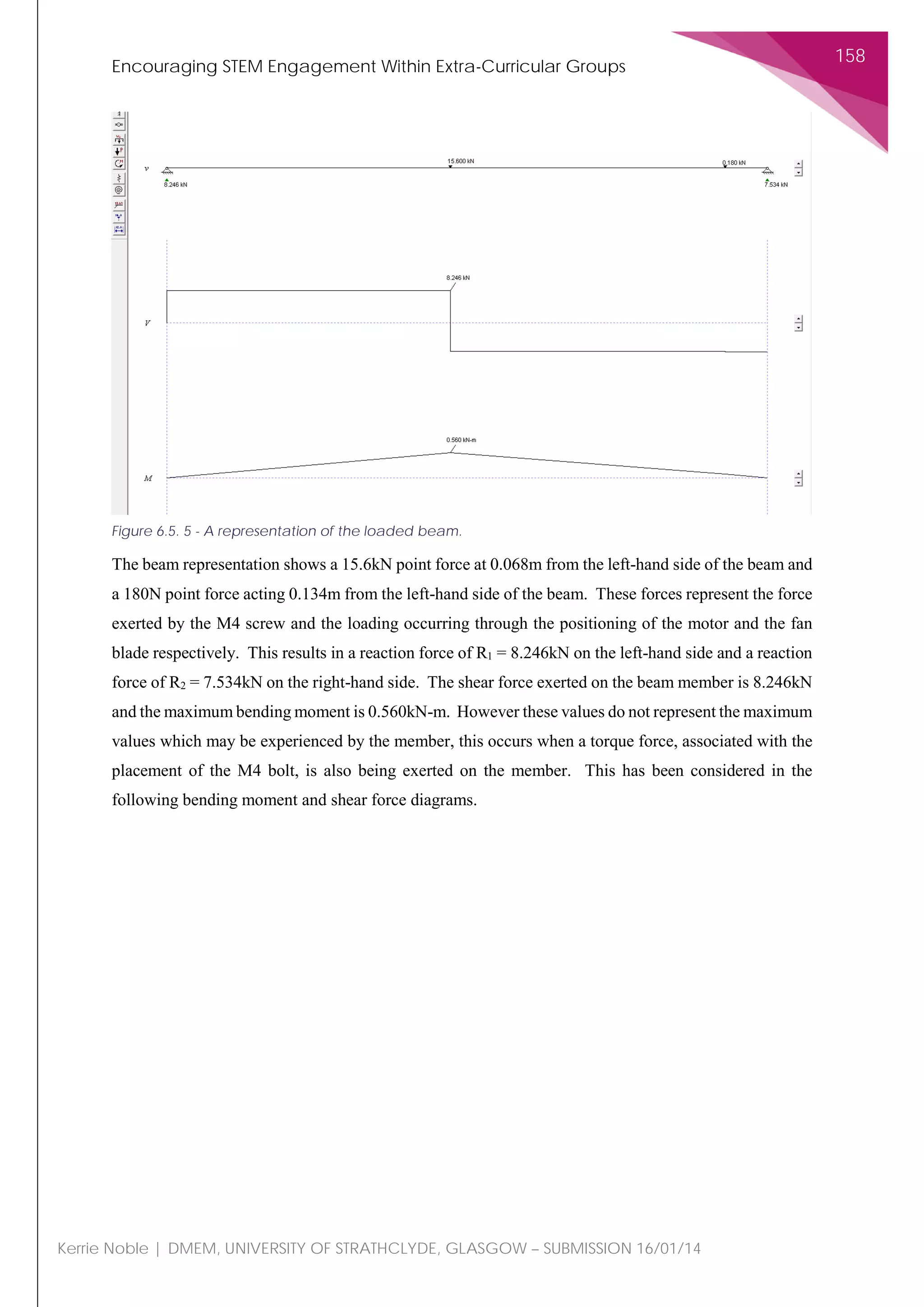
  • 201.
    Encouraging STEM EngagementWithin Extra-Curricular Groups 200 Kerrie Noble | DMEM, UNIVERSITY OF STRATHCLYDE, GLASGOW – SUBMISSION 16/01/14 become more challenging and we try to encourage them to think creatively. Having considered this I would say the developed resource is targeted correctly in terms of age range. 2. What are your thoughts on the how much the user will learn through constructing this kit with the outlined inclusion of questioning within the assembly instructions? I think for use within a group setting, it may be that the young people will not immediately be concerned about the questions or achieving the correct answer to the question unless this is directly linked with the ability to complete the final product. I agree that learning should be an integral part of the kit to ensure the benefits of running these types of activity within the group are maximised. It is also beneficial that the product is open to challenging the user and allowing the possibility of change. This allows for a learning cycle, where the user can learn through the initial completion of the set task and then change the process and aim as time progresses using the knowledge they captured from their first attempt. 3. Do you have any feelings towards the group interaction aspect of the proposal through the app and online communities and the overall benefits or negatives this may have for the user? I like the idea of having a group interaction aspect. Learning from what has previously been done is sometimes the best type of learning you can get in my opinion. Also the use of smartphone applications and an online community are technological elements which are widely used throughout society and therefore the users would feel comfortable with this aspect of the product. I do believe there would be benefit in spending time to develop these areas of the product design. There may also be benefit in organising a competitive aspect associated with using the product. A competition based on the best adaptation or development of the activities completed using the product would not only be beneficial to users, who can take inspiration and learn from what other users are doing, but it continually allows the product range and capability to grow and develop at the same time, keeping the product fresh and innovative. 4. What were your initial thoughts on the provision of varying difficulty levels through the development of a series of kits? This is a great aspect of the developed kit idea. This is the problem with so many resources that are available. They either start at a level which is too complex for many of the young people within the group or they are too simplistic for some and therefore they do not get a challenge from completing the activity. In comparison, this idea would potentially suit all abilities within the group and allows young people to progress from one stage to another and promotes progressive learning. 5. Analysis of focus group and user feedback is still ongoing to establish exactly what would be included within this range of kits to encourage this age group to use the resource in the setting of extra-curricular groups as specified. From an engineering perspective can you suggest
  • 202.
    Encouraging STEM EngagementWithin Extra-Curricular Groups 201 Kerrie Noble | DMEM, UNIVERSITY OF STRATHCLYDE, GLASGOW – SUBMISSION 16/01/14 necessary inclusions within this type of product and also some features which would be nice to see which other products do not currently have? From an engineering perspective it should be relevant to what is being achieved in the industry currently and keeping up-to-date with the latest technology emerging would be very beneficial and generate a lot of interest within the target user group. Developing the difficulty level 6 idea which was presented, the programmable robot arm, and including other technology like this would be great. Also including and developing things like Raspberry Pi would be beneficial, giving the user the opportunity to work with high-tech products and would increase the learning associated with the product. Being able to achieve different outcomes from one kit is great, it really expands the opportunities available. From a scouting perspective being able to gain easily purchase the product would be a key concern, as many current resources are not widely advertised in a way which is visible to most people involved in scouting. 6. What is your overall opinion on how effective this will be in engaging with the target age group and encouraging them to think about STEM subject areas in a more positive manner? Do you think this will help combat the poor careers advice which is sometimes given in regards to STEM opportunities within studying or in terms of career options? I think this product will be very effective in achieving and generating more interest in STEM and in providing needed resources for use by groups such as Scouts and Guides. I also think if the use of the product and the development of a smartphone application could somehow incorporate careers guidance then that would help eliminate some of that problem. Summary Phase 3 testing was conducted in order to gauge the opinion of potential customers in relation to the developed prototypes and how they potentially saw this fitting within the programme provided by their respective extra-curricular group. For this test, Michael MacLennan, an engineering graduate and Assistant Scout Leader, had a chance to analyse the final solution, test and use the developed prototypes and use his knowledge and experience to look at the possibility of introducing this type of product into his scout troop and what impact this might have. The observations from this test were recorded on a questionnaire and the key points emerging from this test are summarised below. Key Learning Points; • The resource is being targeted at the correct age group for use in extra-curricular groups. The 11 – 19 year old age range coincides with the age limits placed on most senior sections within any extra-curricular group and therefore could be utilised and implemented within group programmes without any major concern. • In relation to the use of questioning as part of the product instructions, young people may not be immediately concerned with this element. If this is used to develop and promote learning then it needs to be integral to the progression of the task and other options need to be made
  • 203.
    Encouraging STEM EngagementWithin Extra-Curricular Groups 202 Kerrie Noble | DMEM, UNIVERSITY OF STRATHCLYDE, GLASGOW – SUBMISSION 16/01/14 available which don’t involve questioning. Learning should also be incorporated in other ways through the use of the smartphone application or with the sharing availability through the use of an online community. • Group interaction is a great aspect of the product and this should be encouraged and an integral consideration within any further development of the product. • Varying difficulty levels is great. It means the more capable young people can be pushed and challenged, but those who need extra support can still be involved in the use of the kit and can still be challenged in a way which is suited to their individual ability. • The product should incorporate technology and features which are current within industry to generate and retain interest, while also teaching up-to-date techniques and theories. • Bulk purchasing and visible advertising is important to make customers aware of the product availability. • Overall, the development of an accompanying smartphone application should be completed as an integral part of the resource. • Opinion suggests that this development is solving a current problem with the type of resources available and the ability extra-curricular groups have to purchase and use STEM-based resources and further development in this area should continue. 8. Release Phase This is the final phase of the project and considers the business requirements associated with the production and retail of the finalised design. The initial process of identifying key business requirements was conducted through the use of the business model canvas, which is included on page 47 of the supporting portfolio. This initial identification of elements was then utilised and developed into a business plan which is a separate document to accompany the project.
  • 204.
    Encouraging STEM EngagementWithin Extra-Curricular Groups 203 Kerrie Noble | DMEM, UNIVERSITY OF STRATHCLYDE, GLASGOW – SUBMISSION 16/01/14 9. Conclusion 9.1. Testing The evaluation and testing phase of the project highlighted some positive feedback in relation to the developed prototypes which were tested; • The resource is being targeted at the correct age group for use in extra-curricular groups. The 11 – 19 year old age range coincides with the age limits placed on most senior sections within any extra-curricular group and therefore could be utilised and implemented within group programmes without any major concern. • Group interaction is a great aspect of the product and this should be encouraged and an integral consideration within any further development of the product. • Varying difficulty levels is great. It means the more capable young people can be pushed and challenged, but those who need extra support can still be involved in the use of the kit and can still be challenged in a way which is suited to their individual ability. • Opinion suggests that this development is solving a current problem with the type of resources available and the ability extra-curricular groups have to purchase and use STEM-based resources and further development in this area should continue. The Newton’s cradle activity needs more thought within the development of the design as user found this too hard to complete and as a result the cradle didn’t function as intended. • General feedback from the user suggested that they enjoyed using the product, it was relevant to topics they had covered in STEM subjects in school, and the product itself looked appealing to the user. • Some feedback received from adult volunteers within the group also highlighted how useful they thought the product would be and again highlighted the need for this type of resource for use in this context. Current kits being used within extra-curricular groups, especially those generally used within scouts, do not fulfil key learning requirements or portray knowledge within the area they were designed to represent. The results from this test show that the developed prototypes were more successful in generated learning of key STEM principals and encouraging experimentation and creative problem solving. • Young learners between the ages of 11 – 19 have indicated that they enjoyed participating in this testing session and completing the activities given. They were enthusiastic and engaged throughout the testing session and were keen to complete an activity similar to those tested again. They enjoyed the challenge which was given to them through the use of the kit. This positive feedback was also combined with feedback regarding particular areas for future development;
  • 205.
    Encouraging STEM EngagementWithin Extra-Curricular Groups 204 Kerrie Noble | DMEM, UNIVERSITY OF STRATHCLYDE, GLASGOW – SUBMISSION 16/01/14 Circuit construction – One of the main suggestions emerging from the testing was issues surrounding the design of the circuit construction. The electronic circuit used within the testing used existing construction methods which resulted in the circuit malfunctioning due to loose connections during the testing phases. To overcome this issue some design suggestions to improve this area have been suggested and are illustrated on page 46 of the stage 2 supporting portfolio. Smartphone application/online community – The second major area for further development was highlighted as the development of a smartphone application. This was seen as a ‘must’ within the nest development steps for the product as the ability to provide interactive and detailed instructions for use of the product, alongside other useful information such as careers options, local STEM-related visitor attractions and key STEM-related resources for further study of the principals exhibited within the product was seen as a great benefit to the final product. It was suggested this should be accompanied by an online networking community allowing for communication and sharing between users. 9.2. Project Objectives The successful conclusion of the project depends on whether the initial project objectives have been met throughout the duration of the project. This part of the conclusion assess the project objectives and looks at whether these have been met within the project outcome. Develop a reliable and durable product which can be suitably re-used in order to reduce the cost and impractical nature of providing replacement parts. Funding has already been outlined as a key issue so a re-usable product will eliminate this major issue, also a re-usable product is more likely to sustain interest in STEM according to some early feedback received around the project. – The final design utilises a modular construction, without the use of perishable components or items. This ultimately means the final design has succeeded in meeting this project objective as the kit is re-usable and therefore more likely to sustain interest within key STEM subject areas. Explore the key area of Design for Assembly to ensure the kit is easy to use by minimising parts while still maintaining a high level of functionality. A kit which is easy to use without the need for expert knowledge is very desirable as it builds more of a sense of achievement for the young people in this area. – Design for assembly was not widely considered as a separate entity within the progression of the project as it was decided within the duration of the project that user testing would highlight any negative issues surrounding the assembly of the kit. Instead the area of design for manufacture was considered to ensure the cost of production was kept to a minimum without compromising the structural strength of any of the components.
  • 206.
    Encouraging STEM EngagementWithin Extra-Curricular Groups 205 Kerrie Noble | DMEM, UNIVERSITY OF STRATHCLYDE, GLASGOW – SUBMISSION 16/01/14 Develop a product which is inherently easy to use but also requires the end user to think and actively engage to encourage understanding of some basic scientific principles. Deep learning through doing is required in order to help young people within the curriculum, this can only be achieved through a kit which is easy to use but does not provide all answers freely, and there must be an element of self- teaching. - The three-phase testing approach provided some good feedback with regards to how easy the target market found use of the product. However, there were areas of difficulty with the ease of use and these have been addressed within the main conclusion to the project. Explore the idea of having one modular product which can be configured into many different layouts to provide the user with the opportunity of exploring more than one area of STEM with the need to only purchase one kit.- The final kit is ultimately a modular product which can be configured into many different layouts, as demonstrated throughout stage 2 of the project with many assembly options highlighted as part of the final design solution. Develop a product which can be easily and cheaply manufactured but also has the capability of being re-used several times. - Design for manufacture has been widely considered for each of the components within the final design of the STEM kit, with particular attention being placed on manufacturing cost. Develop a product which allows young people, aged 14 – 19, to use the kit without the need for any supervision or expert input. – The target age group was changed during the project to represent some feedback obtained from a teaching professional, primarily as it was thought to retain interest in STEM subject areas, the age of 14 was too late with regards to school subject decisions. With regards to the new age group, the kit does allow young people to use the product and investigate different STEM subjects without the need for supervision, as highlighted throughout the product testing phases. However, there are still improvements which could be made, ie. The development of a smartphone application and an online networking community. Explore the idea of STEM involvement in an extra-curricular environment to further define the problem, need and aim for the project. Also identify key products which are currently being used in this area and outline the key issues which exist with the use of these products and how these could be addressed. - This was successfully achieved within the second phase of the project, with a wide range of research techniques being utilised to gain extensive detail on the problem area and the customer design requirements. Particular attention was paid to utilising user-centred methods to ensure the user and customer were the central focus of research outputs and interaction between the user and current products could be observed. Explore some of the basic scientific principles which could be adapted into a small scale form which could provide ideas for an electronic-based scientific kit for the 14 – 19 age range. – The final design
  • 207.
    Encouraging STEM EngagementWithin Extra-Curricular Groups 206 Kerrie Noble | DMEM, UNIVERSITY OF STRATHCLYDE, GLASGOW – SUBMISSION 16/01/14 took inspiration from the displays used within the Glasgow Science Centre and focused on trying to provide similar interaction and learning experiences through the provision of the same activities and display, except on a smaller scale. Develop the idea through model making and CAD. Specifically exploring the areas of modular kit building and the key area of circuit construction which will reduce the need for specialist equipment such as solder and soldering irons, whilst also providing the re-usable functionality which has been clearly identified as a user requirement. – The product documentation has shown clear progression through the use of modelling, from paper-based models during concept generation in stage 1, to the use of cardboard and rough modelling and final prototyping using 3D printing technology in stage 2. The development of CAD –based models is also clear throughout stage 2. Test and validate the design and idea by testing a working model through scouts and schools and talking to organisations who run STEM workshops or promote STEM within the community. Engineering testing of elements such as structure stability, force analysis and electrical component testing within the circuit structure will also be key to this project. – A three-phase testing approach was adopted to ensure all key stakeholders had the opportunity to test the developed prototype and express their views on the design. This progress began with a return to the focus group who had provided the initial concept generation ideas, as concept generators they already had an idea of what they wanted in a product and so their input to the design would test whether this product really appealed to the target user group. The second phase re-tested the product with a wider range of end users, spanning various ages within the target user group and including participants from several different extra-curricular groups. The final test asked a group volunteer to provide feedback on the design, this person represents a potential customer/buyer of the product and their view matters in terms of saleability of the product. 9.3. Reflection Throughout the duration of the project progression there has been a chance to reflect on the activities and progression within each phase of the methodology. Some of the thoughts which I have noted on the project are outlined below. Research Phase – The outcome of the research project was detailed and overall achieved the main objective of considering a broad range perspective in relation to the given problem context. The main criticism of this phase of the project is the repetitive nature of the outcomes of some of the design methods used. On reflection it was perhaps possible to reduce the amount of information relayed in this phase by re-evaluating the design methods and research data collection methods used. Some of the methods appeared to have achieved similar outcomes and if this phase were to be repeated then one method would have been utilised instead of 2, with the same outcome being achieved. A
  • 208.
    Encouraging STEM EngagementWithin Extra-Curricular Groups 207 Kerrie Noble | DMEM, UNIVERSITY OF STRATHCLYDE, GLASGOW – SUBMISSION 16/01/14 reconsideration of the exact sequence of the methods within this phase may also have avoided some of the repetition occurring within the outcomes. On a positive reflection, the user focus required for this type of design project was evident within the recording of the research phase activities and the design methods utilised within this phase were chosen correctly with the aim of ensuring the user and customer were the key consultants providing qualitative and quantitative data on the problem area. Conceptual Design Phase – On reflecting upon the participants used throughout this phase of the project, it appears that many of the participants were female. Although this was a conscious decision at the beginning of this project phase, it appears to have created an imbalance between male and female user opinions in relation to the project. If this stage were to be repeated, widening the participant scope would be beneficial so as exclusion of half of the target user market does not occur. This phase of the project also saw the changing of the target market age group, due to feedback received from a teaching professional and how they saw the product affecting the participation in STEM-based school subjects. This is perhaps an area of research which was neglected in the previous project phase. It would have been more beneficial and less disruptive to the progression of the project if this age range definition had been obtained as part of the user/customer research. Detailed Design Phase – The detailed design phase was well structured, combining evaluation, testing and design development, this helped to ensure the customer design requirements were always at the forefront of the product development. This could have been improved with further modelling and testing, however time constraints for the project and the requirement to produce detailed, working, final prototypes in order to conducted the final phase of the project limited this development. Evaluate and Test Phase – The evaluation and test phase was extremely successful and the idea of conducting testing in three phases, beginning by returning to a focus group which initially developed conceptual ideas and ending by speaking to potential customer has ensured a rounded view of the developed product. If time and design iteration had allowed, further development of the other assembly options within the final design would have been beneficial in allowing an oversight on the potential and success and failings of the fully described final kit design. Release Phase – The release phase utilised the business model canvas in helping to identify key business requirements before implementing the findings within a business plan. I found that some elements of the business plan were quite repetitive, however this may be due to the lack of experience in utilising both of these methods. A full, detailed business plan was produced, including 5 yearly financial projections, however with lack of experience it may not be accurate and requires further development, however the learning process of completing this step can be used within the next project.
  • 209.
    Encouraging STEM EngagementWithin Extra-Curricular Groups 208 Kerrie Noble | DMEM, UNIVERSITY OF STRATHCLYDE, GLASGOW – SUBMISSION 16/01/14 Project Planning and Management – Project planning and management throughout the duration of the project appeared to be very successful, especially in stage 2 where a revision of the Gantt chart was not required as the majority of the design process activities and time scales remained very similar to the revisions made to the Gantt chart at the end of stage 1, therefore an updated project plan has not been submitted with this stage submission of the project. This was a very successful element of the project and I believe the use of the project planning sheets, outlining the design methods to be used throughout each phase of the project, played a key part in the successful control and management of the project.
  • 210.
    Encouraging STEM EngagementWithin Extra-Curricular Groups 209 Kerrie Noble | DMEM, UNIVERSITY OF STRATHCLYDE, GLASGOW – SUBMISSION 16/01/14 References Adams, J.A. (1987). Historical review and appraisal of research on the learning, retention, and transfer of human motor skills. Psychological Bulletin, 101, 41-74 APIS, 2011, Acid Deposition, [ONLINE] Available at; http://www.apis.ac.uk/overview/pollutants/overview_Acid_deposition.htm, accessed 22/04/2014 Argotec, 2014, Glossary, [ONLINE] Available at; http://www.argotec.com/RF_Glossary.html, accessed 22/04/2014 ASTM, 2014, Fire standards and flammability standards, [ONLINE] Available at; http://www.astm.org/Standards/fire-and-flammability-standards.html , accessed 22/04/2014 BBC News, 2013 Scottish Scout Numbers on the Rise, Online, Available at www.bbc.co.uk/news/uk- scotland-22230007, Accessed 17/10/13 BCS, 2013, Grand Theft Auto V, [ONLINE] Available at; http://www.bcs.org/content/conWebDoc/51507 accessed 10 January 2014 Beardmore, R., 2013, Anthropometric Data, [ONLINE] Available at; http://www.roymech.co.uk/Useful_Tables/Human/Human_sizes.html , accessed 22/04/2014 Beer, Ferdinand P.; E. Russel Johnston, Jr. (1996). Vector Mechanics for Engineers (Sixth ed.). McGraw-Hill. p. 397. ISBN 0-07-297688-8. Biggs, J., 1993, “What do inventories of students’ learning processes really measure? A theoretical review and clarification,” British Journal of Educational Psychology, 63 (1): 3-19 Bolt Depot, 2014, About fastener materials, [ONLINE] Available at; http://www.boltdepot.com/fastener-information/materials-and-grades/materials.aspx, accessed 22/04/2014 Boyce, G., Williams, S., Kelly, A., & Yee, H., 2001, “Fostering deep and elaborative learning and generic (soft) skill development: Strategic use of case studies in accounting education,” Accounting Education, 10 (1), 37-60 Carbon Trust, 2014, Carbon Footprinting Guide, [ONLINE] Available at; http://www.carbontrust.com/resources/guides/carbon-footprinting-and-reporting/carbon-footprinting, accessed 22/04/2014 Case Western Reserve University, 2014, Thermal properties of polymers, [ONLINE] Available at; http://plc.cwru.edu/tutorial/enhanced/files/polymers/therm/therm.htm, accessed 22/04/2014 D4S, 2014, Design for Sustainability, [ONLINE] Available at; http://www.d4s-de.org/, accessed 22/04/2014
  • 211.
    Encouraging STEM EngagementWithin Extra-Curricular Groups 210 Kerrie Noble | DMEM, UNIVERSITY OF STRATHCLYDE, GLASGOW – SUBMISSION 16/01/14 Department for Business Innovation and Skills, 2012, Engaging the Public in Science and Engineering, Online, Available at https://www.gov.uk/government/policies/engaging-the-public-in-science-and- engineering--3/supporting-pages/inspiring-students-to-study-science-technology-engineering-and- mathematics, Accessed 14/10/13 Department for Business, Innovation and Skills, 2012, Engaging the Public in Science and Engineering, Online, Available at https://www.gov.uk/government/policies/engaging-the-public-in-science-and- engineering--3, Accessed 14/10/13 Department for Education, 2008, After-school Science and Engineering Clubs Evaluation: Final Report, London Department for Education, 2010, The STEM Cohesion Programme: Final Report, London Department of Further Education, Employment, Science and Technology (Australia), 2013, Female Participation in STEM Study and Work in South Australia 2012, Adelaide Dow Corning, 2012, Application centre glossary, [ONLINE] Available at; http://www.google.co.uk/url?sa=t&rct=j&q=&esrc=s&source=web&cd=1&ved=0CC8QFjAA&url=h ttp%3A%2F%2Fwww.dowcorning.com%2Fcontent%2Fpublishedlit%2F11-2092.pdf&ei=O2g8U-3- B4LRhAe374CQCg&usg=AFQjCNEjhs0v5RvdqM4ArjwiJv0tqBMz-A&sig2=N92eRTSK2- vcOXZfB7YNXQ , accessed 22/04/2014 Dowson, Duncan (1997). History of Tribology, 2nd Edition. Professional Engineering Publishing. ISBN 1-86058-070-X. England, G., 2011, Reducing Wear by Using Thermal Spray Coatings, [ONLINE] Available at; http://www.gordonengland.co.uk/wear.htm#TSC1, accessed 22/04/2014 EU Commission, 2014, Energy and Environment, [ONLINE] Available at; http://ec.europa.eu/environment/integration/energy/index_en.htm, accessed 22/04/2014 Eurostat (European Commission), 2011, Education Statistics, Brussels Evidence for Policy and Practice Information and Co-ordinating Centre, 2010, Subject Choice in STEM: Factors Influencing Young People (aged 14-19) in Education (A systematic review of the UK literature), University of London Experience UI, 2009, User Centred Design Definition, Online, Available at; experience.expressionz.in, Accessed 14/10/13 Facebook, 2014, 1st Facebook Scout Group, [ONLINE] Available at; https://www.facebook.com/groups/2450689742/ accessed 9 January 2014
  • 212.
    Encouraging STEM EngagementWithin Extra-Curricular Groups 211 Kerrie Noble | DMEM, UNIVERSITY OF STRATHCLYDE, GLASGOW – SUBMISSION 16/01/14 Freudenrich, C., 2014, How rubber works, [ONLINE] Available at; http://science.howstuffworks.com/rubber.htm/printable , accessed 22/04/2014 Girl Scouts of America Research Institute, 2012, Generation STEM: What Girls Say About Science, Technology, Engineering and Maths, Lockheed Martin GoldieBlox, 2013, GoldieBlox: Building games for girls to inspire future engineers, Online, Available at www.goldieblox.com/pages/about, Accessed 18/10/13 Gustafsson, E., 2013, Investigation of friction between plastic parts, Master's thesis in Polymer tribology, [ONLINE] Available at; http://www.google.co.uk/url?sa=t&rct=j&q=&esrc=s&source=web&cd=4&ved=0CEwQFjAD&url=h ttp%3A%2F%2Fpublications.lib.chalmers.se%2Frecords%2Ffulltext%2F181751%2F181751.pdf&ei =2Jo5U762L4iA7Qa- FQ&usg=AFQjCNGrWQ05wZjVPkXNFIaVSQ8dUn16mw&sig2=L7LRs9rRJfo557QlpKHwIg , accessed 22/04/2014 Hamaker, J., 2009, The Rise of Social Networking Sites and Their Effects on Our Lives, [ONLINE] Available at; http://ezinearticles.com/?The-Rise-of-Social-Networking-Sites-and-Their-Effects-on- Our-Lives&id=2887717 accessed 9 January 2014 Harrison, Medrington & Stransom, 2013, User Centred Design Research Methods for Mobile Industry Practitioners, WI Journal of Mobile Media, Sound Moves, Vol.7 No.1, March 2013 IMBD, 2013, Most Popular Video Games Released in 2013, [ONLINE] Available at; http://www.imdb.com/search/title?sort=moviemeter&title_type=game&year=2013,2013 accessed 9 January 2014 IPSOS MORI Social Research Institute, 2011, Public Attitudes to Science, Department for Business Innovation and Skills, London Johnson, T., 2014, Plastics in children’s toys, [ONLINE] Available at; http://composite.about.com/od/Plastics/a/Plastics-In-Children-S-Toys.htm , accessed 22/04/2014 Kalpakjian & Schmid, 2009, Manufacturing Engineering and Technology, Sixth Edition, Prentice Hall, Singapore Keithley, 2001, Volume and Surface Resistivity Measurements of Insulating Materials Using the Model 6517A Electrometer/High Resistance Meter, [ONLINE] Available at; http://www.google.co.uk/url?sa=t&rct=j&q=&esrc=s&source=web&cd=2&ved=0CDYQFjAB&url= http%3A%2F%2Fwww.keithley.co.uk%2Fdata%3Fasset%3D6069&ei=SmY8U8qTDMqshQeQyYG gCw&usg=AFQjCNGjYOiwffUs37foyRMum9HolCE9Vg&sig2=7nBjMy2n0EXk12z541i7iw , accessed 22/04/2014
  • 213.
    Encouraging STEM EngagementWithin Extra-Curricular Groups 212 Kerrie Noble | DMEM, UNIVERSITY OF STRATHCLYDE, GLASGOW – SUBMISSION 16/01/14 Kent, R., 2009, What’s your process energy fingerprint?, [ONLINE] Available at; http://www.ptonline.com/articles/whats-your-process-energy-fingerprint, accessed 22/04/2014 K’NEX, 2013, Online, Available at www.knex.com/products, Accessed 17/10/13 Knowledge Project, 2013, Eutrophication: Causes, Consequences and Controls in Aquatic Ecosystems, [ONLINE] Available at; http://www.nature.com/scitable/knowledge/library/eutrophication-causes- consequences-and-controls-in-aquatic-102364466, accessed 22/04/2014 Lego Mindstorm picture http://education.lego.com/en-gb/lego-education-product- database/mindstorms/9797-lego-mindstorms-education-base-set Lego education2, 2013, http://shop.legoeducation.com/gb/product/lego-mindstorms-education-nxt- base-set-9797-29/ Lord Sainsubury, 2007, The Race to The Top: A Review of Government’s Science and Innovation Policies, October 2007 Lyondell, 2014, Mould shrinkage, [ONLINE] Available at; http://www.google.co.uk/url?sa=t&rct=j&q=&esrc=s&source=web&cd=2&ved=0CDgQFjAB&url=h ttp%3A%2F%2Fwww.lyondellbasell.com%2Ftechlit%2Ftechlit%2FTech%2520Topics%2FGeneral% 2FMold%2520Shrinkage.pdf&ei=fGI8U7zRApOShQflsoHADw&usg=AFQjCNGta2DvS0- Sh_rAIXBeyYw5BVPBmg&sig2=6WFmJs5-mll4o5fFKcX5TQ&bvm=bv.63934634,d.ZWU , accessed 22/04/2014 Lyondell Chemical Company, 2014, A guide to polyolefin sheet extrusion, [ONLINE] Available at; http://www.lyondellbasell.com/techlit/techlit/Brochures/Sheet%20Extrusion%209531.pdf, accessed 22/04/2014 Mashable, 2013, Social Networking, [ONLINE] Available at; http://mashable.com/category/social- networking/ accessed 9 January 2014 (and social networking image) Marteniuk, R. (1976). Information Processing in Motor Skills. New York: Holt, Rinehart & Winston. Marton, F., & Säljö, R., 1976a, “Qualitative differences in learning I. Outcomes and processes,” British Journal of Educational Psychology, 46, 4-11 Marton, F., & Säljö, R., 1976b, “On qualitative differences in learning II. Outcomes as a function of the learners’ conception of the task,” British Journal of Educational Psychology, 46, 115-127 Mat Web, 2014, Material property search, [ONLINE] Available at; http://www.matweb.com/search/search.aspx , accessed 22/04/2014 Mayer, R.E., & Chandler, P., 2001, “When learning is just a click away: Does simple user interaction foster deep understanding of multimedia messages?”, Journal of Educational Psychology, Vol. 93, No. 2, 390-397, American Psychological Association INC.
  • 214.
    Encouraging STEM EngagementWithin Extra-Curricular Groups 213 Kerrie Noble | DMEM, UNIVERSITY OF STRATHCLYDE, GLASGOW – SUBMISSION 16/01/14 Mayer, R.E., & Moreno, R., 2003, “Nine ways to reduce cognitive load in multimedia learning,” Educational Psychologist, 38 (1) 43-52, Lawrence Erlbaum Associates, INC. Merriam-Webster, 2014, Back-pressure, [ONLINE] Available at; http://www.merriam- webster.com/dictionary/back%20pressure, accessed 22/04/2014 Met Office, 2014, Monthly temperature records by country, [ONLINE] Available at; http://www.metoffice.gov.uk/climate/uk/extremes/monthly_temperature_country.html#highest_daily_ maximum_england , accessed 22/04/2014 Micro Chem, 2014,Material properties definitions, [ONLINE] Available at; http://www.microchem.com/Tech-MaterialPropDefs.htm , accessed 22/04/2014 Mirror, 2013, 2011 Census: The main 20 languages spoken in the UK, available at http://www.mirror.co.uk/news/uk-news/2011-census-top-20-languages-1563629, accessed 30 September 2013 Mischel, W., 2013, “Personality and Assessment,” Psychology Press, Taylor and Francis Group, 15 April 2013, Hove, United Kingdom National Academy of Engineering, 2013, Engineer Girl: Debbie Sterling, Online, Available at www.engineergirl.org/Engineers/Directory/13512.aspx, Accessed 18/10/13 NASA, 2008, Volume I, Section 4: 4 HUMAN PERFORMANCE CAPABILITIES, [ONLINE] Available at; http://msis.jsc.nasa.gov/sections/section04.htm , accessed 22/04/2014 NIST, 2006, Specular Gloss, [ONLINE] Available ay; http://www.google.co.uk/url?sa=t&rct=j&q=&esrc=s&source=web&cd=7&ved=0CF0QFjAG&url=ht tp%3A%2F%2Fwww.nist.gov%2Fcalibrations%2Fupload%2Fsp250-70.pdf&ei=6mg8U- meDYKrhQff3IHwCA&usg=AFQjCNFI7jdI51nrC6oqD_mrzJTdwKpRlA&sig2=tYlVVbjhSoXLzQ- fqymYGQ , accessed 22/04/2014 Office for National Statistics, Historic UK Population Pyramid, Census Figures 2011, Online, Available at www.ons.gov.uk/ons/interactive/historic-uk-population-pyramid/index.html, Accessed 14/10/13 Persson, B. N.; Volokitin, A. I (2002). "Theory of rubber friction: Nonstationary sliding". Physical Review B 65 (13): 134106. Bibcode:2002PhRvB..65m4106P. doi:10.1103/PhysRevB.65.13410 Pintirch, P.R., 2002, “The role of metacognitive knowledge in learning, teaching and assessing,” Theory into Practice, Vol. 41, No. 4, Revising Bloom’s Taxonomy, 219-225 Polymer Engineering Guide, 2012, Elastomer engineering guide, [ONLINE] Available at; http://www.google.co.uk/url?sa=t&rct=j&q=&esrc=s&source=web&cd=6&ved=0CFkQFjAF&url=ht tp%3A%2F%2Fwww.jameswalker.biz%2Fen%2Fpdf_docs%2F148-elastomer-engineering- guide&ei=OmM8U72JM8-
  • 215.
    Encouraging STEM EngagementWithin Extra-Curricular Groups 214 Kerrie Noble | DMEM, UNIVERSITY OF STRATHCLYDE, GLASGOW – SUBMISSION 16/01/14 AhAegk4CABw&usg=AFQjCNH7wIHA9RDs8IUjylQbpICq84QOgA&sig2=TnZv3fl1OWzLuqh7w zYAXQ , accessed 22/04/2014 TEDxTalks, 2013, Inspiring the next generation of female engineers: Debbie Sterling at TEDxPSU, Online, Available at www.youtube.com/watch?v=FEeTLopLkEo, Accessed 19/10/13 The design society, 2011, Design Procedures for Statically Loaded Bolted Joints, [ONLINE] Available at; http://www.bath.ac.uk/idmrc/themes/projects/delores/co-design-website/dpg/bol/bol3.html , accessed 22/04/2014 Resin Supplies, 2014, Casting Resins, [ONLINE] Available at; http://www.resin- supplies.co.uk/casting%20resin%20detailed.htm , accessed 22/04/2014 The Royal Academy of Engineering, 2007, Educating Engineers for the 21st Century, London The Russell Group of Universities, (February 2009), STEM-Briefing, London Sandoval, W. A., 2004, “Understanding student’s practical epistemologies and their influence on learning through inquiry,” Sci Ed, 89: 634-656, Wiley Periodicals INC. Scott, R., 2008, Basic Wear Modes in Lubricated Systems, [ONLINE] Available at; http://www.machinerylubrication.com/Read/1375/wear-modes-lubricated , accessed 22/04/2014 Singer, R.N. (1975). Motor Learning and Human Performance (2nd Ed.). New York: Macmillan Skinner, B. F., 2012, “I The Science of Learning and the Art of Teaching,” Readings in Educational Psychology, Learning and Teaching, E. Stones, Routledge Library Editions: Education, 4th May 2012, pp. 301-309 Startasys, 2014, Finishing Touch Smoothing Station: Expanding Possibilities, [ONLINE] Available at; http://www.stratasys.com/applications/finishing/smoothing-fdm-parts , accessed 22/04/2014 Stevens, H., 2012, Employer Engagement in STEM Learning in the Heart of the South West, University of Exeter Sweller, 1999, “Instructional Design in Technical Areas,” Camberwell, Australia, Acer Press Thomasnet, 2014, What is laser cutting?, [ONLINE] Available at; http://www.thomasnet.com/articles/custom-manufacturing-fabricating/laser-cutting-technology, accessed 22/04/2014 Tian, Y., & Gao, F., 1999, Ind. Eng. Chem. Res., 1999, 38 (9), pp 3396–3406, DOI: 10.1021/ie980535p Publication Date (Web): August 14, 1999 Copyright © 1999 American Chemical Society Translators Café, 2014, Electrical Resistivity, [ONLINE] Available at; http://www.translatorscafe.com/cafe/EN/units-converter/electric-resistivity/d/ , accessed 22/04/2014 UL, 2014, UL 94, the Standard for Safety of Flammability of Plastic Materials for Parts in Devices and Appliances testing, [ONLINE] Available at;
  • 216.
    Encouraging STEM EngagementWithin Extra-Curricular Groups 215 Kerrie Noble | DMEM, UNIVERSITY OF STRATHCLYDE, GLASGOW – SUBMISSION 16/01/14 http://www.ul.com/global/eng/pages/offerings/industries/chemicals/plastics/testing/flame/ , accessed 22/04/2014 Understanding energy consumption in injection moulding machine, [ONLINE] Available at; http://www.pitfallsinmolding.com/energyeffic1.html, accessed 22/04/2014 Wiki Answers, 2014, How many miles from England to China?, [ONLINE] Available at; http://wiki.answers.com/Q/How_many_miles_from_England_to_China#slide=3&article=How_many _miles_from_England_to_China, accessed 22/04/2014 Williamson Corporation, 2014, Die Temperature, [ONLNE] Available at; http://www.williamsonir.com/die-temperature, accessed 22/04/2014 Yahoo Answers, 2011, What materials are used for children’s toys?, [ONLINE] Available at; https://uk.answers.yahoo.com/question/index?qid=20110418143658AAZvzSy , accessed 22/04/2014
  • 217.
    Encouraging STEM EngagementWithin Extra-Curricular Groups 216 Kerrie Noble | DMEM, UNIVERSITY OF STRATHCLYDE, GLASGOW – SUBMISSION 16/01/14 Appendix 1 – PDS Version 8 Individual Project 2 – Kerrie Noble Product Design Specification Improving STEM Engagement within Extra-Curricular Groups Version 8 1. Performance 1.1 The product should be durable to withstand repetitive use and the extremities of the environment. 1.2 The product must have a high robustness in quality to withstand the stresses it will experience during use and storage. 1.3 It is expected that the product is suitable for use in an extra-curricular group with an average activity time of 0 – 1 hours available for using the product. 1.4 The product must have the ability to cater for a large number of young people, between 5 and 50 people within a group. 1.5 All material used must be fully functional within a temperature range of -40oC - +70oC. This includes a storage and transport environment of -40oC - +70oC. 1.6 The product must be fully functional for a minimum of 10 years. 1.7 The product should be easy for the user to store when not in use. 1.8 The product should allow for interchangeable to allow for creativity and experimentation. 1.9 To ensure biocompatibility all patient contact materials should be latex free and tested in accordance with ISO 10993-1. To ensure safety standards are reached with regards to the suitable use of the product without possibility of causing harm to any user. 1.10 The battery, when required and fully charged, should typically last for around 100 hours. 1.11 The product should be small, light and easy to carry. 1.12 A large, easy to read display, where required, should be incorporated into the design. 1.13 The product should be suitable for use by children between the ages of 14 and 19. 1.14 The device must be compatible with laptops and other standard electronic equipment where necessary to ensure any included component will function correctly and allow the product to achieve the outcome it was designed for. 1.15 The device must not fail under tensile loading of 729N, or other forces commonly associated with occurrence during experimentation or interactive activities. 1.16 The device must actively encourage deep and meaningful learning of key STEM principles through the use of guidance and questioning instead of stated instructions. 1.17 Chemicals must provide no effect on the materials used within the product. 1.18 The product must ideally have a high robustness in quality to withstand every day stress. The everyday stress the components must deal with will range between 13.7Nm and 729N. 2. Aesthetics 2.1 The product should utilize standard practice colour coding used safety markings associated with the use of the components included within the kit. Specific colour-coding related to any component used and standard conventions within the STEM area should also be incorporated 2.2 The function of the product should be considered over the aesthetic appearance of the product, however the product should be aesthetically pleasing where possible 2.3 The product should appear modern by utilizing flowing shapes and curves, without compromising on any aspect of performance
  • 218.
    Encouraging STEM EngagementWithin Extra-Curricular Groups 217 Kerrie Noble | DMEM, UNIVERSITY OF STRATHCLYDE, GLASGOW – SUBMISSION 16/01/14 3. Standards specifications 3.1 The product must comply with all relevant British Safety Standards. • Care Quality Commission • Health and Safety Executive • CE Marking – Medical Device Directive • European Commission rules on medical devices • Export Control Act 2002 • Department for Business Innovation and Skills; Sanctions, Embargoes and Restrictions • See also sections 7 and 8 3.2 As the product makes contact with the human body, a voltage of no more than? may be used within the product. A material should be non-electrically conducting to prevent device and component failure which could cause harm to the user. 3.3 There should be no sharp edges. 3.4 There should be no danger of trapping the users’ fingers in any moving parts which may be incorporated in the design. 3.5 Must meet safety standard set out in BSI Catalogue under Ergonomics 13.180 3.6 Must meet safety standard set out in BSI Catalogue under Fire Protection 13.220. 4. Ergonomics 4.1 The product should be ergonomically designed for the user so that the component providing contact with the human is correctly sized and shaped so that a secure connection is provided whilst also being comfortable for the user. 4.2 The product should be ergonomically designed for the user so that they are as comfortable as possible 4.3 Sharp edges will not be included in the design of this product to comply with British Safety Standards. 4.4 The product should be ergonomically designed for the user so that construction of the kit is easily achieved with suitably sized components. This will also make conducting experiments and general use of the kit easier and a more pleasant experience. 4.5 The product should be ergonomically designed for the user so that pushing, pulling, and gripping components is as comfortable as possible. This involves the size of components being 160mm in length and 70mm in breadth, this is the maximum size expected. 5. Materials 5.1 The product should be made from an eco-friendly material which is easy to clean, durable and waterproof to suit the environment in which it is being used. 5.2 Any polymeric material within the product should be researched into its suitability with regards to weight, durability and reaction to the contact with any chemicals which may be involved. 5.3 The material ideally should have resistance to rain, dust and chemicals to provide ultimate durability for the product. 5.4 Any material required to be water resistant must withstand 9.8kPa of pressure (over 1,000 milliliters of water) without leaking or 1m depth waterproof for 30 minutes. 5.5 Chemicals must provide no effect on the material used within the product. 5.6 Corrosion resistance may be considered by the use of special materials or surface protection methods. 6. Product Lifespan 6.1 The product should be fully functional for a minimum of 10 years. 6.2 Spare parts will be available for as long as the product is in production plus 10 years. 6.3 The product warranty should cover a period of 6 months after purchase.
  • 219.
    Encouraging STEM EngagementWithin Extra-Curricular Groups 218 Kerrie Noble | DMEM, UNIVERSITY OF STRATHCLYDE, GLASGOW – SUBMISSION 16/01/14 7. Legal 7.1 The product must conform to all safety standards (3.1…) • Working time directive – maximum of 48 hours unless the employee voluntarily opts to work more • National minimum wage - £5.80 for workers 22 and over • Holiday entitlement – 28 days if working 5 days per week • Maternity leave – up to 52 weeks • Paternity leave – up to 2 consecutive weeks • Human rights Act 1998 • Health and Safety at Work Act 1974 • ISO 8124-1:2012 Safety of toys -- Part 1: Safety aspects related to mechanical and physical properties • ISO 8124-2:2007 Safety of toys -- Part 2: Flammability • ISO 8124-3:2010 Safety of toys -- Part 3: Migration of certain elements. • ISO 8124-4:2010/Amd 1:2012 Inflatable activity toys 8. Safety 8.1 As the product is primarily being used by children between the ages of 14 and 19, consideration must be given to common safety procedures used within scientific experimentation, including the use of safety goggles. These safety items should be provided with the product when required. 8.2 Sharp corners are to be avoided to minimise the risk to users. 8.3 There should be no danger of trapping the users’ fingers in any moving parts which may be used within the product, and they should be clearly marked and guarded where possible. 8.4 Any moving parts should not pose a hazard to the user. 8.5 Markings should be clearly shown on the product to indicate how much fluid is contained within any holding vessel or other piece of equipment used for holding substances. 8.6 The product should be designed with suitable consideration given to the avoidance of harmful effects of included substances or components. User safety is a key consideration. 9. Testing 9.1 The parts of the STEM engagement kit being manufactured or purchased from another company will undergo an inspection to ensure quality control. 1 in every 20 items will be inspected. 9.2 Prototypes of the STEM engagement kit must meet the product design specification and will be tested. 9.3 The product should be tested in accordance with ISO/TC 181 Safety of toys. 10. Patents 10.1 As scientific methods or discoveries cannot be patented, there are currently no patents which affect the development of this product. However, when a final solution is chosen the patent database will be checked again to ensure patents relating to specific design features are not being compromised. 11. Quality/ reliability 11.1 The product’s construction should be of a high quality to ensure customer satisfaction 11.2 The product should be very reliable as it will be under constant strain through regular use 11.3 All materials must meet the standards required (see standard specifications - 3) 11.4 The product must adhere to British Safety standards as it is being used by consumers in a medical scenario (see legal - 7).
  • 220.
    Encouraging STEM EngagementWithin Extra-Curricular Groups 219 Kerrie Noble | DMEM, UNIVERSITY OF STRATHCLYDE, GLASGOW – SUBMISSION 16/01/14 11.5 The product must be suitable for mass production. 11.6 It must have a maximum 5% failure rate over service life. 11.7 The dimensions of the specified parts must fall within 2%− + to pass all quality control checks to ensure good operation and a high quality finish for the product. 12. Competition 12.1 The product needs to out-perform competition through performance and aesthetics. 12.2 The product should be cheaper and more widely available than the competitors. 13. Maintenance 13.1 Parts which may need maintenance should be easily accessible 13.2 The material should be resistant to all fluids involved with the use of the product so it is easy to maintain (see materials section, 5.2). 13.3 The product is to require no regular servicing of maintenance except routine cleaning of material and surfaces. 13.4 Any part of the vessel must have a suitable finish for easy cleaning and removal of dust/fluid. 13.5 Where possible symbols should be used to convey meanings and instructions. 13.6 The product should require no regular service or maintenance except routine cleaning of material and surfaces. 13.7 The product should be waterproof so it is easy to maintain. 14. Weight (Only concerning overall weight of the product) 14.1 The product should be lightweight – ideally no heavier than _ kg. 14.2 This product should use latest technology if possible to reduce weight, and to provide relevant experience in relation to STEM subjects and current capabilities which are present within each of these areas. 15. Market Constraints 15.1 The product must be reliable. 15.2 The product must be comfortable for the user. 15.3 The product should be cheaper than our main competition. 15.4 The product must adhere to all legal legislation and British Safety Institution standards (see sections on legal and safety) 16. Size 16.1 The product should be small enough to fit unobtrusively into a plastic storage container, _. The device must also be of a suitable size to fit securely on a storage shelf or within a small storage cupboard, _. 16.2 The product should include suitable use of appropriate mechanisms to allow the device to be reduced in size for storage purposes, due to identification of limited storage space. 16.3 The dimensions of the product should be within the approximate region of 160mm in length and 70mm in breadth. 17. Customer 17.1 To provide customer satisfaction, the product should provide good ergonomic fit to the users’ hand measurements, be durable for regular use, especially around the area of the cable connections and fastenings. 17.2 The product is not intended to replace the teaching within the school curriculum, it is meant as a simple aid to help adult volunteers within extra-curricular groups run STEM-related activities with young people between the ages of 14 and 19.
  • 221.
    Encouraging STEM EngagementWithin Extra-Curricular Groups 220 Kerrie Noble | DMEM, UNIVERSITY OF STRATHCLYDE, GLASGOW – SUBMISSION 16/01/14 18. Product Cost 18.1 The cost of the product should be kept to a minimum to be considered affordable for use in extra-curricular groups which receive little or no funding, approximate target cost of between £20 and £80. 18.2 The cost of the product should ideally be significantly less than our competitors but should not compromise the quality and reliability of the product 18.3 The cost of packaging and shipping should be no more than 15% of the manufacturing cost, if possible the device should be produced within the country of use to eliminate some of the manufacturing cost and provide jobs to boost the local economy. 18.4 The product cost should ideally be less than £50. 18.5 The product should be cheaper than the main competitors. 19. Life in Service 19.1 Must be fully functional and last for a minimum of ? years, but if economically viable, a ? years life in service would be preferred. 19.2 While the product is in service, it must maintain a higher performance than its nearest competitor to fulfil its competitive edge. 19.3 The device must provide sufficient access to allow components to be changed easily to maintain the performance of the product for a longer period of time. 20. Quantity 20.1 This product must be suitable for batch production. 20.2 Fast, simple production is necessary to sustain the level of requirement needed, e.g. 1000’s of extra-curricular groups are active throughout the UK and cater for a large number of children in the 14 – 19 year old age bracket. 20.3 The product must be suitable for mass production, this will involve standard parts and sizes for quick and easy production. 21. Documentation 21.1 A detailed user manual and maintenance instructions should be included. 21.2 It should be simple and relatively easy to follow. 21.3 Alternative documentation should be available on request, such as in coloured paper for dyslexic users and written British Sign Language for deaf sign language users and it should also be available in multiple languages. 21.4 User manual and maintenance instruction should be interactive and encourage deep learning of key principles being portrayed by the product. This should be achieved through the use of an application or a website with easy accessibility. 22. Environment 22.1 The pollution level must be minimised during manufacturing. 22.2 The product must be fully functional with the limited resources available within halls commonly used by extra-curricular groups. 22.3 Corrosion resistance may be considered by the use of special materials or surface protection methods. 22.4 The unit should perform and not be damaged by temperatures in the range of -40oC to +70oC. 22.5 Materials must be recyclable at the end of the product’s life. 22.6 The product must be stain-proof as a wide range of chemicals may be required for cleaning and it shouldn’t degrade the material used. This is necessary for prolonging the useful life of the product.
  • 222.
    Encouraging STEM EngagementWithin Extra-Curricular Groups 221 Kerrie Noble | DMEM, UNIVERSITY OF STRATHCLYDE, GLASGOW – SUBMISSION 16/01/14 22.7 Chemicals must provide no effect on the materials used within the product. 23. Packing 23.1 Must reduce packaging of the product to a minimum to eliminate waste and pollution. 23.2 The size of the box that the product must pack into should be of a suitable size so that the total number of boxes being transported at any time, in a typical sized heavy truck, reaches the minimal number of transportation boxes this type of vehicle can carry. A typical size of the trailer (body) on the heavy truck is 2.64m (height) by 2.54 (width) and 13.5 (length). 23.3 The parts must be safe enough to transport (wrapping may be essential) so damage does not occur to the device during transit and the product does not cause harm to those transporting the product. 23.4 If possible, use recycled material for the packaging to help reduce the environmental footprint of the product. 24. Manufacturing Facility 24.1 Machined parts must come in standardised sizes to ensure quick and easy manufacturing time. 24.2 Simple assembly must be included to reduce the length of time between completion and the product being used. 24.3 Common assembly parts should be used if possible to reduce price and time considerations. 24.4 Injection moulded parts should be designed efficiently to avoid material wastage within the manufacturing process, therefore reducing production costs. 25. Disposal 25.1 After the products lifecycle the product should be easily disposable. 25.2 The materials used should be easily recyclable where possible. 25.3 Consideration should be given to harmful chemicals or components contained within the kit and appropriate disposal methods should be outlined. 26. Time Scale 26.1 Production to start nine months from specification date 27. Target Cost 27.1 The design must consider the market area this product is being designed for. The product will be batch produced and therefore the target cost should be set relative to this. 27.2 The target cost for this product should within the range of currently available products ranging between £20 and £80. 27.3 The product should ideally cost less than £50.
  • 223.
    Encouraging STEM EngagementWithin Extra-Curricular Groups 222 Kerrie Noble | DMEM, UNIVERSITY OF STRATHCLYDE, GLASGOW – SUBMISSION 16/01/14 Appendix 2 – Detailed Structural Analysis Reports
  • 224.
    Assumptions Model Information Model name:corner-backet-1 Current Configuration: Default Solid Bodies Document Name and Reference Treated As Volumetric Properties Document Path/Date Modified Cut-Extrude5 Solid Body Mass:0.0502851 kg Volume:4.69955e-005 m^3 Density:1070 kg/m^3 Weight:0.492794 N E:UniYear 55th Year ProjectIndividual Project 2 - CAD Modelscorner- backet-1.SLDPRT Apr 19 15:12:54 2014 Analyzed with SolidWorks Simulation Simulation of corner-backet-1 2
  • 225.
    Material Properties Model ReferenceProperties Components Name: ABS PC Model type: Linear Elastic Isotropic Default failure criterion: Unknown Tensile strength: 4e+007 N/m^2 SolidBody 1(Cut- Extrude5)(corner-backet-1) Loads and Fixtures Fixture name Fixture Image Fixture Details Fixed-1 Entities: 1 face(s) Type: Fixed Geometry Load name Load Image Load Details Force-1 Entities: 2 face(s) Type: Apply normal force Value: 260 N Analyzed with SolidWorks Simulation Simulation of corner-backet-1 3
  • 226.
    Mesh Information Mesh typeSolid Mesh Mesher Used: Standard mesh Automatic Transition: Off Include Mesh Auto Loops: Off Jacobian points 4 Points Element Size 1.22174 mm Tolerance 0.061087 mm Mesh Quality High Mesh Information - Details Total Nodes 314010 Total Elements 190247 Maximum Aspect Ratio 16.986 % of elements with Aspect Ratio < 3 99.9 % of elements with Aspect Ratio > 10 0.000526 % of distorted elements(Jacobian) 0 Time to complete mesh(hh;mm;ss): 00:00:22 Computer name: CML-LIBEATN-BF Analyzed with SolidWorks Simulation Simulation of corner-backet-1 4
  • 227.
    Study Results Name TypeMin Max Stress VON: von Mises Stress 7179.04 N/m^2 Node: 232510 3.35983e+007 N/m^2 Node: 171456 corner-backet-1-SimulationXpress Study-Stress-Stress Name Type Min Max Displacement URES: Resultant Displacement 0 mm Node: 1 2.43454 mm Node: 170422 Analyzed with SolidWorks Simulation Simulation of corner-backet-1 6
  • 228.
    corner-backet-1-SimulationXpress Study-Displacement-Displacement Name Type DeformationDeformed Shape corner-backet-1-SimulationXpress Study-Displacement-Deformation Analyzed with SolidWorks Simulation Simulation of corner-backet-1 7
  • 229.
    Assumptions Model Information Model name:corner-backet-1 Current Configuration: Default Solid Bodies Document Name and Reference Treated As Volumetric Properties Document Path/Date Modified Cut-Extrude5 Solid Body Mass:0.0496977 kg Volume:4.64464e-005 m^3 Density:1070 kg/m^3 Weight:0.487037 N E:UniYear 55th Year ProjectIndividual Project 2 - CAD Modelscorner- backet-1.SLDPRT Apr 19 15:38:48 2014 Analyzed with SolidWorks Simulation Simulation of corner-backet-1 2
  • 230.
    Material Properties Model ReferenceProperties Components Name: ABS PC Model type: Linear Elastic Isotropic Default failure criterion: Unknown Tensile strength: 40 N/mm^2 SolidBody 1(Cut- Extrude5)(corner-backet-1) Loads and Fixtures Fixture name Fixture Image Fixture Details Fixed-2 Entities: 1 face(s) Type: Fixed Geometry Load name Load Image Load Details Force-2 Entities: 4 face(s) Type: Apply normal force Value: 729 N Analyzed with SolidWorks Simulation Simulation of corner-backet-1 3
  • 231.
    Mesh Information Mesh typeSolid Mesh Mesher Used: Standard mesh Automatic Transition: Off Include Mesh Auto Loops: Off Jacobian points 4 Points Element Size 1.22174 mm Tolerance 0.061087 mm Mesh Quality High Mesh Information - Details Total Nodes 305493 Total Elements 183828 Maximum Aspect Ratio 4.998 % of elements with Aspect Ratio < 3 99.9 % of elements with Aspect Ratio > 10 0 % of distorted elements(Jacobian) 0 Time to complete mesh(hh;mm;ss): 00:00:25 Computer name: CML-LIBEATN-BF Analyzed with SolidWorks Simulation Simulation of corner-backet-1 4
  • 232.
    Study Results Name TypeMin Max Stress VON: von Mises Stress 0.0181681 N/mm^2 (MPa) Node: 301777 120.439 N/mm^2 (MPa) Node: 223408 corner-backet-1-SimulationXpress Study-Stress-Stress Name Type Min Max Displacement URES: Resultant Displacement 0 mm Node: 1 7.4167 mm Node: 294510 Analyzed with SolidWorks Simulation Simulation of corner-backet-1 6
  • 233.
    corner-backet-1-SimulationXpress Study-Displacement-Displacement Name Type DeformationDeformed Shape corner-backet-1-SimulationXpress Study-Displacement-Deformation Analyzed with SolidWorks Simulation Simulation of corner-backet-1 7
  • 234.
    Assumptions Model Information Model name:corner-backet-2 Current Configuration: Default Solid Bodies Document Name and Reference Treated As Volumetric Properties Document Path/Date Modified Fillet10 Solid Body Mass:0.0663829 kg Volume:6.20401e-005 m^3 Density:1070 kg/m^3 Weight:0.650552 N E:UniYear 55th Year ProjectIndividual Project 2 - CAD Modelscorner- backet-2.SLDPRT Apr 19 15:05:46 2014 Analyzed with SolidWorks Simulation Simulation of corner-backet-2 2
  • 235.
    Material Properties Model ReferenceProperties Components Name: ABS PC Model type: Linear Elastic Isotropic Default failure criterion: Unknown Tensile strength: 40 N/mm^2 SolidBody 1(Fillet10)(corner- backet-2) Loads and Fixtures Fixture name Fixture Image Fixture Details Fixed-1 Entities: 4 face(s) Type: Fixed Geometry Load name Load Image Load Details Force-1 Entities: 2 face(s) Type: Apply normal force Value: 260 N Analyzed with SolidWorks Simulation Simulation of corner-backet-2 3
  • 236.
    Mesh Information Mesh typeSolid Mesh Mesher Used: Standard mesh Automatic Transition: Off Include Mesh Auto Loops: Off Jacobian points 4 Points Element Size 2.05124 mm Tolerance 0.389737 mm Mesh Quality High Mesh Information - Details Total Nodes 99340 Total Elements 58411 Maximum Aspect Ratio 35.719 % of elements with Aspect Ratio < 3 98.9 % of elements with Aspect Ratio > 10 0.104 % of distorted elements(Jacobian) 0 Time to complete mesh(hh;mm;ss): 00:00:18 Computer name: CML-LIBEATN-BF Analyzed with SolidWorks Simulation Simulation of corner-backet-2 4
  • 237.
    Study Results Name TypeMin Max Stress VON: von Mises Stress 0.0105753 N/mm^2 (MPa) Node: 5840 104.132 N/mm^2 (MPa) Node: 434 corner-backet-2-SimulationXpress Study-Stress-Stress Name Type Min Max Displacement URES: Resultant Displacement 0 mm Node: 377 2.52805 mm Node: 83402 Analyzed with SolidWorks Simulation Simulation of corner-backet-2 6
  • 238.
    corner-backet-2-SimulationXpress Study-Displacement-Displacement Name Type DeformationDeformed Shape corner-backet-2-SimulationXpress Study-Displacement-Deformation Analyzed with SolidWorks Simulation Simulation of corner-backet-2 7
  • 239.
    Assumptions Model Information Model name:corner-backet-2 Current Configuration: Default Solid Bodies Document Name and Reference Treated As Volumetric Properties Document Path/Date Modified Fillet10 Solid Body Mass:0.0640944 kg Volume:5.99013e-005 m^3 Density:1070 kg/m^3 Weight:0.628125 N E:UniYear 55th Year ProjectIndividual Project 2 - CAD Modelscorner- backet-2.SLDPRT Apr 19 15:05:46 2014 Analyzed with SolidWorks Simulation Simulation of corner-backet-2 2
  • 240.
    Material Properties Model ReferenceProperties Components Name: ABS PC Model type: Linear Elastic Isotropic Default failure criterion: Unknown Tensile strength: 40 N/mm^2 SolidBody 1(Fillet10)(corner- backet-2) Loads and Fixtures Fixture name Fixture Image Fixture Details Fixed-2 Entities: 4 face(s) Type: Fixed Geometry Load name Load Image Load Details Force-2 Entities: 4 face(s) Type: Apply normal force Value: 729 N Analyzed with SolidWorks Simulation Simulation of corner-backet-2 3
  • 241.
    Mesh Information Mesh typeSolid Mesh Mesher Used: Standard mesh Automatic Transition: Off Include Mesh Auto Loops: Off Jacobian points 4 Points Element Size 2.05124 mm Tolerance 0.389737 mm Mesh Quality High Mesh Information - Details Total Nodes 97974 Total Elements 57371 Maximum Aspect Ratio 27.523 % of elements with Aspect Ratio < 3 98.8 % of elements with Aspect Ratio > 10 0.108 % of distorted elements(Jacobian) 0 Time to complete mesh(hh;mm;ss): 00:00:20 Computer name: CML-LIBEATN-BF Analyzed with SolidWorks Simulation Simulation of corner-backet-2 4
  • 242.
    Study Results Name TypeMin Max Stress VON: von Mises Stress 0.0126223 N/mm^2 (MPa) Node: 4615 86.0952 N/mm^2 (MPa) Node: 40322 corner-backet-2-SimulationXpress Study-Stress-Stress Name Type Min Max Displacement URES: Resultant Displacement 0 mm Node: 377 5.39077 mm Node: 780 Analyzed with SolidWorks Simulation Simulation of corner-backet-2 6
  • 243.
    corner-backet-2-SimulationXpress Study-Displacement-Displacement Name Type DeformationDeformed Shape corner-backet-2-SimulationXpress Study-Displacement-Deformation Analyzed with SolidWorks Simulation Simulation of corner-backet-2 7