ENCOURAGING STEM ENGAGEMENT
As demand for STEM skills continues to
grow, encouraging young people to actively en-
gage in this area of education is becoming more
of a concern. Schools throughout the UK are
currently facing a shortage of highly qualified
science and mathematics teachers and as a result
this severely reduces their ability to provide the
government required STEM teaching. To pro-
mote and encourage STEM participation amongst
young learners there is a need to develop a STEM-based educational kit which can
be used in extra-curricular environments such as Young Engineer’s clubs, Scouts,
Guides and other youth organisations. The development of such a resource will be
aimed at 14-19 year olds as this is a critical stage in educational decisions and this
age group is not well catered for with current products available.
PROBLEMPROBLEM
MET
H
ODOLOGY
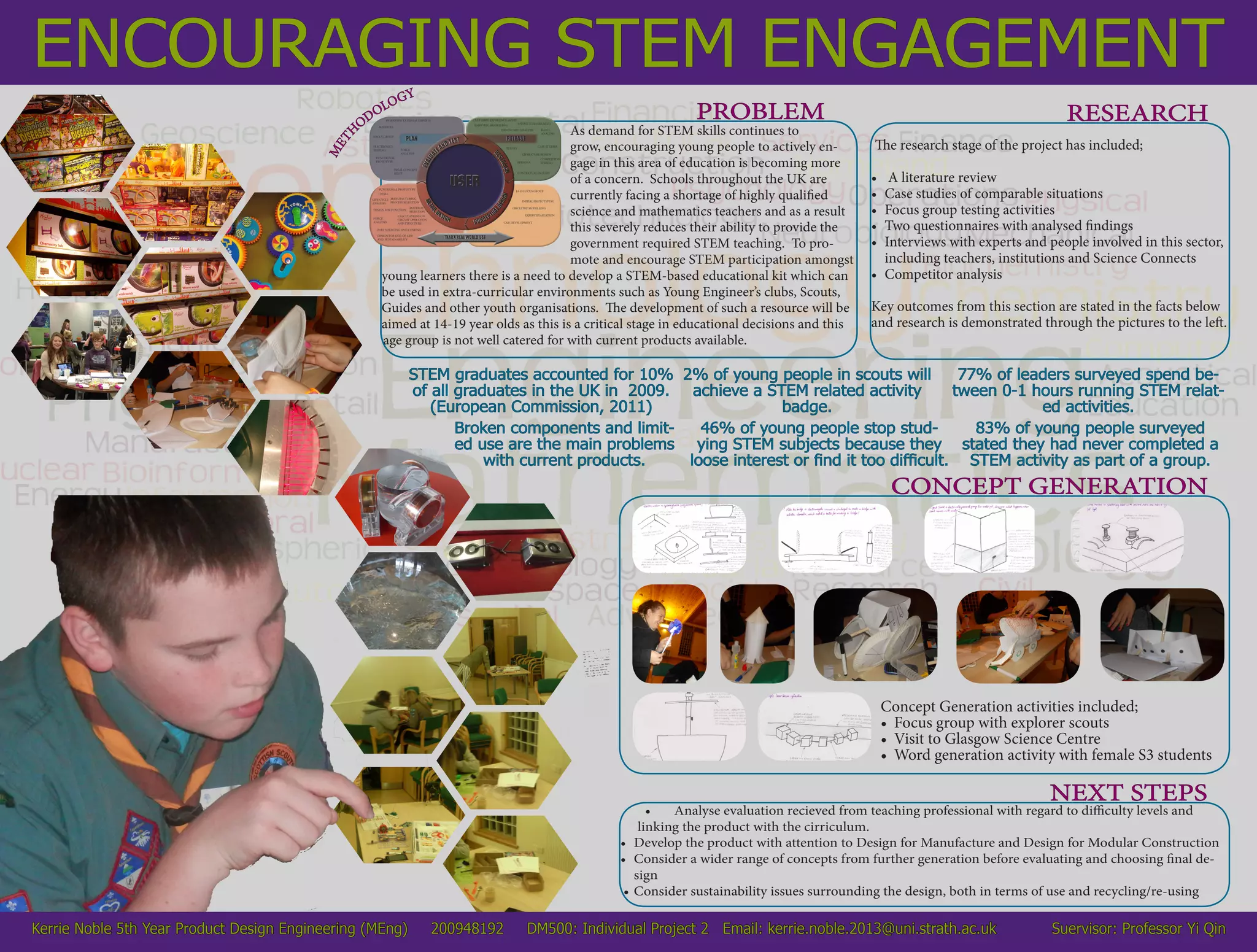
The research stage of the project has included;
•	 A literature review
•	 Case studies of comparable situations
•	 Focus group testing activities
•	 Two questionnaires with analysed findings
•	 Interviews with experts and people involved in this sector,
including teachers, institutions and Science Connects
•	 Competitor analysis
Key outcomes from this section are stated in the facts below
and research is demonstrated through the pictures to the left.
RESEARCH
CONCEPT GENERATION
•	 Analyse evaluation recieved from teaching professional with regard to difficulty levels and
linking the product with the cirriculum.
•	 Develop the product with attention to Design for Manufacture and Design for Modular Construction
•	 Consider a wider range of concepts from further generation before evaluating and choosing final de-
sign
•	Consider sustainability issues surrounding the design, both in terms of use and recycling/re-using
NEXT STEPS
Kerrie Noble 5th Year Product Design Engineering (MEng) 200948192 DM500: Individual Project 2 Email: kerrie.noble.2013@uni.strath.ac.uk Suervisor: Professor Yi Qin
STEM graduates accounted for 10%
of all graduates in the UK in 2009.
(European Commission, 2011)
2% of young people in scouts will
achieve a STEM related activity
badge.
77% of leaders surveyed spend be-
tween 0-1 hours running STEM relat-
ed activities.
Broken components and limit-
ed use are the main problems
with current products.
46% of young people stop stud-
ying STEM subjects because they
loose interest or find it too difficult.
83% of young people surveyed
stated they had never completed a
STEM activity as part of a group.
Concept Generation activities included;
•	 Focus group with explorer scouts
•	 Visit to Glasgow Science Centre
•	 Word generation activity with female S3 students

5TH year progress critique

  • 1.
    ENCOURAGING STEM ENGAGEMENT Asdemand for STEM skills continues to grow, encouraging young people to actively en- gage in this area of education is becoming more of a concern. Schools throughout the UK are currently facing a shortage of highly qualified science and mathematics teachers and as a result this severely reduces their ability to provide the government required STEM teaching. To pro- mote and encourage STEM participation amongst young learners there is a need to develop a STEM-based educational kit which can be used in extra-curricular environments such as Young Engineer’s clubs, Scouts, Guides and other youth organisations. The development of such a resource will be aimed at 14-19 year olds as this is a critical stage in educational decisions and this age group is not well catered for with current products available. PROBLEMPROBLEM MET H ODOLOGY The research stage of the project has included; • A literature review • Case studies of comparable situations • Focus group testing activities • Two questionnaires with analysed findings • Interviews with experts and people involved in this sector, including teachers, institutions and Science Connects • Competitor analysis Key outcomes from this section are stated in the facts below and research is demonstrated through the pictures to the left. RESEARCH CONCEPT GENERATION • Analyse evaluation recieved from teaching professional with regard to difficulty levels and linking the product with the cirriculum. • Develop the product with attention to Design for Manufacture and Design for Modular Construction • Consider a wider range of concepts from further generation before evaluating and choosing final de- sign • Consider sustainability issues surrounding the design, both in terms of use and recycling/re-using NEXT STEPS Kerrie Noble 5th Year Product Design Engineering (MEng) 200948192 DM500: Individual Project 2 Email: kerrie.noble.2013@uni.strath.ac.uk Suervisor: Professor Yi Qin STEM graduates accounted for 10% of all graduates in the UK in 2009. (European Commission, 2011) 2% of young people in scouts will achieve a STEM related activity badge. 77% of leaders surveyed spend be- tween 0-1 hours running STEM relat- ed activities. Broken components and limit- ed use are the main problems with current products. 46% of young people stop stud- ying STEM subjects because they loose interest or find it too difficult. 83% of young people surveyed stated they had never completed a STEM activity as part of a group. Concept Generation activities included; • Focus group with explorer scouts • Visit to Glasgow Science Centre • Word generation activity with female S3 students