STAFFING Christ University, Bangalore
Flow of Presentation Staffing Manpower Planning Performance Appraisal Recruitment and Selection How it differs Training and Development How to make it effective Christ University, Bangalore 2
Staffing Staffing is a process of matching the jobs with individuals , 3 Christ University, Bangalore
Staffing is a function of managing the jobs After organizing the total activities to be done, the management is in a position to know the man- power requirements of the company at different levels in the organization The management is in a position to take necessary steps for recruitment, selection, training and placement of employees Staffing Christ University, Bangalore 4
Staffing is a continuous process because existing employees may leave the organization and new employees may join it Therefore, business organization has to recruit additional managerial and operative force to meet the growing requirements of the enterprise Staffing 5 Christ University, Bangalore
Definition of Staffing According to Koontz and O’ Donnell, “ Staffing involves manning the organization structure through proper and effective selection, appraisal and development of personnel to fill the roles designed into the structure” Christ University, Bangalore 6
Definition of Staffing According to Theo Heimann, “Staffing is concerned with the placement, growth and development of all those members of the organization whose function is to get the things done through the efforts of other individuals” Christ University, Bangalore 7
Activities Involved in Staffing Christ University, Bangalore 8 To determine the sources of recruitment of employees To select the capable employees To train the employees according to need To assign the jobs to the employees To evaluate the performance of employees To arrange for the transfers and promotions of employees To pass the necessary entries regarding the employees To formulate the personnel policy, and, To control the implementation policy
Nature of Staffing Christ University, Bangalore 9 Refer Page 685 of Manmohan Prasad Text + Some other subject text books for a better answer
Scope of Staffing Christ University, Bangalore 10 Refer Page 685 of Manmohan Prasad Text + Some other subject text books for a better answer
Staffing Functions Christ University, Bangalore 11 Man Power Planning Development of People Determination of Employment Standards Scientific Selection of Employees Determining the sources of Personnel: Sources of personnel can be of two types- (i) Internal and (ii) External Internal sources constitute the internal promotion policy while external sources include former employees, technical schools and colleges, through intermediaries, private employment agencies and newspaper advertisements etc.
Staffing Functions Christ University, Bangalore 12 6. Training is Essential 7. Other Functions: Staffing involves other activities also such as coordinating, promotions and transfers, conducting separation procedures, maintenance of records etc.
Manpower Planning (Human Resource Planning) Christ University, Bangalore 13 According to E. B. Geisler, “Manpower planning is the process including forecasting, developing and controlling by which a firm ensures that it has the right number of people and right kind of people at the right places, at the right time doing work for which they are economically most useful.”
Manpower Planning(Human Resource Planning) Christ University, Bangalore 14 According to Dale S. Beach, “ Human resources planning is a process of determining and assuring that the organization will have an adequate number of qualified persons, available at the proper times, performing jobs which meet the needs of enterprise and which provide satisfaction for the individuals involved”.
Christ University, Bangalore 15 Personnel Forecasting Personnel Inventory Job Analysis Planning for Staffing Process/ Steps of Manpower Planning
Advantages of Manpower Planning It reduces personnel costs To plan the development of the employees Manpower inventory It helps in formulating Managerial Succession Plans Thorough Performance Appraisal and Identification Improvement in Business Planning Process Employment Opportunities Greater awareness among workers Christ University, Bangalore 16
Christ University, Bangalore 17 Manpower Planning Process To analyze the current manpower inventory To make Manpower Forecast or Workload Analysis To draw Employment Programme To design Training and Development Programme
Christ University, Bangalore 18 Recruitment Recruitment is the process of searching for prospective employees and stimulating them to apply for jobs in the organization It is a positive process because it increases the selection ratio by attracting a large number of applicants for the advertised jobs
Christ University, Bangalore 19 According to Dale S. Beach, “Recruitment is the development and maintenance of adequate manpower resources. It involves the creation of a pool of available labor upon whom the organization can depend when it needs additional employees” Definition of Recruitment

Christ University, Bangalore 20 According to Edwin B. Flippo, “Recruitment is the process of searching for prospective employees and stimulating them to apply for jobs in the organization” Definition of Recruitment
Christ University, Bangalore 21 Importance of Recruitment Refer Page 691 of Manmohan Prasad Text+ Refer other subject texts for more points
Sources of Recruitment Sources of recruitment can be classified into two broad categories: Internal i.e., recruitment from within the enterprise External i.e., recruitment from outside Christ University, Bangalore 22
Christ University, Bangalore 1. Internal Sources of Recruitment  There are two important internal sources of recruitment, namely- (i) Transfer; and (ii) Promotion Transfer: It involves the shifting of an employee from one job to another At the time of transfer, it is ensured that the employee to be transferred to the new job is capable of performing it In fact, transfer does not involve any drastic change in the responsibilities and status of the employee 23
Christ University, Bangalore 24 ii. Promotion Promotion leads to shifting an employee to a higher position carrying higher responsibilities, facilities, status and pay Most of the companies follow the practice of filling higher jobs by promoting employees who are considered for such positions 1. Internal Sources of Recruitment
Christ University, Bangalore 25 2. External Sources of Recruitment Common external sources of recruitment are as follows: Unsolicited applications : This type of recruitment serves as a valuable source of manpower. If adequate attention is paid to maintain pending application folders for various jobs, the personnel department may find the unsolicited applicants useful in filling the vacancies whenever they arise Advertisement : Advertisement in newspaper or trade and professional journals is generally used when qualified or experienced personnel are not available from other sources. Most of the senior positions in industry as well as commerce are filled by this method Employment Agencies : Employment agencies run by the government are regarded as a good source of recruitment for unskilled, semi- skilled and skilled operative jobs
Christ University, Bangalore 26 2. External Sources of Recruitment d.  Educational Institutions : Jobs in commerce and industry have become increasingly technical and complex to the point where school and college degrees are widely required. Consequently, many big organizations maintain a close liaison with the universities, vocational institutes and management institutes for recruitment to various jobs e.  Recommendations : Applicants introduced by friends and relatives may prove to be a good source of recruitment and indeed many employers prefer to take such persons because something about their background is known. When a present employee or a business friend recommends a person, a type of preliminary screening takes place f.  Labor Contractors : are an important source of recruitment in many industries in India. Workers are recruited through labor contractors who are themselves employees of the organization. But, now- a- days, this system of recruitment is losing popularity
Christ University, Bangalore 27 Steps in Selection Procedure Scrutiny of Application Forms Preliminary Interview Application Blank: Identification Education Experience Expected salaries Community activities References
Christ University, Bangalore 28 Steps in Selection Procedure Employment Tests: Trade Tests Psychological Tests-  Aptitude Tests Intelligence Tests Interest Tests Knowledge Tests
Christ University, Bangalore 29 Projective Texts Personality Tests Judgment Tests Dexterity Tests 5. Employment Interview 6. Physical/ Medical Examination 7. Reference Check 8. Final Selection Refer Page 694 to 697 of Manmohan Prasad Text for the explanation of all the above points Steps in Selection Procedure
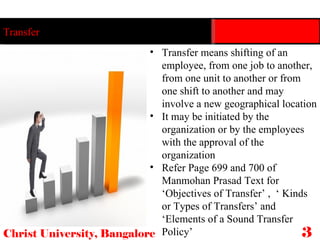
Christ University, Bangalore 30 Transfer Transfer means shifting of an employee, from one job to another, from one unit to another or from one shift to another and may involve a new geographical location It may be initiated by the organization or by the employees with the approval of the organization Refer Page 699 and 700 of Manmohan Prasad Text for ‘Objectives of Transfer’ ,  ‘ Kinds or Types of Transfers’ and ‘Elements of a Sound Transfer Policy’
Christ University, Bangalore 31 Promotion The term ‘Promotion’ is the advancement of an employee to a better job Better job meant a job which entails greater responsibilities and more prestige or status, needs greater skills and brings increased rate of pay or salary
Christ University, Bangalore 32 Definition of Promotion According to Scott and Spriegal, “A promotion is the transfer of an employee to a job that pays more money or that enjoys some preferred status” Edwin B. Flippo has said that “A promotion involves a change from one job to another that is better in terms of status and responsibility” Refer Page 701 to 706 of Manmohan Prasad Text for ‘Elements of Promotion’, ‘Significance of Promotion’, ‘Principles of Promotion’ and ‘Role of Personnel Department in Promotion’
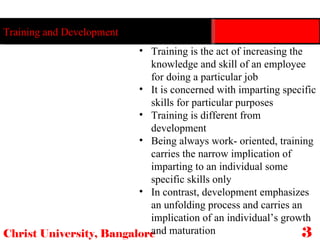
Christ University, Bangalore Training and Development Training is the act of increasing the knowledge and skill of an employee for doing a particular job It is concerned with imparting specific skills for particular purposes Training is different from development  Being always work- oriented, training carries the narrow implication of imparting to an individual some specific skills only In contrast, development emphasizes an unfolding process and carries an implication of an individual’s growth and maturation  33
Christ University, Bangalore 34 Training Vs. Development (V. Important as per course plan- Answer has to be given in a Table)  Refer any HRM textbook and take a Xerox of it You can get the same from some Management Text also Advantages and Disadvantages of Training- Refer any HRM Text or Management Text Different Training Methods- Refer any HRM Text or Management Text
Christ University, Bangalore 35 Recruitment Vs. Selection (V. Important as per course plan- Answer has to be given in a Table)  Refer any HRM textbook and take a Xerox of it You can get the same from some Management Text also
Christ University, Bangalore 36 How to make Training and Development Effective? V. Important Specified in the Course Plan Refer any HRM textbook and take a Xerox of it You can get the same from some Management Text also
THANK YOU!!!!!!!!!!!

Staffing

  • 1.
  • 2.
    Flow of PresentationStaffing Manpower Planning Performance Appraisal Recruitment and Selection How it differs Training and Development How to make it effective Christ University, Bangalore 2
  • 3.
    Staffing Staffing isa process of matching the jobs with individuals , 3 Christ University, Bangalore
  • 4.
    Staffing is afunction of managing the jobs After organizing the total activities to be done, the management is in a position to know the man- power requirements of the company at different levels in the organization The management is in a position to take necessary steps for recruitment, selection, training and placement of employees Staffing Christ University, Bangalore 4
  • 5.
    Staffing is acontinuous process because existing employees may leave the organization and new employees may join it Therefore, business organization has to recruit additional managerial and operative force to meet the growing requirements of the enterprise Staffing 5 Christ University, Bangalore
  • 6.
    Definition of StaffingAccording to Koontz and O’ Donnell, “ Staffing involves manning the organization structure through proper and effective selection, appraisal and development of personnel to fill the roles designed into the structure” Christ University, Bangalore 6
  • 7.
    Definition of StaffingAccording to Theo Heimann, “Staffing is concerned with the placement, growth and development of all those members of the organization whose function is to get the things done through the efforts of other individuals” Christ University, Bangalore 7
  • 8.
    Activities Involved inStaffing Christ University, Bangalore 8 To determine the sources of recruitment of employees To select the capable employees To train the employees according to need To assign the jobs to the employees To evaluate the performance of employees To arrange for the transfers and promotions of employees To pass the necessary entries regarding the employees To formulate the personnel policy, and, To control the implementation policy
  • 9.
    Nature of StaffingChrist University, Bangalore 9 Refer Page 685 of Manmohan Prasad Text + Some other subject text books for a better answer
  • 10.
    Scope of StaffingChrist University, Bangalore 10 Refer Page 685 of Manmohan Prasad Text + Some other subject text books for a better answer
  • 11.
    Staffing Functions ChristUniversity, Bangalore 11 Man Power Planning Development of People Determination of Employment Standards Scientific Selection of Employees Determining the sources of Personnel: Sources of personnel can be of two types- (i) Internal and (ii) External Internal sources constitute the internal promotion policy while external sources include former employees, technical schools and colleges, through intermediaries, private employment agencies and newspaper advertisements etc.
  • 12.
    Staffing Functions ChristUniversity, Bangalore 12 6. Training is Essential 7. Other Functions: Staffing involves other activities also such as coordinating, promotions and transfers, conducting separation procedures, maintenance of records etc.
  • 13.
    Manpower Planning (HumanResource Planning) Christ University, Bangalore 13 According to E. B. Geisler, “Manpower planning is the process including forecasting, developing and controlling by which a firm ensures that it has the right number of people and right kind of people at the right places, at the right time doing work for which they are economically most useful.”
  • 14.
    Manpower Planning(Human ResourcePlanning) Christ University, Bangalore 14 According to Dale S. Beach, “ Human resources planning is a process of determining and assuring that the organization will have an adequate number of qualified persons, available at the proper times, performing jobs which meet the needs of enterprise and which provide satisfaction for the individuals involved”.
  • 15.
    Christ University, Bangalore15 Personnel Forecasting Personnel Inventory Job Analysis Planning for Staffing Process/ Steps of Manpower Planning
  • 16.
    Advantages of ManpowerPlanning It reduces personnel costs To plan the development of the employees Manpower inventory It helps in formulating Managerial Succession Plans Thorough Performance Appraisal and Identification Improvement in Business Planning Process Employment Opportunities Greater awareness among workers Christ University, Bangalore 16
  • 17.
    Christ University, Bangalore17 Manpower Planning Process To analyze the current manpower inventory To make Manpower Forecast or Workload Analysis To draw Employment Programme To design Training and Development Programme
  • 18.
    Christ University, Bangalore18 Recruitment Recruitment is the process of searching for prospective employees and stimulating them to apply for jobs in the organization It is a positive process because it increases the selection ratio by attracting a large number of applicants for the advertised jobs
  • 19.
    Christ University, Bangalore19 According to Dale S. Beach, “Recruitment is the development and maintenance of adequate manpower resources. It involves the creation of a pool of available labor upon whom the organization can depend when it needs additional employees” Definition of Recruitment
  • 20.
    Christ University, Bangalore20 According to Edwin B. Flippo, “Recruitment is the process of searching for prospective employees and stimulating them to apply for jobs in the organization” Definition of Recruitment
  • 21.
    Christ University, Bangalore21 Importance of Recruitment Refer Page 691 of Manmohan Prasad Text+ Refer other subject texts for more points
  • 22.
    Sources of RecruitmentSources of recruitment can be classified into two broad categories: Internal i.e., recruitment from within the enterprise External i.e., recruitment from outside Christ University, Bangalore 22
  • 23.
    Christ University, Bangalore1. Internal Sources of Recruitment There are two important internal sources of recruitment, namely- (i) Transfer; and (ii) Promotion Transfer: It involves the shifting of an employee from one job to another At the time of transfer, it is ensured that the employee to be transferred to the new job is capable of performing it In fact, transfer does not involve any drastic change in the responsibilities and status of the employee 23
  • 24.
    Christ University, Bangalore24 ii. Promotion Promotion leads to shifting an employee to a higher position carrying higher responsibilities, facilities, status and pay Most of the companies follow the practice of filling higher jobs by promoting employees who are considered for such positions 1. Internal Sources of Recruitment
  • 25.
    Christ University, Bangalore25 2. External Sources of Recruitment Common external sources of recruitment are as follows: Unsolicited applications : This type of recruitment serves as a valuable source of manpower. If adequate attention is paid to maintain pending application folders for various jobs, the personnel department may find the unsolicited applicants useful in filling the vacancies whenever they arise Advertisement : Advertisement in newspaper or trade and professional journals is generally used when qualified or experienced personnel are not available from other sources. Most of the senior positions in industry as well as commerce are filled by this method Employment Agencies : Employment agencies run by the government are regarded as a good source of recruitment for unskilled, semi- skilled and skilled operative jobs
  • 26.
    Christ University, Bangalore26 2. External Sources of Recruitment d. Educational Institutions : Jobs in commerce and industry have become increasingly technical and complex to the point where school and college degrees are widely required. Consequently, many big organizations maintain a close liaison with the universities, vocational institutes and management institutes for recruitment to various jobs e. Recommendations : Applicants introduced by friends and relatives may prove to be a good source of recruitment and indeed many employers prefer to take such persons because something about their background is known. When a present employee or a business friend recommends a person, a type of preliminary screening takes place f. Labor Contractors : are an important source of recruitment in many industries in India. Workers are recruited through labor contractors who are themselves employees of the organization. But, now- a- days, this system of recruitment is losing popularity
  • 27.
    Christ University, Bangalore27 Steps in Selection Procedure Scrutiny of Application Forms Preliminary Interview Application Blank: Identification Education Experience Expected salaries Community activities References
  • 28.
    Christ University, Bangalore28 Steps in Selection Procedure Employment Tests: Trade Tests Psychological Tests- Aptitude Tests Intelligence Tests Interest Tests Knowledge Tests
  • 29.
    Christ University, Bangalore29 Projective Texts Personality Tests Judgment Tests Dexterity Tests 5. Employment Interview 6. Physical/ Medical Examination 7. Reference Check 8. Final Selection Refer Page 694 to 697 of Manmohan Prasad Text for the explanation of all the above points Steps in Selection Procedure
  • 30.
    Christ University, Bangalore30 Transfer Transfer means shifting of an employee, from one job to another, from one unit to another or from one shift to another and may involve a new geographical location It may be initiated by the organization or by the employees with the approval of the organization Refer Page 699 and 700 of Manmohan Prasad Text for ‘Objectives of Transfer’ , ‘ Kinds or Types of Transfers’ and ‘Elements of a Sound Transfer Policy’
  • 31.
    Christ University, Bangalore31 Promotion The term ‘Promotion’ is the advancement of an employee to a better job Better job meant a job which entails greater responsibilities and more prestige or status, needs greater skills and brings increased rate of pay or salary
  • 32.
    Christ University, Bangalore32 Definition of Promotion According to Scott and Spriegal, “A promotion is the transfer of an employee to a job that pays more money or that enjoys some preferred status” Edwin B. Flippo has said that “A promotion involves a change from one job to another that is better in terms of status and responsibility” Refer Page 701 to 706 of Manmohan Prasad Text for ‘Elements of Promotion’, ‘Significance of Promotion’, ‘Principles of Promotion’ and ‘Role of Personnel Department in Promotion’
  • 33.
    Christ University, BangaloreTraining and Development Training is the act of increasing the knowledge and skill of an employee for doing a particular job It is concerned with imparting specific skills for particular purposes Training is different from development Being always work- oriented, training carries the narrow implication of imparting to an individual some specific skills only In contrast, development emphasizes an unfolding process and carries an implication of an individual’s growth and maturation 33
  • 34.
    Christ University, Bangalore34 Training Vs. Development (V. Important as per course plan- Answer has to be given in a Table) Refer any HRM textbook and take a Xerox of it You can get the same from some Management Text also Advantages and Disadvantages of Training- Refer any HRM Text or Management Text Different Training Methods- Refer any HRM Text or Management Text
  • 35.
    Christ University, Bangalore35 Recruitment Vs. Selection (V. Important as per course plan- Answer has to be given in a Table) Refer any HRM textbook and take a Xerox of it You can get the same from some Management Text also
  • 36.
    Christ University, Bangalore36 How to make Training and Development Effective? V. Important Specified in the Course Plan Refer any HRM textbook and take a Xerox of it You can get the same from some Management Text also
  • 37.