1
Programming and Data Structures
Stack & Queue
2
*Queue
*Basic principles
*Operation of queue
*Queue using Array
*Queue using Linked List
*Applications of queue
Today’s discussion…
3
*Stack
*Basic principles
*Operation of stack
*Stack using Array
*Stack using Linked List
*Applications of stack
Stack
4
Basic Idea
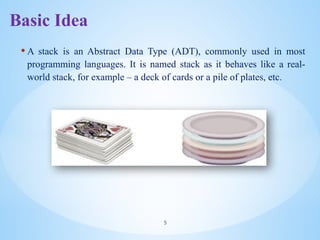
• A stack is an Abstract Data Type (ADT), commonly used in most
programming languages. It is named stack as it behaves like a real-
world stack, for example – a deck of cards or a pile of plates, etc.
5
Stack Representation
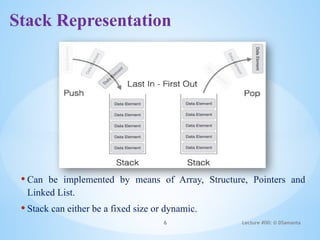
• Can be implemented by means of Array, Structure, Pointers and
Linked List.
• Stack can either be a fixed size or dynamic.
6 Lecture #00: © DSamanta
7
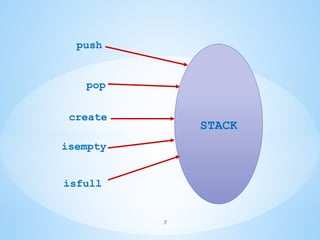
STACK
push
create
pop
isfull
isempty
STACK: Last-In-First-Out (LIFO)
• void push (stack *s, int element);
/* Insert an element in the stack */
• int pop (stack *s);
/* Remove and return the top element */
• void create (stack *s);
/* Create a new stack */
• int isempty (stack *s);
/* Check if stack is empty */
• int isfull (stack *s);
/* Check if stack is full */
8
Assumption: stack contains integer elements!
Stack using Array
9
Lecture #00: © DSamanta
10
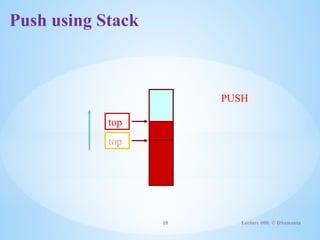
top
top
PUSH
Push using Stack
Lecture #00: © DSamanta
11
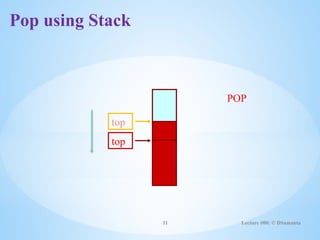
top
top
POP
Pop using Stack
Stack using Linked List
12 Lecture #00: © DSamanta
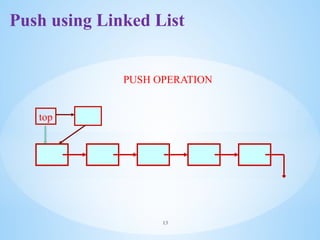
13
top
PUSH OPERATION
Push using Linked List
Lecture #00: © DSamanta
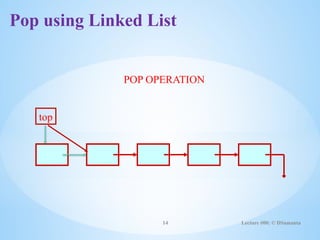
14
top
POP OPERATION
Pop using Linked List
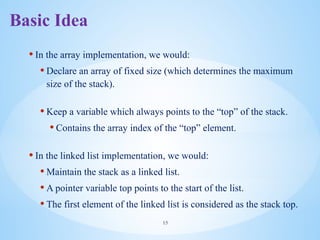
• In the array implementation, we would:
• Declare an array of fixed size (which determines the maximum
size of the stack).
• Keep a variable which always points to the “top” of the stack.
• Contains the array index of the “top” element.
• In the linked list implementation, we would:
• Maintain the stack as a linked list.
• A pointer variable top points to the start of the list.
• The first element of the linked list is considered as the stack top.
15
Basic Idea
Declaration
16
#define MAXSIZE 100
struct lifo
{
int st[MAXSIZE];
int top;
};
typedef struct lifo
stack;
stack s;
struct lifo
{
int value;
struct lifo *next;
};
typedef struct lifo
stack;
stack *top;
ARRAY LINKED LIST
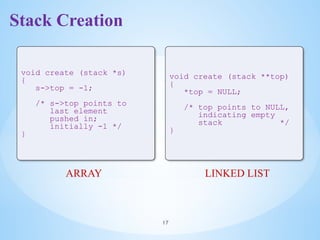
Stack Creation
17
void create (stack *s)
{
s->top = -1;
/* s->top points to
last element
pushed in;
initially -1 */
}
void create (stack **top)
{
*top = NULL;
/* top points to NULL,
indicating empty
stack */
}
ARRAY LINKED LIST
Pushing an element into stack
18
void push (stack *s, int element)
{
if (s->top == (MAXSIZE-1))
{
printf (“n Stack overflow”);
exit(-1);
}
else
{
s->top++;
s->st[s->top] = element;
}
}
ARRAY
void push (stack **top, int element)
{
stack *new;
new = (stack *)malloc (sizeof(stack));
if (new == NULL)
{
printf (“n Stack is full”);
exit(-1);
}
new->value = element;
new->next = *top;
*top = new;
}
LINKED LIST
Popping an element from stack
19
int pop (stack *s)
{
if (s->top == -1)
{
printf (“n Stack underflow”);
exit(-1);
}
else
{
return (s->st[s->top--]);
}
}
ARRAY
int pop (stack **top)
{
int t;
stack *p;
if (*top == NULL)
{
printf (“n Stack is empty”);
exit(-1);
}
else
{
t = (*top)->value;
p = *top;
*top = (*top)->next;
free (p);
return t;
}
}
LINKED LIST
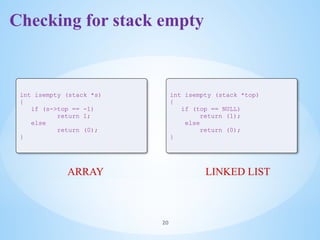
Checking for stack empty
20
int isempty (stack *s)
{
if (s->top == -1)
return 1;
else
return (0);
}
ARRAY LINKED LIST
int isempty (stack *top)
{
if (top == NULL)
return (1);
else
return (0);
}
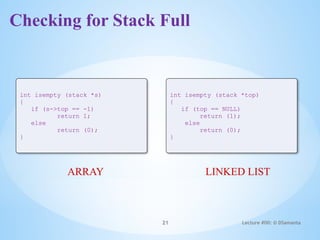
Checking for Stack Full
21 Lecture #00: © DSamanta
int isempty (stack *s)
{
if (s->top == -1)
return 1;
else
return (0);
}
ARRAY LINKED LIST
int isempty (stack *top)
{
if (top == NULL)
return (1);
else
return (0);
}
Example: A Stack using an Array
22
#include <stdio.h>
#define MAXSIZE 100
struct lifo
{
int st[MAXSIZE];
int top;
};
typedef struct lifo stack;
main() {
stack A, B;
create(&A);
create(&B);
push(&A,10);
push(&A,20);
push(&A,30);
push(&B,100);
push(&B,5);
printf (“%d %d”, pop(&A), pop(&B));
push (&A, pop(&B));
if (isempty(&B))
printf (“n B is empty”);
return;
}
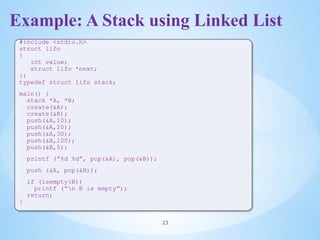
Example: A Stack using Linked List
23
#include <stdio.h>
struct lifo
{
int value;
struct lifo *next;
};
typedef struct lifo stack;
main() {
stack *A, *B;
create(&A);
create(&B);
push(&A,10);
push(&A,20);
push(&A,30);
push(&B,100);
push(&B,5);
printf (“%d %d”, pop(&A), pop(&B));
push (&A, pop(&B));
if (isempty(B))
printf (“n B is empty”);
return;
}
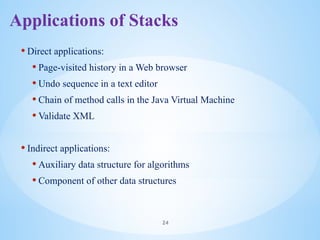
Applications of Stacks
• Direct applications:
• Page-visited history in a Web browser
• Undo sequence in a text editor
• Chain of method calls in the Java Virtual Machine
• Validate XML
• Indirect applications:
• Auxiliary data structure for algorithms
• Component of other data structures
24
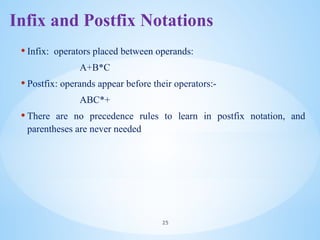
Infix and Postfix Notations
• Infix: operators placed between operands:
A+B*C
• Postfix: operands appear before their operators:-
ABC*+
• There are no precedence rules to learn in postfix notation, and
parentheses are never needed
25
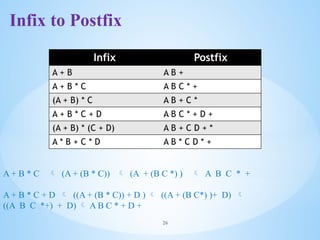
Infix Postfix
A + B A B +
A + B * C A B C * +
(A + B) * C A B + C *
A + B * C + D A B C * + D +
(A + B) * (C + D) A B + C D + *
A * B + C * D A B * C D * +
A + B * C  (A + (B * C))  (A + (B C *) )  A B C * +
A + B * C + D  ((A + (B * C)) + D )  ((A + (B C*) )+ D) 
((A B C *+) + D)  A B C * + D +
26
Infix to Postfix
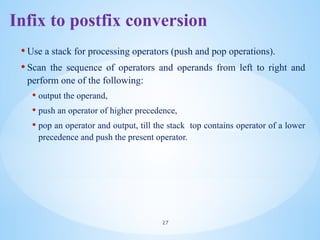
Infix to postfix conversion
• Use a stack for processing operators (push and pop operations).
• Scan the sequence of operators and operands from left to right and
perform one of the following:
• output the operand,
• push an operator of higher precedence,
• pop an operator and output, till the stack top contains operator of a lower
precedence and push the present operator.
27
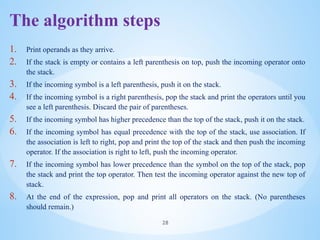
The algorithm steps
1. Print operands as they arrive.
2. If the stack is empty or contains a left parenthesis on top, push the incoming operator onto
the stack.
3. If the incoming symbol is a left parenthesis, push it on the stack.
4. If the incoming symbol is a right parenthesis, pop the stack and print the operators until you
see a left parenthesis. Discard the pair of parentheses.
5. If the incoming symbol has higher precedence than the top of the stack, push it on the stack.
6. If the incoming symbol has equal precedence with the top of the stack, use association. If
the association is left to right, pop and print the top of the stack and then push the incoming
operator. If the association is right to left, push the incoming operator.
7. If the incoming symbol has lower precedence than the symbol on the top of the stack, pop
the stack and print the top operator. Then test the incoming operator against the new top of
stack.
8. At the end of the expression, pop and print all operators on the stack. (No parentheses
should remain.)
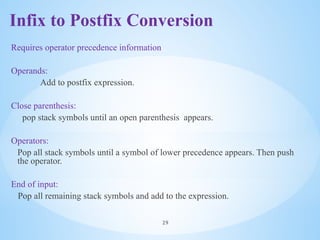
28
Infix to Postfix Conversion
Requires operator precedence information
Operands:
Add to postfix expression.
Close parenthesis:
pop stack symbols until an open parenthesis appears.
Operators:
Pop all stack symbols until a symbol of lower precedence appears. Then push
the operator.
End of input:
Pop all remaining stack symbols and add to the expression.
29
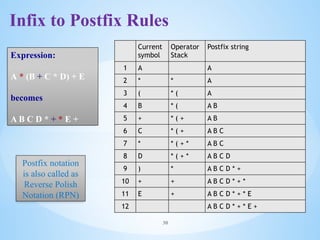
Current
symbol
Operator
Stack
Postfix string
1 A A
2 * * A
3 ( * ( A
4 B * ( A B
5 + * ( + A B
6 C * ( + A B C
7 * * ( + * A B C
8 D * ( + * A B C D
9 ) * A B C D * +
10 + + A B C D * + *
11 E + A B C D * + * E
12 A B C D * + * E +
Expression:
A * (B + C * D) + E
becomes
A B C D * + * E +
Postfix notation
is also called as
Reverse Polish
Notation (RPN)
30
Infix to Postfix Rules
Queue
31 Lecture #00: © DSamanta
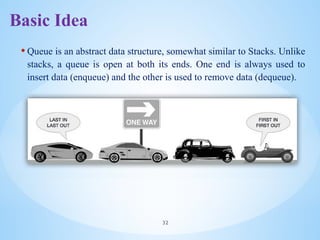
Basic Idea
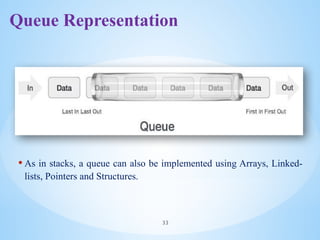
• Queue is an abstract data structure, somewhat similar to Stacks. Unlike
stacks, a queue is open at both its ends. One end is always used to
insert data (enqueue) and the other is used to remove data (dequeue).
32
Queue Representation
• As in stacks, a queue can also be implemented using Arrays, Linked-
lists, Pointers and Structures.
33
34
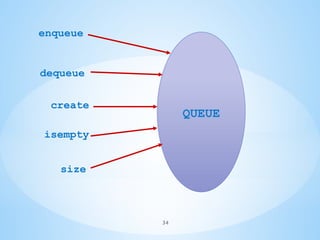
QUEUE
enqueue
create
dequeue
size
isempty
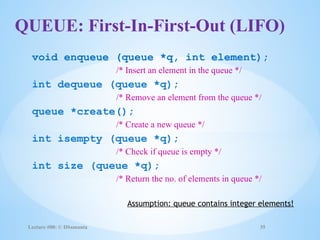
void enqueue (queue *q, int element);
/* Insert an element in the queue */
int dequeue (queue *q);
/* Remove an element from the queue */
queue *create();
/* Create a new queue */
int isempty (queue *q);
/* Check if queue is empty */
int size (queue *q);
/* Return the no. of elements in queue */
Lecture #00: © DSamanta 35
Assumption: queue contains integer elements!
QUEUE: First-In-First-Out (LIFO)
Queue using Linked List
36
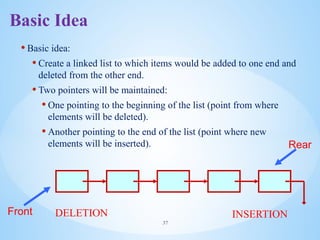
37
Front
Rear
DELETION INSERTION
Basic Idea
• Basic idea:
• Create a linked list to which items would be added to one end and
deleted from the other end.
• Two pointers will be maintained:
• One pointing to the beginning of the list (point from where
elements will be deleted).
• Another pointing to the end of the list (point where new
elements will be inserted).
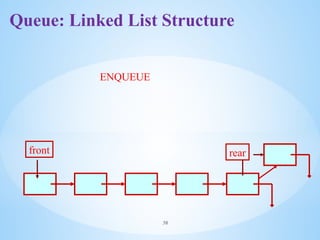
38
front rear
ENQUEUE
Queue: Linked List Structure
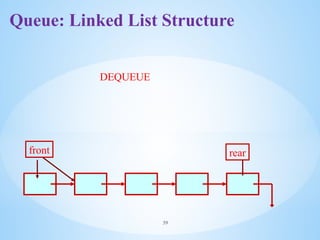
39
front rear
DEQUEUE
Queue: Linked List Structure
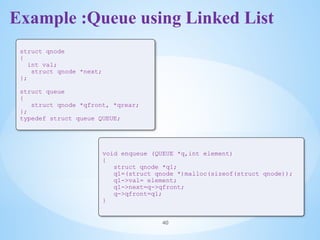
Example :Queue using Linked List
40
struct qnode
{
int val;
struct qnode *next;
};
struct queue
{
struct qnode *qfront, *qrear;
};
typedef struct queue QUEUE;
void enqueue (QUEUE *q,int element)
{
struct qnode *q1;
q1=(struct qnode *)malloc(sizeof(struct qnode));
q1->val= element;
q1->next=q->qfront;
q->qfront=q1;
}
Example :Queue using Linked List
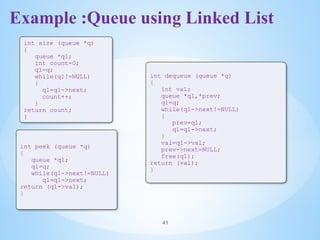
41
int size (queue *q)
{
queue *q1;
int count=0;
q1=q;
while(q1!=NULL)
{
q1=q1->next;
count++;
}
return count;
}
int peek (queue *q)
{
queue *q1;
q1=q;
while(q1->next!=NULL)
q1=q1->next;
return (q1->val);
}
int dequeue (queue *q)
{
int val;
queue *q1,*prev;
q1=q;
while(q1->next!=NULL)
{
prev=q1;
q1=q1->next;
}
val=q1->val;
prev->next=NULL;
free(q1);
return (val);
}
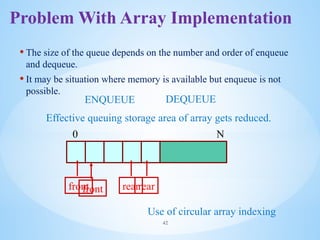
• The size of the queue depends on the number and order of enqueue
and dequeue.
• It may be situation where memory is available but enqueue is not
possible.
42
front rearrear
ENQUEUE
front
DEQUEUE
Effective queuing storage area of array gets reduced.
Use of circular array indexing
0 N
Problem With Array Implementation
Applications of Queues
• Direct applications:-
• Waiting lists
• Access to shared resources (e.g., printer)
• Multiprogramming
• Indirect applications:-
• Auxiliary data structure for algorithms
• Component of other data structures
43
Practice Questions :Stack
1. Implement a stack using an array and demonstrate the push, pop, and peek
operations.
2. Implement a program that converts a decimal number to its binary equivalent
using a stack.
3. Given a string containing multiple parentheses, write a program to check
whether the parentheses are balanced using a stack. Analyze the algorithm's time
complexity.
4. Write a program to check whether a given string is a palindrome by using a
stack.
5. Write a program to convert an infix expression to a postfix expression using a
stack. Analyze the difference in computational efficiency between the two
notations.
6. Implement a program to reverse a singly linked list using a stack.
7. Write a program to evaluate a postfix expression (e.g., 231*+9-).
8. Implement the Tower of Hanoi problem using stacks. Analyze the solution in
terms of recursion versus stack-based implementation.
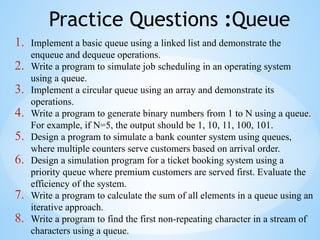
Practice Questions :Queue
1. Implement a basic queue using a linked list and demonstrate the
enqueue and dequeue operations.
2. Write a program to simulate job scheduling in an operating system
using a queue.
3. Implement a circular queue using an array and demonstrate its
operations.
4. Write a program to generate binary numbers from 1 to N using a queue.
For example, if N=5, the output should be 1, 10, 11, 100, 101.
5. Design a program to simulate a bank counter system using queues,
where multiple counters serve customers based on arrival order.
6. Design a simulation program for a ticket booking system using a
priority queue where premium customers are served first. Evaluate the
efficiency of the system.
7. Write a program to calculate the sum of all elements in a queue using an
iterative approach.
8. Write a program to find the first non-repeating character in a stream of
characters using a queue.

DSA_Unit3_ Stacks and Queues using array (1).pptx

  • 1.
  • 2.
  • 3.
    *Queue *Basic principles *Operation ofqueue *Queue using Array *Queue using Linked List *Applications of queue Today’s discussion… 3 *Stack *Basic principles *Operation of stack *Stack using Array *Stack using Linked List *Applications of stack
  • 4.
  • 5.
    Basic Idea • Astack is an Abstract Data Type (ADT), commonly used in most programming languages. It is named stack as it behaves like a real- world stack, for example – a deck of cards or a pile of plates, etc. 5
  • 6.
    Stack Representation • Canbe implemented by means of Array, Structure, Pointers and Linked List. • Stack can either be a fixed size or dynamic. 6 Lecture #00: © DSamanta
  • 7.
  • 8.
    STACK: Last-In-First-Out (LIFO) •void push (stack *s, int element); /* Insert an element in the stack */ • int pop (stack *s); /* Remove and return the top element */ • void create (stack *s); /* Create a new stack */ • int isempty (stack *s); /* Check if stack is empty */ • int isfull (stack *s); /* Check if stack is full */ 8 Assumption: stack contains integer elements!
  • 9.
  • 10.
    Lecture #00: ©DSamanta 10 top top PUSH Push using Stack
  • 11.
    Lecture #00: ©DSamanta 11 top top POP Pop using Stack
  • 12.
    Stack using LinkedList 12 Lecture #00: © DSamanta
  • 13.
  • 14.
    Lecture #00: ©DSamanta 14 top POP OPERATION Pop using Linked List
  • 15.
    • In thearray implementation, we would: • Declare an array of fixed size (which determines the maximum size of the stack). • Keep a variable which always points to the “top” of the stack. • Contains the array index of the “top” element. • In the linked list implementation, we would: • Maintain the stack as a linked list. • A pointer variable top points to the start of the list. • The first element of the linked list is considered as the stack top. 15 Basic Idea
  • 16.
    Declaration 16 #define MAXSIZE 100 structlifo { int st[MAXSIZE]; int top; }; typedef struct lifo stack; stack s; struct lifo { int value; struct lifo *next; }; typedef struct lifo stack; stack *top; ARRAY LINKED LIST
  • 17.
    Stack Creation 17 void create(stack *s) { s->top = -1; /* s->top points to last element pushed in; initially -1 */ } void create (stack **top) { *top = NULL; /* top points to NULL, indicating empty stack */ } ARRAY LINKED LIST
  • 18.
    Pushing an elementinto stack 18 void push (stack *s, int element) { if (s->top == (MAXSIZE-1)) { printf (“n Stack overflow”); exit(-1); } else { s->top++; s->st[s->top] = element; } } ARRAY void push (stack **top, int element) { stack *new; new = (stack *)malloc (sizeof(stack)); if (new == NULL) { printf (“n Stack is full”); exit(-1); } new->value = element; new->next = *top; *top = new; } LINKED LIST
  • 19.
    Popping an elementfrom stack 19 int pop (stack *s) { if (s->top == -1) { printf (“n Stack underflow”); exit(-1); } else { return (s->st[s->top--]); } } ARRAY int pop (stack **top) { int t; stack *p; if (*top == NULL) { printf (“n Stack is empty”); exit(-1); } else { t = (*top)->value; p = *top; *top = (*top)->next; free (p); return t; } } LINKED LIST
  • 20.
    Checking for stackempty 20 int isempty (stack *s) { if (s->top == -1) return 1; else return (0); } ARRAY LINKED LIST int isempty (stack *top) { if (top == NULL) return (1); else return (0); }
  • 21.
    Checking for StackFull 21 Lecture #00: © DSamanta int isempty (stack *s) { if (s->top == -1) return 1; else return (0); } ARRAY LINKED LIST int isempty (stack *top) { if (top == NULL) return (1); else return (0); }
  • 22.
    Example: A Stackusing an Array 22 #include <stdio.h> #define MAXSIZE 100 struct lifo { int st[MAXSIZE]; int top; }; typedef struct lifo stack; main() { stack A, B; create(&A); create(&B); push(&A,10); push(&A,20); push(&A,30); push(&B,100); push(&B,5); printf (“%d %d”, pop(&A), pop(&B)); push (&A, pop(&B)); if (isempty(&B)) printf (“n B is empty”); return; }
  • 23.
    Example: A Stackusing Linked List 23 #include <stdio.h> struct lifo { int value; struct lifo *next; }; typedef struct lifo stack; main() { stack *A, *B; create(&A); create(&B); push(&A,10); push(&A,20); push(&A,30); push(&B,100); push(&B,5); printf (“%d %d”, pop(&A), pop(&B)); push (&A, pop(&B)); if (isempty(B)) printf (“n B is empty”); return; }
  • 24.
    Applications of Stacks •Direct applications: • Page-visited history in a Web browser • Undo sequence in a text editor • Chain of method calls in the Java Virtual Machine • Validate XML • Indirect applications: • Auxiliary data structure for algorithms • Component of other data structures 24
  • 25.
    Infix and PostfixNotations • Infix: operators placed between operands: A+B*C • Postfix: operands appear before their operators:- ABC*+ • There are no precedence rules to learn in postfix notation, and parentheses are never needed 25
  • 26.
    Infix Postfix A +B A B + A + B * C A B C * + (A + B) * C A B + C * A + B * C + D A B C * + D + (A + B) * (C + D) A B + C D + * A * B + C * D A B * C D * + A + B * C  (A + (B * C))  (A + (B C *) )  A B C * + A + B * C + D  ((A + (B * C)) + D )  ((A + (B C*) )+ D)  ((A B C *+) + D)  A B C * + D + 26 Infix to Postfix
  • 27.
    Infix to postfixconversion • Use a stack for processing operators (push and pop operations). • Scan the sequence of operators and operands from left to right and perform one of the following: • output the operand, • push an operator of higher precedence, • pop an operator and output, till the stack top contains operator of a lower precedence and push the present operator. 27
  • 28.
    The algorithm steps 1.Print operands as they arrive. 2. If the stack is empty or contains a left parenthesis on top, push the incoming operator onto the stack. 3. If the incoming symbol is a left parenthesis, push it on the stack. 4. If the incoming symbol is a right parenthesis, pop the stack and print the operators until you see a left parenthesis. Discard the pair of parentheses. 5. If the incoming symbol has higher precedence than the top of the stack, push it on the stack. 6. If the incoming symbol has equal precedence with the top of the stack, use association. If the association is left to right, pop and print the top of the stack and then push the incoming operator. If the association is right to left, push the incoming operator. 7. If the incoming symbol has lower precedence than the symbol on the top of the stack, pop the stack and print the top operator. Then test the incoming operator against the new top of stack. 8. At the end of the expression, pop and print all operators on the stack. (No parentheses should remain.) 28
  • 29.
    Infix to PostfixConversion Requires operator precedence information Operands: Add to postfix expression. Close parenthesis: pop stack symbols until an open parenthesis appears. Operators: Pop all stack symbols until a symbol of lower precedence appears. Then push the operator. End of input: Pop all remaining stack symbols and add to the expression. 29
  • 30.
    Current symbol Operator Stack Postfix string 1 AA 2 * * A 3 ( * ( A 4 B * ( A B 5 + * ( + A B 6 C * ( + A B C 7 * * ( + * A B C 8 D * ( + * A B C D 9 ) * A B C D * + 10 + + A B C D * + * 11 E + A B C D * + * E 12 A B C D * + * E + Expression: A * (B + C * D) + E becomes A B C D * + * E + Postfix notation is also called as Reverse Polish Notation (RPN) 30 Infix to Postfix Rules
  • 31.
  • 32.
    Basic Idea • Queueis an abstract data structure, somewhat similar to Stacks. Unlike stacks, a queue is open at both its ends. One end is always used to insert data (enqueue) and the other is used to remove data (dequeue). 32
  • 33.
    Queue Representation • Asin stacks, a queue can also be implemented using Arrays, Linked- lists, Pointers and Structures. 33
  • 34.
  • 35.
    void enqueue (queue*q, int element); /* Insert an element in the queue */ int dequeue (queue *q); /* Remove an element from the queue */ queue *create(); /* Create a new queue */ int isempty (queue *q); /* Check if queue is empty */ int size (queue *q); /* Return the no. of elements in queue */ Lecture #00: © DSamanta 35 Assumption: queue contains integer elements! QUEUE: First-In-First-Out (LIFO)
  • 36.
  • 37.
    37 Front Rear DELETION INSERTION Basic Idea •Basic idea: • Create a linked list to which items would be added to one end and deleted from the other end. • Two pointers will be maintained: • One pointing to the beginning of the list (point from where elements will be deleted). • Another pointing to the end of the list (point where new elements will be inserted).
  • 38.
  • 39.
  • 40.
    Example :Queue usingLinked List 40 struct qnode { int val; struct qnode *next; }; struct queue { struct qnode *qfront, *qrear; }; typedef struct queue QUEUE; void enqueue (QUEUE *q,int element) { struct qnode *q1; q1=(struct qnode *)malloc(sizeof(struct qnode)); q1->val= element; q1->next=q->qfront; q->qfront=q1; }
  • 41.
    Example :Queue usingLinked List 41 int size (queue *q) { queue *q1; int count=0; q1=q; while(q1!=NULL) { q1=q1->next; count++; } return count; } int peek (queue *q) { queue *q1; q1=q; while(q1->next!=NULL) q1=q1->next; return (q1->val); } int dequeue (queue *q) { int val; queue *q1,*prev; q1=q; while(q1->next!=NULL) { prev=q1; q1=q1->next; } val=q1->val; prev->next=NULL; free(q1); return (val); }
  • 42.
    • The sizeof the queue depends on the number and order of enqueue and dequeue. • It may be situation where memory is available but enqueue is not possible. 42 front rearrear ENQUEUE front DEQUEUE Effective queuing storage area of array gets reduced. Use of circular array indexing 0 N Problem With Array Implementation
  • 43.
    Applications of Queues •Direct applications:- • Waiting lists • Access to shared resources (e.g., printer) • Multiprogramming • Indirect applications:- • Auxiliary data structure for algorithms • Component of other data structures 43
  • 44.
    Practice Questions :Stack 1.Implement a stack using an array and demonstrate the push, pop, and peek operations. 2. Implement a program that converts a decimal number to its binary equivalent using a stack. 3. Given a string containing multiple parentheses, write a program to check whether the parentheses are balanced using a stack. Analyze the algorithm's time complexity. 4. Write a program to check whether a given string is a palindrome by using a stack. 5. Write a program to convert an infix expression to a postfix expression using a stack. Analyze the difference in computational efficiency between the two notations. 6. Implement a program to reverse a singly linked list using a stack. 7. Write a program to evaluate a postfix expression (e.g., 231*+9-). 8. Implement the Tower of Hanoi problem using stacks. Analyze the solution in terms of recursion versus stack-based implementation.
  • 45.
    Practice Questions :Queue 1.Implement a basic queue using a linked list and demonstrate the enqueue and dequeue operations. 2. Write a program to simulate job scheduling in an operating system using a queue. 3. Implement a circular queue using an array and demonstrate its operations. 4. Write a program to generate binary numbers from 1 to N using a queue. For example, if N=5, the output should be 1, 10, 11, 100, 101. 5. Design a program to simulate a bank counter system using queues, where multiple counters serve customers based on arrival order. 6. Design a simulation program for a ticket booking system using a priority queue where premium customers are served first. Evaluate the efficiency of the system. 7. Write a program to calculate the sum of all elements in a queue using an iterative approach. 8. Write a program to find the first non-repeating character in a stream of characters using a queue.