Except where otherwise noted, this work is licensed under: http:
//creativecommons.org/licenses/by-nc-sa/3.0/
The polyglot programmer
Leganés, feb 11, 12
David Muñoz
@voiser
objective:
qualitative description of languages
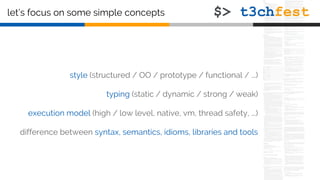
let’s focus on some simple concepts
style (structured / OO / prototype / functional / ...)
typing (static / dynamic / strong / weak)
execution model (high / low level, native, vm, thread safety, ...)
difference between syntax, semantics, idioms, libraries and tools
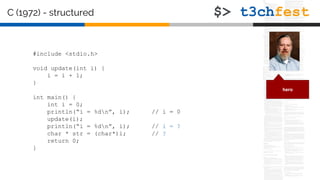
C (1972) - structured
#include <stdio.h>
void update(int i) {
i = i + 1;
}
int main() {
int i = 0;
println(“i = %dn”, i); // i = 0
update(i);
println(“i = %dn”, i); // i = ?
char * str = (char*)i; // ?
return 0;
}
hero
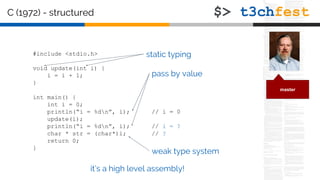
C (1972) - structured
#include <stdio.h>
void update(int i) {
i = i + 1;
}
int main() {
int i = 0;
println(“i = %dn”, i); // i = 0
update(i);
println(“i = %dn”, i); // i = ?
char * str = (char*)i; // ?
return 0;
}
master
static typing
pass by value
it’s a high level assembly!
weak type system
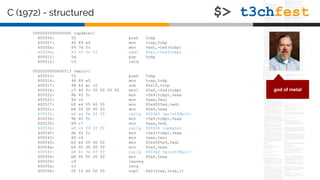
C (1972) - structured
0000000000400506 <update>:
400506: 55 push %rbp
400507: 48 89 e5 mov %rsp,%rbp
40050a: 89 7d fc mov %edi,-0x4(%rbp)
40050d: 83 45 fc 01 addl $0x1,-0x4(%rbp)
400511: 5d pop %rbp
400512: c3 retq
0000000000400513 <main>:
400513: 55 push %rbp
400514: 48 89 e5 mov %rsp,%rbp
400517: 48 83 ec 10 sub $0x10,%rsp
40051b: c7 45 fc 00 00 00 00 movl $0x0,-0x4(%rbp)
400522: 8b 45 fc mov -0x4(%rbp),%eax
400525: 89 c6 mov %eax,%esi
400527: bf e4 05 40 00 mov $0x4005e4,%edi
40052c: b8 00 00 00 00 mov $0x0,%eax
400531: e8 aa fe ff ff callq 4003e0 <printf@plt>
400536: 8b 45 fc mov -0x4(%rbp),%eax
400539: 89 c7 mov %eax,%edi
40053b: e8 c6 ff ff ff callq 400506 <update>
400540: 8b 45 fc mov -0x4(%rbp),%eax
400543: 89 c6 mov %eax,%esi
400545: bf e4 05 40 00 mov $0x4005e4,%edi
40054a: b8 00 00 00 00 mov $0x0,%eax
40054f: e8 8c fe ff ff callq 4003e0 <printf@plt>
400554: b8 00 00 00 00 mov $0x0,%eax
400559: c9 leaveq
40055a: c3 retq
40055b: 0f 1f 44 00 00 nopl 0x0(%rax,%rax,1)
god of metal
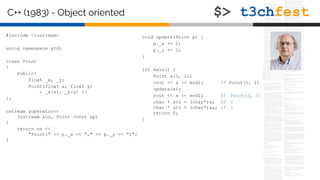
C++ (1983) - Object oriented
#include <iostream>
using namespace std;
class Point
{
public:
float _x, _y;
Point(float x, float y)
: _x(x), _y(y) {}
};
ostream &operator<<
(ostream &os, Point const &p)
{
return os <<
"Point(" << p._x << "," << p._y << ")";
}
void update(Point p) {
p._x += 1;
p._y += 1;
}
int main() {
Point a(1, 2);
cout << a << endl; // Point(1, 2)
update(a);
cout << a << endl; // Point(?, ?)
char * str = (char*)a; // ?
char * str = (char*)&a; // ?
return 0;
}
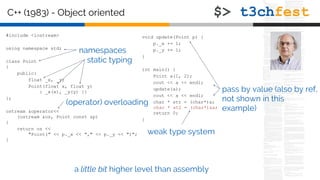
C++ (1983) - Object oriented
#include <iostream>
using namespace std;
class Point
{
public:
float _x, _y;
Point(float x, float y)
: _x(x), _y(y) {}
};
ostream &operator<<
(ostream &os, Point const &p)
{
return os <<
"Point(" << p._x << "," << p._y << ")";
}
void update(Point p) {
p._x += 1;
p._y += 1;
}
int main() {
Point a(1, 2);
cout << a << endl;
update(a);
cout << a << endl;
char * str = (char*)a;
char * st2 = (char*)&a;
return 0;
}
static typing
pass by value (also by ref,
not shown in this
example)
a little bit higher level than assembly
weak type system
namespaces
(operator) overloading
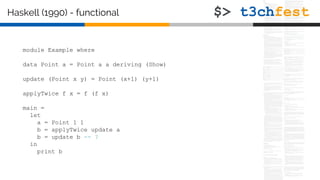
module Example where
data Point a = Point a a deriving (Show)
update (Point x y) = Point (x+1) (y+1)
applyTwice f x = f (f x)
main =
let
a = Point 1 1
b = applyTwice update a
b = update b -- ?
in
print b
Haskell (1990) - functional
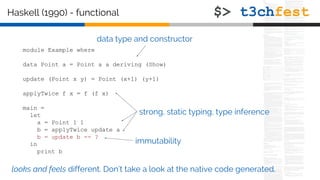
module Example where
data Point a = Point a a deriving (Show)
update (Point x y) = Point (x+1) (y+1)
applyTwice f x = f (f x)
main =
let
a = Point 1 1
b = applyTwice update a
b = update b -- ?
in
print b
Haskell (1990) - functional
data type and constructor
strong, static typing, type inference
looks and feels different. Don’t take a look at the native code generated.
immutability
Let’s give it a try
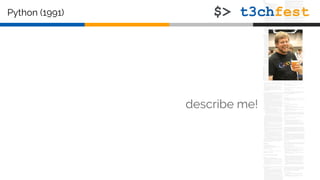
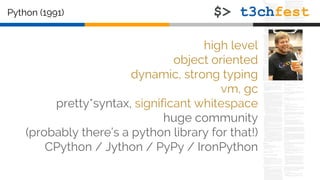
Python (1991)
describe me!
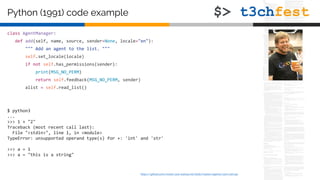
Python (1991) code example
class AgentManager:
def add(self, name, source, sender=None, locale="en"):
""" Add an agent to the list. """
self.set_locale(locale)
if not self.has_permissions(sender):
print(MSG_NO_PERM)
return self.feedback(MSG_NO_PERM, sender)
alist = self.read_list()
$ python3
...
>>> 1 + "2"
Traceback (most recent call last):
File "<stdin>", line 1, in <module>
TypeError: unsupported operand type(s) for +: 'int' and 'str'
>>> a = 1
>>> a = "this is a string"
https://github.com/voiser/zoe-startup-kit/blob/master/agents/zam/zam.py
Python (1991)
high level
object oriented
dynamic, strong typing
vm, gc
pretty*syntax, significant whitespace
huge community
(probably there’s a python library for that!)
CPython / Jython / PyPy / IronPython
what if I describe you a language without
letting you see actual code?
high level
object oriented
vm jit, gc
static, explicit, strong* typing
(messy) generic types
simple*, verbose, bureaucratic
enormous community
Java - let me break your strong type system
import java.util.List;
public class T3chFest {
private Object[] stuff;
private List<Object> rooms;
public T3chFest(String[] talks, List<String> rooms) {
this.stuff = talks;
stuff[0] = Thread.currentThread(); // ?
this.rooms = rooms; // ?
List rooms2 = rooms; // ?
this.rooms = rooms2; // ?
}
}
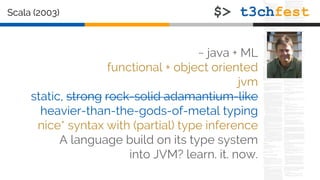
~ java + ML
functional + object oriented
jvm
static, strong rock-solid adamantium-like
heavier-than-the-gods-of-metal typing
nice* syntax with (partial) type inference
A language build on its type system
into JVM? learn. it. now.
Scala (2003)
scala> val a = Array("a", "b", "c")
a: Array[String] = Array(a, b, c)
scala> val b: Array[Object] = a
<console>:11: error: type mismatch;
found : Array[String]
required: Array[Object]
Note: String <: Object, but class Array is invariant in type T.
Scala (2003) - fun with invariance
scala> class Animal;
scala> class Mammal extends Animal;
scala> class Human extends Mammal;
scala> class Group[ +A]
scala> def sizeof(g: Group[ Animal]) = ...
scala> sizeof(new Group[ Animal]())
scala> sizeof(new Group[ Mammal]())
scala> class Veterinary[ -A]
scala> def treat(g: Group[Mammal], v: Veterinary[ Mammal]) = ...
scala> treat(..., new Veterinary[ Mammal]())
scala> treat(..., new Veterinary[ Animal]())
scala> class Treatment[ T <: Mammal]
scala> def cure[B](x: Group[ B]) : Treatment[ B] = …
error: type arguments [B] do not conform to class Treatment's type parameter bounds [T
<: Mammal]
scala> def cure[ B <: Mammal](x: Group[B]) : Treatment[ B] = ...
Scala - basic types
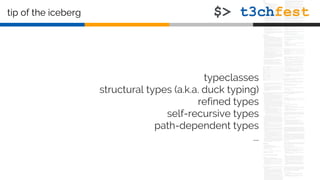
typeclasses
structural types (a.k.a. duck typing)
refined types
self-recursive types
path-dependent types
...
tip of the iceberg
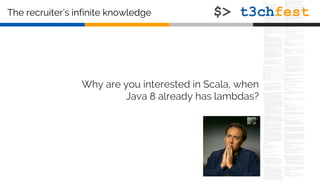
The recruiter’s infinite knowledge
Why are you interested in Scala, when
Java 8 already has lambdas?
Except where otherwise noted, this work is licensed under: http:
//creativecommons.org/licenses/by-nc-sa/3.0/
Leganés, feb 11, 12
Thanks!

T3chFest 2016 - The polyglot programmer

  • 1.
    Except where otherwisenoted, this work is licensed under: http: //creativecommons.org/licenses/by-nc-sa/3.0/ The polyglot programmer Leganés, feb 11, 12 David Muñoz @voiser
  • 2.
  • 3.
    let’s focus onsome simple concepts style (structured / OO / prototype / functional / ...) typing (static / dynamic / strong / weak) execution model (high / low level, native, vm, thread safety, ...) difference between syntax, semantics, idioms, libraries and tools
  • 4.
    C (1972) -structured #include <stdio.h> void update(int i) { i = i + 1; } int main() { int i = 0; println(“i = %dn”, i); // i = 0 update(i); println(“i = %dn”, i); // i = ? char * str = (char*)i; // ? return 0; } hero
  • 5.
    C (1972) -structured #include <stdio.h> void update(int i) { i = i + 1; } int main() { int i = 0; println(“i = %dn”, i); // i = 0 update(i); println(“i = %dn”, i); // i = ? char * str = (char*)i; // ? return 0; } master static typing pass by value it’s a high level assembly! weak type system
  • 6.
    C (1972) -structured 0000000000400506 <update>: 400506: 55 push %rbp 400507: 48 89 e5 mov %rsp,%rbp 40050a: 89 7d fc mov %edi,-0x4(%rbp) 40050d: 83 45 fc 01 addl $0x1,-0x4(%rbp) 400511: 5d pop %rbp 400512: c3 retq 0000000000400513 <main>: 400513: 55 push %rbp 400514: 48 89 e5 mov %rsp,%rbp 400517: 48 83 ec 10 sub $0x10,%rsp 40051b: c7 45 fc 00 00 00 00 movl $0x0,-0x4(%rbp) 400522: 8b 45 fc mov -0x4(%rbp),%eax 400525: 89 c6 mov %eax,%esi 400527: bf e4 05 40 00 mov $0x4005e4,%edi 40052c: b8 00 00 00 00 mov $0x0,%eax 400531: e8 aa fe ff ff callq 4003e0 <printf@plt> 400536: 8b 45 fc mov -0x4(%rbp),%eax 400539: 89 c7 mov %eax,%edi 40053b: e8 c6 ff ff ff callq 400506 <update> 400540: 8b 45 fc mov -0x4(%rbp),%eax 400543: 89 c6 mov %eax,%esi 400545: bf e4 05 40 00 mov $0x4005e4,%edi 40054a: b8 00 00 00 00 mov $0x0,%eax 40054f: e8 8c fe ff ff callq 4003e0 <printf@plt> 400554: b8 00 00 00 00 mov $0x0,%eax 400559: c9 leaveq 40055a: c3 retq 40055b: 0f 1f 44 00 00 nopl 0x0(%rax,%rax,1) god of metal
  • 7.
    C++ (1983) -Object oriented #include <iostream> using namespace std; class Point { public: float _x, _y; Point(float x, float y) : _x(x), _y(y) {} }; ostream &operator<< (ostream &os, Point const &p) { return os << "Point(" << p._x << "," << p._y << ")"; } void update(Point p) { p._x += 1; p._y += 1; } int main() { Point a(1, 2); cout << a << endl; // Point(1, 2) update(a); cout << a << endl; // Point(?, ?) char * str = (char*)a; // ? char * str = (char*)&a; // ? return 0; }
  • 8.
    C++ (1983) -Object oriented #include <iostream> using namespace std; class Point { public: float _x, _y; Point(float x, float y) : _x(x), _y(y) {} }; ostream &operator<< (ostream &os, Point const &p) { return os << "Point(" << p._x << "," << p._y << ")"; } void update(Point p) { p._x += 1; p._y += 1; } int main() { Point a(1, 2); cout << a << endl; update(a); cout << a << endl; char * str = (char*)a; char * st2 = (char*)&a; return 0; } static typing pass by value (also by ref, not shown in this example) a little bit higher level than assembly weak type system namespaces (operator) overloading
  • 9.
    module Example where dataPoint a = Point a a deriving (Show) update (Point x y) = Point (x+1) (y+1) applyTwice f x = f (f x) main = let a = Point 1 1 b = applyTwice update a b = update b -- ? in print b Haskell (1990) - functional
  • 10.
    module Example where dataPoint a = Point a a deriving (Show) update (Point x y) = Point (x+1) (y+1) applyTwice f x = f (f x) main = let a = Point 1 1 b = applyTwice update a b = update b -- ? in print b Haskell (1990) - functional data type and constructor strong, static typing, type inference looks and feels different. Don’t take a look at the native code generated. immutability
  • 11.
  • 12.
  • 13.
    Python (1991) codeexample class AgentManager: def add(self, name, source, sender=None, locale="en"): """ Add an agent to the list. """ self.set_locale(locale) if not self.has_permissions(sender): print(MSG_NO_PERM) return self.feedback(MSG_NO_PERM, sender) alist = self.read_list() $ python3 ... >>> 1 + "2" Traceback (most recent call last): File "<stdin>", line 1, in <module> TypeError: unsupported operand type(s) for +: 'int' and 'str' >>> a = 1 >>> a = "this is a string" https://github.com/voiser/zoe-startup-kit/blob/master/agents/zam/zam.py
  • 14.
    Python (1991) high level objectoriented dynamic, strong typing vm, gc pretty*syntax, significant whitespace huge community (probably there’s a python library for that!) CPython / Jython / PyPy / IronPython
  • 15.
    what if Idescribe you a language without letting you see actual code?
  • 16.
    high level object oriented vmjit, gc static, explicit, strong* typing (messy) generic types simple*, verbose, bureaucratic enormous community
  • 17.
    Java - letme break your strong type system import java.util.List; public class T3chFest { private Object[] stuff; private List<Object> rooms; public T3chFest(String[] talks, List<String> rooms) { this.stuff = talks; stuff[0] = Thread.currentThread(); // ? this.rooms = rooms; // ? List rooms2 = rooms; // ? this.rooms = rooms2; // ? } }
  • 18.
    ~ java +ML functional + object oriented jvm static, strong rock-solid adamantium-like heavier-than-the-gods-of-metal typing nice* syntax with (partial) type inference A language build on its type system into JVM? learn. it. now. Scala (2003)
  • 19.
    scala> val a= Array("a", "b", "c") a: Array[String] = Array(a, b, c) scala> val b: Array[Object] = a <console>:11: error: type mismatch; found : Array[String] required: Array[Object] Note: String <: Object, but class Array is invariant in type T. Scala (2003) - fun with invariance
  • 20.
    scala> class Animal; scala>class Mammal extends Animal; scala> class Human extends Mammal; scala> class Group[ +A] scala> def sizeof(g: Group[ Animal]) = ... scala> sizeof(new Group[ Animal]()) scala> sizeof(new Group[ Mammal]()) scala> class Veterinary[ -A] scala> def treat(g: Group[Mammal], v: Veterinary[ Mammal]) = ... scala> treat(..., new Veterinary[ Mammal]()) scala> treat(..., new Veterinary[ Animal]()) scala> class Treatment[ T <: Mammal] scala> def cure[B](x: Group[ B]) : Treatment[ B] = … error: type arguments [B] do not conform to class Treatment's type parameter bounds [T <: Mammal] scala> def cure[ B <: Mammal](x: Group[B]) : Treatment[ B] = ... Scala - basic types
  • 21.
    typeclasses structural types (a.k.a.duck typing) refined types self-recursive types path-dependent types ... tip of the iceberg
  • 22.
    The recruiter’s infiniteknowledge Why are you interested in Scala, when Java 8 already has lambdas?
  • 23.
    Except where otherwisenoted, this work is licensed under: http: //creativecommons.org/licenses/by-nc-sa/3.0/ Leganés, feb 11, 12 Thanks!