Using Podcasting in Teaching and Learning e-learning Summer Seminar Series 2008 Andy Ramsden & Lindsay Jordan Slideshare.net: eatbath-present08 All material and post session discussion: www.tasterseries.wordpress.com
key questions What is podcasting? How would I podcast material at the University of Bath? What does podcasting add to the teaching and learning experience? What should my next steps be if I wanted to start podcasting?
a little bit about you
Have you listened to internet radio (audio) in the last 6 months? Yes No
Is lecturing part of your current job responsibilities? Yes No
Have you subscribed to a podcast in the last 6 months? Yes No
In the last 6 months have you created an audio file, i.e., an mp3 file on a computer? Yes No
Have you ever created and published a podcast? Yes No
what is podcasting? What do you think when you hear the term podcasting?
definitions Technical  Podcasting entails audio content that is delivered via an RSS feed presenting a downloadable or streaming file (often mp3).  www.rsstoolchest.com/rss-glossary.html Functional The term podcast, like "radio", can mean both the content and the method of delivery. Podcasters' websites also may offer direct download of their files, but the subscription feed of automatically delivered new content is what distinguishes a podcast from a simple download or real-time streaming. Usually, the podcast features one type of "show" with new episodes either sporadically or at planned intervals such as daily, weekly, etc. http://en.wikipedia.org/wiki/Podcasting
How do I podcast? Publisher  Create the file (mp3, ogg, mp4) using the appropriate tool (audacity, camtasia) Publish on the web (LMF, blog, or podcast services) Subscriber (the listener) Install podcatcher software (Juice, iTunes, PocketRSS) Add the rss feed address as a subscription Listen / watch the file
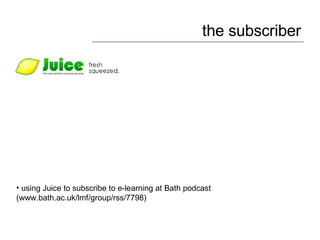
the subscriber using Juice to subscribe to e-learning at Bath podcast ( www.bath.ac.uk/lmf/group/rss/7798)
the publisher Tips on effective podcasting http://podcastingforpp.pbwiki.com/Resources Upload to the Learning Materials Filestore http://www.bath.ac.uk/lmf/welcome “ how might you use podcasting in your teaching and learning?”
How has podcasting been used in teaching and learning within Higher Education in the UK? Distribution of lecture archives for review Delivery of supplemental educational materials and content Assignments requiring students to produce and submit their own podcasts.
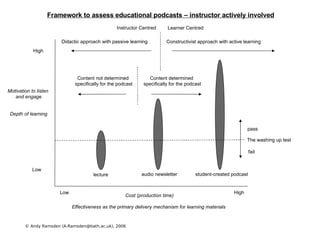
Learner Centred Instructor Centred Constructivist approach with active learning Didactic approach with passive learning Content determined  specifically for the podcast Content not determined  specifically for the podcast The washing up test pass fail lecture audio newsletter student-created podcast Low Low High High Cost (production time) ‏ Effectiveness as the primary delivery mechanism for learning materials   Motivation to listen  and engage Depth of learning © Andy Ramsden (A.Ramsden@bath.ac.uk), 2006  Framework to assess educational podcasts – instructor actively involved
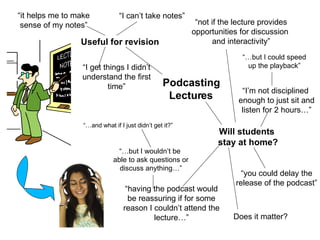
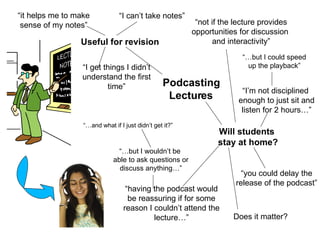
Podcasting Lectures Useful for revision “ it helps me to make sense of my notes” “ I can’t take notes” “ I get things I didn’t understand the first time” Will students  stay at home? “ I’m not disciplined  enough to just sit and listen for 2 hours…” “ having the podcast would be reassuring if for some reason I couldn’t attend the lecture…” “… but I wouldn’t be  able to ask questions or discuss anything…” “… and what if I just didn’t get it?” “… but I could speed up the playback” “ you could delay the release of the podcast” Does it matter? “ not if the lecture provides opportunities for discussion  and interactivity”
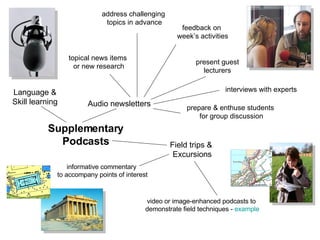
Supplementary Podcasts address challenging  topics in advance present guest lecturers Field trips &  Excursions Audio newsletters video or image-enhanced podcasts to  demonstrate field techniques -  example informative commentary  to accompany points of interest topical news items  or new research feedback on  week’s activities prepare & enthuse students  for group discussion interviews with experts Language & Skill learning
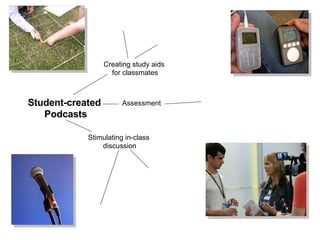
Student-created  Podcasts Creating study aids  for classmates Assessment Stimulating in-class  discussion Students collect audio and/or  visual evidence of their learning, e.g. during fieldwork  Interviews with  professionals,  academics or experts  lecture summaries   instructions for using particular  instruments and procedures  Presenting own point of view
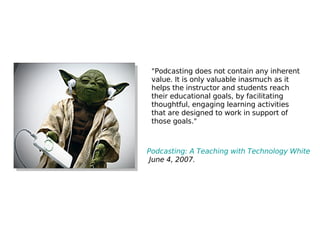
Podcasting: A Teaching with Technology White Paper,  June 4, 2007.   "Podcasting does not contain any inherent value. It is only valuable inasmuch as it helps the instructor and students reach their educational goals, by facilitating thoughtful, engaging learning activities that are designed to work in support of those goals."
Thank you, questions and other events Material and online discussion: www.tasterseries.wordpress.com Next event: Encouraging online collaboration through wikis – Thursday 22 nd  May. Twitter updates: eatbath  Podcasts:  www.bath.ac.uk/lmf/group/rss/7798  Email: e-learning@bath.ac.uk

Using Podcasting in Teaching and Learning

  • 1.
    Using Podcasting inTeaching and Learning e-learning Summer Seminar Series 2008 Andy Ramsden & Lindsay Jordan Slideshare.net: eatbath-present08 All material and post session discussion: www.tasterseries.wordpress.com
  • 2.
    key questions Whatis podcasting? How would I podcast material at the University of Bath? What does podcasting add to the teaching and learning experience? What should my next steps be if I wanted to start podcasting?
  • 3.
    a little bitabout you
  • 4.
    Have you listenedto internet radio (audio) in the last 6 months? Yes No
  • 5.
    Is lecturing partof your current job responsibilities? Yes No
  • 6.
    Have you subscribedto a podcast in the last 6 months? Yes No
  • 7.
    In the last6 months have you created an audio file, i.e., an mp3 file on a computer? Yes No
  • 8.
    Have you evercreated and published a podcast? Yes No
  • 9.
    what is podcasting?What do you think when you hear the term podcasting?
  • 10.
    definitions Technical Podcasting entails audio content that is delivered via an RSS feed presenting a downloadable or streaming file (often mp3). www.rsstoolchest.com/rss-glossary.html Functional The term podcast, like "radio", can mean both the content and the method of delivery. Podcasters' websites also may offer direct download of their files, but the subscription feed of automatically delivered new content is what distinguishes a podcast from a simple download or real-time streaming. Usually, the podcast features one type of "show" with new episodes either sporadically or at planned intervals such as daily, weekly, etc. http://en.wikipedia.org/wiki/Podcasting
  • 11.
    How do Ipodcast? Publisher Create the file (mp3, ogg, mp4) using the appropriate tool (audacity, camtasia) Publish on the web (LMF, blog, or podcast services) Subscriber (the listener) Install podcatcher software (Juice, iTunes, PocketRSS) Add the rss feed address as a subscription Listen / watch the file
  • 12.
    the subscriber usingJuice to subscribe to e-learning at Bath podcast ( www.bath.ac.uk/lmf/group/rss/7798)
  • 13.
    the publisher Tipson effective podcasting http://podcastingforpp.pbwiki.com/Resources Upload to the Learning Materials Filestore http://www.bath.ac.uk/lmf/welcome “ how might you use podcasting in your teaching and learning?”
  • 14.
    How has podcastingbeen used in teaching and learning within Higher Education in the UK? Distribution of lecture archives for review Delivery of supplemental educational materials and content Assignments requiring students to produce and submit their own podcasts.
  • 15.
    Learner Centred InstructorCentred Constructivist approach with active learning Didactic approach with passive learning Content determined specifically for the podcast Content not determined specifically for the podcast The washing up test pass fail lecture audio newsletter student-created podcast Low Low High High Cost (production time) ‏ Effectiveness as the primary delivery mechanism for learning materials Motivation to listen and engage Depth of learning © Andy Ramsden (A.Ramsden@bath.ac.uk), 2006 Framework to assess educational podcasts – instructor actively involved
  • 16.
    Podcasting Lectures Usefulfor revision “ it helps me to make sense of my notes” “ I can’t take notes” “ I get things I didn’t understand the first time” Will students stay at home? “ I’m not disciplined enough to just sit and listen for 2 hours…” “ having the podcast would be reassuring if for some reason I couldn’t attend the lecture…” “… but I wouldn’t be able to ask questions or discuss anything…” “… and what if I just didn’t get it?” “… but I could speed up the playback” “ you could delay the release of the podcast” Does it matter? “ not if the lecture provides opportunities for discussion and interactivity”
  • 17.
    Podcasting Lectures Usefulfor revision “ it helps me to make sense of my notes” “ I can’t take notes” “ I get things I didn’t understand the first time” Will students stay at home? “ I’m not disciplined enough to just sit and listen for 2 hours…” “ having the podcast would be reassuring if for some reason I couldn’t attend the lecture…” “… but I wouldn’t be able to ask questions or discuss anything…” “… and what if I just didn’t get it?” “… but I could speed up the playback” “ you could delay the release of the podcast” Does it matter? “ not if the lecture provides opportunities for discussion and interactivity”
  • 18.
    Supplementary Podcasts addresschallenging topics in advance present guest lecturers Field trips & Excursions Audio newsletters video or image-enhanced podcasts to demonstrate field techniques - example informative commentary to accompany points of interest topical news items or new research feedback on week’s activities prepare & enthuse students for group discussion interviews with experts Language & Skill learning
  • 19.
    Student-created PodcastsCreating study aids for classmates Assessment Stimulating in-class discussion Students collect audio and/or visual evidence of their learning, e.g. during fieldwork Interviews with professionals, academics or experts lecture summaries instructions for using particular instruments and procedures Presenting own point of view
  • 20.
    Podcasting: A Teachingwith Technology White Paper, June 4, 2007. "Podcasting does not contain any inherent value. It is only valuable inasmuch as it helps the instructor and students reach their educational goals, by facilitating thoughtful, engaging learning activities that are designed to work in support of those goals."
  • 21.
    Thank you, questionsand other events Material and online discussion: www.tasterseries.wordpress.com Next event: Encouraging online collaboration through wikis – Thursday 22 nd May. Twitter updates: eatbath Podcasts: www.bath.ac.uk/lmf/group/rss/7798 Email: e-learning@bath.ac.uk