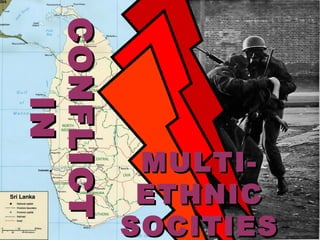
SOCITIES
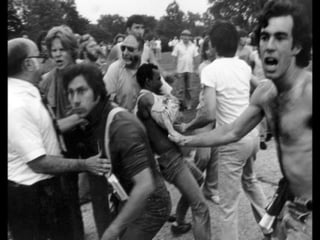
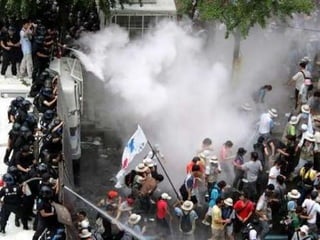
       ETHNIC
       MULTI-
CON FLIC T
CON FLIC T
   IN
   IN
Why do people of Different Races
    and Religions Disagree?
• Forced to adopt different customs & traditions
• Language and education policies do not
  consider their interests
• Law unfair to minority groups
• Power struggle
• Disagreement on ruling of country
• Competition for Job Opportunities or
  Economic Resources
How do people Resolve
    Disagreements?
• Tolerance

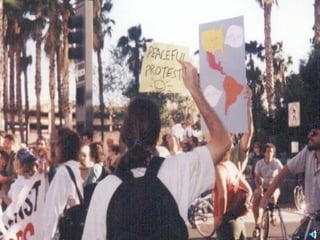
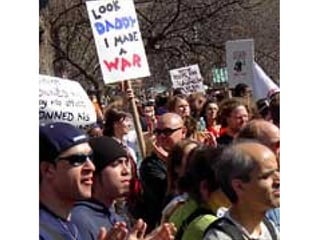
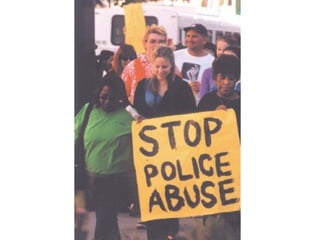
• Peaceful protest & marches

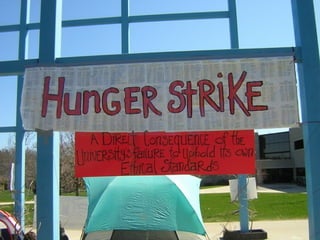
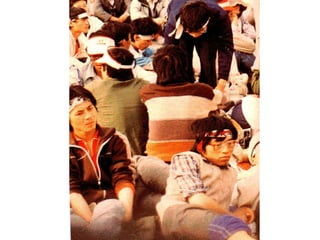
• Hunger strikes

• Violence
SRI LANKA             SRI LANKA
Causes of Conflicts      Consequences
 Citizenship rights      Armed Conflict
    Sinhala Only       Foreign Intervention
University Admission     Unemployment
   Resettlement          Fall in Tourists
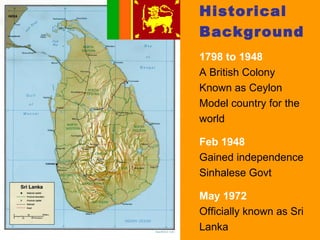
Historical
Background
1798 to 1948
A British Colony
Known as Ceylon
Model country for the
world

Feb 1948
Gained independence
Sinhalese Govt

May 1972
Officially known as Sri
Lanka
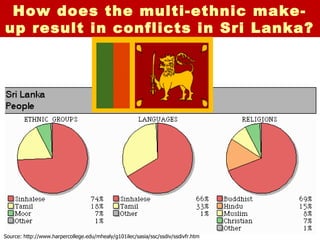
How does the multi-ethnic make-
up result in conflicts in Sri Lanka?


Source: http://www.harpercollege.edu/mhealy/g101ilec/sasia/ssc/ssdiv/ssdivfr.htm
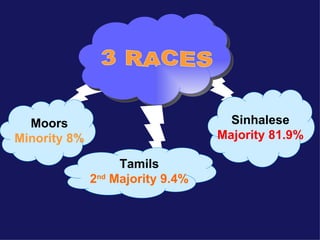
Moors                             Sinhalese
Minority 8%                       Majority 81.9%

                   Tamils
              2nd Majority 9.4%
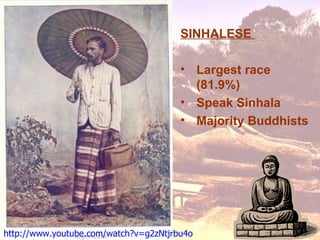
SINHALESE

                                       • Largest race
                                         (81.9%)
                                       • Speak Sinhala
                                       • Majority Buddhists


http://www.youtube.com/watch?v=g2zNtjrbu4o
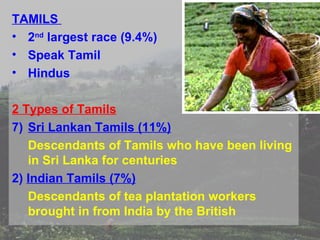
TAMILS
• 2nd largest race (9.4%)
• Speak Tamil
• Hindus

2 Types of Tamils
7) Sri Lankan Tamils (11%)
   Descendants of Tamils who have been living
   in Sri Lanka for centuries
2) Indian Tamils (7%)
   Descendants of tea plantation workers
   brought in from India by the British
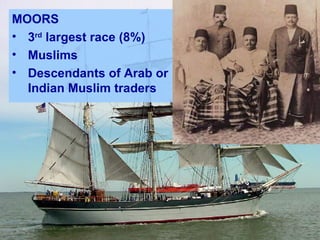
MOORS
• 3rd largest race (8%)
• Muslims
• Descendants of Arab or
  Indian Muslim traders
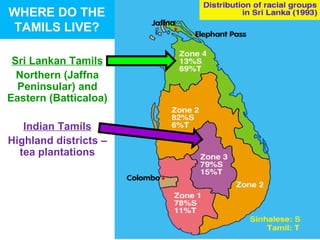
WHERE DO THE
TAMILS LIVE?

 Sri Lankan Tamils
  Northern (Jaffna
  Peninsular) and
Eastern (Batticaloa)

   Indian Tamils
Highland districts –
  tea plantations
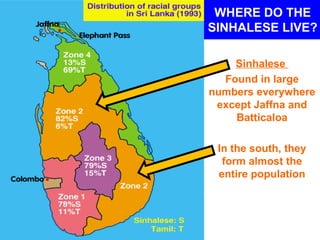
WHERE DO THE
SINHALESE LIVE?

    Sinhalese
  Found in large
numbers everywhere
 except Jaffna and
    Batticaloa

 In the south, they
  form almost the
 entire population
SRI LANKA
Causes of Conflicts
 Citizenship rights
    Sinhala Only
University Admission
   Resettlement
• Part 1 (Causes: Citizenship): http://
  www.youtube.com/watch?v=X46qh7twGfM
Why (1) Citizenship Rights became
    a cause of the Conflicts?
Ceylon Citizenship Act
Citizenship granted to:
   a. Those born in Sri Lanka
   b. Those whose fathers & grandfathers were born
       in Sri Lanka

This excluded the Indian Tamils brought from India to
    work in tea plantation in Sri Lanka.
They became stateless despite living in Sri Lanka for
    many years and contributing to its economy.
They were denied basic rights such as education,
    jobs, housing, voting etc.
Outcome of Citizenship Rights?
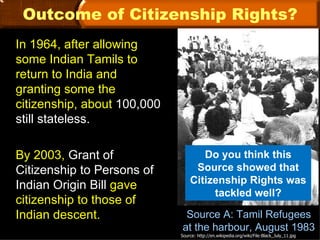
In 1964, after allowing
some Indian Tamils to
return to India and
granting some the
citizenship, about 100,000
still stateless.
By 2003, Grant of                   Do you think this
Citizenship to Persons of         Source showed that
                                 Citizenship Rights was
Indian Origin Bill gave
                                      tackled well?
citizenship to those of
Indian descent.               Source A: Tamil Refugees
                             at the harbour, August 1983
                             Source: http://en.wikipedia.org/wiki/File:Black_July_11.jpg
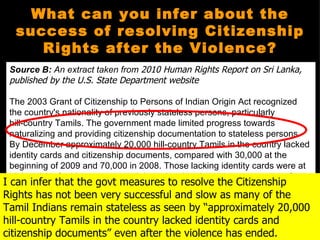
What can you infer about the
   success of resolving Citizenship
      Rights after the Violence?
 Source B: An extract taken from 2010 Human Rights Report on Sri Lanka,
 published by the U.S. State Department website

  The 2003 Grant of Citizenship to Persons of Indian Origin Act recognized
  the country's nationality of previously stateless persons, particularly
  hill-country Tamils. The government made limited progress towards
  naturalizing and providing citizenship documentation to stateless persons.
  By December approximately 20,000 hill-country Tamils in the country lacked
  identity cards and citizenship documents, compared with 30,000 at the
  beginning of 2009 and 70,000 in 2008. Those lacking identity cards were at
  higher risk of arbitrary arrest and detention, but there were no reports of
I such infer that the govt measures to resolve the Citizenship
   can
Rights has not been very successful and slow as many of the
  incidents during the year.
Tamil Indians remain stateless as seen by “approximately 20,000
hill-country Tamils in the country lacked identity cards and
  http://www.state.gov/j/drl/rls/hrrpt/2010/sca/154486.htm


citizenship documents” even after the violence has ended.
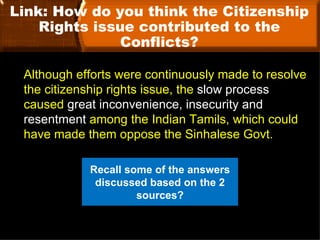
Link: How do you think the Citizenship
    Rights issue contributed to the
               Conflicts?

 Although efforts were continuously made to resolve
 the citizenship rights issue, the slow process
 caused great inconvenience, insecurity and
 resentment among the Indian Tamils, which could
 have made them oppose the Sinhalese Govt.

            Recall some of the answers
             discussed based on the 2
                     sources?
SRI LANKA
Causes of Conflicts
 Citizenship rights
    Sinhala Only
University Admission
   Resettlement
• Part 2 (Causes: Sinhala Only):
  http://www.youtube.com/watch?v=t9Z7P1Y4
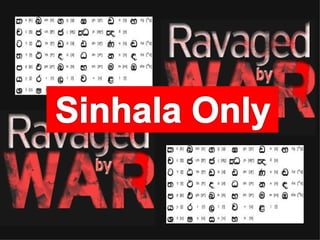
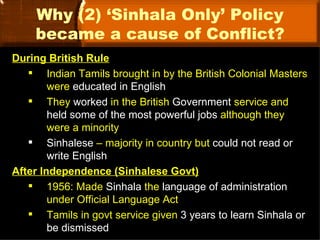
Why (2) ‘Sinhala Only’ Policy
    became a cause of Conflict?
During British Rule
    Indian Tamils brought in by the British Colonial Masters
        were educated in English
    They worked in the British Government service and
        held some of the most powerful jobs although they
        were a minority
    Sinhalese – majority in country but could not read or
        write English
After Independence (Sinhalese Govt)
    1956: Made Sinhala the language of administration
        under Official Language Act
    Tamils in govt service given 3 years to learn Sinhala or
        be dismissed
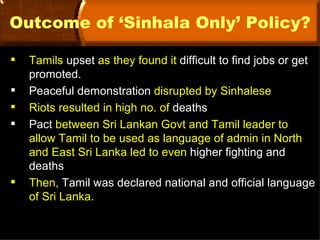
Outcome of ‘Sinhala Only’ Policy?

   Tamils upset as they found it difficult to find jobs or get
    promoted.
   Peaceful demonstration disrupted by Sinhalese
   Riots resulted in high no. of deaths
   Pact between Sri Lankan Govt and Tamil leader to
    allow Tamil to be used as language of admin in North
    and East Sri Lanka led to even higher fighting and
    deaths
   Then, Tamil was declared national and official language
    of Sri Lanka.
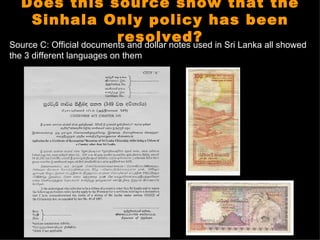
Does this source show that the
     Sinhala Only policy has been
                          resolved?
Source C: Official documents and dollar notes used in Sri Lanka all showed
the 3 different languages on them
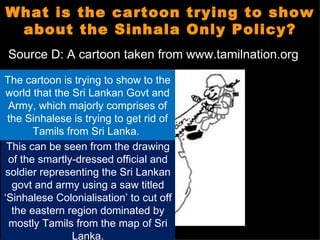
What is the cartoon trying to show
 about the Sinhala Only Policy?
Source D: A cartoon taken from www.tamilnation.org

The cartoon is trying to show to the
 world that the Sri Lankan Govt and
 Army, which majorly comprises of
 the Sinhalese is trying to get rid of
       Tamils from Sri Lanka.
 This can be seen from the drawing
 of the smartly-dressed official and
soldier representing the Sri Lankan
  govt and army using a saw titled
‘Sinhalese Colonialisation’ to cut off
  the eastern region dominated by
 mostly Tamils from the map of Sri
                Lanka.
Link: How do you think the Sinhala Only
  policy contributed to the Conflicts?

  As the discrimination caused the Tamils to be
  denied the right to use their language and forced to
  accept a different culture instead, they felt outraged
  and the urgent need to fight for their rights, resulting
  in violence and bloodshed.
SRI LANKA
Causes of Conflicts
 Citizenship rights
    Sinhala Only
University Admission
   Resettlement
Why (3) University Admission
criteria became a cause of Conflict?
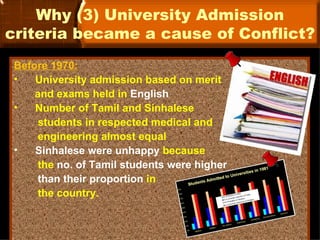
 Before 1970:
 •   University admission based on merit
     and exams held in English
 •   Number of Tamil and Sinhalese
      students in respected medical and
      engineering almost equal
 •   Sinhalese were unhappy because
      the no. of Tamil students were higher
      than their proportion in
      the country.
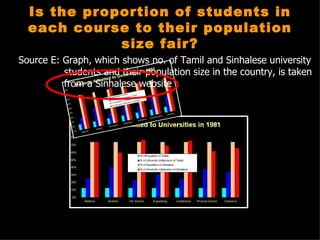
Is the proportion of students in
  each course to their population
             size fair?
Source E: Graph, which shows no. of Tamil and Sinhalese university
          students and their population size in the country, is taken
          from a Sinhalese website
Why (3) University Admission
criteria became a cause of Conflict?

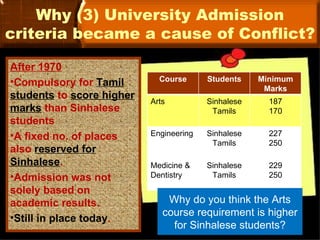
After 1970
•Compulsory for Tamil        Course      Students    Minimum
                                                      Marks
students to score higher
                           Arts          Sinhalese     187
marks than Sinhalese                      Tamils       170
students
•A fixed no. of places     Engineering   Sinhalese     227
                                          Tamils       250
also reserved for
Sinhalese.                 Medicine &    Sinhalese     229
•Admission was not         Dentistry      Tamils       250
solely based on
academic results.              Why do you think the Arts
                              course requirement is higher
•Still in place today.
                                for Sinhalese students?
Link: How do you think the University
Admission criteria contributed to the
             Conflicts?

• Because of the unfair admission criteria, the
  number of Tamil students entering universities fell.
  They felt frustrated and helpless as this
  discrimination adversely affected their educational
  qualifications, job opportunities and standard of
  living. This encouraged the Tamil youths to join
  forces which could help them seek justice.
SRI LANKA
Causes of Conflicts
 Citizenship rights
    Sinhala Only
University Admission
   Resettlement
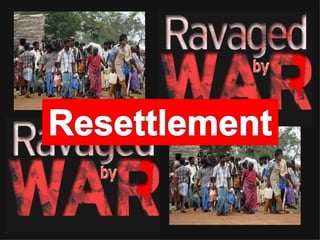
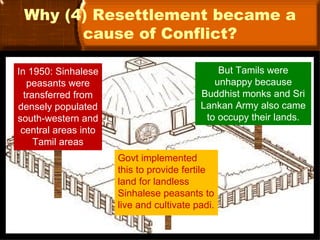
Why (4) Resettlement became a
       cause of Conflict?

In 1950: Sinhalese                            But Tamils were
   peasants were                             unhappy because
  transferred from                        Buddhist monks and Sri
densely populated                         Lankan Army also came
south-western and                          to occupy their lands.
 central areas into
     Tamil areas
                      Govt implemented
                      this to provide fertile
                      land for landless
                      Sinhalese peasants to
                      live and cultivate padi.
What can you learn about the
      Resettlement and Violence in Sri
                  Lanka?
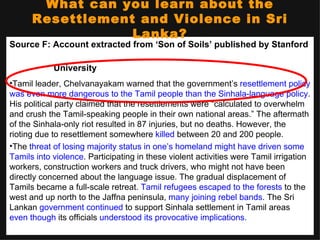
Source F: Account extracted from ‘Son of Soils’ published by Stanford

            University
•Tamil leader, Chelvanayakam warned that the government’s resettlement policy
was even more dangerous to the Tamil people than the Sinhala-language policy.
His political party claimed that the resettlements were “calculated to overwhelm
and crush the Tamil-speaking people in their own national areas.” The aftermath
of the Sinhala-only riot resulted in 87 injuries, but no deaths. However, the
rioting due to resettlement somewhere killed between 20 and 200 people.
•The threat of losing majority status in one’s homeland might have driven some
Tamils into violence. Participating in these violent activities were Tamil irrigation
workers, construction workers and truck drivers, who might not have been
directly concerned about the language issue. The gradual displacement of
Tamils became a full-scale retreat. Tamil refugees escaped to the forests to the
west and up north to the Jaffna peninsula, many joining rebel bands. The Sri
Lankan government continued to support Sinhala settlement in Tamil areas
even though its officials understood its provocative implications.
Link: How do you think the Resettlement
      contributed to the Conflicts?


 • Because of the injustice of being driven out of
   their lands, threatened security and being treated
   as minority in their own areas, the Tamils felt
   outraged by the government deliberate plans to
   discriminate them. This had motivated many
   Tamils to carry out violence and seek help from
   rebel militants, the LTTE.
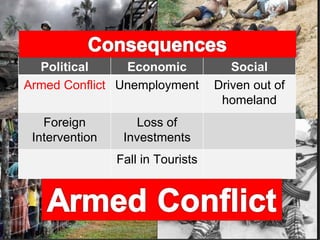
Political     Economic              Social
Armed Conflict Unemployment        Driven out of
                                    homeland
   Foreign         Loss of
 Intervention    Investments
                Fall in Tourists
• Part 3 (Consequences: Armed Conflict & LTTE):
  http://www.youtube.com/watch?v=ftrjkIGegqA

• Part 4 (Consequences: Tamils welcome LTTE,
  Foreign Intervention, Peace Accord) :
  http://www.youtube.com/watch?v=ZlqTpuE2-7o

• Part 5 (Consequences: Unemployment):
  http://www.youtube.com/watch?v=nQJkXtoB2ro

• Part 6 (Consequences: Fall in Tourist,
  Massacre) :
  http://www.youtube.com/watch?v=jdrZdH9H0JM
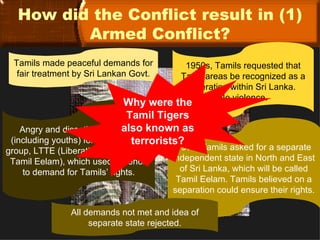
How did the Conflict result in (1)
          Armed Conflict?
  Tamils made peaceful demands for         1950s, Tamils requested that
   fair treatment by Sri Lankan Govt.     Tamil areas be recognized as a
                                            federation within Sri Lanka.
                                                    No violence.
                              Why were the
                               Tamil Tigers
    Angry and dissatisfied, Tamils known as
                              also
                                 terrorists?
 (including youths) form the militant
group, LTTE (Liberation Tigers of the    1976, Tamils asked for a separate
 Tamil Eelam), which used violence      independent state in North and East
    to demand for Tamils’ rights.         of Sri Lanka, which will be called
                                         Tamil Eelam. Tamils believed on a
                                        separation could ensure their rights.

                All demands not met and idea of
                     separate state rejected.
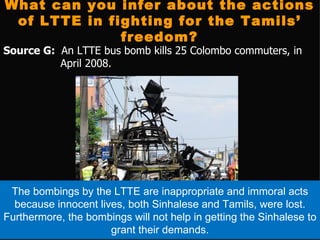
What can you infer about the actions
 of LTTE in fighting for the Tamils’
              freedom?
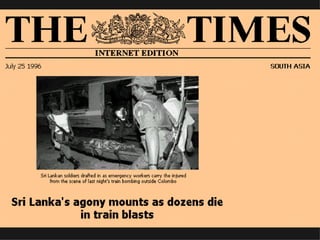
Source G: An LTTE bus bomb kills 25 Colombo commuters, in
          April 2008.


 The bombings by the LTTE are inappropriate and immoral acts
  because innocent lives, both Sinhalese and Tamils, were lost.
Furthermore, the bombings will not help in getting the Sinhalese to
                      grant their demands.
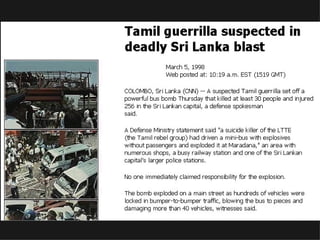
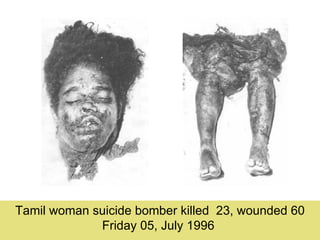
Tamil woman suicide bomber killed 23, wounded 60
             Friday 05, July 1996
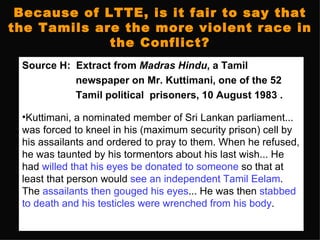
Because of LTTE, is it fair to say that
the Tamils are the more violent race in
             the Conflict?
 Source H: Extract from Madras Hindu, a Tamil
           newspaper on Mr. Kuttimani, one of the 52
           Tamil political prisoners, 10 August 1983 .

 •Kuttimani, a nominated member of Sri Lankan parliament...
 was forced to kneel in his (maximum security prison) cell by
 his assailants and ordered to pray to them. When he refused,
 he was taunted by his tormentors about his last wish... He
 had willed that his eyes be donated to someone so that at
 least that person would see an independent Tamil Eelam.
 The assailants then gouged his eyes... He was then stabbed
 to death and his testicles were wrenched from his body.
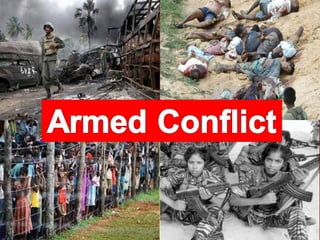
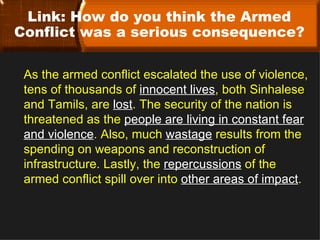
Link: How do you think the Armed
Conflict was a serious consequence?

 As the armed conflict escalated the use of violence,
 tens of thousands of innocent lives, both Sinhalese
 and Tamils, are lost. The security of the nation is
 threatened as the people are living in constant fear
 and violence. Also, much wastage results from the
 spending on weapons and reconstruction of
 infrastructure. Lastly, the repercussions of the
 armed conflict spill over into other areas of impact.

SS Chap 4 Sri Lanka_2012

  • 1.
    SOCITIES ETHNIC MULTI- CON FLIC T CON FLIC T IN IN
  • 2.
    Why do peopleof Different Races and Religions Disagree? • Forced to adopt different customs & traditions • Language and education policies do not consider their interests • Law unfair to minority groups • Power struggle • Disagreement on ruling of country • Competition for Job Opportunities or Economic Resources
  • 3.
    How do peopleResolve Disagreements? • Tolerance • Peaceful protest & marches • Hunger strikes • Violence
  • 12.
    SRI LANKA SRI LANKA Causes of Conflicts Consequences Citizenship rights Armed Conflict Sinhala Only Foreign Intervention University Admission Unemployment Resettlement Fall in Tourists
  • 13.
    Historical Background 1798 to 1948 ABritish Colony Known as Ceylon Model country for the world Feb 1948 Gained independence Sinhalese Govt May 1972 Officially known as Sri Lanka
  • 14.
    How does themulti-ethnic make- up result in conflicts in Sri Lanka? Source: http://www.harpercollege.edu/mhealy/g101ilec/sasia/ssc/ssdiv/ssdivfr.htm
  • 15.
    Moors Sinhalese Minority 8% Majority 81.9% Tamils 2nd Majority 9.4%
  • 16.
    SINHALESE • Largest race (81.9%) • Speak Sinhala • Majority Buddhists http://www.youtube.com/watch?v=g2zNtjrbu4o
  • 17.
    TAMILS • 2nd largestrace (9.4%) • Speak Tamil • Hindus 2 Types of Tamils 7) Sri Lankan Tamils (11%) Descendants of Tamils who have been living in Sri Lanka for centuries 2) Indian Tamils (7%) Descendants of tea plantation workers brought in from India by the British
  • 18.
    MOORS • 3rd largestrace (8%) • Muslims • Descendants of Arab or Indian Muslim traders
  • 19.
    WHERE DO THE TAMILSLIVE? Sri Lankan Tamils Northern (Jaffna Peninsular) and Eastern (Batticaloa) Indian Tamils Highland districts – tea plantations
  • 20.
    WHERE DO THE SINHALESELIVE? Sinhalese Found in large numbers everywhere except Jaffna and Batticaloa In the south, they form almost the entire population
  • 21.
    SRI LANKA Causes ofConflicts Citizenship rights Sinhala Only University Admission Resettlement
  • 23.
    • Part 1(Causes: Citizenship): http:// www.youtube.com/watch?v=X46qh7twGfM
  • 24.
    Why (1) CitizenshipRights became a cause of the Conflicts? Ceylon Citizenship Act Citizenship granted to: a. Those born in Sri Lanka b. Those whose fathers & grandfathers were born in Sri Lanka This excluded the Indian Tamils brought from India to work in tea plantation in Sri Lanka. They became stateless despite living in Sri Lanka for many years and contributing to its economy. They were denied basic rights such as education, jobs, housing, voting etc.
  • 25.
    Outcome of CitizenshipRights? In 1964, after allowing some Indian Tamils to return to India and granting some the citizenship, about 100,000 still stateless. By 2003, Grant of Do you think this Citizenship to Persons of Source showed that Citizenship Rights was Indian Origin Bill gave tackled well? citizenship to those of Indian descent. Source A: Tamil Refugees at the harbour, August 1983 Source: http://en.wikipedia.org/wiki/File:Black_July_11.jpg
  • 26.
    What can youinfer about the success of resolving Citizenship Rights after the Violence? Source B: An extract taken from 2010 Human Rights Report on Sri Lanka, published by the U.S. State Department website The 2003 Grant of Citizenship to Persons of Indian Origin Act recognized the country's nationality of previously stateless persons, particularly hill-country Tamils. The government made limited progress towards naturalizing and providing citizenship documentation to stateless persons. By December approximately 20,000 hill-country Tamils in the country lacked identity cards and citizenship documents, compared with 30,000 at the beginning of 2009 and 70,000 in 2008. Those lacking identity cards were at higher risk of arbitrary arrest and detention, but there were no reports of I such infer that the govt measures to resolve the Citizenship can Rights has not been very successful and slow as many of the incidents during the year. Tamil Indians remain stateless as seen by “approximately 20,000 hill-country Tamils in the country lacked identity cards and http://www.state.gov/j/drl/rls/hrrpt/2010/sca/154486.htm citizenship documents” even after the violence has ended.
  • 27.
    Link: How doyou think the Citizenship Rights issue contributed to the Conflicts? Although efforts were continuously made to resolve the citizenship rights issue, the slow process caused great inconvenience, insecurity and resentment among the Indian Tamils, which could have made them oppose the Sinhalese Govt. Recall some of the answers discussed based on the 2 sources?
  • 28.
    SRI LANKA Causes ofConflicts Citizenship rights Sinhala Only University Admission Resettlement
  • 30.
    • Part 2(Causes: Sinhala Only): http://www.youtube.com/watch?v=t9Z7P1Y4
  • 31.
    Why (2) ‘SinhalaOnly’ Policy became a cause of Conflict? During British Rule  Indian Tamils brought in by the British Colonial Masters were educated in English  They worked in the British Government service and held some of the most powerful jobs although they were a minority  Sinhalese – majority in country but could not read or write English After Independence (Sinhalese Govt)  1956: Made Sinhala the language of administration under Official Language Act  Tamils in govt service given 3 years to learn Sinhala or be dismissed
  • 32.
    Outcome of ‘SinhalaOnly’ Policy?  Tamils upset as they found it difficult to find jobs or get promoted.  Peaceful demonstration disrupted by Sinhalese  Riots resulted in high no. of deaths  Pact between Sri Lankan Govt and Tamil leader to allow Tamil to be used as language of admin in North and East Sri Lanka led to even higher fighting and deaths  Then, Tamil was declared national and official language of Sri Lanka.
  • 33.
    Does this sourceshow that the Sinhala Only policy has been resolved? Source C: Official documents and dollar notes used in Sri Lanka all showed the 3 different languages on them
  • 34.
    What is thecartoon trying to show about the Sinhala Only Policy? Source D: A cartoon taken from www.tamilnation.org The cartoon is trying to show to the world that the Sri Lankan Govt and Army, which majorly comprises of the Sinhalese is trying to get rid of Tamils from Sri Lanka. This can be seen from the drawing of the smartly-dressed official and soldier representing the Sri Lankan govt and army using a saw titled ‘Sinhalese Colonialisation’ to cut off the eastern region dominated by mostly Tamils from the map of Sri Lanka.
  • 35.
    Link: How doyou think the Sinhala Only policy contributed to the Conflicts? As the discrimination caused the Tamils to be denied the right to use their language and forced to accept a different culture instead, they felt outraged and the urgent need to fight for their rights, resulting in violence and bloodshed.
  • 36.
    SRI LANKA Causes ofConflicts Citizenship rights Sinhala Only University Admission Resettlement
  • 38.
    Why (3) UniversityAdmission criteria became a cause of Conflict? Before 1970: • University admission based on merit and exams held in English • Number of Tamil and Sinhalese students in respected medical and engineering almost equal • Sinhalese were unhappy because the no. of Tamil students were higher than their proportion in the country.
  • 39.
    Is the proportionof students in each course to their population size fair? Source E: Graph, which shows no. of Tamil and Sinhalese university students and their population size in the country, is taken from a Sinhalese website
  • 40.
    Why (3) UniversityAdmission criteria became a cause of Conflict? After 1970 •Compulsory for Tamil Course Students Minimum Marks students to score higher Arts Sinhalese 187 marks than Sinhalese Tamils 170 students •A fixed no. of places Engineering Sinhalese 227 Tamils 250 also reserved for Sinhalese. Medicine & Sinhalese 229 •Admission was not Dentistry Tamils 250 solely based on academic results. Why do you think the Arts course requirement is higher •Still in place today. for Sinhalese students?
  • 41.
    Link: How doyou think the University Admission criteria contributed to the Conflicts? • Because of the unfair admission criteria, the number of Tamil students entering universities fell. They felt frustrated and helpless as this discrimination adversely affected their educational qualifications, job opportunities and standard of living. This encouraged the Tamil youths to join forces which could help them seek justice.
  • 42.
    SRI LANKA Causes ofConflicts Citizenship rights Sinhala Only University Admission Resettlement
  • 44.
    Why (4) Resettlementbecame a cause of Conflict? In 1950: Sinhalese But Tamils were peasants were unhappy because transferred from Buddhist monks and Sri densely populated Lankan Army also came south-western and to occupy their lands. central areas into Tamil areas Govt implemented this to provide fertile land for landless Sinhalese peasants to live and cultivate padi.
  • 45.
    What can youlearn about the Resettlement and Violence in Sri Lanka? Source F: Account extracted from ‘Son of Soils’ published by Stanford University •Tamil leader, Chelvanayakam warned that the government’s resettlement policy was even more dangerous to the Tamil people than the Sinhala-language policy. His political party claimed that the resettlements were “calculated to overwhelm and crush the Tamil-speaking people in their own national areas.” The aftermath of the Sinhala-only riot resulted in 87 injuries, but no deaths. However, the rioting due to resettlement somewhere killed between 20 and 200 people. •The threat of losing majority status in one’s homeland might have driven some Tamils into violence. Participating in these violent activities were Tamil irrigation workers, construction workers and truck drivers, who might not have been directly concerned about the language issue. The gradual displacement of Tamils became a full-scale retreat. Tamil refugees escaped to the forests to the west and up north to the Jaffna peninsula, many joining rebel bands. The Sri Lankan government continued to support Sinhala settlement in Tamil areas even though its officials understood its provocative implications.
  • 46.
    Link: How doyou think the Resettlement contributed to the Conflicts? • Because of the injustice of being driven out of their lands, threatened security and being treated as minority in their own areas, the Tamils felt outraged by the government deliberate plans to discriminate them. This had motivated many Tamils to carry out violence and seek help from rebel militants, the LTTE.
  • 47.
    Political Economic Social Armed Conflict Unemployment Driven out of homeland Foreign Loss of Intervention Investments Fall in Tourists
  • 49.
    • Part 3(Consequences: Armed Conflict & LTTE): http://www.youtube.com/watch?v=ftrjkIGegqA • Part 4 (Consequences: Tamils welcome LTTE, Foreign Intervention, Peace Accord) : http://www.youtube.com/watch?v=ZlqTpuE2-7o • Part 5 (Consequences: Unemployment): http://www.youtube.com/watch?v=nQJkXtoB2ro • Part 6 (Consequences: Fall in Tourist, Massacre) : http://www.youtube.com/watch?v=jdrZdH9H0JM
  • 50.
    How did theConflict result in (1) Armed Conflict? Tamils made peaceful demands for 1950s, Tamils requested that fair treatment by Sri Lankan Govt. Tamil areas be recognized as a federation within Sri Lanka. No violence. Why were the Tamil Tigers Angry and dissatisfied, Tamils known as also terrorists? (including youths) form the militant group, LTTE (Liberation Tigers of the 1976, Tamils asked for a separate Tamil Eelam), which used violence independent state in North and East to demand for Tamils’ rights. of Sri Lanka, which will be called Tamil Eelam. Tamils believed on a separation could ensure their rights. All demands not met and idea of separate state rejected.
  • 51.
    What can youinfer about the actions of LTTE in fighting for the Tamils’ freedom? Source G: An LTTE bus bomb kills 25 Colombo commuters, in April 2008. The bombings by the LTTE are inappropriate and immoral acts because innocent lives, both Sinhalese and Tamils, were lost. Furthermore, the bombings will not help in getting the Sinhalese to grant their demands.
  • 54.
    Tamil woman suicidebomber killed 23, wounded 60 Friday 05, July 1996
  • 55.
    Because of LTTE,is it fair to say that the Tamils are the more violent race in the Conflict? Source H: Extract from Madras Hindu, a Tamil newspaper on Mr. Kuttimani, one of the 52 Tamil political prisoners, 10 August 1983 . •Kuttimani, a nominated member of Sri Lankan parliament... was forced to kneel in his (maximum security prison) cell by his assailants and ordered to pray to them. When he refused, he was taunted by his tormentors about his last wish... He had willed that his eyes be donated to someone so that at least that person would see an independent Tamil Eelam. The assailants then gouged his eyes... He was then stabbed to death and his testicles were wrenched from his body.
  • 56.
    Link: How doyou think the Armed Conflict was a serious consequence? As the armed conflict escalated the use of violence, tens of thousands of innocent lives, both Sinhalese and Tamils, are lost. The security of the nation is threatened as the people are living in constant fear and violence. Also, much wastage results from the spending on weapons and reconstruction of infrastructure. Lastly, the repercussions of the armed conflict spill over into other areas of impact.