Chapter 4: Essential questions: What causes conflicts in multi-ethnic societies? What are the consequences of these conflicts? What are the challenges in managing ethnic diversity?
Today’s agenda: Introduction to ethnic conflicts Background information about Sri Lanka Causes of the Sri Lankan conflict Recap: Pop Quiz! Next lesson: Consequences of the Sri Lankan conflict
In 1948, Ceylon (Sri Lanka) enjoyed the highest literacy rate in Asia. It did not have the problem of over-population; its educational and transportation systems were advanced. For some years, Ceylon was a model for the world. But, today, it is an island known for its problems, and its reputation as a killing field only matched by that of countries such as Rwanda. Adapted from a comment by an editor of a Tamil newspaper in 2003.
Watch this news clip: ‘The Casualties of Sri Lanka’s Conflict’ http://www.youtube.com/watch?v=ZD77iTj7zBw What can you infer about the conflict in Sri Lanka? How far do you believe what the reporter says?
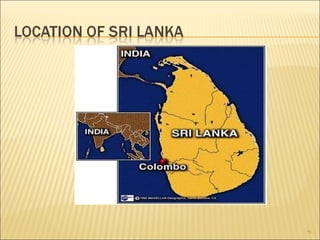
Why the conflict between the Sinhalese and Tamils in Sri Lanka?
 
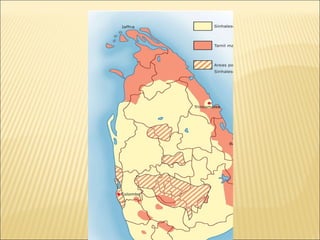
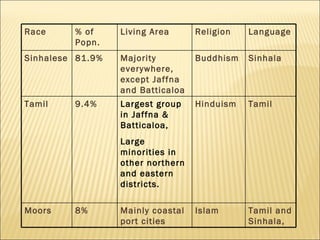
8% 9.4% 81.9% % of Popn. Tamil and Sinhala,  Islam Mainly coastal port cities Moors Tamil Hinduism Largest group in Jaffna & Batticaloa, Large minorities in other northern and eastern districts. Tamil Sinhala Buddhism Majority everywhere, except Jaffna and Batticaloa Sinhalese Language Religion Living Area Race
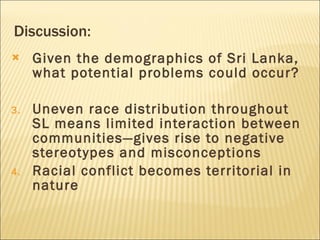
Discussion: Given the demographics of Sri Lanka, what potential problems could occur? Uneven race distribution throughout SL means limited interaction between communities—gives rise to negative stereotypes and misconceptions Racial conflict becomes territorial in nature
The people Sinhalese are natives of Sri Lanka Sri Lankan Tamils are descendents of Tamils who have been living in the country since 300 BCE Indian Tamils: came in 1800s with the British colonial masters to work in tea plantations
1.  Citizenship Rights 2. ‘Sinhala-Only’ Policy 3.  University Admission 4.  Resettlement of Population Reasons for Sinhalese -Tamil Conflict
Citizenship Qualification in Sri Lanka Given only to those who were born in Sri Lanka, or whose forefathers were born there  Result of Citizenship Qualification Policy Many Indian Tamils brought from  India  by the British to work in Sri Lanka became  stateless Indian Tamils not allowed to vote No basic citizenship rights despite contributing to economy 1. Citizenship Rights
What was done: India tried to help stateless Tamils by holding talks with the Sri Lankan govt. Results of the Talks Sri Lanka is to allow certain numbers of Indian Tamils to return to India The rest of the Indian Tamils were to be granted Sri Lankan citizenship By the 1980s, this agreement was not fulfilled and many Indian Tamils remained stateless Indian Tamils felt neglected and upset
Resolution 2003: Grant of Citizenship to Persons of Indian Origin Bill passed Citizenship granted to any person of Indian origin who had  Permanently lived in SL since 1964, or Was descended from someone who had permanently stayed in SL since that date
Many educated Tamils could enter government service during the colonial period They held important jobs in the government  Two questions for you to consider: Why do you think they were able to accomplish this?  How do you think the Sinhalese, the majority group in Sri Lanka, feel about this? 2. 'Sinhala-Only' Policy
Changes made after Sri Lanka gained independence from the British In 1956, Sinhala was made the only  official language of administration  Tamils in the government service were given three years to learn Sinhala or be dismissed from the job.
Result of the policy Tamils were unhappy as they were now unable to get jobs or promotions Organised a peaceful demonstration against the Official Language Act  How did the Sinhalese react? The Sinhalese supporters disrupted the peaceful  demonstrations Riots occurred Over a hundred deaths were reported
What happened after the riot over the Official language Act Sri Lankan Prime Minister signed  a pact   with Tamil leader.  Tamil was made the official language of the Tamil minority.  Tamil was allowed to be used as a language for administration. However tension between the Tamils and Sinhalese continued to increase leading to more fighting and deaths ?
Tamil Language was given greater recognition in the Sri Lankan Constitution Tamil was made the national language and the language of the administration in the northern and eastern provinces where Tamils formed the majority. English was taught in school to facilitate communication among the different racial groups. 1978 1987 Tamil accepted as an official language.
3. UNIVERSITY ADMISSION Before 1970:  University admission criteria was based on merit  Examinations were held in the English language Sinhalese were unhappy at the equal number of Sinhalese and Tamil students in the medical and engineering courses, as it was not proportionate to their numbers in the country
3. University Admission What was done after 1970: Several educational policies were introduced to rectify this imbalance. E.g. it was compulsory for Tamil students to score higher marks than the Sinhalese students to enter the same courses in the universities.
Minimum marks for university admission, 1971 183 204 Sinhalese Tamils Physical sciences 175 181 Sinhalese Tamils Bio-science 229 250 Sinhalese Tamils Medicine and Dentistry 227 250 Sinhalese Tamils Engineering 187 170 Sinhalese Tamils Arts Minimum marks Students Course
 
Result of this policy: successful in increasing the number of Sinhalese youth who were qualified to enter the universities. Percentage of Tamil students who were admitted to the engineering courses fell significantly. Tamil youths unhappy and dissatisfied with the unfair educational policies  Difficult to qualify for admission into the university esp. medical and engineering courses    limited job opportunities    disillusionment with government    supported or joined Tamil Tigers (LTTE)
4. Resettlement of Population What this policy is about:  the Sri Lankan government  transferred Sinhalese from the densely populated south-western and and central areas into the Tamil area. Aim was to provide land for the landless Sinhalese peasants to live on and to cultivate rice. How did the Tamils react? They were unhappy as the arrival of the peasants was accompanied by Buddhist monks and the Sri Lankan Army which was mostly Sinhalese.
CHECKPOINT There are 4 reasons for the conflict in Sri Lanka: 1948:  Citizenship Rights —over 1 million Tamils made ‘stateless’ 1950: Government-sponsored  resettlement  of Sinhalese in Tamil areas began 1956:  ‘Sinhala Only’  policy was introduced 1972: Government  restricted Tamils’ admission into university  by raising admission criteria
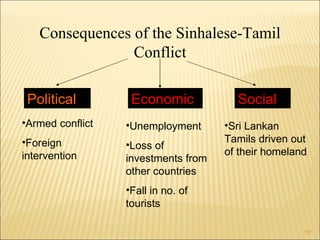
Consequences of the Sinhalese-Tamil Conflict Political Economic Social Armed conflict Foreign intervention Unemployment Loss of investments from other countries Fall in no. of tourists Sri Lankan Tamils driven out of their homeland
1. Armed Conflict The policies introduced by the Sri Lankan government made the Tamils discriminated Made peaceful demands to be fairly treated by the Sri Lankan government Early 1950s: Federal Party asked that Tamil areas be recognised as a federation within the country By 1976 demands still not met New political party Tamil United Liberation Front emerged ?
Tamil United Liberation Front Fought for a separate independent state. Wanted this independent state to be called Tamil-Eelam Sri Lanka government rejected the idea of a separate and independent state Some angry and dissatisfied Tamil youths formed a militant group, the Liberation Tigers of Tamil Eelam (LTTE)
Liberation Tigers of Tamil Eelam With the formation of the militant group LTTE, violence was inevitable  LTTE were considered to be  terrorists. They attacked Tamil members of the police force, and Tamil politicians who rejected their call for an  independent state. Later, they resorted to attacking Sinhalese
ARMED CONFLICT Sinhalese also showed violence towards the Tamils repeatedly, eg. during 1956 peaceful protest against the ‘Sinhala Only’ language policy. They took part in 1983 riots Armed conflict has resulted in war between LTTE and Sri Lankan government Cost: more than 60,000 lives Has lasted more than 20 years Still on-going
2. Unemployment Riots and violence led to massive unemployment.  Business in the conflict areas/districts slowed down or some stopped totally. Many factories were closed and plantation workers lost their jobs.  The jobless started to take part in vandalising, looting and burning their places of work.
The instability caused by the riots and violence did not only led to massive unemployment. It resulted in the loss of investments as investors lost  the confidence in investing in the country. The economy would inevitably suffer as it needs businesses from other countries. 3. Loss of Investments from other countries
The violent internal conflict made Sri Lanka an unsafe place for tourists. As a result, tourism which was one of the income earners for the country was damaged. This decrease resulted in a loss of jobs and a fall in Sri Lanka’s earnings. The economy was badly affected and the country lacked the finances needed to build up its infrastructure  4. Fall in Number of Tourists
The conflict caught India’s attention India played the role of  a mediator Mediated between the Sinhalese and the Tamils after the 1983 riots but was unsuccessful India supported the Sri Lankan Tamils by sending supplies Stopped by the Sri Lankan navy Indian Air Force dropped supplies in Jaffna Violated SL air space ? 5. Foreign Intervention
India forced Sri Lanka to sign a  peace accord   in July 1987. Both parties agreed to a ceasefire. The Tamil-Tigers were to surrender  their  weapons to Indian peacekeeping troops. Jaffna was captured by the Indian peacekeepers by force. Clashes between the Tigers and the Indian peace-keeping troops occurred in the north and east of Sri Lanka. 1990 India withdrew its peacekeeping force from Sri Lanka.
6. Sri Lankan Tamils driven out of their Homeland Caused large-scale displacement beyond its borders E.g. in the 1983 riots, thousands of Tamils fled to Tamil Nadu in South India Abt 65,000 Sri Lankans are still refugees in India today
6. Sri Lankan Tamils driven out of their Homeland Early 1990s: High Security Zones (HSZ) set up by SL Army to keep LTTE away Access is controlled in HSZ Army occupied large parts of Tamil-dominated areas in North and East of SL 1995: Many Tamils had to flee their homes when SL Army moved into Jaffna Many still live in overcrowded conditions
Overview of Lesson We have looked at the following: 1.  The population compostion and distribution in Sri Lanka 2.  The causes of the Sinhalese - Tamils Conflict. Citizenship Rights Jobs in the Government Service University Admission Resettlement of population The consequences of the Sinhalese-Tamil Conflict
Causes of conflict in Northern Ireland Background textbook p. 111-114 Causes textbook p. 114-124
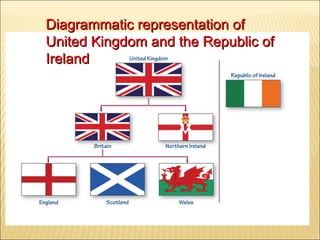
Diagrammatic representation of United Kingdom and the Republic of Ireland
Map of Northern Ireland and the UK Part of the United Kingdom Independent
Facts on Northern Ireland
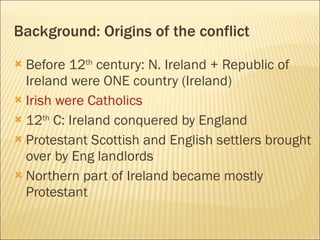
Background: Origins of the conflict Before 12 th  century: N. Ireland + Republic of Ireland were ONE country (Ireland) Irish were Catholics 12 th  C: Ireland conquered by England Protestant Scottish and English settlers brought over by Eng landlords Northern part of Ireland became mostly Protestant
Catholic King James II tried to defeat the Protestants But failed; defeated by Protestant King William of Orange in Battle of Boyne in 1690 Protestants implemented Penal Laws against Catholics For years, civil war raged. 1800: Ireland part of UK Background: Origins of the conflict
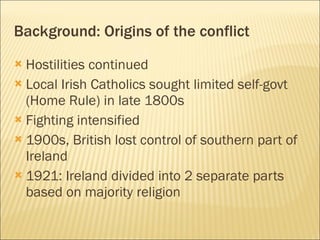
Hostilities continued Local Irish Catholics sought limited self-govt (Home Rule) in late 1800s Fighting intensified 1900s, British lost control of southern part of Ireland 1921: Ireland divided into 2 separate parts based on majority religion Background: Origins of the conflict
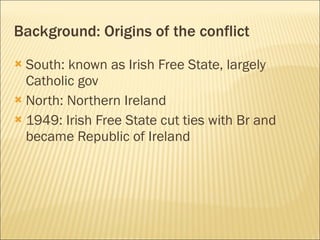
South: known as Irish Free State, largely Catholic gov North: Northern Ireland 1949: Irish Free State cut ties with Br and became Republic of Ireland Background: Origins of the conflict
In 1993  1 million Protestants, mostly of Scottish and English origin 600 000 Catholics, mostly descendents of local Irish inhabitants of the island People of Northern Ireland
Government in Northern Ireland Since 1972 ruled by the British parliament in London Secretary of State for Northern Ireland chosen by the British Prime Minister finance,commerce,health and education controlled by N Ireland government Foreign affairs and defence matters were in British hands
Causes for the Conflict between the Protestants and the Catholics Divided Loyalties The Education System Employment Housing Voting Rights
The Protestant and the Catholics are intolerant of one another. Give their  allegiance  to different countries.  Protestants want to continue to be part of United Kingdom Fear union with Republic of Ireland Fear Catholics would not be tolerant of the Protestant beliefs What about the Catholics? 1. Divided Loyalties
Catholics want  N Ireland reunited with the Republic of Ireland Remember persecution suffered by the Catholics during England’s conquest of Ireland Distrust the Protestants  eg. Protestants still celebrate the Battle of Boyne as a mark of  Protestant dominance What about the Catholics?
Education system in N Ireland deepened the rift between the Catholics and the Protestants Schools in N Ireland can be divided into 3 categories: The Protestant Schools The Catholic Schools Mixed Schools ? 2. The Education System
In the Protestant Schools Students are taught British History, play British sport and are loyal to Britain In the Catholic Schools Students learn Irish History,  play Irish sports and taught Irish language and culture. See Britain as a foreign country In Mixed Schools Subjects cater to both the Catholics and Protestants Schools run by private individuals Unpopular
Results of the Educational System: Generations of children grow to be distrustful of each other  Hostility between them increases.
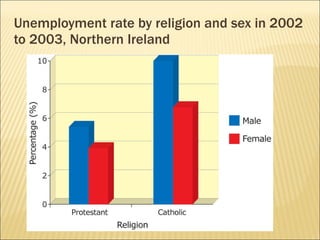
Competition for jobs Catholics felt there is no equal opportunity for them in  getting the jobs  Number of Catholics engineers and civil servants was not  proportionate to their numbers in the country Fewer Catholics in senior positions in the public or private  sectors 3. Employment
Unemployment rate by religion and sex in 2002 to 2003, Northern Ireland
The provision of  housing by city council- caused great concern to the Irish The Councils made up of  largely of Protestants Catholics were delayed in getting their houses They became frustrated as the shortage of houses meant they have to wait for many years to own a house Catholics felt the provision of housing was unfair to them 4. Housing
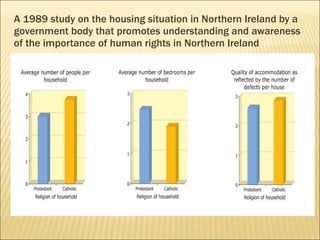
A 1989 study on the housing situation in Northern Ireland by a government body that promotes understanding and awareness of the importance of human rights in Northern Ireland
The right to vote was a problem to the Catholics prior  to 1968 Each household was given to 2 votes while companies had more votes depending on their sizes Many companies owned by Protestants- so they ended up with more votes many voting districts were often drawn up to include large  proportion of Protestants Catholics were unhappy ? 5. Voting
Since 1968, changes have been made  due to the changes voting rights ceased to be a  problem in Northern Ireland  everyone is entitled to one vote must be a British subject must be above 18 years old has to be born in Northern Ireland or must have lived in the United Kingdom for 7 years voting districts have also been redrawn to ensure fairness
The Troubles – From Peace to Violence 1967: The Northern Ireland Civil Rights Association (NICRA) formed Wanted to end discrimination against Catholics Adopted non-violent methods Civil Rights Movement organised by NICRA in 1968 Marked the beginning of ‘The Troubles’ ?
NICRA Organised marches Fighting broke out among Catholics, Protestants and police In 1969,  the British Army was sent to Northern  Ireland to help keep peace Catholics welcomed their protectors Catholics soon lost faith in the British Army  when the army started to search their homes and made arrests
In Jan 1972: 15,000 participated in illegal peaceful civil rights march British soldiers shot at protesters 13 civilians died and many more were wounded  This incident is called the  ‘Bloody Sunday’ incident Led to great outburst of Catholic anger
More violence resulted between Catholics and Protestants Inaction of local police British Army often raided Catholic homes Violence
Involvement of  Irish Republican Army (IRA) Desperate Catholics turned to IRA Aimed to destroy the state and force Br to withdraw completely through using violence Attacked Br soldiers Bombed businesses and shops belonging to Protestants 1969-1993: more than 3,500 deaths IRA responsible for 2/3 of deaths
Effects of Protestants–Catholic Conflict  The conflict resulted in : Social segregation Declining economy:    Decrease in investment    Decline in tourism trade
Throughout 1970s to 1990s attempts were made  to resolve the conflict but attempts failed Peace accord was discussed in the 1990s but failed Good Friday Peace Agreement reached in 1998 Peace is uncertain as there is still tension Conclusion

Chapter 4 Ethnic Conflict

  • 1.
    Chapter 4: Essentialquestions: What causes conflicts in multi-ethnic societies? What are the consequences of these conflicts? What are the challenges in managing ethnic diversity?
  • 2.
    Today’s agenda: Introductionto ethnic conflicts Background information about Sri Lanka Causes of the Sri Lankan conflict Recap: Pop Quiz! Next lesson: Consequences of the Sri Lankan conflict
  • 3.
    In 1948, Ceylon(Sri Lanka) enjoyed the highest literacy rate in Asia. It did not have the problem of over-population; its educational and transportation systems were advanced. For some years, Ceylon was a model for the world. But, today, it is an island known for its problems, and its reputation as a killing field only matched by that of countries such as Rwanda. Adapted from a comment by an editor of a Tamil newspaper in 2003.
  • 4.
    Watch this newsclip: ‘The Casualties of Sri Lanka’s Conflict’ http://www.youtube.com/watch?v=ZD77iTj7zBw What can you infer about the conflict in Sri Lanka? How far do you believe what the reporter says?
  • 5.
    Why the conflictbetween the Sinhalese and Tamils in Sri Lanka?
  • 7.
  • 8.
    8% 9.4% 81.9%% of Popn. Tamil and Sinhala, Islam Mainly coastal port cities Moors Tamil Hinduism Largest group in Jaffna & Batticaloa, Large minorities in other northern and eastern districts. Tamil Sinhala Buddhism Majority everywhere, except Jaffna and Batticaloa Sinhalese Language Religion Living Area Race
  • 9.
    Discussion: Given thedemographics of Sri Lanka, what potential problems could occur? Uneven race distribution throughout SL means limited interaction between communities—gives rise to negative stereotypes and misconceptions Racial conflict becomes territorial in nature
  • 10.
    The people Sinhaleseare natives of Sri Lanka Sri Lankan Tamils are descendents of Tamils who have been living in the country since 300 BCE Indian Tamils: came in 1800s with the British colonial masters to work in tea plantations
  • 11.
    1. CitizenshipRights 2. ‘Sinhala-Only’ Policy 3. University Admission 4. Resettlement of Population Reasons for Sinhalese -Tamil Conflict
  • 12.
    Citizenship Qualification inSri Lanka Given only to those who were born in Sri Lanka, or whose forefathers were born there Result of Citizenship Qualification Policy Many Indian Tamils brought from India by the British to work in Sri Lanka became stateless Indian Tamils not allowed to vote No basic citizenship rights despite contributing to economy 1. Citizenship Rights
  • 13.
    What was done:India tried to help stateless Tamils by holding talks with the Sri Lankan govt. Results of the Talks Sri Lanka is to allow certain numbers of Indian Tamils to return to India The rest of the Indian Tamils were to be granted Sri Lankan citizenship By the 1980s, this agreement was not fulfilled and many Indian Tamils remained stateless Indian Tamils felt neglected and upset
  • 14.
    Resolution 2003: Grantof Citizenship to Persons of Indian Origin Bill passed Citizenship granted to any person of Indian origin who had Permanently lived in SL since 1964, or Was descended from someone who had permanently stayed in SL since that date
  • 15.
    Many educated Tamilscould enter government service during the colonial period They held important jobs in the government Two questions for you to consider: Why do you think they were able to accomplish this? How do you think the Sinhalese, the majority group in Sri Lanka, feel about this? 2. 'Sinhala-Only' Policy
  • 16.
    Changes made afterSri Lanka gained independence from the British In 1956, Sinhala was made the only official language of administration Tamils in the government service were given three years to learn Sinhala or be dismissed from the job.
  • 17.
    Result of thepolicy Tamils were unhappy as they were now unable to get jobs or promotions Organised a peaceful demonstration against the Official Language Act How did the Sinhalese react? The Sinhalese supporters disrupted the peaceful demonstrations Riots occurred Over a hundred deaths were reported
  • 18.
    What happened afterthe riot over the Official language Act Sri Lankan Prime Minister signed a pact with Tamil leader. Tamil was made the official language of the Tamil minority. Tamil was allowed to be used as a language for administration. However tension between the Tamils and Sinhalese continued to increase leading to more fighting and deaths ?
  • 19.
    Tamil Language wasgiven greater recognition in the Sri Lankan Constitution Tamil was made the national language and the language of the administration in the northern and eastern provinces where Tamils formed the majority. English was taught in school to facilitate communication among the different racial groups. 1978 1987 Tamil accepted as an official language.
  • 20.
    3. UNIVERSITY ADMISSIONBefore 1970: University admission criteria was based on merit Examinations were held in the English language Sinhalese were unhappy at the equal number of Sinhalese and Tamil students in the medical and engineering courses, as it was not proportionate to their numbers in the country
  • 21.
    3. University AdmissionWhat was done after 1970: Several educational policies were introduced to rectify this imbalance. E.g. it was compulsory for Tamil students to score higher marks than the Sinhalese students to enter the same courses in the universities.
  • 22.
    Minimum marks foruniversity admission, 1971 183 204 Sinhalese Tamils Physical sciences 175 181 Sinhalese Tamils Bio-science 229 250 Sinhalese Tamils Medicine and Dentistry 227 250 Sinhalese Tamils Engineering 187 170 Sinhalese Tamils Arts Minimum marks Students Course
  • 23.
  • 24.
    Result of thispolicy: successful in increasing the number of Sinhalese youth who were qualified to enter the universities. Percentage of Tamil students who were admitted to the engineering courses fell significantly. Tamil youths unhappy and dissatisfied with the unfair educational policies Difficult to qualify for admission into the university esp. medical and engineering courses  limited job opportunities  disillusionment with government  supported or joined Tamil Tigers (LTTE)
  • 25.
    4. Resettlement ofPopulation What this policy is about: the Sri Lankan government transferred Sinhalese from the densely populated south-western and and central areas into the Tamil area. Aim was to provide land for the landless Sinhalese peasants to live on and to cultivate rice. How did the Tamils react? They were unhappy as the arrival of the peasants was accompanied by Buddhist monks and the Sri Lankan Army which was mostly Sinhalese.
  • 26.
    CHECKPOINT There are4 reasons for the conflict in Sri Lanka: 1948: Citizenship Rights —over 1 million Tamils made ‘stateless’ 1950: Government-sponsored resettlement of Sinhalese in Tamil areas began 1956: ‘Sinhala Only’ policy was introduced 1972: Government restricted Tamils’ admission into university by raising admission criteria
  • 27.
    Consequences of theSinhalese-Tamil Conflict Political Economic Social Armed conflict Foreign intervention Unemployment Loss of investments from other countries Fall in no. of tourists Sri Lankan Tamils driven out of their homeland
  • 28.
    1. Armed ConflictThe policies introduced by the Sri Lankan government made the Tamils discriminated Made peaceful demands to be fairly treated by the Sri Lankan government Early 1950s: Federal Party asked that Tamil areas be recognised as a federation within the country By 1976 demands still not met New political party Tamil United Liberation Front emerged ?
  • 29.
    Tamil United LiberationFront Fought for a separate independent state. Wanted this independent state to be called Tamil-Eelam Sri Lanka government rejected the idea of a separate and independent state Some angry and dissatisfied Tamil youths formed a militant group, the Liberation Tigers of Tamil Eelam (LTTE)
  • 30.
    Liberation Tigers ofTamil Eelam With the formation of the militant group LTTE, violence was inevitable LTTE were considered to be terrorists. They attacked Tamil members of the police force, and Tamil politicians who rejected their call for an independent state. Later, they resorted to attacking Sinhalese
  • 31.
    ARMED CONFLICT Sinhalesealso showed violence towards the Tamils repeatedly, eg. during 1956 peaceful protest against the ‘Sinhala Only’ language policy. They took part in 1983 riots Armed conflict has resulted in war between LTTE and Sri Lankan government Cost: more than 60,000 lives Has lasted more than 20 years Still on-going
  • 32.
    2. Unemployment Riotsand violence led to massive unemployment. Business in the conflict areas/districts slowed down or some stopped totally. Many factories were closed and plantation workers lost their jobs. The jobless started to take part in vandalising, looting and burning their places of work.
  • 33.
    The instability causedby the riots and violence did not only led to massive unemployment. It resulted in the loss of investments as investors lost the confidence in investing in the country. The economy would inevitably suffer as it needs businesses from other countries. 3. Loss of Investments from other countries
  • 34.
    The violent internalconflict made Sri Lanka an unsafe place for tourists. As a result, tourism which was one of the income earners for the country was damaged. This decrease resulted in a loss of jobs and a fall in Sri Lanka’s earnings. The economy was badly affected and the country lacked the finances needed to build up its infrastructure 4. Fall in Number of Tourists
  • 35.
    The conflict caughtIndia’s attention India played the role of a mediator Mediated between the Sinhalese and the Tamils after the 1983 riots but was unsuccessful India supported the Sri Lankan Tamils by sending supplies Stopped by the Sri Lankan navy Indian Air Force dropped supplies in Jaffna Violated SL air space ? 5. Foreign Intervention
  • 36.
    India forced SriLanka to sign a peace accord in July 1987. Both parties agreed to a ceasefire. The Tamil-Tigers were to surrender their weapons to Indian peacekeeping troops. Jaffna was captured by the Indian peacekeepers by force. Clashes between the Tigers and the Indian peace-keeping troops occurred in the north and east of Sri Lanka. 1990 India withdrew its peacekeeping force from Sri Lanka.
  • 37.
    6. Sri LankanTamils driven out of their Homeland Caused large-scale displacement beyond its borders E.g. in the 1983 riots, thousands of Tamils fled to Tamil Nadu in South India Abt 65,000 Sri Lankans are still refugees in India today
  • 38.
    6. Sri LankanTamils driven out of their Homeland Early 1990s: High Security Zones (HSZ) set up by SL Army to keep LTTE away Access is controlled in HSZ Army occupied large parts of Tamil-dominated areas in North and East of SL 1995: Many Tamils had to flee their homes when SL Army moved into Jaffna Many still live in overcrowded conditions
  • 39.
    Overview of LessonWe have looked at the following: 1. The population compostion and distribution in Sri Lanka 2. The causes of the Sinhalese - Tamils Conflict. Citizenship Rights Jobs in the Government Service University Admission Resettlement of population The consequences of the Sinhalese-Tamil Conflict
  • 40.
    Causes of conflictin Northern Ireland Background textbook p. 111-114 Causes textbook p. 114-124
  • 41.
    Diagrammatic representation ofUnited Kingdom and the Republic of Ireland
  • 42.
    Map of NorthernIreland and the UK Part of the United Kingdom Independent
  • 43.
  • 44.
    Background: Origins ofthe conflict Before 12 th century: N. Ireland + Republic of Ireland were ONE country (Ireland) Irish were Catholics 12 th C: Ireland conquered by England Protestant Scottish and English settlers brought over by Eng landlords Northern part of Ireland became mostly Protestant
  • 45.
    Catholic King JamesII tried to defeat the Protestants But failed; defeated by Protestant King William of Orange in Battle of Boyne in 1690 Protestants implemented Penal Laws against Catholics For years, civil war raged. 1800: Ireland part of UK Background: Origins of the conflict
  • 46.
    Hostilities continued LocalIrish Catholics sought limited self-govt (Home Rule) in late 1800s Fighting intensified 1900s, British lost control of southern part of Ireland 1921: Ireland divided into 2 separate parts based on majority religion Background: Origins of the conflict
  • 47.
    South: known asIrish Free State, largely Catholic gov North: Northern Ireland 1949: Irish Free State cut ties with Br and became Republic of Ireland Background: Origins of the conflict
  • 48.
    In 1993 1 million Protestants, mostly of Scottish and English origin 600 000 Catholics, mostly descendents of local Irish inhabitants of the island People of Northern Ireland
  • 49.
    Government in NorthernIreland Since 1972 ruled by the British parliament in London Secretary of State for Northern Ireland chosen by the British Prime Minister finance,commerce,health and education controlled by N Ireland government Foreign affairs and defence matters were in British hands
  • 50.
    Causes for theConflict between the Protestants and the Catholics Divided Loyalties The Education System Employment Housing Voting Rights
  • 51.
    The Protestant andthe Catholics are intolerant of one another. Give their allegiance to different countries. Protestants want to continue to be part of United Kingdom Fear union with Republic of Ireland Fear Catholics would not be tolerant of the Protestant beliefs What about the Catholics? 1. Divided Loyalties
  • 52.
    Catholics want N Ireland reunited with the Republic of Ireland Remember persecution suffered by the Catholics during England’s conquest of Ireland Distrust the Protestants eg. Protestants still celebrate the Battle of Boyne as a mark of Protestant dominance What about the Catholics?
  • 53.
    Education system inN Ireland deepened the rift between the Catholics and the Protestants Schools in N Ireland can be divided into 3 categories: The Protestant Schools The Catholic Schools Mixed Schools ? 2. The Education System
  • 54.
    In the ProtestantSchools Students are taught British History, play British sport and are loyal to Britain In the Catholic Schools Students learn Irish History, play Irish sports and taught Irish language and culture. See Britain as a foreign country In Mixed Schools Subjects cater to both the Catholics and Protestants Schools run by private individuals Unpopular
  • 55.
    Results of theEducational System: Generations of children grow to be distrustful of each other Hostility between them increases.
  • 56.
    Competition for jobsCatholics felt there is no equal opportunity for them in getting the jobs Number of Catholics engineers and civil servants was not proportionate to their numbers in the country Fewer Catholics in senior positions in the public or private sectors 3. Employment
  • 57.
    Unemployment rate byreligion and sex in 2002 to 2003, Northern Ireland
  • 58.
    The provision of housing by city council- caused great concern to the Irish The Councils made up of largely of Protestants Catholics were delayed in getting their houses They became frustrated as the shortage of houses meant they have to wait for many years to own a house Catholics felt the provision of housing was unfair to them 4. Housing
  • 59.
    A 1989 studyon the housing situation in Northern Ireland by a government body that promotes understanding and awareness of the importance of human rights in Northern Ireland
  • 60.
    The right tovote was a problem to the Catholics prior to 1968 Each household was given to 2 votes while companies had more votes depending on their sizes Many companies owned by Protestants- so they ended up with more votes many voting districts were often drawn up to include large proportion of Protestants Catholics were unhappy ? 5. Voting
  • 61.
    Since 1968, changeshave been made due to the changes voting rights ceased to be a problem in Northern Ireland everyone is entitled to one vote must be a British subject must be above 18 years old has to be born in Northern Ireland or must have lived in the United Kingdom for 7 years voting districts have also been redrawn to ensure fairness
  • 62.
    The Troubles –From Peace to Violence 1967: The Northern Ireland Civil Rights Association (NICRA) formed Wanted to end discrimination against Catholics Adopted non-violent methods Civil Rights Movement organised by NICRA in 1968 Marked the beginning of ‘The Troubles’ ?
  • 63.
    NICRA Organised marchesFighting broke out among Catholics, Protestants and police In 1969, the British Army was sent to Northern Ireland to help keep peace Catholics welcomed their protectors Catholics soon lost faith in the British Army when the army started to search their homes and made arrests
  • 64.
    In Jan 1972:15,000 participated in illegal peaceful civil rights march British soldiers shot at protesters 13 civilians died and many more were wounded This incident is called the ‘Bloody Sunday’ incident Led to great outburst of Catholic anger
  • 65.
    More violence resultedbetween Catholics and Protestants Inaction of local police British Army often raided Catholic homes Violence
  • 66.
    Involvement of Irish Republican Army (IRA) Desperate Catholics turned to IRA Aimed to destroy the state and force Br to withdraw completely through using violence Attacked Br soldiers Bombed businesses and shops belonging to Protestants 1969-1993: more than 3,500 deaths IRA responsible for 2/3 of deaths
  • 67.
    Effects of Protestants–CatholicConflict The conflict resulted in : Social segregation Declining economy:  Decrease in investment  Decline in tourism trade
  • 68.
    Throughout 1970s to1990s attempts were made to resolve the conflict but attempts failed Peace accord was discussed in the 1990s but failed Good Friday Peace Agreement reached in 1998 Peace is uncertain as there is still tension Conclusion

Editor's Notes