
Reconciliation in Sri Lanka Sanjana Hattotuwa
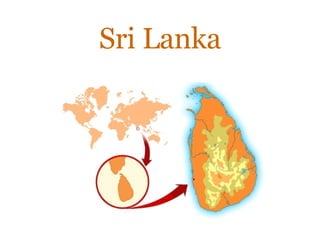
Sri Lanka
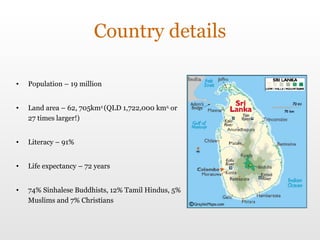
Country details Population – 19 million Land area – 62, 705km 2  (QLD 1,722,000 km 2,  or 27 times larger!) Literacy – 91% Life expectancy – 72 years 74% Sinhalese Buddhists, 12% Tamil Hindus, 5% Muslims and 7% Christians
 
Overview of conflict
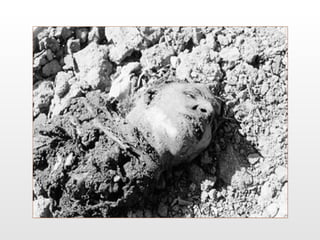
Overview of conflict 65,000 dead (+ around 31,000 from tsunami) 400,000 IDPs Devastated the economy, livelihoods Traumatised societies (Tamil, Muslim, Sinhala) Religious violence (Buddhist / Evangelical Christian / Muslim extremism)
February 2002 – Ceasefire Agreement (CFA) Six Rounds of Peace Talks (2002 – 2003) / Reconciliation never on agenda LTTE pulls out of talks in May 2003 Constitutional imbroglio – change of government in April 2004 Overview of conflict
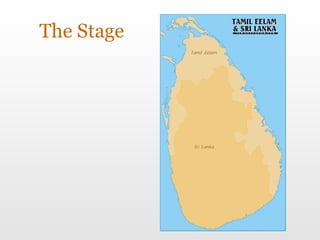
The Stage
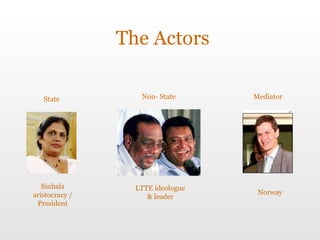
The Actors State Non- State Mediator Sinhala aristocracy / President LTTE ideologue & leader Norway
The roots In the first half of the 20th century, Sri Lanka (then Ceylon) was considered something of a model of political tranquility and social development. At independence in 1948, power was transferred in very orderly fashion to a conservative, Anglicised native elite.
The roots 1956 - The Official Language Act makes Sinhala the sole medium of state affairs. Communal violence kills an estimated 150 people, mostly Tamils.  1961 - The 1956 'Sinhala Only' Act is implemented. Disillusioned activists express secessionist aspirations.  1971 - Educational 'standardisation' leads to higher university entrance requirements for Tamil speakers. Many Tamil students are instantly radicalised.  1972 - The 'district quota' system is introduced for university entrance. 1978 - Buddhism enshrined as State religion in Art. 2 of the constitution
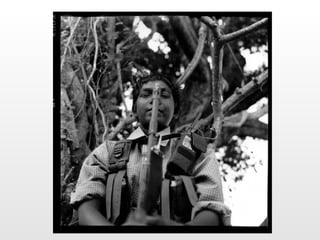
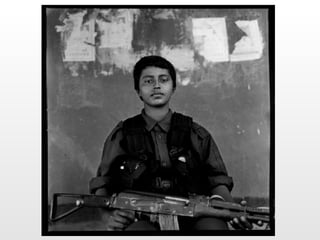
LTTE The Liberation Tigers of Tamil Eelam is an armed group capable of sustainable guerrilla actions, terrorist attacks, and also fighting large conventional battles. It has a tight organizational structure (military and political) under the control of one person, and it is completely disciplined. It has systematically eliminated other Tamil militant groups, controls territory in the north and east of Sri Lanka, and runs a parallel government (with a police force, judicial system, and other structures). It has extensive international linkages and has created a worldwide business empire. For example, the LTTE has extensive shipping interests that are used for the delivery of weapons to the LTTE in Sri Lanka. It has broad support from Tamil people living in Sri Lanka, and from the Tamil Diaspora. It has an effective publicity and propaganda program, which can rapidly mobilize political, economic, and financial support of the Tamil diaspora. It is proscribed as a terrorist organization in Sri Lanka, and by a few other countries.
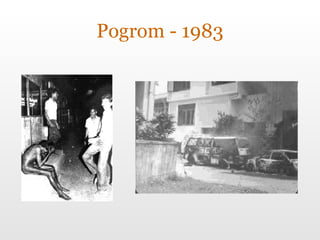
Pogrom - 1983
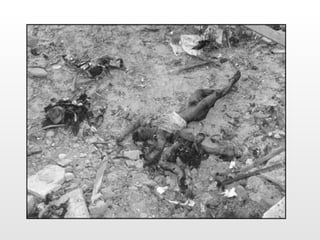
Pogrom - 1983 The riots, which began in Colombo, spread to other areas where Sri Lankan and Indian Tamils were concentrated.  Within Colombo alone, nearly 100,000 Tamils were displaced. The Government admitted to a death toll of 250, but reliable non-governmental sources estimated it at 2,000.  There was hardly any Tamil family in Colombo that escaped death, destruction or displacement. The communal holocaust was an awful turning point in Sri Lanka's recent history.
Pogrom - 1983 Voters lists Welikanda prison massacre State complicity / catastrophic failure of political leadership


War and Insurgency Massive trauma, loss of life Wider ethnic divide No trust, polarised communities Very little people to people contact Media stereotypes Zero sum politics, garrison nationalism Familiar litany of issues…
So what then is reconciliation in Sri Lanka?
Within and between Sinhala / Tamil Buddhist / non-Buddhist South / North-East Local / diaspora Youth / ancienne regime
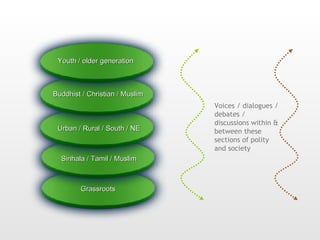
Voices / dialogues / debates / discussions within & between these sections of polity and society Grassroots Sinhala / Tamil / Muslim Urban / Rural / South / NE Buddhist / Christian / Muslim Youth / older generation
Should Sri Lanka remember? There are many arguments as to why the past should not be explored, investigated or uncovered.  It is argued that uncovering past can de-rail peace initiatives and cause further violence.  If unmanaged, the realisation of uncovering the past can be more psychologically painful than leaving it undisturbed.  Youth bear no responsibility for past violence
¿Nunca Mas? Sustainable and just peace in Sri Lanka is not possible without reconciliation. Infusing a relationship / reconciliation focus to the negotiations process will reap enormous tactical and strategic benefits. Help build trust and respect. Trickle down effect, improving relations among and between different communities.
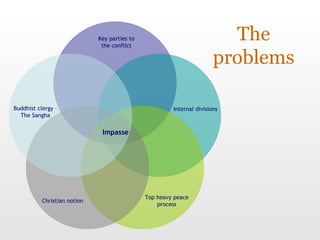
The problems Key parties to the conflict Internal divisions Top heavy peace process Christian notion Buddhist clergy – The Sangha Impasse
Key parties to the conflict Govt. not interested in cross-sectoral & holistic dialogues with commitment to addressing structural inequality LTTE not interested – maintaining political hegemony more important Incumbent coalition partner not interested Opposition not interested Civil society divided Lack of awareness and support for grassroots initiatives Donor disinterest
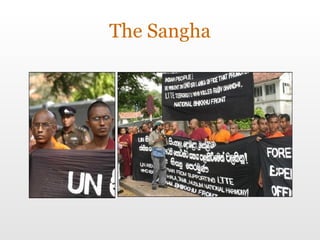
The Sangha
The Sangha Heavily influenced by Sinhalese nationalist ideology – a past with a unified Sinhala-speaking people, who were egalitarian in their social relations, farmed their paddy fields, and lived in austere simplicity and in accordance with Buddhist morality. After independence, time to go back to this past and cure the ravages of colonialism, Christian influence and western immorality.
The Sangha Anti-conversion bill  vs. secular Buddhism Militant Sangha – “over my dead body” rhetoric Voice in parliament Plural / multifaceted Core values of non-violence & compassion exist with just war
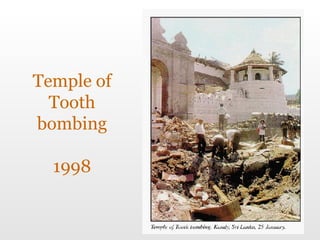
Temple of Tooth bombing 1998
The Sangha High support for peace Very low support for federalism (which is equated with secession) Highly symbolic in Sinhalese politics & society No peace process will last without engaging them No peace agreement can be signed without their majority consent
Christian / Western imperialism Reconciliation as Christian / Western construct Destroying Buddhist social fabric of Sri Lanka Linked to anti-NGO rhetoric Turning the page vs. reconciliation Reconciliation as Western conspiracy to create ethnic conflict
Internal divisions Too early  Too late Too much Too little Post-conflict vs. mainstream in the peace process  South vs. North-East vs. Diaspora
Reconciliation as ‘soft’ issue Lack of Track 1 interest Relegated to Track 3 Post-conflict activity vs. mainstreaming in the peace process Of lesser important than ‘hard’ issues of power sharing, development, demilitarisation, constitutional reform etc.
Restorative justice Restorative justice focuses on transforming wrongdoing by healing the harm, particularly to relationships, that is created by harmful behavior.  The primary stakeholders in restorative justice processes are the person(s) who caused the harm (offender), the person(s) harmed (victim), and the affected community. By collectively identifying and addressing harms, needs, and obligations resulting from wrongdoing, we are able to create healing and put things right again. Emphasis on social relationships and restoration of order under-girded by a strong sense of social justice
Moving forward
President’s Apology - 2004 “ Every citizen in this country should collectively accept the blame and make an apology to the tens of thousands who suffered. I would like to assign to myself that task on behalf of the State of Sri Lanka, the government and on behalf of all of us; all the citizens of Sri Lanka to extend that apology.” First apology for incidents of ‘Black July’ in 1983
Politics of apology Why? Breakdown of talks Political instability / deadlock Addressing structural issues or political pawn? Timing At the beginning of peace talks / peace process Mainstreamed into peace talks vs. single apology
Politics of apology Does blame on all citizens negate justice for the real architects of the pogrom? Process vs. speech Partisan nature of  Presidential Truth Commission Follow up Progressive political will
Past attempts Presidential Truth Commission  Disappearances Commission RRR National Plan for Reconciliation Government of Reconciliation
Tsunami for reconciliation? 31,000+ dead Over a million displaced
Ways forward? How do you move forward with reconciliation in the face of political impasse? (Lit. concentrates on post-conflict reconciliation) How do you integrate reconciliation into the peace process and interim institutional structures? How does one address: Knowledge and acknowledgement Justice and redress Reparation Healing Memory
Reconciliation + Our understanding of reconciliation must not be limited to improving relations between the Sinhala and Tamil communities Extend to all communities, religions, identity groups Socio-political relations Intra-ethnic relations (the JVP pogrom) Gender relations
 
 
Thank you!

Reconciliation in Sri Lanka

  • 1.
    Reconciliation in SriLanka Sanjana Hattotuwa
  • 2.
  • 3.
    Country details Population– 19 million Land area – 62, 705km 2 (QLD 1,722,000 km 2, or 27 times larger!) Literacy – 91% Life expectancy – 72 years 74% Sinhalese Buddhists, 12% Tamil Hindus, 5% Muslims and 7% Christians
  • 4.
  • 5.
  • 6.
    Overview of conflict65,000 dead (+ around 31,000 from tsunami) 400,000 IDPs Devastated the economy, livelihoods Traumatised societies (Tamil, Muslim, Sinhala) Religious violence (Buddhist / Evangelical Christian / Muslim extremism)
  • 7.
    February 2002 –Ceasefire Agreement (CFA) Six Rounds of Peace Talks (2002 – 2003) / Reconciliation never on agenda LTTE pulls out of talks in May 2003 Constitutional imbroglio – change of government in April 2004 Overview of conflict
  • 8.
  • 9.
    The Actors StateNon- State Mediator Sinhala aristocracy / President LTTE ideologue & leader Norway
  • 10.
    The roots Inthe first half of the 20th century, Sri Lanka (then Ceylon) was considered something of a model of political tranquility and social development. At independence in 1948, power was transferred in very orderly fashion to a conservative, Anglicised native elite.
  • 11.
    The roots 1956- The Official Language Act makes Sinhala the sole medium of state affairs. Communal violence kills an estimated 150 people, mostly Tamils. 1961 - The 1956 'Sinhala Only' Act is implemented. Disillusioned activists express secessionist aspirations. 1971 - Educational 'standardisation' leads to higher university entrance requirements for Tamil speakers. Many Tamil students are instantly radicalised. 1972 - The 'district quota' system is introduced for university entrance. 1978 - Buddhism enshrined as State religion in Art. 2 of the constitution
  • 12.
    LTTE The LiberationTigers of Tamil Eelam is an armed group capable of sustainable guerrilla actions, terrorist attacks, and also fighting large conventional battles. It has a tight organizational structure (military and political) under the control of one person, and it is completely disciplined. It has systematically eliminated other Tamil militant groups, controls territory in the north and east of Sri Lanka, and runs a parallel government (with a police force, judicial system, and other structures). It has extensive international linkages and has created a worldwide business empire. For example, the LTTE has extensive shipping interests that are used for the delivery of weapons to the LTTE in Sri Lanka. It has broad support from Tamil people living in Sri Lanka, and from the Tamil Diaspora. It has an effective publicity and propaganda program, which can rapidly mobilize political, economic, and financial support of the Tamil diaspora. It is proscribed as a terrorist organization in Sri Lanka, and by a few other countries.
  • 13.
  • 14.
    Pogrom - 1983The riots, which began in Colombo, spread to other areas where Sri Lankan and Indian Tamils were concentrated. Within Colombo alone, nearly 100,000 Tamils were displaced. The Government admitted to a death toll of 250, but reliable non-governmental sources estimated it at 2,000. There was hardly any Tamil family in Colombo that escaped death, destruction or displacement. The communal holocaust was an awful turning point in Sri Lanka's recent history.
  • 15.
    Pogrom - 1983Voters lists Welikanda prison massacre State complicity / catastrophic failure of political leadership
  • 16.
  • 17.
  • 18.
  • 19.
  • 20.
    War and InsurgencyMassive trauma, loss of life Wider ethnic divide No trust, polarised communities Very little people to people contact Media stereotypes Zero sum politics, garrison nationalism Familiar litany of issues…
  • 21.
    So what thenis reconciliation in Sri Lanka?
  • 22.
    Within and betweenSinhala / Tamil Buddhist / non-Buddhist South / North-East Local / diaspora Youth / ancienne regime
  • 23.
    Voices / dialogues/ debates / discussions within & between these sections of polity and society Grassroots Sinhala / Tamil / Muslim Urban / Rural / South / NE Buddhist / Christian / Muslim Youth / older generation
  • 24.
    Should Sri Lankaremember? There are many arguments as to why the past should not be explored, investigated or uncovered. It is argued that uncovering past can de-rail peace initiatives and cause further violence. If unmanaged, the realisation of uncovering the past can be more psychologically painful than leaving it undisturbed. Youth bear no responsibility for past violence
  • 25.
    ¿Nunca Mas? Sustainableand just peace in Sri Lanka is not possible without reconciliation. Infusing a relationship / reconciliation focus to the negotiations process will reap enormous tactical and strategic benefits. Help build trust and respect. Trickle down effect, improving relations among and between different communities.
  • 26.
    The problems Keyparties to the conflict Internal divisions Top heavy peace process Christian notion Buddhist clergy – The Sangha Impasse
  • 27.
    Key parties tothe conflict Govt. not interested in cross-sectoral & holistic dialogues with commitment to addressing structural inequality LTTE not interested – maintaining political hegemony more important Incumbent coalition partner not interested Opposition not interested Civil society divided Lack of awareness and support for grassroots initiatives Donor disinterest
  • 28.
  • 29.
    The Sangha Heavilyinfluenced by Sinhalese nationalist ideology – a past with a unified Sinhala-speaking people, who were egalitarian in their social relations, farmed their paddy fields, and lived in austere simplicity and in accordance with Buddhist morality. After independence, time to go back to this past and cure the ravages of colonialism, Christian influence and western immorality.
  • 30.
    The Sangha Anti-conversionbill vs. secular Buddhism Militant Sangha – “over my dead body” rhetoric Voice in parliament Plural / multifaceted Core values of non-violence & compassion exist with just war
  • 31.
    Temple of Toothbombing 1998
  • 32.
    The Sangha Highsupport for peace Very low support for federalism (which is equated with secession) Highly symbolic in Sinhalese politics & society No peace process will last without engaging them No peace agreement can be signed without their majority consent
  • 33.
    Christian / Westernimperialism Reconciliation as Christian / Western construct Destroying Buddhist social fabric of Sri Lanka Linked to anti-NGO rhetoric Turning the page vs. reconciliation Reconciliation as Western conspiracy to create ethnic conflict
  • 34.
    Internal divisions Tooearly Too late Too much Too little Post-conflict vs. mainstream in the peace process South vs. North-East vs. Diaspora
  • 35.
    Reconciliation as ‘soft’issue Lack of Track 1 interest Relegated to Track 3 Post-conflict activity vs. mainstreaming in the peace process Of lesser important than ‘hard’ issues of power sharing, development, demilitarisation, constitutional reform etc.
  • 36.
    Restorative justice Restorativejustice focuses on transforming wrongdoing by healing the harm, particularly to relationships, that is created by harmful behavior. The primary stakeholders in restorative justice processes are the person(s) who caused the harm (offender), the person(s) harmed (victim), and the affected community. By collectively identifying and addressing harms, needs, and obligations resulting from wrongdoing, we are able to create healing and put things right again. Emphasis on social relationships and restoration of order under-girded by a strong sense of social justice
  • 37.
  • 38.
    President’s Apology -2004 “ Every citizen in this country should collectively accept the blame and make an apology to the tens of thousands who suffered. I would like to assign to myself that task on behalf of the State of Sri Lanka, the government and on behalf of all of us; all the citizens of Sri Lanka to extend that apology.” First apology for incidents of ‘Black July’ in 1983
  • 39.
    Politics of apologyWhy? Breakdown of talks Political instability / deadlock Addressing structural issues or political pawn? Timing At the beginning of peace talks / peace process Mainstreamed into peace talks vs. single apology
  • 40.
    Politics of apologyDoes blame on all citizens negate justice for the real architects of the pogrom? Process vs. speech Partisan nature of Presidential Truth Commission Follow up Progressive political will
  • 41.
    Past attempts PresidentialTruth Commission Disappearances Commission RRR National Plan for Reconciliation Government of Reconciliation
  • 42.
    Tsunami for reconciliation?31,000+ dead Over a million displaced
  • 43.
    Ways forward? Howdo you move forward with reconciliation in the face of political impasse? (Lit. concentrates on post-conflict reconciliation) How do you integrate reconciliation into the peace process and interim institutional structures? How does one address: Knowledge and acknowledgement Justice and redress Reparation Healing Memory
  • 44.
    Reconciliation + Ourunderstanding of reconciliation must not be limited to improving relations between the Sinhala and Tamil communities Extend to all communities, religions, identity groups Socio-political relations Intra-ethnic relations (the JVP pogrom) Gender relations
  • 45.
  • 46.
  • 47.