Атопийн дерматит
AD is a chronic relapsing inflammatory skin disease
•Primarily affects young children
• More than 50% develop asthma
• 75% developAR
Mark Boguniewicz, Donald Leung.Middleton’s Allergy 7’th edition 893-1999
Introduction
Epidemiology
•Affects 15-30% of children, 2-10% of adult
•45% begin within the first 6 mo
•60% begin during the first yr
•85% begin before 5 yrs
•Up to 75%: spontaneous remission before
adolescence
•Үлдсэн 25% нь насанд хүрээд дахидаг. Hand
eczema
•Анх үйлдвэржсэн орнуудад их тохиолдож
байсан.
NJEM 2008;358:1483-94
Risk factor
• Genetics
Fillagrin gene mutation
Other gene mutation
• Environment
Hygiene hypothesis
Pathophysiology
1. Immunological hypothesis. (hypersensitive 1 )
Pathophysiology
2. The Skin Barrier Hypothesis.
• Fillagrin уургийн мутацийн улмаас эвэрлэг давхарга болон мөхлөгт
давхаргын кератиноцит эсүүдийн хоорондын холбоо алдагдана.
(desmosom)
• Barier dysfunction
• Transepidermal water loss
• Үр дүнд нь арьс хуурайшиж, арьсанд аллерген нэвтрэх нь ихэснэ.
Morphology
Acute AD
• Intensely pruritic, erythematous papule associated with
excoriations, vesiculation, and serous exudate
• Pathology : spongiosis (intercellular epidermal edema), superficial
epidermal hypertrophy and acantholysis
• marked infiltration of CD4 activated memory T cells, APCs,(LCs,
inflammatory dendritic epidermal cells (IDECs), macrophages),
and degranulated mast cell
Histology: Spongiotic area within the epidermis
Chronic AD
• thickened plaques with increased lichenification
• Pathology : marked epidermal hyperplasia, acanthosis
• macrophage-dominated mononuclear cell infiltrate in dermis, and
perivascular accumulation of lymphocytes in smaller numbers than
seen in acuteAD
Hyperplastic of epidermis with hyperkeratosis
Adv Immunol.2009;102;135-226
Diagnosis
• Essential features Itch
• Eczema with typical morphology and age-specic pattern
Important features
• Early age of onset
Atopy (personal or family history) Dry skin
• Associated features
Atypical vascular response (i.e., facial pallor, white
dermographism)
• Keratosis pilaris, palmar hyperlinearity, ichthyosis Ocular
and periorbital changes
Other regionalndings (e.g., perioral and
periauricular lesions)
• Perifollicular accentuation, lichenification, and excoriations
Modied from American Academy of Dermatology
Distribution
• In infants, the face is often affected first, then the
hands and feet; dry red patches may appear all
over the body.
• In older children, the skin folds are most often
affected, especially the elbow creases and behind
the knees.
• In adults, the face and hands are more likely to be
involved.
Distribution
Atopic
Derm
Adults
Atopic Derm Adults
Atopic Dermatitis:
Associated features
• The skin is usually dry, itchy & easily irritated by:
• soap
• detergents
• wool clothing
• May worsen in hot weather & emotional stress.
• May worsen with exposure to dust & cats.
Associated Findings
• Pityriasis alba
Associated Findings
• Xerosis
Associated Findings
• Keratosis Pilaris
Associated
Findings
• Ichthyosis
Differential Diagnosis
• Seborrheic
dermatitis
Differential Diagnosis
• Seborrheic dermatitis
• Scabies
Differential Diagnosis
• Seborrheic dermatitis
• Scabies
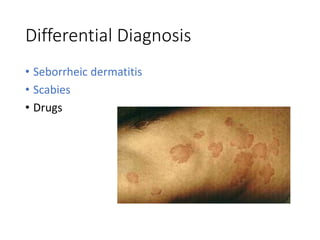
• Drugs
Differential Diagnosis
• Seborrheic dermatitis
• Scabies
• Drugs
• Psoriasis
Differential Diagnosis
• Seborrheic dermatitis
• Scabies
• Drugs
• Psoriasis
• Allergic contact
dermatitis
Differential Diagnosis
• Seborrheic dermatitis
• Scabies
• Drugs
• Psoriasis
• Allergic contact
dermatitis
• Cutaneous T-cell
lymphoma
Assessment of severity
• Clear – normal skin no evidence of active atopic
eczema
• Mild – areas of dry skin, frequent itching + - small
areas of redness
• Moderate - areas of dry skin, frequent itching,
redness, +- excoriation and localised thickening.
• Severe – widespread areas of dry skin, incessant
itching, redness (+- excoriation, extensive skin
thickening, bleeding, oozing, cracking.
Impact on quality of life
• None – no impact on quality of life
• Mild – little impact on everyday activities, sleep and
psychosocial well being
• Moderate - Moderate impact on everyday activities,
psychosocial well being, frequently disturbed sleep
• Severe – severe limitation of everyday activities and
psychosocial well being, loss of sleep every night
Management
• Identify trigger factors
• Irritants – Management
• soaps and detergents
• Contact allergens
• Food allergens
• Inhalant allergens
• Skin infections
• Topical treatments
• Corticosteroids
• Calcineur ininhibitors
• Phototherapy
• Ultravioletlight A (UVA)
• Ultravioletlight B (UVB)
• Ultravioletlight A + Psoralene (PUVA)
• Systemic treatments
• Oralcorticosteroids
• Azathioprine
• Cyclosporine A
• Methotrexate
Stepped treatment
• Tailor treatment to severity
• Start with emollients – should be used even when skin
clear
• Mild disease – emollients + mild steroid creams 1%
hydrocortisone
• Moderate disease – emollients + moderate steroid
creams. Topical calcineurin inhibitors, bandages.
• Severe disease – potent steroid creams (short periods
only) topical calcineurin inhibitors, bandages,
phototherapy, systemic therapy
Management
• Use topical antibiotics + steroid for localised
infection for no longer than 2 weeks
• Non-sedating antihistamines if eczema is severe or
severe itching or urticaria
• Sedating antihistamines children aged > 6/12 during
acute flares if sleep disturbance for child or carers.
• Recognise indications for referral
Баярлалаа…

атопийн дерматит

  • 1.
  • 2.
    AD is achronic relapsing inflammatory skin disease •Primarily affects young children • More than 50% develop asthma • 75% developAR Mark Boguniewicz, Donald Leung.Middleton’s Allergy 7’th edition 893-1999 Introduction
  • 3.
    Epidemiology •Affects 15-30% ofchildren, 2-10% of adult •45% begin within the first 6 mo •60% begin during the first yr •85% begin before 5 yrs •Up to 75%: spontaneous remission before adolescence •Үлдсэн 25% нь насанд хүрээд дахидаг. Hand eczema •Анх үйлдвэржсэн орнуудад их тохиолдож байсан. NJEM 2008;358:1483-94
  • 4.
    Risk factor • Genetics Fillagringene mutation Other gene mutation • Environment Hygiene hypothesis
  • 5.
  • 7.
    Pathophysiology 2. The SkinBarrier Hypothesis. • Fillagrin уургийн мутацийн улмаас эвэрлэг давхарга болон мөхлөгт давхаргын кератиноцит эсүүдийн хоорондын холбоо алдагдана. (desmosom) • Barier dysfunction • Transepidermal water loss • Үр дүнд нь арьс хуурайшиж, арьсанд аллерген нэвтрэх нь ихэснэ.
  • 8.
  • 9.
    Acute AD • Intenselypruritic, erythematous papule associated with excoriations, vesiculation, and serous exudate • Pathology : spongiosis (intercellular epidermal edema), superficial epidermal hypertrophy and acantholysis • marked infiltration of CD4 activated memory T cells, APCs,(LCs, inflammatory dendritic epidermal cells (IDECs), macrophages), and degranulated mast cell Histology: Spongiotic area within the epidermis
  • 11.
    Chronic AD • thickenedplaques with increased lichenification • Pathology : marked epidermal hyperplasia, acanthosis • macrophage-dominated mononuclear cell infiltrate in dermis, and perivascular accumulation of lymphocytes in smaller numbers than seen in acuteAD Hyperplastic of epidermis with hyperkeratosis Adv Immunol.2009;102;135-226
  • 13.
    Diagnosis • Essential featuresItch • Eczema with typical morphology and age-specic pattern Important features • Early age of onset Atopy (personal or family history) Dry skin • Associated features Atypical vascular response (i.e., facial pallor, white dermographism) • Keratosis pilaris, palmar hyperlinearity, ichthyosis Ocular and periorbital changes Other regionalndings (e.g., perioral and periauricular lesions) • Perifollicular accentuation, lichenification, and excoriations Modied from American Academy of Dermatology
  • 14.
    Distribution • In infants,the face is often affected first, then the hands and feet; dry red patches may appear all over the body. • In older children, the skin folds are most often affected, especially the elbow creases and behind the knees. • In adults, the face and hands are more likely to be involved.
  • 15.
  • 21.
  • 22.
  • 23.
    Atopic Dermatitis: Associated features •The skin is usually dry, itchy & easily irritated by: • soap • detergents • wool clothing • May worsen in hot weather & emotional stress. • May worsen with exposure to dust & cats.
  • 24.
  • 25.
  • 26.
  • 27.
  • 28.
  • 29.
  • 30.
    Differential Diagnosis • Seborrheicdermatitis • Scabies • Drugs
  • 31.
    Differential Diagnosis • Seborrheicdermatitis • Scabies • Drugs • Psoriasis
  • 32.
    Differential Diagnosis • Seborrheicdermatitis • Scabies • Drugs • Psoriasis • Allergic contact dermatitis
  • 33.
    Differential Diagnosis • Seborrheicdermatitis • Scabies • Drugs • Psoriasis • Allergic contact dermatitis • Cutaneous T-cell lymphoma
  • 34.
    Assessment of severity •Clear – normal skin no evidence of active atopic eczema • Mild – areas of dry skin, frequent itching + - small areas of redness • Moderate - areas of dry skin, frequent itching, redness, +- excoriation and localised thickening. • Severe – widespread areas of dry skin, incessant itching, redness (+- excoriation, extensive skin thickening, bleeding, oozing, cracking.
  • 35.
    Impact on qualityof life • None – no impact on quality of life • Mild – little impact on everyday activities, sleep and psychosocial well being • Moderate - Moderate impact on everyday activities, psychosocial well being, frequently disturbed sleep • Severe – severe limitation of everyday activities and psychosocial well being, loss of sleep every night
  • 37.
    Management • Identify triggerfactors • Irritants – Management • soaps and detergents • Contact allergens • Food allergens • Inhalant allergens • Skin infections
  • 40.
    • Topical treatments •Corticosteroids • Calcineur ininhibitors • Phototherapy • Ultravioletlight A (UVA) • Ultravioletlight B (UVB) • Ultravioletlight A + Psoralene (PUVA) • Systemic treatments • Oralcorticosteroids • Azathioprine • Cyclosporine A • Methotrexate
  • 41.
    Stepped treatment • Tailortreatment to severity • Start with emollients – should be used even when skin clear • Mild disease – emollients + mild steroid creams 1% hydrocortisone • Moderate disease – emollients + moderate steroid creams. Topical calcineurin inhibitors, bandages. • Severe disease – potent steroid creams (short periods only) topical calcineurin inhibitors, bandages, phototherapy, systemic therapy
  • 42.
    Management • Use topicalantibiotics + steroid for localised infection for no longer than 2 weeks • Non-sedating antihistamines if eczema is severe or severe itching or urticaria • Sedating antihistamines children aged > 6/12 during acute flares if sleep disturbance for child or carers. • Recognise indications for referral
  • 47.