Endogenous Eczemas
Atopic dermatitis
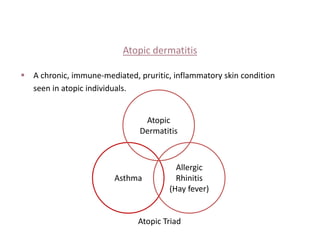
 A chronic, immune-mediated, pruritic, inflammatory skin condition
seen in atopic individuals.
Asthma
Allergic
Rhinitis
(Hay fever)
Atopic
Dermatitis
Atopic Triad
Atopic dermatitis
 Marked by alternating periods of remission and flare-ups.
 A result of complex interplay between environmental, immunologic,
genetic and pharmacologic factors.
 Aggravated by infection, psychological stress, seasonal changes,
irritants, and allergens.
Atopic dermatitis
Diagnosis
 It cannot be precisely defined as it does not have specific skin
changes, histologic features or diagnostic laboratory test.
 The diagnosis is usually arrived on the basis of clinical findings,
comprising three or more major criteria and three or more minor
criteria (Hanifin and Rajka, 1980).
Atopic dermatitis
Diagnostic criteria : Major features
 Pruritus.
 Typical morphology and distribution - Facial and extensor
involvement in infants and children, flexural lichenification in adults.
 Chronic or relapsing dermatitis.
 Personal or family history of atopy (atopic dermatitis; asthma;
allergic rhinitis).
Atopic dermatitis
Diagnostic criteria : Minor features
 Xerosis
 Ichthyosis, palmar hyperlinearity, or keratosis pilaris
 Immediate (type 1) skin-test reactivity
 Raised serum IgE
 Early age of onset
 Tendency toward cutaneous infections (especially S aureus and
herpes simplex) or impaired cell-mediated immunity
 Tendency toward non-specific hand or foot dermatitis
 Nipple eczema
 Cheilitis , Recurrent conjunctivitis
 Dennie-Morgan- infraorbital fold
Atopic dermatitis
Diagnostic criteria : Minor features
 Keratoconus
 Anterior subcapsular cataracts
 Orbital darkening
 Facial pallor or facial erythema
 Pityriasis alba
 Anterior neck folds
 Itch when sweating
 Intolerance to wool and lipid solvents
 Perifollicular accentuation
 Food intolerance
 Course influenced by environmental or emotional factors
 White dermographism or delayed blanch
Atopic dermatitis
Clinical features
 Age of onset typically during infancy (2 to 6 months); but may start
at any age.
 Clinical features vary at different phases of life; and comprise:
• Itching
• Macular erythema, papules or papulo-vesicles
• Eczematous areas with crusting
• Lichenification and excoriation
• Dryness of the skin
• Cutaneous reactivity
• Secondary infection
Atopic dermatitis
Infantile phase (2 months to 2 years)
 Sites : cheeks, perioral area and
scalp; extensors of feet and
elbows.
 Oozing lesions.
 Teething, respiratory infections,
emotional upsets and seasonal
changes influence the disease
course.
 The disease often subsides by 18
months of age; but may progress
to the childhood phase.
Atopic dermatitis
Childhood phase (2 to 12 years)
 Characteristically involves elbow and
knee flexures, sides of the neck,
wrists and ankles.
 Scratching and chronicity lead to
lichenification.
 Hands may often be involved with
exudative lesions, sometimes with
nail changes.
 Secondary bacterial or viral infection
may give rise to acute generalized or
localized vesiculation.
Atopic dermatitis
Adult phase (12 years onwards)
 Commonly involves flexural areas.
 The disease may be diffuse or patchy.
 May manifest only as chronic hand eczema.
 Dermatitis of the upper eyelids and blepharitis.
Atopic dermatitis
Triggering factors
 Anxiety; emotional stress
 Temperature change and sweating
 Decreased humidity
 Excessive washing
 Contact with irritants
 Allergens
 Foods
 Microbial agents
Atopic dermatitis
Management
 First-line treatment
 Second-line treatment
 Third-line treatment
 Counselling; occupational advice
Management of Atopic dermatitis
First-line treatment
 Identify and control ‘flare factors’
Topical treatments
 Bathing; Emollients; Humectants
 Corticosteroids
 Calcineurin inhibitors : Pimecrolimus; tacrolimus
 Icthamol and tar
Management of Atopic dermatitis
First-line treatment
 Oral treatment
• Antihistamines
– Sedative antihistamines preferred
– Promethazine; trimeperazine; hydroxyzine
• Antibiotics
• Systemic steriods (in severe cases)
Management of Atopic dermatitis
Second-line treatment
 Intensive topical therapy- step up to potent steroid
 Wet wrap technique
 Allergy management
• Food
• Inhalants
• Contact allergy
Management of Atopic dermatitis
Third-line treatment
 Phototherapy
 Oral immunosuppresants
• Cyclosporine
• Azathriopine
• Thymopentine
• α- Interferon
 Desensitization

atopic dermatitis.pptx

  • 2.
  • 3.
    Atopic dermatitis  Achronic, immune-mediated, pruritic, inflammatory skin condition seen in atopic individuals. Asthma Allergic Rhinitis (Hay fever) Atopic Dermatitis Atopic Triad
  • 4.
    Atopic dermatitis  Markedby alternating periods of remission and flare-ups.  A result of complex interplay between environmental, immunologic, genetic and pharmacologic factors.  Aggravated by infection, psychological stress, seasonal changes, irritants, and allergens.
  • 5.
    Atopic dermatitis Diagnosis  Itcannot be precisely defined as it does not have specific skin changes, histologic features or diagnostic laboratory test.  The diagnosis is usually arrived on the basis of clinical findings, comprising three or more major criteria and three or more minor criteria (Hanifin and Rajka, 1980).
  • 6.
    Atopic dermatitis Diagnostic criteria: Major features  Pruritus.  Typical morphology and distribution - Facial and extensor involvement in infants and children, flexural lichenification in adults.  Chronic or relapsing dermatitis.  Personal or family history of atopy (atopic dermatitis; asthma; allergic rhinitis).
  • 7.
    Atopic dermatitis Diagnostic criteria: Minor features  Xerosis  Ichthyosis, palmar hyperlinearity, or keratosis pilaris  Immediate (type 1) skin-test reactivity  Raised serum IgE  Early age of onset  Tendency toward cutaneous infections (especially S aureus and herpes simplex) or impaired cell-mediated immunity  Tendency toward non-specific hand or foot dermatitis  Nipple eczema  Cheilitis , Recurrent conjunctivitis  Dennie-Morgan- infraorbital fold
  • 8.
    Atopic dermatitis Diagnostic criteria: Minor features  Keratoconus  Anterior subcapsular cataracts  Orbital darkening  Facial pallor or facial erythema  Pityriasis alba  Anterior neck folds  Itch when sweating  Intolerance to wool and lipid solvents  Perifollicular accentuation  Food intolerance  Course influenced by environmental or emotional factors  White dermographism or delayed blanch
  • 9.
    Atopic dermatitis Clinical features Age of onset typically during infancy (2 to 6 months); but may start at any age.  Clinical features vary at different phases of life; and comprise: • Itching • Macular erythema, papules or papulo-vesicles • Eczematous areas with crusting • Lichenification and excoriation • Dryness of the skin • Cutaneous reactivity • Secondary infection
  • 10.
    Atopic dermatitis Infantile phase(2 months to 2 years)  Sites : cheeks, perioral area and scalp; extensors of feet and elbows.  Oozing lesions.  Teething, respiratory infections, emotional upsets and seasonal changes influence the disease course.  The disease often subsides by 18 months of age; but may progress to the childhood phase.
  • 11.
    Atopic dermatitis Childhood phase(2 to 12 years)  Characteristically involves elbow and knee flexures, sides of the neck, wrists and ankles.  Scratching and chronicity lead to lichenification.  Hands may often be involved with exudative lesions, sometimes with nail changes.  Secondary bacterial or viral infection may give rise to acute generalized or localized vesiculation.
  • 12.
    Atopic dermatitis Adult phase(12 years onwards)  Commonly involves flexural areas.  The disease may be diffuse or patchy.  May manifest only as chronic hand eczema.  Dermatitis of the upper eyelids and blepharitis.
  • 13.
    Atopic dermatitis Triggering factors Anxiety; emotional stress  Temperature change and sweating  Decreased humidity  Excessive washing  Contact with irritants  Allergens  Foods  Microbial agents
  • 14.
    Atopic dermatitis Management  First-linetreatment  Second-line treatment  Third-line treatment  Counselling; occupational advice
  • 15.
    Management of Atopicdermatitis First-line treatment  Identify and control ‘flare factors’ Topical treatments  Bathing; Emollients; Humectants  Corticosteroids  Calcineurin inhibitors : Pimecrolimus; tacrolimus  Icthamol and tar
  • 16.
    Management of Atopicdermatitis First-line treatment  Oral treatment • Antihistamines – Sedative antihistamines preferred – Promethazine; trimeperazine; hydroxyzine • Antibiotics • Systemic steriods (in severe cases)
  • 17.
    Management of Atopicdermatitis Second-line treatment  Intensive topical therapy- step up to potent steroid  Wet wrap technique  Allergy management • Food • Inhalants • Contact allergy
  • 18.
    Management of Atopicdermatitis Third-line treatment  Phototherapy  Oral immunosuppresants • Cyclosporine • Azathriopine • Thymopentine • α- Interferon  Desensitization

Editor's Notes

  • #14 Anxiety and emotional stress have marked aggravating effect on the atopic dermatitis. Atopic patients do not tolerate sudden changes in the temperature. Decrease in the humidity, as in winter months, aggravates dryness of skin. Repeated washing and drying remove water-binding lipids from the first layer of the skin. Use of detergents, cosmetics, soaps, solvents, wool, household and industrial chemicals, cosmetics, perfumes, and some soaps. House dust mite - Dermatophagoides pteronyssinus , pollens and allergens from pets, molds, or human dander Food - eggs, peanuts, milk, fish, soy and wheat. Staphylococcus aureus
  • #16 General measures: Advise the patient to avoid frequent use of soaps; and to use soaps that are less alkaline (pH 5.5). Advise the patients to avoid contact with wool, which irritates the skin Advise measures to avoid exposure to house dust mites - regular cleaning of the premises; use of dust mite proof encasings on pillows, mattresses; weekly washing of the bedding in hot water; removal of bedroom carpets and maintaining indoor humidity levels with air conditioning. Advise patients also to avoid keeping pets. Identify the offending food agents and advise patients to avoid the same. Inform patients about the aggravating effect of the herpes simplex infection on the AD Advise patient to avoid extremes of temperature. Advise patients to avoid stress
  • #18 Wet wrap techniques - This technique is employed for controlling severe AD or acute flare-ups. The rationale is to keep the skin moist when the topical steroids are applied so as to enhance their skin penetration. A low-potency topical steroid is applied to the affected skin. Then two layers of absorbent bandage are applied over it. The inner layer is pre-soaked in warm water and the outer layer is dry. The dressings can be used overnight or changed every 12 hr. Encourage mothers for prolonged breast-feeding. Avoid eggs, milk, peanuts, soy and wheat. Aggressive eradication of the house dust mites
  • #19 NBUVB – preferred in children. Desensitization plays a limited role. Counseling and occupational advice Counseling about the nature of the atopic dermatitis, the trigger factors, the fluctuant course of the disease, and the treatment benefits and limitations play a major role.