ATOPIC
DERMATITIS
Presentation by Kaushik Janvi, Group 7
ATOPICDERMATITIS
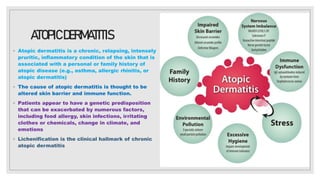
◦ Atopic dermatitis is a chronic, relapsing, intensely
pruritic, inflammatory condition of the skin that is
associated with a personal or family history of
atopic disease (e.g., asthma, allergic rhinitis, or
atopic dermatitis)
◦ The cause of atopic dermatitis is thought to be
altered skin barrier and immune function.
◦ Patients appear to have a genetic predisposition
that can be exacerbated by numerous factors,
including food allergy, skin infections, irritating
clothes or chemicals, change in climate, and
emotions
◦ Lichenification is the clinical hallmark of chronic
atopic dermatitis
ATOPIC DERMATITIS IS PREDOMINANTLY A DISEASE OF CHILDHOOD, WITH 17%
OF CHILDREN AND 6% OF ADULTS AFFECTED. IT USUALLY STARTS AFTER
2 MONTHS OF AGE, AND BY 5 YEARS OF AGE, 90% OF THE PATIENTS WHO WILL
DEVELOP ATOPIC DERMATITIS HAVE MANIFESTED THE DISEASE. IT IS
UNCOMMON FOR ADULTS TO DEVELOP ATOPIC DERMATITIS WITHOUT A
HISTORY OF CHILDHOOD ECZEMA.
INCIDENCE OF ATOPIC DERMATITIS
PHYSICAL EXAMINATION
◦ MORPHOLOGY AND DISTRIBUTION OF ATOPIC DERMATITIS ARE AGE- DEPENDENT
◦ Infantile atopic dermatitis is characterized by acute-to-subacute eczema with papules, vesicles, oozing, and
crusting. It is distributed over the head, diaper area, and extensor surfaces of the extremities. In children and
adults, the eruption is a chronic dermatitis with lichenification and scaling. The distribution includes the neck,
face, upper chest, and, characteristically, antecubital and popliteal fossae.
Atopic dermatitis in infants is papular or
vesicular; in children
and adults, it is lichenified, especially affecting
the antecubital
and popliteal fossae.
Individuals with atopic dermatitis have a
characteristic
expression. The face has mild to moderate
erythema, perioral pallor, and infraorbital folds
(Dennie – Morgan lines)
associated with dermatitis and
hyperpigmentation. The
skin generally is dry and may have generalized
fine, whitish
scaling. The palms often have increased linear
markings.
PATHOGENESIS
Adisrupted skinbarrier
(filaggringenemutation) anddisturbed immunologic
response(Th2+Th1cytokines,and IgE) havebeen
implicatedintheetiologyofatopic dermatitis
Thesechangesincluderaisedserum IgElevels,
defectivecell-mediatedimmunity, decreased
chemotaxisofmononuclearcells,increasedT-
lymphocyteactivation withproduction ofThelperTh1
andTh2cytokines,andhyperstimulatory Langerhans
cells.
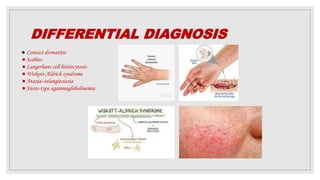
DIFFERENTIAL DIAGNOSIS
● Contact dermatitis
● Scabies
● Langerhans cell histiocytosis
● Wiskott-Aldrich syndrome
● Ataxia–telangiectasia
● Swiss-type agammaglobulinemia
COURSE AND COMPLICATIONS
◦ Atopic dermatitis is a chronic disease punctuated by repeated acute flare-ups followed
by longer periods of slow resolution. The cause of these flare-ups is frequently
unknown – a feature that adds to the frustration of this disease. Most children (90%)
outgrow their disease by adolescence, although as adults, some continue to have
localized forms of atopic dermatitis such as chronic hand or foot dermatitis, patches of
lichen simplex chronicus, or eyelid dermatitis. Longitudinal studies suggest an “atopic
march” in which over half of infants and children with atopic dermatitis will progress
to develop allergic rhinitis and asthma
◦ Atopic dermatitis is frequently complicated by skin infections. Atopic skin has a higher
rate of colonization with Staphylococcus aureus. The most serious cutaneous infection
is Kaposi’s varicelliform eruption. This widespread vesiculopustular eruption is caused
by herpes simplex (eczema herpeticum), variola, or vaccinia virus. Patients with this
infection are acutely ill and may die; for this reason, smallpox immunization was
contraindicated in these patients. The hyper-IgE syndrome refers to a syndrome of
atopic dermatitis characterized by recurrent pyoderma (skin infections), raised serum
IgE levels, and decreased chemotaxis of mononuclear cells
Complications
THERAPY
◦ Initial
◦ ● Moisturizers
◦ ● Avoidance of irritants – woollen clothes, harsh soaps,
◦ uncomfortable climate
◦ ● Steroids, topical macrolide immunosuppressants,
◦ crisaborole ointment, antihistamines, baths, compresses,
◦ and antibiotics (see Therapy for Essential Dermatitis, below)
◦ ● Avoidance of food allergens (eggs, peanuts, milk, wheat) in
◦ selected patients
◦ Alternative
◦ ● Ultraviolet light – UVB, PUVA
◦ ● Immunomodulants – azathioprine, cyclosporine,
◦ mycophenolate mofetil, dupilumab
◦ ● Support group – National Eczema Association for Science
◦ and Education, www.nationaleczema.org

ATOPIC DERMATITIS.pptx

  • 1.
  • 2.
    ATOPICDERMATITIS ◦ Atopic dermatitisis a chronic, relapsing, intensely pruritic, inflammatory condition of the skin that is associated with a personal or family history of atopic disease (e.g., asthma, allergic rhinitis, or atopic dermatitis) ◦ The cause of atopic dermatitis is thought to be altered skin barrier and immune function. ◦ Patients appear to have a genetic predisposition that can be exacerbated by numerous factors, including food allergy, skin infections, irritating clothes or chemicals, change in climate, and emotions ◦ Lichenification is the clinical hallmark of chronic atopic dermatitis
  • 3.
    ATOPIC DERMATITIS ISPREDOMINANTLY A DISEASE OF CHILDHOOD, WITH 17% OF CHILDREN AND 6% OF ADULTS AFFECTED. IT USUALLY STARTS AFTER 2 MONTHS OF AGE, AND BY 5 YEARS OF AGE, 90% OF THE PATIENTS WHO WILL DEVELOP ATOPIC DERMATITIS HAVE MANIFESTED THE DISEASE. IT IS UNCOMMON FOR ADULTS TO DEVELOP ATOPIC DERMATITIS WITHOUT A HISTORY OF CHILDHOOD ECZEMA. INCIDENCE OF ATOPIC DERMATITIS
  • 4.
    PHYSICAL EXAMINATION ◦ MORPHOLOGYAND DISTRIBUTION OF ATOPIC DERMATITIS ARE AGE- DEPENDENT ◦ Infantile atopic dermatitis is characterized by acute-to-subacute eczema with papules, vesicles, oozing, and crusting. It is distributed over the head, diaper area, and extensor surfaces of the extremities. In children and adults, the eruption is a chronic dermatitis with lichenification and scaling. The distribution includes the neck, face, upper chest, and, characteristically, antecubital and popliteal fossae. Atopic dermatitis in infants is papular or vesicular; in children and adults, it is lichenified, especially affecting the antecubital and popliteal fossae. Individuals with atopic dermatitis have a characteristic expression. The face has mild to moderate erythema, perioral pallor, and infraorbital folds (Dennie – Morgan lines) associated with dermatitis and hyperpigmentation. The skin generally is dry and may have generalized fine, whitish scaling. The palms often have increased linear markings.
  • 5.
    PATHOGENESIS Adisrupted skinbarrier (filaggringenemutation) anddisturbedimmunologic response(Th2+Th1cytokines,and IgE) havebeen implicatedintheetiologyofatopic dermatitis Thesechangesincluderaisedserum IgElevels, defectivecell-mediatedimmunity, decreased chemotaxisofmononuclearcells,increasedT- lymphocyteactivation withproduction ofThelperTh1 andTh2cytokines,andhyperstimulatory Langerhans cells.
  • 8.
    DIFFERENTIAL DIAGNOSIS ● Contactdermatitis ● Scabies ● Langerhans cell histiocytosis ● Wiskott-Aldrich syndrome ● Ataxia–telangiectasia ● Swiss-type agammaglobulinemia
  • 9.
    COURSE AND COMPLICATIONS ◦Atopic dermatitis is a chronic disease punctuated by repeated acute flare-ups followed by longer periods of slow resolution. The cause of these flare-ups is frequently unknown – a feature that adds to the frustration of this disease. Most children (90%) outgrow their disease by adolescence, although as adults, some continue to have localized forms of atopic dermatitis such as chronic hand or foot dermatitis, patches of lichen simplex chronicus, or eyelid dermatitis. Longitudinal studies suggest an “atopic march” in which over half of infants and children with atopic dermatitis will progress to develop allergic rhinitis and asthma ◦ Atopic dermatitis is frequently complicated by skin infections. Atopic skin has a higher rate of colonization with Staphylococcus aureus. The most serious cutaneous infection is Kaposi’s varicelliform eruption. This widespread vesiculopustular eruption is caused by herpes simplex (eczema herpeticum), variola, or vaccinia virus. Patients with this infection are acutely ill and may die; for this reason, smallpox immunization was contraindicated in these patients. The hyper-IgE syndrome refers to a syndrome of atopic dermatitis characterized by recurrent pyoderma (skin infections), raised serum IgE levels, and decreased chemotaxis of mononuclear cells
  • 10.
  • 11.
    THERAPY ◦ Initial ◦ ●Moisturizers ◦ ● Avoidance of irritants – woollen clothes, harsh soaps, ◦ uncomfortable climate ◦ ● Steroids, topical macrolide immunosuppressants, ◦ crisaborole ointment, antihistamines, baths, compresses, ◦ and antibiotics (see Therapy for Essential Dermatitis, below) ◦ ● Avoidance of food allergens (eggs, peanuts, milk, wheat) in ◦ selected patients ◦ Alternative ◦ ● Ultraviolet light – UVB, PUVA ◦ ● Immunomodulants – azathioprine, cyclosporine, ◦ mycophenolate mofetil, dupilumab ◦ ● Support group – National Eczema Association for Science ◦ and Education, www.nationaleczema.org