Chapter 6 Contraction of Skeletal Muscle
근육세포
경북대학교 의학전문대학원
생리학교실 홍 장 원
Chapter 7 Excitation of Skeletal Muscle: Neuromuscular Transmission
and Excitation-Contraction Coupling
1. Physiological anatomy of skeletal muscle
① Skeletal muscle fiber
ⓐ sarcolemma
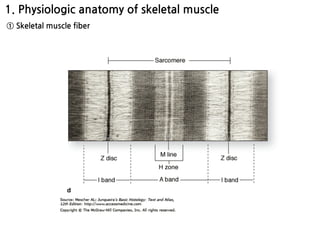
ⓑ myofibril; I band, A band, Z disc, Sacromere, actin/myosin filament
ⓒ Titin filament
ⓓ Sarcoplasm
ⓔ Sarcoplasmic reticulum
2. General mechanism of muscle contraction
① Initiation and execution of muscle contraction
AP along motor nerve → ACh → AchR → sodium influx → AP depol muscle membrane → T-tubule →
Ca2+ release from SR → Ca2+ initiate attractive force between actin and myosin filaments → Ca2+
pumped back into SR
3.Molecular mechanism of muscle contraction
① Sliding filament mechanism of muscle contraction
② Molecular characteristics of contractile filaments
ⓐ myosin filament
ⓑ ATPase activity of the myosin head
ⓒ actin filament
ⓓ tropomyosin molecules
ⓔ Troponin and its role in muscle contraction
③ Interaction of 1 myosin, 2 actin, Ca2+ cause contraction
④ Walk-along theory of contraction
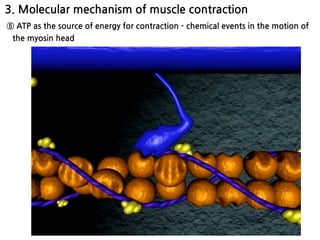
⑤ ATP as the source of energy for contraction
Chapter 6-7 Contraction and excitation of Skeletal Muscle
1. Physiologic anatomy of skeletal muscle
① Skeletal muscle fiber
1. Physiologic anatomy of skeletal muscle
① Skeletal muscle fiber
ⓐ Sarcolemma
- muscle fiber의 cell membrane
- plasma membrane + outer coat (polysaccharide + collagen fibrils)로 구성
- Sarcolemma가 tendon과 fuse한 얇은 layer → tendon fiber가 bundle을 모아서 →
bone에 insert한다.
1. Physiologic anatomy of skeletal muscle
① Skeletal muscle fiber
ⓑ Myofibril; actin and myosin filaments
- 각각의 muscle fiber는 많은 myofibril로 이루어져 있다.
- Each myofibril; composed of 15,000 adjacent myosin filaments, 3000 actin
filaments
- Thick filaments; myosin, thin filaments; actin
- Myosin and actin filaments partially interdigitate → light and dark bands
1. Physiologic anatomy of skeletal muscle
① Skeletal muscle fiber
ⓑ Myofibril; actin and myosin filaments
- I band; light band only contain actin
- A band; contains myosin filaments and ends of actin filaments
- Z disc; ends of the actin filaments are attached. composed of filamentous
proteins different from actin and myosin filaments
- Sarcomere; from Z disc to Z disc. When a muscle is contracted, actin
completely overlap the myosin filaments
1. Physiologic anatomy of skeletal muscle
① Skeletal muscle fiber
1. Physiologic anatomy of skeletal muscle
① Skeletal muscle fiber
1. Physiologic anatomy of skeletal muscle
① Skeletal muscle fiber
1. Physiologic anatomy of skeletal muscle
① Skeletal muscle fiber
1. Physiologic anatomy of skeletal muscle
① Skeletal muscle fiber
1. Physiologic anatomy of skeletal muscle
① Skeletal muscle fiber
ⓑ Myofibril; actin and myosin filaments
1. Physiologic anatomy of skeletal muscle
① Skeletal muscle fiber
ⓒ What keeps myosin and actin filaments in pace?
- Titin filamentous molecules
- 탄력있는 titin molecule은 myosin과 actin filament 구조를 유지시켜주는
framework로 작동한다.
1. Physiologic anatomy of skeletal muscle
① Skeletal muscle fiber
ⓓ Sacroplasm
- myofibril 사이의 공간은 sarcoplasm으로 불리우는 intercellular fluid로 채워져있다.
- 이곳에는 많은 양의 potassium, magnesium, phosphate, protein enzyme이 존재
- 또한 많은 양의 mitochondria가 myofibril에 parallel하게 존재하여 ATP를 공급한다.
1. Physiologic anatomy of skeletal muscle
① Skeletal muscle fiber
ⓔ Sacroplasmic reticulum
- 각 muscle fiber의 myofibril를 감싸는 sarcoplasm은 extensive한 reticulum이며 →
근육의 수축을 조절하는 중요한 역할을 수행한다.
2. General mechanism of muscle contraction
① Initiation and execution of muscle contraction
ⓐ Action potential이 muscle fiber에 다다르는 motor nerve를 따라 spreading
ⓑ 각 nerve ending에서 nerve는 neurotransmitter substance (acetylcholine)을 분비
ⓒ Acetylcholine은 muscle fiber membrane의 acetylcholine-gated channel을 open
ⓓ Opening of acetylcholine-gated channel → 많은 양의 sodium이 muscle fiber의 내
부로 들어옴 → action potential의 형성
ⓔ AP travels along the muscle fiber membrane (same way that AP travel along
nerve fiber membrane)
ⓕ AP depolarizes the muscle membrane → AP electricity가 muscle fiber의 중앙으로
이동 → sarcoplasmic reticulum release large amounts of calcium ions
ⓖ Ca2+ initiate attractive force between actin and myosin filaments → slide
alongside each other (contractile process)
ⓗ 수초 뒤, Ca2+이 Ca2+ membrane pump에 의해 SR로 재흡수. 이후 새로운 AP가 오기
전까지 SR에서 보관된다; 이 myofibrils에서 Ca2+의 제거가 muscle contraction이 멈출
수 있게 해준다.
2. General mechanism of muscle contraction
3. Molecular mechanism of muscle contraction
① Sliding filament mechanism of muscle contraction
- Sarcomere의 relaxed state와 contracted state
- Contraction에서는 actin filament는 myosin filament 사이로 slide inward; 이는
myosin filament와 actin filament 사이의 cross-bridge의 interaction force에 의해서
- AP → SR release Ca2+ + ATP → activate force between myosin and actin →
contraction
3. Molecular mechanism of muscle contraction
② Molecular characteristics of the contractile filaments
ⓐ Myosin filament
㉠ Myosin molecule
- 6개의 polypeptide chain (2 heavy + 4 light)으로 이루어져 있다.
- tail; double helix, 2 heavy chain
- head; globular polypeptide structure, 4 light chain + 2 heavy chain
㉡ Myosin filament
- 200개 이상의 myosin molecule

로 구성
- Body; myosin molecule의 tail로

구성
- Cross-bridge; Protruding하는

head와 arm. Arm의 hinge

구조는 head가 extended되거나

body에서 서로 close되게 한다.
- total length; 1.6 μm
ⓑ ATPase activity of the myosin head
- Myosin head act as an ATPase enzyme
3. Molecular mechanism of muscle contraction
② Molecular characteristics of the contractile filaments
ⓒ Actin filament
- three protein components로 구성; actin, tropomyosin, troponin
- F-actin; the backbone of actin filament, double-stranded F-actin molecules
- 각각의 F-actin helix 는 polymerized G-actin로 구성
- G-actin에는 ADP가 부착되어 있다 ; 이 부분이 actin filament의 active site로
myosin filament와 cross-bridge해서 muscle contraction을 일으키는 부위
- Actin filaments의 base 부분은 Z-disc에 강하게 부착되어 있다.
3. Molecular mechanism of muscle contraction
② Molecular characteristics of the contractile filaments
ⓓ Tropomyosin molecules
- F-actin helix 측면으로 spiral하게 감싸고 있다.
- Resting state에서 tropomyosin molecules은 actin strand의 active site 위에 존재
ⓔ Troponin and its role in muscle contraction
- 세개의 loosely bound protein subunits (I, T, C)로 구성
- Troponin I; strong affinity for actin
- Troponin T; strong affinity for Tropomyosin
- Troponin C; strong affinity for Ca2+
3. Molecular mechanism of muscle contraction
③ Interaction of 1 myosin filament, 2 actin filaments, Ca2+ to cause contraction
- Troponin-tropomysin complex가 없는 actin filament는 myosin molecule의 head에
강하게 부착한다.
- Troponin-tropomysin complex가 추가되면 → the binding between actin/myosin이
일어나지 않는다; relaxed muscle의 normal actin filament의 active site가 troponin-
tropomysin complex에 의해 물리적으로 덮혀서
→ Contraction이 일어나기 전에, troponin-tropomysin complex의 억제효과가 사라진다
3. Molecular mechanism of muscle contraction
③ Interaction of 1 myosin filament, 2 actin filaments, Ca2+ to cause contraction
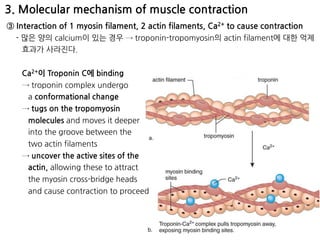
- 많은 양의 calcium이 있는 경우 → troponin-tropomyosin의 actin filament에 대한 억제
효과가 사라진다.
Ca2+이 Troponin C에 binding
→ troponin complex undergo

a conformational change
→ tugs on the tropomyosin 

molecules and moves it deeper

into the groove between the 

two actin filaments
→ uncover the active sites of the 

actin, allowing these to attract

the myosin cross-bridge heads

and cause contraction to proceed
3. Molecular mechanism of muscle contraction
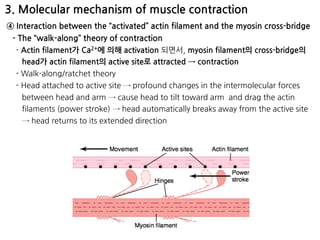
④ Interaction between the “activated” actin filament and the myosin cross-bridge
- The “walk-along” theory of contraction
- Actin filament가 Ca2+에 의해 activation 되면서, myosin filament의 cross-bridge의
head가 actin filament의 active site로 attracted → contraction
- Walk-along/ratchet theory
- Head attached to active site → profound changes in the intermolecular forces
between head and arm → cause head to tilt toward arm and drag the actin
filaments (power stroke) → head automatically breaks away from the active site
→ head returns to its extended direction
3. Molecular mechanism of muscle contraction
⑤ ATP as the source of energy for contraction - chemical events in the motion of
the myosin head
- Fenn effect; muscle이 work하는 양이 많아질 수록 더 많은 ATP가 소모된다.
ⓐ Head of the cross-bridge bind with ATP. The ATPase activity of the myosin head
cleave ATP but leaves the cleavage product, ADP+Pi; conformation of the head
is perpendicular toward the actin filaments but is not yet attached to the actin
ⓑ Troponin-tropomyosin complex binds with calcium → active site uncovered,
myosin head binds
ⓒ Binding of head/active site → conformational change in the head → head tilt
toward the arm; power stroke
ⓓ The head of the cross-bridge tilts → allows the release of ADP/Pi from the head
→ a new molecule of ATP binds → cause detachment of head from the actin
ⓔ the new ATP is cleaved to begin the next cycle; the energy is again “cocks” the
head back to its perpendicular position
3. Molecular mechanism of muscle contraction
⑤ ATP as the source of energy for contraction - chemical events in the motion of
the myosin head
3. Molecular mechanism of muscle contraction
⑤ ATP as the source of energy for contraction - chemical events in the motion of
the myosin head
1. Physiological anatomy of skeletal muscle
① Skeletal muscle fiber
ⓐ sarcolemma
ⓑ myofibril; I band, A band, Z disc, Sacromere, actin/myosin filament
ⓒ Titin filament
ⓓ Sarcoplasm
ⓔ Sarcoplasmic reticulum
2. General mechanism of muscle contraction
① Initiation and execution of muscle contraction
AP along motor nerve → ACh → AchR → sodium influx → AP depol muscle membrane → T-tubule →
Ca2+ release from SR → Ca2+ initiate attractive force between actin and myosin filaments → Ca2+
pumped back into SR
3.Molecular mechanism of muscle contraction
① Sliding filament mechanism of muscle contraction
② Molecular characteristics of contractile filaments
ⓐ myosin filament
ⓑ ATPase activity of the myosin head
ⓒ actin filament
ⓓ tropomyosin molecules
ⓔ Troponin and its role in muscle contraction
③ Interaction of 1 myosin, 2 actin, Ca2+ cause contraction
④ Walk-along theory of contraction
⑤ ATP as the source of energy for contraction
Chapter 6-7 Contraction and excitation of Skeletal Muscle
4. The neuromuscular junction
① Physiological anatomy of the NM junction - the motor end plate
5. Secretion of Ach by the nerve terminals
① Effect of Ach on the postsynaptic muscle fiber membrane to open ion channels
② Destruction of the released Ach by AchE
③ End plate potential and excitation of the skeletal muscle fiber
④ Safety factors for transmission at NM junction; fatigue of the junction
6. Molecular biology of ACh formation and release
7. Drugs that enhance or block transmission at NM junction
① Drugs that stimulate the muscle fiber like Ach-lkie action
② Drugs that stimulate the neuromuscular junction by inactivating AchE
③ Drugs that block transmission at the neuromuscular junction
8. Myasthenia gravis
9. Muscle action potential
① quantitative aspects of muscle potential
② spread of the AP to the interior of the muscle fiber by transverse tubule
③ Excitation-contraction coupling
ⓐ Transverse tubule-SR system
ⓑ release of calcium from SR
㉠ calcium pump for removing calcium from myofibrillar fluid after contraction
㉡ excitation “pulse” of the calcium ions
Chapter 6-7 Contraction and excitation of Skeletal Muscle
4. The neuromuscular junction
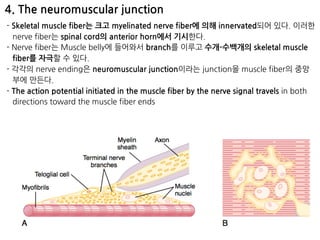
- Skeletal muscle fiber는 크고 myelinated nerve fiber에 의해 innervated되어 있다. 이러한
nerve fiber는 spinal cord의 anterior horn에서 기시한다.
- Nerve fiber는 Muscle belly에 들어와서 branch를 이루고 수개-수백개의 skeletal muscle
fiber를 자극할 수 있다.
- 각각의 nerve ending은 neuromuscular junction이라는 junction을 muscle fiber의 중앙
부에 만든다.
- The action potential initiated in the muscle fiber by the nerve signal travels in both
directions toward the muscle fiber ends
4. The neuromuscular junction
① Physiologic anatomy of the neuromuscular junction - the motor end plate
- Motor end plate: muscle fiber의 surface내부로 invaginate하거나 muscle fiber
plasma membrane 밖에 위치하는 nerve terminal의 branch complex
4. The neuromuscular junction
① Physiologic anatomy of the neuromuscular junction - the motor end plate
- Motor end plate: muscle fiber의 surface내부로 invaginate하거나 muscle fiber
plasma membrane 밖에 위치하는 nerve terminal의 branch complex
4. The neuromuscular junction
① Physiologic anatomy of the neuromuscular junction - the motor end plate
- Neuromuscular junction
- synaptic gutter/trough; invaginated membrane
- synaptic cleft/space; the space between the terminal and nerve fiber, 20-30 nm
- subneural cleft; smaller folds of the muscle membrane
4. The neuromuscular junction
① Physiologic anatomy of the neuromuscular junction - the motor end plate
- in the axon terminal are many mitochondria that supply ATP, the energy source
that is used for synthesis of an excitatory transmitter acetylcholine
- The acetylcholine excites the muscle fiber membrane
- acetylcholine is synthesized in the cytoplasm of the terminal, absorbed rapidly
into the many small synaptic vesicles
- In the synaptic cleft, large quantities of acetylcholinesterase, which destroy
acetylcholine a few milliseconds after it has been released from the synaptic
vesicle
4. The neuromuscular junction
5. Secretion of acetylcholine by the nerve terminals
- When a nerve impulse reaches the neuromuscular junction → about 125 vesicles of
Ach are released from the terminal into the synaptic vesicle
- To each side of each dense bar are protein particles that penetrate the neural
membrane; these are voltage-gated calcium channel
- When AP spreads over terminal → VGCC opens → Ca2+ influx → attractive influence
on the ACh vesicles, drawing them to neural membrane adjacent to dense bar →
vesicles fuse with neural membrane → empty Ach by exocytosis
5. Secretion of acetylcholine by the nerve terminals
① Effect of ACh on the postsynaptic muscle fiber membrane to open ion channels
- Acetylcholine-gated ion channels on postsynaptic membrane; five subunits (2 α
protein + β + Δ + γ proteins)
- When ACh binds to α subunits → conformational change → Na+, K+, Ca2+
movement → in practice, far more sodium ions flow through the AChR (large Na+
in extracellular space, very negative potential inside the muscle membrane) → a
local positive potential change inside the muscle fiber; called endplate potential →
spreads along muscle membrane → muscle contraction
5. Secretion of acetylcholine by the nerve terminals
② Destruction of the released ACh by Acetylcholinesterase
- ACh, once released into the synaptic space, continues to activate the AchR as long
as the ACh persist in the space. However it is removed rapidly by two means
ⓐ Acetylcholinesterase; destruct ACh
ⓑ small amount of ACh diffuse out of the synaptic space
→ no longer available → prevents continued muscle re-excitation
5. Secretion of acetylcholine by the nerve terminals
③ End plate potential and excitation of the skeletal muscle fiber
- The sudden insurgence of sodium ions into the muscle fiber when AChR opens →
electrical potential inside the fiber at the local area of the end plate to increase in
the positive direction up to 50-75 mV; local potential, end plate potential
- sudden increase of membrane potential over 20-30 mV → sufficient to initiate
more and more sodium channel openings → initiation of AP at the muscle fiber
membrane
- Three separate end-plate potentials
- A/C is too weak to elicit AP
- B is enough to activate sodium channel
- A is muscle poisoned by curare; block by

competing AChR
- C is muscle poisoned by botulinum toxin

; decrease the quantity of ACh release

by the nerve terminals
5. Secretion of acetylcholine by the nerve terminals
④ Safety factors for transmission at the Neuromuscular junction; fatigue of the junction
- Neuromuscular junction에 도달하는 각각의 impulse는 muscle fiber를 stimulation하
는데 필요한 end plate potential의 세 배 정도 강하게 자극한다: neuromuscular
junction의 high safety factor
- 하지만, 초당 100회 이상의 속도로 nerve fiber가 자극되면, Ach vesicle의 감소가 일어나
서 muscle fiber로 impulse를 전달하지 못하게 된다; 이를 neuromuscular junction의
fatigue라고 부르며, CNS에서 synapse가 overexcited될 때 synapse의 fatigue와 비슷
6. Molecular biology of ACh formation and release
The formation and release of ACh
① Small vesicles (40 nm in size) are formed by Golgi apparatus in the cell body of the
motor neuron in the spinal cord → these vesicles are transported by axoplasm that
streams through the core of the axon.
② ACh is synthesized in the cytosol of nerve fiber terminal and is immediately
transported through the membrane of the vesicle to their interior
③ When AP arrives at the nerve terminal → opens voltage-gated calcium channel →
increase rate of fusion of the ACh vesicles with terminal membrane → vesicle
rupture, allowing exocytosis of ACh into the synaptic vesicles → ACh is split by AChE
→ Choline is reabsorbed into neuronal terminal
④ new vesicles need to be re-formed rapidly, coated pits appear in the terminal nerve
membrane by clathrin → proteins contract and cause pits to break away to be
interior of the membrane, forming new vesicles
7. Drugs that enhance or block transmission at N-M junction
① Drugs that stimulate the muscle fiber by ACh-like action
- metacholine, carbachol, nicotine; have same effect on the muscle fiber as does
ACh
- the difference between these drugs and Ach is that drugs are not destroyed by
cholinesterase or are destroyed slowly that their action persist for many minutes
and hours
② Drugs that stimulate the neuromuscular junction by inactivating AChE
- neostigmine, physostigmine, diisopropyl fluorophosphate; inactivate the AChE in
the synapse → no longer hydrolyze ACh → ACh accumulation in synaptic cleft →
cause muscle spasm
7. Drugs that enhance or block transmission at N-M junction
③ Drugs that block transmission at the neuromuscular junction
- curariform drugs can prevent passage of impulses from the nerve endings into
the muscle
8. Myasthenia Gravis
- 1/20,000, autoimmune disease
- neuromuscular disease, muscle weakness and fatigue
- circulating antibody that block nicotinic acetylcholine receptors at the postsynaptic
neuromuscular junction → block binding of ACh to AChR → inability of the
neuromuscular junction to transmit enough signals from the nerve to the muscle
fibers
- AChE inhibitor (neostigmine) → allow larger

than normal amount of ACh accumulated in

synaptic space
9. Muscle action potential
① quantitative aspects of muscle potentials
ⓐ resting membrane potential: -80 to -90 mV in skeletal muscle (same as large
myelinated nerve)
ⓑ Duration of AP: 1-5 millisecond in skeletal muscle (about 5 times as long as
large myelinated nerve)
ⓒ Velocity of conduction: 3-5 m/sec (about 1/3 the velocity of conduction in the
large myelinated nerve fibers)
② Spread of the action potential to the interior of the muscle fiber by way of
transverse tubules
- Skeletal muscle fiber는 두껍기 때문에 action potential이 surface membrane을 통해
전달되기에는 굉장히 힘들어서 fiber의 깊숙한 부위까지 current가 전달이 안 된다.
- 따라서, muscle fiber의 깊숙한 부분까지 current를 전달하여 maximum contraction을
일으키는 다른 방법이 필요
- Transverse tubule (T tubule)을 통한 action potential 의 transmission
→ T tubule action potential cause release of calcium ions inside the muscle fiber in
the immediate vicinity of the myofibrils, and these calcium ions cause
contraction; excitation-contraction coupling
9. Muscle action potential
③ Excitation-contraction coupling
ⓐ Transverse tubule-sarcoplasmic reticulum system
- myofibrils are surrounded by the T tubule-sarcoplasmic reticulum system
- T tubules
- very small, run transverse to the myofibrils, internal extension of cell memb.
- begin at the cell membrane and penetrate all the way from one side of the
muscle fiber to the opposite side
- form entire planes of T tubules interlacing among all the separate myofibrils
- Where T tubules originate from the cell memb → they are open to the ext.;
communicate with extracellular fluid, contains extracellular fluid
- AP spreads → potential changes also spread among T tubules to the deep
interior of the muscle fiber → elicit muscle contraction
9. Muscle action potential
③ Excitation-contraction coupling
ⓑ Release of calcium ions by the sarcoplasmic reticulum
- sarcoplasmic reticulum composed of large chamber called terminal cisternae
that abut the T tubule, and longitudinal tubule that surrounds all surfaces of
the actual contracting myofibrils
- SR contains excess calcium ions in high concentration, and many of these ions
are released from each vesicle when an AP occurs in adjacent T tubule
- AP near cisternae→ Ca2+ channel opening → Ca2+ are released into the
sarcoplasm surrounding myofibrils to cause contraction
9. Muscle action potential
③ Excitation-contraction coupling
ⓑ Release of calcium ions by the sarcoplasmic reticulum
㉠ Calcium pump for removing calcium ions from the myofibrillar fluid after
contraction occurs
- Once Ca2+ released from SR tubules and diffuse among the myofibrils,
muscle contraction continues as long as the calcium ions remain in high
concentration
- continually active Ca2+ pump located in the wall of the SR pumps Ca2+ ions
aways from myofibrils back into the SR tubules
㉡ Excitatory “pulse” of calcium ions
- The normal resting concentration of calcium in the cytosol that bathes
myofibrils is too little to elicit contraction → therefore, the troponin-
tropomyosin complex keeps actin filaments inhibited and maintains a
relaxed state of muscle
- conversely, full excitation of T tubules and SR → enough release of Ca2+ to
increase concentration in the myofibrillar fluid
- immediately, Ca2+ pumps depletes Ca2+ again
- The total duration of this Ca2+ ‘pulse’ in the skeletal muscle fiber last about
1/20 of a seconds
4. The neuromuscular junction
① Physiological anatomy of the NM junction - the motor end plate
5. Secretion of Ach by the nerve terminals
① Effect of Ach on the postsynaptic muscle fiber membrane to open ion channels
② Destruction of the released Ach by AchE
③ End plate potential and excitation of the skeletal muscle fiber
④ Safety factors for transmission at NM junction; fatigue of the junction
6. Molecular biology of ACh formation and release
7. Drugs that enhance or block transmission at NM junction
① Drugs that stimulate the muscle fiber like Ach-lkie action
② Drugs that stimulate the neuromuscular junction by inactivating AchE
③ Drugs that block transmission at the neuromuscular junction
8. Myasthenia gravis
9. Muscle action potential
① quantitative aspects of muscle potential
② spread of the AP to the interior of the muscle fiber by transverse tubule
③ Excitation-contraction coupling
ⓐ Transverse tubule-SR system
ⓑ release of calcium from SR
㉠ calcium pump for removing calcium from myofibrillar fluid after contraction
㉡ excitation “pulse” of the calcium ions
Chapter 6-7 Contraction and excitation of Skeletal Muscle
Actin
Actin
A Dictyostelium discoideum soil amoeba labelled in red
eating green-fluorescently marked yeast cells. Marked in
red fluorescence is the filament protein F-actin, which is
a key component of the cell's inner skeleton. Through a
process called 'phagocytosis', which depends upon the
forces generated by F-actin, the amoeba surrounds and
engulfs the yeast cell with its outer membrane. Normal
(wild-type) cells typically eat one cell at a time.
Isik et al., Developmental Cell 15(4), 590-602.
Actin
High-NA TIRF-SIM for 91
frames at 4-second intervals
in a COS-7 cell expressing
mEmerald-clathrin (green)
and mCherry-Lifeact
(orange-red).
11. Energitics of muscle contraction
① work output during muscle contraction
② Source of energy for muscle contraction
ⓐ Phosphocreatine ⓑ glycolysis ⓒ oxidative mechanism
12. Characteristics of whole muscle contraction
① isotonic vs isometric contraction
② characteristics of isometeric twitches from different muscles
③ fast vs slow muscle fiber
ⓐ fast fibers ⓑ slow fibers
13. Mechanics of skeletal muscle contraction
① motor unit
② muscle contraction of different force - force summation
ⓐ multiple fiber summation ⓑ frequency summation and tetanization
③ maximum strength of contraction
④ changes in muscle strength at the onset of contraction
⑤ skeletal muscle tone ⑥ muscle fatigue ⑦ lever system of body
⑧ positioning of body part by contraction of agonist/antagonist muscle on opposite sides of joint - co-
activation of antagonist muscle
14. Remodeling of muscle to match function
① muscle hypertrophy and muscle atrophy ② adjustment of muscle length
③ hyperplasia of muscle fibers ④ effect of muscle denervation
⑤ recovery of muscle contraction in poliomyelitis; development of macromotor units
15. Rigor mortis
Chapter 6-7 Contraction and excitation of Skeletal Muscle
10. Effect of amount of actin and myosin filament
overlap on Tension developed by the contracting muscle
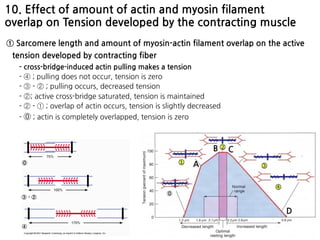
① Sarcomere length and amount of myosin-actin filament overlap on the active
tension developed by contracting fiber
- cross-bridge-induced actin pulling makes a tension
- ④ ; pulling does not occur, tension is zero
- ③ - ② ; pulling occurs, decreased tension
- ②; active cross-bridge saturated, tension is maintained
- ② - ① ; overlap of actin occurs, tension is slightly decreased
- ⓪ ; actin is completely overlapped, tension is zero
④
③ - ②
⓪
D
CB
A
⓪
10. Effect of amount of actin and myosin filament
overlap on Tension developed by the contracting muscle
① Sarcomere length and amount of myosin-actin filament overlap on the active
tension developed by contracting fiber
③
②
⓪
normalrange
10. Effect of amount of actin and myosin filament
overlap on Tension developed by the contracting muscle
① Sarcomere length and amount of myosin-actin filament overlap on the active
tension developed by contracting fiber
⓪
①
⓪
10. Effect of amount of actin and myosin filament
overlap on Tension developed by the contracting muscle
① Sarcomere length and amount of myosin-actin filament overlap on the active
tension developed by contracting fiber
③
④
10. Effect of amount of actin and myosin filament
overlap on Tension developed by the contracting muscle
② Effect of muscle length on force of contraction in the whole intact muscle
- Figure 6-10; tension of intact, whole muscle
- muscle의 active tension; single muscle의 contraction과 동일
10. Effect of amount of actin and myosin filament
overlap on Tension developed by the contracting muscle
② Effect of muscle length on force of contraction in the whole intact muscle
10. Effect of amount of actin and myosin filament
overlap on Tension developed by the contracting muscle
③ Relation of velocity of contraction to load
- Skeletal muscle의 contraction은 load가 없을 경우 굉장히 빨리 일어난다 - full
contraction까지 0.1초 정도
- Load가 걸릴 경우 contraction의 속도는 load의 강도에 따라서 점진적으로 감소한다.
- Load가 muscle이 할 수 있는 최대 힘과 같아질때 muscle fiber의 activation에도 불구하고,
contraction의 velocity는 0이 되고, contraction이 일어나지 않는다.
11. Energetics of muscle contraction
① Work output during muscle contraction
- Muscle이 load에 대해서 contraction을 하면 work를 하게 된다; muscle에서 external load
로 energy가 transfer 되어서 움직임에 대한 저항을 극복할 만큼 커지게 되면 load를 lift하게
된다.
W = L X D
- W; work output, L; load, D; distance of movement against the load
② Sources of energy for muscle contraction
- Muscle contraction은 ATP에 의해 에너지를 공급받는다.
- 대부분의 필요한 에너지는 work에 이용되지만, 그 중 작은 양은 다음의 기전에 이용된다.

ⓐ contraction이후 sarcoplasm에서 SR로 Ca2+를 pumping

ⓑ Sodium과 potassium을 muscle fiber membrane으로 pumping

이는 muscle fiber action potential의 propagation을 위한 적절한 이온 환경을 유지하기
위해서이다.
- concentration of ATP in the muscle fiber = 4 mM ; 1-2초간 근육의 full contraction을
유지하기에 충분한 정도
- ATP를 보충하기 위한 energy source들이 존재
11. Energetics of muscle contraction
② Sources of energy for muscle contraction
- ATP를 공급하기 위한 energy source
ⓐ Phosphocreatine
- ATP의 bond와 비슷한 high-energy phosphate
- Phosphocreatine의 high-energy phosphate bond는 ATP의 free energy보다 조금
더 많은 양의 에너지를 생성할 수 있다 → phosphocreatine이 cleaved되면 유리된
energy가 new phosphate ion과 ADP를 binding시켜 ATP를 보충시킬 수 있게 해준
다.
- 하지만, muscle내의 phosphocreatine의 양은 매우 적다 → 따라서 store되어있는 ATP
와 phosphocreatine에 의한 에너지는 muscle contraction을 5-8초 정도 유지시킬 수
있게 해준다.
11. Energetics of muscle contraction
② Sources of energy for muscle contraction
- ATP를 공급하기 위한 energy source
ⓑ Glycolysis
- Muscle에 store되어있는 glycogen의 glycolysis
- ATP와 phosphocreatine을 보충시켜준다
- glycogen을 pyruvic acid와 lactic acid로 enzymatic breakdown시 유리되는 에너지
는 ADP를 ATP로 convert할 수 있게 해준다.
㉠ anaerobic reaction → 산소가 없는 상태에서

수초-수분간 muscle contraction을 유지할 수

있게 해준다.
㉡ Glycolysis에 의한 ATP 생성률은 foodstuff와

oxygen reaction에 의한 ATP 생성률보다 2.5배

정도 빠르다.
- 하지만 end product의 축적 (pyruvate, lactate)은

1분 정도 뒤에는 maximal muscle contraction을 

시킬 수 없게 만든다 → acidity의 증가로 인한 

metabolic disturbance 및 통증 유발
11. Energetics of muscle contraction
② Sources of energy for muscle contraction
- ATP를 공급하기 위한 energy source
ⓒ Oxidative metabolism
- glycolysis의 end product + oxygen + cellular foodstuffs → liberate ATP
- Muscle이 sustained, long-term contraction을 유지하기 위한 모든 에너지의 95%가
oxidative metabolism을 통해 생성된다.
- carbohydrates, fats, and protein
- extremely long-term maximal muscle activity (> 수시간); 대부분 fat에서 에너지를
충당한다.
- long-term maximal muscle activity (2-4 시간); stored carbohydrate가 필요한 에너
지의 1/2 정도를 공급한다.
12. Characteristics of whole muscle contraction
- Muscle contraction이 대부분의 특징들은 single muscle twitch를 통해 밝혀졌다;
muscle로 가는 nerve의 electrical excitation이나 muscle 자체에 short electrical
stimulus를 주어서, single/sudden contraction을 일으키는 실험; twitch (a single
contraction in response to a brief threshold stimulation)
① Isotonic versus isometric contraction
- isometric; contraction동안 muscle의 길이변화가 없다.
- isotonic; muscle은 짧아지나, muscle에 걸리는 tension은 contraction동안 동일
12. Characteristics of whole muscle contraction
① Isotonic versus isometric contraction
- isometric system; muscle length의 변화 없이 force transducer에 대해서 contract
- 물컵을 오랫동안 들고 있는 경우를 상상
- record strictly changes in force of muscle contraction itself
12. Characteristics of whole muscle contraction
① Isotonic versus isometric contraction
- Isotonic system; fixed load에 대해서 muscle이 contraction하는 경우; 무거운 물체
를 들어올리는 경우.
12. Characteristics of whole muscle contraction
② Characteristics of isometric twitches from different muscles
- 사람은 많은 크기의 skeletal muscle을 가지고 있다.
- 세 종류의 skeletal muscle의 isometric contraction을 측정할 경우 duration은
- ocular muscle; 1/40 s
- gastrocnemius; 1/5 s
- soleus; 1/3 s
- contraction의 duration은 각 muscle의 function에 adapted되어 있음을 알 수 있다.
12. Characteristics of whole muscle contraction
③ Fast versus slow muscle fiber
- 몸의 모든 muscle은 fast/slow muscle fiber의 조합으로 이루어져 있다.
- 빠르고 강하게 반응해야하는 muscle은 대게 fast fiber로, 느리지만 오랫동안 contraction
해야하는 muscle들은 slow fiber로 이루어져 있다.
ⓐ Fast fiber
㉠ contraction strength가 큰 크기가 큰 fiber
㉡ Extensive SR; rapid release of Ca2+ to initiate contraction
㉢ Large amount of glycolytic enzyme; rapid release of energy by glycolysis
㉣ Less extensive blood supply; oxidative metabolism은 secondary importance이
므로
㉤ Fewer mitochondria, 많은 white muscle
12. Characteristics of whole muscle contraction
③ Fast versus slow muscle fiber
ⓑ Slow fibers
㉠ Small fibers
㉡ innervated with smaller nerve fibers
㉢ More extensive blood vessel system and capillaries; supply extra amount of
oxygen
㉣ Greatly increased numbers of mitochondria; support high levels of oxidative
metabolism
㉤ 많은 양의 myoglobin을 가지고 있다 (RBC의 Hb와 비슷한 iron containing protein).
Myoglobin은 oxygen과 결합하여서 store하고 있다가 필요시 mitochondria에 빠르게
oxygen을 transport해준다 → slow muscle이 reddish appearance를 가지게 해준다.
(fast muscle은 white muscle로 불리운다.)
12. Characteristics of whole muscle contraction
③ Fast versus slow muscle fiber
13. Mechanics of skeletal muscle contraction
① Motor unit
- spinal cord에서 기시하는 각각의 motor neuron은 여러 muscle fiber에 innervate
- 각 nerve fiber에 의해 innervate된 muscle fiber들을 가르켜서 motor unit이라고 한다.
- 빠르고 정확하게 react해야하는 작은 muscle들은 적은 muscle fiber에도 많은 nerve들이
innervated되어 있다.
- fine control을 필요로 하지 않는 large muscle의 경우는 하나의 motor unit에 수백개의
muscle fiber가 존재한다.
13. Mechanics of skeletal muscle contraction
② Muscle contraction of different force - force summation
- summation; 전체 muscle의 contraction의 intensity를 증가시키기위해 individual
twitch의 합이 작용한다.
- 이는 (1) 동시에 contracting하는 motor unit의 수가 증가 (multiple fiber summation)
하거나 (2) contraction의 frequency의 증가 (frequency summation)에 의해서 이루어
지며, tetanization을 일으킬 수 있다.
ⓐ Multiple fiber summation
- Recruit되는 motor unit의 숫자
- size principle; CNS가 처음에 muscle contraction을 시키는 약한 신호를 주면 →
smaller motor unit이 large motor unit보다 먼저 stimulation되고 → CNS의 신호
가 점차로 커지면, 점차 큰 motor unit들이 excited
13. Mechanics of skeletal muscle contraction
② Muscle contraction of different force - force summation
ⓐ Multiple fiber summation
- spinal cord의 smaller motor neuron이 larger one보다 먼저 activation되어서 smaller
motor unit이 먼저 자극된다.
- 각기 다른 motor unit이 spinal cord에서 asynchronously하게 자극되어서 contraction
이 번갈아 가면서 진행되어서, low frequency의 nerve signal에도 불구하고 부드러운 근
수축이 일어나게 된다.
Low recruitment of
Motor units
High recruitment of
Motor units
13. Mechanics of skeletal muscle contraction
② Muscle contraction of different force - force summation
ⓑ Frequency summation and tetanization
- Low frequency of stimulation에서는 개개의 twitch contraction이 일어난다 →
frequency 증가에 따라 직전 contraction이 끝나기 전에 contraction이 일어난다 → 수
축의 총 강도가 frequency 증가에 따라 점진적으로 증가
- frequency가 critical level에 다다르면, 연속된 수축이 서로 융합되어 근육 수축이 부드럽
고 연속적으로 나타나게 된다; tetanization
- 이 시점부터 additional frequency의 증가는 

더 이상 contractile force의 증가를 가져오지

못하게 된다.
- SR내에는 충분한 양의 Ca2+ ions이 있어서

AP 사이 사이에서 relaxation없이 계속된

full contraction을 가져오게 된다.
13. Mechanics of skeletal muscle contraction
② Muscle contraction of different force - force summation
ⓑ Frequency summation and tetanization
- Involuntary, sustained tetanic contraction; AP frequency를 높이는 어떠한 종류
의 disease나 contraction → tetanus
13. Mechanics of skeletal muscle contraction
③ Maximum strength of contraction
- normal muscle length에서 tetanic contraction의 maximum strength; 3-4 kg/cm2
of muscle
- normal quadriceps muscle; 100 cm2 → 400 kg 즉, 이만큼의 tension이 patellar
tendon에 걸릴 수 있다.
④ Changes in muscle strength at the onset of contraction - the staircase effect
- 오래 쉬었다가 muscle이 contraction할 경우 처음 contraction은 원래의 1/2정도의 강
도만을 가진다 → strength of contraction이 plateau한 형태로 증가한다 (staircase
effect)
- 이는 연속된 muscle AP에서 SR이 ion을 즉시 recapture하지 못하면서 SR에서 cytosol
로 calcium의 축척이 일어나게 되고 이로 인해 점차 강한 힘을 내게 되는 것
13. Mechanics of skeletal muscle contraction
⑤ Skeletal muscle tone
- 근육이 쉴 경우라도 일정 정도의 긴장감 (tautness)는 지니게 된다; muscle tone
- normal skeletal muscle fiber는 AP없이는 contract할 수 없으므로 muscle tone은 spinal
cord에서 오는 low rate의 nerve impulse에 의해서 유지되게 된다.
- 이는 brain에서 appropriate spinal cord anterior motor neuron으로 전송되는 signal과
muscle spindle 자체에서 originate하는 signal에 의해서 유지된다.
13. Mechanics of skeletal muscle contraction
⑤ Skeletal muscle tone
- Amyotrophic lateral sclerosis (Lou Gehrig’s disease)
- death of both upper/lower motor neuron in the motor cortex of the brain,
the brain stem, and the spinal cord; caused by defects in protein degradation
→ accumulation of protein-rich inclusions in cell bodies and axon → death of
motor neurons → stiff muscles, muscle twitching, gradually worsening
weakness due to muscles decreasing in the size
13. Mechanics of skeletal muscle contraction
⑥ Muscle fatigue
- Prolonged, strong contraction은 muscle이 지치게 만든다.
- Muscle fatigue는 muscle glycogen의 고갈의 정도에 비례한다; Fatigue는 muscle fiber의
contractile/metabolic process가 work output을 유지하지 못하게 되어서 생겨난다.
- Neuromuscular junction을 통한 nerve signal의 transmission은 intense, prolonged
muscle activity 가 지속되면서 약해지게 된다 → muscle contraction의 감소
- Contracting muscle에 공급되는 blood flow의 interruption은 nutrient supply의 감소로
인해 (특히 oxygen) 1-2분 내에 muscle이 지치게 만든다.
13. Mechanics of skeletal muscle contraction
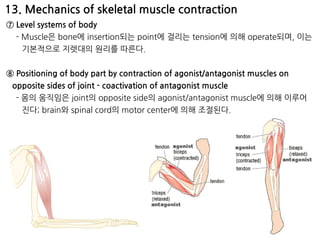
⑦ Level systems of body
- Muscle은 bone에 insertion되는 point에 걸리는 tension에 의해 operate되며, 이는
기본적으로 지렛대의 원리를 따른다.
⑧ Positioning of body part by contraction of agonist/antagonist muscles on
opposite sides of joint - coactivation of antagonist muscle
- 몸의 움직임은 joint의 opposite side의 agonist/antagonist muscle에 의해 이루어
진다; brain와 spinal cord의 motor center에 의해 조절된다.
14. Remodeling of muscle to match function
- 모든 muscle은 function에 맞추어서 끊임없이 remodeling된다; diameter가 변하고, 길이
가 변하고, strength가 변하고, vascular supply가 변한다.
- 이 remodeling은 대게 빨라서 수주 내로 이루어진다.
① Muscle hypertrophy and muscle atrophy
- hypertrophy; total mass of a muscle의 증가
- 모든 muscle hypertrophy는 각 muscle fiber의 actin/myosin filament의 증가에
의한다 → individual muscle fiber의 enlargement (fiber hypertrophy)
- Hypertrophy는 muscle이 load에 대한 contractile process에서 일어난다.
- atrophy; total mass of muscle의 감소
- 수주동안 사용되지 않은 경우 contractile protein의 감소가 일어난다.
14. Remodeling of muscle to match function
② Adjustment of muscle length
- muscle이 normal length에 비해서 stretch되었을 때 다른 종류의 hypertrophy가 생겨난다
→ 새로운 sarcomere가 muscle fiber의 끝부분에 추가된다 (특히 tendon attach되는 부위)
- 반면에 muscle이 자신의 원래 크기보다 계속 shorten된 상태로 있을 경우 muscle fiber의
끝부위의 sarcomere는 감소하게 된다.
③ Hyperplasia of muscle fibers
- 아주 드물게 extreme muscle force generation의 환경에서, muscle fiber 숫자가 증가될
경우가 있다; fiber hyperplasia
14. Remodeling of muscle to match function
④ Effects of muscle denervation
- muscle이 nerve supply를 잃을 경우; normal muscle size를 유지하는데 필요한
contractile signal을 더이상 받을 수 없게 된다 → atrophy가 발생
- Denervation에 의한 final stage에서는 대부분의 muscle fiber가 파괴되고, fibrous
fatty tissue로 대체되게 된다.
14. Remodeling of muscle to match function
⑤ Recovery of muscle contraction in poliomyelitis; development of macromotor
units
- Nerve fiber가 destroyed되면 (poliomyelitis에서 흔히), 남아있는 nerve fiber가 새로운
branch를 내어서 새로운 axon을 형성하고 이들이 paralyzed muscle fiber에 innervate
된다 (macromotor unit)
- macromotor unit는 spinal cord에서 오는 motorneuron에 비해서 5배 정도 많은
muscle fiber를 담당한다 → fineness는 감소 하지만, muscle이 다시 strength를 가질
수 있도록 해준다.
15. Rigor mortis
- 죽음 후 몇 시간 이내에, 모든 근육은 사후경직 (rigor mortis)에 이르르게 된다.
- AP가 없음에도 근육이 contract하면서 rigid해지는 것
- 이러한 rigidity는 ATP의 모든 고갈 (relaxation process에서 actin filament로 부터 cross-
bridge의 separation하는데 필요한)에 의한다.
- 근육은 강직된채로 15-25시간동안 있으며, 이후에는 lysosome에서 유리된 enzyme에 의한
autolysis에 의해 경직이 풀리게 된다.
1. Physiological anatomy of skeletal muscle
① Skeletal muscle fiber
ⓐ sarcolemma
ⓑ myofibril; I band, A band, Z disc, Sacromere, actin/myosin filament
ⓒ Titin filament
ⓓ Sarcoplasm
ⓔ Sarcoplasmic reticulum
2. General mechanism of muscle contraction
① Initiation and execution of muscle contraction
AP along motor nerve → ACh → AchR → sodium influx → AP depol muscle
membrane → T-tubule → Ca2+ release from SR → Ca2+ initiate attractive
force between actin and myosin filaments → Ca2+ pumped back into SR
3.Molecular mechanism of muscle contraction
① Sliding filament mechanism of muscle contraction
② Molecular characteristics of contractile filaments
ⓐ myosin filament
ⓑ ATPase activity of the myosin head
ⓒ actin filament
ⓓ tropomyosin molecules
ⓔ Troponin and its role in muscle contraction
③ Interaction of 1 myosin, 2 actin, Ca2+ cause contraction
④ Walk-along theory of contraction
⑤ ATP as the source of energy for contraction
Chapter 6-7 Contraction and excitation of Skeletal Muscle
4. The neuromuscular junction
① Physiological anatomy of the NM junction - the motor end plate
5. Secretion of Ach by the nerve terminals
① Effect of Ach on the postsynaptic muscle fiber membrane to open ion channels
② Destruction of the released Ach by AchE
③ End plate potential and excitation of the skeletal muscle fiber
④ Safety factors for transmission at NM junction; fatigue of the junction
6. Molecular biology of ACh formation and release
7. Drugs that enhance or block transmission at NM junction
① Drugs that stimulate the muscle fiber like Ach-lkie action
② Drugs that stimulate the neuromuscular junction by inactivating AchE
③ Drugs that block transmission at the neuromuscular junction
8. Myasthenia gravis
9. Muscle action potential
① quantitative aspects of muscle potential
② spread of the AP to the interior of the muscle fiber by transverse tubule
③ Excitation-contraction coupling
ⓐ Transverse tubule-SR system
ⓑ release of calcium from SR
㉠ calcium pump for removing calcium from myofibrillar fluid after contraction
㉡ excitation “pulse” of the calcium ions
Chapter 6-7 Contraction and excitation of Skeletal Muscle
11. Energitics of muscle contraction
① work output during muscle contraction
② Source of energy for muscle contraction
ⓐ Phosphocreatine ⓑ glycolysis ⓒ oxidative mechanism
12. Characteristics of whole muscle contraction
① isotonic vs isometric contraction
② characteristics of isometeric twitches from different muscles
③ fast vs slow muscle fiber
ⓐ fast fibers ⓑ slow fibers
13. Mechanics of skeletal muscle contraction
① motor unit
② muscle contraction of different force - force summation
ⓐ multiple fiber summation ⓑ frequency summation and tetanization
③ maximum strength of contraction
④ changes in muscle strength at the onset of contraction
⑤ skeletal muscle tone ⑥ muscle fatigue ⑦ lever system of body
⑧ positioning of body part by contraction of agonist/antagonist muscle on opposite sides of joint - co-
activation of antagonist muscle
14. Remodeling of muscle to match function
① muscle hypertrophy and muscle atrophy ② adjustment of muscle length
③ hyperplasia of muscle fibers ④ effect of muscle denervation
⑤ recovery of muscle contraction in poliomyelitis; development of macromotor units
15. Rigor mortis
Chapter 6-7 Contraction and excitation of Skeletal Muscle

③ 근육

  • 1.
    Chapter 6 Contractionof Skeletal Muscle 근육세포 경북대학교 의학전문대학원 생리학교실 홍 장 원 Chapter 7 Excitation of Skeletal Muscle: Neuromuscular Transmission and Excitation-Contraction Coupling
  • 2.
    1. Physiological anatomyof skeletal muscle ① Skeletal muscle fiber ⓐ sarcolemma ⓑ myofibril; I band, A band, Z disc, Sacromere, actin/myosin filament ⓒ Titin filament ⓓ Sarcoplasm ⓔ Sarcoplasmic reticulum 2. General mechanism of muscle contraction ① Initiation and execution of muscle contraction AP along motor nerve → ACh → AchR → sodium influx → AP depol muscle membrane → T-tubule → Ca2+ release from SR → Ca2+ initiate attractive force between actin and myosin filaments → Ca2+ pumped back into SR 3.Molecular mechanism of muscle contraction ① Sliding filament mechanism of muscle contraction ② Molecular characteristics of contractile filaments ⓐ myosin filament ⓑ ATPase activity of the myosin head ⓒ actin filament ⓓ tropomyosin molecules ⓔ Troponin and its role in muscle contraction ③ Interaction of 1 myosin, 2 actin, Ca2+ cause contraction ④ Walk-along theory of contraction ⑤ ATP as the source of energy for contraction Chapter 6-7 Contraction and excitation of Skeletal Muscle
  • 3.
    1. Physiologic anatomyof skeletal muscle ① Skeletal muscle fiber
  • 4.
    1. Physiologic anatomyof skeletal muscle ① Skeletal muscle fiber ⓐ Sarcolemma - muscle fiber의 cell membrane - plasma membrane + outer coat (polysaccharide + collagen fibrils)로 구성 - Sarcolemma가 tendon과 fuse한 얇은 layer → tendon fiber가 bundle을 모아서 → bone에 insert한다.
  • 5.
    1. Physiologic anatomyof skeletal muscle ① Skeletal muscle fiber ⓑ Myofibril; actin and myosin filaments - 각각의 muscle fiber는 많은 myofibril로 이루어져 있다. - Each myofibril; composed of 15,000 adjacent myosin filaments, 3000 actin filaments - Thick filaments; myosin, thin filaments; actin - Myosin and actin filaments partially interdigitate → light and dark bands
  • 6.
    1. Physiologic anatomyof skeletal muscle ① Skeletal muscle fiber ⓑ Myofibril; actin and myosin filaments - I band; light band only contain actin - A band; contains myosin filaments and ends of actin filaments - Z disc; ends of the actin filaments are attached. composed of filamentous proteins different from actin and myosin filaments - Sarcomere; from Z disc to Z disc. When a muscle is contracted, actin completely overlap the myosin filaments
  • 7.
    1. Physiologic anatomyof skeletal muscle ① Skeletal muscle fiber
  • 8.
    1. Physiologic anatomyof skeletal muscle ① Skeletal muscle fiber
  • 9.
    1. Physiologic anatomyof skeletal muscle ① Skeletal muscle fiber
  • 10.
    1. Physiologic anatomyof skeletal muscle ① Skeletal muscle fiber
  • 11.
    1. Physiologic anatomyof skeletal muscle ① Skeletal muscle fiber
  • 12.
    1. Physiologic anatomyof skeletal muscle ① Skeletal muscle fiber ⓑ Myofibril; actin and myosin filaments
  • 13.
    1. Physiologic anatomyof skeletal muscle ① Skeletal muscle fiber ⓒ What keeps myosin and actin filaments in pace? - Titin filamentous molecules - 탄력있는 titin molecule은 myosin과 actin filament 구조를 유지시켜주는 framework로 작동한다.
  • 14.
    1. Physiologic anatomyof skeletal muscle ① Skeletal muscle fiber ⓓ Sacroplasm - myofibril 사이의 공간은 sarcoplasm으로 불리우는 intercellular fluid로 채워져있다. - 이곳에는 많은 양의 potassium, magnesium, phosphate, protein enzyme이 존재 - 또한 많은 양의 mitochondria가 myofibril에 parallel하게 존재하여 ATP를 공급한다.
  • 15.
    1. Physiologic anatomyof skeletal muscle ① Skeletal muscle fiber ⓔ Sacroplasmic reticulum - 각 muscle fiber의 myofibril를 감싸는 sarcoplasm은 extensive한 reticulum이며 → 근육의 수축을 조절하는 중요한 역할을 수행한다.
  • 16.
    2. General mechanismof muscle contraction ① Initiation and execution of muscle contraction ⓐ Action potential이 muscle fiber에 다다르는 motor nerve를 따라 spreading ⓑ 각 nerve ending에서 nerve는 neurotransmitter substance (acetylcholine)을 분비 ⓒ Acetylcholine은 muscle fiber membrane의 acetylcholine-gated channel을 open ⓓ Opening of acetylcholine-gated channel → 많은 양의 sodium이 muscle fiber의 내 부로 들어옴 → action potential의 형성 ⓔ AP travels along the muscle fiber membrane (same way that AP travel along nerve fiber membrane) ⓕ AP depolarizes the muscle membrane → AP electricity가 muscle fiber의 중앙으로 이동 → sarcoplasmic reticulum release large amounts of calcium ions ⓖ Ca2+ initiate attractive force between actin and myosin filaments → slide alongside each other (contractile process) ⓗ 수초 뒤, Ca2+이 Ca2+ membrane pump에 의해 SR로 재흡수. 이후 새로운 AP가 오기 전까지 SR에서 보관된다; 이 myofibrils에서 Ca2+의 제거가 muscle contraction이 멈출 수 있게 해준다.
  • 17.
    2. General mechanismof muscle contraction
  • 18.
    3. Molecular mechanismof muscle contraction ① Sliding filament mechanism of muscle contraction - Sarcomere의 relaxed state와 contracted state - Contraction에서는 actin filament는 myosin filament 사이로 slide inward; 이는 myosin filament와 actin filament 사이의 cross-bridge의 interaction force에 의해서 - AP → SR release Ca2+ + ATP → activate force between myosin and actin → contraction
  • 19.
    3. Molecular mechanismof muscle contraction ② Molecular characteristics of the contractile filaments ⓐ Myosin filament ㉠ Myosin molecule - 6개의 polypeptide chain (2 heavy + 4 light)으로 이루어져 있다. - tail; double helix, 2 heavy chain - head; globular polypeptide structure, 4 light chain + 2 heavy chain ㉡ Myosin filament - 200개 이상의 myosin molecule
 로 구성 - Body; myosin molecule의 tail로
 구성 - Cross-bridge; Protruding하는
 head와 arm. Arm의 hinge
 구조는 head가 extended되거나
 body에서 서로 close되게 한다. - total length; 1.6 μm ⓑ ATPase activity of the myosin head - Myosin head act as an ATPase enzyme
  • 20.
    3. Molecular mechanismof muscle contraction ② Molecular characteristics of the contractile filaments ⓒ Actin filament - three protein components로 구성; actin, tropomyosin, troponin - F-actin; the backbone of actin filament, double-stranded F-actin molecules - 각각의 F-actin helix 는 polymerized G-actin로 구성 - G-actin에는 ADP가 부착되어 있다 ; 이 부분이 actin filament의 active site로 myosin filament와 cross-bridge해서 muscle contraction을 일으키는 부위 - Actin filaments의 base 부분은 Z-disc에 강하게 부착되어 있다.
  • 21.
    3. Molecular mechanismof muscle contraction ② Molecular characteristics of the contractile filaments ⓓ Tropomyosin molecules - F-actin helix 측면으로 spiral하게 감싸고 있다. - Resting state에서 tropomyosin molecules은 actin strand의 active site 위에 존재 ⓔ Troponin and its role in muscle contraction - 세개의 loosely bound protein subunits (I, T, C)로 구성 - Troponin I; strong affinity for actin - Troponin T; strong affinity for Tropomyosin - Troponin C; strong affinity for Ca2+
  • 22.
    3. Molecular mechanismof muscle contraction ③ Interaction of 1 myosin filament, 2 actin filaments, Ca2+ to cause contraction - Troponin-tropomysin complex가 없는 actin filament는 myosin molecule의 head에 강하게 부착한다. - Troponin-tropomysin complex가 추가되면 → the binding between actin/myosin이 일어나지 않는다; relaxed muscle의 normal actin filament의 active site가 troponin- tropomysin complex에 의해 물리적으로 덮혀서 → Contraction이 일어나기 전에, troponin-tropomysin complex의 억제효과가 사라진다
  • 23.
    3. Molecular mechanismof muscle contraction ③ Interaction of 1 myosin filament, 2 actin filaments, Ca2+ to cause contraction - 많은 양의 calcium이 있는 경우 → troponin-tropomyosin의 actin filament에 대한 억제 효과가 사라진다. Ca2+이 Troponin C에 binding → troponin complex undergo
 a conformational change → tugs on the tropomyosin 
 molecules and moves it deeper
 into the groove between the 
 two actin filaments → uncover the active sites of the 
 actin, allowing these to attract
 the myosin cross-bridge heads
 and cause contraction to proceed
  • 24.
    3. Molecular mechanismof muscle contraction ④ Interaction between the “activated” actin filament and the myosin cross-bridge - The “walk-along” theory of contraction - Actin filament가 Ca2+에 의해 activation 되면서, myosin filament의 cross-bridge의 head가 actin filament의 active site로 attracted → contraction - Walk-along/ratchet theory - Head attached to active site → profound changes in the intermolecular forces between head and arm → cause head to tilt toward arm and drag the actin filaments (power stroke) → head automatically breaks away from the active site → head returns to its extended direction
  • 25.
    3. Molecular mechanismof muscle contraction ⑤ ATP as the source of energy for contraction - chemical events in the motion of the myosin head - Fenn effect; muscle이 work하는 양이 많아질 수록 더 많은 ATP가 소모된다. ⓐ Head of the cross-bridge bind with ATP. The ATPase activity of the myosin head cleave ATP but leaves the cleavage product, ADP+Pi; conformation of the head is perpendicular toward the actin filaments but is not yet attached to the actin ⓑ Troponin-tropomyosin complex binds with calcium → active site uncovered, myosin head binds ⓒ Binding of head/active site → conformational change in the head → head tilt toward the arm; power stroke ⓓ The head of the cross-bridge tilts → allows the release of ADP/Pi from the head → a new molecule of ATP binds → cause detachment of head from the actin ⓔ the new ATP is cleaved to begin the next cycle; the energy is again “cocks” the head back to its perpendicular position
  • 26.
    3. Molecular mechanismof muscle contraction ⑤ ATP as the source of energy for contraction - chemical events in the motion of the myosin head
  • 27.
    3. Molecular mechanismof muscle contraction ⑤ ATP as the source of energy for contraction - chemical events in the motion of the myosin head
  • 28.
    1. Physiological anatomyof skeletal muscle ① Skeletal muscle fiber ⓐ sarcolemma ⓑ myofibril; I band, A band, Z disc, Sacromere, actin/myosin filament ⓒ Titin filament ⓓ Sarcoplasm ⓔ Sarcoplasmic reticulum 2. General mechanism of muscle contraction ① Initiation and execution of muscle contraction AP along motor nerve → ACh → AchR → sodium influx → AP depol muscle membrane → T-tubule → Ca2+ release from SR → Ca2+ initiate attractive force between actin and myosin filaments → Ca2+ pumped back into SR 3.Molecular mechanism of muscle contraction ① Sliding filament mechanism of muscle contraction ② Molecular characteristics of contractile filaments ⓐ myosin filament ⓑ ATPase activity of the myosin head ⓒ actin filament ⓓ tropomyosin molecules ⓔ Troponin and its role in muscle contraction ③ Interaction of 1 myosin, 2 actin, Ca2+ cause contraction ④ Walk-along theory of contraction ⑤ ATP as the source of energy for contraction Chapter 6-7 Contraction and excitation of Skeletal Muscle
  • 29.
    4. The neuromuscularjunction ① Physiological anatomy of the NM junction - the motor end plate 5. Secretion of Ach by the nerve terminals ① Effect of Ach on the postsynaptic muscle fiber membrane to open ion channels ② Destruction of the released Ach by AchE ③ End plate potential and excitation of the skeletal muscle fiber ④ Safety factors for transmission at NM junction; fatigue of the junction 6. Molecular biology of ACh formation and release 7. Drugs that enhance or block transmission at NM junction ① Drugs that stimulate the muscle fiber like Ach-lkie action ② Drugs that stimulate the neuromuscular junction by inactivating AchE ③ Drugs that block transmission at the neuromuscular junction 8. Myasthenia gravis 9. Muscle action potential ① quantitative aspects of muscle potential ② spread of the AP to the interior of the muscle fiber by transverse tubule ③ Excitation-contraction coupling ⓐ Transverse tubule-SR system ⓑ release of calcium from SR ㉠ calcium pump for removing calcium from myofibrillar fluid after contraction ㉡ excitation “pulse” of the calcium ions Chapter 6-7 Contraction and excitation of Skeletal Muscle
  • 30.
    4. The neuromuscularjunction - Skeletal muscle fiber는 크고 myelinated nerve fiber에 의해 innervated되어 있다. 이러한 nerve fiber는 spinal cord의 anterior horn에서 기시한다. - Nerve fiber는 Muscle belly에 들어와서 branch를 이루고 수개-수백개의 skeletal muscle fiber를 자극할 수 있다. - 각각의 nerve ending은 neuromuscular junction이라는 junction을 muscle fiber의 중앙 부에 만든다. - The action potential initiated in the muscle fiber by the nerve signal travels in both directions toward the muscle fiber ends
  • 31.
    4. The neuromuscularjunction ① Physiologic anatomy of the neuromuscular junction - the motor end plate - Motor end plate: muscle fiber의 surface내부로 invaginate하거나 muscle fiber plasma membrane 밖에 위치하는 nerve terminal의 branch complex
  • 32.
    4. The neuromuscularjunction ① Physiologic anatomy of the neuromuscular junction - the motor end plate - Motor end plate: muscle fiber의 surface내부로 invaginate하거나 muscle fiber plasma membrane 밖에 위치하는 nerve terminal의 branch complex
  • 33.
    4. The neuromuscularjunction ① Physiologic anatomy of the neuromuscular junction - the motor end plate - Neuromuscular junction - synaptic gutter/trough; invaginated membrane - synaptic cleft/space; the space between the terminal and nerve fiber, 20-30 nm - subneural cleft; smaller folds of the muscle membrane
  • 34.
    4. The neuromuscularjunction ① Physiologic anatomy of the neuromuscular junction - the motor end plate - in the axon terminal are many mitochondria that supply ATP, the energy source that is used for synthesis of an excitatory transmitter acetylcholine - The acetylcholine excites the muscle fiber membrane - acetylcholine is synthesized in the cytoplasm of the terminal, absorbed rapidly into the many small synaptic vesicles - In the synaptic cleft, large quantities of acetylcholinesterase, which destroy acetylcholine a few milliseconds after it has been released from the synaptic vesicle
  • 35.
  • 36.
  • 37.
    5. Secretion ofacetylcholine by the nerve terminals - When a nerve impulse reaches the neuromuscular junction → about 125 vesicles of Ach are released from the terminal into the synaptic vesicle - To each side of each dense bar are protein particles that penetrate the neural membrane; these are voltage-gated calcium channel - When AP spreads over terminal → VGCC opens → Ca2+ influx → attractive influence on the ACh vesicles, drawing them to neural membrane adjacent to dense bar → vesicles fuse with neural membrane → empty Ach by exocytosis
  • 38.
    5. Secretion ofacetylcholine by the nerve terminals ① Effect of ACh on the postsynaptic muscle fiber membrane to open ion channels - Acetylcholine-gated ion channels on postsynaptic membrane; five subunits (2 α protein + β + Δ + γ proteins) - When ACh binds to α subunits → conformational change → Na+, K+, Ca2+ movement → in practice, far more sodium ions flow through the AChR (large Na+ in extracellular space, very negative potential inside the muscle membrane) → a local positive potential change inside the muscle fiber; called endplate potential → spreads along muscle membrane → muscle contraction
  • 39.
    5. Secretion ofacetylcholine by the nerve terminals ② Destruction of the released ACh by Acetylcholinesterase - ACh, once released into the synaptic space, continues to activate the AchR as long as the ACh persist in the space. However it is removed rapidly by two means ⓐ Acetylcholinesterase; destruct ACh ⓑ small amount of ACh diffuse out of the synaptic space → no longer available → prevents continued muscle re-excitation
  • 40.
    5. Secretion ofacetylcholine by the nerve terminals ③ End plate potential and excitation of the skeletal muscle fiber - The sudden insurgence of sodium ions into the muscle fiber when AChR opens → electrical potential inside the fiber at the local area of the end plate to increase in the positive direction up to 50-75 mV; local potential, end plate potential - sudden increase of membrane potential over 20-30 mV → sufficient to initiate more and more sodium channel openings → initiation of AP at the muscle fiber membrane - Three separate end-plate potentials - A/C is too weak to elicit AP - B is enough to activate sodium channel - A is muscle poisoned by curare; block by
 competing AChR - C is muscle poisoned by botulinum toxin
 ; decrease the quantity of ACh release
 by the nerve terminals
  • 41.
    5. Secretion ofacetylcholine by the nerve terminals ④ Safety factors for transmission at the Neuromuscular junction; fatigue of the junction - Neuromuscular junction에 도달하는 각각의 impulse는 muscle fiber를 stimulation하 는데 필요한 end plate potential의 세 배 정도 강하게 자극한다: neuromuscular junction의 high safety factor - 하지만, 초당 100회 이상의 속도로 nerve fiber가 자극되면, Ach vesicle의 감소가 일어나 서 muscle fiber로 impulse를 전달하지 못하게 된다; 이를 neuromuscular junction의 fatigue라고 부르며, CNS에서 synapse가 overexcited될 때 synapse의 fatigue와 비슷
  • 42.
    6. Molecular biologyof ACh formation and release The formation and release of ACh ① Small vesicles (40 nm in size) are formed by Golgi apparatus in the cell body of the motor neuron in the spinal cord → these vesicles are transported by axoplasm that streams through the core of the axon. ② ACh is synthesized in the cytosol of nerve fiber terminal and is immediately transported through the membrane of the vesicle to their interior ③ When AP arrives at the nerve terminal → opens voltage-gated calcium channel → increase rate of fusion of the ACh vesicles with terminal membrane → vesicle rupture, allowing exocytosis of ACh into the synaptic vesicles → ACh is split by AChE → Choline is reabsorbed into neuronal terminal ④ new vesicles need to be re-formed rapidly, coated pits appear in the terminal nerve membrane by clathrin → proteins contract and cause pits to break away to be interior of the membrane, forming new vesicles
  • 43.
    7. Drugs thatenhance or block transmission at N-M junction ① Drugs that stimulate the muscle fiber by ACh-like action - metacholine, carbachol, nicotine; have same effect on the muscle fiber as does ACh - the difference between these drugs and Ach is that drugs are not destroyed by cholinesterase or are destroyed slowly that their action persist for many minutes and hours ② Drugs that stimulate the neuromuscular junction by inactivating AChE - neostigmine, physostigmine, diisopropyl fluorophosphate; inactivate the AChE in the synapse → no longer hydrolyze ACh → ACh accumulation in synaptic cleft → cause muscle spasm
  • 44.
    7. Drugs thatenhance or block transmission at N-M junction ③ Drugs that block transmission at the neuromuscular junction - curariform drugs can prevent passage of impulses from the nerve endings into the muscle
  • 45.
    8. Myasthenia Gravis -1/20,000, autoimmune disease - neuromuscular disease, muscle weakness and fatigue - circulating antibody that block nicotinic acetylcholine receptors at the postsynaptic neuromuscular junction → block binding of ACh to AChR → inability of the neuromuscular junction to transmit enough signals from the nerve to the muscle fibers - AChE inhibitor (neostigmine) → allow larger
 than normal amount of ACh accumulated in
 synaptic space
  • 46.
    9. Muscle actionpotential ① quantitative aspects of muscle potentials ⓐ resting membrane potential: -80 to -90 mV in skeletal muscle (same as large myelinated nerve) ⓑ Duration of AP: 1-5 millisecond in skeletal muscle (about 5 times as long as large myelinated nerve) ⓒ Velocity of conduction: 3-5 m/sec (about 1/3 the velocity of conduction in the large myelinated nerve fibers) ② Spread of the action potential to the interior of the muscle fiber by way of transverse tubules - Skeletal muscle fiber는 두껍기 때문에 action potential이 surface membrane을 통해 전달되기에는 굉장히 힘들어서 fiber의 깊숙한 부위까지 current가 전달이 안 된다. - 따라서, muscle fiber의 깊숙한 부분까지 current를 전달하여 maximum contraction을 일으키는 다른 방법이 필요 - Transverse tubule (T tubule)을 통한 action potential 의 transmission → T tubule action potential cause release of calcium ions inside the muscle fiber in the immediate vicinity of the myofibrils, and these calcium ions cause contraction; excitation-contraction coupling
  • 47.
  • 48.
    9. Muscle actionpotential ③ Excitation-contraction coupling ⓐ Transverse tubule-sarcoplasmic reticulum system - myofibrils are surrounded by the T tubule-sarcoplasmic reticulum system - T tubules - very small, run transverse to the myofibrils, internal extension of cell memb. - begin at the cell membrane and penetrate all the way from one side of the muscle fiber to the opposite side - form entire planes of T tubules interlacing among all the separate myofibrils - Where T tubules originate from the cell memb → they are open to the ext.; communicate with extracellular fluid, contains extracellular fluid - AP spreads → potential changes also spread among T tubules to the deep interior of the muscle fiber → elicit muscle contraction
  • 49.
    9. Muscle actionpotential ③ Excitation-contraction coupling ⓑ Release of calcium ions by the sarcoplasmic reticulum - sarcoplasmic reticulum composed of large chamber called terminal cisternae that abut the T tubule, and longitudinal tubule that surrounds all surfaces of the actual contracting myofibrils - SR contains excess calcium ions in high concentration, and many of these ions are released from each vesicle when an AP occurs in adjacent T tubule - AP near cisternae→ Ca2+ channel opening → Ca2+ are released into the sarcoplasm surrounding myofibrils to cause contraction
  • 50.
    9. Muscle actionpotential ③ Excitation-contraction coupling ⓑ Release of calcium ions by the sarcoplasmic reticulum ㉠ Calcium pump for removing calcium ions from the myofibrillar fluid after contraction occurs - Once Ca2+ released from SR tubules and diffuse among the myofibrils, muscle contraction continues as long as the calcium ions remain in high concentration - continually active Ca2+ pump located in the wall of the SR pumps Ca2+ ions aways from myofibrils back into the SR tubules ㉡ Excitatory “pulse” of calcium ions - The normal resting concentration of calcium in the cytosol that bathes myofibrils is too little to elicit contraction → therefore, the troponin- tropomyosin complex keeps actin filaments inhibited and maintains a relaxed state of muscle - conversely, full excitation of T tubules and SR → enough release of Ca2+ to increase concentration in the myofibrillar fluid - immediately, Ca2+ pumps depletes Ca2+ again - The total duration of this Ca2+ ‘pulse’ in the skeletal muscle fiber last about 1/20 of a seconds
  • 51.
    4. The neuromuscularjunction ① Physiological anatomy of the NM junction - the motor end plate 5. Secretion of Ach by the nerve terminals ① Effect of Ach on the postsynaptic muscle fiber membrane to open ion channels ② Destruction of the released Ach by AchE ③ End plate potential and excitation of the skeletal muscle fiber ④ Safety factors for transmission at NM junction; fatigue of the junction 6. Molecular biology of ACh formation and release 7. Drugs that enhance or block transmission at NM junction ① Drugs that stimulate the muscle fiber like Ach-lkie action ② Drugs that stimulate the neuromuscular junction by inactivating AchE ③ Drugs that block transmission at the neuromuscular junction 8. Myasthenia gravis 9. Muscle action potential ① quantitative aspects of muscle potential ② spread of the AP to the interior of the muscle fiber by transverse tubule ③ Excitation-contraction coupling ⓐ Transverse tubule-SR system ⓑ release of calcium from SR ㉠ calcium pump for removing calcium from myofibrillar fluid after contraction ㉡ excitation “pulse” of the calcium ions Chapter 6-7 Contraction and excitation of Skeletal Muscle
  • 52.
  • 53.
    Actin A Dictyostelium discoideumsoil amoeba labelled in red eating green-fluorescently marked yeast cells. Marked in red fluorescence is the filament protein F-actin, which is a key component of the cell's inner skeleton. Through a process called 'phagocytosis', which depends upon the forces generated by F-actin, the amoeba surrounds and engulfs the yeast cell with its outer membrane. Normal (wild-type) cells typically eat one cell at a time. Isik et al., Developmental Cell 15(4), 590-602.
  • 54.
    Actin High-NA TIRF-SIM for91 frames at 4-second intervals in a COS-7 cell expressing mEmerald-clathrin (green) and mCherry-Lifeact (orange-red).
  • 55.
    11. Energitics ofmuscle contraction ① work output during muscle contraction ② Source of energy for muscle contraction ⓐ Phosphocreatine ⓑ glycolysis ⓒ oxidative mechanism 12. Characteristics of whole muscle contraction ① isotonic vs isometric contraction ② characteristics of isometeric twitches from different muscles ③ fast vs slow muscle fiber ⓐ fast fibers ⓑ slow fibers 13. Mechanics of skeletal muscle contraction ① motor unit ② muscle contraction of different force - force summation ⓐ multiple fiber summation ⓑ frequency summation and tetanization ③ maximum strength of contraction ④ changes in muscle strength at the onset of contraction ⑤ skeletal muscle tone ⑥ muscle fatigue ⑦ lever system of body ⑧ positioning of body part by contraction of agonist/antagonist muscle on opposite sides of joint - co- activation of antagonist muscle 14. Remodeling of muscle to match function ① muscle hypertrophy and muscle atrophy ② adjustment of muscle length ③ hyperplasia of muscle fibers ④ effect of muscle denervation ⑤ recovery of muscle contraction in poliomyelitis; development of macromotor units 15. Rigor mortis Chapter 6-7 Contraction and excitation of Skeletal Muscle
  • 56.
    10. Effect ofamount of actin and myosin filament overlap on Tension developed by the contracting muscle ① Sarcomere length and amount of myosin-actin filament overlap on the active tension developed by contracting fiber - cross-bridge-induced actin pulling makes a tension - ④ ; pulling does not occur, tension is zero - ③ - ② ; pulling occurs, decreased tension - ②; active cross-bridge saturated, tension is maintained - ② - ① ; overlap of actin occurs, tension is slightly decreased - ⓪ ; actin is completely overlapped, tension is zero ④ ③ - ② ⓪ D CB A ⓪
  • 57.
    10. Effect ofamount of actin and myosin filament overlap on Tension developed by the contracting muscle ① Sarcomere length and amount of myosin-actin filament overlap on the active tension developed by contracting fiber ③ ② ⓪ normalrange
  • 58.
    10. Effect ofamount of actin and myosin filament overlap on Tension developed by the contracting muscle ① Sarcomere length and amount of myosin-actin filament overlap on the active tension developed by contracting fiber ⓪ ① ⓪
  • 59.
    10. Effect ofamount of actin and myosin filament overlap on Tension developed by the contracting muscle ① Sarcomere length and amount of myosin-actin filament overlap on the active tension developed by contracting fiber ③ ④
  • 60.
    10. Effect ofamount of actin and myosin filament overlap on Tension developed by the contracting muscle ② Effect of muscle length on force of contraction in the whole intact muscle - Figure 6-10; tension of intact, whole muscle - muscle의 active tension; single muscle의 contraction과 동일
  • 61.
    10. Effect ofamount of actin and myosin filament overlap on Tension developed by the contracting muscle ② Effect of muscle length on force of contraction in the whole intact muscle
  • 62.
    10. Effect ofamount of actin and myosin filament overlap on Tension developed by the contracting muscle ③ Relation of velocity of contraction to load - Skeletal muscle의 contraction은 load가 없을 경우 굉장히 빨리 일어난다 - full contraction까지 0.1초 정도 - Load가 걸릴 경우 contraction의 속도는 load의 강도에 따라서 점진적으로 감소한다. - Load가 muscle이 할 수 있는 최대 힘과 같아질때 muscle fiber의 activation에도 불구하고, contraction의 velocity는 0이 되고, contraction이 일어나지 않는다.
  • 63.
    11. Energetics ofmuscle contraction ① Work output during muscle contraction - Muscle이 load에 대해서 contraction을 하면 work를 하게 된다; muscle에서 external load 로 energy가 transfer 되어서 움직임에 대한 저항을 극복할 만큼 커지게 되면 load를 lift하게 된다. W = L X D - W; work output, L; load, D; distance of movement against the load ② Sources of energy for muscle contraction - Muscle contraction은 ATP에 의해 에너지를 공급받는다. - 대부분의 필요한 에너지는 work에 이용되지만, 그 중 작은 양은 다음의 기전에 이용된다.
 ⓐ contraction이후 sarcoplasm에서 SR로 Ca2+를 pumping
 ⓑ Sodium과 potassium을 muscle fiber membrane으로 pumping
 이는 muscle fiber action potential의 propagation을 위한 적절한 이온 환경을 유지하기 위해서이다. - concentration of ATP in the muscle fiber = 4 mM ; 1-2초간 근육의 full contraction을 유지하기에 충분한 정도 - ATP를 보충하기 위한 energy source들이 존재
  • 64.
    11. Energetics ofmuscle contraction ② Sources of energy for muscle contraction - ATP를 공급하기 위한 energy source ⓐ Phosphocreatine - ATP의 bond와 비슷한 high-energy phosphate - Phosphocreatine의 high-energy phosphate bond는 ATP의 free energy보다 조금 더 많은 양의 에너지를 생성할 수 있다 → phosphocreatine이 cleaved되면 유리된 energy가 new phosphate ion과 ADP를 binding시켜 ATP를 보충시킬 수 있게 해준 다. - 하지만, muscle내의 phosphocreatine의 양은 매우 적다 → 따라서 store되어있는 ATP 와 phosphocreatine에 의한 에너지는 muscle contraction을 5-8초 정도 유지시킬 수 있게 해준다.
  • 65.
    11. Energetics ofmuscle contraction ② Sources of energy for muscle contraction - ATP를 공급하기 위한 energy source ⓑ Glycolysis - Muscle에 store되어있는 glycogen의 glycolysis - ATP와 phosphocreatine을 보충시켜준다 - glycogen을 pyruvic acid와 lactic acid로 enzymatic breakdown시 유리되는 에너지 는 ADP를 ATP로 convert할 수 있게 해준다. ㉠ anaerobic reaction → 산소가 없는 상태에서
 수초-수분간 muscle contraction을 유지할 수
 있게 해준다. ㉡ Glycolysis에 의한 ATP 생성률은 foodstuff와
 oxygen reaction에 의한 ATP 생성률보다 2.5배
 정도 빠르다. - 하지만 end product의 축적 (pyruvate, lactate)은
 1분 정도 뒤에는 maximal muscle contraction을 
 시킬 수 없게 만든다 → acidity의 증가로 인한 
 metabolic disturbance 및 통증 유발
  • 66.
    11. Energetics ofmuscle contraction ② Sources of energy for muscle contraction - ATP를 공급하기 위한 energy source ⓒ Oxidative metabolism - glycolysis의 end product + oxygen + cellular foodstuffs → liberate ATP - Muscle이 sustained, long-term contraction을 유지하기 위한 모든 에너지의 95%가 oxidative metabolism을 통해 생성된다. - carbohydrates, fats, and protein - extremely long-term maximal muscle activity (> 수시간); 대부분 fat에서 에너지를 충당한다. - long-term maximal muscle activity (2-4 시간); stored carbohydrate가 필요한 에너 지의 1/2 정도를 공급한다.
  • 67.
    12. Characteristics ofwhole muscle contraction - Muscle contraction이 대부분의 특징들은 single muscle twitch를 통해 밝혀졌다; muscle로 가는 nerve의 electrical excitation이나 muscle 자체에 short electrical stimulus를 주어서, single/sudden contraction을 일으키는 실험; twitch (a single contraction in response to a brief threshold stimulation) ① Isotonic versus isometric contraction - isometric; contraction동안 muscle의 길이변화가 없다. - isotonic; muscle은 짧아지나, muscle에 걸리는 tension은 contraction동안 동일
  • 68.
    12. Characteristics ofwhole muscle contraction ① Isotonic versus isometric contraction - isometric system; muscle length의 변화 없이 force transducer에 대해서 contract - 물컵을 오랫동안 들고 있는 경우를 상상 - record strictly changes in force of muscle contraction itself
  • 69.
    12. Characteristics ofwhole muscle contraction ① Isotonic versus isometric contraction - Isotonic system; fixed load에 대해서 muscle이 contraction하는 경우; 무거운 물체 를 들어올리는 경우.
  • 70.
    12. Characteristics ofwhole muscle contraction ② Characteristics of isometric twitches from different muscles - 사람은 많은 크기의 skeletal muscle을 가지고 있다. - 세 종류의 skeletal muscle의 isometric contraction을 측정할 경우 duration은 - ocular muscle; 1/40 s - gastrocnemius; 1/5 s - soleus; 1/3 s - contraction의 duration은 각 muscle의 function에 adapted되어 있음을 알 수 있다.
  • 71.
    12. Characteristics ofwhole muscle contraction ③ Fast versus slow muscle fiber - 몸의 모든 muscle은 fast/slow muscle fiber의 조합으로 이루어져 있다. - 빠르고 강하게 반응해야하는 muscle은 대게 fast fiber로, 느리지만 오랫동안 contraction 해야하는 muscle들은 slow fiber로 이루어져 있다. ⓐ Fast fiber ㉠ contraction strength가 큰 크기가 큰 fiber ㉡ Extensive SR; rapid release of Ca2+ to initiate contraction ㉢ Large amount of glycolytic enzyme; rapid release of energy by glycolysis ㉣ Less extensive blood supply; oxidative metabolism은 secondary importance이 므로 ㉤ Fewer mitochondria, 많은 white muscle
  • 72.
    12. Characteristics ofwhole muscle contraction ③ Fast versus slow muscle fiber ⓑ Slow fibers ㉠ Small fibers ㉡ innervated with smaller nerve fibers ㉢ More extensive blood vessel system and capillaries; supply extra amount of oxygen ㉣ Greatly increased numbers of mitochondria; support high levels of oxidative metabolism ㉤ 많은 양의 myoglobin을 가지고 있다 (RBC의 Hb와 비슷한 iron containing protein). Myoglobin은 oxygen과 결합하여서 store하고 있다가 필요시 mitochondria에 빠르게 oxygen을 transport해준다 → slow muscle이 reddish appearance를 가지게 해준다. (fast muscle은 white muscle로 불리운다.)
  • 73.
    12. Characteristics ofwhole muscle contraction ③ Fast versus slow muscle fiber
  • 74.
    13. Mechanics ofskeletal muscle contraction ① Motor unit - spinal cord에서 기시하는 각각의 motor neuron은 여러 muscle fiber에 innervate - 각 nerve fiber에 의해 innervate된 muscle fiber들을 가르켜서 motor unit이라고 한다. - 빠르고 정확하게 react해야하는 작은 muscle들은 적은 muscle fiber에도 많은 nerve들이 innervated되어 있다. - fine control을 필요로 하지 않는 large muscle의 경우는 하나의 motor unit에 수백개의 muscle fiber가 존재한다.
  • 75.
    13. Mechanics ofskeletal muscle contraction ② Muscle contraction of different force - force summation - summation; 전체 muscle의 contraction의 intensity를 증가시키기위해 individual twitch의 합이 작용한다. - 이는 (1) 동시에 contracting하는 motor unit의 수가 증가 (multiple fiber summation) 하거나 (2) contraction의 frequency의 증가 (frequency summation)에 의해서 이루어 지며, tetanization을 일으킬 수 있다. ⓐ Multiple fiber summation - Recruit되는 motor unit의 숫자 - size principle; CNS가 처음에 muscle contraction을 시키는 약한 신호를 주면 → smaller motor unit이 large motor unit보다 먼저 stimulation되고 → CNS의 신호 가 점차로 커지면, 점차 큰 motor unit들이 excited
  • 76.
    13. Mechanics ofskeletal muscle contraction ② Muscle contraction of different force - force summation ⓐ Multiple fiber summation - spinal cord의 smaller motor neuron이 larger one보다 먼저 activation되어서 smaller motor unit이 먼저 자극된다. - 각기 다른 motor unit이 spinal cord에서 asynchronously하게 자극되어서 contraction 이 번갈아 가면서 진행되어서, low frequency의 nerve signal에도 불구하고 부드러운 근 수축이 일어나게 된다. Low recruitment of Motor units High recruitment of Motor units
  • 77.
    13. Mechanics ofskeletal muscle contraction ② Muscle contraction of different force - force summation ⓑ Frequency summation and tetanization - Low frequency of stimulation에서는 개개의 twitch contraction이 일어난다 → frequency 증가에 따라 직전 contraction이 끝나기 전에 contraction이 일어난다 → 수 축의 총 강도가 frequency 증가에 따라 점진적으로 증가 - frequency가 critical level에 다다르면, 연속된 수축이 서로 융합되어 근육 수축이 부드럽 고 연속적으로 나타나게 된다; tetanization - 이 시점부터 additional frequency의 증가는 
 더 이상 contractile force의 증가를 가져오지
 못하게 된다. - SR내에는 충분한 양의 Ca2+ ions이 있어서
 AP 사이 사이에서 relaxation없이 계속된
 full contraction을 가져오게 된다.
  • 78.
    13. Mechanics ofskeletal muscle contraction ② Muscle contraction of different force - force summation ⓑ Frequency summation and tetanization - Involuntary, sustained tetanic contraction; AP frequency를 높이는 어떠한 종류 의 disease나 contraction → tetanus
  • 79.
    13. Mechanics ofskeletal muscle contraction ③ Maximum strength of contraction - normal muscle length에서 tetanic contraction의 maximum strength; 3-4 kg/cm2 of muscle - normal quadriceps muscle; 100 cm2 → 400 kg 즉, 이만큼의 tension이 patellar tendon에 걸릴 수 있다. ④ Changes in muscle strength at the onset of contraction - the staircase effect - 오래 쉬었다가 muscle이 contraction할 경우 처음 contraction은 원래의 1/2정도의 강 도만을 가진다 → strength of contraction이 plateau한 형태로 증가한다 (staircase effect) - 이는 연속된 muscle AP에서 SR이 ion을 즉시 recapture하지 못하면서 SR에서 cytosol 로 calcium의 축척이 일어나게 되고 이로 인해 점차 강한 힘을 내게 되는 것
  • 80.
    13. Mechanics ofskeletal muscle contraction ⑤ Skeletal muscle tone - 근육이 쉴 경우라도 일정 정도의 긴장감 (tautness)는 지니게 된다; muscle tone - normal skeletal muscle fiber는 AP없이는 contract할 수 없으므로 muscle tone은 spinal cord에서 오는 low rate의 nerve impulse에 의해서 유지되게 된다. - 이는 brain에서 appropriate spinal cord anterior motor neuron으로 전송되는 signal과 muscle spindle 자체에서 originate하는 signal에 의해서 유지된다.
  • 81.
    13. Mechanics ofskeletal muscle contraction ⑤ Skeletal muscle tone - Amyotrophic lateral sclerosis (Lou Gehrig’s disease) - death of both upper/lower motor neuron in the motor cortex of the brain, the brain stem, and the spinal cord; caused by defects in protein degradation → accumulation of protein-rich inclusions in cell bodies and axon → death of motor neurons → stiff muscles, muscle twitching, gradually worsening weakness due to muscles decreasing in the size
  • 82.
    13. Mechanics ofskeletal muscle contraction ⑥ Muscle fatigue - Prolonged, strong contraction은 muscle이 지치게 만든다. - Muscle fatigue는 muscle glycogen의 고갈의 정도에 비례한다; Fatigue는 muscle fiber의 contractile/metabolic process가 work output을 유지하지 못하게 되어서 생겨난다. - Neuromuscular junction을 통한 nerve signal의 transmission은 intense, prolonged muscle activity 가 지속되면서 약해지게 된다 → muscle contraction의 감소 - Contracting muscle에 공급되는 blood flow의 interruption은 nutrient supply의 감소로 인해 (특히 oxygen) 1-2분 내에 muscle이 지치게 만든다.
  • 83.
    13. Mechanics ofskeletal muscle contraction ⑦ Level systems of body - Muscle은 bone에 insertion되는 point에 걸리는 tension에 의해 operate되며, 이는 기본적으로 지렛대의 원리를 따른다. ⑧ Positioning of body part by contraction of agonist/antagonist muscles on opposite sides of joint - coactivation of antagonist muscle - 몸의 움직임은 joint의 opposite side의 agonist/antagonist muscle에 의해 이루어 진다; brain와 spinal cord의 motor center에 의해 조절된다.
  • 84.
    14. Remodeling ofmuscle to match function - 모든 muscle은 function에 맞추어서 끊임없이 remodeling된다; diameter가 변하고, 길이 가 변하고, strength가 변하고, vascular supply가 변한다. - 이 remodeling은 대게 빨라서 수주 내로 이루어진다. ① Muscle hypertrophy and muscle atrophy - hypertrophy; total mass of a muscle의 증가 - 모든 muscle hypertrophy는 각 muscle fiber의 actin/myosin filament의 증가에 의한다 → individual muscle fiber의 enlargement (fiber hypertrophy) - Hypertrophy는 muscle이 load에 대한 contractile process에서 일어난다. - atrophy; total mass of muscle의 감소 - 수주동안 사용되지 않은 경우 contractile protein의 감소가 일어난다.
  • 85.
    14. Remodeling ofmuscle to match function ② Adjustment of muscle length - muscle이 normal length에 비해서 stretch되었을 때 다른 종류의 hypertrophy가 생겨난다 → 새로운 sarcomere가 muscle fiber의 끝부분에 추가된다 (특히 tendon attach되는 부위) - 반면에 muscle이 자신의 원래 크기보다 계속 shorten된 상태로 있을 경우 muscle fiber의 끝부위의 sarcomere는 감소하게 된다. ③ Hyperplasia of muscle fibers - 아주 드물게 extreme muscle force generation의 환경에서, muscle fiber 숫자가 증가될 경우가 있다; fiber hyperplasia
  • 86.
    14. Remodeling ofmuscle to match function ④ Effects of muscle denervation - muscle이 nerve supply를 잃을 경우; normal muscle size를 유지하는데 필요한 contractile signal을 더이상 받을 수 없게 된다 → atrophy가 발생 - Denervation에 의한 final stage에서는 대부분의 muscle fiber가 파괴되고, fibrous fatty tissue로 대체되게 된다.
  • 87.
    14. Remodeling ofmuscle to match function ⑤ Recovery of muscle contraction in poliomyelitis; development of macromotor units - Nerve fiber가 destroyed되면 (poliomyelitis에서 흔히), 남아있는 nerve fiber가 새로운 branch를 내어서 새로운 axon을 형성하고 이들이 paralyzed muscle fiber에 innervate 된다 (macromotor unit) - macromotor unit는 spinal cord에서 오는 motorneuron에 비해서 5배 정도 많은 muscle fiber를 담당한다 → fineness는 감소 하지만, muscle이 다시 strength를 가질 수 있도록 해준다.
  • 88.
    15. Rigor mortis -죽음 후 몇 시간 이내에, 모든 근육은 사후경직 (rigor mortis)에 이르르게 된다. - AP가 없음에도 근육이 contract하면서 rigid해지는 것 - 이러한 rigidity는 ATP의 모든 고갈 (relaxation process에서 actin filament로 부터 cross- bridge의 separation하는데 필요한)에 의한다. - 근육은 강직된채로 15-25시간동안 있으며, 이후에는 lysosome에서 유리된 enzyme에 의한 autolysis에 의해 경직이 풀리게 된다.
  • 89.
    1. Physiological anatomyof skeletal muscle ① Skeletal muscle fiber ⓐ sarcolemma ⓑ myofibril; I band, A band, Z disc, Sacromere, actin/myosin filament ⓒ Titin filament ⓓ Sarcoplasm ⓔ Sarcoplasmic reticulum 2. General mechanism of muscle contraction ① Initiation and execution of muscle contraction AP along motor nerve → ACh → AchR → sodium influx → AP depol muscle membrane → T-tubule → Ca2+ release from SR → Ca2+ initiate attractive force between actin and myosin filaments → Ca2+ pumped back into SR 3.Molecular mechanism of muscle contraction ① Sliding filament mechanism of muscle contraction ② Molecular characteristics of contractile filaments ⓐ myosin filament ⓑ ATPase activity of the myosin head ⓒ actin filament ⓓ tropomyosin molecules ⓔ Troponin and its role in muscle contraction ③ Interaction of 1 myosin, 2 actin, Ca2+ cause contraction ④ Walk-along theory of contraction ⑤ ATP as the source of energy for contraction Chapter 6-7 Contraction and excitation of Skeletal Muscle
  • 90.
    4. The neuromuscularjunction ① Physiological anatomy of the NM junction - the motor end plate 5. Secretion of Ach by the nerve terminals ① Effect of Ach on the postsynaptic muscle fiber membrane to open ion channels ② Destruction of the released Ach by AchE ③ End plate potential and excitation of the skeletal muscle fiber ④ Safety factors for transmission at NM junction; fatigue of the junction 6. Molecular biology of ACh formation and release 7. Drugs that enhance or block transmission at NM junction ① Drugs that stimulate the muscle fiber like Ach-lkie action ② Drugs that stimulate the neuromuscular junction by inactivating AchE ③ Drugs that block transmission at the neuromuscular junction 8. Myasthenia gravis 9. Muscle action potential ① quantitative aspects of muscle potential ② spread of the AP to the interior of the muscle fiber by transverse tubule ③ Excitation-contraction coupling ⓐ Transverse tubule-SR system ⓑ release of calcium from SR ㉠ calcium pump for removing calcium from myofibrillar fluid after contraction ㉡ excitation “pulse” of the calcium ions Chapter 6-7 Contraction and excitation of Skeletal Muscle
  • 91.
    11. Energitics ofmuscle contraction ① work output during muscle contraction ② Source of energy for muscle contraction ⓐ Phosphocreatine ⓑ glycolysis ⓒ oxidative mechanism 12. Characteristics of whole muscle contraction ① isotonic vs isometric contraction ② characteristics of isometeric twitches from different muscles ③ fast vs slow muscle fiber ⓐ fast fibers ⓑ slow fibers 13. Mechanics of skeletal muscle contraction ① motor unit ② muscle contraction of different force - force summation ⓐ multiple fiber summation ⓑ frequency summation and tetanization ③ maximum strength of contraction ④ changes in muscle strength at the onset of contraction ⑤ skeletal muscle tone ⑥ muscle fatigue ⑦ lever system of body ⑧ positioning of body part by contraction of agonist/antagonist muscle on opposite sides of joint - co- activation of antagonist muscle 14. Remodeling of muscle to match function ① muscle hypertrophy and muscle atrophy ② adjustment of muscle length ③ hyperplasia of muscle fibers ④ effect of muscle denervation ⑤ recovery of muscle contraction in poliomyelitis; development of macromotor units 15. Rigor mortis Chapter 6-7 Contraction and excitation of Skeletal Muscle