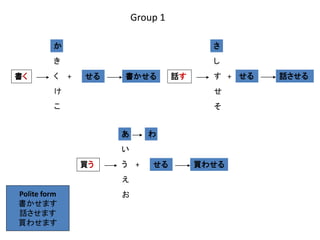
EXPLANATION
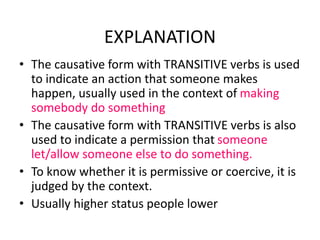
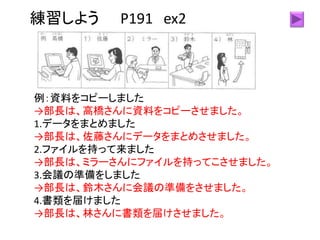
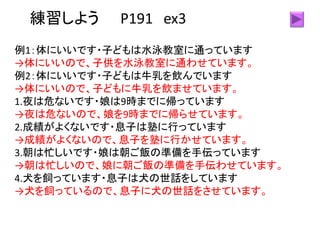
• The causativeform with TRANSITIVE verbs is used
to indicate an action that someone makes
happen, usually used in the context of making
somebody do something
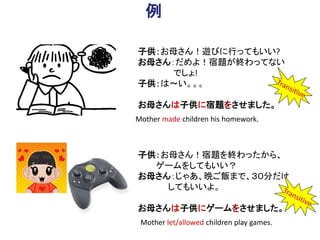
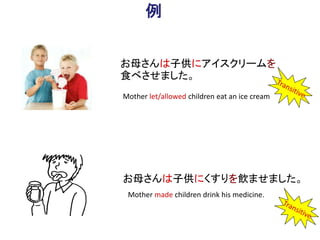
• The causative form with TRANSITIVE verbs is also
used to indicate a permission that someone
let/allow someone else to do something.
• To know whether it is permissive or coercive, it is
judged by the context.
• Usually higher status people lower
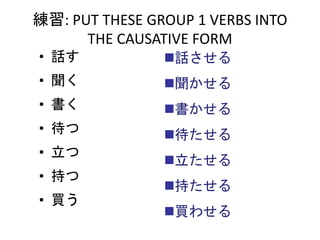
• 話す
• 聞く
•書く
• 待つ
• 立つ
• 持つ
• 買う
練習: PUT THESE GROUP 1 VERBS INTO
THE CAUSATIVE FORM
話させる
聞かせる
書かせる
待たせる
立たせる
持たせる
買わせる
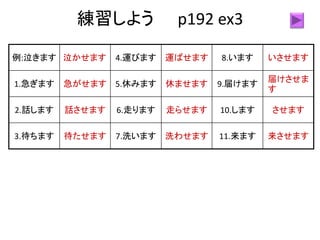
7.
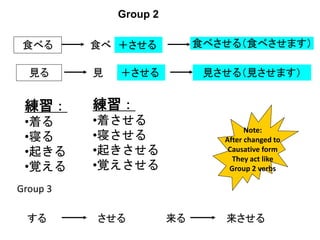
Group 2
食べる 食べ+させる 食べさせる(食べさせます)
見る 見 +させる 見させる(見させます)
練習:
•着る
•寝る
•起きる
•覚える
練習:
•着させる
•寝させる
•起きさせる
•覚えさせる
Group 3
する させる 来る 来させる
Note:
After changed to
Causative form
They act like
Group 2 verbs
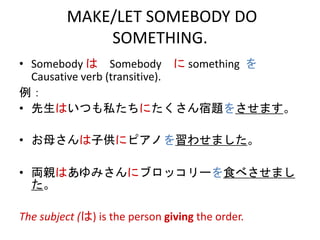
MAKE/LET SOMEBODY DO
SOMETHING.
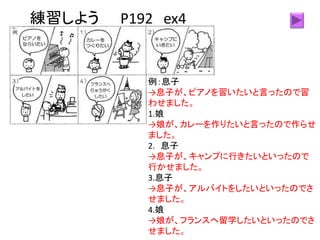
•Somebody は Somebody に something を
Causative verb (transitive).
例:
• 先生はいつも私たちにたくさん宿題をさせます。
• お母さんは子供にピアノを習わせました。
• 両親はあゆみさんにブロッコリーを食べさせまし
た。
The subject (は) is the person giving the order.
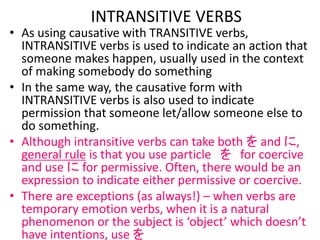
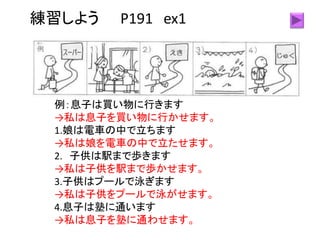
• As usingcausative with TRANSITIVE verbs,
INTRANSITIVE verbs is used to indicate an action that
someone makes happen, usually used in the context
of making somebody do something
• In the same way, the causative form with
INTRANSITIVE verbs is also used to indicate
permission that someone let/allow someone else to
do something.
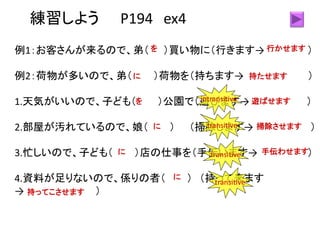
• Although intransitive verbs can take both を and に,
general rule is that you use particle を for coercive
and use に for permissive. Often, there would be an
expression to indicate either permissive or coercive.
• There are exceptions (as always!) – when verbs are
temporary emotion verbs, when it is a natural
phenomenon or the subject is ‘object’ which doesn’t
have intentions, use を
INTRANSITIVE VERBS
12.
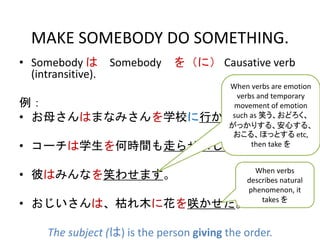
MAKE SOMEBODY DOSOMETHING.
• Somebody は Somebody を(に) Causative verb
(intransitive).
例:
• お母さんはまなみさんを学校に行かせました。
• コーチは学生を何時間も走らせました。
• 彼はみんなを笑わせます。
• おじいさんは、枯れ木に花を咲かせた。
The subject (は) is the person giving the order.
When verbs are emotion
verbs and temporary
movement of emotion
such as 笑う、おどろく、
がっかりする、安心する、
おこる、ほっとする etc,
then take を
When verbs
describes natural
phenomenon, it
takes を
13.
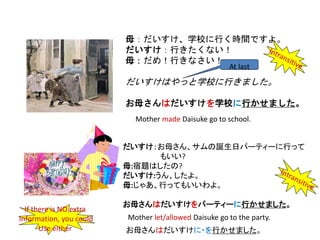
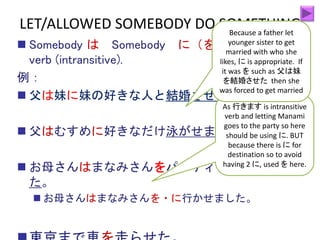
Somebody はSomebody に(を) Causative
verb (intransitive).
例:
父は妹に妹の好きな人と結婚させた。
父はむすめに好きなだけ泳がせました。
お母さんはまなみさんをパーティーに行かせまし
た。
お母さんはまなみさんを・に行かせました。
LET/ALLOWED SOMEBODY DO SOMETHING
As 行きます is intransitive
verb and letting Manami
goes to the party so here
should be using に. BUT
because there is に for
destination so to avoid
having 2 に, used を here.
Because a father let
younger sister to get
married with who she
likes, に is appropriate. If
it was を such as 父は妹
を結婚させた then she
was forced to get married
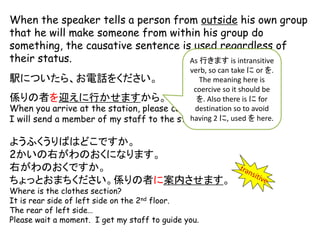
When the speakertells a person from outside his own group
that he will make someone from within his group do
something, the causative sentence is used regardless of
their status.
駅についたら、お電話をください。
係りの者を迎えに行かせますから。
When you arrive at the station, please call me.
I will send a member of my staff to the station to pick you up.
ようふくうりばはどこですか。
2かいの右がわのおくになります。
右がわのおくですか。
ちょっとおまちください。係りの者に案内させます。
Where is the clothes section?
It is rear side of left side on the 2nd floor.
The rear of left side…
Please wait a moment. I get my staff to guide you.
As 行きます is intransitive
verb, so can take に or を.
The meaning here is
coercive so it should be
を. Also there is に for
destination so to avoid
having 2 に, used を here.
20.
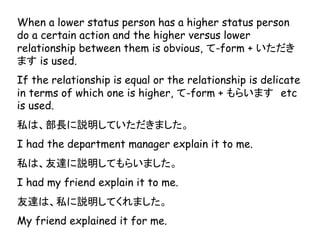
When a lowerstatus person has a higher status person
do a certain action and the higher versus lower
relationship between them is obvious, て-form + いただき
ます is used.
If the relationship is equal or the relationship is delicate
in terms of which one is higher, て-form + もらいます etc
is used.
私は、部長に説明していただきました。
I had the department manager explain it to me.
私は、友達に説明してもらいました。
I had my friend explain it to me.
友達は、私に説明してくれました。
My friend explained it for me.
21.
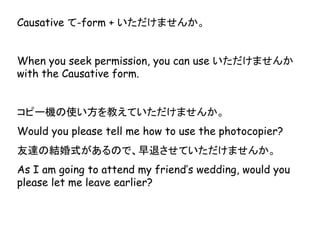
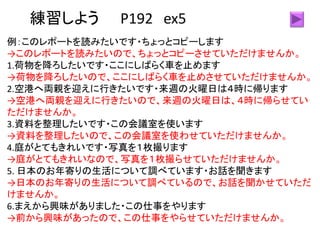
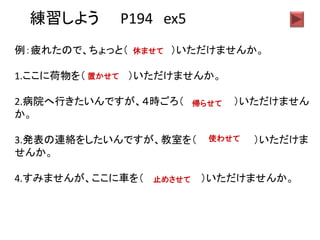
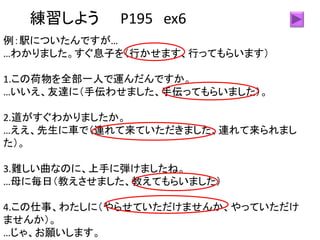
Causative て-form +いただけませんか。
When you seek permission, you can use いただけませんか
with the Causative form.
コピー機の使い方を教えていただけませんか。
Would you please tell me how to use the photocopier?
友達の結婚式があるので、早退させていただけませんか。
As I am going to attend my friend’s wedding, would you
please let me leave earlier?
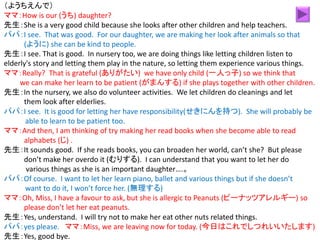
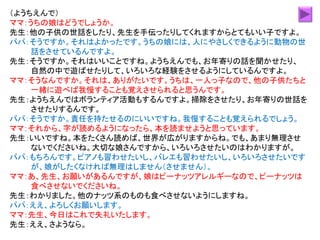
(ようちえんで)
ママ:How is our(うち) daughter?
先生:She is a very good child because she looks after other children and help teachers.
パパ:I see. That was good. For our daughter, we are making her look after animals so that
(ように) she can be kind to people.
先生:I see. That is good. In nursery too, we are doing things like letting children listen to
elderly's story and letting them play in the nature, so letting them experience various things.
ママ:Really? That is grateful (ありがたい) we have only child (一人っ子) so we think that
we can make her learn to be patient (がまんする) if she plays together with other children.
先生:In the nursery, we also do volunteer activities. We let children do cleanings and let
them look after elderlies.
パパ:I see. It is good for letting her have responsibility(せきにんを持つ). She will probably be
able to learn to be patient too.
ママ:And then, I am thinking of try making her read books when she become able to read
alphabets (じ) .
先生:It sounds good. If she reads books, you can broaden her world, can’t she? But please
don’t make her overdo it (むりする). I can understand that you want to let her do
various things as she is an important daughter….。
パパ:Of course. I want to let her learn piano, ballet and various things but if she doesn’t
want to do it, I won’t force her. (無理する)
ママ:Oh, Miss, I have a favour to ask, but she is allergic to Peanuts (ピーナッツアレルギー) so
please don’t let her eat peanuts.
先生:Yes, understand. I will try not to make her eat other nuts related things.
パパ:yes please. ママ:Miss, we are leaving now for today. (今日はこれでしつれいいたします)
先生:Yes, good bye.